Inside the bizarre race to secure Earth’s nuclear tombs
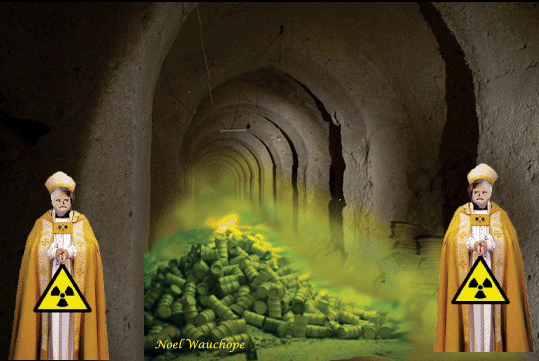
outlandish ideas have included linguist Thomas Sebeok’s proposal of an ‘atomic priesthood’ that would pass on nuclear folklore (in much the same way that generations of clergy have been relaying the tenets of their respective faiths for thousands of years
“Our generation must find a way to bury the waste very deep to avoid radioactive pollution or exposure to people and animals up to one million years into the future.”
“Currently, about 75 per cent of the UK’s nuclear waste is already stored across 20 sites,” says Winsley. “People are surprised to hear you’re never far away from the most hazardous radioactive waste, wherever you are in the UK.
Jheni Osman, BBC Science Focus, April 5, 2025
With nuclear energy production increasing globally, the problem of what to do with the waste demands a solution. But where do you store something that stays dangerous for thousands of years?
Uniformed guards with holstered guns stand at the entrance and watch you lumber past. Ahead lies a wasteland of barren metal gantries, dormant chimney stacks and abandoned equipment.
You trudge towards the ruins of a large, derelict red-brick building. Your white hazmat suit and heavy steel-toe-capped boots make it difficult to walk. Your hands are encased in a double layer of gloves, your face protected by a particulate-filtering breathing mask. Not an inch of flesh is left exposed.
Peering into the building’s gloomy interior, the beam from your head torch picks out machinery and vats turned orange with rust. On a wall nearby, a yellow warning sign featuring a black circle flanked by three black blades reminds you of the danger lurking inside.
Apart from the sound of your own breathing behind your mask, the only thing you can hear is the crackling popcorn of your Geiger counter.
This is what entering the Prydniprovsky Chemical Plant is like for nuclear researchers, including Tom Scott, professor of materials at the University of Bristol and head of the UK Government’s Nuclear Threat Reduction Network.
Prydniprovsky was once a large Soviet materials and chemicals processing site on the outskirts of Kamianske in central Ukraine. Between 1948 and 1991, it processed uranium and thorium ore into concentrate, generating tens of millions of tonnes of low-level radioactive waste.
When the Soviet Union dissolved, Prydniprovsky was abandoned and fell into disrepair.
“The buildings are impressively awful and not for the faint-hearted,” says Scott. “As well as physical hazards, such as gaping holes in the floor, there’s no light or power. And obviously there are radiological hazards. Until very recently, the Ukrainian Government didn’t have a clue what had gone on at the site, so there were concerns about the high radiation levels and ground contamination.”
When radiation levels are deemed too high for humans, Scott sends in the robots. ………………………….
Scott and his team are known as industrial nuclear archaeologists, and they’re working to find, characterise and quantify the ‘legacy’ radioactive waste at sites around the world.
“High-level radioactive waste gives off a significant amount of radioactivity, sufficient to make humans sick if they get too close,” he says. “Some of this waste will be dangerously radioactive for very long periods of time, meaning that it needs to be physically kept away from people and the environment to ensure that no harm is caused.”
But finding legacy waste like this, which has been amassing since the 1940s, is only part of the challenge. Once it’s been found, it has to be isolated and stored long enough for it to no longer pose a threat. And that’s not easy.
“Currently we’re storing our high-level wastes above ground in secure, shielded facilities,” Scott says. “Such facilities need to be replaced every so often because buildings and concrete structures can’t last indefinitely.”
Safely storing the nuclear waste that already exists is only the start of the problem, however. With the world moving away from fossil fuels towards low-carbon alternatives, nuclear energy production is set to increase, which means more waste is going to be produced – a lot more.
Currently, nuclear energy provides roughly nine per cent of global electricity from about 440 power reactors. By 2125, however, the UK alone is predicted to have 4.77 million m3 (168 million ft3) of packaged radioactive waste. That’s enough to fill 1,900 Olympic swimming pools.
Hence, the world needs more safe storage sites for both legacy and new nuclear waste. And it needs them fast.
Safe spaces
In the UK, most nuclear waste is currently sent to Sellafield, a sprawling site in Cumbria, in the north-west of England, with about 11,000 employees, its own road and railway network, a special laundry service for contaminated clothes and a dedicated, armed police force (the Civil Nuclear Constabulary).
Sellafield processes and stores more radioactive waste than anywhere in the world.
But more hazardous material is on the way, much of which will come from the new nuclear power station being built at Hinckley Point in Somerset. To keep pace, experts have been hunting for other, much stranger, disposal solutions.
It’s a challenge for nuclear agencies all around the world. All sorts of proposals have been put forward, including some bizarre ideas like firing nuclear waste into space. (The potential risk of a launch failure showering the planet with nuclear debris has silenced that proposal’s supporters.)
So far, the most plausible solution is putting the waste in special containers and storing them 200–1,000m (660–3,280ft) underground in geological disposal facilities (GDFs). Eventually, these GDFs would be closed and sealed shut to avoid any human intrusion.
These ‘nuclear tombs’ are the safest, most secure option for the long-term and minimise the burden on future generations.
“In the UK, around 90 per cent of the volume of our legacy waste can be disposed of at surface facilities, but there’s about 10 per cent that we don’t currently have a disposal facility for. The solution is internationally accepted as being GDFs,” says Dr Robert Winsley, design authority lead at the UK’s Nuclear Waste Services.
“We estimate that about 90 per cent of the radioactive material in our inventory will decay in the first 1,000 years or so. But a portion of that inventory will remain hazardous for much longer – tens of thousands, even hundreds of thousands of years.
“GDFs use engineered barriers to work alongside the natural barrier of stable rock. This multi-barrier approach isolates and contains waste, ensuring no radioactivity ever comes back to the surface in levels that could do harm.”
But how do you keep that radioactivity in the ground? Radioactive waste is typically classified as either low-, intermediate- or high-level waste.
Before being disposed of deep underground, high-level waste is converted into glass (a process known as vitrification) and then packed in metal containers made of copper or carbon steel. Intermediate-level waste is typically packaged in stainless-steel or concrete containers, which are then placed in stable rock and surrounded by clay, cement or crushed rock.
The process isn’t set in stone yet, though. Other materials, such as titanium- and nickel-based alloys, are being considered for the containers due to their resistance to corrosion.
Meanwhile, scientists in Canada have developed ultra-thin copper cladding that would allow them to produce containers that take up less space, while providing the same level of protection.
Rock solid
The hunt is also on to find facilities with bedrock that can withstand events such as wars and natural disasters (‘short-term challenges’, geologically speaking). Sites that won’t change dramatically over the millennia needed for nuclear waste to no longer pose a risk.
“A misconception is that we’re looking for an environment that doesn’t change, but the reality is the planet does change, very slowly,” says Stuart Haszeldine, professor of carbon capture and storage at the University of Edinburgh.
“Our generation must find a way to bury the waste very deep to avoid radioactive pollution or exposure to people and animals up to one million years into the future.”
To achieve this, the site ideally needs to be below sea level. If it’s above sea level, rainwater seeping down through fractures in the rock around the site might become radioactive and eventually find its way to the sea.
When this radioactive freshwater meets the denser saltwater, it’ll float upwards, posing a risk to anything in the water above.
Another challenge is predicting future glaciations, which happen roughly once every 100,000 years. During such a period, the sort of glaciers that cut the valleys in today’s landscape could form again, gouging new troughs in the bedrock that might breach an underground disposal facility.
“Accurate and reliable future predictions depend on how well you understand the past,” says Haszeldine.
“Typically, repository safety assessments cover a one-million-year timeframe, and regulations require a GDF site to cause fewer than one human death in a million for the next million years. Exploration doesn’t search for a single best site to retain radioactive waste, but one that’s good enough to fulfil these regulations.”
Hiding places
In 2002, the US approved the construction of a nuclear tomb in an extinct supervolcano in Yucca Mountain, Nevada, about 160km (100 miles) north-west of Las Vegas.
…………. opponents cited concerns that it was too close to a fault line and, in 2011, US Congress ended funding for the project. Since then, waste from all US nuclear power plants has been building up in steel and concrete casks on the surface at 93 sites across the country.
Other sites have fared better, however. Already this year, construction has begun on a nuclear tomb in Sweden, expected to be ready in the 2030s, but it’s also the year the world’s first tomb – at a site in Finland, called Onkalo (Finnish for ‘cave’ or ‘hollow’) – could open its doors for waste………………..
In January 2025, the UK Government announced plans to permanently dispose of its 140 tonnes of radioactive plutonium, currently stored at Sellafield. In a statement, energy minister Michael Shanks cited plans to put it “beyond reach”, deep underground.
Three potential sites in England and Wales are being explored by Nuclear Waste Services, and one of Haszeldine’s PhD students is independently investigating a fourth off the Cumbrian coast. The offshore site appears to be hydro-geologically stable (even over glacial timescales), but it would be expensive and difficult to engineer.
“Currently, about 75 per cent of the UK’s nuclear waste is already stored across 20 sites,” says Winsley. “People are surprised to hear you’re never far away from the most hazardous radioactive waste, wherever you are in the UK. Our mission is to make this radioactive waste permanently safe, sooner.”
……………………..The deep isolation approach costs less than a third of what it costs to construct a nuclear tomb and uses smaller sites, but the canisters are harder to recover if anything goes wrong.
Nevertheless, it’s a viable option for smaller nuclear countries and a second prototype is expected to undergo field testing at a deep borehole demonstration site in the UK in early 2025.
……………………………………………………………………………………………………………“The half-life of plutonium 239 is about 24,100 years, but the requirement is to keep a ceramic in that state for up to a million years. Essentially, we’re trying to design materials that’ll last forever. I don’t think humans will be around in a million years’ time, so the work we do needs to outlast humanity.”
Hide and seek
But even after you’ve found a suitable site and buried the radioactive material safely inside it, you still need to warn future generations about what’s hidden inside.
The trouble is, even if humans are still around in a million years’ time, there’s no guarantee the languages our ancestors speak, or the symbols they use, will be anything like those of today.
In Japan, 1,000-year-old ‘tsunami stones’, which warned future generations to find high ground after earthquakes, have failed to prevent construction on vulnerable sites.
Even the radiation symbol we use today (that black circle flanked by black blades on a yellow background) isn’t universally recognised. Research by the International Atomic Energy Agency found that only six per cent of the global population know what it signifies.
That’s why scientists have been working with everyone from artists to anthropologists, librarians to linguists, and sculptors to science-fiction writers – to come up with other ways of warning future generations about nuclear tombs.
………………….outlandish ideas have included linguist Thomas Sebeok’s proposal of an ‘atomic priesthood’ that would pass on nuclear folklore (in much the same way that generations of clergy have been relaying the tenets of their respective faiths for thousands of years
…………………………….. While some back this active forgetting of future nuclear tombs, researchers like Scott are still trying to get everyone to remember the nuclear sites we’ve already forgotten. It’s like a game of nuclear ‘hide and seek’ – but the stakes are high, and there’s no room for error.
…………………Currently, nuclear tombs are our best bet, but it’s a burden humanity must shoulder for thousands of years, long after the benefits gained from nuclear technology will have faded.
“My personal opinion is, I don’t think we should allow future generations to forget about a geological disposal facility,” says Scott. “The material is both dangerous and, in longer timescales, potentially valuable. People need to be reminded of its presence.”…………………… https://www.sciencefocus.com/planet-earth/inside-the-bizarre-race-to-secure-earths-nuclear-tombs
Millom nuclear waste plans ‘currently detrimental’ to locals.
Proposed plans for a nuclear waste dump in Millom have been described as
‘detrimental’ for one of the town’s estates. Members of the community were
invited to attend a Town Council meeting at the end of last month to
discuss the construction of a Geological Disposal Facility (GDF) near
Haverigg. Residents of the Bank Head housing estate, which sits alongside
the proposed site, asked for support from the local authority, with a
particular concern on the impact of house prices in the area.
A spokesperson from Millom Town Council said: “[We continue] to have a
neutral stance and support the principle that residents will have the final
say if they wish to be the future host community for a GDF. “Whilst this
could be the biggest economic opportunity for the area since iron ore was
found at Hodbarrow, we cannot deny that the way the current Area of Focus
has been drawn on the map by NWS is currently detrimental to the residents
of the Bank Head estate.
“We do not believe at this early stage of the
investigation that any of our residents should be impacted in the way the
Bank Head estate currently is, with local estate agents reporting that they
have had no requests for viewing homes on this previously popular
estate.” A campaign group, Millom and District Against the Nuclear Dump,
argued that the majority of locals were ‘resoundingly’ against the GDF.
Whitehaven News 4th April 2025 https://www.whitehavennews.co.uk/news/25060423.millom-nuclear-waste-plans-currently-detrimental-locals/
Cumbria could be only option for nuclear disposal

(and still they intend to keep making the foul stuff!)
Ian Duncan, BBC News, 2 April 25
Cumbria could be the only area left in the search for a new nuclear disposal site, councillors have been told.
Members of Cumberland Council’s nuclear issues board were given an update on the search to pin down a site to build a geological disposal facility (GDF) on Monday.
Three areas had previously been shortlisted by government body Nuclear Waste Services (NWS) – Mid Copeland and South Copeland in Cumbria and Lincolnshire.
Councillors were told that Lincolnshire County Council plans to withdraw, however, the authority is due to meet in June after local elections, when the result could signal a change in a new council’s intention.
Nuclear waste would be stored at the GDF beneath up to 1,000m (3,300ft) of solid rock until its radioactivity had naturally decayed.
Earlier this month Lincolnshire County Council said it would pull out of talks unless it received “significant” further information about the plan.
Two surface areas of focus had been identified by NWS in Mid Copeland, east of Sellafield and east of Seascale.
In South Copeland, land west of Haverigg had been chosen.
The Copeland area is already home to Sellafield, where the vast majority of the UK’s radioactive nuclear waste is stored, as well as the world’s largest stockpile of plutonium…………….
The nuclear waste disposal site would need community support, the Local Democracy Reporting Service said.
NWS previously said construction would only start when a potential community had confirmed its “willingness” to host the facility……….
https://www.bbc.co.uk/news/articles/cqj4rvkd8e7o
Nuclear waste centre delayed

Nuclear center must replace roof on 70-year-old lab so it can process radioactive waste.
Project sees 7-year delay and budget swell to £1.5B, but nuclear leadership ‘confident’ it has an alternative
Lindsay Clark, 28 Mar 25, The Register
The center of the UK’s nuclear industry has agreed on alternatives for how it will process waste into the next decade after delays and overspending hit a lab project.
In the face of a 2028 deadline to put facilities in place to treat and repackage plutonium, Sellafield paused a delayed project to build a replacement for its 70-year-old analytical lab.
Speaking to MPs last week, Euan Hutton, CEO of Sellafield Ltd, said he was “confident” in an alternative that involves refurbishing its old lab and borrowing facilities from another onsite lab.
This comes after the go live date for its Replacement Analytical Project (RAP) was delayed from 2028 until at least 2034 and costs ballooned to £1.5 billion ($1.93 billion).
The center of the UK’s nuclear industry has agreed on alternatives for how it will process waste into the next decade after delays and overspending hit a lab project.
In the face of a 2028 deadline to put facilities in place to treat and repackage plutonium, Sellafield paused a delayed project to build a replacement for its 70-year-old analytical lab.
Speaking to MPs last week, Euan Hutton, CEO of Sellafield Ltd, said he was “confident” in an alternative that involves refurbishing its old lab and borrowing facilities from another onsite lab.
This comes after the go live date for its Replacement Analytical Project (RAP) was delayed from 2028 until at least 2034 and costs ballooned to £1.5 billion ($1.93 billion).
Sellafield, formerly known as Windscale, has been the center of the UK’s nuclear industry since the 1950s. While the site is home to a number of companies, and the government’s Nuclear Decommissioning Authority, Sellafield Limited is a British nuclear decommissioning Site Licence Company controlled by the NDA.
In October last year, the UK’s public spending watchdog said Sellafield depends on an on-site laboratory that is “over 70 years old, does not meet modern construction standards and is in extremely poor (and deteriorating) condition.”
The National Audit Office said [PDF] the laboratory is “not technically capable of carrying out the analysis required to commission the Sellafield Product and Residue Store Retreatment Plant (SRP)” to treat and repackage plutonium.
Sellafield’s plan in 2016 was to convert a 25-year-old laboratory on the site, to replace the 70 year-old lab, under the “Replacement Analytical Project.” The outline business case was approved in 2019 with an estimated cost of between £486 million and £1 billion ($626 million – $1.3 billion).
However, that project was “strategically paused” in February 2024 after it emerged Sellafield believed it could take until December 2034 to deliver the full capability, while cost could reach £1.5 billion ($1.93 billion).
Speaking to Parliament’s Public Accounts Committee last week, Hutton said: “Fundamentally, around December 2023, there was an incoherence that came out between the availability of the analytical services and when I needed to have those available for the plutonium repack plant…………………………………………
https://www.theregister.com/2025/03/28/uk_nuclear_center_waste_project_delayed/
Dounreay more likely to build up than knock down.

By Iain Grant, 26 March 2025
People are being warned not to expect any of Dounreay’s former fuel or
waste buildings to be levelled any time soon. NRS Dounreay managing
director Dave Wilson was responding to a query posed at the latest meeting
of Dounreay Stakeholder Group (DSG). Mr Wilson said none of the cluster of
buildings deployed in the former fast reactor complex is slated for
demolition in the next couple of years. He added: “Skyline changes in the
short term might be a building going up to store material.
John O Groat Journal 26th March 2025, https://www.johnogroat-journal.co.uk/news/dounreay-more-likely-to-build-up-than-knock-down-377882/
**Plutonium**
Second shipment of high level waste departs UK for Germany
Second shipment of high level waste departs UK for Germany. As previously
announced, the UK will be returning high level waste (HLW) in the form of
vitrified residues to Germany. The second of three planned shipments is now
safely under way. Seven flasks containing high level waste were transported
from the Sellafield site in West Cumbria to the nearby port of
Barrow-in-Furness by rail. The flasks were then loaded to the specialist
nuclear transport vessel Pacific Grebe, operated by Nuclear Transport
Solutions (NTS).
Sellafield 27th March 2025. https://www.gov.uk/government/news/second-shipment-of-high-level-waste-departs-uk-for-germany
Massive Mine Shafts and Nuclear Dump For Cumbria Coast? Tell Cumberland Council “Vote NOW

A Very Hot Nuclear Waste Dump Under the Irish Sea Bed ? Decision Maker: Cumberland Council
, By mariannewildart. https://mariannewildart.wordpress.com/2025/03/27/massive-mine-shafts-and-nuclear-dump-for-cumbria-coast-tell-cumberland-council-vote-now/
The Issue
We, the undersigned, including residents, Council taxpayers and electors of Cumberland in Cumbria, UK, call upon Cumberland Council to schedule a debate at a specially convened meeting of Full Council on the question of whether Cumberland Council:
1. Continues to support Nuclear Waste Services in its investigations to identify potential locations for a Geological Disposal Facility for Heat Generating Nuclear Wastes in either the Mid or South Copeland Search Areas and
2. Continues to remain a partner in the two Community Partnerships.This debate to be followed by a vote in which all elected members be invited to vote yes or no to continuing these arrangements, with a majority no vote signifying that Cumberland Council withdraws its support and withdraws from membership of the two Community Partnerships ending the process.
In making this appeal, the petitioners are aware that:
1. An Executive of only four members at Copeland Borough Council originally decided to engage with Nuclear Waste Services in initiating a search for a site in either Mid or South Copeland, and that no vote ever took place amongst all the Councillors of that authority.
2. The Executive of the successor authority Cumberland Council assumed that commitment to GDF engagement, despite the facts that –
Cumbria County Council, which like Copeland was replaced by the new unitary authority and was its biggest component, was manifestly opposed to any GDF in the county.
There has never been a vote amongst all elected Councillors of Cumberland Council as to whether the authority should have assumed this commitment made by just four Copeland Councillors.
ADDITIONAL INFORMATION
Cumberland Council in Cumbria is unique in becoming a “Partner” in the UKs dangerous nuclear dump proposal while having had no debate or full council vote. Other areas who were persuaded to go into Partnership with the developer, Nuclear Waste Services, later held full council debates and a vote. South Holderness and Theddlethorpe in Lincolnshire decided that they were not to be fobbed off with the bribe of £2 Million a year to host a dangerous experimental “geological disposal facility.”
The beautiful and fragile Cumbrian coastline and already vulnerable ocean is in the firing line for the biggest infrastructure project ever in the UK. This construction site would be active for 100+ years with massive industrial sprawl, movements of highly radioactive materials and pollution. Mine shafts on the Cumbrian coast would be tunnelled by giant tunnel boring machines leading to a mined out void the size of the country of Tuvalu (26km square) up to the size of Bermuda (50 km square).
The massive amount of rock spoil from an area up to 1000 metres deep and 50km square would be an industrial hazard in itself with naturally occurring radioactive material leaching out of the mountain of spoil.
Tourism is Cumbria’s biggest industry closely followed by Farming and despite ongoing pressures both these industries support tens of thousands of people many in the Cumberland Council area. Both tourism and farming would be disastrously impacted by the plan for a 100+ year massive mine in which to dump high level nuclear wastes, a plan which now includes plutonium, under the Cumbrian coastline and ocean.
The reason the proposed “geological disposal facility” (sub-sea nuclear dump) has to be so huge is to dissipate the enormous heat from widely spaced out containers of highly radioactive nuclear wastes which are currently stacked together and kept cool by millions of gallons of fresh water a day from the top quality fresh water in Wastwater and the rivers Ehen and Calder (Nuclear is the most wasteful means of producing electricity as a vanishingly small percentage of heat from uranium fuel is used to turn the turbines while the rest is waste and has to “cool off” for tens of thousands, in some cases millions of years).
Where is this planned?
The Lake District coast adjacent to the National Park.
“Mid-Copeland Community Partnership Area of Focus.” Despite Sellafield, the biggest industrialised mass in the North West or an “atomic carbuncle” as Wainwright called it, this is an ancient and beautiful area with Viking hoards, stone circle and Abbey.
“South Copeland Community Partnership Areas of Focus” are rising up against the plan to host the access mine shafts and associated industrial sprawl for a sub-sea nuclear dump in their beautiful and historic area.
SIGN HERE
China calls for strict, long-term international supervision over Fukushima wastewater discharge: spokesman

2025-03-26, https://www.bastillepost.com/global/article/4690031-china-calls-for-strict-long-term-international-supervision-over-fukushima-wastewater-discharge-spokesman?fbclid=IwY2xjawJSuCVleHRuA2FlbQIxMQABHRXbhJz-aEa94Wd_9BghnsxtDEzzaxDZiiCBsWn9LWkvzinWWdeZIhe3Zg_aem_9apdp3Teicc2HwmyoEjwCw
Guo made the statement at a press conference in Beijing in response to a media query about Japan’s wastewater discharge.
China calls for strict and long-term international supervision over Japan’s discharge of nuclear-contaminated wastewater from the crippled Fukushima Daiichi Nuclear Power Plant into the ocean, Chinese Foreign Ministry spokesman Guo Jiakun said on Wednesday.
“I would like to emphasize that China opposes Japan’s unilateral discharge of nuclear-contaminated wastewater into the ocean, and this position remains unchanged. Since last year, Chinese experts have visited Japan twice to independently collect samples and announced the relevant test results in a timely manner. On the basis that Japan has fulfilled its commitments and the test results haven’t shown any abnormalities, the General Administration of Customs of China held in Beijing on March 12 technical exchanges with Japan over the safety of Japanese aquatic products,” Guo said.
“China will continue to work with the rest of the international community to urge Japan to earnestly fulfill its commitments and ensure that the discharge of Fukushima nuclear-contaminated wastewater into the sea is always under strict international supervision,” said the spokesman.
Hit by a magnitude-9.0 earthquake and an ensuing tsunami on March 11, 2011, the Fukushima Daiichi nuclear power plant suffered core meltdowns in three reactors that released radiation, resulting in a level-7 nuclear accident, the highest on the International Nuclear and Radiological Event Scale.
The plant then generated a massive amount of wastewater tainted with radioactive substances from cooling down the nuclear fuel in the reactor buildings.
Disregarding domestic and foreign questioning and protests, the Japanese government decided in April 2021 to “filter and dilute” the nuclear contaminated wastewater from the plant and started the ocean discharge of the radioactive wastewater on August 24, 2023. This process is expected to last 20 to 30 years, until the nuclear power plant is scrapped.
Dounreay learns what its share of £4bn decommissioning cash will be
Dounreay has been allocated a total spend of £221 million for the coming
financial year. Its share of the £4 billion budget overseen by the Nuclear
Decommissioning Authority (NDA) is a good outcome for the site, according
to Dave Wilson, managing director of operators NRS.
“It’s a really, really good settlement given the current financial challenges,” he said
at the latest meeting of Dounreay Stakeholder Group (DSG) on Wednesday. Mr
Wilson said it was just over £5 million up on the previous year after
taking account of inflation. He said: “It’s a very positive settlement
for Dounreay and will make sure the site is safe, secure and able to
continue to protect the environment.” The funding would underwrite the
ongoing clean-up of the site and the upgrading of its ageing
infrastructure.
John O’Groat Journal 22nd March 2025, https://www.johnogroat-journal.co.uk/news/dounreay-learns-what-its-share-of-4bn-decommissioning-cash-377633/
Ministry of Defence under fire over nuclear clean-up in Scotland

Pete Roche, a Scottish-based nuclear consultant and critic, was concerned that no money had been set aside to cover decommissioning military sites, especially given the pressures on the budget for cleaning up civil sites.
Rob Edwards, March 23, 2025, The Ferret
The Ministry of Defence has been accused of trying to avoid responsibility for cleaning up a military nuclear site on the north coast of Scotland by making it “someone else’s problem”.
The Ferret can reveal that discussions to transfer ownership of Vulcan, a former submarine reactor testing site next to Dounreay in Caithness, to the UK and Scottish governments’ Nuclear Decommissioning Authority are at an advanced stage. The aim is to complete the deal in 2027-28.
But no decision has been taken on who will pay for the site’s multi-million pound clean-up, including dismantling and disposing of two defunct, radioactive reactors. Unlike some civil nuclear sites, military sites do not have any funding set aside for decommissioning.
Campaigners are concerned that the Ministry of Defence (MoD) could escape paying for the pollution it has caused at Vulcan and other military sites. They are demanding transparency, and calling on the Scottish Government to block any “backroom transfer” that undermines Scotland’s interests.
The 26-strong UK group of nuclear-free local authorities is planning to raise the issue with UK nuclear minister, Lord Hunt, at a meeting on 31 March. It will be urging him to extract a promise from the MoD to fully fund the decommissioning of Vulcan.
The MoD promised to deliver “value for taxpayers’ money” on the Vulcan clean-up. The Nuclear Decommissioning Authority (NDA) said financing would be agreed with the UK Government “as part of the usual funding process”.
Construction work at Vulcan began in 1957, with one reactor operational from 1965 to 1984, and another from 1987 to 2015. They were used for onshore testing of five different designs of reactors to power the UK nuclear submarine fleet.
In 2012 the second Vulcan reactor suffered a mishap, and started leaking radioactivity into its cooling water. When the leak was disclosed two years later, it triggered a bitter argument between the Scottish and UK governments.
The then first minister of Scotland, Alex Salmond, accused the Conservative UK defence minister, Philip Hammond, of deception. Hammond had told MPs that there had been “no measurable change in the radiation discharge” from Vulcan.
But an investigation by the Sunday Herald revealed that there had in fact been a tenfold rise in emissions of radioactive gases. Hammond subsequently corrected the official parliamentary record……………………………………………………..
There are seven defunct nuclear submarines awaiting decommissioning at Rosyth in Fife and a further 15 at Devonport in Plymouth. Other MoD nuclear sites in Scotland that may eventually need to be cleaned up are the Faslane nuclear submarine base and the Coulport nuclear weapons depot on the Clyde near Helensburgh.
The Scottish Government reports, however, have little to say about how the Vulcan clean-up will be paid for. According to another January 2025 update, a paper on “post-transfer funding options” was “being socialised” within the NDA – though it is unclear what this means.
The costs of decommissioning the more recent civil nuclear power stations, including Hunterston B in North Ayrshire and Torness in East Lothian, will be covered by the UK Government’s Nuclear Liabilities Fund. It has secured more than £20 billion from private power companies.
But there is no equivalent fund for cleaning up military nuclear sites. Uncertainty over how Vulcan’s decommissioning will be funded has triggered widespread fears that the MoD could be seeking to wriggle out of its responsibilities.
‘Unacceptable’ for MoD to evade nuclear responsibilities
Alba, the breakaway nationalist party launched in 2021 by former SNP leader, Alex Salmond, is “deeply concerned” that the MoD may “offload” defence nuclear liabilities “without transparency or adherence to the polluter pays principle.”
The party’s national organiser, retired Royal Navy commodore Rob Thompson, said: “It is unacceptable for current and future Scottish taxpayers to bear billions in clean-up costs while the MoD evades responsibility.
“The Scottish Government must urgently clarify its due diligence processes, civil-defence cooperation policy and use its veto to oppose any backroom transfer that undermines Scotland’s interests.”………………………………………………..
The Nuclear Free Local Authorities highlighted reports in February that £2.8 billion given to the NDA by the UK Government to clean up the biggest and dirtiest nuclear site at Sellafield in Cumbria was “not enough”.
“We will be raising directly with nuclear minister, Lord Hunt, how important it is that he secures from his colleague, the defence secretary, a promise to fully finance decommissioning work at Vulcan,” said the group’s secretary, Richard Outram.
“It is our view that the principle that the polluter pays should apply equally to both the nuclear industry and the defence ministry.”
Pete Roche, a Scottish-based nuclear consultant and critic, was concerned that no money had been set aside to cover decommissioning military sites, especially given the pressures on the budget for cleaning up civil sites.
“The UK Government must increase the NDA’s budget sufficiently if it is expected to take on the MoD’s decommissioning work as well,” he said.
Tor Justad, chairperson of Highlands Against Nuclear Power (HANP), is a member of the Dounreay Stakeholder Group, which covers Vulcan. It was important that details of the transfer to the NDA were “clarified as soon as possible and that the full costs of returning the land to a brownfield site should be paid for by the MoD,” he said……………………………….
https://theferret.scot/nuclear-clean-up-vulcan-mod/
Thin-wall canisters do not really stop radiation from nuclear wastes

Donna Gilmore, Systems Analyst , SanOnofreSafety.org, Monterey, CA
Technically these thin-wall canister systems are not waste storage systems since they continuously release radiation and even create new radiation.
Thin-wall canisters do not stop gamma or neutron radiation per the NRC. This radiation is released through the concrete cask/overpack large air vents.
Also, water and carbon particles are converted to radioactive water and radioactive carbon (from neutron bombardment). This radiation is also released through the air vents.
All of this is without any cracks in the thin-wall canisters. This is by design!
The NRC only measures low-energy gamma radiation. This is a massive coverup that needs to be exposed to the world.
This is a non-partisan issue. We need to stop the political bickering and work with both Democrats and Republicans on this issue.
Nuclear bosses quizzed by MPs over Sellafield’s £130 billion century-long clean up
by Business Crack, March 21, 2025
The Public Accounts Committee examined the decommissioning of Sellafield
at a hearing yesterday morning. In the session, which lasted over two
hours, Euan Hutton, chief executive at Sellafield Ltd and David Peattie,
group chief executive office at Nuclear Decommissioning Authority were
among those giving evidence. It also saw Lee McDonough, director general,
net zero, nuclear and international at Department for Energy Security and
Net Zero, Clive Maxwell, second permanent secretary at Department for
Energy Security and Net Zero, and Kate Bowyer, chief financial officer at
Nuclear Decommissioning Authority, appear in front of the committee.
The hearing follows a National Audit Office report that found while management
of major projects have begun to improve, four projects underway when the
office last reported in 2018 were significantly over budget and behind
schedule. It added while Sellafield has demonstrated that it can remove its
most hazardous waste, progress is not quick enough.
MPs covered several
topics at the hearing yesterday relating to the £130 billion century-long
clean up of the Sellafield and work at the site.
Topics included: How realistic targets and goals set for decommissioning are; Whistleblowing ands urrounding policies; Balancing safety with value for money; Public safety
– in particular covering the Magnox Reprocessing Plant; The select
committee heard that a leak from Magnox started in the 2019 and every three
years, it leaked enough material to fill an Olympic-sized swimming pool.
But Mr Hutton said the leak, caused by a crack in the underground section
of the silo, was not detrimental to the public. He said it was monitored
closely and that showed the leak was staying beneath the surface.
Mr Peattie said it was Britain’s most hazardous building and the best way to
stop the leak was to empty the silo as quickly as possible. It is hoped it
will be emptied by 2059. Concerns around Sellafield’s ability to meet its
long and short term targets were also raised. Milestones for substantially
emptying three of the legacy ponds and silos have been pushed back by
between six and 13 years.
Business Crack 31st March 2025 https://businesscrack.co.uk/2025/03/21/nuclear-bosses-quizzed-by-mps-over-sellafields-130-billion-century-long-clean-up/
SCOTUS Ruling Could Shape the Future of Nuclear Waste Storage.

Samuel Lawrence Foundation, 20 Mar 25
The U.S. Supreme Court is currently reviewing a case that could have major implications for how nuclear waste is stored across the country—including the 3.6 million pounds of radioactive waste at San Onofre. At the center of the case is whether the Nuclear Regulatory Commission (NRC) has the authority to license private interim storage facilities, such as the one proposed in Andrews County, Texas, which would hold high-level nuclear waste away from reactor sites. Texas has challenged this decision, arguing that the NRC is overstepping its legal bounds and that waste management should remain under federal oversight.
This case matters to us because San Onofre’s waste remains in thin-walled metal canisters near a rising ocean, with no long-term plan for safe containment. If the Supreme Court rules against private storage, it could limit future options for moving this waste to a safer location. Meanwhile, if the Court upholds the NRC’s authority, it could pave the way for private companies to take a larger role in nuclear waste management—raising serious questions about safety, oversight, and accountability. As we continue to fight for a real solution for San Onofre, this decision will play a critical role in shaping what’s possible. Stay tuned for more updates as this case unfolds.
Sellafield decommissioning to continue for at least a century – robot dogs play a part
Robot dogs could help decommission Sellafield nuclear plant after successful trials.
Operators working from the Westlakes Science Park in Whitehaven, around
eight miles from Sellafield, remotely operated “safely and securely” a
custom Boston Dynamics Spot Quadrupedal Robot ‘dog’ that could carry
out tasks such as remote inspections, data gathering and clean-up work.
Energy generation at the plant stopped in 2003, but the painstaking
decommissioning process typically takes decades and presents radioactive
hazards to workers. Sellafield is unusual in that the decommissioning
challenge also encompasses early nuclear research and nuclear weapons
programmes that took place on the site.
The Nuclear Decommissioning Authority (NDA) is not expecting full site remediation to be completed until 2125.
Engineering & Technology 20th March 2025
1 This Month

of the week – Shut Down Drone Warfare!


Tell the Ukrainian Government to Drop Prosecution of Peace Activist Yurii Sheliazhenko

Petition to revoke the licensing of the Near Surface Nuclear Disposal Facility (NSDF) at Chalk River. https://www.ourcommons.ca/petitions/en/Petition/Details?Petition=e-7247
To see nuclear-related stories in greater depth and intensity – go to https://nuclearinformation.wordpress.com
-
Archives
- April 2026 (79)
- March 2026 (251)
- February 2026 (268)
- January 2026 (308)
- December 2025 (358)
- November 2025 (359)
- October 2025 (376)
- September 2025 (257)
- August 2025 (319)
- July 2025 (230)
- June 2025 (348)
- May 2025 (261)
-
Categories
- 1
- 1 NUCLEAR ISSUES
- business and costs
- climate change
- culture and arts
- ENERGY
- environment
- health
- history
- indigenous issues
- Legal
- marketing of nuclear
- media
- opposition to nuclear
- PERSONAL STORIES
- politics
- politics international
- Religion and ethics
- safety
- secrets,lies and civil liberties
- spinbuster
- technology
- Uranium
- wastes
- weapons and war
- Women
- 2 WORLD
- ACTION
- AFRICA
- Atrocities
- AUSTRALIA
- Christina's notes
- Christina's themes
- culture and arts
- Events
- Fuk 2022
- Fuk 2023
- Fukushima 2017
- Fukushima 2018
- fukushima 2019
- Fukushima 2020
- Fukushima 2021
- general
- global warming
- Humour (God we need it)
- Nuclear
- RARE EARTHS
- Reference
- resources – print
- Resources -audiovicual
- Weekly Newsletter
- World
- World Nuclear
- YouTube
-
RSS
Entries RSS
Comments RSS
 nuclear-news