Japanese government considers taking over the Fukushima radiation cleanup
J
 apan LDP Plan Would Put Government in Control of Fukushima Cleanup, WSJ, Proposal Would Reduce Tepco’s Financial Burden By MARI IWATA, 20 Sept 13 TOKYO—Japan’s ruling Liberal Democratic Party is considering a plan that would give the government sole responsibility for containing and cleaning up contamination from the stricken Fukushima Daiichi nuclear-power plant, allowing its operator, Tokyo Electric Power Co., 9501.TO -2.28% to focus its dwindling resources more efficiently on decommissioning the facility……..
The government had already effectively nationalized Tepco by buying a majority of its shares, but the stock still trades on the Tokyo Stock Exchange, and Prime Minister Shinzo Abe’s administration is eager to see the cash-strapped company return to financial health, a significant challenge, given lost revenue from the idling of all of the company’s nuclear reactors, as well as the costs of the cleanup and purchasing of more liquefied natural gas than before the accident to fuel thermal-power plants to make up for lost nuclear generation.
Tepco has posted two straight years of large net losses since the accident. It swung to a profit in the April-June quarter, solely on the back of a large government subsidy to help it pay compensation to Fukushima victims but it carries Y800 billion ($8.14 billion) in debt that should be refinanced this fall. On top of that, Tepco estimates it must borrow an additional Y300 billion by the end of December if it wants to stay afloat, a spokesman said……..
Tepco President Naomi Hirose said Thursday that the company would prepare Y1 trillion ($10 billion) to decommission the entire plant in addition to Y960 billion it had reserved for the work by the end of June. This doesn’t include costs associated with handling contaminated water at the site. There hasn’t been any estimate on the total cost of decommissioning the stricken plant…….Japan’s Nuclear Regulation Authority Chairman Shunichi Tanaka has urged the government and Tepco to intensify the decommissioning effort, saying “the deadliest risk is another huge natural disaster,” which would “destroy all these makeshift tanks and water processing systems, releasing all the radioactive materials there into the environment.” http://online.wsj.com/article/SB10001424127887324492604579086742989825408.htm
Public meeting about decommissioning process for san Onofre Nuclear Power PLant
 NRC sets first public meeting on decommissioning San Onofre nuclear plant http://www.scpr.org/news/2013/09/12/39216/nrc-sets-san-onofre-nuclear-plant-meeting-in-carls/
Ed Joyce | September 12th, 2013 The Nuclear Regulatory Commission announced Thursday it will hold a public meeting September 26 in Carlsbad to talk about the decommissioning process for the San Onofre Nuclear Generating Station in northern San Diego County.
It will be the agency’s first public meeting on closing the plant operated by Southern California Edison.
The meeting is scheduled for 6 p.m. at the Omni LaCosta Hotel, 2100 Costa del Mar Road. Doors will open at 5 p.m. to accommodate security screening.
An NRC press release says technical staff will give a presentation describing the process and regulations covering the decommissioning with a Q&A session to follow.
“We think this meeting is very important for the community,” said Gene Stone with San Clemente-based Residents Organized for a Safe Environment. It’s one of several groups in Orange and San Diego counties that pushed for the plant’s closure.
Stone says a coalition of environmental groups “will create a committee focusing on safety of nuclear waste storage, the timeliness of the process and the costs associated with decommissioning.”
The nuclear plant, which is located on the coast near the border of San Diego and Orange counties, has been shut down since January 2012 after radioactive steam escaped from damaged tubes inside one of the reactors. In June of this year, Southern California Edison announced it would seek the permanent closure of the plant.
Edison International Chairman Ted Craver told reporters in June that closing the plant would take decades and result in spent nuclear fuel being stored “for a very long time” at the plant.
According to Craver, the company has a $2.7 billion decommissioning fund that can be used to close San Onofre. But the money to make up for the loss of the San Onofre plant will come from ratepayers, insurance claims, shareholders and Mitsubishi Heavy Industries, which made the equipment that led to the problems at San Onofre.
The California Public Utilities Commission has set an October 1 hearing to determine just how much ratepayers will pay.
Earlier this month, Southern California Edison opened the San Onofre Digital Document Library. The utility said the library provides the public with documents related to the design of the steam generators that were cited as a reason for the plant’s problems.
Along with Edison, San Diego Gas & Electric owns 20 percent of the plant and the City of Riverside owns nearly 2 percent.
The plant is located about two miles south of San Clemente.
UK nuclear decommissioning executives rorted the system
Nuclear plant bosses forced to pay back inappropriate expense claims including a £714 taxi bill for a CAT, Mail Online 9 Sept 13
- Executives at Nuclear Management Partners consortium widely criticised
- They were brought in to help decommission part of the Sellafield plant
- Claims also included trip to US Masters and £719 on good from Amazon
- One boss demanded £714 cab fare for themselves ‘and the cat’
- Audit of claims from 2008 to 2012 leads to thousands being handed back Taxpayer-paid executives running the Sellafield nuclear power plant billed £714 to chauffeur-drive a cat, expense claims revealed today.

- Bosses at consortium Nuclear Management Partners (NMP) also used the perk to pay for flights to the US Masters golf tournament and Amazon purchases submitted without receipts.NMP were brought in to decommission a nuclear plant at Sellafield in Cumbria, but senior staff have now been forced to hand back thousands of pounds after an audit of their claims between 2008 and 2012.
- From more than 606 expense documents it emerged £236,781 of claims were requested without a proper description, £30,557 worth were purely for personal expenditure and £42,711 should not have been claimed at all.
Jamie Reed, Labour MP for Copeland in Cumbria, which contains Sellafield told City AM: ‘A workforce that is being asked to accept many changes – including pay restraint – will have many questions.
‘Taxis for cats and flights to the US Masters simply beggars belief.’ Continue reading
Build ’em up, pull ’em down – always money for the nuclear industry
 Nuclear Trashmen Gain From Record U.S. Reactor Shutdowns Bloomberg By Brian Wingfield – Sep 4, 2013 More than 50 years into the age of nuclear energy, one of the biggest growth opportunities may be junking old reactors. Entergy Corp. (ETR) said Aug. 27 it will close its 41-year-old Vermont Yankee nuclear plant in 2014, making the reactor the fifth unit in the U.S. marked for decommissioning within the past 12 months, a record annual total. Companies that specialize in razing nuclear plants and hauling away radioactive waste are poised to benefit.
Disposal work is “where companies are going to make their fortune,” Margaret Harding, an independent nuclear-industry consultant based in Wilmington, North Carolina, said in an phone interview. Contractors that are usually involved in building reactors, including Bechtel Group Inc. and URS Corp. (URS), “are going to be looking very hard at the decommissioning side of it.”
With Dominion Resources Inc. (D), Duke Energy Corp. (DUK)and Edison International (EIX) shuttering reactors this year — and Exelon Corp. (EXC) planning to close its Oyster Creek plant in 2019 — the U.S. nuclear fleet of 104 units is shrinking, even as Southern Co. (SO) and Scana Corp. (SCG) build two units each. The reasons vary: Edison and Duke are permanently removing damaged plants from service. Entergy and Dominion are retiring the units because of factors including a glut of natural gas, a competing fuel……….
The length of time to decommission a reactor creates uncertainty surrounding plant oversight, according to Shaun Burnie, an independent nuclear consultant who previously led environmental group Friends of the Earth’s campaign to close Edison’s San Onofre plant in California.
“Is Entergy going to be around in 50 years time? In 10 years time?” he said in a phone interview.
Ralph Andersen, senior director of radiation safety and environmental protection for the Nuclear Energy Institute, said the industry is entering a new era for the companies that handle reactor decommissioning.
“It really does open the door to the marketplace rethinking ways to handle decommissioning,” he said………. http://www.bloomberg.com/news/2013-09-04/nuclear-trashmen-gain-from-record-u-s-reactor-shutdowns.html
The tricky but lucrative business of shutting down dead nuclear raectors
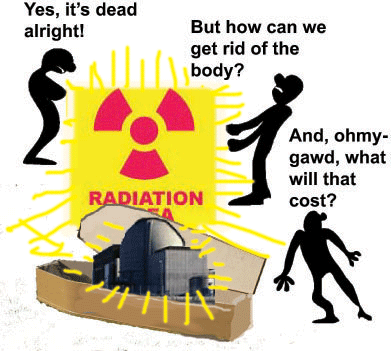 Nuclear Trashmen Gain From Record U.S. Reactor Shutdowns Bloomberg By Brian Wingfield – Sep 4, 2013 1:”……..Tricky Business The physical work involved in tearing down a nuclear plant takes about 10 years, according to John Hickman, a project manager in the U.S. Nuclear Regulatory Commission’s decommissioning branch. The agency gives reactor owners 60 years to complete decommissioning, which it defines as permanently removing a plant from service and reducing radioactivity enough for the property to be used for another purpose.
The NRC is now overseeing 14 commercial reactors that are in some phase of decommissioning, excluding those marked for closure in the last year. The first plant to deliver commercial power in the U.S. was a General Electric Co (GE).-designed unit near Fremont, California, which began service in 1957, according to the agency. It was also the first unit to be decommissioned, in 1963.
Razing a plant is tricky business. Radiation can seep into the concrete, pipes and metal of plant structures, and workers need to be able to break down the units without exposing themselves, or the public, to contamination. Plants often sit idle for decades before being torn down in order to let radioactive material decay. Continue reading
UK nuclear decommissioning costs soar- could be over £100bn.
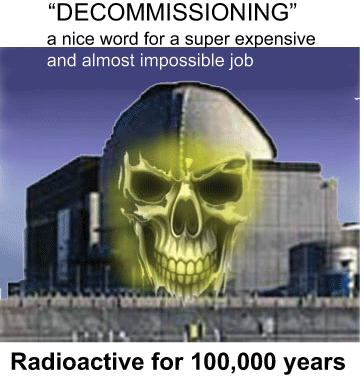 UK’s nuclear clean-up programme to cost billions more than expected
  Guardian UK, Terry Macalister 23 June 13, Nuclear Decommissioning Authority declines to predict final lifetime clean-up cost amid fears total bill could exceed £100bn
The public body charged with overseeing the dismantling of Britain’s network of atomic power and research stations will reveal on Monday that its estimates for the lifetime cost of the programme has risen by billions of pounds.
Despite this, the Nuclear Decommissioning Authority (NDA) will say in its annual report that it is getting to grips with the clean-up problem because the rate of cost growth is slowing year-on-year.
Yet the soaring costs will alarm industry critics at a time when the government is trying to encourage construction of a new generation of atomic power plants while plans to construct a permanent home for high-level radioactive waste are stalled.
In the NDA’s 2011 annual report the provisional cost of dealing with the UK’s nuclear legacy was put at £53bn, compared with a 2010 figure of £49bn. The new number in the 2012 set of accounts is expected to be around £55bn. But under previous accounting methods, the figure historically used has risen to well over £80bn with some predicting the final bill could exceed £100bn. Continue reading
San Onofre nuclear “decommissioning” will last for decades
So there the disabled behemoth sits, awaiting a decommissioning project that will continue for decades, requiring continued regulatory oversight and inspiring never-ending debates about who should pay and how much.
The Unit 1 reactor, which was shut down in 1992, was supposed to be boxed up and shipped to a repository in South Carolina, but no one could figure out how to transport a 770-ton bundle of radioactive junk across the country. Instead, it remains where it is, encased in concrete, waiting for the transmutation of the elements to complete its ten-thousand-million-year-long conversion from deadly isotopes to stable lead. We won’t be free of it anytime soon.
So long, San Onofre (in like 700 million years) High Country News Judith Lewis Mernit | Jun 17, 2013“……We have come to the end of an era — the nuclear power renaissance I had set out to investigate a decade ago has come to nothing.
Yes, a handful of new reactors have been proposed and a couple are even under construction, interrupting a hiatus that lasted nearly a quarter of a century. And the same band of shiny, PR-minded techno-enviros continue to argue that nuclear power is the only solution to climate change (their latest effort, Robert Stone’s documentary “Pandora’s Promise,” is simply one long advert for dreamy advanced waste-free reactors that don’t yet exist). Continue reading
They don’t now how much it costs to bury all those dead nuclear reactors
Nuclear Decommissioning Surge Is Investor Guessing Game, Bloomberg by Stefan Nicola in Berlin at snicola2@bloomberg.net; Julie Johnsson in Chicago at jjohnsson@bloomberg.net editor responsible for this story: Reed Landberg at landberg@bloomberg.net 16 June 13
Nuclear utilities thrust into the spotlight after the Fukushima meltdowns have ordered 20 reactors shut, the most in a three-year span since Chernobyl’s aftermath, saddling the industry with a possible $26 billion in costs.
EON SE and RWE AG (RWE) are leading the biggest decommissioning project by European utilities ever, an effort to tear down 12 reactors in Germany over two decades. Edison International (EIX) said June 7 it will never restart its idled two-unit San Onofre Generating Station outside Los Angeles, bringing the number of U.S. reactors permanently closed in a year to a record four.
The global utility industry faces its biggest test to prove enough money was saved for shutdowns, having undergone numerous cost-overruns building atomic plants. A cautionary tale can be seen with government-owned facilities. In Britain, where taxpayers are on the hook to retire the Sellafield complex’s seven reactors and fuel-reprocessing stations on the Irish Seaduring the next 100 years, the U.K. government this year doubled its estimate for the work to 67.5 billion pounds ($106 billion).
“There’s a lot of speculation how much these projects cost, but an exact estimate can only be given by utilities,” said Sascha Gentes, a Karlsruhe Institute for Technology professor specializing in atomic shutdowns. “The longer a nuclear decommissioning project takes, the more expensive it becomes.” Continue reading
Closing of Germany’s nuclear reactors
Nuclear Decommissioning Surge Is Investor Guessing Game, Bloomberg by Stefan Nicola in Berlin at snicola2@bloomberg.net; Julie Johnsson in Chicago at jjohnsson@bloomberg.net editor responsible for this story: Reed Landberg at landberg@bloomberg.net 16 June 13 “………German Closings Germany closed eight units after Fukushima and will shutter another nine by 2022. Its four utilities have set aside about 33 billion euros for decommissioning their 21 reactors and handling the deadly waste from them. The utilities set up GNS, a company that supplies 125-ton Castor dry casks to store and transport spent nuclear fuel, and also employ in-house decommissioning staff.
EON is 10 years into the job on its oldest commercial-scale unit, the 672-megawatt Stade plant in Lower Saxony, slated for completion by 2014. It started tearing down its 670-megawatt Wuergassen reactor in 1995, and plans to also complete that next year.
RWE said tearing down its 1970s-era Muelheim-Kaerlich reactor will cost about 750 million euros; it didn’t give cost estimates for the two pressurized water reactors at the 2,525-megawatt Biblis plant, which was closed after Fukushima, citing a lack of permits for their deconstruction plans.
EON declined to reveal the individual bill for the Wuergassen and Stade projects. It said costs are at about 1 billion euros depending on the reactor type, citing a “benchmark report for Germany,” in an e-mailed reply to questions.
Green Opposition
The opposition Green Party, which was in government from 1998 until 2005 and helped draft Germany’s first nuclear phase-out agreement, has called for the money to be put in a government-administered fund.
“Projects are often more expensive and longer than anticipated,” Sylvia Kotting-Uhl, a lawmaker with the Greens, said in an interview. “The question is: Will the money be available when it’s needed? A public fund would ensure that.”….”
EON and RWE said the current system shouldn’t be changed in favor of a state-run fund. The German system of setting aside money via utilities’ balance sheets “has proven itself,” Lothar Lambertz, a spokesman for RWE, said in an e-mailed reply to questions.http://www.bloomberg.com/news/2013-06-16/nuclear-decommissioning-surge-is-investor-guessing-game.html
Decommissioning Fukushima nuclear reactors will take 50 years at the very least
 Stricken nuke plant struggles on, Yahoo 7 Finance, AAP Jun 10, 2013 “……Experts, including even the most optimistic government officials, say decommissioning Fukushima Dai-ichi will take nearly a half-century.
TEPCO acknowledges that the exact path to decommissioning remains unclear because an assessment of the state of the melted reactor cores has not yet been carried out. Since being brought under control following the disaster, the plant has suffered one setback after another.
A dead rat caused a power blackout, including temporarily shutting down reactor-cooling systems, and leaks required tons of water to be piped into hundreds of tanks and underground storage areas.
The process of permanently shutting down the plant hasn’t gotten started yet and the work up to now has been one makeshift measure after another to keep the reactors from deteriorating.
Thousands of spent nuclear fuel rods that are outside the reactors also have to be removed and safely stored. Taking them out is complex because the explosions at the plant have destroyed parts of the structure used to move the rods under normal conditions. The process of taking out the rods, one by one, hasn’t even begun yet. The spent rods have been used as fuel for the reactors but remain highly radioactive…….”.http://au.finance.yahoo.com/news/stricken-nuke-plant-struggles-000105277.html
Demolishing San Onofre nuclear plant – 50 years and $billions in costs
A long cooling-off period for San Onofre nuclear plant http://articles.latimes.com/2013/jun/08/local/la-me-san-onofre-nuclear-20130609 Tearing down San Onofre’s two nuclear reactors will be a technically complex job completed over decades. It’s likely Southern California Edison will first mothball the plant.|By Ralph Vartabedian, Los Angeles Times
Southern California Edison built San Onofre’s two nuclear reactors in about nine years, but tearing them down will be a technically complex, multibillion-dollar job completed over decades. It is likely that Edison first will mothball the plant, which under federal rules could keep its imposing imprint on the Orange-San Diego County coastline for another half-century.
When the plant does come down, it will be a massive job.
Tons of highly radioactive fuel now stored in pools will have to cool before the rods can be moved to concrete pads outdoors. Giant pipes that extend more than a mile into the ocean will have to come out. Pieces of the reactors will have to be cut with special saws and torches that reach 20 feet into the vessels’ cooling water. Continue reading
Canada’s tax-payers up for increased costs for nuclear wastes
 Nuclear waste cleanup liability cost up by $2.4B, Ottawa told Andy Johnson, CTV News, , Mar. 20, 2013 The cost of cleaning up Canada’s nuclear program has risen dramatically in recent years and Ottawa is being warned another $2.4 billion is needed, bring the total to $6 billion.
Atomic Energy of Canada Limited posted a statement Tuesday saying liability costs will go up by $2.4 billion from $3.6 billion in March of last year.
The estimate represents the cost associated with “decommissioning, managing and disposing of its radioactive waste in a manner that will ensure long-term health, safety, security and environmental responsibility.” “The main reason for the liability adjustment is an increase in the indirect costs attributed to the decommissioning and waste management over the period of up to 70 years of the program,” said a statement posted on the AECL website. Continue reading
EU lacks funds for decommissioning nuclear reactors
Funding gap for nuclear decommissioning in Bulgaria, Lithuania and Slovakia
Defects in the EU’s nuclear decommissioning programmes in Bulgaria, Lithuania and Slovakia include cost overruns, delays, lack of coordination and supervision, diffused responsibilities, too much money going to unrelated energy projects and ill-informed priority setting, say Budgetary Control Committee MEPs in a resolution voted on Monday. Continue reading
Corporations circle around for lucrative nuclear waste cleanup
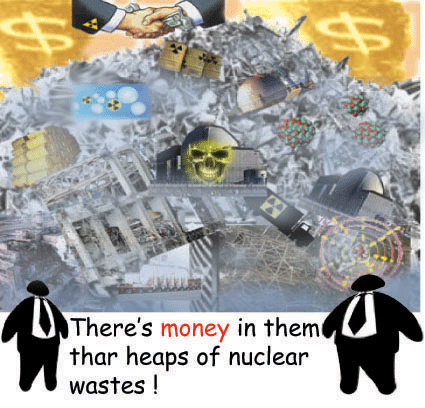 UK firms to bid for Japan’s nuclear clean-up
http://www.independent.co.uk/news/business/news/uk-firms-to-bid-for-japans-nuclear-cleanup-8458524.html
MARK LEFTLY, 20 JANUARY 2013 British engineers Amec, Babcock
International, and Atkins are believed to be circling nuclear
decommissioning work estimated to be worth at least $5bn (£3.2bn) in
Japan as a result of the Fukushima disaster.
The new Japanese government is thought to be preparing decommissioning
contracts that will include Fukushima’s Daiichi plant, which was
overwhelmed by a tsunami in 2011, and other reactors in seismically
endangered areas.
A nuclear source said bids could be invited for the clean-up work
before the end of the year, with British groups in a strong position
due to all the decommissioning work that has been undertaken in the
UK.
US-owned Energy Solutions will also be interested.
“This is a huge opportunity,” claimed the source. “Japan should start
making some real progress on decommissioning now.”
Nuclear weapons components “scattered” across America
Strategy Lacking for Disposal of Nuclear Weapons Components Secrecy News, January 17th, 2013 by Steven Aftergood There is a “large inventory” of classified nuclear weapons components “scattered across” the nation’s nuclear weapons complex and awaiting disposal, according to an internal Department of Energy contractor reportlast year.
But “there is no complex-wide cost-effective classified weapon disposition strategy.” And as a result, “Only a small portion of the inventory has been dispositioned and it has not always been in a cost-effective manner.”.. http://www.fas.org/blog/secrecy/2013/01/disposal_strategy.html
1 This Month

of the week – Shut Down Drone Warfare!


Tell the Ukrainian Government to Drop Prosecution of Peace Activist Yurii Sheliazhenko

Petition to revoke the licensing of the Near Surface Nuclear Disposal Facility (NSDF) at Chalk River. https://www.ourcommons.ca/petitions/en/Petition/Details?Petition=e-7247
To see nuclear-related stories in greater depth and intensity – go to https://nuclearinformation.wordpress.com
-
Archives
- April 2026 (103)
- March 2026 (251)
- February 2026 (268)
- January 2026 (308)
- December 2025 (358)
- November 2025 (359)
- October 2025 (376)
- September 2025 (257)
- August 2025 (319)
- July 2025 (230)
- June 2025 (348)
- May 2025 (261)
-
Categories
- 1
- 1 NUCLEAR ISSUES
- business and costs
- climate change
- culture and arts
- ENERGY
- environment
- health
- history
- indigenous issues
- Legal
- marketing of nuclear
- media
- opposition to nuclear
- PERSONAL STORIES
- politics
- politics international
- Religion and ethics
- safety
- secrets,lies and civil liberties
- spinbuster
- technology
- Uranium
- wastes
- weapons and war
- Women
- 2 WORLD
- ACTION
- AFRICA
- Atrocities
- AUSTRALIA
- Christina's notes
- Christina's themes
- culture and arts
- Events
- Fuk 2022
- Fuk 2023
- Fukushima 2017
- Fukushima 2018
- fukushima 2019
- Fukushima 2020
- Fukushima 2021
- general
- global warming
- Humour (God we need it)
- Nuclear
- RARE EARTHS
- Reference
- resources – print
- Resources -audiovicual
- Weekly Newsletter
- World
- World Nuclear
- YouTube
-
RSS
Entries RSS
Comments RSS
 nuclear-news