Germany’s “big four” utilities liable for nearly 40 billion euros for nuclear waste storage
Nuclear commission proposes firms transfer cash by 2022 to pay for clean-up http://af.reuters.com/article/commoditiesNews/idAFB4N10000F Feb 22, 2016 BERLIN (Reuters) – Germany’s utilities will have to transfer provisions set aside to pay for the interim and final storage of nuclear waste to a fund in cash by 2022, according to a draft report from a government-appointed committee seen by Reuters on Monday.
The report recommends that Germany’s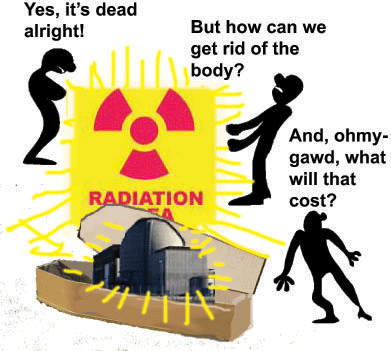 — E.ON, RWE, EnBW and Vattenfall — remain liable for the cost of up to double the 18 billion euros ($19.8 billion) allocated so far to pay for interim and final storage.
The companies will also have to set aside a further 1.3 billion euros in provisions, according to the report which is due to be presented at the end of the month. ($1 = 0.9084 euros) (Reporting by Markus Wacket; Writing by Caroline Copley; Editing by Christoph Steitz)
Europe is more than 118 billion euros short of funds needed to decommission its nuclear reactors
EU lacks 118 billion euros in nuclear decommissioning funds – draft http://www.reuters.com/article/us-europe-nuclear-idUSKCN0VP1S6
Assets covering only 150.1 billion euros in decommissioning costs – which includes the lengthy dismantling of stations as well as the removal and storage of radioactive parts and waste – are available, compared with 268.3 billion euros in expected costs, the paper shows.
The data is part of a broader analysis of Europe’s nuclear capacity, the so-called Nuclear Illustrative Programme of the Commission (PINC), the last of which has been published in 2007, before Japan’s Fukushima nuclear crisis five years ago.
As a result, Europe’s largest economy Germany has decided to fully abandon nuclear power by no later than 2022, relying on solar, wind as well as coal and gas-fired instead to eliminate the risk of a meltdown.
Among 16 EU member states still operating nuclear plants, only Britain’s operators have sufficient dedicated assets to cover the expected costs, 63 billion euros, according to the paper. France, which operates Europe’s largest fleet of nuclear plants, is heavily underfunded, having earmarked assets only worth 23 billion euros, less than a third of 74.1 billion euros in expected costs.
In Germany, an additional 7.7 billion euros in funds are needed on top of the current 38 billion euros.
Decommissioning costs vary according to reactor type and size, location, the proximity and availability of disposal facilities, the intended future use of the site and the condition of the reactor at the time of decommissioning.
Although technology used for decommissioning might gradually become cheaper, the cost of final waste depositories is largely unknown and costs might spiral over time. Reactor lifespans are measured in decades, which means financing costs and provisions depend strongly on unpredictable interest rate levels.
($1 = 0.8952 euros)
(Reporting by Barbara Lewis; Writing by Christoph Steitz; Editing by Tom Heneghan)
Limited liability for Germany’s nuclear operators in nuclear paseout
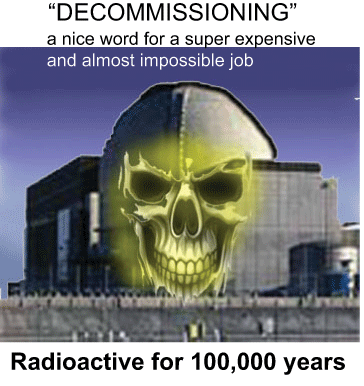
 German commission favours limited liability for nuclear phaseout-document http://www.reuters.com/article/germany-nuclear-idUSB4N11703M Feb 18 Germany’s nuclear operators could face only limited long-term liability for the costs of the country’s nuclear phaseout, according to a paper from a government-appointed commission seen by Reuters on Thursday.
The paper indicates that the commission took on board concerns of the four utilities – E.ON, RWE, EnBW and Vattenfall – which have earmarked nearly 40 billion euros in provisions to pay for the dismantling and storage of waste from their nuclear plants.
The last plant will be closed in 2022.
Worries over their financial health have raised fears that the companies may be unable to turn the provisions – including some illiquid assets – into liquid funds, eventually leaving taxpayers to foot some or much of the bill.
The paper said an unlimited liability would lead to excessive demands being made of the operators and that this would ultimately not be beneficial to society.
The paper said the operators may be asked to set aside additional funds on top of existing provisions for the costs of the nuclear phaseout, and that it favoured a state-controlled fund for the long-term costs.
A spokesman for E.ON said he did not want to comment before the final results of the commission are published. (Additional reporting by Tom Kaeckenhoff in Duesseldorf; Reporting by Markus Wacket; Writing by Madeline Chambers; Editing by Noah Barkin)
Nuclear industry discounts the massive tax-payer future costs of radioactive wastes
Nuclear Energy Dangerous to Your Wallet, Not Only the Environment, CounterPunch, by PETE DOLACK , 1 JAN 16 “………There would at least be a small silver lining in this dark picture if the electricity produced were cheap. But that’s not the case. From the mid-1970s to the mid-1990s, the cost of producing electricity from nuclear power in France tripled and in the United States the cost increased fivefold, according to the Vermont Law School paper [page 46].
 Then there are the costs of nuclear that are not imposed by any other energy source: What to do with all the radioactive waste? Regardless of who ultimately shoulders these costs, the environmental dangers will last for tens of thousands of years. In the United States, there is the fiasco of the Yucca Mountain nuclear waste dump in Nevada. The U.S. government has collected $35 billion from energy companies to finance the dump, which is the subject of fierce local opposition and appears to have no chance of being built.
Presumably, the energy companies have passed on these costs to their consumers but nonetheless are demanding the government take the radioactive waste they are storing at their plants or compensate them. As part of this deal, the U.S. government made itself legally responsible for finding a permanent nuclear-waste storage facility.
And, eventually, plants come to the end of their lives and must be decommissioned, another big expense that energy companies would like to be borne by someone else. The Heinrich Böll Stiftung studysays:
“[T]here is a significant mismatch between the interests of commercial concerns and society in general. Huge costs that will only be incurred far in the future have little weight in commercial decisions because such costs are “discounted.” This means that waste disposal costs and decommissioning costs, which are at present no more than ill-supported guesses, are of little interest to commercial companies. From a moral point of view, the current generation should be extremely wary of leaving such an uncertain, expensive, and potentially dangerous legacy to a future generation to deal with when there are no ways of reliably ensuring that the current generation can bequeath the funds to deal with them, much less bear the physical risk. Similarly, the accident risk also plays no part in decision-making because the companies are absolved of this risk by international treaties that shift the risk to taxpayers.” [page 17]
The British government, for instance, currently foots more than three-quarters of the bill for radioactive waste management and decommissioning, and for nuclear legacy sites. A report prepared for Parliament estimates that total public liability to date just for this program is around £50 billion, with tens of billions more to come……….http://www.counterpunch.org/2016/01/01/nuclear-energy-dangerous-to-your-wallet-not-only-the-environment/
Japan’s NRA may change nuclear waste burial rules, increase depth
 NRA panel wants deeper disposal for nuclear waste http://www3.nhk.or.jp/nhkworld/english/news/20151211_01.html A team of experts at Japan’s nuclear regulator has proposed that nuclear waste with relatively high levels of radiation be buried deeper underground than current law requires.
The team at the Nuclear Regulation Authority, or NRA, presented a draft of regulations for such waste on Thursday. The waste comes from the decommissioning of reactors. The draft calls for such waste to be buried at least 70 meters underground. This is to prevent people from approaching the waste.
Current law requires that waste with low or relatively high levels of radiation be buried at least 50 meters underground. The draft requires utilities to maintain buried waste for 300 to 400 years.
The draft also would have the central government prepare a system to prevent the buried waste from being dug up after the maintenance period ends. The NRA team plans to gather opinions from the Federation of Electric Power Companies of Japan and compile basic ideas by the end of next March.
Germany’s process of decommissioning nuclear power plant
This Is How You Decommission a Nuclear Power Plant [great photos] German Chancellor Angela Merkel called time on nuclear energy in her country in 2011, after a tsunami severely damaged the Fukushima power plant in Japan, causing a major radioactive leak. Almost five years later, that process is in full swing – with an estimated cost of up to €77 billion ($84 billion). The operation to decommission Germany’s Greifswald nuclear power plant is described by German energy officials as the largest project of its kind in the world. Once the largest power plant in the former East Germany, Greifswald was closed in 1990 during German reunification. This is how it is being made safe. Bloomberg Tino Andresen , 10 Dec 15
Alexander Jones Germany’s nuclear plant operators are seeking public agreement on how to manage the burden of decommissioning the country’s atomic power stations. Chancellor Angela Merkel’s government decided in 2011 to phase out nuclear power by 2022 in light of the Fukushima disaster in Japan. ……..
The decommissioning process could force those footing the bill to set aside anything from €25 billion to €77 billion, according to scenarios.
Germany’s Economy Ministry believes that utility companies do have enough funds to pay for the shutdown and cleanup of nuclear power plants……..
Depending on the severity of contamination, some of the components will go on to be housed in temporary disposal sites before a final storage solution is found….http://www.bloomberg.com/news/photo-essays/2015-12-10/this-is-how-you-decommission-a-nuclear-power-plant
Germany expecting nuclear utilities to pay the costs of decommissioning and disposal of radioactive trash
Germany: Utilities Must Shoulder Nuclear Phase-Out Costs http://www.powermag.com/germany-utilities-must-shoulder-nuclear-phase-costs/ 12/01/2015 | Sonal Patel Germany’s nuclear power–producing companies will be able to shoulder the costs of the nuclear phase-out—including costs for decommissioning and the disposal of radioactive waste. That’s according to the country’s Federal Ministry for Economic Affairs and Energy, as it published the results of a “stress test” on October 10. The government on July 1 reaffirmed that energy companies must bear the costs of dismantling their nuclear plants and concluded in October that reserves set aside by EON SE, RWE AG, Energie Baden-Wuerttemberg AG, Vattenfall AB, and Stadtwerke Muenchen GmbH of €38.3 billion ($41.98 billion) are within various scenarios examined during the stress test.
In the wake of the Fukushima disaster, Germany decreed the phase-out of all its nuclear capacity by December 2022. It shuttered eight reactors in the immediate aftermath of the Japanese earthquake and tsunami, and this June it closed the Grafenrheinfeld plant (Figure 3). Eight reactors remain open.
The government-commissioned study, prepared by auditing company Warth & Klein Grant Thornton AG, breaks down expected costs across five different categories, from dismantling to final storage. It finds that cost estimates made by companies are higher than the international average. Dismantling costs in Germany are estimated by the companies at €857 million ($939 million) per reactor compared to between €205 million ($224 million) and €542 million ($594 million) in other countries. If nuclear plants are dismantled in “an efficient manner,” overall costs could be slashed by about €6 billion ($6.5 billion), the auditors also said.
“We do not consider the scenarios requiring the highest provisions to be likely to materialise, as they are based on the assumption of major losses being incurred by the companies over a long period of time,” Minister Sigmar Gabriel said. Gabriel noted that the Federal Cabinet will soon establish a commission to review financing for the nuclear phase-out to adopt draft legislation on extended liability for the dismantling of nuclear power plants and the disposal of nuclear waste. The results of the stress test will be made available to the commission.
Nuclear giants AREVA and Hitachi to help dismantle Japan’s nuclear recators
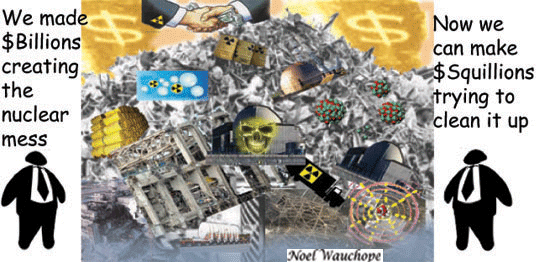
Areva was involved in the Fukushima clean-up, but that reactor is not covered by the new agreement, the French group said in a statement. It has been working with Hitachi to improve Japanese reactors’ safety for the past two years.
Areva’s role will now be to participate in preliminary studies for dismantling boiling-water reactors.
Prime Minister Shinzo Abe’s government has been pushing for a return to nuclear power to generate electricity after Japan’s several dozen reactors went offline in the wake of the 2011 disaster.
The resource-poor nation’s energy bill has soared since it was forced to turn to fossil-fuel imports to plug the gap.
But the Japanese public remains wary of atomic power, and Abe’s push has prompted rare protests and damaged his popularity.
Europe’s nuclear companies face multi $billion burden in disposing of dead nuclear reactors
Standard & Poor’s: Dismantling Europe’s old nuclear power plants will run up a €100bn bill for EDF, E.ON, RWE and others http://www.cityam.com/229161/standard-poors-dismantling-europes-old-nuclear-power-plants-will-run-up-a-eur100bn-bill-for-edf-eon-rwe-and-others 19 November 2015 by Jessica Morris Dismantling Europe’s old, uneconomic power plants will impose heavy costs on Europe’s biggest operators, something which could strain their balance sheets, and hit their credit rating.
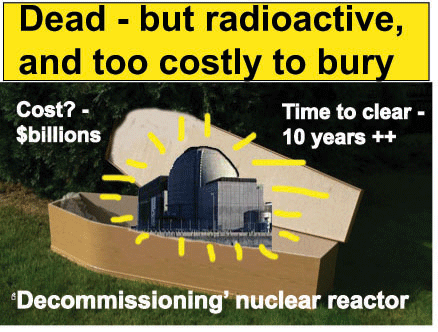
Nuclear liabilities of the largest eight nuclear plant operators in Europe totaled €100bn at the end of last year, representing around 22 per cent of their aggregate debt, according to credit rating agency Standard & Poor’s.
Operators are legally responsible for decommissioning nuclear power plants, a process which can take several decades to implement, meaning the associated costs are high. Europe’s main nuclear operators include France’s EDF, Germany’s E.ON and RWE. They are legally responsible for decommissioning nuclear power plants, a process which can take several decades to implement, meaning the associated costs are high.
While the analysis by S&P treats nuclear liabilities as debt-like obligations, it recognises that several features differentiate them from traditional debt. But given the size of the liabilities against a company’s debt, they can impact a company’s credit metrics, and their credit rating.
The report noted that a company’s nuclear provisions are difficult to quantify, as well as cross compare, because accounting methods vary between different countries. It also foresees many operational challenges ahead, including a reality check on costs and execution capabilities.
Barsebäck nuclear power plant to be dismantled – good business for Westinghouse?
Westinghouse Electric to dismantle Barsebäck nuclear power plant http://cphpost.dk/news/westinghouse-electric-to-dismantle-barseback-nuclear-power-plant.html Located just 20 kilometers from Copenhagen, the plant ceased operation already in 2005 November 6th, 2015 12:10 pm| by Lucie Rychla

According to Westinghouse, the company will dismantle, segment and package the reactor pressure vessel internals for final disposal – a process that significantly reduces the radioactivity remaining in the plant since it was shut down.
No more nuclear energy
Barsebäck is a boiling water nuclear power plant with two units, which began commercial operation in May 1975 and June 1977. Barsebäck Unit One was shut down in 1999, 17 years before its planned life expectancy, and Barsebäck Unit Two ceased operation in May 2005.
In 1980, the Swedish parliament decided not to build any new nuclear power plants in the country and to phase out existing plants by 2010, following a referendum that took place after the Three Mile Island incident in Pennsylvania.
Banking-industry style regulation needed for Europe’s nuclear decommissioning costs
EU regulation of nuclear decommissioning costs needed -Capgemini http://www.reuters.com/article/2015/11/02/nuclear-decommissioning-idUSL8N12X22J20151102 Europe needs banking-industry style regulation to bring more transparency to the costs of nuclear reactors, consultancy Capgemini said in its annual energy market report.
Capgemini said gross provisions for decommissioning and long-term spent fuel management work out at 4.7 billion euros ($5.2 billion) per reactor in Germany, compared to just 1.2 billion in France and 3.38 billion euros in Britain.
Even if France’s nuclear fleet of 58 reactors is much bigger than Germany’s 17 reactors, economies of scale from the standardization of processes look too big to account for such a difference by themselves, according to Capgemini.
“Establishing what methodology is used to estimate the overall cost is essential, but it is never explained in annual reports, with each player relying on the estimates of their own experts in that area,” Capgemini said.
Nuclear operators like France’s EDF, Germany’s E.ON and RWE and Sweden’s Vattenfall all use different discount and inflation rates to calculate the present value of long-term liabilities and the parameters for these calculations are left to individual companies to decide, the consultancy said. “For obvious reasons to do with transparency, it is urgent that a process be instituted at European level … similar to the international regulatory framework for banks (Basel III) following the financial crisis that affected most European countries,” Capgemini said.
There are also strong disparities with regards to nuclear operators’ legal obligations in terms of covering these future costs, it said.
Only Finland’s Fortum, Vattenfall (for its Swedish activities), EDF and the Czech Republic’s CEZ have portfolios dedicated to the financing of these long-term obligations, with coverage ratios of 100, 78, 68 and 31 percent respectively, Capgemini said.
Other sector players do not have dedicated assets on their balance sheets, and German utilities currently do not cover their provisions, it added.
Last month, E.ON dropped plans to spin off its German nuclear power plants, bowing to political pressure to retain liability for billions of euros of decommissioning costs when the plants are shut down.
The International Energy Agency said late last year that almost 200 of the world’s 434 reactors in operation would be retired by 2040, and estimated the decommissioning cost at more than $100 billion, but many experts view this figure as way too low. ($1 = 0.9057 euros) (Reporting by Geert De Clercq; Editing by Susan Fenton)
NRC allows nuclear companies to use decommissioning funds for waste storage, violating rules
 Nuclear plants dip into dismantling funds to pay for waste By Dave Gram, The Associated Press DAILY NEWS, 10/25/15, MONTPELIER, VT. WITH A FEDERAL PROMISE TO TAKE HIGHLY RADIOACTIVE SPENT FUEL FROM NUCLEAR PLANTS STILL UNFULFILLED, CLOSED REACTORS ARE DIPPING INTO FUNDS SET ASIDE FOR THEIR EVENTUAL DISMANTLING TO BUILD WASTE STORAGE ON-SITE, RAISING QUESTIONS ABOUT WHETHER THERE WILL BE ENOUGH MONEY WHEN THE TIME COMES.
It violates Nuclear Regulatory Commission rules for the plants to take money from their decommissioning trust funds to pay for building the concrete pads and rows of concrete and steel casks where waste is stored after it is cooled in special storage pools. But the NRC is granting exemptions from those rules every time it is asked.
“All of the plants that have permanently shut down in recent years have sought, and been approved for, the use of decommissioning funds for spent fuel storage costs,” NRC spokesman Neil Sheehan wrote in an email in response to questions from The Associated Press this past week.
These include the Kewaunee plant in Wisconsin, San Onofre 1 and 2 in California, Crystal River 3 in Florida, and Vermont Yankee in Vernon, in Vermont’s southeast corner, which closed at the end of last year. The Zion 1 and 2 reactors in Illinois, which shut down in the late 1990s, had gotten a similar OK to use decommissioning money for spent fuel storage, Sheehan said.
Ratepayers chipped in during nuclear plants’ lives to set aside the money it would take eventually to tear down reactors, remove their radioactive components and restore the sites. It was not envisioned they also would have to pay for indefinite storage of spent fuel on the roughly 100 nuclear plant sites around the country.
And long-term, on-site storage of nuclear waste is a bad idea, said Arnold Gundersen, a former nuclear industry executive turned consultant who frequently criticizes the industry.
“You build power plants near water because you have to cool them, and you build nuclear waste storage sites away from water” because of the threat of radioactive materials reaching it, Gundersen said
“It would be much better to get the stuff underground where terrorists couldn’t fly a plane into it,” he said.
Nuclear industry spokespeople, government officials and industry critics agree the retirement fund raids have been triggered by the failure to date of the U.S. Department of Energy to open a permanent disposal site for spent nuclear fuel. For years, the government had been planning a disposal site at Nevada’s Yucca Mountain, but that plan has been scuttled by a lack of funding from Congress.
That has left reactors redesigning the racks in their spent fuel pools to accommodate more of the waste and expanding into “dry cask” storage, both of which Vermont Yankee did in the years before its owner, Entergy Corp., closed the plant at the end of last year because it was becoming less competitive against electricity generated with cheap natural gas.
The spent fuel bottleneck leaves closed and soon-to-close nuclear plants with the prospect that for the indefinite future, they will look like the site of the former Maine Yankee plant. That plant was permanently shut down in 1997, nearly two decades ago. Today, the reactor is gone, but the site in the coastal town of Wiscasset still features 60 steel canisters encased in concrete that contain the 550 metric tons of spent fuel the plant generated in its 25-year life. The site is guarded 24 hours a day, 7 days a week………..http://www.dailynews.com/business/20151025/nuclear-plants-dip-into-dismantling-funds-to-pay-for-waste
A year later, uncertainty over management of Vermont Yankee’s radioactive trash
Nearly A Year After Shutdown, Vermont Yankee Continues To Spark Debate http://digital.vpr.net/post/nearly-year-after-shutdown-vermont-yankee-continues-spark-debate#stream/0By JANE LINDHOLM & SAM GALE ROSEN • OCT 12, 2015 Almost a year after its shutdown, the Vermont Yankee nuclear power plant is still sparking debate over safety, spending and the disposal of nuclear waste.
Vermont Edition spoke to Susan Smallheer, a reporter with theRutland Herald, about what’s been happening since the Vermont Yankee nuclear power plant shut down last December, as well as the back and forth between Entergy Corporation and the state of Vermont as mediated by the Nuclear Regulatory Commission.
On what’s currently happening at the plant
Entergy is putting a majority of buildings in what is called “safe and dark” mode, and demolishing minor buildings. Ultimately, they are preparing to transfer fuel from the spent pool into a facility that will begin construction in 2016.
“That will hold the spent nuclear from Vermont Yankee until the year 2052, when Entergy is expecting the Department of Energy to take away the fuel,” says Smallheer.
Uncertainties arise when discussing where this spent fuel will be held next. Vermont and Vermont Yankee have a contract with a Texas facility, owned privately by Waste Control Specialists, which holds a federal permit until 2045. According to filings that Entergy has made with the NRC, Vermont Yankee does not expect to begin deconstruction until 2068.
“Vermont Yankee has to be demolished, decommissioned and decontaminated before the waste can be shipped to Texas,” says Smallheer.
On how decommissioning funds are being spent
A point of contention for the state and Entergy is how Entergy Vermont Yankee is spending money from the decommissioning trust fund, which had reached approximately $660 million as of the shutdown.
“Now it’s down to about $600 million,” says Smallheer. “Yankee has made quite a few withdrawals with this so-called 30-day notification to the NRC, which is how the state of Vermont learns about it.”
The state claims that Entergy is not providing enough information on how these funds are being spent. “Vermont has a very vested interest in not only getting the plant decommissioned as quickly as possible, because Entergy said they’ll start decommissioning as long as there’s adequate funds in the decommissioning trust fund, but because whatever’s leftover goes back to Vermont ratepayers who started the fund,” says Smallheer.
“[The state] needs to know how [Entergy] is spending it, and if they can say it’s being spent wisely,” says Smallheer.
New York nuclear stations can’t afford costly shutdowns – so prolong decommissioning

 New York nuclear plants phase out, challengingly http://www.capitalnewyork.com/article/albany/2015/10/8579839/new-york-nuclear-plants-phase-out-challengingly One doesn’t have look hard in New York and throughout the region to see that the nuclear power industry has hit a rough patch.
The James FitzPatrick nuclear plant in Oswego County may be closing. The Ginna plant is on life support. Gov. Andrew Cuomo says he wants to close Indian Point.
Those closings and potential closings, combined with closure of Vermont Yankee in December and the announcement this month that Pilgrim in Massachusetts would be shuttered, herald what nuclear experts say is a denouement to the story of nuclear power in the United States.
“I would call it an organic phaseout,” said Mycle Schneider, a nuclear consultant based in Paris, during a conference at the New York Society for Ethical Culture on Thursday. “Nuclear’s position is threatened by a number of factors.”
Among those threats, he and others said, are the increasing costs of safely providing nuclear power, stagnant demand, a decrease in electricity use, and “ferocious competitors,” including natural gas and renewable power.
The question for state and federal regulators becomes how to safely and efficiently retire the nation’s nuclear fleet, a task infinitely more complex than getting rid of a typical power plant. Continue reading
Closure of Pilgrim nuclear station opens a new era of costly, dangerous, radioactive trash clean-up
Decommissioning Pilgrim could take decades, millions Boston Globe By Nestor Ramos and David Abel GLOBE STAFF OCTOBER 13, 2015 Shutting off the power at a nuclear plant takes only a few minutes. But decommissioning one — safely removing and storing dangerous radioactive material and closing down the plant for good — can take decades.
In announcing Tuesday that it planned to close the Pilgrim Nuclear Power Station, owner Entergy Corp. revealed few details about how it plans to decommission its aging plant in Plymouth, rated among the least safe in the country. But recent history at nuclear plants in New England and beyond suggests that the process could be long, contentious and cost hundreds of millions of dollars.
Entergy has 60 years to close the plant, according to Nuclear Regulatory Commission guidelines, and that clock may not even start running until 2019, the year by which the company plans to cease operations at Pilgrim. That means it could be 2079 before radioactivity is reduced to safe levels — the ultimate goal of decommissioning.
Company officials say Pilgrim shouldn’t take that long. “We don’t intend to wait until 60 years,” said Bill Mohl, president of Entergy Wholesale Commodities, which oversees most of its nuclear plants.
Still, decommissioning any nuclear power plant takes time. Giant industrial edifices such as the reactor, where the fuel generates heat that is converted to steam, would be difficult to dismantle even if they were not brittle and dangerously radioactive. Radioactive nuclear fuel must remain in storage pools for years after the plant has ceased to generate power.
And even after the fuel is stowed in giant canisters called dry casks, deciding where to store the nuclear waste is still tied up by debate in Washington, and remains years away.
“It’s going to take years in any event,” said Geoffrey Fettus, a senior attorney at the Natural Resources Defense Council. “It’s very complicated, very expensive industrial cleanup.” Continue reading
1 This Month

of the week – Shut Down Drone Warfare!


Tell the Ukrainian Government to Drop Prosecution of Peace Activist Yurii Sheliazhenko

Petition to revoke the licensing of the Near Surface Nuclear Disposal Facility (NSDF) at Chalk River. https://www.ourcommons.ca/petitions/en/Petition/Details?Petition=e-7247
To see nuclear-related stories in greater depth and intensity – go to https://nuclearinformation.wordpress.com
-
Archives
- April 2026 (103)
- March 2026 (251)
- February 2026 (268)
- January 2026 (308)
- December 2025 (358)
- November 2025 (359)
- October 2025 (376)
- September 2025 (257)
- August 2025 (319)
- July 2025 (230)
- June 2025 (348)
- May 2025 (261)
-
Categories
- 1
- 1 NUCLEAR ISSUES
- business and costs
- climate change
- culture and arts
- ENERGY
- environment
- health
- history
- indigenous issues
- Legal
- marketing of nuclear
- media
- opposition to nuclear
- PERSONAL STORIES
- politics
- politics international
- Religion and ethics
- safety
- secrets,lies and civil liberties
- spinbuster
- technology
- Uranium
- wastes
- weapons and war
- Women
- 2 WORLD
- ACTION
- AFRICA
- Atrocities
- AUSTRALIA
- Christina's notes
- Christina's themes
- culture and arts
- Events
- Fuk 2022
- Fuk 2023
- Fukushima 2017
- Fukushima 2018
- fukushima 2019
- Fukushima 2020
- Fukushima 2021
- general
- global warming
- Humour (God we need it)
- Nuclear
- RARE EARTHS
- Reference
- resources – print
- Resources -audiovicual
- Weekly Newsletter
- World
- World Nuclear
- YouTube
-
RSS
Entries RSS
Comments RSS
 nuclear-news