High rates of birth defects in Iraq, where depleted uranium was used
 in Iraq, and Afghanistan, too, the idea of sicknesses related to depleted uranium does not seem in much doubt, from what we can tell. In Iraq, as we have reported many times, doctors are even advising women in certain areas not to have children because the chances of birth defects are so great
Depleted Uranium Receives More Attention , The Daily Bell
December 21, 2012
Mystery in Iraq – Are US Munitions to Blame for Basra Birth Defects? … The World Health Organization (WHO) is currently assembling a report on DU ammunition. It will reflect the current state of research on the issue, but it will hardly provide any new insights. With the help of the University of Greifswald, a cancer registry has been developed for the Basra region and will serve as the basis for all future study. Still, even as further research is needed, if only for the children’s sake, it will come too late for many. The guns have been silent in Iraq for years, but in Basra and Fallujah the number of birth defects and cancer cases is on the rise. Locals believe that American uranium-tipped munitions are to blame and some researchers think they might be right. – Der Spiegel
Dominant Social Theme: US munitions are harmless except to the bad guys.
Free-Market Analysis: The WHO (see above) is finally getting around to seeing if depleted uranium weapons used by NATO and the US are responsible for the many birth defects in Iraq. From what we can tell, the outcome will be a preordained “no.”
US officials, military or otherwise, have already ruled out the idea that depleted uranium dust could possibly be responsible for these birth defects or for US ailments that are much in dispute – having to do with immune deficiencies, etc. Continue reading
Doubts on uranium market’s future add to environment fears in Virginia
Charles Ebinger, the director of the energy security initiative at the Brookings Institution, a research center in Washington. thinks, though, that the United States is moving away from nuclear energy as cheap natural gas and flat electricity demand make nuclear power less competitive. That makes it tougher to argue in favor of the mine, said Ebinger, who’s a supporter of nuclear energy
 Proposed Coles Hill uranium mine: Buried treasure or hidden threat? By Sean Cockerham and John Murawski | McClatchy Newspapers
CHATHAM, Va. 23 Dec 12, — “….. pitting neighbor against neighbor and North Carolinians against Virginians. North Carolina is only about 20 miles from the proposed uranium mine and residents, public officials and lawmakers there worry that a catastrophic release of radioactive waste could poison Kerr Lake, the drinking water source for more than 118,000 North Carolinians, as well as contaminate the fishing- and recreation-rich Roanoke River as far east as Pamlico Sound.
“My concern is the catastrophic impact it could have on North Carolina’s water, and it could be major,” said state Rep. Mitch Gillespie, a McDowell County Republican. “This is brand new for North Carolina.” Continue reading
Coles Hill uranium decision depends on Virginia legislature
Virginia alone can’t approve the mine. The Nuclear Regulatory Commission, a federal agency, also would have to sign off on it. The agency would do an environmental impact statement that might take more than two years.
When asked, Larry Camper, the head of environmental protection for the Nuclear Regulatory Commission, said he wasn’t aware of his agency ever fully rejecting such an application. So the mine’s fate might rest entirely on whether Virginia lifts its moratorium on uranium mining.
Proposed Coles Hill uranium mine: Buried treasure or hidden threat? By Sean Cockerham and John Murawski | McClatchy Newspapers
CHATHAM, Va. 23 Dec 12NORTH CAROLINA PROTESTS
Opposition in North Carolina has spread from towns near the potentially affected areas to the state capital. Eighteen towns, counties and economic groups have passed resolutions in opposition, including Henderson, Creedmoor and the Roanoke River Mayors Association. Continue reading
Keep the ban on uranium mining in Virginia
Feeling The Heat On Uranium Mining In Virginia Jessie Thomas-Blate, Coordinator, Most Endangered Rivers December 21, 2012 Uranium mining is a hot topic right now in Virginia. You might remember that American Rivers listed the Roanoke River as one of America’s Most Endangered Rivers® of 2011 due to a proposed uranium mine. Since that time, the Virginia legislature has been talking about whether or not to lift a 30-year ban on uranium mining in Virginia.
Recently, the Virginia Pilot’s Editorial Board issued a clear and concise summary of recent activity with this issue. Their ultimate conclusion is key— that the local taxpayers will ultimately have to shoulder the burden of maintaining the radioactive waste from this mine in perpetuity. Thirty years or so of mine production is not worth thousands of years of radioactive waste maintenance. The Roanoke Times Editorial Board agrees.……
The fight is not over.
- If you are a resident of Virginia, tell your legislator that you care too much about the Roanoke River and the water it supplies to thousands of area residents to allow the ban on uranium mining to be lifted! Also, you can sign this petition from Keep The Ban to retain the momentum on this important issue.
If you would like to have more information before forming your own opinion on this issue, Keep The Ban has compiled a list of scientific studies to examine the issue of uranium mining in Virginia. http://www.americanrivers.org/newsroom/blog/jblate-20121221-feeling-the-heat-on-uranium-mining-in-virginia.html
Lynas radioactive waste plans: unsafe?
 Lynas’ waste plans a toxic pipe dream Aliran, 19 December 2012 by Wendy Bacon ” ……While Lynas says it is confident in the current by-product plans, they are yet to be tested. Dr Peter Karamoskas, who has been a nuclear radiologist for 13 years and represents the Australian public on the Radiation Safety Committee of Australia’s nuclear safety agency, shares none of that confidence.
Speaking on his own behalf, Karamoskas said that to be safe more than a million tons of WLP residue with a radioactive reading of 6Bq have to be mixed with five times the amount of aggregate to reduce its reading to 1Bq. While he said that a similar process had been used in the Netherlands, the waste was far less radioactive, sitting near 1Bq, which is the threshold for safety.
Karamoskas said it has never been used with material with the Lamp WLP reading of 6Bq. He says that it is extremely unlikely to be a long term solution from a safety or economic point of view: “If this was all ready to go they would be trumpeting it in the public arena … already it looks slippery. If this was possible wouldn’t most countries around the world be doing it?” He thinks it is extremely unlikely that the road mix could be imported, other than to a country with “lax standards” because it would breach international best practice standards. Continue reading
Lynas rare earths project – the saga in Malaysia
The IAEA also recommended that Lynas proceed no further until it had filed comprehensive plans for the permanent disposal of waste, decommissioning of the plant and remediation of the site at the end of its life.
Lynas’ waste plans a toxic pipe dream Aliran, 19 December 2012 Scientists and community leaders are concerned about radioactive waste from Lynas’ Malaysian plant but the company representative who took Wendy Bacon’s questions brushed off the criticism. This is the second of two articles about Lynas by Wendy Bacon.Read the first here.http://aliran.com/11005.html
Australian rare earth company Lynas has always known it had a waste problem.
It plans to process rare earth concentrate, imported from its mine at Mount Weld in Western Australia, at its Lynas Advanced Materials Plant (Lamp) in Malaysia. It will not only produce rare earths for export but also a huge amount of waste, including more than a million cubic metres of low level radioactive material. Continue reading
Shutting down the critics of Lynas rare earths Malaysain project
Lynas’ waste plans a toxic pipe dream Aliran, 19 December 2012 Scientists and community leaders are concerned about radioactive waste from Lynas’ Malaysian plant but the company representative who took Wendy Bacon’s questions brushed off the criticism. This is the second of two articles about Lynas by Wendy Bacon “………Shutting down the critics
New Matilda asked to interview Lynas Executive Chairperson Nick Curtis but he was not available. Instead we interviewed a Lynas spokesperson who insists that the waste products of the Lamp project are “not hazardous in any way”. He refers to the safety record of Lynas which in “all of its constructions … has been achieved with zero lost time injury”.
When New Matilda suggested that problems are more likely to arise in the long term, even 20 or 30 years away, he replied: “I would be lying if I categorically tell you there is no risk in 20 or 30 years time from anything. What I can tell you is that the unanimous conclusion of all of the scientific experts from all of the different organisations that have investigated this material and everything else is that there will be no discernible risk for the public or anyone else from this facility.”
But this is far from true.
For example, in April this year, the National Toxic Network (NTN), a community-based network “working to ensure a toxic-free future for all”, published a preliminary assessment of the waste steam of Lynas’s Lamp project. It was prepared by Lee Bell, a qualified environmental scientist with 20 years experience in analysis of industrial process plants, groundwater monitoring and contaminated sites. He co-chaired the Core Consultative Committee on Waste under the former Labor government in Western Australia, which reformed the state’s hazardous waste sector. Readers of his 29 page NTN report (pdf), which was reviewed by another scientist, are likely to be concerned about the company’s environmental plans.
I asked Lynas’ spokesperson about the NTN report: “Whatever you think of it, it [the report] is a solid document. It appears to be academically referenced and it also appears to have had some form of review. If you read it, on a number of scores, you would be concerned?”…..
The Lynas spokesman rejected an NTN claim that Lamp’s location on a reclaimed swamp with a high rainfall is relevant to disposal of low level radioactive waste. Asked if he was aware it was a “marshy site”, he said, “I have no idea”. He explained that although there is a pristine fishing village and beach at Kuantan three and a half kilometres away on the coast, “if there is a risk there, it is much wider than just Lynas because the Lamp is in a petrochemical zone”. In fact, the site is on a reclaimed peat swamp……..http://aliran.com/11018.html
“Uranium widows country” – prolonged task of cleaning up Navajo land
 Uranium cleanup on Navajo Nation complicated by scope, history of problem 19, 2012 By MARYANN BATLLE Cronkite News WASHINGTON – For seven weeks this fall, workers and scientists labored from 7:30 a.m. to 5 p.m., six days a week, digging up and hauling off thousands of cubic yards of uranium-tainted soil in Cove, Ariz., and sealing what remained.
The $1.5 million project by the U.S. Environmental Protection Agency was an emergency measure to clean up two former uranium transfer stations because of their proximity to a day school, a house – which sat on top of one station – and a highway on the Navajo Nation.
The goal was to remove the immediate threat of uranium contamination, stabilize the soil and keep uranium from becoming windborne.
It’s a stopgap measure on two tainted sites among at least 500 – possibly more than 2,000 – that pose a threat to people on the Navajo reservation that spans parts of Utah, New Mexico and Northern Arizona.
More than six decades after the first mines opened on Navajo lands, it is still unclear how many sites need to be cleaned up, how many people may be suffering from the effects of uranium exposure and what can be done to contain all the hazardous material in these communities – if that’s even possible.
What everyone can agree on is that overcoming the legacy of uranium mining will take a long, long time.
“They say it’s a widow community,” Eugene Esplain said of Cove, where this fall’s cleanup took place. “So many men have died from the impacts of uranium mining.”….. http://cronkitenewsonline.com/2012/12/uranium-cleanup-on-navajo-nation-complicated-by-scope-history-of-problem/
.Mining uranium – A recent history of uranium on Navajo lands
 Uranium cleanup on Navajo Nation complicated by scope, history of problem 19, 2012 By MARYANN BATLLE Cronkite News “…..
• 1940s: The mining and milling of uranium ore for U.S defense and energy begins on the Navajo Nation. Continue reading
Malawi protest against uranium mining company called off. Why?
Malawi group gets Paladin’s K0.9 million to publicize aborted protest … The Maravi Post-14/11/2012 Malawi group gets Paladin’s K0.9 million to publicize aborted … MZUZU–Paladin (Africa) Limited has provided funds amounting to K900, 000 … subscribers only
Paladin accuser recants threat allegation; Kyungu’s point man ... The Maravi Post-26/11/2012 MZUZU–Karonga Youth for Justice and Development (KYJD) has recanted the allegation made against Paladin (Africa) Limited, owners of … subscribers only http://www.maravipost.com/malawi-news/society/2331-paladin-accuser-recants-threat-allegation-kyungu%E2%80%99s-point-man-praises-mining-firm.html
Cree Nation stand against uranium mining in Quebec
many concerned groups and individuals are now joining the Crees in urging the Quebec government to conduct an independent and comprehensive assessment of the long-term environmental, social and ethical challenges presented by the uranium industry
When the mining is done and the profits have been taken, these tailings will be left behind in my people’s backyard, where we have lived for thousands of years, and where we hunt, fish and trap, raise our children and bury our dead.
It is indisputable that these uranium tailings will remain radioactive and highly toxic for hundreds of thousands of years.
The Cree Nation will not be intimidated or silenced
Quebec should support Cree moratorium on uranium mining http://www.montrealgazette.com/news/Opinion+Quebec+should+support+Cree+moratorium+uranium+mining/7695600/story.html By Matthew Coon Come, Montreal Gazette December 13, 2012 This summer, my people, the James Bay Cree Nation, enacted a permanent moratorium on uranium exploration, mining, milling and waste emplacement in our territory on the east shore of James Bay, Eeyou Istchee. I was
mandated to take all necessary steps to ensure full recognition of our stand. Continue reading
How objective is the International Atomic Energy Agency? Regulatory capture?
 The Anti-Lynas movement: Are we being unreasonable? – Jeyakumar Devaraj, The Malaysian Insider , 13 Dec 12 Dr Jeyakumar Devaraj is a PSM central committee member and MP for Sungai Siput.”……..The IAEA is fully behind the drive to build nuclear reactors. They say that these are safe. That we have the technology to ensure that nothing goes wrong. But we have had accidents inSellafield (UK), the Three Miles Reactor (USA), Chernobyl (USSR), and this was the worst until Fukushima (Japan) occurred! How safe are they really? But the IAEA is still all for Malaysia embarking on building 2 nuclear reactors – at a cost of more than RM 20 billion! How objective is the IAEA? Continue reading
Danville/Pittsylvania County Chamber of Commerce oppose uranium mining
Chamber of Commerce Takes Stance on Uranium Mining http://www.wset.com/story/20340605/danville Dec 13, 201 By Tola Adamson Danville, VA– The Danville/Pittsylvania County Chamber of Commerce has now taken their stance on uranium mining.
They released a statement on Tuesday saying they believe the moratorium on uranium mining and milling should not be lifted.Their decision came after the board of directors read studies and went to the public forums.
The Chamber said they did consider the possible economic benefits. However, the board said there are still unanswered questions about safety. They are also concerned it could negatively effect businesses.
“The Chamber is a pro-business, pro- economic development organization,” Chamber president Laurie Moran said. “We wanted to make sure we protected the jobs that were here as well as the future jobs that might come here.” In the statement the Chamber also said they
oppose the development of a uranium permitting program and anything that would help end the ban.
Global uranium mining industry is in a dismal state
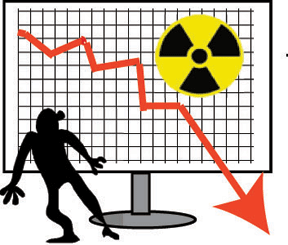 Uranium miners still struggling to emerge from shadow of Fukushima Canada.com. BY PETER KOVEN, FINANCIAL POST DECEMBER 12, 2012 Following the Fukushima nuclear facility disaster in March 2011, uranium miners were quick to rationalize that the fundamentals of their business were unlikely to change and the world still needed more nuclear power.
They were wrong, to put it kindly.
The recovery in Japan has been slower than we expected More than 21 months after Fukushima, the uranium business is still stuck in a rut. Uranium’s spot price has plummeted to nearly US$40 a pound (compared to a high topping US$135 in 2007), and there has been minimal activity in the spot market. Utilities are well-supplied with uranium for the foreseeable future, and, thanks to Fukushima, the outlook for demand growth is not nearly as healthy as it was a couple of years ago Now the question on everyone’s mind is whether things will finally start to turn around in 2013? Continue reading
Nuclear weapons proliferation risk from Thorium reactors
just 1.6 tonnes of thorium metal would be enough to produce 8kg of uranium-233 which is the minimum amount required for a nuclear weapon.
”Small-scale chemical reprocessing of irradiated thorium can create an isotope of uranium – uranium-233 – that could be used in nuclear weapons. If nothing else, this raises a serious proliferation concern.”
Thorium: Proliferation warnings on nuclear ‘wonder-fuel’ , Phys Org, December 5, 2012Thorium is being touted as an ideal fuel for a new generation of nuclear power plants, but in a piece in this week’s Nature, researchers suggest it may not be as benign as portrayed.
The element thorium, which many regard as a potential nuclear “wonder-fuel”, could be a greater proliferation threat than previously thought, scientists have warned. Continue reading
1 This Month



26 September – International Day for the Total Elimination of Nuclear Weapons


PLEASE OPPOSE HR 8255 AND S.3639 – bills would accelerate satellite deployment, with no environmental review or safeguards – https://ncstd5li.quorum.us/campaign/169331/
To see nuclear-related stories in greater depth and intensity – go to https://nuclearinformation.wordpress.com
-
Archives
- September 2026 (219)
- August 2026 (330)
- July 2026 (355)
- June 2026 (287)
- May 2026 (306)
- April 2026 (356)
- March 2026 (251)
- February 2026 (267)
- January 2026 (308)
- December 2025 (358)
- November 2025 (359)
- October 2025 (375)
-
Categories
- 1
- 1 NUCLEAR ISSUES
- business and costs
- climate change
- culture and arts
- ENERGY
- environment
- health
- history
- indigenous issues
- Legal
- marketing of nuclear
- media
- opposition to nuclear
- PERSONAL STORIES
- politics
- politics international
- Religion and ethics
- safety
- secrets,lies and civil liberties
- spinbuster
- technology
- Uranium
- wastes
- weapons and war
- Women
- 2 WORLD
- ACTION
- AFRICA
- Atrocities
- AUSTRALIA
- Christina's notes
- Christina's themes
- culture and arts
- Events
- Fuk 2022
- Fuk 2023
- Fukushima 2017
- Fukushima 2018
- fukushima 2019
- Fukushima 2020
- Fukushima 2021
- general
- global warming
- Humour (God we need it)
- Nuclear
- RARE EARTHS
- Reference
- resources – print
- Resources -audiovicual
- Weekly Newsletter
- World
- World Nuclear
- YouTube
-
RSS
Entries RSS
Comments RSS
 nuclear-news