Cameco’s Australian uranium project in doubt, with 4 year record low price
Spot Uranium Falls Below $40/Pound Benchmark for First Time in Four Years http://uraniuminvestingnews.com/14766/spot-uranium-falls-below-40pound-benchmark-for-first-time-in-four-years.html June 7, 2013,The West Australian reported that spot uranium prices fell to below $40/pound for the first time since August 2009, placing pressure on uranium explorers.
As quoted in the market report:
A hearty increase in the spot price is needed to force WA’s fledgling uranium sector into first gear, with Canadian giant Cameco indicating a price of more than $70/lb is needed before it can give the green light to its massive Yeelirrie or Kintyre deposits.
USA – South Korea nuclear deal and the dangers of an Asian nuclear arms race
Obama’s Nuclear Vietnam National Review Online By Henry Sokolski June 4, 2013 “………..South Korea. The Obama administration has asked Congress to act in the next few weeks on a two-year extension of the existing U.S. nuclear-cooperative agreement with Seoul. The existing deal was supposed to be renegotiated so it could be extended for another 30-year period. Seoul, however, wanted Washington to allow it to make nuclear fuel from U.S. nuclear materials. This caused U.S. negotiators to balk. Publicly, U.S. officials worried that giving South Korea the go-ahead to enrich uranium and reprocess plutonium would sink any prospect of getting North Korea to back off from doing so.
An additional concern, though, was more immediate and credible: Saying yes might lock down Japanese plans to finally open a large, uneconomical fuel-making plant capable of producing 1,000 to 2,000 nuclear bombs’ worth of “civilian” plutonium a year. If Japan should decide to open this plant, located in Rokkasho, it might easily give Beijing yet another reason to turn its own military preparations up an additional notch. It was for these reasons that U.S. negotiators asked South Korea to agree to a short, two-year extension to allow further negotiations to sort these matters out.
Reflecting these worries, congressional staffers from both parties added modest language to the administration’s draft U.S.–South Korea two-year nuclear-agreement-extension bill. The staffers’ amended language clarified the desirability of keeping nuclear-fuel-making at bay on the Korean peninsula and in Asia more generally. Administration officials, however, have privately made it clear that they want this language taken out.
This raises even more questions. Is the administration going to hold the line on Korean fuel-making? If so, how can it do this without doing the same with Vietnam? Or is the plan to cave in both cases? If so, how do we intend to deal with the nuclear-fuel-making aspirations of Japan, Saudi Arabia, South Africa, Jordan, Egypt, and Turkey?
One diplomatic answer is that we will handle these matters country by country (i.e., case by case). If Congress settles for this, though, it will have forgotten what it was trying to make the White House understand when it first complained about Secretary Clinton’s cutting a loose nuclear deal with Vietnam: That a “case by case” policy is no policy at all.http://www.nationalreview.com/article/350043/obamas-nuclear-vietnam-henry-sokolski
Oak Ridge uranium processing facility costs running out of control?
Frank Munger: Alexander keeping eye on Uranium Processing Facility costs Knox News, By Frank Munger June 5, 2013 U.S. Sen. Lamar Alexander has been a big supporter of the Uranium Processing Facility and no doubt still is, but Tennessee’s senior senator sounded a warning last week that he wouldn’t put up with out-of-control costs — even for an Oak Ridge project that he considers essential.
“I’ve pretty well had it with these big Energy Department projects
that start out costing a billion dollars and end up costing $6
billion,” Alexander said in an interview. “We can’t afford that. And
we can use the money much more wisely, either to reduce the debt or to
pay for energy research.”
There are reports that the UPF is on the verge of going over the top
end of its estimated cost range — currently set at $4.2 billion to
$6.5 billion. The senator is the ranking Republican on the Senate
Appropriations’ energy and water subcommittee, which plays a pivotal
role in funding the Department of Energy and its sub-unit, the
National Nuclear Security Administration.
I asked him if there was a price tag too high.
“Well, we’ll have to decide that,” he said. “One thing I want to make
sure is we don’t start constructing the facility until we have a
design. And then I want it to be more like the big Spallation Neuron
Source which we built a few years ago that (ORNL Director) Thom Mason
was in charge of. Once we knew the design and we knew the cost, even
though the number was big ($1.4 billion), they stayed on time and on
budget.”
When pressed about a cost ceiling for UPF, Alexander wouldn’t go
there….. http://www.knoxnews.com/news/2013/jun/05/frank-munger-alexander-keeping-eye-on-uranium/
More bad news for uranium industry
Uranium – little selling in May 9 News Finance 4 June 13 By Andrew
Nelson Uranium sellers were not inclined to sell in May and
unfortunately for them, the buyers weren’t really buying either. The
spot price traded in a tight range over the month, starting at
US$40.50 per pound and then dropping to US$40.25 before heading back
up to end the month at US$40.40 per pound.
The same old story continued to play out, the one in which sellers
can’t/don’t want to drop prices further versus buyers that really
don’t need the stock. Industry analyst TradeTech reports that
producers have been going almost door to door to shift uncommitted
material off the shelves this year at or around current prices, but
buyers are increasingly focused on 2014 deliveries.
There was a bit of hope earlier in the month that prices could start
pushing higher on news of a terrorist attack and subsequent production
stoppage at the Somair uranium mine in Niger. The problem with this
ill-conceived hope is that it looks like production at the facility
will kick back on over the next few months and with little disruption
to delivery commitments.
With buyers not buying and sellesr not wanting to sell at lower
prices, market activity in May was slow. TradeTech reports only 23
transactions were concluded, accounting for nearly 3 million pounds of
U3O8 equivalent. While by no means running hot, May was at least up on
the 2.4m pounds that changed hands in April.
By the end of the month, which was also the end of the week,
TradeTech’s Exchange Spot Price Indicator had come off US10c to
US$40.40…… http://finance.ninemsn.com.au/newscolumnists/other/8669520/uranium-little-selling-in-may
Uranium mining pollution evident in Thalupula mandal in Anantapur district, India
“Uranium mining posing danger to people, habitat” http://www.thehindu.com/news/national/andhra-pradesh/uranium-mining-posing-danger-to-people-habitat/article4782354.ece 5 June 13, Kadapa Memorandum submitted to in-charge Collector
Uranium mining at Thummalapalle in Pulivendula and Kadiri in Anantapur district is leading to radiation and causing water pollution, thus endangering the health of people, Rayalaseema Rashtra Samithi president K. Venkatasubba Reddy alleged on Tuesday.
People were perturbed at reports that uranium purification plant would be set up at P. Kothapalli in Nambulapoolakunta mandal in Anantapur district, he said in a press release here. The effects of radiation were evident in Somavandlapalle, Velagalabailu and other villages in Thalupula mandal in Anantapur district and RIMS doctors were collecting blood samples of the people and enquiring about their health as the radiation was said to have been causing cancer, he said.
Uranium Corporation of India Limited and Bhabha Atomic Research Centre officials have inspected lands in P. Kothapalle panchayat in accordance with the plans to set up the uranium purification plant. The UCIL plant at Thummalapalle has an installed capacity to produce 3,000 tonnes of uranium. A 140 km. tunnel was being dug for excavating uranium and it caused steep depletion of groundwater, he said. Drinking water was being contaminated and water was not available for irrigation, he alleged.
Meanwhile, United Forum Against Uranium Project, leaders L. Nagasubba Reddy, P. Siva Reddy, K. Jayasri, R. Shamir Basha, M. Bhaskar and K. Srinivasulu Reddy submitted a memorandum to in-charge District Collector K. Nirmala complaining against the UCIL Executive Director. The UCIL laid tailing pipeline through two acres of land belonging to L. Damodar Reddy in Mabbuchinthalapalle in Vemula mandal, they alleged.
The pipeline leakage on April 22 led to the death of goats due to internal chemical injuries and skin burns when they entered the sludge pond. The UCIL officials tried to hush up the matter by getting the sick livestock treated by veterinary doctors and issuing compensation cheques to farmers for the death of the livestock, they said.
South Korea and USA planning nuclear pyroprocessing
 Meanwhile, South Korea and the U.S. are set to sign a pact that will allow the two nations to step up their joint research on pyroprocessing technology, said a senior official at Seoul’s foreign ministry.
 If adopted, the pact would enable the International Atomic Energy Agency to guarantee the safety of pyroprocessing technology.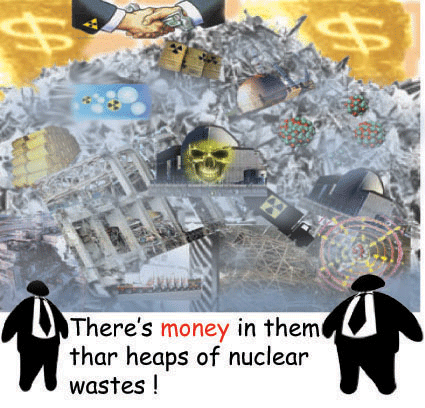
The fight to save Grand Canyon from uranium radioactive contamination
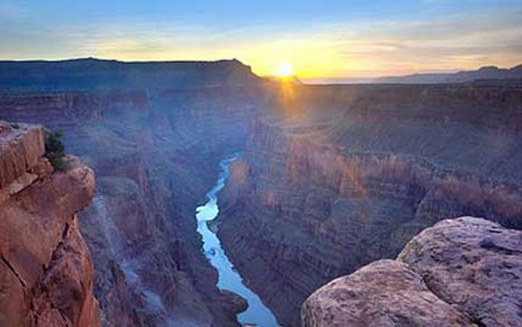 Tribes, Enviros Fight Uranium Mining Near Grand Canyon KPBS, June 3, 2013 By Laurel Morales “……environmentalists and Indian tribes oppose mining near the canyon. On a recent sunny day EcoFlight pilot Gary Kraft steered the six-seat Cessna onto the tarmac of the Grand Canyon Airport and gracefully took off. He flew a group over the Grand Canyon to check out mines from above.
“As Gary brings the plane around we’ll get a little better look at the site,” said Grand Canyon Trust’s Roger Clark who served as our guide.
He has been fighting uranium mining companies for many years. Last year he scored a victory. The Obama Administration put a ban on any new mining claims on federal land surrounding the park. In the 1980s and 1990s a dozen mines pocked the landscape surrounding the park. All but a few have been cleaned up and reseeded. But a handful of older claims are still being mined. Continue reading
Uranium and thorium distribution rules, from NRC
NRC Finalizes Rules on Using & Distributing Uranium & Thorium http://smnewsnet.com/archives/66243 2 June 13, The Nuclear Regulatory Commission is amending its regulations for products and materials containing unenriched uranium and thorium, also known as source material. The changes include new requirements for distributing source material and licensing its use.
Manufacturers and importers of products that can be used without a license—such as welding rods and gas lantern mantles that contain thorium, and decorative glassware containing uranium—will now need to apply to the NRC for specific licenses to distribute these products. Such licenses will impose new requirements for labeling, quality control, reporting and recordkeeping.
The new regulations also modify distribution, possession and use requirements for small quantities of source material that can be used or transferred without a specific license. Distributors of small quantities must now apply for specific licenses. For source material being processed or in a dispersible form, such as liquid or powder, the limit on the use or transfer at any one time without a license is decreasing from 15 to 3.3 pounds; the annual limit will drop from 150 to 15.4 pounds. Limits are not changing for anyone possessing source material in a solid, non-dispersible form (such as display samples of depleted uranium metal), removing uranium from drinking water, or determining the concentration of uranium and thorium in a material at a laboratory.
Finally, the new regulations expand the exemption from licensing for optical lenses containing thorium to include lenses and mirrors coated with or containing uranium or thorium. These products are typically used in lasers or other high-technology optical systems.
These new license requirements and possession limits are intended to ensure those who possess source material do so safely, and that the NRC has a better understanding of how much source material is being distributed annually.
Northern Saskatchewan First Nation to drop lawsuit, signs up with uranium companies
Northern Saskatchewan First Nation signs uranium mining deal worth $600 million http://www.newstalk650.com/story/northern-saskatchewan-first-nation-signs-uranium-mining-deal-worth-600-million/112624 Agreement with mining giants Cameco and Areva calls for First Nation to drop lawsuit over proposed mine by Nigel Maxwell May 31, 2013 The English River First Nation in northern Saskatchewan has signed a deal with Uranium mining giants Cameco and Areva worth $600 million.
Much of money is to flow to the First Nation over 10 years through contracts with band-owned businesses and wages to band members who would work at the mines and on community development projects.
Part of the agreement calls for the First Nation to drop a lawsuit over land near the proposed Millennium mine project.
Some members of the band have raised concerns about the environmental impact of more uranium in the area.
Iran converting much enriched uranium to non weapons usable form
Uranium conversion may help ease bomb fears, Japan Times, 1 June 13 VIENNA – An important recent development in Iran’s nuclear program, if it continues, might help to ease international fears that Tehran wants the bomb, but serious questions still remain, analysts and diplomats said.
This potentially positive step, as highlighted in recent quarterly reports by the International Atomic Energy Agency, concerns uranium enriched by Iran to a fissile purity of 20 percent.
This material is of major international concern because if further purified to 90 percent — a process well within Iran’s technical capabilities — it would be suitable for a bomb.
According to the IAEA’s most recent report, Iran has produced 324 kg of uranium enriched to 20 percent, well above the about 240 kg thought to be needed for one nuclear device — which is reportedly also Israel’s “red line”.
But more than 40 percent of this has been converted into another form, triuranium octoxide, which experts say is tricky to convert back to the original uranium hexafluoride.
Iran says that it is converting this uranium in order to provide fuel for a reactor in Tehran, and four others that outgoing President Mahmoud Ahmadinejad last February ordered constructed, for nuclear medicines.
Tehran also calls it a “confidence-building” measure in so-far fruitless talks with six world powers on hold until after the presidential election on June 14…… http://www.japantimes.co.jp/news/2013/06/01/world/uranium-conversion-may-help-ease-bomb-fears/#.UapgdNJwo6I
URENCO might die, in failing global uranium industry
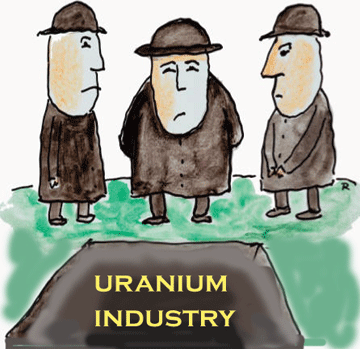 one of the more important factors, surely, is the projected value of the MOX itself, which in turn is a function of long term uranium prices—there would be no point in completing the plant and then making the MOX, as opposed to just dumping the plutonium, if uranium will be dirt-cheap as far ahead as one can see.
the fate of the MOX plant is but one indicator of retrenchment in the global nuclear fuels market, post-Fukushima
the Japanese nuclear shut-down, which, the Times went on to note, has reduced global demand for nuclear fuels by close to 10 percent, plus Germany’s planned nuclear exit, have cast a pall that now stretches to New Mexico,
Kentucky, and South Carolina.
Restructuring and Retrenchment in Nuclear Fuels http://spectrum.ieee.org/energywise/energy/nuclear/restructuring-and-retrenchment-in-nuclear-fuels By Bill Sweet 29 May 2013 In 2000, the United States agreed with Russia to get rid of 34 tons of weapons-grade plutonium. To that end, it embarked on construction of a large plant at Savannah River, S.C.,where the plutonium would be mixed with uranium to make so-called mixed oxide fuel (MOX), suitable for use in nuclear power plants.
Buried in the president’s fiscal 2014 budget request is a line sharply cutting funding for the Savannah River MOX plant, which “may be tantamount to killing it,” a former National Nuclear Security Administration official told Arms Control Today. Continue reading
Beaverlodge area – an example of uranium mining’s filthy legacy
Uranium mining legacy expensive, The Star Phoenix, By Ann Coxworth, May 30, 2013 “…….The Canadian Nuclear Safety Commission recently reviewed plans for continuing management of some of the contaminated sites in northern Saskatchewan – relics of uranium mining activities that took place during the 1960s and 1970s.
The cost of remediating surface waters to levels compatible with Saskatchewan surface water quality objectives is so overwhelming thatwe know it will never happen.
Because the companies that caused the pollution are no longer in existence, these costs now fall to the federal and provincialtaxpayers. The goal of industry and regulators now is simply to prevent the contamination from getting any worse.
One such contaminated region is the Beaverlodge area. Continue reading
India’s rural communities angry over uranium and weapons projects
Grasslands bristle over uranium plant, test range http://timesofindia.indiatimes.com/city/bangalore/Grasslands-bristle-over-uranium-plant-test-range/articleshow/20357979.cms Deepika Burli, TNN | May 31, 2013 BANGALORE: Green activists and local villagers have taken serious exception to proposals from defence and research institutions to build sensitive projects on the 10,000 acres of Amrit Mahal Kaval land allotted to them in Challakere taluk of Chitradurga district.
“The Barc plan envisages conducting experiments with uranium, which will not only ruin the fertility of the land but put the lives of so many villagers at risk. Continue reading
South Korea seeking uranium enrichment, despite its previous pledges
Two-Decade-Old Pledge Complicates South Korean Nuclear Goals National Journal, By Elaine M. Grossman May 30, 2013 | South Korea’s designs on producing atomic fuel recently scotched a 2014 trade deal with the United States, but could yet have new ramifications: Potentially shattering a twenty-one-year-old pledge Seoul made to never process sensitive nuclear materials, according to issue experts.
“By dint of the Joint Declaration of 1992, South Korea has said it will not possess enrichment or reprocessing facilities on its peninsula,” Thomas Moore, deputy director of the Proliferation Prevention Program at the Center for Strategic and International Studies, said at a recent panel discussion. …………http://www.nationaljournal.com/nationalsecurity/two-decade-old-pledge-complicates-south-korean-nuclear-goals-20130530
Uranium enrichment company URENCO for sale – uneconomic
Powerhouse of the Uranium Enrichment Industry Seeks an Exit NYT, BY STANLEY REED , 26 May 13“..….Urenco was formed by treaty in 1971 when Britain, West Germany and the Netherlands decided for
strategic and business reasons to combine their uranium enrichment programs. The company is still owned by the British and Dutch governments, with one-third each, and with the German third held jointly by two big utility companies, E.On and RWE.
Urenco now has four enrichment plants — in Britain, the Netherlands
and Germany — selling fuel for civilian energy purposes around the
world, capturing nearly a third of the global market………the
company is at a crossroads. Growth may flatten in the next couple of
years, executives say, mainly because Japan — a major user of nuclear
power until the 2011 Fukushima Daiichi disaster — has shut down its
reactors, taking about 10 percent of the world’s nuclear energy
generating capacity offline. And the Japanese have stockpiled
substantial amounts of fuel for the day, if ever, that those reactors
go back into operation……
“Nuclear strategies have changed,” said Michael Kruse, a consultant on
nuclear issues for the management consultant Arthur D. Little in
Frankfurt. “Governments no longer think they need to be in this
business,” he said, “and utilities in several countries want out after
Fukushima.”
People in the industry say the most likely buyers would be companies
already in the industry that might want to offer clients fuel along
with nuclear power stations. Areva, a French giant, might fit that
bill. So might Toshiba of Japan, which is studying building nuclear
plants in Britain. Still, “there are in my view not many companies
that can buy Urenco,” Mr. Kruse said.
1 This Month

of the week – Shut Down Drone Warfare!


Tell the Ukrainian Government to Drop Prosecution of Peace Activist Yurii Sheliazhenko

Petition to revoke the licensing of the Near Surface Nuclear Disposal Facility (NSDF) at Chalk River. https://www.ourcommons.ca/petitions/en/Petition/Details?Petition=e-7247
To see nuclear-related stories in greater depth and intensity – go to https://nuclearinformation.wordpress.com
-
Archives
- April 2026 (103)
- March 2026 (251)
- February 2026 (268)
- January 2026 (308)
- December 2025 (358)
- November 2025 (359)
- October 2025 (376)
- September 2025 (257)
- August 2025 (319)
- July 2025 (230)
- June 2025 (348)
- May 2025 (261)
-
Categories
- 1
- 1 NUCLEAR ISSUES
- business and costs
- climate change
- culture and arts
- ENERGY
- environment
- health
- history
- indigenous issues
- Legal
- marketing of nuclear
- media
- opposition to nuclear
- PERSONAL STORIES
- politics
- politics international
- Religion and ethics
- safety
- secrets,lies and civil liberties
- spinbuster
- technology
- Uranium
- wastes
- weapons and war
- Women
- 2 WORLD
- ACTION
- AFRICA
- Atrocities
- AUSTRALIA
- Christina's notes
- Christina's themes
- culture and arts
- Events
- Fuk 2022
- Fuk 2023
- Fukushima 2017
- Fukushima 2018
- fukushima 2019
- Fukushima 2020
- Fukushima 2021
- general
- global warming
- Humour (God we need it)
- Nuclear
- RARE EARTHS
- Reference
- resources – print
- Resources -audiovicual
- Weekly Newsletter
- World
- World Nuclear
- YouTube
-
RSS
Entries RSS
Comments RSS
 nuclear-news