The “disorderly exit” of uranium from the share market
Uranium spot price sinks amid ‘disorderly exit’ Financial Post Peter Koven 13/07/29
Over the past few years, the uranium spot price found support whenever it fell to US$40 a pound. But not this time.
Uranium has plunged 14% over the last two months, and now sits at US$34.50 a pound after dropping another US$1.50 last week. It’s the lowest level since 2006.
“It appears that by the end of last week, a disorderly exit from the spot market was underway,” TD Securities analyst Greg Barnes said in a note…..
Western leaders’ hypocrisy on uranium investment scandals in Africa
Malawi gov’t and Paladin: Act on Kayelekera uranium raw deal now! By Veronica Maele-Magombe Nyasa Times, By Veronica Maele-Magombe July 30, 2013 “……one cannot underestimate the ‘politicking’
surrounding foreign investment. There is the brainwashing and fear
that African leaders endure in their struggle to appease donors who
are sometimes capable of clamping on aid or trade deals if a poor
country like Malawi is ‘hostile’ to western investors. In the un-coded
diplomatic language of foreign investment it means, treat business
clients from the west well and we will handle your aid and loan
cheques accordingly.
Western leaders have continued to hypocritically talk about fair trade
and dealings with Africa whilst winking an eye to their investors.
And, tightening the shackles of neo-colonialism on their behalf has
been IMF – convincing poor countries to lure foreign investor with a
portfolio of incentives. Just last year, IMF advised poor Gambia to
reform its tax system so that the country avoids discouraging foreign
investors with many taxes. Resident Representative, Meshack Tunee,
noted: Continue reading
Terminal state of uranium prices!
Uranium Nearing Terminal Velocity 9 News Finance By Andrew Nelson, 30 July 13 The steady and significant retreat of the uranium price over the month of July gathered even more pace last week. Volumes were steady, with six transactions involving around 700,000 pounds of uranium being reported, but the spot uranium price still fell 5% over the five days.
We are now looking at levels last seen in November 2005. This was just before that time everyone thought uranium would make for a great investment, pushing the price up to US$138 a pound by June 2007. The GFC interrupted, then we had the Fukushima incident in March 2011 and uranium has been moving steadily south ever since……
Uranium in common airliner parts
 Common Airliner Parts Now Admitted To Be Laced With Uranium http://www.thedailysheeple.com/common-airliner-parts-now-admitted-to-be-laced-with-uranium_0720 www.IntelliHub.com July 25th, 2013 MIAMI — Ten minutes away from the Sun Life Stadium, home of the Miami Dolphins and Florida Marlins, is Opa-locka Executive Airport (OPF), the site of a recent environmental tragedy.
Thursday, a portion of the airport grounds were sealed off due to a radioactive substance leak emitting from an old 55-gallon drum. HAZMAT and fire crews responded just after noon, finding radioactive airplane parts laced with Uranium inside the drum.
The drum was said to be found on the Grounds of the former, now bankrupt, Arrow Cargo. According to Wikipedia Arrow Cargo, “was an American cargo airline (originally known as Arrow Air) based in Building 712 on the grounds of Miami International Airport in unincorporated Miami-Dade County, Florida, USA. It operated over 90 weekly scheduled cargo flights, and had a strong charter business. Its main base was Miami International Airport. Arrow Air ceased operations on June 29, 2010, and filed for Chapter 11 bankruptcy protection on July 1, 2010. It plans to liquidate.”
What is most startling about this is the fact that Miami-Dade’s Fire Rescue spokesman Lt. Arnold Piedrahita, admitted to the press that indeed aircraft “counterbalances” are indeed made with radioactive uranium. The local press went on to downplay the severity of the finding.
Upon further investigation it turns out even the Boing Corporation itself has expressed concerns about certain aircraft parts containing radioactive materials. In fact, Boing even submitted paperwork to the United States Nuclear Regulatory Commission (USNRC) detailing their concerns:
Boeing Company Request Concerning Depleted Uranium Counterweights by Enformable
– See more at: http://www.thedailysheeple.com/common-airliner-parts-now-admitted-to-be-laced-with-uranium_072013#sthash.VzIwAfvb.dpuf
Religious faith of uranium industry in the face of financial doom
Elemental: How some people are playing the uranium glut 24 Jul 2013 | By: Anna Andrianova | Special to CNBC.com With Japan shuttering its nuclear reactors and Europe pulling away from the nuclear power, the world has more uranium than it needs. But that’s not stopping some people from betting on the radioactive element in the longer term. ……
Nuclear bulls
Despite those low prices—or perhaps because of them—some investors are putting bets on a uranium turnaround.
Uranium Energy Corp, an exploration and production company, said it expects demand to pick up faster than production can respond.
“With the uranium prices falling so low post-Fukushima, they are well below the economic incentive level needed to see new mine construction,” said Amir Adnani, CEO of Uranium Energy Corp.
As mines struggle because of the low prices, now is the time to buy them, Adnani said………….
All the acquisitions could gain value when demand revives, which could be triggered by the Japanese reactors’ coming back—at least that’s what investors hope………..
Demand for uranium is expected to grow less than 1 percent this year, leaving the industry with a net oversupply of 7 million pounds, said Nicolas Carter, senior vice president for uranium at Ux Consulting, a nuclear industry consultancy.
The world’s net oversupply of uranium may reach 18 million pounds this year, according to Ux. The difference between demand (185 million pounds) and the supply from mining (155 million pounds) is covered by 48 million pounds from secondary sources.
Those sources include government stockpiles, as well as recycled uranium from a U.S.-Russia treaty that lets U.S. utilities acquire uranium from former Soviet nuclear weapons. That treaty is set to expire this year.
However, USEC is a buyer of that Soviet uranium, and Donald said that even the expiration of the treaty will not create a shortage in the near term. The market has been prepared for the change, so it is unlikely to have a big impact on prices, he added.
Exelon, a utility company with 10 power plants and 17 reactors in Illinois, Pennsylvania and New Jersey, said that it does not expect any uranium shortage soon and that it has planned its purchases with the cessation of the Russian treaty in mind. http://www.cnbc.com/id/100901959
UN examines Australian uranium miner Paladin’s Malawi operations
UN rubbishes Malawi’s Paladin uranium deal, fertilizer subsidy By Hudson Mphande, Nyasa Times July 23, 2013 United Nations Special Raportuer on the Right to Food Olivier De Schutter who was in Malawi for an assessment of the food situation in the country has rubbished Kayerekera uranium mine deal between Malawi and Australian Paladin Mining Company saying the Southern African country has had a raw deal that is robbing the poor.
The UN Raportuer said the uranium mining deal was one of the investments in Malawi through which the country is losing resources that could otherwise make a difference in food security and other pro-poor initiatives. He said in the life span of the mine Malawi is expected to lose almost US$281 million…
“Mining companies are exempt from customs duty, excise duty, value added taxes on mining machinery, plant and equipment. They can also sign special deals on the rate of royalty owed to the government. I believe that there are more reasons that investors would come to Malawi without such incentives,” he said.
De Schutter was addressing journalists in the capital Lilongwe at the end of his 11-day tour of the country.
He bemoaned that due to illicit financial flows, tax envasion as well as tax incentives that the country offer to both domestic and foreign companies currently Malawi was failing to get maximum use of its resources.
De Schutter said that revenue losses from special tax incentives to Paladin Africa Mining alone are estimated at almost K67 billion (US$205 milion) since the mine started its operations and could reach almost K92 billion (US$281 million) over its13-year lifespan.
“Paladin alone is costing the budget more than US$20 million (almost K8 billion) a year in taxes,” he said.
He added: “I am convinced that unless combined with a comprehensive enhancement and optimisation of tax revenue, current macro-economic reforms may not have substantive positive impacts. There is need for
Malawi to examine its national tax laws and policies towards preventing illicit capital flight. As mining develops, Malawi can simply not afford business-as-usual.”
The UN Special Raportuer said it is estimated that the country has lost over 10 percent of its growth domestic product (GDP) to illicit outflows and tax evasion over the period 1980 to 2009……..
De Schutter also specifically expressed concerns on the country’s current minimum wage currently at K371 ($1.12) per day, describing it as the lowest in the world…… The UN special rapporteur said he will give a report and his recommendations to both the UN Human Rights Commission and the Malawi Government. http://www.nyasatimes.com/2013/07/23/un-rubbishes-malawis-paladin-uranium-deal-fertilizer-subsidy/
Rapid fall in uranium spot AND TERM prices
 The week ended with TradeTech’s Weekly U3O8 Spot Price Indicator sitting at $36.50 a pound, a decline of $1.75 over the prior week’s value. This is the lowest price that has been seen in more than seven years
The weakness was not isolated to the spot market and is starting to spill over into the term market.
Uranium Market Marches South at Double Time 9 News Finance byFN Arena By Andrew Nelson Tuesday, July 23, 2013 The crack appeared the week before last. Sellers started to buckle under the strain and gave in to lower prices. A US$1.30 drop ensued. That’s the way last week started and from there things only got worse for the uranium spot price. Continue reading
New Mexico court ruling against uranium mine permit

 Judge overturns uranium mine permit http://www.abqjournal.com/main/224658/abqnewsseeker/judge-overturns-uranium-mine-permit.html By Associated Press on Tue, Jul 23, 2013 SANTA FE (AP) — A lawyer for environmental groups say a Santa Fe judge has overturned a decision by Gov. Susana Martinez’s administration granting a permit for a uranium mine to remain inactive without any cleanup.
Eric Jantz of the New Mexico Environmental Law Center said District Judge Raymond Ortiz’s decision on Monday will send the case back to the state Mining and Minerals Division for further public hearings.
The agency renewed a standby permit last year for Rio Grande Resources’ Mount Taylor mine near Grants.
The judge ruled Amigos Bravos and the Multicultural Alliance for a Safe Environment weren’t adequately allowed to raise issues about protecting ground water from contamination from mining waste piles.
The judge also said the agency wrongly kept a company report confidential on the mine’s economic viability.
USA scandal of Uranium Center of Excellence taxpayer ripoff
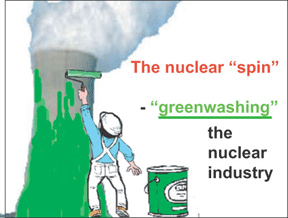 The “excellence” of this facility was that the radioactive garbage was green-washed as “recyclable,” and Ohio voters were also duped by the promise that it would bring hundreds of jobs, when the final tally was only two full-time inventory managers. I suppose that if spent fuel storage had been added, it would have been called the Center for Real Awesomeness with Plutonium.
Many of the same contractors who had been paid to haul the excellent garbage in were then paid a second time to haul the excellent garbage out in a less-than-excellent shell game that meant lucre for an elite group of crappy corporations.
Uranium Titan Tumbles EcoWatch July 12, 2013 By Geoffrey Sea“…….Excellent Extortion Recent developments at Piketon and Paducah make no sense at all without understanding that the working national plan for how to deal with the outmoded gaseous diffusion plants and their massively contaminated sites has been to convert both into “national sacrifice” waste repositories. But you won’t find that plan in any Federal Register notices or Environmental Impact Reports. Rather, it’s the subtext of a hundred different records of decision and formal notifications. The new way to evade those nuisance environmental compliance requirements is for federal agencies and funded corporations to simply not announce what they intend to do. Continue reading
The disastrous history of U.S. Enrichment Corporation (USEC)
Despite public funding, no governmental process is contemplated for gathering or disseminating data on the commercial worthiness of USEC’s centrifuges, because that answer is already widely known: The technology at issue is forty years old and out of date…… doesn’t produce anything anymore and it never will
 the “American Centrifuge” project (ACP) was never more than a false front, a mechanism for wrangling government bailout after government bailout, while the rock-red company waited for a Republican administration that would approve its audacious waste storage plans.
 That team included Iraq War architect Richard Perle and a physics professor whose only claim to fame was in pushing centralized storage solutions for spent nuclear fuel. His name was Ernest Moniz. (left)
Uranium Titan Tumbles EcoWatch July 12, 2013 By Geoffrey Sea “……The Un-American Centrifuge Plant Created first as a government corporation in response to a mismanagement scandal at the U.S. Department of Energy (DOE) in the 1990s, USEC was privatized in 1998. The USEC Privatization Act, premised on delusional Thatcherite ideology, placed two solemn obligations on the respective parties in the split: The Department of Energy, though continuing to own the land and facilities with which USEC operates, had to stay out of the business of uranium enrichment; USEC, while free to conduct its business as a private corporation, had to use its free access to public land and resources to develop advanced uranium enrichment technology and improve the U.S. position in the global enrichment marketplace.
Now those statutory goals can only bring a ROFLMAO reaction. USEC has become a wholly-dependent ward of the Department of Energy, which effectively makes all the big “business” decisions that concern enrichment, and USEC has defaulted on any credible effort to deploy a domestic advanced enrichment technology. Yet the Privatization Act remains on the books, its provisions violated cavalierly but with no efforts at repeal, like metropolitan municipal laws about donkey carts and Sunday dancing.
The basic and shocking truth about USEC, Continue reading
Auditors shocked at rocketing costs for Uranium Processing Facility
Auditors Slam Uranium Project’s Ballooning Expense http://news.yahoo.com/auditors-slam-uranium-projects-ballooning-expense-150204641.html Diane Barnes, Global Security Newswire 16 July 13, WASHINGTON –– When U.S. government contractors designing a $500 million nuclear-weapon facility last year said they would have to raise the roof, they didn’t exactly mean it was time to pump up the music.
An update to plans for the future Uranium Processing Facility at the Y-12 national security complex in Oak Ridge, Tenn., would increase its height by 13 feet — a move required for the building to hold all its intended contents. Problem was: officials offered no stab at how much the revision would cost.
The changes ended up costing well over half a billion dollars more, congressional auditors said last Friday. The site is to replace existing facilities that handle and store highly enriched uranium.
The Government Accountability Office blamed the additional $540 million price tag on a failure by the lead design firm to “adequately manage and integrate the design work” of four subcontractors. Construction of the building itself has not begun.
The unanticipated expense contrasted with a number of “overly optimistic assumptions” made by the National Nuclear Security Administration, which has overseen the project, and laid out in a 35-page GAO report.
The project’s maximum anticipated expense soared from $1.1 billion to $6.5 billion between 2004 and 2011, and the cost might increase further because the roof revision burned through nearly half of NNSA “contingency” funds. The nuclear weapons complex oversight agency — a semiautonomous branch of the Energy Department — “did not account for such a large sum of money being needed to address this risk,” the auditors said in their report to the Senate Appropriations Energy and Water Development Subcommittee.
The panel fears “NNSA will not be able to execute multiple, highly complex life-extension projects and construction projects concurrently under ambitious schedules,” lawmakers said in a report on spending legislation approved by the full committee in June.
The Energy Department last month informed Congress the facility will not start becoming operational until 2025, the Knoxville News Sentinelreported on Saturday.
Guangdong protests against uranium processing plant
 Jiangmen residents protest against uranium processing plant http://www.scmp.com/news/china/article/1280894/jiangmen-residents-protest-against-uranium-processing-plant Several hundred people gathered in Jiangmen’s city centre on Friday morning to protest against a planned uranium processing plant in the Guangdong city.
 “Jiangmen doesn’t want radiation”, one banner carried by demonstrators said. “We want children, not atoms,” said another. Police appear to have been anticipating the protest with Jiangmen city government building being cordoned-off.
One group of protesters gathered in front of the building, another group meet at the Donghu Lake park.
Two protesters, who declined to be identified, said that the protest had been organized via QQ and WeChat, two social messaging services, at least two days ahead of the protest.
One local said that the local government had held an emergency meeting last night to prepare for the protest. According to one demonstrator, the public protest lasted from 8am to 11:30am and is planned resume in the afternoon.
Some protesters were holding banners calling for another protest on Sunday.
Thee 30-hectare plant would carry out uranium conversion, enrichment and fuel fabrication, the Jiangmen City Development and Reform Bureau said in an earlier statement.
The plant’s construction some 100km from Hong Kong and Macau has sparked health concerns in both cities as well. The Heshan government under the administration of Jiangmen held a press conference earlier on Friday morning defending the project. Heshan mayor Wu Yuxiong said that the local government has decided to extend the period in which the risk assessment report is publicly accessible by a further ten days.
Microblogs about the protests have been quickly censored, indicating increased sensitivity about a backlash. Earlier this year, two demonstrations against a gas refinery in Kunming have caused a public backlash. A similar protest in Chengdu had been repressed.
Confusion and secrecy surround China’s proposed uranium processing plant in Jiangmen,
 Experts call for more details on Guangdong uranium plant, South China Morning Post, Olga Wong and Minnie Chan Concern over sketchy nature of details and possible radiation risks from proposed nuclear development in Guangdong.
Nuclear experts and green activists have called for more information from the Guangdong government after limited details were released about its proposal for a uranium processing plant in Jiangmen, about 100 kilometres from Hong Kong.
An announcement by the Jiangmen City Development and Reform Bureau said the 230-hectare plant would carry out uranium conversion, enrichment and fuel fabrication.
But the three-page statement, issued last Thursday, did not make it clear whether the plant, in the Longwan industrial district of Zhishanzhen, would perform spent fuel reprocessing – recycling of old fuel rods that could emit high doses of radiation – or what measures would be used to avoid radiation leaks…… Continue reading
Uranium price goes ever downward
Spot uranium prices about $39.50/lb with ‘downward’ bias: sources Washington (Platts)- Jim Ostroff -9 Jul2013 The spot price of uranium is around $39.50 a pound, unchanged from last Tuesday, but the ongoing weak demand for U3O8 indicates that prices are more likely to soften further than rise in coming weeks, according to price publisher Ux Consulting and market sources.
Ux, in its weekly report Monday, said the spot U3O8 price was $39.50/lb, unchanged from Friday, but that the market “could see further erosion as the month wears on.” It added, “The overall demand situation may not improve anytime soon,” noting it is unlikely “that Japanese reactors will see a surge in restarts in the near future.”
Ux on Monday reduced its daily Broker Average Price — based on information from Evolution Markets and Armajaro Securities — by 6 cents to $39.38/lb. The BAP bid-offer spread Monday was $39.00-$39.75/lb, with the bid down 13 cents and the offer unchanged from Friday…..”The bias still is to the downside a bit” in the uranium spot market, one market source said in an interview Tuesday. “There remains more supply than demand and nobody seems to be motivated on either side,” to conclude deals, he said. http://www.platts.com/latest-news/electric-power/washington/spot-uranium-prices-about-3950lb-with-downward-21262350
Uranium Processing Facility in Tennessee getting even further behind schedule
Oak Ridge uranium project even more behind schedule than it used to be http://www.abqjournal.com/main/219488/blogs/nm-science/oak-ridge-uranium-project-even-more-behind-schedule-than-it-used-to-be.html By John Fleck / Journal Staff Writer on Wed, Jul 10, 2013
[T]he Department of Energy’s Stockpile Stewardship and Management Plan states that the First Phase of the Uranium Processing Facility project will be completed in 2025, which indicated a rather significant delay from previous reports that — just a couple of years ago — had the entire project completed before then. The First Phase is focused on moving the operations now housed in the 9212 uranium processing complex at the Y-12 nuclear weapons plant in Oak Ridge. Phases Two and Three, incorporating the work now done in Y-12′s 9215 building and 9204-2E (Beta-2E), would not be completed until around 2038.
The National Nuclear Security Administration, in a response to earlier questions about the plan, this week confirmed the schedule in the Stockpile Stewardship report as being the most up-to-date assessment of the work plan for the multibillion-dollar project.
1 This Month

of the week – Shut Down Drone Warfare!


Tell the Ukrainian Government to Drop Prosecution of Peace Activist Yurii Sheliazhenko

Petition to revoke the licensing of the Near Surface Nuclear Disposal Facility (NSDF) at Chalk River. https://www.ourcommons.ca/petitions/en/Petition/Details?Petition=e-7247
To see nuclear-related stories in greater depth and intensity – go to https://nuclearinformation.wordpress.com
-
Archives
- April 2026 (103)
- March 2026 (251)
- February 2026 (268)
- January 2026 (308)
- December 2025 (358)
- November 2025 (359)
- October 2025 (376)
- September 2025 (257)
- August 2025 (319)
- July 2025 (230)
- June 2025 (348)
- May 2025 (261)
-
Categories
- 1
- 1 NUCLEAR ISSUES
- business and costs
- climate change
- culture and arts
- ENERGY
- environment
- health
- history
- indigenous issues
- Legal
- marketing of nuclear
- media
- opposition to nuclear
- PERSONAL STORIES
- politics
- politics international
- Religion and ethics
- safety
- secrets,lies and civil liberties
- spinbuster
- technology
- Uranium
- wastes
- weapons and war
- Women
- 2 WORLD
- ACTION
- AFRICA
- Atrocities
- AUSTRALIA
- Christina's notes
- Christina's themes
- culture and arts
- Events
- Fuk 2022
- Fuk 2023
- Fukushima 2017
- Fukushima 2018
- fukushima 2019
- Fukushima 2020
- Fukushima 2021
- general
- global warming
- Humour (God we need it)
- Nuclear
- RARE EARTHS
- Reference
- resources – print
- Resources -audiovicual
- Weekly Newsletter
- World
- World Nuclear
- YouTube
-
RSS
Entries RSS
Comments RSS
 nuclear-news