15,000 Abandoned Uranium Mines – Dirty, Deadly Front End of Nuclear Power —
The Dirty, Deadly Front End of Nuclear Power — 15,000 Abandoned Uranium Mines Truth Out Friday, 11 March 2016 00:00By Josh Cunnings and Emerson Urry, EnviroNews | Video Report Editor’s Note: The following news piece represents the first in a 15-part mini-series titled, Nuclear Power in Our World Today, featuring nuclear authority, engineer and whistleblower Arnie Gundersen. The EnviroNews USA series encompasses a wide span of topics, ranging from Manhattan-era madness to the continuously-unfolding crisis on the ground at Fukushima Daiichi in eastern Japan. The transcript follows the video below:
TRANSCRIPT:
Josh Cunnings (Narrator): Welcome to the EnviroNews USA news desk. I’m your host Josh Cunnings. In this first episode of a unique 15-part mini-series of short-films, we are going to explore Nuclear Power in Our World Today.
Our journey extends outward from a bombshell interview conducted by EnviroNews Editor-in-Chief Emerson Urry, with the esteemed nuclear expert, whistleblower, and expert witness Arnie Gundersen. Gundersen is a nuclear engineer, as well as a former power plant operator, and trade executive, whose own life, for a good amount of time, was ruined by the nuclear industry after he exposed radioactive safety violations. So to get this series rolling, here’s what Gundersen revealed to Emerson Urry……..
The educational short serious we’re about to bring you spans a plethora of nuclear-related topics, but maintains a special focus on the myriad nuclear problems still festering right here in the US In this series, we will also explore with Gundersen, critical and downright disturbing details from the ongoing, ever-unfolding, nuclear crisis at Fukushima Daiichi in eastern Japan.
Some of the segments in this series are very short and feature raw interview excerpts, while in other episodes we dive deeper into the content discussed between Gundersen and Urry.
But before going around the world to talk about the incredible state of despair, still palpable on the ground in Japan, we’re going to start this series right here on US soil — at the beginning where all nuclear complexities commence — we begin with the aftermath from the mining and extraction of the naturally occurring radioactive element uranium — a mineral with a four-and-a-half-billion-year half-life that presents very little harm when safely sequestered in the earth — but all that changes when it’s mined and brought to the surface……….
While for many years nuclear power rode under the guise of the so-called “peaceful atom,” the industry has been chastised for being a friendly cover for the bomb fuel business……….
In the 40s and 50s, America was pillaging uranium out of the earth as fast and furiously as possibly in a rush for both electricity and bombs — but it turns out that many of those mining messes weren’t cleaned up very well — if at all.
The perplexing problem of these open, deadly, toxic messes was discussed between Urry and Gundersen. Take a listen.
To our understanding there are about 15,000 abandoned uranium mines that have been left in complete ruin with very little cleanup or remediation at all, just in the western United States. This has happened, by-and-large, because of an antiquated mining bill — the 1872 Mining Bill — still affecting these situations today — that kind of allowed miners to just walk away from these situations — but yet, they remain in the open leaching off tailings — blowing around radioactive dust. I think there’s about 4,500 of these exposed mining sites just in Navajo country — another 2,500 or so in Wyoming. How do we deal with that situation? What does the future hold in those regards, and quite frankly, are we all being poisoned by these mines?…..
Gundersen: The way our system is set up is that you take the profit early, and then when everything is done you walk away and the government takes the risk. So, we’ve socialized the risk, and the capitalists make the profit early on and the rest of us pick up the cost afterward. And that’s historically true on the Navajo reservation especially — but you get in the Black Hills and the Lakota Sioux… We had a member of our board go out to South Dakota and sample a dried riverbed, and the bottom of the riverbed had as much uranium in it as a mine — from runoff from uphill mines. We have a legacy that we’re really not admitting exists. Thousands and thousands of these mines — mainly on the Native American property, but not entirely………
Charmaine White Face (excerpt from Defenders of the Black Hills video): Dr. Lilias Jarding in her research that she completed in 2010 calledUranium Activities’ Impacts on Lakota Territory talked about, not only what was happening on the Northern Great Plains, but also in Colorado. All of these are abandoned open-pit uranium mines. 397 in Montana, 2103 in Wyoming, 113 in North Dakota, 272 in South Dakota, and 387 in northern Colorado, for a total of 3272………
Dr. Kearfott with her students came out and started doing some readings in our treaty territory, and this is what they found: “The radiation levels in parts I visited with my students were higher than those in the evacuated zones around the Fukushima nuclear disaster.” Higher. Fukushima radiation levels were higher than Chernobyl. The Northern Great Plains’ levels are higher than Fukushima — and these are not from nuclear power plants or from an atomic weapon, or atomic bomb being exploded. These are from 2,885 abandoned open-pit uranium mines and prospects, and we are subject to that radioactive pollution constantly. We, the people of the Great Sioux Nation, we are the miner’s canary. We are the miner’s canary for the rest of the United States. We have the highest cancer rates now. We never gave permission for uranium mining to occur in our treaty territory. It’s not just the nuclear power plants that people have to be afraif. All of these abandoned open-pit uranium mines in the Northern Great Plains are affecting everyone, but they are genocide for the Great Sioux Nation — for my people. This is genocide……….
Tune in tomorrow for the second part of fifteen in this EnviroNews special — Nuclear Power in Our World Today. For EnviroNews USA — Josh Cunnings. http://www.truth-out.org/news/item/35179-nuclear-power-in-our-world-today
Strong opposition to uranium mining in Kuannersuaq, Greenland
We are strongly opposed to plans to exploit minerals with uranium reserves at Kuannersuaq, Narsaq http://arcticjournal.com/press-releases/2204/we-are-strongly-opposed-plans-exploit-minerals-uranium-reserves-kuannersuaq We are strongly opposed to plans to exploit minerals with uranium reserves at Kuannersuaq, Eric Jensen, Nuka David SørensenMarch 9, 2016 By The Arctic Journal Information to citizens concerning the plans for exploitation of mineral deposits with uranium and exploitation of uranimium by Kuannersuaq at Narsaq is not sufficient and we demand that there should be a referendum on the plans for exploitation of mineral resources with uranium content. Therefore we require that plans for exploitation of mineral resources with uranium content and exploitation of uranium and all the decisions concerning these must be stopped.
By requiring that plans for exploitation of mineral resources with uranium content and exploitation of uranmium by Kuannersuaq at Narsaq temporarily stopped, we have begun planning of demonstrations against these plans on April 8, 2016, from 12:00 in the towns of Narsaq, Qaqortoq, Nuuk, Tasiilaq , Ilulissat, Qeqertarsuaq and in the settlements Qassiarsuk and Narsarsuaq. We have the following arguments against the plans for the exploitation of mineral resources with uranium content and exploitation of uranium:
- No sufficient information has been submitted regarding the potential impacts on people, the environment and wildlife, if an open mine is to be opened at Kuannersuaq;
- Citizens are not informed with clear information printed in Greenlandic concerning the plans for the exploitation of mineral resources containing uranium and exploitation of uranium.
We require the following information from the Greenland Government on plans for use of mineral resources from Kuannersuit:
1. What impacts can an open pit mine on the top of Kunnersuaq have on people’s health and the environment?
2. How can dust with different radioactive substances from the exploitation of raw materials from the mountain all year round be avoided?
3. What plans are there to ensure that waste from the mine to be thrown in the lake does not pollute the environment?
4. What can the waste from the mine placed into the lake have of impacts?
5. Is there sufficient space to the amount of waste in the lake?
6. According to the latest survey, only very small amounts of uranium, how credible are these compared to Risø’s studies?
7. How will you ensure the credibility of the EIA report as yet been presented publicly?
8. How ready is Greenland to store waste / tailings containing uranium mining and exploitation for many years without polluting?
9. There are not taken into account the next coming generations who will inherit it all?
Everybody is welcome to participate in the demonstrations on April 8 from pm. 12:00 at the following towns Narsaq, Qaqortoq, Nuuk, Tasiilaq, Ilulissat, Qeqertarsuaq, Qassiarsuk, Narsarsuaq and possible. Elsewhere.
South Africa: CORRUPTION GOES NUCLEAR – Jacob Zuma, the Guptas and the Russians


Zuma’s 9 600MW nuclear procurement programme and its accompanying contracts are tainted with alleged vested interests of the most deplorable kind.
If the country has any hope of having a rational, legal, and transparent evaluation of the need for nuclear energy, the procurement process has to start afresh.
This however can only occur under new leadership, which places the country’s interests ahead of its own.
If this does not occur, the future of South Africa will consist of a dark and discontented nuclear winter.
Zuma, the Guptas and the Russians — the inside story
Part 1: In pursuit of satisfying his insatiable greed — Jacob Zuma will liberate us from our constitutional democracy, and destroy the chance of a ‘better life for all’ Zuma, the Guptas and the Russians — the inside story RAND DAILY MAIL LILY GOSAM 02 FEBRUARY 2016
I wish to make it clear from the outset that this piece is not about arguing the merits or demerits of nuclear energy. It is whether Zuma’s decision for nuclear energy is based on sound economic principles for the good of the country, or for some other purpose.
Zuma’s (rabid) pet project
On 9 of December 2015 (and hours before Nene was fired), Zuma’s cabinet approved the 9 600 MW nuclear procurement programme (nuclear programme). This paves the way for nuclear vendors to present proposals in March 2016 to build 6 to 8 nuclear reactors, at an estimated cost of between R800-billion and R1.6-trillion ($50-billion to $100 billion)[5] [6] [7.
The nuclear programme, however, glows with controversy. According to Peter Attard Montalto (an emerging market economist at Nomura), the nuclear programme is Zuma’s “pet project”, and is highly interwoven with politics and the succession issue[8]. His analysis is supported by a Mail and Guardian [M&G] source who said that the programme was regarded as one of Zuma’s “presidential legacy projects” [9]. Professor William Gumede, of Democracy Works, added that the programme is being implemented essentially from a purely patronage point of view[10]. While Andrew Feinstein, executive director of Corruption Watch UK (and former ANC MP), said simply, “I fear that the corruption in this deal might dwarf the arms deal” (News24)[11].
A nuclear procurement process in a constitutional democracy should be transparent, logical, considered, legal, participatory, and unbiased.
Yet Zuma has assumed personal control of the nuclear programme, and it has been characterised by: secret meetings; undisclosed documents and classified financial reports; deceit; aggressive campaigning; damage control exercises; illegality; use of apartheid (‘national key-point’) legislation[12]; sidestepping of Eskom’s technical and financial oversight; destruction of oversight organs of state; disregarding of industry experts; refusal of public consultation; ignoring of the ANC’s national executive committee (NEC) and ANC resolutions; and the removal of any government opponents, the most notable of whom was Nene…………
Below exposes the reasons why Zuma is so hell bent on forcing the Russian 9 600 MW programme through, irrespective of: the evidence against it (from independent and government sources); the laws that stand in his way; the people that advise against it; and the grave concerns of his own party.
Radioactive plant-feed
Nuclear reactors require uranium to function, in particular low-enriched uranium (LEU). But first one must mine the uranium, and for South Africa’s 9 600MW nuclear programme, plus the existing Koeberg Nuclear Plant, the demand for uranium would steadily increase as the nuclear power plants come online. Luckily South Africa is said to have 6% of global identified resources of uranium (or 970 000 tons), the seventh highest share in the world [OECD-NEA, 2013][62].
With a 9 600MW nuclear deal, local uranium reactor demand would grow from the current 290 tons of Uranium (Ut) per year, to eventually 3300 Ut per year, once all the reactors are operational [OECD- Nuclear Energy Agency, 2014][63]. That’s a dramatic 11 times increase in local demand for uranium.
And as it just so happens, in 2010 the Guptas (a family well-known for their backing of Zuma), along with Zuma’s son, Duduzane, emerged as buyers of a South African uranium mine — the Dominion Rietkuil Uranium Project — amid claims that Zuma intervened to ease state funding for the project (according to amaBhungane – M&G’s investigative arm)[64].
[For summaries of the Guptas’ influence with Zuma and his family, read Verashni Pillay’s 2013 M&G article, or Franz Wild’s 2015 Bloomberg article. There are also excellent standalone articles on the Guptas dealings with the state, such as the Sunday Times piece by Sabelo Skiti on how Eskom allegedly went to extraordinary lengths to make sure the Gupta family landed a R4-billion coal deal, or M&G’s amaBhungane articles on a former Gupta associate allegedly involved in R835-million Transnet kickbacks]
All mine
Uranium One Incorporated (Uranium One) — a public company in Canada — owned a number of uranium mines around the world, including a uranium and gold mine in the North West province, South Africa[65] [66]. The local mine was called the Dominion Rietkuil Uranium project, which proved to be a disappointment to the company and so it was mothballed in late 2008.
Uranium One’s global uranium holdings attracted the attention of Rosatom, which from 2009 onwards began buying up the company’s shares through one of its many wholly-owned subsidiaries. (Rosatom would eventually indirectly secure 51% ownership of Uranium One in 2010, and 100% in 2013, after which it was delisted[67])[68].
As Rosatom (through its subsidiary) was buying into Uranium One, the company sold the South African Dominion Rietkuil Uranium project. Reporters picked up on Uranium One’s “low-key announcement” in April 2010 of the sale of the mine to an undisclosed party[69] [70]. The mine was sold for $37.3-million, at a loss to the company of $242-million (based on the company’s interim financial statements)[71]. Thus the mine was sold for about 14% of its reported value.
One month later, in May 2010, the media got wind that the mine — which would come to be known as Shiva Uranium — was bought by Oakbay Resources and Energy Limited (a Gupta-controlled company) together with minority shareholders, which consist of companies within companies (like a Russian nesting doll), including indirectly the ANC’s MK war veterans and its women’s group[72], and the black economic empowerment group Mabengela Investments (Mabengela).
Mabengela is headed by Zuma’s son Duduzane and Rajesh “Tony” Gupta (the youngest of three Gupta brothers). 45% of Mabengela is owned by Duduzane Zuma; 25% by Rajesh “Tony” Gupta (the youngest of the three Gupta brothers); 20% by an array of Gupta employees, former business partners and friends; and the last 10% is owned by an obscure offshore company, with its sole owner a Dubai resident with discernible traces in South Africa[73] [M&G]. The M&G wrote that Mabengela appears to be the vehicle for the Zuma family’s empowerment by the Gupta family[74].
(The North West province — where the mine is situated — is governed by Supra Mahumapelo, the province’s premier, and he is said to be a member of the so-called “premier league”, which consists of premiers loyal to Zuma. The other premier-league provinces are the Free State and Mpumalanga[75]. For the 2014/15 period, the auditor-general found the number of “clean audits” — that is, financial statements that present a fair and accurate picture and comply with accepted accounting principles — for the departments and public entities in Mpumalanga and the North West came to 24% and 4% respectively, while 32% of the Free State’s audits were deemed clean[76] [77]. This excludes financial statements by departments not submitted on time, or at all[78].
amaBhungane and the Sunday Times uncovered that the Guptas had expected the Public Investment Corporation (PIC) to facilitate funding for the Uranium mine purchase. (The state-owned PIC is the country’s largest institutional investor, with more than R750-billion — as at 2010 – in civil servants’ pensions under its management[79]).
……….At the time of the purchase of the Dominion Rietkuil Uranium mine, journalist Brendan Ryan [Fin24] pondered, “Who in their right mind would buy one of the most notorious dogs in the entire South African mining sector — the failed Dominion Uranium mine — and do it at a time when uranium prices are still depressed? That’s the $64 000 question following news that the Gupta family — the ultimate controlling shareholder in Shiva Uranium — has bought Dominion for $37.3-million. It’s either the steal of the century — given that developers Uranium One wrote off an investment of $1.8-billion when they shut Dominion down in October 2008 — or it’s a classic case of throwing good money after bad.”[93]
Unbeknownst to Ryan, at the time, was that Zuma and his benefactors had set the course for a large-scale nuclear programme.
Atomic timeline: 2000 to 2010
In the early 2000’s, Zuma — then South African deputy president — met the Guptas for the first time, as a guest at a business function held by a Gupta company, Sahara Computers[94].
In 2005, during the power struggle between Zuma and Thabo Mbeki for the presidency, the Guptas were said to have sided with Zuma, even after he had been fired as deputy president. The Guptas had tried to court Mbeki, but did not get far. (The Guptas claim that they were friends with Mbeki as much as they are friends with Zuma). The Guptas don’t mind telling whoever cares to listen that they were there for Zuma when his days were dark [Business Day][95].
Early in 2007, Eskom approved a plan to expand South Africa’s overall electricity capacity by the year 2025. The plan included the construction of 20 000 MW of new nuclear capacity, consisting of up to 12 nuclear reactors. France’s Areva and the United States’ Westinghouse were contenders[96].
In December 2007, Zuma was elected as ANC president[97].
Six month’s later, in June 2008, Duduzile and Duduzane, Zuma’s daughter and son joined the board of the Gupta-controlled company, Sahara Computers[98] [99]. (Duduzile resigned from the position in 2010[100]. Duduzane and Gupta family members are directors of at least 11 of the same companies, as at December 2015 [Timeslive][101].)
In September 2008, Mbeki resigned as South African president.
In December 2008, Eskom abandoned the 20 000MW nuclear plan for being unaffordable in the wake of the 2008 global financial crisis and the renewed appreciation for coal production[102] [103] [104][Professor J. van Wyk of Political Sciences]
Zuma was inaugurated as South African president in May 2009. In November 2009, the Guptas’ formed a new company, which would come to be known as Oakbay Resources and Energy Limited[105](Oakbay).
One month later, in December 2009, Zuma declared at the United Nations Climate Change Conference in Copenhagen that South Africa was going to reduce its carbon emissions by 34% by 2020[106]. His announcement took both local and international commentators by surprise, but it revealed Zuma’s nuclear ambitions.
Four months after that, in April 2010, the Guptas, Duduzane Zuma, and other investors bought the mine — soon to be called Shiva Uranium — with Zuma allegedly ensuring state assistance. The Guptas and Duduzane then jumped into action, refurbishing the uranium and gold plant “very aggressively”[107] to make the plant operational for production. They also possessed due diligence studies and a comprehensive bankable feasibility study (a document required to raise capital)[108] [109]……..
In August 2010, Zuma met with his Russian counterpart, Dmitry Medvedev, during his first official visit to Russia. Zuma was accompanied by 11 cabinet ministers and more than 100 South African business people[112].
During the trip, Zuma concluded a deal with Medvedev for Rosatom to supply 40% of Koeberg’s enriched uranium needs until 2017 to 2018[113] [114]. The Head of Rosatom told reporters that the company hoped to eventually control 45% of the low-enriched uranium (LEU) market in South Africa[115].”Our share of the market in South Africa will rise,” he said…………….
Gupta and Gupta-linked companies involved in mining – including Shiva Uranium – have several times run into trouble with regulatory requirements, as well as those on environmental compliance[226] [227][TimesLive]. Due to changes in environmental and mining legislation, Zwane is in charge of enforcing those regulations[228] [229]………..
South Africa has become one of the leading destinations for renewable energy investment, so said a 2015 research report by the Energy Research Centre UCT. The Renewable Energy Independent Power Producers Project (REIPPP) is a joint private-public initiative for renewable energy generation, mainly from wind, solar PV and concentrated solar power. Since its inception, the REIPPP has been hailed an unprecedented success. The programme is unique in that for projects to qualify, developers must contribute to the reduction of socio-economic inequity, through community ownership and economic development benefits[237].
As of October 2015, 92 projects had been selected as part of the REIPPP, mobilising private investment of R193-billion, and with a combined capacity of 6 327MW. In addition, 37 out of the 92 projects had been completed by then and they contributed 1 827MW of power to the national electricity grid (this is equivalent to one Koeberg nuclear power station), while also providing social upliftment[238] [239] [240][241]. In June 2015, the energy department issued a determination to procure a further 6 300 MW for the project[242]. The national treasury expected the REIPPP to eventually contribute 17 000 MW of electricity capacity to the grid by 2022[243].
Yet, in October 2015, just when bidding by renewable power producers was set to start for the additional capacity[244], Brian Molefe — now CEO of Eskom — halted the process, with the non-issuance of budget quotes for the programme. He said it was a temporary measure taken to protect the financial sustainability of Eskom. Effectively, he was saying Eskom could not afford to support new REIPPP connections as well as energy purchases. He added that, “very soon a lasting solution will be found to address this matter” [Fin24][245] [246] [247]. (As of writing, no reports on Eskom’s future commitment to the REIPPP could be located.)
On Wednesday, 9 of December 2015, Zuma held a cabinet meeting to discuss key government programmes and decisions. Amongst them was the nuclear procurement programme for 9 600 MW, which was then approved by cabinet (but excluded the then Cooperative Governance and Traditional Affairs minister Gordhan, who was off sick) [Carol Paton of Business Day uncovered cabinet’s decision][248].
Just hours after the meeting, and to the cabinet’s great consternation and surprise (according to Jeff Radebe, who is a cabinet member, an ANC NEC member, and minister of the presidency)[249], they heard along with the rest of the public that Zuma had fired Nene, and replaced him with a parliamentary backbencher, David van Rooyen. The move was met with shock and disbelief in all sectors at home and abroad[250].
Two days later, on Friday, 11 of December 2015, the post-cabinet media briefing by Radebe and accompanying press statement made no mention of the fact that the 9 600MW nuclear deal had been approved[251] [252] [253]. It was only on Monday, 14 December 2015, after Gordhan had taken the helm of treasury that cabinet’s decision was publically confirmed by him.
Uranium enrichment
“Global uranium demand is predominantly driven by its use in nuclear power generation plants,”[254]declared Oakbay, the majority shareholder in Shiva Uranium. But uranium cannot be used as fuel to run nuclear reactors until it has been converted into low enriched uranium (LEU)[255] [256].
The World Nuclear Organisation states that Eskom procures its conversion, enrichment and fuel fabrication services from world markets, and that nearly half of its enrichment is from Russia. However, historically, South Africa has sought self-sufficiency in its fuel cycle[257].
In the 1970s the Apartheid government established a uranium enrichment company, which later, in 1999, was restructured to become Necsa (currently under the management of Zuma’s “lynchpins” Seekoe and CEO Tshelane). But actual enrichment operations ceased in 1995, and the only two conversion plants were both demolished. Much of the high-enriched uranium (HEU) is still stored away. (Some say there’s a 250kg cache[258]).
With the prospect of 9 600MW of nuclear power, local enrichment operations are again a priority. ………
Uranium is not the only commodity with dubious links to the nuclear programme.
In July 2013, John Helmer (a provocative American journalist who focuses on the Russian business sector) flagged a strange deal with a company Nemascore which had links to Zuma’s associates ……….
Stacked deck
Overall, the tendering process for the 9 600MW nuclear build programme will include 80% South African sourced construction companies, engineers, waste management system suppliers, security systems providers, cabling, cement, steel, finance, transport, IT firms, mining, and more[286] [287].
Which on the face of it sounds wonderful, but not when one considers it is for a nuclear programme that has already been declared by government and independent studies to be unnecessary and unaffordable, will ultimately result in 10 to 50 times higher electricity costs than we are paying now, and already exhibits alarming signs of fixed tendering through devious means[288]……..
Zuma is the bomb
Besides LEU, enrichment plants can also produce high enriched uranium (HEU), which is used in nuclear weaponry.
In March 2012, at a Nuclear Security Summit in Seoul, Zuma stated on the subject of HEU, “…South Africa has adopted a policy on the benefication of our mineral resources, including uranium.”[293] What Zuma meant by “benefication” was that SA has a policy of enriching Uranium and does not want to limit its options by foreswearing the production or use of HEU [IOL]. Officials further explained that Zuma was not only keeping SA’s options open for producing HEU in the future, but also defended its decision to hold on to its existing stock of HEU from the nuclear weapons programme of the Apartheid government [IOL]………..
Conclusion
Zuma’s 9 600MW nuclear procurement programme and its accompanying contracts are tainted with alleged vested interests of the most deplorable kind.
If the country has any hope of having a rational, legal, and transparent evaluation of the need for nuclear energy, the procurement process has to start afresh.
This however can only occur under new leadership, which places the country’s interests ahead of its own.
If this does not occur, the future of South Africa will consist of a dark and discontented nuclear winter. http://www.rdm.co.za/politics/2016/02/02/zuma-the-guptas-and-the-russians–the-inside-story
South Africa’s Zuma and the get rich plan about uranium
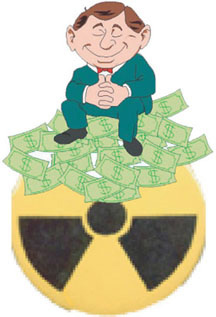 Zuma, the Guptas and the Russians — the inside story RAND DAILY MAIL LILY GOSAM 02 FEBRUARY 2016 “……..Below exposes the reasons why Zuma is so hell bent on forcing the Russian 9 600 MW programme through, irrespective of: the evidence against it (from independent and government sources); the laws that stand in his way; the people that advise against it; and the grave concerns of his own party.
Radioactive plant-feed Continue reading
Karoo, South Africa, community unaware of hazards of uranium mining
 People should make their voices heard in the public consultations expected to take place over the course of the year 2016, before mining rights are granted.
To register as Interested and Affected Parties write to Ferret Mining at info@ferretmining.co.zaor call 012 753 1284/5.
To stay informed, join the Facebook page Stop Uranium Mining in the Karoo.
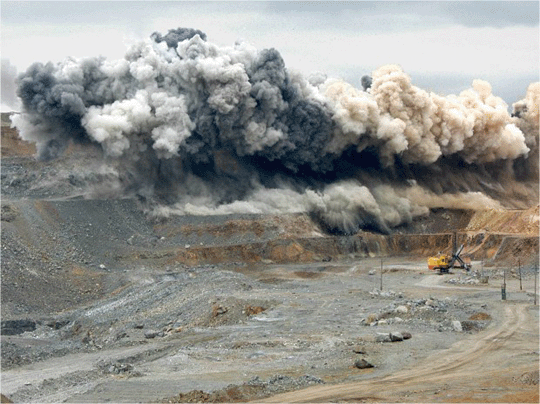 Uranium Mining Threatens the Karoo, Karoo Space, 18 Jan 16 By Dr Stefan Cramer Images sourced by Dr Stefan Cramer Just as the threat of fracking seemed to recede in the Karoo, the danger of uranium mining has arisen – and it is even more frightening and more likely than shale gas extraction.
The Karoo has long been known to harbour substantial sedimentary uranium deposits. Now an Australian company with Russian funding is planning to get the radioactive mineral out of the ground on a major scale.
The company has quietly accumulated over 750 000 hectares of Karoo properties and concessions around Beaufort West and plans to set up a large Central Processing Plant just outside that town.
While the nation is still debating the pros and cons of fracking, the Environmental Impact Assessment (EIA) as the precursor to mining licences is nearing finalisation. During 2016 the Department of Mineral Resources will make a decision on the industry’s application……….
extensive studies on the risks of uranium mining over many decades are available today.
We can draw on vast experiences on what huge impact the uranium mining industry has had in such diverse places as in Germany, USA, Australia or Niger. The death toll of a hugely dangerous industry is well known and firmly established.
Yet so far there is no public debate, no strategic assessment process in place in the Karoo.
No advocacy groups balance the glossy claims of the industry against sobering experiences on the ground. While global energy prices are depressed, the deepening economic and political crisis makes South Africa less and less attractive to the huge investments necessary to establish an upstream gas industry. Continue reading
Political connections in South Africa’s uranium energy drive
 Uranium Mining Threatens the Karoo, Karoo Space, 18 Jan 16 By Dr Stefan Cramer Images sourced by Dr Stefan Cramer “……..It is particularly interesting to see who the South African partners are in this joint venture. The Black Economic Empowerment partner in this case is Lukisa, which holds a total of 26% of Tasman RSA Mines, primarily in the form of exploration rights and nuclear licenses from the National Nuclear Regulator .
Perhaps more important are the excellent relations Lukisa has with Government and the ruling ANC.
Lukisa was founded by the controversial Andile Nkuhlu then a leading member of the ANC Youth League (ANCYL). He belonged to the faction co-opted by the then mining magnate Brett Kebble, whose assisted suicide made headlines in 2005 after he swindled government out of billions of Rand in shady mining deals.
Andile Nkuhlu was then made chief director in the Department of State Enterprises until his career stumbled in a corruption scandal. He pre-empted his dismissal from the ANC by founding the opposition party Congress of the People (COPE).
When this flopped he was readmitted to the ANC and continued to influence provincial polices in the Eastern Cape. A few years ago he relinquished his position at LUKISA because of deteriorating health, until he succumbed to diabetes complications in December 2015.
Now the company is run by Tefo Maloisane, who is said to have a long history of excellent political connections………http://karoospace.co.za/uranium-mining-threatens-the-karoo/
Radiation hazards in planned uranium mining in the Karoo, South Africa
Uranium Mining Threatens the Karoo, Karoo Space, 18 Jan 16 By Dr Stefan Cramer Images sourced by Dr Stefan Cramer “…..According to its documents, Tasman RSA Mines today controls exclusive prospecting rights over more than 750 000 hectares in a circle of nearly 200 kilometres around Beaufort West.
About 32 000 hectares are directly owned under freehold by the company. Local farmers find it hard to resist purchase offers, as farming in this part of the Karoo is particularly difficult due to low rainfall and poor soils.
Unlike in fracking, farms are permanently damaged by uranium opencast mining………
So far the company has not indicated whether they would use ‘in-situ-leaching’, a particularly dangerous but low-cost method. Here, large quantities of leaching agent are injected underground. The uranium is dissolved and recovered in well fields.
The uranium deposits are scattered over large zone of 200 by 300 kilometres which will necessitate trucking of ores over poorly constructed dust roads for hundreds of kilometres to reach the Central Processing Plant.
For this plant, the company has already applied for a water licence to abstract annually 700 million litres of groundwater annually, roughly half of the total water consumption of the Central Karoo Municipality.
It is still unclear what will happen with the contaminated waste water. A discharge of radioactive waste water into the aquatic environment, above or below ground, would be illegal under South Africa’s strict Water Act.
Most probably contaminated slimes will be delivered to large settling ponds, like those around Johannesburg, from which the remaining water will evaporate. This leaves behind a soft and unstable pile of contaminated soil which can be easily mobilised by the strong prevailing winds in the Karoo into large dust dispersal.
Already today, the environment around Beaufort West is contaminated close to the previous mine sites. First field studies by the author show unprotected nuclear wastes with 10 to 20 times the background radiation.
Dust and Radiation – Two Deadly Impacts
The devastating impacts of uranium mining on people, especially the mine workers, and the environment have been well research and documented. Several studies of large number of cases and with exposure over many years (Wismut AG in the former East Germany, theColorado-Plateau in the USA, and Saskatchewan in Canada, have established a particular direct relationship between occupational exposure to uranium and its decay products and lung diseases.
Mining uranium ore in the Karoo will invariably create huge plumes of contaminated dust. Dust clouds are unavoidable during drilling, blasting and transporting.
Dust suppression by spraying water is only partially effective and creates new problems with contaminated slimes, adding to the environmental cost of groundwater abstraction……..http://karoospace.co.za/uranium-mining-threatens-the-karoo/
All of Iran’s enriched uranium removed with Russian assistance
That’s It: All Enriched Uranium Removed From Iran Under Russian Assistance http://sputniknews.com/politics/20151229/1032438231/iran-uranium-russia.html MOSCOW (Sputnik) – All of the enriched uranium in Iran under the Joint Comprehensive Plan of Action, accepted on July 14 in Vienna on Iran’s nuclear energy program, has been removed under Russia’s assistance, the Russian Foreign Ministry said Tuesday.
“Under Russia’s assistance, all of the enriched uranium falling into the Joint Comprehensive Plan of Action has been removed from Iran,” the ministry said in a statement.
On July 14, Iran and the P5+1 group of mediators — Russia, the United States, China, France and the United Kingdom plus Germany — reached an agreement on maintaining a peaceful nature of Tehran’s nuclear program in exchange for sanctions relief.
On Monday, US Secretary of State John Kerry said that Russia played a vital role in arranging for Tehran’s low-enriched uranium being shipped out of Iran under the P5+1 nuclear deal
Kentucky history illustrates the real disaster of nuclear energy
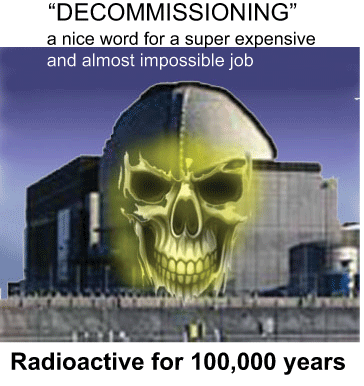 And then there are the power plants themselves after they have completed their 30-40-year life. Do you build a lead mausoleum around it and then another one around it? You certainly can’t dismantle it and take it off to nowhere.
Be wary, Kentucky legislators, when thinking about entering the nuclear field.
KY should stay far from nuclear power http://www.courier-journal.com/story/opinion/2015/12/17/commentary-nuclear-power-waste/77473024/ David Ross Stevens Kentucky history tells us that the commonwealth should stay as far away as possible from nuclear power. Yet the recently past Energy Secretary Len Peters was proposing to the Kentucky legislature that it consider allowing uranium-powered electricity plants. Now there is a new Energy and Environment Cabinet secretary in Charles Snavely, who represented the coal company that was justfined $500,000 to $6 million for water pollution violations. (But that’s another story.) Will Snavely include nuclear energy with a mix of energy in Kentucky’s future?
As coal continues to decline mainly because of natural gas prices and as solar/wind power flex their muscles, nuclear energy always seems to hover on the horizon like an enticing siren.
Here is why Kentucky and every other state should avoid nukes like the plague. Most of the negatives happen in the uranium enrichment cycle before making electricity and in the storage (or non-storage) of radioactive wastes after electrical generation. Both have been disasters for the state: at the uranium enrichment plant at Paducah and at the radioactive waste deposit site at Maxey Flats near Morehead. Continue reading
Down, down, down goes the price of uranium
 URANIUM DAILY SPOT PRICE TUMBLES $1.25 FROM A WEEK AGO TO $36.50/LB
Washington (Platts)–27 Oct 2015
The daily spot price of uranium Monday was $36.50/lb U3O8, down $1.15 from October 20, following a week when sellers accepted incrementally lower offer prices, according to price reporting company TradeTech.
The U3O8 daily spot price has declined nearly every day since TradeTech reported it at $37.75/lb October 16 and 19. The price was $37.65/lb October 20, $37.35/lb the next day, $37/lb October 22 and $36.50/lb on October 22, according to the company, which reported the spot price unchanged Monday.
In its report Friday for the week ended that day, TradeTech said, “a few sellers did attempt to draw out additional buying interest by lowering offer prices. A few buyers did step into the market to take advantage of lower prices, but most buyers remained largely disinterested.”
Overall, it reported an aggregate of 700,000 lb of U3O8 in six transactions were concluded for the week ending Friday, “with prices declining with each successive transaction.”
TradeTech on Friday reported the weekly U3O8 spot price at $36.50/lb, down $1.25 from October 16.
Price reporting company Ux Consulting on Monday also reported a $36.50/lb weekly U3O8 spot price, down $1.25 from October 19……. http://www.platts.com/latest-news/electric-power/washington/uranium-daily-spot-price-tumbles-125-from-a-week-21364472
Uranium industry in Niger from AREVA to Chinese companies
 One uranium mine in Niger says a lot about China’s huge nuclear-power ambitions, Business Insider, 25 Oct 15, ARMIN ROSEN “………the ambitions of the nuclear powers in Niger are still playing out today as Niger’s remote and inhospitable northern desert environment contains the world’s fifth-largest recoverable uranium reserves, some 7% of the global total.
A fourth mine, in a place called Azelik, near the mostly ethnic Tuareg city of In’gall, is currently much smaller than the other three sites.
Like Imouraren, it’s currently shuttered as a partial result of the uranium price dip. But because of its ownership and a checkered recent history, it’s an instructive guide to the future of Niger’s uranium and the global nuclear energy industry at large.
Niger’s Azelik uranium mine, owned and operated by Chinese companies, is at the geographic and economic fringes of a continent-wide wave of Chinese investment, goods, and people. Continue reading
Precious Groundwater in Drought Areas Threatened by Uranium Mining
Why Are We Allowing Uranium Miners to Pollute Groundwater in Drought Zones?

 Uranium mining threatens aquifers that could provide the drought-stricken West with emergency water supplies. BRIAN PALMER OCT 16, 2015 Mining uranium, the fuel for nuclear reactors, is a dirty business. Following World War II, mining companies extracted millions of tons of uranium from Navajo tribal lands in the West, contaminating homes and water supplies in the process. It went on for decades, and Navajo miners developed lung cancer at very high rates.
Today, even as the United States nuclear power industry struggles to survive, uranium mining continues. The techniques are more modern, but conservationists say the threat could be just as insidious: polluting water supplies in drought-ridden parts of the country where drinking water is already alarmingly scarce.
New rules proposed by the federal government last year could help reduce the threat—although industry is fighting to weaken them, along with its Republican allies in Congress. And critics say the proposed regulations might not be strong enough anyhow. Ironically, this might all be happening to extract a resource we barely need anymore—at the risk of one that we most certainly do……..
The industry must now work with what geologists call “roll-fronts.” These are relatively thin uranium deposits that formed deep underground over the course of thousands of years. Typically just 10 to 30 feet in height—too small to be harvested by human miners—the roll-fronts can only be extracted by chemical means.
The process used today is called in situ recovery, or ISR, mining. (Opponents use the more chemically descriptive phrase “in situ leaching,” or ISL.) The mining company drills four or five holes, called injection wells, and then pumps down a mix of an oxidizing agent (often hydrogen peroxide or simple oxygen) and water. Pressure from the constant influx of fluid forces the solution to percolate through the uranium-rich layer of Earth toward another hole, called the production well, which carries it up to the surface. At this point, the company reverses the chemical reaction that dissolved the uranium, using a separate chemical to precipitate the metal out of the water. The water, now stripped of most of the uranium, heads back into the well to continue the cycle…….

In reality, ISR mining isn’t so tidy, and the few peer-reviewed studies available suggest that leaching uranium out of rocks contaminates the surrounding groundwater for decades. As Western states deal with increasing levels of drought, that’s a problem…….
Remediation is water- and time-intensive, but does it work? The answer is pretty disturbing: No one knows. There have been only a handful of major studies on the efficacy of the uranium-mining remediation process. Continue reading
The fight to preserve pure water in Nebraska from uranium mining contamination
Water first! Lakota women and ranchers lead charge to close toxic uranium mine , Ecologist, Suree Towfighnia / Waging NonViolence 13th October 2015 The impending renewal of the license for a uranium mine in Nebraska has ignited a years long resistance among those – most of them women – for whom good health and safe, clean water in the Ogallala aquifer is as important as life itself, writes Suree Towfighnia. But for others, jobs and money come first. Now the Nuclear Regulatory Commission must reach its decision.
With a population of around 1,000 people, the rural town of Crawford, Nebraska was an unlikely setting for a federal hearing.
But it became the site of one in late August thanks to the dogged determination of a group of Lakota and environmental activists, as well as geologists, hydrologists and lawyers – all of whom have been fighting the permit renewal of a uranium mine located in town.
The region is ripe with stories from the brutal Indian wars, when Lakota and neighboring tribes fought over western expansion.
Today, this intersection of frontier America and Native resistance is a battleground in the war between environmental advocates and energy corporations, only this time allies from all sides are joining forces in the effort to protect their water.
The Crow Butte Resources, or CBR, uranium mine is comprised of thousands of wells at the base of Crow Butte, a sacred site located within Lakota treaty territories.
For the past couple of decades CBR has mined uranium using the in situ leach process, which injects water under high pressure into aquifers, extracts uranium ore, and then processes it into yellow cake.
Each year 700,000 pounds of uranium is produced here and shipped to Canada, where it is sold on the open market. CBR has applied for a permit renewal and expansions to three neighboring sites.
Pure water must be protected at all costs Continue reading
Move for Grand Canyon Monument that would ban uranium mining
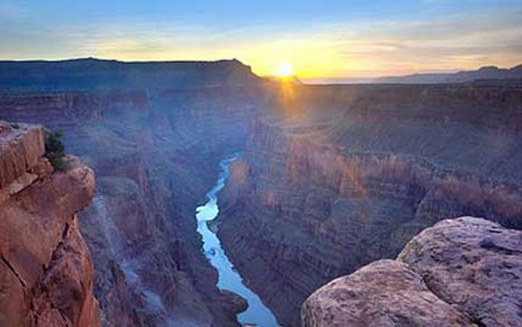 Grand Canyon Monument Would Make Uranium Ban Permanent http://www.fronterasdesk.org/content/10147/grand-canyon-monument-would-make-uranium-ban-permanent By Laurel Morales October 13, 2015 Arizona Congressman Raul Grijalva introduced legislation Monday that would preserve and restore sacred lands, the watershed and the environment north and south of Grand Canyon National Park. The Greater Grand Canyon Heritage National Monument Act would set aside 1.7 million acres of public land.
The area surrounding the Grand Canyon is rich in uranium. In 2012, the Obama administration put a 20-year moratorium on new uranium mining claims. If passed, the law would make that ban permanent.
Eleven tribes connected to the Grand Canyon support the bill. And if passed, they would help manage the monument.
Havasupai council member Carletta Tilousi told a group of reporters her tribe, that lives at the bottom of the Grand Canyon, is at the front lines of groundwater contamination.
“We the Havasupai would like to keep our canyon home clean of no uranium mining,” Tilousi said. “We’d like to see our water remain clean of no uranium mining. We’d like to see our children live in a clean environment, go to our sacred mountains in peace and pray and do our offerings.” This announcement comes at a time when the National Park Service says Energy Fuels has plans to reopen an old mine and extract uranium on Red Butte, what is considered a sacred site by the Havasupai Tribe.
Supporters of the legislation say it will be difficult to get the act through Congress.
Saskatchewan plan to clean up neglected Gunnar uranium mine site
Plan for cleaning up uranium tailings ready for approval BY ALEX MACPHERSON, THE STARPHOENIX SEPTEMBER 28, 2015 The cleanup of a derelict northern Saskatchewan uranium mine could move one step closer this week.
The Saskatchewan Research Council (SRC) — which is overseeing the multi-million-dollar Gunnar Remediation Project on behalf of the provincial government — will present its plan to cover the site’s three tailings deposits at a Canadian Nuclear Safety Commission (CNSC) hearing in Ottawa on Wednesday.
Canada’s nuclear watchdog will consider evidence presented by all interested parties, including the SRC and northern First Nations, before making its decision, which is expected in about six weeks, a CNSC spokesman said Monday…..
After Gunnar ceased production in 1963, the open pit and underground works were flooded with water from Lake Athabasca. The mine was abandoned the following year with little other decommissioning work.
“There was no Department of Environment when those mines were abandoned,” said Ann Coxworth, a nuclear chemist and member of the Saskatchewan Environmental Society board. “At the time, there was, I would say, rather limited understanding of the hazards of leaving those tailings in an unmanaged condition.”
The absence of baseline studies and the insidious effects of radioactive contamination make assessing the Gunnar site’s environmental impact difficult, but it’s clear the work needed to be done, Coxworth said.
“We know that it can’t be cleaned up. (But) the situation can certainly be improved.”……..
Jack Flett, regulatory affairs coordinator for the Athabasca Chipewyan First Nation, said he hopes work on the Gunnar site continues.
“For me, it’s water,” he said, noting that the northern Alberta First Nation is downstream of the Gunnar mine. “Water is everything. Water is life.”….. http://www.thestarphoenix.com/technology/plan+cleaning+uranium+tailings+ready+approval/11397802/story.html
1 This Month

of the week – Shut Down Drone Warfare!


Tell the Ukrainian Government to Drop Prosecution of Peace Activist Yurii Sheliazhenko

Petition to revoke the licensing of the Near Surface Nuclear Disposal Facility (NSDF) at Chalk River. https://www.ourcommons.ca/petitions/en/Petition/Details?Petition=e-7247
To see nuclear-related stories in greater depth and intensity – go to https://nuclearinformation.wordpress.com
-
Archives
- April 2026 (44)
- March 2026 (251)
- February 2026 (268)
- January 2026 (308)
- December 2025 (358)
- November 2025 (359)
- October 2025 (376)
- September 2025 (257)
- August 2025 (319)
- July 2025 (230)
- June 2025 (348)
- May 2025 (261)
-
Categories
- 1
- 1 NUCLEAR ISSUES
- business and costs
- climate change
- culture and arts
- ENERGY
- environment
- health
- history
- indigenous issues
- Legal
- marketing of nuclear
- media
- opposition to nuclear
- PERSONAL STORIES
- politics
- politics international
- Religion and ethics
- safety
- secrets,lies and civil liberties
- spinbuster
- technology
- Uranium
- wastes
- weapons and war
- Women
- 2 WORLD
- ACTION
- AFRICA
- Atrocities
- AUSTRALIA
- Christina's notes
- Christina's themes
- culture and arts
- Events
- Fuk 2022
- Fuk 2023
- Fukushima 2017
- Fukushima 2018
- fukushima 2019
- Fukushima 2020
- Fukushima 2021
- general
- global warming
- Humour (God we need it)
- Nuclear
- RARE EARTHS
- Reference
- resources – print
- Resources -audiovicual
- Weekly Newsletter
- World
- World Nuclear
- YouTube
-
RSS
Entries RSS
Comments RSS
 nuclear-news