NUCLEAR UTILITIES SCRAMBLE TO STAVE OFF TRUMP URANIUM QUOTAS, by John Siciliano & Josh Siegel June 20, 2019 Washington Examiner, : Major U.S. nuclear utilities are warning President Trump it would be a big mistake to impose strict limits on the amount of uranium the nation imports from Canada and other allies, risking thousands of layoffs and other calamitous effects at nuclear power plants.
Trump is expected to meet with his Cabinet in the next few days to discuss recommendations the Commerce Department provided to him in April on placing firm quotas on uranium imports as a matter of national security.
Utility lobbyists representing Exelon, Duke Energy, and other owners of nuclear power plants, say the idea of placing limits on the amount of fissile fuel the nation imports is misguided, and Trump should reject any proposal that recommends such action.
Uranium mining firms had petitioned for the quotas to protect U.S. jobs in the mining sectors under trade provisions aimed at protecting national security……..
Canadian Prime Minister Justin Trudeau, however, is expected to push back against the idea of imposing quotas at Thursday’s bilateral meetings at the White House. …… https://www.washingtonexaminer.com/policy/energy/daily-on-energy-nuclear-utilities-scramble-to-stave-off-trump-uranium-quotas
June 22, 2019
Posted by Christina Macpherson |
politics, Uranium, USA |
Leave a comment
 Top Uranium Producer Is Gloomy About Nuclear Power, for Now, Bloomberg, By Will Wade, June 7, 2019, Don’t expect an upswing in the global uranium market anytime soon.
“In our models, we don’t get excited on the demand side,” said Galymzhan Pirmatov, chief executive officer of Kazatomprom, Kazakhstan’s state-owned mining company that’s the world’s biggest supplier.
With construction of nuclear power plants at a 10-year low, uranium demand remains weak. That’s holding prices so low that mining companies have been wary of increasing production. Kazatomprom’s output will increase about 5% this year, to as much as 22,800 tons, and then will be flat in 2020, Pirmatov said Wednesday in an interview in New York. While he hasn’t yet made a decision on 2021, he doesn’t see much to get excited about, at least in the short term.
“I do believe prices are too low,” he said. Uranium has slumped 15% this year to $24.35 a pound as of Wednesday. Kazakhstan controls about 40% of the world’s supply of the metal, and Kazatomprom accounts for half of that, making it the biggest producer………
U.S. Closings
In the U.S., flush with abundant and cheap natural gas, utilities are closing nuclear plants. The U.S. is also considering whether to impose tariffs on uranium, after two small domestic mining companies filed a trade case last year, arguing that imports are a threat to national security. The Commerce Department concluded its investigation in April, but the results haven’t been made public……..https://www.bloomberg.com/news/articles/2019-06-05/top-uranium-producer-is-gloomy-about-nuclear-power-for-now
June 8, 2019
Posted by Christina Macpherson |
2 WORLD, business and costs, Uranium |
Leave a comment

Uranium Week: Buyers’ Market. https://www.fnarena.com/index.php/2019/05/28/uranium-week-buyers-market, By Greg Peel, May 28 2019
Sellers continue to chase down ever more empowered buyers in an ongoing weak uranium market.
-Uranium spot price continues to fall
-Rio Tinto may shut down Rossing
-US production falls dramatically
It was Groundhog Week last week in the uranium market. With utilities largely out of the market pending a section 232 decision, sellers continue to lower prices in order to flush out buying interest.
And the buyers are not making it easy. Having the upper hand, they are not simply insisting on lower prices, industry consultant TradeTech reports, but on specific origins, delivery locations and other restrictive terms and conditions.
Four transactions totalling 500,000lbs U3O8 equivalent were recorded in the spot market last week. TradeTech’s weekly spot price indicator has fallen -US20c to US$24.30/lb.
The spot price has now fallen -16% in 2019, whittling a 12-month gain down to 6%.
There were no transactions reported in uranium term markets. TradeTech’s term price indicators remain at US$28.50/lb (mid) and US$32.00/lb (long).
Supply Response
Australian-listed diversified miner Rio Tinto ((RIO)) has announced it will advance the closure of its 69% owned Rossing uranium mine in Namibia to June 2020 if the Namibian competition regulator blocks the US$104m sale of the mine to China National Uranium Corp.
Rio cannot continue to operate the loss-making business and would rather cease operations ahead of a forecast 2025 mine life if the sale is rejected.
The Namibian government owns a 3% stake in Rossing but 51% of the voting rights. The Iranian Foreign Investment Co holds 15% and the Industrial Development Corp of South Africa owns 10%.
Persistently low uranium prices continue to impact on global supply. Last week the US Energy Information Agency reported US uranium mines produced 700,000lbs U3O8 in 2018, down -37% from 2017.
Total shipment of uranium concentrate from US mills fell -35%. US producers sold 1.5mlbs of concentrate at an average price of US$32.51/lb.
May 30, 2019
Posted by Christina Macpherson |
2 WORLD, business and costs, Uranium |
Leave a comment
It may become impossible to tell if Iran starts making a nuclear bomb, https://www.newscientist.com/article/2202247-it-may-become-impossible-to-tell-if-iran-starts-making-a-nuclear-bomb/ By Debora MacKenzie, 10  May 19,
The most ambitious effort ever to peacefully stop a country getting a nuclear bomb hangs by a thread this week. On 8 May Iranian president Hassan Rouhani announced that his country would start stockpiling low-enriched uranium and heavy water – a potential step towards building nuclear weapons.
The move was in response to US sanctions, despite Iran’s compliance with the Joint Comprehensive Plan of Action (JCPOA), which aims to limit the country’s potential bomb-making nuclear activities.
JCPOA imposed an unprecedented inspections regime on Iranian nuclear plants, which has been testing novel monitoring technology that could severely limit the spread of the bomb.
The deal does not stop Iran making enriched uranium to fuel its nuclear power plant, or heavy water for a reactor it was building at Arak. But it prevents it stockpiling either or enriching uranium further towards weapons-grade, and says Arak must be re-designed to produce less of another bomb fuel, plutonium.
The incentive for Iran was a lifting of trade sanctions, imposed after it was found to have covertly enriched uranium in the early 2000s. Since then the International Atomic Energy Agency (IAEA) has judged Iran to be in compliance with the deal.
But one year ago, US president Donald Trump pulled out of the JCPOA, saying he was unhappy with the deal. The US re-imposed trade sanctions and threatened countries that did business with Iran with severe trade penalties. Since then Iran’s oil exports have since fallen from 2.5 to 1 million barrels a day.
Now, Rouhani’s pledge means Iran will stop exporting low-enriched uranium and heavy water, which was mandated by the JCPOA, so Iran could continue production without exceeding caps on stockpiles.
The build-up of the materials will not immediately violate the JCPOA. But Rouhani added that if European countries do not, in 60 days, find some way for banks and importers to do business with Iran without suffering US sanctions, Iran will start enriching uranium further – and build Arak to existing specifications. That will be the end of the JCPOA, as Iran resumes its path to a bomb.
We may not even know if it does. The JCPOA provides three levels of safeguards in Iran. It gets the standard inspections the IAEA does in all countries with nuclear plants; additional inspections agreed in 1997 and voluntary for IAEA member states; and extra, unprecedented inspections, including continuous monitoring using novel technology.
James Acton of the Carnegie Endowment for International Peace in Washington, says that without the JCPOA, Iran gets only the basic inspections – which it successfully evaded in the past. Without extra inspections the IAEA cannot draw credible conclusions about the absence of undeclared activities in Iran, says Acton.
In theory inspectors outside Iran could watch for krypton-85, a tell-tale gas emitted when plutonium is extracted from heavy water reactors. But Acton is not even sure Iran would attempt to keep that secret. The idea of having nuclear weapons is to deter attack – and as Dr. Strangelove observed, it isn’t much of a deterrent if no one knows you have it.
May 11, 2019
Posted by Christina Macpherson |
Iran, politics international, Uranium, weapons and war |
Leave a comment
Uranium waste in NM puts lie to ‘carbon free’, Albuquerque Journal, BY DUANE CHILI YAZZIE / SHIPROCK CHAPTER PRESIDENT, NAVAJO NATION, April 26th, 2019 “……..We must understand that abuse of seemingly inanimate matter has consequence. The extraction of uranium and the exploitation of it causes compounded waste and resultant compounded consequence. We have created mountains of radioactive waste; because we have limited knowledge and capacity to conclusively, effectually and permanently deal with this waste, we bury it. Out of sight, out of mind does not ease our minds because we know it is there. My community of Shiprock has one of the largest uranium waste disposal cells in the country sitting in the middle of our community. People who naively exalt science and technology may simultaneously inebriate themselves from the consequence of the devastating reality.The natural law of cause and effect predicates all. With my Navajo people, we have suffered the deaths of hundreds of our uranium miners, millers, transporters and affected family members due to health complications caused by exposure to uranium. In 1979 a United Nuclear Corp. holding pond burst, releasing 94 million gallons of radioactive waste that cascaded through Gallup and on downstream. Women and children who waded in the contaminated Rio Puerco, burning their feet, were told that the radioactive water was a figment of their imagination. … Our lives continue to be at stake. The radioactive levels remain, and we, the contaminated people, continue to develop uranium-related health issues. We die a slow death. The world of science and technology has damaged us and the natural world.
The Public Service Company of New Mexico, which has made an incredible indelible scar of industrial consequence on New Mexico and the Earth, now wants to add more nuclear to its portfolio. By doing so, PNM will only amplify this consequence. Some say that nuclear-generated electricity should be allowed because it is “carbon-free.” From a life-cycle perspective, it is not carbon-free. The semantics are irrelevant; what matters is the eventual and permanent negative impact and consequence to the land, the people and our planet Earth.
(In honor of) this Earth Day, it is imperative we acknowledge the damage done to the integrity of the life of Earth. The seemingly insurmountable effect from the cause of the extractive industry demands our attention. We have a climate crisis that is ebbing the life of our planet. The delicate balance of the equilibrium of the Earth and its life systems have been dangerously upset. We cannot further aggravate this great dilemma with more uranium exploitation and continue to destroy the sanctity of our Earth Mother and all life upon and within her.https://www.abqjournal.com/1307342/uranium-waste-in-nm-puts-lie-to-carbon-free.html
April 30, 2019
Posted by Christina Macpherson |
climate change, Uranium, USA |
Leave a comment
Saskatoon Star Phoenix 20th April 2019 , Canada’s largest uranium producer says it’s developing a plan to clean
up groundwater contaminated with uranium and radiation four months after it was first discovered at a shuttered mill in northern Saskatchewan.
Cameco Corp. reported in December that a sampling well adjacent to its Key Lake mill “was showing an increasing trend in uranium concentration” after 50,000 litres of water were “released” over the previous year. Carey Hyndman, aspokeswoman for the Saskatoon-based company, said this week that the incident was immediately reported to the Saskatchewan Ministry of Environment and the Canadian Nuclear Safety Commission.
https://thestarphoenix.com/news/local-news/cameco-developing-plan-to-clean-up-contaminated-groundwater-at-key-lake
April 22, 2019
Posted by Christina Macpherson |
Canada, Uranium, water |
Leave a comment
The Nuclear Energy Industry Goes MAGA to Win Over Trump
A U.S. uranium company set up shop at CPAC and started spreading Clinton scare stories. The Daily Beast, Lachlan Markay, 03.03.19 A leading U.S. uranium producer is confident that President Donald Trump is going to crack down on its foreign competitors. But in the spirit of not taking any chances, the company rented space at the annual Conservative Political Action Conference, enlisted a top Trumpworld public relations executive, and invoked a well-worn Trump attack line on his 2016 campaign opponent to try to nail down a policy win.
The Texas-based Uranium Energy Corporation posted up in the exhibition hall of the annual conservative confab this week, where it courted conservative activists, radio hosts, and at least one senior White House official with its pitch to crack down on foreign competition in the name of national security.
Specifically, the company is pressing the Department of Commerce to impose quotas on uranium imports that would carve out a quarter of the market purely for domestic producers. The department is scheduled to present its findings to President Trump in April, when he will decide whether to invoke his authority to impose “national security” trade restrictions.
UEC’s pitch isn’t just boilerplate national security or protectionist rhetoric. It has something most other companies vying for attention at this year’s CPAC do not: an opponent that’s been repeatedly called out and demonized by President Trump and his allies—Uranium One.
A Canadian company, Uranium One is a major uranium importer to the U.S., which pits it against UEC’s policy agenda. It is also a boogeyman for conservatives, who believe that then-Secretary of State Hillary Clinton shepherded its acquisition by Rosatom, a nuclear energy company owned by Russia’s state atomic energy agency, after Uranium One’s chairman donated millions of dollars to her family’s foundation.
The conspiracy theory fails to account for the fact Clinton was just one of a board of nine federal officials who signed off on the deal. But that didn’t stop Scott Melbye, UEC’s executive vice president of Uranium Energy Corp, from warning about it while manning the company’s booth at CPAC……..
The UEC company’s presence at CPAC underscores the ways in which private interests frequently attempt to leverage the conference, and its influential attendees, often by tailoring communications and advocacy strategies to the pet issues and causes that animate the moment’s conservative voters, activists, and officials.
UEC wasn’t listed on the conference’s website as either a sponsor or an exhibitor. But a source familiar with its work there said it signed on late as an exhibitor—the lowest level of CPAC sponsorship—which comes at a $4,000 price tag.
Helping to organize UEC’s CPAC presence was Alexandra Preate, a public relations executive who works closely with former White House strategist and leading protectionist Steve Bannon, who formerly ran the pro-Trump website Breitbart. Also mulling about UEC’s exhibit was Matt Boyle, Breitbart’s political editor. ……….
UEC is using the access CPAC offers its sponsors and exhibitors to pursue a strategy tailor-made for Trump-era conservatives. https://www.thedailybeast.com/the-nuclear-energy-industry-goes-maga-to-win-over-t
March 5, 2019
Posted by Christina Macpherson |
business and costs, Canada, politics, Uranium, USA |
Leave a comment
By 2050 the government intends to meet 25% of its electricity needs from nuclear power JADUGUDA, JHARKHAND: Nestled in the mountainous district of East Singhbhum, this tiny dot on India’s vast map has become a virtual cancer ward for its residents, following years of dangerous radiation being emitted from uranium mines and tailing ponds in the area.
Jaduguda (or Jadugora) made its tryst with the hazardous byproducts of ‘clean’ nuclear power just 20 years after independence, when the country launched its nuclear programme.
Meeting 25 percent of India’s uranium needs, the town is in the news again as the Uranium Corporation of India Limited (UCIL) recently announced that it would soon resume its excavation operations here, following the renewal of its land lease for another 50 years.
Will Jaduguda’s residents still be able to live there 50 years from now?
As part of its indigenous nuclear power programme, India aims to generate 14.6 GWe (gigawatts electrical) of power through nuclear reactors in the next seven years – and 63 GWe by 2032.
By 2050 the Indian government intends to meet 25% of its electricity needs from uranium-based nuclear power, as against 5% at present.
This ambition, however, may annihilate a large number of Adivasi citizens resident in Jaduguda – from the Ho, Birhore, Santhal, Kora, Beiga, Munda, Malpahari and Mahali communities – who already are paying very dearly for uranium mining.
Due to the dangerous fallout of radiation, they are suffering from a plethora of clinical problems which were unheard of in the area before the public sector UCIL began excavating uranium ores in 1967.
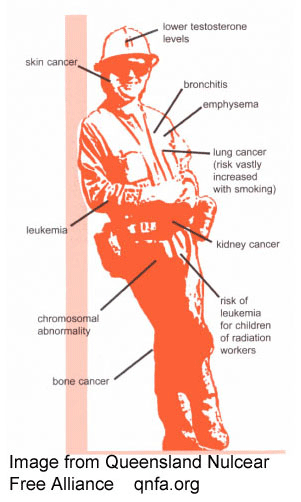
People in the area suffer disproportionately from congenital deformities, sterility, spontaneous abortions, cancers and a plethora of other serious diseases known to be caused by radiation and industrial pollution.
Despite the low risk and damage done by wind and solar renewable energy generation, large, destructive hydel projects and nuclear reactors with highly toxic byproducts continue to be a part of India’s energy generation plans – not to mention the use of fossil fuels which continues unabated.
Jaduguda’s residents inhale toxic air. They drink poisoned water. They consume vegetables and cereals laced with radioactive iodine. They are exposed to radiation 24×7.
As you enter the hamlets located around UCIL’s mines and tailing ponds, where radioactive elements are dumped, the gory sight of deformed children playing innocently with their homemade toys meets your eyes.
The culprit is uranium, the highly radioactive mineral used in making nuclear warheads and for generating electricity.
Uranium is a sleeping monster. An estimated 99.28% of mined uranium ore is effectively waste – referred as tailings. These wastes are very highly radioactive with a centuries’ long half life.
In India the process of neutralising the toxicity of tailings is still done in a rudimentary manner, with simple lime, with the wastes carried through pipes to tailing ponds.
Of course, nowhere in the world is there a safe way to permanently dispose of nuclear waste, or render it harmless. In Jaduguda, though the tailings are treated at an effluent treatment plant for the removal of radium and manganese, solid radioactive matter settles in the ponds, allowing toxic iodine to vitiate the entire atmosphere.
Radioactive elements also leak out of the tailing ponds and enter the earth and water during floods, affecting people, livestock, rivers, forests and agricultural produce in and around Jaduguda.
Yellowcake or urania, processed from uranium, is the lifeblood of any nuclear programme. Jaduguda uranium ore can be enriched to 0.065-grade, making it highly valuable for nuclear power generation. The yellowcake produced Jaduguda is sent to nine nuclear reactors in India.
To obtain about 65 grams of usable uranium, UCIL needs to mine, grind and process 1000 tonnes of uranium ore. The waste is thrown into the tailing ponds.
As mentioned these tailings undergo radioactive decay to produce other radioactive substances, such as radium-226 which in turn produces radon-222 gas, a highly toxic cancer-causing gas, which emits high-energy alpha and gamma particles that can shred genetic material in our cells, leading to cancer and other illnesses.
For instance, radon-222 gas damages the air passages in our lungs. It remains radioactive for 1,600 years.
Some 36,000 to 40,000 citizens – mostly Adivasis – live within 5 kilometres of Jaduguda’s tailing ponds. So you can imagine what the extent of this “radiation trap” would be, given that uranium has been excavated and enriched here almost without a break since 1967.
The ores go through several process of purification. At each and every process, the ores emit radiation and other carcinogens.
Since the mining is carried out at depths as great as 880 metres, the miners also endanger their lives.
As long as uranium remains buried deep inside the earth, it does not pose any danger to living beings. But the moment it is brought out to the surface of the earth and ground, levels of radioactivity become hazardous in the ways described above.
Inside the Cancer Ward
On visits to villages in the Jaduguda uranium mine area, whether Chatikocha or Dungridih or others, several times this writer came across unusually large numbers of deformed children. They were born deformed.
According to an official estimate by the Union Ministry of Social Justice and Empowerment, nearly 3 percent of Indians suffer from physical disabilities, with congenital deformity being one of them.
In Jaduguda the rate is 50 percent higher, at 4.49 percent.
Cases of impotency, frequent abortions, infant mortality, Down’s syndrome, cancers, thalassemia and other serious diseases have made Jaduguda their home.
Some 9,000 people here – almost a quarter of the population – are suffering from congenital deformities, leukemia, and various forms of cancer. Cancer deaths are commonplace here, and do not surprise locals at all now.
Now uranium mining is set to resume here, despite this public health catastrophe. Jaduguda’s citizens are slowly being choked to death before our eyes.
January 7, 2019
Posted by Christina Macpherson |
health, India, Uranium |
Leave a comment
 How Poor Is the Long-term Outlook for Cameco Corp. (TSX:CCO)? The Motley Fool Matt Smith | December 27, 2018 “………it is becoming increasingly unpopular. This is primarily due to the dangers it poses during times of catastrophic failure, as demonstrated by the Fukushima incident. There are also concerns over the safe processing and storage of the radioactive waste that it produces.
Bullish analysts point to growing demand for the fuel and rising supply constraints as the reason to be optimistic for uranium and Cameco. This makes the demand side dynamics for uranium appear healthy, pointing to higher consumption which will bolster prices.
However, other nations are moving to reduce their dependence on nuclear power in favour of renewable sources of energy which in recent years have become significantly cheaper to install and operate. The inherent risks associated with nuclear power see France intending to reduce the share of its electricity generated by nuclear by 25% by 2025. Whereas Germany has measures in place to decommission all reactors by 2022 and South Korea intends to undergo a similar process.
According to analysis conducted by asset management firm Lazard, utility scale solar and wind generated electricity is significantly cheaper to produce than nuclear as well as coal and natural gas-fired power generation. This explains why a record level of renewable energy was installed during 2017 and most of that new installed capacity was composed of solar and wind. This points to a sharp deterioration in demand for nuclear power over the long term, particularly given that some of the reactors under construction will replace existing reactors that are to be decommissioned.
No analysis is complete without an understanding of the supply-side of the equation. Recent production cutbacks by Cameco and Kazakhstan’s state-owned producer Kazatomprom triggered uranium’s latest rally and those are likely only to be temporary. Both miners will boost output once uranium prices firm sufficiently to make the operations that they have shuttered economic to operate. Then you have nations such as Namibia, the world’s sixth-largest producer, which is aiming to boost production to benefit financially from uranium before it falls into disuse, becomes a stranded asset and loses its value.
The long-term outlook is poor
While the average spot price during the third quarter 2018 was higher than the equivalent period in 2017 Cameco’s revenue of $488 million was flat year over year. This can be attributed to much of the uranium sold by the miner being priced according to long-term contracts. Cameco, however, reported a significant improvement in its bottom line, announcing adjusted net income of $15 million compared to a $50 million loss a year earlier.
The miner has also secured additional uranium deliveries during the fourth quarter 2018, which along with firmer prices, bodes well for Cameco to report stronger earnings. This will give its stock a short-term lift, but it appears that any lasting recovery may never occur. The reasons for this are simple: there is no sign of the bear market for uranium ending anytime soon. A combination of declining demand over the long-term and the potential for supply to grow significantly all points to uranium never attaining its pre-Fukushima prices. https://www.fool.ca/2018/12/27/how-poor-is-the-long-term-outlook-for-cameco-corp-tsxcco/
December 28, 2018
Posted by Christina Macpherson |
business and costs, Uranium |
Leave a comment
The real cost of uranium mining October 29, 2018 by beyondnuclearinternational
The case of Tummalapalle By Krishna Shree and Rajesh Serupally, First PostGangotri was 10 when the first boil appeared on her leg — an itchy pustule that soon led to others. Two years later today, both her legs are covered in scabby blisters that continue to spread. Doctors haven’t been able to diagnose her condition or cure it.
Gangotri is a chirpy, carefree child — she unselfconsciously showed us the skin disease (pictured above the headline) that has so changed her life. However, the mood in her village — Kottala in Kadapa district, Andhra Pradesh — is one of anger. Gangotri isn’t the only one to suffer from the mysterious ailment, other cases abound, as do other conditions: unheard-of diseases, death of livestock, loss of crops. Bad news is in plenty, and residents point to one culprit: the neighbouring Tummalapalle uranium mine.
The mine started its operation in 2012 after getting the requisite environmental clearance in 2006; the uranium ore in the Kadapa Basin is the largest reserve in the country. The neighbouring villages of Tummalapalle, Mabbuchintalapalle, Bumayigaripalle and Rachakuntapalle of Velpula and Medipentla Mandals and 60 hectares in Kottala village of Vemula Mandal were acquired by Uranium Corporation of India Limited (a government enterprise) for ‘tailing disposal’ — these are the areas where waterborne refuse material is pumped into a body known as a tailing pond. This is where the radioactive mining waste has been dumped for the past six years.
The Tummalapalle project, consisting of an underground mine and processing unit, processes 2,350 tonnes of ore per day (according to a letter sent to the Uranium Corporation of India by the Andhra Pradesh Pollution Control Board). Only 1,305 grams of uranium can be extracted out of the 2,350 tonnes and the rest becomes radioactive waste which is dumped into the tailing pond. It’s been six years since the plant was commissioned, in April 2012. So if we do the math, then till today the plant has dumped some 51,46,500 tonnes (that’s 5,14,65,00,000 kg) of radioactive waste into the tailing pond.
The remnants of the mining process are stored in the form of a semi-solid slurry, pumped to the pond located six km away from the unit. This slurry contains thorium and radium, which are common components of the leached material and airborne dust from uranium ore tailings and waste piles. They pose a serious health hazard if inhaled or ingested. When we visited the tailing pond, we noted that neither is the area cordoned off, nor does it have restricted entry. The locals with their cattle frequent the area for grazing and other such activities, almost as if it is a normal thoroughfare.
Global safety protocol dictates that all tailing ponds be lined with bentonite clay and polyethene to avoid polluting ground water. But the tailing pond at Tummalapalle is unlined and the radioactive slurry has found its way into all the neighbouring water bodies. It has affected everything in its wake, from livestock to crops and has started to show its effects on the people as well.
The ground water in surrounding villages has become contaminated by uranium and other heavy metals according to a Centre for Materials for Electronics Technology (C-MET) report. This test was carried out at the behest of YS Avinash Reddy (Member of Parliament elected from Kadapa ) after having received complaints from the locals about the apparent water contamination.
Dr Babu Rao, a retired scientist from the Indian Institute of Chemical Technology (IICT, Hyderabad) says, “They admit that they have not lined the pond as per the conditions given in the CFE (Consent For Establishment document). UCIL claims that they have followed the more stringent norms of Atomic Energy Regulatory Board (AERB). It does not stand to scrutiny with the reality at the pond. Now that the pond is full, it is difficult to cross check the permeability of the bottom. Side slopes abutting the tailings are not lined or compacted — as is evident visually. Slopes are highly porous and may be causing severe seepage loss of liquid coming with tailings. Even the bottom is not seepage proof. Approximate calculations indicate a loss of at least 43 m3/day from the bottom surface. That is a lot of contamination.”
After numerous complaints, UCIL established an RO plant (Reverse Osmosis for water purification) in KK Kottala and Mabuchintalapalle. Kanampalli’s request was denied. Ravi Nayak, the Mandal Praja Parishad (MPP) president of Kanampalli told us, “Despite offering our land free of cost to set up the RO plant, UCIL never approved one for our village. Now we are buying drinking water from outside.”
In KK Kottala, Mabuchintalapalle and Kanampalli, as soon as people found out we were there to talk about the mine, they started pouring in with complaints. Most of these were about chronic skin problems which doctors had been unable to cure, uniformly present in people of all ages since all of them still use the contaminated groundwater for cooking, washing, bathing etc. They showed us their limbs covered in itchy black scabs. A similar pattern of skin problems was seen in the livestock as well.
Karthik, a nine-year-old from KK Kottala, has been suffering from skin problems for the past few years. He constantly itches his body, pain visible on his young face. His right thigh had finally healed after years of medication. But the disease has now reappeared on his left hand and is spreading again.
The rashes are just the first strike. Thorium and radium present in mine tailings which have contaminated the water sources, have been shown to lead to a higher risk of cancer (eg. cancer of the bone).
Uranium, which is a radioactive element, has a half life of 2,40,000 years and emits radiation for thousands of years. Uranium radiation has the ability to damage human DNA. A team comprising members of NAPM (National Alliance of People’s Movements) and HRF (Human Rights Watch) measured radiation at different places in and around the tailing pond on 11 June 2018, as part of their study of the impact of the mine. The reading were recorded using a Radiation Dosimeter. At the tailing pond, the reading was as high as 0.80-0.90 µSv Microsievert/hour (a measure of the amount of radiation that a person is exposed to during one hour in the specific area). And at a farm in Kanampalli, it was found to be 0.26 µSv Microsievert/hour. The maximum permissible limit is set at 0.24 µSv Microsievert/hour by internationally accepted standards on background radiation.
Chandra Nayak’s farm was once flourishing but the past few years have been bleak. When we visited, the farm only had droopy plantains trees with blackened, shrivelled branches to show.
The death of the cattle in the affected villages made us recount the words of Ghansham Birulee of Jharkhandi Organisation Against Radiation. Birulee was among the first people to witness the effects of uranium mining in Jaduguda in Jharkhand. “The animals started leaving Jaduguda area immediately after the mining started… They must have sensed the radiation earlier than the humans,” Birulee had said.
Back in Kunampalle, P Narsimulu a 65-year-old resident, says, “The livestock in the village has been dying in large numbers since last year. The goats have been shedding hair excessively. They are unable to walk properly due to weak bones. This is all due to radiation.”
The Lambada community in Kanampalli is among the worst affected. They do not own any land and depend on cattle (goats, cows, buffaloes) to make a living. We spoke to Bhaskar, who lost 30 of his goats over the last couple of years. “I didn’t even have money to take all of them to the vet. Each injection costs more than Rs 175 and the vet himself was 12 km away in Pulivendula. I just sat and watched them die one after the other.” ………..
Ashish Birulee say that “once the mining starts it would be very difficult for the locals to shut it down even when they finally learn and realise (the full extent of) the problems. Jaduguda should be taken as an example. Whatever the villagers are going through is real — severe health problems and cancers are very common. And the future is sure to be much worse, and people should take that as a given. UCIL will never accept the truth that uranium mining and dumping of radioactive waste negatively impacts human health and environment.”
“It took almost five decades for the effects of the radiation to become evident in Jaduguda. But by what we can see in Tummalapalle, it might take less than 15 years for it to become the next Jaduguda,” he adds. Birulee points out that UCIL still hasn’t answered a question which the people of Jaduguda have been asking for decades: “What will happen to us once the mining stops?”
If Jaduguda is any indication, UCIL will disappear from the site as soon as the project loses its economic viability. Those who live in the area will be left grappling with the tonnes of radioactive waste left behind. Where will these people go for help? Who should they complain to, about the way their lives have been bartered in the name of development and better economic prospects? Amid the finger-pointing any real solution remains elusive. https://beyondnuclearinternational.org/2018/10/29/the-real-cost-of-uranium-mining/
October 29, 2018
Posted by Christina Macpherson |
environment, health, PERSONAL STORIES, Uranium |
Leave a comment
 Federal Uranium Contamination Rule Withdrawn, Wyoming Public Media By COOPER MCKIM • OCT 23, 2018 The U.S. Environmental Protection Agency (EPA) has withdrawn a proposed rule that would limit contamination of groundwater from uranium mining long-term. The regulation was proposed on former President Barack Obama’s last day in office.The form of mining is called in-situ recovery (ISR); it’s the only technique used in Wyoming. It retrieves uranium from aquifers by drilling an injection well and then using liquid to mobilize it and produce it. The problem is that same mobilization technique brings out other chemicals and heavy metals like lead, arsenic, and mercury. Those contaminate the aquifer water and potentially seep into other groundwaters. Federal Uranium Contamination Rule Withdrawn, Wyoming Public Media By COOPER MCKIM • OCT 23, 2018 The U.S. Environmental Protection Agency (EPA) has withdrawn a proposed rule that would limit contamination of groundwater from uranium mining long-term. The regulation was proposed on former President Barack Obama’s last day in office.The form of mining is called in-situ recovery (ISR); it’s the only technique used in Wyoming. It retrieves uranium from aquifers by drilling an injection well and then using liquid to mobilize it and produce it. The problem is that same mobilization technique brings out other chemicals and heavy metals like lead, arsenic, and mercury. Those contaminate the aquifer water and potentially seep into other groundwaters.
The proposed rule under Obama would have set standards requiring operators to do long-term monitoring of groundwater conditions while lowering how much of eachchemical is allowed. Both would be stricter than Wyoming’s current standards. The federal version would require quarterly monitoring over three years rather than one ensuring contaminant concentrations remained at pre-mine levels. ……
The National Resource Defense Council found no groundwater near ISR mines have been returned to pre-mine conditions.http://www.wyomingpublicmedia.org/post/federal-uranium-contamination-rule-withdrawn#stream/0
|
|
October 25, 2018
Posted by Christina Macpherson |
politics, Uranium, USA |
Leave a comment
 US EPA withdraws Obama administration uranium safety regulation Mining Technology, By JP Casey, 23 Oct 18
The US Environmental Protection Agency (EPA) has withdrawn a uranium safety proposal introduced in the last days of the Obama administration that would have introduced tighter regulation for uranium mill tailings to minimise the dangers of uranium extraction.
Uranium mill tailings are sandy materials produced as a by-product of uranium mining, which contain radioactive elements. The US Nuclear Regulatory Commission (NRC) states that only waste products produced by surface operations, such as in-situ recovery and ion exchanges, can be considered mill tailings, unlike waste materials left behind underground when ore bodies are depleted.
As a result, mill tailings can pose a threat to people, animals and the environment in the vicinity of a uranium mine, with water sources particularly vulnerable to surface waste.
Uranium operations in the US are governed by the Uranium Mill Tailings Radiation Control Act, which places responsibility for the regulation and disposal of mining waste with individual states, rather than the NRC.
The Obama-era proposition sought to give the NRC greater authority over tailings regulation and removal, and would have addressed an imbalance in the number of states that regulate their own waste and those which rely on the NRC for guidance.
Currently, just 13 states defer to the NRC for tailing regulation……
October 23, 2018
Posted by Christina Macpherson |
business and costs, health, Uranium, USA |
Leave a comment
 Reuters 11th Sept 2018 , French nuclear group Orano on Monday inaugurated a 1.15 billion euro (1.02
billion pounds)uranium conversion plant despite huge global overcapacity
for nuclear reactor fuel. State-owned Orano’s new plant in Tricastin,
southern France, will account for a quarter of the world’s 60,000-tonne
annual uranium hexafluoride (UF6) production capacity when it fully ramps
up in 2021 and is set to have the industry’s lowest costs, the company
said. UF6, produced by combining “yellowcake” uranium ore concentrate
with fluorine, is a precursor of enriched uranium, which fuels the
world’s nuclear plants. Following the 2011 Fukushima disaster in Japan,
uranium prices are near decade lows as several countries reduced their
reliance on nuclear energy.
https://uk.reuters.com/article/uk-france-nuclearpower-enrichment/french-orano-opens-uranium-conversion-plant-despite-glut-idUKKCN1LQ2O9
September 12, 2018
Posted by Christina Macpherson |
business and costs, France, politics, Uranium |
Leave a comment
 Fighting for life in the “place of death”https://beyondnuclearinternational.org/2018/08/27/fighting-for-life-in-the-place-of-death/ August 27, 2018 by beyondnuclearinternationa
Traditional owners won’t give up 40-year opposition to Yeelirrie uranium mine, By Linda Pentz Gunter
In the local Aboriginal language, the name Yeelirrie means to weep or mourn. It is referred to as a “place of death.” Yeelirrie is on Tjiwarl Native Title lands in Western Australia, where it has long been faithfully protected by Aboriginal traditional owners. The Seven Sisters Dreaming songline is there. It is home to many important cultural sites. And for 40 years, due to resolute indigenous opposition, and thousands of community submissions of protest, it had been spared plans by the Canadian mining company, Cameco, to plunder it for uranium.
The earth guardians know that such a desecration would cause the extinction of multiple species of subterranean fauna. It would release death. It would destroy Yeelirrie.
Now the fate of those tiny creatures hangs in the balance, their future in the hands of three brave women, backed by environmental organizations, after the outgoing Western Australian government decided to allow the Yeelirrie uranium mine project to go forward.
That decision was made in January 2017, despite the fact that, in August 2016, the Western Australia Environmental Protection Agency (WAEPA) had recommended that the Yeelirrie project be rejected.
The Conservation Council of Western Australia (CCWA), which is engaged in contesting the uranium mining permit for Yeelirrie, said the WAEPA had rejected the Yeelirrie mine plan “on the grounds that the project is inconsistent with three of the objectives of the Environmental Protection Act — the Precautionary Principle, the Principle of conservation of biological diversity, and the Principle of intergenerational equity. The EPA decision was based on the overwhelming evidence that the project would make several species of subterranean fauna extinct.”
But former Minister for Environment, Albert Jacob, threw all that aside to approve the Yeelirrie mine in the waning days of Western Australia’s Liberal government, now replaced by Labor, which came in on a mandate to end uranium mining that it now may not be able to enforce.
In February 2018, CCWA and three members of the Tjiwarl community initiated proceedings in the Western Australia Supreme Court in an attempt to invalidate the approval decision made by Jacob. The case was dismissed by the court, a decision said CCWA executive director, Piers Verstegen, that shows that “our environmental laws are deeply inadequate,” and “confines species to extinction with the stroke of a pen.”
However, while the decision was a set-back, Verstegen said, “it’s absolutely not the end of the road for Yeelirrie or the other uranium mines that are being strongly contested here in Western Australia.”
Accordingly, CCWA and the three Tjiwarl women — Shirley Wonyabong, Elizabeth Wonyabong, and Vicky Abdullah (pictured left to right above the headline) vow to fight on, and have begun proceedings in the WA Court of Appeal to review the Supreme Court decision.
“I grew up here, my ancestors were Traditional Owners of country, and I don’t want a toxic legacy here for my grandchildren,” Abdullah told Western Australia Today in an August 2017 article.
“We have no choice but to defend our country, our culture, and the environment from the threat of uranium mining — not just for us but for everyone.”
Yeelirrie is one of four uranium mines proposed for Western Australia. The other three are Vimy’s Mulga Rock project, Toro Energy’s Wiluna project, and Cameco’s and Mitsubishi’s Kintyre project. Each of them is home to precious species, but Yeelirrie got special attention from the WAEPA because the proposed mine there would cause actual extinctions of 11 species, mostly tiny underground creatures that few people ever see.
According to a new animated short film, produced by the Western Australia Nuclear-Free Alliance, all four of these proposed mines could irreparably damage wildlife, habitat and the health of the landscape and the people and animals who depend on it. The film highlights Yeelirrie, but also describes the other three proposed uranium mines and the threats they pose.
At Mulga Rock, in the Queen Victoria Desert, the site is home to the Sandhill Dunnart, the Marsupial Mole, the Mulgara and the Rainbow Bee Eater, according to the film.
Wiluna, a unique desert lake system, could see uranium mining across two salt lakes that would leave 50 million tonnes of radioactive mine waste on the shores of Lake Way, which is prone to flooding.
The Kintyre uranium deposit was excluded from the protection of the Karlamilyi National Park within which it sits so that uranium could be mined there. It is a fragile desert ecosystem where 28 threatened species would be put at risk, including the Northern Quoll, Greater Bilby, Crest Tailed Mulgara, Marsupial Mole and Rock Wallaby.
At Yeelirrie, says the CCWA, “Cameco plans to construct a 9km open mine pit and uranium processing plant. The project would destroy 2,421 hectares of native vegetation and generate 36 million tonnes of radioactive mine waste to be stored in open pits.”
The mine would likely operate for 22 years and use 8.7 million litres of water a day.
Under Australian laws, ‘nuclear actions’ like the Yeelirrie proposal also require approval by the Federal Environment Minister. CCWA and Nuclear-Free Western Australia, have launched a campaign directed at Federal Environment Minister, Josh Frydenberg, calling for a halt to the Yeelirrie mine, given the immense risk it poses to “unique subterranean fauna that have been found nowhere else on the planet.” They point out that the Minister has the opportunity to “protect these unique species from becoming extinct.
“Species have a right to life no matter how great or small,” they wrote. “One extinction can massively disrupt an entire ecosystem. No one should have the right to knowingly eliminate an entire species from our planet forever.”
August 29, 2018
Posted by Christina Macpherson |
AUSTRALIA, indigenous issues, opposition to nuclear, Uranium |
Leave a comment