“Get the Hell Off”: The Indigenous Fight to Stop a Uranium Mine in the Black Hills

An unidentified member of AIM Native American woman sits with her rifle at ready on steps of building in Wounded Knee, South Dakota, March 2, 1973. Indians still have control of town having seized it on Tuesday. Eleven hostages they had taken were finally released. (AP Photo/Jim Mone)
Get the Hell Off”: The Indigenous Fight to Stop a Uranium Mine in the Black Hills
Can the Lakota win a “paper war” to save their sacred sites?
Mother Jones, BY DELILAH FRIEDLER; PHOTOS BY DANNY WILCOX FRAZIER, MARCH/APRIL 2020 ISSUE, Regina Brave remembers the moment the first viral picture of her was taken. It was 1973, and 32-year-old Brave had taken up arms in a standoff between federal marshals and militant Indigenous activists in Wounded Knee, South Dakota, on the Pine Ridge Indian Reservation. Brave had been assigned to guard a bunker on the front lines and was holding a rifle when a reporter leaped from a car to snap her photo. She remembers thinking that an image of an armed woman would never make the papers—“It was a man’s world,” she says—but the bespectacled Brave, in a peacoat with hair pulled back, was on front pages across the country the following Sunday……..
In October, Brave spoke at Magpie Buffalo Organizing’s inaugural “No Uranium in Treaty Territory” summit, which offered a crash course on tribal sovereignty. The activists are closely tracking the various Keystone XL permits, which the Rosebud Sioux Tribe is challenging in court as a treaty violation. As the threat of both uranium and gold mining looms, there’s talk of occupying land in the Black Hills, as the American Indian Movement did in 1981.
Low Oil Prices May Kill Off The Next Nuclear Boom Before It Begins
 Low Oil Prices May Kill Off The Next Nuclear Boom Before It Begins, Oil Price, By Alex Kimani – Apr 27, 2020
Opening up the West
On Thursday, the Nuclear Fuel Working Group (NFWG) made recommendations to the U.S. Administration to open up ~1,500 acres outside the Grand Canyon for uranium production, arguing that the country needs to beef up domestic production to avoid an over-reliance on foreign sources.
The organization has recommended spending $1.5 billion over ten years buying uranium from American producers to create a uranium stockpile that would necessitate buying about 10 million pounds a year.
The working group’s report claims that the United States also needs more uranium for two other purposes:
– Low-enriched uranium for the production of tritium for nuclear weapons through the 2040s, and
– Highly enriched uranium to be used as fuel for Navy nuclear reactors through the 2050s
The slow and painful demise of the American uranium mining industry can be chalked up to the fact that the country is not endowed with the most abundant and most accessible uranium deposits, with resources in Canada and Australia boasting significantly higher uranium content and a lower production cost per unit.
American miners have had trouble making a profit from their operations even at the best of times. Consequently, the industry has historically had to rely heavily on government largesse.
During the golden age of American uranium that spanned from 1955-1980, the U.S. government offered fat uranium bonuses in a bid to shore up its stockpiles during the Cold War. These included 10-year price guarantees for certain kinds of ore as well as $10,000 discovery and production bonuses for new sources, which pencils out to nearly $100K in today’s dollars. The incentives set off a mad gold rush in the nation’s vast Western region as every man with a jeep and a Geiger counter set out to make the next significant discovery.
The program was a resounding success: U.S. uranium stockpiles skyrocketed so much that the government stopped paying out the bonuses sometime in the 1960s…….
By 1987, the tables had turned completely, with the country importing nearly 15 million pounds of uranium while domestic production clocked in at just 13 million.
Growing competition weighed heavily on domestic production while the country’s love affair with nuclear energy got its first dose of the harsh reality of nuclear technology thanks to the Three Mile Island nuclear disaster in 1979 as well as the Chernobyl reactor meltdown of 1986 that turned an entire Ukrainian city into a ghost town. Meanwhile, utilities began to grow weary of the time and cost of building reactors, which further depressed demand.
The result: U.S. uranium production had sunk to a 35-year low by the time the last wave of reactors came online in 1990…….
Brief Renaissance
The U.S. uranium industry enjoyed a renaissance in the early 2000s as falling global stockpiles, and booming economies in China and India drove new demand.
Unfortunately, this, too, was not to last as the financial crisis of 2008 destroyed demand, while the Fukushima nuclear disaster of 2011 led to another severe backlash that set off a new round of reactor closures while Germany set to phase out the technology by 2022.
The third nuclear gold rush is starting off on very shaky grounds, too.
First off, the world’s strategic uranium reserves are not in any immediate danger of running out. In 2016, the International Atomic Energy Agency said that the global nuclear fleet has enough stockpiles for 130 years, more than enough for the markets to respond to any shortfalls rapidly as they have done in the past. …..
But more importantly, trying to open up the west for uranium mining is bound to be met with stiff resistance and widespread public uproar.
For all its setbacks over the years, nuclear power has remained broadly popular in the United States. However, the turning point came in 2016 when the majority of people turned against the technology.
The latest poll last year revealed that American public opinion remains split over nuclear power, with 49 percent of U.S. adults either strongly favor (17 percent) or somewhat favor (32 percent) it in power generation while 49 percent either strongly oppose (21 percent) or somewhat oppose (28 percent) its use……
The funny thing is that Gallup has found that American opinion on nuclear power does not have much to do with radiation or safety concerns; rather, it is driven by prevailing fuel prices. …..
a 2020 Colorado College Conservation in the West Poll found that 71 percent of voters in the Mountain West and 77 percent of Arizona voters oppose the development of new uranium mines on public lands adjacent to the Grand Canyon. It’s the kind of backlash that no president wants to deal with, whether they are seeking re-election or not. https://oilprice.com/Energy/Energy-General/Low-Oil-Prices-May-Kill-Off-The-Next-Nuclear-Boom-Before-It-Begins.html
Trump administration to boost uranium mining, weaken environmental regulations
|
Trump officials pitch nuclear plan that would bolster struggling uranium industry, The Hill
BY REBECCA BEITSCH – 04/23/20 The Trump administration on Thursday outlined its plan for revitalizing the U.S. nuclear energy industry in a move that would boost uranium mining while benefiting just a handful of companies.The report from the Nuclear Fuel Working Group includes a set of recommendations to the White House and comes as the price of uranium has steadily fallen over the past decade. he effort to shore up nuclear power is sure to be controversial. Uranium mining has been floated in sensitive areas, including land near the Grand Canyon. …. Nuclear energy has also struggled to remain competitive with other energy sources, leaving some states to bail out nuclear reactors to the tune of tens of millions of dollars to keep them afloat…. To revitalize the industry, however, the new report backs President Trump’s proposal to spend $150 million on a uranium reserve, which would buy U.S.-mined uranium from the small number of domestic producers. The Uranium Producers of America identifies just eight members on its website……. Also at risk is nearly 1,562 square miles just outside the boundaries of the Grand Canyon that since 2012 have been off limits for production. Critics have worried Trump might seek to overturn that ban since he declared uranium a critical mineral for national security purposes at the end of 2017. Some uranium mining companies already own some of that land, and there’s been a push from some Republicans lawmakers to open the area for mining. “It’s despicable to risk irreversible harm to spectacular wild places by propping up uranium companies that can’t compete in global markets,” Taylor McKinnon with the Center for Biological Diversity said in a statement Thursday…….. The report published Thursday, however, calls for “expand[ing] access to uranium deposits on federal lands, including support for necessary legislation” and reconsidering categorical exclusions that bar mining in certain areas. It also recommends overhauling regulations to more quickly spur any number of nuclear projects and easing requirements under the National Environmental Policy Act (NEPA). The Trump administration has already proposed a major rollback of NEPA that is set to be finalized in the coming months, including provisions that give companies a greater role in assessing the environmental safety of their own projects. The report also identified potential new financing sources for nuclear projects, like the Export-Import Bank, and changing “legacy policies that disallow support for nuclear projects” to open up financing from the U.S. International Development Finance Corporation…… https://thehill.com/policy/energy-environment/494315-trump-officials-pitch-nuclear-plan-that-would-bolster-struggling |
|
Trump’s new uranium plans threaten Grand Canyon area
|
New Trump Nuclear Plan Favors Uranium Mining Bordering the Grand Canyon, The administration, seeking to restore America’s “competitive nuclear advantage,” also wants to create a $150 million uranium reserve in the coming decade. Inside Climate News, Judy Fahys APR 26, 2020
Evergreen forests blanket the Grand Canyon’s less traveled northern plateau, and the perfume of Ponderosa pine drifts down a creekbed to the bottom of the great redrock canyon. Downstream, the strangely blue waters of the Little Colorado River meet the main Colorado, coming from the southern plateau close to sacred places for indigenous people who have lived here for centuries.
Both plateaus are also where mining companies want to unearth uranium. Mining those claims has been barred since 2012, when Congress imposed a 20-year mining ban across 1,000 acres here because past uranium extraction has polluted drinking water and poisoned the air and the ground. Local tribes and environmental groups that sought the temporary ban have been pressing Congress to make the ban permanent. But in a sweeping plan to revive the domestic uranium mining industry unveiled Thursday, the Trump administration proposed instead to open the scenic and sacred areas once again in the name of economic vitality and national security. Allowing more uranium mining on federal lands is just one of the suggestions that emerged from an eight-month review by the White House Nuclear Fuel Working Group. Proposals outlined in the Restoring America’s Competitive Nuclear Advantage report quickly triggered criticism. Some environmentalists say that the administration shouldn’t propose using taxpayer funds during a pandemic to bail out a dirty, uncompetitive industry that’s largely owned by foreign companies. ….. |
|
Outcry as uranium industry exploits Covid 19 to call for financial bailout
  Uranium Industry’s COVID-19 Bailout Request Sparks a Disgusted Pushback, Phoenix New Times, Uranium Industry’s COVID-19 Bailout Request Sparks a Disgusted Pushback, Phoenix New Times,
ELIZABETH WHITMAN | APRIL 14, 2020 , When Jamescita Peshlakai was a little girl, she herded sheep along the Little Colorado River, which courses through the Navajo Nation in northern Arizona.
One July morning in 1979, a dam containing tailings from United Nuclear Corporation’s uranium mill some 200 miles away broke, letting loose more than 1,000 tons of waste. Ninety-four million gallons of radioactive water gushed into the Puerco River, which feeds the Little Colorado. More than 40 years later, the Church Rock spill is still the biggest release of radioactive material in American history. The lambs born soon after that disaster barely lasted after birth, recalled Peshlakai, now an Arizona state senator. “Once the umbilical cord was cut, they simply died,” she said. “That happened to a lot of livestock at that time, and we did not know it was because of the Church Rock spill.” Uranium mining has left a toxic, indelible imprint on the Navajo Nation. Mining companies would come in over the years to hire Navajo people for the backbreaking work of picking at uranium ore and hauling it in wheelbarrows. When the companies were ready to move on, they abandoned more than 500 mines on the Navajo Nation, the water they had contaminated, and the people who worked them, many of whom died of cancer and whose offspring were born with birth defects, Peshlakai said. “They never did anything to fix the land, and fix the communities or the tribal nations that they used,” Peshlakai said. That legacy has done nothing to stop America’s dwindling uranium mining industry from going to the federal government and asking to be bailed out in the midst of a public health crisis. At the end of March, two uranium companies penned a letter to President Donald Trump asking for a $150 million bailout, citing the economic impacts of COVID-19. One of them was Energy Fuels Resources, which hopes to open a uranium mine south of the Grand Canyon and whose exploratory operations already have led to it trucking radioactive water across the Navajo Nation. The request quickly sparked disgust and fury among those who oppose the industry’s deleterious effects on people and the land. Last Friday, a cohort of 75 conservation and grassroots groups penned a missive of their own and sent it to four congressional leaders, asking them to reject any bailout for an industry that has wreaked so much destruction, and calling into question the companies’ claims that a public health crisis like COVID-19 justifies extending a lifeline to a declining industry. Leaders of the Navajo Nation also oppose the request. Jared Touchin, a spokesperson for Navajo Nation President Jonathan Nez and Vice President Myron Lizer, said that the two leaders “would not support this effort if it proposes to use uranium resources that impact the Navajo people.” Peshlakai also rejected the idea that the industry, which has never been held accountable for its operations in Arizona, receive a bailout. “This industry should not be left off the hook,” she said. In their letter to Senate Majority Leader Mitch McConnell, Senate Minority Leader Chuck Schumer, Speaker of the House of Representatives Nancy Pelosi, and House Minority Leader Kevin McCarthy, the 75 groups declared that the uranium industry was “falsely” suggesting that the COVID-19 pandemic had led to uranium shortages that threatened supply chains. Rather than helping the industry, they said, Congress should “invest stimulus funds towards the assessment, reclamation, and cleanup of the hundreds of thousands of abandoned hardrock mines on public and tribal lands, which are currently polluting roughly 40 percent of western headwaters.” Among the signatories were the Sierra Club, the Wilderness Society, the Grand Canyon Trust, and the Natural Resources Defense Council…….. To the 75 groups who wrote in protest, because the U.S. uranium industry has been in decline for years, the two companies [ Energy Fuels Resources, and Ur-Energy USA], are unjustly invoking the COVID-19 pandemic in an effort to make funding that the administration promised months ago finally materialize. The industry is “seeking to take advantage of the global Coronavirus pandemic for their own benefit by seeking $150 million for the establishment of a uranium reserve,” they wrote. Citing the fact that Arizona Public Service, which operates the country’s largest nuclear power plant, Palo Verde, recently said it was “confident” it could provide reliable service throughout the pandemic, they suggested that the industry’s warning of supply chain disruptions was misleading. “Industry reports are telling us that they have more than enough uranium,” said Ray Rasker, executive director of the Montana-based Headwaters Economics, a nonprofit land management research firm. The U.S. already has a stockpile of uranium, he explained. Because of a global oversupply or uranium, prices have also fallen low, Rasker said; right now, prices are below $30 a pound. And if they were to rise again, the most economically viable deposits of uranium in North America are in Saskatchewan, Canada — an ally of the U.S. “There’s no national security concern,” Rasker said. Past statements suggest that the industry is now invoking COVID-19 to seek what it believes it is due……. In an investigation in 2018, Phoenix New Times found that reviving uranium mining in the U.S. made little sense, because of the low quality of deposits in the country, an oversaturated global market, and the lack of benefits for local economies. https://www.phoenixnewtimes.com/news/uranium-industry-asks-for-bailout-during-covid-19-arizona-11465201 |
|
Canada pushing Small Modular Nuclear Reactors, but the outlook for uranium/nuclear industry is bleak
 Nuclear power, and Canada’s uranium industry, are struggling to find their place in a green energy future, CIM Magazine, 23 Mar , 2020 NuScale Power submitted its small modular nuclear reactor (SMR) design to the Canadian Nuclear Safety Commission for a pre-licensing vendor design review. This came just over a month after the leaders of three Canadian provinces – Ontario premier Doug Ford, New Brunswick premier Blaine Higgs and Saskatchewan premier Scott Moe – signed a memorandum of understanding to develop SMRs in their respective provinces.
This week’s uranium report- prices fall again, Australia’s “nuclear future” going nowhere
 Uranium Week: The Nuclear Debate https://www.fnarena.com/index.php/2020/03/11/uranium-week-the-nuclear-debate-3/ Mar 11 2020
Moves are afoot once again in Australia to lift bans on both uranium mining and nuclear power. The uranium spot price has slipped once more.
-U3O8 spot prices fall again
-Nuclear debate reopens in Australia
-History suggests it will be no easy road
By Greg Peel This week’s uranium report could simply be left as “nothing happened”. At least nothing of major uranium industry implication. The same issues remain in place, so rather than rake over old ground yet again, as to why uranium prices are in the doldrums, this week we’ll zoom in Australia’s nuclear dilemma.
For the record, industry consultant TradeTech reported ten transactions completed in the uranium spot market last week totalling 1mlbs U3O8 equivalent. As buyers were again largely MIA, prices fell gradually during the week. TradeTech’s weekly spot price indicator has fallen -US50c to US$24.40/lb.
Term price indicators remain at US$28.25/lb (mid) and US$33.00 (long).
How to React?
The nuclear power debate has heated up in Australia once more. Driving fresh debate is the pending shutdown of ageing coal-fired power stations that provide Australia’s base load electricity. The federal government wants to build new coal-fired power stations. This policy already had its critics but as a result of this season’s bushfire disaster, an electoral groundswell is calling for the government to recognise climate change and act accordingly before it’s too late.
Australians are now generally opposed to both coal-fired power and new thermal coal mines. But not all Australians. The country is the world’s largest exporter of coal. The coal mining industry employs thousands, and thousands more are supported indirectly by that industry. The surprise victory for the coal-friendly Coalition at last year’s federal election was in part due to support from Queensland-based electorates, Queensland being Australia’s premier coal producing state.
Nuclear power has long been proposed as an alternative source to meet Australia’s electricity needs, if for no other reason Australia boasts the world’s largest known reserves of uranium. But from Three Mile Island to Chernobyl and Fukushima, successive governments have considered nuclear power to be electoral suicide. The debate is now back on again nevertheless, to lift bans on uranium mining and build nuclear reactors.
Australia is a federation of six sovereign states and two federal territories. Of those six states, four have bans on uranium mining. Tasmania has no known commercial uranium deposits, leaving South Australia as the only state with operating uranium mines. Of those four operating mines, two are currently under care & maintenance pending improved uranium prices, leaving only BHP Group’s ((BHP)) Olympic Dam and the foreign-owned Beverley in operation. A fifth mine – Ranger in the Northern Territory — is currently producing uranium but only from stockpiled ore.
Over a decade ago, the then Queensland premier decided to lift the state’s ban on uranium mining. So swift and brutal was the backlash from the coal lobby, the premier very quickly changed his mind. In the interim, one Western Australia state government lifted the ban on uranium mining, only to have the next government ban it again. Two mines under construction on the basis of the prior policy were exempted.
The Australian federal government previously limited the number of allowable uranium mines, but that policy has since been abandoned. The federal government is currently content to restrict the number of countries Australia can export uranium to.
Last week the New South Wales deputy premier supported a bill in state parliament to overturn a nuclear power ban, after a parliamentary inquiry recommended that the law prohibiting uranium mining and nuclear facilities should be repealed. The bill has the support of the Minerals Council of Australia, and the Australian Workers Union, which supports uranium mining and nuclear power for the jobs both will create. But the AWU’s stance puts it at odds with the Australian Council of Trade Unions, which has long been anti-uranium for what we might call Fukushima reasons.
And support for uranium mining and nuclear power is not split down party lines at either federal or state level. The debate is splitting parties.
A lifting of state uranium mining bans would likely not achieve much in the near term. The marginal cost of new production well exceeds current uranium trading prices. To not build nuclear reactors, on the other hand, when the issue of Australia’s future base load power and electricity prices is paramount, and Australia has abundant uranium resources, is seen by supporters as pure folly.
The debate will rage on, but in the short term at least, likely go nowhere.
Protesters call for Capenhurst Urenco nuclear plant to be closed down
|
Protesters call for Capenhurst nuclear plant to be closed down https://www.cheshire-live.co.uk/news/chester-cheshire-news/protesters-call-capenhurst-nuclear-plant-17873816 Demonstration held as Urenco celebrated its 50th birthday By
David HolmesChief reporter 6 MAR 2020
Urenco’s nuclear plant at Capenhurst this week celebrated 50 years since the government-owned international company was founded . But outside protesters lamented the damage to human health and the environment caused by disasters like Chernobyl in Ukraine and Fukushima in Japan. Close Capenhurst campaigners argued the sector was unsafe from uranium mining to nuclear power production and the transportation and storage of highly radioactive waste.
Concerns have been raised about the Urenco plant itself which enriches uranium for use as fuel in nuclear reactors with the depleted uranium – a low level radioactive and toxic byproduct of the process – stored on site. Marianne Birkby, an anti-nuclear campaigner from Cumbria, speaking at the small demonstration outside the plant, said: “The start of the nuclear fuel cycle is here and where it ends up is Sellafield in Cumbria and every day, virtually, there’s nuclear waste transported on the roads, rail, sea and nobody wants the waste. “It’s all very well for Urenco to say ‘enriching the future’ and how fantastic it all is but nobody wants nuclear waste at the end of the day. And nuclear waste is the product of nuclear power.” Japanese campaigner Kaori Mikata-Pralat read out a statement on behalf of a group pursuing legal action against the Tokyo Electric Power Company over the 2011 Fukushima disaster when a tsunami swamped the plant leading to the release of radioactive contamination. Explaining that Fukushima had alerted her to the dangers, she told CheshireLive: “I wasn’t quite aware of the scale of the problem of this nuclear industry.” She has met victims of nuclear accidents, adding: “What they want is this tragedy should not be repeated any where in the world. Fukushima people suffered a lot.” Kaori said the ocean had also been poisoned. Even nuclear power stations functioning normally affected the eco-system as sea and river water was used to cool the reactors with the hot water put back, harming fish and plant life. Pointing at the sun, fellow protester Philip Gilligan said: “That nuclear power station up there is supplying the energy. It’s the only nuclear power station we want. So the energy coming to earth could easily be used with zero carbon output and zero nuclear. The problem is we need a bomb. And it’s hidden in statements like ‘energy as cheap as water’ which was current when Sellafield went critical in the ‘70s.” Urenco highlights the alleged green credentials of nuclear because there are no CO2 emissions during energy generation but the protesters claim the carbon footprint is ‘enormous’ after taking into account uranium mining, transport and the manufacture of thousands of tons of concrete for the installations. But what of the job losses if plants like Capenhurst, which employs 550 people, were closed? The campaigners argue the Government should reskill the workforce to produce renewable technology like solar panels. |
Uranium prices at rock bottom- doesn’t help the struggling nuclear industry
Uranium Week: The Nuclear Conundrum https://www.fnarena.com/index.php/2020/02/11/uranium-week-the-nuclear-conundrum/
By Greg Peel, Lack of demand continues to drag on uranium prices despite ongoing production curtailments, yet nuclear energy remains a matter of cost.
-Uranium spot prices drift lower
-Production curtailments ongoing
-Nuclear power a costly option
he world’s largest mining investment conference, now in its 26th year, began in Cape Town last week. Given the tenuous state of South Africa’s energy supply, the focus this year of the “Investing in African Mining Indaba” is on a transition from coal toward renewable and clean energy resources to deal with power shortages across the African continent. (Indaba means meeting.)
The five-day conference brought together representatives from 94 countries and regions, including more than 38 ministers, under the theme “Optimizing Growth and Investment in the Digitized Mining Economy.”
The CEO of the Minerals Council South Africa said at the conference the Council fully supports a transition from coal to non-fossil fuel forms of power generation such as wind and solar power and, where cost is not prohibitive, nuclear power.
“Where cost is not prohibitive” underscores the dilemma facing the global nuclear power and uranium mining industries at present. The US experience is one of US uranium miners being unable to compete with cheaper imports from the likes of Canada and Kazakhstan, with uranium prices near historically low levels. Yet the US nuclear power industry cannot compete with gas-fired and renewable power, despite historically low uranium prices.
World’s first public database of mine tailings dams aims to prevent deadly disasters
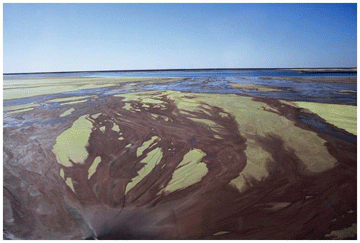
World’s first public database of mine tailings dams aims to prevent deadly disasters https://www.eurekalert.org/pub_releases/2020-01/g-wfp012320.php
Previously unreleased data offer unprecedented view into mining industry’s waste storage practices
GRID-ARENDAL 24 JAN 2020 ENVIRONMENTAL ORGANIZATION GRID-ARENDAL HAS LAUNCHED THE WORLD’S FIRST PUBLICLY ACCESSIBLE GLOBAL DATABASE OF MINE TAILINGS STORAGE FACILITIES. THE DATABASE, THE GLOBAL TAILINGS PORTAL, WAS BUILT BY NORWAY-BASED GRID-ARENDAL AS PART OF THE INVESTOR MINING AND TAILINGS SAFETY INITIATIVE, WHICH IS LED BY THE CHURCH OF ENGLAND PENSIONS BOARD AND THE SWEDISH NATIONAL PENSION FUNDS’ COUNCIL ON ETHICS, WITH SUPPORT FROM THE UN ENVIRONMENT PROGRAMME. THE INITIATIVE IS BACKED BY FUNDS WITH MORE THAN US$13 TRILLION UNDER MANAGEMENT.
Until now, there has been no central database detailing the location and quantity of the mining industry’s liquid and solid waste, known as tailings. The waste is typically stored in embankments called tailings dams, which have periodically failed with devastating consequences for communities, wildlife and ecosystems.
“This portal could save lives”, says Elaine Baker, senior expert at GRID-Arendal and a geosciences professor with the University of Sydney in Australia. “Dams are getting bigger and bigger. Mining companies have found most of the highest-grade ores and are now mining lower-grade ones, which create more waste. With this information, the entire industry can work towards reducing dam failures in the future.”
The database allows users to view detailed information on more than 1,700 tailings dams around the world, categorized by location, company, dam type, height, volume, and risk, among other factors.
“Most of this information has never before been publicly available”, says Kristina Thygesen, GRID-Arendal’s programme leader for geological resources and a member of the team that worked on the portal. When GRID-Arendal began in-depth research on mine tailings dams in 2016, very little data was accessible. In a 2017 report on tailings dams, co-published by GRID and the UN Environment Programme, one of the key recommendations was to establish an accessible public-interest database of tailings storage facilities.
“This database brings a new level of transparency to the mining industry, which will benefit regulators, institutional investors, scientific researchers, local communities, the media, and the industry itself”, says Thygesen.
The release of the Global Tailings Portal coincides with the one-year anniversary of the tailings dam collapse in Brumadinho, Brazil, that killed 270 people. After that disaster, a group of institutional investors led by the Church of England Pensions Board asked 726 of the world’s largest mining companies to disclose details about their tailings dams. Many of the companies complied, and the information they released has been incorporated into the database.
For more information on tailings dams, see the 2017 report “Mine Tailings Storage: Safety Is No Accident” and the related collection of graphics, which are available for media use.
About GRID-Arendal
GRID-Arendal supports environmentally sustainable development by working with the UN Environment Programme and other partners. We communicate environmental knowledge that motivates decision-makers and strengthens management capacity. We transform environmental data into credible, science-based information products, delivered through innovative communication tools and capacity-building services.
Kyrgyzstan bans uranium, thorium mining

Above – radioactive tailings mountain in Central Asia
|
Kyrgyzstan bans uranium, thorium mining http://www.xinhuanet.com/english/2019-12/16/c_138635832.htm 2019-12-16 BISHKEK, Dec. 16 (Xinhua) –– President of Kyrgyzstan Sooronbai Jeenbekov signed a decree banning the mining of uranium and thorium deposits in the Central Asian country, his press service reported on Monday.The law, aimed at ensuring radiation and environmental safety, prohibits geological exploration and development of uranium and thorium deposits in Kyrgyzstan, as well as dumping and transfer of the material, the report said.
Meanwhile, the import of raw materials and waste containing the two radioactive substances is not allowed by law, it said. Earlier this year, protests arose against the development of uranium deposits after reports that exploration work had begun in the Kyzyl-Ompol area in the Issyk-Kul region. |
|
The global uranium industry is really on the skids

Uranium bulls ‘as rare as white unicorns’ Jim Green, Online Opinion, 26 November 2019, https://onlineopinion.com.au/view.asp?article=20623&page=0
Uranium bulls are “as rare as white unicorns” according to a commentary in FNArena in September 2019, and the market is “sick and dying” with uranium “quickly becoming a dinosaur of a commodity”.
Canadian company Cameco recently said it cannot see any case for construction of new uranium mines for some years to come. Chief financial officer Grant Isaac said that new mines will not win financial backing without a far stronger recovery in demand for uranium than is currently on the horizon.
“It’s pretty hard to say you’re going to take the risk on an asset … that isn’t licensed, isn’t permitted, probably doesn’t have a proven mining method, when you have idle tier one capacity that’s licensed, permitted, sitting there,” Isaac said.
Moreover, Cameco has no plans to restart mines put into care-and-maintenance in 2016 and 2017: McArthur River (and the Key Lake mill) and Rabbit Lake in Canada, and the Crow Butte and Smith Ranch-Highland in-situ leach mines in the US. Plans to expand Crow Butte were abandoned in March 2019.
Instead, Cameco will continue to meet its contracts by purchasing uranium on the spot market. Delivering the company’s third-quarter results (a small loss), chief executive Tim Gitzel said that only 9 million pounds of uranium oxide will be produced from its mines next year, with the remainder of its requirement of 30‒32 million pounds supplied from spot market purchases.
Cameco’s workforce in Canada has halved. Before the Fukushima disaster, the company employed more than 2,100 people in Saskatchewan. Since then, 810 mine and mill workers have been sacked, along with 219 head office employees in Saskatoon. Continue reading
New type of uranium nuclear fuel has safety risks
 Nuclear fuel alternatives after Fukushima have challenges ahead, https://www.manchester.ac.uk/discover/news/nuclear-fuel-alternatives-after-fukushima-have-challenges-ahead/ 15 Nov 19, Nuclear fuel alternatives after Fukushima have challenges ahead, https://www.manchester.ac.uk/discover/news/nuclear-fuel-alternatives-after-fukushima-have-challenges-ahead/ 15 Nov 19,
Research at The University of Manchester suggests that the preferred candidate fuel to replace uranium oxide in nuclear reactors may need further development before use. Dr Robert Harrison led the research, published in the journal Corrosion Science, with colleagues from the University and the Dalton Nuclear Institute. “Since the 2011 Fukushima accident,” explains Dr Harrison, “there has been an international effort to develop accident tolerant fuels (ATFs), which are uranium-based fuel materials that could better withstand the accident scenario than the current fuel assemblies.” One of these ATFs is a uranium silicon compound, U3Si2. This material conducts heat much better than the traditional uranium oxide fuels, allowing the reactor core to be operated at lower temperatures. In an emergency situation, this buys more time for engineers to bring the reactor under control. However, there are many unknowns about how U3Si2 will behave in the reactor core. “One of these unknowns,” says Dr Harrison, “is how it will behave when exposed to high temperature steam or air, as may happen during manufacturing or a severe accident during reactor operation.” To investigate just how accident tolerant ATFs are, Dr Harrison and his colleagues investigated how Ce3Si2 – a non-radioactive material analogous to U3Si2 – behaved under exposure to high-temperature air. Using advanced electron microscopy techniques, available at The University of Manchester Electron Microscopy Centre (EMC), the researchers were able to study the reaction products after Ce3Si2 was exposed to air at temperatures of up to 750oC. They discovered the material was prone to forming nanometre sized grains of silicon and silicon oxide, as well as cerium oxide. These nano-grains may allow for enhanced corrosion of the fuel material or the escape of radioactive gasses formed during reactor activity. This is because the formation of nano-grains creates more grain boundary areas – interfaces between grains, which provide pathways for corrosive substances or fission gases to migrate along. “Similarly,” adds Dr Harrison, “it would also allow for hazardous gaseous fission products produced during the splitting of uranium (such as xenon gas that would normally be trapped within the material) to diffuse out along these grain boundaries and be released, which would be potentially harmful to the environment.” While Dr Harrison stops short of saying that these ATFs are more unsafe under accident conditions than the current fuels they are looking to replace, he would argue they are currently not any better, and “aren’t as tolerant to accident conditions as once hoped”. Dr Harrison concludes “However, with the new insight developed in this work it will be possible to develop and engineer ATF candidates to better withstand these accident conditions, perhaps by adding other elements, such as aluminium, or manufacturing composite materials to give higher protection of the fuel material”. The full title of the paper is “Atomistic Level Study of Ce3Si2 Oxidation as an Accident Tolerant Nuclear Fuel Surrogate”, and the DOI is 10.1016/j.corsci.2019.108332
|
|
Toxic effects of uranium mining on indigenous communities
 Coconino Voices: Solving Our Toxic Nuclear Legacy, https://azdailysun.com/opinion/columnists/coconino-voices-solving-our-toxic-nuclear-legacy/article_b8e2ef35-31fe-5cb0-a844-6c0fba973c19.html, BRYAN BATES, 30 Oct 19,
-
- When creating any system, whether a building, a community or an energy system, waste products need to be safely managed. This should be true if we’re building an energy system where the waste products can cause cancer and genetic mutations in humans or any organism within range of long-lived radioactive particles. However, it hasn’t been.
First discovered in 1895, radiation was shown to kill bacteria in 1898; however, with a high energy potential and money-making promise, radioactivity was not linked to cancer and genetic change until much later and even then its true health effects were hidden from miners and the public.
Because the geologic Chinle Formation on the Navajo Nation is rich in Uranium, Navajo men were put to work without protection from known hazards. Several hundred Navajos became sick from radiation exposure, many at the same time that other Navajos enlisted in the Marines to become Navajo Code Talkers.
Health effects from mining Uranium persist on the Navajo Nation with numerous pit mines still open and potentially affecting water, plants, livestock and Navajo. The amount of pain, illness, death and cost are still unknown. (See Judy Pasternak, 2011, Yellow Dirt.)
With the geologic uplift of the Grand Canyon upwarp, it’s hypothesized that numerous vertical shafts eroded allowing broken rock carrying Uranium from the Chinle Formation to fall into these “breccia pipes”. Left alone, the Uranium and other metals remain isolated from the biotic world; drilled into, these metals can migrate into interconnected aquifers that discharge into the Colorado River, water often used to grow food. The Grand Canyon upwarp has the greatest concentration of Uranium containing breccia pipes in the world.
This region is sacred to the Hopi, Navajo, Pai and other native people. The Canyon Mine has promised to create jobs; however, tourism and outdoor activities “support over 9,000 jobs, contribute over $938 million annually to (local) economies, and generate over $160 million in annual state and local tax revenues. Uranium mining threatens these economic drivers while possessing little capacity to support the regional economy.” (www.grandcanyontrust.org).
Under President Obama, a twenty-year moratorium on Uranium mining was instituted to allow for compilation and review of scientific information and energy policy. President Trump has requested and will receive a proposal from the nuclear industry to assess opening up mining on the Grand Canyon upwarp.
Mined Uranium would be used to generate nuclear electricity in reactors that are at or nearing their engineered lifespan. Building new nuclear reactors is massively expensive and concrete, the primary component of reactors, is the second largest emitter of climate changing CO2. (United Nations, IPCC report). Claims that nuclear energy is climate neutral only look at the internal nuclear reaction and ignore the entire fuel cycle necessary to keep the nuclear system functioning. Currently, nuclear waste is stored on-site at numerous reactors, several of which have moderate security and leaky infrastructure. The one national nuclear repository, Yucca Mountain, has been mothballed after expending $15Billion of taxpayer money.
To be sure, mining engineers are very intelligent people, and if they can pull Uranium out of breccia pipes, they can pull Uranium out of 1940’s open mining pits and then close off any radiation leakage. These same engineers could pull nuclear fuels from corroding storage bins on-site at nuclear reactors across the country. If a future President decides we need fewer nuclear weapons, future engineers could pull those radioactive elements, though it is questionable whether nuclear power will even be necessary given energy conservation and emerging sustainable energy sources.
In short, our country is not at lack of energy, but our current leadership is at lack of offering practical energy options. The best option is to leave the Uranium in the ground and clean up our country’s toxic nuclear legacy.
High levels of uranium in some Navajo women and infants near old uranium mining sites
 US official: Research finds uranium in Navajo women, babies, https://apnews.com/334124280ace4b36beb6b8d58c328ae3?fbclid=IwAR2UqarRiUTIPwnRCA_DGkjKuahfFO4T_l9iFrXxb1P8qL5AnmrTc1m61W8By MARY HUDETZ, October 8, 2019, ALBUQUERQUE, N.M. (AP) — About a quarter of Navajo women and some infants who were part of a federally funded study on uranium exposure had high levels of the radioactive metal in their systems, decades after mining for Cold War weaponry ended on their reservation, a U.S. health official Monday.
The early findings from the University of New Mexico study were shared during a congressional field hearing in Albuquerque. Dr. Loretta Christensen — the chief medical officer on the Navajo Nation for Indian Health Service, a partner in the research — said 781 women were screened during an initial phase of the study that ended last year.
Among them, 26% had concentrations of uranium that exceeded levels found in the highest 5% of the U.S. population, and newborns with equally high concentrations continued to be exposed to uranium during their first year, she said.
The research is continuing as authorities work to clear uranium mining sites across the Navajo Nation.
“It forces us to own up to the known detriments associated with a nuclear-forward society,” said U.S. Rep. Deb Haaland, who is an enrolled member of Laguna Pueblo, a tribe whose jurisdiction lies west of Albuquerque.
The hearing held in Albuquerque by U.S. Sen. Tom Udall, Haaland and U.S. Rep. Ben Ray Lujan, all Democrats from New Mexico, sought to underscore the atomic age’s impact on Native American communities.
The three are pushing for legislation that would expand radiation compensation to residents in their state, including post-1971 uranium workers and residents who lived downwind from the Trinity Test site in southern New Mexico.
The state’s history has long been intertwined with the development of the nation’s nuclear arsenal, from uranium mining and the first atomic blast to the Manhattan project conducted through work in the once-secret city of Los Alamos. The federal Radiation Exposure Compensation Act, however, only covers parts of Nevada, Arizona and Utah that are downwind from a different nuclear test site.
During the hearing, Haaland said one of her own family members had lost his hearing because of radiation exposure. At Laguna Pueblo, home to her tribe, the Jackpile-Paguate Mine was once among the world’s largest open-pit uranium mines. It closed several decades ago, but cleanup has yet to be completed.
“They need funds,” Haaland said. “They job was not completed.”
David Gray, a deputy regional administrator for the U.S. Environmental Protection Agency, said the mine illustrates uranium mining and milling’s lingering effects on Indian Country.
On the Navajo Nation, he said, the EPA has identified more than 200 abandoned uranium mines where it wants to complete investigation and clean up under an upcoming five-year plan, using settlements and other agreements to pay for the work that has taken decades.
Udall, who chaired the hearing, acknowledged federal officials had shown progress but that the pace of cleanup has proven frustrating for some community members.
“They feel an urgency,” Udall said. “They feel that things need to happen today.”
In her testimony, Christensen described how Navajo residents in the past had used milling waste in home construction, resulting in contaminated walls and floors.
From the end of World War II to the mid-1980s, millions of tons of uranium ore were extracted from the Navajo Nation, leaving gray streaks across the desert landscape, as well as a legacy of disease and death.
While no large-scale studies have connected cancer to radiation exposure from uranium waste, many have been blamed it for cancer and other illnesses.
By the late 1970s, when the mines began closing around the reservation, miners were dying of lung cancer, emphysema or other radiation-related ailments.
“The government is so unjust with us,” said Leslie Begay, a former uranium miner who lives in Window Rock, an Arizona town that sits near the New Mexico border and serves as the Navajo Nation capital. “The government doesn’t recognize that we built their freedom.”
Begay, who said he has lung problems, attended the hearing with an oxygen tank in tow. The hearing held in the Southwest was especially meaningful for him after traveling in the past to Washington to advocate for himself and others, he said.
Associated Press reporter Felicia Fonseca in Flagstaff, Arizona, contributed to this report.
1 This Month

of the week – Shut Down Drone Warfare!


Tell the Ukrainian Government to Drop Prosecution of Peace Activist Yurii Sheliazhenko

Petition to revoke the licensing of the Near Surface Nuclear Disposal Facility (NSDF) at Chalk River. https://www.ourcommons.ca/petitions/en/Petition/Details?Petition=e-7247
To see nuclear-related stories in greater depth and intensity – go to https://nuclearinformation.wordpress.com
-
Archives
- April 2026 (19)
- March 2026 (251)
- February 2026 (268)
- January 2026 (308)
- December 2025 (358)
- November 2025 (359)
- October 2025 (376)
- September 2025 (257)
- August 2025 (319)
- July 2025 (230)
- June 2025 (348)
- May 2025 (261)
-
Categories
- 1
- 1 NUCLEAR ISSUES
- business and costs
- climate change
- culture and arts
- ENERGY
- environment
- health
- history
- indigenous issues
- Legal
- marketing of nuclear
- media
- opposition to nuclear
- PERSONAL STORIES
- politics
- politics international
- Religion and ethics
- safety
- secrets,lies and civil liberties
- spinbuster
- technology
- Uranium
- wastes
- weapons and war
- Women
- 2 WORLD
- ACTION
- AFRICA
- Atrocities
- AUSTRALIA
- Christina's notes
- Christina's themes
- culture and arts
- Events
- Fuk 2022
- Fuk 2023
- Fukushima 2017
- Fukushima 2018
- fukushima 2019
- Fukushima 2020
- Fukushima 2021
- general
- global warming
- Humour (God we need it)
- Nuclear
- RARE EARTHS
- Reference
- resources – print
- Resources -audiovicual
- Weekly Newsletter
- World
- World Nuclear
- YouTube
-
RSS
Entries RSS
Comments RSS
 nuclear-news