INTERNATIONAL DARK SKY ASSOCIATION vs. FCC AND SPACEXOn December 29, 2022, the International Dark-Sky Association (IDA) sued the U.S. Federal Communications Commission over its decision to approve SpaceX’s application for up to 30,000 more low-orbit satellites, in addition to the 12,000 already approved and in process of filling our skies. This is Case No. 22-1337 before the United States Court of Appeals for the District of Columbia Circuit, and has not yet been decided by the court.
American plasma physicist Sierra Solter implored the FCC to “please save our night sky… Please, please, don’t take away my stars. To feel that my place of comfort and calm — a starry sky — is being taken away and given to billionaires is suffocating.”
On December 18, 2023, Ms. Solter published a scientific article detailing her fear for our planet. Each of the 42,000 planned Starlink satellites, she wrote, has a design lifespan of only 5 years, after which it will be de-orbited, burned up in the atmosphere, and replaced. She calculated that this will require 23 satellites per day — each the size of an SUV or truck — to be burned up in the atmosphere forever into the future, leaving an enormous amount of toxic chemicals and metallic dust to accumulate in the air we breathe and in the ionosphere.
This is already happening, she wrote, and should be stopped if we value our lives. “Since the beginning of the space industry, approximately 20,000 tons of material have been demolished during reentry… This is over 100 billion times greater than [the mass of] the Van Allen Belts.” She estimated that if 42,000 Starlink satellites are deployed and regularly demolished — let alone the 1,000,000 satellites planned by other companies and governments — “every second the space industry is adding approximately 2,000 times more conductive material than mass of the Van Allen Belts into the ionosphere.”
“Unlike meteorites, which are small and only contain trace amounts of aluminum, these wrecked spacecraft are huge and consist entirely of aluminum and other exotic, highly conductive materials,” she explained in an April 16, 2024 article in The Guardian.
Much of the metallic dust will settle into the ionosphere where, she says, it could act as a magnetic shield, reducing the magnitude of the Earth’s magnetic field in space. If that happens, the atmosphere itself could eventually be destroyed, because the Earth’s magnetic field — the magnetosphere — is what deflects the solar wind and prevents it from stripping away Earth’s atmosphere, as she told Teresa Pulterova in an interview on Space.com.
Other astronomers involved in the litigation before the FCC and now the Court of Appeals include Meredith Rawls with the Vera C. Rubin Observatory in Chile; Gary Hunt with Action Against Satellite Light Pollution in the UK; Samantha Lawler at the University of Regina in Canada; Graeme Cuffy of Port of Spain, Trinidad and Tobago; Mark Phillips, President of the Astronomical Society of Edinburgh; Roberto Trotta of the Imperial Centre for Inference and Cosmology in London; Carrie Nugent, Associate Professor of Computational Physics and Planetary Science at the Olin College of Engineering in Massachusetts; and Cameron Nelson of Tenzing Startup Consultants in Virginia.
Other issues are also mentioned in the appeal. For example, the burned up aluminum produces aluminum oxide, which destroys ozone and contributes to climate change. So does the water vapor, soot, and nitrogen oxides in rocket exhaust.
Cameron Nelson told the FCC that “Humans, not to mention all other animal and plant life, have not given our consent for SpaceX to send the signals it is proposing into our bodies and irrevocably alter us.”
The BroadBand International Legal Action Network (BBILAN) mentioned “RF/EMF radiation from linked base and earth stations” in comments sent to the FCC. Starlink earth stations, also called Gateways, are far more powerful than the Starlink dishes that people are putting on their homes. The (as of March 2024) 2.6 million Starlink dishes each send one signal up to the moving network of satellites above them. All of this traffic is coordinated in space by thousands of lasers linking the satellites to one another, and on the ground by Gateways, which relay the thousands of signals in a large geographic area to and from the satellites. This is what a Gateway with 5 antennas (“radomes”) looks like:
Some Gateways have up to 40 radomes. Each of those domes weighs 1750 kilograms. Each aims a narrow beam at moving satellites. According to FCC filings by SpaceX, each beam can have an effective radiated power of more than 1,000,000 watts, which it can aim as low as 25 degrees above the horizon. If you are a bird you do not want to fly anywhere near a Starlink Gateway. And if you are a human you do not want to live near one either. When a satellite aims its beam containing thousands of signals at a Gateway, that beam is about 10 miles in diameter by the time it reaches the Earth.
At last count there were 277 Starlink Gateways in operation or under construction in the world: 181 in North America and the Caribbean, 26 in South America, 2 in Africa, 26 in Europe, and 42 in Asia and the Pacific.
The FCC maintains a webpage listing thousands of licenses that it has handed out to hundreds of companies to operate both fixed and mobile satellite earth stations in the United States. Some of these stations are far more powerful than the Starlink Gateways. SES’s earth station at Bristol, Virginia emits up to 1,900,000,000 watts of effective radiated power, and it is allowed to aim it as low as 5 degrees above the horizon. SES’s earth station at Brewster, Washington is allowed to emit almost 1,000,000 watts in the actual direction of the horizon! SES owns O3b mPOWER, which is the satellite system that had its first radomes on board the Diamond Princess cruise ship, the ship that had the famous outbreak of disease blamed on COVID-19 at the beginning of the pandemic.
On 24 April, the Security Council voted on a resolution tabled by the United States and Japan, which reaffirmed our commitment to the Outer Space Treaty. Thirteen Member States voted in favour. One, the Russian Federation, used its veto.
Outer space belongs to all humankind and space technologies are critical to our daily lives. From using maps and checking the weather on our phones, to international shipping and large-scale disaster risk reduction programmes, the far-reaching applications of space technologies are embedded in all of our economies.
For this reason, we need to protect and regulate the safe use of space, while taking appropriate steps to prevent it becoming the backdrop of the next arms race.
Could a nuke be used in space? Last month, Russia seemingly took a step toward making the idea a reality. In defiance of a US and Japan-sponsored UN resolution, the country vetoed plans to prevent the development and deployment of off-world nuclear weapons.
Fortunately, the country didn’t actually threaten to launch such a device into space, an act that would violate the 1967 Outer Space Treaty. However, the UN representative for Russia did call the new resolution a “cynical ploy” and claimed “we are being tricked”.
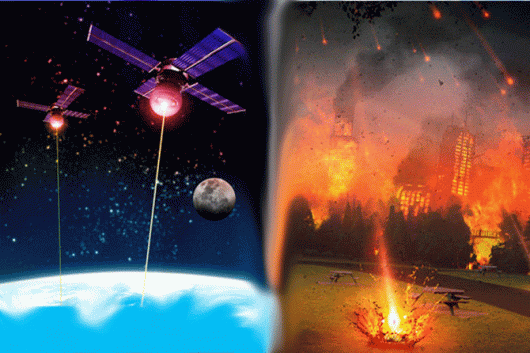
But what would actually happen if Russia – or any other country – detonated a nuke above Earth? The worrying answer: such an explosion could be as devastating as one on ground level.
What happens if you detonate a nuclear warhead in space?
There are some pretty stark differences between setting off a nuke at ground level and up in orbit.
“When nuclear weapons go off on the ground, a lot of energy is initially released as X-rays,” Dr Michael Mulvihill, vice chancellor research fellow at Teesside University, tells BBC Science Focus.
“Those X-rays superheat the atmosphere, causing it to explode into a fireball – that’s what produces the shockwave and characteristic mushroom cloud that sucks up dirt and produces fallout.”
But in space there is no atmosphere. So no mushroom clouds or shockwaves are formed when you set off a nuke in space. That doesn’t mean the effects are any less terrifying, however.
“In space, a nuclear explosion releases a huge amount of energy as X-rays, gamma rays, intense flows of neutrons and subatomic charged particles. It also produces what’s known as an electromagnetic pulse, or EMP,” Mulvihill says.
An EMP is effectively a burst of electromagnetic energy; when one interacts with the upper atmosphere, it strips electrons from it, blinding radar systems, knocking out communications and wiping out power systems.
After the initial explosion, a belt of radiation wraps around the Earth that persists for months, possibly even years – no one knows for sure. The radiation can damage satellites and, as Mulvihill points out, would pose a serious risk to anyone in space at the time – such as astronauts on the ISS.
“The EMP would knock out power systems on the ISS, effectively destroying the life support systems and everything that circulates the atmosphere within the space station. And I imagine the astronauts would be exposed to high levels of radiation too,” Mulvihill explains.
“It would be highly hostile to life in orbit.”
Space is becoming more and more crowded with satellites – approximately 10,000 satellites are in low earth orbit right now, and tens of thousands more are planned for launch in the coming years. This significantly raises the stakes of unleashing nuclear energy in space, as we become more reliant on the systems we put into orbit.
From ground level, however, other than blowing power grids and disrupting communications, the effects could also be somewhat beautiful.
As charged particles from the explosion interact with the Earth’s magnetic field and the atmosphere, they would cause brilliant auroras, stretching across huge distances that could last for days. So there’s that, at least.
Have nuclear explosions reached space before?
Unsurprisingly, during the Cold War, global superpowers (namely, the US and Russia) tested nukes in just about every scenario imaginable. On land, underwater, in a mountain – you name it, they tried blowing it up.
It comes as no surprise then, that detonating nuclear weapons in space has been done before. In total, the US conducted five space nuclear tests in space; the most famous of which, according to Mulvihill, occurred on 9 July 1962 near(ish) to the Pacific island paradise of Hawaii.
Starfish Prime was launched 400km (250 miles) above Johnston Island and had an explosive power of 1.4 megatons – about 100 times more powerful than the Hiroshima bomb.
The EMP was much larger than expected, compromising the classified nature of the test as streetlights and phone lines were knocked out in Hawaii 1,450 km (900 miles) away from the detonation point.
The ensuing red auroras stretched across the Pacific Ocean and lasted for hours.
“At the time there were around 22 satellites in space, of which around a third were knocked out,” Mulvihill says. The casualties included the world’s first TV communication satellite, Telstar 1, which had been a beacon of US technological development until Starfish Prime caused it to prematurely fail after just seven months in orbit.
In the following years, everyone came to their senses a bit and decided that testing nuclear warheads in space constituted a bad idea. Thus, the Outer Space Treaty (OST) was born.
Signed in 1967 by the US, UK and Soviet Union, the OST now has over 100 signatories and designates space as free for all to use for peaceful purposes only. The world breathed a sigh of relief and got on with using space for nice things like astronomy, space stations and WiFi for the next 60 years. So, what’s changed?
How worried should we be?
Rumours of a change in the orbital security situation began swirling when earlier this year the US House Intelligence Committee chairman Mike Turner issued a vague warning about a “serious national security threat” posed by Russia.
Following this, news outlets began reporting that the threat pertained to a possible “nuclear weapon in space”.
“It’s certainly concerning, but don’t lose sleep over it,” Mulvihill says. “Russia is still a signatory of the OST, so any sort of weapon in space would be absolutely illegal.”
He also points out that as Starfish Prime demonstrated, nuclear weapons in space are indiscriminate, meaning any detonation would do just as much damage to Russia and its allies as anyone else.
“It wouldn’t just knock out Starlink [the SpaceX system of satellites that provides internet to 75 countries]. It would knock out Chinese satellites and everyone else’s too.”
Another possibility, Mulvihill thinks, is that countries could develop nuclear-powered ‘jammers’. In other words, not a bomb (phew), but something that uses nuclear power to generate a signal that could disrupt, rather than destroy, other satellites.
Ultimately, though, this could all be little more than geopolitical posturing. “Deterrence is all about messaging and trying to persuade somebody that you would do it without ever actually getting there. I think that’s probably the psychology that’s going on with this,” Mulvihill concludes.
On December 29, 2022, the International Dark-Sky Association (IDA) sued the U.S. Federal Communications Commission over its decision to approve SpaceX’s application for up to 30,000 more low-orbit satellites, in addition to the 12,000 already approved and in process of filling our skies. This is Case No. 22-1337 before the United States Court of Appeals for the District of Columbia Circuit, and has not yet been decided by the court.
American plasma physicist Sierra Solter implored the FCC to “please save our night sky… Please, please, don’t take away my stars. To feel that my place of comfort and calm — a starry sky — is being taken away and given to billionaires is suffocating.”
On December 18, 2023, Ms. Solter published a scientific article detailing her fear for our planet. Each of the 42,000 planned Starlink satellites, she wrote, has a design lifespan of only 5 years, after which it will be de-orbited, burned up in the atmosphere, and replaced. She calculated that this will require 23 satellites per day — each the size of an SUV or truck — to be burned up in the atmosphere forever into the future, leaving an enormous amount of toxic chemicals and metallic dust to accumulate in the air we breathe and in the ionosphere
This is already happening, she wrote, and should be stopped if we value our lives. “Since the beginning of the space industry, approximately 20,000 tons of material have been demolished during reentry… This is over 100 billion times greater than [the mass of] the Van Allen Belts.” She estimated that if 42,000 Starlink satellites are deployed and regularly demolished — let alone the 1,000,000 satellites planned by other companies and governments — “every second the space industry is adding approximately 2,000 times more conductive material than mass of the Van Allen Belts into the ionosphere.”
“Unlike meteorites, which are small and only contain trace amounts of aluminum, these wrecked spacecraft are huge and consist entirely of aluminum and other exotic, highly conductive materials,” she explained in an April 16, 2024 article in The Guardian.
Much of the metallic dust will settle into the ionosphere where, she says, it could act as a magnetic shield, reducing the magnitude of the Earth’s magnetic field in space. If that happens, the atmosphere itself could eventually be destroyed, because the Earth’s magnetic field — the magnetosphere — is what deflects the solar wind and prevents it from stripping away Earth’s atmosphere, as she told Teresa Pulterova in an interview on Space.com.
Other astronomers involved in the litigation before the FCC and now the Court of Appeals include Meredith Rawls with the Vera C. Rubin Observatory in Chile; Gary Hunt with Action Against Satellite Light Pollution in the UK; Samantha Lawler at the University of Regina in Canada; Graeme Cuffy of Port of Spain, Trinidad and Tobago; Mark Phillips, President of the Astronomical Society of Edinburgh; Roberto Trotta of the Imperial Centre for Inference and Cosmology in London; Carrie Nugent, Associate Professor of Computational Physics and Planetary Science at the Olin College of Engineering in Massachusetts; and Cameron Nelson of Tenzing Startup Consultants in Virginia.
Other issues are also mentioned in the appeal. For example, the burned up aluminum produces aluminum oxide, which destroys ozone and contributes to climate change. So does the water vapor, soot, and nitrogen oxides in rocket exhaust.
Cameron Nelson told the FCC that “Humans, not to mention all other animal and plant life, have not given our consent for SpaceX to send the signals it is proposing into our bodies and irrevocably alter us.”
The BroadBand International Legal Action Network (BBILAN) mentioned “RF/EMF radiation from linked base and earth stations” in comments sent to the FCC. Starlink earth stations, also called Gateways, are far more powerful than the Starlink dishes that people are putting on their homes. The (as of March 2024) 2.6 million Starlink dishes each send one signal up to the moving network of satellites above them. All of this traffic is coordinated in space by thousands of lasers linking the satellites to one another, and on the ground by Gateways, which relay the thousands of signals in a large geographic area to and from the satellites. This is what a Gateway with 5 antennas (“radomes”) looks like:
Some Gateways have up to 40 radomes. Each of those domes weighs 1750 kilograms. Each aims a narrow beam at moving satellites. According to FCC filings by SpaceX, each beam can have an effective radiated power of more than 1,000,000 watts, which it can aim as low as 25 degrees above the horizon. If you are a bird you do not want to fly anywhere near a Starlink Gateway. And if you are a human you do not want to live near one either. When a satellite aims its beam containing thousands of signals at a Gateway, that beam is about 10 miles in diameter by the time it reaches the Earth.
Robin is a subscriber who lives in a remote area of Idaho less than 3 miles from the Starlink Gateway in Colburn. She writes about effects on her family and her animals…………………………….Robin knows many people in her area who are similarly affected. She adds that “when we first moved here in 2019 we had A LOT of birds. We now have a silent spring, it’s like a dead zone.
At last count there were 277 Starlink Gateways in operation or under construction in the world: 181 in North America and the Caribbean, 26 in South America, 2 in Africa, 26 in Europe, and 42 in Asia and the Pacific.
The FCC maintains a webpage listing thousands of licenses that it has handed out to hundreds of companies to operate both fixed and mobile satellite earth stations in the United States. Some of these stations are far more powerful than the Starlink Gateways. SES’s earth station at Bristol, Virginia emits up to 1,900,000,000 watts of effective radiated power, and it is allowed to aim it as low as 5 degrees above the horizon. SES’s earth station at Brewster, Washington is allowed to emit almost 1,000,000 watts in the actual direction of the horizon! SES owns O3b mPOWER, which is the satellite system that had its first radomes on board the Diamond Princess cruise ship, the ship that had the famous outbreak of disease blamed on COVID-19 at the beginning of the pandemic
Our ozone is pennies thick – and soon we’ll put at least an Eiffel Tower’s worth of metallic ash into the ionosphere every year.
Adead spacecraft the size of a truck ignites with plasma and pulverizes into dust and litter as it rips through the ionosphere and atmosphere. This is what happens to internet service satellites during re-entry. When the full mega-constellation of satellites is deployed in the 2030s, companies will do this every hour because satellite internet requires thousands of satellites to constantly be replaced. And it could compromise our atmosphere or even our magnetosphere.
Space entrepreneurs are betting on disposable satellites as key to a new means of wealth. There are currently nearly 10,000 active satellites and companies are working as fast as possible to get tens of thousands more into orbit – for a projected 1m in the next three to four decades.
“We could get to 100,000 satellites in 10 to 15 years,” Dr Jonathan McDowell, of the Harvard-Smithsonian Center for Astrophysics, told me. Those satellites power hyper-connected internet services and may turn somebillionaires into trillionaires – at the cost of shrouding the planet with toxic trash.
The problem is that space, contrary to popular belief, isn’t really a giant, self-cleaning void. Space holds systems like the magnetosphere that keep us alive and supplied with oxygen by protecting our atmosphere. The space around our planet is a plasma cocoon that is cradling life.
It is easy to assume that the magnetosphere is too vast and robust for humanity to ever have any impact on it, but I don’t think that’s true.I’m a plasma physicist at the intersection of aerospace and physics and the author of recent research in peer-review that found that the space trash generated by dead and dying commercial satellites could compromise our ionosphere or magnetosphere, also known as our planet’s plasma environment.
After studying the problem for over a year, I have no doubt that the sheer vastness of this pollution is going to disrupt our delicate plasma environment in one way or another. Yet few people are discussing this potential crisis – in part,I suspect, because so much scientific research about space is intertwined with commercial space ventures, which have a vested interest in avoiding these questions.
Upon investigating just how much dust in the form of satellite and rocket debris the space industry has dumped into the ionosphere during re-entry, I was alarmed to find that it is currently multiple Eiffel Tower’s worth of metallic ash. I wouldn’t have even been able to calculate that at all without a scientist’s personally run website. Our ozone is mere pennies thick, and soonwe will be putting at least an Eiffel Tower’s worth of metallic asha year directly into the ionosphere. And all of that will stay there, indefinitely.
How could we possibly think that burning trash in our atmosphere 24/7 is going to be fine? Although some study is being devoted to stratospheric loading – the phenomenon of satellite and rocket chemicals saturating the atmosphere with ozone-depleting alumina – humanity might also be forcing “magnetospheric loading” on our planet, as well. No one else is currently studying the pollution of the magnetosphere except for myself.
We don’t even have a clear estimate of the mass of all regions in the magnetosphere, yet we are going to load it with the wreckage of countless giant spacecraft. These SUV-size satellites will soon be burning in the atmosphere on an hourly basis. Unlike meteorites, which are small and only contain trace amounts of aluminum, these wrecked spacecraft arehuge andconsist entirely of aluminum and other exotic, highly conductive materials. And highly conductive materials can create charging effects and act as a magnetic shield.
If all of these conductive materials accumulate into a huge layer of trash, it could trap or deflect all or parts of our magnetic field. The Earth is a ball magnet that we’re surrounding with fast-moving metal trash. And so far, extrapolating from open-source data, the current trash in the ionosphere shows an apparent human-made electrostatic signature. It is known that individual spacecraft can perturb their environment with plasma wakes; imagine how 100,000 or more of them and their associated trash could perturb the magnetosphere.
Even if we only induce ionospheric perturbations regionally – say, in spaceflight regions – then it could cause holes above the ozone. This in turn, could allow atmospheric stripping,which could erode our atmosphere over time and put the planet at risk of losing habitability.
Low Earth orbit is being promoted as a “destination and economy” for satellites and even low-gravity space hotels (which seem to be perpetually “coming soon” and then canceled). People like Elon Musk and Jeff Bezos repeatedly state that space is the key to human longevity. But what if it isthe opposite? What if the space industry is the means to our pale blue dot’s demise? And what if all of this pollution that space entrepreneurs are creating is happening in such a multidisciplinary, inaccessible, un-studied way that we don’t even understand the risk?
Our magnetosphere keeps us alive. It should be protected as an Earth environment. Instead, we’re filling it with electronic waste so that billionaires can trade electromagnetic signals for dollars they really don’t need.
“Our technical civilization poses a real danger to itself,” Carl Sagan warned in his 1997 book Billions and Billions: Thoughts on Life and Death at the Brink of the Millennium. The magnetosphere is our first line of defense against an otherwise lethal solar system, andany pollution of it should be intensely studied and monitored. Indeed, if an asteroid the size of a Starlink satellite was headed towards Earth, it would activate planetary defense monitoring. But since it’s a human-made object impacting the atmosphere, we don’t monitor it at all.
Spacecompanies need to stop launching satellitesif they can’t provide studies that show that their pollution will not harm the stratosphere and magnetosphere. Until this pollution is studied further, we should all reconsidersatellite internet.
Sierra Solter is a plasma physicist, engineer, and inventor who studies the intersection of heliophysics and aerospace
UNITED NATIONS, April 24 (Reuters) – Russia on Wednesday vetoed a U.S.-drafted United Nations Security Council resolution that called on countries to prevent an arms race in outer space, a move that prompted the United States to question if Moscow was hiding something.
The vote came after Washington accused Moscow of developing a anti-satellite nuclear weapon to put in space, an allegation that Russia has denied. Russian President Vladimir Putin has said that Moscow was against putting nuclear weapons in space.
“Today’s veto begs the question: Why? Why if you are following the rules would you not support a resolution that reaffirms them? What could you possibly be hiding?” U.S. Ambassador to the U.N. Linda Thomas-Greenfield told the council after the vote. “It’s baffling and it’s a shame.”
Russia’s U.N. Ambassador Vassily Nebenzia accused Washington of trying to tarnish Moscow and said Russia would shortly begin negotiations with council members on its own draft resolution aimed at keeping space peaceful.
“We want a ban on the placement of weapons of any kind in outer space, not just (weapons of mass destruction). But you don’t want that … Let me ask you that very same question: Why?” Nebenzia asked Thomas-Greenfield in the council.
The draft resolution was put to a vote by the U.S. and Japan after nearly six weeks of negotiations. It received 13 votes in favor, while China abstained and Russia cast a veto.
The U.N. text would have affirmed an obligation to comply with the Outer Space Treaty and called on states “to contribute actively to the objective of the peaceful use of outer space and of the prevention of an arms race in outer space.”
The 1967 Outer Space Treaty bars signatories – including Russia and the United States – from placing “in orbit around the Earth any objects carrying nuclear weapons or any other kinds of weapons of mass destruction.
Before the council voted on the U.S. draft text, Russia and China had proposed it be amended to include a call on all states “to prevent for all time the placement of weapons in outer space and the threat or use of force in outer space, from space against Earth and from Earth against objects in outer space.”
Elon Musk’s space company SpaceX recently secured a classified contract to build an extensive network of “spy satellites” for an undisclosed U.S. intelligence agency, with one source telling Reuters that “no one can hide” under the prospective network’s reach.
While the deal suggests the space company, which currently operates over half the active satellites orbiting Earth, has warmed to U.S. national security agencies, it’s not the first Washington investment in conflict-forward space machinery. Rather, the U.S. is funding or otherwise supporting a range of defense contractors and startups working to create a new generation of space-bound weapons, surveillance systems, and adjacent technologies.
In other words, America is hell-bent on a new arms race — in space.
Space arms, then and now
Attempts to regulate weapons’ presence and use in space span decades. Responding to an intense, Cold War-era arms race between the U.S. and Soviet Union, the 1967 Outer Space Treaty established that space, while free for all countries to explore and use, was limited to peaceful endeavors. Almost 60 years later, the Outer Space Treaty’s vague language regarding military limitations in space, as space policy experts Michelle L.D. Hanlon and Greg Autry highlight, “leave more than enough room for interpretation to result in conflict.”
Stonewalling subsequent international efforts to limit the militarization of space (though the U.S. is participating in a new U.N. working group on the subject), Washington’s interest in space exploration and adjacent weapons technologies also goes back decades. Many may recall President Ronald Reagan’s 1983 Strategic Defense Initiative (SDI), which was established to develop land-, air-, and space-based missile defense systems to deter missile or nuclear weapons attacks against the U.S. Cynically referred to by critics as the “Star Wars” program, many SDI initiatives were ultimately canned due to prohibitive costs and technological limitations.
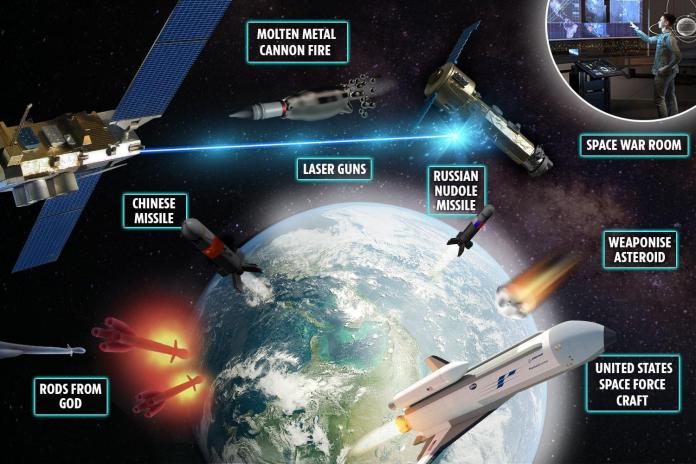
Long-term American interest in space war tech now manifests in ambitious projects, where defense companies and startups are lining up for military contracts to create a new generation of space weaponry and adjacent tech, including space vehicles, hypersonic rockets, and extensive surveillance and communications projects.
The PWSA will serve as the backbone of the Pentagon’s Joint All-Domain Command and Control project, an effort to bolster warfighting capacities and decision-making processes by facilitating “information advantage at the speed of relevance.”
Other efforts are just as sci-fi-esque. Zoning in on hypersonic weapons systems and parts, for example, RTX (formerly Raytheon) and Northrop Grumman have collaborated to secure a DARPA contract for a Hypersonic Air-breathing Weapons Concept, where scramjet-powered missiles can travel at hypersonic speeds (Mach 5 or faster) for offensive purposes.
As True Anomaly finds fiscal success, accruing over $100 million in a December 2023 series B fundraising round from venture capitalists including Eclipse Ventures and ACME Capital, other aerospace start-ups are flooding the market with the assistance of the U.S. government, both in funding and other critical partnerships.
Take how Firehawk Aerospace — which wants to “create the rocket system of the future” to “enab[le] the next generation of aerospace and defense systems” — partnered with NASA in 2021 to test rocket engines at NASA’s Stennis Space Center in Mississippi. It recently secured Army Applications Laboratory and U.S. Air Force Small Business Innovation Research Awards to advance developments in its rocket motors and engines.
And data and satellite-focused American space tech company Capella Space, a contractor for federal agencies including the Air and Space Forces, specializes in reconnaissance and powerful surveillance tools, including geospatial intelligence and Synthetic Aperture Radar monitoring that help national security officials identify myriad security risks. In early 2023, Capella Space even formed a subsidiary, Capella Federal, to provide federal clients with additional access to Synthetic Aperture Radar imagery services.
We need diplomacy, not space superiority
The funding of expensive, futuristic space surveillance and weapons projects indicates the U.S.’s eagerness to maintain superiority, where military personnel posit such advancements are critical within the context of both a “space race” and an increasingly tumultuous geopolitical climate, if not the possibility of war in space outright.
As Space Force General Chance Saltzman declared at the recent Mitchell Institute Spacepower Security Forum: “if we do not have space, we lose.” Testifying before the Senate Armed Services Committee in late February, U.S. Space Force General Stephen N. Whiting explained that the U.S. Space Command must bolster its military capacities through increased personnel training and investments in relevant technologies so that the U.S. is “ready if deterrence fails.”
While upping its own military capacities, however, Washington is simultaneously pushing against other countries’ anti-satellite weapons testing, a capability the U.S. already has.
In any case, such pointing fingers, when coupled with ongoing space deterrence and weapons proliferation efforts, does little to advance genuine diplomacy, where states could instead discuss, on equal terms, how space should be used and shared amongst nations.
Ultimately, weapons and aerospace companies’ efforts have launched a new generation of weaponry and adjacent tech — buoyed by consistent support from a “deterrence”-focused U.S. As a result, the military industrial complex has further expanded into the domain of space, where defense companies have new opportunities to score lucrative weapons contracts and theoretically even push for more conflict.
COLORADO SPRINGS – U.S. Space Command seeks to expand international collaboration by inviting Germany, France and New Zealand to join Operation Olympic Defender. Olympic Defender, a U.S.-led initiative to jointly strengthen defenses and deter hostility, already includes England, Australia and Canada.
“We share intelligence, we plan together and work to ensure space is safe for all,” Gen. Stephen Whiting, commander of U.S. Space Command, said April 9 at the 39th Space Symposium here. “We’re working to even improve our integration through improved command and control and planning. I’ve been proud to work alongside Germany, France and New Zealand for many years, and I look forward to their consideration of our invitation to join Operation Olympic Defender.”
Preparing for military operations with U.S. allies and partners is one of U.S. Space Command’s top priorities.
Other priorities for the Colorado-based organization are making its constellations more resilient, defending them against a growing array of threats, protecting the joint force from space-enabled attack, and conducting tests and training “that convinces us that these capabilities will work in a conflict which has never happened,” Whiting said.
China is rapidly expanding space-based intelligence, reconnaissance and surveillance capabilities, and building a “range of counterspace weapons from reversible jamming all the way up to kinetic hit-to-kill direct-ascent and co-orbital” anti-satellite weapons, Whiting said.
Russia, meanwhile, “continues to invest in counterspace weapons,” Whiting said. “Russia appears more and more to be relying on asymmetric capabilities like space, cyber and nuclear.”
“All of us at U.S. Space Command are laser-focused on improving all of our existing forces and capabilities, so that we can stitch them together seamlessly when called upon,” Whiting said.
U.S. Space Command also intends to draw on commercial space technology.
“Our commercial industry will deliver innovative state-of-the-art capabilities,” Whiting said. “We have to modernize our legacy systems, ensure they all work together seamlessly and deliver new capabilities by 2027 to counter the threats that we now see.”
Beyond 2027
At the same time, U.S. Space Command is eager to adopt technology that is likely to pay off in the longer term.
“It’s time to bring dynamic space operations and on-orbit logistics and infrastructure to the space domain,” Whiting said. “Sustained space maneuver will change how we operate, opening up new tactics, techniques, procedures and operating concepts, and allowing operations until the mission is complete, not until the fuel we launched with runs out.”
With an eye toward future conflict, U.S. Space Command also is expanding its reliance on modeling and simulation.
Whiting announced that Space Command’s Capability Assessment and Validation Environment, a modeling and simulation laboratory known as CAVE, has achieved minimum viable capability.
CAVE “enables us to perform analysis on warfighting, on plans, on campaigning,” Whiting said. Space Command will rely on CAVE to help plan “operations for a war that’s never happened and a war we don’t want to happen. We’ll also use it to figure out our combatant command requirements and gain insights into multi-domain joint-warfighting concepts.”
Rolls-Royce has received a funding boost from the UK Space Agency to develop nuclear-powered projects for the space sector. Some £1.2m is being offered up to Rolls-Royce Submarines and the US-based nuclear supplier BWX Technologies as part of a project to use fission nuclear systems for space missions.
It comes as part of a wider £13m funding package unveiled by the government to support 11 international space projects, ranging from capturing high-res photos of the Moon and Mars to X-ray images of the Earth’s Aurora. Other beneficiaries include Vertical Future, which is developing a “robotic space arm” facility to grow plants in space, and the University of Leicester, which is identifying potential space missions for nuclear powered technologies.
The US has been seeking to dismantle legally-binding international security mechanisms and replace them with vague norms of the so-called ‘rules-based world order’, Russian Foreign Ministry spokeswoman Maria Zakharova said on Saturday.
The remarks were in response to statements from the outgoing US assistant secretary of defense for space policy, John Plumb, at a Defense Writers Group meeting on Friday. According to Zakharova, Plumb dismissed Russian-Chinese initiatives on the prevention of an arms race in space as a “political ploy,” claiming that adherence to the deal would not be verifiable.
“The US is an ardent opponent of Russian initiatives to prevent an arms race in outer space. Strong opposition to the aforementioned Russian-Chinese draft treaty has long been an integral part of American foreign policy,” Zakharova said in a Telegram post, referring to a 2008 draft agreement.
Instead, the US has been pursuing its own approach to keeping space free of weapons by promoting a “set of norms of ‘responsible’ behavior within the framework of their concept of a ‘rules-based world order,’” which is untenable both in technical and international legal terms, the spokeswoman said.
Plumb’s remarks, as well as Washington’s ongoing activities in the UN Security Council with regard to nuclear weapons in space, are part of its longstanding efforts to dismantle the system of legally-binding security treaties, she claimed.
The Russian Embassy in the US provided a similar assessment of Plumb’s remarks, suggesting they are part of a concerted campaign to divert attention away from Washington’s own pursuits. “We consider the Pentagon’s manipulations of information to be further proof of US attempts to use Russophobic slogans to justify its own plans for militarizing space,” the mission said in a statement.
Meanwhile, Washington has been promoting a resolution on the non-deployment of nuclear weapons in space. The UN Security Council is set to vote on the US- and Japan- backed document next week, which, if adopted, would reaffirm that countries must fully comply with their obligations under the 1967 Outer Space Treaty, which bans weapons of mass destruction in space.
The resolution comes amid claims in the US media early this year that Russia is seeking to deploy anti-satellite nukes, or at least mock-ups, into space. Moscow has strongly denied the claims, with Russian President Vladimir Putin describing them as “unfounded accusations.”
Russia has promised to “form a position” on a US-sponsored Security Council resolution proposing a ban nuclear weapons in space in due course. Why is Washington suddenly so interested in the idea? What kinds of things could the resolution contain? Sputnik asked one of America’s top independent military and foreign affairs observers to comment.
Matters of strategic security are one of the few areas where potential for dialogue between Russia and the US exists, Kremlin spokesman Dmitry Peskov has said.
“The main potential area for dialogue between the United States and Russia is issues related to strategic security, which includes the space issue,” the spokesman told reporters on Friday, commenting on plans by the US and Japan to put forward a resolution before the United Nations Security Council next week proposing a ban on the deployment of nuclear weapons in space.
“As for the project, we need to wait, study the document, read it and then form a position,” Peskov said.
Peskov’s comments were preceded by remarks by White House National Security Council spokesman John Kirby on Thursday outlining Washington’s expectations for Moscow as far as the as yet untabled draft resolution is concerned.
“We have heard President Putin say that Russia has no intention of deploying nuclear weapons in space,” Kirby said. “So we look forward to Russia voting in favor of this resolution. There should be no reason why not to. And if they do [sic], then I think that should open up some really legitimate questions to Mr. Putin about what his intentions really are,” Kirby added, with his comments coming off as an attempt to force Moscow’s hand on the issue.
“Our position is quite clear and transparent,” Putin said in a meeting in the Kremlin with Defense Minister Sergei Shoigu back in February, commenting on claims by US officials that Russia had obtained some kind of “troubling” new “anti-satellite weapon capability” that might become operational soon.
“We have always been and remain categorically opposed to the deployment of nuclear weapons in space. Just the opposite, we are urging everyone to adhere to all the agreements that exist in this sphere,” Putin said, adding that Western powers “know” that Russia’s space-based capabilities are in line with those possessed by other nations, including the United States.
Russia has “many times suggested to strengthen joint cooperation in the area but for some reason, in the West, this topic has not come up again,” Putin said.
“We haven’t deployed any nuclear weapons in space or any elements of them to use against satellites or to create fields where satellites can’t work efficiently,” Shoigu said during the meeting, accusing Washington of talking up a Russian space threat to pressure Congress into approving more aid to Kiev, and to try to maneuver Russia into nuclear arms control negotiations suspended amid the crisis in Ukraine.
“The US and the West…are calling for Russia’s strategic defeat, while on the other hand saying they would like to have a dialogue on strategic stability, pretending that those things aren’t connected,” Putin said, stressing that such an approach “won’t work.”
What’s in the Resolution?
The US-Japanese joint resolution reportedly urges countries to commit not to “develop nuclear weapons or any other kinds of weapons of mass destruction designed to be placed in orbit,” reaffirming the expectation that nations “fully comply” with the 1967 Outer Space Treaty prohibiting nuclear arms in space.
Further details on the draft resolution have not been publicized, but Russian Deputy Ambassador to the UN Dmitry Polyansky commented on the proposal last month, calling it “divorced from reality” and accusing the US of “yet another propaganda stunt” via a “very politicized” draft document.
Curious Timing
“It’d be interesting to know the details of this proposed treaty by the United States,” Earl Rasmussen, a veteran independent military and foreign affairs commentator and retired US Army Lieutenant Colonel with 20 years of service under his belt, told Sputnik.
“I’m often kind of cautious when they propose something, because the US is probably the one country that has reneged or withdrawn unilaterally from more treaties than any other country,” Rasmussen said.
Saying the Outer Space Treaty could use an update after nearly 60 years, Rasmussen said he found the timing of the US proposal both “interesting” and “curious,” and the undisclosed details crucial to know, because a treaty dealing with the deployment of nuclear weapons in space already exists.
“I’m just curious what the intent behind this is,” the analyst pondered, wondering whether the resolution could be meant to reign in not just the deployment of nuclear weapons in outer space, but their development as well.
“I mean if we look at the [1972 Anti-Ballistic Missile] Treaty that the US pulled out of – they were developing missile defense systems prior to doing so and then they withdrew from the treaty and deployed them,” Rasmussen said, noting that there is nothing prohibiting countries from developing, but not fielding, powerful space-based weapons at the moment.
“I also think that the US probably has concerns over EMP,” the observer said, referring to electromagnetic pulse weapons which can knock out satellite electronics. “Nuclear weapons obviously can do that, but you don’t need a nuclear weapon. The US even admits that they’re not sure that Russia is developing a nuclear weapon for outer space, but I think they’re concerned about it.”
The US military machine is “highly dependent on satellites” for its operations, Rasmussen said. “So I’m thinking they’re probably concerned as far as not really having a good defensive capability to counter some type of satellite killer or disrupter or something. So that may be behind this.”
Whatever the case may be, “there’s got to be a benefit” to Washington to field the resolution now, or they wouldn’t be proposing it, the observer stressed.
If the resolution is honestly worded, and promotes proposals beneficial to everyone, Rasmussen doesn’t see a problem Russia and other countries considering it. “But if it angles and cuts off research and tries to skew proposals to the West’s benefit, then you could see China and Russia pushing back,” he predicted.
The US has repeatedly accused Russia of developing space-based superweapons capable of tilting the global strategic balance, most recently via the creation of nuclear-powered satellite killer technology.
At the same time that it has accused Russia of militarizing space, the Pentagon has gradually ramped up its own space warfare capabilities, formally establishing Space Force as a separate branch of the US military in 2019, taking steps to ramp up its space-based military activities with new satellite constellations, and openly discussing plans to turn space into a new “warfighting domain.” Last December, Marine Corps Lt. Gen. Matthew Glavy emphasized that the US must “win the space domain” to win wars.
In 2008, Russia and China introduced the Proposed Prevention of an Arms Race in Outer Space (PAROS) Treaty – a comprehensive draft arms control agreement designed to ban the deployment of weaponry, anti-satellite systems and other advanced technology used for military purposes in space.
Moscow and Beijing have returned to the treaty again and again in negotiations with Washington and its allies, with Russian Foreign Minister Sergey Lavrov emphasizing as recently as 2021 that “generally accepted, legally binding measures which can prevent a military confrontation in outer space” can be created, with PAROS serving as a jumping off point for talks. Successive US administrations have rejected PAROS as a “diplomatic ploy” by Russian and China to somehow give the countries a “military edge” over the US.
……………. Mars Sample Return, or MSR, set to launch later this decade. MSR is an audacious plan to collect samples of material from the red planet and send them on a one-way trip to Earth.
……………………………..MSR is also hugely expensive, mired in revision and bureaucracy, and, in some experts’ opinions, lacking adequate scientific value. As the planned 2028 launch date approaches, those tensions are becoming more pressing. Budget uncertainties and possible cuts have put the project in limbo as politicians and scientists alike are questioning how MSR’s cost — currently estimated at $8 billion to $11 billion — and scientific benefit balance, and what it might mean for other NASA missions. “They’re competing for funding,” said Linda Billings, who has been a communication consultant for NASA’s Planetary Defense Coordination Office and its astrobiology program. “They’re competing for attention.”
MSR is attention-grabbing, impressive, and has already been appropriated about $1.7 billion for development. It’s also, if it succeeds, a political boon for NASA and the U.S. And so, the program, despite doubts and a current stall, continues, at least for the moment……………………………………………………………………………………………………………………………………………………..
LOFTY ambitions come at a steep price — and one that keeps mounting. In April 2023, NASA announced it was convening an independent review board in part to help wrangle MSR’s budget. And in September 2023, its board — which had 16 members, including Hamilton — issued its report.
The authors estimated that the mission may ultimately cost between $8 billion and $11 billion, a far cry from a 2020 independent review that estimated it closer to $4 billion.
A new report from the Office of the Inspector General largely concurs with the independent review board’s findings, stating that NASA should have more realistic estimates for MSR’s cost and timeline, and that it should revisit the mission’s specifics.
Given that inflation, the Senate last year proposed slashing the mission’s 2024 budget to $300 million, and possibly canceling it or cutting its scope. (The budget request was for $949 million, a figure the House approved.) The final budget, approvedthis month gives NASA the option to spend as little as the Senate-suggested $300 million and as much as $949 million on the mission. A report that accompanied the budget noted that NASA must submit its own report on the future of MSR to Congress, after its response to the independent review is complete.
At stake aren’t only taxpayer dollars, but also NASA’s other projects. ………………………..
MSR has a “near zero probability” of launching in 2028 as intended. If the agency wants to launch by 2030, the next window, it can expect to spend more than $1 billion per year between 2025 and 2027……………
ONCERNS ABOUT MSR value, though, aren’t just about money. Some scientists — including a NASA-funded researcher who studies Mars — question the mission’s scientific value……………………
Billings, the NASA consultant, questions whether the mission will benefit members of the general public, who are footing the bill. “If you’re not a Mars scientist, who cares?” she said.
According to a 2023 Pew study, the public believes NASA’s top priorities should be monitoring asteroids and other objects that might hit Earth, and studying the climate — things that aid life on Earth. Several missions NASA is delaying in favor of MSR do, in fact, deal with such terrestrial concerns.
If Billings oversaw NASA’s budget, she said she would focus on science that’s important not just to scientists but to the broader world: “There should be tangible public benefit.”
………………………..Comparing MSR to Apollo is particularly potent at this moment. The dynamics are parallel: China is also planning a sample-return mission, called Tianwen-3. Such competition from an adversary was fuel for NASA during the Cold War, when the agency went up against the Soviets in space. “That was really the reason why we sent people to the Moon,” said Lee. “It wasn’t even about science at all.”
And while science will surely come out of MSR, this mission may owe its continued existence more to political power and international competition — things that tend to resonate with Congress. That is, after all, what appropriators are generally more concerned with, compared to the ages of alien rocks.
exposure to elevated levels of ionising radiation, such as those possible during space weather events, can potentially cause damage to DNA. The risk of space travel therefore ranges from a minor increase in health defects to serious health implications such as cancers.
The space tourism industry is currently not fully aware of the radiation risks, we discovered. It is instead relying on incomplete “informed consent” for non-crew participants.
The Conversation, March 19, 2024 , Chris Rees, Postgraduate Researcher of Space Risk Engineering, University of Surrey
In a decade or two, journeys into space could become as normal [really?]as transatlantic flights. In particular, the number of humans travelling into space with the help of commercial companies, such as Virgin Galactic and Blue Origin, will increase significantly.
But such travel comes with huge radiation risks. Sudden changes in space weather, such as solar flares, for example, could have significant health implications for crew and passengers. Now our recent paper, from the University of Surrey, Foot Anstey LLP Space and Satellite Team, has found that current legislation and regulation don’t do enough to protect space tourists and crew.
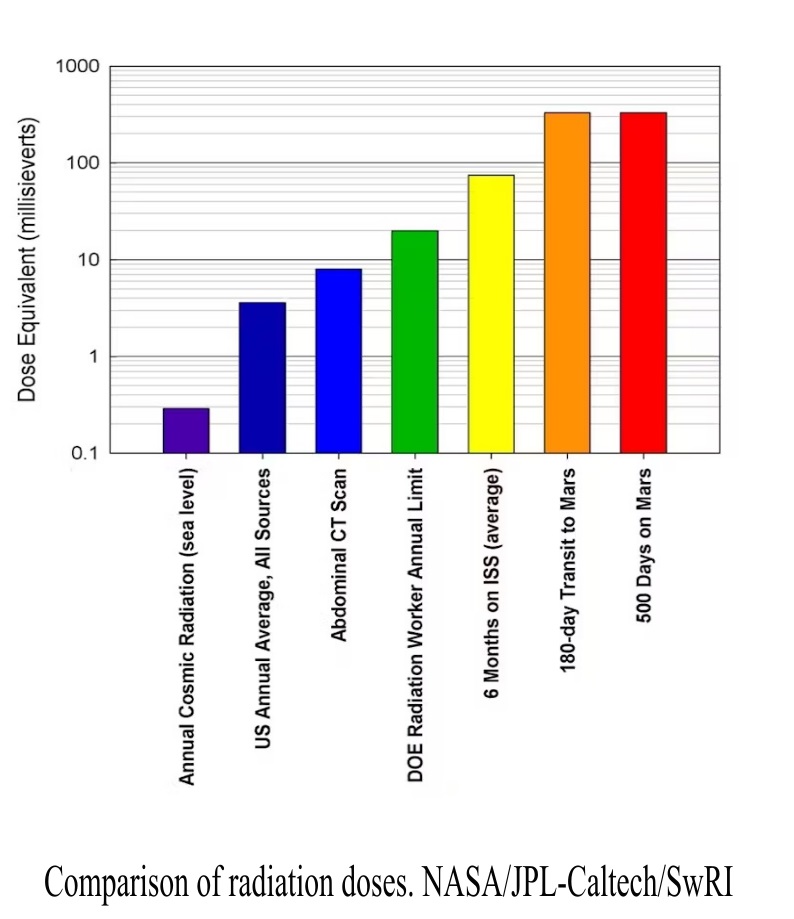
Changes in space weather could expose space tourists to radiation doses in excess of the recommended maximum 1 millisievert (mSv) yearly uptake for a member of the public and 20mSv yearly for those working with radiation. Research at the University of Surrey shows that during an extreme space weather event, flight participants could receive doses in excess of 100mSv.
Current legislation and regulation focusing on potential radiation exposure for space tourists is limited and largely untested. There is a heavy focus on conventional non-radiation risk and wider safety, with guidance stemming from regulation of normal commercial flights. However, these are significantly different to space tourism enterprises.
Similarly, the law around space flights and their associated risk liability is complex. Space law incorporates a mix of international law (such as international agreements, treaties and conventions), domestic legislation and guidance.
Cancer risk
Exposure to low levels of background natural radiation is part of everyday life. Most people are not aware of this exposure and the potential risks to our health. For example, an 0.08mSv effective dose from a commercial flight from the UK to the US.
However, exposure to elevated levels of ionising radiation, such as those possible during space weather events, can potentially cause damage to DNA. The risk of space travel therefore ranges from a minor increase in health defects to serious health implications such as cancers.
There has been significant risk assessment of radiation exposure on Earth; for example in the nuclear industry. This is unlike the space tourism industry, which is still in its infancy.
Previous research has focused on the potential risk assessment for astronauts from radiation exposure and long duration missions outside low-Earth orbit. But this does not consider risks for those on short trips to space as tourists. Thus, there is still significant work to be done to assess the unique risk for space tourist flights and the supporting guidance and regulation.
The space tourism industry is currently not fully aware of the radiation risks, we discovered. It is instead relying on incomplete “informed consent” for non-crew participants. The current regulation for the industry therefore places the risk burden firmly on the space tourist. We argue more legislation and regulation are needed.
The United States and Japan are sponsoring a U.N. Security Council resolution calling on nations not to deploy or develop nuclear weapons in space
ByEDITH M. LEDERER Associated Press, March 19, 2024,
UNITED NATIONS — The United States and Japan are sponsoring a U.N. Security Council resolution calling on all nations not to deploy or develop nuclear weapons in space, the U.S. ambassador announced Monday.
Linda Thomas-Greenfield told a U.N. Security Council meeting that “any placement of nuclear weapons into orbit around the Earth would be unprecedented, dangerous, and unacceptable.”
The announcement that the U.S. and Japan had circulated a resolution follows White House confirmation last month that Russia has obtained a “troubling” anti-satellite weapon capability, although such a weapon is not operational yet.
Russian President Vladimir Putin declared later that Moscow has no intention of deploying nuclear weapons in space, claiming that the country has only developed space capabilities similar to those of the U.S.
The Outer Space Treaty ratified by about 114 countries including the United States and Russia prohibits the deployment of “nuclear weapons or any other kinds of weapons of mass destruction” in orbit or the stationing of “weapons in outer space in any other manner.”
Japan’s Foreign Minister Yoko Kamikawa, who chaired the council meeting, said that even during “the confrontational environment” of the Cold War, the rivals agreed to ensure that outer space remained peaceful. That prohibition on putting any weapons of mass destruction into orbit must be upheld today, she said.
Thomas-Greenfield said all parties to the treaty must commit to the ban on nuclear and other destructive weapons, “and we must urge all member states who are not yet party to it to accede to it without delay.”









 nuclear-news