US loosens some rules for offensive counterspace ops, wargaming
Some decision-making authorities, previously closely held by the president or secretary of defense, have been delegated to US SPACECOM, according to sources, but military space leaders want more freedom to act.
Breaking DEfense, By Theresa Hitchens, on May 12, 2025
WASHINGTON — When the Space Force recently put out a forward-leaning “warfighting” framework, it included an unusually blunt warning for military commanders: ensure the rules of engagement for space operations aren’t too restrictive, or the US will be at a severe disadvantage in the heavens.
That warning was public, but Breaking Defense has learned it comes amid a parallel push by the Space Force and US Space Command (SPACECOM) over the last several years to gain more military decision-making control over the use of anti-satellite (ASAT) weapons — decision-making authority that has historically been closely held by the president and/or the secretary of defense.
While delegation of presidential authority with regard to space weapons is obscured by deep secrecy and classification, discussions by Breaking Defense with more than a dozen sources — including former Pentagon and US government civilian officials, retired and current military officials and outside space experts — have revealed that gradual but ground-breaking shifts in military freedom to prosecute war in the heavens have begun to take place in response to growing threats from Russia and, in particular China.
“We have made some changes that delegated some authorities down to Space Command commander under certain circumstances,” a former senior Space Force official said. “But in my view, not enough.”
For example, over the last decade there has been a gradual loosening of the reins on case-by-case determinations about the use of some types of temporary or reversible counterspace actions, such as jamming or lazing, according to a handful of sources. However, these sources did not indicate that there has been any relaxation of the requirement for approval by the president and/or the secretary of defense for a kinetic attack to destroy an enemy satellite……………………….
Changes in delegation of authority sped up following the standup of SPACECOM in 2019, the former senior Space Force official said. And according to three sources close to the debate, there were intense discussions as late as last summer within the Biden administration about delegating authority for the use of offensive satellite attack weapons to SPACECOM.
“OSD [Office of the Secretary of Defense] Space Policy was engaged in the strongest push I’m aware of to get authorization to use offensive counterspace capabilities delegated down from the [White House] to the [Secretary of Defense] and eventually to” the head of SPACECOM, said another former Pentagon official.
John Plumb, the head of OSD Space Policy under President Joe Biden, did reveal to Breaking Defense one significant move by that administration: allowing joint force planners to include space warfighting in their routine contingency plans and wargames for future conflict. (He would not, however, address the key question of whether destructive, kinetic strikes can be included in those plans.)………………………………………………………………………………………………………………………………. https://breakingdefense.com/2025/05/exclusive-us-loosens-some-rules-for-offensive-counterspace-ops-wargaming/
China, Russia may build nuclear plant on moon to power lunar station, official says

By Eduardo Baptista, April 24, 2025,
https://www.reuters.com/business/energy/china-led-lunar-base-include-nuclear-power-plant-moons-surface-space-official-2025-04-23/
- Summary
- China and Russia plan nuclear reactor for lunar base by 2035
- China and Russia-led ILRS aims to rival NASA’s Artemis program
- China-Russia cooperation strengthened by tensions with West
SHANGHAI, April 23 (Reuters) – China is considering building a nuclear plant on the moon to power the International Lunar Research Station (ILRS) it is planning with Russia, a presentation by a senior official showed on Wednesday.
China aims to become a major space power and land astronauts on the moon by 2030, and its planned Chang’e-8 mission for 2028 would lay the groundwork for constructing a permanent, manned lunar base.
In a presentation in Shanghai, the 2028 mission’s Chief Engineer Pei Zhaoyu showed that the lunar base’s energy supply could also depend on large-scale solar arrays, and pipelines and cables for heating and electricity built on the moon’s surface.
Russia’s space agency Roscosmos said last year it planned to build a nuclear reactor on the moon’s surface with the China National Space Administration (CNSA) by 2035 to power the ILRS.
The inclusion of the nuclear power unit in a Chinese space official’s presentation at a conference for officials from the 17 countries and international organisations that make up the ILRS suggests Beijing supports the idea, although it has never formally announced it.
“An important question for the ILRS is power supply, and in this Russia has a natural advantage, when it comes to nuclear power plants, especially sending them into space, it leads the world, it is ahead of the United States,” Wu Weiren, chief designer of China’s lunar exploration program, told Reuters on the sidelines of the conference.
After little progress on talks over a space-based reactor in the past, “I hope this time both countries can send a nuclear reactor to the moon,” Wu said.
China’s timeline to build an outpost on the moon’s south pole coincides with NASA’s more ambitious and advanced Artemis programme, which aims to put U.S. astronauts back on the lunar surface in December 2025.
Wu said last year that a “basic model” of the ILRS, with the Moon’s south pole as its core, would be built by 2035.
In the future, China will create the “555 Project,” inviting 50 countries, 500 international scientific research institutions, and 5,000 overseas researchers to join the ILRS.
Researchers from Roscosmos also presented at the conference in Shanghai, sharing details about plans to look for mineral and water resources, including possibly using lunar material as fuel.
China, Russia may build nuclear plant on moon to power lunar station, official says
China is considering building a nuclear plant on the moon to power the
International Lunar Research Station (ILRS) it is planning with Russia, a
presentation by a senior official showed on Wednesday. China aims to become
a major space power and land astronauts on the moon by 2030, and its
planned Chang’e-8 mission for 2028 would lay the groundwork for
constructing a permanent, manned lunar base.
Reuters 23rd April 2025, https://www.reuters.com/business/energy/china-led-lunar-base-include-nuclear-power-plant-moons-surface-space-official-2025-04-23/
As more countries enter space, the boundary between civilian and military enterprise is blurring. Dangerously.
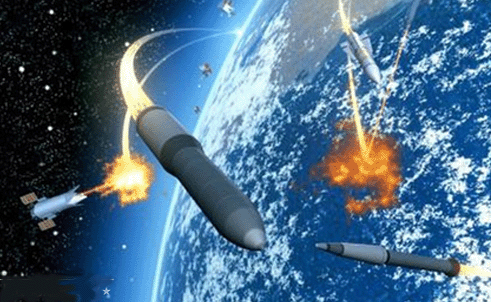
By Zohaib Altaf | April 9, 2025, https://thebulletin.org/2025/04/as-more-countries-enter-space-the-boundary-between-civilian-and-military-enterprise-is-blurring-dangerously/#post-heading
Outer space is no longer just for global superpowers and large multinational corporations. Developing countries, start-ups, universities, and even high schools can now gain access to space. The democratization of space has led to significant technological advancements, economic growth, and international collaboration.
In 2024, a record 2,849 objects were launched into space. The commercial satellite industry saw global revenue rise to $285 billion in 2023, driven largely by the growth of SpaceX’s Starlink constellation. Private space companies such as SpaceX have played crucial roles in making space more accessible globally.
Developing countries have also made strides. Since 2018, nations like Bangladesh, Ghana, Nepal, Rwanda, and Sri Lanka have launched their first satellites. The African space scene has grown, with 43 satellites launched since 2016, totaling 63 in 2025. Ethiopia, despite being one of the world’s poorest countries, has made significant progress in space activities. Similarly, Rwanda, with a substantial portion of its population living in poverty, has embarked on its space journey. These advances show that barriers to space entry are declining.
While the democratization of space is a positive development, it has introduced complex challenges, particularly an ethical quandary that I call the “double dual-use dilemma.” The double dual-use dilemma refers to how private space companies themselves—not just their technologies—can become militarized and integrated into national security while operating commercially
Unlike the traditional military-industrial complex, space companies fluidly shift between civilian and military roles. Their expertise in launch systems, satellites, and surveillance infrastructure allows them to serve both markets, often without clear regulatory oversight. Companies like Walchandnagar Industries in India, SpaceX in the United States, and the private Chinese firms that operate under a national strategy of the Chinese Communist Party called Military-Civil Fusion exemplify this trend, maintaining commercial identities while actively supporting defense programs. This blurring of roles, including the possibility that private space companies may develop their own weapons, raises concerns over unchecked militarization and calls for stronger oversight to preserve space as a neutral domain.
Dual use of space companies. Countries like the United States and China have already shown a willingness to use commercial space entities for military purposes. China encourages private entities to participate in space activities as part of its Military-Civilian Integration Strategy. Similarly, the 2021 United States Space Priorities Framework outlines how new commercial space capabilities and services can be leveraged to meet national security needs. In a 2021 interview, the then-head of the US Space Force discussed the importance of using the space industry for national security.
Researchers and security analysts are increasingly concerned that the dual use of private space companies is not limited to their space technologies, such as the satellites they launch. In some cases, a company may appear to be a civilian space entity while actually maintaining close links with defense sectors.
For instance, take the example of India, which has seen phenomenal growth in its space sector in recent years. The leading companies of the Indian Space Association have worked closely with the Indian Ministry of Defence on various contracts.
Furthermore, the association’s leadership maintains a close connection with the Indian army and defense organizations. For example, the first chairman, Jayant Patil, was also the senior vice president for defense business at Larsen and Toubro, an Indian company involved in the space industry. The company has collaborated with India’s Defence Research and Development Organisation since the mid-1980s.
The usefulness of space companies goes beyond their existing technologies. Military organizations can use expertise gained through civilian cooperation programs to develop other critical technologies. India’s intercontinental ballistic missile program, based on the SLV-3 vehicle, was initially developed under civilian space cooperation with NASA. India’s Agni-V ICBM, which is capable of carrying multiple warheads and has a range exceeding 5,000 kilometers, has also benefited from technological cooperation with NASA.
Indian private space companies such as Walchandnagar Industries are also defense contractors producing aerospace, defense, missile, and nuclear power technologies. These companies collaborate with India’s Defence Ministry and the Defence Research and Development Organisation to produce strategic articles, tactical missiles, and critical platform-based equipment. The expertise gained from private space launches and technological developments can be leveraged to improve missile technology.
There is a serious risk that civilian companies in India and elsewhere, having gained expertise through cooperation with the military, might start developing their own weapons. The table below shows how specific types of space expertise can be used to develop missiles, drones, precision missiles, hypersonic missiles, and other loitering munitions.
Dual use of space technology. India’s rapidly growing space sector and expanding military-commercial partnerships make it a key case study of the double dual-use dilemma. Unlike the United States and China, which have structured policies—the US Space Force and National Space Policy formally integrate private firms into defense, while China’s Military-Civil Fusion strategy mandates commercial space support for China’s army—India’s private space sector is expanding, but its dual-use regulatory framework is still developing. India’s Space Policy 2023, while not explicitly mentioning the military, hints at defense applications by emphasizing space capabilities for “national security.”
This lack of clear regulatory boundaries allows technologies initially developed for civilian use to be repurposed for defense applications, as seen in the case of Synthetic Aperture Radar. Originally acquired through civilian cooperation with NASA, this radar imaging technique is now being adapted for military reconnaissance and targeting. Although not a weapon, the technique’s dual-use nature enables high-resolution surveillance, missile guidance, and intelligence operations.
The commercialization of space by private companies poses significant security challenges. For instance, ostensibly civilian satellites can be repurposed for military uses such as surveillance and espionage. Commercial satellites with high-resolution imaging capabilities, like those from companies such as Planet Labs, can be used for intelligence gathering, providing detailed information on adversaries’ activities and installations. The dual-use dilemma affects governments as well as private companies, but poses greater risks with private entities due to weaker oversight and profit-driven priorities. Governments operate under strict security frameworks and treaties like the Outer Space Treaty, ensuring accountability in the use of dual-use technologies. In contrast, private companies may prioritize commercial interests, potentially selling technologies to less accountable actors, increasing proliferation risks. While satellite launches are regulated, post-launch activities—like selling high-resolution imagery or repurposing technology—are harder to monitor.
Furthermore, companies like the American company Capella Space have developed synthetic aperture radar satellites for civilian purposes such as disaster management and environmental monitoring. However, the high-resolution images provided by these satellites can also be used for military applications, including counterforce strikes and espionage. These satellites can monitor adversaries and plan strategic military operations.
Moreover, American companies like SpaceX and Blue Origin, which focus on developing rockets and spacecraft for civilian space missions, also have the potential to contribute to military logistics and defense operations. For instance, SpaceX’s Starlink constellation, designed for global internet coverage, could be used in military scenarios to support drone operations by enabling real-time communication and coordination, as seen during the Russia-Ukraine conflict.
Repurposing commercial technologies for military use introduces potential risks. Civilian systems could become high-value targets, vulnerable to cyberattacks and physical strikes, potentially disrupting operations and escalating conflicts into space. The reliance on privately owned infrastructure also poses challenges, as it reduces government oversight and increases the risk of misuse or proliferation. For example, reusable rockets developed for commercial launches could be adapted for missile programs, enabling military advancements to be concealed within civilian initiatives. These dual-use capabilities have the potential to blur the boundaries between civilian and military applications, increasing the risks of conflict escalation and complicating efforts to maintain global stability in a democratized space domain.
Need for robust regulatory framework. The challenges posed by the double dual-use dilemma necessitate robust regulatory frameworks and international cooperation to ensure that the commercialization of space does not compromise global security. For example, commercial satellite launch services could be used to deploy space-based weapons or reconnaissance systems under the guise of civilian activities, making it harder to enforce arms control agreements. Effective space governance must address the potential for commercial space entities to be co-opted for military purposes. One practical step is the establishment of international agreements that mandate transparency in satellite launches and operations.
The Outer Space Treaty, which forms the basis of international space law, should be expanded to include specific provisions for the dual use of space technologies. For example, countries could be required to declare the intended uses of their satellites, with periodic inspections to ensure compliance. International space governance must ensure that expertise gained through civil cooperation does not translate into new weapons programs.
Furthermore, partnerships between governments and private corporations should be regulated to prevent the misuse of commercial space capabilities. The European Union’s Space Surveillance and Tracking network is an example of regional cooperation to monitor space activities and ensure that space assets are used for their declared purposes. This type of cooperation should be extended globally to include major space-faring nations and emerging space players.
In the United States, the Space Force has already begun leveraging commercial space capabilities for national security purposes. For instance, the National Reconnaissance Office has contracted with commercial satellite companies to provide imagery for intelligence purposes. Such partnerships highlight the need for clear guidelines to differentiate civilian and military applications and to ensure that commercial space activities do not escalate geopolitical tensions.
The international community must develop comprehensive strategies to manage the complexities introduced by the double dual-use dilemma. It is no longer a distant challenge—it is actively reshaping the balance of power in space. As private space firms blur the lines between commercial innovation and military assets, the risk of an unregulated arms race beyond Earth’s atmosphere grows.
Without clear governance, space could follow the path of cyberspace—a once-neutral domain now deeply entrenched in geopolitical rivalry. The question is no longer if commercial space activities will fuel strategic competition, but how soon nations will act to prevent the militarization of the final frontier.
I’ve got a rocket for these space cadets and their pantomime of feminism
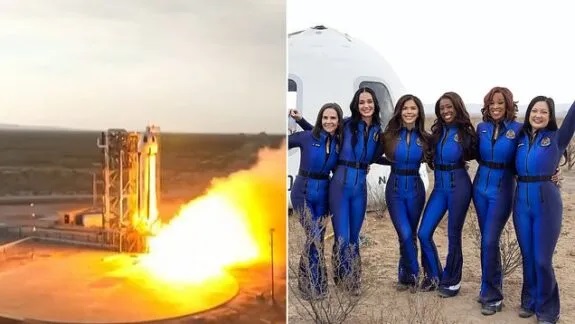
They do not operate the spaceship. They dress sexy for the spaceship flight.
pseudo-feminism.. which wrinkles its nose if you look grey, ugly or old
The Age, Jacqueline Maley, April 20, 2025
“……………………………………………………………….. We didn’t want to look but we found we couldn’t look away when, on Wednesday, Jeff Bezos’ Blue Origin – a space technology company – launched an all-female, B- and C-list celebrity crew of six into space, wearing skintight designer spacesuits and heavy make-up. It was the first fully-lady-mission since Russian astronaut Valentina Tereshkova’s solo space flight in 1963.
The team consisted of the billionaire Bezos’ fiancée, the television journalist and children’s book author Lauren Sanchez; pop star Katy Perry; television host and Oprah-bestie Gayle King; former NASA rocket scientist Aisha Bowe; activist, sexual assault survivor and scientist Amanda Nguyen; and film producer Kerianne Flynn.
“I was like, ‘What am I going to wear?’” Perry told Elle of her initial reaction to the invitation. “But seriously, I have wanted to go to space for almost 20 years.”
In terms of publicity for space tourism for the rich and (dubiously) famous, it was a bonanza. But the heavily girlified nature of the rhetoric around the mission (if we can call it that – the trip lasted for 11 minutes), and its explicit branding as an exercise in empowering girls to aspire to careers in space exploration, well, that made it a very dark day for feminism.
The whole exercise was emblazoned with such drippy femininity and lame girlboss-ery that all womankind was implicated. It was a test of the implicit feminist pact to Support Women. I suspect I failed it.
It’s not something that Virginia Woolf or Betty Friedan ever prepared us for – an all-woman space crew which served quotes like: “I think it’s so important for people to see … this dichotomy of engineer and scientist, and then beauty and fashion. We contain multitudes. Women are multitudes. I’m going to be wearing lipstick.”
Despite not having any direct link to the Trump administration, it all felt so very Trumpy – a symbol of the dark end-days of American democracy; the great American project of aspiration and exploration reduced to a commercialised stunt, obscenely wasteful and vulgar beyond words. …………..
… the moral emptiness of the mission was underscored by leaked documents showing the Trump administration plans to gut key science programs funded by the federal government.
Under the leaked plans, NASA’s science budget for the fiscal year 2026 would be nearly halved. As Nature reported: “At risk is research that would develop next-generation climate models, track the planet’s changing oceans and explore the Solar System.”
Separately, NASA’s Diversity, Equity and Inclusion chief Neela Rajendra was sacked, in compliance with Trump’s executive order to “terminate” all people employed under “DEI” programs.
Business Standard reported Rajendra “played a key role in national initiatives like the Space Workforce 2030 pledge, aimed at increasing representation of women and minorities in STEM fields”.
Sure, but did she put the glam into space? The girlstronauts represent a pantomime of feminism found everywhere across Trump-land.
It’s in the robotically doll-like women who sit behind the men of the administration, nodding and smiling as they announce powerful new assaults on the rule of law.
It’s in the milquetoast “Be Best” initiatives of first lady Melania Trump.
It’s in the administration’s persecution of trans people in the name of “women’s rights”, and in its rollback of abortion rights…………
But at least the women are on stage, right? Women can be treated as a special category as long as they uplift and adorn – that seems to be the message the girl crew have absorbed and then promoted. But there is little point in them being on view if they are not looking “glam”.
Such women equate a certain kind of physical presentation with self-respect, and they defend it as their “right”. They fail to realise, or are too rich to care, that the companies which sell them their version of beauty are exploiting them. They do not operate the spaceship. They dress sexy for the spaceship flight.
It is a nihilistic form of pseudo-feminism that insists on women’s right to “take up space” (as the astronaut women chanted when they reached the zero-gravity part of their adventure), but which wrinkles its nose if you look grey, ugly or old while doing so.
It is a way of reducing women to the status of a pretty distraction, while insisting, straight-faced, that at least that means we are being “seen”. https://www.theage.com.au/politics/federal/i-ve-got-a-rocket-for-these-space-cadets-and-their-pantomime-of-feminism-20250417-p5lslv.html
Gender Stunts in Space: Blue Origin’s Female Celebrity Envoys
April 15, 2025 Dr Binoy Kampmark, https://theaimn.net/gender-stunts-in-space-blue-origins-female-celebrity-envoys/
Indulgent, vain and profligate, the all-female venture into space on the self-piloted New Shepard (NS-31) operated by Jeff Bezos’ Blue Origin was space capitalism and celebrity shallowness on full show, masquerading as profound, moving and useful.
The crew consisted of bioastronautics research scientist and civil rights activist Amanda Nguyen, CBS Mornings co-host Gayle King, pop entertainer Katy Perry, film producer Kerianne Flynn, former NASA scientist and entrepreneur Aisha Bowe and Lauren Sánchez, fiancée of Jeff Bezos. The journey took 11 minutes and reached the Kármán line at approximately 96 kilometres above the earth.
Blue Origin had advertised the enterprise as an incentive to draw girls to pursue careers in science, technology, engineering and mathematics (STEM). It also shamelessly played on the background of some of the crew, with Nguyen promoted as “the first Vietnamese and south-east Asian female astronaut” whose presence would “highlight science as a tool for peace” and also project a potent “symbol of reconciliation between the US and Vietnam.”
Phil Joyce, Senior Vice President of New Shepard, thought it a “privilege to witness this crew of trailblazers depart the capsule today.” Each woman was “a storyteller” who would “use their voices – individually and together – to channel their life-changing experience today into creating lasting impact that will inspire people across our planet for generations.”
What was more accurately on show were celebrity space marketers on an expensive jaunt, showing us all that women can play the space capitalism game as well, albeit as the suborbital version of a catwalk or fashion show. Far from pushing some variant of feminism in the frontier of space, with scientific rewards for girls the world over, we got the eclipsing, if not a wholesale junking, of female astronauts and their monumental expertise.
It hardly compared, at any stretch or by any quantum of measure, with the achievement of Russian cosmonaut, Valentina Tereshkova, who piloted a Vostok 6 into earth’s orbit lasting 70 hours over six decades prior. To have Sánchez claiming to be “so proud of this crew”, tears cued for effect, gave the impression that they had shown technical expertise and skill when neither was required. It was far better to have deep pockets fronting the appropriate deposit, along with the necessary safe return, over which they had virtually no control over.
Dr Kai-Uwe Schrogl, special advisor for political affairs at the European Space Agency, offered a necessarily cold corrective. “A celebrity isn’t an envoy of humankind – they go into space for their own reasons,” he told BBC News. “These flights are significant and exciting, but I think maybe they can also be a source of frustration for space scientists.” How silly of those scientists, who regard space flight as an extension of “science, knowledge and the interests of humanity.”
The Guardian was also awake to the motivations of the Bezos project. “The pseudo progressiveness of this celebrity space mission, coupled with Bezos’s conduct in his other businesses, should mean we are under no illusion what purpose these flights serve.” With Richard Branson’s Virgin Galactic and Elon Musk’s SpaceX, the space tourism market, marked by its bratty oligarchs, is becoming competitive. In an effort to corner the market, attractive gimmicks are in high demand.
The cringingly superficial nature of the exercise was evident in various comments on the fashion aspect of the suits worn by the crew. Here was branding, and the sort that could be taken to space. As Sánchez stated: “Usually, you know, these suits are made for a man. Then they get tailored to fit a woman. I think the suits are elegant, but they also bring a little spice to space.” Blue Origin had capitalised on NASA’s own failings in 2019, which saw the abandoning of an all-female spacewalk for lacking appropriately fitting spacesuits.
On their return, the female cast performed their contractual undertakings to bore the press with deadly clichés and meaningless observations, reducing space travel to an exercise for the trivial. “Earth looked so quiet,” remarked Sánchez. “It was quiet, but really alive.” King, after getting on her knees to kiss the earth, merely wanted “to have a moment with the ground, just appreciate the ground for just a second.” (Surely she has had longer than that.) Perry, on her return after singing What a Wonderful World during the trip, overflowed with inanities. She felt “super connected to life”, as well as being “so connected to love.”
On the ground were other celebrities, delighted to offer their cliché-clotted thoughts. “I didn’t realise how emotional it would be, it’s hard to explain,” reflected Khloé Kardashian. “I have all this adrenaline and I’m just standing here.” From a family of celebrities that merely exist as celebrities and nothing else, she had some advice: “Dream big, wish for the stars – and one day, you could maybe be amongst them.”
Amanda Hess, reflecting on the mission in The New York Times, tried to put her finger on what it all meant. “The message is that a little girl can grow up to be whatever she wishes: a rocket scientist or a pop star, a television journalist or a billionaire’s fiancée who is empowered to pursue her various ambitions and whims in the face of tremendous costs.” Just not an astronaut.
ESA’s new documentary paints worrying picture of Earth’s orbital junk problem
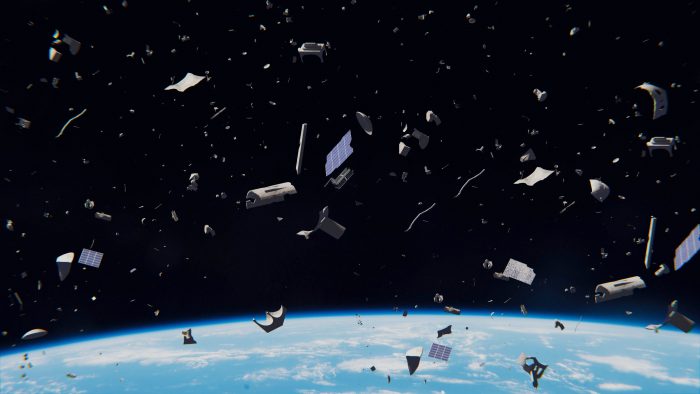
By Monisha Ravisetti , April 3, 2025, https://www.space.com/the-universe/earth/esas-new-documentary-paints-worrying-picture-of-earths-orbital-junk-problem
There are a lot of satellites, and a lot of trash, around our planet — and the quantities are only going to get higher.
A new documentary short released by the European Space Agency presents an ominous statement within its first 20 seconds: “Around 70% of the 20,000 satellites ever launched remain in space today, orbiting alongside hundreds of millions of fragments left behind by collisions, explosions and intentional destruction.”
The approximately eight-minute-long film “Space Debris: Is it a Crisis?” attempts to answer its conjecture with supportive statistics and orbital projections.
For instance, it discusses how the rise of satellite constellations (think, SpaceX Starlink internet satellites) is bound to further increase the amount of stuff that orbits our planet — yet simultaneously, the amount of space junk will likely go up, too, due to shards of rockets tearing off during launch and out-of-commission spacecraft that can’t be returned to the ground in a timely manner.
Considering how quickly things in Earth orbit tend to zip around, a fragment of a spacecraft crashing into a satellite could greatly hinder that satellite; two satellites colliding could be catastrophic for both. Sometimes, debris even falls uncontrolled back to our planet.
The film also mentions that the kind of Earth orbit matters when discussing whether we’re in a space junk “crisis” — though unfortunately, orbits at risk appear to be those with satellites that help with communication and navigation, as well as our fight against another primarily human-driven crisis: global warming.
Still, the film emphasizes that solutions ought to be thought of carefully: “True sustainability is complex, and rushed solutions risk creating the problem of burden-shifting.”
You can watch the film on ESA’s website, linked just here.
Swarms of satellites are harming astronomy. Here’s how researchers are fighting back

SpaceX and other companies plan to launch tens of thousands of satellites, which could mar astronomical observations and pollute the atmosphere.
Nature, By Alexandra Witze, 18 Mar 25
In the next few months, from its perch atop a mountain in Chile, the Vera C. Rubin Observatory will begin surveying the cosmos with the largest camera ever built. Every three nights, it will produce a map of the entire southern sky filled with stars, galaxies, asteroids and supernovae — and swarms of bright satellites ruining some of the view.
Astronomers didn’t worry much about satellites photobombing Rubin’s images when they started drawing up plans for the observatory more than two decades ago. But as the space around Earth becomes increasingly congested, researchers are having to find fresh ways to cope — or else lose precious data from Rubin and hundreds of other observatories.
The number of working satellites has soared in the past five years to around 11,000, mostly because of constellations of orbiters that provide Internet connectivity around the globe (see ‘Satellite surge’). Just one company, SpaceX in Hawthorne, California, has more than 7,000 operational Starlink satellites, all launched since 2019; OneWeb, a space communications company in London, has more than 630 satellites in its constellation. On paper, tens to hundreds of thousands more are planned from a variety of companies and nations, although probably not all of these will be launched1.
Satellites play a crucial part in connecting people, including bringing Internet to remote communities and emergency responders. But the rising number can be a problem for scientists because the satellites interfere with ground-based astronomical observations, by creating bright streaks on images and electromagnetic interference with radio telescopes. The satellite boom also poses other threats, including adding pollution to the atmosphere.
When the first Starlinks launched, some astronomers warned of existential threats to their discipline. Now, researchers in astronomy and other fields are working with satellite companies to help quantify and mitigate the impacts on science — and society. “There is growing interest in collaborating and finding solutions together,” says Giuliana Rotola, a space-policy researcher at the Sant’Anna School of Advanced Studies in Pisa, Italy.
Timing things right………………………………………..https://www.nature.com/articles/d41586-025-00792-y?fbclid=IwY2xjawJYMe9leHRuA2FlbQIxMAABHZglIwLgXdf2zs39ZTJIEmAP2QcvsWbVMRrzGsBT3jO8rtlyneCYBjefSA_aem_YRQybLlF5vTcwKEIIuQ0ZA
The rush to war in space only needs a Gulf of Tonkin incident, and then what happens?

| Spacecom Protecting Homeland From Growing Threats March 26, 2025 | By David Vergun , https://www.defense.gov/News/News-Stories/Article/Article/4136285/spacecom-protecting-homeland-from-growing-threats/ |
The Defense Department must prepare for conflict in space to ensure deterrence. If that fails, the U.S. military is ready to fight and win, said Space Force Commander Gen. Stephen N. Whiting, who testified today at a Senate Armed Services subcommittee on strategic forces.
He said threats continue to expand at a breathtaking pace and pose a risk to the joint force.
The Defense Department must prepare for conflict in space to ensure deterrence. If that fails, the U.S. military is ready to fight and win, said Space Force Commander Gen. Stephen N. Whiting, who testified today at a Senate Armed Services subcommittee on strategic forces.
He said threats continue to expand at a breathtaking pace and pose a risk to the joint force.
Whiting said no other country can match the United States’ understanding of the complexities of space and the requirements to operate effectively in the most challenging areas of responsibility.
“Our military has the best trained, most capable space warfighting force in the world, and they stand dedicated to for America,” he added.
The general said Operation Olympic Defender is an example of working with allies and partners. He noted that Germany, France and New Zealand recently joined the United Kingdom, Canada and Australia as participating nations.
The operation’s mission optimizes space operations, improves mission assurance, enhances resilience and synchronizes efforts, according to a Spacecom news release.
This growth further strengthens partnerships and enables our allies to share the burden of collective space security, Whiting said.
“These advantages and our ability to deter potential adversaries cannot be taken for granted,” he said. “Deterrence in space is consistent with other domains. It requires a keen understanding and clear communication of what we are deterring against, credible, acknowledged capabilities to impose costs on those who attack us, and resilient architectures to dissuade attack by making any effort futile.”
Whiting said Spacecom is fully integrated into and contributing to the department’s efforts to establish a Golden Dome for American missile defense shield, adding that Space Command requires stable funding, as well as effective and efficient acquisition programs that deliver advanced space capabilities.
He identified the most pressing issues as the delivery of integrated space fires, enhanced battlespace awareness, and integrated command and control capabilities to achieve space superiority, which enhances homeland defense while protecting and enabling the joint force.
“Although many challenges lie ahead, the future of space holds tremendous promise for America if we actively and thoughtfully protect it,” he said.
In Whiting’s prepared testimony submitted to lawmakers, he wrote: “Spacecom is partnering with U.S. Northern Command and other stakeholders to write an initial capabilities document aimed at defining capability-based requirements for the Golden Dome architecture, based on forecasted threat scenarios. As these capabilities develop and deliver, we stand ready to take an active role in the operation of a next-generation space architecture which will be resident in our in support of protecting American citizens from attack.”
In his prepared testimony, he also addressed China’s views on space technology and its goal of becoming the dominant power in East Asia and a global superpower.
” seeks to rival the United States in nearly all areas of space technology by 2030 and establish itself as the world’s preeminent space power by 2045. Since 2015, China’s on-orbit presence has grown by 1,000%, with 1,094 active satellites as of January 2025. Its sophisticated space and counter-space systems enhance its ability to secure territorial claims, project power, and challenge U.S. advantages.”
Risk of Radiation Carcinogenesis

There is not currently thought to be a notable risk of a crewmember developing clinically detectable cancer during a mission due to spaceflight exposure.
Robert E. Lewis, NASA, 11 Mar 25, https://www.nasa.gov/directorates/esdmd/hhp/risk-of-radiation-carcinogenesis/
Increased radiation exposure in the spaceflight environment outside of low-Earth orbit may contribute to an increased risk of developing cancer later in an astronaut’s life. Shielding is effective against some radiation exposure, such as solar particle events (SPE) but does not mitigate Galactic Cosmic Radiation (GCR) exposure. Primary contributors to development of cancer later in life are dependent on mission parameters and duration, solar conditions, body structures present, individual radiosensitivity, and age at exposure. The effects of other sources of uncertainty that may modify radiation risk (e.g., secondary spaceflight hazards) are being characterized but cannot be estimated or integrated currently. Terrestrial cancer therapies continue to progress and may be able to mitigate cancer outcomes. There is not currently thought to be a notable risk of a crewmember developing clinically detectable cancer during a mission due to spaceflight exposure.
Nuke Mars, Elon? Not with your Outer Space Treaty

27th January 2025,
https://www.nuclearpolicy.info/news/nuke-mars-elon-not-with-your-outer-space-treaty/
The CEO of Tesla Motors and space entrepreneur Elon Musk may not be celebrating today’s 58th anniversary of the Outer Space Treaty because it stands between him and his ambition to ‘Nuke Mars’.
In September 2015, the eccentric billionaire first spoke on US chat show The Late Show with Stephen Colbert of ‘nuking Mars’. In later interviews later that year, Mr Musk described exploding nuclear weapons over the Martian poles every few seconds to create two pulsing ‘suns’ that would warm up the surface as a prelude to his plan to initiate human colonization of the Red Planet.
Mr Musk appeared to marginalise the ethics, excusing the exercise as the explosions would take place “above the planet, not on the planet” – the atomic bomb explosions in Japan were also airbursts – and, of the challenge of establishing fusion weapons in orbit above the surface and then sequentially exploding them, he said: “Yeah absolutely no problem.”
Clearly at that time Mr Musk was unaware, or dismissive, of the Outer Space Treaty – or Treaty on Principles Governing the Activities of States in the Exploration and Use of Outer Space, including the Moon and Other Celestial Bodies – which first opened for signature on 27 January 1967 and became effective on the 10 October of that year. 115 states parties have signed the treaty, including all space-faring nations.
Intended to annul fears that, in the missile age, space could become yet another contested battleground and a further location in which to station weapons of mass destruction, the treaty contains several key provisions, specifically the prohibition of nuclear weapons in space, limiting the use of the moon and other celestial bodies to peaceful purposes, and banning military bases, testing weapons or conducting military manoeuvres on such bodies.
Clearly then deploying and using nuclear weapons in space is prohibited under international law, and Mr Musk being an Earth-bound US citizen is subject to the laws and obligations applicable to the United States.
Whether the treaty would prevent Mr Musk establishing a ‘colony’ is debatable, even if in name only. The treaty provides for space and any celestial body to be freely explored and used by all nations, but on whether he could claim hegemony the treaty is moot for it only precludes nations from claiming sovereignty over space and celestial bodies, not individuals.
Clearly at the time the idea of a powerful individual in the future becoming sole ruler of an entire planet was regarded as inconceivable, which seems a little bizarre when many of the legislators would have been brought up on a cinematic diet of Flash Gordon with the Emperor Ming and Dan Dare with the Mekon.
Unsurprisingly in 2015, Mr Musk’s pronouncements led to him being branded a ‘Bond villain’ in certain quarters, but he was clearly comfortable with it as he took to wearing a tee shirt specifying his ambition. Now with his recent ‘elevation’ to become President Trump’s special advisor on government efficiency and, seemingly, space, his ambition may be one step closer to becoming reality for in President Trump, he has found an ally reported to have also advocated for using nuclear weapons to overcome geographical challenges.
In August 2019, the news website Axios wrote that Trump had asked his top national security officials to “consider using nuclear bombs to weaken or destroy hurricanes.” Axios alleged that in a briefing on hurricanes, the 45th President postulated: “[Hurricanes] start forming off the coast of Africa, as they’re moving across the Atlantic, we drop a bomb inside the eye of the hurricane, and it disrupts it. Why can’t we do that?” It was reported that attendees were astonished, but the President later claimed it to be ‘Fake News.’
Who knows? But with an office holder restored to the White House with little regard for international institutions and with a reputation for making outrageous utterances, counselled by an advisor with a proclaimed desire to conquer space and nuke and colonise planets, the Nuclear Free Local Authorities would not be surprised if US diplomats are instructed to seek amendments to the treaty to enable Mr Musk’s ambitions to made legal, even if, for now, they remain impractical.
The Quiet Crisis Above: Unveiling the Dark Side of Space Militarization

By Justin James McShane, GeopoliticsUnplugged, Nov 28, 2024
Summary:
In this episode, we examine the growing militarization of space, focusing on the development and testing of anti-satellite weapons (ASATs) by various nations, including the U.S., Russia, China, and India. We detail the history of space militarization, from the Cold War to the present, highlighting the dangers of space debris and the inadequacy of existing treaties like the Outer Space Treaty in addressing modern threats. Different types of ASATs are described, both kinetic and non-kinetic, along with electronic warfare systems used for disrupting satellites. We also discuss the lack of international cooperation and robust enforcement mechanisms to prevent an arms race in space, emphasizing the need for new agreements to ensure the peaceful use of outer space. Ultimately, we warn of the potential for space to become a new theater of conflict. cooperation?”………………………………………………….
https://geopoliticsunplugged.substack.com/p/ep93-the-quiet-crisis-above-unveiling-ed9
Departing Air Force Secretary Will Leave Space Weaponry as a Legacy

msn, by Eric Lipton, 30 Dec 24
WASHINGTON — Weapons in space. Fighter jets powered by artificial intelligence.
As the Biden administration comes to a close, one of its legacies will be kicking off the transformation of the nearly 80-year-old U.S. Air Force under the orchestration of its secretary, Frank Kendall.
When he leaves office in January — after more than five decades at the Defense Department and as a military contractor, including nearly four years as Air Force secretary — Mr. Kendall, 75, will have set the stage for a transition that is not only changing how the Air Force is organized but how global wars will be fought.
One of the biggest elements of this shift is the move by the United States to prepare for potential space conflict with Russia, China or some other nation.
In a way, space has been a military zone since the Germans first reached it in 1944 with their V2 rockets that left the earth’s atmosphere before they rained down on London, causing hundreds of deaths. Now, at Mr. Kendall’s direction, the United States is preparing to take that concept to a new level by deploying space-based weapons that can disable or disrupt the growing fleet of Chinese or Russian military satellites………………………
Perhaps of equal significance is the Air Force’s shift under Mr. Kendall to rapidly acquire a new type of fighter jet: a missile-carrying robot that in some cases could make kill decisions without human approval of each individual strike.
In short, artificial-intelligence-enhanced fighter jets and space-based warfare are not just ideas in some science fiction movie. Before the end of this decade, both are slated to be an operational part of the Air Force because of choices Mr. Kendall made or helped accelerate.
The Pentagon is the largest bureaucracy in the world. But Mr. Kendall has shown, more than most of its senior officials, that it too can be forced to innovate.
“It is big,” said Richard Hallion, a military historian and retired senior Pentagon adviser, describing the change underway at the Air Force. “We have seen the maturation of a diffuse group of technologies that, taken together, have forced a transformation of the American military structure.”
Mr. Kendall is an unusual figure to be the top civilian executive at the Air Force, a job he was appointed to by President Biden in 2021, overseeing a $215 billion budget and 700,000 employees…………….
Mr. Kendall, who has a folksy demeanor more like a college professor than a top military leader, comes at the job in a way that recalls his graduate training as an engineer.
He gets fixated on both the mechanics and the design process of the military systems his teams are building at a cost of billions of dollars. Mr. Kendall and Gen. David Allvin, the department’s top uniformed officer, have called this effort “optimizing the Air Force for great power competition.”………………….
Mr. Kendall has taken these innovations — built out during earlier waves of change at the Air Force — and amped up the focus on autonomy even more through a program called Collaborative Combat Aircraft.
These new missile-carrying robot drones will rely on A.I.-enhanced software that not only allows them to fly on their own but to independently make certain vital mission decisions, such as what route to fly or how best to identify and attack enemy targets.
The plan is to have three or four of these robot drones fly as part of a team run by a human-piloted fighter jet, allowing the less expensive drone to take greater risks, such as flying ahead to attack enemy missile defense systems before Navy ships or piloted aircraft join the assault.
Mr. Kendall, in an earlier interview with The Times, said this kind of device would require society to more broadly accept that individual kill decisions will increasingly be made by robots……………….
These new collaborative combat aircraft — which will cost as much as about $25 million each, compared to the approximately $80 million price for a manned F-35 fighter jet — are being built for the Air Force by two sets of vendors. One group is assembling the first of these new jets while a second is creating the software that allows them to fly autonomously and make key mission decisions on their own.
This is also a major departure for the Air Force, which usually relies on a single prime contractor to do both, and a sign of just how important the software is — the brain that will effectively fly these robotic fighter jets………………………………………
Space is now a fighting zone, Mr. Kendall acknowledged, like the oceans of the earth or battlefields on the ground.
The United States, Russia and China each tested sending missiles into space to destroy satellites starting decades ago, although the United States has since disavowed this kind of weapon because of the destructive debris fields it creates in orbit.
So during his tenure, the Air Force started to build out a suite of what Mr. Kendall called “low-debris-causing weapons” that will be able to disrupt or disable Chinese or other enemy satellites, the first of which is expected to be operational by 2026.
Mr. Kendall and Gen. Chance Saltzman, the chief of Space Operations, would not specify how these American systems will work. But other former Pentagon officials have said they likely will include electronic jamming, cyberattacks, lasers, high-powered microwave systems or even U.S. satellites that can grab or move enemy satellites.
The Space Force, over the last three years, has also been rapidly building out its own new network of low-earth-orbit satellites to make the military gear in space much harder to disable, as there will be hundreds of cheaper, smaller satellites, instead of a few very vulnerable targets.
Mr. Kendall said when he first came into office, there was an understandable aversion to weaponizing space, but that now the debate about “the sanctity or purity of space” is effectively over.
“Space is a vacuum that surrounds Earth,” Mr. Kendall said. “It’s a place that can be used for military advantage and it is being used for that. We can’t just ignore that on some obscure, esoteric principle that says we shouldn’t put weapons in space and maintain it. That’s not logical for me. Not logical at all. The threat is there. It’s a domain we have to be competitive in.” https://www.msn.com/en-us/news/politics/departing-air-force-secretary-will-leave-space-weaponry-as-a-legacy/ar-AA1wE4iS
US Space Force conducts ‘simulated on-orbit combat’ training
SPACE, By Brett Tingley, August 25, 2022
The exercise brought together Space Force members with counterparts in the U.S. Army and Air Force.
The U.S. Space Force just completed a major joint training exercise that saw participants engage in simulated orbital combat.
The exercise, known as Space Flag 22-3, took place from Aug. 8 to Aug.19 at Schriever Space Force Base in Colorado. Close to 120 Space Force personnel from multiple U.S. Space Force Deltas took part in the training alongside counterparts from the U.S. Air Force and the U.S. Army, according to a Space Force statement. The training was conducted by Space Force’s training and education component, Space Training and Readiness Command (STAR Command or STARCOM).
Space Flag 22-3 presented realistic training opportunities that “challenged players to consider complex astrodynamics while maneuvering and operating during simulated on-orbit combat engagements” in a “contested, degraded and operationally-limited environment,” the statement continues. ………………… https://www.space.com/space-force-space-flag-simulated-orbit-combat
SpaceX Wants to Increase Launches at Boca Chica Without a Full Environmental Review
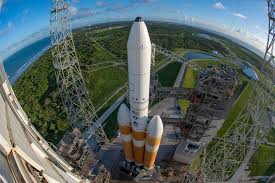

The Hypocrisy of Musk’s Anti-Regulation Stance
Despite Musk’s repeated calls for a smaller government and less regulation, SpaceX’s operations are heavily subsidized by the public,
If you are funded by the public, you should be regulated by the public. Musk’s calls, as the head of the DOGE to dismantle regulation are dangerously misguided.
Lynda Williams, December 12, 2024, https://www.counterpunch.org/2024/12/12/spacex-wants-to-increase-launches-at-boca-chica-without-a-full-environmental-review/
On April 20, 2023, SpaceX’s Starship—the largest and most powerful rocket ever built—exploded just four minutes after liftoff from its Boca Chica spaceport in Texas. While CEO Elon Musk touted the mission as a success for clearing the launch pad, the environmental and community fallout painted a different picture. Scorched wetlands, debris scattered for miles, and fire damage underscored the risks of high-stakes experiments in a region rich with biodiversity and human history. Now, SpaceX seeks approval from the Federal Aviation Administration (FAA) to increase its Starship launch frequency or “cadence” to 25 times per year—potentially 75 events annually when accounting for booster and spacecraft recovery attempts—all without completing the rigorous Environmental Impact Statement (EIS) required by law for projects of this magnitude. Instead the FAA only requires a weaker form of environmental review, an Environmental Assessments (EA).
Although Musk has accused the FAA of regulatory overreach and declared on Twitter that “humanity will never get to Mars” under such constraints, the reality is that the FAA has granted him every Starship license for he has sought at Boca Chica, never once requiring a full EIS. Now, as the Trump-appointed head of the Department of Government Efficiency (DOGE), Musk has the power to push anti-regulation initiatives like Project 2025, which seek to dismantle critical environmental protections. Without swift action to demand accountability, Boca Chica could become not just a testing ground, but a sacrifice zone for Musk’s megalomaniacal pursuit of a world where neither people nor the planet stand in his way. Unless his plans are stopped or slowed, communities, ecosystems, and taxpayers will bear the cost of his unchecked ambitions. Submitting testimony during the FAA’s public comment period is an important way to hold Musk and SpaceX accountable and demand a thorough environmental review with an EIS.
Boca Chica: A Community Under Siege
Boca Chica is far more than a launch site; it is a vital ecosystem and home to diverse communities. The region includes the Laguna Atascosa National Wildlife Refuge, wetlands and endangered species such as the Kemp’s Ridley sea turtle and piping plover. It is also sacred land for the Carrizo Comecrudo Tribe, whose members have opposed SpaceX’s industrial encroachment on their ancestral lands. The Tigua Tribe, also known as the Ysleta del Sur Pueblo, has argued that the development of the SpaceX launch site at Boca Chica Beach has disrupted their traditional ceremonial practices, which include the use of the beach for sacred rites, thereby violating their First Amendment-protected religious practices. Advocacy groups like Save RGV and the Center for Biological Diversity have stepped forward to challenge SpaceX’s operations, highlighting the disproportionate burden borne by the local environment and residents. Both organizations have filed lawsuits demanding the FAA require a full EIS for SpaceX’s activities at Boca Chica. Save RGV has highlighted violations such as discharging untreated industrial wastewater into surrounding wetlands, while the Center for Biological Diversity’s lawsuit argues that the FAA has violated the National Environmental Policy Act (NEPA) by allowing SpaceX to operate under insufficient EAs. Ironically, SpaceX is required to do a full EIS for Starship operations at Kennedy Space Center (KSC) under the U.S. Space Force due to stricter regulations. Yet Boca Chica, with its more fragile ecosystem, is left without the same level of scrutiny. The people of Boca Chica deserve the same protections and oversight as those at KSC.
For local residents, the impact of SpaceX’s operations is impossible to ignore. Frequent road closures disrupt daily life and block access to public beaches. Loud rocket tests and sonic booms disturb both human and wildlife populations, and the April 2023 explosion left debris scattered across miles of sensitive habitat. Meanwhile, Indigenous and local voices remain sidelined in regulatory decisions. The FAA has failed to adequately consult with communities, treating them as collateral damage in Musk’s ambitious pursuit of Mars.
According to a recent NPR story, the situation has worsened due to SpaceX’s wastewater discharges. The company has been found to have violated the Clean Water Act, with both the Environmental Protection Agency (EPA) and the Texas Commission on Environmental Quality (TCEQ) levying fines totaling over $150,000. Environmentalists, including local group Save RGV, have pointed out that this disregard for environmental regulations highlights the urgent need for a more comprehensive review of SpaceX’s impact on the region. Local activist Joyce Hamilton stated, “This is potentially really damaging,” emphasizing the significant environmental consequences of SpaceX’s unchecked operations.
Environmental Risks Ignored by the FAA
Although the FAA did complete an Environmental Impact Statement (EIS) for the SpaceX Starbase in 2014, it was only for Falcon 9 and Falcon Heavy rockets—much smaller and less complex systems. Since then, SpaceX’s operations have expanded dramatically to include the much larger and more powerful Starship/Super Heavy launch system. The FAA has relied on a Programmatic Environmental Assessment (PEA) and tiered reviews, rather than conducting a full EIS specific to Starship operations. While the FAA completed a full EIS for Falcon 9 and Falcon Heavy launches at Cape Canaveral in Florida, it has failed to apply the same standard to Starship’s vastly more powerful and experimental operations in Texas. The two systems are not comparable: Starship’s unique size, power, and planned recovery operations—along with its location in sensitive wetlands near endangered species—demand a new, comprehensive review. The FAA’s reliance on outdated assessments is grossly inadequate and leaves the area unprotected from significant, unexamined risks.
The environmental risks of SpaceX’s operations extend far beyond Boca Chica. The FAA has also permitted SpaceX to blow up Starship in the Indian Ocean, the Pacific Ocean off the coast of California, and north of Hawaii. Even in cases where the spacecraft are intended for “soft” landings in the ocean, the explosive charge used to destroy the spacecraft results in significant pollution, including harmful chemicals like rocket fuel residues, other contaminants, and debris that can endanger marine ecosystems. In the Pacific near Hawaii, it is dangerously close to the Papahānaumokuākea Marine National Monument, a UNESCO World Heritage Site that is considered sacred to Native Hawaiians. Despite its cultural and ecological significance, no cultural consultation has been conducted for permission to land or conduct operations near this sacred site. The monument is one of the largest marine protected areas in the world, home to over 7,000 species, many of which are endangered. The contamination of these waters from SpaceX’s operations further threatens the delicate biodiversity of this pristine marine environment. These crash landing sites are also in the direct path of humpback whale migration, potentially endangering their migratory patterns and jeopardizing their fragile populations.
In April 2023, SpaceX’s experimental launch license included a plan for Starship to crash into the Pacific Ocean just 62 miles north of Kauai. The EA claimed that fewer than one marine mammal would be harmed during the explosion, despite the spacecraft’s 100-metric-ton mass and the force of 14 tons of rocket fuel detonating on impact. The FAA’s “Finding of No Significant Impact” or FONSI ignored the area’s cultural significance and failed to consult with Hawaiian residents or agencies such as the Office of Hawaiian Affairs (OHA), which co-manages the marine sanctuary. Local experts raised concerns that even minor deviations from SpaceX’s “nominal” trajectory could cause debris fields to drift into the protected waters of Papahānaumokuākea.
Why the Current Reviews for Starship Are Totally Outdated and Inaccessible
Right now, SpaceX’s licenses for launching Starship at Boca Chica are based on a 2022 PEA. But here’s the catch: that review relies on the even older EIS from 2014 which wasn’t written for Starship at all—it was written for SpaceX’s Falcon 9 and Falcon Heavy rockets, which are much smaller and much less complicated. In fact, Starship isn’t even mentioned in the 2014 EIS.
The problem is simple: Starship is nearly twice the size of Falcon 9, ten times heavier, and far more powerful, with untested systems like mid-air recovery and deluge cooling that bring entirely new risks. While the 2014 EIS assumed far fewer launches, SpaceX now proposes up to 25 per year, with vastly greater environmental damage and disruption. The FAA’s reliance on this outdated framework ignores these realities and creates a confusing web of layered reviews that fail to provide a clear picture for the public or sufficient protection for local communities and ecosystems. It’s time to stop building on broken foundations and require a full, updated EIS that reflects the true scope of Starship’s operations.
Furthermore, the Council on Environmental Quality (CEQ) which oversees NEPA have regulatins that include requirements for public participation and clear communication. The current FAA Revised Draft EA spans 75 pages and refers to over a dozen additional technical documents critical to understanding the full scope of SpaceX’s proposed operations. These referenced materials total about 1,200 pages, requiring over 80 hours to read and analyze. Written in dense, jargon-heavy language, the EA and its supporting documents are nearly incomprehensible to the layperson, effectively excluding the public from meaningful participation. NEPA mandates that environmental reviews be accessible and transparent, yet the FAA has failed to provide simplified summaries or plain-language guides. Finding the place to submit comments and testimony is ridiculously complicated. This inaccessibility undermines public input and compliance with NEPA’s core purpose, leaving communities without the tools to adequately challenge or engage with the review process. The FAA must extend the public comment period and provide simpler, more accessible documents so communities can meaningfully engage.
The Hypocrisy of Musk’s Anti-Regulation Stance
Despite Musk’s repeated calls for a smaller government and less regulation, SpaceX’s operations are heavily subsidized by the public, having received over $5 billion in federal funding for projects ranging from national security launches to satellite deployments. On top of this, SpaceX benefits from indemnities under the Commercial Space Launch Act, which caps its liability for catastrophic accidents at $500 million, effectively shifting much of the financial risk to taxpayers. As SpaceX pushes for an accelerated launch cadence, the potential for accidents—and the resulting financial burden on the public—grows. This stark contradiction highlights how Musk’s anti-regulation rhetoric is at odds with the significant taxpayer dollars and protections that sustain his company.
In addition to federal subsidies, SpaceX also benefits from generous incentives provided by the state of Texas and the city of Brownsville. Texas has offered tax breaks, land leases, and infrastructure support to encourage SpaceX’s development of the Boca Chica launch site. Brownsville, a city with one of the lowest median incomes in the U.S., has also provided SpaceX with significant tax exemptions and financial incentives to attract the company to the region. These subsidies not only reduce SpaceX’s operating costs but also shift the financial burden onto Texas taxpayers and the local community. While Musk criticizes government regulation, his company is essentially a recipient of state and local welfare, further illustrating the gap between his public persona and the reality of SpaceX’s reliance on public funds.
If you are funded by the public, you should be regulated by the public. Musk’s calls, as the head of the DOGE to dismantle regulation are dangerously misguided. Those who benefit from public money and protections must be held accountable to the same level of oversight that ensures the safety, health, and well-being of the public they rely on. The people who are regulated should not be in control of deregulation. Its a conflict of interenst.
Musk’s Mars Myth and Planetary Risks
Musk’s plan to make humanity a “multiplanetary species” reflects a childish understanding of the challenges we face on Earth. His rush to colonize Mars, driven by a naive belief that it offers a backup for human survival, overlooks the fact that Mars is a hostile, uninhabitable world that couldn’t sustain a colony without Earth’s support and resources. Using his X platform, Musk is pushing the Mars survival myth to convince the public to fund his childish dream of conquering the “final frontier” of space on the taxpayer dime, all while demanding the dismantling of public agencies that protect people and the planet. Instead of risking Earth’s biosphere for an uncertain future on Mars, we should focus on safeguarding our home planet.
In addition to SpaceX, dozens of private companies and countries are ramping up rocket launches to deploy satellites, explore the moon, and mine asteroids. With thousands of launches expected annually in the coming years, the environmental impact—particularly on the ionosphere—could be catastrophic. The ionosphere plays a critical role in protecting Earth from harmful radiation from the sun and space, and the long-term consequences of rocket chemicals on this protective layer are still not fully understood. These risks have yet to be adequately addressed in the environmental review process, either domestically or globally.
We must act before the unregulated rush to space spirals out of control, leading to catastrophic unintended consequences damaging the ionosphere and the ecosystems that sustain life on Earth. Musk’s goal of making humanity “multiplanetary” could become a self-fulfilling prophecy, where the push for Mars colonization leads to the destruction of Earth’s biosphere. The future of our planet is at stake, and yet this critical issue is being ignored. There is no Planet B, and it certainly isn’t Mars.
Public Input: A Critical Opportunity
Public comments are due by January 17, 2025. You don’t have to be an expert to submit comments and it doesn’t take much time. You can read the EA here and submit comments electronically, by mail or in person or on zoom here. Here is a sample testimony you are free to use or modify:
“I am submitting this testimony to urge the FAA to require a full Environmental Impact Statement (EIS) for SpaceX’s Starship operations at Boca Chica. The current Revised Environmental Assessment (EA) is based on a Programmatic Environmental Assessment (PEA) from 2022, which in turn relies on a 2014 EIS written for Falcon 9 and Falcon Heavy—rockets that are far smaller and less complex than Starship. This outdated and insufficient review fails to account for the unique risks posed by Starship, including its size, power, experimental systems, and increased launch frequency. A full EIS is critical to assess the environmental, safety, and community impacts of this project and ensure transparency and accountability. Additionally, the FAA must extend the public comment period and provide simpler, more accessible documents so communities can meaningfully engage. Other impacted communities, such as Hawaii, where proposed crash sites are located, must also be included in the review process.”
Submitting comments to the FAA is important, but it’s not enough. We must take it a step further and push the Senate, which oversees the FAA, to hold them accountable. The U.S. Senate Committee on Commerce, Science, and Transportation, specifically its Subcommittee on Space and Science, oversees the FAA’s Office of Commercial Space Transportation, which regulates commercial spaceflight. Progressives on this subcommittee, such as Senators Edward Markey (D-MA) and Ben Ray Luján (D-NM), have stood for transparency and environmental protections. Senator Gary Peters (D-MI), a member of the full committee, has also championed science-backed policy. It’s critical to contact these lawmakers and demand they pressure the FAA to require a full EIS and ensure NEPA reviews are accessible to the public. We must not allow the billionaire space cowboys to turn Earth into a sacrifice zone for their ego trips to Mars.
Lynda Williams is a physicist and environmental activist living in Hawaii. She can be found at scientainment.com and on Bluesky @lyndalovon.bsky.social
1 This Month

of the week – Shut Down Drone Warfare!


Tell the Ukrainian Government to Drop Prosecution of Peace Activist Yurii Sheliazhenko

Petition to revoke the licensing of the Near Surface Nuclear Disposal Facility (NSDF) at Chalk River. https://www.ourcommons.ca/petitions/en/Petition/Details?Petition=e-7247
To see nuclear-related stories in greater depth and intensity – go to https://nuclearinformation.wordpress.com
-
Archives
- March 2026 (237)
- February 2026 (268)
- January 2026 (308)
- December 2025 (358)
- November 2025 (359)
- October 2025 (376)
- September 2025 (257)
- August 2025 (319)
- July 2025 (230)
- June 2025 (348)
- May 2025 (261)
- April 2025 (305)
-
Categories
- 1
- 1 NUCLEAR ISSUES
- business and costs
- climate change
- culture and arts
- ENERGY
- environment
- health
- history
- indigenous issues
- Legal
- marketing of nuclear
- media
- opposition to nuclear
- PERSONAL STORIES
- politics
- politics international
- Religion and ethics
- safety
- secrets,lies and civil liberties
- spinbuster
- technology
- Uranium
- wastes
- weapons and war
- Women
- 2 WORLD
- ACTION
- AFRICA
- Atrocities
- AUSTRALIA
- Christina's notes
- Christina's themes
- culture and arts
- Events
- Fuk 2022
- Fuk 2023
- Fukushima 2017
- Fukushima 2018
- fukushima 2019
- Fukushima 2020
- Fukushima 2021
- general
- global warming
- Humour (God we need it)
- Nuclear
- RARE EARTHS
- Reference
- resources – print
- Resources -audiovicual
- Weekly Newsletter
- World
- World Nuclear
- YouTube
-
RSS
Entries RSS
Comments RSS
 nuclear-news