Small Nuclear Reactors on the moon- desperate hope for the failing nuclear industry
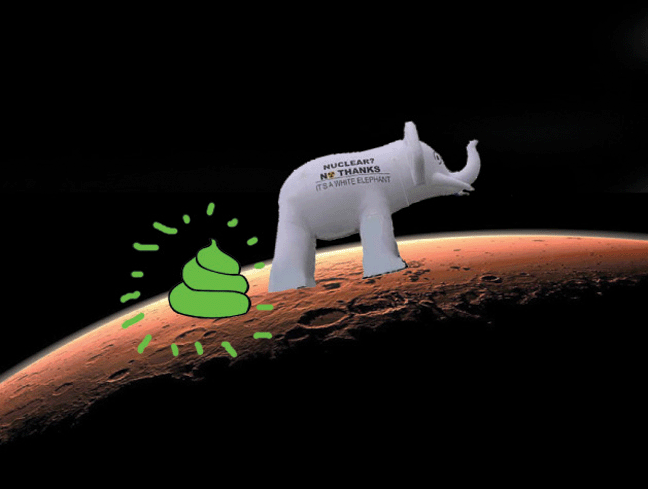
While our species’ insatiable scientific curiosity has undoubtedly led to some beneficial inventions, it has also drawn us inexorably towards our own downfall. Our zeal to create the atomic bomb ignored logic, ethics, consequences and the fundamentals of human rights.
The bomb brought us so-called civil nuclear power reactors, the ugly and irresponsible spawn of a weapon that leaves us perched perpetually on the precipice of extinction. But there is nothing “civil” about nuclear power.
At the dawn of the nuclear energy age, not a thought was given to the legacy of deadly radioactive waste it would produce. That can was kicked summarily down the road. Now we are far down that road and no solution has been arrived at, while we ignore the one obvious one: stop making more of it!
So now comes the news that the US wants to put nuclear power reactors on the Moon.
In the news stories that followed the announcement, replete with the usual excitement about space exploration (never mind the cost and bellicose implications) there was not one single mention of the radioactive waste these reactors would produce.
The problem, like the waste itself, will simply be kicked into some invisible crater on the dark side of the Moon.
NASA, the US Department of Energy and assorted nuclear labs are pushing the small modular reactor for nuclear projects on the 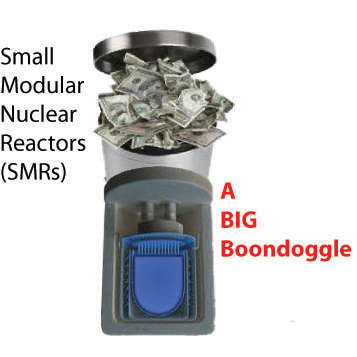 Moon and Mars. Desperate to stay relevant and to continue gobbling up taxpayer dollars, this is music to the failing nuclear industry’s ears. Financially disastrous and technically unresolved on Earth, the SMR, say these “experts”, is ideally suited to the needs of humans living for extensive periods in space.
Since each of these mini-reactors will likely have an uninterrupted output of only 10 kilowatts, it will take multiple reactors on the Moon or Mars to fulfill the necessary functions for their human inhabitants.
Needless to say, so far there is no certified design, no test reactor, no actual reactor, and no fool-proof way to send such a reactor to the Moon. (Rockets have an unfortunate habit of sometimes blowing up on — or shortly after — launch.) Nevertheless, the year 2026 is the ambitious target date for all systems go. In keeping with the theme, “pie in the sky” springs to mind.
While no reactor design has been identified, it will most likely need to use highly enriched uranium (HEU) which puts the reactor firmly in violation of non-proliferation standards. As Dr. Edwin Lyman of the Union of Concerned Scientists told PBS Newshour, “This may drive or start an international space race to build and deploy new types of reactors requiring highly enriched uranium.”
Given the utility of HEU for nuclear weapons use, and the probes currently being sent to the Moon and Mars by “unfriendly” countries such as China and the United Arab Emirates, it does not take much of an imagination to envisage the temptation for theft by force. Will the US deploy guards around its lunar reactors.? Will we see terrorism on the Moon, even war?
What is this really all about? Profit? Prestige? Proliferation? The Idaho National Laboratory, which is eager to develop the lunar SMR prototype, sees this as an opportunity to emphasize “the United States’ global leadership in nuclear innovation,” the lab’s John Wagner told Newshour.
This echoes the mantra parroted by almost every federal institution and corporation seeking to justify some new and exorbitant nuclear expense: we cannot let China and Russia take over; the US must retain — or regain — pre-eminence in the nuclear sector and in space. And so on.
It’s not being cute to call this lunacy. With the ever-expanding crises on Earth, caused by the ravaging effects of climate change as well as the current pandemic, spending exorbitant sums to stick reactors on the Moon or Mars is more than madness; it is morally irresponsible. It abandons most of us on Earth to our fate, while, just maybe, possibly, someday, a handful of people will head off to the Red Planet. Never to return.
Yet undeterred by immorality and expense, and apparently without the slightest concern for the radioactive dirt pile these reactors will produce, NASA and the Department of Energy are eagerly soliciting proposals.
And what will these lunar reactors do? They will enable “capability for a sustained lunar presence, particularly for surviving a lunar night,” NASA’s Anthony Calomino told Space News. “The surface of the moon provides us an opportunity to fabricate, test and flight qualify a space fission system,” he said.
The Moon is seen as our launchpad to Mars. Now, it seems, it will also become our latest nuclear dustbin. If there is a meltdown, or a cascade of accidents among the cluster of small identical reactors there, all of which could suffer the same failure at the same time, it will become our next nuclear wasteland.
I am happy to say “goodnight moon.” But I don’t wan’t to say “goodbye.”
On the moon ”normal” humans (i.e males) will get 200 Times the Radiation Experienced on Earth, (what about females?)

Christina Macpherson’s websites & blogs
It is amazing that in all this propaganda for putting a woman on the moon, – no mention is ever made, of the fact that women are much more susceptible to the effects of ionising radiation, meaning that their risk of developing cancer and other illnesses is greater than it is for men. Apparently the space enthusiasts are still buying into that traditional view that the ”normal” human being is male.

The 12 human beings who have walked on the moon were all bombarded by radiation roughly 200 times what we experience here on Earth, reports Adam Mann for Science. That’s two to three times what astronauts experience aboard the International Space Station, explains Marcia Dunn for the Associated Press (AP), suggesting that any long term human presence on the moon will require shelters with thick walls capable of blocking the radiation.
Despite the fact that the measurements, which come courtesy of China’s Chang’e-4 lunar lander, are quite high compared to what we experience on Earth, the data is quite useful for protecting future moonwalkers. According to Science, the levels of radiation at the lunar surface wouldn’t be expected to increase the risk of NASA astronauts developing cancer by more than 3 percent—a risk threshold the agency is legally required to keep its astronauts’ activities safely below.
Despite the fact that the measurements, which come courtesy of China’s Chang’e-4 lunar lander, are quite high compared to what we experience on Earth, the data is quite useful for protecting future moonwalkers. According to Science, the levels of radiation at the lunar surface wouldn’t be expected to increase the risk of NASA astronauts developing cancer by more than 3 percent—a risk threshold the agency is legally required to keep its astronauts’ activities safely below……
Some forms of radiation, which is electromagnetic energy emitted in forms like heat, visible light, X-rays and radio waves, can mess with the cells inside the human body by breaking up the atoms and molecules they’re made of. On Earth, most people are familiar with ultraviolet radiation’s harmful effects on our skin, but in space, astronauts are also subjected to galactic cosmic rays, accelerated solar particles, neutrons and gamma rays, according to the research published this week in the journal Science Advances. This material can damage our DNA and lead to increased incidences of cancer or contribute to other health problems such as cataracts and degenerative diseases of the central nervous system or other organ systems.
Humanity measured the radiation astronauts on the Apollo missions experienced on their journeys to the moon, but those measurements were cumulative for each astronaut’s entire journey, per Science. To figure out the daily dose of radiation exclusively on the surface of the moon, the robotic Chang’e-4 lander used a stack of ten silicon solid-state detectors.
The renewed interest in collecting such measurements is partly because NASA has plans to send more people to the moon. The Artemis moon mission, scheduled for 2024, will feature the first woman ever to walk on the moon as well as a week-long expedition to the lunar surface and a minimum of two moonwalks, reports Katie Hunt for CNN.
Berger tells the AP that these new findings suggest the shelters needed to protect Artemis’ astronauts during such a long stay on the moon should have walls made of moon dirt that are some two and a half feet thick. Science notes that the shelter would also need an even more heavily shielded inner sanctum to protect astronauts in the event of a solar storm. Adequate shielding for this inner chamber would be roughly 30 feet of water, and would also need to be reachable within 30 minutes—the current limit of satellites’ abilities to provide astronauts with advanced warning of such hazards.
The findings aren’t exactly suprising: they are in line with calculations made using existing measurements. But they’re a crucial step towards putting people on the surface of the moon for extended periods of time. According to Science, the results confirm that with proper shielding astronauts could spend as long as six months on the moon. https://www.smithsonianmag.com/smart-news/moonwalking-humans-get-blasted-200-times-radiation-experienced-earth-180975926/
Lunar base woud have to be underground, due to the danger of high radiation on the moon
 After measuring radiation on the moon for the first time, scientists say a lunar base should be built underground to protect astronauts, Business Insider, AYLIN WOODWARD, SEP 30, 2020,
- NASA recently unveiled the plan for its Artemis program, a series of missions that would return astronauts to the moon.
- A new study found how much radiation astronauts are exposed to on the lunar surface: a daily dose about 200 times as great as on Earth.
- NASA wants to build a base on the moon, but the new data suggests it’d be safest to bury such a base under 2.5 feet of moon dirt to protect astronauts from radiation.
But a new study found that any astronauts who go there would face levels of radiation nearly three times as high as what the astronauts on the space station deal with. Long-term exposure to enough of this cosmic radiation poses significant health risks, including cataracts, cancer, and diseases of the central nervous system.
The new research, published last week in the journal Science, calculated for the first time what a moonwalker’s daily dose of radiation would be.
“If you think about people staying on the moon for extended periods of time — say, on a scientific research station for a year or two — then these levels start getting problematic,” Robert Wimmer-Schweingruber, an author of the new study, told Business Insider.
The solution, he said, would be to build any lunar base beneath the moon’s surface.
The first study to calculate radiation on the moon
Apollo astronauts carried radiation-measuring instruments on their missions in the 1960s and ’70s, but those dosimeters could tell scientists only the total amount of radiation the astronauts were exposed to throughout their time in space, from blasting off to landing, not just on the moon.
Astronauts on the moon, meanwhile, face a daily radiation level five to 10 times as high as transatlantic fliers, since the moon doesn’t have the shield that Earth does.
Radiation exposure on the moon is nearly three times that on the International Space Station
 Radiation exposure on the moon is nearly three times that on the ISS, 25 September 2020
By Layal Liverpool Astronauts on the moon would face nearly three times more radiation exposure than those aboard the International Space Station, which could make long-term missions riskier than thought.
“Once you’ve survived being on the moon and come back to Earth, radiation damage is what stays with you for the rest of your life and that’s why this is a critical measurement,” says Robert Wimmer-Schweingruber at the University of Kiel in Germany.
Wimmer-Schweingruber and his team analysed several weeks of data acquired by China’s Chang’e … (subscribers only) https://www.newscientist.com/article/2255545-radiation-exposure-on-the-moon-is-nearly-three-times-that-on-the-iss/#ixzz6Z61souv7
As Dept of Energy officials enthuse over nuclear in space, they show their disdain for health and safety in pandemic
Here we see 9 DOE officials all close to each other – bugger social distancing. Typical nuclear enthusiasts, 7 men confident, think they’re invincible? next to them , the two token women, wearing masks – they have some grasp of the need for safety and public health measures in the pandemic.

US Ramps Up Planning for Space Nuclear Technology AIP, NASA and the Department of Energy are expanding their collaboration as part of a broader White House push to develop nuclear power systems for space applications. The initiative comes as NASA faces key decisions on what fuel sources and technology development paths to pursue.
Now, NASA, DOE, and the White House want nuclear power to play a much larger role in space exploration as plans take shape for a sustained human presence on the Moon and subsequent crewed journeys to Mars……….
The American Nuclear Society hosted a debate on the topic at its annual meeting in June. While the society has generally supported the use of space nuclear power and propulsion in the past, it has decided to develop a position statement by spring 2021 on whether to favor the use of LEU.
Among the participants was Rep. Bill Foster (D-IL), a former Fermilab physicist, who argued that proceeding with HEU ( Highly Enriched Uranium)would set a dangerous precedent. “If all of the spacefaring nations start using HEU reactors in space, then this would involve utilization of a significant amount of weapons grade material,” he remarked…….
Alan Kuperman, a policy scholar affiliated with the Nuclear Proliferation Prevention Project, pointed to U.S. efforts since the 1970s to minimize the use of HEU in civilian applications, arguing they are “based on the logic of no exceptions.”
“If we say, ‘well, we’re going to have exceptions,’ then other countries are going to say, ‘well, we want exceptions too,’ and then the whole thing falls apart,” he remarked……..https://www.aip.org/fyi/2020/us-ramps-planning-space-nuclear-technology
Problems in USA’s rush to put a nuclear reactor on the moon
 America Wants to Put a Nuclear Power Plant on the Moon
What happens to all that highly enriched uranium in space? Popular Mechanics, BY CAROLINE DELBERT, JUL 30, 2020
- The U.S. Department of Energy (DoE) is looking for technology partners to help power the moon.
- This could begin a project that later includes powering a Mars surface mission.
- The Union for Concerned Scientists doesn’t want highly enriched uranium in space.
Scientists at the U.S. Department of Energy’s (DoE) Idaho National Laboratory have a new design for a nuclear power plant they say could allow humans to more easily live on the moon. As part of a form plan, the scientists say they want to have the fission reactor, safe launch, and landing system ready by 2027
What are the challenges of generating nuclear energy on the moon?
Design Development Today reports that the Union of Concerned Scientists expressed, well, concerns:
“Edwin Lyman, director of Nuclear Power Safety at the Union of Concerned Scientists, a nonprofit, said his organization is concerned the parameters of the design and timeline make the most likely reactors those that use highly enriched uranium, which can be made into weapons. Nations have generally been attempting to reduce the amount of enriched uranium being produced for that reason.”
While the Idaho National Laboratory and the DoE broadly are pushing for “advanced” reactor technology in terms of issues like modularity and safety, the “parameters of the design and timeline” they refer to—in this case advocating for a small, reliable, space-friendly design in just 6 years—almost definitely rules out the modular reactors being developed and certified now.
To fully test and regulate these reactors—and design the special edition to send to the moon in this timeframe—is probably impossible. To rush any nuclear approval is a terrible idea, not just for safety, but also for a public that’s already shy about nuclear energy.
Technology like thorium fuel is still far from ready for the market….
USA Department of Energy enthuses about Highly Enriched Uranium in space. Not everyone agrees
As I’ve mentioned before on this site, the oh so confident macho nuclear enthusiasts don’t need to do precautions, even though USA is in the thick of the pandemic. Only the 2 token women have the brains to wear masks.
US Ramps Up Planning for Space Nuclear Technology AIP, 31 July 20, NASA and the Department of Energy are expanding their collaboration as part of a broader White House push to develop nuclear power systems for space applications. The initiative comes as NASA faces key decisions on what fuel sources and technology development paths to pursue.
Now, NASA, DOE, and the White House want nuclear power to play a much larger role in space exploration as plans take shape for a sustained human presence on the Moon and subsequent crewed journeys to Mars……….
The American Nuclear Society hosted a debate on the topic at its annual meeting in June. While the society has generally supported the use of space nuclear power and propulsion in the past, it has decided to develop a position statement by spring 2021 on whether to favor the use of LEU.
Among the participants was Rep. Bill Foster (D-IL), a former Fermilab physicist, who argued that proceeding with HEU ( Highly Enriched Uranium) would set a dangerous precedent. “If all of the spacefaring nations start using HEU reactors in space, then this would involve utilization of a significant amount of weapons grade material,” he remarked…….
Alan Kuperman, a policy scholar affiliated with the Nuclear Proliferation Prevention Project, pointed to U.S. efforts since the 1970s to minimize the use of HEU in civilian applications, arguing they are “based on the logic of no exceptions.”
“If we say, ‘well, we’re going to have exceptions,’ then other countries are going to say, ‘well, we want exceptions too,’ and then the whole thing falls apart,” he remarked……..https://www.aip.org/fyi/2020/us-ramps-planning-space-nuclear-technology
USA wants nuclear power stations on the moon and on Mars
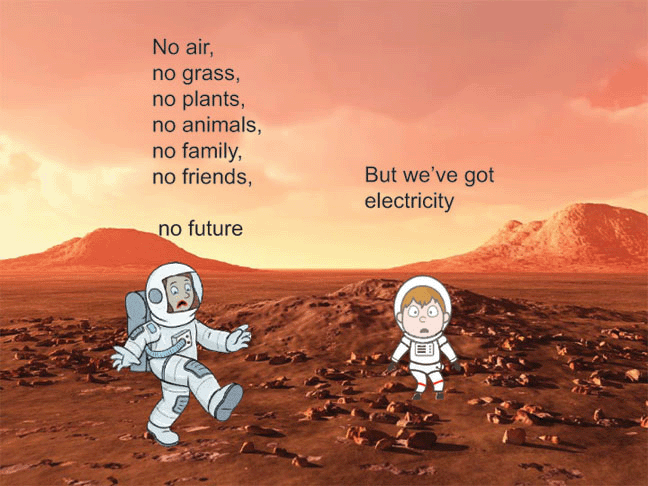
The U.S. Department of Energy put out the formal request to build what it calls a fission surface power system that could allow humans to live for long periods in harsh space environments.
The Idaho National Laboratory, a nuclear research facility in eastern Idaho, the Energy Department and NASA will evaluate the ideas for developing the reactor.
The lab has been leading the way in the U.S. on advanced reactors, some of them micro reactors and others that can operate without water for cooling. Water-cooled nuclear reactors are the vast majority of reactors on Earth.
“Small nuclear reactors can provide the power capability necessary for space exploration missions of interest to the Federal government,” the Energy Department wrote in the notice published Friday.
The Energy Department, NASA and Battelle Energy Alliance, the U.S. contractor that manages the Idaho National Laboratory, plan to hold a government-industry webcast technical meeting in August concerning expectations for the program.
The plan has two phases. The first is developing a reactor design. The second is building a test reactor, a second reactor be sent to the moon, and developing a flight system and lander that can transport the reactor to the moon. The goal is to have a reactor, flight system and lander ready to go by the end of 2026.
The reactor must be able to generate an uninterrupted electricity output of at least 10 kilowatts. The average U.S. residential home, according to the U.S. Energy Information Administration, uses about 11,000 kilowatt-hours per year. The Energy Department said it would likely take multiple linked reactors to meet power needs on the moon or Mars.
In addition, the reactor cannot weigh more than 7,700 pounds (3,500 kilograms), be able to operate in space, operate mostly autonomously, and run for at least 10 years.
“This may drive or start an international space race to build and deploy new types of reactors requiring highly enriched uranium.”
– Edwin Lyman, director of Nuclear Power Safety at the Union of Concerned Scientists
The Energy Department said the reactor is intended to support exploration in the south polar region of the moon. The agency said a specific region on the Martian surface for exploration has not yet been identified.
Edwin Lyman, director of Nuclear Power Safety at the Union of Concerned Scientists, a nonprofit, said his organization is concerned the parameters of the design and timeline make the most likely reactors those that use highly enriched uranium, which can be made into weapons. Nations have generally been attempting to reduce the amount of enriched uranium being produced for that reason.
“This may drive or start an international space race to build and deploy new types of reactors requiring highly enriched uranium,” he said.
Earlier this week, the United Arab Emirates launched an orbiter to Mars and China launched an orbiter, lander and rover. The U.S. has already landed rovers on the red planet and is planning to send another next week.
Officials say operating a nuclear reactor on the moon would be a first step to building a modified version to operate in the different conditions found on Mars.
“Idaho National Laboratory has a central role in emphasizing the United States’ global leadership in nuclear innovation, with the anticipated demonstration of advanced reactors on the INL site,” John Wagner, associate laboratory director of INL’s Nuclear Science & Technology Directorate, said in a statement. “The prospect of deploying an advanced reactor to the lunar surface is as exciting as it is challenging.”
Space archaeology, space junk and weapons, and long-lasting radioactivity
While the nuclear macho men plan more nuclear, and nuclear weapons in space, it seems that it takes a woman, Alice Gorman, to investigate the radioactive pollution on Earth and in space, due to these activities
Nuclear sites still dangerous in 24,000 years, say space archaeologists
Some nuclear tests were conducted also in outer space and nuclear fuel was employed as propellant for rockets. https://www.jpost.com/health-science/nuclear-sites-still-dangerous-in-24000-years-space-archaeologists-say-636379 By ROSSELLA TERCATIN JULY 26, 2020
Gorman said the issue presents two challenging elements: What materials can survive such a long time, and what form of language can be used to deliver the actual message?
“As for the first difficulty, we know that stones and pottery last a very long time,” she said. “But the second point raises a big archaeological question related to symbolic communication. If we look at rock art from 20,000 years ago, we can see that there are pictures of animals, but we do not know what those pictures mean. Therefore, it is possible that our current symbols to mark radioactive sites, the yellow [and] black sign, will be interpreted as an invitation to explore the area, rather than to keep away from it.”
If the UN Outer Space Treaty of 1967 prohibited nuclear weapons in space, the issue of its weaponization remains very relevant.“Recently, Russia tested an anti-satellite weapon, reawakening the debate,” Gorman told the Post.
She began to work in space archaeology following years of work focused on stone-tool analysis and the aboriginal use of bottle glass after European settlement.
Space archaeology deals with the same issues of regular archaeology, understanding material culture, human behavior and the interaction with the surrounding environment, Gorman said.
Gorman was drawn to space archaeology by the idea of exploring space junk, those many objects that cannot even be seen in the sky circling the Earth. Currently, she is working on the archaeology of the International Space Station.
The recent attempt by Israel to land a robotic unit on the moon with the Beresheet mission represents a very interesting development for space archaeologists, Gorman said.
“For many decades, the only material cultures present on the moon were the American and the Soviet one,” she said. “As new countries have started to reach the moon, this has changed, bringing more diversity to the field.”
Outer space beginning to look like a new area of nuclear conflict, according to Pentagon
 THE PENTAGON IS WORRIED A SPACE NUKE WILL FRY ITS SATELLITES, https://futurism.com/the-byte/pentagon-worried-space-nuke-fry-satellites JUNE 18TH 20__DAN ROBITZSKI__
Space Nukes
The U.S. Department of Defense released a new space strategy report on Wednesday. In it, the military revealed that it’s concerned that nukes detonated in space could wipe out its fleet of satellites.
It’s not a new concern, since space nukes were originally banned in the 1967 Outer Space Treaty. But all the same, Business Insider reports that the Pentagon is particularly concerned that China and Russia might strike — a dire warning for the future of combat.
The report specifically identified China and Russia as immediate threats. Such an attack could potentially devastate military communication networks as well as the myriad other systems that depend on satellites.
“The challenge of a nuclear detonation is that it creates an electromagnetic pulse and a signal that could then take out indiscriminately many satellites in space and essentially fry the electronics,” Deputy Assistant Secretary of Defense for Space Policy Stephen Kitay said at a press conference on the report, according to BI.
“That is a threat that we have to potentially be prepared for — a nuclear detonation in space,” he added.
If nothing else, the report is yet another sign that the idea of space remaining peaceful seems to be slipping away.
“I wish I could say that space is a sea of tranquility, but the fact of the matter is that space is contested,” Kitay said. “Outer space has emerged as a key arena of potential conflict in an era of great power competition.”
Trump’s ominous creation of the U.S. Space Force – for the purposes of war
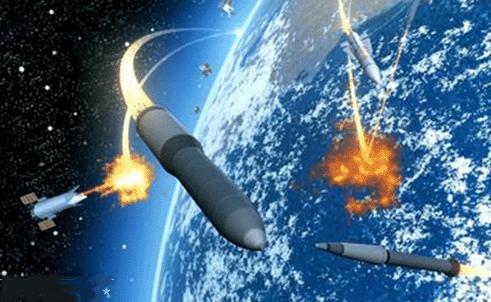
How much will it cost? The vast costs will be shouldered by taxpayers, likely by slashing funding for essential social needs. The aerospace industry has suggested defunding “entitlement programs” to pay  for “everything space.” That would likely include cutting Social Security, Medicare, and Medicaid among other social and welfare programs. In his proposed fiscal year 2021 budget, Trump is recommending $15.4 billion for the Space Force. The Space Force, if it is allowed to continue, will clearly be a multi-billion dollar annual affair.
Who will profit?
Raytheon is emerging as a major beneficiary of Space Force work. Perhaps not uncoincidentally, Mark Esper, Trump’s U.S. Secretary of Defense at the time the Space Force was announced, is a former lobbyist for the corporation. Other major contractors for the Space Force will be Northrop Grumman, Boeing and Lockheed-Martin, the world’s biggest military contractor.
Space Force is no laughing matter, May 31, 2020 by beyondnuclearinternational
What started as “a joke” his now deadly serious; and just plain deadly Continue reading
Here’s a supremely unaffordable nuclear fantasy – reactors on the moon and Mars
 NASA Wants to Go Nuclear on the Moon and Mars for Astronaut Settlement, SciTech Daily By AMERICAN CHEMICAL SOCIETY MAY 31, 2020 m It might sound like science fiction, but scientists are preparing to build colonies on the moon and, eventually, Mars. With NASA planning its next human mission to the moon in 2024, researchers are looking for options to power settlements on the lunar surface. According to a new article in Chemical & Engineering News, the weekly newsmagazine of the American Chemical Society, nuclear fission reactors have emerged as top candidates to generate electricity in space.
Confusion over which American military satellites are “nuclear” and which are “nonnuclear.”
|
Space-Based Nuclear Command and Control and the ‘Non-Nuclear Strategic Attack’ Counterspace capabilities may meet dual-purpose command and control assets to create new risks. The Diplomat, By Ankit Panda, April 08, 2020 The Trump administration’s 2018 Nuclear Posture Review (NPR) drew much attention for the inclusion of language expanding the scope under which the United States might employ nuclear weapons. Specifically, the document observed that certain “extreme circumstances,” which “could include significant non-nuclear strategic attacks,” would rise to the level of meriting a nuclear response. In remarks delivered during an online video conference this week, Christopher Ford, U.S. assistant secretary at the State Department’s Bureau of International Security and Nonproliferation, discussed this language in the context of space security. Ford emphasized that for the purposes of parsing that bit of the 2018 NPR, American adversaries should understand that U.S. space-based dual-use (nuclear and nonnuclear) command and control assets qualified as what the 2017 National Security Strategy had dubbed a “vital U.S. interest.” Accordingly, Ford continues: “I need hardly point out — but I will nonetheless, for emphasis — that the U.S. National nuclear Command, Control, and Communications (NC3) architecture depends to some extent upon space-based systems.” He is clear therefore that nonnuclear attacks on this architecture would potentially rise to the level of a nuclear response: “Any harmful interference with or attacks upon such components of our space architecture at any time, even if undertaken only with non-nuclear tools, thus starts to move into ‘significant non-nuclear strategic attack’ territory, and would lead to a significant and potentially drastic escalation of a crisis or conflict.” Much of what Ford says here is not new or surprising, but his remarks offer one of the starker presentations of these ideas by a U.S. official in recent years — at least since the release of the 2018 NPR. The problem that arises is one of “entanglement,” where a crisis might escalate to the nuclear level inadvertently if an adversary — say China — is attempting to degrade U.S. conventional operations by taking aim at certain space-based assets. Though the United States openly acknowledges the role of space-based assets in nuclear command and control, there is no explicit tabulation of which American military satellites are “nuclear” and which are “nonnuclear.”….. https://thediplomat.com/2020/04/space-based-nuclear-command-and-control-and-the-non-nuclear-strategic-attack/ |
|
|
Critical comments on the claim that “Nuclear Energy Could Power The Trillion-Dollar Space Race”
 Haley Zaremba’s final comment “” good news for public health and the environment coming out of the space industry”” left me puzzled.
Just exactly how are nuclear-powered space travel, and nuclear reactors on the moon and on Mars “good news for public health and the environment”?
A second question – nuclear reactors in space as a “trillion dollar” industry. Does this mean that it will magically somehow bring in trillions of dollars to the U.S. economy, – or, more likely, just add trillions of dollars to the national debt?
A final question – as the global economy, and especially the American economy, goes into freefall, heading for the greatest Depression ever, is this article just a rather sad joke?
Nuclear Energy Could Power The Trillion-Dollar Space Race https://oilprice.com/Energy/Energy-General/Nuclear-Energy-Could-Power-The-Trillion-Dollar-Space-Race.html By Haley Zaremba – Apr 09, 2020, While the economy comes to a grinding halt here on Earth, some investors, inventors, and dreamers are looking to the stars for their next business venture. The final frontier has been touted as a potential breeding ground for untold numbers of industries in key economic sectors including mining, tourism, research and development, data collection and analysis, to name just a very few.
In fact, the commercial potential of the space economy is allegedly so great and so untapped (for now) that Bank of America Merrill Lynch projected back in 2017 that the size of the space industry is due to explode, expanding to more than eight times its current size by 2050. Valued at nearly $400 billion now, that means that the space sector would reach a total value of nearly $3 trillion over the next thirty years.
We are entering an exciting era in space where we expect more advances in the next few decades than throughout human history,” a Bank of America report stated. Goldman Sachs and Morgan Stanley, however, were far more conservative in their projections than Bank of America Merrill Lynch, but the financial corporations still predicted that the space sector will expand to be a more-than trillion dollar industry inside of 20 years.
Even the United States Chamber of Commerce has been bullish on the space sector, stating that “total private investment is growing at a striking pace,” citing research by Bryce Space and Technology. “From 2000-2005, the industry received more than $1.1 billion in investment from private equity, venture capital, acquisitions, prizes and grants, and public offerings. By the 2012-2017 period, the industry had received more than $10.2 billion.” The Chamber goes on to say that, “the increased investment reflects the new opportunities in the commercial space sector and new startup ventures that did not exist a decade ago.”
Last summer, Oilprice reported that the nuclear industry was also angling to get a piece of the modern-day space race. “In just a few short years from now, the United States will be shipping nuclear reactors to the moon and Mars,” the report said, citing statements from team members from the Kilopower project, a collaborative venture from NASA and the United States Department of Energy.
The Kilopower project is a near-term technology effort to develop preliminary concepts and technologies that could be used for an affordable fission nuclear power system to enable long-duration stays on planetary surfaces,” said NASA’s Space Technology Mission Directorate. “In layman’s terms, the focus of the Kilopower project is to use an experimental fission reactor to power crewed outposts on the moon and Mars, allowing researchers and scientists to stay and work for much longer durations of time than is currently possible,” the Oilprice article summed up.
Now, just this week, an article from Space.com reported that “space is about to go nuclear — at least if private companies get their way.” The article is referencing developments from the 23rd annual Commercial Space Transportation Conference (CST), which took place in Washington, D.C. back in January. There, “a panel of nuclear technology experts and leaders in the commercial space industry spoke about developments of the technology that could propel future spacecraft faster and more efficiently than current systems can.”
NASA is no stranger to nuclear power. The agency has already used nuclear energy to power its Mars rovers, its Cassini mission probe of Saturn and its rings, and the two Voyagers up there exploring the edges of our solar system as we speak. The nuclear energy that powered those projects, however, relied “on the passive decay of radioactive plutonium, converting heat from that process into electricity to power the spacecraft,” whereas, according to the panelists at the CST, the future of space industry electricity lies in “Nuclear Thermal Propulsion (NTP), a technology developed in the 1960s and ’70s that relies on the splitting, or fission, of hydrogen atoms.” This form of nuclear fission would need low-enriched uranium, a much less hazardous material.
“An NTP-powered spacecraft would pump hydrogen propellant through a miniature nuclear reactor core. Inside this reactor core, high energy neutrons would split uranium atoms in fission reactions; those freed neutrons would smack into other atoms and trigger more fission. The heat from these reactions would convert the hydrogen propellent into gas, which would produce thrust when forced through a nozzle,” explained Space.com.
At least there is some good news for public health and the environment coming out of the space industry on the week that Trump announced that he wants to mine the moon.
Russian Space Agency confirms plans to launch nuclear-powered space tug by 2030
|
Russian Space Agency confirms plans to launch nuclear-powered space tug by 2030 Space Daily, by Staff Writers
Moscow (Sputnik) Jan 29, 2020 The secrecy-laden project, in development since 2010, is intended to facilitate the transportation of large cargoes in deep space, including for the purpose of creating permanent bases on other planets in our solar system.Roscosmos plans to deliver a nuclear-powered space tug into orbit by the year 2030, agency first deputy director Yuri Urlichich has confirmed. In a presentation at the ongoing Korolev Academic Space Conference in Moscow, Urlichich explained that the tug will be launched in 2030 for flight testing, with series production and commercial use to begin after that…….. http://www.spacedaily.com/reports/Russian_Space_Agency_confirms_plans_to_launch_nuclear_powered_space_tug_by_2030_999.html |
|
1 This Month

of the week – Shut Down Drone Warfare!


Tell the Ukrainian Government to Drop Prosecution of Peace Activist Yurii Sheliazhenko

Petition to revoke the licensing of the Near Surface Nuclear Disposal Facility (NSDF) at Chalk River. https://www.ourcommons.ca/petitions/en/Petition/Details?Petition=e-7247
To see nuclear-related stories in greater depth and intensity – go to https://nuclearinformation.wordpress.com
-
Archives
- April 2026 (19)
- March 2026 (251)
- February 2026 (268)
- January 2026 (308)
- December 2025 (358)
- November 2025 (359)
- October 2025 (376)
- September 2025 (257)
- August 2025 (319)
- July 2025 (230)
- June 2025 (348)
- May 2025 (261)
-
Categories
- 1
- 1 NUCLEAR ISSUES
- business and costs
- climate change
- culture and arts
- ENERGY
- environment
- health
- history
- indigenous issues
- Legal
- marketing of nuclear
- media
- opposition to nuclear
- PERSONAL STORIES
- politics
- politics international
- Religion and ethics
- safety
- secrets,lies and civil liberties
- spinbuster
- technology
- Uranium
- wastes
- weapons and war
- Women
- 2 WORLD
- ACTION
- AFRICA
- Atrocities
- AUSTRALIA
- Christina's notes
- Christina's themes
- culture and arts
- Events
- Fuk 2022
- Fuk 2023
- Fukushima 2017
- Fukushima 2018
- fukushima 2019
- Fukushima 2020
- Fukushima 2021
- general
- global warming
- Humour (God we need it)
- Nuclear
- RARE EARTHS
- Reference
- resources – print
- Resources -audiovicual
- Weekly Newsletter
- World
- World Nuclear
- YouTube
-
RSS
Entries RSS
Comments RSS
 nuclear-news