SpaceX and Blue Origin abruptly shift priorities amid US Golden Dome push

Thursday, Feb 19, 2026, https://www.defensenews.com/space/2026/02/19/spacex-and-blue-origin-abruptly-shift-priorities-amid-us-golden-dome-push/?utm_source=sailthru&utm_medium=email&utm_campaign=dfn-space
Just a year ago, SpaceX majority owner Elon Musk dismissed going to the moon as a “distraction.” Now, SpaceX and Jeff Bezos’ Blue Origin are racing toward it, and the Pentagon may be the reason why.
Within weeks of each other, the two largest U.S. commercial space companies abruptly shifted their priorities toward lunar development. The moves came as the Department of Defense accelerates plans for a next-generation missile shield known as the Golden Dome, raising questions about whether America’s return to the moon is as much about defense as it is exploration.
In early February, SpaceX announced it would redirect plans for a future city on Mars to establishing one on the moon. The reversal was striking, as Musk previously insisted Mars was the only meaningful destination.
Just days prior to this announcement, Blue Origin quietly paused its New Shepard tourism program for at least two years to increase focus on lunar development, framing the move as part of the nation’s goal of returning to the moon.
However, the timing may suggest a more strategic approach.
In December 2025, the White House issued an executive order calling for a missile shield prototype by 2028, critical for the Golden Dome initiative.
This order also set a timeline for an American lunar return by 2028, with elements of a permanent moon presence targeted for 2030.
Defense officials, such as Space Force Vice Chief of Operations Gen. Shawn Bratton, have emphasized that commercial partnerships will be essential to achieving these goals.
SpaceX is reportedly in line for a $2 billion Pentagon contract to build a 600-satellite constellation supporting Golden Dome tracking and targeting, though the award has not been formally confirmed.
The project would rely on low Earth orbit satellites capable of rapid, near-real-time missile detection. Such systems improve coverage, but remain vulnerable to anti-satellite attacks from adversaries.
The company’s shift to the moon could change that equation. Lunar-based infrastructure would sit far beyond the reach of most anti-satellite capabilities, offering more resilient communications and sensing layers.
In this scenario, the moon could become a strategic “high ground,” which could offer the Pentagon a more durable and far-reaching view for missile detection and surveillance.
Just 15 days before Blue Origin announced its shift toward the moon, the Missile Defense Agency added the company to its $151 billion SHIELD contract, a Pentagon program allowing firms to compete for Golden Dome-related work.
While no specific awards are guaranteed, the timing is noteworthy. Blue Origin is now putting lunar logistics front and center, pausing the New Shepard program to focus resources on that effort.
The company’s Blue Ring vehicle is designed for orbital maneuvering and refueling, capabilities that could one day support sensor deployment and flexible positioning beyond Earth’s orbit, where they are less vulnerable to attack and can provide broader global coverage.
Meanwhile, its Blue Moon MK1 and MK2 landers can deliver multi-ton payloads to the lunar surface, which could be enough to deploy communications systems, sensors or other infrastructure to remote locations, potentially supporting Golden Dome-like operations.
Taken together, these developments could suggest a broader transformation in the strategic landscape of space, one that increasingly intersects with homeland defense and global security.
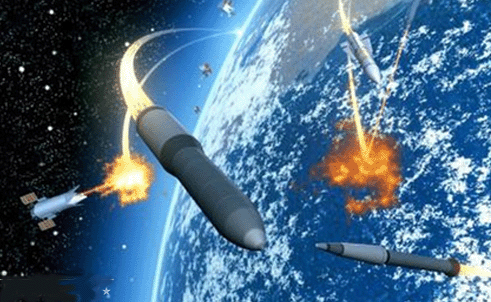
Space-based missiles, killer robots key to U.S. effort to gain orbital dominance.
By Bill Gertz – The Washington Times – Wednesday, February 11, 2026
The U.S. Space Force is accelerating the deployment of counterspace weapons under a new Trump administration policy aimed at reasserting and ensuring American dominance over China and Russia in any potential orbital conflict.
The force is deploying three electronic satellite jammers and racing to match the more advanced space forces of China and Russia, which include arsenals of anti-satellite weapons.
Space Force Gen. B. Chance Saltzman, chief of space operations, said Defense Secretary Pete Hegseth recently set the goal for the U.S. military to dominate in space.
“And the Space Force was created to do just that,” Gen. Saltzman told The Washington Times. “The service has and will continue to invest in a full range of counterspace capabilities to deter conflict in space and to win decisively if called upon.
“Continuing to train and equip combat-credible Guardians is essential to maintaining our warfighting readiness,” he said.
Mr. Hegseth said in a speech to workers at the space company Blue Origin last week that the $25 billion being spent on the Golden Dome national missile and drone defense system would produce “cutting-edge, space-based capabilities which we are going to need.”……………….
“That is how we will establish total orbital supremacy,” he said.
Golden Dome systems are expected to support Space Force counterspace arms.
A Space Force spokeswoman declined to provide details on Gen. Saltzman’s plans for counterspace weapons, but at this point, the newest branch of the American military — the force was founded in 2019 under the first Trump administration — has only limited capabilities with counterspace systems. The force will be challenged to match enemy systems…………………….
Funding for counterspace weapons in the recently passed $890.6 billion defense authorization bill is relatively meager and does not appear to support a space dominance policy.
Procurement for counterspace weapons in the current fiscal year is $2 million, and the research, development, testing and evaluation budget for counterspace systems spending is $31.2 million, according to a funding chart in the defense authorization act.
Developing space weapons is a priority for the Pentagon because U.S. space systems, including high-altitude Global Positioning System satellites — used for GPS targeting and navigation in military operations, missile warning satellites and key imagery and communications systems — were not designed for conflict in space…………..
A Pentagon official said a presidential directive requires U.S. space superiority and therefore “American leadership in space is nonnegotiable.”…………………………..
“The Department of War has and will continue to invest in a full range of capabilities — kinetic, non-kinetic, reversible and irreversible — to restore deterrence and, if necessary, prevail in conflict.”………………………………………………
Charles Galbreath, a retired Space Force colonel, said Mr. Hegseth’s comments on space power dominance are “probably some of the most aggressive language I’ve heard ever, openly, about conflict in the space domain.”………………………………………………………..
The orbital playbook
Space Force plans for waging warfare in space are outlined in a March 2025 report, “United States Space Force Space Warfighting: A Framework for Planners.”
The report defined three main types of counterspace operations as control of space using both offensive and defensive action.
“Counterspace operations are conducted across the orbital, link and terrestrial segments of the space architecture,” the report said, creating effects aimed at “space superiority.”……………………
The combat will include “orbital warfare” using fires, movement and maneuver to control space.
Also used will be electromagnetic warfare to defeat enemy space and counterspace threats.
Cyberwarfare will be a major part of space combat, with strikes and other actions aimed at gaining control of space.
Offensive space combat will include orbital strike operations, pursuit and escort of satellites, standoff attacks, interdicting space communications links, and maneuvering killer satellites that can grab and crush enemy systems.
Orbital attacks will use “pursuit operations” with an attacking system maneuvering to an enemy spacecraft before firing weapons. Alternatively, the Space Force will use standoff operations — space-based or ground long-range missiles that attack without a nearby orbital rendezvous.
Space link interdiction will use electromagnetic or cybernetwork attacks……………………………………………
For electronic attacks, high-powered lasers and microwave weapons are being built, and some reports indicate that electromagnetic pulse arms could be used to damage satellite electronics without causing debris.
Emil Michael, undersecretary of defense for research and engineering, stated in a X post that the Pentagon has directed energy weapons………………………………………………………………………………..
U.S. policymakers must take urgent action to ensure the United States wins the new space race and retains the strategic high ground that has long underpinned our military and economic leadership, the panel said. https://www.washingtontimes.com/news/2026/feb/11/us-racing-build-space-weapons-counter-anti-satellite-power-china/?utm_source=Boomtrain&utm_medium=subscriber&utm_campaign=threat_status&utm_term=threat_status&utm_content=threat_status&bt_ee=wjQ2GCMecOIl6%2Ftk98uhjTa%2F2aWCScEubIvYIkRk66Y0v%2FpyHece2aahuYzGEgHT&bt_ts=1770914789113
NASA wants a nuclear reactor on the Moon. What would happen during a meltdown?
With NASA announcing plans to build a nuclear reactor on the Moon, what would happen if a meltdown strikes?
Hayley Bennett, BBC Science Focus, February 7, 2026
NASA has announced plans to build a nuclear reactor on the Moon – a milestone that could power future lunar bases and long-term missions. But it also raises some big questions.
How much will it cost? Will someone need to stay up there to operate it? And, for the doom-mongers among us, what happens if it fails?……………………………………………………………………
its demise is a fascinating hypothetical.
What if it blew up?
We’ve really no idea what a nuclear meltdown on the Moon would look like – and, with current plans, there’s no indication it would even be big enough to be considered a meltdown.
But we can speculate, of course. It’s not just the size of the reactor that determines what happens if it blows – it’s the environment.
A reactor accident on the Moon would unfold very differently to one on Earth.
As the Moon has no atmosphere, no weather and one-sixth of Earth’s gravity, we might expect that instead of the explosion, mushroom cloud and aftershock (triggered by reactions with molecules in the Earth’s atmosphere) it would be something somewhat less dramatic.
Instead, the reactor might simply overheat, perhaps producing an initial flash, then a glowing pool of molten metal that cools and solidifies in silence.
That’s not to say that such an event wouldn’t be dangerous for anyone manning the station. They would still be exposed to a strong surge in radiation.
That radiation would still be dangerous nearby, but without air or wind to carry radioactive dust, fallout would remain largely local.
A near miss
Thankfully, we don’t have a better answer to the question, though we might have done if certain US scientists had got their way back in the 1950s.
Project A119 was a secret plan to drop a hydrogen bomb on the Moon as part of the escalating ‘space race’ between the US and the Soviet Union.
Fortunately, it never really got beyond the planning stage. https://www.sciencefocus.com/space/moon-nuclear-reactor-meltdown
Hegseth calls for U.S. space dominance.

Trump’s War Department is returning to this illusory vision that hopes to erase the multi-polar world in favor of American global dominance. Thus, despite all the nice talk about negotiating with China, Russia, Iran and other BRICS+ nations, the US is stepping deeply back into the big muddy. This time though it includes a major league arms race in space.
For years China and Russia have been introducing a global ban on weapons in space treaty at the United Nations. The US and Israel have been blocking the development of such a treaty that would close the door to the barn before the horses get out.
Bruce K. Gagnon , 7 Feb 26, https://space4peace.blogspot.com/2026/02/hegseth-calls-for-us-space-dominance.html
Secretary of War Pete Hegseth delivered an overly confident and aggressive speech at Blue Origin’s Rocket Park in Florida (owned by Jeff Bezos), emphasizing the strategic importance of space in U.S. war-making.
Speaking to employees and big-wigs, Hegseth declared: ‘We will unleash American space dominance’.
He underscored that space is the ultimate high ground, criticized the Biden administration, and praised the military initiatives of President Trump, highlighting the urgency of American leadership in the ‘space race’.
This is not completely new as the US Space Command (and now the US Space Force) have long been calling for ‘America to come out on top’ in space.
He said, ‘We have a Commander in Chief who is interested in winning’.
The big difference these days is the current level of braggadocio and arrogance inside this administration.
‘We are just unleashing the war fighter to be lethal, disciplined, trained, accountable and ready’, he claimed.
Hegseth called it his ‘arsenal of freedom tour’ during the next month across the country. He declared that the administration intends to spend $1.5 trillion this year on war-making. ‘We will dominate in every domain’, he bragged.
Those funds include $25 billion to start work on Golden Dome – ‘total orbit supremacy’ he called it. ‘We have to dominate the space domain’.
He congratulated ‘America’s deterrence in action’ at the US border, in Venezuela, Yemen, and Iran.
He described the Pentagon as a place where we ‘rip out the bureaucracy….and expedite innovation for the war fighter’.
This aggressive talk reminds me of an Iraq-war era speech by author Thomas Barnett where he told an assembly of Pentagon and CIA reps that America’s role in the coming years would be ‘security export’. He said at that time that we won’t make shoes, cars, refrigerators and the like. It is cheaper to produce those products overseas. Our role under corporate globalization will be to play the role of world policeman.
Barnett declared that the Pentagon would go into nations not currently under our ‘control’ with overwhelming force – what he called ‘Leviathan’. But the problem he said, is who will run these countries after we take them over?
What we need he said is a force to run these nations after the initial take down. He called this team ‘Systems Administration’. Not too soon after watching his presentation I noticed that Lockheed Martin had received a huge contract to train ‘Sys Ad’ forces. Barnett said our ‘Sys Ad’ troops would never come home.
Barnett also claimed that the US would need legions of young people to go into the ‘Leviathan’ force and they would be easy to find because there are essentially no jobs in this country anymore. He said that we need to recruit these ‘angry young men’ who wile away their time playing violent video games. There is an endless supply of them across America.
Trump’s War Department is returning to this illusory vision that hopes to erase the multi-polar world in favor of American global dominance. Thus, despite all the nice talk about negotiating with China, Russia, Iran and other BRICS+ nations, the US is stepping deeply back into the big muddy. This time though it includes a major league arms race in space.
For years China and Russia have been introducing a global ban on weapons in space treaty at the United Nations. The US and Israel have been blocking the development of such a treaty that would close the door to the barn before the horses get out.
Trump appears to want to release all the war horses, and come what may, vainly attempt to make America ‘Mr. Big’ once again.
Does his administration understand they are on a crash course with WW3 – total global annihilation?
There is always an Achilles’ heel. In the case of the US it is our crumbling economy. Hegseth declares big dreams for global control. But where will the $$$ come from to pay for it? Do they intend to take Social Security for example?
Time will tell but in the meantime we all need to be on the case.
Protest and survive. Build resilience and hope. Keep paddling.
Jeff Bezos and the audacious bid to put nuclear reactors on the Moon.

Amazon billionaire could get one-up on his rival Elon Musk in the space race’s latest twist.
Matthew Field, Senior Technology Reporter,
Amazon billionaire could get one-up on his rival Elon Musk in the space
race’s latest twist. Nasa’s proposals are likely to kick off a race
within the nuclear industry to be the first company to plant a reactor on
the Moon.
The US space agency previously ran a concept study into the idea.
The winning bidders included energy giant Westinghouse and defence firm
Lockheed Martin, working with nuclear business BWXT and X-energy, a nuclear
start-up backed by Jeff Bezos’s Amazon.
Amazon led a $500m (£365m)
investment in X-energy in 2024 and is one of its biggest shareholders. For
Bezos, who also controls the rocket business Blue Origin, success in
building a nuclear reactor on the Moon could help the billionaire one-up
rival Musk. Bezos and Musk have repeatedly clashed over their ambitions to
dominate space. The billionaires both bid for Nasa’s multibillion-dollar
lunar lander contract, which Musk won. The SpaceX boss has repeatedly
labelled Bezos and his Blue Origin business a “copycat”.
Telegraph 31st Jan 2026, https://www.telegraph.co.uk/business/2026/01/31/bezos-seeks-one-up-musk-nuclear-reactors-on-the-moon/
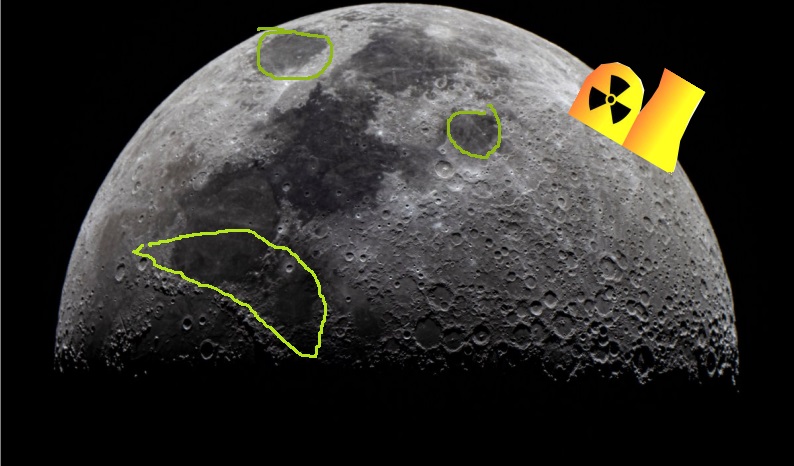
This country wants to build a nuclear power plant on the moon.
The project aims to supply energy for its lunar space programme
Guy Faulconbridge, Tuesday 20 January 2026, https://www.independent.co.uk/space/russia-china-space-race-moon-nuclear-b2904029.html
Russia is reportedly planning to establish a nuclear power plant on the moon within the next decade.
This ambitious project aims to supply energy for its lunar space programme and a joint research station with China, as global powers intensify their efforts in lunar exploration.
Historically, Russia has held a prominent position in space, notably with Yuri Gagarin’s pioneering journey in 1961.
However, its dominance has waned in recent decades, with the nation now trailing behind the United States and, increasingly, China.
The country’s lunar aspirations faced a significant setback in August 2023 when its uncrewed Luna-25 mission crashed during a landing attempt.
Furthermore, the landscape of space launches, once a Russian speciality, has been revolutionised by figures such as Elon Musk, adding to the competitive pressure.
Russia’s state space corporation, Roscosmos, said in a statement that it planned to build a lunar power plant by 2036 and signed a contract with the Lavochkin Association aerospace company to do it.
Roscosmos said the purpose of the plant was to power Russia’s lunar programme, including rovers, an observatory and the infrastructure of the joint Russian-Chinese International Lunar Research Station.
“The project is an important step towards the creation of a permanently functioning scientific lunar station and the transition from one-time missions to a long-term lunar exploration program,” Roscosmos said.
Roscosmos did not say explicitly that the plant would be nuclear but it said the participants included Russian state nuclear corporation Rosatom and the Kurchatov Institute, Russia’s leading nuclear research institute.
The head of Roscosmos, Dmitry Bakanov, said in June that one of the corporation’s aims was to put a nuclear power plant on the moon and to explore Venus, known as Earth’s “sister” planet.
The moon, which is 384,400 km (238,855 miles) from our planet, moderates Earth’s wobble on its axis, which ensures a more stable climate. It also causes tides in the world’s oceans.
Caught between Trump and Musk’s rockets, a Mexican village despairs
Space Race Echoes on Mexico’s Shores: A Coastal Community Grapples with Progress
Playa Bagdad, a once-tranquil fishing village nestled along the northeastern coast of Mexico, finds itself at the intersection of ambitious technological advancements and the complex realities of community life. Situated just south of the United States border and within earshot of the din of rocket testing, the village is experiencing profound changes, both environmental and social, as the global space industry expands its reach. The narrative unfolding in Playa Bagdad serves as a microcosm of the broader challenges faced by communities bordering burgeoning spaceports around the world.
For generations, the residents of Playa Bagdad have relied on the Gulf of Mexico for their livelihoods. Fishing has been the lifeblood of the community, passed down through families, and deeply intertwined with the rhythms of the sea. However, the increasing frequency of rocket launches and associated activities has raised concerns about the potential impact on marine life and the overall health of the ecosystem. Noise pollution, vibrations, and the potential for accidental spills are among the anxieties voiced by local fishermen and environmental advocates.
Beyond the immediate environmental concerns, Playa Bagdad is also grappling with the socioeconomic shifts accompanying the space industry’s presence. While some residents see the potential for new jobs and economic opportunities, others fear displacement and the erosion of their traditional way of life. The influx of workers and investment can drive up property values and the cost of living, potentially making it difficult for long-time residents to remain in their homes. Furthermore, there are concerns that the focus on technological development may overshadow the needs of the local community, leading to neglect of essential infrastructure and social services.
The situation in Playa Bagdad underscores the importance of responsible and sustainable development in the space industry. As humanity ventures further into the cosmos, it is crucial to consider the impact on communities located near launch sites and to ensure that their voices are heard. Transparent communication, environmental impact assessments, and community engagement are essential to mitigating potential negative consequences and fostering a mutually beneficial relationship between the space industry and the communities that host it.
The Mexican government, along with international organizations, faces the challenge of balancing the economic benefits of the space industry with the need to protect the environment and the rights of local communities. Finding solutions that promote both technological advancement and social well-being is paramount. This requires a collaborative approach, involving government agencies, space companies, environmental groups, and, most importantly, the residents of Playa Bagdad themselves.
The story of Playa Bagdad serves as a potent reminder that progress should not come at the expense of vulnerable communities. As the space race intensifies, it is imperative that we prioritize ethical considerations and strive to create a future where technological innovation and human well-being go hand in hand. The fate of this small Mexican village, caught between the allure of space exploration and the realities of life on Earth, offers valuable lessons for navigating the complex landscape of the 21st century and beyond.
Russia wants to build a nuclear power plant on the moon in the next few years .
Project aims to supply energy for its lunar space programme
Guy Faulconbridge, Wednesday 24 December 2025, https://www.independent.co.uk/space/russia-china-space-race-moon-nuclear-power-b2890010.html
Russia is reportedly planning to establish a nuclear power plant on the moon within the next decade.
This ambitious project aims to supply energy for its lunar space programme and a joint research station with China, as global powers intensify their
efforts in lunar exploration.
Historically, Russia has held a prominent position in space, notably with Yuri Gagarin’s pioneering journey in 1961.
However, its dominance has waned in recent decades, with the nation now trailing behind the United States and, increasingly, China.
The country’s lunar aspirations faced a significant setback in August 2023 when its uncrewed Luna-25 mission crashed during a landing attempt.
Furthermore, the landscape of space launches, once a Russian speciality, has been revolutionised by figures such as Elon Musk, adding to the competitive pressure.
Russia’s state space corporation, Roscosmos, said in a statement that it planned to build a lunar power plant by 2036 and signed a contract with the Lavochkin Association aerospace company to do it.
Roscosmos said the purpose of the plant was to power Russia’s lunar programme, including rovers, an observatory and the infrastructure of the joint Russian-Chinese International Lunar Research Station.
“The project is an important step towards the creation of a permanently functioning scientific lunar station and the transition from one-time missions to a long-term lunar exploration program,” Roscosmos said.
Roscosmos did not say explicitly that the plant would be nuclear but it said the participants included Russian state nuclear corporation Rosatom and the Kurchatov Institute, Russia’s leading nuclear research institute.
The head of Roscosmos, Dmitry Bakanov, said in June that one of the corporation’s aims was to put a nuclear power plant on the moon and to explore Venus, known as Earth’s “sister” planet.
The moon, which is 384,400 km (238,855 miles) from our planet, moderates Earth’s wobble on its axis, which ensures a more stable climate. It also causes tides in the world’s oceans.
Trump orders return to Moon by 2028, lunar base with nuclear power by 2030.
NASA is directed to pursue a commercial pathway to replace the International Space Station by 2030, continuing the transition toward privately owned and operated orbital platforms.
By Stephen Pope, December 19, 2025, https://www.aerotime.aero/articles/trump-moon-2028-lunar-base-golden-dome
In a sweeping reset of US space policy, President Donald Trump on December 18, 2025, signed an executive order directing NASA to return astronauts to the Moon by 2028, establish the first elements of a permanent lunar base by 2030, deploy nuclear power systems on the Moon and in orbit, and accelerate development of the administration’s “Golden Dome” missile defense program.
The order, titled Ensuring American Space Superiority, sets some of the most aggressive space and defense timelines ever laid out in a single White House directive, blending civil exploration, national security, and commercial space development into one policy framework.
Under the order, NASA is instructed to land Americans on the Moon by 2028 through the Artemis program, and then move quickly toward establishing an initial, sustained lunar presence by the end of the decade. The administration frames the Moon not only as a destination, but as strategic infrastructure — a platform for economic activity, scientific research, and preparation for future missions to Mars.
Lunar nuclear reactors
A central and notable element of the policy is nuclear power. The order calls for deploying nuclear reactors on the lunar surface and in orbit, with a lunar surface reactor required to be ready for launch by 2030. The White House argues that nuclear power is essential to sustaining long-duration operations on the Moon, where solar energy alone may not support continuous activity.
The executive order also reiterates Trump’s push for the Golden Dome missile defense initiative, directing the government to develop and demonstrate prototype next-generation missile defense technologies by 2028. It also calls for improved detection and countermeasures against threats to US space assets, extending from low Earth orbit to the moon, including concerns over nuclear weapons placed in orbit.
The order places heavy emphasis on accelerating procurement and integrating commercial space capabilities. NASA and the Department of Commerce are directed to reform their space acquisition processes within 180 days, with a stated preference for commercial solutions, faster contracting methods, and reduced bureaucratic friction. The policy also seeks to attract at least $50 billion in additional private investment into US space markets by 2028.
Compressed timelines
Commercial space involving many companies is positioned in Trump’s order as a replacement, not just a partner, for legacy government programs. NASA is directed to pursue a commercial pathway to replace the International Space Station by 2030, continuing the transition toward privately owned and operated orbital platforms.
The order also makes structural changes to space governance. It revokes the National Space Council and shifts coordination of national space policy to the White House Office of Science and Technology Policy. Several agencies are given near-term reporting deadlines, including a 90-day requirement for NASA to outline how it will meet the Moon and exploration goals within existing funding levels.
In addition, the order revises prior space traffic management policy by removing language that had described government-provided tracking services as free, potentially opening the door to paid or commercially supported models in the future.
Taken together, the executive order outlines an expansive vision with compressed timelines, placing pressure on NASA, the Pentagon, and industry to deliver rapid progress.
Over the Moon and Down to Earth
15 December 2025, https://www.banng.info/news/regional-life/over-the-moon-and-down-to-earth/
Varrie Blowers writes for the December 2025 issue of Regional Life magazine
If Bradwell is an unsuitable site for nuclear development……what about the Moon? Although it can be seen shining over the Blackwater and appear quite close, the Moon is actually almost 239,000 miles away. But Sean Duffy, the Acting Administrator of NASA, is over the Moon at the idea of such development.
A new space race is starting between the USA and Russia in collaboration with China planning to build nuclear reactors on the Moon, in 2030 and 2035 respectively, to power bases. No doubt other members of the space club will wish to follow where they lead. Is this a case of the unbelievable becoming believable?
A key problem for building nuclear reactors on the Moon is getting them up there in the first place – in the hope that the transporting rockets do not explode (not unknown!) and shower radioactive particles on populated areas below.
Another is that a stable power supply would be required to sustain the astronauts who would have to get the reactors up and running. This would seem to be impossible; the location for the proposed bases is the Moon’s dark South Pole, where solar power could not provide a consistent supply.
Among other serious problems are:
the Moon’s very environment with its extreme thermal cycles, abrasive dust, reduced gravity, cosmic radiation, the lack of atmosphere;- astronauts in space suits, it seems, would be unable to maintain the reactors regularly meaning that electronic components that could last for a very long time without being replaced would be needed;
- the vast expense and need for sustained funding with cost and time overruns
So why would any nation wish to attempt to undertake a project that appears to be a non-starter? To undertake space exploration…… or space exploitation?
The motive behind the bases is the desire to exploit what are regarded as the Moon’s vast resources of minerals, including rare earths, metals and helium.
All of this prompts the question of ‘Who owns the Moon?’. The answer according to the UN Outer Space Treaty of 1967 is that space, including the Moon, belongs to us all and should be used peacefully for the benefit of all nations. It is, however, unlikely that any nation with a base would regard the resources as ‘belonging to us all’.
History should warn us that in this grab for the Moon’s riches, likely clashes between nations would arise, perhaps even leading to military conflict in space.
We are in danger of transporting our problems to the Moon. Back down to Earth, we have enough problems to cope with.
Europe militarizes its space agency.
Sat, 29 Nov 2025 , https://www.sott.net/article/503252-Europe-militarizes-its-space-agency
The ESA has been awarded record funding, dropping its civilian-only focus and branching out to military and security missions.
The European Space Agency (ESA) will begin working on defense projects for the first time, in a move it is describing as “historic.” A resolution by its 23 member states says the agency has the tools to develop space systems “for security and defense.”
The EU and NATO are pouring tens of billions in taxpayer and borrowed money into supporting defense firms and churning out weapons, claiming Russia poses an imminent threat. Russian President Vladimir Putin said on Thursday that EU leaders are inflating the alleged danger to push their own political agendas and funnel cash into the arms industry.
Next year’s budget allocates a record €22.1 billion (around $24 billion) to the ESA for the next three years.Its member states include virtually all European NATO countries, as well as non‑NATO members such as Switzerland and Austria.
The new budget is a sharp rise from the previous €17 billion. Germany is the top contributor with €5 billion, followed by France and Italy at over €3 billion each.
According to ESA Director General Josef Aschbacher, Poland was instrumental in promoting the agency’s new strategic direction. He confirmed that Warsaw is currently in discussions to host a new ESA center dedicated to security-focused projects.
Across the EU, defense budgets are surging as Brussels and its allies push for rearmament under the banner of security. The European Commission’s ‘ReArm Europe’ plan aims to pour hundreds of billions into joint weapons procurement and infrastructure, while member states have boosted arms purchases by nearly 40% in just one year.
Research and development spending is also up sharply, signaling a full-speed shift toward a greater military focus.
ESA approves first-ever defense program:
Europe is taking its biggest step yet into space militarization. The centrepiece of this shift is European Resilience from Space (ERS), a new dual-use program intended to build a military-grade “system of systems” combining national satellites for secure surveillance, communications, navigation, and climate monitoring.
ERS received $1.39 billion of the $1.56 billion ESA sought. In February, ESA will ask European defense ministries for an additional $290 million.
ESA Director General Josef Aschbacher called the decision “a clear defense and security mandate,” noting that support from 23 member states — including non-EU countries such as the UK — was nearly unanimous.
At the ministerial summit in Bremen, ESA member states also approved:
- a total transportation budget of $5.09 billion (4.39 billion EUR) to develop reusable European rockets;
- $4.18 billion for commercial space partnerships;
- continued funding for the Rosalind Franklin Mars mission, now slated for launch in 2028 with NASA’s confirmed support;
- initial studies for a mission to Saturn’s moon Enceladus, seen by astrobiologists as a prime target for finding extraterrestrial life.
Germany — already planning to invest $40.6 billion in military space capabilities by 2030 — extended its lead as ESA’s largest contributor. In exchange, Berlin secured a commitment that a German astronaut will be the first European to join NASA’s Artemis lunar missions.
Space consultants note that while ERS funding is substantial, it remains politically delicate. “The coming year will be decisive for whether Europe can truly stand up a sovereign, rapid-response intelligence surveillance and reconnaissance constellation,” said Maxime Puteaux of Novaspace.
Earlier, Maj. Gen. Paul Tedman, head of the UK Space Command,reported that Russia was routinely shadowing and trying to jam British military satellites.
Star Wars redux: the false promise of space-based missile defense
by Najam Ul Hassan, November 24, 2025, https://spacenews.com/star-wars-redux-the-false-promise-of-space-based-missile-defense/?utm_source=ActiveCampaign&utm_medium=email&utm_content=Opinions%3A%20Is%20space-based%20missile%20defense%20a%20non-starter%3F&utm_campaign=Opinions%20-%202025-11-29
Star Wars is back in vogue with President Trump’s executive order to establish the “Golden Dome” missile defense shield. It will feature an ambitious space-based boost-phase interceptor program in addition to terrestrial systems. While admittedly the holy grail of defense against ballistic missiles, the obstacles that plagued its discontinued predecessor, “Brilliant Pebble,” under the Strategic Defense Initiative, remain unaddressed. The technological breakthroughs in launch capacity, decreasing costs of sending mass into space and faster data transfer have led to renewed hope for space-based missile defense, but the fundamental hurdle — physics, not technology — remains to be effectively overcome.
Recurrent interest in space-based missile interceptors (SBI) is driven by the motivation to neutralize the missile in the boost phase, contrary to the other air defense systems that intercept either in the mid-course or the terminal phase. This offers numerous advantages: it is substantially easier to detect and target as the booster has not detached yet, making the target bulkier; the plume from the burn makes it visible; its speed is slower compared to other phases; and the target has not hardened yet, making it more vulnerable. Once the missile enters the midcourse, it deploys decoys with a similar radar cross-section as the actual warhead, which float at similar trajectories, making it exponentially harder to achieve an effective kill. Additionally, the deployment of multiple warheads in case of a Multiple Independent Re-entry Vehicle or zig-zag moment of hypersonic glide vehicles adds another layer of complexity to successful interception.
However, this lucrative promise is heavily outweighed by the drawback of what could be termed the absenteeism problem in physics. These satellites, carrying kill vehicles, must be stationed in low Earth orbit (LEO) to reach the target in the boost phase, which only lasts from three to five minutes after launch. The fundamental problem is that objects in LEO cannot be parked above one point on Earth; they revolve around Earth, completing a cycle between 90 and 120 minutes. To cover the entire stretch of potential launching points and establish a genuinely global air defense, a constellation of 950 satellites has to be deployed, according to conservative estimates. The estimated cost, according to the Congressional Budget Office’s estimates, is $542 billion as opposed to the $175 billion claim by President Trump.
Not only is the scaling dynamic flawed, but the system is also easy to defeat. The constellation is easily overwhelmed by simultaneous launches. Even if each satellite were to carry more than one interceptor, the system still saturates quickly. Once that happens, instead of a linear increase in required satellites to intercept additional hostile launches, the requirement jumps exponentially, which is untenable. Besides, the enemy can simply punch holes in the chain by employing anti-satellite missiles, as the satellites can be tracked.
Furthermore, attempts to field even a limited number of SBIs for tests could pose a security dilemma for other states. These SBIs can be effective ASAT vehicles as they would require high thrust and maneuverability, allowing them to potentially reach and attack satellites in geosynchronous orbits. This can trigger an arms race of satellite-based weapons as well as counter-space capabilities, resulting in a net effect of added insecurity for all, including the U.S. itself, which depends heavily on its space capabilities. Challenging the effectiveness of an adversary’s deterrent would have profound strategic implications, at least insofar as it would either find qualitative ways to evade the newly developed defense architecture, or increase the number of their missiles to overwhelm the systems, or both. Ultimately, durable security cannot be achieved alone but in concert with others, including the adversary, and perhaps the only way to prevent attacks and ensure long-term stability remains deterrence by punishment.
The proposal for SBIs has also triggered sharp international reactions. China has already fielded its own “Golden Dome” prototype, which is essentially an early warning system with enormous big data computation ability, that uses the present capabilities in a more integrated and efficient manner, rather than seeking new platforms for interceptors. Criticizing the American approach, Beijing has asserted that SBIs would disturb “global strategic balance and stability” and turn “space into a war zone”, while Moscow has called it “very destabilizing.”
The desire to secure the homeland drives this saga, undergirded by the belief that technology could fundamentally alter defense logics. Yet despite significant progress in almost all the technological components needed to improve the cost-benefit equation, the physical — and perhaps insurmountable — barriers remain as formidable as they were three decades ago. The return to space-based interceptors thus reflects a recurring faith in technological solutions to strategic problems that are, at their core, governed by physics and deterrence. Rather than investing in an orbit-based missile shield that risks instability and imposes exorbitant costs, pursuing balanced security arrangements may offer a sustainable path toward long-term stability.
Najam Ul Hassan is a Research Assistant at the Centre for Aerospace and Security Studies, Lahore.
‘The war of tomorrow will begin in space’: Macron
by AFP Staff Writers, Toulouse, France (AFP) Nov 12, 2025, https://www.spacewar.com/reports/The_war_of_tomorrow_will_begin_in_space_Macron_999.html
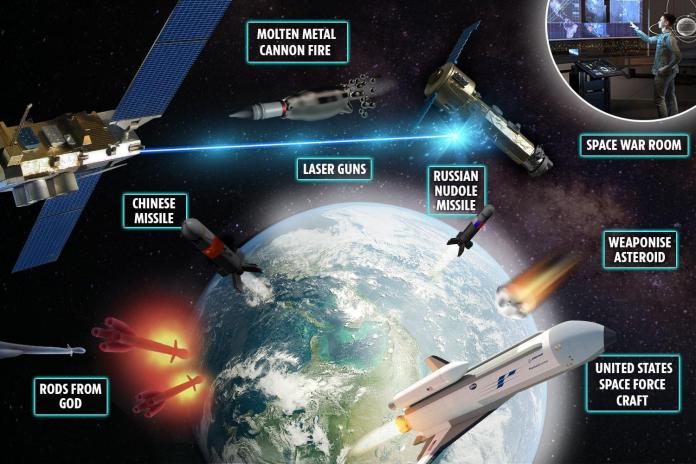
Modern conflicts are already being fought in space and the next wars will begin there, French President Emmanuel Macron said Wednesday, singling out the threat posed by Russia and announcing a multi-billion euro increase in spending on military activities in space.
“The war of today is already being fought in space, and the war of tomorrow will begin in space,” Macron said in Toulouse, France’s space and aviation hub, which is home to its new space military command centre.
“Space is no longer a sanctuary, it has become a battlefield,” Macron said.
He said that Russia in the wake of its 2022 full scale invasion of Ukraine was carrying out “espionage” activities in space.
Russian space vehicles were monitoring French satellites, there was mass jamming of GPS signals and cyberattacks against space infrastructure, he added.
Macron also pointed to the “particularly shocking Russian threat of nuclear weapons in space, the effects of which would be disastrous for the whole world”.
Without giving specific details, Macron announced an additional 4.2 billion euros ($4.9 billion) in funding for military space activities up to 2030.
In a “fragile” European space sector, he also stressed the need to “encourage our European champions to be competitive on the global market”.
The priorities outlined for France’s space strategy included “developing future launchers” that are reusable, have low-cost propulsion and high-thrust engines.
In a nod to the ambitious programmes of American billionaires Elon Musk who leads Space X and Jeff Bezos with Blue Origin, Macron said: “Depending on a major third-party power or any space magnate is out of the question.
“Let us be ready: this will be a condition for the success of military operations on land, in the air and at sea.”
He also said France was accelerating the development of advanced warning capabilities in cooperation with Germany, strengthening space surveillance with the Aurore radar system to reduce dependence on other states.
“We are investing in means of action from the ground and space while respecting international law, but without any naivety,” he said.
Mainers will not benefit from coastal rocket launch sites
Economic and oversight concerns make this a bad idea for our state.
I read with interest the Sept. 17 op-ed by Thom Moore, “Maine should vie to be the next US spaceport,” arguing for Maine to become a place where rocket launches occur regularly.
It’s not surprising that a retired NASA scientist who is not from Maine feels our state would be improved by toxic industrial activity of the sort Texas and Florida have to deal with regularly. Moore writes: “… a space industry could make beneficial contributions to Maine’s economy and to the national supply of viable launch sites.”
Let’s examine those claims.
Claims of benefit to Maine’s economy must be weighed against the harms to our traditional economy. Maine’s economy is highly dependent on commercial fishing on the one hand and tourism on the other. Even with the government shutdown, tourists are still flocking to Acadia National Park from all over the world. It’s a uniquely beautiful spot where one can witness the first rays of dawn light in the continental U.S.
Residents of nearby Steuben earlier this year rejected a bid to build a rocket launch site offshore of their village, citing the threat to environmental health of waters where food is harvested and also significant noise pollution. And as far as optics, who wants to see a rocket launch facility within sight of Acadia? Not locals.
Previously, Jonesport rejected a launch site after passing a moratorium to halt development while local residents had time to study the proposal. Which town will be next to say it does not want to hear or see rockets launching from its coast?
At present there is almost no regulatory oversight of such potentially harmful uses of Maine’s shoreline. Look what SpaceX has done to Boca Chica, Texas, over local objections: littered bird nesting grounds with debris from rocket explosions and prevented local residents from access to their beach.
“National supply of viable launch sites” is a backhand acknowledgement of the central role of the Space Force branch of the Pentagon in pushing for launch sites to be constructed. No rocket launch site would be financially viable without military spending, and the U.S. military plans to benefit from the investments of private industry as much as it can with so-called public-private partnerships.
At least two rocket firms in Maine have acknowledged they’ve already received funding from the U.S. Space Force: bluShift Aerospace in Brunswick and VALT Enterprizes in Presque Isle.
But when the Maine Space Corporation was established, legislators were told that its purpose was research and development for civilian and educational purposes. They were explicitly told by the bill’s sponsor that there would be no military use.
This is also what locals in Kodiak, Alaska, were told when a rocket launch site was built there more than 20 years ago. Now, the site has expanded to multiple launch facilities and is most often used for Israeli military satellites and Pentagon payloads. Personnel are brought into Kodiak to oversee these launches, and the only local jobs generated are for custodians and security guards.
Wealthy people looking to profit from using Maine’s natural resources is nothing new. The CMP corridor is being built through the North Woods — over the objections of a majority of Maine voters — in order to enrich CMP and Hydro Quebec.
As you and your neighbors struggle to fund schools and heat your homes amid soaring inflation, ask yourself who would really benefit from building a rocket launch site on the coast of Maine
Peace is Possible – The Weaponization of Space with Bruce Gagnon.
Peace is Possible – The Weaponization of Space with Bruce Gagnon
West Hartford Community Interactive, 1 Oct 25
Joe Wasserman interviews Bruce Gagnon, Coordinator and co-founder of the Global Network Against Weapons & Nuclear Power in Space. https://www.youtube.com/watch?v=Y_ps6sJI1XM
1 This Month


Petition to revoke the licensing of the Near Surface Nuclear Disposal Facility (NSDF) at Chalk River. https://www.ourcommons.ca/petitions/en/Petition/Details?Petition=e-7247


of the week – STOP SMALL MODULAR REACTORS IN CANADA
To see nuclear-related stories in greater depth and intensity – go to https://nuclearinformation.wordpress.com
-
Archives
- March 2026 (163)
- February 2026 (268)
- January 2026 (308)
- December 2025 (358)
- November 2025 (359)
- October 2025 (376)
- September 2025 (258)
- August 2025 (319)
- July 2025 (230)
- June 2025 (348)
- May 2025 (261)
- April 2025 (305)
-
Categories
- 1
- 1 NUCLEAR ISSUES
- business and costs
- climate change
- culture and arts
- ENERGY
- environment
- health
- history
- indigenous issues
- Legal
- marketing of nuclear
- media
- opposition to nuclear
- PERSONAL STORIES
- politics
- politics international
- Religion and ethics
- safety
- secrets,lies and civil liberties
- spinbuster
- technology
- Uranium
- wastes
- weapons and war
- Women
- 2 WORLD
- ACTION
- AFRICA
- Atrocities
- AUSTRALIA
- Christina's notes
- Christina's themes
- culture and arts
- Events
- Fuk 2022
- Fuk 2023
- Fukushima 2017
- Fukushima 2018
- fukushima 2019
- Fukushima 2020
- Fukushima 2021
- general
- global warming
- Humour (God we need it)
- Nuclear
- RARE EARTHS
- Reference
- resources – print
- Resources -audiovicual
- Weekly Newsletter
- World
- World Nuclear
- YouTube
-
RSS
Entries RSS
Comments RSS
 nuclear-news