A hopeless pursuit? National efforts to promote small modular nuclear reactors and revive nuclear power.
This article examines national efforts
in three countries, Canada, the UK, and the United States, which are
pursuing SMRs vigorously and where the government has funded their
development generously.
We compare the different strategies and foci of
these national strategies, analyzing the various forms of support offered
by the separate agencies of the government, and the private companies that
are trying to develop SMRs.
We also offer an overview of the different
types of reactor technologies being pursued in these different countries.
Following these, we outline the main challenge confronting SMR
technologies: their ability to generate electricity in an economically
competitive manner, highlighting the problems resulting from economies of
scale being lost. By examining the experience so far, we find that even
designs based on well-tested technology cannot be deployed till after 2030
and the more radical designs might never be.
Wires Energy & Environment 12th Jan 2022
https://wires.onlinelibrary.wiley.com/doi/epdf/10.1002/wene.429
Japan to join with NuScam, Bill Gates’ TerraPower, to develop plutonium fast reactors and small nuclear reactors
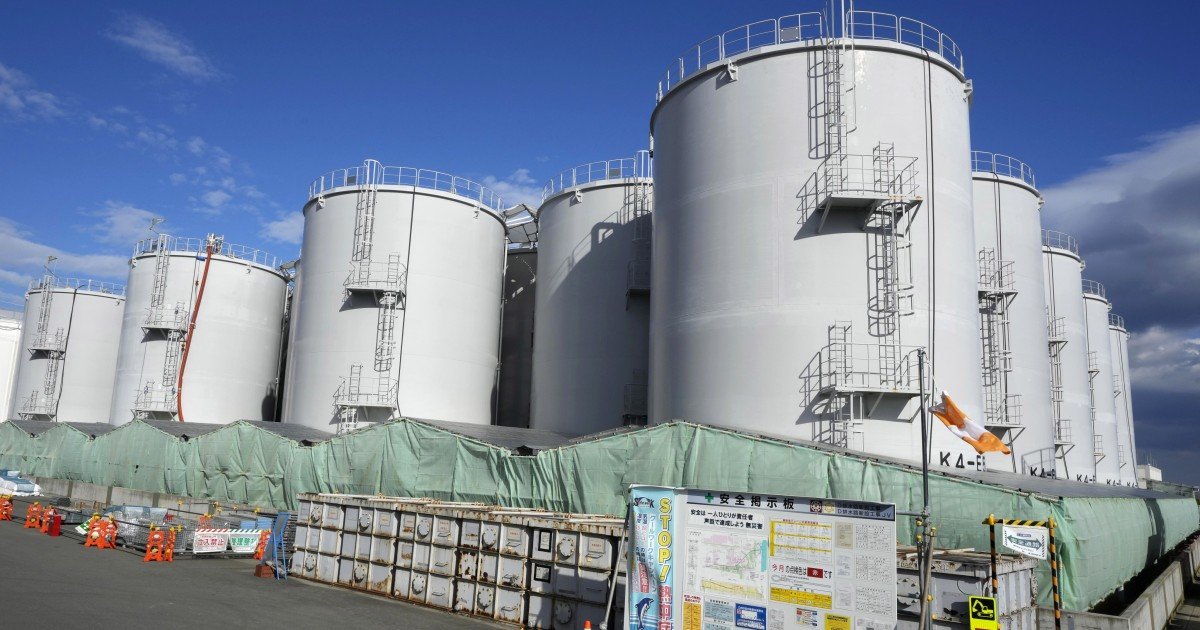
there is considerable skepticism of nuclear energy in Japan, and critics are concerned that the government is moving ahead with alliances with the United States to create new technologies while there are so many unanswered questions about safety
Next-Gen Nuclear Technology – US’ Ambitious Nuclear Power Pact With Tokyo Could Fuel Japanese Industry For Decades, BySakshi Tiwari, Eurasia Times, January 14, 2022 ”………………… (Japan) is set to give nuclear technology an all-new shot……………… Collaboration with scientists and companies in the United States will be a key component in the development of future nuclear energy technology
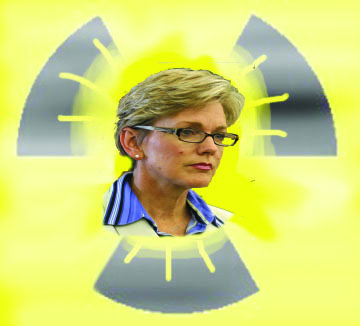
Japan’s Minister of Industry Koichi Hagiuda had a virtual meeting with US Energy Secretary Jennifer Granholm on January 6 during which they agreed to cooperate in the development of plutonium-burning fast reactors and advanced energy plants based on small modular reactors (SMRs).
Hagiuda told Granholm that Tokyo will encourage more local energy companies to join an international program to test fast reactors and small modular reactors, or SMRs, developed by US companies such as NuScale Power LLC and others.
The meeting, Hagiuda’s first since taking office last year, took place at a time when Japan is stepping up its efforts to develop advanced nuclear power technologies.
The Japanese government intends to promote domestic enterprises that participate in international tests incorporating such technology as part of its national energy plan. The United States and France are among the other international participants in the initiative…………………………..
in a noteworthy development that could now be seen as a premise for this new technology development, the Japanese government made it clear in its Sixth Strategic Energy Plan, released in October that it intends to move on from the events in northeast Japan………………..
In 2018, Japan and the United States had signed a memorandum of understanding to “advance the two countries’ worldwide leadership role” in civil nuclear energy.
“The Japan Atomic Energy Agency [JAEA] and Mitsubishi Heavy Industries are cooperating with US nuclear power start-up TerraPower simply because they have the required skills and knowledge on fast reactors,” says Tomoko Murakami, manager of the nuclear energy group at the Institute of Energy Economics Japan.
In the first stage of the alliance, Tokyo would spend 900 million yen ($7.8 million) on improving the AtheNa sodium experimental plant in Ibaraki prefecture for fast reactor development. The facility operated by Japan Atomic Energy Agency (JAEA) is already in operation, and an MoU on technological cooperation with TerraPower is expected to be inked by the end of January, SCMP reported.
In 2018, Japan and the United States had signed a memorandum of understanding to “advance the two countries’ worldwide leadership role” in civil nuclear energy.
“The Japan Atomic Energy Agency [JAEA] and Mitsubishi Heavy Industries are cooperating with US nuclear power start-up TerraPower simply because they have the required skills and knowledge on fast reactors,” says Tomoko Murakami, manager of the nuclear energy group at the Institute of Energy Economics Japan.
The system is meant to extract heat from a reactor core using liquid sodium to generate electricity. The facility will also be used in the cooperative development of a next-generation fast reactor with the United States, while work is also underway at another location, Joyo, to study the impact of neutrons on fuels and other equipment using sodium as a coolant……………………
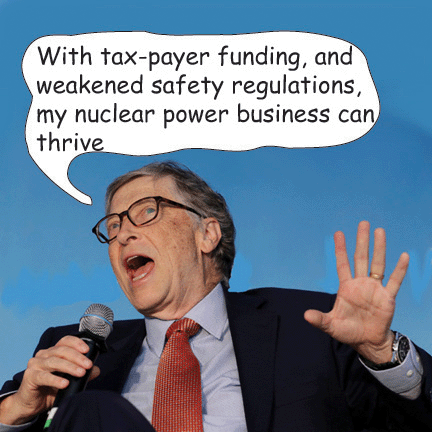
With American experience in the technology and two of its companies deeply invested in it, Japan has a natural partner to cooperate with. Terrapower is a start-up, which is rigorously working on SMR technology and is partially funded by the American billionaire and philanthropist Bill Gates.
Another US giant working on this advanced next-generation technology is NuScale Power which has partnered with the US government on SMR development for third countries………….
Nonetheless, there is considerable skepticism of nuclear energy in Japan, and critics are concerned that the government is moving ahead with alliances with the United States to create new technologies while there are so many unanswered questions about safety, according to the SCMP.
“All the media coverage has become very positive about these new developments and the technology alliance with the US, but we must remember that at the moment fast reactor technology exists only on paper and there are no guarantees that it will be a success,” Hajime Matsukubo, secretary-general of the Tokyo-based Citizens’ Nuclear Information Centre (CNIC) was quoted as saying.
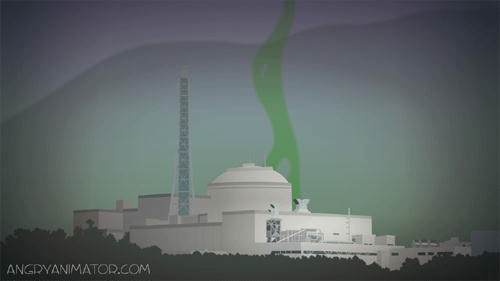
“Japan has already spent 1 trillion yen [US$8.7 billion] on fast reactor research and another 1 trillion yen on decommissioning the experimental Monju reactor, to say nothing of what is being spent on all the work at Fukushima and decommissioning all the other reactors around the country. So it’s ridiculous to spend even more on nuclear technology that so many people do not want and do not trust,” he added.
The billions spent on nuclear power, according to CNIC, would have been far better used in establishing a local renewable sector that could have tapped into geothermal, wind, wave, solar, and other sources — and would have been the envy of the world.
It also warns that due to Japan’s unstable geology, a replay of the Fukushima accident – or a situation far worse –always remains a possibility……
You thought Rolls Royce’s Small Nuclear Reactors would be for electricity on Earth?

Rolls-Royce team moves into Space Park Leicester to work on nuclear powered space travel, BusinessLive, 13 Jan 22,
Rolls-Royce already signed contract with UK Space Agency to study future nuclear power options for space exploration.
Rolls-Royce has moved a team onto Space Park Leicester to push forward its work on nuclear power for space travel.
The engineering giant has taken space in the new £100 million facility which was launched as a breeding ground for out-of-this-world tech by bringing together industry and academia.
Rolls-Royce is reported to be the only UK company focussing on the line of work and staff with a pedigree in nuclear power will collaborate with new space park head Professor Richard Ambrosi, Professor of Space Instrumentation and Space Nuclear Power Systems at University of Leicester and other experts in space science.
Last January, Rolls-Royce signed a contract with the UK Space Agency to study future nuclear power options for space exploration………………… https://www.business-live.co.uk/technology/rolls-royce-team-moves-space-22728938
What future for Small Nuclear Reactors (SMRs) ?

Small nuclear reactor? It’s a lemon!
Large taxpayer subsidies might get some projects, such as the NuScale project in the US or the Rolls-Royce mid-sized reactor project in the UK, to the construction stage. Or they may join the growing list of abandoned SMR projects
In 2022, nuclear power’s future looks grimmer than ever, Jim Green, 11 Jan 2022, RenewEconomy
”……………………………………….. Small modular reactors
Small modular reactors (SMRs) are heavily promoted but construction projects are few and far between and have exhibited disastrous cost overruns and multi-year delays.
It should be noted that none of the projects discussed below meet the ‘modular’ definition of serial factory production of reactor components, which could potentially drive down costs. Using that definition, no SMRs have ever been built and no country, company or utility is building the infrastructure for SMR construction.
In 2004, when the CAREM SMR in Argentina was in the planning stage, Argentina’s Bariloche Atomic Center estimated an overnight cost of A$1.4 billion / GW for an integrated 300 megawatt (MW) plant, while acknowledging that to achieve such a cost would be a “very difficult task”. Now, the cost estimate is more than 20 times greater at A$32.6 billion / GW. A little over A$1 billion for a reactor with a capacity of just 32 MW. The project is seven years behind schedule and costs will likely increase further.
Russia’s 70 MW floating nuclear power plant is said to be the only operating SMR anywhere in the world (although it doesn’t fit the ‘modular’ definition of serial factory production). The construction cost increased six-fold from 6 billion rubles to 37 billion rubles (A$688 million), equivalent to A$9.8 billion / GW. The construction project was nine years behind schedule.

According to the OECD’s Nuclear Energy Agency, electricity produced by the Russian floating plant costs an estimated A$279 / MWh, with the high cost due to large staffing requirements, high fuel costs, and resources required to maintain the barge and coastal infrastructure. The cost of electricity produced by the Russian plant exceeds costs from large reactors (A$182-284) even though SMRs are being promoted as the solution to the exorbitant costs of large nuclear plants.
SMRs are being promoted as important potential contributors to climate change abatement but the primary purpose of the Russian plant is to power fossil fuel mining operations in the Arctic.
A 2016 report said that the estimated construction cost of China’s demonstration 210 MW high-temperature gas-cooled reactor (HTGR) is about A$7.0 billion / GW and that cost increases have arisen from higher material and component costs, increases in labour costs, and project delays. The World Nuclear Association states that the cost is A$8.4 billion / GW. Those figures are 2-3 times higher than the A$2.8 billion / GW estimate in a 2009 paper by Tsinghua University researchers.
China’s HTGR was partially grid-connected in late-2021 and full connection will take place in early 2022.
China reportedly plans to upscale the HTGR design to 655 MW (three reactor modules feeding one turbine). China’s Institute of Nuclear and New Energy Technology at Tsinghua University expects the cost of a 655 MW HTGR will be 15-20 percent higher than the cost of a conventional 600 MW pressurised water reactor.
NucNet reported in 2020 that China’s State Nuclear Power Technology Corp dropped plans to manufacture 20 additional HTGR units after levelised cost of electricity estimates rose to levels higher than a conventional pressurised water reactor such as China’s indigenous Hualong One. Likewise, the World Nuclear Association states that plans for 18 additional HTGRs at the same site as the demonstration plant have been “dropped”.

The World Nuclear Association lists just two other SMR construction projects other than those listed above. In July 2021, China National Nuclear Corporation (CNNC) New Energy Corporation began construction of the 125 MW pressurised water reactor ACP100. According to CNNC, construction costs per kilowatt will be twice the cost of large reactors, and the levelised cost of electricity will be 50 percent higher than large reactors.

In June 2021, construction of the 300 MW demonstration lead-cooled BREST fast reactor began in Russia. In 2012, the estimated cost for the reactor and associated facilities was A$780 million, but the cost estimate has more than doubled and now stands at A$1.9 billion.
SMR hype
Much more could be said about the proliferation of SMRs in the ‘planning’ stage, and the accompanying hype. For example a recent review asserts that more than 30 demonstrations of ‘advanced’ reactor designs are in progress across the globe. In fact, few have progressed beyond the planning stage, and few will. Private-sector funding has been scant and taxpayer funding has generally been well short of that required for SMR construction projects to proceed.
Large taxpayer subsidies might get some projects, such as the NuScale project in the US or the Rolls-Royce mid-sized reactor project in the UK, to the construction stage. Or they may join the growing list of abandoned SMR projects.
A failed history of small reactor projects. A handful of recent construction projects, most subject to major cost overruns and multi-year delays. And the possibility of a small number of SMR construction projects over the next decade. Clearly the hype surrounding SMRs lacks justification.
Everything that is promising about SMRs belongs in the never-never; everything in the real-world is expensive and over-budget, slow and behind schedule. Moreover, there are disturbing, multifaceted connections between SMR projects and nuclear weapons proliferation, and between SMRs and fossil fuel mining.
SMRs for Australia
There is ongoing promotion of SMRs in Australia but a study by WSP / Parsons Brinckerhoff, commissioned by the South Australian Nuclear Fuel Cycle Royal Commission, estimated costs of A$225 / MWh for SMRs. The Minerals Council of Australia states that SMRs won’t find a market unless they can produce power at about one-third of that cost.
In its 2021 GenCost report, CSIRO provides these 2030 cost estimates:
* Nuclear (SMR): A$128-322 / MWh
* 90 percent wind and solar PV with integration costs (transmission, storage and synchronous condensers): A$55-80 / MWh
Enthusiasts hope that nuclear power’s cost competitiveness will improve, but in all likelihood it will continue to worsen. Alone among energy sources, nuclear power becomes more expensive over time, or in other words it has a negative learning curve.
Dr Jim Green is the national nuclear campaigner with Friends of the Earth Australia and the author of a recent report on nuclear power’s economic crisis. , https://reneweconomy.com.au/in-2022-nuclear-powers-future-is-grimmer-than-ever/
What motivates Canadian province Premiers to enthuse about costly, probably useless, Small Nuclear Reactors?
So why are Canadian provinces like Alberta so enthusiastic about the idea? Well, it provides a way for governments captured by the fossil fuel industry to show they’re doing something about climate change without actually doing anything about climate change. Of course, just because nuclear power generators might reduce the carbon footprint of oilsands extraction, that doesn’t mean the oil extracted would not be burned elsewhere, contributing to climate change.
Guess Who’s Leading the Charge for Nuclear Power in Canada?
Small reactors make no economic sense, despite the boost by Alberta Premier Jason Kenney and lobbyists. David Climenhaga The Tyee, Today | Alberta Politics 10 Jan 22,
”………………………………… Premier of Albeta Jason Kenney’s most recent tweet — which provides a link to a slick video touting nuclear power produced by the British newsmagazine the Economist, was posted on Jan. 6.
By coincidence, presumably, a communique issued the same day by the former heads of nuclear regulatory committees in the United Kingdom, United States, Germany and France concluded that “nuclear is not a practicable means to combat climate change.”
“The central message, repeated again and again, that a new generation of nuclear will be clean, safe, smart and cheap, is fiction,” the communique states.
Nuclear energy is neither cheap enough nor safe enough to provide an effective strategy against global climate change, the communique authors argued. “To make a relevant contribution to global power generation, up to more than 10,000 new reactors would be required, depending on reactor design.”
Among their key points:
- Nuclear power more expensive than renewable energy on a similar scale
- None of the problems of waste disposal have been solved
- It’s so expensive financial markets won’t invest in it, so it requires massive public subsidies
- No one is prepared to insure against the full potential cost of environmental and human impacts of accidental radiation releases
- Construction timelines are too long for it to make a contribution to stopping global warming.
- So why are Canadian provinces like Alberta so enthusiastic about the idea? Well, it provides a way for governments captured by the fossil fuel industry to show they’re doing something about climate change without actually doing anything about climate change.Of course, just because nuclear power generators might reduce the carbon footprint of oilsands extraction, that doesn’t mean the oil extracted would not be burned elsewhere, contributing to climate change.
- For a government like Kenney’s United Conservative Party, it’s also an opportunity to make positive-sounding announcements about new jobs in a new industry on days when news media would otherwise be concentrating on the latest scandal — nowadays pretty well every day.Moreover, the UCP Government is being actively lobbied by the Canadian Nuclear Association, “the voice of the Canadian nuclear industry since 1960,” which “promotes the industry nationally and internationally.

According to the Alberta Lobbyist Registry, Calgary-based New West Public Affairs, a firm with close ties to the Kenney government headed by former Harper government minister Monte Solberg, has been engaged to “facilitate introductions for the Canadian Nuclear Association and share information on small modular reactors” with various government departments.
New West was hired “specifically, to generate support for the technology and to identify if there is an opportunity in Alberta’s mining and oil and gas sectors for the deployment of new low carbon energy sources, including nuclear,” the registry entry says.
The CNA is also using Ottawa-based Earnscliffe Strategies, one of Canada’s best-known lobby firms, to seek “support for clean electricity — including nuclear electricity — as a foundation for emissions reduction in Canada.” In addition, Earnscliffe is lobbying for “support for the research and development of small modular reactors.” https://thetyee.ca/Analysis/2022/01/10/Nuclear-Power-Canada-Who-Leading-Charge/
Small nuclear reactors make no economic sense, despite the boost by Alberta Premier Jason Kenney and lobbyists.
Guess Who’s Leading the Charge for Nuclear Power in Canada?
Small reactors make no economic sense, despite the boost by Alberta Premier Jason Kenney and lobbyists. David Climenhaga The Tyee, Today | Alberta Politics 10 Jan 22,
David J. Climenhaga is an award-winning journalist, author, post-secondary teacher, poet and trade union communicator. He blogs at AlbertaPolitics.ca. Follow him on Twitter at @djclimenhaga.
Small nuclear reactors don’t make any more economic sense now than they did back in the summer of 2020 when Alberta Premier Jason Kenney took to the internet to tout the supposed benefits of the largely undeveloped technology being promoted by Canada’s nuclear industry.
Now that Kenney has taken to Twitter again to claim atomic energy is a “real solution that helps reduce emissions” and that so-called small modular reactors can “strengthen and diversify our energy sector,” it’s worth taking another look at why the economics of small nuclear reactors don’t add up.
As I pointed out in 2020, “as long as natural gas is cheap and plentiful, small nuclear reactors will never make economic sense.”
Natural gas is somewhat more expensive now than it was then, but not enough to make a difference to that calculation when the massive cost of any new nuclear-energy project is considered.
Even “small modular reactors,” so named to reassure a public skittish about the term nuclear and wary of the costs and risks of atomic reactors, are extremely expensive. It would be more accurate to call them “medium-sized nuclear reactors.”
For example, two such reactors built by Russia starting in 2006 were supposed to cost US$140 million. They ended up costing US$740 million by the time the project was completed in 2019.
Getting approvals for smaller reactors is time consuming, too. As environmentalist and author Chris Turner pointed out yesterday, the first small nuclear reactor approved in the United States “submitted its application in 2017, got approval late last year, could begin producing 700MW by 2029 if all goes perfectly. Solar will add double that to Alberta’s grid by 2023.” Indeed, the estimated completion date of the NuScale Power project may be even later.
The small reactors touted by many companies, often entirely speculative ventures, are nothing more than pretty drawings in fancy brochures. According to the International Atomic Energy Agency, there are about 50 concepts, but only a couple in the United States and Russia with massive amounts of government money behind them are anything more than pipedreams or stock touts’ pitches to investors.
And small nuclear reactors are less economical than big reactors, so power companies aren’t interested in building them; all but one proposed design requires enriched uranium, which Canada doesn’t produce, so they won’t do much for uranium mining in Alberta; and all the safety and waste-removal problems of big nukes continue to exist with small ones.
These points are documented in more detail my 2020 post, which also discussed why smaller reactors will never create very many jobs in Alberta, ……………………- https://thetyee.ca/Analysis/2022/01/10/Nuclear-Power-Canada-Who-Leading-Charge/
A warning against fetishizing nuclear power so it’s part of every solution

the enthusiasm overlooks some ugly truths about nuclear power.
Many alternative reactor designs are pitched as if they’re novel. They’re not. A good example is the Natrium reactor
The drawbacks of sodium technology should resonate especially loudly for Californians.
The 1959 explosion of a sodium-cooled test reactor at the government’s secretive Santa Susana Field Laboratory outside Simi Valley remains the worst nuclear accident in U.S. history
Today’s younger environmental activists may be more inclined to accept these promises today because their thinking wasn’t forged in the anti-nuclear protests of the 1960s and 1970s, as was that of their older colleagues.
The danger is that they, and society, may have to learn the harsh lessons of nuclear power’s past all over again.
Nuclear energy backers say it’s vital for the fight against global warming. Don’t be so sure, Los Angeles Times, BY MICHAEL HILTZIKBUSINESS COLUMNIST , JAN. 6, 2022
No one would have believed this possible only a few years ago, but nuclear energy has been creeping up in public estimation, despite its long record of unfulfilled promise and cataclysmic missteps.
The impetus has come from government and big business, among other sources.
Billions of dollars in incentives to keep existing nuclear plants operating and to get new nuclear technologies off the drawing board were enacted as part of the $1.2-trillion infrastructure bill signed late last year by President Biden.
You don’t compromise safety to keep a nuclear plant open so you can meet a carbon target—you need to have minimum, stringent safety standards. – EDWIN LYMAN, UNION OF CONCERNED SCIENTISTS……………

Some celebrity entrepreneurs have weighed in, without demonstrating that they have given the issue the thorough consideration it deserves. Elon Musk last month tweeted that “unless susceptible to extreme natural disasters, nuclear power plants should not be shut down.”Musk didn’t, however, define “extreme natural disasters” or mention the myriad other reasons that a plant might need to be shuttered, such as advanced age, upside-down economics or dangers in its own design or operation……………..
the enthusiasm overlooks some ugly truths about nuclear power.
The history of nuclear power in America is one of rushed and slipshod engineering, unwarranted assurances of public safety, political influence and financial chicanery, inept and duplicitous regulators, and mismanagement on a grand scale.
Many of the problems originated in the government’s decision to place the technology in the hands of the utility industry, which was ill-equipped to handle anything so complicated.
This record accounts for the technology’s deplorable public reputation, which has made it almost impossible to build a new nuclear plant in the U.S. for decades. Forgetting the history threatens to stage the same drama over again.
The debate over the nuclear power future is really two separate debates.
First, there are the optimistic expectations raised by alternatives to the design of the 93 reactors currently in operation in the U.S. — reactors in which a radioactive core heats water, producing steam to drive electricity-generating turbines.
Then there’s the question of what to do with the existing reactors, many of which have lasted well beyond their design lives. Only 28 of these have remained “competitive” — that is, economically viable — according to energy expert Amory Lovins.

That existing fleet includes Diablo Canyon, whose owner, PG&E, said the plant was facing an unprofitable future when it made the decision to abandon plans to seek a permit renewal from the Nuclear Regulatory Commission.
Many alternative reactor designs are pitched as if they’re novel. They’re not. A good example is the Natrium reactor, which is cooled not by water but liquid sodium and is being promoted by TerraPower, a firm founded by Microsoft billionaire Bill Gates.
Far from an advanced new technology, sodium-cooled reactors date from the very dawn of the nuclear power age. They were considered as an alternative to water-cooled reactors for submarine power plants, for example, by Adm. Hyman Rickover, the founder of America’s nuclear navy.
Rickover, whose rigorous standards for technology and crew training made the nuclear navy a success, ordered a prototype sodium reactor for the submarine Seawolf. Almost instantly, the technology demonstrated its flaws.
While the Seawolf was still at the dock, the reactor sprung a leak. “It took us three months, working 24 hours a day, to locate and correct” the leak, Rickover told a congressional committee in 1957.
Rickover abandoned any thought of using the reactors in his submarines, finding them “expensive to build, complex to operate, susceptible to prolonged shut down as a result of even minor malfunctions, and difficult and time-consuming to repair,” as he advised his Navy superiors and technical experts at the Atomic Energy Commission in late 1956 and early 1957.
The drawbacks of sodium technology should resonate especially loudly for Californians.
The 1959 explosion of a sodium-cooled test reactor at the government’s secretive Santa Susana Field Laboratory outside Simi Valley remains the worst nuclear accident in U.S. history, venting an immense amount of radioactivity into the air and creating what former California EPA Director Jared Blumenfeld called “one of the most toxic sites in the United States by any kind of definition.”

The three entities controlling portions of the site — Boeing Co., the U.S. Department of Energy and NASA — reached agreements with the state in 2007 and 2010 binding them to restore the site to “background” standards. Much of the work still hasn’t begun.
“There’s been a kind of cult that’s been trying to keep this technology alive for decades” despite persistent evidence of its inadequate reliability or sustainability, says Edwin Lyman, director of nuclear power safety at the Union of Concerned Scientists and the author of a report challenging safety and efficiency claims made for Natrium, among other alternative technologies.
“Pretty effective lobbyists” push the idea that “this is somehow a breakthrough technology that’s going to transform nuclear power,” Lyman said of sodium-cooled reactors.
“History tells us that it’s not a very reliable source of power and has a number of safety and security disadvantages that make one wonder why there’s such enthusiasm for it,” he said. None of the other alternatives, he adds, solve the most pressing problem of nuclear power: what to do with the radioactive waste produced by every plant.
………. TerraPower’s utility partner, PacifiCorp, a unit of Berkshire Hathaway (the conglomerate controlled by Warren Buffett), which is to take over the project once it’s operational, has no experience running a nuclear plant.
In any case, the Natrium reactor won’t become operational until 2028 at the earliest. That’s a deadline imposed by the government’s Advanced Reactor Demonstration Program, which is providing some of the funding…….
He cautions against “fetishizing nuclear power so it’s part of every solution.” His view is “you don’t compromise safety to keep a nuclear plant open so you can meet a carbon target — you need to have minimum, stringent safety standards.”
By that measure, there’s hardly any doubt that Diablo Canyon should be shut down, and the sooner the better.
The plant’s history makes that case…………………………………………….
The danger is that claims for the future of nuclear energy — that it will be a cheap and efficient path to a carbon-free future — will be as illusory as those of the past, when nuclear power was also promoted as safe and “too cheap to meter.”
Today’s younger environmental activists may be more inclined to accept these promises today because their thinking wasn’t forged in the anti-nuclear protests of the 1960s and 1970s, as was that of their older colleagues. The danger is that they, and society, may have to learn the harsh lessons of nuclear power’s past all over again. https://www.latimes.com/business/story/2022-01-06/column-nuclear-energy-backers-say-its-vital-for-the-fight-against-global-warming-dont-believe-them?fbclid=IwAR015ej03ZDoUA2kcNoc_mAqJS3D2N8T
Safety concerns: NRC was right to deny OKLO’s plan for small nuclear reactors

“The company asserted that its reactor was so small and so safe that it didn’t need to play by the same rules as those used to license larger reactors,” Lyman said. “But the fact remains that even a very small reactor contains enough highly radioactive material to cause significant radiological contamination in the event of an accident or a terrorist attack.”..
NRC denies Oklo Power’s plan to construct 1.5 MW advanced nuclear reactor in Idaho
Utility Dive Jan. 7, 2022 Robert Walton, Reporter
Dive Brief:
- The Nuclear Regulatory Commission on Thursday announced it denied without prejudice an application by Oklo Power to construct the United States’ first advanced nuclear reactor, in Idaho. The small design, dubbed “Aurora,” would be capable of producing 1.5 MW of electric power.
- The NRC cited “significant information gaps” in the company’s application, including details on potential accidents and its classification of safety systems and components. However, the company can resubmit its application and regulators said they are “prepared to re-engage” the company.
- Oklo is reviewing the decision, but in a statement said it was “eager to continue moving forward” on the Idaho reactor as well as others. Opponents of the project say a failure to provide safety information could put the public at significant risk in the event of an accident or attack.
………………………. according to the Union of Concerned Scientists, NRC was right to reject the application.
“Oklo simply refused to give the NRC the basic information that the agency needs to assess compliance with its regulations and its legal mandate to protect public health, safety, and the environment,” UCS Director of Nuclear Power Safety Edwin Lyman said in an email………
“The company asserted that its reactor was so small and so safe that it didn’t need to play by the same rules as those used to license larger reactors,” Lyman said. “But the fact remains that even a very small reactor contains enough highly radioactive material to cause significant radiological contamination in the event of an accident or a terrorist attack.”………. https://www.utilitydive.com/news/nrc-denies-oklo-powers-plan-to-construct-15-mw-advanced-nuclear-reactor-i/616807/
Japan to help build Bill Gates’ high-tech Natrium nuclear reactor in Wyoming
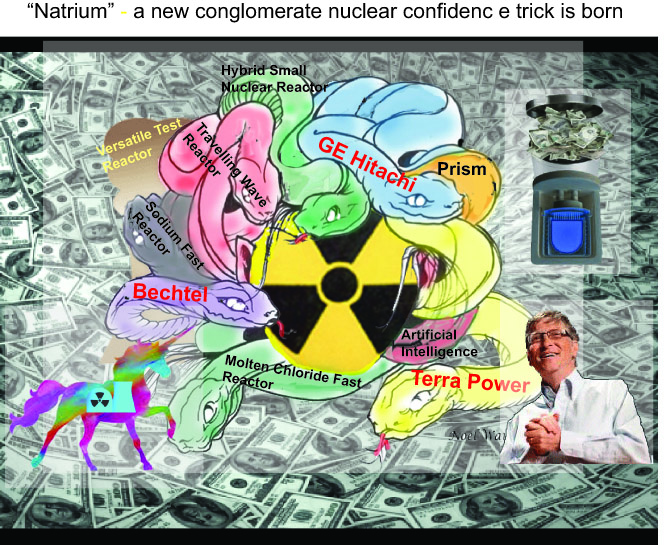
Japan to help build Bill Gates’ high-tech nuclear reactor in Wyoming -Yomiuri https://www.reuters.com/markets/commodities/japan-help-build-bill-gates-high-tech-nuclear-reactor-wyoming-yomiuri-2022-01-01/Reuters TOKYO. Reporting by Sakura Murakami; Editing by Kim Coghill- The Japan Atomic Energy Agency (JAEA) and Mitsubishi Heavy Industries Ltd (7011.T) are set to cooperate with the United States and Bill Gates’ venture company to build a high-tech nuclear reactor in Wyoming, the daily Yomiuri reported on Saturday.
The parties will sign an agreement as early as January for JAEA and Mitsubishi Heavy Industries to provide technical support and data from Japan’s own advanced reactors, the report said citing multiple unidentified sources.
TerraPower, an advanced nuclear power venture founded by Gates, is set to open its Natrium plant in Wyoming in 2028. The U.S. government will provide funding to cover half of the $4 billion project. read more
Terrapower had initially explored the prospect of building an experimental nuclear plant with state-owned China National Nuclear Corp, until it was forced to seek new partners after the administration of Donald Trump restricted nuclear deals with China.
The United States has been competing with China and Russia which also hope to build and export advanced reactors.
Japan, on the other hand, has a bitter history of decommissioning its Monju prototype advanced reactor in 2016, a project which cost $8.5 billion but provided little results and years of controversy.
The Monju facility saw accidents, regulatory breaches, and cover-ups since its conception, and was closed following public distrust of nuclear energy after the 2011 Fukushima nuclear disaster.
Both JAEA and Mitsubishi Heavy Industries could not be reached for comment, as their offices were closed for the New Year holidays.
The murky world of financing Small Nuclear Reactors (SMRs)

IKEA it ain’t: don’t go looking for friendly nuclear option, no matter the spin
MICHAEL WEST MEDIA, By Noel Wauchope|December 30, 2021
”……………..[Everyone] should be aware of the financial gymnastics going on in the USA, with NuScale, and in the UK, with Rolls-Royce. That’s just to single out the two most advanced of the many dubious SMR projects still at the starting gate.
The Murdoch media is enthusiastic about SMRs. Missing from the hype are a lot of unanswered questions. For a start — the ”M” stands for ”modular” — meaning that these reactors will be built in pieces, sort of, and transferred to a site, where they will be assembled, like a piece of IKEA furniture. But in fact there are at least 50 designs being promoted, and not all are modular.
The critical question comes down to – the money
The enthusiasm of the SMR lobby for the economic viability of SMRs is not matched by the facts.
For one thing to consider – there’s the price of the electricity to be eventually delivered by these small nuclear reactors. The Minerals Council of Australia estimates that by 2030 and beyond, SMRs could offer power to grids from $64-$77MWh, depending on size and type.
An analysis by WSP / Parsons Brinckerhoff, prepared for the 2015-16 South Australian Nuclear Fuel Cycle Royal Commission, estimated a cost of A$225 / MWh for a reactor based on the NuScale design, about three times higher than the MCA’s target range. CSIRO estimates SMR power costs at A$258-338 / MWh in 2020 and A$129-336 / MWh in 2030.
Then there are the costs of actually getting SMRs in the first place.
In Russia, China, France, and Argentina, the construction is done entirely or largely at taxpayers’ expense, and there is little or no transparency about the costs. But generally in the Western world, electricity production is supposed to be a commercially viable operation. In the context of promoting low -carbon technologies, SMRs are promoted as being cheaper than large ones. It is generally acceptable for the government to kick-start the process, with some funding, but with the understanding that the industry will become successful, profitable.
NuScale financing contortions
In the US, NuScale leads the pack. After its efforts to partner with Romania, UK, Canada and Jordan, NuScale has joined with a Utah-based utility consortium to develop what initially was proposed to be a power plant with 12 small reactors. The project, which is now forecast to cost $5.1 billion, has since been scaled back to six reactors, expected to start coming online in 2029. The Department of Energy (DOE) is to provide an annual supplement of about $130 million a year for a decade. However, that would be dependent upon annual renewals of the funding by Congress during that decade, which is a risk.
NuScale promises to deliver electricity at $55/MWh. UAMPS and NuScale have not explained the methodology used to develop this figure. Meanwhile PacifiCorp and Idaho Power have concluded that electricity from NuScale reactors would cost $94-$121/MWh.
Now NuScale is to go public by merging with what’s known as a special purpose acquisition company, or SPAC. The company, Spring Valley Acquisition Corporation, is already publicly traded. The new company named NuScale Power Corporation will list on the Nasdaq under the ticker symbol SMR. Their new SMR power plants will be called VOYGR, and NuScale will open centres at universities to promote technical training for them. The Department of Energy (DOE) will support these centres with funding, and NuScale will open centres at universities to promote technical training for them. DOE will support these centres with funding.
A SPAC is a type of shell company (shell companies being those not having actual business operations, just specific objectives, in this case, raising capital) The SPAC raises money from the public through initial public offerings, the sponsor getting 20% of the funds invested. Later private investments through public equity, or PIPES, can be added, often bought at a discount price by big institutions. The whole process is done relatively speedily, and with much less scrutiny than in usual mergers. US Securities and Exchange Commission Chair Gary Gensler wants to tighten regulations on SPACs:
Glitzy corporate presentation decks, hyped press releases and celebrity endorsements can balloon a SPAC’s equity well beyond a reasonable value long before proper disclosures are filed, Gensler said.
SPACs have had a chequered history — they enable the sponsors to avoid financial loss, even if the business fails, as many did, in the 1990s. Sixty-five per cent of deals completed in 2021 at a valuation above $1bn are trading below $10 — the price at which they were floated. All of the companies are trading below their stock market highs with some of them down by as much as 70%. Senator Elizabeth Warren and three other Democrats are investigating the imbalance between the financial results for the sponsors and banks versus the early investors.
Rolls-Royce still looking for money
The process of getting funding for the UK’s SMRs is equally tortuous. The government invested £18 million in November 2019, which delivered significant development of the initial design as part of Phase One of the project. At the beginning of November 2021, Rolls-Royce Holdings Plc raised 455 million pounds ($608 million) to fund the development of SMRs, with almost half of the financing coming from the U.K government Rolls-Royce Small Modular Reactor (SMR) business is a consortium, backed by BNF Resources and Exelon Generation. BNF Resources UK Limited is a subsidiary of BNF Capital Limited. Other members of the consortium are Assystem, Atkins, BAM Nuttall, Laing O’Rourke, National Nuclear Laboratory (NNL), Jacobs, The Welding Institute (TWI) and Nuclear AMRC, as well as Rolls-Royce. It’s not at all clear how much each group has put into the venture.
For the plan to have the planned £30 billion fleet of mini-nuclear power stations, the business will have to rely on UK taxpayers to help fund the construction of the first of the new designs. New government funding of £210 million announced on November 9 will take forward phase 2, over the next three years, of the so-called Low-Cost Nuclear project to further develop SMR design and take it through the regulatory processes to assess suitability of potential deployment in the UK. Exelon is contributing under an agreement from a year ago to find international markets. Rolls-Royce expects the first five SMR reactors to cost £2.2bn each, falling to £1.8bn for subsequent units.
Rolls-Royce will be seeking more investment for the project to help fund the building of actual SMRs.
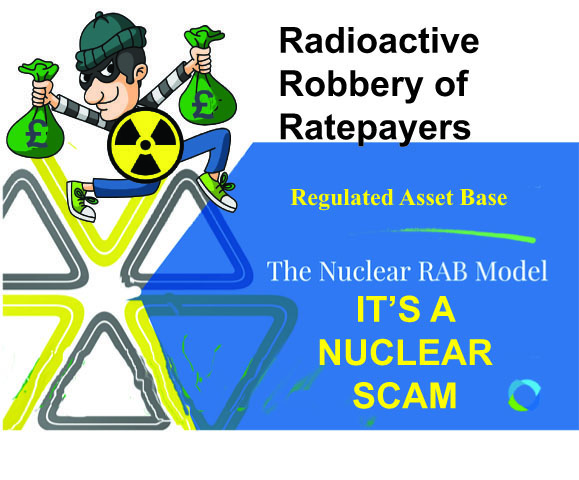
The government is currently passing legislation that will allow investors to back projects like SMRs using a regulated asset base (RAB) model, which allows them to recoup upfront costs from the consumers, over the construction period, long before those consumers actually get any electricity from the project.
Mythical beasts
So — what it all boils down to is an agreement to spend about £400 million over the next three years — to perhaps produce a design for a reactor, which might get approved by the regulators, and might find investors who might be willing to pay what will be at least £2 billion to build each one.
It’s not at all clear who is going to end up paying the most for small nuclear reactors, or indeed, if that fleet of SMRs will ever become a reality. It will probably be the taxpayers. I haven’t mentioned all those ancillary costs — of winning community approval, of security, waste disposal.
In the meantime, it’s worth being wary about the financial aspects, given the obscure manipulations going on in the US and UK, and remembering that not yet does one of these mythical beasts, Small Modular Nuclear Reactors actually exist.
Renewables remain the cheapest “new-build” source of energy generation. They exist. They work. https://www.michaelwest.com.au/ikea-it-aint-small-modular-nuclear-reactors/
.
NuScale’s Small Nuclear Reactors (SMRs) to go public with the dodgy Special Purpose Acquisition Company System
US nuclear reactor company NuScale to go public via SPAC, Capital.com, 30 Dec 21,
NuScale Power announced plans to go public in a merger with blank cheque company Spring Valley Acquisition earlier this month, highlighting the growing area of small nuclear power reactors……. So far, NuScale is the first and only company to design a SMR that received approval from the US Nuclear Regulatory Commission, according to the company’s presentation to investors…….
Going public
The deal values NuScale at $1.9bn, which implies a four-times multiple over its 2026 estimated EBITDA, CEO of Spring Valley Acquisition Chris Sorrells said in a call with investors.
The merger is expected to close in 2022 and will make NuScale a public company that trades on the Nasdaq under the ticker “SVIIU.”
The company has yet to produce revenue but estimates that once it’s incorporated, the company can begin producing around $16m in revenue next year and boost that to $13.1bn by 2030, according to the presentation.
NuScale was formed in 2007 when Oregon State University (OSU) granted exclusive rights to the core SMR technology patents. OSU maintains an interest in the company due to the technology transfer agreement.
Other companies that have invested in NuScale include Samsung’s construction subsidiary, Japanese engineering company JGC Holdings and Doosan Heavy Industries and Construction……
One of the first customers of NuScale’s technology will be Utah Associated Municipal Power Systems, which is expected to deploy a new plant in Idaho by 2029 for its Carbon Free Power Project.
Just last month, Romania’s state-owned electric utility service SN Nuclearelectrica signed an agreement to advance the deployment of NuScale’s technology in the country as early as 2027–2028.
Canada to be the guinea pig for America’s probably unviable small nuclear reactor.

“There’s lots of enthusiasm among nuclear reactor designers, developers and national laboratories, and academic nuclear engineering departments” about SMRs, said Edwin Lyman, director of nuclear power safety at the Union of Concerned Scientists, who published a report on SMR reactor designs in early 2021. “
There’s a lot of supply but there’s not much demand, because utilities don’t want to be guinea pigs.”
cost escalation is practically inevitable.
Canada’s first new nuclear reactor in decades is an American design. Will it prompt a rethink of government support? The Globe and Mail, MATTHEW MCCLEARN, 26 Dec 21, Ontario Power Generation’s selection of GE Hitachi Nuclear Energy to help build a small modular reactor (SMR) at its Darlington station in Clarington, Ont., set in motion events that could shape Canada’s nuclear industry for decades to come.
OPG’s choice, announced in December, is the BWRX-300. It’s a light water reactor, the variety most popular in developed countries, and quite unlike Canada’s existing fleet of CANDU heavy water reactors. Though not exactly small – the BWRX’s 300-megawatt nameplate capacity is roughly equivalent to a large wind farm – it would produce only one-third as much electricity as traditional reactors. It would use different fuel, produce different wastes and possibly have different safety implications.
The Darlington SMR would be the first BWRX-300 ever constructed. By moving first, OPG hopes Ontario will become embedded in a global supply chain for these reactors.
“OPG ourselves, we don’t really get anything out of it – it’s a lot of work,” said Robin Manley, OPG’s vice-president of nuclear development. “Our goal is to have as many contracts signed with Canadian suppliers as we possibly can.” But that might not satisfy some critics, who’ve protested OPG’s selection of a U.S. design by GE Hitachi, which is based in North Carolina.
Ontario Power Generation chose GE Hitachi Nuclear Energy to build a light water reactor .
It does seem to confirm the end of Canada’s tradition of homegrown reactors. The BWRX-300 would be Canada’s first new reactor since Darlington Unit 4 in Ontario, completed in 1993. According to Mycle Schneider Consulting, the average age of the country’s 19 operational reactors is 38 years. Attempts to update the CANDU design proved largely fruitless; OPG and Bruce Power opted to refurbish reactors at Darlington and Bruce stations to operate another few decades, while sizing up SMRs as a possible next act.
Time is running short. This decade is widely regarded as crucial for building emissions-free generation capacity. SMRs will be late to that party even if this BWRX-300 is built on time. Delays and cost overruns, ever-present risks with any reactor, could kill its prospects.
The partnership with OPG represents a major coup for GE Hitachi, a U.S.-Japanese alliance that set up its SMR subsidiary in Canada less than a year ago. There are at least 50 SMR designs worldwide, but most exist only on paper; vendors compete vigorously to sell to experienced nuclear operators such as OPG because they represent an opportunity to build a bona fide reactor that might entice other clients. For the same reason, OPG’s decision is a blow to the losing candidates, Oakville, Ont.-based Terrestrial Energy Inc. and X-energy, an American vendor
“There’s lots of enthusiasm among nuclear reactor designers, developers and national laboratories, and academic nuclear engineering departments” about SMRs, said Edwin Lyman, director of nuclear power safety at the Union of Concerned Scientists, who published a report on SMR reactor designs in early 2021. “There’s a lot of supply but there’s not much demand, because utilities don’t want to be guinea pigs.”
Nuclear industry executives and government officials hope the Darlington SMR will be the first of many deployed in Ontario and beyond. SaskPower is also shopping; it has collaborated with OPG since 2017, and said the BWRX-300 is among its candidates. Canada has a small population, so observers doubt the country could support supply chains for multiple reactor designs.
But OPG’s selection of an American SMR has drawn some sharp criticism. Some observers assumed Terrestrial enjoyed a home turf advantage, particularly in light of the federal government’s decision to invest $20-million toward its Integral Molten Salt Reactor (IMSR). The Society of Professional Engineers and Associates, a union representing engineers and others working on CANDU reactors, complained that “priority should have been given to Canadian design.”
“It is a slap in the face for Terrestrial,” said M.V. Ramana, professor at the University of British Columbia’s Liu Institute for Global Issues. “It is not a good sign for Canada’s nuclear industry.”
Prof. Ramana added that OPG’s decision may prompt a rethinking of government support to SMR developers. In addition to Terrestrial’s funding, Moltex Energy received $50.5-million from the federal Strategic Innovation Fund and the Atlantic Canada Opportunities Agency to advance the Stable Salt Reactor-Wasteburner it is working on in New Brunswick. ARC Clean Energy received $20-million from New Brunswick’s government toward its ARC-100 reactor.
“If these companies are not able to persuade OPG, then maybe we should stop funding them,” he said…………………..
Unlike CANDUs, which consume unenriched uranium, light water reactors require fuel enriched to increase Uranium-235 content. Mr. Lyman said that by adopting any non-CANDU design, Canada will become dependent on enriched fuel imported from the U.S., Europe or elsewhere.
The industry would also need to learn how to dispose of unfamiliar wastes. The Nuclear Waste Management Organization (NWMO), which is in the final stages of selecting an underground storage site for Canada’s radioactive spent fuel, said spent BWRX-300 fuel would generate more heat and radioactivity than CANDU fuel, but could be stored in fewer containers, placed further apart.
“We will learn from our international partners who already have plans to permanently store this type of waste in a deep geological repository,” the NWMO said in a statement.
All this assumes OPG’s reactor gets built. To begin with, the BWRX-300 actually isn’t licensed to be built anywhere. GE Hitachi is participating in the Canadian Nuclear Safety Commission’s Vendor Design Review, through which it receives early feedback from the regulator on its reactor. ………
critics say completing the reactor by 2028 is a tall order. According to Mycle Schneider Consulting, one in eight reactors that have begun construction since 1951 were never connected to the grid. Many survivors, meanwhile, arrived years later than promised.
Mr. Manley said 2028 is “an aspirational goal” rather than a hard deadline. The project schedule will firm up over the next two years.
OPG has yet to publish a cost estimate, but according to a report published by PwC, the SMR project “is expected to spend $2-billion over seven years.” That’s already higher than the US$1-billion price tag GE Hitachi promised for a BWRX-300 in 2019. (In public presentations, GE executives declared that keeping the price below US$1-billion was crucial to its plans to exponentially grow its customer base.)……
Prof. Ramana said cost escalation is practically inevitable……….https://www.theglobeandmail.com/business/article-canadas-first-new-nuclear-reactor-in-decades-is-an-american-design/
ROLLS ROYCE FALLS 3% ON QATARI INVESTMENT IN SMALL NUCLEAR BUSINESS
- Rolls Royce Holding PLC (LON: RR) has fallen 3% on news of the Qatari investment into the small nuclear reactor business
- It may well not be the investment itself that is the catalyst for the price change but Omicron
- The £85 million Qatar investment isn’t really a material number for Rolls Royce, even as it’s a vote of confidence in the programme.
Rolls Royce shares have continued their recent decline even as the news comes through of a Qatari investment in the small nuclear reactor programme. This could be seen as a surprise – investment in such a programme is likely to be a good deal for Rolls Royce after all. On the other hand, £85 million, the size of the investment, isn’t a large number compared to Rolls Royce – it’s not, as they say, a material number.
The likelihood is therefore that it is wider events driving the Rolls Royce share price, Omicron continues to rage around the world, air travel becomes increasingly restricted and so on. It’s worth pointing out that the RR incomes do not depend, particularly, on actually selling engines to people. There are fees involved in that, most certainly, but there’s an element of selling razors in how the business work. Once you’ve sold someone a razor then you’ve a capitve market for razor blades. Once you’ve got an engine in an aircraft then there’s a decades-long maintenance and repair income flow. That Rolls Royce income stream though depends upon hours in the air – exactly the thing being depressed by Omicron.
Rolls Royce shares have continued their recent decline even as the news comes through of a Qatari investment in the small nuclear reactor programme. This could be seen as a surprise – investment in such a programme is likely to be a good deal for Rolls Royce after all. On the other hand, £85 million, the size of the investment, isn’t a large number compared to Rolls Royce – it’s not, as they say, a material number.
The likelihood is therefore that it is wider events driving the Rolls Royce share price, Omicron continues to rage around the world, air travel becomes increasingly restricted and so on. It’s worth pointing out that the RR incomes do not depend, particularly, on actually selling engines to people. There are fees involved in that, most certainly, but there’s an element of selling razors in how the business work. Once you’ve sold someone a razor then you’ve a capitve market for razor blades. Once you’ve got an engine in an aircraft then there’s a decades-long maintenance and repair income flow. That Rolls Royce income stream though depends upon hours in the air – exactly the thing being depressed by Omicron. https://www.asktraders.com/analysis/rolls-royce-falls-3-on-qatari-investment-in-small-nuclear-business/
Bill Gates’ sodium-cooled ‘Natrium’ nuclear reactor design – strikingly like the disastrous reactors at Santa Susana Field Lab.
Most striking of all is the success of official campaigns asserting that even the most serious accidents have caused little or no harm

Spent Fuel, Harpers, by Andrew Cockburn, 20 Dec 21, The risky resurgence of nuclear power ” …………………………. Gates and other backers extoll the promise of TerraPower’s Natrium reactors, which are cooled not by water, as commercial U.S. nuclear reactors are, but by liquid sodium. This material has a high boiling point, some 1,600 degrees Fahrenheit, which in theory enables the reactor to run at extreme temperatures without the extraordinary pressures that, in turn, require huge, expensive structures……………….
Prosperous and 70 percent white, West Hills, California, is one of the communities that have sprouted near the Santa Susana Field Laboratory in the decades since the 1959 meltdown. Unlike the poor, sick, and embittered residents of Shell Bluff, people living in West Hills had until recently only the barest inkling that nuclear power in the neighborhood might have had unwelcome consequences. “Almost no one knew about the Santa Susanna Field Lab, or they thought it was an urban legend,” Melissa Bumstead, who grew up in nearby Thousand Oaks, told me recently. In 2014, Bumstead’s four-year-old daughter, Grace, was diagnosed with an aggressive form of leukemia. “This has no environmental link,” her pediatric oncologist told her firmly. Childhood cancers were rare, and this was just cruel luck.
Then, while taking Grace to Children’s Hospital Los Angeles, Bumstead ran into a woman who recognized her from the local park where their young daughters played. The woman’s child had neuroblastoma, another rare cancer, as did another from nearby Simi Valley, whom they encountered while the children were getting chemo. Back at home, someone on her street noticed the childhood cancer awareness sticker on Bumstead’s car and mentioned that another neighbor had died of cancer as a teenager.
Bumstead began to draw a map detailing the cluster of cancer deaths in small children just in the previous six years, but stopped working on it in 2017. “I had such severe PTSD when I added children onto it, my therapist told me to stop.” But it is still happening, she said, mentioning the unusual number of bald children she had noticed in local elementary schools in recent years, as well as the far-above-average rate of breast cancer cases recorded in the area. A cleanup of the field lab was due to be completed in 2017, but it has yet to begin.

I called Bumstead because I had been struck by the fact thatTerraPower’s Natrium reactor resembles in its basic features the long-ago Sodium Reactor Experiment at Santa Susana. (Natrium is Latin for sodium.) “That’s exactly what we had!” Bumstead exclaimed when I mentioned that liquid sodium is integral to TerraPower’s project. “The meltdown was in the sodium reactor.” As her comment made clear, such liquid sodium technology is by no means innovative.
Nor, in an extensive history of experiments, has it ever proved popular—not least because liquid sodium explodes when it comes into contact with water, and burns when exposed to air. In addition, it is highly corrosive to metal, which is one reason the technology was rapidly abandoned by the U.S. Navy after a tryout in the Seawolf submarine in 1957.
That system “was leaking before it even left the dock on its first voyage,” recalls Foster Blair, a longtime senior engineer with the Navy’s reactor program. The Navy eventually encased the reactor in steel and dropped it into the sea 130 miles off the coast of Maryland, with the assurance that the container would not corrode while the contents were still radioactive. The main novelty of the Natrium reactor is a tank that stores molten salt, which can drive steam generators to produce extra power when demand surges. “Interesting idea,” Blair commented. “But from an engineering standpoint one that has some real potential problems, namely the corrosion of the high-temperature salt in just about any metal container over any period of time.”
TerraPower’s Jeff Navin assured me in response that Natrium “is designed to be a safe, cost-effective commercial reactor.” He added that Natrium’s use of uranium-based metal fuel would increase the reactor’s safety and performance. Blair told me that such a system had been tried and abandoned in the Fifties because the solid fuel swelled and grew after fissioning.
As the sodium saga indicates, the true history of nuclear energy is largely unknown to all but specialists, which is ironic given that it keeps repeating itself. The story of Santa Susana follows the same path as more famous disasters, most strikingly in the studious indifference of those in charge to signs of impending catastrophe.The operators at Santa Susana shrugged off evidence of problems with the cooling system for weeks prior to the meltdown, and even restarted the reactor after initial trouble. Soviet nuclear authorities covered up at least one accident at Chernobyl before the disaster and ignored warnings that the reactor was dangerously unsafe. The Fukushima plant’s designers didn’t account for the known risk of massive tsunamis, a vulnerability augmented by inadequate safety precautions that were overlooked by regulators. Automatic safety features at Santa Susana did not work. This was also the case at Fukushima, where vital backup generators were destroyed by the tidal wave.
No one knows exactly how much radiation was released by Santa Susana—it exceeded the scale of the monitors. Nor was there any precise accounting of the radioactivity released at Chernobyl. Fukushima emitted far less, yet the prime minister of Japan prepared plans to evacuate fifty million people, which would have meant, as he later recounted, the end of Japan as a functioning state. Another common thread is the attempt by overseers, both corporate and governmental, to conceal information from the public for as long as possible. Santa Susana holds the prize in this regard: its coverup was sustained for twenty years, until students at UCLA found the truth in Atomic Energy Commission documents.
Most striking of all is the success of official campaigns asserting that even the most serious accidents have caused little or no harm……………………
“The right not to know” about the effects of nuclear power is currently embraced far beyond Fukushima. In the face of escalating alarm about climate change, the siren song of “clean and affordable and reliable” power finds an audience eager to overlook a business model that is dependent on state support and often greased with corruption; failed experiments now hailed as “innovative”; a pattern of artful disinformation; and a trail of poison from accidents and leaks (not to mention the 95,000 tons of radioactive waste currently stored at reactor sites with nowhere to go) that will affect generations yet unborn. Arguments by proponents of renewables that wind, solar, and geothermal power can fill the gap on their own have found little traction with policymakers. Ignoring history, we may be condemned to repeat it. Bill Gates has bet a billion dollars on that. https://harpers.org/archive/2022/01/spent-fuel-the-risky-resurgence-of-nuclear-power/
Small nuclear reactors for military use would be too dangerous – excellent targets for the enemy

In normal operation, they release potentially hazardous quantities of fission products that would be widely distributed by any penetration of the reactor vessel. More worryingly, the resiliency of tri-structural isotropic particles to kinetic impact is questionable: The silicon carbide coating around the fuel material is brittle and may fracture if impacted by munitions.
Further, graphite moderator material, which is used extensively in most mobile power plant cores, is vulnerable to oxidation when exposed to air or water at high temperatures, creating the possibility of a catastrophic graphite fire distributing radioactive ash. Even in the case of intact (non-leaking) fuel fragments being distributed by a strike, the radiological consequences for readiness and effectiveness are dire.
Given these vulnerabilities, sophisticated adversaries seeking to hinder U.S. forces are likely to realize the utility of the reactor as an area-denial target…….. , a reactor strike offers months of exclusion at the cost of only a few well-placed high-explosive warheads, a capability well within reach of even regional adversaries
Even an unsuccessful or minimally damaging attack on a reactor could offer an adversary significant benefits…………..placing these reactors in combat zones introduces nuclear reactors as valid military targets,
MOBILE NUCLEAR POWER REACTORS WON’T SOLVE THE ARMY’S ENERGY PROBLEMS, War on the Rocks, 14 Dec 21, JAKE HECLA ”………… As China and Russia develop microreactors for propulsion, the U.S. Army is pursuing the ultimate in self-sufficient energy solutions: the capability to field mobile nuclear power plants. In this vision of a nuclearized future, the Army will replace diesel generator banks with microreactors the size of shipping containers for electricity production by the mid-2020s.
……. the question is whether or not reactors can truly be made suitable for military use. Are they an energy panacea, or will they prove to be high-value targets capable of crippling entire bases with a single strike?
nuclear power program is confidently sprinting into uncharted territory in pursuit of a solution to its growing energy needs and has promised to put power on the grid within three years. However, the Army has not fielded a reactor since the 1960s and has made claims of safety and accident tolerance that contradict a half-century of nuclear industry experience.
The Army appears set to credulously accept industry claims of complete safety that are founded in wishful thinking and characterized by willful circumvention of basic design safety principles………..
1 This Month



26 September – International Day for the Total Elimination of Nuclear Weapons


PLEASE OPPOSE HR 8255 AND S.3639 – bills would accelerate satellite deployment, with no environmental review or safeguards – https://ncstd5li.quorum.us/campaign/169331/
To see nuclear-related stories in greater depth and intensity – go to https://nuclearinformation.wordpress.com
-
Archives
- September 2026 (219)
- August 2026 (330)
- July 2026 (355)
- June 2026 (287)
- May 2026 (306)
- April 2026 (356)
- March 2026 (251)
- February 2026 (267)
- January 2026 (308)
- December 2025 (358)
- November 2025 (359)
- October 2025 (375)
-
Categories
- 1
- 1 NUCLEAR ISSUES
- business and costs
- climate change
- culture and arts
- ENERGY
- environment
- health
- history
- indigenous issues
- Legal
- marketing of nuclear
- media
- opposition to nuclear
- PERSONAL STORIES
- politics
- politics international
- Religion and ethics
- safety
- secrets,lies and civil liberties
- spinbuster
- technology
- Uranium
- wastes
- weapons and war
- Women
- 2 WORLD
- ACTION
- AFRICA
- Atrocities
- AUSTRALIA
- Christina's notes
- Christina's themes
- culture and arts
- Events
- Fuk 2022
- Fuk 2023
- Fukushima 2017
- Fukushima 2018
- fukushima 2019
- Fukushima 2020
- Fukushima 2021
- general
- global warming
- Humour (God we need it)
- Nuclear
- RARE EARTHS
- Reference
- resources – print
- Resources -audiovicual
- Weekly Newsletter
- World
- World Nuclear
- YouTube
-
RSS
Entries RSS
Comments RSS
 nuclear-news