John Chilibeck, Local Journalism Initiative reporter|, Brunswick News, 11 Oct 23
A physicist from British Columbia is warning that New Brunswick is heading down a dangerous path, increasing the likelihood of a nuclear war by supporting the development of small reactors for export.
M. V. Ramana, a professor and Simons Chair in Disarmament, Global and Human Security at the University of British Columbia, says the two companies that are trying to develop small modular reactors at Point Lepreau near Saint John – Moltex and ARC – use technology that could one day be used to make nuclear weapons.
If those reactors fell in the wrong hands, he says, humankind could be put at risk.
“All reactors use plutonium and many of them use enriched uranium. Both of these processes can also be used to produce weapons material,” the academic said from the Vancouver airport on Wednesday, a day ahead of his lecture at St. Thomas University in Fredericton at 7 p.m. at the Kinsella Auditorium, McCain Hall. “The other issue is personnel. People working with reactors can learn to make nuclear weapons. And lastly, in many countries, it’s the same institutions that are involved in developing nuclear energy as developing nuclear weapons.”
Ramana cited the country of his birth, India, which ostensibly developed reactors for peaceful purposes through its Department of Nuclear Energy but after a couple of decades started making weapons out of the material to counter the influence of Pakistan, which it has fought four wars against since independence in 1947.
He also mentioned Iran, which first acquired the technology for nuclear energy in the 1970s when the Shah was in power and the country was friendly to the West. Following the revolution of 1979, religious extremists took over who now sponsor terrorist attacks around the world – such as the Hamas raid last weekend that left 1,000 Israeli citizens and soldiers dead – and also want to develop their own nuclear arsenal.
New Brunswick, he said, could unwittingly undo years of international efforts to stop nuclear proliferation once the ARC and Moltex technologies are ready, expected sometime around 2030 or a few years after.
Despite a long history of producing nuclear energy, Canada has never made nuclear weapons. Ramana said that could change if the wrong politicians came to power.
“Look at what happened on January 6, 2021 at the Capitol Building,” he said of the attempted insurrection in the United States. “I don’t think anyone thought that would ever happen. And we don’t know who will be in power in Canada in 30 years.”
Moltex and ARC have made no secret of their desire to create prototype reactors in New Brunswick that could one day be made and sold to other places, both within Canada and to other countries. It’s part of their business model.
Rory O’Sullivan, the CEO of Moltex, recently wrote a letter to Prime Minister Justin Trudeau rebutting the criticisms of a group of anti-nuclear non-proliferation academics from the United States.
Ottawa has already provided Moltex $50 million to develop its technology, and New Brunswick $5 million. It will likely need more public investment to keep developing its technology…………………………..
“Imagine one day they export reactors to South Korea, or Saudi Arabia, or Nigeria, whatever country you want to think about it. When they send the reactors abroad, they’ll have to send the fuel for those reactors, and they have a very large amount of plutonium. A country could get the reactor and the plutonium and say, ‘we’re going to use the plutonium to make nuclear weapons,’ there’s very little we can do to sanction that country.”– said Ramana #nuclear #antinuclear #NuclearFree #NoNukes #NuclearPlants
CITY,AM NICHOLAS EARL 3 Oct 23 #antinuclear #nuclear-free #NoNukes
Bill Gates’ nuclear reactor design company Terrapower has not been shortlisted for the next round of the government’s competition for scaled-down power plants.
Industry vehicle GB Nuclear has selected six companies to advance to the latest stage, including rumoured front-runner Rolls-Royce which has already secured over £200m in government funding.
The remaining contenders also include EDF, GE-Hitachi, Holtec Britain, Nuscale and Westinghouse Electric.
These companies will be invited to bid for government contracts later this year, with successful companies announced next spring and contracts awarded in the summer.
Gates, the world’s fifth richest man and the co-creator of Microsoft, founded Terrapower in 2006.
He is currently the company’s chairman and is still their biggest investor, leading a £588.3m funding round last year.
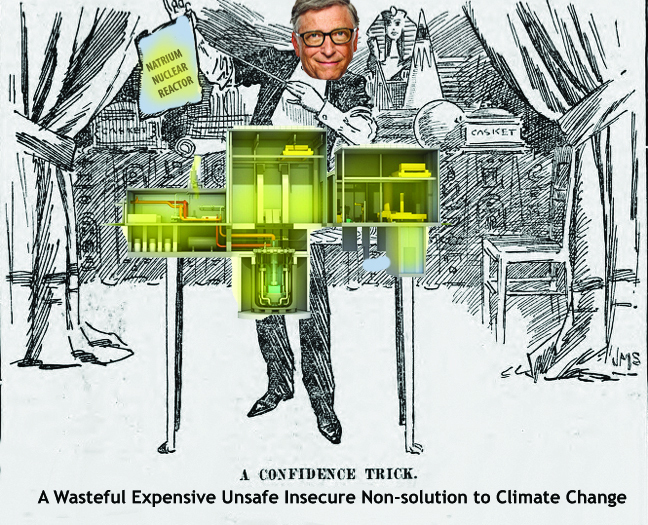
The company has been pitching bespoke ‘Natrium’ reactors powered by high-assay low-enriched uranium and announced its intentions earlier this year to enter the UK race for projects.
However, Whitehall officials have reportedly been concerned over insufficient supplies to import at scale to meet demand for Terrapower reactors, as most of the uranium it needs is produced in Russia – which is under sanctions following the country’s invasion of Ukraine.
City A.M. understands GB Nuclear wanted to prioritise the most ready-made technologies which could guarantee a final investment decision by the end of the decade.
Instead, Terrapower could feature in an upcoming consultation on advanced technology.
Small modular reactors are a cornerstone of the government’s plan to revive domestic nuclear energy and replace the country’s ageing fleet – with 85 per cent of the country’s current capacity set to go offline over the next 12 years.
……………………..Downing Street is targeting operational SMRs in the UK by the mid-2030s, with a £20bn cap being placed on the competitive process.
BBC News By Peter Hoskins, Business reporter 2 October Britain’s biggest defence firm, BAE Systemshas won a £3.95bn ($4.82bn) contract to build a new generation of submarines as the security pact between the US, UK and Australia moves ahead.
In March, the three countries announced details of the so-called Aukus pact to provide Australia with nuclear-powered attack submarines by the late 2030s.
The pact aims to counter China’s ambitions in the Indo-Pacific region.
Beijing has strongly criticised the three countries over the deal.
……………………..”This multi-billion-pound investment in the Aukus submarine programme will help deliver the long-term hunter-killer submarine capabilities the UK needs to maintain our strategic advantage and secure our leading place in a contested global order,” UK Defence Secretary Grant Shapps said as the Conservative party conference got under way in Manchester.
………………….Other major UK defence contractors are also getting a boost from the Aukus deal.
Until the government shares facts instead of sales pitches for small modular nuclear reactors, Indigenous nations must assume that representation is not connected to people, but to industry.
FREDERICTON, N.B.—Governments and other nuclear proponents are failing both Indigenous and settler communities by promoting sales and publicity material about small modular nuclear reactors (SMNRs) instead of sharing facts by independent researchers not tied to the industry.
For decades, nuclear proponents, including both the federal and New Brunswick governments, have focused on the ‘dream of plentiful power’ without highlighting the risks. The nuclear fuel chain—mining uranium, chemically processing the ore, fabricating the fuel, fissioning uranium in a reactor creating toxic radioactive waste remaining hazardous for tens of thousands of years—leaves a legacy of injustices disproportionately felt by Indigenous Peoples and all our relations.
Now the same is happening with the push for SMNRs. We are promised safer reactors by nuclear startup companies in New Brunswick using modifications of reactor designs—molten salt, sodium cooled—that have never operated successfully and safely on a grid anywhere despite billions of dollars of public funds spent in other countries.
Only one example of the misguided SMNR sales pitches for Indigenous and settler communities in New Brunswick is that used CANDU reactor fuel can be “recycled” to make new fuel. The technical name for this process is “reprocessing.” Calling it “recycling” is a buzzword meant to reassure people because the truth is impossible to accept. Less than one per cent of the used fuel at Point Lepreau is plutonium and other elements that could possibly be extracted and re-used for new fuel. The more than 99 per cent left over will be a toxic mess of new kinds of nuclear waste that nobody knows how to safely contain.
The reprocessing method planned for New Brunswick is based on a technology developed by the Idaho National Laboratory, which has spent hundreds of millions of dollars so far, over two decades, attempting to reprocess a small amount of used fuel.
In different countries, commercial reprocessing has been an environmental and financial disaster. In just one example, a small commercial reprocessing plant in the United States operated for six years—heavily subsidized by the federal government and New York state—before shutting down for safety improvements. After the owner abandoned the project in the 1970s, the multi-billion-dollar cleanup continues today.
The research on reprocessing used fuel is clear: it’s an expensive nuclear experiment that could leave a multi-million-dollar mess affecting entire ecosystems and the health of people and other living beings. Why are governments sharing sales and promotional material about the project, and fantasies about ‘recycling’ instead of facts about reprocessing and the experiences in other countries? Why are New Brunswickers and First Nation leaders not demanding the evidence?
The lack of transparency by governments on the risks of SMNRs indicates that either they are not concerned with the risks, or they choose not to share them—the opposite of what is required under the United Nations Declaration of Rights of Indigenous Peoples.
Much of society’s standards for integrity have been lost. We accept circular references, we accept that no one is declaring a conflict of interest in conversations surrounding nuclear. When our integrity is lost, so is our quality of life. Words such as “protect” and “conservation” have no meaning anymore. Though we use the terms “transparency” and “accountability” more and more often, they have less and less meaning.
The Peskotomuhkati Nation in Canada and Wolastoq Grand Council cannot provide consent for any new nuclear developments in New Brunswick without considering the lessons they have learned in the past, the current relationships and communications they are experiencing, and the impacts of toxic wastes that remain dangerous forever. First Nations in New Brunswick cannot provide consent for toxic radioactive waste to be sent to Ontario, where Indigenous nations also do not want it on their territories.
The Wolastoq Grand Council, which issued a statement on nuclear energy and nuclear waste in 2021, opposes any destruction or harm to Wolastokuk which includes all “Flora and Fauna” in, on, and above their homeland. Nuclear is not a green source of energy, or solution to a healthier future for our children, grandchildren and the ones who are not born yet. Wolastoqewi-Elders define Nuclear in their language as ‘Askomiw Sanaqak,’ which translates as ‘forever dangerous.’
The Peskotomuhkatik ecosystem includes Point Lepreau. The Peskotomuhkati leadership in Canada has repeatedly tried to bring facts about both New Brunswick SMNR projects and their potential environmental implications to the attention of New Brunswickers and all Canadians, writing twice to Environment and Climate Change Minister Steven Guilbeault urging him to designate the SMNR projects in New Brunswick for a federal impact assessment, so that all the facts could be made public. Both attempts were denied, the most recent in August this year.
Peskotomuhkati leadership has participated, and continues to participate, in Canadian Nuclear Safety Commission and various provincial processes, and has firsthand experience that these past and current engagement and assessment tools do not provide a sufficient framework to address adverse effects and impacts to Indigenous rights.
The SMNR projects planned for Point Lepreau within Peskotomuhkatik homeland will have profound and lasting impacts on Indigenous rights as well as those of Indigenous communities in Ontario where the nuclear industry is proposing to build a deep geological repository for the used nuclear fuel and other sites for intermediate radioactive waste. The SMNR projects will also have profound and lasting impacts on the Bay of Fundy, the marine life the bay supports, and coastal communities.
Until the government begins to ask for and share facts about SMNRs instead of sales materials, Indigenous nations must assume that representation no longer means peoples’ representation, but rather representation of the industry.
Hugh Akagi is chief of the Peskotomuhkati Nation in Canada. Dr. Susan O’Donnell is the lead investigator of the CEDAR research project at St. Thomas University in Fredericton
A dozen nuclear energy experts are calling for a formal risk assessment of emerging nuclear technologies and warning Prime Minister Justin Trudeau if a company in New Brunswick were to be successful, its product could be used by other countries to make nuclear bombs.
The open letter sent to the Prime Minister’s Office is dated Sept. 22, and spells out concerns that Saint John-based nuclear startup Moltex is embarking on a risky path. The proposed Moltex reactor is planned to be built at the site of the Point Lepreau Nuclear Generating Station in Saint John, where it would essentially recycle spent nuclear waste sourced from CANDU reactors to produce more energy. The letter, signed by experts like former U.S. Nuclear Regulatory commissioner Peter Bradford, director of nuclear power safety with the Union of Concerned Scientists Edwin Lyman, George Washington University research professor and former State Department official Sharon Squassoni, says the risk is the plutonium in the used nuclear fuel could be separated and used to make weapons.
Despite Moltex claiming its technology is “proliferation-resistant,” the expert letter says there is “every reason to be skeptical of Moltex’s reactor technology.” The letter points to failed attempts in the United States and the United Kingdom to reprocess nuclear waste as a fuel, resulting in hundreds of billions worth of cleanup costs. To date, Moltex has received at least $50.5 million worth of federal government subsidies, $10 million from New Brunswick, and $1 million from Ontario Power Generation –– and is eyeing roughly $200 million more.
……………………………………………………For the experts who wrote the letter, inadvertently creating a product that could be used to make nuclear weapons is a very real concern, and one with precedent. As the letter to Trudeau details, Canada and the United States were both exporting nuclear reactor technology to India decades ago for power generation purposes and ended up increasing the risk of nuclear war.
“Some of the plutonium India produced and separated with that assistance was used in the plutonium-fuelled prototype bomb India tested in 1974, precipitating the South Asian nuclear arms race,” the letter reads.
Canada and its allies are concerned that as new nuclear technologies are developed, the technology could similarly lead to unexpected nuclear weapon development. In May at the annual G7 meeting, Canada committed “to prioritizing efforts to reduce the production and accumulation of weapons-usable nuclear material for civil purposes around the world.”
The letter requests a nuclear weapons proliferation risk assessment of the technology………………………………………………..
As the energy transition unfolds, nuclear energy is increasingly seen as a contentious fuel. While it is non-emitting, making it a potentially valuable tool in the race to decarbonize, nuclear waste is a long-lasting environmental concern with unclear storage options given it can be hazardous for thousands of years. Moreover, preventing the worst impacts of climate change requires slashing fossil fuel use by about half globally by the end of the decade, meaning experimental technology not yet suitable for use does not have any meaningful role to play in near-term emissions reductions.
A row is brewing between a nuclear energy company founded by Bill Gates and the UK government over fears it may be sidelined from a £1 billion competition to build new small power plants. The billionaire is the chairman of Terrapower, which fears exclusion from the race to build the next generation of reactors over questions about its fuel source, according to people familiar with the matter.
In May, The Sunday Times revealed that Terrapower had joined the likes of Rolls Royce, GE-Hitachi and Bechtel in the running to manufacture Britain’s future nuclear infrastructure. But Terrapower is concerned that the government is prioritising so-called small modular reactors designed by its rivals, rather than Terrapower’s model, which uses more innovative technology and is classed as an “advanced modular reactor”, sources said.
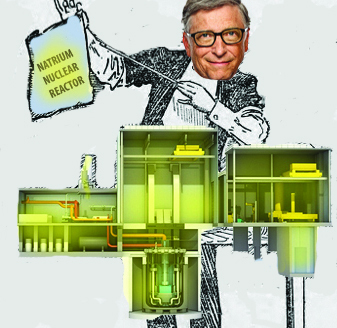
Terrapower’s reactor, called Natrium, uses high-assay low-enriched uranium (HALEU) as fuel. Officials are said to be concerned that it does not have reliable supplies to import at scale, as most of it is produced in Russia. A government spokesman said: “Great British Nuclear is assessing the bids received as part of the latest phase of the competition launched earlier this year and will announce an update in due course.”
Ukraine’s Energoatom and the US firm Westinghouse have signed a memorandum of understanding (MoU) relating to the development and deployment of AP300 small modular reactors (SMRs) in Ukraine.
we now have ‘an echo chamber, with each outlet clambering over the next to crow about the great benefits of nuclear power in misleading language that suggests this technology is already entirely proven out’.
It all fits into what see she see as an emerging pro-SMR mind set, with there being a lot of speculative investment venture cash still around- and a lot of press support. She says that though ‘very few of the proposed SMRs have been demonstrated and none are commercially available, let alone licensed by a nuclear regulator’, the media has been promoting them as the way ahead.
Allison Macfarlane, who was Chair of the US Nuclear Regulatory Commission (NRC) from 2012-2014, has been looking at Small Modular Reactors in the USA and elsewhere. She thinks they are likely to be uneconomic, much like the their larger brethren, which, as she describes, have recently been doing very poorly in the USA.
Indeed, just like the EPR story in the EU, it makes for a sorry saga: ‘The two units under construction in South Carolina were abandoned in 2017, after an investment of US$9 billion. The two AP-1000 units in Georgia were to start in 2016/2017 for a price of US$14 billion. One unit started in April, 2023, the second unit promises to start later in 2023. The total cost is now over US$30 billion.’
Big reactors do look increasingly hard to fund and build on time and budget, while it is argued that smaller ones could be mass produced in factories at lower unit costs and finished units installed on site more rapidly. However, that would mean foregoing conventional economies of (large) scale, and, overall, Macfarlane claims that SMRs may end up being worse that large plants in operational and economic terms.
For example, she says ‘one of the reasons SMRs will cost more has to do with fuel costs’ with some designs requiring ‘high-assay low enriched uranium fuel (HALEU), in other words, fuel enriched in the isotope uranium-235 between 10-19.99%, just below the level of what is termed “highly enriched uranium,” suitable for nuclear bombs.’ She notes that ‘currently, there are no enrichment companies outside of Russia that can produce HALEU, and thus the chicken-and-egg problem: an enrichment company wants assurance from reactor vendors to invest in developing HALEU production. But since commercial-scale SMRs are likely decades away, if they are at all viable, there is risk to doing so.’
She also notes that the use of HALEU, so as to offset the smaller size of the reactor core, will ‘result in increased security and safeguards requirements that will add to the price tag’. As she has explored in a PNAS paper with others, smaller cores mean more neutron escapes and so a need for more shielding, which will become activated, adding to the waste burden to be dealt. Indeed she says, overall, some SMRs may produce ‘significantly more high-level waste by volume that current light water reactors.’ That view did not go down well with SMR promoters, who sometimes portray SMRs as being cleaner than standard reactors.
Some advanced SMRs may use molten salt fluids as a reactant and also coolant, and the waste chemistry then is different, although there will still be wastes to deal with. But for the moment, the focus is on simpler technology – just scaled down versions of the standard Pressurised Water Reactor (PWR). Macfarlane notes that one of these, NuScale, is the only SMR design to received ‘design certification’ for its 50MW unit from the NRC
However, the company has now decided to submit a new application to the NRC to build a larger version, presumably in the expectation that this would be more economic. It’s also proposed to have multiple units on one site, sharing some common services. That might offset some of the extra costs of small systems, but not much. Macfarlane says ‘cost estimates for the reactor have risen from US$55/megawatt electric (MWe) in 2016 to $89/MWe in 2023, according to the Institute for Energy Economics and Financial Analysis.’
Arguably, to be economic, they need to be bigger. That seems to have been the logic behind another mini-PWR, the Rolls Royce SMR being developed in the UK by Rolls Royce. Although at 470MW, that one is hardly ‘small’.
By contrast, Oklo, another US company, is going in the opposite direction. It has been developing Auora, an advanced micro-nuclear power plant. It’s a tiny (1.5 MW) liquid sodium cooled fast neutron reactor. However, it was outright rejected by the NRC. Macfarlane says that ‘the NRC rarely outright rejects an application, instead working with licensees until they either get the application right or decide to walk away. In this case, Oklo refused to fill “information gaps” related to “safety systems and components.’ But Oklo persevered. And she notes it has gone for public finance via a merger with AltC Acquisition Corporation.
It all fits into what see she see as an emerging pro-SMR mind set, with there being a lot of speculative investment venture cash still around- and a lot of press support. She says that though ‘very few of the proposed SMRs have been demonstrated and none are commercially available, let alone licensed by a nuclear regulator’, the media has been promoting them as the way ahead.
Even usually sane US outlets like the Atlantic Policy journal seem to have joined in. She says we now have ‘an echo chamber, with each outlet clambering over the next to crow about the great benefits of nuclear power in misleading language that suggests this technology is already entirely proven out’.
So she concludes, a bit pessimistically, that, in the USA, ‘in the nuclear celebratory mood of the moment, there is little patience or political will for sober voices to discuss the reality that new nuclear power is actually many decades away from having any measurable impact on climate change – if at all’.
The situation in Europe is a bit different. Although nuclear is also being supported in some countries, like the UK and France, anti-nuclear views are also apparent. For example a recent academic paper in Joule claims that ‘relying on nuclear new-builds to achieve the EU climate targets is virtually impossible.’ And overall it concludes ‘in solving the climate crisis, new nuclear is a costly and dangerous distraction.’ Whereas SMRs will be any better is unclear. There are quite few speculative SMR ventures around the word, as a UK review noted, but a recent study of 19 proposed SMR designs found that they were likely to be generally more expensive than conventional nuclear, and even more so than renewables. So, why bother?
As Macfarlane says, the battle lines are drawn on this issue around the world, with much of it being a PR battle – there is no real hardware yet. While the likes of Forbes magazine are pushing SMRs as the ‘go-to energy source’, in a hard hitting article in Fortune, Stephanie Cookes says ‘the billions currently being spent on nuclear are crowding out viable, less costly solutions for decarbonizing the power sector.’
Place your bets…but, for some, the outcome already looks clear. As David Schlissel said in US trade journal Utility Drive, ‘an old adage is that anything that sounds too good to be true probably is. Given the history of the nuclear power industry, everyone – utilities, ratepayers, legislators, federal officials and the general public – should be very skeptical about the industry’s current claim the new SMRs will cost less and be built faster than previous designs.’
The ”tech bro” libertarian culture that valorizes new technology, loathes regulation, and embraces the marketplace has spawned a new generation of, according to the Washington Post, “nuclear bros.”
The media has become an echo chamber, with each outlet clambering over the next to crow about the great benefits of nuclear power in misleading language that suggests this technology is already entirely proven out.
The end of Oppenheimer’s energy dream
iai news,Allison Macfarlane Allison Macfarlane is the director of the School of Public Policy and Global Affairs at the University of British Columbia and former chairman of the US Nuclear Regulatory Commission. 21st July 2023
Nuclear energy is both lauded as a baseload renewable power and decried as risky, expensive and outdated technology. Small modular reactors have received billions in venture capital and unprecedented media attention, but are they a red herring, with philosophy, rather than science, driving our fixation? Professor Allison Macfarlane explores the current sombre state of the technology, where it is falling short, and what philosophy is driving the interest in this unpromising tech.
From the inception of Oppenheimer’s harnessing of the power of the atom, first as a device for war, and later, as a means of peaceful energy production, nuclear energy has possessed both promise and peril. With large nuclear power plants struggling to compete in a deregulated marketplace against renewables and natural gas, small modular reactors (SMRs) offer the promise to save the nuclear energy option. In the past few years, investors, national governments, and the media have paid significant attention to small modular nuclear reactors as the solution to traditional nuclear energy’s cost and long build times and renewable’s space and aesthetic drawbacks, but behind the hype there is very little concrete technology to justify it. By exploring the challenges facing small modular reactor technology, I will demonstrate that this resurgence in nuclear energy speaks to the popular imagination, rather than materializing as actual technological innovation.
News broke last week that Oklo, a company that has designed an advanced micro-nuclear power plant, will go public via a merger with AltC Acquisition Corporation. Co-founder of AltC Acquisition and Chair of Oklo’s board, Sam Altman, hopes to raise US$500 million with this offering. Oklo’s news is a sample of the almost-constant barrage of excitement around the potential of small modular reactors (SMRs) to help mitigate climate change.
But can they?
The Oklo story is intriguing, since its license application to build and operate its Aurora design reactor was outright rejected by the U.S. Nuclear Regulatory Commission, the country’s nuclear safety regulator (full disclosure: I was Chairman of the NRC from 2012-2014). And note that such rejection is an accomplishment: the NRC rarely outright rejects an application, instead working with licensees until they either get the application right or decide to walk away. In this case, Oklo refused to fill “information gaps” related to “safety systems and components.”
Most of these designs are just that: designs. Very few of the proposed SMRs have been demonstrated and none are commercially available.
There are many new SMR companies in the U.S., Canada, U.K., Europe, China, and elsewhere, and the reactor designs themselves are numerous as well. There are smaller versions of existing light water reactors, like those in the U.S., France, Japan, and elsewhere. There are more “advanced” designs like sodium-cooled fast reactors (like Oklo and Bill Gate’s company Terrapower’s design), high-temperature gas reactors, and molten salt reactors.
…………………………….. One U.S. company, NuScale, is the only SMR design in the US to received “design certification” from the NRC. NuScale has an agreement with UAMPS, a consortium of utility companies, to build the first NuScale reactors in Idaho in the U.S. But NuScale won’t build the already-certified design in Idaho; the company has a new application at the NRC to build a larger, and presumably more economic, model of the reactor. Nonetheless, cost estimates for the reactor have risen from US$55/megawatt electric (MWe) in 2016 to $89/MWe in 2023, according to the Institute for Energy Economics and Financial Analysis.
Many of the non-light water SMR designs will likely be even costlier, based on recent analyses. A recent Massachusetts Institute of Technology study suggests that SMRs will run significantly higher in cost than large light water reactors, especially in per MW comparable “overnight” costs (how much it would cost to build a new reactor if one could do so overnight) and operations and maintenance costs.
Advanced reactors do not solve the problems of nuclear waste and may, in fact, exacerbate the problem.
Recent construction experience in the US and Europe does not herald success for SMR new builds. The two French-design evolutionary power reactor (EPR) builds have been far over budget and schedule. The EPR in Finland was originally supposed to cost 3 billion euros and open in 2009. It finally began producing electricity in 2023 at a cost of 11 billion euros. There is a similar story in France, where the EPR at Flamanville was set to begin operation in 2012 at a cost of 3.5 billion euro. Instead, it is still under construction and costs have ballooned to 12.4 billion euros.
And Europe is the rule, not the exception. US – based Westinghouse’s AP-1000, a robust design with passive safety features has suffered similarly. The two units under construction in South Carolina were abandoned in 2017, after an investment of US$9 billion. The two AP-1000 units in Georgia were to start in 2016/2017 for a price of US$14 billion. One unit started in April, 2023, the second unit promises to start later in 2023. The total cost is now over US$30 billion.
SMR designers appeal to factory construction to avoid some of the pitfalls of large reactor construction (thus the “modular” in Small Modular Reactor). But the AP-1000 should provide a cautionary tale: ……………………………………
One of the reasons SMRs will cost more has to do with fuel costs. Most non-light water designs require high-assay low enriched uranium fuel (HALEU), in other words, fuel enriched in the isotope uranium-235 between 10-19.99%, just below the level of what is termed “highly enriched uranium,” suitable for nuclear bombs. Currently, there are no enrichment companies outside of Russia that can produce HALEU, and thus the chicken-and-egg problem: an enrichment company wants assurance from reactor vendors to invest in developing HALEU production. But since commercial-scale SMRs are likely decades away, if they are at all viable, there is risk to doing so. Use of HALEU will also result in increased security and safeguards requirements that will add to the price tag.
The ”tech bro” libertarian culture that valorizes new technology, loathes regulation, and embraces the marketplace has spawned a new generation of, according to the Washington Post, “nuclear bros.”
HALEU fuel is needed to offset the smaller size of the reactor core, which results in increased neutron leakage – and neutrons are the initiators of fission reactions that release the energy harnessed as electrical power. Smaller reactor sizes can also result in comparatively more waste volume, next to existing large light water reactors. In fact, a recent U.S. National Academy of Science analysis noted that advanced reactors do not solve the problems of nuclear waste and may, in fact, exacerbate the problem. Some reactor designs will produce significantly more high-level waste by volume that current light water reactors, other designs will produce waste the requires chemical processing prior to disposal. These types of issues are relatively little examined and will add to the final price tag of the new technology.
With all these potential drawbacks and delays, why would anyone invest in an SMR company? I put a similar question to Ray Rothrock, a venture capitalist, at a meeting of a committee of the National Academy of Engineering that was studying the potential of these new reactors (and of which I was a member). If these reactors won’t be commercially available for a decade or more, how do investors make money? His response? “Even before they sell [energy], they go public and that’s how early investors make money…it fits the model – the company hasn’t made money, but the investors have made money.” He goes on to say that going public opens the door to much more money that is needed.
But all of this in the future. If SMRs are not ready to deploy in the next ten years, what are the implications? There are two significant ones. The first is that, given the development timelines for these new reactor designs, they are not likely to have a significant impact on CO2 emissions reductions for decades, and as a result their relevance to the climate argument shrinks.
The media has become an echo chamber, with each outlet clambering over the next to crow about the great benefits of nuclear power in misleading language that suggests this technology is already entirely proven out.
More significantly, if, as a recent study showed, that SMRs will be significantly more expensive than solar photovoltaic (PV) and on-shore wind, and even geothermal, what will the marketplace look like in 20 or 30 years, when renewables will presumably be even cheaper?
………………….. So why there so much hype around new nuclear power technologies that so far, largely, don’t exist and will likely be very costly? The need to decarbonize energy production plays a role
The advent of large amounts of available venture capital in the past decade is another factor. One analyst told me, “there’s a lot of stupid money out there right now [for investing].”
The ”tech bro” libertarian culture that valorizes new technology, loathes regulation, and embraces the marketplace has spawned a new generation of, according to the Washington Post, “nuclear bros.” Naomi Oreskes notes that an appeal to nuclear power to address our energy needs in a warming world reflects our “technofideism,” the faith that technology will solve our problems.
In the nuclear celebratory mood of the moment, there is little patience or political will for sober voices to discuss the reality that new nuclear power is actually many decades away from having any measurable impact on climate change – if at all. https://iai.tv/articles/the-end-of-oppenheimers-energy-dream-auid-2549
“Without civilian nuclear energy there is no military use of this technology — and without military use there is no civilian nuclear energy,” admitted French President Emmanuel Macron in 2019. No surprise then, that France is investing billions in SMR technology.
If you didn’t know better, you’d think Lloyd Marbet was a dairy farmer or maybe a retired shop teacher. His beard is thick, soft, and gray, his hair pulled back in a small ponytail. In his mid-seventies, he still towers over nearly everyone. His handshake is firm, but there’s nothing menacing about him. He lumbers around like a wise, old hobbling tortoise.
We’re standing in the deco lobby of the historic Kiggins Theater in downtown Vancouver, Washington, about to view a screening of Atomic Bamboozle, a remarkable new documentary by filmmaker Jan Haaken that examines the latest push for atomic power and a nuclear “renaissance” in the Pacific Northwest. Lloyd, a Vietnam veteran, is something of an environmental folk hero in these parts, having led the early 1990s effort to shut down Oregon’s infamous Trojan Nuclear Plant. He’s also one of the unassuming stars of a film that highlights his critical role in that successful Trojan takedown and his continued opposition to nuclear technology.
I’ve always considered Lloyd an optimist, but this evening I sense a bit of trepidation.
“It concerns me greatly that this fight isn’t over yet,” he tells me in his deep baritone. He’s been at this for years and now helps direct the Oregon Conservancy Foundation, which promotes renewable energy, even as he continues to oppose nuclear power. “We learned a lot from Trojan, but that was a long time ago and this is a new era, and many people aren’t aware of the history of nuclear power and the anti-nuclear movement.”
The new push for atomic energy in the Pacific Northwest isn’t just coming from the well-funded nuclear industry, their boosters at the Department of Energy, or billionaires like Bill Gates. It’s also echoing in the mainstream environmental movement among those who increasingly view the technology as a potential climate savior.
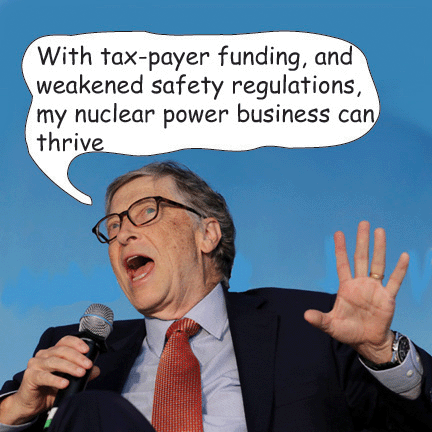
In a recent interview with ABC News, Bill Gates couldn’t have been more candid about why he’s embraced the technology of so-called small modular nuclear reactors, or SMRs. “Nuclear energy, if we do it right, will help us solve our climate goals,” he claimed. As it happens, he’s also invested heavily in an “advanced” nuclear power start-up company, TerraPower, based up in Bellevue, Washington, which is hoping to build a small 345-megawatt atomic power reactor in rural Kemmerer, Wyoming.
The nuclear industry is banking on a revival and placing its bets on SMRs like those proposed by the Portland, Oregon-based NuScale Power Corporation, whose novel 60-megawatt SMR design was approved by the Nuclear Regulatory Commission (NRC) in 2022. While the underlying physics is the same as all nuclear power plants, SMRs are easier to build and safer to run than the previous generation of nuclear facilities — or so go the claims of those looking to profit from them.
NuScale’s design acceptance was a first in this country where 21 SMRs are now in the development stage. Such facilities are being billed as innovative alternatives to the hulking commercial reactors that average one gigawatt of power output per year and take decades and billions of dollarsto construct. If SMRs can be brought online quickly, their sponsors claim, they will help mitigate carbon emissions because nuclear power is a zero-emissions energy source.
Never mind that it’s not, since nuclear power plants produce significant greenhouse gas emissions from uranium mining to plant construction to waste disposal. Life cycle analyses of carbon emissions from different energy sources find that, when every stage is taken into account, nuclear energy actually has a carbon footprint similar to, if not larger than, natural gas plants, almost double that of wind energy, and significantly more than solar power.
“SMRs are no longer an abstract concept,” Assistant Secretary for Nuclear Energy Kathryn Huff, a leading nuclear advocate who has the ear of the Biden administration, insisted. “They are real and they are ready for deployment thanks to the hard work of NuScale, the university community, our national labs, industry partners, and the NRC. This is innovation at its finest and we are just getting started here in the U.S.!”
A Risky (and Expensive) Business
Even though Huff claims that SMRs are “ready for deployment,” that’s hardly the case. NuScale’s initial SMR design, under development in Idaho, won’t actually be operable until at least 2029 after clearing more NRC regulatory hurdles. The scientists of the Intergovernmental Panel on Climate Change are already calling for fossil-fuel use to be cut by two-thirds over the next 10 years to transition away from carbon-intensive energy, a schedule that, if kept, such small reactors won’t be able to speed up.
And keep in mind that the seemingly prohibitive costs of the SMRs are a distinct problem. NuScale’s original estimate of $55-$58 per megawatt-hour for a proposed project in Utah — already higher than wind and solar which come in at around $50 per megawatt-hour — has recently skyrocketed to $89 per megawatt-hour. And that’s after a $4 billion investment in such energy by U.S. taxpayers, which will cover 43% of the cost of the construction of such plants. This is based on strikingly rosy, if not unrealistic, projections. After all, nuclear power in the U.S. currently averages around $373 per megawatt-hour.
And as the Institute for Energy Economics and Financial Analysis put it:
“[N]o one should fool themselves into believing this will be the last cost increase for the NuScale/UAMPS SMR. The project still needs to go through additional design, licensing by the U.S. Nuclear Regulatory Commission, construction, and pre-operational testing. The experience of other reactors has repeatedly shown that further significant cost increases and substantial schedule delays should be anticipated at any stages of project development.”
Here in the Pacific Northwest, NuScale faces an additional obstacle that couldn’t be more important: What will it do with all the noxious waste such SMRs are certain to produce? In 1980, Oregon voters overwhelmingly passed Measure 7, a landmark ballot initiative that halted the construction of new nuclear power plants until the federal government established a permanent site to store spent nuclear fuel and other high-level radioactive waste. Also included in Measure 7 was a provision that made all new Oregon nuclear plants subject to voter approval. Forty-three years later, no such repository for nuclear waste exists anywhere in the United States, which has prompted corporate lobbyists for the nuclear industry to push several bills that would essentially repeal that Oregon law.
NuScale, no fan of Measure 7, has decided to circumvent it by building its SMRs across the Columbia River in Washington, a state with fewer restrictions. There, Clark County is, in its own fashion, beckoning the industry by putting $200,000 into a feasibility study to see if SMRs could “benefit the region.” There’s another reason NuScale is eyeing the Columbia River corridor: its plants will need water. Like all commercial nuclear facilities, SMRs must be kept cool so they don’t overheat and melt down, creating little Chernobyls. In fact, being “light-water” reactors, the company’s SMRs will require a continuous water supply to operate correctly.
Like other nuclear reactors, SMRs will utilize fission to make heat, which in turn will be used to generate electricity. In the process, they will also produce a striking amount of waste, which may be even more challenging to deal with than the waste from traditional reactors. At the moment, NuScale hopes to store the nasty stuff alongside the gunk that the Trojan Nuclear Plant produces in big dry casks by the Columbia River in Oregon, near the Pacific Ocean.
As with all the waste housed at various nuclear sites nationwide, Trojan’s casks are anything but a permanent solution to the problem of such waste. After all, plutonium garbage will be radioactive for hundreds of thousands of years. Typically enough, even though it’s no longer operating, Trojan still remains a significant risk as it sits near the Cascadia Subduction Zone, where a “megathrust” earthquake is expected someday to violently shake the region and drown it in a gigantic flood of seawater. If that were to happen, much of Oregon’s coastline would be devastated, including the casks holding Trojan’s deadly rubbish. The last big quake of this sort hit the area more than 300 years ago, but it’s just a matter of time before another Big One strikes — undoubtedly, while the radioactive waste in those dry casks is still life-threatening.
Nuclear expert M. V. Ramana, a soft-spoken but authoritative voice in Jan Haaken’s Atomic Bamboozle documentary, put it this way to me:
“The industry’s plans for SMR waste are no different from their plans for radioactive waste from older reactors, which is to say that they want to find some suitable location and a community that is willing to accept the risk of future contamination and bury the waste underground.
“But there is a catch [with SMR’s waste]. Some of these proposed SMR designs use fuel with materials that are chemically difficult to deal with. The sodium-cooled reactor design proposed by Bill Gates would have to figure out how to manage the sodium. Because sodium does not behave well in the presence of water and all repositories face the possibility of water seeping into them, the radioactive waste generated by such designs would have to be processed to remove the sodium. This is unlike the fleet of reactors [currently in operation].”
Other troubles exist, too, explains Ramana. One, in particular, is deeply concerning: the waste from SMRs, like the waste produced in all nuclear plants, could lead to the proliferation of yet more atomic weaponry.
Nuclear Hot Links
As the pro-military Atlantic Council explained in a 2019 report on the deep ties between nuclear power and nuclear weapons in this country:
“The civilian nuclear power sector plays a crucial role in supporting U.S. national security goals. The connectivity of the civilian and military nuclear value chain — including shared equipment, services, and human capital — has created a mutually reinforcing feedback loop, wherein a robust civilian nuclear industry supports the nuclear elements of the national security establishment.”
In fact, governments globally, from France to Pakistan, the United States to China, have a strategic incentive to keep tabs on their nuclear energy sectors, not just for potential accidents but because nuclear waste can be utilized in making nuclear weapons.
Spent fuel, or the waste that’s left over from the fission process, comes out scalding hot and highly radioactive. It must be quickly cooled in pools of water to avoid the possibility of a radioactive meltdown. Since the U.S. has no repository for spent fuel, all this waste has to stay put — first in pools for at least a year or more and then in dry casks where air must be constantly circulated to keep the spent fuel from causing mayhem.
The United States already has a troubling and complicated nuclear-waste problem, which worsens by the day. Annually, the U.S. produces 88,000 metric tons of spent fuel from its commercial nuclear reactors. With the present push to build more plants, including SMRs, spent fuel will only be on the rise. Worse yet, as Ramana points out, SMRs are going to produce more of this incendiary waste per unit of electricity because they will prove less efficient than larger reactors. And therein lies the problem, not just because the amount of radioactive waste the country doesn’t truly know how to deal with will increase, but because more waste means more fuel for nukes.
As Ramana explains:
“When uranium fuel is irradiated in a reactor, the uranium-238 isotope absorbs neutrons and [transmutes] into plutonium-239. This plutonium is in the spent fuel that is discharged by the reactor but can be separated from the rest of the uranium and other chemicals in the irradiated fuel through a chemical process called reprocessing. Once it is separated, plutonium can be used in nuclear weapons. Even though there are technical differences between different kinds of nuclear reactors, all reactors, including SMRs, can be used to make nuclear weapons materials… Any country that acquires a nuclear reactor automatically enhances its ability to make nuclear weapons. Whether it does so or not is a matter of choice.”
Ramana is concerned for good reason. France, as he points out, has Europe’s largest arsenal of nuclear warheads, and its atomic weapons industry is deeply tied to its “peaceful” nuclear energy production. “Without civilian nuclear energy there is no military use of this technology — and without military use there is no civilian nuclear energy,” admitted French President Emmanuel Macron in 2019. No surprise then, that France is investing billions in SMR technology. After all, many SMR designs require enriched uranium and plutonium to operate, and the facilities that produce materials for SMRs can also be reconfigured to produce fuel for nuclear weapons. Put another way, the more countries that possess this technology, the more that will have the ability to manufacture atomic bombs.
As the credits rolled on Atomic Bamboozle, I glanced around the packed theater. I instantly sensed the shock felt by movie-goers who had no idea nuclear power was priming for a comeback in the Northwest. Lloyd Marbet, arms crossed, was seated at the back of the theater, looking calmer than most. Still, I knew he was eager to lead the fight to stop SMRs from reaching the shores of the nearby Columbia River and would infuse a younger generation with a passion to resist the nuclear-industrial complex he’s been challenging for decades.
“Can you believe we’re fighting this shit all over again?” he asked me later with his usual sense of urgency and outrage. “We’ve beat them before and you can damn well bet we’ll do it again.”
The diminutive reactors are likely to be just as prone to delays and cost overruns as their behemoth predecessors.
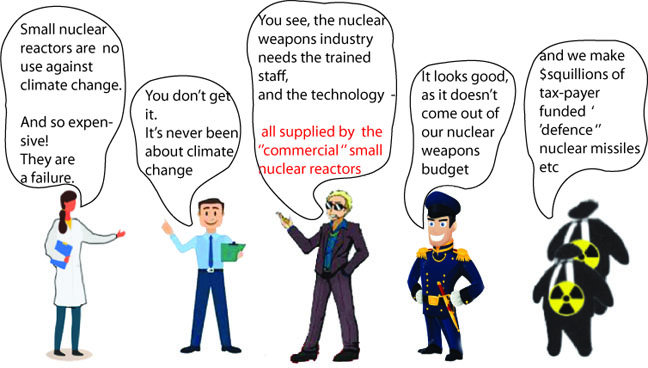
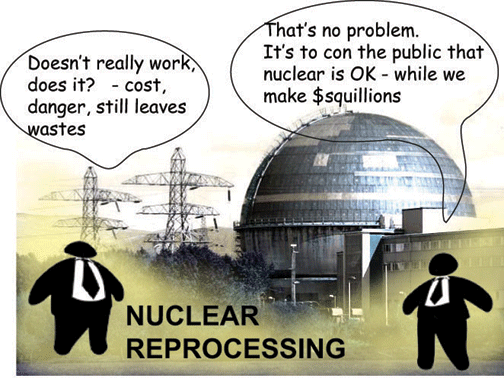
I just read Pal Hockenos’ fine story about small nuclear reactors. But Hockenos is naive to think that Bill Gates and co. give a hoot about our future. What they do care about is their own increasing $squillions. And the coming source of new $squillions is in weaponry – that’s where all sorts of applications for SMRs lie. And Gates etc are well aware that the fixing-climate story is just a cover for the real practical purpose.
IN RECENT YEARS, the nuclear power lobby and its advocates have begun to sing a new song. They have bailed on the monstrous reactors of the 20th century — not because of safety or toxic waste concerns, but because of the reactors’ exorbitant expense and ponderous rollout schedules. And they have switched their allegiance to a next generation nuclear fission technology: small modular reactors, which they claim will help rescue our warming planet, as well as the nuclear power industry— once they exist.
Respected thinkers such as former U.S. president Barack Obama, French president Emmanuel Macron, and Microsoft co-founder and philanthropist Bill Gates have toasted the idea of small modular reactors, or SMRs, as a potentially reliable, almost-emissions-free backup to intermittent renewable energy sources like wind and solar. Advocates claim that because SMRs will be smaller than the giants that currently dominate horizons, they will be safer, cheaper, and quicker to build. Although SMRs will have only a fraction of the power-generating capacity of traditional nuclear power reactors, proponents envision that they will, one day, be assembled in factories and transported as a unit to sites — like Sears’ mail-order Modern Homes of the early 1900s.
Currently, half of the states in the EU, both major political parties in the U.S, and the five BRICS nations — Brazil, Russia, India, China, and South Africa — have indicated that they want to split atoms for the purpose of generating energy. U.S. President Joe Biden included billions of dollars in tax credits for nuclear energy in the Inflation Reduction Act and the Infrastructure Investment and Jobs Act. Gates has gone so far as to invest a chunk of his fortune in a firm he founded, TerraPower, a leading nuclear innovation company. But despite the prodigious chatter, the endeavor to blanket the Earth with SMRs is a Hail Mary pass that’s very unlikely to succeed.
Granted, it is certainly a step in the right direction that most observers now see the postwar, giga-watt-scale water-cooled reactors as obsolete. When constructed new, these behemoths generate electricity at up to nine times the cost of large-scale solar and onshore wind facilities, and can take well over a decade to get up and running. Perhaps for this reason, there has been one, and only one, new nuclear power project initiated in the U.S. since construction began on the last one 50 years ago: a two-reactor expansion of the Vogtle Electric Generating Plant in Georgia. The first of the reactors came online this year — seven years behind schedule. The staggering $35 billion cost for the pair is more than twice the original projection.
But SMRs are just as likely to face similar delays and cost overruns. Currently, there are just two existing advanced SMR facilities in the world that could be reasonably described as SMRs: a pilot reactor in China and Russia’s diminutive Akademik Lomonosov. More small reactors are under construction in China, Russia, and Argentina, but all of them are proving even more expensiveper kilowatt than traditional reactors.
It’s worth noting that in the U.S., and everywhere else in the world, nuclear policy relies heavily on subsidies to be economically competitive. Starting next year, utilities operating nuclear facilities in the U.S. can qualify for a tax credit of $15 per megawatt-hour — a break that could be worth up to $30 billion for the industry as a whole. However, even these giveaways won’t reduce the projected costs of SMR-generated electricity to anywhere near the going prices of wind and solar power.
In the U.S., the only SMR developer with a design approved by the Nuclear Regulatory Commission is NuScale, which plans to deploy six modules at one site in Idaho that will together generate less electricity than a smallish standard nuclear reactor. So far, however, NuScale has yet to lay a single brick. Its biggest win to date is securing $4 billion in federal tax subsidies. In January of this year, NuScale announced plans to sell electricity not at $58 per megawatt-hour, as originally pledged, but at $89 per megawatt-hour, citing higher than anticipated construction costs. The new projection is nearly twice the average global cost of utility-scale solar and onshore wind, according to calculations by BloombergNEF. And without the government subsidies, NuScale’s price tag would be that much higher.
In fact, there’s a fair chance that not a single NuScale SMR will ever be built: The company has said it will not begin construction until 80 percent of its expected generation capacity is subscribed, and currently buyers have signed up for less than a quarter of the plant’s capacity.
Gates’s TerraPower has an even longer way to go, although it too is cashing in on subsidies. The U.S. Department of Energy has pledged up to $2 billion in matching funds to construct a demonstration plant in Wyoming. Yet TerraPower recently announced it’s facing delays of at least two years because of difficulties securing uranium fuel from its lone supplier: Russia.
Even if the unlikely rollout of SMRs eventually happens, it will unfold too late to curb the climate crisis. And the reactors will face many of the same safety and radioactive waste concerns that plagued their larger counterparts, if only at smaller scales. Meanwhile, the siren song of nuclear energy is diverting critical resources from the urgent task of building out clean technologies. And the idea that nuclear reactors would serve as “backups” for wind and solar is misguided because the reactors can’t be ramped up and down quickly.
……………………………The technology of the future is already here. Clean wind and solar energy — coupled with updated smart grids, expanded storage capacity, hydrogen technology, virtual power plants, and demand response strategies — can work. Our energy systems of the future will look like a patchwork quilt, with diverse energy sources kicking in at different times during the day, and with the mix differing from one day to the next.
Bill Gates and like-minded innovators should put their minds and fortunes to work on this futuristic project of the present — and leave the 20th century relic that is nuclear power in the past, where it belongs
The UK government is to offer grants of £157m as part of its launch of a new body to support the nuclear power industry.
Great British Nuclear (GBN) will be tasked with helping deliver the government’s commitment to provide a quarter of the UK’s electricity from nuclear energy by 2050.
The new body will help drive rapid expansion of nuclear power plants in the UK, boost energy security and reduce dependence on fossil fuel imports, said the energy security secretary, Grant Shapps.
It is hoped that a competition to develop small modular reactors (SMRs) will drive billions of pounds of investment into the technology, which the government hopes will be cheaper and quicker to build than traditional large nuclear power plants.
However, environmental campaigners and academics have argued that SMRs have no track record and that time and resources would be better spent on renewables such as more offshore wind.
The launch at the Science Museum in London on Tuesday was delayed from last week after it clashed with the government’s public sector pay deal announcement.
The government’s previous attempts to attract funding for conventional large reactors have so far only yielded the much delayed and over-budget Hinkley Point C nuclear plant in Somerset.
Shapps is expected to announce the winners of the competition in the autumn, with a number of manufacturing firms such as Rolls-Royce and Hitachi interested in developing SMRs.
The government said it was still committed to Hinkley Point C and also Sizewell C, a nuclear power plant in Suffolk that was announced last year and has been backed with £700m of public funds.
In addition to the competition launch, Shapps announced that up to £157m of grant funding would be available. There will be up to £77m to accelerate the development of a nuclear business in the UK and support new designs, and a further £58m for the development and design of a new advanced modular reactor that operates at higher temperatures……………………………………….
Dr Doug Parr, the chief scientist for Greenpeace UK, accused the government of “obsessing” over nuclear power and decried SMRs.skip past newsletter promotion.
“As the government tries to whip up investment for the latest generation of reactors, it is striking how many of the nuclear industry’s speculative claims are being repeated by ministers as fact,” he said. “The hype seems to have been enough to convince our government that nuclear’s last gasp is in fact a new dawn, but at their radioactive cores SMRs remain the same bad bet.
“SMRs have no track record, but initial indications are that the familiar problems of cost overruns and delays will be repeated, and the accumulation of unmanageable waste will continue.”
Parr added: “By continually obsessing about nuclear, the government is taking its eye off the net zero ball, which will have to be delivered through a predominantly renewable, modern electricity grid. No number of SMRs will fix the government’s lacklustre effort to address issues of delayed connections, smart local grids and home efficiency.”
Steve Thomas, an emeritus professor of energy policy at the University of Greenwich, said: “Yet again, the British government has proved credulous to the claims of the nuclear industry that a new generation of technology will solve all the problems of its predecessors.
The government delayed the event over “unforeseen circumstances”
Mini nuclear reactor developers including Rolls-Royce Holdings PLC (LSE:RR.) have been left in the dark after the official launch of Great British Nuclear was delayed on Thursday.
Net zero secretary Grant Shapps had been due to unveil the new public body at London’s science museum before the event was cancelled over “unforeseen circumstances”.
Great British Nuclear, originally announced in the chancellor’s spring budget, will be an arms-length body set up to support the roll-out of small modular reactors (SMRs) in the UK……………..
Rolls-Royce and General Electric (NYSE:GE) had been among those due to attend the event, having both proposed designs for prospective use in the UK.
Rolls is currently the only company which has an SMR design currently passing through regulatory assessments though, carried out by the Office for Nuclear Regulation, Environment Agency and Natural Resources Wales.
2 Mycle Schneider, who produces the World Nuclear Industry Status Report (WNISR) says that the recent announcements by the Ontario government about new nuclear reactors at Darlington and Bruce amount to “a mixture of tech fantasy and collective denial of the state of the industry.”
He gave evidence to the Belgian Parliament on SMRs on 20 June 2023, following a first hearing on 30 May 2023. Six of ten presentations were given by technology providers, one by a former administrator of the French Alternative Energies and Atomic Energy Commission (CEA), one by an International Energy Agency representative, and one by a Dutch ex-government “expert” — a very open, balanced panel – sound familiar?
All ten presentations – including Mycle’s – are available in one volume here. Most are in English. He says they provide “useful documentation on current SMR strategies. NuScale and Rolls Royce were invited but did not show up. Maybe NuScale did not feel like coming… When it became public that the NuScale CFO has sold most of his shares, their value on the stock market plunged even further.
The videos of the hearings, including Q&A are here and here.














 nuclear-news