SMR – Spending Money Recklessly
Spending Money Recklessly: This video explains why the nuclear industry
has been stagnating for the last 25 years, and why nuclear promoters are
desperate to obtain government fundings for SMRs (Small Modular Reactors)
despite the fact that nuclear power is the slowest, costliest, and most
speculative approach to fighting climate change.
Energy efficiency and renewables with storage are far preferable, not least because they are
do-able. Gordon Edwards gives the Keynote address on Small Modular Reactors
(SMRs) at the AGM of the Alliance to Halt Fermi-3 (Detroit Michigan), on
December 3, 2023. Edwards is prudent of the Canadian Coalition for Nuclear
Responsibility: www.ccnr.org .
Gordon Edwards 23rd Dec 2023
Grand plan to triple nuclear energy with small nuclear reactors, but where’s the funding?

1 US nuclear start-ups battle funding challenge in race to curb emissions.
Reactors pioneered by Oklo, X-energy and NuScale suffer financing setbacks
as well as regulatory headwinds.
US plans to build up its nuclear industry
face big funding and regulatory challenges which could delay a new
generation of smaller, more efficient reactors touted by advocates as
critical to fighting climate change.
Industry experts told the Financial
Times a declaration signed last week by Washington and 21 other nations at
the COP 28 climate summit to triple the amount of installed nuclear energy
by 2050 was a step forward, given the sector’s ability to provide
(?)emissions-free power.
But a sharp fall in market support for start-ups
developing so-called small modular reactors and other advanced nuclear
facilities threaten US ambitions, they said. Last month NuScale Power Corp
cancelled plans to build the first SMR in the US, despite receiving $1.4bn in government cost-sharing pledges.
Not enough power utilities expressed an
interest in purchasing electricity from the facility in Idaho when NuScale
increased power prices by more than 50 per cent over two years to $89 per
megawatt hour. The setback followed the collapse of a $1.8bn deal agreed
between X-energy and special purpose acquisition company Ares Acquisition,
which was intended to enable the developer of nuclear technologies to go
public.
Now the industry is focused on whether Oklo, a start-up chaired by
OpenAI chief executive Sam Altman, can successfully go public via a
blank-cheque company announced in July with AltC Acquisition Corp. The
merger was proposed at a valuation of $850mn and would provide Oklo with
$500mn to develop and commercialise its reactor design.
FT 12th Dec 2023
https://www.ft.com/content/c0700a01-c1e8-4e5e-8300-ac264bd25293
United Arab Emirates is using COP 28 Climate Summit to promote small nuclear reactor industry, as well as fossil fuel industries
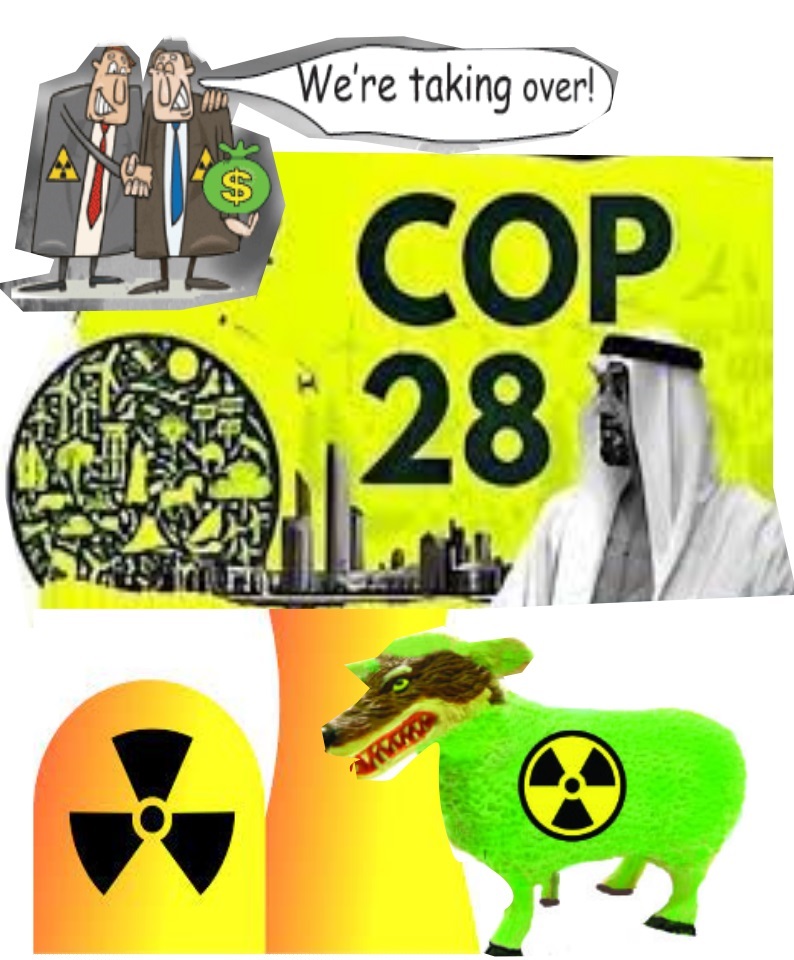
Following the launch of a programme aimed at leveraging its experience in
successfully delivering a nuclear power plant project, the UAE’s Emirates
Nuclear Energy Corporation (ENEC) has signed a number of agreements with
small modular reactor and micro-reactor vendors to explore opportunities
for the commercialisation and global deployment of their designs.
World Nuclear News 5th Dec 2023
https://www.world-nuclear-news.org/Articles/ENEC-to-evaluate-deployment-of-SMRs-and-microreact
SMRs two examples. NuScale in the US, NUWARD in France
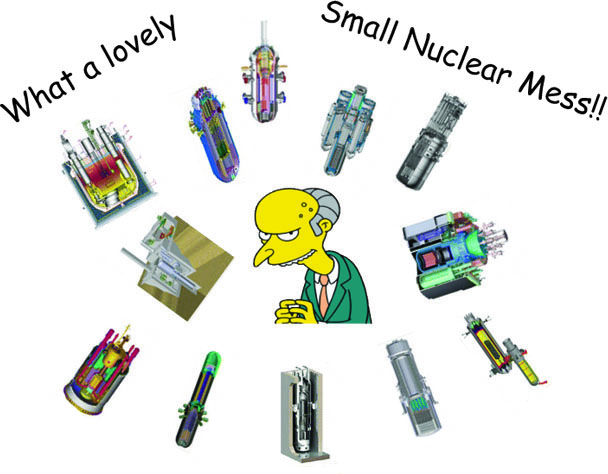
Samedi 2 décembre 2023, par Bernard Laponche, Jean-Luc Thierry, https://global-chance.org/SMRs-two-examples-NuScale-in-the-US-NUWARD-in-France
In recent years, a new type of reactor has appeared on the world stage, the SMR – Small Modular Reactor. Historically, a number of “small reactors” of very different types have been in operation – small in terms of power compared with the reactors of nuclear power plants currently in operation around the world – notably for use in ship propulsion, such as the nuclear submarines of the pressurized water/enriched uranium type.
The “modular” feature of an SMR is achieved by mass production in a dedicated plant. It would then be transported to the operating site, where it would be connected to the heat or electricity production system to form a “module” and then a “power plant”, known as an “SMR”. The hope of SMR promoters rests on the hoped-for gain in unit reactor cost due to the series effect, as they are rightly aware that the cost of a site-built model is far too high.
At present, according to the International Atomic Energy Agency (IAEA), there are almost a hundred “candidate” SMR projects/designs, some of them based on existing prototypes (“small” but not “modular”), most of them existing only on paper, of various power ratings, from enriched uranium and pressurized water reactors, a well-known technology, to plutonium fast neutron reactors, thorium or molten salt reactors, etc. There are no existing SMRs at present.

In addition to a general presentation of the SMR issue and a selection of IAEA projects, this report examines two “SMR candidate” reactor projects in the enriched uranium and pressurized water (PWR) family of reactors : NuScale in the USA and NUWARD in France. Numerous safety-related questions remain unanswered about the NuSCale model, and the Safety Options File for the NUWARD reactor, studied by the French, Czech and Finnish safety authorities, is not yet available. The technical challenges to be met to guarantee SMR safety are not qualitatively different from those of large reactors.
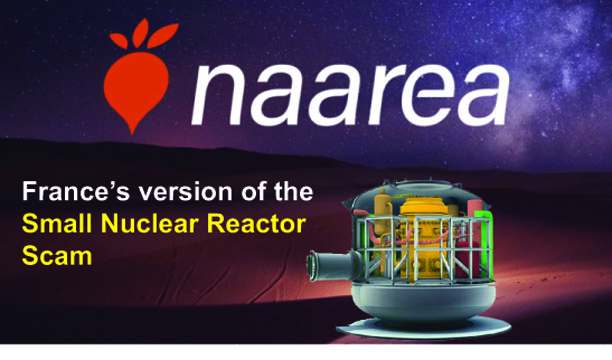
These challenges are compounded by the uncertainties brought about by the reactor’s novel “compact” design, which contains the reactor core (the site of the nuclear fission reaction), the control rods, the steam generator(s) and the pressurizer in a single enclosure. The SMR gamble is not only risky in terms of the bill, but also in terms of the climate, technical and safety agendas, as well as entailing the negative externalities of nuclear installations such as the risk of nuclear accidents and the production of waste that we are relegating to future generations, at least for the next 100,000 years. These reactors also entail other risks, including proliferation.
The complete text is available here : https://global-chance.org/Les-SMR-Deux-exemples-NuScale-et-NUWARD
A sobering analysis of the Canadian plan for small modular nuclear reactors (SMRs) and their toxic waste problem

“We found that small modular reactors will generate at least nine times more neutron-activated steel than conventional power plants. These radioactive materials have to be carefully managed prior to disposal, which will be expensive.” The study concluded that, overall, small modular designs were inferior to conventional reactors with respect to radioactive waste generation, management requirements, and disposal options.
Canada does not have a permanent solution to deal with the radioactive waste that has already been produced
Nuclear Power and SMR Development
Story by The Canadian Press • 11h (December 1, 2023) , Carol Baldwin, Local Journalism Initiative Reporter, Wakaw Recorder
In August it was announced that Ottawa had approved up to $74 million in federal funding for small modular reactor (SMR) development in the province. Jonathan Wilkinson, Federal Minister of Energy and Natural Resources, made the announcement at the Sylvia Fedoruk Canadian Centre for Nuclear Innovation at the University of Saskatchewan in Saskatoon. The funding will support pre-engineering work and technical studies, environmental assessments, regulatory studies, and community and Indigenous engagement to help advance the SMR project, Natural Resources Canada said.
On November 20, Dustin Duncan, Saskatchewan’s minister responsible for SaskPower, was joined by Ontario Energy Minister Todd Smith as SaskPower announced it had signed a five-year master services agreement with Ontario Power Generation and its subsidiary Laurentis Energy Partners. Duncan said the deal will allow for the development of a Canadian fleet of SMRs.
“To have an agreement that allows us to tap into that expertise and knowledge from a jurisdiction and organizations that have a great deal of expertise and history in the nuclear sector is critically important for Saskatchewan to carry forward with,” he said. What he failed to acknowledge, however, is that Ontario’s expertise and knowledge is with the older and much larger CANDU reactor. SMR technology is a newly developed field and Ontario itself is still in the process of building its first SMR.
Nuclear power does have a long history in Canada, with the first plant, the Nuclear Power Demonstration Reactor in Rolphton, Ont., going online in the early 1960s. Today, larger nuclear-generating stations in Ontario and New Brunswick supply about 15 percent of Canada’s electricity. However, accidents like those at Chalk River, Three-Mile Island, Chernobyl, and Fukushima invariably bring up questions about safety and environmental impacts. President of the Canadian Nuclear Safety Commission, Rumina Velshi, has said in promoting SMRs, that when it comes to new builds the technology has improved safety by incorporating a passive system that is supposed to shut the reactor down if ‘things go wrong.’
While the CANDU reactors in operation in Canada and around the world do have a good safety record, SMRs are recent technology and many in the public are skeptical of the ‘infallibility’ of new technology. That skepticism is perhaps, not misplaced, according to a study. A study published at the end of May 2022, in “Proceedings of the National Academy of Sciences” concluded that “most small modular reactor designs will actually increase the volume of nuclear waste in need of management and disposal,” said study lead author Lindsay Krall, a former MacArthur Postdoctoral Fellow at Stanford University’s Center for International Security and Cooperations (CISAC). The study found that, because of their smaller size, small modular reactors will experience more neuron leakage than conventional reactors. This increased leakage affects the amount and composition of their waste streams.
“We found that small modular reactors will generate at least nine times more neutron-activated steel than conventional power plants. These radioactive materials have to be carefully managed prior to disposal, which will be expensive.” The study concluded that, overall, small modular designs were inferior to conventional reactors with respect to radioactive waste generation, management requirements, and disposal options. (https://news.stanford.edu/2022/05/30/small-modular-reactors-produce-high-levels-nuclear-waste/#) There are literally dozens of different models of SMRs and reports on this study did not identify which models it examined. SaskPower hosted an online and call-in event on October 5th, 2023, to engage the public with the development of a small modular reactor site in the province, but studies like this by an entity that seemingly has nothing to gain from a positive or negative study outcome, will not reassure people that the new build will be a safe neighbour in their community.
A research paper compiled by Esam Hussein, Faculty of Engineering and Applied Science at the University of Regina, agreed that some SMRs identified as integral reactors do have a higher leakage of neutrons and thermal energy due to a higher surface-to-volume ratio, but the boiling water reactors, such as the one chosen by SaskPower, do not experience the same leakage rate. At the end of his paper, he quotes a discussion paper of the CNSC which states that most “SMR concepts, although based on technological work and operating experience from past and existing plants, propose to employ several novel approaches. Novel approaches can affect the certainty of how the plant will perform under not only normal operation but also in accident conditions, in which predictability is paramount to safety.” In other words, SMRs are new and there is no guarantee about what hazards may or may not come into play.
Another concern that should be considered when advancing nuclear power generation, is that Canada does not have a permanent solution to deal with the radioactive waste that has already been produced and is sitting in temporary storage at the plants where it was produced. CNSC president Velshi has said work is being done to change that through a deep geological repository, but after ten years of work to locate and create one it still does not exist.
According to authors Kerrie Blaise and Shawn-Patrick Stensil, roughly 20 years ago it was recognized that for any type of revival and expansion of the nuclear industry, there needed to be a plan to manage the stockpiles of radioactive waste that had been accumulating since the 1960s. In 2002, the Nuclear Fuel Management Act was passed by the federal government, which then led to the creation of the Nuclear Waste Management Organization, whose mandate was to develop and implement a management plan. The fundamental assumption in all the management options considered was that ‘the volume of used nuclear fuel which needs to be managed was assumed to be limited to the projected inventory from the existing fleet of reactors’ (Nuclear Waste Management Organization 2004).
Put simply, when it came to planning for a repository for nuclear waste, the plan did not count on an increase in the number of nuclear plants and the resultant increase in the amount of nuclear waste. [Chapter 11, Small Modular Reactors in Canada: Eroding Public Oversight and Canada’s Transition to Sustainable Development, J.L. Black-Branch and D. Fleck (eds.), Nuclear Non-Proliferation in International Law-Volume V (chrome-extension://efaidnbmnnnibpcajpcglclefindmkaj/https://cela.ca/wp-content/uploads/2021/01/Blaise-Stensil-Ch11-Small-Modular-Reactors.pdf)]
Government and industry proponents portray SMRs as a needed component in a low-carbon society and notably every press conference and news release is filled with assurances that the technology is safe. Nevertheless, recent events at federal and province levels of government involving interference, cover-up, and withholding of information have left a sense of distrust amongst many in the public. Trust once lost can be a difficult hurdle to overcome.
Failure of USA’s NuScale small nuclear reactors (SMRs) not a good omen for Rolls Royce and other UK SMR developers
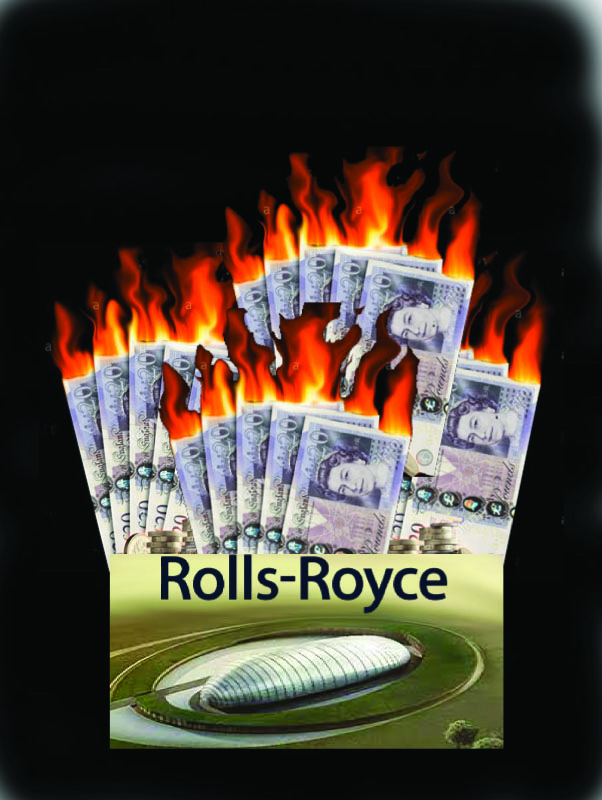
Concern for Rolls-Royce, other developers after US mini nuclear setback
Proactive ,30 Nov 2023
A major setback in the roll out of mini nuclear power plants in the US has raised concern over the UK’s own bid to introduce the technology, whose developers include Rolls-Royce Holdings PLC (LSE:RR.).
Cancelling plans for its first small modular reactor (SMR) in the US earlier this week, NuScale blamed a lack of interest in the plant’s power output by local utilities.
“Despite significant efforts […] it appears unlikely that the project will have enough subscription to continue toward deployment,” the company said in a statement.
Given the plant was set to be the first of its kind in the US, having been granted regulatory approval in 2022, concern has been raised over the ramifications on other countries looking to utilise modular nuclear technology………………………..
Rolls-Royce is among frontrunners developing such technology in the UK, with its SMR representing the only system currently being assessed by independent regulators.
Cambridge University nuclear energy professor Tony Roulstone commented that failure of NuScale to push through its SMRs was “bad for the broader market”, however.
“They’re the one with a ticket from a safety authority,” he added. NuScale has received some US$600 million from the US government since 2014.
Pointing to the UK, he suggested just one version of the technology was needed, given companies will need several orders to help bring down costs as a whole.
“You can do it if you’ve got an order for ten,” he said. “You can’t do this if you’ve got an order for one.”
A host of companies are indeed looking to build SMRs though, such as EDF, GE-Hitachi and of course Rolls-Royce and NuScale.
Alongside the fact each is looking for public support and contracts, concern has been raised in the UK over a lack of urgency on the government’s part.
Rolls-Royce has previously laid out the need for fast decision making on SMRs, with chief executive Tufan Erginbilgic himself having said the winner of the UK’s ongoing government-run SMR competition will need “tangible commitments in terms of projects – multiple projects”. https://www.proactiveinvestors.co.uk/companies/news/1034737/concern-for-rolls-royce-other-developers-after-us-mini-nuclear-setback-1034737.html
Why Britain’s mini-nukes dream is hanging by a thread
Scuppered American power deal throws the UK’s promise of a green transition into doubt
Telegraph UK, By Howard Mustoe, 29 November 2023
It was meant to provide cheap, clean power to towns in the Midwest of the US.
But a scuppered nuclear power deal has thrown the promise of green power in the region into doubt, and could have repercussions in Britain.
NuScale Power said earlier this month that its maiden deal to build six of its mini-nukes in Utah was dead, after several towns that were backing the project pulled out over soaring costs…………………………………
In Britain, the Government wants a quarter of all electricity to come from nuclear power by 2050, and has launched a competition to find developers who can build SMRs by the mid-2030s. Last month, it unveiled a shortlist of six contenders, including NuScale.
However, the Portland, Oregon-based company’s struggles raise the spectre that SMRs may be beset to the same cost overruns that have long haunted the industry, casting doubt over whether mini-nukes can actually deliver on their promise.
NuScale is the only SMR developer with a design approved by a regulator.
The Utah Associated Municipal Power Systems (UAMPS), which provides power to local areas across the Midwest, first signed a deal with NuScale in 2015.
The ambition of the project changed over time, with UAMPS eventually settling on plans to buy six NuScale reactors that could deliver 77 megawatts (MW) of electricity each, collectively enough to power almost 1.4 million homes.
However, members of UAMPS, small towns and local areas, were uneasy with the long timeline and high costs of the project.
When the Utah city of Logan pulled out in 2020, its finance chief Richard Anderson told the Salt Lake City paper Deseret News: “We don’t have the experience to be swimming in these waters. I didn’t feel good about it.”
The death knell for NuScale came in January when new estimates showed a 53pc increase in costs. The price of steel and other raw materials had leapt, sending the price of power from the plant from $58 per MW hour to $89.
The sharp increase came despite a promise of $4bn (£3.2bn) in US taxpayer support under President Biden’s Inflation Reduction Act.
Several member towns pulled out over soaring costs, leaving the project dead in the water.
Tony Roulstone, a lecturer in nuclear energy at the University of Cambridge and a former Rolls-Royce engineer, said the deal coming unstuck was “bad for the broader market”.
“They’re the one with a ticket from a safety authority,” he said of NuScale. “They’re the one with a project, which has been supported by the US government.”
SMRs offered the promise of bringing the cost discipline of mass production to nuclear engineering. They were touted as a way to pull the industry away from unwieldy megaprojects that were subject to cost overruns and delays……………………………..
the rising costs in Utah evoke worrying parallels to the industry of old. Hinkley Point C in Somerset was estimated to cost about £26bn in 2015, for example, but could now end up costing £33bn, according to the latest estimate.
While the scale of costs is different, the unpredictability is a worry……………………………….
The market is also quite crowded. France’s EDF, US-Japanese alliance GE-Hitachi, Rolls-Royce and US companies Holtec, NuScale and Westinghouse are all competing for part of the SMR market in the UK through the Government’s competition.
With costs rising and interest waning, the industry has complained the Government is moving too slowly…………………………………..
To succeed in delivering the economies of scale promised by factory production, SMRs must be developed en masse………………………………………………………. https://www.telegraph.co.uk/business/2023/11/29/soaring-costs-mini-nuclear-dream-left-on-thread/
Small modular nuclear reactors: a history of failure
Jim Green 28 November 2023 https://reneweconomy.com.au/small-modular-nuclear-reactors-a-history-of-failure/
Small modular reactors (SMRs) are defined as reactors with a capacity of 300 megawatts (MW) or less. The term ‘modular’ refers to serial factory production of reactor components, which could drive down costs.
By that definition, no SMRs have ever been built and none are being built now. In all likelihood none will ever be built because of the prohibitive cost of setting up factories for mass production of reactor components.
No SMRs have been built, but dozens of small (<300 MW) power reactors have been built in numerous countries, without factory production of reactor components. The history of small reactors is a history of failure.
The US Army built and operated eight small reactors beginning in the 1950s, but they proved unreliable and expensive and the program was shut down in 1977. In addition, 17 small civilian reactors were built in the US in the 1950s and 1960s, but all have since shut down.
Twenty-six small Magnox reactors were built in the UK but all have shut down and no more will be built. The only operating Magnox is a mini-Magnox in North Korea: the design was made public at an Atoms for Peace conference and North Korea uses its 5 MW Magnox to produce plutonium for nuclear weapons.
India’s operates 14 small pressurised heavy water reactors, each with a capacity of about 200 MW. Prof. M.V. Ramana noted in his 2012 book, ‘The Power of Promise: Examining Nuclear Energy in India’, that despite a standardised approach to designing, constructing, and operating these reactors, many suffered cost overruns and lengthy delays. There are no plans to build more of these small reactors in India.
Elsewhere, the history of small reactors is just as underwhelming. This includes three small reactors in Canada (all shut down), six in France (all shut down), and four in Japan (all shut down).
Prof. Ramana concludes his history of small reactors with this downbeat assessment: “Without exception, small reactors cost too much for the little electricity they produced, the result of both their low output and their poor performance.”
Recent history
Just two SMRs are said to be operating — neither meeting the ‘modular’ definition of serial factory production of reactor components. The two SMRs — one each in Russia and China — exhibit familiar problems of massive cost blowouts and multi-year delays.
The construction cost of Russia’s floating nuclear power plant increased six-fold and the OECD’s Nuclear Energy Agency estimates that the electricity it produces costs US$200 (A$306) / megawatt-hour (MWh). The reactor is used to power fossil fuel mining operations in the Arctic.
The other operating SMR (loosely defined) is China’s demonstration 210 MW high-temperature gas-cooled reactor (HTGR). The World Nuclear Association states that the cost of the demonstration HTGR was US$6,000 (A$9,200 billion) per kilowatt, three times higher than early cost estimates and 2-3 times higher than the cost of China’s larger Hualong reactors per kilowatt.
NucNet reported in 2020 that China dropped plans to manufacture 20 HTGRs after levelised cost estimates rose to levels higher than conventional large reactors. Likewise, the World Nuclear Association states that plans for 18 additional HTGRs at the same site as the demonstration HTGR have been “dropped”. China’s demonstration HTGR demonstrates yet again that the economics of small reactors doesn’t stack up.
Three SMRs are under construction – again with the qualification that there’s nothing ‘modular’ about these projects.
Argentina’s CAREM reactor has been a disaster. Construction began in 2014 and the National Atomic Energy Commission now hopes to complete the reactor in 2027 — nearly 50 years after the project was conceived. The cost estimate in 2021 was US$750 million (A$1.1 billion) for a reactor with a capacity of just 32 MW. That’s over one billion Australian dollars for a plant with the capacity of a handful of large wind turbines.
In 2021, China began construction of a 125 MW pressurised water reactor. According to China National Nuclear Corporation, construction costs per kilowatt will be twice the cost of large reactors, and levelised costs will be 50 percent higher than large reactors.
Also in 2021, construction of the 300 MW demonstration lead-cooled BREST fast neutron reactor began in Russia. The cost estimate has more than doubled to 100 billion rubles (A$1.7 billion) and no doubt it will continue to climb.
NuScale and mPower
In 2012, the US Department of Energy (DOE) offered up to US$452 million to cover “the engineering, design, certification and licensing costs for up to two US SMR designs.” The two SMR designs that were selected by the DOE for funding were NuScale Power and Generation mPower.
Taking its cues from the US government, in 2015 the South Australian Nuclear Fuel Cycle Royal Commission commissioned research by WSP Parsons Brinckerhoff (now WSP) on the economic potential of the same two designs.

However NuScale recently abandoned its flagship project in Idaho as RenewEconomy recently reported. NuScale secured subsidies amounting to around US$4 billion (A$6.1 billion) from the US government comprising a US$1.4 billion subsidy from the DOE and an estimated US$30 per megawatt-hour (MWh) subsidy in the Inflation Reduction Act. Despite that government largesse, NuScale didn’t come close to securing sufficient funding to get the project off the ground.
NuScale’s most recent cost estimates were through the roof: US$9.3 billion (A$14.2 billion) for a 462 MW plant comprising six 77 MW reactors. That equates to US$20,100 (A$30,700) per kilowatt and a levelised cost of US$89 (A$135) / MWh. Without the Inflation Reduction Act subsidy of US$30/MWh, the figure would be US$129 (A$196) / MWh. That’s close to WSP’s estimate of A$225 / MWh.
To put those estimates in perspective, the Minerals Council of Australia states that SMRs won’t find a market in Australia unless they can produce power at a cost of A$60-80 / MWh, 2-3 times lower than the WSP and NuScale estimates.
NuScale still hopes to build SMRs but the company is burning cash and, some analysts suggest, heading towards bankruptcy.
Generation mPower — a collaboration between Babcock & Wilcox and Bechtel — was the other SMR design prioritised by the US DOE and the South Australian Royal Commission. mPower was to be a 195 MW pressurised light water reactor.
In 2012, the DOE announced that it would subsidise mPower in a five-year cost-share agreement. The DOE’s contribution would be capped at US$226 million, of which US$111 million was subsequently paid. The following year, Babcock & Wilcox said it intended to sell a majority stake in the joint venture, but was unable to find a buyer.
In 2014, Babcock & Wilcox announced it was sharply reducing investment in mPower to US$15 million annually, citing the inability “to secure significant additional investors or customer engineering, procurement and construction contracts to provide the financial support necessary to develop and deploy mPower reactors”.
The mPower project was abandoned in 2017. The joint venture companies spent more than US$375 million on the project, in addition to the DOE’s US$111 million contribution.
Iceberg Research analysts predicted the collapse of NuScale’s Idaho project, drawing a furious response from NuScale, and later drew the connections between NuScale and mPower:
“[NuScale’s] trajectory bears striking similarities to the B&W mPower project, a joint venture formed in 2010 between Babcock & Wilcox and Bechtel. Like NuScale, mPower was developing a small modular reactor and enjoyed DOE backing. Babcock & Wilcox, mPower’s 90%-shareholder, attempted but failed to sell a majority stake in the project. In a similar vein, NuScale’s largest shareholder Fluor is actively trying to sell around 30% of its equity interest in NuScale.
“There was eventually a significant reduction in funding for mPower. In March 2017, Bechtel withdrew from the joint venture, pointing to the challenges of securing a site and an investor for the first reactor. This led to the termination of the mPower project and Babcock & Wilcox paid Bechtel $30m as settlement.”
“There was eventually a significant reduction in funding for mPower. In March 2017, Bechtel withdrew from the joint venture, pointing to the challenges of securing a site and an investor for the first reactor. This led to the termination of the mPower project and Babcock & Wilcox paid Bechtel $30m as settlement.”
NuScale and mPower had everything going for them: large, experienced companies; conventional light-water reactor designs; and generous government subsidies. But they struggled to secure funding other than government subsidies. Needless to say, non-government funding is even more difficult to secure for projects without the backing of large companies, and for projects that envisage construction of unconventional reactors (molten salt reactors, fast neutron reactors, etc.).
NuScale’s failure is particularly striking given the extent of the government subsidies and given that NuScale had progressed further through the licensing process than other SMR designs (which isn’t saying much). Australia’s energy minister Chris Bowen said: “The opposition’s only energy policy is small modular reactors. Today, the most advanced prototype in the US has been cancelled. The LNP’s plan for energy security is just more hot air from Peter Dutton.”
NuScale’s failure is particularly striking given the extent of the government subsidies and given that NuScale had progressed further through the licensing process than other SMR designs (which isn’t saying much). Australia’s energy minister Chris Bowen said: “The opposition’s only energy policy is small modular reactors. Today, the most advanced prototype in the US has been cancelled. The LNP’s plan for energy security is just more hot air from Peter Dutton.”
Other failures
Many other plans to build small reactors have been abandoned. In 2013, US company Transatomic Power was promising that its ‘Waste-Annihilating Molten-Salt Reactor‘ would deliver safer nuclear power at half the price of power from conventional, large reactors. By the end of 2018, the company had given up on its ‘waste-annihilating’ claims, run out of money, and gone bust.
MidAmerican Energy gave up on its plans for SMRs in Iowa in 2013 after failing to secure legislation that would require ratepayers to partially fund construction costs.

In 2018, TerraPower abandoned its plan for a prototype fast neutron reactor in China due to restrictions placed on nuclear trade with China by the Trump administration.
The French government abandoned the planned 100-200 MW ASTRID demonstration fast reactor in 2019.
The US government abandoned consideration of ‘integral fast reactors‘ for plutonium disposition in 2015 and the UK government did the same in in 2019. (Plutonium disposition means destroying weapons-useable plutonium through irradiation, or treating plutonium in such a way as to render it useless in nuclear weapons.)
During the South Australian Royal Commission, nuclear lobbyists united behind a push for integral fast reactors and they would have expected some support from the stridently pro-nuclear Royal Commission.
However the Royal Commission rejected the proposal, noting in its May 2016 report that advanced fast reactors and other innovative reactor designs are unlikely to be feasible or viable in the foreseeable future; that the development of such a first-of-a-kind project would have high commercial and technical risk; that there is no licensed, commercially proven design and development to that point would require substantial capital investment; and that electricity generated from such reactors has not been demonstrated to be cost competitive with current light water reactor designs.
Dozens of SMR designs are being promoted — mostly by start-ups with a Powerpoint presentation. Precious few will reach the construction stage and the likelihood of SMRs being built in large numbers is negligible.
Dr. Jim Green is the national nuclear campaigner with Friends of the Earth Australia and author of a detailed SMR briefing paper released in June.
France goes for its own costly small nuclear reactor, following the USA NuScale flop, and UK’s lagging Rolls Royce one.

https://www.bnnbloomberg.ca/french-nuclear-startup-seeks-150-million-for-reactor-prototype-1.2003704 27 Nov 23
Naarea, a three-year-old French nuclear startup, is looking to raise €150 million ($164 million) as it seeks to develop a small reactor that would meet growing industrial decarbonization needs from the start of the next decade.
The company, which already raised €50 million from a handful of French family offices such as Eren Groupe SA and €10 million from the government, is reaching out to venture capital, industrial and institutional investors, and sovereign wealth funds for a Series A funding round with the help of Rothschild & Co., co-founder Jean-Luc Alexandre said in an interview in Paris Friday. He hopes to close the fundraising in the first quarter next year.
Naarea, which stands for Nuclear Abundant Affordable Resourceful Energy for All, is part of a growing wave of companies from Europe to North America promoting smaller, cheaper (?) and safer(?) designs for reactors. The burgeoning(?) sector of small modular and advanced nuclear reactors — which have a wide array of sizes and technologies — suffered a setback this month when NuScale Power Corp. canceled a plan to build a plant in the US amid mounting costs.
“NuScale isn’t dead, and still has projects,” the Naarea CEO said, while pointing out that the French startup, which employs 175 people, has a different business model and is developing another technology. Naarea aims “to produce power and heat, as close as possible to industrial companies, to relieve the grid.”
The startup, which is working with the French nuclear industry and foreign laboratories, is seeking to build a reactor that would produce 40 megawatts of electricity — enough to power a car factory or some of the biggest desalination plants — as well as heat, according to Alexandre.
Naarea is working on so-called molten salt fast neutron reactors that would be the size of a bus. It would burn plutonium and highly toxic radioactive waste that’s currently stored in France. It has found a ceramic that would prevent corrosion from the liquid fuel, something that has hampered the development of such reactors in the past, the company’s boss said.
The nuclear startup and Automotive Cells Co. — the electric-car battery venture of Stellantis NV, Mercedes-Benz Group AG and TotalEnergies SE — signed a memorandum of understanding to study whether Naarea’s mini-reactors might meet the future needs of ACC’s factories, Naarea said in a statement Monday.
If all goes according to plan, there would be a full-scale prototype in 2028. By 2030, a total of €2 billion would be required to complete the reactor development, build a fuel plant at or near Orano SA’s nuclear-waste recycling facility in La Hague, and a separate reactor factory elsewhere in France. The startup also needs to convince nuclear safety and regulatory authorities about the project.
These reactors “are competitive because they are small,” and safe by design, Alexandre said.
NuScale cancels first planned SMR nuclear project due to lack of interest
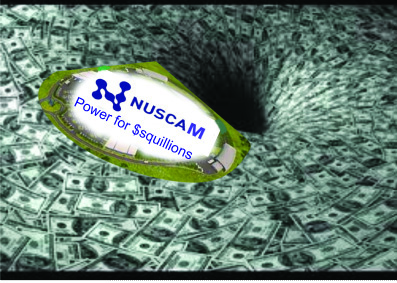
The Chemical Engineer, by Adam Duckett, 27 Nov 23
NUSCALE has cancelled the first project for its pioneering small modular nuclear reactor (SMR) technology because too few customers signed up to receive its power amid rising costs.
NuScale is the only company to have received design approval from US regulators for an SMR, a smaller form of reactor that can be fully fabricated in a factory to reduce the costly overruns that occur with larger conventional nuclear plants.
The first plant, known as the Carbon Free Power Project (CFPP), was set for construction at the US Department of Energy’s Idaho National Laboratory. It would have included six reactor modules generating a combined 462 MW of low carbon energy and had planned to begin operations in 2030. However, the company says there has not been enough interest from utilities across western states to continue the project.
The DoE has provided more than US$600m in funding since 2014 for NuScale and others to develop SMR technology. A spokesperson said: “We believe the work accomplished to date on CFPP will be valuable for future nuclear energy projects,” Reuters reports……………………
Critics argue that the technology is unproved, produces radioactive waste, and will be too slow and costly compared to renewable options which are available to deploy now. NuScale announced at the start of the year that the target cost of power from CFPP had climbed 53% since 2021 to US$89/ MWh.
The Institute for Energy Economics and Financial Analysis warned that “no one should fool themselves into believing this will be the last cost increase” given the additional design, licensing and testing needed, on top of inflation. https://www.thechemicalengineer.com/news/nuscale-cancels-first-planned-smr-nuclear-project-due-to-lack-of-interest/
Rolls Royce panicking, as UK government and investors are lukewarm about its small nuclear reactor project?
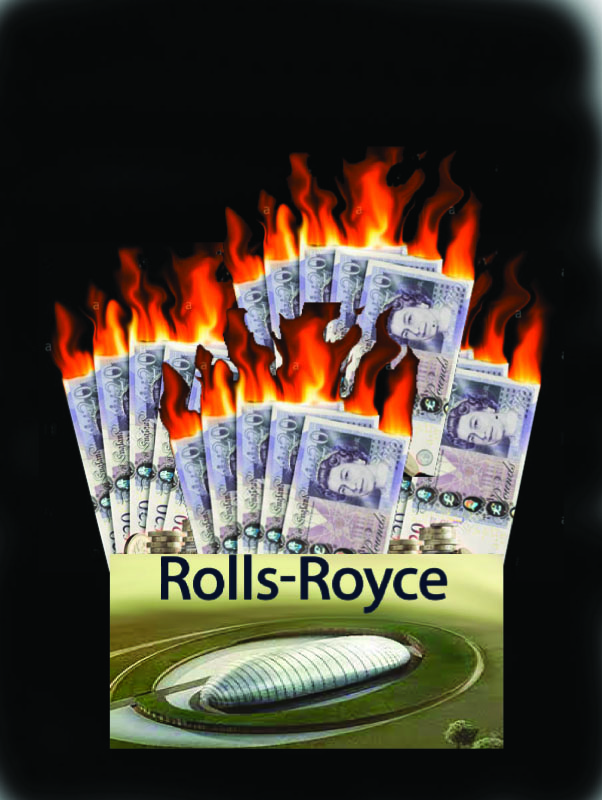
Rolls-Royce boss Tufan Erginbilgic: Britain must win nuclear race. The
boss of Rolls-Royce is this week expected to urge the Government to throw
its full weight behind ground-breaking British nuclear technology developed
by the country’s flagship engineering giant. Chief executive Tufan
Erginbilgic is pushing through a whirlwind transformation of the company.
He will on Tuesday unveil his blueprint for restoring Rolls to its former
glory. ‘Turbo-Tufan’ will be highlighting his company’s mini nuclear
power plants – known as SMRs, standing for small modular reactors.
Erginbilgic is a big believer in the SMR project, which is based on
technology honed for use in submarines over the last three decades.
Rolls-Royce, which has so far benefited from about £200 million
of Government backing for its work, is ahead of other companies in the UK
and abroad. But Erginbilgic is understood to be concerned that competitors
will catch up if the Government does not give its full-throated support.
There are also fears that potential overseas buyers of the technology are
hesitant because of the British Government’s apparently lukewarm attitude
towards Rolls-Royce’s technology.
Instead of backing Rolls outright, the
Government launched a competition to select an SMR provider, pitting the
company against foreign rivals. Six firms were selected for the next phase
of the competition last month, including EDF of France and a joint venture
between the US’s GE and Hitachi of Japan. Erginbilgic is likely to argue
that the process should be speeded up.
This is Money 25th Nov 2023
Failed U.S. Nuclear Project Raises Cost Concerns for Canadian SMR Development

The Energy Mix November 10, 2023, Primary Author: Mitchell Beer
The abrupt failure of the leading small modular nuclear reactor (SMR) project in the United States is shining a light on public subsidies that might keep similar technology under development in Canada, even if it’s prone to the same cost overruns that scuttled NuScale Power Corporation’s Carbon Free Power Project (CFPP) in Utah.
NuScale and its customer, Utah Associated Municipal Power Systems (UAMPS), announced they were cancelling the project earlier this week, after its anticipated cost increased 53% over earlier estimates, Bloomberg reports. “The decision to terminate the project underscores the hurdles the industry faces to place the first so-called small modular reactor into commercial service in the country.”
But a clear-eyed assessment of the project’s potential was really made possible by a level of accountability that doesn’t exist in Canada, said Gordon Edwards, president of the Canadian Coalition for Nuclear Responsibility.
“Private investors in Utah forced NuScale to divulge financial information regarding the cost of electricity from its proposed nuclear plant,” and “cost became the deal-breaker,” Edwards told The Energy Mix in an email. “Publicly-owned utilities in Canada are not similarly accountable. The public has little opportunity to ‘hold their feet to the fire’ and determine just how much electricity is going to cost, coming from these first-of-a-kind new nuclear reactors.”
In the U.S., the business case started to fall apart last November, when NuScale blamed higher steel costs and rising interest rates for driving the cost of the project up from US$58 to $90 or $100 per megawatt-hour of electricity. The new cost projection factored in billions of dollars in tax credits the project would receive under the Biden administration’s Inflation Reduction Act, amounting to a 30% saving.
At the time, the Institute for Energy Economics and Financial Analysis (IEEFA) estimated the total subsidy at $1.4 billion. This week, Bloomberg said NuScale had received $232 million of that total so far.
The cost increase meant that UAMPS “will not hit certain engineering, procurement, and construction benchmarks, allowing participants to renegotiate the price they pay or abandon the project,” Utility Dive wrote……………………………….
In Canada, “the massively expensive SMR projects in Canada will eventually face the same reckoning,” predicted Susan O’Donnell, an adjunct research professor at St. Thomas University and member of the Coalition for Responsible Energy Development in New Brunswick. While the Canadian Energy Regulator’s modelling assumes SMRs could be built at a cost of C$9,262 per kilowatt in 2020, falling to $8,348 per kilowatt by 2030 and $6,519 by 2050, the latest cost estimate from NuScale exceeded $26,000 per kilowatt in Canadian dollars, O’Donnell said—and the technology had been in development since 2007.
“Too bad our leaders have chosen to pursue an energy strategy which is too expensive, too slow, and too costly in comparison with the alternatives of energy efficiency and renewables—the fastest, cheapest, and least speculative strategies,” Edwards wrote. He added that waste disposal and management challenges and costs for SMRs will be very different from what Canadian regulators have had to confront with conventional Candu nuclear reactors.
The news from NuScale landed just days after civil society groups in the European Union warned that SMR development won’t help the continent reach its climate goals. Citing prolonged project delays and cost overruns, the long time frame to develop unproven technologies, and the risks associated with radioactive waste disposal and proliferation of nuclear materials, they urged EU governments to focus on renewable energy, power grid development, and energy storage.
“Nuclear energy is being pushed by powerful lobbies and geostrategic interests,” with several EU states relying on Russian state nuclear company Rosatom for their uranium supplies, the groups said. “To quickly decarbonize, we must choose cheap technologies, easy to deploy at scale, like solar panels and windmills.”………….https://www.theenergymix.com/2023/11/10/failed-u-s-nuclear-project-raises-cost-concerns-for-canadian-smr-development/
Small nuclear reactors are NOT emissions-free

No emissions claim mars SaskPower webinar on nuclear power
A reader comments that a presentation by SaskPower on small modular nuclear reactors failed to include information about nuclear emissions.
Nov 18, 2023 , Dale Dewar, Wynyard https://thestarphoenix.com/opinion/letters/letter-no-emissions-claim-mars-saskpower-webinar-on-nuclear-power
SaskPower held a webinar on its proposal for a Hitachi Boiling Water Reactor (BWRX300), a small modular nuclear reactor in Southern Saskatchewan. Its otherwise informative webinar was marred by a statement that the BWRX300 would have no emissions.
No emissions! People may not know everything about nuclear power plants, but most of us know that tritium or “hydrogen” is created and released in planned or unplanned episodes. It could build up and cause an explosion.
Tritium is more dangerous than the nuclear industry admits. Tritium is radioactive hydrogen. When combined with oxygen, it forms radioactive water. Tritium has been described as a “weak beta emitter.” Its beta particle can be stopped by paper or skin.
Our bodies incorporate hydrogen into every cell and cellular structure in our bodies. Our bodies are unable to distinguish between a normal hydrogen atom and tritium. This means that every tritium atom that we ingest into our bodies could spontaneously decay into helium, a gas.
As the tritium decays, it emits energy that can oxidize cellular contents including RNA and DNA, genetic material. Many believe that tritium is the culprit for the increase in children developing leukemia close to nuclear power plants.
With a half-life of 12 years, the tritium that is released today will not be “gone” for 120 years.
But let’s not forget the small amounts of other radioactive elements emitted: krypton-85, carbon-14, strontium-90, iodine-131, and caesium-137, to name a few. Nuclear power plants also emit all the types of pollutants any other steam- or gas-powered electrical plant emits.
U.S. military quietly revokes planned contract for small nuclear plant at Alaska Air Force base

the systems now under development have not been commercially proven: No micro-reactors have yet been built in the U.S. since the earliest days of nuclear technology.
This month, the only company with an approved design, Oregon-based Nuscale Power, announced that it had canceled a leading demonstration project in Idaho. Several potential customers had abandoned the project amid increasing costs, according to Reuters.
The military had planned to give a contract for a “micro-reactor” to Silicon Valley firm Oklo — whose chairman, Sam Altman, also leads the company behind the ChatGPT artificial intelligence chatbot.
Alaska Beacon, BY: NATHANIEL HERZ, NORTHERN JOURNAL – NOVEMBER 18, 2023
The U.S. military has rescinded the preliminary award of what could be a nine-figure contract with the company it had tentatively selected to build a small-scale nuclear power plant at Eielson Air Force Base near Fairbanks.
The Department of the Air Force and the Defense Logistics Agency in August announced an “intent to award” the contract to Oklo — a Silicon Valley startup backed by Sam Altman, who, until his ouster this week, also led the company behind ChatGPT.
In late September, the DLA’s energy arm revoked its decision, citing a need for “further consideration” of its obligations under a specific military contracting regulation, according to a memo sent to a competing bidder and obtained by Northern Journal from another source.
The regulation says the military should engage in post-bidding negotiations and discussions for contracts worth $100 million or more.
A DLA spokeswoman, Michelle McCaskill, declined to make agency officials available for an interview. In an emailed response to questions, she explained the revocation by repeating the language from the memo and said all bidders that responded to the agency’s request for proposals are still under consideration.
McCaskill said a “pre-filing notice of protest” of the award to Oklo was submitted to the U.S. Court of Federal Claims, but she declined to share a copy. A spokeswoman for Ultra Safe Nuclear Corp., the company that received the memo obtained by Northern Journal, confirmed that her business had made the pre-filing notice but added that a formal protest had not been filed.
Oklo is one of a growing number of businesses developing what are known as “micro-reactors,” which the military describes as small projects with “built-in safety features that self-adjust to changing conditions and demands to prevent overheating.”
The Eielson contract drew broad interest from the energy industry; officials from companies like Westinghouse, Rolls-Royce and Siemens participated in an informational meeting about it last year, according to a roster published by the military.
Oklo’s chief executive, Jake DeWitte, said in a brief interview Friday that his company is letting the contracting process play out.
the systems now under development have not been commercially proven: No micro-reactors have yet been built in the U.S. since the earliest days of nuclear technology.
This month, the only company with an approved design, Oregon-based Nuscale Power, announced that it had canceled a leading demonstration project in Idaho. Several potential customers had abandoned the project amid increasing costs, according to Reuters……………………………………………………….
Following the revocation, the office of Republican U.S. Sen. Lisa Murkowski, who helped secure federal spending on micro-reactor development, asked the Department of Defense for a timeline but has not heard back, spokesman Joe Plesha said in an email.
“We will continue to monitor this issue closely,” he said……………………………………………
USNC, which is based in Seattle, has proposed to build what could be Canada’s first micro-reactor, in Ontario, and aims for it to go online by 2028.
Nov 2023
Canadian Nuclear Safety Commission queried on proposal for untested small nuclear reactors in Ontario.
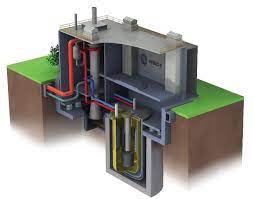
to the question of whether it is appropriate to propose the siting of up to four untested reactors
No BWRX-300 reactors are operating anywhere in the world
Submission Concerning the Proposed Development of BWRX-300 reactors at the Darlington Site
November 19,2023 by Evelyn Gigantes
I am submitting my response to the proposed development by Ontario Power Generation of 4 BWRX-300 reactors on the existing site of the Darlington CANDU nuclear reactors.
Apparently this project has been given a CNSC license to” Prepare the Site” based on the CNSC’s decision that OPG has met the recommendations of the 2011 Environmental Assessment Report by the Joint Review Panel. However nowhere is evidence available that the recommendations of the JRP have been addressed by OPG, or required by the CNSC.
It is critical that the many environmental concerns raised by the JRP in 2011 – everything from the existing geographic and soil structure of the site, the possible air and water contaminants, the surrounding housing, noise, and potential shoreline alteration, must be addressed by OPG, and approved by the CNSC, before OPG is permitted to prepare the Darlington site for additional reactors. The same is true of recommendations by the JRP concerning a decommissioning financial guarantee which should include the cost of rehabilitating the site if the project does not proceed beyond site preparation.
If the CNSC has, in fact, required OPG to meet these recommendations, the material associated with that requirement should be made easily available to outside organizations and individuals who wish to take part in public discussion concerning these matters.
Now to the question of whether it is appropriate to propose the siting of up to four untested reactors next to the 4 existing CANDUs at Darlington, and their stored nuclear waste.
No BWRX-300 reactors are operating anywhere in the world. The proposed design and operation of a BWRX-300 is entirely different from the CANDU design and involves a structure and a method of operating which is, in large part, below ground level. Again the many issues of the quality of the soil and rock structures and how the physical and operating structures of 4 new BRWX-300 reactors might affect, or be affected by, the issues raised by the JRP recommendations concerning the physical attributes of the Darlington site, need to be openly addressed by OPG and considered publically by the CNSC.
This is the very least that is required before the CNSC begins to examine whether it might permit OPG to begin building even one untested BRWX-300 SMR at the Darlington location.
1 This Month
10 March A LIVE WEBINAR THE REAL EFFECTS OF NUCLEAR POWER
What the Industry Isn’t Telling Us
1:00 PM Mountain, 2 pm Central, 3 pm Eastern. Live on the Keepers of the Water Facebook page



18 March Webinar @ 1 PM EST: An Assessment of SMR Projects: The Case of Canada
register for the zoom:
https://us02web.zoom.us/webinar/register/WN_o8BIIOUvQ2ONJR1nta65DQ#/registration


of the week – STOP SMALL MODULAR REACTORS IN CANADA
To see nuclear-related stories in greater depth and intensity – go to https://nuclearinformation.wordpress.com
-
Archives
- March 2026 (109)
- February 2026 (268)
- January 2026 (308)
- December 2025 (358)
- November 2025 (359)
- October 2025 (376)
- September 2025 (258)
- August 2025 (319)
- July 2025 (230)
- June 2025 (348)
- May 2025 (261)
- April 2025 (305)
-
Categories
- 1
- 1 NUCLEAR ISSUES
- business and costs
- climate change
- culture and arts
- ENERGY
- environment
- health
- history
- indigenous issues
- Legal
- marketing of nuclear
- media
- opposition to nuclear
- PERSONAL STORIES
- politics
- politics international
- Religion and ethics
- safety
- secrets,lies and civil liberties
- spinbuster
- technology
- Uranium
- wastes
- weapons and war
- Women
- 2 WORLD
- ACTION
- AFRICA
- Atrocities
- AUSTRALIA
- Christina's notes
- Christina's themes
- culture and arts
- Events
- Fuk 2022
- Fuk 2023
- Fukushima 2017
- Fukushima 2018
- fukushima 2019
- Fukushima 2020
- Fukushima 2021
- general
- global warming
- Humour (God we need it)
- Nuclear
- RARE EARTHS
- Reference
- resources – print
- Resources -audiovicual
- Weekly Newsletter
- World
- World Nuclear
- YouTube
-
RSS
Entries RSS
Comments RSS
 nuclear-news