Failure of Japanese nuclear reprocessing plan. What to do with all that plutonium?
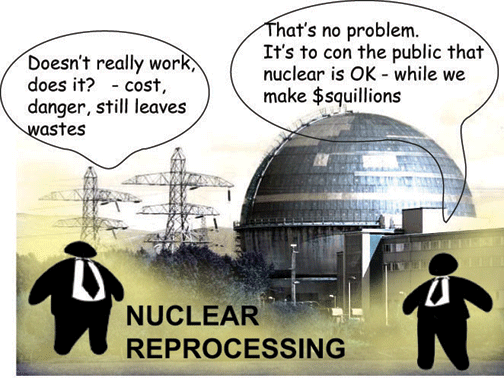 Two reactors, Takahama 3 and 4, owned by Kansai Electric, began operation in January and February 2016 loaded with plutonium MOX fuel, with unit 3 operating with 24 assemblies containing 1,088kg of plutonium and unit 4 with 4 assemblies containing 184kg of plutonium. Unit 4 shutdown due to an electrical failure three days after start up, while unit 3 was forced to shutdown on March 10th following a court order. Both reactors remain shutdown and are subject of a court injunction preventing operation issued by the Otsu district court, Shiga prefecture on March 9th. They are expected to be non operational for many months. Of the 26 reactors under review by the Nuclear Regulation Authority (NRA), Ikata-3, Genkai-3 and Tomari-3 are all intended to operate with plutonium MOX fuel.
“On current plans, and if ever the Rokkasho-mura reprocessing plant begins operation, Japan`s program could yield as much as 93,000kg by 2025 – most of which will remain unused. The reactor program in Japan is in crisis with no credible program for either restarting most reactors or using large amounts of this plutonium. If ever there was a time to abandon its current doomed nuclear energy policy, it is now. The Obama administration in its last year has an opportunity to step up and actively reduce the spiraling proliferation dynamic in East Asia – this should be top of the agenda in Washington instead of being ignored. The next step is to challenge the basis of the U.S.-Japan nuclear cooperation agreement which runs to 2018 – approval for Japan to continue acquiring plutonium must be reversed,” said Burnie.
USA worried about weapons proliferation risks in China’s Nuclear Recycling plan
China’s Plans to Recycle Nuclear Fuel Raise Concerns U.S. energy secretary airs worries about proliferation risks ahead of nuclear-security summit WSJ, By BRIAN SPEGELE, 17 MAR 16, BEIJING—China’s plans to process spent nuclear fuel into plutonium that could be used in weapons is drawing concern from the U.S. that Beijing is heightening the risk of nuclear proliferation.
U.S. Energy Secretary Ernest Moniz, in Beijing for talks, said Thursday that China’s plans to build a nuclear-recycling facility present challenges to global efforts to control the spread of potentially dangerous materials……..
Mr. Moniz’s comments marked a rare public expression by the Obama administration of concern over China’s reprocessing plans. The differences, which the governments have discussed privately, are being aired ahead of a visit by President Xi Jinping to Washington this month for a summit with President Barack Obama and other world leaders on nuclear security.
The issue comes down to the different choices countries make over how to handle potentially dangerous waste created by commercial nuclear reactors. In the U.S., spent fuel is treated as sensitive material and is stored, and reprocessing is banned out of proliferation concerns.
Elsewhere, including in France and Japan, spent fuel is recycled to extract plutonium to be used in nuclear reactors. The U.S.’s concern is that the bigger the stockpiles of plutonium, the higher the risk that some of it could be refined for use in nuclear weapons or taken by terrorists……
U.S. concerns about nuclear reprocessing and proliferation are particularly acute in the Asia-Pacific region, “where the perception is there is less international cooperation, less transparency,” said Mark Hibbs, a nuclear expert at the Carnegie Endowment for International Peace………
larger Chinese stockpiles of isolated plutonium could prompt Japan, especially, to build up its caches.
Civilian plutonium stockpiles reached 271 metric tons by the end of 2014, up from around 150 metric tons in the 1990s, the International Panel on Fissile Materials, an independent group looking at nonproliferation policy, said in its latest annual report.
The official Xinhua News Agency reported in September that construction of China’s reprocessing facility may start in 2020 and take a decade to complete. The project is expected to have a processing capacity of 800 metric tons of spent fuel a year…..
Previously, the U.S. has questioned the economic viability of such projects, which are expensive to build and operate, as well as proliferation issues, Ernest Moniz said……
Mr. Hibbs from the Carnegie center said China’s decision to pursue reprocessing couldn’t be justified on economic or commercial grounds, given the billions of dollars needed to construct one large-scale facility. But China may be acting strategically, guaranteeing future fuel supply by recycling, he added.
Last June, state-owned China National Nuclear Corp. and France’sAreva SA agreed to speed up negotiations on building the facility. Areva didn’t respond to a request for comment on Mr. Moniz’s remarks and CNNC said its press officers weren’t available.
Write to Brian Spegele at brian.spegele@wsj.com http://www.wsj.com/articles/chinas-plans-to-recycle-nuclear-fuel-raise-concerns-1458228504
PRISM and Pyropressing – untested , toxic and dangerous new nuclear toys
 PRISM BURNS AND BREEDS PLUTONIUM MIXED WITH URANIUM AND ZIRCONIUM, THE MOST TOXIC AND DANGEROUS MAN MADE ELEMENT ON EARTH


The decline of the South Carolina Mixed Oxide Fuel Fabrication (MOX) Nuclear Reprocessing Facility
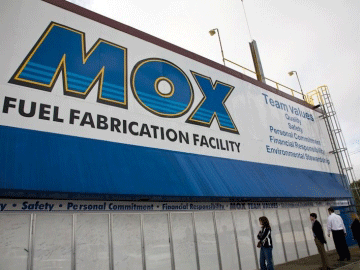 Half-Built Nuclear Fuel Plant in South Carolina Faces Test on Its Future, NYT, By JAMES RISEN FEB. 8, 2016 WASHINGTON — Time may finally be running out on the Mixed Oxide Fuel Fabrication Facility, a multibillion-dollar, over-budget federal project that has been hard to kill.
The Energy Department has already spent about $4.5 billion on the half-built plant near Aiken, S.C., designed to make commercial reactor fuel out of plutonium from nuclear bombs. New estimates place the ultimate cost of the facility at between $9.4 billion and $21 billion, and the outlay for the overall program, including related costs, could go as high as $30 billion.
Officials warn that the delays in the so-called MOX program are so bad that the plant may not be ready to turn the first warhead into fuel until 2040.
So in the budget that the Obama administration will present on Tuesday, the Energy Department proposes abandoning it. Energy officials want to spend only the money necessary to wind down the MOX program while the government shifts to a different method of disposing of the plutonium……..
The struggle is a case study in the difficulty of cutting unnecessary or wasteful federal programs, with the added twist that proponents of keeping the plant include some of the Republican Party’s most determined opponents of government spending, like Representative Joe Wilson, a South Carolina Republican whose district includes Aiken……..
Two companies involved with the plant’s construction are among Mr. Wilson’s biggest contributors, according to campaign records. Chicago Bridge and Iron, one of the two companies that own the main contractor for the facility, gave $10,000 to Mr. Wilson’s 2014 re-election campaign, and the other owner, Areva Group, donated $8,000, according to campaign records.
“Programs like this stay in the budget when they become jobs programs, and then senior members of Congress try to protect them, even if they have no redeeming value,” said David Hobson, a former Republican congressman from Ohio who said he tried and failed to kill the MOX program while he was in the House. “Where are all the budget hawks on this?”……..
The Obama administration has wanted to get rid of the program for years. In a budget request three years ago, it said the idea of making reactor fuel “may be unaffordable.” But Congress has repeatedly restored funding.
The plant is being built to comply with an agreement with Russia in 2000, when both countries said they would eliminate 34 metric tons of weapons-grade plutonium from their nuclear arsenals. Construction started during the George W. Bush administration, but has been plagued by long delays, cost overruns and little interest from commercial nuclear plants in buying the fuel that the plant was designed to produce.
Giving up on the plant means the administration will abandon plans to turn the weapons-grade plutonium into fuel for commercial nuclear reactors, and will instead switch to a process that dilutes the plutonium into nuclear waste.
The Energy Department would like to move that nuclear waste to a facility near Carlsbad, N.M., where it would be stored deep underground in salt formations. The administration says it can get rid of the weapons material under the alternative approach for about $300 million to $400 million a year, compared with $800 million to $1 billion a year under MOX………. http://www.nytimes.com/2016/02/09/us/politics/half-built-nuclear-fuel-plant-in-south-carolina-faces-test-on-its-future.html?_r=0
Nuclear waste repositary still needed: reprocessing is no answer to radioactive trash problem
EU paints challenging picture of Europe’s nuclear future, Energy Post. February 2, 2016 by Sonja van Renssen “……….Limited prospects for recycling nuclear fuel
France is the only country in Europe that is still working towards a fully closed fuel cycle with fast neutron reactors and advanced reprocessing technology. Other countries use open cycles.
France will be the only country to operate reprocessing facilities after 2018 (when those in the UK are shut down). The partially closed cycle that technology currently permits “is not expected to give a major reduction of the final disposal solution footprint in comparison to an open cycle”.
The future of recycled nuclear fuel is limited by the lack of fast-breeder reactors, more safety requirements, a higher risk of proliferation, lower competitiveness, and the fact that it still requires a final waste depository……. http://www.energypost.eu/exclusive-eu-paints-challenging-picture-europes-nuclear-future/
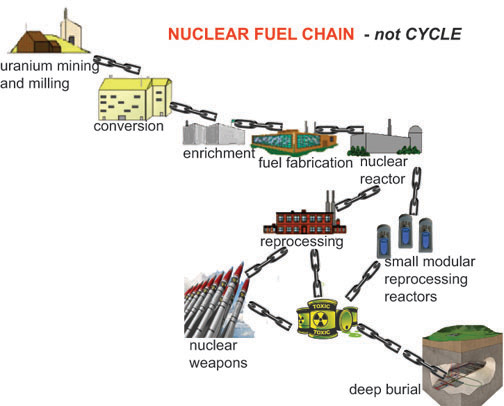
For China,nuclear reprocessing is both too costly and too dangerous
While reprocessing reduces the level of radioactivity in nuclear waste, The Union of Concerned Scientists – an advocacy group that was founded by scientists and students at the Massachusetts Institute of Technology – says it does not reduce the need for storage and secure disposal of waste.
Some within China’s own nuclear establishment are also questioning the merits of reprocessing as the nation mulls huge capital investments in the sector, U.S.-based experts say.
China is an important market for the world’s nuclear industry giants, including the United States. The U.S. last year eased restrictions on its civilian nuclear cooperation with China to allow the reprocessing of fuel from U.S.-designed reactors
 China faces nuclear energy choice: reprocess or not? WT, By MATTHEW PENNINGTON – Associated Press – Thursday, January 14, 2016 WASHINGTON (AP) – China is coming to a crossroads as it hurriedly increases nuclear power production to cope with rising electricity demand and cut carbon emissions: Should it reprocess its nuclear waste or store it?
Nonproliferation advocates warn that recycling waste would generate weapons-usable plutonium, posing a security risk and potentially stirring a nuclear rivalry in East Asia. A new Harvard University study, co-authored by a senior Chinese nuclear engineer, gives another reason against reprocessing – it doesn’t make economic sense. Continue reading
28 years later Japan’s costly nuclear recycling complex is still not working
 Japan’s $25 Billion Nuclear Recycling Quest Enters 28th Year, Bloomberg Stephen Stapczynski sstapczynski Emi Urabe January 5, 2016 It’s designed to recycle spent uranium from Japan’s nuclear power plants, consists of more than three dozen buildings spread over 740 hectares (1,829 acres), costs almost $25 billion and has been under construction for nearly three decades. Amount of fuel successfully reprocessed for commercial use: zero.
Under construction since the late 1980s, the complex is designed to turn nuclear waste into fuel by separating out plutonium and usable uranium. The start date of the project has now been pushed back for the 23rd time, with operations set to commence in 2018.
The money continuing to pour into the Rokkasho reprocessing complex in a northeast corner of Japan’s main island of Honshu is raising speculation that attention is being diverted from more-promising avenues of energy development, including renewables.
Construction on Rokkasho, the heart of the endeavor, was supposed to be completed by 1997. Delays due to technical and safety issues have kept it from operating commercially while costs ballooned to an estimated 2.94 trillion yen ($24.6 billion), according to Japan Nuclear Fuel. The Japanese government and the country’s power industry view fuel reprocessing generally, and Rokkasho specifically, as one of the only ways to lower import dependence and find a home for thousands of tons of highly radioactive spent fuel. Japan has about 17,000 metric tons of spent fuel, almost 3,000 tons of which are stored at Rokkasho.
The facility was originally intended to separate plutonium from spent fuel for use in so-called fast-breeder reactors — plants that produce more fuel than they consume.
While the nation’s first prototype fast-breeder reactor has remained closed due to its own technical issues, Rokkasho expanded construction to include a facility that processes plutonium-uranium mixed-oxide fuel, known as MOX, that can be used in some of Japan’s existing reactors…… http://www.bloomberg.com/news/articles/2016-01-04/japan-s-25-billion-nuclear-recycling-quest-enters-28th-year
Unpalatable news for nuclear industry: reprocessing may be found to be ‘wasteful spending’
 Japan may review spending on plutonium fuel cycle http://www.japantoday.com/category/national/view/japan-may-review-spending-on-plutonium-fuel-cycle By Aaron Sheldrick and Linda Sieg DEC. 11, 2015 TOKYO —
Japan may review spending on reprocessing plutonium for use in nuclear reactors, a minister appointed to identify wasteful spending told Reuters, following years of government outlays on the controversial program that has yielded no results.
The minister’s comments come after the operator of Japan’s fast breeder reactor, designed to use plutonium extracted from spent reactor fuel, was declared unfit following decades of accidents, missteps and falsification of documents.
 Costs for the Monju breeder reactor have ballooned to about 1 trillion yen ($8 billion) while Japan’s public debt is the highest among industrialized nations. Taro Kono, a ruling Liberal Democratic Party member who is a critic of the Monju facility and the nuclear industry in general, was appointed to examine government spending in a recent cabinet reshuffle by Prime Minister Shinzo Abe.
While Kono emphasized he cannot overturn government policy, he can review public projects and said Abe had told the cabinet that wasteful spending had to be taken “out of the budget.”
He has been reviewing part of the government budget request of 102 trillion yen for the fiscal year starting March, including a little-used ship carrying nuclear fuel and subsidies to towns that host nuclear power plants. “In my portfolio, I can ask them if the money is spent wisely and that’s what I have been doing and the nuclear fuel cycle is no exception,” the U.S.-educated Kono said.
He said next year’s review could be widened to include all government spending on nuclear projects, something that might resonate with voters after the Fukushima disaster in 2011 turned the public against atomic power. “If they are not doing a good job, the review next year will be all nuclear, maybe,” Kono said.
His comments could have implications for another costly nuclear project that is mostly in private hands but has strong government support and receives some public funds. The Rokkasho plutonium reprocessing facility in northern Japan is meant to provide fuel for Monju and some of Japan’s nuclear reactors, but completion was delayed for a 23rd time last month.
The plant has been beset with problems since the first concrete was laid in 1993 and costs have ballooned to 2.2 trillion yen ($18 billion) from 760 billion yen.
 Meanwhile, Japan’s plutonium stockpile has expanded to nearly 50 tons, with stocks held in Britain and France as well as in Japan. Recently, a group of 31 scientists wrote to Abe urging him to abandon reprocessing.
With all but two of Japan’s reactors shut down in the wake of the Fukushima disaster and no immediate use for the plutonium, there is little meaning to the costly exercise of extracting more from spent fuel, critics say.
“The PM’s directive is very clear. If we point out any items that are not spent well it has to be out of the budget,” Kono said. “That’s why a few ministers are not speaking to me right now,” he added, with a laugh.
PRISM (Power Reactor Innovative Small Module) and MOX much touted, but nuclear waste burial is best
Another option on the table is PRISM. Developed by GE Hitachi (GEH), PRISM is a sodium-cooled fast reactor that uses a metallic fuel alloy of zirconium, uranium, and plutonium. GEH claims PRISM would reduce the plutonium stockpile quicker than MOX and be the most efficient solution for the UK. The problem is, despite being based on established technology, a PRISM reactor has yet to be built, and the UK is understandably a little reluctant to commit in this direction. Seen as something of a gamble, it remains in the running alongside the currently more favoured MOX option.
Amid all the uncertainty, one thing is for sure. Regardless of what decision is taken, a proportion of the plutonium will end up as waste and will need to be safely disposed of.

 Unlike MOX and PRISM, immobilisation has no prominent industry backers. In comparison to exploiting the plutonium for our energy needs, there is no great fortune to be made from disposing of it safely. But immobilising the entire plutonium stockpile may in fact be a more economically sound approach than reprocessing
Sellafield plutonium a multi-layered problem, The Engineer UK, 6 November 2015 | By Andrew Wade “……..It takes somewhere in the region of 5-10kg of plutonium to make a nuclear weapon, so 140 tons is a slightly worrying amount to have sitting in a concrete shed in Cumbria. While everyone at the press conference was at pains to point out that there are no major safety concerns with the current storage, it is widely accepted that a long-term plan needs to be formulated. This, however, is where things get tricky. The potential energy of the plutonium if converted to nuclear fuel is massive, but there are several competing technologies vying for endorsement, none of which are well proven as financially viable.
Top of the list – and the government’s current preference – is for some application that uses mixed oxide fuel, or MOX. MOX is made by blending plutonium with natural or depleted uranium to create a fuel that is similar, but not identical, to the low-enriched uranium used in most nuclear plants today. MOX can be – and in several European countries is – used in thermal reactors alongside uranium. But despite past concerns, there is in reality no shortage of uranium today, so no huge need to supplement it with MOX in current reactors. Where MOX could in fact lead to greater efficiencies is in fast reactors, but these are costly and difficult to operate, and would not make economic sense unless the cost of uranium fell.
To complicate matters further, developing MOX is by no means a straightforward process. Continue reading
Japan’s nuclear reprocessing boondoggle – Monju reactor still in trouble
NRA’s ‘new management’ call for Monju reactor proves divisive, Japan Times, BY ERIC JOHNSTON OSAKA, 6 Nov 15, – Two decades after a sodium leak and fire shut it down and nearly six decades after it was first conceived, the Monju prototype fast-breeder reactor in Tsuruga, Fukui Prefecture, suffered another blow Wednesday when the Nuclear Regulation Authority called for it to be turned over to another operator.
To date, over ¥1 trillion has been poured into Monju — a plant that has never produced commercial electricity. Despite remaining inactive, safety measures alone cost ¥50 million a day.
Anti-nuclear activists have hailed the NRA’s unusually critical language as an important step toward scrapping the reactor, which was supposed to burn plutonium mixed with uranium.
Fukui politicians who heavily support Monju, including the prefecture’s governor and the mayor of Tsuruga, doubt that another operator can be found. They also worry that scrapping it would create local concerns as well as safety issues.
“What does it mean when the NRA says that it can’t leave Monju’s operations to the (government-backed) Japan Atomic Energy Agency? There aren’t any other organizations it can be left to,” Tsuruga Mayor Takanobu Fuchikami told reporters after the decision…….
Monju, conceived in the 1950s, has faced nothing but technical trouble, domestic and international controversies, and scandals.
Originally slated to go live in 1970, monju did not reach criticality until 1994. It was shut down following a December 1995 leak and fire involving liquid sodium. The incident was at that time Japan’s worst nuclear-related accident.
Further delays and scandals meant that by 2005, when Monju was taken over by JAEA after its predecessor organization was disbanded, officials hoped it would be commercially viable by around 2050.
But after it was revealed in 2012 that JAEA had failed to inspect nearly 10,000 reactor components in and after 2010, the NRA ordered Monju not to engage in preparatory work until it was satisfied safety had been improved…..
Activists are urging the government to give up on the project.
“Monju should be permanently shut down. If the Japanese government is capable of immediately and permanently scrapping Monju, we can gain some trust that it intends to have a logical, functional basic energy policy,” said Aileen Mioko Smith, executive director of Kyoto-based anti-nuclear group Green Action. “If it continues the status quo by flogging a horse that has been dead for 20 years, it bodes badly for Japan’s energy future.” http://www.japantimes.co.jp/news/2015/11/05/national/nras-new-management-call-monju-reactor-proves-divisive/#.Vj0CA9IrLGj
Japan’s Monju nuclear reprocessing reactor, plagued by safety errors, offline for most of 20 years
 Errors found in safety management of Monju reactor http://www3.nhk.or.jp/nhkworld/english/news/20150903_28.html Sep. 3, 2015 Japan’s nuclear regulators have found fresh faults with the safety management of the country’s fast-breeder reactor, which is currently offline. They say they have found thousands of errors in safety classifications of the equipment and devices at the Monju reactor.
The operator of the prototype reactor in Fukui Prefecture, central Japan, has been banned from conducting test runs since 2013 following discoveries of a large number of safety inspection oversights.
The Nuclear Regulation Authority says it has recently found at least 3,000 mistakes with safety classifications of equipment and devices at the reactor during its regular inspections which are conducted 4 times a year. Its officials say, equipment and devices with high importance were, in some cases, classified in lower ranks in the 3-level system, which suggest the operator might have failed to carry out necessary inspections for them.
The errors found recently include those going as far back as 2007. The fact suggests that government inspectors have also overlooked the operator’s mistakes. The operator, Japan Atomic Energy Agency, built the Monju fast-breeder reactor in the early 1990s to reuse the spent nuclear fuel MOX, a mixture of plutonium extracted from spent fuel and uranium.
But it has been offline for most of the period after it underwent a fire from a leak of sodium, the reactor’s coolant, in 1995.
The operator aims to conduct the reactor’s test run by next March. But it is uncertain when the ban by the authority will be lifted. The plant’s director, Kazumi Aoto, says he will take the government’s report seriously. An NRA inspector, Yutaka Miyawaki, says the regulators will try to identify the actual effects of the errors.
Disposal of plutonium; burial is cheaper than MOX processing

 nuClear news No.77, September 20156. Plutonium Conundrum A US Energy Department-commissioned study, which has been leaked to the Union of Concerned Scientists, concludes that it would be cheaper and far less risky to dispose of 34 metric tons of U.S. surplus plutonium at a federal nuclear waste repository in New Mexico than convert it into mixed-oxide (MOX) fuel for commercial nuclear power plants at the MOX Fuel Fabrication Facility in South Carolina.
The unreleased report describes in detail the delays and massive cost overruns at the half-built MOX facility, located at the federal Savannah River Site. High staff turnover, the need to replace improperly installed equipment, and an antagonistic relationship between the local federal project director and the contractor are only some of the factors undermining the project. The new report also notes that there are “no obvious silver bullets” to reduce the life-cycle cost of the MOX approach.
According to UCS, a better alternative to turning the surplus plutonium into commercial nuclear fuel would be to “downblend” it, a method the Energy Department has already used to dispose of several metric tons of plutonium. It involves diluting the plutonium with an inert, nonradioactive material and then sending it to the nuclear waste site in New Mexico, the Waste Isolation Pilot Plant (WIPP), for burial. The new report’s analysis supports that assessment. …….
Disposal of nuclear waste turning out to be half the cost of reprocessing with MOX fuel
Disposal beats MOX in US comparison http://www.world-nuclear-news.org/WR-Disposal-beats-MOX-in-US-comparison-2108151.html?utm_source=dlvr.it&utm_medium=twitter 21 August 2015
America is reconsidering how it will dispose of 34 tonnes of plutonium as the previous plan involving a MOX plant has been said to be twice as costly as a dilution and disposal option in a leaked Department of Energy (DOE) report.
The plutonium arises from a June 2000 nuclear weapons reduction agreement with Russia under which both countries would put 34 tonnes of plutonium beyond military use. Russia opted to use its plutonium as fuel for fast reactors generating power at Beloyarsk.
The USA, meanwhile, decided to build a mixed-oxide (MOX) nuclear fuel plant at Savannah River, where the plutonium would be mixed with uranium and made into fuel for light-water reactors. The design is similar to Areva’s Melox facility at Marcoule, but modified to handle metal plutonium ‘pits’ from US weapons and their conversion from metal to plutonium oxide. It is this part of the process that has been problematic. Construction started in 2007 with an estimated cost of $4.9 billion but work ran into serious trouble before being ‘zeroed’ in the DOE’s 2014 budget, putting development on ice.
The Union of Concerned Scientists yesterday published what it said was an unreleased DOE report that compared the cost of completing the MOX plant to other options. Use in fast reactors was considered briefly, but with this technology not readily available in the near term, the prime comparison was against a ‘dilution and disposal’ option which would see the plutonium mixed with inert materials and disposed of in the Waste Isolation Pilot Plant, or WIPP, in New Mexico.
Despite being 60% built, the MOX plant still needs some 15 years of construction work, said the leaked report, and then about three years of commissioning. Once in operation the plant would work through the plutonium over about 10 years with this 28-year program to cost $700-800 million per year – a total of $19.6-22.4 billion on top of what has already been spent. Not only is the price tag very high, but the timescale is too long: the report said this would not meet the disposal timeframe agreed with Russia.
The cost of the MOX plant could not be mitigated by income from sales of the MOX fuel because the regulatory process to gain approval to use MOX would be too burdensome for a commercial utility. The report said “it may be unlikely” that even a utility in a regulated market where fuel costs are passed on to consumers would “bear the risk of MOX fuel even if it is free”.
Dilution and disposal would cost $400 million per year, said the report, “over a similar duration” as MOX, working out at close to half the cost. Other advantages for dilution and disposal are that it requires no new facilities to be created or decommissioned after use, although the increase in WIPP disposal means “it may eventually become desirable to explore expansion of WIPP’s capacity” beyond currently legislated limits. This unique geologic disposal facility was said to be of “tremendous value to both DOE and the State of New Mexico”.
Savannah River Site’s MOX project needs $800 million a year
Review: MOX needs $800M a year http://www.aikenstandard.com/article/20150820/AIK0101/150829974/1121
Earlier this year, the Department of Energy commissioned the Red Team, a group led by Thom Mason, the director of the Oak Ridge National Laboratory, to evaluate cost projections and alternatives to the MOX method of plutonium disposition. The method includes the Mixed Oxide Fuel Fabrication Facility under construction at SRS.
The project is part of a nonproliferation agreement with Russia to dispose of 34 metric tons of weapons grade plutonium.
“The Red Team concluded that if the MOX pathway is to be successful, then annual funding for the whole program would have to increase from the current $400 million per year to $700 to 800 million per year over the next 2-3 years, and then remain at $700 to $800 million until all 34 metric tons are dispositioned,” officials wrote.
The Aiken Standard will have more on the MOX review in Friday’s paper.
21 years after shutdown, USA’s Experimental Breeder Nuclear Reactor-II (EBR-II) is entombed
USA’s Experimental Breeder Reactor-II now permanently entombed, World Nuclear News
01 July 2015 The main clean-up contractor at the US Department of Energy’s (DOE’s) Idaho Site, has entombed an historic nuclear reactor in place and treated the reactor’s remaining sodium coolant….CH2M-WG, Idaho, LLC (CWI) said yesterday that crews with the Decontamination and Decommissioning (D&D) Program recently completed pouring more than 3400 cubic yards of concrete grout into the basement of the Experimental Breeder Reactor-II (EBR-II) building to fill in any remaining void spaces and effectively entomb the reactor.
Workers also removed and treated the last of the sodium coolant from the reactor’s nine heat exchangers. The exchangers were used to cool the liquid metal and direct the steam to a generating turbine to produce electricity when the reactor was operating.
The EBR-II was the basis of the US Integral Fast Reactor (IFR) program…….. The reactor was shut down in 1994 and its fuel was removed and transported to another site facility for safe storage.
The DOE grouted the reactor in place instead of removing it to protect workers from industrial hazards and radiological risks, CWI said. Crews filled the reactor vessel with grout over two years ago and recently completed the remainder of grouting at the facility under CWI’s contract.
1 This Month

of the week – Shut Down Drone Warfare!


Tell the Ukrainian Government to Drop Prosecution of Peace Activist Yurii Sheliazhenko

Petition to revoke the licensing of the Near Surface Nuclear Disposal Facility (NSDF) at Chalk River. https://www.ourcommons.ca/petitions/en/Petition/Details?Petition=e-7247
To see nuclear-related stories in greater depth and intensity – go to https://nuclearinformation.wordpress.com
-
Archives
- April 2026 (7)
- March 2026 (251)
- February 2026 (268)
- January 2026 (308)
- December 2025 (358)
- November 2025 (359)
- October 2025 (376)
- September 2025 (257)
- August 2025 (319)
- July 2025 (230)
- June 2025 (348)
- May 2025 (261)
-
Categories
- 1
- 1 NUCLEAR ISSUES
- business and costs
- climate change
- culture and arts
- ENERGY
- environment
- health
- history
- indigenous issues
- Legal
- marketing of nuclear
- media
- opposition to nuclear
- PERSONAL STORIES
- politics
- politics international
- Religion and ethics
- safety
- secrets,lies and civil liberties
- spinbuster
- technology
- Uranium
- wastes
- weapons and war
- Women
- 2 WORLD
- ACTION
- AFRICA
- Atrocities
- AUSTRALIA
- Christina's notes
- Christina's themes
- culture and arts
- Events
- Fuk 2022
- Fuk 2023
- Fukushima 2017
- Fukushima 2018
- fukushima 2019
- Fukushima 2020
- Fukushima 2021
- general
- global warming
- Humour (God we need it)
- Nuclear
- RARE EARTHS
- Reference
- resources – print
- Resources -audiovicual
- Weekly Newsletter
- World
- World Nuclear
- YouTube
-
RSS
Entries RSS
Comments RSS
 nuclear-news