Questions: why does USA allow only Japan to reprocess plutonium?
 Japan’s ‘plutonium exception’ under fire as nuclear pact extended https://asia.nikkei.com/Politics/International-Relations/Japan-s-plutonium-exception-under-fire-as-nuclear-pact-extended Beijing and Seoul question why US allows only Tokyo to reprocess, TOKYO — Japan’s nuclear cooperation agreement with the U.S. — the pillar of Tokyo’s nuclear energy policy — renews automatically on Monday after the current pact, which took effect in 1988, expires.
The agreement allows Japan to be the sole non-nuclear-weapons state to use plutonium for peaceful purposes and underlies the country’s policy of recycling spent nuclear fuel.
But the renewal comes at a time when Japan’s “plutonium exception” is increasingly under scrutiny. Instead of negotiating a new pact that could last several decades, Washington and Tokyo chose an automatic extension of the current agreement.
The agreement signed three decades ago stated that after the 30-year period expired, the terms would remain in force but could be terminated by either side with a six months’ notice. Japan worries that without a new long-term agreement, the country enters an “extremely unstable situation,” Foreign Minister Taro Kono has said.
Japan’s neighbors have cried foul over Japan’s plutonium exception. China has said it creates a path for Japan to obtain nuclear weapons. South Korea, which also has a nuclear cooperation agreement with the U.S., has pressed Washington hard to be granted similar freedom on fuel reprocessing.
Countries such as Saudi Arabia that are looking to develop their own nuclear programs have also protested.
Under President Barack Obama, Japan’s plutonium stockpiles — much of which is stored in the U.K. — drew uncomfortable attention in Washington. In March 2016, Thomas Countryman, the then-assistant secretary of state for nonproliferation, told a Senate hearing that he “would be very happy to see all countries get out of the plutonium reprocessing business.”
President Donald Trump has shown less interest in preventing nuclear proliferation, but is committed to dismantling North Korea’s nuclear facilities and materials. Resolving the inconsistent treatment afforded Japan’s plutonium stockpile would make it easier to convince Pyongyang to give up reprocessing capabilities as part of its denuclearization, Countryman told Nikkei recently.
The Trump administration appears aware of these arguments. The National Security Council and State Department have requested that Japan reduce its stockpile and otherwise ensure its plutonium is used and managed appropriately. On July 3, Japan’s cabinet approved a new basic energy plan that includes reducing plutonium holdings, aiming to assuage American concerns.
But Japan’s mostly idled nuclear power industry makes working through the stockpile a challenge.At one point after the 2011 Fukushima nuclear disaster, all of the country’s reactors were offline. Nine have managed to restart under stricter safety standards adopted in the wake of the meltdowns, but only a few Japanese reactors can run on so-called mixed-oxide fuel containing plutonium.
Regulators have asked utilities such as Shikoku Electric Power and Kyushu Electric Power that are working to restart nuclear reactors to look into consuming plutonium fuel held by other power companies. But this would require potentially difficult negotiations with local governments.
One other option is to pay overseas countries that store plutonium on Japan’s behalf to dispose of them, but that would involve discussion on the international level.
“The only viable option is to explain to the world the steady efforts we are making toward reduction,” said an official at the Ministry of Economy, Trade and Industry, which is responsible for Japan’s energy policy.
So far, the U.S. has not called on Japan to abandon its plutonium entirely, or to speed up its reduction. And there is little chance the U.S. will end the cooperation agreement, as “Japan’s nuclear technology is indispensable to the American nuclear industry,” according to a Japanese government source.
But Tokyo worries that the Trump administration may apply the same transactional approach it has to other foreign policy issues to the question of Japan’s plutonium.
Japan’s nuclear reprocessing must end – to stop accumulation of weapons-useful plutonium
Make US-Japanese nuclear cooperation stable again: End reprocessing, Bulletin of the Atomic Scientists, By Victor Gilinsky, Henry Sokolski, June 27, 2018
In a little-noticed but remarkable statement last week, Japanese Foreign Minister Taro Kono described a key pillar of the Japanese-American alliance—US-Japanese peaceful nuclear cooperation—as “unstable.” His pronouncement comes on the eve of the automatic renewal of the 1988 US-Japan peaceful nuclear cooperation agreement in July and days after US officials privately pressured Tokyo to reduce its vast plutonium holdings (some 45 tons —which translates to nearly 9,000 nuclear bombs’ worth).
The starting point in dealing with this massive plutonium stockpile: Keep it from growing. That means Tokyo needs to freeze plans to open its large Rokkasho reprocessing plant, which can separate eight more tons of plutonium a year.
The United States and Japan got to this awkward spot in the 1970s and ‘80s, when Tokyo insisted it needed plutonium to fuel a future generation of fast breeder reactors and sought permission to extract it from irradiated US-supplied uranium fuel. We had earlier allowed the Euratom countries to do this and so President Reagan, hesitating to distinguish among close allies, relented. As Under Secretary of State Richard T. Kennedy told the Senate in 1982 in explaining blanket approvals for Japan and Euratom, “The US will not inhibit or set back civil reprocessing and breeder reactor development abroad in nations with advanced nuclear programs where it does not constitute a proliferation risk … nations which regard the uses of plutonium as crucial to meeting their future nuclear energy needs.”
The 1988 understanding with Japan was the only US nuclear cooperation agreement with an individual country that granted blanket reprocessing approval for the duration of the agreement (which, with automatic extensions, effectively meant forever). The agreement approved reprocessing for Japan both in British and French reprocessing plants and in any that Japan itself might build. Meanwhile, Japan’s fast breeder development faltered (as did other such breeder programs around the world), and Japan installed no commercial reactors of this type. Because it has a large fleet of nuclear power plants that produce spent nuclear fuel containing plutonium and reprocessing arrangements at home and abroad, Japan has amassed an enormous plutonium stockpile.
The legal basis of this blanket approval was problematic from the start. The General Accounting Office (GAO) told Congress that the agreement was so permissive it violated the strict nonproliferation requirements in Section 131 of the US Atomic Energy Act. For this reason, the Senate Foreign Relations Committee urged the Reagan administration to renegotiate the agreement, but the administration overrode Congressional opposition.
In Section 131 b 2, the Atomic Energy Act requires that reprocessing of nuclear reactor fuel supplied by the United States, and extraction of plutonium, take place only with US permission and sets forth the standard for granting reprocessing approvals: The secretaries of Energy and State must find that the action “will not result in a significant increase of the risk of proliferation.” The “foremost consideration” in making that finding is whether the United States will have “timely warning,” that is, “well in advance of the time at which the non-nuclear weapon state could transform the diverted material into a nuclear explosive device.”………..
The official justification for allowing nuclear power systems based on plutonium—a fuel that is also a nuclear explosive—argued that they would be subject to IAEA inspections, which are intended to deter diversion of fissile material to military use by providing warning in time to thwart any such diversion. But the IAEA couldn’t do that in the case of separated plutonium, so something had to give. What buckled was the definition of timely warning, which was rationalized to be met if we had sufficient confidence that the recipient of our exports would not build nuclear weapons. Hence, Under Secretary of State Kennedy could speak in 1982 of countries like Japan where nuclear explosive materials do “not constitute a proliferation risk.”
The situation today, though, is radically different. The economic prospects of civilian nuclear power are now generally far less favorable than they were then; the rationale for plutonium-fueled breeder reactors, once widely believed to be the energy source of the future, has essentially evaporated.
There is no longer any reason to twist the plain meaning of the Atomic Energy Act’s requirement for timely warning. It effectively rules out approvals for plutonium separation, and therefore for reprocessing. Whereas one could have once plausibly argued that this would impose a severe cost on Japan, the situation is now completely reversed: If Japan shut down its Rokkasho reprocessing plant, it would now be freed from an outdated policy and would save a great deal of money.
The Rokkasho decision is of course up to Japan. But the United States should make clear where it stands, which it has not yet done. Such a step should be part of an overall US approach to end plutonium separation throughout the world, for which current nuclear power programs have no need. Nonproliferation and economics point in the same direction: no reprocessing provisions in future 123 agreements and urging other countries that sell nuclear material and technology to include such provisions in their agreements. The recent Korean summits emphasizing denuclearization and Secretary Pompeo’s recent stand against reprocessing in the United Arab Emirates, Saudi Arabia, and Iran are steps in the right direction. They underline the importance of Japan ending its reprocessing. https://thebulletin.org/2018/06/make-us-japanese-nuclear-cooperation-stable-again-end-reprocessing/
Why Japan should disconnect from fast-breeder reactor project – The Asahi Shimbun
EDITORIAL: Japan should disconnect from fast-breeder reactor project http://www.asahi.com/ajw/articles/AJ201806180025.html, June 18, 2018
France has decided to sharply scale down its ASTRID fast-reactor project, which is supported by Japan.
France’s decision underscores afresh the dismal outlook of Japan’s plan to continue the development of fast-reactor technology by relying on an overseas project.
Now that it has become unclear whether participation in the ASTRID project will pay off in future benefits that justify the huge investment required, Japan should pull out of the French undertaking.
Fast reactors are a special type of nuclear reactors that burn plutonium as fuel. The ASTRID is a demonstration reactor, the stage in reactor technology development just before practical use.
The French government has said the Advanced Sodium Technological Reactor for Industrial Demonstration, if it comes on stream, will generate 100 to 200 megawatts of electricity instead of 600 megawatts as originally planned. Paris will decide in 2024 whether the reactor will actually be built.
Japan has been seeking to establish a nuclear fuel recycling system, in which spent nuclear fuel from reactors will be reprocessed to extract plutonium, which will then be burned mainly in fast reactors.
When the Japanese government in 2016 pulled the plug on the troubled Monju prototype fast-breeder reactor, which was at the technology stage prior to that of a demonstration reactor, it decided to make the joint development of the ASTRID the centerpiece of its plan to continue the nuclear fuel recycling program.
The government will provide some 5 billion yen ($45.2 million) annually for the French project through the next fiscal year, which starts in April, and decide, by the end of this year, whether and how it will be involved in the project after that.
Because of significant differences in the roles of prototype and demonstration reactors, a simple comparison between the Monju and the ASTRID can be misleading.
But it is clearly doubtful whether the ASTRID, which will be smaller than the Monju, will offer sufficient benefits for Japan’s fuel recycling program.
If it fully commits itself to the joint development of the ASTRID in response to France’s request, Japan will have to shoulder half the construction cost, estimated to be hundreds of billions to 1 trillion yen, and assign many engineers to the project. But these resources could end up being wasted.
Over the years, the government spent more than 1.1 trillion yen of taxpayer money on the Monju, designed to be a small-scale example of the potential of the fast-breeder reactor technology. But the prototype reactor remained out of operation for most of the two decades after it became operational. It actually accomplished only a small fraction of what it was designed to achieve.
The government should make an early decision to end its involvement in the ASTRID to avoid repeating the mistake it made with the Monju project, which was kept alive at massive cost for far too long as the decision to terminate it was delayed for years without good reason.
The government has only itself to blame for the current situation. Despite deciding to decommission the Monju, it stuck to the old fuel cycle policy without conducting an effective postmortem on the Monju debacle. Instead, the government too readily embraced the ASTRID project as a stopgap to keep its fast-reactor dream alive.
The government needs to rigorously assess whether it is wise to continue developing fast-reactor technology.
Producing electricity with a fast reactor is costlier than power generation with a conventional reactor that uses uranium as fuel. The United States, Britain and Germany phased out their own fast-reactor projects long ago.
France has continued developing the technology, but feels no urgent need to achieve the goal. The country predicts that the technology will be put to practical use around 2080 if it ever is.
Even if Japan wants to continue developing fast-reactor technology, it would be extremely difficult to build a demonstration reactor for the project within the country given that even finding a site to build an ordinary reactor is now virtually impossible.
The government would be utterly irresponsible if it aimlessly keeps pouring huge amounts of money into the project when there is no realistic possibility of the technology reaching the stage of practical application.
If it abandons the plan to develop fast-reactor technology, the government will have to rethink the entire nuclear fuel recycling program.
Any such fundamental change of the nuclear power policy would have serious implications. But there is no justification for postponing the decision any further.
Why does Japan persist with dangerous, unnecessary nuclear Rokkasho reprocessing? Is it to enable nuclear weapons?
 The Rokkasho reprocessing plant could ruin everything, Beyond Nuclear, By Kiyohiko Yamada, with additional contributions by Kurumi Sugita and Jon Gomon, 17 June 18
There is a nuclear fuel cycle center in Rokkasho village, located at the tip of Shimokita Peninsula in Aomori Prefecture, in the northernmost part of the main island of Japan.
On April 9, 1985, the governor of Aomori Prefecture gave the green light for the Rokkasho center to proceed. At first, it comprised three facilities:
•a uranium enrichment plant
•a fuel reprocessing plant
•a low-level radioactive waste repository
Later, two more facilities were added:
•a temporary storage facility of high-level radioactive waste returned from overseas after reprocessing,
•a MOX fabrication plant.
The nuclear fuel cycle center of Rokkasho village is operated by Japan Nuclear Fuel Limited (JNFL), notorious for its incompetent management. In October 2017, the Japanese Nuclear Regulation Autority (NRA) reported that JNFL violated safety measures. As the Mainichi Shimbun reported in an October 11, 2017 article, safety records were faked at the unfinished reprocessing plant.
“The NRA concluded on Oct. 11 that Japan Nuclear Fuel Ltd. (JNFL) has violated safety measures after it was learned that the firm failed to carry out the required checks and nevertheless continued to write down “no abnormalities” in safety check records. There has been a spate of incidents such as the flow of rainwater into facility buildings at the plant in the Aomori Prefecture village of Rokkasho.
“The plant, which is scheduled to reprocess spent nuclear fuel, was on the verge of hosting a final-stage NRA safety inspection, but the checkup is likely to be postponed considerably as JNFL now has to prioritize in-house inspections of all facilities at the plant.”The Japanese nuclear fuel cycle collapsed with the fast breeder reactor “Monju”
The Japanese government obstinately pursued a fast breeder reactor program, even though other similar projects had been abandoned elsewhere in the world. An estimated $9 billion was spent on Japan’s Monju prototype breeder reactor, which was so troubled it operated only 250 days during its 22-year existence. It was finally abandoned permanently in December 2016 and the decision was taken to decommission it.
And yet the Japanese government persists in trying to start operation of the Rokkasho reprocessing plant in the first half of 2021, even though the prospect of the fast breeder reactor’s commercialization has become improbable.
There is a contradiction here. Why start a reprocessing plant when there is no usage plan for the end product? One possible reason is that for quite some time, former Liberal Democratic Party (LDP) ministers have been hinting at the possibility of having nuclear weapons. Reprocessing extracts plutonium from irradiated reactor fuel. Perhaps the real intent is to have such a plutonium extraction plant which can produce eight tons of plutonium annually.
Surplus plutonium problem.……..
If the Rokkasho reprocessing plant is put into operation, it will create a surplus of eight tons of plutonium annually. The possession of such an amount of plutonium will most certainly increase tensions in Asia.
Risks involved in the Rokkasho plant
① The reprocessing plant is on a fault line
Japan is riddled with geological faults, and there is no stable stratum including at the Rokkasho reprocessing plant site. A large, active fault about 100 km in length lies on the Pacific Ocean side. Scientists warn that in the case of a big earthquake, a magnitude 8 tremor could seriously damage the reprocessing plant.
The operating company insists that a big earthquake will not occur in Rokkasho, but their seismograph is installed on bedrock, and is set so that it does not indicate more than a seismic intensity of 3. Why? It is because when seismic intensity higher than 3 is detected, it is necessary to make a total inspection of the reprocessing plant.
② Hakkoda and Towada volcanoes are nearby ….
③ Fighter jets fly near Rokkasho …..
Possibility of a serious accident …….
If the plant goes into operation, even without an accident, radiation exposure of the entire Aomori Prefecture, and of the Pacific Ocean, will be far too high
After the Fukushima Daiichi nuclear accident, many tanks were created on the site of the Fukushima nuclear power plant to store the tritium contaminated water after processing the radioactive water by the multi-nuclide removal facility (Advanced Liquid Processing System). In Fukushima prefecture, tritium contaminated water is not discharged into the ocean due to opposition from fishermen. In contrast, the same tritiated water was released in large amounts in Rokkasho during the active testing. Fishermen in Iwate once demanded that the reprocessing plant drainage be discharged into Mutsu Bay and not into the Pacific Ocean. The person in charge in Aomori Prefecture refused, saying, “Mutsu Bay would die”.
An upcoming mayoral election in Rokkasho Village could have important repercussions for the reprocessing plant. One candidate— Junk Endo — is resolutely opposed to opening it. The election takes place on June 24, 2018.
We are calling on our friends and colleagues all around the world to send Ms. Endo messages of support. It is important that Japanese authorities understand that the world is watching these elections. The people of Rokkasho do not need the leukemia clusters or the proliferation risks of a reprocessing plant. The world does not need more carcinogenic radioactive releases from yet another reprocessing plant when those at La Hague, France, and Sellafield, England, have already poisoned the air and seas far from their own lands. https://beyondnuclearinternational.org/2018/06/17/all-that-would-be-destroyed-reprocessing-japan/
Japan approves 70-year plan to scrap nuclear reprocessing plant
https://mainichi.jp/english/articles/20180613/p2g/00m/0dm/072000c
(Mainichi Japan) TOKYO (Kyodo) — Japan’s nuclear watchdog on Wednesday approved a plan to scrap a nuclear fuel reprocessing plant northeast of Tokyo over a 70-year period with the cost projected at 1 trillion yen ($9 billion).
The facility in Tokaimura, Ibaraki Prefecture went into operation in 1977. It was Japan’s first spent-fuel reprocessing plant built under the nation’s nuclear fuel cycle policy, which aims to reprocess all spent nuclear fuel in order to reuse the extracted plutonium and uranium as reactor fuel in the resource-scarce country.
But the policy has run into a dead end as the completion of a separate fuel reprocessing plant in Aomori Prefecture, built on the technological expertise of the Tokaimura plant, has been delayed by more than 20 years.
The decommissioning cost will be shouldered by taxpayers as the Japan Atomic Energy Agency operating the Tokaimura plant, is backed by the state. Where to store the waste accumulated at the plant is undecided.
In 2014, the agency decided to decommission the plant due to its aging and the huge cost to run it under stricter safety rules introduced after the 2011 Fukushima nuclear crisis.
According to the plan approved by the Nuclear Regulation Authority, around 310 canisters of highly radioactive vitrified waste and some 360 cubic meters of radioactive waste are currently stored at the facility.
About 770 billion yen is estimated for the disposal of such waste and decommissioning of the facility and roughly 217 billion yen for the 10-year preparation work.
MOX nuclear fuel project in deep trouble, but judge rules against suspending its construction

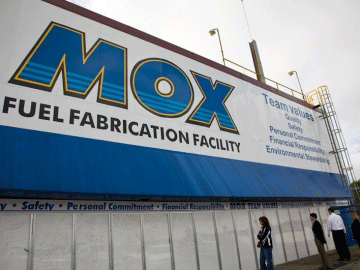 Judge’s ruling keeps over-budget nuclear project from being shut down, BY SAMMY FRETWELL sfretwell@thestate.com June 07, 2018
A judge on Thursday stopped the federal government from suspending construction of a nuclear fuel factory at the Savannah River Site atomic weapons complex near Aiken.
The ruling by U.S. District Judge Michelle Childs damages federal efforts to walk away from the over-budget and behind-schedule mixed oxide fuel project, which has been on the drawing boards for more than two decades and is currently under construction. The mixed oxide fuel plant would turn excess weapons grade plutonium into fuel for commercial nuclear reactors.
The U.S. Department of Energy has been trying in recent years to suspend the project, saying it is expensive and no longer necessary to dispose of the plutonium. The latest federal plan is to ship excess plutonium, a key ingredient in nuclear bombs, to a New Mexico site for disposal.
Childs’ order temporarily halts the federal shutdown process until arguments can be heard in court over whether to keep the effort going. ……..
Savannah River Site Watch’s Tom Clements, an opponent of the MOX project, said he was disappointed in the judge’s ruling Thursday. Clements says the project isn’t necessary.
“The judge doesn’t understand what deep trouble the project is in,’’ he said, noting that building the MOX project doesn’t necessarily mean South Carolina will get rid of all surplus plutonium at SRS.
The project is about $12 billion over budget and years behind schedule, but employs hundreds of people who would be out of work if the project shuts down, boosters say. It has been touted as a way to provide new missions for SRS.
Federal officials say they won’t forget SRS in shutting down the MOX plant. They have proposed converting it to a factory to make plutonium pits for nuclear weapons. http://www.thestate.com/latest-news/article212778069.html
France scaling back nuclear reprocessing – fears of financial disaster as with Japan’s Monju project
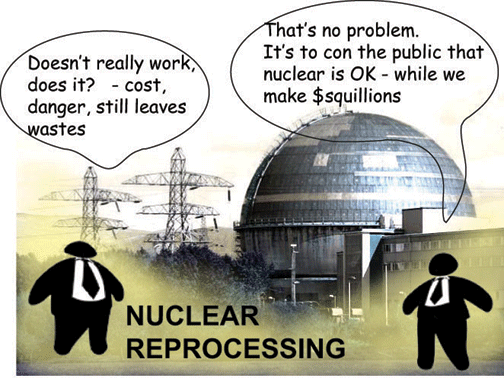 Scaling back of French reactor a blow for nuke fuel reprocessing THE ASAHI SHIMBUN May 31, 2018
Japan’s hopes of keeping its nuclear fuel recycling program alive faces another major obstacle with signs from France that a reactor project there will be scaled back because of swelling construction costs.
After the nuclear fuel recycling program suffered a heavy blow with the decision in late 2016 to decommission the Monju prototype fast-breeder reactor, government officials turned to France’s ASTRID program as an alternative information source for the fuel recycling plan.
But French government officials said the Advanced Sodium Technological Reactor for Industrial Demonstration will have its planned power generation scaled back from the initial plan of 600 megawatts of electricity to between 100 and 200 megawatts.
The major aim of the nuclear fuel recycling program is to reprocess spent nuclear fuel to extract plutonium, which would be used to create mixed-oxide fuel that could be burned in nuclear reactors.
Government officials had hoped to use various technologies emerging from the ASTRID program to eventually construct a demonstration fast reactor in Japan. But a scaled-back ASTRID would mean knowledge needed for the demonstration reactor would not be available.
According to several government sources, French government officials informed their Japanese counterparts of the planned reduction in the ASTRID power generation plan due mainly to the high construction costs.
French officials also inquired about the possibility of Japan shouldering half the ASTRID construction burden, which could run anywhere between several hundreds of billions of yen to about 1 trillion yen ($9.2 billion).
Plans call for constructing the ASTRID in France with construction to start sometime after 2023………
Even some officials of the Ministry of Economy, Trade and Industry, which has been promoting the nuclear fuel recycling program, have raised doubts about participating in the ASTRID program.
Concerns are also being raised among lawmakers in the ruling Liberal Democratic Party, with one executive wondering if cooperating with the ASTRID program could end up much like the Monju project, which wasted more than 1 trillion yen following a spate of accidents and other problems.
(This article was written by Tsuneo Sasai, Shinichi Sekine and Rintaro Sakurai.) http://www.asahi.com/ajw/articles/AJ201805310040.html
Mox plutonium reprocessing plant has been a huge waste of U.S. taxpayers’ money
Another SC nuclear boondoggle could soon meet its end. This time it’s $7B in taxpayer money wasted, Post and Courier By Andrew Brown abrown@postandcourier.com , – May 20, 2018
Japan’s nuclear regulator reviewing Rokkasho nuclear fuel reprocessing plant
 Review of nuclear fuel reprocessing plant resumes https://www3.nhk.or.jp/nhkworld/en/news/20180517_32/ Japan’s nuclear regulator has resumed its review of an under-construction nuclear fuel reprocessing plant, following a suspension of 8 months because of a maintenance problem discovered last summer.
The Nuclear Regulation Authority on Thursday resumed its review of the plant in Rokkasho Village in Aomori Prefecture. The resumption came after the plant’s operator, Japan Nuclear Fuel Limited, gave notice that it has worked out a plan to introduce new safety measures.
Last August, rainwater was found to have flowed into a building for emergency power generators at the plant. The rainwater leak was blamed on a failure by the company to conduct mandatory inspections of the area over a period of several years.
During Thursday’s review session, Japan Nuclear Fuel explained how it will improve its maintenance programs at the plant.
In response, officials from the Regulation Authority said the company should conduct a more rigorous assessment of its past maintenance work.
In future review sessions, the regulator is planning to ask about the company’s contingency plans for emergencies such as the fallout of volcanic ash from a nearby volcano, or a plane crash.
The company is aiming to complete the construction of the plant in 3 years.
Union of Concerned Scientists says USA government was right to end the MOX nuclear reprocessing program
Energy Department Makes the Right Decision to Kill MOX Program https://www.ucsusa.org/press/2018/energy-department-makes-right-decision-kill-mox-program#.Wv35qjSFPGh Statement by Edwin Lyman, Union of Concerned Scientists WASHINGTON (May 14, 2018)—Late last week, the Department of Energy (DOE) submitted a report to Congress documenting that an alternative method to dispose of U.S. excess weapons plutonium would be less than half the cost of the current plan to use it as mixed oxide (MOX) fuel for nuclear reactors. By certifying that finding, Secretary of Energy Rick Perry will have the legal authority next month to stop construction of the MOX facility at the Savannah River Site in South Carolina. The Union of Concerned Scientists (UCS), which obtained the report and publicly released it, has long called for canceling the MOX program because it would make it easier for terrorists to gain access to fissile material that could be used to make a nuclear weapon.
Instead of finishing the half-built MOX facility, the Trump administration—like the Obama administration before it—proposes to dilute 34 tons of plutonium from retired U.S. nuclear weapons with an inert substance and dispose of it at the deep underground Waste Isolation Pilot Plant in New Mexico. According to the DOE report, this “dilute and dispose” process would cost at most $19.9 billion, 40 percent of $49.4 billion cost of continuing the MOX program.
Below is a statement by Edwin Lyman, a UCS senior scientist.
“Energy Secretary Perry made the right decision to terminate the misguided MOX program. Ironically, while the program was intended to reduce the risks posed by the large US stockpile of plutonium from dismantled nuclear weapons, it would make this material more vulnerable to theft. The alternative approach—dilute and dispose—will be far safer and more secure than MOX.
“While the MOX program has gone well over-budget, we now know that the dilute and dispose process will be far cheaper. According to DOE’s comprehensive report the cost of diluting and disposing of 34 metric tons of U.S. excess plutonium will be less than half the remaining cost of the MOX program. This finding allows the DOE to waive the wasteful congressional requirement that it must continue to build the MOX plant. As a bonus, the agency can begin the dilute and dispose process much sooner.
“The dilute and dispose approach will not only be cost-effective, it also will provide sustainable employment at the Savannah River Site for decades to come. The DOE report estimates that the project will require more than 400 full-time employees through its completion date in the late 2040s. Secretary Perry’s decision to kill MOX is a victory for US taxpayers, national security, and South Carolina workers.”
Trump administration abandons costly MOX failed nuclear energy project
Trump Abandons Nuclear Energy Project, Failed ‘Test’ Cost 38 Times More Than Russian Success, Western Journal , By Michael Bastasch , May 14, 2018
The Trump administration will abandon a nuclear energy project that was supposed to satisfy de-nuclearization treaty obligations with Russia and will instead bury diluted nuclear weapons underground.
Energy experts have long pointed to bureaucratic inefficiencies holding back nuclear energy projects, but the now-abandoned Mixed Oxide, or MOX, project illustrates just how expensive building these facilities has become.
Energy Secretary Rick Perry wrote to Congress in early May, detailing the administration’s plan to abandon the project. Perry wants to blend weapons-grade plutonium with inert substances and then bury them underground in New Mexico, according to a copy of the letter obtained by Reuters.
The federal government has already spent about $7.6 billion on the MOX project at South Carolina’s Savannah River Site, but Perry said completing the facility meant to convert nuclear weapons into fuel would cost another $48 billion.
In total, MOX is projected to cost nearly $56 billion and is still decades away from completion. Federal officials initially expected MOX to cost less than $5 billion and begin operations this year……
Trump administration scraps MOX project to generate power from plutonium
 Trump administration axes project to generate power from plutonium, Timothy Gardner, WASHINGTON (Reuters) 13 May 18 – The Trump administration plans to kill a project it says would have cost tens of billions of dollars to convert plutonium from Cold War-era nuclear bombs and burn it to generate electricity, according to a document it sent to Congress last week.
The Department of Energy submitted a document on May 10 to Senate and House of Representative committees saying that the Mixed Oxide (MOX) project at the Savannah River Site in South Carolina would cost about $48 billion more than $7.6 billion already spent on it. The United States has never built a MOX plant.
Instead of completing MOX, the administration, like the Obama administration before it, wants to blend the 34 tonnes of deadly plutonium – enough to make about 8,000 nuclear weapons – with an inert substance and bury it underground in a New Mexico’s Waste Isolation Pilot Plant (WIPP). Burying the plutonium would cost about $19.9 billion, according to the document, a copy of which was seen by Reuters.
“We are currently processing plutonium in South Carolina for shipment (to WIPP) … and intend to continue to do so,” Energy Secretary Rick Perry said in a letter sent to committee leaders.
Legislation passed in February allows the Energy Department to advance burying the plutonium if it showed that the cost would be less than half of completing MOX……..
Edwin Lyman, a physicist at science advisory group the Union of Concerned Scientists concerned about plutonium getting into the wrong hands, said Perry had made a sensible decision. “MOX was a slow-motion train wreck, and throwing good money after bad simply wasn’t an option.”
Reporting by Timothy Gardner; Editing by Lisa Shumaker https://www.reuters.com/article/us-usa-plutonium-mox/trump-administration-axes-project-to-generate-power-from-plutonium-idUSKCN1IE0LH
¥1.13 trillion of taxpayers’ money later, Japan’s Monju nuclear reprocessing reactor a spectacular failure
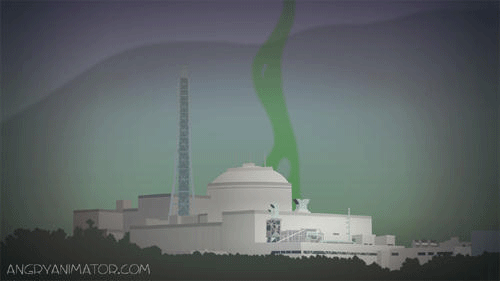
Monju reactor project failed to pay off after swallowing ¥1.13 trillion of taxpayers’ money: auditors https://www.japantimes.co.jp/news/2018/05/11/national/monju-reactor-project-failed-pay-off-swallowing-%C2%A51-13-trillion-taxpayers-money-auditors/#.WvZw_u-FPGg
The Monju fast-breeder reactor experiment yielded few sufficient results despite an investment of at least ¥1.13 trillion ($10.3 billion) worth of taxpayers money since 1994, state auditors confirmed on Friday.
The trouble-plagued prototype, which only ran for 250 days, was designed to play a key role in Japan’s quest to set up a nuclear fuel recycling program, but the project only achieved 16 percent of the intended results, the Board of Audit said.
The government finally decided to scrap Monju in December 2016 at an estimated additional cost of ¥375 billion. But the audit board noted that the 30-year decommissioning plan could cost even more.
The reactor, which started operations in 1994, was designed to produce more plutonium than it consumes while generating electricity, experienced several problems over its more than two-decade run, including a sodium coolant leak and attempted cover-up, and equipment inspection failures.
“Flawed maintenance led to the decommissioning,” the auditors concluded in their report.
But the report also spotlights the absence of a systematic evaluation system for the project. During the entire experiment, the auditors expressed their opinions on Monju’s research and development costs only once — in 2011.
Monju was only up and running for 250 days in total after repeatedly failing to complete test items, according to the report.
As for the decommissioning costs, the report said they might expand because the current estimate does not include personnel costs and taxes. It also noted that the cost of removing the radioactive sodium coolant could change.
Reprocessing nuclear waste – expensive, problematic transport, water intensive, dirty, dangerous
 Recycling nuclear waste is not the win-win it seems like it should be, Las Vegas Sun, Editorial, Sunday, May 6, 2018 The idea of turning Yucca Mountain into a nuclear waste reprocessing facility, which some Nevadans are proposing, sounds wonderful….
But the hard facts behind reprocessing show that doing it at Yucca Mountain is almost as scary as storing waste there. …. Here are a few key reasons why:
- It’s expensive. Reprocessing does yield new fuel, but it costs up to 10 times more than producing conventional fuel — uranium that is mined and enriched. That being the case, the market price of reprocessed fuel is far higher than enriched uranium, so it’s not a cost-effective option for nuclear plant operators.
• It doesn’t solve the transportation problem. Radioactive materials would still be shipped into Nevada, and some of the transportation routes for the waste cut through the heart of the Las Vegas Valley. This isn’t just a NIMBY issue, either, considering that the routes also pass through 43 other states.
• It’s water-intensive. According to one estimate, it would require 50,000 acre-feet of water annually, or the equivalent of enough for 100,000 homes for a year. Considering that the water in the Yucca Mountain area is already over-appropriated, that’s more than would be available and far more than would be environmentally sound.
• It’s dirty. Reprocessing involves using acid to extract plutonium and recover unused uranium from irradiated uranium fuel, which results in liquid wastes teeming with radioactive and chemical poisons. The Hanford Nuclear Reservation in Washington, one of the few places in the U.S. where reprocessing for nuclear weapons production has occurred, is an environmental disaster area where $50 billion in cleanup work has been done and more than $100 billion more is needed to deal with millions of gallons of liquid waste stored in underground tanks.
So while the basic idea behind reprocessing may sound like sort of a nuclear version of recycling aluminium cans or plastic bottles, it’s actually not environmentally friendly and is prohibitively costly.
…… it’s a dangerous idea, not only from a health and environmental standpoint but from a political one, as well.Yucca Mountain proponents in other states would love to see a crack in Nevada’s longstanding official opposition to the repository. If they sense that the reprocessing concept has caused Nevadans to warm to the idea of bringing the nation’s waste to the state, you can bet they’ll exploit it.
That’s especially true given President Donald Trump’s support of the project, for which he placed $120 million in funding to restart the licensing process in his budget. Congress rebuffed him by not including the funding in this year’s omnibus spending bill, but there’s been no indication that Trump will stop pressing.
It’s important for Nevadans to remain galvanized in their opposition to Yucca Mountain. Regardless of whether the site is used for storage or reprocessing, bringing the nation’s 77,000 tons of highly radioactive nuclear waste to a site just 90 miles northwest of Las Vegas would be a disaster waiting to happen. https://lasvegassun.com/news/2018/may/06/recycling-nuclear-waste-is-not-the-win-win-it-seem/
Resuscitated as “Orano”, failed nuclear corporation Areva pins its hopes on reprocessing in Ukraine

Reuters 3rd May 2018 , French uranium mining and nuclear fuel group Orano, formerly called Areva,
said it had signed a fuel reprocessing deal with Ukraine. Orano and the
Ukrainian utility EnergoAtom signed a contract for assessing the
feasibility of reprocessing services of spent fuel assemblies of Ukrainian
VVER-1000 nuclear reactors in Orano la Hague facility Orano said the
contract, signed in the presence of Oleksander Shavlakov, First
Vice-President of EnergoAtom and Pascal Aubret, Senior Executive Vice
President of Orano’s Recycling Business Unit, marks a new step towards
the treatment of Ukrainian used fuels VVER 1000 at the Orano la Hague site.
https://af.reuters.com/article/commoditiesNews/idAFFWN1SA18N
1 This Month

of the week – Shut Down Drone Warfare!


Tell the Ukrainian Government to Drop Prosecution of Peace Activist Yurii Sheliazhenko

Petition to revoke the licensing of the Near Surface Nuclear Disposal Facility (NSDF) at Chalk River. https://www.ourcommons.ca/petitions/en/Petition/Details?Petition=e-7247
To see nuclear-related stories in greater depth and intensity – go to https://nuclearinformation.wordpress.com
-
Archives
- April 2026 (7)
- March 2026 (251)
- February 2026 (268)
- January 2026 (308)
- December 2025 (358)
- November 2025 (359)
- October 2025 (376)
- September 2025 (257)
- August 2025 (319)
- July 2025 (230)
- June 2025 (348)
- May 2025 (261)
-
Categories
- 1
- 1 NUCLEAR ISSUES
- business and costs
- climate change
- culture and arts
- ENERGY
- environment
- health
- history
- indigenous issues
- Legal
- marketing of nuclear
- media
- opposition to nuclear
- PERSONAL STORIES
- politics
- politics international
- Religion and ethics
- safety
- secrets,lies and civil liberties
- spinbuster
- technology
- Uranium
- wastes
- weapons and war
- Women
- 2 WORLD
- ACTION
- AFRICA
- Atrocities
- AUSTRALIA
- Christina's notes
- Christina's themes
- culture and arts
- Events
- Fuk 2022
- Fuk 2023
- Fukushima 2017
- Fukushima 2018
- fukushima 2019
- Fukushima 2020
- Fukushima 2021
- general
- global warming
- Humour (God we need it)
- Nuclear
- RARE EARTHS
- Reference
- resources – print
- Resources -audiovicual
- Weekly Newsletter
- World
- World Nuclear
- YouTube
-
RSS
Entries RSS
Comments RSS
 nuclear-news