
France drops plans to build sodium-cooled nuclear reactor. PARIS (Reuters) – France’s CEA nuclear agency has dropped plans to build a prototype sodium-cooled nuclear reactor, it said on Friday, after decades of research and hundreds of millions of euros in development costs.
Confirming a report in daily newspaper Le Monde, the state agency said it would finalize research in so-called “fourth generation” reactors in the ASTRID (Advanced Sodium Technological Reactor for Industrial Demonstration) project this year and is no longer planning to build a prototype in the short or medium term.
“In the current energy market situation, the perspective of industrial development of fourth-generation reactors is not planned before the second half of this century,” the CEA said.
In November last year the CEA had already said it was considering reducing ASTRID’s capacity to a 100-200 megawatt (MW) research model from the commercial-size 600 MW originally planned.
Le Monde quoted a CEA source as saying that the project is dead and that the agency is spending no more time or money on it.
Sodium-cooled fast-breeder reactors are one of several new designs that could succeed the pressurized water reactors (PWR) that drive most of the world’s nuclear plants. [tinyurl.com/y84d2hvc]
In theory, breeders could turn nuclear waste into fuel and make France self-sufficient in energy for decades, but uranium prices have been on a downward slope for a decade, undermining the economic rationale for fast-breeder technology.
There are also serious safety concerns about using sodium instead of water as a reactor coolant.
Since sodium remains liquid at high temperatures – instead of turning into steam – sodium reactors do not need the heavy pressurized hulls of PWRs. But sodium burns on contact with air and explodes when plunged into water.
An earlier French model was scrapped in the 1980s after encountering major technical problems.
The ASTRID project was granted a 652 million euro ($723 million) budget in 2010. By the end of 2017 investment in the project had reached 738 million euros, according to public auditor data quoted by Le Monde.
The CEA said a revised program would be proposed by the end of the year for research into fourth-generation reactors beyond 2020, in line with the government’s long-term energy strategy.
August 31, 2019
Posted by Christina Macpherson |
France, reprocessing |
Leave a comment
News1 29th Aug 2019 The Astrid Fast Reactor Project is shut down by the Atomic EnergyCommission. A blow to the future of the sector. This was to be the nextstep in the development of the French nuclear industry, one that wouldallow it to project into the future, but which is likely never to see the
light of day. According to our information, the Astrid Fast Neutron Reactor
(RNR) project is being abandoned by the Atomic Energy and Alternative
Energies Commission (CEA), which is nevertheless at the origin.
https://www.news1.news/2019/08/france-abandons-the-fourth-generation-of-reactors.html
Le Monde 29th Aug 2019 Astrid, the acronym for Advanced Sodium Technological Reactor for Industrial Demonstration, is a sodium-cooled fast reactor prototype project to be built at the Marcoule nuclear site in the Gard.
The objective of this new generation is to use depleted uranium and plutonium as fuel, in other words to reuse the radioactive materials from the electricity generation of the current nuclear fleet and largely stored at the La Hague site. (Channel), operated by Orano (formerly Areva).
https://www.lemonde.fr/economie/article/2019/08/29/nucleaire-la-france-abandonne-la-quatrieme-generation-de-reacteurs_5504233_3234.html
August 31, 2019
Posted by Christina Macpherson |
France, reprocessing |
Leave a comment
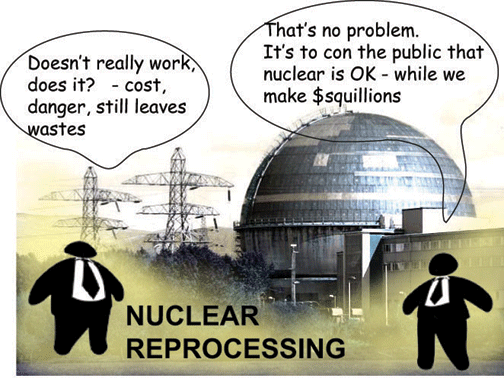 Are Washington’s ‘Advanced’ Reactors a Nuclear Waste?
Congress needs to look hard at the rationale for a fast reactor program.https://nationalinterest.org/feature/are-washington%E2%80%99s-advanced-reactors-nuclear-waste-43797, by Victor Gilinsky Henry Sokolski
Late last year, the Energy Department (DOE), began work on a new flagship nuclear project, the Versatile Test Reactor (VTR), a sodium-cooled fast reactor. If completed, the project will dominate nuclear power research at DOE. The department’s objective is to provide the groundwork for building lots of fast-power reactors. This was a dream of the old Atomic Energy Commission, DOE’s predecessor agency. The dream is back. But before this goes any further, Congress needs to ask, what is the question to which the VTR is the answer? It won’t be cheap and there are some serious drawbacks in cost, safety, but mainly in its effect on nonproliferation.
Congress has to ask hard questions: Is there an economic advantage to such reactors? Or one in safety? Or is it just what nuclear engineers, national laboratories, and subsidy-hungry firms would like to do?
The answer of DOE’s Idaho National Laboratory, which would operate the reactor, is cast in terms of engineering and patriotic goals, not economic ones: “US technological leadership in the area of fast reactor systems . . . is critical for our national security. These systems are likely to be deployed around the globe and U.S. leadership in associated safety and security policies is in our best national interest.” In other words, we need to build fast reactors because DOE thinks other people will be building them, and we need to stay ahead.
In the 1960s, when the Atomic Energy Commission concentrated on fast reactors (“fast” because they don’t use a moderator to slow down neutrons in the reactor core), it argued with a certain plausibility that uranium ore was too scarce to provide fuel for large numbers of conventional light-water reactors that “burned” only a couple percent of their uranium fuel. Fast reactors offered the possibility, at least in principle, of using essentially all of the mined uranium as fuel, and thus vastly expanding the fuel supply. To do this you operate them as breeder reactors—making more fuel (that is, using excess neutrons available in fast reactors to convert inert uranium to plutonium) than they consume to produce energy. The possibility of doing so is the principal advantage of fast reactors.
But we then learned there are vast deposits of uranium worldwide, and at the same time many fewer nuclear reactors were installed than were originally projected, so there is no foreseeable fuel shortage. Not only that, the reprocessing of fuel, which is intrinsic to fast reactor operation, has turned out to be vastly more expensive than projected. Finally, by all accounts fast reactors would be more expensive to build than conventional ones, the cost of which is already out of sight. In short, there is no economic argument for building fast reactors.
When it comes to safety, sodium-cooled fast reactors operate under low pressure, which is an advantage. But fast reactors are worrisome because, whereas a change in the configuration of a conventional nuclear core—say, squeezing it tighter—makes it less reactive, the corresponding result in a fast reactor is to make it more reactive, potentially leading to an uncontrolled chain reaction.
With regard to nonproliferation, the issue that mainly concerns us is that the fast reactor fuel cycle depends on reprocessing and recycling of its plutonium fuel (or uranium 233 if using thorium instead of uranium). Both plutonium and uranium 233 are nuclear explosives. Widespread use of fast reactors for electricity generation implies large quantities of nuclear explosives moving through commercial channels. It will not be possible to restrict such use to a small number of countries. The consequent proliferation dangers are obvious. And while it is doubtful the U.S. fast reactor project will lead to commercial exploitation—few, if any, projects from DOE ever do—U.S. pursuit of this technology would encourage other countries interested in this technology, like Japan and South Korea, to do so.
One should add that one of the claims of enthusiasts for recycling spent fuel in fast reactors is that it permits simpler waste management. This is a complicated issue, but the short answer is that rather than simplifying, reprocessing and recycling complicate the waste disposal process.
With all these concerns, and the lack of a valid economic benefit, why does the Energy Department want to start an “aggressive” and expensive program of fast reactor development? It’s true that so far only exploratory contracts have been let, on the order of millions of dollars (to GE-Hitachi). But the Department is already leaning awfully far forward in pursuing the VTR. It estimates the total cost to be about $2 billion, but that’s in DOE-speak. We’ve learned that translates into several times that amount.
But beyond that, the nuclear engineering community, and the wider community of nuclear enthusiasts, have never given up the 1960s AEC dream of a fast breeder-driven, plutonium-fueled world. Such reactors were to have been deployed by 1980 and were to take over electricity generation by 2000. It didn’t even get off the ground, in part because of AEC managerial incompetence, but mainly because it didn’t make sense.
After the 1974 Indian nuclear explosion and the realization that any country with a small reactor and a way to separate a few kilograms of plutonium could make a bomb, proliferation became a serious issue. In 1976 President Gerald Ford announced that we should not rely on plutonium until the world could reliably control its dangers as a bomb material. The plutonium devotees never accepted this change. Jimmy Carter froze construction of an ongoing fast-breeder prototype, the Clinch River Reactor, about three time the size of the proposed VTR. Ronald Reagan tried to revive it but, as its rationale thinned and its cost mounted, Congress shut it down in 1983. The plutonium enthusiasts thought they got their chance under George W. Bush with a fast reactor and a reprocessing and recycling program under of the rubric of Global Nuclear Energy Partnership. But it was so poorly thought out it didn’t go anywhere. More or less the same laboratory participants are now pushing the VTR.
The DOE advanced reactor program has many irons in the fire, mostly in the small reactor category. But do not be misled. They are mostly small potatoes without much future. Only the fast reactor project is the real thing, bureaucratically, that is. Although at this point DOE has only contracted for conceptual design, the follow-up will cost many millions and take many years. Nothing attracts national laboratories, industrial firms, and Washington bureaucracies as much as the possibility of locking into a large multiyear source of funding.
Congress needs to look hard at the rationale for a fast reactor program. This means getting into the details. At a Senate Appropriations hearing last month on advanced reactors, Sen. Dianne Feinstein said rather plaintively, “We cast the votes, and cross our fingers hoping nothing bad will happen.” That’s not good enough.
Victor Gilinsky is program advisor for the Nonproliferation Policy Education Center (NPEC) in Arlington, Virginia. He served on the Nuclear Regulatory Commission under Presidents Ford, Carter, and Reagan. Henry Sokolski is executive director of NPEC and the author of Underestimated: Our Not So Peaceful Nuclear Future (second edition 2019). He served as deputy for nonproliferation policy in the office of the U.S. secretary of defense in the Cheney Pentagon.
February 11, 2019
Posted by Christina Macpherson |
Reference, reprocessing, USA |
Leave a comment
The rise and demise of the Clinch River Breeder Reactor, Bulletin of the Atomic Scientists, By Henry Sokolski, February 6, 2019 This year marks the 36th anniversary of the termination of the Clinch River Breeder Reactor Project, a federally funded commercial demonstration effort. In the very early 1980s, it was the largest public-works project in the United States. Japan, South Korea, China, France, Russia, and the United States are now all again considering building similar plants. For each, how and why Clinch River was launched and killed is a history that speaks to their nuclear future. This history involves more than cost benefit analysis. For the public and political leadership, facts and arguments rarely close an initial sale of a large government-funded, high-tech commercialization program. Nor do they generally goad officials to abandon such projects. Such acts are fundamentally political: Fears and hopes drive them. Certainly, to understand why the US government launched and subsequently killed Clinch River requires knowledge not just of what the public and its political leadership thought, but also of how they felt.
Unwarranted fears of uranium’s scarcity fueled interest in fast-breeder reactors. …….in 1945, uranium 235, a fissile uranium isotope that can readily sustain a chain reaction, was believed to be so scarce, it was assumed there was not enough of it to produce nuclear electricity on a large scale. Scientists saw the answer in fast-breeder reactors………
The Atomic Energy Commission publicly promoted their commercialization with confident, cartoonish optimism. In one publication, the commission asked the upbeat question: “Johnny had three truckloads of plutonium. He used three of them to power New York for a year. How much plutonium did Johnny have left?” The answer: “Four truckloads.”
Unfortunately, this pitch glossed over two stubborn facts. First, because plutonium is so much more toxic and difficult to handle than uranium, it is many times more expensive to use as a reactor fuel than using fresh uranium. Second, because plutonium fast-breeder reactors use liquid metal coolants, such as liquid sodium, operating them safely is far more challenging and expensive than conventional reactors.
When private industry tried in the early 1960s to operate its own commercial-sized fast-breeder, Fermi I, the benefits were negative. Barely three years after Fermi 1 came online, a partial fuel meltdown in 1966 brought it down. It eventually resumed operations before being officially shut down in 1972.
These facts, however, are rarely emphasized. Those backing breeders—whether it be in 1945, 1975, or today—focus not on reliability and economics, but rather that we are about to run out of affordable uranium. For the moment, of course, we are not. Uranium is plentiful and cheap as is enriching it. This helps explain why the United Kingdom, France, Germany, Japan, and the United States, no longer operate any commercial-sized fast-breeder reactors and are in no immediate rush to build new ones………
When the Atomic Energy Commission argued the case for building a breeder reactor in the late 1960s and early 1970s, it projected 1,000 reactors would be on line in the United States by the year 2000 (the real number turned out to be 103) and that the United States would soon run out of affordable uranium. Also, by the mid-1960s, the commission needed a new, massive project to justify its continued existence. Its key mission, to enrich uranium for bombs and reactors, had been completed and was overbuilt. The commission was running out of construction and research projects commensurate with its large budget. A breeder-reactor- commercialization program with all the reprocessing, fuel testing, and fuel fabrication plants that would go with it, seemed a worthy successor.
But the most powerful political supporter of Clinch River, then-President Richard Nixon, focused on a different point. Nixon saw the project less as a commercial proposition than as a way to demonstrate his power to secure more votes by providing government-funded jobs while at the same time affirming his commitment to big-science, engineering, and progress……….
the Energy Department videotaped safety tests it had conducted of how molten sodium might react once it came in contact with the reactor’s concrete containment structure. Concrete contains water crystals. Molten sodium reacts explosively when it comes in contact with oxygen, including oxygen contained in water. What the test demonstrated and the video showed was concrete exploding when it came in contact with liquid sodium.
This set off waves of worry at the department………
Just weeks before the final vote, the Congressional Budget Office released its financial assessment of the Energy Department’s last ditch effort to use loan guarantees to fund the project. Even under the most conservative assumptions, the budget analysts determined that the loan guarantees would only increase the project’s final costs. This helped push the project over a political cliff. The final Senate vote: 56 against, 40 for. All of the 16 deciding votes came from former Clinch River supporters.
No commercial prospects? Militarize. Nixon backed numerous science commercialization projects like Clinch River, including the Space Shuttle Program and the supersonic transport plane……… While the Space Shuttle Program won congressional support, the envisioned satellite contracts never materialized. The program became heavily dependent on military contracts. Finally, our national security depended upon it.
Although Clinch River never was completed, as its costs spiraled, it too attracted military attention. …….
Essentially, it didn’t matter when you asked–1971 or 1983—Clinch River was always another seven years and at least another $2.1 billion away from completion. ……
With Clinch River, what we now know, we may yet repeat. Fast-reactor commercialization projects and support efforts, such as Argonne National Laboratory’s Small Modular Fast Reactor, the US-South Korean Pyroreprocessing effort, the Energy Department’s Virtual (Fast) Test Reactor, France’s Astrid Fast Reactor Project, the PRISM Reactor, the TerraPower Traveling Wave reactor, India’s thorium breeder, Russia’s BN-1200, China’s Demonstration Fast-Breeder Reactor, continue to capture the attention and support of energy officials in Japan, China, Russia, South Korea, France, the US, and India. None of these countries have yet completely locked in their decisions. How sound their final choices turn out to be, will ultimately speak to these governments’ credibility and legitimacy.
In the case of Clinch River, the decision to launch the program ultimately rested on a cynical set of political calculations alloyed to an ideological faith in fast reactors and the future of the “plutonium economy.” Supporters saw this future clearly. As a nuclear engineer explained to me in 1981 at Los Alamos National Laboratory, the United States technically could build enough breeder reactors to keep the country electrically powered for hundreds of years without using any more oil, coal, or uranium. When I asked him, though, who would pay for this, he simply snapped that only fools let economics get in the way of the future.
This argument suggests that the case for fast reactors is beyond calculation or debate, something mandatory and urgent. That, however, never was the case, nor is it now. Instead, the equitable distribution of goods, which is a key metric of both economic and governmental performance (and ultimately of any government’s legitimacy and viability), has always taken and always must take costs into account. In this regard, we can only hope that remembering how and why Clinch River was launched and killed will help get this accounting right for similar such high-tech commercialization projects now and in the future. https://thebulletin. org/2019/02/the-rise-and- demise-of-the-clinch-river- breeder-reactor/?utm_source= Bulletin%20Newsletter&utm_ medium=iContact%20email&utm_ campaign=ClinchRiver_February6
February 11, 2019
Posted by Christina Macpherson |
Reference, reprocessing, USA |
Leave a comment
 UK’s dream is now its nuclear nightmare https://climatenewsnetwork.net/uks-dream-is-now-its-nuclear-nightmare/?fbclid=IwAR3CEunSXXOxdK_-N8Ka9kwpCMzvHFXNkZf23VGjd6oFuDecember 14, 2018, by Paul Brown
Nobody knows what to do with a vast uranium and plutonium stockpile built up in the UK by reprocessing spent fuel. It is now a nuclear nightmare.
LONDON, 14 December, 2018 − Thirty years ago it seemed like a dream: now it is a nuclear nightmare. A project presented to the world in the 1990s by the UK government as a £2.85 billion triumph of British engineering, capable of recycling thousands of tons of spent nuclear fuel into reusable uranium and plutonium is shutting down – with its role still controversial.
Launched amid fears of future uranium shortages and plans to use the plutonium produced from the plant to feed a generation of fast breeder reactors, the Thermal Oxide Reprocessing Plant, known as THORP, was thought to herald a rapid expansion of the industry.
In the event there were no uranium shortages, fast breeder reactors could not be made to work, and nuclear new build of all kinds stalled. Despite this THORP continued as if nothing had happened, recycling thousands of tons of uranium and producing 56 tons of plutonium that no one wants. The plutonium, once the world’s most valuable commodity, is now classed in Britain as “an asset of zero value.” Continue reading →
December 17, 2018
Posted by Christina Macpherson |
Reference, reprocessing, UK, wastes |
2 Comments
15th Nov 2018 On the morning after the Financial Times has called on the UK Government to reassess its long-term energy plans following the demise of Toshiba’sMoorside nuclear project, the Stop Hinkley Campaign has published a briefing about lessons we can learn from the Sellafield Thermal Oxide Reprocessing Plant which is in the process of closing after only 24 years of operation and a very chequered performance.
The “Lessons for Hinkley from Sellafield” briefing says: The cost of building THORP increased from
£300m in 1977 to £1.8bn on completion in 1992. With the additional cost of associated facilities this figure rose to £2.8bn. Originally expected to reprocess 7,000 tonnes of spent fuel in its first ten years, it has managed only around 9,300 in 24 years.
The original rationale for THORP ended with the closure of the UK’s fast reactor programme in 1994. The new rationale – to produce plutonium fuel for ordinary reactors – was a disaster costing the taxpayer £2.2bn.
Stop Hinkley Spokesperson Roy Pumfrey said: “The rationale for building the THORP plant at Sellafield had disappeared before it even opened. The lesson for 2018 is that we should scrap Hinkley C now before costs escalate. The cancellation costs are small relative to the £50billion extra we’ll have to pay for Hinkley’s electricity, if it ever generates any. If we wait any longer to scrap it,
we risk heading for another Sellafield-scale financial disaster.” http://www.stophinkley.org/PressReleases/pr181115.pdf
November 19, 2018
Posted by Christina Macpherson |
business and costs, reprocessing, UK |
Leave a comment








 nuclear-news