Hamaoka Nuclear Power Plant the world’s most dangerous complex
 Making Hamaoka a special concern to its opponents is the presence of plutonium. Chubu is the only utility in Japan to have signed a contract to process mixed oxide fuel containing plutonium and uranium with the Sellafield plant in the UK.
The industry’s clout, its collusion with government watchdogs and a largely compliant media have helped smother concerns about this potentially explosive collision of state-of-the-art atomic power with primordial seismic instability

 ‘We all said disaster would strike here, not Fukushima’, The Independent, 3 May 11, After a 40-year campaign, warnings about the vast nuclear power station on Japan’s earthquake faultline are finally being heard. By David McNeill in Omaezeki and Nanako Otani, Norihiko Watanabe is pointing to his home, 600m from what he calls the most dangerous nuclear power complex on the planet. “There’s nothing like it anywhere in the world,” he says, eyes widening. “If it blows up, we’re all finished.” Continue reading
Facts on plutonium and Mox nuclear fuel
some reactors do use Mox, but only as a small percentage (less than 30 per cent) of the total fuel. The rest of the fuel is conventional uranium oxide…Mox, which in any case remains far more expensive than conventional uranium fuel…
 (UK) Government’s doomed £6bn plan to dispose of nuclear waste, The Independent, 11 April 11“……Q & A: Why has it come to this?
Q: What is Britain’s “plutonium mountain”?
A: It is the nation’s stockpile of radioactive plutonium, kept as plutonium dioxide powder, packed into special drums stored at Sellafield in Cumbria. A further, smaller amount is stored at the Dounreay nuclear facility in Scotland, the site of the doomed nuclear fast-breeder reactor programme. Continue reading
Only AREVA to benefit from dangerous plutonium reprocessing plant?
 A mixed-oxide, or MOX, plutonium reprocessing plant that is being built in South Carolina has become “an expensive effort that enriches contractors, led by the French government-owned company Areva,”
US anti-nuclear activists slam reprocessing plan, Google news, (AFP) – 5 April 11, WASHINGTON — US anti-nuclear groups Monday condemned a project to build a plant where plutonium from weapons would be reprocessed into fuel for nuclear power plants, saying the plan was costly, dangerous and would benefit mainly the French group, Areva.
A mixed-oxide, or MOX, plutonium reprocessing plant that is being built in South Carolina has become “an expensive effort that enriches contractors, led by the French government-owned company Areva,” Tom Clements of Friends of the Earth said at the launch of a report by an anti-nuclear alliance.”In my opinion, it is primarily because of Areva’s influence inside the Department of Energy that the US is pursuing a plutonium fuel program and it’s because of Areva’s influence that there’s a push for the US to also reprocess commercial spent fuel to remove plutonium, like France does,” he said…….
The plant, on the Department of Energy’s Savannah River site, is roughly one-third finished and three times over budget, with a price tag so far of $4.9 billion dollars, Clements maintained.
But even as the nuclear disaster in Japan highlights the dangers of MOX fuel — which the ANA report says was used in one of the reactors at Japan’s crippled Fukushima power plant — the US government is failing to rethink construction of the South Carolina facility, Clements told reporters.
“As plutonium leaks from the damaged reactors in Japan, the US Department of Energy (DoE) continues planning for the use of dangerous mixed-oxide fuel in US nuclear reactors of the same design as the Fukushima reactors in Japan,” Clements said.
MOX fuel pellets “make reactors harder to control and, in the case of a severe accident, the radiation plutonium releases will be worse than uranium fuel,” said Clements……
Anti-nuclear activists would prefer encasing the plutonium left over from dismantled US nuclear weapons in glass, and then storing it as high-level waste.
That method, called vitrification, is “cheaper, quicker and safer” than converting plutonium into MOX fuel, says the report released Monday by ANA, a network of three dozen organizations…..
AFP: US anti-nuclear activists slam reprocessing plan
Fast breeder nuclear reactor trains for Russia?
 Russia designs nuclear train2011- BarentsObserver Thomas Nilsen 24 Feb 2011, Sounds like a chapter in a science fiction book? Well,it’s not. Rosatom and Russian Railways are seriously developing a nuclear powered train.Vice-president of Russian Railways (RZhD) Valentin Gapanovich says they will present the layout of the train by the end of this year. The train will consist of 11 wagons.The engine of the train will be a small fast breeder reactor, and in its initial stage, the train will be a scientific exhibition complex.The design is made by Russia’s State Atomic Energy Corporation, Rosatom…….Russia designs nuclear train – BarentsObserver
Reprocessing nuclear waste – not a solution to the intractable waste problem
Nuclear waste- no place to go? Environment Reseach by Dave Elliott on February 19, 2011 Reprocessing nuclear waste provides little short-term benefit because the process costs too much and uranium supplies remain plentiful, according to a new study of US nuclear waste management options by MIT, the Massachusetts Institute of Technology. Continue reading

Britain to break international agreement in releasing plutonium into sea
Sellafield activity ‘will ensure UK breaks nuclear pollution promise’ Group monitoring nuclear plant says ‘crash programme’ by government’s NDA will put UK in breach of Ospar convention Rob Edwards, guardian.co.uk, 17 February 2011
• ‘Sellafield is where we house the toxic legacy of our failed nuclear industry’

Britain is on course to break an international agreement to reduce radioactive pollution of the seas, because of an increase in activity at the Sellafield nuclear site, Continue reading
MOX – Britain’s failed attempt to deal with its plutonium problem
The problem is that Britain has the dubious distinction of being the world’s civilian plutonium capital, with 112 tons of it – about half the global total – almost all stored at Sellafield. It is there because, unlike in America, we “reprocess” our nuclear waste to extract plutonium. The idea was for it to power a new generation of “fast breeder” reactors, but the industry admits these are still half a century away, and so we are stuck with the stuff.

 So the nuclear plant does not work, loses £90 million a year, and could be a security risk? Let’s build another, say ministers A bomb factory in our back yard, – Telegraph, UK, 14 Feb 2011, The so-called Mox plant could well go rogue, – Geoffrey Lean.
How’s this for timing? A week ago The Daily Telegraph published a confidential cable from the US embassy calling a controversial plant at Sellafield “one of Her Majesty’s Government’s most embarrassing failures in British industrial history”. Then, within days, ministers said they were minded to build another one like it. Continue reading
UK’s plutonium stockpile could be used in new subsidy to nuclear industry
This could easily end up as yet another black hole for taxpayers’ money. The use of the UK plutonium stockpile in reactors could be yet another subsidy for new nuclear.”
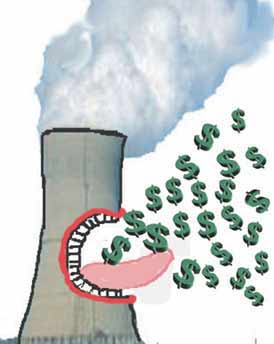
Mox proposal would pay nuclear firms to use recycled plutonium• French group Areva wants to build a Mox plant at Sellafield• Greenpeace fears ‘yet another subsidy for new nuclear’ Tim Webb guardian.co.uk, 7 February 2011 Areva submitted a proposal to the government to build a Mox plant at Sellafield.
Nuclear companies could be paid by the government to buy recycled nuclear fuel from a new taxpayer-funded plant, to reduce the country’s stockpile of plutonium. Continue reading
Unacceptable risks of plutonium nuclear fuel
Energy NW asked not to use plutonium reactor fuel | Seattle Times Newspaper, 4 Feb 2011, RICHLAND, Wash. —Friends of the Earth is calling upon Energy Northwest not to consider using nuclear reactor fuel derived from weapons-grade plutonium at its Columbia Generating Station at Hanford.The environmental organization says it has obtained Department of Energy documents that say the public power consortium is evaluating the potential use of plutonium mixed oxide fuel at the reactor. It says the use of such fuel poses unacceptable risks and costs.The government says the fuel could produce energy while disposing of plutonium from abandoned nuclear weapons. The Energy Department is building a plant in South Carolina to make the fuel.Energy Northwest spokeswoman Rochelle Olson says it has no plans to use the fuel until studies prove it would be safe, economical and technically feasible. Local News | Energy NW asked not to use plutonium reactor fuel | Seattle Times Newspaper
Nuclear fuel reprocessing will leave tax-payer to pay $trillions for waste disposal
President Carter’s Executive Order banned nuclear fuel reprocessing in the 1970’s. Congress recently – and quietly – passed legislation at the behest of the nuclear industry and utilities that appears to circumvent that decision……Interestingly, by U.S. law, once nuclear waste is removed from the property of the utilities, it then becomes the problem of the federal government and tax payers, and no longer a liability for utilities and corporate shareholders…..Somewhere between two to four trillion in U.S. tax dollars has gone to the nuclear experiment, in all its forms over the decades, but now we face very real fiscal constraints.

A blue-ribbon, “nuclear” bus ride Mountain Xpress, Ned Ryan Doyle, 21 Jan 2011 “.………It’s no secret that temporary storage facilities for high level nuclear waste at our nation’s nuclear plants are at, or beyond, design capacity. Continue reading
1 This Month

of the week – Shut Down Drone Warfare!


Tell the Ukrainian Government to Drop Prosecution of Peace Activist Yurii Sheliazhenko

Petition to revoke the licensing of the Near Surface Nuclear Disposal Facility (NSDF) at Chalk River. https://www.ourcommons.ca/petitions/en/Petition/Details?Petition=e-7247
To see nuclear-related stories in greater depth and intensity – go to https://nuclearinformation.wordpress.com
-
Archives
- April 2026 (7)
- March 2026 (251)
- February 2026 (268)
- January 2026 (308)
- December 2025 (358)
- November 2025 (359)
- October 2025 (376)
- September 2025 (257)
- August 2025 (319)
- July 2025 (230)
- June 2025 (348)
- May 2025 (261)
-
Categories
- 1
- 1 NUCLEAR ISSUES
- business and costs
- climate change
- culture and arts
- ENERGY
- environment
- health
- history
- indigenous issues
- Legal
- marketing of nuclear
- media
- opposition to nuclear
- PERSONAL STORIES
- politics
- politics international
- Religion and ethics
- safety
- secrets,lies and civil liberties
- spinbuster
- technology
- Uranium
- wastes
- weapons and war
- Women
- 2 WORLD
- ACTION
- AFRICA
- Atrocities
- AUSTRALIA
- Christina's notes
- Christina's themes
- culture and arts
- Events
- Fuk 2022
- Fuk 2023
- Fukushima 2017
- Fukushima 2018
- fukushima 2019
- Fukushima 2020
- Fukushima 2021
- general
- global warming
- Humour (God we need it)
- Nuclear
- RARE EARTHS
- Reference
- resources – print
- Resources -audiovicual
- Weekly Newsletter
- World
- World Nuclear
- YouTube
-
RSS
Entries RSS
Comments RSS
 nuclear-news