MOX plutonium nuclear reprocessing plants for Tennessee and Alabama?
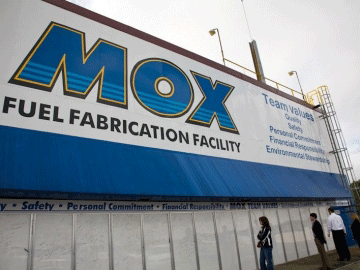 TVA considering fuel made from nuclear weapons http://www.kfoxtv.com/news/ap/energy/tva-considering-fuel-made-from-nuclear-weapons/nP3m5/ CHATTANOOGA, Tenn. — The Department of Energy is preparing an environmental impact statement on the use of fuel made from surplus nuclear weapons to power Tennessee Valley Authority nuclear plants. TVA released a set of talking points on Tuesday about the environmental impact statement, which will appear as a draft this week in the Federal Register, TVA spokesman Ray Golden told The Chattanooga Times Free Press (http://bit.ly/MGUFrO ).
The mixed oxide fuel, also called MOX fuel, is a blend of plutonium and uranium, but the variety under consideration is made from retired nuclear weapons, according to the TVA.
The utility has tentatively agreed to consider using the fuel in its Sequoyah and Browns Ferry nuclear plants in Tennessee and Alabama, with a timetable set for 2018. Continue reading
After one MOX nuclear reprocessing disaster, Britain plans another one!
Pete Wilkinson, an independent environmental consultant, said it “beggared belief” that ministers were going down this path after losing an estimated £600m from operating an original MOX plant.
“It would be interesting to see the commercial arrangements which justify turning Britain into a nuclear waste dump for plutonium that no-one else wants.”
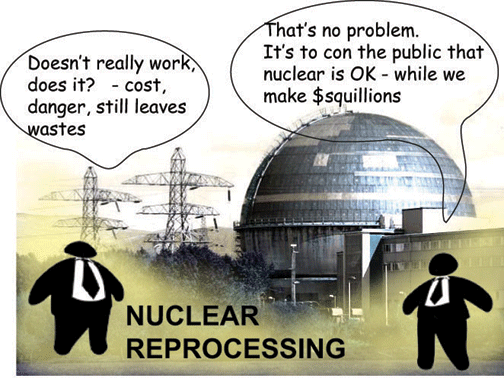
 UK nuclear authority takes ownership of German plutonium UK risks becoming a ‘nuclear laundry’ looking after unwanted waste from other countries, warns industry expert Terry Macalister guardian.co.uk, 13 July 2012 Britain risks being turned into a “nuclear laundry” by taking ownership of German plutonium in return for cash, the government was warned on Friday.
The move came along with confirmation that ministers were moving towards a controversial decision to build a new mixed oxide fuel (MOX) plant despite having just agreed to close an existing one which lost millions of pounds.
Britain has the largest stockpile of plutonium in the world but has taken permanent control of a further 4 tonnes under a deal with German nuclear power companies.. Continue reading
Britain’s disastrous record in technology to manage nuclear waste
Minister admits total failure of Sellafield ‘MOX’ plant http://www.independent.co.uk/news/uk/politics/minister-admits-total-failure-of-sellafield-mox-plant-793489.html BY GEOFFREY LEAN It was a deeply embarrassing moment for the Government, though it passed almost without notice.
Late last month, the Energy Minister, Malcolm Wicks, had to admit to one of the most comprehensive and catastrophic failures in British industrial history – and one that has led directly to the plans to ship weapons-ready plutonium to France.
Answering a question from Dai Davies, the independent MP for Blaenau Gwent, Mr Wicks confessed that a new plant at Sellafield, built amid great controversy at a cost of £473m, had comprehensively failed to work. Continue reading
“Fast nuclear reactors” not the solution to plutonium wastes
Ultimately, however, the core problem may be that such new reactors don’t eliminate the  nuclear waste that has piled up so much as transmute it. Even with a fleet of such fast reactors, nations would nonetheless require an ultimate home for radioactive waste, one reason that a 2010 M.I.T. report on spent nuclear fuel dismissed such fast reactors.
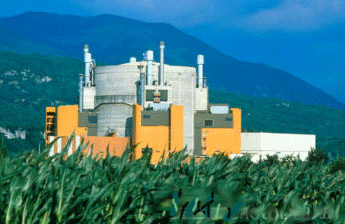 Can Fast Reactors Speedily Solve Plutonium Problems? The U.K. is grappling with how to get rid of weapons-grade plutonium and may employ a novel reactor design to consume it Scientific American By David Biello | March 21, 2012 The U.K. has nearly 100 metric tons of plutonium—dubbed “the element from hell” by some—that it doesn’t know what to do with. The island nation does not need the potent powder to construct more nuclear weapons, and spends billions of British pounds to ensure that others don’t steal it for that purpose. The unstable element, which will remain radioactive for millennia, is the residue of ill-fated efforts to recycle used nuclear fuel.
One solution under consideration is to recycle the plutonium yet further—by using it as fuel in a pair of new, so-called “fast” reactors. Such nuclear reactors can actually “consume” plutonium via fission (transforming it into other forms of nuclear waste that are not as useful for weapons). The U.K. is considering a plan to build two of General Electric’s PRISM fast reactors, the latest in a series of fast-reactor designs that for several decades have attempted with mixed success to handle plutonium and other radioactive waste from nuclear power. The idea remains that fast reactors, which get their name because the neutrons that initiate fission in the reactor are zipping about faster than those in a conventional reactor, could offer a speedy solution to cleaning some nasty nuclear waste, which fissions better with fast neutrons, while also providing electricity as a by-product.
The U.K. is hardly alone in struggling to cope with nuclear waste, whether plutonium or otherwise. Continue reading
Japan’s nuclear reprocessing reactor’s astronomic costs
Fast breeder reactor far costlier than regular nuclear power generation http://english.kyodonews.jp/news/2012/06/166571.html TOKYO, June 29, Kyodo If the development of the controversial Monju prototype fast breeder reactor is continued, its costs will swell to over 1.4 trillion yen and its power generation costs will be 10,000 yen per kilowatt hour, roughly 1,000 times greater than a regular reactor, according to data compiled by Kyodo News.
Construction of the Monju reactor started in Tsuruga, Fukui Prefecture, in 1985 as part of the government’s policy of establishing a nuclear fuel cycle to make use of spent nuclear fuel at conventional atomic plants that run on uranium. Monju uses a uranium and plutonium mix as fuel.
The facility of the government-affiliated Power Reactor and Nuclear Fuel Development Corp. first reached criticality, a situation where a chain reaction of nuclear fission is sustained, in 1994. http://english.kyodonews.jp/news/2012/06/166571.html
Nuclear reprocessing is not the answer to Japan’s mounting radioactive wastes
The amount of spent fuel stored at power stations has continued to surge, standing at around 14,200 tons across 17 facilities as of last September, including the wrecked Fukushima No. 1 nuclear plant.
Japan Nuclear Fuel Ltd.’s storage facilities are already almost full and contained a total of 2,800 tons as of February, while several power stations are expected to reach maximum capacity over the next three years if their currently idled reactors are restarted, industry
sources said.
P olicy of recycling all spent nuclear fuel may be axed, Japan Times, 22 June 12, Kyodo, Jiji The Japan Atomic Energy Commission has proposed both reprocessing and directly disposing of spent nuclear fuel if Japan’s atomic energy reliance is cut to 15 percent, a departure from the current policy of total reprocessing…
.. The changed tack comes as massive amounts of spent fuel are accumulating at nuclear plants nationwide and as decades-long efforts to activate reprocessing facilities remain mired
in technical difficulties, sources said. Continue reading
UK’s Thorpe nuclear reprocessing plant not economically viable
Extending Thorp’s life would require investment “well in excess of £1bn”, the NDA said, including the construction of £600m of storage tanks for the highly-radioactive “liquor” that is produced by reprocessing.
 “It would be very expensive to carry on much longer,” said Bill Hamilton, head of stakeholder relations at the NDA. “If there was a market out there, there would be a reason to invest, but there is no major appetite.”
Cumbria’s reprocessing plant to close Financial Times -8 June 12 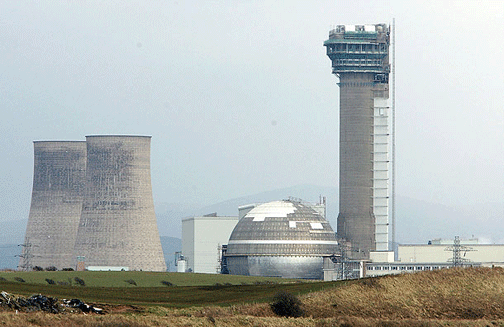
 By Rebecca Bream One of the more problematic facilities in the UK nuclear industry, the Thorp reprocessing plant at Sellafield in Cumbria, is set to close, reflecting a worldwide drop in demand for its services.
The Nuclear Decommissioning Authority, which is responsible for cleaning up the UK’s nuclear reactor sites and dealing with radioactive waste, said on Thursday that Thorp would close in 2018 when its existing reprocessing contracts end. Continue reading
UK’s nuclear reprocessing plant to close
Sellafield’s Thorp plant to close, The Independent, ALAN JONES , EMILY BEAMENT 07 JUNE 2012 A nuclear reprocessing site which has been in operation for 20 years is to close in 2018 after current contracts are completed, it was confirmed today.
The Thermal Oxide Reprocessing Plant (Thorp) at Sellafield in Cumbria,
… was commissioned in the early 1990s…. The NDA said in a statement that the closure decision was confirmed after it completed a strategic review of the options for the management of oxide fuels.
It added: “Oxide fuels include the remaining overseas-derived spent fuels that are being stored at Sellafield pending reprocessing in Thorp and also the spent fuels coming from the UK’s fleet of AGR (advanced gas-cooled reactors) power stations owned and operated by
EDF Energy….. Other decommissioning and reprocessing facilities and waste treatment plants on the Sellafield site remain in operation.
Japan – 37 tons of deadly plutonium, and planning to produce more
 Other countries, including the United States, have scaled back the separation of plutonium because it is a proliferation concern and is more expensive than other alternatives, including long-term storage of spent fuel.
Fuel reprocessing remains unreliable and it is questionable whether it is a viable way of reducing Japan’s massive amounts of spent fuel rods
Japan’s plutonium stockpile — most of which is stored in France and Britain — has swelled despite Tokyo’s promise to international regulators not to produce a plutonium surplus.
 Japan to make more plutonium despite big stockpile, Fox News June 01, 2012 Associated Press TOKYO – Last year’s tsunami disaster in Japan clouded the nation’s nuclear future, idled its reactors and rendered its huge stockpile of plutonium useless for now. So, the industry’s plan to produce even more has raised a red flag.
Nuclear industry officials say they hope to start producing a half-ton of plutonium within months, in addition to the more than 35 tons Japan already has stored around the world. That’s even though all the reactors that might use it are either inoperable or offline while the country rethinks its nuclear policy after the tsunami-generated Fukushima crisis. Continue reading
Fukishima’s radioactive wastes and the failure of nuclear reprocessing
The main reason why there is so much spent fuel at the Da-Ichi site is that the plan to send it off for nuclear recycling has collapsed.
This scheme is based on long discredited assumptions of …. a new generation of “fast” reactors
nearly all of the spent fuel at the Da-Ichi containing some of the largest concentrations of radioactivity on the planet will remain indefinitely in vulnerable pools.
The Fukushima Nuclear Disaster Is Far From Over HUFFINGTON POST, Robert Alvarez, Senior Scholar, Institute for Policy Studies, 22 April 12,“……Last week, Tokyo Electric Power Company (TEPCO) revealed plans to remove 2,274 spent fuel assemblies from the damaged reactors that will probably take at least a decade to accomplish. The first priority will be removal of the contents in Pool No. 4. This pool is structurally damaged and contains about 10 times more cesium-137 than released at Chernobyl. Continue reading
Alas, ‘fast breeder’ reactors don’t solve the nuclear waste problem
Ultimately, however, the core problem may be that such new reactors don’t eliminate the nuclear waste that has piled up
Can Fast Reactors Speedily Solve Plutonium Problems? The U.K. is grappling with how to get rid of weapons-grade plutonium and may employ a novel reactor design to consume it , Scientific American, By David Biello | March 21, 2012 The U.K. has nearly 100 metric tons of plutonium—dubbed “the element from hell” by some—that it doesn’t know what to do with.
The island nation does not need the potent powder to construct more nuclear weapons, and spends billions of British pounds to ensure that others don’t steal it for that purpose. The unstable element, which will remain radioactive for millennia, is the residue of ill-fated efforts to recycle used nuclear fuel. Continue reading
Japan banking on non-viable reprocessing, because it has nowhere to put nuclear wastes
the government has delegated the task of dealing with waste to the private sector, so there is no central decision-maker
“Why does the government stick to the very costly recycle policy? That is because if they give it up, they should explain where a final repository will be located,”
Beyond Fukushima Japan faces deeper nuclear concerns, Vancouver Sun, By RISA MAEDA, Reuters February 24, 2012 TOKYO“…..A DECENT BURIAL With Japan’s recycling efforts running so far behind the required pace
to deal with the waste problem, Japan needs to find another resting place for its waste, away from nuclear power plants, which are typically located on the coast.
But unlike France and the United States, the world’s biggest atomic power generators, Japan does not have much in the way of geologically stable and empty landscapes in which to bury nuclear waste for centuries. Given its population density is 10 times higher than the United States and almost three times higher than France, Japan faces a “not in my backyard” problem like no other big nuclear-power nation. Continue reading
Nuclear reprocessing not a viable option for Japan
Fast-breeder said realistic no more, Japan Times, 25 Feb 12, Kyodo A panel of experts reviewing the nuclear fuel cycle policy in light of the Fukushima crisis has agreed that while a fast-breeder reactor has advantages, from a technology viewpoint it can’t be considered a realistic option for the next 20 to 30 years. The nuclear fuel policy involves reprocessing spent fuel to produce plutonium that can be reused to produce electricity.
The subcommittee of the Japan Atomic Energy Commission said in a draft document summarizing its discussions that two viable options during the next few decades would be to not reprocess spent nuclear fuel, and to recycle plutonium-uranium mixed oxide fuel, or MOX fuel.
The former option is called the “once-through” cycle, in which uranium fuel is used in nuclear reactors just one time and disposed of by burying it in the ground. In the latter option, MOX fuel is manufactured from plutonium recovered from spent nuclear fuel and used
in ordinary reactors. Continue reading
Japan’s nuclear recycling plant, a probable failure
“an 80 to 90 percent chance of the [nuclear recycling] plant being a failure”
even if Rokkasho gets up and running, two problems remain: it alone cannot recycle enough fuel to stop the waste mounting up, and there is still the issue of burying the vitrified waste permanently in a crowded, quake-prone country.
Beyond Fukushima Japan faces deeper nuclear concerns, Vancouver Sun, By RISA MAEDA, Reuters February 24, 2012 TOKYO – On a hillside in northern Japan, wind turbines slice through the cold air, mocking efforts at a nearby industrial complex to shore up the future of the demoralised nuclear power industry.
The wind-power farm at Rokkasho has sprung up close to Japan’s first nuclear reprocessing plant, a Lego-like complex of windowless buildings and steel towers, which was supposed to have started up 15 years ago but is only now nearing completion.
Dogged by persistent technical problems, it is designed to recycle spent nuclear fuel and partly address a glaring weakness in Japan’s bid to restore confidence in the industry, shredded last year when a quake and tsunami wrecked the Fukushima Daiichi power station to the south, triggering radioactive leaks and mass evacuations.
But the Rokkasho project is too little, too late, according to critics who say Japan is running so short of nuclear-waste storage that the entire industry risks shutdown within the next two decades unless a solution is found.
“You don’t build a house without a toilet,” said Jitsuro Terashima, president of the Japan Research Institute think tank and member of an expert panel advising the national government on energy policy after the Fukushima disaster….
Long-term storage of highly radioactive waste is a problem common to all nuclear-powered nations, including the United States, but experts say Japan’s unstable geology and densely populated terrain mean that its challenges are far bigger. Continue reading
Monumental mess of UK’s monumental nuclear reprocessing project
Sellafield faces nuclear option as overspending threatens plant’s future, The Independent UK, 13 Feb 2010 Britain’s biggest single nuclear project has run into serious trouble, with missed deadlines and cost overruns threatening the future of the nuclear reprocessing operation at Sellafield in Cumbria.
Nuclear authorities have ordered a review of a monumental construction project at Sellafield that is millions of pounds over budget and more than four years late following a series of delays and financial mismanagement. Continue reading
1 This Month

of the week – Shut Down Drone Warfare!


Tell the Ukrainian Government to Drop Prosecution of Peace Activist Yurii Sheliazhenko

Petition to revoke the licensing of the Near Surface Nuclear Disposal Facility (NSDF) at Chalk River. https://www.ourcommons.ca/petitions/en/Petition/Details?Petition=e-7247
To see nuclear-related stories in greater depth and intensity – go to https://nuclearinformation.wordpress.com
-
Archives
- April 2026 (7)
- March 2026 (251)
- February 2026 (268)
- January 2026 (308)
- December 2025 (358)
- November 2025 (359)
- October 2025 (376)
- September 2025 (257)
- August 2025 (319)
- July 2025 (230)
- June 2025 (348)
- May 2025 (261)
-
Categories
- 1
- 1 NUCLEAR ISSUES
- business and costs
- climate change
- culture and arts
- ENERGY
- environment
- health
- history
- indigenous issues
- Legal
- marketing of nuclear
- media
- opposition to nuclear
- PERSONAL STORIES
- politics
- politics international
- Religion and ethics
- safety
- secrets,lies and civil liberties
- spinbuster
- technology
- Uranium
- wastes
- weapons and war
- Women
- 2 WORLD
- ACTION
- AFRICA
- Atrocities
- AUSTRALIA
- Christina's notes
- Christina's themes
- culture and arts
- Events
- Fuk 2022
- Fuk 2023
- Fukushima 2017
- Fukushima 2018
- fukushima 2019
- Fukushima 2020
- Fukushima 2021
- general
- global warming
- Humour (God we need it)
- Nuclear
- RARE EARTHS
- Reference
- resources – print
- Resources -audiovicual
- Weekly Newsletter
- World
- World Nuclear
- YouTube
-
RSS
Entries RSS
Comments RSS
 nuclear-news