Mixed Oxide Nuclear Fuel (MOX) program is a dud
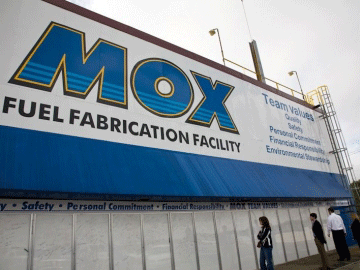 MOX project of little value http://beta.mirror.augusta.com/opinion/letters/2014-05-01/mox-
 project-little-value By Victor J. ReillyAiken, S.C. Thursday, May 1, 2014 MOX is a mix of oxides of uranium and plutonium that can be used as fuel for commercial nuclear reactors. It removes some plutonium from the sticky fingers of terrorists. Sound good? Yes, until the cost of doing this soared.
South Carolina Gov. Nikki Haley has recently said that if MOX is shelved, she wants the plutonium out of South Carolina. That is silly, but it reflects a 2002 federal law that U.S. Sen. Lindsey Graham had demanded.
Apparently, idiocy is endemic.
First, our plutonium problem. With welcome reductions in our nuclear arsenal, we now have about a hundred tons of plutonium in storage. In the wrong hands, less than 20 pounds of it could make a nuclear bomb. That would be a catastrophe. We must store it securely for decades. Savannah River Site would be logical for this job, with its huge area and a staff experienced in handling plutonium. This would provide good jobs that the governor should have jumped at.
MOX’s design capacity is to disable one ton of plutonium per year, so if MOX were the way to work it off, it would take more than a hundred years. A stock of one ton requires as much protection as for 100 tons.
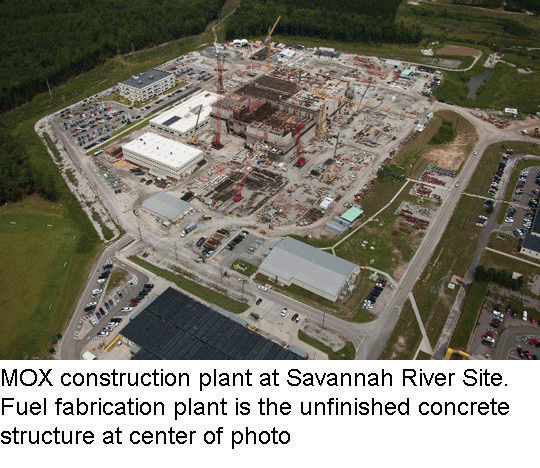
With the huge increase in fixed costs from construction, would it be profitable? If we plan to cancel the program, we would end up writing off the sunk costs, so why not do it anyway? Would it then be profitable? If MOX fuel can’t be sold at a profit, why continue with it?
In summary, MOX has no value in ridding us of our stored plutonium.
Alternatives must be sought for that. The United States will need to have one or several plutonium storage sites, indefinitely. South Carolina should accept the job for one of them.
PRISM an ugly magic trick from the nuclear lobby
http://www.no2nuclearpower.org.uk/nuclearnews/NuClearNewsNo61.pdf
 The U.S. corporation GE Hitachi (GEH) is promoting a reactor design called the PRISM (Power Reactor Innovative Small Modular) that its chief consulting engineer and fast-breeder guru, Eric Loewen, says is a safe and secure way to power the world using yesterday’s nuclear waste – he means plutonium which hasn’t officially been classified as waste in the UK. The Nuclear Decommissioning Authority has declared PRISM to be a “credible option” for managing the UK’s plutonium stockpile.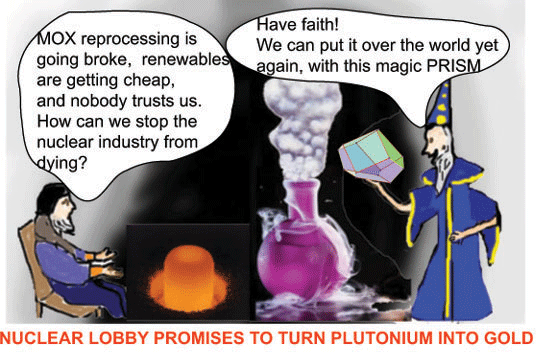
MOX nuclear plant consumed $billions – now to be closed
DOE shuts $4 billion ‘plutonium-eater’ reactor Ecologist, Douglas Birch 12th March 2014 A nuclear reactor designed to burn up surplus Cold War plutonium has been closed by the US Department of Energy. Initially it was meant to cost $1bn. So far it has cost $4bn. To complete and operate would cost $25-34bn.
After a year of study meant to examine the viability of the two-decade old program, the department’s leadership made clear in budget documents for fiscal year 2015 that the plant is no longer affordable within budget limits set by Congress.
The mad world of nuclear economics
Initially advertised as a $1 billion program, the plant has already consumed more than $4 billion and was projected to cost up to $10 billion to complete over the next five years. Its total costs – including operation over 15 years – were estimated at nearly $34 billion by a special study conducted for Energy Secretary Ernest Moniz.
The plant, which lay at the center of a diplomatic deal with Russia that was blessed by three U.S. presidents, was supposed to transform at least 34 tons of plutonium withdrawn from retired U.S. nuclear weapons into so-called Mixed Oxide (MOX) fuel to be burned in civilian nuclear power plants. Russia agreed to undertake a similar effort, but the cancellation of the U.S. plan may affect that decision.
The department’s review “has determined that the MOX fuel approach is significantly more expensive than planned and it is not viable within the FY 2015 funding levels”, the White House’s Energy Department budget proposal states……..http://www.theecologist.org/News/news_round_up/2317472/doe_shuts_4_billion_plutoniumeater_reactor.htm
Rokkasho a big-box store for nuclear terrorists.

After spending tens of billions of dollars and decades on breeder-related programs, Tom Cochran said, countries find it hard to pull the plug.
“You have an entrenched bureaucracy and an entrenched research and development community and commercial interests invested in breeder technology, and these guys don’t go away,” Cochran said. “They’re believers … and they’re not going to give up. The really true believers don’t give up.”……..
“Stealing a weapon is too hard,” Cochran said. “But there is no big risk in fuel assemblies, or in taking things from a bulk handling facility that can be used to make weapons.” In this view, Rokkasho is a kind of big-box store for would-be nuclear terrorists.
A Washington-based physicist and nuclear contrarian, Cochran helped kill a vast plutonium-based nuclear industrial complex back in the 1970s, and now he’s at it again — lecturing at symposia, standing up at official meetings, and confronting nuclear industry representatives with warnings about how commercializing plutonium will put the public at enormous risk.
Where the story ends isn’t clear. But the stakes are large. Continue reading
Dirty bomb could be made from uranium-233 recovered from thorium reactor
Japan Nuclear Fuel trying to get Rokkasho nuclear reprocessing plant into production
Safety screening sought for nuclear fuel plant The Japan News, 7 Jan 14, Nuclear Fuel Ltd. on Tuesday filed for regulatory safety screening of its spent nuclear fuel reprocessing plant.
The company aims to complete the plant in the village of Rokkasho, Aomori Prefecture, in October, expecting that tests by the Nuclear Regulation Authority will be concluded in about six months. The company is determined to do whatever it can to ensure the screening goes smoothly, Senior Executive Vice President Kazuhiro Matsumura said.
The NRA last month drew up new safety standards for key facilities used in the country’s nuclear fuel cycle, such as fuel reprocessing plants.
Under the new rules, operators of these facilities must take steps to ensure they can deal with severe accidents caused by earthquakes, tsunami and terrorist attacks.
The operators are also required to take a stricter approach in research to determine whether faults running near or directly under their facilities are active or not.
Japan Nuclear Fuel previously planned to finish construction of the plant in October 2013. But the firm put off the planned completion by about one year to meet the new standards………
The ¥2.2 trillion plant has seen its scheduled completion date moved back as many as 20 times due to a series of problems. Initially, the plant was slated to be completed in 1997, four years after the start of construction.
It is uncertain whether the NRA can complete its safety screening of the plant in six months as expected……
Japan Nuclear Fuel also filed for safety screening tests of other facilities, such as a low-level radioactive waste management center and a plant to make mixed oxide, or MOX, fuel from extracted uranium and plutonium.http://the-japan-news.com/news/article/0000921892
Approval for Tokai nuclear reprocessing plant BEFORE safety screening!
NRA to approve restart of reprocessing facility http://www3.nhk.or.jp/nhkworld/english/news/20131211_29.html Japan’s nuclear regulator plans to approve a partial restart of a facility for reprocessing spent nuclear fuel before it clears safety screening under new regulations.
The Nuclear Regulation Authority says it’s allowing the restart to make plutonium and other highly radioactive waste in the facility solid and more stable.
The authority said on Wednesday that it plans to allow the government-backed Japan Atomic Energy Agency to operate part of the plant in Tokai Village, about 100 kilometers north of Tokyo.
The decision comes after the agency sought permission to restart the facility soon, saying that keeping the waste in liquid form involves high risks.
NRA commissioners said the facility’s stockpiles of plutonium solutions and other liquid waste will be made safer when reprocessed into solids.
They came up with a plan to allow part of the facility to run for 5 years before checking is done under the enhanced regulations.
The facility stores 3.5 cubic meters of solutions containing plutonium and more than 400 cubic meters of highly radioactive liquid waste. NRA secretariat officials say reprocessing the plutonium solutions into powder will take about 2 years, and turning other liquid waste into glass 21 years.
The new regulations are to take effect on December 18th. The NRA is to give formal approval after confirming that the agency can ensure stable reprocessing at the plant.
PRISM – Power Reactor Innovative Small Module new nuclear magic gimmick
The plutonium stockpile poses enormous problems for the government. Not only is it highly radioactive and an immense potential danger to health, it is also a target for terrorist attacks and for anyone interested in stealing nuclear weapons-grade material.
The NDA’s report to DECC is understood to conclude that the Prism fast reactor is as credible as the two other options based on Mox fuel, even though GE-Hitachi has not yet built a commercial-scale plant for burning plutonium waste. DECC, however, has refused to release the report under a Freedom of Information request
It is understood that the NDA has been impressed by proposals from GE-Hitachi to build a pair of its Prism fast reactors on the Sellafield site,
Revealed: UK Government’s radical plan to ‘burn up’ UK’s mountain of plutonium http://www.independent.co.uk/news/science/revealed-uk-governments-radical-plan-to-burn-up-uks-mountain-of-plutonium-8967535.html 28 Nove 13 A radical plan to dispose of Britain’s huge store of civil plutonium – the biggest in the world – by “burning” it in a new type of fast reactor is now officially one of three “credible options” being considered by the Government, The Independent understands. However, further delays have hit attempts to make a final decision on what to do with the growing plutonium stockpile which has been a recurring headache for successive governments over the past three decades.
The stock of plutonium, one of the most dangerous radioactive substances and the element of nuclear bombs, has already exceeded 100 tonnes and is likely to grow to as much as 140 tonnes by 2020, bolstered by a recent decision to include foreign plutonium from imported nuclear waste.
Ministers had pledged to resolve the plutonium problem in a public consultation but are sitting on a secret report by the Nuclear Decommissioning Authority (NDA) which is believed to confirm that there are now three “credible options” for dealing with the plutonium stored at the Sellafield nuclear reprocessing plant in Cumbria. Continue reading
MOX nuclear fuel – the secret and so dangerous ingredient in the Fukushima No 4 nuclear cooling pond
The un-irradiated rods inside the Unit 4 spent-fuel pool are, in all probability, made of a new type of MOX fuel containing highly enriched plutonium.
 Why TEPCO is Risking the Removal of Fukushima Fuel Rods. The Dangers of Uncontrolled Global Nuclear Radiation, Global Research, 24 Nov 13 By Yoichi Shimatsu
“…….Mystery of MOX super-fuel A Mainichi Shimbun editorial mentions in passing that the Reactor 4 pool contains 202 fresh fuel assemblies.(3) The presence of new fuel rods was confirmed in the TEPCO press release, which described the first assembly lifted into the transfer cask as an “un-irradiated fuel rod.” Why were new  rods being stored inside a spent-fuel pool, which is designed to hold expended rods? What threat of criticality do these fresh rods pose if the steel frame collapses or if crane operators drop one by accident onto other assemblies, as opposed to a spent rod?
Against the official silence and disinformation, a few whistleblowers have come forward with clues to answer these questions. Former GE nuclear worker Kei Sugaoka disclosed in a video interview that a joint team from Hitachi and General Electric was inside Reactor 4 at the time of the March 11, 2011 earthquake. By that fateful afternoon, the GE contractors were finishing the job of installing a new shroud, the heat-resistant metal shield lining the reactor interior.(4)
TEPCO inadvertently admitted to the presence of foreign contractors at Fukushima No.1 up until March 12, 2012, when the management ordered their evacuation in event of a massive explosion during the rapid meltdown of Reactor 2. So far, leaks indicate the presence of the GE team and of a Israeli nuclear security team with Magna BSP, a company based in Dimona.(5)
Another break came in April 2012, when a Japanese humor magazine published a brief interview of a Fukushima worker who disclosed that radioactive pieces of a broken shroud were left inside a device-storage pool at rooftop level behind the Reactor 4 spent-fuel pool.(6) This undoubtedly is the used shroud removed by the GE-H workers in February-March 2011.
A curious point here is that the previous shroud had been in use for only 15 months. Why would TEPCO and the Japanese government expend an enormous sum on a new lining when the existing one was still good for many years of service?
Obviously, the installation of a new shroud was not a mere replacement of a worn predecessor. It was an upgrade. The refit of Reactor 4 was, therefore, similar to the 2010 conversion of Reactor 3 to pluthermal or MOX fuel. The same model of GE Mark 1 reactor was being revamped to burn MOX fuel (mixed oxide of uranium and plutonium).
The un-irradiated rods inside the Unit 4 spent-fuel pool are, in all probability, made of a new type of MOX fuel containing highly enriched plutonium. If the frame collapses, triggering fire or explosion inside the spent-fuel pool, the plutonium would pulse powerful neutron bursts that may well possibly ignite distant nuclear power plants, starting with the Fukushima No.2 plant, 10 kilometers to the south…..
The upgrade of the Reactor 4 shroud may well have involved the test-fitting of some MOX rods, which abandoned on the floor next to the reactor when the tsunami reached shore. In other words, in early March 2011 crane operators completely filled space inside the spent-fuel pool with new MOX rods and then simply left casks of assemblies on the roof and lowered more into the basement. That is the simplest explanation for the damage to the structural integrity of the reactor building. GE is not about to disclose its role in this disaster………. http://www.globalresearch.ca/why-tepco-is-risking-the-removal-of-fukushima-fuel-rods-the-dangers-of-uncontrolled-global-nuclear-radiation/5359188…..http://www.globalresearch.ca/why-tepco-is-risking-the-removal-of-fukushima-fuel-rods-the-dangers-of-uncontrolled-global-nuclear-radiation/535918
Pandora’s misleading spin about Integral Fast Nuclear Reactors (IFRs)
 Other Department of Energy studies showed that pyroprocessing, by generating large quantities of low-level nuclear waste and contaminated uranium, greatly increases the volume of nuclear waste requiring disposal, contradicting “Pandora’s Promise’s” claim it would reduce the amount of waste.
Scientist: Film hypes the promise of advanced nuclear technology By Edwin Lyman, CNN November 7, 2013 In his zeal to promote nuclear power, filmmaker Robert Stone inserted numerous half-truths and less-than-half-truths in his new documentary “Pandora’s Promise,” One of Stone’s more misleading allegations was that scientists at a U.S. research facility, the Argonne National Laboratory, were on the verge of developing a breakthrough technology that could solve nuclear power’s numerous problems when the Clinton administration and its allies in Congress shut the program in 1994 for purely political reasons.
Like the story of Pandora itself, the tale of the integral fast reactor (IFR) — or at least the version presented in the movie — is more myth than reality. In the final assessment, the concept’s drawbacks greatly outweighed its advantages. The government had sound reasons to stanch the flow of taxpayer dollars to a costly, flawed project that also was undermining U.S. efforts to reduce the risks of nuclear terrorism and proliferation around the world…….
What did “Pandora’s Promise” leave out? First, it does not clearly explain what a “fast reactor” is and how it differs from the water-cooled reactors in use today. Most operating reactors use a type of fuel called “low-enriched” uranium, which cannot be used directly to make a nuclear weapon and poses a low security risk. The spent fuel from these water-cooled reactors contains weapon-usable plutonium as a byproduct, but it is very hard to make into a bomb because it is mixed with uranium and highly radioactive fission products.
Fast reactors, on the other hand, are far more dangerous because they typically require fuels made from plutonium or “highly enriched” uranium that can be used to make nuclear weapons.
In fact, fast reactors can be operated as “breeders” that produce more plutonium than they consume. To produce the large quantities of plutonium needed to fuel fast reactors, spent fuel from conventional reactors has to be reprocessed — chemically processed to separate plutonium from the other constituents. Facilities that produce plutonium fuel must have strong protections against diversion and theft. All too often, however, security at such facilities is inadequate.
In the IFR concept, which was never actually realized in practice, reactor-spent fuel would be reprocessed using a technology called pyroprocessing, and the extracted plutonium would be fabricated into new fuel. IFR advocates have long asserted that pyroprocessing is not a proliferation risk because the plutonium it separates is not completely purified.
But a 2008 U.S. Department of Energy review — which confirmed many previous studies — concluded that pyroprocessing and similar technologies would “greatly reduce barriers to theft, misuse or further processing, even without separation of pure plutonium.” Continue reading
On Integral Fast Reactor and France “Pandora’s Promise” gets it wrong
Nuclear energy film overstates positives, underplays negatives By Ralph Cavanagh and Tom Cochran, CNN November 6, 2013 – “………The still-unrealized Integral Fast Reactor is the real star of the film, along with the nation of France, whose nuclear generation program is extolled as “one of the most inspiring stories ever” (“the trains are electric powered, they have clean air, and they have the cheapest electricity in Europe”). Nuclear power debates are the only places where you will ever see those at the conservative edge of the political spectrum argue that the United States should reorganize its economy to be more like France.
The Clinton administration killed the Integral Fast Reactor in 1994 because of concern over the potential diversion of the plutonium fuel by terrorists and non-nuclear weapon states of concern. Yet the film’s closing argument is that a “fourth-generation” reactor modeled on the Integral Fast Reactor will sweep the globe, burning waste created by the first three generations and “solving” the nagging problem of long-term disposal of nuclear waste. The film fails to mention that this would take hundreds to thousands of plutonium-fueled reactors operating over hundreds of years, resulting most likely in an increase in the releases of radioactivity to the environment as a consequence of operations by the Integral Fast Reactor’s fuel processing and fabricating facilities.
The film invokes Bill Gates as one of many forward-thinking new investors in nuclear innovation, but surely even Gates would recoil from the Integral Fast Reactor’s poor economic outlook compared to conventional reactors and the financial risks associated with building just one Integral Fast Reactor, let alone a global fleet of them. The film fails to acknowledge that the flagship fast reactor development efforts in the United States, France, Germany, Japan and Italy all failed, and that fast reactors were abandoned by both the U.S. and Soviet navies, hardly a strong selling point for resurrecting the Integral Fast Reactor program………..http://edition.cnn.com/2013/11/06/opinion/pandora-nuclear-energy-opinion-cavanagh-cochran/
Confusion and secrecy surround China’s proposed uranium processing plant in Jiangmen,

 Experts call for more details on Guangdong uranium plant, South China Morning Post, Olga Wong and Minnie Chan Concern over sketchy nature of details and possible radiation risks from proposed nuclear development in Guangdong.
Nuclear experts and green activists have called for more information from the Guangdong government after limited details were released about its proposal for a uranium processing plant in Jiangmen, about 100 kilometres from Hong Kong.
An announcement by the Jiangmen City Development and Reform Bureau said the 230-hectare plant would carry out uranium conversion, enrichment and fuel fabrication.
But the three-page statement, issued last Thursday, did not make it clear whether the plant, in the Longwan industrial district of Zhishanzhen, would perform spent fuel reprocessing – recycling of old fuel rods that could emit high doses of radiation – or what measures would be used to avoid radiation leaks…… Continue reading
The failure of the South Carolina Mixed Oxide (MOX) nuclear fuel plant
Nuclear waste: DC has ignored a cheaper way to dispose of plutonium — until now Sentinel.com, Douglas Birch & R. Jeffrey Smith The Center for Public Integrity, 7 July 13, “………..Unrealized ambitions
Although the White House has not allocated any additional funding for the South Carolina plant after 2014, the Energy Department claims it remains in contention as a solution to the plutonium disposal problem. But already it’s clear that the original U.S. goal for the program — reducing the world’s supply of nuclear explosive material by 68 tons – will not be realized.
Washington compromised repeatedly with Russia to pursue a program that even for some of its initial supporters has long since ceased to be a top nonproliferation priority. Meanwhile, the price of the MOX fuel factory soared far beyond the Energy department’s estimates, making it one of many, multi-billion dollar, Energy Department programs accused of being poorly run.
“MOX is just a sample of a larger problem,” says Gene Aloise, a senior federal auditor who tracked nonproliferation projects for the Government Accountability Office from 1994 to 2012.
The result is that Washington has spent at least $3.7 billion on a plant to manufacture reactor fuel no U.S. utility is eager to buy, after rejecting alternatives that likely would have been cheaper.
“The government’s plutonium plan is a pluperfect disaster,” Sen. Edward Markey, a newly-elected Massachusetts Democrat, told the Center for Public Integrity in a statement. “And all to produce $2 billion worth of reactor fuel at a cost of tens of billions of taxpayer dollars and damage to our global non-proliferation efforts.” Markey was the ranking member of the House Natural Resources Committee, has long been active on nuclear safety issues, and in 1986 chaired hearings on the Chernobyl disaster.
The factory’s fate might be decided next year, as the administration prefers, after another $320 million is spent on its construction. Or Congress might decide to take swifter and more decisive action in budget legislation this summer……..And after twenty years of negotiations, promises and plans, and billions in spending, the U.S. appears no closer — in its principal plutonium disposal efforts — to the goal of making the world safer from a nuclear disaster.http://www.tucsonsentinel.com/nationworld/report/070513_nuclear_waste/nuclear-waste-dc-has-ignored-cheaper-way-dispose-plutonium-until-now/
Secret promises to USA, by Japan, to burn plutonium
 Mainichi: Japan’s secret promise with U.S. to burn plutonium — “It is abnormal for sure” — “Expected to stir up controversy” http://enenews.com/mainichi-japan-secretly-promised-to-burn-plutonium-it-is-abnormal-for-sure-expected-to-stir-up-controversy
Title: Japan made secret promise with U.S. to restart pluthermal nuclear program
 Source: Mainichi
Date: June 25, 2013
A Japanese prime ministerial envoy secretly promised to the United States that Japan would resume its controversial “pluthermal” program, using light-water reactors to burn plutonium, according to documents obtained by the Mainichi.
The secret promise was made by Hiroshi Ogushi, then parliamentary secretary of the Cabinet Office, to Daniel Poneman, deputy secretary of the U.S. Department of Energy, during Ogushi’s visit to the United States on behalf of then Prime Minister Yoshihiko Noda in September last year.
[…] The fact that a Japanese official promised to the U.S. to implement such a controversial project without a prior explanation to the Japanese public is expected to stir up controversy. […]
“It is abnormal for sure,” said one official with the Agency for Natural Resources and Energy. […]
See also: Plutonium-burning reactors to restart in Japan? — Gov’t forcing companies to use MOX fuel — Official: “We have no other choice”
The exploding costs of the Savannah River MOX plant
The explosive costs of disposing of nuclear weapons WP,By Walter Pincus, July 3 Costs can explode like fireworks when it comes to nuclear weapons disposal.
For example, it could cost more money and take longer to get rid of just 37.5 tons of excess, weapons-grade plutonium than it did for the Manhattan Project to produce the atomic bombs that ended World War II. Four weapons — the Trinity plutonium implosion device tested in the New Mexico desert; the Little Boy uranium bomb dropped on Hiroshima; the Fat Man plutonium bomb that hit Nagasaki, and an unused uranium bomb — were produced within six years in current dollars of some $24.1 billion, according to Stephen I. Schwartz’s book, “Atomic Audit.”
In comparison, it will cost more than $24.2 billion and take until 2036 for the United States to get rid of those 37.5 tons of plutonium, according to a Government Accountability Office estimate. It appears in the Senate Armed Services report on the fiscal 2014 defense authorization bill.
Costs have skyrocketed for the Mixed Oxide Fuel Fabrication Facility at the Savannah River plant in South Carolina. The facility is designed to blend the surplus plutonium with uranium oxide to make mixed oxide (MOX) that can be used as fuel in some U.S. commercial reactors. That would make the plutonium unusable for future nuclear weapons.
When the National Nuclear Security Administration (NNSA) originated this MOX program in 2002, design and construction were to cost $1 billion.
By 2005, the estimate was $3.5 billion. When project construction began in 2007, it was three years behind schedule with a $4.8 billion price tag.
According to NNSA’s fiscal 2014 budget request, construction will hit $7.78 billion.
The annual cost to run the facility has also exploded. NNSA estimated in 2002 that it would cost $100.5 million a year to operate the MOX plant. Annual operating costs are now expected to be $543 million. The planned 2017 completion date has slipped another two years, according to a recent Congressional Research Service report.
Here’s another ticking time bomb. A federal facilities agreement in 2002 with South Carolina called for Washington to pay up to $100 million a year to the state if the plant did not produce 1 ton of MOX fuel annually, starting in 2009. That was to compensate the state for the storage of excess plutonium.
Sen. Lindsay Graham (R-S.C.), a main project booster, has used amendments to delay the fines until 2016, according to a study by the Center for Public Integrity.
The cost prompted the Obama administration to propose slowing construction while it reviews the MOX program, including assessing other ways to get rid of the plutonium……… http://www.washingtonpost.com/world/national-security/the-explosive-cost-of-disposing-of-nuclear-weapons/2013/07/03/64f896e0-e287-11e2-80eb-3145e2994a55_story.html
1 This Month

of the week – Shut Down Drone Warfare!


Tell the Ukrainian Government to Drop Prosecution of Peace Activist Yurii Sheliazhenko

Petition to revoke the licensing of the Near Surface Nuclear Disposal Facility (NSDF) at Chalk River. https://www.ourcommons.ca/petitions/en/Petition/Details?Petition=e-7247
To see nuclear-related stories in greater depth and intensity – go to https://nuclearinformation.wordpress.com
-
Archives
- April 2026 (7)
- March 2026 (251)
- February 2026 (268)
- January 2026 (308)
- December 2025 (358)
- November 2025 (359)
- October 2025 (376)
- September 2025 (257)
- August 2025 (319)
- July 2025 (230)
- June 2025 (348)
- May 2025 (261)
-
Categories
- 1
- 1 NUCLEAR ISSUES
- business and costs
- climate change
- culture and arts
- ENERGY
- environment
- health
- history
- indigenous issues
- Legal
- marketing of nuclear
- media
- opposition to nuclear
- PERSONAL STORIES
- politics
- politics international
- Religion and ethics
- safety
- secrets,lies and civil liberties
- spinbuster
- technology
- Uranium
- wastes
- weapons and war
- Women
- 2 WORLD
- ACTION
- AFRICA
- Atrocities
- AUSTRALIA
- Christina's notes
- Christina's themes
- culture and arts
- Events
- Fuk 2022
- Fuk 2023
- Fukushima 2017
- Fukushima 2018
- fukushima 2019
- Fukushima 2020
- Fukushima 2021
- general
- global warming
- Humour (God we need it)
- Nuclear
- RARE EARTHS
- Reference
- resources – print
- Resources -audiovicual
- Weekly Newsletter
- World
- World Nuclear
- YouTube
-
RSS
Entries RSS
Comments RSS
 nuclear-news