Canada’s environmental groups join to oppose experimental Small Nuclear Reactors (SMRs)
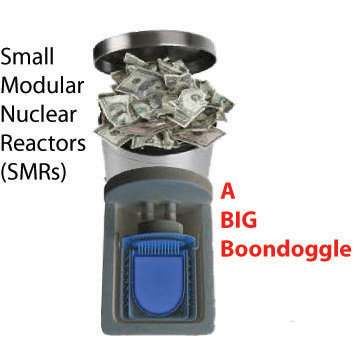 Canadian environmental groups oppose experimental small modular nuclear reactors, https://blackburnnews.com/midwestern-ontario/midwestern-ontario-news/2020/11/24/canadian-environmental-groups-oppose-experimental-small-modular-nuclear-reactors/ By Janice MacKay November 24, 2020 A number of groups have joined together to ask the federal government to halt its plans to fund experimental new small modular nuclear reactors (SMRs).
The Federal Government is preparing to launch the federal government’s SMR ” Action Plan” within weeks.
The SMR Action Plan is expected to include a strategy to fund and support the development of experimental nuclear reactors by private sector companies, the majority based in the US and UK.
In a media release, dozens of organizations from coast to coast have called the proposed new nuclear reactors a dirty, dangerous distraction from tackling climate change. They include Greenpeace Canada, Friends of the Earth Canada, Ralliement contre la pollution radioactive, Équiterre, the Coalition for Responsible Energy Development in New Brunswick, the Canadian Coalition for Nuclear Responsibility and Northwatch..
The Bloc Québécois, the NDP and the Green Party all oppose the government’s “small” modular nuclear reactor plan.
On November 13, Monique Pauze from the Bloc Québécois stated: “The Bloc Québécois denounces the intention of Ottawa to invest in nuclear energy to the benefit, once again, of the Ontario industrial sector, instead of financing the transition towards clean electricity. The Bloc calls for the abandonment of the anticipated deployment of small modular nuclear reactors. The Federal government is leading Canada towards a wall by betting on nuclear energy that is absolutely not clean.”
NDP natural resources critic Richard Cannings said in a statement: “Many Canadians have concerns about impacts of nuclear energy. When it comes to energy generation there are better ways forward. We have options that are cheaper and safer and will be available quicker. I think we should be supporting the development of energy storage solutions to help roll out renewables like solar and wind on a larger scale instead.”
On November 10, all three Green Party of Canada caucus members issued a statement and signed a letter to Minister O’Regan and Minister Navdeep Bains saying that: “Small nuclear reactors (SMRs) have no place in any plan to mitigate climate change when cleaner and cheaper alternatives already exist. The federal government must stop funding the nuclear industry and instead redirect investments towards smarter solutions. Nuclear fails on many grounds, including on the economics.”
Prof. Susan O’Donnell from the Coalition for Responsible Energy Development in New Brunswick said: “Building new nuclear reactors does not belong in a climate action plan. Leading researchers have shown that investing in renewable energy is the best path to net zero and that adding nuclear energy to the mix actually hinders rather than helps.”
Shawn-Patrick Stensil, Director of Programs at Greenpeace Canada, said: “The Liberal government is throwing good money after bad. Hypothetical new nuclear power technologies have been promising to be the next big thing for the last forty years, but in spite of massive public subsidies, that prospect has never panned out.”
The release pointed out the proposed reactors are still on the drawing board and will take a decade or more to develop. If built, their power will cost ten times more than wind or solar energy. The most advanced SMR project to date in the US has already doubled its estimated cost – from $3B to over $6B.
The federal government announced its first SMR grant of $20 million to Terrestrial Energy on October 15.
The environmental groups said they are shocked that the government is funding new nuclear energy development with no parliamentary review, while trying to avoid public scrutiny and debate. They called the consultation process leading to date on the SMR Action Plan a sham. Individuals and groups could only comment on the plan if they first signed on to a statement of principles supporting SMR technologies. They say nuclear power and uranium mining will always be dirty and dangerous. Radioactive waste will have to be kept out of the environment for tens of thousands of years, and there is no known means of achieving that.
Serious technical problems for the much hyped molten salt nuclear reactor
 Advanced reactor developers trying to expand nuclear power’s selling points Advanced reactor developers trying to expand nuclear power’s selling points
Molten salt reactor developers believe they can solve nuclear’s cost problem. Utiity Dive, Matthew Bandyk, 12 March 2020, “……….. the passage of the Nuclear Energy Innovation and Modernization Act (NEIMA) has given the nuclear industry a new boost in confidence that advanced reactors will make significant progress soon. Signed into law by President Trump in early 2019, NEIMA requires the Nuclear Regulatory Commission to create a new regulatory structure by the end of 2027 that will ease the licensing process for new reactor designs. ……..More federal legislative support for advanced reactors is possible ……… Despite the enthusiasm for the technology, commercialization could be many years away. Molten salt reactors still have several technical challenges that must be solved before they can become accepted in the power industry, according to Jacopo Buongiorno, TEPCO Professor of Nuclear Science and Engineering at the Massachusetts Institute of Technology /
…….. The MIT Energy Initiative study found that…. “less mature reactor concepts, including lead fast reactors, gas-cooled fast reactors, and molten salt systems, however, would not be expected to reach commercialization before 2050 .
……. One of the biggest challenges that extends the timeline is determining the structural materials that would go into a molten salt reactor core, which may be very different than the materials used in conventional reactors because of the completely different chemical environment.
While the Oak Ridge National Laboratory operated an experimental molten salt reactor for several years in the 1960’s, that project was for research and not for producing power, so it only partially answers the many technical questions needed to determine how a molten salt reactor could operate as a power plant, according to Buongiorno. “We don’t know exactly yet how long the materials used for molten salt reactors will last before they corrode,” he said. “Another important issue to be resolved is access and maintenance of the reactor components during power operations and outages, since the molten salts can become highly radioactive.” ….https://www.utilitydive.com/news/nuclear-energy-storage-advanced-reactor-developers-trying-to-expand-nuclea/573570/
|
|
Concerns in Utah cities about costs and safety of NuScam’s small nuclear reactor scheme
|
Following the withdrawal of seven Utah cities from the Carbon Free Power Project before the October deadline, the Southern Utah cities have passed resolutions to cap financial obligation for the first phase of licensing…….. Not all are completely sold on the safety of this power plant. Scott Williams, the executive director of Healthy Environment Alliance of Utah, told St. George News that one of the major issues with this project has to do with the lack of transparency, as UAMPS is exempt from the Open and Public Meetings Act. “We don’t get minutes. We don’t get agendas.” he said……. The next off-ramp for cities to withdraw will be near the end of the 2021 or early 2022 after the next licensing phase. UAMPS has also talked about possibly downsizing the project from 12 modules to four or six modules……. Environmentally devastating’ When it comes to potential environmental impacts, Williams said the number one problem is highly radioactive waste. “We’ve been building nuclear reactors around the country since the 60s, and all of that highly radioactive fuel is just sitting at those power plants with nowhere to go.”….. “We just think we shouldn’t generate anymore high-level nuclear waste until we have a safe, environmentally responsible way to deal with it.” Second to this, he said, is the whole process of creating nuclear fuel. All of the stages – mining, milling and enrichment – present health hazards to people. “Southeastern Utah is full of abandoned uranium mines that create radioactive exposure to the populations down there, and they’re not being cleaned up,” he said, adding that these mines are almost all in San Juan County. “The entire Navajo Nation is full of them. In fact, we’re just putting a map together; There’s hundreds of them on the Navajo Reservation.” Much of the mine tailings were put near Moab, he added, and for some 40 years they have been in the process of moving these tailings away from the Colorado River up to a place near Interstate 70, which has cost billions of dollars of taxpayers’ money. This project, the Moab Uranium Mill Tailings Remedial Action Project, is being administered by the U.S. Department of Energy and is about 68% complete with efforts to move 16 million tons of uranium tailings from the banks of the Colorado River to a permanent disposal site 32 miles north, near Crescent Junction. The final possible implication of the project, Williams said, would be in the case of an accident at the facility, which would be “environmentally devastating.” “UAMPS and NuScale say this plant is meltdown-proof, but they’ve never actually built one of these modules before, so it’s all theoretical at this point.” So if not nuclear, what’s the best option? Aside from wind, solar and hydro (that’s already established), he said there is new technology coming to the scene that will be here before this power plant is finished. This technology includes utility-scale or home-based battery storage for intermittent power sources. Investing in energy efficiency is also integral, as well as making use of wasted power through grid integration. But what it really comes down to, he said, is a shift in public perception. “A lot of the people who are proponents of this nuclear plant are still thinking about energy the way we’ve been producing it in the past, and they say, ‘Battery storage will never be economically competitive.’ But they said that about solar 10 years ago, and it’s become cheaper faster than any of them could have predicted.”https://www.stgeorgeutah.com/news/archive/2020/11/21/asd-environmentally-devastating-or-really-really-safe-southern-utah-cities-set-financial-caps-for-nuclear-power-project/#.X7rBxGgzbIU |
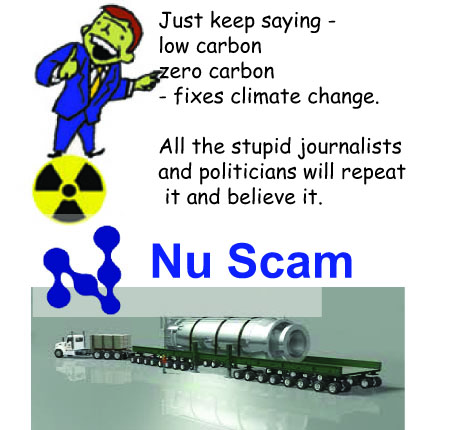
Examining Britain’s 10 Point Plan – Small Modular Nuclear Reactors downgraded, as renewables are cheaper and better?
 New Civil Engineer 19th Nov 2020, Prime Minister Boris Johnson’s 10 Point Plan for a “green industrial revolution” – announced yesterday – is “pretty vague” about the future of big nuclear energy projects and disappointing for the mini nuclear industry, according to Energy & Climate Intelligence Unit head of analysis Jonathan Marshall. In the plan, Johnson backed the development of nuclear energy, committing £525M “to help develop large and smaller-scale nuclear plants, and research and develop new advanced modular reactors”. New Civil Engineer 19th Nov 2020, Prime Minister Boris Johnson’s 10 Point Plan for a “green industrial revolution” – announced yesterday – is “pretty vague” about the future of big nuclear energy projects and disappointing for the mini nuclear industry, according to Energy & Climate Intelligence Unit head of analysis Jonathan Marshall. In the plan, Johnson backed the development of nuclear energy, committing £525M “to help develop large and smaller-scale nuclear plants, and research and develop new advanced modular reactors”.However, according to Marshall large nuclear support is”buried” in the proposals and investment in small modular reactors (SMRs)
is less than expected. “If I was in the SMR game I’d be disappointed with this because that £2bn support for a small initial fleet of reactors has been pared back to just over £500M,” Marshall said. “It’s a lot of cash and still a lot of support – it’s more than most unproven technologies get – but it feels a bit like SMRs have been put on the backburner now. For a while it felt like the government was believing that the SMR industry could be the future. “Paring back on what was expectedto be offered might show that the government is cooling or laying down a tougher set of challenges to Rolls Royce and others in the SMR world to prove the claims are true before they get more money.”
Marshall attributed this change to the increasing support for renewables. “The EU has set out huge ambitions to boost offshore wind capacity, the UK has already done that, all the rest of the world is investing in renewables whereas not many are investing in nuclear now,” he said. “None of these cost reductions that were touted for years for nuclear industry seem to be happening whereas the evidence shows the cost of renewables is plummeting and the cost of what’s needed to balance the grid is plummeting too.”
|
USA revives plan for fast nuclear reactor, despite terrorism risks
|
Idaho is top pick for Energy Department nuclear test reactor, By KEITH RIDLER, BOISE, Idaho (AP) 20 Nov 20, — The U.S. government said Thursday that Idaho is its preferred choice ahead of Tennessee for a test reactor to be built as part of an effort to revamp the nation’s fading nuclear power industry by developing safer fuel and power plants. The U.S. Department of Energy said in an email to The Associated Press that the site that includes Idaho National Laboratory will be listed as its preferred alternative in a draft environmental impact statement planned for release in December. The Versatile Test Reactor, or VTR, would be the first new test reactor built in the U.S. in decades and give the nation a dedicated “fast-neutron-spectrum” testing capability. Some scientists decry the plan, saying fast reactors are less safe than current reactors. A news release by the Energy Department earlier Thursday listed both Idaho and Tennessee as possible locations without selecting one as being favored…… The department had a fast reactor, the Experimental Breeder Reactor II, operating in eastern Idaho until it was shut down in 1994 as the nation turned away from nuclear power. ……. Some scientists are wary of fast reactors, noting they’re cooled with harder to control liquid sodium and likely fueled by plutonium, increasing potential nuclear terrorism risks because plutonium can be used to make nuclear weapons….. https://apnews.com/article/environment-tennessee-nuclear-power-idaho-f70ae4dac811f90f1493231fe7edb7bd |
|
British govt’s foolhardy plan to pay up for non existent Rolls Royce small nuclear reactors
Guardian 17th Nov 2020, Boris Johnson’s £12bn plan for a “green industrial revolution” spans renewable energy, nuclear power and countryside restoration. However, some of the objectives are likely to be difficult to reach, and the plan has been criticised for a lack of ambition in key areas.Canadian government misplacing funding into unviable small nuclear reactors for North West Territories

Is small-scale nuclear energy an option for the N.W.T.?
N.W.T., federal gov’t looking closely at industry, but some say they should focus only on renewable energy, Hannah Paulson · CBC News Nov 18, 2020 “……. both the federal government and the Northwest Territories look to transition away from fossil fuels, territorial leaders are exploring how small-scale nuclear energy could alleviate the North’s dependency on diesel.
In October, the federal government announced it was investing $20 million into small modular nuclear energy reactors
…….The N.W.T. government has also shown interest in this form of energy and identified it as an emerging energy technology that it follows “closely,” according to a written statement from the Department of Infrastructure.
Others, however, think the federal funding is misplaced.
Last week, the Green Party of Canada called on the federal government to abandon nuclear energy and invest in renewable energy instead.
In a press release, MP Elizabeth May said that “small nuclear reactors (SMRs) have no place in any plan to mitigate climate change when cleaner and cheaper alternatives exist.”
May cited issues with the high costs involved in nuclear energy, the long timeline to rollout, and the environmental risk.
What is small-scale nuclear energy?
SMRs is a term that represents “a range of technology,” said Diane Cameron, director of nuclear energy at Natural Resources Canada.
The federal government’s $20-million investment is toward Terrestrial Energy, an Oakville, Ont., firm that is working to bring SMRs to market. That technology is still in the design phase, but could become commercially viable in five to 10 years, said Cameron……..
N.W.T. part of small-scale nuclear group
The Northwest Territories is among several jurisdictions and energy corporations that are part of a working group looking at how small-scale nuclear reactors could be used across the country.
The working group “has recognized the potential for application in off-grid small and remote communities and for remote industrial sites that rely on diesel,” the Department of Infrastructure said in a statement.
The statement also said that there needs to be more information about whether SMRs would be technically viable, safe, reliable and cost effective in the North.
The Department of Infrastructure considers small-scale nuclear energy a long-term initiative.
Cameron said SMRs could be commercially viable anywhere from 2025 to 2030, but before it’s likely to be brought up to the N.W.T., it will be tested in national labs.
If that is successful, the technology could make its wat into communities, but that might not be for another 20 or so years, she said.
‘Not the answer to climate change’
In a 2018 UN report, scientists warned that there were only 12 years left to drastically reduce global emissions in order to avert the most catastrophic impacts of climate change.
This is part of the reason why May and other environmentalists don’t think small-scale nuclear energy is part of “the answer to climate change.”
Theresa McClenaghan, the executive director of the Canadian Environmental Law Association, said the industry requires extremely high startup costs, which divert attention away from renewable energy.
Funding should be going toward existing renewable energy sources that are currently viable, like geothermal, solar, or wind energy, she said. “These are not pipe dreams. These are existing technologies where the price is coming down practically by the day,” said McClenaghan.
“It’s not to say we don’t want an alternative to diesel, but that alternative should be renewables.” https://www.cbc.ca/news/canada/north/small-scale-energy-nwt-1.5803972
UK government wastes tax-payer money on small and large nuclear reactors that will never be cheap or safe
 FoE Scotland 17th Nov 2020, Friends of the Earth Scotland gave a scathing reaction to
  the UK Government’s announcement of a 10-point plan on climate and energy, calling for much more priority on solutions which can reduce emissions and create jobs today.
crisis like carbon capture and storage, hydrogen and nuclear. “While there are some crumbs from the table in terms of the welcome new target of 2030 to phase out fossil-fuelled cars, overall there is too little new money and too much funding committed to long-term, dangerous distractions.
https://foe.scot/press-release/response-to-the-uk-10-point-climate-plan-for-net-zero/
In the face of public opposition, Ottawa delays small nuclear reactor plan
Ottawa delays small nuclear reactor plan as critics decry push for new reactors, Yahoo Finance Colin Perkel, The Canadian Press, Thu., November 19, 2020, “……… Industry critics were quick to pounce on the government’s expected SMR announcement. They called on Ottawa to halt its plans to fund the experimental technology.
.. a major problem facing the industry is its growing mound of radioactive waste. This week, the government embarked on a round of consultations about what do with the dangerous material.
Dozens of groups, including the NDP, Bloc Quebecois, Green Party and some Indigenous organizations, oppose the plan for developing small modular reactors. They want the government to fight climate change by investing more in renewable energy and energy efficiency.
“We have options that are cheaper and safer and will be available quicker,” Richard Cannings, the NDP natural resources critic, said in a statement. …
Joe McBrearty, head of Canadian Nuclear Laboratories, told the conference the company had signed a host agreement this week with Ottawa-based Global First Power for a demonstration SMR at its Chalk River campus in eastern Ontario. A demonstration reactor will allow for the assessment of the technology’s overall viability, he said
Small Modular Nuclear Reactors, the nuclear industry’s latest pipe dream.
 Ramana and Schacherl: Why the Liberals’ nuclear power plan is a pipe dream https://ottawacitizen.com/opinion/ramana-and-schacherl-why-the-liberals-nuclear-power-plan-is-a-pipe-dream?fbclid=IwAR0GnxYt-JgXg7NVEyccBYt4r0SSbfAHm3Y-b_AvzgMIjxpOotUTBIvAcaI
Not only is this form of power expensive compared to the alternatives, we still haven’t resolved issues around radioactive contamination and hazardous waste streams.
At least a dozen corporations around the world are hoping for taxpayer funding to further develop their SMR designs, all of which are still on the drawing board. Last month, the federal government handed out $20 million to Terrestrial Energy. Other expectant entities include SNC-Lavalin, which bought Atomic Energy of Canada Ltd.’s CANDU division and is developing a CANDU SMR; United Kingdom-based Moltex Energy; and Seattle-based Ultra Safe Nuclear Corporation.
The Liberal government says it supports small modular reactors to help Canada mitigate climate change. The government is simply barking up the wrong tree, for several reasons: cost, cost and cost, as well as renewables, safety and radioactive waste.
Nuclear power is very expensive compared to other low-carbon options, and the difference keeps growing because the cost of renewables and energy storage is going down rapidly. Peter Bradford, a former U.S. Nuclear Regulatory Commission official, likened the use of nuclear power to mitigate climate change to fighting world hunger “with caviar.”
The high price tag for nuclear power plants has led to a near freeze on new ones around the world. Canada’s last nuclear plant came online in 1994, and Ontarians will remember when plans for two reactors at Darlington were shelved in 2009 after a $26-billion bid – three times the expected budget. Nuclear projects also have a long history of cost and time overruns. The cost estimate of NuScale, the most advanced SMR project in the U.S., has gone up from $4.2 billion to $6.1 billion. That works out to almost 10 times the cost per kilowatt of building wind power in Alberta. There is no way SMRs can be cost-competitive with wind or solar energy.
O’Regan has said he doesn’t know any way to get to net zero-carbon emissions by 2050 without nuclear power, but this is refuted by many studies. Ontario can meet its electricity demand using only renewables and hydro power backed up by storage technologies. A recent study using data from 123 countries shows that renewable energy outperforms nuclear power in reducing emissions. It concludes that nuclear investments just get in the way of building up renewable energy.
Advocates claim that we need nuclear energy to back up solar and wind power when the sun doesn’t shine and the wind doesn’t blow. However, nuclear reactors cannot be powered up and down rapidly and safely. If they are, their cost of generating electricity increases further. Nor do nuclear plants run reliably all the time. In France, which generates 70 per cent of its electricity from nuclear power, each reactor was shut down for an average of 96.2 days in 2019.
The federal government sees small reactors playing a role in remote off-grid communities and mines that now rely on diesel. But together they require less than 0.5 per cent of Canada‘s electricity generation capacity. Power from SMRs could be 10 times more expensive for those communities than adding wind and solar energy. There is also strong opposition to SMRs from First Nations communities, who say these represent an unacceptable risk.
The risk from nuclear power comes in multiple forms. There is the potential for accidents leading to widespread radioactive contamination. Because reactors involve parts that interact rapidly in complex ways, no nuclear reactor is immune to accidents. And they all produce radioactive nuclear waste streams that remain hazardous for up to one million years. Dealing with these is a major challenge, and there is no demonstrated solution to date.
Canada has a big challenge ahead: to decarbonize by 2050. Let’s get on with it, in the quickest and most cost-effective way: by improving the efficiency of our energy use, and building out solar, wind and storage technologies. The federal Green Party is correct in stating that nuclear reactors “have no place in any plan to mitigate climate change when cleaner and cheaper alternatives exist.” Let’s forget the dirty, dangerous distraction of small nuclear reactors.
M.V. Ramana is the Simons Chair in Disarmament, Global and Human Security and Director of the Liu Institute for Global Issues at the School of Public Policy and Global Affairs, University of British Columbia. Eva Schacherl is an advocate for protecting the Ottawa River and for environmental and social justice.
Unanswered questions cloud the future of NuScam’s Small Modular Nuclear Reactor project
Questions Remain About ID Nuclear Reactor Project https://www.upr.org/post/questions-remain-about-id-nuclear-reactor-project
NuScale‘s small, modular reactor design is the first of its kind to be approved in the United States. The new, compact concept is made up of 12 small reactors and will be located at the Idaho National Laboratory.

Sarah Fields, program director with the group Uranium Watch, said the Nuclear Regulatory Commission needs to scrutinize the project carefully. In particular, she said she’s concerned about a proposal for fewer people to oversee the project.
“They want to reduce the number of operators, and that’s just to save money,” said Fields. “And the NRC is undergoing a review of that.”.
NuScale said the project needs fewer operators because of its design is simpler and the controls involve more automation. The NRC is reviewing the proposal, which could involve policy changes since the approval process is based on conventional nuclear power plant designs.
The NRC has approved the Design Certification Application for the project in its current form. But Fields said the agency still has to authorize certain aspects of the design.
One NRC engineer has raised questions about dilution of boron water around reactor cores, which could cause a dangerous power surge even if the reactor is shut down. Fields said it could be hard to make modifications once aspects of the design are approved.
“It’s like designing a house,” said Fields. “And once you want to change one thing about the house, then you have to make all different kinds of adjustments. And then, get approvals from that.”
Relentless lobbying by Small Nuclear Reactor companies still doesn’t make them economic or safe

Telegraph 14th Nov 2020 ”………Rolls-Royce, via a relentless lobbying campaign over the past few years, seems to have convinced the  Government that its “mini-nukes” project is a runner. It claims billions are needed from taxpayers to underpin investment in a new production line that will reduce the costs and risks compared with bespoke new reactors such as the £22bn monster at Hinkley Point C.
There are plenty of reasons to be sceptical that even with its nuclear submarine experience, Rolls and its partners can pull it off. The technology is unproven anywhere and – as anti-nuclear campaigners argue – more reactors inevitably mean more potential points of failure. Nuclear power has a poor record of delivering its budgets too…….”
Quite a lot of hurdles for NuScam’s Utah project, and only 27 of UAMPS members signed up

|
|
UAMPS Mulls Downsizing Nuclear Project, Power, 11 Nov 20“…………..So far, the company has marked key regulatory milestones. On Aug. 28, notably, NuScale’s 50-MW (160 MWth) module became the first SMR to receive a final safety evaluation report (FSER) from the NRC as part of a Phase 6 review—the last and final phase—of NuScale’s Design Certification Application (DCA).
The latest power uprate will be reviewed by the NRC as part of a Standard Design Approval (SDA) application, which NuScale on Tuesday said it is schedule to submit in 2022. However, Hughes said that while NuScale has not yet made a final decision on the size or configuration that will be reflected in the SDA application, it will seek approval of 250 MWth modules. “Our final decision will be announced soon,” she said. So far, the company has marked key regulatory milestones. On Aug. 28, notably, NuScale’s 50-MW (160 MWth) module became the first SMR to receive a final safety evaluation report (FSER) from the NRC as part of a Phase 6 review—the last and final phase—of NuScale’s Design Certification Application (DCA). The latest power uprate will be reviewed by the NRC as part of a Standard Design Approval (SDA) application, which NuScale on Tuesday said it is schedule to submit in 2022. However, Hughes said that while NuScale has not yet made a final decision on the size or configuration that will be reflected in the SDA application, it will seek approval of 250 MWth modules. “Our final decision will be announced soon,” she said. NuScale’s Announcement Gives UAMPS’ Options to Downsize Carbon-Free Power Project When UAMPS will submit a COLA for its Carbon Free Power Project (CFPP), a 12-module NuScale power plant that is developing for a site at an Idaho National Laboratory (INL) site in Idaho Falls, Idaho, is not clear. UAMPS has so far developed the much-watched project as a 720-MWe plant, and it has said it expects the first of the 12 proposed NuScale modules could be operational in 2029 with the other 11 modules operational in 2030. But NuScale’s new power increase and its launch of smaller plant sizes now gives the project much-needed flexibility that could affect it current timetable. The newly announced uprate is significant because it “facilitates plant downsizing,” UAMPS told POWER in a statement on Tuesday. “An important early task in the UAMPS [CFPP’s] next phase will be evaluating these new options in plant size and configuration. UAMPS will evaluate the possibilities of building a [308-MWe] 4-module or [462-MWe] 6-module plant instead of a 12-module plant,” it said. UAMPS, notably, just wrapped up the first phase of the CFPP on Oct. 31, securing financial commitments for a potential 720-MW plant from 27 of its 48 members, which are mostly cities in Utah but also scattered across California, Idaho, Nevada, New Mexico, and Wyoming. During the tumultuous first phase, at least eight cities—Lehi, Logan, Murray, Kaysville, Bountiful, Beaver, Heber, and Salmon River Electric—dropped out of the the project, and at least one, Idaho Falls halved its share. The withdrawing cities cited a long list of reasons for their reluctance to commit to the project, but costs—which could increase for remaining subscribers—and uncertainty led their concerns. ….. The next off-ramp will likely be in April 2023, when UAMPS is expected to submit the application to the NRC. The final off-ramp would be in December 2025, before the start of the construction period. As POWER has reported, the 720-MWe CFPP is currently estimated to cost $6.1 billion, and UAMPS is expected to shoulder $4.76 billion of that figure, which is based on a Class 4 estimate (and could decrease by about 10% or increase by 30%). The Department of Energy (DOE) will fund the remaining $1.355 billion through an award announced on Oct. 16. The award, which will be subject to yearly Congressional appropriations, replaces the DOE’s Joint Use Module Plant (JUMP) program. ……. On Tuesday, UAMPS again stressed that the project’s LCOE (Levelised Cost Of Energy )will play a crucial factor in any decisions it makes. Before it can agree to a change in plant size or configuration—including to move forward with NuScale’s newly launched smaller power plant solutions—“UAMPS would have to be assured that the [LCOE] of $55/MWh (or lower) would be preserved. UAMPS would also want assurance that the current schedule/timeline would be followed,” the agency said. ……. |
|
Small nuclear reactor plan by Rolls Royce consortium – not likely to be economically feasible
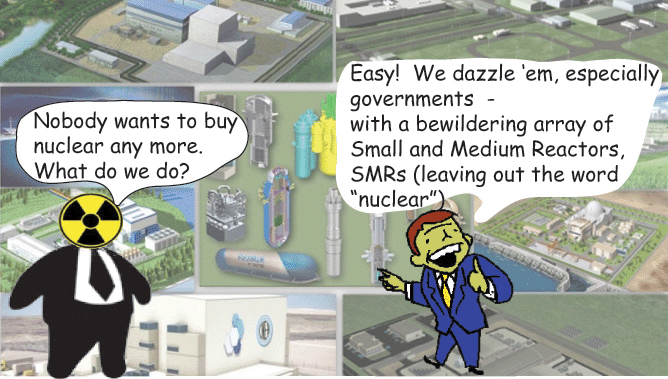
Rolls-Royce vows to create 6,000 UK jobs with nuclear power station plans, Engineering firm is part of consortium pushing for government backing, Jasper Jolly, Wed 11 Nov 2020
‘……….However,it faces opposition on the grounds of safety, security and cost.
The consortium this week signed agreements with the US company Exelon Generation and the Czech power company CEZ to consider the reactors.
Small nuclear reactors were first developed in the 1950s to use in nuclear-powered submarines. Since then Rolls-Royce has designed reactors for seven classes of submarine and two separate land-based prototype reactors.
However, to be cost-effective for civilian use the power generated by the reactors has to compete with renewable sources such as wind and solar power. The costs of installing renewables have fallen dramatically in the last decade and they do not pose the same safety concerns.
The Financial Times last month reported that the government was backing the plans to commit between £1.5bn and £2bn, and that it would form part of Boris Johnson’s 10-point plan for the environment. However, the second wave of coronavirus has caused the delay of the Treasury’s multiyear spending review. …..
a 2017 study by the consortium partner Atkins found that the electricity produced from the small reactors would be a third more expensive than traditional plants……. https://www.theguardian.com/business/2020/nov/11/rolls-royce-vows-to-create-6000-uk-jobs-with-nuclear-power-station-plans
Rolls Royce and Exelon get together to market ‘small’ nuclear reactors
|
Industrial technology company Rolls-Royce has signed a memorandum of understanding (MoU) with Exelon Generation for the operation of compact nuclear power stations in the UK and overseas locations. Under the contract, Exelon Generation agreed to assist Rolls Royce in the development and deployment of UK small modular reactors (UKSMR)…… In January, Rolls-Royce announced that it will be leading a consortium to build and install small modular reactors (SMRs) on former nuclear sites to power the UK by 2029. Members part of the consortium are Assystem, Atkins, BAM Nuttall, Jacobs, Laing O’Rourke, National Nuclear Laboratory, Nuclear Advanced Manufacturing Research Centre, Rolls-Royce and TWI. Working with its partners, as well as the UK government, the consortium will secure a commitment for a fleet of factory-built nuclear power stations, each with a 440MW capacity, developed inside a weatherproof canopy…….. https://www.power-technology.com/news/rolls-royce-exelon-mou/ |
|
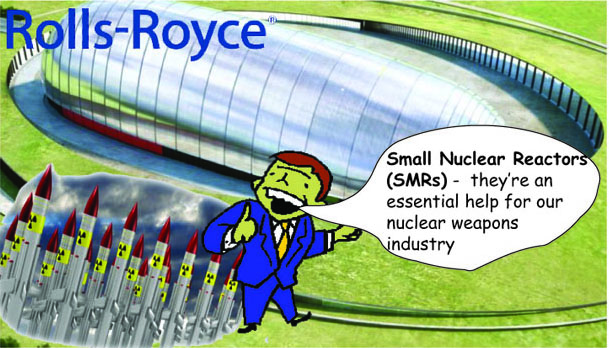
1 This Month
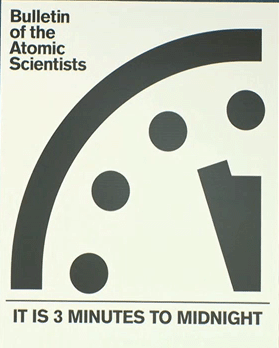
Watch the 2026 Doomsday Clock unveiling live here on January 27 at 10 a.m. EST
To see nuclear-related stories in greater depth and intensity – go to https://nuclearinformation.wordpress.com/

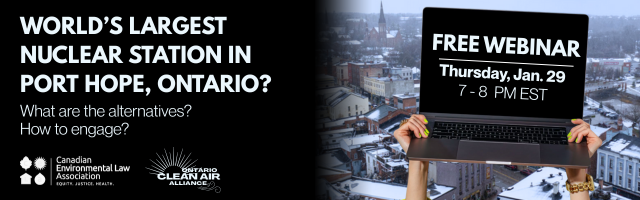
29 Jan. Thursday 7-8 p.m. Webinar – World’s Largest Nuclear Station in Port Hope, ON?

31st January – Challenging the War Machine – a DECLASSIFIED UK SUMMIT

Website of the Week
Now until to February 10, 2026 Radioactive waste storage in France: the debate is finally open! How to participate?
-
Archives
- January 2026 (283)
- December 2025 (358)
- November 2025 (359)
- October 2025 (376)
- September 2025 (258)
- August 2025 (319)
- July 2025 (230)
- June 2025 (348)
- May 2025 (261)
- April 2025 (305)
- March 2025 (319)
- February 2025 (234)
-
Categories
- 1
- 1 NUCLEAR ISSUES
- business and costs
- climate change
- culture and arts
- ENERGY
- environment
- health
- history
- indigenous issues
- Legal
- marketing of nuclear
- media
- opposition to nuclear
- PERSONAL STORIES
- politics
- politics international
- Religion and ethics
- safety
- secrets,lies and civil liberties
- spinbuster
- technology
- Uranium
- wastes
- weapons and war
- Women
- 2 WORLD
- ACTION
- AFRICA
- Atrocities
- AUSTRALIA
- Christina's notes
- Christina's themes
- culture and arts
- Events
- Fuk 2022
- Fuk 2023
- Fukushima 2017
- Fukushima 2018
- fukushima 2019
- Fukushima 2020
- Fukushima 2021
- general
- global warming
- Humour (God we need it)
- Nuclear
- RARE EARTHS
- Reference
- resources – print
- Resources -audiovicual
- Weekly Newsletter
- World
- World Nuclear
- YouTube
-
RSS
Entries RSS
Comments RSS
 nuclear-news