Are small nuclear reactors actually small, safe, economic ?
Can Small Nuclear Reactors Really Help The Climate? QuickTake, Jonathan Tirone 27 Nov 2021 (Bloomberg) — Much of the world has been turning away from nuclear power, with its aging plants, legacy of meltdowns and radioactive waste. But some governments, big companies and billionaires including Bill Gates and Warren Buffett are convinced the technology can help save the planet.
1. How small is small? Of the more than 70 such reactors that the International Atomic Energy Agency lists as in some stage of design or development, the smallest are less than 5 meters (16 feet) in diameter and 10 meters in height. (The plant that would be built to operate the reactor would be bigger, of course.) SMRs typically have less than 300 megawatts of generating capacity, about a third of that of existing reactors.
…………. Do SMRs already exist? The only ones currently in commercial operation are two 35-megawatt units on a floating power plant deployed by Russia in the Arctic in 2020. China expects to begin trials in 2026 on an SMR being built near an existing power plant on Hainan island. The first commercial SMR project in the U.S., planned for the site of the Idaho National Laboratory, will consist of six reactors capable of producing a combined 462 megawatts. It’s supposed to be operational by the end of this decade.
…………….. smaller reactors would ideally be located closer to population centers, increasing the possible danger from an accident. And like their larger brethren, SMRs produce radioactive waste that must be stored safely for centuries.
………….. What are the economic challenges? Cost competitiveness is an uphill climb. U.S. manufacturer NuScale Power LLC, to cite one example, is aiming for an SMR that can sell power for $55 per megawatt-hour. Yet wind power in much of the world is now about $44 a megawatt-hour, solar is $50, and in some regions, renewable energy will be below $20 a megawatt-hour by the end of the decade, according to BloombergNEF. A 2020 study by professors at the University of British Columbia found that on a lifetime basis, the cost of electricity produced by SMRs could be 10 times greater than the cost of electricity produced by diesel fuel.
Who’s investing in SMRs? Electricite de France, China National Nuclear, Japan’s Toshiba and Russia’s Rosatom are pushing SMR designs, as is NuScale. Gates and Buffett have teamed up to build and test a reactor at an abandoned coal plant in Wyoming. Rolls-Royce Holdings Plc raised 455 million pounds ($608 million) to fund the development of SMRs, with almost half of the financing coming from the U.K government.
Read more at: https://www.bloombergquint.com/quicktakes/can-small-nuclear-reactors-really-help-the-climate-quicktake
Nuclear Fusion Recedes Into Far Future For The 57th Time
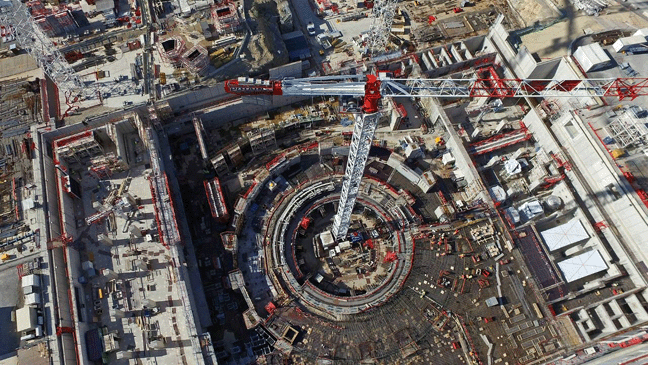
Fusion Recedes Into Far Future For The 57th Time, Clean Technica, Fusion has an amazing future as a source of energy. In space craft beyond the orbit of Jupiter sometime in the next two centuries. By Michael Barnard, November 9, 2021 Fusion has an amazing future as a source of energy. Which is to say, in space craft beyond the orbit of Jupiter, sometime in the next two centuries. Here on Earth? Not so much. At least, that’s my opinion.
Nuclear electrical generation has 2.5 paths. The first is nuclear fission, the part that is the major electrical generation source that provides about 10% of the electricity in the world today.
And then there’s fusion. Where fission splits atoms, fusion merges them. Instead of radioactive fuel, there’s a lot of radioactive emissions from the merging of things like hydrogen-3, deuterium, and tritium that irradiates the containment structures. Lower radioactive waste that doesn’t last as long, but still radioactive waste for those who think that’s a concern…….
fusion generation of electricity, as opposed to big honking nuclear weapons using fusion, is a perpetual source of interest. When Lewis Strauss, then chairman of the United States Atomic Energy Commission, talked about nuclear being “too cheap to meter” in 1954, he was talking about fusion, not fission. Like everyone since the mid-1950s, he assumed that fusion would be generating power in 20 years.
And so here we are, 67 years later. How is fusion doing?
Let’s start with the only credible fusion project on the planet, the ITER Tokamak project. It’s been around for decades. It planted its roots in 1985 with Gorbachev and Reagan. 35 countries are involved. Oddly, ITER isn’t an acronym, it’s Latin for “The Way,” a typically optimistic and indeed somewhat arrogant assumption about its place in the universe.
It’s supposed to light up around 2040. That’s so far away I hadn’t bothered to think much about it, as we have to decarbonize well over 50% of our economy long before that. As a result, I had a lazy read on it. I had assumed, as most press and indeed pretty much everyone involved with it asserted, that it would be generating more energy than it consumed, when it finally lit up…………..
ITER will require about 200 MW of energy input in total running as it creates 500 MW of heat. But the exergy of heat means that if it were tapped, it would only return about 200 MW of electricity. So it might be a perpetual motion machine, but one that wouldn’t do anything more than keep its lights running as long as you fed it tritium, about $140 million worth of the stuff a year.
And it gets worse. ITER is planning at the end of this process to maintain this for less than 3000 seconds at a time. That’s 50 minutes. This is at the end of the process. As they build up to less than an hour, mostly they’ll be working on fusion that lasts five minutes, several times a day. It’s a very expensive physics experiment that will not produce climate-friendly energy. It’s going to teach us a bunch, which I completely respect, but it’s not going to help us deal with climate change.
I expected more from ITER. Not much more. I mean, it is a million-component fission reactor expected to light up in 2040 and not generate any electricity at that point. But I had assumed based on all the press that it would generate more electricity than it used to operate if you bolted a boiler and some turbines to it, even if it were grossly expensive. Apparently not. Just grossly expensive, no net new electricity………..
However, ITER is not the only fusion reactor in the game. There are startups! And we all know startups make no promises that they can’t keep and are excellent at disclosure.
Like Helion. They have a photo-shopped peanut asserting it’s a 6th prototype with regenerative power creation that’s never achieved fusion that is backed by Peter Thiel! It just received $500 million more of VC funding, with an option to get up to $2.2 billion if they hit their targets!
I’m not sure if I could have made up a paragraph less likely to make me think that there was some there there.
The website is likely intentionally lacking in anything approaching detail. It’s low-information and VC friendly, which in the energy space is Thiel’s jam. He’s the guy who, despite being partnered with Elon Musk, has never realized that electrical generation was already being disrupted by wind and solar. His acolytes in startups disrupting energy crashed and burned, because he and they never bothered to do the hard work of understanding how electricity actually works at grid scale. At least Musk was solid on solar, although he got the wrong end of it and hasn’t quite figured that out yet.
While Helion has achieved 100 million degrees Celsius, it’s with a high-energy laser pulse — not new ideas, in fact 1950s ideas, just easier now — and they are incredibly coy about duration. The assumption to be taken is that it lasts for a picosecond at a time. They talk about their prototype having worked for months, but that means it’s maintaining a vacuum and occasionally creating plasma, a precursor to fueled fusion. Many years and tens of millions of dollars in, they are promising the moon, and soon. And to be clear, they are well behind on their initial schedule…………..
fusion generating electricity appears to be as far away as ever. https://cleantechnica.com/2021/11/09/breaking-news-fusion-recedes-into-far-future-for-the-57th-time/
Scientists Warn Experimental Nuclear Plant Backed by Bill Gates Is ‘Outright Dangerous’

“fast breeder reactor” types “are proliferation nightmares.“
Continuing to support nuclear energy at the expense of faster and cheaper alternatives for cutting greenhouse gas emissions is a losing strategy.“
Scientists Warn Experimental Nuclear Plant Backed by Bill Gates Is ‘Outright Dangerous’ “Gates has continually downplayed the role of proven, safe renewable energy technology in decarbonizing our economy.” Common Dreams ANDREA GERMANOS, November 17, 2021 Officials announced Tuesday that the small city of Kemmerer, Wyoming would be the site of a new Bill Gates-backed nuclear power project—an initiative whose proponents say would provide climate-friendly and affordable energy but which some scientists warn is a dangerous diversion from true energy solutions.
The experimental Natrium nuclear power plant will be at the site of the coal-fired Naughton Power Plant, slated for retirement in 2025, though siting issues are not yet finalized. The company behind the project is TerraPower. Gates, who helped found TerraPower, is chairman of the board.
Mr. Gates,” nuclear expert Arnie Gundersen wrote in an open letter in August, Natrium “is following in the footsteps of a 70-year-long record of sodium-cooled nuclear technological failures. Your plan to recycle those failures and resurrect liquid sodium again will siphon valuable public funds and research from inexpensive and proven renewable energy alternatives.”………….
A feature of the future plant, TerraPower says, is “a molten salt-based energy storage system”—technology it claims represents “a significant advance over the light water reactor plants in use today.”
At a June press conference, Gates said Natrium was poised to “be a game-changer for the energy industry.” In a Tuesday tweet, Republican Sen. John Barrasso of Wyoming gave a similar message, saying “the Natrium reactor is the future of nuclear energy in America.”
While the company asserts the safety of Natrium’s sodium-cooled fast reactor, a report released in March by the Union of Concerned Scientists, entitled “Advanced” Isn’t Always Better, casts doubt on those claims.
UCS’s Elliott Negin highlighted the analysis in a June blog post, writing:
In fact, according to the UCS report, sodium-cooled fast reactors would likely be less uranium-efficient and would not reduce the amount of waste that requires long-term isolation. They also could experience safety problems that are not an issue for light-water reactors. Sodium coolant, for example, can burn when exposed to air or water, and the Natrium’s design could experience uncontrollable power increases that result in rapid core melting.
“When it comes to safety and security, sodium-cooled fast reactors and molten salt–fueled reactors are significantly worse than conventional light-water reactors,” says [report author Edwin] Lyman. “High-temperature gas-cooled reactors may have the potential to be safer, but that remains unproven, and problems have come up during recent fuel safety tests.”
Fast reactors have another major drawback. “Historically,” the report points out, “fast reactors have required plutonium or [highly enriched uranium]-based fuels, both of which could be readily used in nuclear weapons and therefore entail unacceptable risks of nuclear proliferation and nuclear terrorism.” Some fast reactors, including the Natrium, will initially use a lower-enriched uranium fuel, called high-assay low-enriched uranium, which poses a lower proliferation risk than highly enriched uranium, but it is more attractive to terrorists seeking nuclear weapons than the much lower-enriched fuel that current light-water reactors use.
Continue reading”Billionaires who fly into space to produce nothing of scientific value” -on hearing that, Jeff Bezos hires lobbyist!
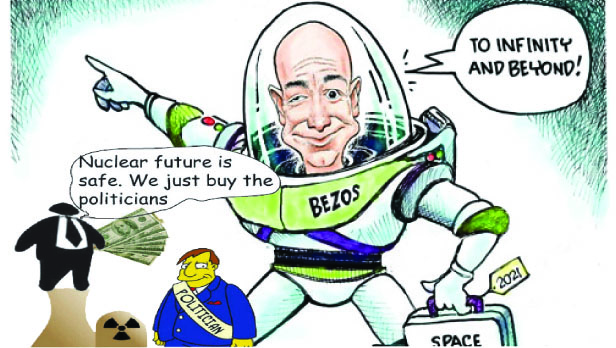
Bezos’ Blue Origin Hires Lobbyist Tied to Obama Admin After Space Tax Proposed, https://sputniknews.com/20211118/bezos-blue-origin-hires-lobbyist-tied-to-obama-admin-after-space-tax-proposed-1090824789.html
The company decided it needs the lobbyist’s services after US representative Earl Blumenauer, proposed a tax on space exploration firms. The Democratic lawmaker made his statement on 20 July – the day when Bezos himself went to space in Blue Origin’s first crewed flight.
“Space exploration isn’t a tax-free holiday for the wealthy. Just as normal Americans pay taxes when they buy airline tickets, billionaires who fly into space to produce nothing of scientific value should do the same, and then some”, he said in a statement at the time. “I’m not opposed to this type of space innovation. However, things that are done purely for tourism or entertainment, and that don’t have a scientific purpose, should, in turn, support the public good”.
NASA seeks ideas for a nuclear reactor on the moon – submissions due by February 19 2022
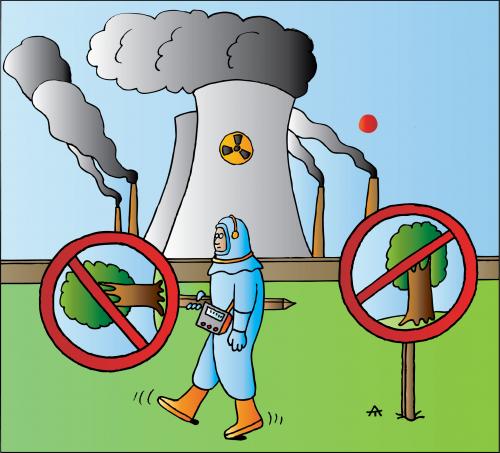
NASA seeks ideas for a nuclear reactor on the moon abc news, 20 Nov 21
If anyone has a good idea on how to put a nuclear fission power plant on the moon, the U.S. government wants to hear about itBy KEITH RIDLER Associated Press BOISE, Idaho — If anyone has a good idea on how to put a nuclear fission power plant on the moon, the U.S. government wants to hear about it.
NASA and the nation’s top federal nuclear research lab on Friday put out a request for proposals for a fission surface power system.
NASA is collaborating with the U.S. Department of Energy’s Idaho National Laboratory to establish a sun-independent power source for missions to the moon by the end of the decade…….
The reactor would be built on Earth and then sent to the moon…….
The proposal requests are for an initial system design and must be submitted by Feb. 19. https://abcnews.go.com/Technology/wireStory/nasa-seeks-ideas-nuclear-reactor-moon-81282960
Despite the frantic nuclear lobbying at COP26, Rolls Royce’s small nuclear reactors will be of zero use against greenhouse emissions – Jonathon Porritt

Rolls-Royce talks of the first plant ‘coming online by 2031’ – do please do the maths yourself. So let’s say 2035, to be generous, at the earliest. And therefore of zero benefit in terms of meeting the Government’s own target of a 78% reduction in greenhouse gas emissions by 2035.
It’s all such a pathetic waste of time – and of taxpayers’ money. Whatever the timescale, SMRs will never compete with renewables plus storage.
COP6 ‘Nuclear Sidebar, http://www.jonathonporritt.com/cop26s-nuclear-sidebar/ Jonathon Porrit, 6 Nov 21, The fact that COP26 was crawling with huge numbers of delegates from Big Oil and Gas got a lot of attention from the media. Less attention was paid to the large number of pro-nuclear delegates parasitically inserting themselves into as many events as they could engineer access to – facilitated at every turn by BEIS Secretary of State Kwasi Kwarteng and Booster Boris himself..
The nuclear industry had its own short-lived moment in the sun, on 9th November. For what is now reckoned to be the fourth time, Kwasi Kwarteng went over the top to re-re-re-confirm the Government’s enthusiasm for Small Modular Reactors, re-re-re-promising (a rather miserly) £210m of Government money for Rolls-Royce, described by Kwasi Kwarteng as ‘a once in a lifetime opportunity’.
Rolls-Royce duly obliged, conjuring up another £250m of private sector investment to deliver a new fleet of at least five SMRs (and possibly as many as 16) at around £2.2bn a pop. The company’s share price duly went up by around 4%. Job done.
It doesn’t matter how many times Ministers bang this particular drum, or how many times deplorably gullible journalists in the BBC, FT, Times and the Telegraph suck it all up, moonshine is still moonshine.
In and of itself, that £460m buys practically nothing. It will allow Rolls-Royce to take whatever design they finally settle on through the Generic Design Assessment process. This will take no less than four years, and probably more than five. Even if (and it’s a big IF) regulatory approval is secured, private sector investors will still have to be found, sites identified and planning permission for each site secured – a process which can take years.
Rolls-Royce talks of the first plant ‘coming online by 2031’ – do please do the maths yourself. So let’s say 2035, to be generous, at the earliest. And therefore of zero benefit in terms of meeting the Government’s own target of a 78% reduction in greenhouse gas emissions by 2035.
It’s all such a pathetic waste of time – and of taxpayers’ money. Whatever the timescale, SMRs will never compete with renewables plus storage.
To be fair, it would be wrong to underestimate the importance here of energy security – meeting our energy needs from home-based, ‘indigenous’ capacity. Boris Johnson keeps banging on about ‘British wind and sunshine’ – mindful perhaps of a recent poll of Daily Express readers, of whom 97.5% said that Boris ‘should pledge to make Britain self-sufficient in energy production by 2050’.
On that basis, British nuclear electrons are therefore much more desirable than those unreliable French electrons, regardless of the fact that we wouldn’t have any new nuclear electrons coming on-stream were it not for Electricité de France.
COP26 was of course a global gathering. UK energy security was therefore less of an issue. But it got a bit of an airing on 12th November, when the two big tidal stream companies here in the UK (Nova Innovation and Atlantis Energy) made a big splash about the huge potential for tidal stream technology in Scotland – with a potential capacity of more than 500 MW. This is a proven technology (with turbines anchored to the sea floor to capture the power of tidal currents) – already delivering suitably ‘indigenous’ electrons – with no moonshine to be seen anywhere.
The potential for tidal stream is indeed significant – not just in the UK, but internationally.
However, for me personally, it’s still relatively small beer in comparison to tidal range – harnessing the power of the tides to generate huge amounts of electricity from either tidal lagoons or barrages, predictably, cost-effectively, over many decades.
If our Government was genuinely serious about energy security (instead of finding ways of propping up Rolls-Royce to support our nuclear weapons programme), tidal power would be top of its list.
But is it heck! So please check out my blog about tidal energy which follows shortly.
UK’s small nuclear reactor consortium indicates that it will be relying on tax-payer funding if it is to go ahead
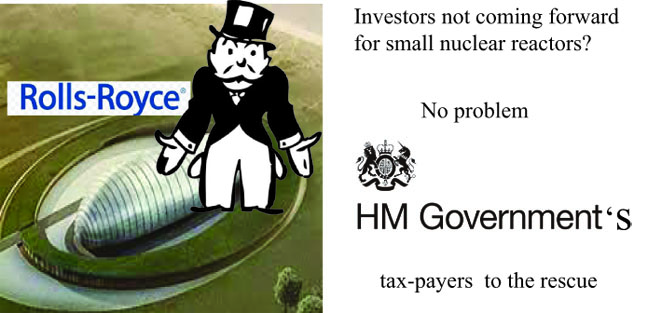
State support a fallback option for UK’s mini-nuclear plants rollout.
The head of the consortium, which is developing a £ 30 billion fleet of
mini-nuclear power stations, has indicated that it will have to rely on UK
taxpayers to help fund the construction of the first of the new designs if
there is not enough investor interest.
FT 10th Nov 2021
https://www.ft.com/content/869279aa-f771-4025-8719-c3b8bdf1f375
Is nuclear power the way forward to combat the climate crisis? – Allison Macfarlane cautions.
 | |||
|

Is nuclear power the way forward to combat the climate crisis?
Nuclear power can go horribly wrong and is notorious for cost overruns, but it is gaining high-profile champions. Aljazeera, By Patricia Sabga 12 Nov 2021 ”’ ………………………
Allison Macfarlane is a professor and the director of the School of Public Policy and Global Affairs at the University of British Columbia. Before that, she was chair of the US Nuclear Regulatory Commission.
She wrote an article for Foreign Affairs (paywall) this summer on the subject of nuclear energy and climate goals. Her arguments generated some pointed pushback (paywall) as world leaders descended on Glasgow, Scotland for COP26.
Macfarlane describes herself as neither a proponent nor a detractor of nuclear power, but an analyst who prefers to give a “measured analytical response” to questions surrounding nuclear energy.
She recently shared her views with Al Jazeera Digital’s Managing Business Editor Patricia Sabga about nations building more nuclear power plants to battle the climate crisis.
Allison Macfarlane: ……………… But I live in a pragmatic, realistic world. And I don’t think, at least in the next 10 or 20 years, that nuclear power will be able to have a big impact on reducing carbon emissions because we can’t build new plants fast enough.
PS: And why is that? Why can’t we build new plants fast enough?
AM: It’s complicated. These are mega projects, and they require a level of quality control and programme management that doesn’t exist in a lot of other industries. And though people may promote some of the newer reactor designs as being easy to produce in factories, if we look at the existing reactors that have been produced in factories – for instance, the ones that are under construction in Georgia, the Vogtle plant [where two additional reactor units are under construction] – the experience in factories has not been good.
The factory that built the modules for the Georgia plant built them incorrectly for years. They welded them incorrectly and they had to be rewelded at the reactor site. That factory led in large part to the bankruptcy of Westinghouse.
PS: You mentioned newer reactor designs. What are these designs and what challenges do they face?
AM: First of all, a lot of them aren’t new. A lot of these designs are 70 years old or older. But given that, there are new sorts of twists to some of these designs.

Many of them exist only on paper, or as small-scale models. And the way engineering works is that you design something – these days, it’s computer-assisted – and then you build a scale model. When you build the scale model, you see where you are wrong in your computer design, and so you fix that. Then you have to build the full-scale design. And when you scale up again, there will be things that you’ve gotten wrong in the scale model, and you’re going to have to fix that.
And so, for many of these designs, we’re still at the computer model stage. We haven’t done the other steps. And those steps take years. And when you get to the full-scale model, that’s really expensive. Where’s that money coming from?
PS: Let’s talk about expense then. In terms of just cost, how does nuclear stack up to say wind or solar?
AM: It’s significantly more expensive. Of course, it depends on what solar you’re talking about. But if you look at Lazard’s recent analysis of levelized costs of energy [an analysis that takes into account how much it costs to finance and build a power plant and to keep it running throughout its lifetime and then divides that cost by how much energy it kicks out each year] and you look at solar PV [photovoltaic] utility scale, and wind, they are significantly cheaper than nuclear.
AM: Expenses are dominated by the capital costs of plant construction. These plants are very expensive to build. I think we’re up to at least $14bn a plant for the Vogtle plants in Georgia. That’s for a thousand gigawatts generation capacity. They’re just really expensive to build and they take a long time to build. And so not only do you have the cost of the capital of building the plant, but you have the cost of the interest on the capital, which becomes a big cost.
That’s really what hurts nuclear. Now there are claims made about the small modular reactors that they’ll be cheaper. But because nobody’s ever built one, and nobody’s established the supply chains to build them and to operate them, we really have no idea what those will cost……………..
[on intermittency] Ten years ago, it was a really big deal. It’s becoming less of a deal, I think. What’s interesting to note is that when you talk to utility companies, they are really interested in having plants be load following [responding to surges and ebbs in power demand]. They’re really orienting themselves towards dealing with intermittency. But that means they need a plant that can ramp up and down quickly. Nuclear can’t do that. The existing nuclear fleet can’t do that. They’re either on or they’re off, and it takes a long time for them to ramp up to full scale on………….. https://www.aljazeera.com/economy/2021/11/12/is-nuclear-power-the-way-forward-to-combat-the-climate-crisis
France: public inquiry for the authorization to reprocess new fuels
**France – Reprocessing**
A public inquiry for the authorization to reprocess new fuels, particularly from foreign heavy water or MOX reactors, is open until
November 17, 2021. It is closely following another survey for the densification of the C D E swimming pools at La Hague in order to increase spent fuel storage capacity by 30%. Based on files with blackened lines, it only confirmed decisions already taken.
Crilan 12th Nov 2021
http://crilan.fr/densification-des-piscines-de-la-hague-mayak-en-cotentin-non-merci/
With the confusing consortium behind it, the UK’s Rolls Royce ”small” nuclear reactor project is running a huge risk

this is a huge risk of public money on a speculative design. By the time we know how much SMRs will cost and whether they are reliable or not, there will be up to 10 reactors being manufactured unless production lines are allowed to sit idle for years waiting until the design is proven enough for new orders to be placed. Realistically the first reactor won’t be complete before the mid-2030s at about the time the last fossil fuel will disappear from the generation mix, so it’s too little, too late and too expensive
What it turns out to amount to is an agreement to spend £400m over the next three years which may produce a design for a reactor which may get approved by the regulators and which may find investors willing to pay what will be at least £2billion to build each one
nuClear News November 21. Rolls Royce’s Small Modular Reactors On 9th November the Government announced that it would back the Rolls-Royce Small Modular Reactor with £210m in funding. Matched by private sector funding of over £250 million, this investment will take forward phase 2 of the Low-Cost Nuclear project to further develop SMR design and take it through the regulatory processes to assess suitability of potential deployment in the UK.
The Government claimed that SMRs have the potential to be less expensive to build than traditional nuclear power plants because of their smaller size, and because the modular nature of the components offers the potential for parts to be produced in dedicated factories and shipped by road to site – reducing construction time and cost. Rolls Royce SMR estimate that each Small Modular Reactor could be capable of powering 1 million homes – equivalent to a city the size of Leeds.
The £210 million grant follows £18 million invested in November 2019, which, according to the Government, has already delivered significant development of the initial design as part of Phase One of the project. (1)
The Rolls Royce SMR design is not exactly small. It was originally conceived as a 440 MW unit, but R-R has found a way of getting 470 MWe out of the core. Each of the proposed 16 reactors is expected to cost around £1.8 billion to £2.2bn and produce power at £40-60/MWh over 60 yrs. (2) Rolls Royce says it has a target cost of £1.8 billion once 5 reactors have been built. (3)
As well as the Government funding, Rolls-Royce has been backed by a consortium of private investors. The creation of the Rolls-Royce Small Modular Reactor (SMR) business was announced following a £195m cash injection from BNF Resources, and Exelon Generation to fund the plans over the next three years. (The Guardian suggests Rolls Royce will top this up with £50m of its own money, which gets us to £245m –not quite the ‘over £250m’ mentioned in the Government Press Release, but it’s not clear whether the £50m is extra money or part of the £195m). It is hoped the new company could create up to 40,000 jobs by 2050. The investment by Rolls-Royce Group, and the government will go towards developing Rolls-Royce’s SMR design and take it through regulatory processes to assess whether it is suitable to be deployed in the UK. It will also identify sites which will manufacture the reactors’ parts and most of the venture’s investment is expected to be focused in the north of the UK, where there is existing nuclear expertise. (4)
BNF Resources UK Limited appears to have been created in June and has two significant employees, Nicholas Fallows and Sean Benson. Benson says: “BNF has an established history of energy market investing and we are proud to be a part of Rolls-Royce SMR in this exciting opportunity. Following reviews of numerous proposals we found that this project, featuring a highly experienced team was the most realistic, affordable and scalable solution for provision of carbon-free baseload and alternative power requirements.” (5)
It appears that BNF Resources UK Limited is a subsidiary of BNF Capital Limited which was created in 2012 (same address) and is registered in Guernsey. These two people seem to have a history in Financial Investment. The Perrodo family, which made its fortune from the private oil company Perenco, is behind BNF Resources UK.
Confusingly there has been no mention of the Rolls Royce SMR Consortium which included Assystem, Atkins, BAM Nuttall, Laing O’Rourke, National Nuclear Laboratory (NNL), Jacobs, The Welding Institute (TWI) and Nuclear AMRC, as well as Rolls Royce. The consortium existed in July of this year when Cavendish signed up to work on the SMR. (6) Assystem has since said it will continue to lead on the design of key areas of power plant infrastructure including the turbine island, cooling water island and balance of plant systems, and is expecting to double the size of its SMR team in the next six months. (7) Similarly Nuclear AMRC has said it will work with Rolls-Royce to help prepare critical components for commercial production in the UK. The centre will also support the design of a new UK factory for large SMR components. (8)
Exelon is contributing under an agreement from a year ago to find international markets. (9)
This new funding will help Rolls-Royce start the SMRs on the Generic Design Assessment (GDA) process. (10) In May, the government declared the Generic Design Assessment (GDA) open to advanced nuclear technologies – including SMRs – for the first time. The process allows the nuclear regulators to assess the safety, security and environmental implications of new reactor designs. Rolls-Royce SMR has stated its intention to enter the GDA process shortly. (11) This could take about 5 years. (The GDA process took 5.75 years for the EPR, 7.5 years for the AP1000, 4.75 years for the ABWR, and process for the UK HPR1000 is continuing after 4 years. (12)) According to the Office for Nuclear Regulation (ONR) the GDA on SMRs was expected to have started by now but there have been delays.
Each of the initial run of reactors is expected to have a generation capacity of 470MW, or enough to power the equivalent of 1.3m UK homes, and cost about £2bn on average, well below the price per MW sought by developers of large-scale nuclear reactors. The consortium hopes to build on an initial run of five SMRs, the first of which could go on line by 2031, to create a multibillion-pound stable of 16 SMRs around the country. (13)
This means that if delivered on budget and to engineering specifications, a single SMR would deliver roughly a seventh of the power of Hinkley for less than a twelfth of the price, while using less land. Each power station is said to be the size of two football pitches, (but this is open to question) and can also be used to create hydrogen by splitting water molecules. The company, primarily a jet engine maker, hopes the hydrogen SMRs could produce would accelerate a move to greener aviation.

Rolls-Royce will be seeking more investment for the project to help fund the building of actual SMRs. The government is currently passing legislation that will allow investors to back projects like SMRs using a regulated asset base (RAB) model, which allows them to recoup up-front costs. The government said this would “attract a wider range of private investment into these projects, reducing build costs, consumers’ energy bills and Britain’s reliance on overseas developers for finance.”
Professor MV Ramana, a nuclear policy expert at the University of British Columbia in Canada, cautioned that this would be a new market for Rolls. He said: “It’s the same technology, but the set of constraints that you will be dealing with in the electricity sector are very different from submarines.” He also said Rolls has some catching up to do against rivals pursuing the same goals. NuScale Power, based in Oregon, received US regulatory approval for its own reactor design last year and could have a plant working by 2026. (14)
Steve Thomas, Emeritus Professor of Energy Policy at Greenwich University said this is a huge risk of public money on a speculative design. By the time we know how much SMRs will cost and whether they are reliable or not, there will be up to 10 reactors being manufactured unless production lines are allowed to sit idle for years waiting until the design is proven enough for new orders to be placed. Realistically the first reactor won’t be complete before the mid-2030s at about the time the last fossil fuel will disappear from the generation mix, so it’s too little, too late and too expensive
Chair of the E3Gthink tank, Tom Burke, points out that this is the third or fourth time this programme has been announced in the past year. What it turns out to amount to is an agreement to spend £400m over the next three years which may produce a design for a reactor which may get approved by the regulators and which may find investors willing to pay what will be at least £2billion to build each one and which may be generating electricity which may be competitive with renewables just before the whole of our electricity system has to be decarbonised to meet the PM’s target. So, six things have to go right before we might see an SMR somewhere.
As expected, Moorside, Wylfa and Trawsfynydd have all been mentioned as potential sites for an SMR. Tees Valley mayor Ben Houchen also wants Hartlepool to be on the list. (15) Dylan Morgan of PAWB (People Against Wylfa B) said: “We have an immediate crisis now. Nuclear power is slow, dangerous and extortionately expensive. It will do nothing to address the current energy crisis, neither will it be effective to counter climate change. The UK and Welsh governments should divert resources and support away from wasteful and outdated nuclear power projects towards developing renewable technologies that are much cheaper and can provide faster and more sustainable solutions to the energy crisis and the challenges of climate change.” (16) https://www.no2nuclearpower.org.uk/wp/wp-content/uploads/2021/11/nuClearNewsNo135.pdf
China’s Taishan nuclear power plant remains closed, following fuel leak.
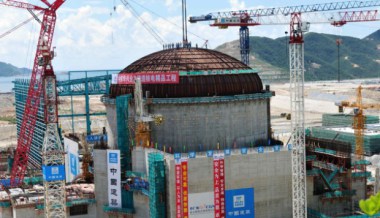
A nuclear reactor in China run by the developers behind Britain’s £20bn
Sizewell C power station remains shut for repair after fuel rods started
leaking.
Inspections are ongoing at the Taishan power plant, where the
reactor was shut in August after radioactivity was found in the cooling
waters. The plant is owned by China General Nuclear (CGN) and France’s
EDF, which are also building the Hinkley Point C plant in Somerset and
Sizewell C in Suffolk, using the same reactor design as at Taishan.
CGN,
which is a minority partner to EDF in Hinkley, has a 20pc development phase
stake in the Sizewell with an option to participate in the construction
phase. The Government is understood to be keen to push CGN out of the
project, however, amid rising concern about Chinese influence in critical
national infrastructure.
There are also hopes that more American investors
would be encouraged to invest if CGN were not involved. Experts have said
cracked fuel rods are “not uncommon” in the industry. An EDF spokesman
said: “The fuel and reactor vessel inspection is still ongoing. The
origin of the fuel rod leakage will only be determined once the analysis is
completed.” The inspection is being carried out under the joint venture
company which runs the plant, TNPJVC, owned 70pc by CGN and 30pc by EDF.
Telegraph 7th Nov 2021
The small nuclear reactor salesmen have bamboozled government officials into funding X-Energy, Terra Power and NuScam’s untested projects.

“I’m frankly speechless at the success that the proponents of these plants have had in bamboozling … a lot of government officials,” said Peter Bradford, a former member of the Nuclear Regulatory Commission and former chair of the Maine and New York utility commissions. “They should be shouldering a much heavier burden when it comes to the credibility of what they are saying.”
This Next-Generation Nuclear Power Plant Is Pitched for Washington State; Can It ‘Change the World’? Hal Bernton / The Seattle Times, 8 Nov 21,
RICHLAND — Near the Columbia River, Clay Sell hopes to launch a new era of nuclear power with four small reactors, each stocked with billiard ball-sized “pebbles” packed full of uranium fuel.
Chief executive officer of Maryland-based X-energy, Sell aims to bring the project online by 2028 as part of a broader attempt to develop safer, more flexible reactors to redefine the nation’s energy future.
These efforts have gained support in the nation’s capital where many Democrats eager to make progress on climate change have joined with Republicans to funnel money into development. The federal Energy Department has received $160 million to help fund X-energy, and the infrastructure bill that cleared Congress on Friday ups that amount to cover almost half the projected $2.2 billion cost of the Washington reactor project.
“We believe what starts here in Washington is going to change the world,” Sell said to public-utility officials gathered Oct. 28 in Kennewick.
X-energy is one of three companies with ties to the Pacific Northwest that have received federal funds to help develop a new generation of small nuclear power plants,
…………………. TerraPower plans to build its project at the site of a Wyoming coal plant in a partnership with a subsidiary of PacifiCorp, a private utility. NuScale is proposing a project in Idaho and has considered eventually locating a unit in Washington state.The nuclear industry, in the Pacific Northwest and elsewhere in the nation, has a history of pitching, and sometimes starting, projects that fail to come to pass. Skeptics say these next-generation projects are being oversold and face big challenges in producing competitively priced power without compromising safety and security, and in a time frame soon enough to help reduce carbon emissions by midcentury.
“I’m frankly speechless at the success that the proponents of these plants have had in bamboozling … a lot of government officials,” said Peter Bradford, a former member of the Nuclear Regulatory Commission and former chair of the Maine and New York utility commissions. “They should be shouldering a much heavier burden when it comes to the credibility of what they are saying.”
The NuScale project in southern Idaho involving small reactors cooled by water is furthest along in development, and has struggled with delays, design changes and escalating cost projections.
NuScale has partnered with a Utah-based utility consortium to develop what initially was proposed to be a power plant with 12 small reactors. The project, which is now forecast to cost $5.1 billion, has since been scaled back to six reactors expected to start coming online in 2029, according to LaVarr Webb, a spokesperson for the Utah Associated Municipal Power Systems.
Though Webb says sign-ups to take power are “going very well,” some utilities have had second thoughts and pulled out of participation in the project. As of early November, the consortium had secured contracts to take 22% of the project’s proposed 462 megawatts of power.
Central Washington site?
Sell has found fervent support for X-energy in the Tri-Cities area, the hub of Washington state’s nuclear industry that has long been buoyed by billions of taxpayer dollars flowing into the cleanup of the federal Hanford site, where plutonium produced for U.S. atomic bombs has left a toxic, radioactive legacy.
The Columbia Generating Station, Washington’s only commercial nuclear power plant, is located at the edge of Hanford. And its operator, Energy Northwest, would manage the X-energy reactors under an agreement announced last year.
A third partner is Eastern Washington’s Grant County Public Utility District, which would own the reactors and be responsible in raising about $1 billion in financing.
This utility boasts an abundance of low-cost hydroelectric power, which has attracted to the county Microsoft, Intuit and other companies that require lots of electricity for data centers and other operations.
…….. The costs of power produced by next-generation nuclear are a key concern and source of uncertainty. Over the past decade, the cost of renewables has plummeted.
Nordt said… a more in-depth financial review is needed, and Grant County might decide not to move forward with any of these projects.
“We may say, ‘You know, hey, the nuclear path was looking favorable, but it’s not for us right now…..
X-energy pushes ahead
X-energy was created by Kam Ghaffarian, an entrepreneurial Iranian immigrant who founded a major NASA contracting company and other ventures. In 2009, he turned his attention to nuclear power
………….X-energy’s four reactors would be able to generate 320 megawatts of power, less than one-third the amount of the roughly 1,200 megawatt capacity of the Columbia Generating Station.
The project, with a reactor dubbed Xe-100, would be the state’s first new nuclear power development since the 1970s, when the Washington Public Power Supply System — the initial name for the Energy Northwest utility consortium — tried to build five large nuclear power plants but finished only one in a disastrous effort based on flawed forecasts of future power demand.
The unfinished plants left a bitter legacy — including the largest municipal bond default in U.S. history and, among some, a deep mistrust of the nuclear power industry.
One of the most visible reminders of the Washington Public Power Supply System, which detractors nicknamed “Whoops,” is a massive concrete-domed building that dominates a 100-acre tract close to the Columbia Generating Station. This was supposed to be WPPSS No. 1 but construction halted in 1982 when it was almost 65% complete.
X-energy’s proposal submitted to the Energy Department calls for installing the reactors on 22 acres of this site, which already includes water intakes from the Columbia River.
Next-generation tech
X-energy’s website promotes the helium-cooled reactor as safely producing electricity “in a process that’s as clean as wind and solar.”
The reactor operates at much higher temperatures than the water-cooled nuclear plants now in operation. It is stocked, like a gumball machine, with the pebbles, each of which holds thousands of fuel particles………
The claims of a meltdown-proof fuel are dismissed as “absurd” by Edwin Lyman, a physicist with the Union of Concerned Scientists who has researched nuclear reactor safety for many years.
Lyman questions whether the X-energy reactor would be safe enough to justify a design that does away with costly leak-tight containment buildings standard for the current generation of water-cooled reactors.
He says the safety of TRISO fuel requires the ability to consistently manufacture it to exacting standards. So far, he said, that has not been demonstrated in the United States.
In a report he published this year, Lyman notes a 2019 test of the fuel at a national laboratory in southern Idaho “had to be terminated prematurely” when monitoring indicated “the fuel began to release fission products at a rate high enough to challenge offsite radiation dose limits.”
If the project moves forward, Lyman calls for the Nuclear Regulatory Commission to take a more cautious licensing approach that would first approve the reactor as a prototype before moving into commercial production.
“A lot of the rationale for why you would embark on this journey is not supported by the evidence,” Lyman said……….
X-energy’s project in Washington also is receiving pushback in from a Northwest tribe.
The Confederated Tribes of the Umatilla Indian Reservation does not support placing small modular reactors such as those proposed by X-energy or any new nuclear missions at Hanford, according to an Aug. 6 letter to the Energy Department from the chair of the tribes’ board, N. Kathryn Brigham.
The federal Hanford reservation includes areas that rank as the most contaminated nuclear sites in North America. The massive task of treating 177 tanks storing a perilous brew of radioactive and chemical waste, some of which are leaking, represents a huge cleanup challenge.
The letter noted that 1855 treaties ceding millions of acres of land called for the preservation of important rights, including hunting, fishing and gathering. Hanford is partially within these treaty territories, and new reactor development could impact those rights and resources, said Brigham’s letter, which called for consultation to discuss the federal government’s trust responsibility under the treaty.
The tribes’ concerns are shared by the Columbia Riverkeeper, a Northwest environmental group that released a September report blasting small nuclear reactors as an “unacceptable solution to climate change.”
X-energy has yet to apply for a Nuclear Regulatory Commission license to operate the reactor, a complex process that includes an extensive safety review, according to Scott Burnell, a commission spokesperson.
“This has to be competitive”……. https://www.chronline.com/stories/this-next-generation-nuclear-power-plant-is-pitched-for-washington-state-can-it-change-the,277542
Anxieties in Pays de la Loire over plan for small nuclear reactor.
With her proposal to host a mini-power plant, the president of Pays de la Loire is reviving local tensions around nuclear power. The idea of setting up an SMR on the site of the Cordemais coal-fired power station launched by
Christelle Mor Anglais, President of Les Républicains in the Pays de la Loire region, is causing concern.
Le Monde 6th Nov 2021
International Thermonuclear Experimental (fusion) Reactor (ITER) will consume as much power as it will generate
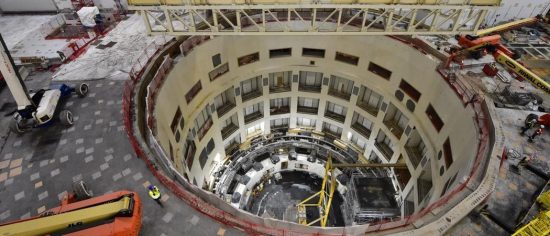
The ITER organization has confirmed that the International Thermonuclear Experimental Reactor is not designed to produce net power. This disclosure comes four years after articles in New Energy Times revealed that the ITER design is equivalent to a zero-net-power reactor.
In an article in the French newspaper Le Canard Enchainé last week, Michel Claessens, the former ITER organization spokesman, explained the ITER power discrepancy.
“For many years, it was claimed that the reactor will generate ten times the power injected. It is completely wrong. Thanks to a patient investigation, the American journalist Steven Krivit showed that ITER will consume as much [power] as it will generate,” Claessens said. “We know now that the net [power] balance will be close to zero.”
New Energy Times 3rd Nov 2021
UN ”Code of Conduct” towards preventing arms race in space, but no treaty banning weapons in space
Alice Slater, 7 Nov 21, The arms controllers have advanced their proposal for a Code of Conduct in space instead of a treaty to ban weapons in space. The country’s who have repeatedly been denied an opportunity to negotiate a space ban treaty in the consensus bound Disarmament Committee in Geneva, like Russia and China, have opposed this proposal, because it won’t create binding law and is an end run and distraction around negotiating a treaty to ban weapons in space. It will look like we’re doing something when we aren’t willing to be legally bound by it! The new American Empire way!!
Outer Space: UN Committee Advances Proposal on Rules Governing Behavior in Space
A United Nations panel overwhelmingly approved a resolution Nov. 1 to create a working group aimed at preventing an arms race in outer space, setting up the measure to pass in the General Assembly. The resolution, introduced by the United Kingdom with the support of more than 30 other nations, including the U.S., would establish an open-ended working group that would “ make recommendations on possible norms, rules and principles of responsible behaviors relating to threats by States to space systems.” The measure was approved by the U.N.’s First Committee, which deals with disarmament and international security threats, in a landslide 163-8 vote, with nine abstentions. Those opposed included Russia, China, North Korea, Iran, Cuba, Nicaragua, Venezuela, and Syria. (Air Force Magazine)
See also: UN Committee says yes to establishing space rules group (Space Watch)
See also: UN Committee Votes ‘Yes’ On UK-US-Backed Space Rules Group (Breaking Defense)
See also: The United Nations Could Finally Create New Rules for Space (Wired)
1 This Month
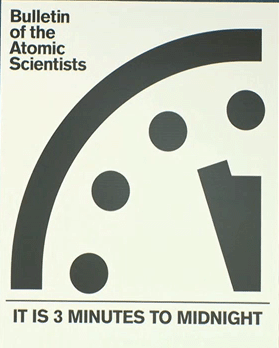
Watch the 2026 Doomsday Clock unveiling live here on January 27 at 10 a.m. EST
To see nuclear-related stories in greater depth and intensity – go to https://nuclearinformation.wordpress.com/

29 Jan. Thursday 7-8 p.m. Webinar – World’s Largest Nuclear Station in Port Hope, ON?


31st January – Challenging the War Machine – a DECLASSIFIED UK SUMMIT


Website of the Week
Now until to February 10, 2026 Radioactive waste storage in France: the debate is finally open! How to participate?
-
Archives
- January 2026 (271)
- December 2025 (358)
- November 2025 (359)
- October 2025 (376)
- September 2025 (258)
- August 2025 (319)
- July 2025 (230)
- June 2025 (348)
- May 2025 (261)
- April 2025 (305)
- March 2025 (319)
- February 2025 (234)
-
Categories
- 1
- 1 NUCLEAR ISSUES
- business and costs
- climate change
- culture and arts
- ENERGY
- environment
- health
- history
- indigenous issues
- Legal
- marketing of nuclear
- media
- opposition to nuclear
- PERSONAL STORIES
- politics
- politics international
- Religion and ethics
- safety
- secrets,lies and civil liberties
- spinbuster
- technology
- Uranium
- wastes
- weapons and war
- Women
- 2 WORLD
- ACTION
- AFRICA
- Atrocities
- AUSTRALIA
- Christina's notes
- Christina's themes
- culture and arts
- Events
- Fuk 2022
- Fuk 2023
- Fukushima 2017
- Fukushima 2018
- fukushima 2019
- Fukushima 2020
- Fukushima 2021
- general
- global warming
- Humour (God we need it)
- Nuclear
- RARE EARTHS
- Reference
- resources – print
- Resources -audiovicual
- Weekly Newsletter
- World
- World Nuclear
- YouTube
-
RSS
Entries RSS
Comments RSS
 nuclear-news