Another burst of tax-payer funding for Bill Gate’s gee-whiz Natrium reactor project
TerraPower receives $8.5M grant to explore recovering uranium from used nuclear fuel, Oil City News
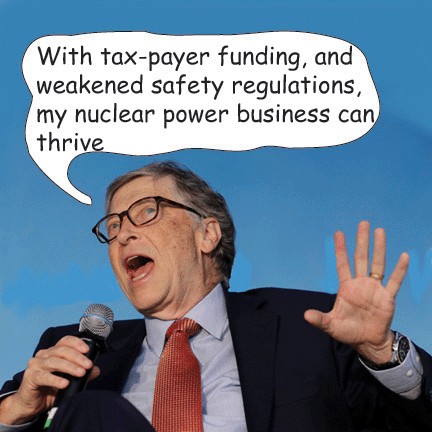
CASPER, Wyo. — TerraPower, the Bill Gates–founded company working toward building a new nuclear reactor in Kemmerer, Wyoming, said in a press release Monday that it has been awarded an $8.5 million grant from the U.S Department of Energy’s Advanced Research Project Agency – Energy (ARPA-E).
The grant funding is part of ARPA-E’s Optimizing Nuclear Waste and Advanced Reactor Disposal Systems (ONWARDS) program that aims to increase the use of nuclear power as a source of clean energy while limiting the amount of nuclear waste created by advanced reactors……
TerraPower and GE technology is going into the new Natrium nuclear reactor, which is expected to be built in Wyoming as part of the U.S. Department of Energy’s Advance Reactor Demonstration program.
“TerraPower is further demonstrating, through the Molten Chloride Reactor Experiment (MCRE), a uranium chloride salt–fueled concept with the DOE, Southern Company and other partners, and advancing medical research and innovation through its TerraPower Isotopes® subsidiary,” the press release states.
TerraPower President and CEO Chris Levesque added in the press release that “TerraPower continues to advance nuclear energy’s promise for our country and the world………… https://oilcity.news/wyoming/energy/2022/03/14/terrapower-receives-8-5m-grant-to-explore-recovering-uranium-from-used-nuclear-fuel/
Rolls Royce wants to hurry up the introduction of small nuclear reactors, but UK govt is focussed on a big one for Wylfa

Rolls-Royce calls for accelerated SMR rollout as Boris considers bigger plans for Wylfa
14 MAR, 2022 BY CATHERINE KENNEDY ROLLS-ROYCE IS APPEALING TO THE UK GOVERNMENT TO SPEED UP THE ROLLOUT OF SMALL MODULAR REACTORS (SMRS), WHILE PRIME MINISTER BORIS JOHNSON IS REPORTEDLY KEEN TO REVIVE PLANS FOR THE WYLFA NEWYDD NUCLEAR POWER PLANT IN RESPONSE TO THE UK ENERGY CRISIS.
There is a pressing need to improve the UK’s energy security, with prices soaring due to the Russian invasion of Ukraine, and alternative solutions are being explored to plug the gap.
Rolls-Royce submitted SMR designs for Wylfa and Trawsfynydd for assessment last week. However extensive safety checks are needed and these are not expected to come online until the 2030s. As such, government sources told the Telegraph that Rolls-Royce is frustrated with the lack of progress.
Meanwhile according to The Times, government sources have also said Johnson is determined to press ahead with plans for a large scale nuclear plant at Wylfa, with the government in talks with US nuclear reactor manufacturer Westinghouse and the engineering firm Bechtel about a proposal to develop the site. The government has so far set aside £120M to support the project………..
French nuclear regulator halts assembly of huge ITER nuclear fusion reactor
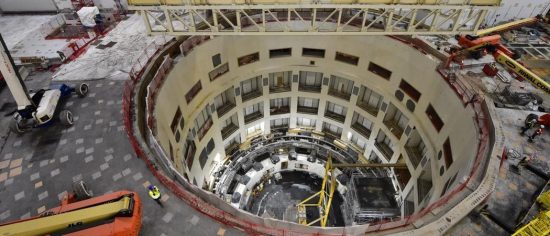
French nuclear regulator halts assembly of huge fusion reactor https://www.science.org/content/article/french-nuclear-regulator-halts-assembly-huge-fusion-reactor
ITER must satisfy safety concerns before welding reactor vessel. 24 FEB 2022, BY DANIEL CLERY France’s nuclear regulator has ordered ITER, an international fusion energy project, to hold off on assembling its gigantic reactor until officials address safety concerns.
This month, the ITER Organization was expecting to get the green light to begin to weld together the 11-meter-tall steel sections that make up the doughnut-shaped reactor, called a tokamak. But on 25 January, France’s Nuclear Safety Authority (ASN) sent a letter ordering a stoppage until ITER can address concerns about neutron radiation, slight distortions in the steel sections, and loads on the concrete slab holding up the reactor. ITER staff say they intend to satisfy ASN by April so they can begin to weld the reactor vessel by July. “We’re working very hard for that,” says ITER Director-General Bernard Bigot.
Limitless power arriving too late: Why fusion won’t help us decarbonise — RenewEconomy

A limitless, clean source of baseload power might be within reach – without the nuclear waste of traditional fission nuclear plants. That’s good, right? Not quite. The post Limitless power arriving too late: Why fusion won’t help us decarbonise appeared first on RenewEconomy.
Limitless power arriving too late: Why fusion won’t help us decarbonise — RenewEconomy
| I first heard the standard joke about fusion as an undergraduate physics student in the 1960s: Fusion power is 50 years away – and probably always will be. More than 50 years later, we still don’t have fusion. That’s because of the huge experimental challenges in recreating a miniature sun on earth. Still, real progress is being made. This month, UK fusion researchers managed to double previous records of producing energy. Last year, American scientists came close to ignition, the tantalising moment where fusion puts more energy out than it needs to start the reaction. And small, fast-moving fusion startups are making progress using different techniques. A limitless, clean source of baseload power might be within reach – without the nuclear waste of traditional fission nuclear plants. That’s good, right? Not quite. While we’re closer than ever to making commercial fusion viable, this new power source simply won’t get here in time to do the heavy lifting of decarbonisation. We are racing the clock to limit damage from climate change. Luckily, we already have the technologies we need to decarbonise. On the megaproject front, the next step is the International Thermonuclear Experimental Reactor (ITER) being built in southern France. Far too big for any one country, this is a joint effort by countries including USA, Russia, China, the UK and EU member countries. The project is enormous, with a vessel ten times the size of the UK reactor and around 5,000 technical experts, scientists and engineers working on it. Famously, the project’s largest magnet is strong enough to lift an aircraft carrier. Even this enormous project is only expected to produce slightly more power than it uses – around 500 megawatts. The first experiments are expected by 2025. To me, this illustrates how far away commercial fusion really is. Renew Economy 25th Feb 2022https://reneweconomy.com.au/limitless-power-arriving-too-late-why-fusion-wont-help-us-decarbonise/ |
‘Serious problems’ with NuScale’s proposed small nuclear reactors
Report claims ‘serious problems’ with proposed NuScale SMR, Power Engineering, By Kevin Clark -2.18.2022. Too late, too expensive, too risky and too uncertain” is how a new report by the Institute for Energy Economics and Financial Analysis (IEEFA) described NuScale’s proposed small modular reactor (SMR) project.
The analysis, released by the institute February 17, primarily focuses on the SMR project the Oregon-based company is building for Utah Associated Municipal Power Systems (UAMPS) at a U.S. Department of Energy (DOE) site in Idaho. However, the institute noted it was outlining cost risks, construction timelines, and competitive alternatives for all buyers in the SMR market.
In 2020, NuScale received U.S. Nuclear Regulatory Commission (NRC) approval on its SMR design, the first design approval for a small commercial nuclear reactor. SMRs have a smaller footprint, capacity and anticipated cost than traditional high-capacity nuclear power plants.
NuScale is among several companies developing SMRs, with the intent of reigniting the country’s nuclear power sector. The company touts its reactors as “smarter, cleaner, safer and cost competitive.”
The SMRs are light-water reactors, which represent most of the reactors now in operation. But modular reactors are designed to use less water than traditional ones and have a passive safety system enabling them to shut down automatically, should something go wrong.
The federal government has invested in the development of SMRs, and the NuScale site is no exception. In October 2020, UAMPS received a nearly $1.4 billion, 10-year award from the DOE to help fund the project.
However, in its report, IEEFA said there are “uncertain implications for the units’ cost, performance and reliability,” and that NuScale makes overly optimistic claims in each of these categories.
NuScale said its plant has a construction period of “less than 36 months from the first safety concrete through mechanical completion,” according to reports on the company’s website. But the institute said based on recent nuclear industry experience, plants with new reactor designs have taken more than twice as long to build as the owners projected at construction start, resulting in “delays of four years or longer before the start of commercial operations.”
IEEFA also noted NuScale’s project design has changed repeatedly throughout the development process. In July 2021 UAMPS said it would be downsizing the project from 12 to six modules, with 462 MW of power. NuScale recently projected the project’s first module, once expected to deliver in 2016, would come online in 2029, with all six modules online by 2030.
The institute also doubted NuScale’s ability to keep construction costs in check, thereby meeting a target power price of less than $60/MWh, set in mid-2021.
The nonprofit noted costs for all recent nuclear projects have vastly exceeded original estimates. It cited cost overruns at the embattled Plant Vogtle in Georgia, the project “most like NuScale in terms of modular development” where costs “now are 140% higher than the original forecast.”
“This first-of-a-kind reactor poses serious financial risks for members of [UAMPS], currently the lead buyer, and other municipalities and utilities that sign up for a share of the project’s power,” IEEFA researchers wrote.
The report also cited the new wind, solar and energy storage that have been added to the grid in the last decade, along with significant additional renewable capacity and storage expected to come online by 2030. IEEFA added new techniques for operating these renewable and storage resources, along with energy efficiency, load management and broad efforts to better integrate the western grid would undermine NuScale’s affordability and reliability claims.
“This new capacity is going to put significant downward pressure on prices, undercutting the need for expensive round-the-clock power,” the institute said……..
VOYGR is the official name of NuScale’s small modular reactor………..
In December 2021 the company and Spring Valley Acquisition Corp., a publicly traded special purpose acquisition company, reached a merger agreement with an estimated enterprise value of $1.9 billion.
Upon completion of the transaction, Fluor projects to control around 60% of the combined company, based on the PIPE investment commitments and the current equity and in-the-money equity equivalents of NuScale Power and Spring Valley.
Existing NuScale shareholders, including majority owner Fluor, will retain their equity in NuScale and roll it into the combined company. Fluor will also continue to provide NuScale with engineering services, project management, administrative and supply chain support. Additional investors in NuScale include Doosan Heavy Industries and Construction, Samsung C&T Corp., JGC Holdings Corp., IHI Corp., Enercon Services, Inc., GS Energy, Sarens and Sargent & Lundy.
In April 2021, Japanese project firm JGC Holdings Corp. announced it was investing $40 million in NuScale Power. https://www.power-eng.com/nuclear/report-claims-serious-problems-with-proposed-nuscale-smr/
Update on the status of Britain’s Rolls Royce Small Nuclear Reactor project

Safe Energy E-Journal No. 93 February 2022, Rolls Royce’s Small Modular Reactors On 9th November the Government announced that it would back the Rolls-Royce Small Modular Reactor with £210m in funding. Matched by private sector funding of over £250 million, this investment will be used to further develop the SMR design and start the Generic Design Assessment (GDA) process. (1)
This was followed in December by an announcement the Qatar Investment Authority will pour £85m into its Small Modular Reactor (SMR) programme, which now has total funding of £490m – enough for RR to start scouting sites for factories to supply parts to build SMRs. (2) France’s wealthy Perrodo family, is also investing in the project. (3) RR hopes to see the first reactors supplying electricity within the next decade.
Rolls-Royce is now seeking bids for a site for a factory to make parts for its small nuclear power plants. It has begun competition between English and Welsh regions. The industry consortium led by Rolls-Royce has sent letters to several regional development agencies in England and the Government of Wales to ask them to sell a site. (4) The main factory will build some of the key components of the reactors which will then be assembled at sites around the UK. The letter from Rolls-Royce promised “high value, sustainable jobs which will produce products that will be exported globally for many decades to come”. It also made clear they were looking for possible “financial and non-financial support” from the host. (5)
The consortium led by Rolls Royce, is planning to build 16 SMRs around the country by 2050, the first of which could be plugged into the grid by 2031. (6) Trawsfynydd and Wylfa are two sites expected to be in line for an SMR. (7) Moorside has also been mentioned and Tees Valley mayor Ben Houchen wants Hartlepool to be on the list. (8) North Ayrshire Conservative councillor Tom Marshall has called for an SMR to be built at Hunterston. (9)
Jamie Stone, the Liberal-Democrat MP for Caithness, Sutherland and Easter Ross wants Caithness to be considered as a possible site. Davie Alexander, the vice-chairman of the Dounreay Stakeholder Group and chairman of the Thurso and Wick Trades Union Council, would also like to see the county included as a possible location. (10) Stone is meeting with Rolls-Royce to discuss the matter. RollsRoyce welcomed the opportunity. (11)
Councillor Feargal Dalton, chair of the Scottish Forum of the NFLA urged Jaime Stone to think again. Given the good news on renewables, Councillor Dalton was shocked to hear that Stone has invited Rolls Royce for talks on locating a new reactor for Caithness.
“There is clearly no need, and almost no public support, for new nuclear in Scotland, and we need to tackle climate change now. The Rolls Royce technology is unproven, and civil nuclear projects continue to be notorious for being delivered years late or at an eye-wateringly inflated cost and there is no guarantee that the project will not eventually be cancelled because it took too long or cost too much.” (12)
In November Rolls Royce submitted its 470 MWe SMR design for entry to the UK’s Generic Design Assessment (GDA) process. (13) But this won’t formally begin until the government has assessed the company’s capability and capacity to successfully enter the GDA process. This could take up to 4 months. The GDA process, once it begins, will take 4 or 5 years. (14)
The Government claims that SMRs have the potential to be less expensive to build than traditional nuclear power plants because of their smaller size, and because the modular nature of the components offers the potential for parts to be produced in dedicated factories and shipped by road to site – reducing construction time and cost. But the reason why existing reactors are large is precisely to derive economies of scale: why smaller reactors should be more economic is problematic. Nuclear proponents allege that assembly-line technology will be used in reactor construction but this has yet to be shown in practice anywhere in the world
Some say that SMRs are little more than wishful thinking. For example, Professor MV Ramana ‒ Simons Chair in Disarmament, Global and Human Security at the School of Public Policy and Global Affairs at the University of British Columbia – states:
“SMR proponents argue that they can make up for the lost economies of scale by savings through mass manufacture in factories and resultant learning. But, to achieve such savings, these reactors have to be manufactured by the thousands, even under very optimistic assumptions about rates of learning.” (15)
The Rolls Royce SMR design is not exactly small at 470 MWe. It is proposing to build 16 reactors at an expected cost around £1.8bn – £2.2bn and producing power at £40-60/MWh over 60 yrs. (16)
As well as the Government funding, Rolls-Royce has been backed by a consortium of private investors. The creation of the Rolls-Royce Small Modular Reactor (SMR) business was announced following a £195m cash injection from BNF Resources, and Exelon Generation to fund the plans over the next three years. (17)
References; …………… https://www.no2nuclearpower.org.uk/wp/wp-content/uploads/2022/02/SafeEnergy_No93.pdf
Mini-reactor for Highlands -too “high cost and high risk” says Scottish MP Maree Todd
Caithness, Sutherland and Ross MSP Maree Todd has declared that she cannot support the idea of a mini-reactor being built in her constituency,pointing to the “high cost and high risk” associated with nuclear energy.
Engineering giant Rolls-Royce hopes to build up to 10 small modular reactor(SMR) power stations by 2035 and there have been calls for one to be established in Caithness, which has been described as “one of the most nuclear-sympathetic parts of the UK”.
However, Ms Todd said her party, the
SNP, has been clear in its opposition to nuclear development and she argued
that Scotland must look to “safe, sustainable and cost-effective” renewable
sources for its future energy supply.
Ms Todd said: “As an MSP representing a vast and rural Highland constituency, a constituency with the highest fuel poverty rates in the country, I cannot in all conscience
support a nuclear fission solution as a cost-effective, safe energy source
for our community and I believe the vast majority of the public back my
position. We must focus on reliable energy sources that offer value for
money and align with our net-zero ambitions.
John O Groat Journal 16th Feb 2022
Fusion delusion – unsafe, too uncertain, too expensive, and too late – even if it worked
Fusion delusion no answer to climate emergency or cost-of-living crisis https://www.nuclearpolicy.info/news/fusion-delusion-no-answer-to-climate-emergency-or-cost-of-living-crisis/ 13 Feb 22,
Fusion is unsafe, too uncertain, too expensive and, if it is even possible, will still come far too late to address either climate change or Britain’s energy needs, says the UK’s Nuclear Free Local Authorities.
Slamming claims of a ‘major break-through’, Councillor David Blackburn, Chair of the NFLA, noted that scientists have made similar claims for decades when it has come to fusion. Commenting he said:
“Fusion has since the Second World War been heralded as the next big evolutionary development in our energy supply, and scientists have made similar claims for decades when it has come to fusion leading to countless billions being invested in this illusionary technology.”
Emeritus Professor of Energy Policy Stephen Thomas of the University of Greenwich suggested a motivation for the latest claims:
“It has always been said that fusion breakthroughs occur when there is a need for more public funding.”
Fusion is a complex technology to master, representing an attempt to reproduce on Earth the nuclear reactions that take place in the sun. As the Earth lacks the immense gravity of the Sun, the interior of the reactor must be superheated to 100 million degrees centrigrade (or six times the temperature of the Sun). Generating fusion reactions to date have used many times more energy than the energy produced, making fusion a technology that remains economically unviable. The reactor also requires intricate cooling and containment systems which ‘gobbles up’ much of the energy it produces; if these failed at any time reactor safety would be compromised.
Fusion is neither green nor safe. Neutrons produced by the reaction would bombard the walls of the reactor and its housing which over time would threaten the integrity of the structure. The radioactive tritium gas that is produced poses a real danger to public health even at very low levels if it enters the air or our water supply. And, like fission power, fusion would result in radioactive waste that will need to be safely stored and managed for countless years.
The UK Government is currently looking at five sites, one of which will soon be chosen to host a new experimental fusion reactor and has pledged £200 million towards its development.
Councillor Blackburn is sceptical there will be any result anytime soon:
“The earliest estimates that any fusion reactor could come on stream is in the late 2040’s, and that even assumes the technology will ever be mastered or economically viable. There is a need for humanity to address climate change and a need for Britons to address the energy crisis now. Fusion will come 30 years too late if at all. All of us are facing huge hikes in our energy bills, and we need power sources that are green, available now and affordable to keep our lights on and heat our homes.
“The UK Government has foolishly continued to pour billions of taxpayer money into the fusion delusion and other grandiose nuclear projects, whilst strangling financial support for renewables that work. We need a complete about-face in energy policy with the government instead investing massively in insulating Britain’s homes to reduce energy demand and energy bills and address fuel poverty, and also to finance the proven renewable technologies that can provide power now at an affordable price to Britain’s citizens, including solar generation, a renewable technology already available to us which harnesses the energy of the Sun.”
Hugely costly venture – nuclear fusion – now going private – but success is as elusive as ever

So far, while nuclear fusion has been successfully achieved in labs, ignition has remained elusive.
Europe’s Nuclear Fusion Race Is Going Private. The race is on to achieve commercial nuclear fusion. Believers in the “holy grail of clean energy” are hopeful that a breakthrough in nuclear fusion is imminent
enough that the clean energy source could power a green energy transition sweeping and swift enough to help the world achieve the emissions targets set by the Paris climate accord.
So far, relatively few large-scale nuclear fusion initiatives have gotten off the ground, due to huge barriers to entry. Because of the enormous expense associated with building a reactor capable of facilitating fusion, so far the field has been dominated by publicly funded projects such as Europe’s ITER and China’s EAST (Experimental Advanced Superconducting Tokamak). As scientists have gotten closer and closer to achieving ‘ignition’ – which refers to a nuclear fusion reaction that emits more energy than it consumes – the private sector has become increasingly interested in getting into the industry on the bottom floor and positioning itself at the forefront of what could be a world-changing innovation. So far, while nuclear fusion has been successfully achieved in labs, ignition has remained elusive.
Naked Capitalism 10th Feb 2022
Ahead of regulatory approval the US Dept of Energy wants Govt to grant $4 billion for Small Nuclear Reactors development

Bloomberg Business Week, 7 Feb 22, –………………………… Congress has ordered the Nuclear Regulatory Commission to replace a rules framework that dates to the 1950s. The new guidelines aren’t expected until at least 2025……… To prove the safety of designs, for instance, the commission demands data from similar plants, but none of the smaller installations have been built in the U.S., so there’s no performance history.
……….. the U.S. Department of Energy has gotten ahead of the NRC. The department is asking Congress for as much as $4 billion over seven years for advanced reactor development.
Beneficiaries include TerraPower, a startup founded by Bill Gates that’s working on a project in Wyoming; X-energy, which is planning a high-temperature, gas-cooled reactor in Washington state; and Kairos Power, which aims to build a 35-megawatt salt-cooled test reactor in Tennessee and applied for a construction license last September.
…………… these plants face staunch opposition. Environmental groups say that small reactors—some have a capacity of only 1.5MW, about 0.1% the size of a traditional plant—still produce enough radioactive material to present a contamination risk. And building more plants, even small ones, will add to the pile of toxic waste that no one can figure out what do with. “To the extent that there will be efforts to weaken the regulatory envelope, we will aggressively push back,” says Geoff Fettus, an attorney with the Natural Resources Defense Council.
Globally, more than 70 small modular reactors, with a total capacity of about 12 gigawatts, have been proposed or are under development in at least five countries, according to the International Atomic Energy Agency. The only one that’s been built is a floating reactor in the Russian town of Pevek, on the Arctic Sea, where it’s used to power mining operations. Gregory Jaczko, who served as NRC chair from 2009 to 2012, says the lack of movement on such plants around the world suggests we would be wrong to count on them as a way out of the climate crisis. “They’re just not ready,” he says. “And by the time they could be ready, they’re not going to be useful.”
A big pile of Plutonium – UK reprocessing ceases, leaving deadly waste and no plan

in the end, reprocessing became a commercial venture rather than producing anything useful. Nine countries sent spent fuel to Sellafield to have plutonium and uranium extracted for reuse and paid a great deal of money to do so. In reality, very little of either metal has ever been used because mixed oxide fuels were too expensive, and fast breeder reactors could never be scaled up sufficiently to be economic.
UK reprocessing ceases, leaving deadly waste and no plan
A big pile of PU — Beyond Nuclear International https://beyondnuclearinternational.org/2022/02/06/a-big-pile-of-pu/120 tons of plutonium is legacy of Britain’s dirty decades of reprocessing, By Paul Brown, The Energy Mix
Seventy years after the United Kingdom first began extracting plutonium from spent uranium fuel to make nuclear weapons, the industry is finally calling a halt to reprocessing, leaving the country with 120 tons of the metal, the biggest stockpile in the world. However, the government has no idea what to do with it.
Having spent hundreds of billions of pounds producing plutonium in a series of plants at Sellafield in the Lake District, the UK policy is to store it indefinitely—or until it can come up with a better idea. There is also 90,000 tons of less dangerous depleted uranium in warehouses in the UK, also without an end use.
Plans to use plutonium in fast breeder reactors and then mixed with uranium as a fuel for existing fission reactors have long ago been abandoned as too expensive, unworkable, or sometimes both. Even burning plutonium as a fuel, while technically possible, is very costly.
The closing of the last reprocessing plant, as with all nuclear endeavours, does not mean the end of the industry, in fact it will take at least another century to dismantle the many buildings and clean up the waste. In the meantime, it is costing £3 billion a year to keep the site safe.
Perhaps one of the strangest aspects of this story to outside observers is that, apart from a minority of anti-nuclear campaigners, this plutonium factory in one of prettiest parts of England hardly ever gets discussed or mentioned by the UK’s two main political parties. Neither has ever objected to what seems on paper to be a colossal waste of money.
Continue readingCan Space Tourism Co-exist with Space being turned into a War Zone?
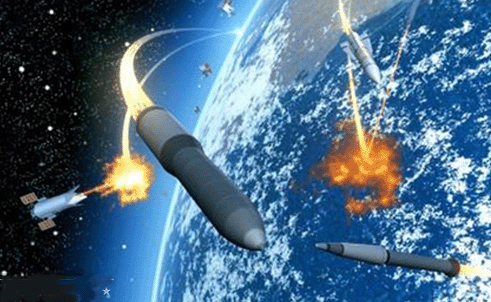
Can Space Tourism Co-exist with Space being turned into a War Zone?, By Karl Grossman, Space 4 Peace, Presented at the Space Tourism: Legal Dimensions Conference, 29 January 2022
The push to turn space into a war zone could spell goodbye to space tourism. The space tourism drive that is underway, led by billionaires Jeff Bezos with his Blue Origin company, Richard Branson and his Virgin Galactic, and Elon Musk and his SpaceX operation, is seen as only a start. As Dylan Taylor wrote in 2021 on www.space.com in an article headed “The Future of space tourism,” it’s a “a growing market expected to be worth at least $3 billion by 2030.” Space.com identified Taylor as an “entrepreneur, investor and philanthropist” and “cofounding patron of the Commercial Spaceflight Federation.” https://www.space.com/future-of-space-tourism-op-ed……………………………
Meanwhile, there’s the push, led by the United States, to turn space into a war zone—and this, despite the Outer Space Treaty of 1967 that sets space aside for peaceful purposes.
As then U.S. President Donald Trump declared in 2018 as he advocated for formation of a U.S. Space Force, “it is not enough to merely have an American presence in space. We must have American dominance in space.” https://www.space.com/40921-trump-space-traffic-policy-american-leadership.html
The following year, he signed the National Defense Authorization Act of 2020 establishing the Space Force as the sixth branch of U.S. armed forces and said: “Space is the world’s newest warfighting domain.” The Space Force, Trump said, would “help” the U.S. “control the ultimate high ground.” https://www.space.com/trump-creates-space-force-2020-defense-bill.html
Then, at the unveiling of a Space Force flag at the White House, Trump said: “Space is going to be…the future, both in terms of defense and offense.” https://www.nbcnews.com/news/us-news/trump-unveils-space-force-flag-ceremony-says-space-future-n1208021
Trump’s successor, U.S. President Joe Biden, has not rolled back the U.S. Space Force………………….
As to the impacts of war in space, Bruce Gagnon, coordinator of the Global Network Against Weapons and Nuclear Power in Space, in an interview in 2021 related the projection of the late Edgar Mitchell, in 1971 the sixth U.S. astronaut to walk on the moon. https://www.youtube.com/watch?v=ow8c7LbPvuI&feature=youtu.be
Gagnon said:
In 1989 during one of our campaigns against NASA plutonium launches [NASA’s launching of plutonium-powered space probes], we had a rally at the Kennedy Space Center in Florida, and our keynote speaker that day was Apollo astronaut Edgar Mitchell, one of the moonwalkers. And he came and said if there is one war in space, it’ll be the one and the only. He said because we will create so much space debris or space junk from all the destroyed satellites and things like that in space that there would literally be a minefield encircling the planet – he called it a piranha-laced river—and we would not be able to get through. A rocket would not be able to get off this Earth through that minefield. So, it’s insane to think about having a war in space.
Gagnon has also spoken of how space warfare would “mean activity on Earth below would immediately shut down—cell phones, ATM machines, cable TV, traffic lights, weather prediction and more—all hooked up to satellites, would be lost. Modern society would go dark.” https://www.counterpunch.org/2019/12/18/the-very-bad-space-force-deal/
Also pointing to the generation of space debris resulting from warfare in space was Alexander Chanock in section titled “Problems With Weaponizing Space” in an article published in 2013 in Journal of Air Law and Commerce titled “The Problems and Potential Solutions Related to the Emergence of Space Weapons in the 2lst Century.” https://scholar.smu.edu/cgi/viewcontent.cgi?article=1327&context=jalc
Chanock, then a candidate for a law degree, now a legislative counsel in the U.S. House of Representatives, wrote that a major problem “is the amount of space debris that space weapons would produce….The fear is that destroying in space could generate extremely dangerous debris with a long orbital life.”
Chanock quoted Dr. Joel Primack, professor of physics and astrophysics at the University of California, Santa Cruz, and “one of the premier experts on space debris, noted Chanock, as saying “the weaponization of space would make the debris problem much worse, and even one war in space could encase the entire planet in a shell of whizzing debris that would thereafter make space near the Earth highly hazardous for peaceful as well as military purposes.”……………………
U.S. interest in war in space has deep roots: back to the former Nazi rocket scientists and engineers brought to the U.S. from Germany after World War II under the U.S.’s Operation Paperclip. They ended up at the U.S. Army’s Redstone Arsenal in Huntsville, Alabama—to use “their technological expertise to help create the U.S. space and weapons program,” wrote Jack Manno, a professor of environmental studies at the State University of New York College of Environmental Science & Forestry, in his 1984 book Arming the Heavens: The Hidden Military Agenda for Space, 1945-1995. https://www.abebooks.com/9780396082118/Arming-heavens-hidden-military-agenda-0396082114/plp
“Many of the early space war schemes were dreamt up by scientists working for the German military, scientists who brought their rockets and their ideas to America after the war,” he wrote. Many of these scientists and engineers “later rose to positions of power in the U.S. military, NASA, and the aerospace industry.” Among them were “Wernher von Braun and his V-2 colleagues” who began “working on rockets for the U.S. Army,” and at the Army’s Redstone Arsenal “were given the task of producing an intermediate range ballistic range missile to carry battlefield atomic weapons up to 200 miles. The Germans produced a modified V-2 renamed the Redstone….Huntsville became a major center of U.S. space military activities.”
Manno told the story of former German Major General Walter Dornberger, who had been in charge of the entire Nazi rocket program, and how he “in 1947 as a consultant to the U.S Air Force and adviser to the Department of Defense…wrote a planning paper for his new employers. He proposed a system of hundreds of nuclear-armed satellites all orbiting at different altitudes and angles, each capable or reentering the atmosphere on command from Earth to proceed to its target. The Air Force began early work on Dornberger’s idea under the acronym NABS (Nuclear Armed Bombardment Satellites).”……………………………………..
This is pessimistic forecast need not be. The Outer Space Treaty of 1967 was—and is—a visionary documentary. “Let Us Beat Our Swords Into Plowshares” is the title of a statue by Evgeniy Vutetich in the sculpture garden of the UN in New York. It is based on the Book of Isaiah and its call that nations “shall beat their swords into plowshares and their spears into pruning hooks; nation shall not lift up sword against nation, neither shall they learn war any more.”
War on Earth is terrible enough. It must not be brought up to the heavens.
This will take continued take political will and international pressure—to preserve and extend the Outer Space Treaty of 1967 and its setting aside space for peaceful purposes. Especially in the United States, this will require action at the grassroots because the two major political parties in the U.S. have joined in a bellicose stance on space, supporting it becoming a war zone. Every year, the grassroots organization Global Network Against Weapons and Nuclear Power in Space, founded in Washington, D.C. in 1991 and the leading group internationally challenging the weaponization of space, holds a “Keep Space For Peace Week” with actions around the world. Meanwhile, there are nations around the globe that have, unlike the U.S., adopted a peaceful stance—as reflected in their support for the proposed PAROS treaty.
We must, indeed, keep space for peace.
Can space tourism co-exist with space being turned into a war zone? The answer is no.
And with a shooting war in space, it will not only space tourism that would be kissed goodbye. http://space4peace.org/can-space-tourism-co-exist-with-space-being-turned-into-a-war-zone/
How giving AI bots control over nuclear weapons could spark World War III

New York Post By Anthony Blair, The Sun, February 2, 2022
Giving artificial intelligence control over nuclear weapons could trigger an apocalyptic conflict, a leading expert has warned.
As AI takes a greater role in the control of devastating weaponry, so the chances of technology making a mistake and sparking World War III increase.
These include the USA’s B-21 nuclear bomber, China’s AI hypersonic missiles, and Russia’s Poseidon nuclear drone.
Writing for the Bulletin of the Atomic Scientists, expert Zachary Kellenborn, a Policy Fellow at the Schar School of Policy and Government, warned: “If artificial intelligences controlled nuclear weapons, all of us could be dead.”
He went on: “Militaries are increasingly incorporating autonomous functions into weapons systems,” adding that “there is no guarantee that some military won’t put AI in charge of nuclear launches.”
Kellenborn, who describes himself as a US Army “Mad Scientist”, explained that “error” is the biggest problem with autonomous nuclear weapons.
He said: “In the real world, data may be biased or incomplete in all sorts of ways.”
Kellenborn added: “In a nuclear weapons context, a government may have little data about adversary military platforms; existing data may be structurally biased, by, for example, relying on satellite imagery; or data may not account for obvious, expected variations such as imagery taken during foggy, rainy, or overcast weather.”
Training a nuclear weapons AI program also poses a major challenge, as nukes have, thankfully, only been used twice in history in Hiroshima and Nagasaki, meaning any system would struggle to learn.
Despite these concerns, a number of AI military systems, including nuclear weapons, are already in place around the world.
Dead Hand
In recent years, Russia has also upgraded its so-called “Doomsday device”, known as “Dead Hand”.
This final line of defense in a nuclear war would fire every Russian nuke at once, guaranteeing total destruction of the enemy.
First developed during the Cold War, it is believed to have been given an AI upgrade over the past few years.
In 2018, nuclear disarmament expert Dr. Bruce Blair told the Daily Star Online he believes the system, known as “Perimeter”, is “vulnerable to cyber attack” which could prove catastrophic.
Dead hand systems are meant to provide a backup in case a state’s nuclear command authority is killed or otherwise disrupted.
US military experts Adam Lowther and Curtis McGuffin claimed in a 2019 article that the US should consider “an automated strategic response system based on artificial intelligence”.
Poseidon Nuclear Drone
In May 2018, Vladimir Putin launched Russia’s underwater nuclear drone, which experts warned could trigger 300ft tsunamis.
The Poseidon nuclear drone, due to be finished by 2027, is designed to wipe out enemy naval bases with two megatons of nuclear power.
Described by US Navy documents as an “Intercontinental Nuclear-Powered Nuclear-Armed Autonomous Torpedo”, or an “autonomous undersea vehicle” by the Congressional Research Service, it is intended to be used as a second-strike weapon in the event of a nuclear conflict.
The big unanswered question over Poseidon is; what can it do autonomously…………………..
B21 Bomber
The US has launched a $550 million remotely-piloted bomber that can fire nukes and hide from enemy missiles.
In 2020, the US Air Force’s B-21 stealth plane was unveiled, the first new US bomber in more than 30 years.
Not only can it be piloted remotely, but it can also fly itself using artificial intelligence to pick out targets and avoid detection with no human output.
Although the military insists a human operator will always make the final call on whether or not to hit a target, information about the aircraft has been slow at getting out.
AI fighter pilots & hypersonic missiles
Last year, China bragged its AI fighter pilots were “better than humans” and shot down their non-AI counterparts in simulated dogfights……..
Last year, China claimed its AI-controlled hypersonic missiles can hit targets with 10 times as much accuracy as a human-controlled missile.,,,,,,,
Checkmate AI warplane
In 2021, Russia unveiled a new AI stealth fighter jet – while also making a dig at the Royal Navy.
The 1,500mph aircraft called Checkmate was launched at a Russian airshow by a delighted Vladimir Putin.
One ad for the autonomous plane – which can hide from its enemies – featured a picture of the Royal Navy’s HMS Defender in the jet’s sights with the caption: “See You”.
The world has already come close to devastating nuclear war which was only prevented by human involvement.
On September 27, 1983, Soviet soldier Stanislav Petrov was an on-duty officer at a secret command center south of Moscow when a chilling alarm went off.
It signaled that the United States had launched intercontinental ballistic missiles carrying nuclear warheads.
Faced with an impossible choice – report the alarm and potentially start WWIII or bank on it being a false alarm – Petrov chose the latter.
He later said: “I categorically refused to be guilty of starting World War III.”

Kellenberg said that Petrov made a human choice not to trust the automated launch detection system, explaining: “The computer was wrong; Petrov was right. The false signals came from the early warning system mistaking the sun’s reflection off the clouds for missiles.
“But if Petrov had been a machine, programmed to respond automatically when confidence was sufficiently high, that error would have started a nuclear war.”
He added: “There is no guarantee that some military won’t put AI in charge of nuclear launches; international law doesn’t specify that there should always be a ‘Petrov’ guarding the button. That’s something that should change, soon.” https://nypost.com/2022/02/02/how-giving-ai-bots-control-over-nuclear-weapons-could-spark-world-war-iii/
Japan to renew subsidies for plutonium nuclear recycling
Ministry to resume subsidies for stalled pluthermal plan https://www.asahi.com/ajw/articles/14526390
By JUNICHIRO NAGASAKI/ Staff Writer February 2, 2022 The economy ministry plans to bring back its subsidy program for areas that host pluthermal generation facilities in an attempt to break the logjam in the nuclear fuel recycling program.
The funds will be offered by the end of fiscal 2022.
The pluthermal program is part of the government’s nuclear fuel cycle policy, in which plutonium extracted from spent nuclear fuel produced at power plants in Japan is processed into plutonium-uranium mixed oxide (MOX) fuel and reused at reactors.
The Federation of Electric Power Companies of Japan plans to start pluthermal power production at 12 or more reactors by fiscal 2030.
But the technology has been in service at only four reactors: the No. 3 and No. 4 reactors in Kansai Electric Power Co.’s Takahama plant in Fukui Prefecture; the No. 3 reactor of Shikoku Electric Power Co.’s Ikata plant in Ehime Prefecture; and the No. 3 reactor of Kyushu Electric Power Co.’s Genkai plant in Saga Prefecture.
By distributing the local-revitalization subsidies, the ministry hopes to accelerate the formation of regional agreements on the fuel cycle project.
A reprocessing facility operated by Japan Nuclear Fuel Ltd. in Aomori Prefecture to recover plutonium is scheduled for completion in the first half of fiscal 2022, but the treatment plant cannot be put in full operation unless pluthermal generation spreads.
Unable to expand the use of MOX fuel, Japan now has 46 tons of plutonium stuck in storage, which has raised international concerns over its potential use in nuclear weapons.
Previously, prefectural governments that had agreed by fiscal 2008 to join the pluthermal circle could receive up to 6 billion yen ($52.4 million) in subsidies. Those that agreed by fiscal 2014 were eligible for a maximum of 3 billion yen in subsidies.
Eight prefectures, including Fukui, Ehime and Saga, have been receiving the subsidies. But currently there are no similar funding mechanisms for local governments under the pluthermal plan.
The economy ministry plans to incorporate a new system to finance prefectures with reactors that have not benefited from past subsidy programs.
Reactors at Japan Atomic Power Co.’s Tokai No. 2 nuclear power plant in Ibaraki Prefecture and elsewhere are expected to be eligible.
Although Chubu Electric Power Co.’s Hamaoka power plant in Shizuoka Prefecture and Chugoku Electric Power Co.’s Shimane plant in Shimane Prefecture are included on the list for past subsidies, it is unclear when they can restart operations because of difficulties in passing the Nuclear Regulation Authority’s screening and gaining consent from residents near the plants.
Bill to help build small nuclear reactors in Indiana passes Senate,
Bill to help build small nuclear reactors in Indiana passes Senate, WFYI Indianapolis,
REBECCA THIELE 2 Feb 22,
A bill that would make it easier for smaller, more advanced nuclear power plants to be built in Indiana passed in the state Senate on Tuesday…….
But opponents of SB 271 said small modular nuclear reactors are a risky investment for the state. None of the planned modular nuclear reactors have been built yet and many have gone over their proposed budgets — some by billions of dollars.
Sen. Shelli Yoder (D-Bloomington) said the fact that ratepayers would have to foot the bill for these projects is concerning.
“This is a question of who is going to pay and for quite some time and before any project has ever come to fruition,” she said.
The Union of Concerned Scientists has also questioned the safety of the plants. It said the nuclear industry has sometimes used the plant’s smaller size to justify cutting back on safety equipment and staff as well as shrink the area that would be told to evacuate in a disaster.
The bill now moves on to the House for consideration. https://www.wfyi.org/news/articles/bill-to-help-build-small-nuclear-reactors-in-indiana-passes-senate
1 This Month
To see nuclear-related stories in greater depth and intensity – go to https://nuclearinformation.wordpress.com/

29 Jan. Thursday 7-8 p.m. Webinar – World’s Largest Nuclear Station in Port Hope, ON?


31st January – Challenging the War Machine – a DECLASSIFIED UK SUMMIT


Website of the Week
Now until to February 10, 2026 Radioactive waste storage in France: the debate is finally open! How to participate?
-
Archives
- January 2026 (271)
- December 2025 (358)
- November 2025 (359)
- October 2025 (376)
- September 2025 (258)
- August 2025 (319)
- July 2025 (230)
- June 2025 (348)
- May 2025 (261)
- April 2025 (305)
- March 2025 (319)
- February 2025 (234)
-
Categories
- 1
- 1 NUCLEAR ISSUES
- business and costs
- climate change
- culture and arts
- ENERGY
- environment
- health
- history
- indigenous issues
- Legal
- marketing of nuclear
- media
- opposition to nuclear
- PERSONAL STORIES
- politics
- politics international
- Religion and ethics
- safety
- secrets,lies and civil liberties
- spinbuster
- technology
- Uranium
- wastes
- weapons and war
- Women
- 2 WORLD
- ACTION
- AFRICA
- Atrocities
- AUSTRALIA
- Christina's notes
- Christina's themes
- culture and arts
- Events
- Fuk 2022
- Fuk 2023
- Fukushima 2017
- Fukushima 2018
- fukushima 2019
- Fukushima 2020
- Fukushima 2021
- general
- global warming
- Humour (God we need it)
- Nuclear
- RARE EARTHS
- Reference
- resources – print
- Resources -audiovicual
- Weekly Newsletter
- World
- World Nuclear
- YouTube
-
RSS
Entries RSS
Comments RSS
 nuclear-news