NuScale: Not new, not needed — Beyond Nuclear International

Costs, delays and competition will likely kill SMR
NuScale: Not new, not needed — Beyond Nuclear International Risks of rising costs, likely delays, and increasing competition cast doubt on long- running development effort
By David Schlissel and Dennis Wamsted
In a new analysis, the Institute for Energy Economics and Financial Analysis looked at NuScale’s proposed Small Modular Reactor, concluding that its costs will be far higher than NuScale predicts and that the reactor is fundamentally not needed. What follows are the Executive Summary and Conclusions sections of the report. The full report can be read and downloaded here.
Executive Summary

The second set of problems with the NuScale proposal are contractual. As the power sale agreement is currently structured, anyone who signs on to buy power from NuScale’s SMR will have to pay the actual costs and expenses of the project, not just the $58 per MWh estimated target price now being promoted by NuScale and UAMPS. And participants would have to continue to do so for decades, even if the price of the electricity from the SMR is much more expensive than NuScale and UAMPS now claim or even if participants don’t receive any power from the project for a significant part of its forecast operating life. These are risks that far outweigh any potential project benefits.
Too late, too expensive, too risky and too uncertain. That, in a nutshell, describes NuScale’s planned small modular reactor (SMR) project, which has been in development since 2000 and will not begin commercial operations before 2029, if ever.
As originally sketched out, the SMR was designed to include 12 independent power modules, using common control, cooling and other equipment in a bid to lower costs. But that sketch clearly was only done in pencil, as it has changed repeatedly during the development process, with uncertain implications for the units’ cost, performance and reliability.
For example, the NuScale power modules were initially based on a design capable of generating 35 megawatts (MW), which grew first to 40MW and then to 45MW. When the company submitted its design application to the Nuclear Regulatory Commission in 2016, the modules’ size was listed at 50MW.
Subsequent revisions have pushed the output to 60MW, before settling at the current 77MW. Similarly, the 12-unit grouping has recently been amended, with the company now saying it will develop a 6-module plant with 462MW of power. NuScale projects that the first module, once forecast for 2016, will come online in 2029 with all six modules online by 2030.
While these basic parameters have changed, the company has insisted its costs are firm, and that the project will be economic.
Based on the track record so far and past trends in nuclear power development, this is highly unlikely. The power from the project will almost certainly cost more than NuScale estimates, making its already tenuous economic claims even less credible.
Worse, at least for NuScale, the electricity system is changing rapidly. Significant amounts of new wind, solar and energy storage have been added to the grid in the past decade, and massive amounts of additional renewable capacity and storage will come online by 2030. This new capacity is going to put significant downward pressure on prices, undercutting the need for expensive round-the-clock power. In addition, new techniques for operating these renewable and storage resources, coupled with energy efficiency, load management and broad efforts to better integrate the western grid, seriously undermine NuScale’s claims that its untested reactor technology will be needed for reliability reasons.
This first-of-a-kind reactor poses serious financial risks for members of the Utah Associated Municipal Power System (UAMPS), currently the lead buyer, and other municipalities and utilities that sign up for a share of the project’s power.
NuScale is marketing the project with unlikely predictions regarding its final power costs, the amount of time it will take to construct and its performance after entering commercial services:
- There is significant likelihood that the project will take far longer to build than currently estimated;
- There is significant likelihood that its final cost of power will be much higher than the current $58 per megawatt-hour claim;
- There is significant likelihood that the reactor will not operate with a 95% capacity factor when it enters commercial service.
As currently structured, those project risks will be borne by the buying entities (participants), not NuScale or Fluor, its lead investor. In other words, potential participants need to understand that they would be responsible for footing the bill for construction delays and cost overruns, as well as being bound by the terms of an expensive, decades-long power purchase contract.
These compelling risks, coupled with the availability of cheaper and readily available renewable and storage resources, further weaken the rationale for the NuScale SMR.
Conclusions
There are serious problems with the proposed NuScale SMR project.
The first set of problems revolve around the company’s optimistic assumptions regarding its untested, first-of-a-kind reactor. NuScale claims it will be able to accomplish a performance trifecta that has never been accomplished:
- Completing construction at the new facility in 36 months or less;
- Keeping construction costs in check and thereby meeting a target power
price of less than $60/MWh; and - Operating the plant with a 95% capacity factor from day one.
As this report has demonstrated, these are unduly optimistic assumptions. Costs and construction times for all recent nuclear projects have vastly exceeded original estimates and there is no reason to assume the NuScale project will be any different. For example, costs at Vogtle, the project most like NuScale in terms of modular development, now are 140% higher than the original forecast and construction is years late with significant uncertainty about a final completion date.
The second set of problems with the NuScale proposal are contractual. As the power sale agreement is currently structured, anyone who signs on to buy power from NuScale’s SMR will have to pay the actual costs and expenses of the project, not just the $58 per MWh estimated target price now being promoted by NuScale and UAMPS. And participants would have to continue to do so for decades, even if the price of the electricity from the SMR is much more expensive than NuScale and UAMPS now claim or even if participants don’t receive any power from the project for a significant part of its forecast operating life. These are risks that far outweigh any potential project benefits.
The second set of problems with the NuScale proposal are contractual. As the power sale agreement is currently structured, anyone who signs on to buy power from NuScale’s SMR will have to pay the actual costs and expenses of the project, not just the $58 per MWh estimated target price now being promoted by NuScale and UAMPS. And participants would have to continue to do so for decades, even if the price of the electricity from the SMR is much more expensive than NuScale and UAMPS now claim or even if participants don’t receive any power from the project for a significant part of its forecast operating life. These are risks that far outweigh any potential project benefits.
The Institute for Energy Economics and Financial Analysis (IEEFA) examines issues related to energy markets, trends and policies. The Institute’s mission is to accelerate the transition to a diverse, sustainable and profitable energy economy. www.ieefa.org. Director of Resource Planning Analysis David Schlissel is a long-time consultant, expert witness, and attorney on engineering and economic issues related to energy. He has testified in more than 100 court proceedings or cases before regulatory bodies. Analyst/Editor Dennis Wamsted has covered energy and environmental policy and technology issues for 30 years. He is the former editor of The Energy Daily, a Washington, D.C.-based newsletter.
Elon Musk joins the frenzy for small nuclear reactors in Wales, despite local opposition to nuclear development.

A company backed by investor in Elon Musk’s businesses is the latest to
say that it wants to build a nuclear power plant in Wales. Last Energy is
now the third company that wants to build nuclear power plants in Wales,
having settled on a not yet named site within the country.
They would join a Rolls-Royce led consortium who have mooted Wylfa on Anglesey and
Trawsfynydd in Gwynedd as the locations of new modular reactors. US nuclear
company Westinghouse have also put together a consortium with construction
group Bechtel to revive plans for two nuclear reactors at Wylfa since
Hitachi, a Japanese conglomerate, abandoned their own plans in 2019.
According to the Sunday Telegraph, Last Energy’s plans are very similar
to those of Rolls-Royce. They want to build a first “mini-nuclear”
power plant in Wales by 2025, as part of a plan to spend £1.4bn on 10
reactors by the end of the decade. Elon Musk, who is the world’s richest
person with assets worth an estimated £220bn, said on Twitter last month
that he was keen on investing in nuclear energy.
More nuclear power at Wylfa is not without its critics with campaign groups CADNO and PAWB among
the local opposition. Writing for Nation.Cymru, Dylan Morgan of PAWB
(People Against Wylfa B) warned that “nuclear power is a dirty, outdated,
dangerous, vastly expensive technology which threatens both human and
environmental health”. “It would also steal much-needed resources from
renewable technologies which are cheaper, much quicker to build and more
effective to combat the effects of climate change.”
Plaid Cymru leader Adam Price, whose party currently controls Anglesey Council, also spoke out
against nuclear power last week, calling it “the wrong answer” to
Wales’ energy needs. “We do not support nuclear power. It’s the wrong
answer. Renewables absolutely is the way to go. And I fear that, you know,
nuclear power, very expensive and unnecessary distraction,” he said.
NuScale’s small modular nuclear reactor – ”too late, too expensive, too risky and too uncertain” – Institute for Energy Economics and Financial Analysis

A small modular reactor (SMR) that NuScale has been developing since the turn of the century is “too late, too expensive, too risky and too uncertain,” according to an analysis of the project by the Institute for Energy Economics and Financial Analysis.
The first-of-its-kind SMR is a serious financial threat to the member communities of the Utah Associated
Municipal Power System that have signed up for a share of its power and to any other communities and utilities thinking about doing so. NuScale has optimistically targeted the cost of power from the new plant at $58 per megawatt-hour (MWh), although some estimates predict costs for the power from new SMRs could reach $200/MWh.
IEEFA 17th Feb 2022
Getting bigger but not safer or cheaper – the myth of Rolls Royce and its very big non-modular reactor

Rolls Royce are now starting a ‘Generic Design Assessment’ (GDA) process with the ONR which will take around 5 years. After then they will be asking the UK Government for a blank cheque for the project.
https://100percentrenewableuk.org/getting-bigger-but-not-safer-or-cheaper-the-myth-of-rolls-royce-and-its-very-big-non-modular-reactor By David Toke, 30 Mar 22, Rolls Royce’s so-called small modular reactor (SMR) is getting bigger, but is likely to have fewer special safety features compared to EDF’s increasingly pricey design for Hinkley C.
In 2017 Rolls Royce said that its small modular reactor would be between 220 and 440 MW, but the latest design is bigger, at 470 MW. It is strange to call this small. Reactors in service at the moment (the so-called AGR reactors) were around the 600 MW size for each unit and, strange as it might seem, most of the first generation of so-called ‘Magnox’ nuclear reactors built in the UK were actually smaller than 470 MW. They were not called ‘small’. So why is Rolls Royce calling this a SMR? There’s no reason for this other than public relations.
Rolls Royce claim that the parts will be mainly built in factories. Well, of course they will, that’s always the case with nuclear power plant. The difference with building a relatively smaller plant of course is that you get less of the economies of scale in doing this. That is why nuclear power plant have got bigger.

So the fact that the Rolls Royce unit will be about a third the size of the EPR is likely to make them cost more. But there is one way that Rolls Royce will be able to economise compared to the European Pressurised Reactor (EPR) being built at Hinkley C, and that is because I have seen no sign that Rolls Royce will include some special safety features that have been included in the EPR.
The best known of these safety features are a) a ‘double containment’ feature that is designed to stop material from the inside getting out (as well as another external shell to shield from aircraft) and b) a ‘core catcher’ to stop a melting core eating its way into the ground and potentially contaminating water courses. I am assuming Rolls Royce will not be including either of these features, although it will have to satisfy the Office for Nuclear Regulation (ONR) that it has other ways of stopping radioactive releases from accidents.
Rolls Royce are now starting a ‘Generic Design Assessment’ (GDA) process with the ONR which will take around 5 years. After then they will be asking the UK Government for a blank cheque for a project.
Of course there is another factor and that is that EDF have some experience (admittedly not very successful of late) of building nuclear power plant. Rolls Royce do not have experience of building large nuclear power plant (which is what they are really hoping to do). Producing small (and, it must be said extremely expensive) genuinely small reactors for nuclear submarines is not the same thing at all! So Rolls Royce are likely not to have the skills to build large nuclear power plant. That is a bad sign!
The so-called SMRs proferred by Rolls Royce will just be the latest in a long line of very expensive, very lately delivered nuclear power stations in the UK. It is unlikely to be any cheaper than the reactor that EDF is building at Hinkley C (becoming more expensive as time goes on). But it will have fewer safety features.
Robert (Bob) Hoggar comments: Small Mod Reactors scattered about Britain will also have lots of nuclear waste scattered about Britain which will need careful looking after and that is guaranteed to be an additional rusk to the nation.
New nuclear reactors will pose a bigger, hotter, more long-lasting waste problem

As Boris Johnson prepares a new push for nuclear power, the £131bn
problem of how to safely dispose of vast volumes of radioactive waste
created by the last British atomic energy programme remains unsolved.
The hugely expensive and dangerous legacy of the UK’s 20th-century nuclear
revolution amounts to 700,000 cubic metres of toxic waste – roughly the
volume of 6,000 doubledecker buses. Much of it is stored at Sellafield in
Cumbria, which the Office for Nuclear Regulation says is one of the most
complex and hazardous nuclear sites in the world.
As yet, there is nowhere
to safely and permanently deposit this waste. Nearly 50 years ago the
solution of a deep geological disposal facility (GDF) was put forward, but
decades later the UK is no nearer to building one.
Experts say new nuclear
facilities will only add to the problem of what to do with radioactive
waste from nuclear energy and that the “back end” issue of the
hazardous toxic waste from the technology must not be hidden.
An assessment by the Nuclear Decommissioning Authority (NDA) says spent fuel from new
nuclear reactors will be of such high temperatures it would need to stay on
site for 140 years before it could be removed to a GDF, if one is ever
built in the UK.
“It is essential to talk about the back end of the
nuclear fuel cycle when you are considering building new nuclear power
stations,” said Claire Corkhill, a professor of nuclear material
degradation at the University of Sheffield and a member of the Committee on
Radioactive Waste Management, an independent body that advises the
government.
Whilst we have a plan to finally and safely deal with the
waste, it is less certain how this will be applied to the modern nuclear
reactors that the government are planning to roll out. “These are
completely different to previous reactors and we are at a very early stage
of understanding how to deal with the waste.
In my personal view, I do not
think we should be building any new nuclear reactors until we have a
geological disposal facility available.” “The amount of legacy waste is
not small in terms of nuclear waste,” said Corkhill. “It is expensive
to deal with. These materials are hazardous and we are looking at an
underground footprint of some 20km at a depth of 200 metres to 1,000
metres.
So regarding new nuclear sites, we need to think about whether it
is possible to build a GDF big enough for all the legacy waste and the new
nuclear waste.” Steve Thomas, a professor of energy policy at the
University of Greenwich, said: “Despite 65 years of using nuclear power
in Britain, we are still, at best, decades away from having facilities to
safely dispose of the waste. Until we know this can be done, it is
premature to embark on a major new programme of nuclear power plants.”
A government spokesperson said: “This is not an either/or situation. As the
prime minister has said, nuclear will be a key part of our upcoming energy
security strategy alongside renewables. We are committed to scaling up our
nuclear electricity generation capacity, and building more nuclear power
here in the UK, as seen through the construction of Hinkley Point C – the
first new nuclear power station in a generation. Alongside this we’re
developing a GDF to support the decommissioning of the UK’s older nuclear
facilities.”
Guardian 28th March 2022
Ottawa’s Nuclear Funding Delays Climate Action, Ignores Indigenous Objections, Opponents Warn
Ottawa’s Nuclear Funding Delays Climate Action, Ignores Indigenous Objections, Opponents Warn The Energy Mix March 20, 2022
The federal government is delaying climate action by subsidizing small, modular nuclear reactor (SMR) development, over the objections of the remote, Indigenous communities the technology is supposed to serve as an alternative to diesel generators, opponents warned last week.
“There is no guarantee SMRs will ever produce energy in a safe and reliable manner in Canada,” the groups said in a release, after Innovation Minister François-Philippe Champagne announced a C$27.2-million grant for Westinghouse Electric’s $57-million bid to move its e-Vinci reactor toward licencing. They said systems of the type Westinghouse is developing “are not the energy answer for remote communities”, since they “do not compete when compared with other alternatives.”
In a study conducted in 2020, “the cost of electricity from SMRs was found to be much higher than the cost of wind or solar, or even of the diesel supply currently used in the majority of these communities,” the release added.
“Canadians want affordable energy that does not pollute the environment,” said Susan O’Donnell, spokesperson for the Coalition for Responsible Energy Development in New Brunswick. “Why would we invest in unproven technologies that, if they ever work, will cost two to five times more than building proven renewables?”
“The nuclear industry is promoting a nuclear fantasy to attract political support while purging past failures—like cost overruns and project delays—from public debate,” said Kerrie Blaise, northern services legal counsel at the Canadian Environmental Law Association. “Before Canada invests any public dollars in this yet-to-be-developed technology, they must fully evaluate the costs of nuclear spending and liabilities associated with the construction, oversight, and waste of this novel technology.”
“Studies have shown that electricity from small modular reactors will be more expensive than electricity from large nuclear power plants, which are themselves not competitive in today’s electricity markets,” said M. V. Ramana, a professor at the University of British Columbia School of Public Policy and Global Affairs, one of the co-authors of the 2020 study. “There is no viable market for small modular reactors, and even building factories to manufacture these reactors would not be a sound financial investment……………….
Last week’s government release added that SMR development will “help communities that rely on heavy-polluting diesel fuel to transition to a cleaner source of energy.” But the opposing groups say many of those remote settings are Indigenous communities, and SMR development isn’t the help they’re looking for. A December, 2018 resolution by the Assembly of First Nation Chiefs asked the industry to stop pursuing SMR development and the government to stop funding it, and “other Indigenous communities, including the Chiefs of Ontario, have passed resolutions opposing funding and deployment of SMRs”. https://www.theenergymix.com/2022/03/20/ottawas-nuclear-funding-delays-climate-action-ignores-indigenous-objections-opponents-warn%ef%bf%bc/
British public in the dark about what ”Modular” nuclear reactors really means (hint -they’re like Lego pieces)
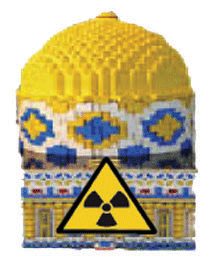
What does “modular” mean here? I haven’t the faintest. Isn’t it to
do with university courses? I’ve been quizzing friends and so far only
two even took a stab: one thought it might mean being able to have them
together, or not, or something. The other thought it might mean
“portable”. My guess is that the British population shares my
ignorance, but thinks you don’t say “small reactors” without
inserting “modular”. Obviously, we’ll have to ramp these modularities
up. On multiple occasions. Onwards, then, to my next small, modular item.
Times 23rd March 2022
https://www.thetimes.co.uk/article/this-craze-for-modular-must-be-a-fission-thing-s35qx0ktq
Nuclear lobby touting small nuclear reactors to Alaska

House bill would streamline approval of small nuclear reactors in Alaska, Alaska Public Media, By, Dan Bross, KUAC – Fairbanks, March 21, 2022 A bill moving through the Alaska Legislature would streamline the state’s approval process for small nuclear reactors, which have been touted as cleaner, more cost-effective sources of energy for Alaska.
There are no microreactors operating anywhere in the United States. But a few pilot projects are planned, including one at Eielson Air Force Base. The federal Nuclear Regulatory Commission must approve any new reactor, but House Bill 299 from Gov. Mike Dunleavy would exempt microreactors from some decades-old state requirements.
At a state House committee hearing, Alaska Department of Environmental Conservation environmental health director Christina Carpenter said the bill would exempt microreactors from multi-agency study and legislative siting approval requirements……………
Alaska Community Action on Toxics executive director Pam Miller describes nuclear power as destructive throughout its lifecycle.
“While these nuclear microreactors are being touted as a solution for the climate crisis and energy needs in rural Alaska, I believe that it’s a false solution and that these reactors are actually quite dangerous,” she said. “From the mining of uranium, which usually takes place on Indigenous lands, through the enrichment process. And then there is the untenable problem of radioactive waste disposal, and that has not been solved.”
Miller said she is also concerned about the security of microreactors in Alaska, especially if deployed in remote locations.
Under the bill, microreactors proposed for areas without local government would still need to get siting approval from the legislature. https://www.alaskapublic.org/2022/03/21/house-bill-would-streamline-approval-of-small-nuclear-reactors-in-alaska/
Indigenous, scientific, environmental and citizen groups strongly oppose Ottawa’s push for small nuclear reactors
Ottawa pours more money into next-gen nuclear tech; critics to push back
against ‘dangerous distraction’. Innovation, Science and Industry
Minister François-Philippe Champagne announced a $27.2-million investment
Thursday in the development of next-generation nuclear technology he said
will make energy more accessible to remote communities.
However, numerous Indigenous, scientific, environmental and citizen groups have called the
technology a “dirty, dangerous distraction” from real climate action.
The money will go to the development of Westinghouse Electric Canada
Inc.’s eVinci micro-reactor, a small modular reactor (SMR) the company
says will “bring carbon-free, transportable, safe and scalable energy
anywhere Canada requires reliable, clean energy.”
National Observer 17th March 2022
Small modular nuclear reactors – no good for Canada’s indigenous communities, no good for climate action
The Government of Canada is further delaying climate action with an
announcement of $27 million in funding today to develop a Small Modular
Nuclear Reactor (SMR).
There is no guarantee SMRs will ever produce energy
in a safe and reliable manner in Canada. During his remarks for the
announcement, François-Philippe Champagne, Minister of Innovation, Science
and Economic Development Canada, as well as Westinghouse representatives,
said that the technology to be developed, the e-Vinci reactor by the
Westinghouse Electric Company, will be suitable for remote Indigenous
communities currently using diesel energy.
However, research has demonstrated that small modular nuclear reactors such as the type
Westinghouse is proposing are not the energy answer for remote communities.
The researchers–Froese, Kunz & Ramana (2020)–concluded that the
economics of SMRs do not compete when compared with other alternatives. The
cost of electricity from SMRs was found to be much higher than the cost of
wind or solar, or even of the diesel supply currently used in the majority
of these communities.
Canadian Coalition for Nuclear Responsibility 17th March 2022
Why New Technology Is Making Nuclear Arms Control Harder
The US, China, and Russia are locked in a high-tech race to perfect new nuclear capabilities, rendering some Cold War safeguards obsolete. Defense One, PATRICK TUCKER | MARCH 14, 2022
The risks associated with nuclear weapons are rising once again, the heads of three U.S. intelligence agencies told lawmakers last week, as Russia’s brutal invasion of Ukraine intensified.
t wasn’t supposed to be this way.
At the end of the Cold War, President George H.W. Bush boasted that the United States could now reduce its nuclear forces. But today’s arsenals—and global politics—are much different than in 1991. U.S. leaders face threatening dictatorships in Moscow, Beijing, Tehran, and Pyongyang, all racing to create new nuclear bombs and ways to deliver them. Technology, it turns out, is making arms control harder, and that’s forcing a big rethink about nuclear deterrence.
Thirty years later, the United States is spending hundreds of billions of dollars on 21st-century versions of the nuclear triad’s strategic bombers, nuclear-powered submarines, and intercontinental ballistic missiles, or ICBM. At the same time, China, Russia, and the United States are also developing new types of hypersonic missiles that, maneuvering at more than five times the speed of sound, make Cold War-era ICBMs look like Chrysler Imperials. But these new missiles don’t doesn’t replace the old ones: they just add to the stuff each nation must buy to keep up.
Beyond the delivery systems, today’s nuclear command-and-control systems include a vast network of satellites; sensors, including drone-mounted ones; and computer systems constantly being developed, maintained, and upgraded.
Some argue that while U.S. leaders could have used the post-Cold War era’s peace dividend to dismantle global nuclear arsenals, instead the Pentagon’s own ambitions for newer missile-defense technology forced the rising autocratic regimes of other global powers to respond in kind. Heavy U.S. investment in developing new ballistic missile defense, in particular, prompted Russia and China on their current path to develop highly-maneuverable hypersonic weapons.
Several senior U.S. military leaders declined interview requests for this article; Defense Department leaders keep current nuclear concerns close to their vest. But in 2019, the Air Force released a collection of papers in which leaders already were lodging concerns. In it, Maj. Jeff Hill, said that newly developed U.S. defenses against Russian and Chinese missiles “has led each of these two countries to aggressively pursue its own [highly-maneuverable hypersonic missile] programs. Russia specifically highlights ‘American military-technological advances’ including its ballistic missile defense program as an area of concern in relation to deterrence,” citing the work of Kristin Ven Bruusgaard, one of the foremost Western academic experts on Russian nuclear strategy. His work was published as part of a U.S. Air Force Center for Strategic Deterrence Studies student research project that assessed the influence of hypersonic weapons on deterrence.
All this makes preparing for and deterring nuclear war a great deal more complex than it was during the 1950s and 1960s.
“There’s a number of very fundamental assumptions that we have made over the last 30 years, that really are no longer valid,” said Adm. Charles Richard said at September’s Deterrence Symposium. Richard leads U.S. Strategic Forces, or STRATCOM, which oversees the military’s nuclear arsenal. “After the fall of the Soviet Union and the [U.S.] success in Desert Storm, we achieved a national security environment where, I would argue that, the risk of a strategic deterrent failure, and, in particular, the risk of a nuclear deterrence failure, was low…. We started taking it for granted and forgot all the things that we had to do, from a strategic deterrence standpoint, to get us to that environment to begin with.”
………………… China has since vastly expanded its arsenal; in 2020, Pentagon officials estimated it numbered “in the low 200s,” and could double. It has also built out its own nuclear triad, with nuclear-capable stealth bombers; four Type 094 ballistic missile submarines; and on land, truck-mounted missile launchers
and an estimated 300 completed and planned ICBM silos.
………………And the emergence of a third huge nuclear arsenal complicates deterrence theory, STRATCOM’s Richard said.
“In general, deterrence theory doesn’t really account for a three-party problem. How you do deterrence with three, peer nuclear-capable competitors?” Richard said. “The Cold War was very much a two-party competition.”
Meanwhile, U.S. military planners are changing their definition of “strategic” deterrence, weapons, and attacks. During the Cold War, this almost always referred to nuclear war. But today’s planners use the term to include non-nuclear threats and technologies that could have devastating effects—for example, destroying an adversary’s ability to see an attack coming or respond to it.
“Strategic effects can be much broader than simply ‘nuclear,’ in terms of what could possibly be done in cyber or possibly be done in space, critical infrastructure, information domain, role of allies and partners. All of that, I think, requires a very critical relook,” Richard said.
That nuance is often lost in the contemporary conversation about nuclear weapons and deterrence. In 2018, a New York Times article, “Pentagon Suggests Countering Devastating Cyberattacks With Nuclear Arms” sparked frenzied concern that the United States under President Donald Trump was lowering its bar for launching a nuclear strike…………
Future nuclear weapons, including ICBMs, will likely be part of a complex, interconnected digital architecture, and will likely exhibit “some level of connectivity to the rest of the warfighting system,” Werner J.A. Dahm, then-chairman of the Air Force Scientific Advisory Board, predicted in 2016. His warning came on the eve of a major study by the Air Force to see how trustworthy nuclear weapons would be if they were networked together, a study that was never publicly released.
Super Maneuverable Missiles
Perhaps the biggest change to nuclear deterrence is the appearance of new types of hypersonic weapons. Unlike Cold-War era ICBMs, the new class of hypersonics that China and Russia (along with the United States) are pursuing are steerable, allowing an adversary to target a much wider space with one missile, and making such missiles very difficult to defend against…………………..
any country could use a non-nuclear hypersonic missile to strike its adversary’s nuclear command-and-control targets…………….
The development of these new “invincible” weapons—as Russian leader Vladimir Putin has called them—has triggered a concurrent arms race for new concepts to defeat them. One U.S. answer has been the use of new satellite architectures to watch hypersonics as they proceed along their flight path, in addition to new sensors and object-finding software to spot things like mobile missile launchers.
,…………………………………. https://www.defenseone.com/policy/2022/03/why-new-technology-making-nuclear-arms-control-harder/363135/
The Ukraine war is bad for USA’s nuclear industry- hard to get the Highly Enriched Uranium needed from Russia for Advanced Nuclear Reactors
How Russia’s invasion is affecting U.S. nuclear, EE News, By Hannah Northey | 03/14/2022
Russia’s invasion of Ukraine is raising questions about the cost and flow of fuel to existing and yet-to-be commercialized advanced U.S. reactors touted by advocates as a tool for tackling climate change.
President Biden didn’t target the nuclear sector when he issued an executive order this month to block imports of Russian crude and natural gas.
But as the war drags on for a third week, the White House is consulting with the nuclear sector about the potential impact of imposing sanctions on Rosatom, Russia’s state-owned atomic energy company, according to Bloomberg, which cited anonymous sources familiar with the matter.
The White House did not immediately confirm talks with the nuclear industry.
Sanctions on Rosatom, sources told E&E News, could pose long-term challenges for the United States’ fleet of more than 90 reactors running on low-enriched uranium.
While the existing plants have enough fuel for the next six to eight months and possibly longer, experts say sanctions on Russian imports could raise the global cost of low-enriched uranium and rile U.S. plants sensitive to cost swings. Russia supplies 20 percent of the low-enriched uranium needed to run American nuclear plants, according to the Nuclear Energy Institute.
Others say the larger concern may sit with advanced reactor demonstrations expected to come online around 2028 that will require high-assay, low-enriched uranium, or HALEU. That’s because Russia is the only viable commercial supplier globally and other firms are years away from readily providing such fuel, they say.
Groups like Beyond Nuclear have said the Russian invasion highlights the liability of nuclear power and spent fuel, arguing the fuel source cannot be a climate solution.
Frank von Hippel, a physicist and professor emeritus at Princeton University, said the bigger challenge for nuclear power is that the technology is not economically competitive…………..
Russia represents— about 20 percent in 2020 — of the enriched uranium making its way to American reactors. Concerns about what steps the Biden administration would take regarding uranium began surfacing publicly when Reuters, citing sources familiar with the matter, reported earlier this month that NEI urged the White House to keep uranium sales exempt from sanctions (Energywire, March 3)…………………
Focus on advanced reactors
Possible sanctions on Russia could affect the current timeline for the deployment of advanced reactors in the U.S., said Jeff Merrifield, who sat on the Nuclear Regulatory Commission during the Clinton and George W. Bush administrations and is now a Pillsbury Winthrop Shaw Pittman LLP law firm partner.
Merrifield agreed Russia is the most readily available short-term option for providing fuel for advanced reactors that will need HALEU, uranium that’s enriched between 5 percent and 20 percent — higher rates that allow smaller designs to get more power for their size.
The first projects that would need a steady source of HALEU could be the Energy Department’s advanced reactor demonstration program, including a TerraPower plant in Wyoming and an X-energy project in Washington state. Those plants are expected to come online around 2028.
To be sure, sources of HALEU outside Russia are emerging — but industry and regulatory sources E&E News spoke with said it’s a matter of demand and timing as advanced reactors come online…………… https://www.eenews.net/articles/how-russias-invasion-is-affecting-u-s-nuclear/
Another burst of tax-payer funding for Bill Gate’s gee-whiz Natrium reactor project
TerraPower receives $8.5M grant to explore recovering uranium from used nuclear fuel, Oil City News

CASPER, Wyo. — TerraPower, the Bill Gates–founded company working toward building a new nuclear reactor in Kemmerer, Wyoming, said in a press release Monday that it has been awarded an $8.5 million grant from the U.S Department of Energy’s Advanced Research Project Agency – Energy (ARPA-E).
The grant funding is part of ARPA-E’s Optimizing Nuclear Waste and Advanced Reactor Disposal Systems (ONWARDS) program that aims to increase the use of nuclear power as a source of clean energy while limiting the amount of nuclear waste created by advanced reactors……
TerraPower and GE technology is going into the new Natrium nuclear reactor, which is expected to be built in Wyoming as part of the U.S. Department of Energy’s Advance Reactor Demonstration program.
“TerraPower is further demonstrating, through the Molten Chloride Reactor Experiment (MCRE), a uranium chloride salt–fueled concept with the DOE, Southern Company and other partners, and advancing medical research and innovation through its TerraPower Isotopes® subsidiary,” the press release states.
TerraPower President and CEO Chris Levesque added in the press release that “TerraPower continues to advance nuclear energy’s promise for our country and the world………… https://oilcity.news/wyoming/energy/2022/03/14/terrapower-receives-8-5m-grant-to-explore-recovering-uranium-from-used-nuclear-fuel/
Rolls Royce wants to hurry up the introduction of small nuclear reactors, but UK govt is focussed on a big one for Wylfa

Rolls-Royce calls for accelerated SMR rollout as Boris considers bigger plans for Wylfa
14 MAR, 2022 BY CATHERINE KENNEDY ROLLS-ROYCE IS APPEALING TO THE UK GOVERNMENT TO SPEED UP THE ROLLOUT OF SMALL MODULAR REACTORS (SMRS), WHILE PRIME MINISTER BORIS JOHNSON IS REPORTEDLY KEEN TO REVIVE PLANS FOR THE WYLFA NEWYDD NUCLEAR POWER PLANT IN RESPONSE TO THE UK ENERGY CRISIS.
There is a pressing need to improve the UK’s energy security, with prices soaring due to the Russian invasion of Ukraine, and alternative solutions are being explored to plug the gap.
Rolls-Royce submitted SMR designs for Wylfa and Trawsfynydd for assessment last week. However extensive safety checks are needed and these are not expected to come online until the 2030s. As such, government sources told the Telegraph that Rolls-Royce is frustrated with the lack of progress.
Meanwhile according to The Times, government sources have also said Johnson is determined to press ahead with plans for a large scale nuclear plant at Wylfa, with the government in talks with US nuclear reactor manufacturer Westinghouse and the engineering firm Bechtel about a proposal to develop the site. The government has so far set aside £120M to support the project………..
French nuclear regulator halts assembly of huge ITER nuclear fusion reactor
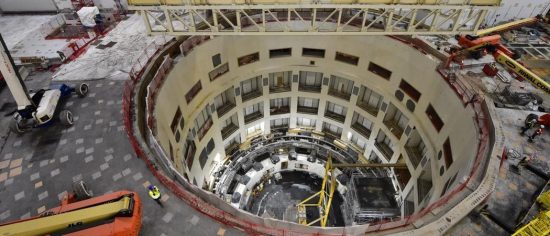
French nuclear regulator halts assembly of huge fusion reactor https://www.science.org/content/article/french-nuclear-regulator-halts-assembly-huge-fusion-reactor
ITER must satisfy safety concerns before welding reactor vessel. 24 FEB 2022, BY DANIEL CLERY France’s nuclear regulator has ordered ITER, an international fusion energy project, to hold off on assembling its gigantic reactor until officials address safety concerns.
This month, the ITER Organization was expecting to get the green light to begin to weld together the 11-meter-tall steel sections that make up the doughnut-shaped reactor, called a tokamak. But on 25 January, France’s Nuclear Safety Authority (ASN) sent a letter ordering a stoppage until ITER can address concerns about neutron radiation, slight distortions in the steel sections, and loads on the concrete slab holding up the reactor. ITER staff say they intend to satisfy ASN by April so they can begin to weld the reactor vessel by July. “We’re working very hard for that,” says ITER Director-General Bernard Bigot.
1 This Month

Website of the Week

New book – https://www.amazon.com/dp/1923372157?utm_source=substack&utm_medium=email
Now until to February 10, 2026 Radioactive waste storage in France: the debate is finally open! How to participate?
-
Archives
- January 2026 (74)
- December 2025 (358)
- November 2025 (359)
- October 2025 (377)
- September 2025 (258)
- August 2025 (319)
- July 2025 (230)
- June 2025 (348)
- May 2025 (261)
- April 2025 (305)
- March 2025 (319)
- February 2025 (234)
-
Categories
- 1
- 1 NUCLEAR ISSUES
- business and costs
- climate change
- culture and arts
- ENERGY
- environment
- health
- history
- indigenous issues
- Legal
- marketing of nuclear
- media
- opposition to nuclear
- PERSONAL STORIES
- politics
- politics international
- Religion and ethics
- safety
- secrets,lies and civil liberties
- spinbuster
- technology
- Uranium
- wastes
- weapons and war
- Women
- 2 WORLD
- ACTION
- AFRICA
- Atrocities
- AUSTRALIA
- Christina's notes
- Christina's themes
- culture and arts
- Events
- Fuk 2022
- Fuk 2023
- Fukushima 2017
- Fukushima 2018
- fukushima 2019
- Fukushima 2020
- Fukushima 2021
- general
- global warming
- Humour (God we need it)
- Nuclear
- RARE EARTHS
- Reference
- resources – print
- Resources -audiovicual
- Weekly Newsletter
- World
- World Nuclear
- YouTube
-
RSS
Entries RSS
Comments RSS
 nuclear-news