Costs of NuScam’s Small Modular Nuclear Reactors revised upwards – yet again!

According to industry reports the builders of the NuScale small modular reactor (SMR) project recently submitted revised cost estimates to their muni and co-op partners. Initial cost estimates were for power to be produced at about $58/MWh. This figure was recently revised upwards to roughly $90-$100/Mwh, a projected price increase of 60-70%.
The causes cited by management for these price increases were twofold: inflation (in material costs, i.e. steel) and higher interest rates. This initial NuScale project located at the federal government’s Idaho National Laboratories in Idaho Falls would consist of six 77 MW reactors with the units slated to enter commercial service in 2029-2030. These estimates of per KWH cost are significantly above those we have seen recently for renewables plus storage.
Oil Price 21st Nov 2022
Nuclear power no solution for Canada’s North West Territory
Nuclear power no solution for the N.W.T., some experts suggest, Liny Lamberink · CBC News · Nov 23, 2022
When it comes to reducing greenhouse gas emissions — nuclear power is a divisive option.
But for Canada’s North, two academics on different sides of the debate agree: small modular reactors, called SMRs, are not an economically feasible way of getting remote northern communities off of diesel-generated power.
Since 2017, the N.W.T. government has been part of a working group looking at the possibility of SMRs.
John Richards, a fellow at the C.D. Howe Institute, co-authored a paper published last week that said Canada needs to embrace small modular reactors in order to meet its greenhouse gas reduction goals.
In a transition to cleaner forms of energy, Richards says Canada can’t entirely rely on solar and wind power because it’s intermittent. He said nuclear power can be used in conjunction with those forms of renewable energy to provide a constant supply of energy — when there’s no wind or no sunlight.
But, he said, he sees it as an option in Saskatchewan or Manitoba — where there isn’t much more potential for hydro. In the small remote communities in the North, he said, small modular reactors would be too expensive.
Who will build them?
Small modular reactors are nuclear reactors that use fission to produce energy, similar to existing large reactors, but with smaller power capacity. They’re “modular” because they’re designed to be assembled in a factory, transported by flatbed trucks or trains, and installed where needed. The International Atomic Energy Agency defines reactors as “small” if their output is under 300 megawatts.
Small modular reactors are still in the prototype phase now. Even if they can be built small enough so as not to massively over-supply power in a small remote community, M.V. Ramana — a professor at the School of Public Policy and Global Affairs at the University of British Columbia and a critic of nuclear power — doubts a private sector manufacturer will do so.
Ramana said a manufacturer would want to be guaranteed there’s a market for the technology, and he thinks they’ll be too expensive for remote communities to buy them. According to Natural Resources Canada, a 20 megawatt SMR for the mining industry is expected to cost between $200 and $350 million.
Ramana co-authored a report that found all the remote communities and all the remote mines in Canada would not generate enough demand to serve as an incentive for a manufacturer to build an SMR factory.
The price of the technology would also drive up the cost of the power it generates.
“Our estimates showed that the price of electricity from a small modular reactor built in the remote parts of Canada could cost up to 10 times as much as the cost of electricity from diesel,” he said.
Too much power
During peak demand in the winter months, Yellowknife uses about 34 megawatts of power, according to the Northwest Territories Power Corporation. Elsewhere in the N.W.T., Inuvik’s peak demand is 5.5 megawatts, while in Jean Marie River, it’s just 0.5 megawatts.
In an emailed statement to CBC News in late October, Ben Israel, a senior co-ordinator with the N.W.T.’s infrastructure department, said the smallest available size of SMR might still be oversized for most of the territory’s remote communities.
Israel said the territory has been part of an SMR working group since 2017, and that it is also participating in an SMR feasibility study being carried out by the Yukon government.
“Any development of SMR technology in the N.W.T. would first require extensive demonstration of safety and cost-effectiveness in other jurisdictions — as well as education about the technology … before it would be considered as an option by the Government of the Northwest Territories.”
Kevin O’Reilly, the MLA for Frame Lake, said nuclear energy comes up every so often “as some kind of climate crisis saviour” — and he isn’t convinced yet that it would work.
“If we want to deal with the climate crisis, I think we need to be looking at some fundamental changes in the way we do things and the way we consume and extract energy.”……………………….. https://www.cbc.ca/news/canada/north/nuclear-power-smr-nwt-north-1.6659679—
Putin touts Russia’s ‘Arctic power’ with new nuclear icebreaker

President vows to develop his country’s nuclear fleet despite current difficulties in Russia’s economy and production.
Aljazeera, 22 Nov 22,
President Vladimir Putin on Tuesday touted Russia’s Arctic power at a flag-raising ceremony and dock launch for two nuclear-powered icebreakers that will ensure year-round navigation in the Western Arctic.
Presiding via video link from the Kremlin at the launch ceremony in St Petersburg in northern Russia, Putin said such icebreakers were of strategic importance for the country.
“Both icebreakers were laid down as part of a large serial project and are part of our large-scale, systematic work to re-equip and replenish the domestic icebreaker fleet, to strengthen Russia’s status as a great Arctic power,” Putin said.
The Arctic is taking on greater strategic significance due to climate change, as a shrinking ice cap opens up new sea lanes.
Vast oil and gas resources lie in Russia’s Arctic regions, including a liquefied natural gas plant on the Yamal Peninsula.
The Kremlin chief pledged to develop his country’s nuclear fleet despite current difficulties in Russia’s economy and production, in an apparent reference to Western sanctions over Moscow’s offensive in Ukraine……………………..
The 173.3-metre (569 feet) Yakutia, with a displacement of up to 33,540 tonnes, can smash through ice of up to three metres. It will enter service in 2024.
Two other icebreakers in the same series, the Arktika and the Sibir, are already in service, and another, the Chukotka, is scheduled for 2026.
Putin said a super-powerful nuclear 209-metre icebreaker known as “Rossiya”, with a displacement of up to 71,380 tonnes, would be completed by 2027. It will be able to break through ice four metres thick………………………………….. more https://www.aljazeera.com/news/2022/11/22/putin-touts-russias-arctic-power-with-new-nuclear-icebreaker
Philippines to be America’s nuclear guinea-pig for experimental small modular nuclear reactors?
Philippines’ Makabayan bloc files resolution seeking to probe US-Philippines nuclear energy deal By CNN Philippines Staff.Nov 23, 2022,
— The Makabayan bloc in the House of Representatives has filed a resolution seeking to investigate the nuclear energy cooperation deal announced by United States Vice President Kamala Harris, citing threats to the health and safety of Filipinos and the environment.

ACT Teachers party-list Rep. France Castro, Gabriela Women’s Party Rep. Arlene Brosas, and Kabataan party-list Rep. Raoul Danniel Manuel warned that Filipinos may be used as “guinea pigs” for testing nuclear equipment.
“Ang mahirap dito baka tayong mga mamamayang Pilipino ang ma-1-2-3 at maging mga guinea pig ng teknolohiyang ito na tine-testing pa lang ng US,” Castro said in a statement.
[Translation: The problem here is that Filipinos may be duped and served as guinea pigs for a technology still being tested by the US.]
According to the White House fact sheet released on Monday, the 123 Agreement, or the nuclear energy cooperation deal, will provide the legal basis for US exports of nuclear equipment and material to the Philippines.
The 123 Agreement also aims to support expanded partnerships on zero-emission energy and nonproliferation of nuclear weapons.
According to Philippine Ambassador to the US Jose Manuel Romualdez, the Marcos administration is considering bringing in US-developed small modular reactors to the country.
“As it is, modular or microreactor nuclear power plants are still at an experimental stage and are only legally being made in US bases. Early this year, the Pentagon’s Strategic Capabilities Office announced the construction and testing decision that followed the office’s Environmental Impact Statement work for Project Pele,” Castro said………….more https://www.cnnphilippines.com/news/2022/11/23/Makabayan-bloc-US-PH-nuclear-energy-deal-probe.html
Even with billions of dollars in tax credits, costs skyrocket at U.S. Small Modular Reactor Project
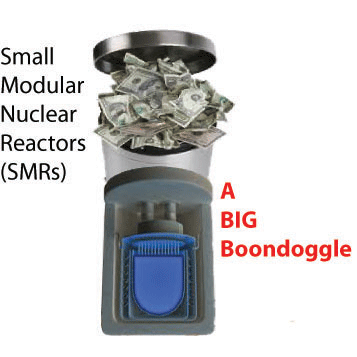
Costs Skyrocket at U.S. Small Modular Reactor Project https://www.theenergymix.com/2022/11/18/costs-skyrocket-at-u-s-small-modular-reactor-project/?fbclid=IwAR2o88KrFfN4Z5XD2pX8Kwpqk1eNAzrBmYFFcAySiVwckPjbA2aZ-311Je8 November 18, 2022
Higher steel costs and rising interest rates are taking the blame after a small modular nuclear reactor project in Utah reported a cost increase from US$58 to $90 or $100 per megawatt-hour for the electricity it’s meant to produce.
Utah Associated Municipal Power Systems is planning to bring the six NuScale reactors online in 2029 with combined output of 462 megawatts. But “the rise in prices likely means the UAMPS project will not hit certain engineering, procurement, and construction benchmarks, allowing participants to renegotiate the price they pay or abandon the project,” Utility Dive reports.
“It was like a punch in the gut when they told us,” said Scott Hughes, power manager for Hurricane City Power, one of the 27 municipal utilities that had signed on to buy power from UAMPS’ advanced nuclear Carbon Free Power Project (CFPP).
“The increased costs in the new Class 3 cost estimate currently being finalized for the CFPP have been shocking, even to NuScale and Fluor, the company responsible for overall management of the project,” the Institute for Energy Economics and Financial Analysis (IEEFA) writes, citing minutes of an October, 2022, Idaho Falls Power Board meeting.
Another municipal utility official called the increase a “big red flag in our face”.
The new cost projections factor in billions of dollars in tax credits the project would receive under the Biden administration’s Inflation Reduction Act, amounting to a 30% saving. IEEFA estimates the total subsidy at $1.4 billion.
Without the IRA, the cost per megawatt-hour would be closer to $120. Utility Dive and IEEFA both say any price above $58/MWh could allow the utilities to renegotiate their contracts or leave the project with no financial penalty.
“The next question is what are we going to do instead?” Hughes told Utility Dive. “Or what if the project fails, what are we gonna do? There’s not a lot of options.”
Then again, if other cities abandon the CFPP, it “might just fail anyway,” he added.
With seven years remaining before the project goes online, Hughes said material costs and interest rates could come back down. But the history doesn’t back that hope. “Nuclear industry experience over the past four decades points to the likelihood of future cost increases and schedule delays during all phases of the project—design, construction, licencing, and testing,” IEEFA says.
The institute cites the Vogtle nuclear project in Georgia, the only new reactors currently under construction in the U.S., where costs have increased 140% and work has fallen more than six years behind schedule since construction began in 2011.
UAMPS doesn’t plan to complete design work until 2024, and has eight years of design, licencing, construction, and pre-operational and start-up testing ahead. (IEEFA puts the project start date at 2030, not 2029.) But even at today’s revised pricing, “a target power price between $90 and $100 per MWh will make the CFPP even more uneconomic compared to renewable and battery storage resources costs that are expected to continue to decline over the next decade.”
In October, analysis by investment banking giant Crédit Suisse found that IRA funding combined with other available tax credits would bring solar project costs in as low as $4 per megawatt-hour, or less than half a penny per kilowatt-hour, falling to zero (literally) in the second half of the decade.
The fading promise of low-cost power from UAMPS’ Small Modular Reactors – Institute for Energy Economics and Financial Analysis
Small Modular Reactor Update: The Fading Promise of Low-Cost Power from
UAMPS’ SMR. The original target power price for a planned 12-module SMR by
UAMPS (Utah Associated Municipal Power Systems) and NuScale Power
Corporation was $55 per megawatt-hour (MWh).
When UAMPS reduced the size of the carbon-free power plant (CFPP) to six modules in the summer of 2021, it raised the target power price to $58 per MWh. Recent presentations to the
power boards of Washington City and Hurricane, two of the Utah communities
that have signed agreements to buy power from the CFPP, suggest that
project power prices are now likely to end up in the range of $90-$100 per
MWh.
The prices include an anticipated $1.4 billion subsidy from the U.S.
Department of Energy and a new subsidy from the Inflation Reduction Act
(IRA) on the order of $30 per MWh. The unsubsidized price of the power from
the CFPP would be substantially higher than $100 per MWh, perhaps even
double the current $58 target price.
IEEFA 17th Nov 2022
https://ieefa.org/resources/small-modular-reactor-update-fading-promise-low-cost-power-uamps-smr
Strange Rolls Royce plan for Large complex of Large Small Nuclear Reactors for Bradwell

Rolls Royce announced on 9 November that it is eying up Bradwell as a potential site for the deployment of four to six so-called (and currently non-existent) Small Nuclear Reactors (SMRs).
Professor Andy Blowers, the Chair of the Blackwater Against New Nuclear Group (BANNG), commented:
‘This proposal, if it ever came about, would place up to six nuclear reactors on the Bradwell site. And they are hardly ‘small’ since each reactor would be close to the size of the old Bradwell A station. Together
these reactors would comprise a nuclear complex larger than the massive, proposed Bradwell B currently under consideration for development by the Chinese company, CGN.
‘It is hard to state how utterly inappropriate such a development, which would include long-term storage of highly radioactive nuclear wastes, would be on the low- lying Bradwell site, threatened by the impacts of Climate Change and Sea Level Rise.
BANNG finds it extremely odd that Rolls Royce is proposing the Bradwell site for SMRs. Only two days
before the announcement BANNG, at a meeting of the Department of Business, Energy and Industrial Strategy (BEIS) NGO Nuclear Forum, asked if CGN had withdrawn from the Bradwell B project. BANNG was told that there was no change to the proposals for Bradwell B but that further discussion was not
possible because of ‘commercial confidentiality’.
The Bradwell site is owned by the French company, EDF, which is also a minor partner in the
Bradwell B project. Rolls Royce agree that its proposal ‘requires agreement with CGN and EDF energy’.
Perhaps the Rolls Royce announcementunravels the mystery as to why CGN has not quit its operations at Bradwell altogether, claiming they are paused indefinitely. Could this be paving the way for Rolls Royce and also explain why BEIS invoked commercial confidentiality?
Blackwater Against New Nuclear Group 17th Nov 2022
USA using COP27 to co-opt Europe , especially Ukraine, into the small nuclear reactor gamble

U.S. announces new European SMR initiatives at COP27 in Egypt
“……………………………….. On November 12, the U.S. announced two global Small Modular Reactor (SMR) initiatives: (1) a Ukraine clean fuels from SMRs pilot project and (2) a new initiative to accelerate the European transition of coal-fired plants to SMRs.
………. additional information on these two initiatives is still underway (the White House mentioned both initiatives in its Overview of COP27)
The U.S. Special Presidential Envoy for Climate, John Kerry, and Ukraine Minister of Energy German Galushchenko introduced a “Ukraine Clean Fuels from SMRs Pilot” project…………………………
- The pilot project, which will run for 2-3 years, also relies on the work of a public-private consortium on scientific and practical developments for SMRs.
- Participating partners from the U.S. include Argonne National Laboratory, Clark Seed, FuelCell Energy, NuScale and Starfire Energy. On the Ukraine side, participants include nuclear operator Energoatom, the National Security and Defense Council, and the State Scientific and Technical Center for Nuclear and Radiation Safety.
Special Envoy Kerry introduced another a new initiative, called Project Phoenix, to accelerate the European transition of coal-fired plants to SMRs,……………
According to the White House Fact Sheet Project Phoenix will provide direct U.S. support for the coal-to-SMR feasibility studies and related activities that support energy security goals for countries in Central and Eastern Europe.
Japan’s new nuclear energy policy- is it really feasible?
On August 24, 2022, at the newly established GX (Green Transformation)
Implementation Council chaired by Prime Minister Kishida Fumio, the
Japanese government announced a new nuclear energy policy.
The framework
for this new policy consists of three key points: maximize the use of
existing nuclear power plants through an accelerated restart and extension
of their operation period; develop and build advanced next-generation
reactors; and develop conditions suitable for the use of nuclear energy,
including back-end support.
The most contentious of these is the second
point: the development and construction of advanced next-generation
reactors. Since the Fukushima nuclear disaster, previous Japanese
government policy has made no mention of building new power plants, so it
is being seen as a major policy change. What explains this policy change,
and is it really feasible?
The Diplomat 14th Nov 2022
https://thediplomat.com/2022/11/japans-changing-nuclear-energy-policy/
Nuclear fusion discovery uncovers strange behaviour of limitless energy source
Despite promises of imminent breakthroughs in nuclear fusion power going
back decades, the ultimate clean energy source remains out of scientists’
reach. Nuclear fusion discovery uncovers strange behaviour of limitless
energy source. Even as scientists achieve new milestones in developing
fusion power, new questions arise as to how the basic physics of fusion
reactions may work.
Independent 15th Nov 2022
So-Called Next-Generation Nuclear Power Plants Are Being Oversold

One contender, for example, TerraPower’s 345-megawatt Natrium reactor, received considerable media attention earlier this year when company founder Bill Gates touted it during interviews about his new book, How to Avoid a Climate Disaster. According to the UCS report, however, sodium-cooled fast reactors such as Natrium would likely be less uranium-efficient and would not reduce the amount of waste that requires long-term isolation. They could also experience safety problems that are not an issue for light-water reactors. Sodium coolant, for instance, can burn when exposed to air or water, and the Natrium’s design could experience uncontrollable power increases that result in rapid core melting.

There’s little evidence that they’d be cheaper or safer than existing designs
https://www.scientificamerican.com/article/lsquo-advanced-rsquo-nuclear-reactors-don-rsquo-t-hold-your-breath/— By Elliott Negin, Elliott Negin is a senior writer at the Union of Concerned Scientists. July 21
The U.S. nuclear power industry is at an impasse. Since 2012, 11 of the 104 light-water reactors in operation at the time have closed, mainly as a result of aging infrastructure and the inability to compete with natural gas, wind and solar, which are now the cheapest sources of electricity in the U.S. and most other countries worldwide.
One way the industry is trying to reverse the trend is by looking to what it likes to call “advanced” reactors. Despite the name, these designs are largely based on unproven concepts from more than 50 years ago. Unlike conventional light-water reactors, these rely on sodium or molten salt or gas for cooling, and their proponents claim they will be less expensive, safer and more secure than their predecessors. Some claim that these innovative devices will be ready for prime time by the end of this decade.
The U.S. nuclear power industry is at an impasse. Since 2012, 11 of the 104 light-water reactors in operation at the time have closed, mainly as a result of aging infrastructure and the inability to compete with natural gas, wind and solar, which are now the cheapest sources of electricity in the U.S. and most other countries worldwide.
One way the industry is trying to reverse the trend is by looking to what it likes to call “advanced” reactors. Despite the name, these designs are largely based on unproven concepts from more than 50 years ago. Unlike conventional light-water reactors, these rely on sodium or molten salt or gas for cooling, and their proponents claim they will be less expensive, safer and more secure than their predecessors. Some claim that these innovative devices will be ready for prime time by the end of this decade.
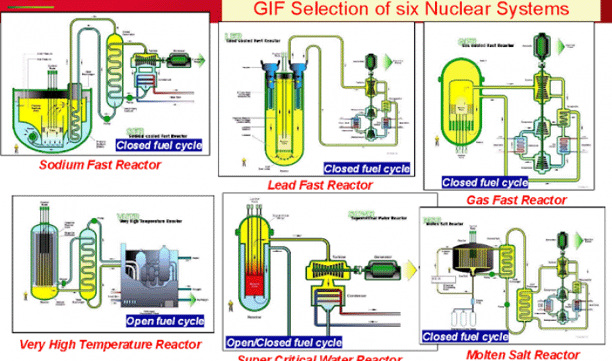
This has naturally attracted the attention of Biden administration officials and some key members of Congress, who are looking for ways to curb carbon emissions. But an analysis of non-light-water reactor concepts in development by the Union of Concerned Scientists (UCS) has found that these designs are no better—and in some respects significantly worse—than the light-water reactors in operation today. The report’s author, UCS physicist Edwin Lyman, took a close look at the claims developers have been making: that these new devices will burn uranium fuel more efficiently and produce less radioactive waste than existing plants; will reduce the risk of nuclear proliferation; and will be commercialized relatively soon. Those claims, however, do not hold up to scrutiny.
One contender, for example, TerraPower’s 345-megawatt Natrium reactor, received considerable media attention earlier this year when company founder Bill Gates touted it during interviews about his new book, How to Avoid a Climate Disaster. According to the UCS report, however, sodium-cooled fast reactors such as Natrium would likely be less uranium-efficient and would not reduce the amount of waste that requires long-term isolation. They could also experience safety problems that are not an issue for light-water reactors. Sodium coolant, for instance, can burn when exposed to air or water, and the Natrium’s design could experience uncontrollable power increases that result in rapid core melting.
In June, TerraPower announced that it would build the first Natrium reactor in Wyoming as part of a 50–50 cost-share program with the Department of Energy. The DOE program originally required the company to have the reactor, still in its early design stage, up and running by 2027. That was recently pushed back a year, but it is still a completely unrealistic timetable. According to the UCS report, if federal regulators require the necessary safety demonstrations, it could take at least 20 years—and billions of dollars in additional costs—to commercialize such reactors, their associated fuel-cycle facilities, and other related infrastructure.
The Nuclear Regulatory Commission (NRC) may have to adapt some regulations when licensing reactor technologies that differ significantly in design from the current fleet. Lyman says that should not mean weakening public health and safety standards, finding no justification for the claim that “advanced” reactors will be so much safer and more secure that the NRC can exempt them from fundamental safeguards. On the contrary, because there are so many open questions about these reactors, he says they may need to meet even more stringent requirements.
Lyman’s report recommends that the DOE suspend its advanced reactor demonstration program until the NRC determines whether it will require full-scale prototype tests before any designs are licensed for commercial deployment, which the report argues are essential. It also calls on Congress to require the NRC to convene an independent commission to review the technical merits of non-light-water reactors and approve only those projects that have a high likelihood of commercialization and are clearly safer and more secure than the current fleet.
Finally, it recommends that the NRC and Congress consider spending more research and development dollars on improving the safety and security of light-water reactors rather than on commercializing immature, overhyped non-light-water reactor designs. Any federal appropriations for R&D and deployment of these reactor designs, Lyman says, should be guided by a realistic assessment of the likely benefits and not based on wishful thinking.
Why molten salt nuclear reactors really can’t succeed
Beyond Nuclear By M.V. Ramana and Cassandra Jeffery 14 Nov 22

………………………………………………………….Technical Problems
Let us start with the problems with the molten chloride fast reactor. As its name suggests, the reactor uses nuclear materials dissolved in molten chemical salts.
Salt is corrosive — just ask anyone who lives on the coast. So the inside of the reactor will be a chemically corrosive and highly radioactive environment.
No material can perform satisfactorily in such an environment. After reviewing the available studies, all that the U.S. Idaho National Laboratory — a nuclear power booster — could recommend was that “a systematic development program be initiated.”
TerraPower has three different nuclear reactor designs on the books: the Natrium reactor; the molten chloride fast reactor; and the traveling wave reactor.
Given his emphasis on novelty and innovation, one would expect Gates to put his money on reactor designs that are new and likely to succeed. None of these designs have that merit. All of these reactors are based on two old reactor designs vexed with major problems.
Other leading research laboratories like France’s Institut de radioprotection et de sûreté nucléaire (IRSN) and the U.K.’s Nuclear Innovation and Research Office, have concluded that molten salt reactors are problematic. As IRSN put it, “numerous technological challenges remain to be overcome before the construction of an MSR can be considered.”
The historical experience with molten salt reactors has been pretty bleak, to put it mildly. The last one to be built was the Molten Salt Reactor Experiment in Oakridge, Tennessee. It operated intermittently from 1965 to 1969, and operations were interrupted 225 times in those four years; of these interruptions, only 58 were planned.
But it’s not just a matter of molten salt reactors being unreliable or technologically challenged. As Edwin Lyman from the Union of Concerned Scientists has documented at length, the “use of liquid fuel instead of a solid fuel” in molten salt reactors “has significant safety implications for both normal operation and accidents.”
Specifically, the molten nature of the fuel makes it easier for radioactive materials to escape into the atmosphere and be dispersed.
Terrapower’s other two reactor designs are not much better. Both the Travelling Wave Reactor and the Natrium use molten sodium. Another problematic material, molten sodium is used to transport the intense heat produced by the nuclear fission reactions. Again, such reactors have been constructed since the dawn of the nuclear age and with similarly dismal results.
To start with, such reactors have had numerous accidents. The record starts on November 29, 1955 when the Experimental Breeder Reactor (EBR-1) in Idaho had a partial core meltdown.
A decade later, in October 1966, the Fermi-1 demonstration fast reactor in Michigan suffered a partial core meltdown. The shock made its way into the cultural mainstream in the form of a book called We Almost Lost Detroit and a song with the same name by Gil Scott Heron.
In Japan, the Monju reactor suffered a series of accidents and produced almost no electricity, after an expenditure of at least $8.5 billion
The use of molten sodium makes such reactors susceptible to serious fires, because the material burns if exposed to air. Almost all sodium-cooled reactors constructed around the world have experienced sodium leaks, likely because of chemical interactions between sodium and the stainless steel used in various components of the reactor.
Finally, the use of sodium also makes it difficult to maintain and carry out repairs on fast reactors, which then become susceptible to long shutdowns. Having to deal with all these volatile properties and safety concerns naturally drives up the construction costs of fast reactors, rendering them substantially more expensive than common thermal reactors.
Sodium-cooled reactors are also unreliable, operating at dismally low rates compared to standard reactors. The load factor (the ratio of the amount of electrical energy a power plant has produced to the amount of energy it would have produced had it operated at full capacity) for the Prototype Fast Reactor in the United Kingdom was 27%; France’s Superphenix reactor managed a mere 7.9%.
The typical U.S. reactor operates with a load factor of more than 90%. Sodium- cooled reactors would have to sell their power at higher prices to compensate for the fewer units of electrical energy generated.
“Without innovation, we will not solve climate change,” chanted Gates. But no amount of innovation will change the laws of chemistry or physics. How sodium behaves when it interacts with air or water won’t be affected, even if the sodium is inside a nuclear reactor backed by one of America’s oligarchs.
Innovation will not change the fact that the radioactive wastes produced by the Natrium reactor will remain hazardous for tens of thousands of years……………………………………………….. more https://beyondnuclearinternational.org/2022/11/13/bill-gates-and-techno-fix-delusions/
Surprise surprise. USA co-opts Ukraine to try out small nuclear reactors

US, Ukraine announce project on construction of small modular nuclear reactor,
New initiative aims to accelerate conversion of coal-fired power plants in central, eastern Europe: US State Department AA, Burc Eruygur |13.11.2022
The US and Ukraine have announced the launch of a project on the construction of a small modular nuclear reactor (SMR) in Ukraine during the 27th UN Climate Change Conference (COP27) in Egypt, according to the US State Department.
“Special Presidential Envoy for Climate John Kerry and Ukraine Minister of Energy Herman Halushchenko announced a Ukraine Clean Fuels from SMRs pilot project that will demonstrate the production of clean hydrogen and ammonia using secure and safe SMRs and cutting-edge electrolysis technologies in Ukraine,” read a statement by the US State Department on Saturday………………………
In addition to Argonne National Laboratory and Ukraine’s Energoatom, National Security and Defense Council, and State Scientific and Technical Center for Nuclear and Radiation Safety, the statement expresses that multiple private companies will also take part in the project’s multinational consortium.
Kerry separately announced the launch of a new initiative, called Project Phoenix, “to accelerate the transition in Europe of coal-fired plants to SMRs while retaining local jobs through workforce retraining,” it also said.
“Project Phoenix will provide direct US support for coal-to-SMR feasibility studies and related activities in support of energy security goals for countries in central and eastern Europe,” according to the statement.
On Sunday, Ukraine’s Ambassador to the US Oksana Markarova also confirmed the project, reiterating the information released by the US State Department.
“Ukraine is not only working to protect and quickly repair/replace what was destroyed but is already planning to build an innovative energy system,” Markarova said on Facebook. https://www.aa.com.tr/en/russia-ukraine-war/us-ukraine-announce-project-on-construction-of-small-modular-nuclear-reactor/27
Ever the optimists… Rolls-Royce chooses four sites for reactor that’s yet to be built

https://www.nuclearpolicy.info/news/ever-the-optimistsrolls-royce-chooses-four-sites-for-reactor-thats-yet-to-be-built/ 9 Nov 22, Rolls Royce SMR, the company behind the development of so-called Small Modular Reactors, has today announced its ambitious plans to deploy new reactors at four sites in England and North Wales by the early 2030’s, but there is a fly in the ointment – it is a reactor that has yet to be built.
Rolls-Royce has been visiting sites in recent months and number-crunching existing data to identify their preferred locations for any future SMRs, and Wylfa and Trawsfynydd in North Wales; Sellafield in West Cumbria; and Oldbury in Gloucestershire have been selected based on ‘existing geotechnical data, adequate grid connection and because each site is large enough to deploy multiple SMRs’.
But the announcement leapfrogs several crucial challenges Roll-Royce will first need to overcome before their SMR vision becomes reality.
Councillor David Blackburn, Chair of the UK/Ireland Nuclear Free Local Authorities, explained: “Rolls-Royce may sound optimistic, but the history of British civil nuclear power is littered with projects delivered late, over budget, whilst compromising safety, or with sub-standard power output. And the SMR concept has its own set of problems.
“For one the design has not even received regulatory approval from the Office of Nuclear Regulation, and it may not, and this is a process expected to take until at least mid-2024.
“It is also conceived to be prefabricated and assembled on site, but factories still have to be built to fabricate the parts; the process of fabrication has to be mastered; all the necessary approvals and permits will have to secured to build on each site, possibly in the teeth of significant public opposition; and the assembly of pre-fabricated reactors on site is still not a perfected art – just think of the challenge of building an IKEA furniture set and multiply that a million fold.”

The NFLA also has real concerns about the radioactive waste future SMRs will bring, with a recent study by the University of Stanford and British Columbia identifying that fission in these smaller reactor types could produce between two and thirty times as much radioactive waste as that produced by a ‘conventional’ larger reactor per unit of electricity generated.[1]
Added Councillor Blackburn: “That is an awful lot of radioactive waste to add to the stockpile Britain has already accumulated from almost seventy years of civil nuclear power generation; toxic waste that must be managed safely at vast public expense and for which a long-term totally safe storage solution has yet to be found. Do we really want to produce more when we can generate our electricity safely and more cheaply using renewables?”
1 This Month
To see nuclear-related stories in greater depth and intensity – go to https://nuclearinformation.wordpress.com/

29 Jan. Thursday 7-8 p.m. Webinar – World’s Largest Nuclear Station in Port Hope, ON?


31st January – Challenging the War Machine – a DECLASSIFIED UK SUMMIT


Website of the Week
Now until to February 10, 2026 Radioactive waste storage in France: the debate is finally open! How to participate?
-
Archives
- January 2026 (271)
- December 2025 (358)
- November 2025 (359)
- October 2025 (376)
- September 2025 (258)
- August 2025 (319)
- July 2025 (230)
- June 2025 (348)
- May 2025 (261)
- April 2025 (305)
- March 2025 (319)
- February 2025 (234)
-
Categories
- 1
- 1 NUCLEAR ISSUES
- business and costs
- climate change
- culture and arts
- ENERGY
- environment
- health
- history
- indigenous issues
- Legal
- marketing of nuclear
- media
- opposition to nuclear
- PERSONAL STORIES
- politics
- politics international
- Religion and ethics
- safety
- secrets,lies and civil liberties
- spinbuster
- technology
- Uranium
- wastes
- weapons and war
- Women
- 2 WORLD
- ACTION
- AFRICA
- Atrocities
- AUSTRALIA
- Christina's notes
- Christina's themes
- culture and arts
- Events
- Fuk 2022
- Fuk 2023
- Fukushima 2017
- Fukushima 2018
- fukushima 2019
- Fukushima 2020
- Fukushima 2021
- general
- global warming
- Humour (God we need it)
- Nuclear
- RARE EARTHS
- Reference
- resources – print
- Resources -audiovicual
- Weekly Newsletter
- World
- World Nuclear
- YouTube
-
RSS
Entries RSS
Comments RSS
 nuclear-news