$Billions of tax-payer money to go to kickstarting the “new nuclear reactor” industry’s “inflection point”

“It’s a really great investor environment — both publicly and privately,”
said Ryan Norman, analyst
at energy think-tank Third Way
US nuclear enjoys revival as public and private funding pours in. The US
nuclear industry has hailed 2022 as an “inflection point”, with surging
private investment and unprecedented government support breathing new life
into a sector that fell from favour in recent decades.
New federal legislation enacted in the past 18 months will pump about $40bn into the
sector over the coming decade, according to industry estimates, while
roughly $5bn in private funds has flowed into companies designing new types
of reactor in the past year alone.
“It’s a really great investor environment — both publicly and privately,” said Ryan Norman, analyst
at energy think-tank Third Way. “There’s federal recognition that nuclear
energy technologies have a key role to play in the US energy future,” he
said. “No matter how you cut it, we’re talking about billions of dollars
being poured into these advanced reactor companies.”
FT 1st Jan 2023
https://www.ft.com/content/f3c6f333-bc2e-4694-963a-7084e438905a
Japan’s Rokkasho nuclear reprocessing project delayed again – for the 26th time
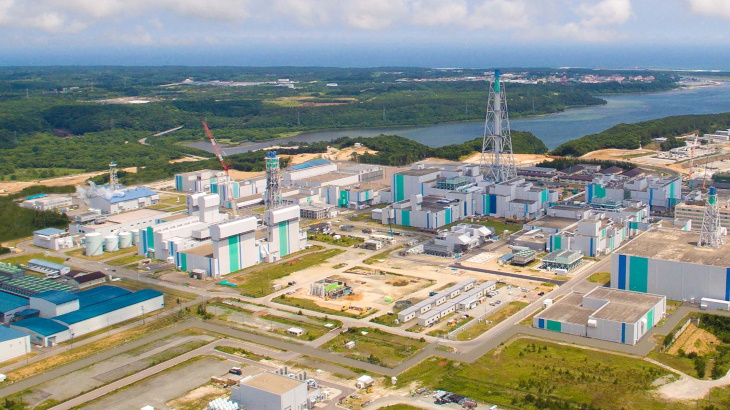
The completion of a nuclear fuel reprocessing plant in Aomori Prefecture
will be delayed by two years, the 26th postponement since the project
started three decades ago.
Senior officials with Japan Nuclear Fuel Ltd.,
operator of the facility under construction, said the new completion date
will be in the first half of fiscal 2024. The officials visited the Aomori
prefectural government and the village hall of Rokkasho, the site of the
plant, on Dec. 26 to explain the situation.
An earlier completion timeframe
was listed as in the first half of fiscal 2022. But the company in
September postponed this deadline without giving a new date. It said
prolonged safety checks of the facility by the Nuclear Regulation Authority
made it difficult to do so and pledged to announce the new deadline by the
year-end.
According to Japan Nuclear Fuel’s latest estimate, the NRA’s
screening of the detailed design of the plant will take about a year, while
checks of the plant will take four to seven months after it clears the
safety standards. The company said it will work hard to move up the
completion to an early date of the first half of fiscal 2024.
Asahi Shimbun 27th Dec 2022
Small modular reactors will not save the day. The US can get to 100% clean power without new nuclear

We can create a renewable electricity system that is much more resilient to weather extremes and more reliable than what we have today.
https://www.utilitydive.com/news/small-modular-reactor-smr-wind-solar-battery-100-percent-clean-power-electricity/637372/ Nov. 28, 2022, By Arjun Makhijani
There is a widespread view that nuclear energy is necessary for decarbonizing the electricity sector in the United States. It is expressed not only by the nuclear industry, but also by scholars and policy-makers like former Energy Secretary Steven Chu, a Nobel Prize-winning physicist who recently said that the choices we have “…when the wind doesn’t blow and the sun doesn’t shine” are “fossil fuel or nuclear.” I disagree.
Wind and solar are much cheaper than new nuclear plants even when storage is added. The National Renewable Energy Laboratory estimated the cost of unsubsidized utility-scale solar plus battery storage in 2021 was $77 per megawatt-hour — about half the cost of new nuclear as estimated by the Wall Street firm Lazard. (An average New York State household uses a megawatt-hour in about seven weeks.)
Time is the scarcest resource of all for addressing the climate crisis. Nuclear has failed spectacularly on this count as well. Of the 34 new reactor projects announced for the “nuclear renaissance,” only two reactors being built in Georgia are set to come online — years late at more than double the initial cost estimate, a success rate of 6%. Even including the old Watts Bar 2 reactor (start of construction: 1973), which was completed in 2016 (well over budget), raises the success rate to just 9% — still much worse than the mediocre 50-50 record of the first round of nuclear construction in the U.S., when about half of the proposed reactors were ultimately built. The nuclear industry is marching fast — in the wrong direction.
The much-ballyhooed Small Modular Reactors are not going to save the day. NuScale, the most advanced in terms of certification, had announced in 2008 that its first reactor would be on line in 2015-2016; now the date is 2028 and costs have risen. In the same period, wind and solar generation have cumulatively generated electricity equal to more than the amount 300 NuScale SMRs would produce in 15 years. Nuclear is dismally slow, unequal to the climate challenge.
Simply saying that nuclear is “baseload power” is to recite an obsolete mantra. As David Olsen, a member of the Board of Governors of the California Independent System Operator, which runs that state’s electricity grid, has said: “‘Baseload’ refers to an old paradigm that has to go away.”
It is generally agreed that solar, wind and battery storage cannot address the entire decarbonization problem. They can do the job economically and reliably about 95% of the time. Much of the gap would be on winter nights with low wind when most buildings have electrified their heating and electric cars are plugged in. That’s where working with the rhythms of nature comes in.
Spring and autumn will be times of plentiful surplus wind and solar; that essentially free electricity could be used to make hydrogen to power light-duty fuel cells (such as those used in cars) to generate electricity on those cold winter nights. Surplus electricity can also be stored in the ground as cold or heat — artificial geothermal energy — for use during peak summer and winter hours.
Then there is V2G: vehicle-to-grid technology. When Hurricane Ian caused a blackout for millions in Florida, a Ford F-150 Lightning in “vehicle-to-home” mode saved the day for some. Plugged-in cars could have a dual purpose — as a load on the grid, or, for owners who sign up to profit, a supply resource for the grid, even as the charge for the commute next day is safeguarded.
We are also entering an era of smart appliances that can “talk” to the grid; it’s called “demand response.” The Federal Energy Regulatory Commission recognizes it as a resource equivalent to generation when many devices like cars or air conditioners are aggregated. People would get paid to sign up, and on those rare occasions when their heaters are lowered a degree or their clothes washing is postponed by a few hours, they would be paid again. No one would have to sign up; but signing up would make electricity cheaper. We know from experience there will be plenty of takers if the price is right.
All that is more than enough to take care of the 5% gap. No uranium mining, no nuclear waste, no plutonium produced just to keep the lights on.
We can create a renewable electricity system that is much more resilient to weather extremes and more reliable than what we have today. The thinking needs to change, as the Drake Landing Solar Community in Alberta, Canada, where it gets to negative 40 degrees Celsius in the winter, has shown. It provides over 90% of its heating by storing solar energy in the ground before the winter comes. Better than waiting for the nuclear Godot.
Military satellites add to Earth’s orbit, which is already crowded with satellites

Earth’s Orbit Is About to Get More Crowded. Undark, BY SARAH SCOLES, 12.26.2022
The military is launching a fleet of small, interconnected satellites to collect data, track missiles, and aim weapons.
SOMETIME THIS COMING March, a network of 10 small satellites winged with solar panels is scheduled to launch into Earth’s low orbit. Though likely invisible to the naked eye, the satellites will be part of a future herd of hundreds that, according to the Space Development Agency, or SDA, will bolster the United States’ defense capabilities.
The SDA, formed in 2019, is an organization under the United States Space Force, the newly formed military branch that operates and protects American assets in space. And like all good startups, the agency is positioned as a disruptor. It aims to change the way the military acquires and runs its space infrastructure. For instance, the forthcoming satellite network, called the National Defense Space Architecture, will collectively gather and beam information, track missiles, and help aim weapons, among other tasks.
The SDA’s vision both mimics and relies on shifts that started years ago in the commercial sector: groupings of cheap little satellites — often weighing hundreds of pounds, instead of thousands — that together accomplish what fewer big, expensive satellites used to.
Such sets of small satellites are called constellations, and those in low Earth orbit, which circle 1,200 miles or lower above Earth, can send data back and forth quickly. They rely on relatively inexpensive spacecraft that can be replaced and updated regularly. And they are hard to knock out, just like it’s more difficult to shoot down a flock of doves than a large turkey (or sitting duck).
The National Defense Space Architecture’s first spacecraft will launch from Vandenberg Space Force Base, part of the so-called Tranche 0, which will eventually total 28 interlinked satellites. “This tranche is incredibly important as sort of the trailblazer,” said Mike Eppolito, its program director. The launch was originally scheduled for September 2022, then delayed to December because of supply-chain issues, and delayed again until March to fix glitchy power supplies on eight of the satellites.
Now that the military has begun blazing this trail, it will also face the same challenges the commercial sector has recently had to reckon with: crowded orbits, potential collisions, and a sky filled with synthetic electromagnetic signals. Military and intelligence satellites haven’t proliferated at nearly the level of, say, those owned by SpaceX, and astronomers haven’t been paying as much attention to them. But an increased reliance on constellations will result in orbital emissions that can interfere with scientific research, and create an increased potential for collisions.
……………………………………………… Though the Department of Defense had long been interested in the idea of small satellite constellations, it was only when these companies started to link lots of them together — to do the same kinds of jobs that the military had been doing — like taking snapshots of Earth, or providing data connectivity — that the military began to seriously pursue them.
………….. The SDA’s founding vision remains essentially the same. As such, its architecture will consist of multiple layers of satellites, with spacecraft someday in the hundreds. These layers will transport data to share information from different sensors; track missiles; provide an alternative to GPS; and tell weapons where to aim. They will also incorporate data from commercial satellites, said Tournear. The spacecraft being less expensive and more replaceable, the SDA can upgrade them regularly, whereas the older satellites have to wait a decade or more for replacement.
The military can now simply buy that up-to-date technology from companies like Lockheed Martin and York Space Systems……………….
EANWHILE, space-traffic managers and astronomers, already coping with the proliferation of commercial constellations, are figuring out how best to navigate the more-crowded future.
For one thing, the sunlight that reflects off satellites’ surfaces, and the radio waves that satellites often use to transmit data, can show up in telescopes’ sensors back on Earth, marring the signals coming from stars, galaxies, and gases.
According to Jonathan McDowell of the Harvard-Smithsonian Center for Astrophysics, radio and optical astronomers began voicing concerns as far back as the 1980s, but it was only when SpaceX began launching its Starlink satellites that the issue went from annoying to problematic. Since then, astronomers like Meredith Rawls — a research scientist at the University of Washington and a member of a new international group called the Center for the Protection of the Dark and Quiet Sky from Satellite Constellation Interference — have been working to mitigate constellations’ negative effects on science and the sky’s purity. Yet the group doesn’t comment on military satellites and focuses on commercial constellations. Defense spacecraft, Rawls said, are “a total blindspot” for her.
“It’s taken 40 years to come to the point where it is a real problem,” said McDowell, who publishes an approximately monthly report of all space launches. Constellations, he noted, can become “a serious problem when you’re talking about not hundreds or even thousands of satellites, but tens of thousands.”
……………… he and others do worry about potential collisions of satellites and space debris with the addition of military constellations. “Even a relatively small number of satellites whose orbits are secret, it’s problematic,” said McDowell, because managing space traffic requires knowing where it actually is.
Leolabs will keep track of the SDA’s objects, but the more satellites are in orbit, the more likely they are to crash — into each other or into the many pieces of litter already up there. “We can help you almost guarantee that you won’t get hit by a piece of trackable debris,” said McKnight of Leolabs. “Unfortunately, there are hundreds of thousands of objects that are too small for us or anybody to see. They can still kill you.”
That means it’s important for the SDA to build spacecraft that can recover from small smashups (and to have a plan for bringing down spacecraft that don’t survive, so they don’t create more debris). “I know that SDA understands how to do that,” said McKnight.
But they also have to contend as well with large pieces of existing space trash — spent rocket bodies the size of school buses, left over from American and Russian launches during the Cold War. “These clusters of massive derelict objects have a much greater debris-generating potential than any of these constellations do,” said McKnight. The constellations’ members, after all, can generally thrust away from danger. “These are small, very agile, very aware, and highly controlled and responsible satellites,” he continued.
But any crash creates tons of fragments (metal shards, bolts, paint chips, solar-panel shivs) that whiz around space, making other crashes even more likely, and creating tons more fragments. If two old rocket bodies hit each other, for example, a huge cloud of debris could come barreling at SDA satellites just as easily as they could Starlink’s. “They could affect these constellations drastically,” said McKnight.
……………………. Even if the military’s satellites don’t present problems on the level of commercial ones, the Department of Defense at the same time supports private proliferation. “It may not be a question of ‘Oh, the military are going to have massive constellations,’ but ‘the military are going to be customers of all of these massive constellations,’” said McDowell. The Air Force, for instance, just gave SpaceX a $1.9 million contract to test out one year of Starlink connectivity in Europe and Africa. And in early December, SpaceX announced a new business arm called Starshield, which will focus on providing satellite-constellation capabilities — like communications and Earth observation — to the government, for national security missions………………….
Civil society groups urge feds to ban reprocessing used nuclear fuel.

Natasha Bulowski / Local Journalism Initiative / Canada’s National Observer, 30 Dec 22,
Canada’s forthcoming radioactive waste policy should include a ban on plutonium reprocessing, a national alliance of civil society organizations says.
Plutonium — a radioactive, silvery metal used in nuclear weapons and power plants — can be separated from spent nuclear reactor fuel through a process known as “reprocessing” and reused to produce weapons or generate energy.
The federal government is expected to release its policy for managing radioactive waste early next year. On Dec. 15, a handful of organizations urged Ottawa to include a ban on plutonium reprocessing because of its links to nuclear weapons proliferation and environmental contamination.
The World Nuclear Association says reprocessing used fuel to recover uranium and plutonium “avoids the wastage of a valuable resource.”
Ottawa has yet to take a definitive stance on the process. A draft policy released last February said: “Deployment of reprocessing technology … is subject to policy approval by the Government of Canada.”
But in 2021, a New Brunswick company, Moltex Energy, received $50.5 million from the federal coffers to help design and commercialize a molten salt reactor and spent fuel reprocessing facility. Commercial plutonium reprocessing has never been carried out in Canada, and we should not start now, according to Nuclear Waste Watch, a national network of Canadian organizations concerned about high-level radioactive waste and nuclear power. The group is among those pushing for a plutonium reprocessing ban.
More than 7,000 Canadians submitted letters including a demand to ban plutonium reprocessing throughout the consultation process, according to a Nuclear Waste Watch news release.
The group points to a 2016 report by Canadian Nuclear Laboratories stating reprocessing would “increase proliferation risk.”
“There is no legitimate reason to support technologies that create the potential for new countries to separate plutonium and develop nuclear weapons,” Susan O’Donnell, spokesperson for the Coalition for Responsible Energy Development in New Brunswick, said in Nuclear Waste Watch’s news release. “The government should stop supporting this dangerous technology.”
China, India, Japan, Russia, the United Kingdom and some European countries, like France, reprocess their spent nuclear fuel.
Canada’s forthcoming radioactive waste policy should include a ban on plutonium reprocessing, a national alliance of civil society organizations says. Plutonium separated from used nuclear fuel can be reused in power generation or nuclear weapons
Calling nuclear fusion a potential ‘climate solution’ may undermine actual solutions
The latest fusion breakthrough is scientifically important, but the technology’s timeline just doesn’t match up with the urgency of climate change.
Grid Dave Levitan 28 Dec 22 Climate Reporter
When scientists at Lawrence Livermore National Laboratory announced a “breakthrough” in nuclear fusion research this month, many eyes quickly turned to climate change. Stories from the BBC, CNN and other major outlets mentioned the potential for “limitless” clean energy and discussed fusion’s place as a global warming fix within their opening paragraphs. Even Secretary of Energy Jennifer Granholm, in announcing the new result, touted its potential to provide “clean power to combat climate change.”
From a purely theoretical standpoint, this makes some sense. Fusion power, in an idealized, storybook form, turns the world’s energy system on its head, offering an emissions-free way to keep the lights on. And the latest advance sounds truly impressive: Using enormously powerful lasers, scientists at Livermore’s National Ignition Facility (NIF) managed to create a split-second fusion reaction — mimicking that which takes place on a massive scale inside the sun — that produced more energy than it consumed.
But the world doesn’t live in that storybook. On a practical, near-term level, nuclear fusion and climate change have almost nothing to do with each other. One remains in more-or-less scientific infancy, many years away from even a hint of usable form; the other gets more urgent by the day, requires immediate intervention and has some readily available tech being deployed as we speak.
“A lot of people are desperate for some sort of silver bullet climate solution that will help to bypass the hard work of actually getting political agreements and policymaking and sacrifice to eliminate fossil fuels,” said Edwin Lyman, a physicist and director of nuclear power safety for the Union of Concerned Scientists. “It would just be easier if there were this panacea out there that would transform everything, but of course that’s totally unrealistic.”
Celebrating scientific advances is important. But linking that science with an urgent global need that it cannot on relevant time scales address may offer false hope and potentially undermine the more banal climate progress — dramatic renewable energy expansion, efficiency improvements, vehicle electrification and so on — that is possible today.
Ignition achieved
The old joke about nuclear fusion is that it is always 20 — or 30 or 50 — years away. Taking hydrogen atoms and fusing them into helium, in the process releasing energy that theoretically can be used to power the electric grid, is so technically challenging that despite well over a half-century of advances, the joke still more or less holds true…………………. more https://www.grid.news/story/climate/2022/12/26/calling-nuclear-fusion-a-potential-climate-solution-may-undermine-actual-solutions/
NuScam’s small nuclear reactors have both regulatory and financial woes.

How did the US nuclear industry fare in 2022? Canary Media 28 December 2022 Eric Wesoff
“……………………………………………………………………….. NuScale’s NRC blues, NuScale Power has led the charge on small nuclear reactors for more than a decade but is still struggling with the NRC, as well as facing rising costs on a crucial first-of-a-kind 462-megawatt project in Idaho.
The proposed project from NuScale and Utah Associated Municipal Power Systems, a group of 50 municipal utilities spanning seven Western states, was initially slated to begin operation of the first of six small modular reactors in 2029. But according to December reporting in E&E News, “NuScale’s first reactor now faces sharply higher construction cost estimates, due to inflation and higher interest rates. If projected costs rise above $58 per megawatt-hour, it would trigger an up-or-down vote as early as next month from the project’s anchor customers.” E&E also reported that the costs of construction materials such as steel plate and carbon steel piping have skyrocketed since the project was approved in 2020.
In addition to cost issues, NuScale has run into a regulatory snag. The company replaced its NRC-approved 50-megawatt design and now needs to gain regulatory approval for the 77-megawatt module it plans to use in the UAMPS project. Utility Dive reported in November that the NRC has concerns about the new design, writing in a letter to NuScale that the company’s proposed module raised “several challenging and/or significant issues” with its draft application.
Small module reactor architecture is an unproven solution to the nuclear industry’s cost and schedule overruns. Scaling down new reactors in power output and size theoretically enables small modular and micro solutions that can be constructed less expensively off-site using fewer custom components with lower total project costs.
But even NuScale’s design, a small modular reactor that bears some resemblance to existing light-water reactors, poses challenges to the testing and approval processes of the NRC. NuScale says it has spent over $500 million and expended more than 2 million labor hours to compile the information needed for its design-certification application.
And it’s not just the nuclear regulators, engineers and politicians who need to weigh in on this project. These days, it’s the nuclear accountants who have the final say. And so far, small reactors have not proven to be a financial or regulatory slam dunk. …………… https://www.canarymedia.com/articles/nuclear/how-did-the-us-nuclear-industry-fare-in-2022
What’s not to like about nuclear fusion?
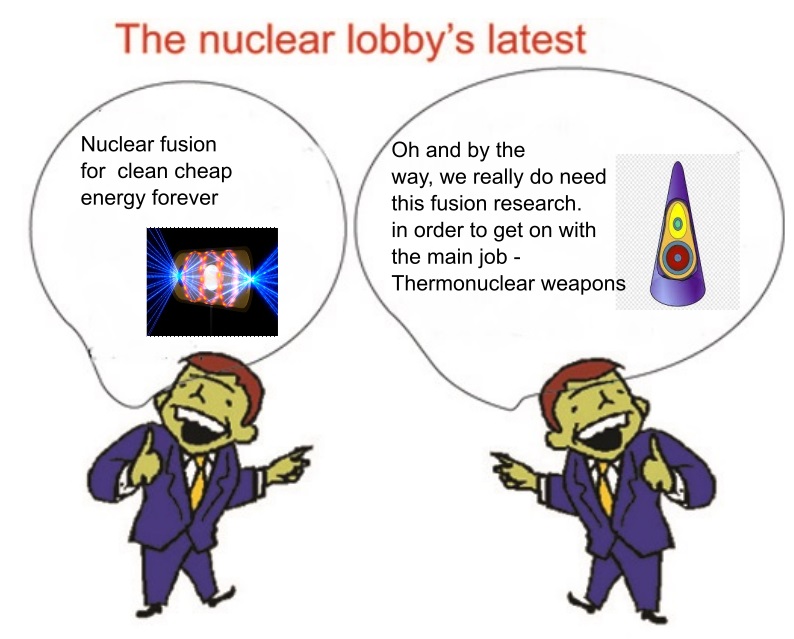
If one of these approaches is eventually successful in generating electricity continuously, the earliest we could expect commercial nuclear fusion reactors would be around 2050
The proponents remain silent about its applications to nuclear weapons. Fusion produces a stream of neutrons that can convert the common form of uranium, Uranium-238, into Plutonium-239, and common thorium into Uranium-233. Both Pu-239 and U-233 are nuclear (fission) weapons explosives
https://johnmenadue.com/whats-not-to-like-about-nuclear-fusion/— Mark Diesendorf , Dec 27, 2022
Headlines shout ‘Breakthrough in nuclear fusion could mean “near-limitless energy”’ and, one with a note of caution, ‘At last, we’ve found our energy source for the future (if we have one)’.
The publicity followed an experiment, conducted at the Lawrence Livermore National Laboratory in California, in which slightly more fusion energy output was obtained than the vast amount of energy input.
Nuclear fusion results from forcing together the nuclei of light atoms, against their electrostatic forces of repulsion, to form heavier nuclei, with the release of energy. It is the reaction that gives our Sun and the other stars their energy. In the centres of stars, the nuclei are forced together by the immense pressure due to gravity. But in the laboratory on Earth, confining the system and achieving controlled fusion is much more difficult.
One approach is to heat the system to hundreds of millions of degrees while confining it with intense magnetic fields. This is the method used in a multinational, multi-billion dollar experiment to build the International Thermonuclear Experimental Reactor (ITER), currently under construction in France. The researchers and investor governments hope that the huge size of the system will eventually enable energy break-even.
Another method, the one used at Livermore, is to bombard a pellet comprising two isotopic forms of hydrogen, deuterium and tritium, with 192 high-powered lasers. Energy breakeven was achieved for a fraction of a second.
If one of these approaches is eventually successful in generating electricity continuously, the earliest we could expect commercial nuclear fusion reactors would be around 2050, probably too late to contribute to climate mitigation and almost certainly unnecessary. By 2050, the whole world’s electricity generation will likely be renewable, mostly from wind and solar photovoltaics supplemented by hydro. This can be achieved at a fraction of the cost of any nuclear energy technology, fission or fusion.
The hype for fusion claims limitless, safe, zero-carbon energy, negligible nuclear wastes, and no risk of devastating nuclear accidents. So, what’s not to like about nuclear fusion?
The proponents remain silent about its applications to nuclear weapons. Fusion produces a stream of neutrons that can convert the common form of uranium, Uranium-238, into Plutonium-239, and common thorium into Uranium-233. Both Pu-239 and U-233 are nuclear (fission) weapons explosives.
Even more dangerous is the potential use of the neutron stream to convert lithium, which is common, into large quantities of tritium, a rare isotope of hydrogen. Tritium is an essential component of compact nuclear weapons, enabling them to be made small enough to fit into missiles. The principal purpose of the Lawrence Livermore Lab is research and development of nuclear weapons. Indeed, a former member of the research staff described it to me as ‘a nuclear bomb factory’.
The desirability of ‘near-limitless energy’ also needs critical examination. The economic system is driven, to a large degree by energy consumption, and vice versa. Energy and economy are closely coupled. Furthermore, economic activity is a major driver of environmental impacts. Already, at the present level of global GDP and global energy consumption, we have massive impacts on our forests, soils, freshwater, biodiversity and biogeochemical flows such as phosphorus and nitrogen. Although we humans are totally dependent upon nature, we (especially rich countries and rich individuals) are destroying our life support system. A further expansion of energy consumption and associated economic activity, even if energy generation is zero-carbon, could finish the job of destroying human civilisation this century.
There is growing evidence of the need for the world to transition to a steady-state economic system, that is, one with no growth in the use of energy, materials and land, and no growth in population. The interdisciplinary field of ecological economics is based on this goal. Since low-income countries must continue to grow, this means that the rich countries must commence a process of planned degrowth to an ecologically sustainable, socially just socioeconomic system. Planned degrowth, which is very different from a recession, is discussed in recent books by Jason Hickel (Less is More), Giorgos Kallis (The Case for Degrowth) and Matthias Schmelzer (The Future is Degrowth).
Dounreay pushes forward plans to build new 37-metre-high stack at prototype fast breeder reactor.
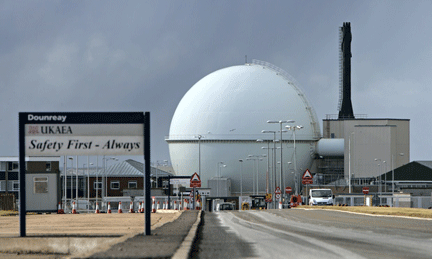
Dounreay pushes forward plans to build new 37-metre-high stack at reactor.
Dounreay’s operators are looking to clear the way to progress long-delayed
plans to replace the discharge stack at the site’s prototype fast reactor.
Dounreay Site Restoration Limited (DSRL) is seeking Highland Council’s
agreement to approve a design for the system to vent authorised emissions
of gases, including radionuclides. Last year, it awarded a £7 million
contract to US conglomerate Jacobs to carry out the work.
Concrete foundations and a steel framework would support the proposed new 37-metre
high stack which would house a plant room containing an extract fan, filter
units, stack sampling and control panels. The contract involves removal of
the existing vent and the design, manufacturing, testing, installation and
commissioning of its replacement. The new stack is earmarked to go up on
the seaward side of the reactor and be in place by October 2024.
John O Groat Journal 21st Dec 2022
A pretentious and dishonest story-telling conference of Small Nuclear Reactor salesmen in Atlanta 2022
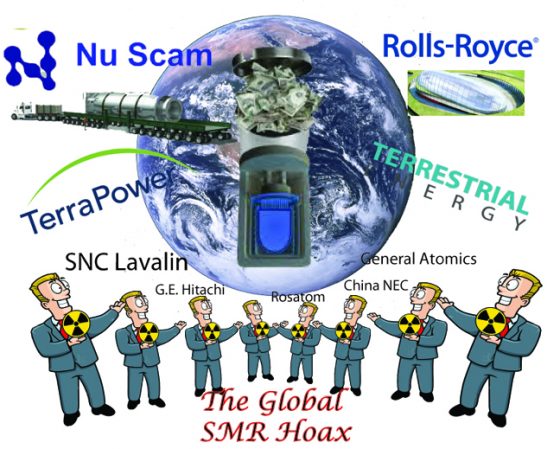
Markku Lehtonen in The Bulletin of the Atomic Scientists covered this conference – “SMR & Advanced Reactor 2022” event in Atlanta – in a lengthy article.
The big players were there, among over 400 vendors, utility representatives, government officials, investors, and policy advocates, in “an atmosphere full of hope for yet another nuclear renaissance.
The writer details the claims and intentions of the SMR salesmen – in this “occasion for “team-building” and raising of spirits within the nuclear community.’, in relation to climate change and future energy needs, and briefly mentioning “security”, which is code for the nuclear weapons aspect.

It struck me that “team building” might be difficult, seeing that the industry representatives were from a whole heap of competing firms, with a whole heap of different small reactor designs, (and not all designs are even small, really)
This Bulletin article presents a measured discussion of the possibilities and the needs of the small nuclear reactors. The writer recognises that this gathering was really predominantly a showcase for the small nuclear wares, – the SMR salesmen “must promise, if not a radiant future, at least significant benefits to society. “
“Otherwise, investors, decision-makers, potential partners, and the public at large will not accept the inevitable costs and risks. Above all, promising is needed to convince governments to provide the support that has always been vital for the survival of the nuclear industry.”
He goes on to describe the discussions and concerns about regulation, needs for a skilled workforce, government support, economic viability. There were some contradictory claims about fast-breeder reactors.
Most interesting was the brief discussion on the political atmosphere, the role of governments, the question of over-regulation .
” A senior industry representative …. lamenting that the nuclear community has “allowed too much democracy to get in“
“The economic viability of the SMR promise will crucially depend on how much further down the road towards deglobalization, authoritarianism in its various guises, and further tweaking of the energy markets the Western societies are willing to go”
The Bulletin article concludes:
“Promises and counter-promises. For the SMR community that gathered in Atlanta, the conference was a moment of great hope and opportunity, not least thanks to the aggravating climate and energy security crises. But the road toward the fulfilment of the boldest SMR promises will be long, as is the list of the essential preconditions. To turn SMR promises into reality, the nuclear community will need no less than to achieve sufficient internal cohesion, attract investors, navigate through licensing processes, build up supply chains and factories for module manufacturing, win community acceptance on greenfield sites, demonstrate a workable solution to waste management, and reach a rate of deployment sufficient to trigger learning and generate economies of replication. Most fundamentally, governments would need to be persuaded to provide the many types of support SMRs require to deliver on their promises.
Promising of the kind seen at the conference is essential for the achievement of these objectives. The presentations and discussions in the corridors indeed ran the full gamut of promise-building, from the conviction of a dawning nuclear renaissance along the lines “this time, it will be different!” through the hope of SMRs as a solution to the net-zero and energy-security challenges, and all the way to specific affirmations hailing the virtues of individual SMR designs. The legitimacy and credibility of these claims were grounded in the convictions largely shared among the participants that renewables alone “just don’t cut it,” that the SMR supply chain is there, and that the nuclear industry has in the past shown its ability to rise to similar challenges.
Two questions appear as critical for the future of SMRs. First, despite the boost from the Ukraine crisis, it is uncertain whether SMR advocates can muster the political will and societal acceptance needed to turn SMRs into a commercial success. The economic viability of the SMR promise will crucially depend on how much further down the road towards deglobalization, authoritarianism in its various guises, and further tweaking of the energy markets the Western societies are willing to go. Although the heyday of neoliberalism is clearly behind us and government intervention is no longer the kind of swearword it was before the early 2000s, nothing guarantees that the nuclear euphoria following the Atoms for Peace program in the 1950s can be replicated. Moreover, the reliance of the SMR business case on complex global supply chains as well as on massive deployment and geographical dispersion of nuclear facilities creates its own geopolitical vulnerabilities and security problems.
Second, the experience from techno-scientific promising in a number of sectors has shown that to be socially robust, promises need constructive confrontation with counter-promises. In this regard, the Atlanta conference constituted somewhat of a missed opportunity. The absence of critical voices reflected a longstanding problem of the nuclear community recognized even by insiders—namely its unwillingness to embrace criticism and engage in constructive debate with sceptics. “Safe spaces” for internal debates within a like-minded community certainly have their place, yet in the current atmosphere of increasing hype, the SMR promise needs constructive controversy and mistrust more than ever.” https://thebulletin.org/2022/12/building-promises-of-small-modular-reactors-one-conference-at-a-time
Canada’s Federal environment minister rejects impact assessment for small modular nuclear reactor on the Bay of Fundy.
Coalition for Responsible Energy Development in New Brunswick (CRED-NB), December 23, 2022
SAINT JOHN, NEW BRUNSWICK – In a deeply disappointing decision for the environment and public oversight, Steven Guilbeault, federal Minister of Environment and Climate Change, has ruled against a full federal Impact Assessment (IA) for a small modular nuclear reactor (SMR) proposed by New Brunswick Power at Point Lepreau in New Brunswick.
This decision comes in response to a request submitted by the Coalition for Responsible Energy Development in New Brunswick (CRED-NB) on July 4, 2022, calling for an IA for this first-of-its-kind nuclear project in Canada. Letters of support for CRED-NB’s request were submitted by the Wolastoq Grand Council, and Indigenous organizations representing the Peskotomuhkati Nation and the Mi’gmaq First Nations in New Brunswick and over 300 public interest groups and individuals.
In rejecting the need for an IA for the proposed SMR project, the Minister found it would be “unwarranted” as the concerns raised by Indigenous peoples and members of the public would be considered as part of the licensing process by the nuclear regulator and within New Brunswick’s Clean Environment Act.
“The Minister’s choice not to designate the SMR for an assessment goes against their commitments to sound, science-based decision-making and public participation,” noted Ann McAllister of CRED-NB, reacting to the news of the Minister’s decision. “This lack of a precautionary approach is especially dismaying given that sodium-cooled nuclear technology – of which this SMR is one – has a known history of accidents and has never been successfully commercialized, despite repeated attempts over the decades.”
“The mechanism we had to uphold environmental justice has been denied,” reacted Kerrie Blaise, an environmental lawyer who assisted CRED-NB with the IA request. “The many unknowns and the potential for not only severe but irreversible impacts to the health of communities and the environment will not be subject to a rigorous public and cumulative effects assessment that an IA provides. This is quite simply something that cannot be achieved by the nuclear regulator in their license-specific assessment.”
“By refusing an IA for the SMR project at Point Lepreau, the Minister suggested the concerns about the project raised by CRED-NB would be dealt with by a provincial Environmental Impact Assessment,” said Dr. Susan O’Donnell,Adjunct Professor at the University of New Brunswick and St. Thomas University, and CRED-NB member. “The provincial process is not as comprehensive as the federal IA. However in its submission, the Government of New Brunswick stated that a provincial EIA would address all the concerns raised in the CRED-NB request, and that the premier has confirmed that a provincial EIA review, including public consultation, will be required before the project can proceed. We look forward to that comprehensive provincial review in the new year.”
Pressure from the nuclear industry lobby changed federal environmental assessment law in 2019, exempting SMRs below a certain threshold from undergoing a full environmental IA. The only way for thisproject to have undergone an IA, was at the direction of the Minister. The Minister’s decision sets an unfortunate precedent, weakening our impact assessment laws and ability for broad public participation.
Dishonesty: British authorities knew it was wrong to proceed with the thermal oxide reprocessing plant (Thorp) at Sellafield.
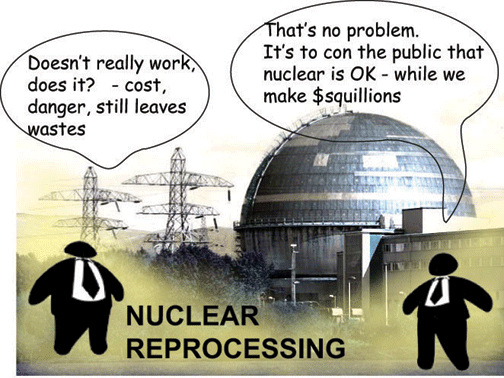
Letter William Walker: In 1993, a government official told me that “it
was sometimes right to do the wrong thing”. For reasons of political
expediency, it was right to give political consent for the operation of the
thermal oxide reprocessing plant (Thorp) at Sellafield.
This huge facility, not mentioned in Samanth Subramanian’s fine long read, had been built over
the previous decade to reprocess British and foreign, especially Japanese,
spent nuclear fuels. Abandoning it would be too embarrassing for the many
politicians and their parties that had backed it, expensive in terms of
compensation for broken contracts, and damaging to Britain’s and the
nuclear industry’s international reputation.
It was wrong to proceed, as
the government well knew, because the primary justification for its
construction – supply of plutonium for fast breeder reactors (FBRs) – had
been swept away by the abandonment of FBRs in the 1980s (none were built
anywhere).
Because returning Thorp’s separated plutonium and radwaste to
Japan would be difficult and risky.
Because decommissioning Thorp would
become much more costly after its radioactive contamination.
Because there was a known win-win solution, favoured by most utilities – store the spent
fuel safely at Sellafield prior to its return to senders, avoiding the many
troubles that lay ahead.
Guardian 22nd Dec 2022
Despite the hype, we shouldn’t bank on nuclear fusion to save the world from climate catastrophe

Robin McKie, https://www.theguardian.com/commentisfree/2022/dec/17/dont-bank-on-nuclear-fusion-to-save-the-world-from-a-climate-catastrophe-i-have-seen-it-all-before
Last week’s experiment in the US is promising, but it’s not a magic bullet for our energy needs
“…….. For almost half a century, I have reported on scientific issues and no decade has been complete without two or three announcements by scientists claiming their work would soon allow science to recreate the processes that drive the sun. The end result would be the generation of clean, cheap nuclear fusion that would transform our lives.
Such announcements have been rare recently, so it gave me a warm glow to realise that standards may be returning to normal. By deploying a set of 192 lasers to bombard pellets of the hydrogen isotopes deuterium and tritium, researchers at the US National Ignition Facility (NIF) in Livermore, California, were able to generate temperatures only found in stars and thermonuclear bombs. The isotopes then fused into helium, releasing excess energy, they reported.
It was a milestone event but not a major one, although this did not stop the US government and swaths of the world’s media indulging in a widespread hyping jamboree over the laboratory’s accomplishment. Researchers had “overcome a major barrier” to reaching fusion, the BBC gushed, while the Wall Street Journal described the achievement as a breakthrough that could herald an era of clean, cheap energy.
It is certainly true that nuclear fusion would have a beneficial impact on our planet by liberating vast amounts of energy without generating high levels of carbon emissions and would be an undoubted boost in the battle against climate change.
The trouble is that we have been presented with such visions many times before. In 1958, Sir John Cockcroft claimed his Zeta fusion project would supply the world with “an inexhaustible supply of fuel”. It didn’t. In 1989, Martin Fleischmann and Stanley Pons announced they had achieved fusion using simple laboratory equipment, work that made global headlines but which has never been replicated.
To this list you can also add the International Thermonuclear Experimental Reactor (Iter), a huge facility being built in Saint-Paul-lès-Durance in Provence, France, that was supposed to achieve fusion by 2023 but which is over 10 years behind schedule and tens of billions of dollars over budget.
In each case, it was predicted that the construction of the first commercially viable nuclear fusion plants was only a decade or two away and would transform our lives. Those hopes never materialised and have led to a weary cynicism spreading among hacks and scientists. As they now joke: “Fusion is 30 years away – and always will be.”
It was odd for Jennifer Granholm, the US energy secretary, to argue that the NIF’s achievement was “one of the most impressive scientific feats of the 21st century”. This is a hard claim to justify for a century that has already witnessed the discovery of the Higgs boson, the creation of Covid-19 vaccines, the launch of the James Webb telescope and the unravelling of the human genome. By comparison, the ignition event at the NIF is second-division stuff.
Most scientists have been careful in their responses to the over-hyping of the NIF “breakthrough”. They accept that a key step has been taking towards commercial fusion power but insist such plants remain distant goals. They should not be seen as likely saviours that will extract us from the desperate energy crisis we now face – despite all the claims that were made last week.
Humanity has brought itself to a point where its terrible dependence on fossil fuels threatens to trigger a 2C jump in global temperatures compared with our pre-industrial past. The consequences will include flooding, fires, worsening storms, rising sea levels, spreading diseases and melting ice caps.
Here, scientists are clear. Fusion power will not arrive in time to save the world. “We are still a way off commercial fusion and it cannot help us with the climate crisis now,” said Aneeqa Khan, a research fellow in nuclear fusion at Manchester University. This view was backed by Tony Roulstone, a nuclear energy researcher at Cambridge University. “This result from NIF is a success for science, but it is still a long way from providing useful, abundant clean energy.”
At present, there are two main routes to nuclear fusion. One involves confining searing hot plasma in a powerful magnetic field. The Iter reactor follows such an approach. The other – adopted at the NIF facility – uses lasers to blast deuterium-tritium pellets causing them to collapse and fuse into helium. In both cases, reactions occur at more than 100 million C and involve major technological headaches in controlling them.
Fusion therefore remains a long-term technology, although many new investors and entrepreneurs – including Bill Gates and Jeff Bezos – have recently turned their attention to the field, raising hopes that a fresh commercial impetus could reinvigorate the development of commercial plants.
This input is to be welcomed but we should be emphatic: fusion will not arrive in time to save the planet from climate change. Electricity plants powered by renewable sources or nuclear fission offer the only short-term alternatives to those that burn fossil fuels. We need to pin our hopes on these power sources. Fusion may earn its place later in the century but it would be highly irresponsible to rely on an energy source that will take at least a further two decades to materialise – at best.
Small nuclear reactors – the nuclear industry’s last ditch chance to thrive?
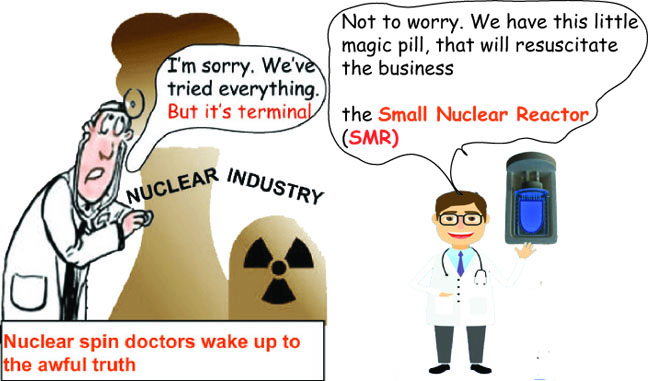
if this purported renaissance doesn’t flourish, there is unlikely to be another.
Nuclear power has one last chance to flourish in the U.S.
Climate urgency, energy security and government support make this a make-or-break moment for atomic energy
Japan Times, BY LIAM DENNING, BLOOMBERG 19 Dec 22,
Once again, we are on the cusp of a nuclear renaissance. Actually realizing one requires something nuclear power isn’t known for: Speed.
………. There are two sides to a mooted renaissance. One is a new lease on life for existing plants. More than 10 reactors have closed over the past decade, largely because cheap shale gas depressed the price of electricity and burgeoning renewables also muscled in.
……….. The last reactor came online in 2016. Not only was it the first in 20 years, its construction kicked off more than 40 years ago………
Nuclear power’s fall from grace is often traced to the Three Mile Island accident in 1979, which stoked distrust from the public and excessive zeal from regulators. But nuclear power was struggling already. Many projects had been canceled before 1979, in part because it was already taking a decade to plan, license and construct a plant. Capital costs soared well before Three Mile Island, more than doubling in real terms between 1971 and 1978, flouting the conventional wisdom of greater scale leading to efficiencies.
…………………………. The bankruptcy of the Washington Public Power Supply System in the early 1980s exemplified this collision of rosy demand assumptions with new economic realities, saddling ratepayers with billions in costs for abandoned, half-built plants. The same thing happened as recently as 2017 with the abandonment of two unfinished projects in South Carolina. Two other new reactors have actually been built in Georgia and are due to switch on next year. But they are far from being good PR; massively over-budget and delayed, they owe their completion to regulators offloading much of the cost onto ratepayers.
Meanwhile, as much as climate change bolsters the case for nuclear power, it has also bolstered alternatives. Not just renewable power and batteries, but conservation now enhanced by distributed energy technologies and sophisticated demand-management tools. Unlike nuclear power, the cost of such technologies has been falling fast.
……………… Competing clean technology cost trends and whatever else the 2020s throw up lie between now and the likely start of new projects at scale in the 2030s.
This is why the current renaissance centers on developing small modular reactors, or SMRs……… Companies such as NuScale Power and TerraPower LLC, founded by Bill Gates, aim to deploy initial commercial projects in the late 2020s.
…………….. Despite being talked about for years, however, SMRs haven’t arrived yet. “There are no good cost estimates (for SMRs) because no one’s actually built one,” says Jonathan Koomey, a researcher studying energy technology costs and co-author of a forthcoming book “Solving Climate Change.” Given nuclear power’s track record, he adds, “what’s needed is a construction time and cost that we could predict with accuracy.”Even under good circumstances — and there are signs of cost issues already — initial SMR projects likely won’t operate for several more years. That means commercialization at scale is probably at least a decade away. What will the cost of competing technologies be by then?
………… government must underwrite that risk to some degree. For the existing plants, and those new ones in Georgia, that involved guaranteed recovery of costs for regulated utilities. Today, it is subsidies and development grants and loans……………………
We are in a moment where all the stars have seemingly aligned: climate urgency, energy security concerns, new technology, new subsidies, and government intervention in energy markets writ large. The corollary is that, with our grids undergoing fundamental change and net-zero targets bearing down on us, if this purported renaissance doesn’t flourish, there is unlikely to be another. https://www.japantimes.co.jp/opinion/2022/12/19/commentary/world-commentary/u-s-nuclear-reactors/
Bill Gates’ Natrium project stalled, lacks Russian fuel – call for tax-payer funding for nuclear fuel development
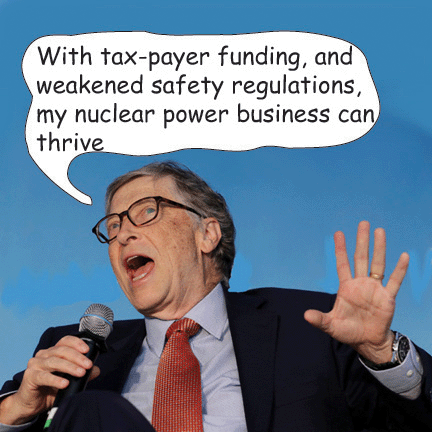
Russia’s war has stalled a next-gen US nuclear reactor backed by Bill Gates – because it’s lost its sole supplier of uranium
Markets Insider, George Glover , Dec 19, 2022,
- TerraPower has delayed a demo of its flagship nuclear reactor project in Wyoming by at least two years.
- The nuclear innovation company said it’s unable to get uranium fuel from any source other than Russia.
- TerraPower has received backing from Bill Gates and the US DOE for its advanced nuclear plant design.
……………..Its CEO Chris Levesque said the war has hit supplies of high-assay low-enriched uranium, or HALEU. That means the Natrium nuclear plant that TerraPower is building in Wyoming won’t go into demonstration service in 2028 as planned.
…………. Efforts to get US manufacturers in commercial production and to find alternative suppliers have not worked out, he said.
“Given the lack of fuel availability now, and that there has been no construction started on new fuel enrichment facilities, TerraPower is anticipating a minimum of a two-year delay to being able to bring the Natrium reactor into operation,” Levesque added.
……… Natrium project is expected to cost $4 billion to build, with around half of that funding coming from the US Energy Department.
TerraPower plans to fuel Natrium with HALEU , which has a higher level of enrichment than the 5%-enriched uranium-235 fuel used by American nuclear reactors already in operation.
The company assumed it would use Russian supplies for its first core load because the US doesn’t have the capacity to enrich uranium-235 right now, according to Levesque.
But Russia’s invasion of Ukraine in February cut off the fuel source, after the US, the EU and other western allies imposed sanctions on Moscow.
TerraPower and the Department of Energy are now looking for alternative sources of HALEU – and want lawmakers to approve a $2.1 billion funding package to support low-enriched uranium production in the US, Levesque said. https://markets.businessinsider.com/news/commodities/russia-war-in-ukraine-bill-gates-nuclear-startup-uranium-fuel-2022-12
1 This Month
To see nuclear-related stories in greater depth and intensity – go to https://nuclearinformation.wordpress.com/

29 Jan. Thursday 7-8 p.m. Webinar – World’s Largest Nuclear Station in Port Hope, ON?


31st January – Challenging the War Machine – a DECLASSIFIED UK SUMMIT

Website of the Week
Now until to February 10, 2026 Radioactive waste storage in France: the debate is finally open! How to participate?
-
Archives
- January 2026 (259)
- December 2025 (358)
- November 2025 (359)
- October 2025 (376)
- September 2025 (258)
- August 2025 (319)
- July 2025 (230)
- June 2025 (348)
- May 2025 (261)
- April 2025 (305)
- March 2025 (319)
- February 2025 (234)
-
Categories
- 1
- 1 NUCLEAR ISSUES
- business and costs
- climate change
- culture and arts
- ENERGY
- environment
- health
- history
- indigenous issues
- Legal
- marketing of nuclear
- media
- opposition to nuclear
- PERSONAL STORIES
- politics
- politics international
- Religion and ethics
- safety
- secrets,lies and civil liberties
- spinbuster
- technology
- Uranium
- wastes
- weapons and war
- Women
- 2 WORLD
- ACTION
- AFRICA
- Atrocities
- AUSTRALIA
- Christina's notes
- Christina's themes
- culture and arts
- Events
- Fuk 2022
- Fuk 2023
- Fukushima 2017
- Fukushima 2018
- fukushima 2019
- Fukushima 2020
- Fukushima 2021
- general
- global warming
- Humour (God we need it)
- Nuclear
- RARE EARTHS
- Reference
- resources – print
- Resources -audiovicual
- Weekly Newsletter
- World
- World Nuclear
- YouTube
-
RSS
Entries RSS
Comments RSS
 nuclear-news