Delusional, ruinous and obsolete -the ITER nuclear fusion project
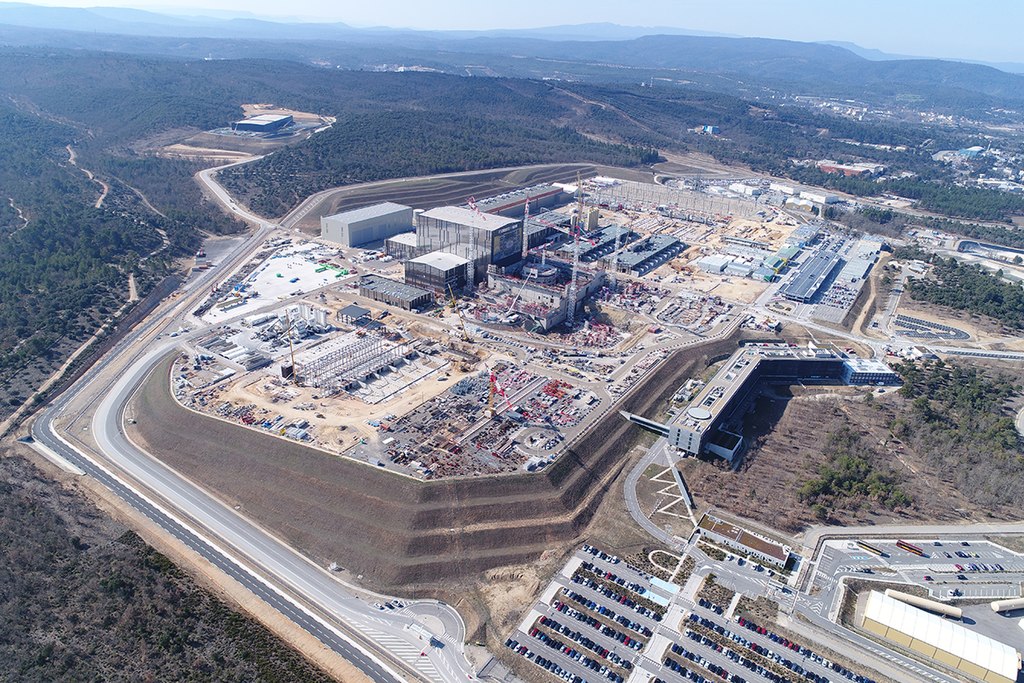
The ITER fusion project is 18 years late and can do nothing about climate change, writes Antoine Calandra
https://beyondnuclearinternational.org/2025/03/16/delirante-ruineuse-et-obsolete/
ITER (International Thermonuclear Experimental Reactor) is an international tokamak nuclear fusion research and engineering project, which has been significantly over budget and schedule, and is currently under construction next to the Cadarache nuclear facility in southern France.
India is one of the seven partner countries in the ITER project, along with the European Union, Russia, Japan, the United States, China, and South Korea. Macron may boast as much as he likes, but ITER is a complete fiasco, a delusional, ruinous, and obsolete project.
On November 14, 2024, the annual public meeting entitled: ITER, 15 years: what assessment? was held in Peyrolles.
I was expecting a big event and to get some recent information on the ITER construction site…But surprise, none of that!
A nondescript multipurpose room, no decor, no documents available, unpleasant white light, around forty people present, only interns (CEA ITER* employees, CLI members, local elected officials, a few union members)
For the event, the tables and chairs were arranged differently, “for a more convivial, cabaret-like atmosphere,” I heard. Oh!?
Pietro Barabaschi, Director General of ITER, was not there.
No agenda to announce the evening’s schedule with the names of the speakers, as in previous occasions. A very meager presentation of the ITER project (5 or 6 images) and that was it. And “time for questions from the audience.” Ah!
In short, the most pathetic ITER public meeting I have ever attended. A public meeting that reflects the ITER assessment.
ITER, what is the outcome?….a disaster!
We already wrote in 2005 with the MEDIANE association: “ITER, a dangerous, ruinous and doomed nuclear project”
The latest important news regarding ITER came on July 3, 2024, during the press conference of Pietro Barabaschi, the current ITER Director General, news that had been expected for a year.
A new calendar: 9 more years late!
The first plasma was originally scheduled for 2016, then postponed to 2025. It has been postponed to 2034. We are 18 years behind schedule.
And with the new calendar, an additional cost of €5 billion!
That’s at least €25 billion of public money to date, a cost multiplied by five. And in reality, more than €40 billion, including the in-kind contributions from the project’s partner countries.
The ITER Director acknowledged that “Fusion cannot come in time to solve the problems our planet faces today, and investments in other technologies, both known and unknown, are absolutely necessary.”
However, the speeches and commitments to get this nuclear fusion project accepted were completely different in 2006 at the time of this charade of public debate.
It was even possible to read that after ITER, DEMO, a pre-industrial demonstrator, was planned to “prove the industrial feasibility of this technology around 2040 and demonstrate that fusion can, by 2050, produce electricity on an industrial scale.”
Once again, the seven partner countries (the European Union, Russia, Japan, the United States, China, India, and South Korea) have agreed to pay more. But the ITER Director is now considering finding private actors to try to fill this financial gap.
Several private companies no longer expect anything from ITER, but they firmly believe in nuclear fusion and promise electricity production in a shorter timeframe.
Some even claim that ITER will be obsolete by the time it is commissioned.
I would add that ITER will probably not work and that there will never be industrial production of electricity through nuclear fusion.
Nuclear fusion will be neither “a revolution for humanity” nor “the energy of the future.”
It is not clean energy, nor even abundant energy. It is dangerous to human health and produces radioactive waste.
Its interest is above all military and to try to save the nuclear industry which has been in a bad state for several years.
ITER will probably never work and will end in total fiasco, worse than SuperPhénix*, which was supposed to be the flagship of the French nuclear industry.
But by squandering all these billions, the ITER monster will have succeeded in blocking any progress towards another energy model and imposing the continuation of the nuclear industry for years to come.
This myth of free and inexhaustible energy that allows for indefinite consumption and waste must be eradicated from people’s minds once and for all. It is also time to put an end to this gigantism and centralization of production in the hands of powerful, commanding states that serve the richest.
The solutions for the future have been known for a long time:
save energy, put an end to waste, develop and improve renewable energies (solar, wind, hydraulic) the only truly clean and future energies.
And not to develop them in an industrial and centralized manner, which is obviously and unfortunately the case.
The industrialization of the world must be fought. A new social project is a prerequisite for any energy project.
The future lies in small production units, local or regional, with technology accessible to the greatest number, low energy consumption, avoiding the cost of distribution.
Nuclear fusion, like fission, is a dangerous, dirty, and expensive energy source. It’s a complex, centralized technology reserved for wealthy countries, leading to proliferation, dependency, injustice, and war.
* CEA: Atomic Energy Commission
* CLI: Local information commission
* SuperPhénix, a former nuclear reactor, commissioned in 1986 and definitively shut down in 1997, is a prototype of a sodium-cooled fast neutron reactor. A dangerous machine that consumed more than 60 billion francs while operating for only thirty months in its twelve years of existence.
Antoine Calandra is a former administrator of the “Sortir du nucléaire” network and a member of the Médiane association. This article was first published in French on Mediapart.
The Volunteer “Data Hoarders” Resisting Trump’s Purge
Can librarians and guerrilla archivists save the country’s files from DOGE?
New Yorker, By Julian Lucas, 15 Mar 25
The deletions began shortly after Donald Trump took office. C.D.C. web pages on vaccines, H.I.V. prevention, and reproductive health went missing. Findings on bird-flu transmission vanished minutes after they appeared. The Census Bureau’s public repository went offline, then returned without certain directories of geographic information. The Department of Justice expunged the January 6th insurrection from its website, and whitehouse.gov took down an explainer page about the Constitution. On February 7th, Trump sacked the head of the National Archives and Records Administration, the agency that maintains the official texts of the nation’s laws, and whose motto is “the written word endures.”
More than a hundred and ten thousand government pages have gone dark in a purge that one scientist likened to a “digital book burning,” and which has proved as frightening in its imprecision as in its malice……………………………………………………………………………………. (Subscribers only)
https://www.newyorker.com/news/the-lede/the-data-hoarders-resisting-trumps-purge?utm_source=nl&utm_brand=tny&utm_mailing=TNY_Science_031525&utm_campaign=aud-dev&utm_medium=email&bxid=5be9d23d24c17c6adf3bf435&cndid=30183386&hasha=432fc0d0ad6543e820e2dfcd39f76c35&hashb=e1c24f6a6459c7d1d625eb2ea55d9dfbbb4633bf&hashc=ac5a1f5526e7292c73f49dfa8fb6d5d0cb87d8773cec3b9b03d38a4ce482d7c8&esrc=subscribe-page&mbid=CRMNYR012019&utm_term=TNY_Science_Tech
Book Review: How Our Digital Infatuation Undermines Discourse

In “Superbloom,” Nicholas Carr laments that we live in a state of uncontrollable sensory and communication overload.
By Elizabeth Svoboda, 03.14.2025, https://undark.org/2025/03/14/book-review-superbloom/?utm_source=Undark%3A+News+%26+Updates&utm_campaign=ecc4df9cbe-RSS_EMAIL_CAMPAIGN&utm_medium=email&utm_term=0_5cee408d66-185e4e09de-176033209
It was all Mother Nature’s fault, you could say. After winter rains in Lake Elsinore, California, reawakened countless dormant poppy seeds in early 2019, spring blossoms crowded in thickly enough to turn the hillsides bright orange — a fleeting “superbloom.” Recognizing an Instagrammable backdrop when she saw one, influencer Jaci Marie Smith reclined across the floral carpet in orange overalls and hit post. “You’ll never influence the world by trying to be like it,” her photo caption read.
In March, posts like Smith’s and #superbloom hashtags fueled a global frenzy. So many sightseers and influencers crowded into Lake Elsinore, snarling traffic and pulling up blooms by the handfuls, that officials declared a public safety emergency. As residents and others ripped into influencers for unleashing viral havoc on the small town, some took down their poppy posts, while others offered excuses and mea culpas. A meme that had begun in innocent enthusiasm curdled in an internet minute, setting people against each other and leaving a wake of real-world destruction.
We’re living in a perpetual digital superbloom, contends technology writer Nicholas Carr — a state of sensory and communication overload we can no longer control, one that’s sowing division and damage on a global scale. And like the poppy field that hypnotized Dorothy’s “Wizard of Oz” crew, this social media-fueled superbloom lures us in with enticements that are nearly impossible to resist. “Poppies are lush, vibrant, and entrancing,” Carr writes in “Superbloom: How Technologies of Connection Tear Us Apart.” “They’re also garish, invasive, and narcotic.”
This is familiar ground for Carr — at least, as familiar as any fast-morphing digital terrain can be. Carr’s stance as a techno-skeptic has been consistent for decades, though it’s evolved as digital communication modes have bloomed and receded. His 2010 book “The Shallows”, a finalist for the Pulitzer Prize, argued that the online world is distracting and prevents deeper engagement with texts, and he followed that up in 2014 with “The Glass Cage,” a reflection on how interacting with our computers changes us.
In “Superbloom,” Carr expands on a central theme of “The Glass Cage”: While we view our digital devices as helpers serving up knowledge and entertainment, they exact an unacknowledged toll in the process, altering how we think, act, and communicate. We are far different humans in an era of texting, posting, and like-seeking, Carr argues, than we were when limited to letters and phone calls — and not for the better.
He contends that when we communicate mostly in one-line messages and hot takes, the kind that titillate and propagate from one human node to the next, our capacity to engage more intently and thoughtfully withers. “What we sacrifice are depth and rigor,” he writes. Thus, “we rely on quick and often emotional judgments while eschewing slower, reflective ones.”
This is a fair point, if only true in some online contexts: Masters of the 140-character social media quip win plenty of fans elsewhere with their books and long essays. What’s more convincing is Carr’s analysis of why our instant access to one another online, which we often assume is an advantage, has led to more social breakdown rather than less.
……………………………………in virtual space, “we’re all in one another’s business all the time,” Carr writes, later adding, “With an almost microscopic view of what everybody else is saying and doing — the screen turns us all into peeping Toms — we have no end of opportunities to take offense.”
……………….Carr’s vivid, jargon-free prose hits right in the solar plexus. “We’re not hostages with Stockholm syndrome,” he writes of our relationship with social media. “We’re being given what we want, in quantities so generous we can’t resist gorging ourselves.”
…………………However hard-hitting and sound its claims, “Superbloom” might feel too apocalyptic were it not for Carr’s closing plea to hold the line. He says it’s too late to change the online systems we’re embedded in — a judgment that seems a tad dour, given how rapidly those same systems have themselves changed over time. But he rightly notes that to peel away from a virtual world that’s more image than substance, users must deliberately resist its empty charms, much as the rebels of Aldous Huxley’s “Brave New World” rejected the happiness drug soma.
…….. he calls for judicious online withdrawal rather than Luddite-style divestment, for staking out a position “not beyond the reach of the informational flow, but beyond the reach of its liquefying force.”
While digital pessimists can come across as Cassandra-like, their warnings have never been more resonant. For Carr, the rough online beast is no longer merely slouching in our direction. It’s already devouring us. “Superbloom” frames the choice ahead in the starkest possible terms: Do we consent to being swallowed, or find a way — however quixotic and improbable — to escape the maw?
Elizabeth Svoboda is a science writer in San Jose, California, and the author of “What Makes a Hero?: The Surprising Science of Selflessness.” She is working on a book about the science of setting a sustainable pace in an overclocked world.
Elon Musk Announces ‘Massive Cyberattack’ Causing X Outage
Thousands of people reported on March 10 that the social media platform was down for them.
Epoch Times, 3/10/2025By Jack Phillips
Tech billionaire Elon Musk on March 10 said that an outage affecting his social media platform, X, is being caused by a “massive cyberattack” that is ongoing.
On March 10, tens of thousands of reports were submitted to DownDetector saying users could not access the X app or website or they could not access posts.
In response, Musk wrote at midday: “There was (still is) a massive cyberattack against X. We get attacked every day, but this was done with a lot of resources.”
“Either a large, coordinated group and/or a country is involved,” the Tesla and SpaceX CEO wrote, adding that his company is “tracing” the attacks.
In a later interview with Fox News on the same day, Musk said that the attacks’ IP addresses in the X cyberattack were “linked to IP addresses originating in the Ukraine area.” The Epoch Times could not immediately authenticate Musk’s comment.
People on the platform first started reporting issues after 5 a.m. ET on March 10, according to DownDetector. After a brief period of time, the number of reports appeared to drop before picking back up again at about 11 a.m. ET……………………………………
More than 10,000 people in the United Kingdom also reported an X outage earlier on March 10, according to DownDetector’s website…………………..
The outage comes amid Musk and Secretary of State Marco Rubio having publicly sparred with Polish Foreign Minister Radoslaw Sikorski on March 9 after Musk said on X that the Ukraine war with Russia would be severely hampered if he were to turn off Starlink internet access in the Eastern European country.
On March 9, Musk, who is currently a senior adviser to President Donald Trump, wrote that Starlink has served as the “backbone of the Ukrainian army” and asserted that “their entire front line would collapse if I turned it off.” He also said he wants peace for Ukraine and that he’s backed the country in its war effort by providing the internet service.
Sikorski responded to Musk by saying that Poland was paying for the internet service and claimed Musk was threatening Kyiv. The Trump administration and Ukraine’s leadership have been engaged in high-stakes talks about ending the conflict and a deal for continued support of Ukraine that also benefits the United States………. https://www.theepochtimes.com/us/elon-musk-announces-massive-cyberattack-causing-x-outage-5823029?utm_source=Aobreakingnoe&utm_medium=Aoemail&utm_campaign=Aobreaking-2025-03-11&utm_content=NL_Ao&src_src=Aobreakingnoe&src_cmp=Aobreaking-2025-03-11&cta_utm_source=Aobreakingnoecta&est=iIzbjUv5GHdVOivdisxCzrbEBMMMNm2pOhOa%2F2%2Bo%2B8Uc84LMJe%2BVuIounSiENahxKSKfQOBK8pkU
Failure After Failure: Let’s Ditch Small Modular Reactors.

The World Mind, February 25, 2025, Carmine Miklovis https://www.theworldmind.org/briefing-archive/failure-after-failure-lets-ditch-small-modular-reactors2025/2/25
Imagine a revolutionary new coffee machine – one that can get twice as much coffee from the same amount of beans. This machine would make coffee cheaper to make at home and buy at shops like Dunkin’ and Starbucks. This coffee machine starts to get buy-in from major companies in the coffee business, like Keurig and Nespresso, and is projected to be launched in Summer 2025. Halfway through the spring, it’s announced that, due to delays, it will now be launched in Winter 2027. After another delay, it’s announced that the project is now expected by 2030. Keurig and Nespresso, in response, withdraw from the project, further delaying it until 2035. After 10 years of delays, would you still invest in this machine? Probably not, so why are we investing in an energy technology that’s built on the same promises?
Small modular reactors (SMRs), unlike the coffee machine, are a real technology that promise to make nuclear energy cheaper and more accessible. In theory, their smaller size allows them to be deployed more quickly and in a variety of settings, an advantage over solar panels, wind turbines, and tidal energy, which have location restrictions. Some of these reactor designs can reprocess spent fuel (known as a “closed fuel cycle”) to extract more energy than traditional reactors can from the same amount of fuel. As such, many have hailed these nuclear reactors as the key to addressing the climate crisis, as they seem to resolve a lot of the current problems that have plagued nuclear power thus far.
On an international level, France and India have announced plans to begin constructing SMRs together, praising the energy source for its potential to enable the transition to a low-carbon future. India is also expected to work with U.S. firms to enhance investment in the technology. Similarly, Trump’s pick for energy secretary, Chris Wright, served on the board of Oklo Inc., a company that focuses on advanced nuclear technology, and is pushing for investments in nuclear energy (alongside fossil fuels). As the Trump administration ditches renewables for fossil fuels and nuclear energy, some, including Wright, have said that now is the time for the nuclear renaissance.

Unfortunately, however, it seems increasingly likely that these reactors will fail to live up to their promise. Talks of deploying small modular reactors have been ongoing for over a decade, and while around a hundred designs exist, only two reactors have been deployed–one in China and one in Russia. In the U.S., while private companies and the federal government have invested billions into their development, projects have faced delays and cancellations. Long construction times, issues with quality control, and disproportionately high energy costs (for producers and consumers alike) have led many to conclude that the energy source is a false promise. Recognizing this failure, many of the largest energy companies, such as Babcock & Wilcox and Westinghouse have withdrawn their investments, leaving many other investors hesitant to put any of their assets in the nuclear cause. While the potential of these models is exciting in theory, investors would much rather hedge their bets on just about anything else.
To make matters worse, small modular reactors come with an additional catch: they risk enabling the proliferation of nuclear weapons. SMRs are a dual-use technology; after reactors have extracted energy from the fuel rods (the real-life equivalent of the coffee beans from earlier), they’re left with weapons-grade plutonium in the nuclear waste that could be used to create a potent nuclear weapon. This risk is particularly acute for reactors that reprocess for more energy, as the leftover waste is more potent and more viable for a nuclear weapon.
This presents a particular challenge, as in order for the touted benefits of SMRs to materialize, they need to distinguish themselves from the nuclear reactors we have now. As such, these new designs have to be more efficient and take advantage of their versatility, which means a lot of smaller reactors capable of reprocessing. More fissile material (in quantity and quality) coming out of more reactors makes it difficult to effectively monitor where all the waste goes. To complicate things, monitoring is already a problem, as it’s difficult to accurately measure nuclear material as it’s being transported from the facility to a waste disposal unit. The ease of diverting material could provide a pathway for states that have long had nuclear ambitions, such as Iran (who is also in a proxy war against a nuclear-armed adversary), or opportunistic non-state actors (such as domestic extremists or terrorist groups like ISIS) to finally get their hands on a nuclear weapon.
Unfortunately for proponents, it’s unlikely that the U.S. will be able to control or monitor the spread of this technology. The U.S. cannot set the standards for SMRs when it continues to lag behind Russia and China in production. Even then, why would countries already in China’s global infrastructure program, known as the Belt and Road Initiative, choose to get nuclear reactor designs from the U.S. further down the line when they can get nuclear reactors from China now? Chinese energy technology is likely more interoperable—able to work with pre-existing infrastructure—than U.S. designs, further restricting the U.S.’ potential market share. Even our closest allies wouldn’t want U.S. models, as some of them, including Germany and Japan, have given up on nuclear energy altogether. Given this hesitation and the long delays, SMRs would either fail to be deployed at a sufficient scale to resolve climate change, or would be completed hastily, which increases the risk of state or non-state actors acquiring a nuclear weapon.
While some may argue that any investment in renewable energy is a net positive in the fight against climate change, investing in nuclear energy hamstrings the response of future administrations. Investing in nuclear power creates a dangerous moral licensing, wherein future leaders may feel less incentivized to invest in other, effective renewable energy sources because they feel that they already have it covered with nuclear power. Historically, because of the way subsidies are distributed under the Clean Power Plan, nuclear energy actively stifles the development of other energies. In an effort to make nuclear power prices competitive, the U.S. government subsidizes it, which actively siphons those subsidies away from solar, wind, and tidal energy. As solar energy becomes the cheapest option available, subsidies to expand its gap or aid its clean partners could enhance renewable energy’s grip on the market. Absent these subsidies, however, fossil fuels may retain their foothold in the market for the foreseeable future. Given the existential threat at stake, the risk that this poses for the climate response cannot be overstated.

While advocates of SMRs are right that renewable energy needs to be adopted swiftly, trying to haphazardly rush out these reactors to deploy around the world risks trading one crisis for another, enabling a new era of nuclear proliferation. Similarly, if the Trump administration wants to keep its promise of low energy prices, their best bet is to stop investing in the nuclear power industry and let solar and wind energy take the reins. Like the hypothetical coffee machine, the benefits of SMRs will remain a nice thought, but nothing more than that. As climate change beckons at our doorstep, we can’t afford to invest in a false promise—it’s time to ditch SMRs.
The SMR Gamble: Betting on Nuclear to Fuel the Data Center Boom

“Who’s going to insure these plants?” “That’s a huge unknown. “
Mar 3, 2025, by Sonal Patel Power Mag
Data center power demand is accelerating, pushing the grid to its limits and prompting tech giants to bet on next-generation nuclear reactors. But given steep costs, regulatory hurdles, and uncertain scalability, is nuclear the future of data center energy—or just another high-stakes gamble?
At the end of January, Chinese artificial intelligence (AI) startup DeepSeek unveiled two large language models (LLMs)—DeepSeek-R1 and DeepSeek-R1-zero. Unlike previous generations of AI models, DeepSeek’s breakthrough reduced the compute cost of AI inference by a factor of 10, allowing it to achieve OpenAI GPT-4.5-level performance while consuming only a fraction of the power.
The news upended future electricity demand assumptions, rattling both the energy and tech sectors. Investment markets reacted swiftly, driving down expectations—and share prices—for power generation, small modular reactor (SMR) developers, uranium suppliers, gas companies, and major tech firms.
Yet, amid the chaos, optimism abounded. Analysts pointed to Jevons paradox, the economic principle that efficiency gains can increase consumption, rather than reduce it. “Our model shows a ~90% drop in the unit cost of compute over a six-year period, and our recent survey of corporate AI adoption suggests increases in the magnitude of AI use cases,” said Morgan Stanley Research. The U.S. remains the dominant market for AI-driven data center expansion, with 40 GW of new projects under development, aligning with a projected 57 GW of AI-related compute demand by 2028. Already, that load is transforming the energy landscape. A recent POWER analysis shows that U.S. data center electricity consumption could reach between 214 TWh and 675 TWh annually by 2030, up from 176 TWh in 2023 (Figure 1 on original)………………………………
Emerging Business Challenges
Still, beyond regulations, the actual business of running co-located nuclear plants remains uncertain. While recent discussions highlight tech companies as potential investors in advanced nuclear facilities, data center sources confirmed most aren’t attracted to the prospect of owning and operating nuclear plants.
“Data center operators are not in the business of running power plants,” said Walsh. “They want reliability and cost certainty, but they don’t want to deal with regulatory oversight, fuel procurement, or reactor maintenance.”………………………
From an operational standpoint, co-located facilities can pose new risks, as Nina Sadighi, professional engineer and founder of Eradeh Power Consulting told POWER. “Who’s going to insure these plants?” she asked. “That’s a huge unknown. Right now, insurance providers are hesitant because of the regulatory and operational complexity. The traditional nuclear liability structures are built around large reactors with established operational histories, and when you introduce something novel like SMRs or microreactors, you’re dealing with a very different risk profile.”
Sadighi, though generally optimistic about nuclear’s suitability for data centers, also pointed to potential workforce-related challenges that hinge on timely deployment. “If we train nuclear workers now, but deployment gets delayed, those workers won’t wait around,” she said. “The nuclear workforce pipeline is not like a tech workforce, where people can pivot between roles quickly. These are specialized skills that require years of training, and if there’s uncertainty about job stability, we risk losing them to other industries entirely,” she said. Sadighi also raised concerns about the stringent operational protocols that add to labor inefficiencies.
Finally, while the data center industry isn’t solely bent on economics—and told POWER sustainability with a long-term vision is a bigger priority—scaling up will require significant investment. That has sparked all kinds of debate. Lux Research estimates first-of-a-kind (FOAK) SMRs could cost nearly three times more than natural gas ($331/MWh versus $124/MWh) and more than 10 times more when factoring in cost overruns and delays. The firm projects SMRs won’t be cost-competitive before 2035. “Cheap nuclear just isn’t in the cards in the next two decades,” it says.
The fundamental debate is rooted in several uncertainties—which is not uncommon for emerging sectors, experts also generally pointed out. “Tax credits—especially the clean electricity production tax credits and investment tax credits—will be vital to the commercial viability of these projects, especially considering the FOAK risk,” said Teplinsky. “DOE [U.S. Department of Energy] loan guarantees and direct financing from the Federal Financing Bank at low rates are also essential to companies’ ability to secure debt and reduce cost of capital. Grant funding to support commercial demonstrations and high-assay low-enriched uranium support are also key.” ………………..
https://www.powermag.com/the-smr-gamble-betting-on-nuclear-to-fuel-the-data-center-boom/
Small modular reactor plans edge closer, amid claims that the technology makes no economic sense
By Simon Hacker, Punchline Gloucester 28th Feb 2025
…………………………………….Dale Vince, the owner of Stroud-based green energy group Ecotricity, has
roundly condemned the technology for “defying the economic laws of
gravity”.
Speaking on his weekly Zerocarbonista podcast, Mr Vince said:
“When you come to small nukes, the government and the nuclear industry have
consistently said that we will get lower bills, but they don’t put a number
on it. They are ecomonists without numbers!
Energy minister Ed Miliband: keen to move ahead on SMR plans. Big nuclear is the most expensive electricity we have ever made, it’s off the charts compared to renewable
energy and one of the fundamental laws of physics is that the economies of
scale come by making something bigger, not by making something smaller –
it always costs money to miniaturise.
So here they are, saying we can
miniatarise nuclear reactors that famously went decades late and billions
over budget… and they’ll be cheap. I don’t believe that for a second and
what we are of course doing is proliferating the risk.”
He added: “It’s always worth imagining what it would be like if the Romans had nuclear
power. If they did, Bath would be a toxic no-go zone. It’s only 2,000 years
ago and sounds like a long time, but not in the context of toxic nuclear
waste.” Whether Berkeley and neighbouring site Oldbury-on-Severn progress
with Rolls Royce’s SMR bid, the technology’s pathway to viable commercial
models for energy production remains challenging: as of today, only China
and Russia have operational SMRs, with China’s HTR-PM pebble-bed reactor
connected to the grid and Russia’s floating Akademik Lomonosov plant
utilizing two 35MW SMRs. https://www.punchline-gloucester.com/articles/aanews/smr-plans-edge-closer-amid-claims-the-technology-makes-no-economic-sense
If China can’t scale nuclear, Australia’s got Buckley’s

Dutton’s proposal has seven nuclear power plants, including five large-scale reactors and two SMRs. This isn’t critical mass for a nuclear program. As of February 2025, the United States operates 94 nuclear reactors, France has 57, and South Korea maintains 26 reactors. Those are sufficient numbers of GW-scale reactors to achieve program economies of scale. Australia’s peak electricity demand of 38.6 GW isn’t sufficient to provide an opportunity for sufficient numbers of reactors of a single design to be built.
Michael Barnard, Feb 25, 2025, https://reneweconomy.com.au/if-china-cant-scale-nuclear-australias-got-buckleys/
The platypus of energy in Australia has reared its duckbill and stamped its webbed feet again in recent years.
A fractious group of bedfellows is advocating for nuclear generation, primarily driven by the Liberal-National Coalition under Peter Dutton, who has proposed repurposing decommissioned coal-fired stations for nuclear power, with the remarkable claim that reactors could be operational between 2035 and 2037.
Other political supporters include the Libertarian Party and One Nation. Unsurprising advocacy organisations such as the Australian Nuclear Association, Nuclear for Australia, the Minerals Council of Australia, and the South Australian Chamber of Mines and Energy are calling for legislative changes to allow nuclear development, citing its reliability and low emissions.
Notable figures like opposition energy spokesperson Ted O’Brien, who has chaired parliamentary inquiries into nuclear energy, and Indigenous leader Warren Mundine, who sees nuclear as an economic and climate solution, have also voiced strong support.
But nuclear energy, like the platypus, is an oddly shaped beast, and needs a very specific hole to fit into the energy jigsaw puzzle.
Successful nuclear programs share several key conditions, drawn from historical examples in the United States, France, South Korea, and the UK. These countries achieved large-scale nuclear deployment first by making it a top-priority national goal, tied to military strategy or energy security.
Bipartisan support ensured long-term stability, while military involvement helped enforce cost discipline and continuity over decades. Australia clearly doesn’t have bipartisan support for nuclear energy.
Previous countries found political consensus in the face of serious geopolitical threats from nuclear armed enemies such as the Soviet Union and North Korea. Australia isn’t threatened by invasion or nuclear war by any country, and the major political parties are clearly on opposite sides of the fence on the subject.
Teal MPs, supported by Climate 200 and a major new force, are in general not supportive of nuclear energy either.
Australia’s federal laws prohibit nuclear power development through the Environmental Protection and Biodiversity Conservation Act 1999 (EPBC Act), which explicitly bans the approval of nuclear power plants.
The Australian Radiation Protection and Nuclear Safety Act 1998 (ARPANS Act) restricts certain nuclear activities, reinforcing the ban. Both laws would have to be repealed or substantially altered, requiring draft legislation to start with. No draft legislation has been in evidence from the Liberal-National Coalition, which appears par for the course for a campaign plank which is very light on details.
If the Liberal-National Coalition were to regain power, they would first have to draft a bill, and then shepherd it through the extensive legislative process, something that with contentious bills can take up to two years. That’s just the beginning.
Australia’s status as a signatory to international nuclear non-proliferation treaties adds a layer of complexity to any move toward nuclear power. Compliance with agreements such as the Treaty on the Non-Proliferation of Nuclear Weapons (NPT) and safeguards enforced by the International Atomic Energy Agency (IAEA) would require strict oversight of uranium handling, enrichment, and waste disposal.
Any shift to nuclear energy could trigger lengthy negotiations with global regulatory bodies to ensure Australia remains within its non-proliferation commitments, delaying and complicating the development of a civilian nuclear program.
The duration for individual countries to negotiate and implement these protocols has ranged from a few months to several years, influenced by national legislative processes and political considerations.
Strong central control is another common factor in successful nuclear programs. National governments directly managed nuclear projects, maintaining tight oversight of construction schedules and decision-making. This approach prevented fragmentation and ensured that experienced leadership remained in place throughout the deployment.
In Australia, power systems are largely under state control, meaning any attempt to build nuclear power plants would require approval from individual state governments. While the federal government sets national energy policies and regulates nuclear safety, states have the authority over planning and construction approvals.
Several states, including Victoria, New South Wales, Queensland, and South Australia, have explicit bans on nuclear power, adding another layer of legislative hurdles. Even if the federal ban were lifted, nuclear development would still depend on state cooperation, making a nationwide rollout politically and legally complex.
Building a skilled workforce was essential to scaling nuclear generation. Successful programs invested in national education and certification systems, training engineers, construction workers, and technicians specifically for nuclear projects. Strict security measures were also necessary to vet personnel and prevent risks.
That’s challenging for Australia. The Australian National Training Authority (ANTA) was abolished on July 1, 2005, with all its functions transferred to the Department of Education, Science and Training. This move aimed to centralize vocational education and training (VET) oversight at the federal level, streamlining operations and reducing administrative complexities associated with the previous federal-state arrangements.
Despite this degree of centralisation, the administration and delivery of VET programs remain primarily under state and territory control, with public technical and further education institutes and private providers delivering courses under regional oversight.
While the coordination and policy aspects of ANTA’s functions persist at the national level, the execution and management of training programs continue to be managed by individual states and territories.
That’s not a good basis for a nationally run and managed nuclear workforce education, certification and security clearance program that would need to persist for thirty to forty years. A nuclear ANTA would have to be established, taking time in and of itself, and then it would take time to attract and create a critical mass of skilled nuclear engineering, construction, operation and security human resources.
Speaking of security, Australia’s nuclear ambitions come with an often overlooked cost: an immense, multilayered security burden that taxpayers will likely shoulder.
In the US, nuclear power requires an extensive web of international, national, state, and local security measures, yet much of this expense is not covered by reactor operators.
The US government funds $1.1 billion annually in international nuclear security, including protecting supply chains and waste management through agencies like the IAEA, the Department of Defense, and the CIA. These costs translate to $8 million per reactor per year, with a full lifecycle cost of $1.2 billion per reactor—expenses that remain largely hidden from public scrutiny.
Domestically, the security footprint is even larger. The U.S. Nuclear Regulatory Commission, the Department of Energy, Homeland Security, and law enforcement agencies provide a $26 million per reactor per year security umbrella, ensuring compliance, protecting fuel transport, and defending against threats.
On-site security measures – including armed patrols, cyber protection, and emergency response teams – add another $18 million annually per reactor. In total, US taxpayers effectively subsidise $34 million per reactor per year, or $4 billion over a nuclear site’s lifespan, a cost that is rarely included in nuclear energy debates.
For Australia, these figures should serve as a stark warning. If nuclear reactors are built, the country will need to establish entirely new layers of security infrastructure, from federal oversight and emergency response teams to military-style site defenses.
The financial burden won’t fall on private operators alone – it will land squarely on the Australian taxpayer. As policymakers debate nuclear’s role in the country’s energy future, they must ask: are Australians ready to take on a security commitment of this scale?
A single, GW-scale, standardised reactor design was crucial to keeping costs under control. Countries that succeeded in nuclear deployment avoided excessive customization and focused on repeating a proven design, allowing for efficiency gains and predictable outcomes.
At present, there are various proposed reactor designs under consideration. Dutton’s proposal includes evaluating various reactor technologies, with a focus on South Korea’s APR1000 and APR1400 pressurized water reactors.
O’Brien has led a delegation to South Korea to study its nuclear power industry and assess the suitability of these reactor models for Australia.
It’s worth noting that while South Korea was successful in scaling nuclear generation, it did so with corruption that included substandard parts in reactors that led to a political scandal that resulted in the jailing of politicians and energy company executives.
Small modular nuclear reactors (SMR) have been proposed as part of the mix. They aren’t GW-scale and they don’t actually exist. As the Australian Academy of Technological Sciences and Engineering (ATSE) accurately pointed out in mid-2024, SMR technology remains in developmental stages globally, with no operational units in OECD countries.
The ATSE suggests that a mature market for SMRs may not emerge until the late 2040s, while I think it’s unlikely to emerge at all. Small reactors were tried in the 1960s and 1970s and were too expensive, leading to reactors being scaled up to around the GW scale in successful programs. There is nothing to indicate that anything has changed since then that will make SMRs successful and inexpensive the second time around.
Scale and speed mattered. Effective programs built between 24 and 100 reactors of very similar designs within a 20-to-40-year timeframe, ensuring that expertise remained within the workforce. Spreading projects over longer periods led to skill erosion and inefficiencies.
Dutton’s proposal has seven nuclear power plants, including five large-scale reactors and two SMRs. This isn’t critical mass for a nuclear program. As of February 2025, the United States operates 94 nuclear reactors, France has 57, and South Korea maintains 26 reactors. Those are sufficient numbers of GW-scale reactors to achieve program economies of scale. Australia’s peak electricity demand of 38.6 GW isn’t sufficient to provide an opportunity for sufficient numbers of reactors of a single design to be built.
Finally, strict adherence to design was non-negotiable. Countries that allowed constant innovation or design changes saw costs balloon and timelines slip. The lesson from history is clear: nuclear success depends on disciplined execution, a committed national strategy, and a workforce dedicated to repeating a single proven approach.
Australia’s strong engineering culture, known for innovation and adaptation, could pose challenges to a strictly controlled nuclear deployment program. Unlike industries where iterative improvements drive progress, nuclear power requires rigid standardization to control costs, ensure safety, and meet regulatory demands.
Australia’s history of engineering-led modifications – seen in mining, renewables, and infrastructure – could lead to pressures for design changes mid-project, a factor that has contributed to cost overruns and delays in nuclear projects overseas.
While flexibility has been a strength in other sectors, in nuclear energy, deviation from a single, proven reactor design undermines efficiency and drives up costs, making strict oversight and discipline crucial to success.
Small Nuclear Reactor developer groups raise $1.5bn amid race to power AI boom
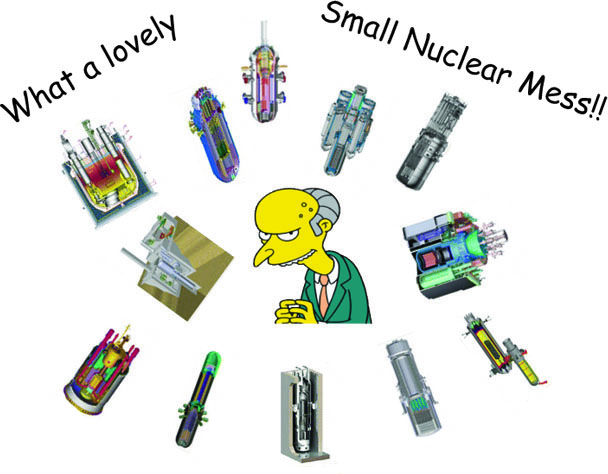
Developers of small modular nuclear reactors have raised at least $1.5bn in
funding over the past year, tapping into a surge of investor interest
linked to power supply deals agreed with Big Tech.
They have also secured pledges of billions of dollars of support from governments, amid a global race to launch new technologies considered critical to powering the
artificial intelligence revolution.
The largest fundraising of $700mn was closed this month by X-energy, a US developer that added Jane Street and other institutional investors to a register that included technology giantAmazon,
Ken Griffin, founder and chief executive of Citadel and chemical
company Dow. Paris-based developer Newcleo raised $151mn in September and
US-based developers Blue Energy and Last Energy raised $45mn and $40mn
respectively last year.
Nano Nuclear Energy, a developer of microreactors
which listed in May, raised $134mn capital in 2024. Three SMR developers
listed in New York, Oklo, NuScale and Nano Nuclear, raised more than $700mn
through share sales and other financing mechanisms over the past 12 months,
according to a Financial Times analysis of public records and data from
PitchBook and BloombergNEF.
Westinghouse, Rolls-Royce, Holtec
International, GE Hitachi and Bill Gates’ TerraPower are also among a host
of companies investing in about 60 SMR projects globally, according to
World Nuclear Association data. Amazon’s purchase of a stake in X-energy
and Google’s power supply deal with SMR developer Kairos Power, which both
occurred in October, have shaken up a funding market that soured in 2023
because of high interest rates and inflation.
But analysts warn developers
still face technical, regulatory and funding risks despite the improved
sentiment.
FT 19th Feb 2025, https://www.ft.com/content/2d84198e-7eeb-4154-bbf2-9a469b0cc700
Pioneering micro nuclear reactors to be built in Britain.
Major test for UK’s energy policy as four reactors planned on site of former power
station in Wales. Britain’s first “micro” nuclear reactors are to be
built on the site of a former coal-fired power station in south Wales. Four
reactors will be installed at the decommissioned Llynfi power station in
Bridgend under the proposals, each generating up to 20 megawatts (MW) of
electricity. These will be assembled in modules after being produced in a
factory off-site. The 14-acre project is being overseen by Last Energy, a
Washington-headquartered business, in a major early test for the
Government’s green energy policy. It will be the first new UK location to
house a commercial nuclear power reactor since the Torness nuclear power
station in East Lothian in 1978. Until now, modern UK nuclear projects have
been built on sites previously occupied by an earlier plant.
Telegraph 17th Feb 2025
Starmer’s nuclear reactors won’t be small, cheap or popular

David Elliott and Arthur Stansfield on Labour’s plans for expanding nuclear power plants, https://www.theguardian.com/environment/2025/feb/16/starmers-nuclear-reactors-wont-be-small-cheap-or-popular
Labour’s plan for siting small nuclear reactor plants around the country (Keir Starmer unveils plan for large nuclear expansion across England and Wales, 6 February) feels almost like something Donald Trump would come up with. The reality is that they would not be small – for example, the system being developed by Rolls-Royce is 470 megawatts, larger than most of the old, now closed, magnox reactors that were built in the UK in the 1960s.
And they will not be cheap – even backers, like the Tony Blair Institute for Global Change, have admitted that they “could have higher costs per MW compared to gigawatt-scale reactors”. And there would be a range of safety- and security-risk issues with local deployment, adding to the cost – nuclear plants are usually located in remote sites. Will many people want one near them? By comparison, with costs falling, public support for renewables, like solar and offshore wind, has never been higher.
David Elliott
Emeritus professor of technology policy, the Open University
Great British Nuclear competition winners announcement still ‘around Spending Review’

13 Feb, 2025 By Tom Pashby
Great British Nuclear (GBN) has confirmed that the winners of its small modular reactor (SMR) competition will still be announced around the time of the Spending Review on 11 June 2025, despite reports that it would take place on 26 March at the Spring Statement.
GE-Hitachi, Holtec Britain, Rolls-Royce SMR and Westinghouse Electric Co. were announced as the final four companies in contention following the conclusion of the initial tender
stage at the end of September. NuScale dropped out at this point, while EDF
exited the competition in July when it failed to submit documents before
the deadline.
GBN completed two rounds of assessment with the four
shortlisted companies and is now entering negotiations ahead of the
submission of final tenders. The nuclear body said in November 2024 it had
started “detailed negotiations” with the four small modular reactor
(SMR) developers remaining in its competition for deployment in the UK. GBN
debunks financial news site report. Financial news site The Motley Fool
reported on 11 February that the announcement was “expected to be
announced by Great British Nuclear on or around the time of the Spring
Budget Statement, scheduled for 26 March”.
New Civil Engineer 13th Feb 2025, https://www.newcivilengineer.com/latest/great-british-nuclear-competition-winners-announcement-still-around-spending-review-13-02-2025/
Sam Altman’s Fusion Power Startup Is Eyeing Trump’s $500 Billion AIPlay.

Few energy startups are better positioned to cash in on Stargate than
Helion, which has raised major funding from the AI initiative’s leaders,
and signed a contract with another. Sam Altman announced the $500 billion
Stargate initiative at the White House last month, with a plan to build the
world’s largest AI infrastructure project.
Stargate, the $500 billion effort to secure American AI supremacy for perpetuity backed by OpenAI’s Sam Altman and SoftBank founder Masa Son, among others, will require a
gargantuan amount of energy to power it. As it happens, Altman and Son are
backing a startup that says it can provide it. It’s a fusion energy
company called Helion that recently raised $425 million in a funding round
backed by SoftBank. Prior to that it banked $375 million from Altman, who
serves as Helion’s chairman. It was the single largest investment check
the AI billionaire has written so far. And Microsoft, a Stargate partner,
was the first company to contract with Helion for a fusion power plant by
2028 — a timeline that has some physicists skeptical.
Forbes 5th Feb 2025 https://www.forbes.com/sites/davidjeans/2025/02/05/stargate-sam-altman-fusion-helion/
Google deletes policy against using AI for weapons or surveillance

The pledge had been in place since 2018.
Mashable By Amanda Yeo on February 5, 2025
Google has quietly deleted its pledge not to use AI for weapons or surveillance, a promise that had been in place since 2018.
First spotted by Bloomberg, Google has updated its AI Principles to remove an entire section on artificial intelligence applications it pledged not to pursue. Significantly, Google’s policy had previously stated that it would not design nor deploy AI technology for use in weapons, or in surveillance technology which violates “internationally accepted norms.”
Now it seems that such use cases might not be entirely off the table.
“There’s a global competition taking place for AI leadership within an increasingly complex geopolitical landscape,” read Google’s blog post on Tuesday. “We believe democracies should lead in AI development, guided by core values like freedom, equality, and respect for human rights. And we believe that companies, governments, and organizations sharing these values should work together to create AI that protects people, promotes global growth, and supports national security.”
While Google’s post did concern its AI Principles update, it did not explicitly mention the deletion of its prohibition on AI weapons or surveillance. ……………………..
Google first published its AI Principles in 2018, following significant employee protests against its work with the U.S. Department of Defense. (The company had already infamously removed “don’t be evil” from its Code of Conduct that same year.) Project Maven aimed to use AI to improve weapon targeting systems, interpreting video information to increase military drones’ accuracy.
In an open letter that April, thousands of employees expressed a belief that “Google should not be in the business of war,” and requested that the company “draft, publicize and enforce a clear policy stating that neither Google nor its contractors will ever build warfare technology.”
The company’s AI Principles were the result, with Google ultimately not renewing its contract with the Pentagon in 2019. However, it looks as though the tech giant’s attitude toward AI weapons technology may now be changing.
Google’s new attitude toward AI weapons could be an effort to keep up with competitors. Last January, OpenAI amended its own policy to remove a ban on “activity that has high risk of physical harm,” including “weapons development” and “military and warfare.” In a statement to Mashable at the time, an OpenAI spokesperson clarified that this change was to provide clarity concerning “national security use cases.”
“It was not clear whether these beneficial use cases would have been allowed under ‘military’ in our previous policies,” said the spokesperson……………
Now Google’s revised policy has consolidated this list to just three principles, merely stating that its approach to AI is grounded in “bold innovation,” “responsible development and deployment,” and “collaborative process, together.” The company does specify that this includes adhering to “widely accepted principles of international law and human rights.” Still, any mention of weapons or surveillance is now conspicuously absent. https://mashable.com/article/google-ai-weapons-surveillance-policy
OpenAI Strikes Deal With US Government to Use Its AI for Nuclear Weapon Security
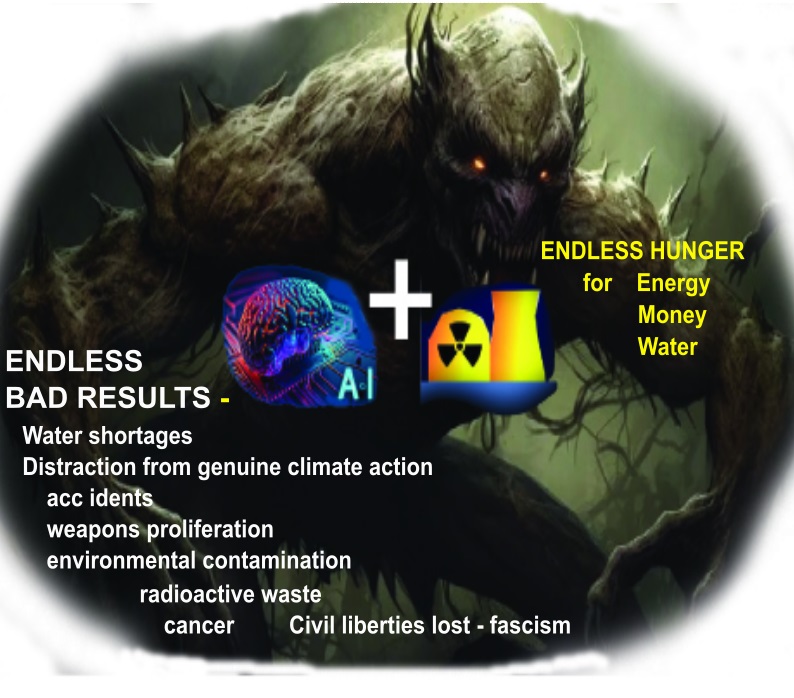
31 Jan24, https://futurism.com/openai-signs-deal-us-government-nuclear-weapon-security
Wait, isn’t this the plot to the “Terminator” movies?
“There was a nuclear war,” a character explains. “Defense network computers. New… powerful… hooked into everything, trusted to run it all. They say it got smart, a new order of intelligence. Then it saw all people as a threat, not just the ones on the other side. Decided our fate in a microsecond: extermination.”
It seems like either the execs at OpenAI have never seen it or they’re working overtime to make that premise a reality.
Don’t believe us? OpenAI has announced that the US National Laboratories will use its deeply flawed AI models to help with a “comprehensive program in nuclear security.”
As CNBC reports, up to 15,000 scientists working at the institutions will get access to OpenAI’s latest o1 series of AI models — the ones that Chinese startup DeepSeek embarrassed on the world stage earlier this month.
According to OpenAI CEO Sam Altman, who announced the partnership at an event in Washington, DC, the tech will be “focused on reducing the risk of nuclear war and securing nuclear materials and weapons worldwide,” as quoted by CNBC.
If any alarm bells are ringing by this point, you’re not alone. We’ve seen plenty of instances of OpenAI’s AI models leaking sensitive user data and hallucinating false claims with abandon.
OpenAI’s been making a huge push into government. Earlier this week, the Sam Altman-led company released ChatGPT Gov, a platform specifically designed for US government use that focuses on security.
But whether the company can deliver on some sky-high expectations — while also ensuring that its frequently lying AI chatbots won’t leak the nuclear codes or trigger the next nuclear war — is anyone’s guess.
The news comes after the Wall Street Journal reported that OpenAI is in early talks for a new round of funding that would value it at a gargantuan $340 billion, double its previous valuation last year.
Altman has also fully embraced president Donald Trump, gifting him $1 million for his inauguration and claiming that he had “really changed my perspective on him” after trashing him in years past.
OpenAI also signed onto Trump’s $500 billion AI infrastructure deal, dubbed Stargate, with the plan of contributing tens of billions of dollars within the next year.
Whether the company’s o1 reasoning models will prove useful in any meaningful way to the researchers at the US National Laboratories remains to be seen.
But given the widespread dismantling of regulations under the Trump administration, it also feels like an unbelievably precarious moment to be handing over any amount of control over nuclear weapons to a busted AI system.
1 This Month

To see nuclear-related stories in greater depth and intensity – go to https://nuclearinformation.wordpress.com
-
Archives
- September 2026 (194)
- August 2026 (330)
- July 2026 (355)
- June 2026 (287)
- May 2026 (306)
- April 2026 (356)
- March 2026 (251)
- February 2026 (267)
- January 2026 (308)
- December 2025 (358)
- November 2025 (359)
- October 2025 (375)
-
Categories
- 1
- 1 NUCLEAR ISSUES
- business and costs
- climate change
- culture and arts
- ENERGY
- environment
- health
- history
- indigenous issues
- Legal
- marketing of nuclear
- media
- opposition to nuclear
- PERSONAL STORIES
- politics
- politics international
- Religion and ethics
- safety
- secrets,lies and civil liberties
- spinbuster
- technology
- Uranium
- wastes
- weapons and war
- Women
- 2 WORLD
- ACTION
- AFRICA
- Atrocities
- AUSTRALIA
- Christina's notes
- Christina's themes
- culture and arts
- Events
- Fuk 2022
- Fuk 2023
- Fukushima 2017
- Fukushima 2018
- fukushima 2019
- Fukushima 2020
- Fukushima 2021
- general
- global warming
- Humour (God we need it)
- Nuclear
- RARE EARTHS
- Reference
- resources – print
- Resources -audiovicual
- Weekly Newsletter
- World
- World Nuclear
- YouTube
-
RSS
Entries RSS
Comments RSS
 nuclear-news