USA Energy Dept moving away from dangerous MOX nuclear fuel plan
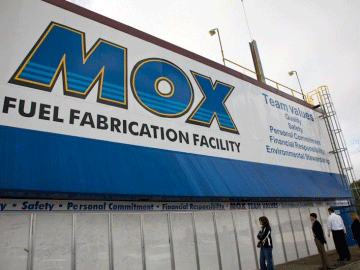 Radioactive Pork Finally on the Chopping Block Project On Government Oversight. By: Lydia Dennett 9 Feb 16 A “Sensitive But Unclassified” document from the Secretary of Energy, obtained by the Project On Government Oversight, indicates that the Department is concerned that parochial interests in Congress may thwart their plans to kill the MOX program.
The Mixed Oxide Fuel Fabrication Facility (MOX) is the result of a bilateral agreement with Russia in which both countries agreed to dispose of 34 metric tons of nuclear weapons grade plutonium. In 2002 the U.S. decided to construct the MOX facility to convert this dangerous material into fuel for commercial nuclear power reactors. But now, 14 years later, the MOX program is almost 3,000 percent over budget, lacks even a single potential customer for the fuel, and could actually be putting our nuclear material at risk.
The November 2015 memorandum from Secretary of Energy Ernest Moniz to President Obama states that MOX is a “high-priority ‘hot potato’ issue” for this Congress and indicates that the Department is finally beginning to shift focus and funding away from MOX and toward a plutonium disposition process that will actually work: “We are working with our appropriators and other stakeholders to shift our plutonium disposition strategy from MOX power reactor fuel to dilution and underground disposal. This is much faster and cheaper.”
Last year, an independent study performed by the Aerospace Corporation confirmed that the cost of finishing construction of MOX and operating the plant for the next 20 years will be at least $47.5 billion and could be as much as $114 billion depending on annual funding from Congress. That would be in addition to the $5 billion already spent on the project. MOX was originally expected to cost a mere $1.6 billion.
Despite the project’s long history of skyrocketing costs, safety and security concerns, and construction problems, it has been kept alive in large part by political officials who have an interest in making sure funding for the project continues.
Problems with the MOX program were first raised in the early 2000s by then-Representative David Hobsen (R-OH), who was serving as Chairman of the House Appropriations Energy and Water Subcommittee at the time. His efforts to halt construction of the MOX facility were stalled in 2006 due to pressure from the Department of Energy, the Administration, and his own party.He was told that canceling the project would hurt then-South Carolina Governor Mark Sanford’s chances of being reelected.
In 2013, Senator Lindsay Graham (R-SC)placed a hold on the president’s nomination for Secretary of Energy Ernest Moniz until Moniz promised to finish the MOX plant. Graham eventually relented and removed the hold but remains one of the most outspoken supporters for the project along with Representative Joe Wilson (R-SC) and Representative Rick Allen (R-GA).
Representatives Wilson and Allen recently denounced the dilution and underground disposal method, which would involve mixing the weapons grade plutonium with other materials before sending it to the Waste Isolation Pilot Plant (WIPP), an underground repository in New Mexico. The Aerospace Corporation found that this method would cost $17 billion over its lifetime as opposed to the $47.5 billion needed to complete the MOX project.
The Center for Public Integrity has previously detailed the long history of lobbying and campaign donations to the South Carolina members by large companies with a financial interest in the MOX project. Many of these same officials bill themselves as budget hawks, committed to limited federal spending while, at the same time, supporting this multi-billion dollar boondoggle.
Secretary Moniz’s November memo to the president references this difficult history. “While Senate appropriators agree with us, the House appropriators are concerned about alienating the South Carolina delegation.”
One of the concerns raised by Representative Wilson and others is that moving away from the MOX strategy will require re-opening negotiations with Russia, something Wilson told the Nuclear Security and Deterrence Monitor (behind a paywall) “the U.S. should avoid.” Although the Energy Department acknowledges that US-Russia relations are “complicated,” Moniz’s memo confirms that the Energy Department’s Russian partners “are amenable to discussion.”
POGO is pleased to see the Energy Department formally move away from the MOX program and begin working toward a cheaper, faster, and less risky strategy for disposing this dangerous material.
Dangerous, pointless nuclear race in East Asia
The plutonium plans of each of the three East Asian countries, reinforced by worst-case assumptions about the intentions of the others, are further destabilizing an increasingly unstable region.
The ultimate goal, however, should be to end the costly, dangerous, pointless industry of plutonium separation. The U.S. has pursued that goal since 1974, when India used plutonium from its nominally civilian breeder reactor development program to launch a nuclear weapons program. Since that time, Belgium, Germany, Switzerland and other countries have abandoned their reprocessing programs and the United Kingdom has decided to do so as well.
A Little-Known Nuclear Race Taking Place in East Asia Is Dangerous and Pointless http://www.huffingtonpost.com/frank-von-hippel/nuclear-race-asia_b_9609116.html 5 Apr 16 Frank von HippelSenior Research Physicist, Emeritus, Program on Science and Global Security, Princeton University Fumihiko YoshidaVisiting Scholar, Carnegie Endowment for International Peace
 Plutonium was first produced and separated during America’s World War II nuclear weapons project. Its destructive power became apparent at the end of the war when, in one-millionth of a second, one kilogram of plutonium in the Nagasaki bomb fissioned and destroyed the city below.
Today, a number of countries — including France and Japan — are separating plutonium from the spent fuel of their reactors and building dangerous stockpiles of this weapon-usable nuclear material with no good economic purpose.
Japan, the only non-nuclear weapons state that separates plutonium today, has accumulated almost 50 metric tons. Last month, Japan shipped more than 700 pounds of mostly weapons-grade plutonium — enough for about 50 nuclear bombs — to a more secure location in the U.S. But Prime Minister Shinzo Abe has been simultaneously pushing through a law to guarantee funding for a new spent fuel “reprocessing” plant designed to separate hundreds of tons of plutonium for use in reactor fuel.
Meanwhile, China’s new five-year plan includes a proposal to buy a reprocessing plant from France that will separate plutonium that will probably accumulate like Japan’s. And South Korea insists that it should have the same right to separate plutonium as Japan.
These plans and desires are troubling. As President Obama said during the 2012 Nuclear Security Summit, “We know that just the smallest amount of plutonium — about the size of an apple — could kill hundreds of thousands and spark a global crisis … We simply can’t go on accumulating huge amounts of the very material, like separated plutonium, that we’re trying to keep away from terrorists.”
Nuclear scientists working on weapons in the U.S. during World War II had a vision that plutonium could have a peaceful use. They proposed a plutonium “breeder” reactor that would convert uranium-238 into chain-reacting plutonium whose fission could power civilization for millennia. During the 1960s, this vision infected the global nuclear energy establishment. Since the 1970s, industrialized countries havespent about $100 billion on attempts to commercialize breeder reactors. Fortunately, this effort failed. We now understand the increased dangers of nuclear terrorism and proliferation that would have resulted had plutonium, a nuclear weapons material, become a commodity like petroleum. Conventional reactors are fueled by low-enriched uranium that is not usable in weapons.
In the absence of breeders, however, France has been continuing to separate plutonium and using it to fuel some of its conventional reactors; Japan has been trying less successfully to do the same.
The plutonium-uranium “mixed oxide” fuel produced in this way costs 10 timesmore than the low-enriched uranium that is the primary fuel for conventional reactors. But France’s government insists that Électricité de France continue to fund the bankrupt government-owned company AREVA to separate plutonium from EDF’s spent fuel. Meanwhile, Japan’s government is obliging its utilities to separate more plutonium as well. Globally, including failed plutonium programs in Russia and the United Kingdom, a surplus of more than 250 tons of plutonium — enough for 30,000 Nagasaki-type nuclear weapons — has been accumulated in civilian plutonium programs.
How can one explain the continuing interest in France, Russia, Japan, China and South Korea in separating plutonium? Institutional inertia is most of the answer in France and Russia but, in East Asia, the original use of plutonium — nuclear weapons — is also a factor. In South Korea, demands that the nation should have the right to be able to separate plutonium peak after North Korean nuclear tests. Security experts in Japan also increasingly justify its plutonium program as providing a latent nuclear deterrent against North Korea and China. China’s nuclear energy establishment is still enthralled with breeder reactors, but some analystsworry that China could use the reprocessing plant it plans to buy from France to quickly build up its nuclear weapons stockpile to the same scale as those of Russia and the United States.
The plutonium plans of each of the three East Asian countries, reinforced by worst-case assumptions about the intentions of the others, are further destabilizing an increasingly unstable region.
The United States cannot dictate to any of these countries. But it has a lot of leverage by virtue of being South Korea and Japan’s most important military ally and its agreements on peaceful nuclear cooperation with both.
In the recently completed negotiations over the renewal of the U.S.-Republic of Korea Agreement for Peaceful Nuclear Cooperation, the two countries kicked the issue of South Korea’s demand for the right to reprocess spent fuel down the road by launching a joint 10-year study of the “feasibility” of South Korea’s proposed program.
If the U.S. cannot convince France to hold off selling a reprocessing plant to China, it should at least insist that, as a part of the deal, both countries commit to “just-in-time” plutonium separation — that is, no stockpiling.
The ultimate goal, however, should be to end the costly, dangerous, pointless industry of plutonium separation. The U.S. has pursued that goal since 1974, when India used plutonium from its nominally civilian breeder reactor development program to launch a nuclear weapons program. Since that time, Belgium, Germany, Switzerland and other countries have abandoned their reprocessing programs and the United Kingdom has decided to do so as well.
The U.S. must continue to press the holdouts.
Would UK government impose Small Nuclear Reactors on communities?
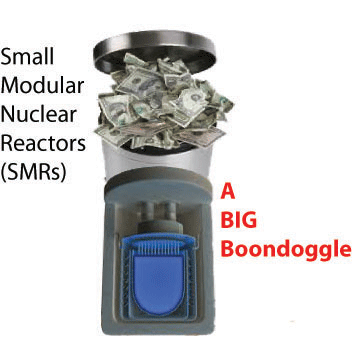 experts have warned that new power stations must not be imposed on local communities.
 Mini nuclear power stations in UK towns move one step closer, Telegraph UK, Kate McCann, senior political correspondent 2 APRIL 2016 Mini nuclear power stations in towns around the UK have moved a step closer after it emerged the Government is assessing suitable sites to push ahead with a build……….. campaigners are warning the plans could mean communities have new power stations forced on them if suitable sites are identified nearby.The Sunday Telegraph understands that sites in Wales, including the site of a former reactor at Trawsfynydd, and in the North of England where ex-nuclear or coal-fired power stations were stationed are being looked at as possible options.
Other areas including Bradwell, Hartlepool, Heysham, Oldbury, Sizewell, Sellafield and Wylfa are also thought to be possibilities. Small modular reactors are attractive because they can be built in factories and assembled on-site. They take less time to develop than conventional nuclear power stations but they produce much less power – meaning there must be more of them to generate sustainable energy and they must be built close to the communities they serve.
A former Government advisor warned the plans were dropped under the Coalition after pressure from Liberal Democrat Ministers because of fears that communities would reject nuclear power stations close to towns.
But in the Budget in March, George Osborne announced a funding competition to get the industry off the ground in the UK.
The document revealed: “The government is launching the first stage of a competition to identify a small modular nuclear reactor to be built in the UK, and will publish an SMR delivery roadmap later this year. It will also allocate at least £30m of funding for research and development in advanced nuclear manufacturing.”
A number of companies are already working on plans for the small power stations…………..experts have warned that new power stations must not be imposed on local communities.
Liberal Democrat energy spokesman Lynne Featherstone said: “It is just striking how little regard the Conservatives have for communities around this country, and the ridiculous lengths they’ll go to to avoid positive investment in renewables. Continue reading
New design nuclear reactors not happening for a long time (if at all)
“Our target is — can we really move the process forward and have a commercial option by 2030?” Mr. Kuczynski said. To do that, he and others say, the pace of the design process, and of the Nuclear Regulatory Commission’s review process, needs to be sped up.
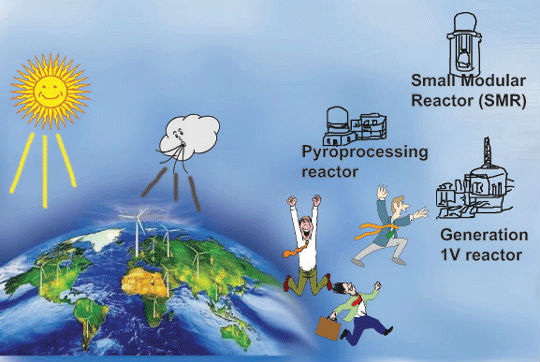
“It’s a 25-year process, no matter what,” said Michael McGough, the chief commercial officer of NuScale Power, which is the furthest along among companies working on less conventional reactors. NuScale’s design, called asmall modular reactor, uses water as a coolant, but the units are far smaller than current reactors and have advanced safety features. They could be built largely in a factory, saving money, and up to 12 of them could be installed at one site.
Mr. McGough knows all about long timetables; NuScale’s design has been under development since 2000……
Many in the industry hope that extending the licenses of existing reactors will forestall at least some closings. Nuclear plants were originally licensed for 40 years, but almost all have sought and received 20-year extensions.
The regulatory commission has begun researching what would be required to extend a plant’s life to 80 years. “We’re asking very basic questions, like how long can a reactor vessel remain acceptable since it’s being bombarded by neutrons,” said Scott Burnell, a spokesman………
Given the relatively poor economics of nuclear power, however, even if a plant could be licensed to operate up to 80 years, the question remains whether it would be financially worthwhile for it to do so, especially if expensive work is required. Skeptics cite two American plants that have been closed for economic reasons since 2012, after their licenses were extended to 60 years.
Similar economic uncertainties surround the latest generation of reactors, the Westinghouse AP1000……..
“What eventually happens with the four AP1000s will be very important,” said Matthew McKinzie, a senior scientist with the Natural Resources Defense Council. “If the economics of extending the lifetime of a plant to 80 years are poor, then what does that say about the economics of a new plant?”
Critics of nuclear power say that novel designs like molten salt reactors raise new issues, especially regarding safety, that will require much time to evaluate.
“A regulator can’t accept paper studies saying that a reactor is supersafe,” said Edwin Lyman of the Union of Concerned Scientists. “They need documentation, experimental data.”
“The industry and Department of Energy have this fantasy that you can have some general design-neutral licensing process,” he added………..http://www.nytimes.com/2016/03/22/science/nuclear-energy-power-plants-advanced-reactors.html?_r=0
Rolls Royce touts “football fields” of mini nuclear reactors for Britain

The UK’s current plans for a new wave of huge nuclear power stations is spinning out of control. The first, Hinkley Point in Somerset, was set to start generating in 2017 but questions over design and financing of the £18bn, 3,200 megawatt plant have put it years behind schedule.
The scheme was thrown into further doubt earlier this month when the finance director of EDF, the French company which will build Hinkley Point, quit over fears the company’s balance sheet could not withstand the huge costs.
Rolls Royce believes a series of mini reactors – known as “small modular reactors” (SMRs) – are a more viable medium-term solution to Britain’s looming energy crisis, although the first crop of new large reactors will still need to be deployed……..
Armed UK vessels secretly take weapons grade plutonium from Japan to USA
The Pacific Egret and its escort ship Pacific Heron are reportedly lightly armed UK flagged vessels and arrived in Kobe port from Barrow-in-Furness, England on March 4th. The Egret docked in Tokai for pre-transport logistics last week. Both ships after departing Tokai port will sail together most likely through the South Pacific to the east coast of the United States.
 NPT and Nuclear Security Risks’ Exposed by Secret Plutonium Shipment: NGOs, March 18, 2016 Tokyo- (PanOrient News) A coalition of five non-governmental organizations warned today that a shipment of weapons-grade plutonium scheduled to
depart the port of the Japanese Tokai nuclear station in Ibaraki prefecture this coming weekend highlights the failure, but also the proliferation risks, of the current Japanese nuclear policy.
A cargo of 331kg of plutonium will be loaded on to the Pacific Egret, an armed British nuclear transport ship, prior to departure under armed escort to the United States. It will be the largest shipment of separated plutonium since 1.8 tons of plutonium was delivered to Japan by controversial Akatsuki-maru in 1992. The two month voyage to the Joint Base Charleston-Weapons Station will then see the plutonium dumped at the Department of Energy Savannah River Site (SRS) in South Carolina. The U.S. National Nuclear Security Administration, which is responsible for the shipment, has identified that storage in Japan poses a security risk justifying its removal.
The organizations, Citizen Nuclear Information Center (Japan); Green Action (Japan); Savannah River Site Watch (U.S.); CORE (England), and Greenpeace, said in a statement they condemn the shipment as a dangerous distraction from the major problem in Japan which is its overall nuclear energy policy, where over 9 tons of plutonium remains stockpiled and there are plans to produce many tons more during the coming decade. The representatives of the five organizations have worked together over the past quarter century against Japan`s plutonium and nuclear fuel cycle program.
For the U.S. and Japanese government, the Tokai shipment will be mistakenly hailed as demonstrating their commitment to reducing the threat from fissile materials, the statement noted. Both Prime Minister Abe and President Obama plan to announce the ‘success’ of the removal from Japan, at the fourth Nuclear Security Summit from March 31st -April 1st in Washington, D.C., while Japan will be desperate to avoid any discussion of the proliferation and security threat posed by its plutonium fuel cycle program.
“If 331 kg of plutonium warrants removal from Japan on the grounds of its vulnerability and in the interests of securing nuclear weapons material, then there is no credible justification for Japan’s current program and future plans to increase its plutonium stockpiling. Hailing a shipment of hundreds of kilograms of plutonium as a triumph for nuclear security, while ignoring over 9 tons of the weapons material stockpiled in Japan and in a region of rising tensions, is not just a failure of nuclear non proliferation and security policy but a dangerous delusion,” said Shaun Burnie, senior nuclear specialist at Greenpeace Germany, who is currently in Japan. ……..
Failure of Japanese nuclear reprocessing plan. What to do with all that plutonium?
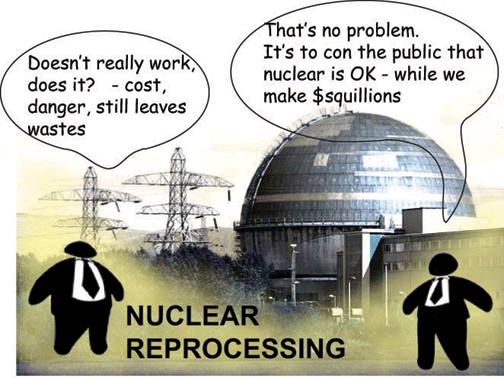 Two reactors, Takahama 3 and 4, owned by Kansai Electric, began operation in January and February 2016 loaded with plutonium MOX fuel, with unit 3 operating with 24 assemblies containing 1,088kg of plutonium and unit 4 with 4 assemblies containing 184kg of plutonium. Unit 4 shutdown due to an electrical failure three days after start up, while unit 3 was forced to shutdown on March 10th following a court order. Both reactors remain shutdown and are subject of a court injunction preventing operation issued by the Otsu district court, Shiga prefecture on March 9th. They are expected to be non operational for many months. Of the 26 reactors under review by the Nuclear Regulation Authority (NRA), Ikata-3, Genkai-3 and Tomari-3 are all intended to operate with plutonium MOX fuel.
“On current plans, and if ever the Rokkasho-mura reprocessing plant begins operation, Japan`s program could yield as much as 93,000kg by 2025 – most of which will remain unused. The reactor program in Japan is in crisis with no credible program for either restarting most reactors or using large amounts of this plutonium. If ever there was a time to abandon its current doomed nuclear energy policy, it is now. The Obama administration in its last year has an opportunity to step up and actively reduce the spiraling proliferation dynamic in East Asia – this should be top of the agenda in Washington instead of being ignored. The next step is to challenge the basis of the U.S.-Japan nuclear cooperation agreement which runs to 2018 – approval for Japan to continue acquiring plutonium must be reversed,” said Burnie.
NASA and Rosatom want nuclear rockets to take astronauts to Mars
Nasa wants to use nuclear rockets to get to Mars: Space agency claims the technique is ‘most effective way’ of reaching red planet
- Nuclear propulsion weighs almost half as much as a chemical rocket
- Nasa is also are planning to build rockets powered by nuclear fission
- They hope it could be used to carry astronauts to the red planet in 2033
- Follows news this week that Russia plans to test a nuclear engine in 2018
By ELLIE ZOLFAGHARIFARD FOR DAILYMAIL.COM
Nuclear thermal propulsion is ‘the most effective’ way of sending humans to Mars.
That’s according to Nasa administrator and former astronaut, Charles Bolden, who made the statement when speaking to Congress this week.
‘We are on a journey to Mars and most people believe that, in the end, nuclear thermal propulsion will be the most effective form of propulsion to get there,’ he said.
 He didn’t, however, expand on details on how quickly Nasa hoped the technology could get astronauts to Mars. ……..’A nuclear power unit makes it possible to reach Mars in a matter of one to one and a half months, providing capability for manoeuvring and acceleration,’ Sergey Kirienko, head of Rosatom told RT . http://www.dailymail.co.uk/sciencetech/article-3499441/Nasa-wants-use-nuclear-rockets-Mars-Space-agency-claims-technique-effective-way-reaching-red-planet.html
USA worried about weapons proliferation risks in China’s Nuclear Recycling plan
China’s Plans to Recycle Nuclear Fuel Raise Concerns U.S. energy secretary airs worries about proliferation risks ahead of nuclear-security summit WSJ, By BRIAN SPEGELE, 17 MAR 16, BEIJING—China’s plans to process spent nuclear fuel into plutonium that could be used in weapons is drawing concern from the U.S. that Beijing is heightening the risk of nuclear proliferation.
U.S. Energy Secretary Ernest Moniz, in Beijing for talks, said Thursday that China’s plans to build a nuclear-recycling facility present challenges to global efforts to control the spread of potentially dangerous materials……..
Mr. Moniz’s comments marked a rare public expression by the Obama administration of concern over China’s reprocessing plans. The differences, which the governments have discussed privately, are being aired ahead of a visit by President Xi Jinping to Washington this month for a summit with President Barack Obama and other world leaders on nuclear security.
The issue comes down to the different choices countries make over how to handle potentially dangerous waste created by commercial nuclear reactors. In the U.S., spent fuel is treated as sensitive material and is stored, and reprocessing is banned out of proliferation concerns.
Elsewhere, including in France and Japan, spent fuel is recycled to extract plutonium to be used in nuclear reactors. The U.S.’s concern is that the bigger the stockpiles of plutonium, the higher the risk that some of it could be refined for use in nuclear weapons or taken by terrorists……
U.S. concerns about nuclear reprocessing and proliferation are particularly acute in the Asia-Pacific region, “where the perception is there is less international cooperation, less transparency,” said Mark Hibbs, a nuclear expert at the Carnegie Endowment for International Peace………
larger Chinese stockpiles of isolated plutonium could prompt Japan, especially, to build up its caches.
Civilian plutonium stockpiles reached 271 metric tons by the end of 2014, up from around 150 metric tons in the 1990s, the International Panel on Fissile Materials, an independent group looking at nonproliferation policy, said in its latest annual report.
The official Xinhua News Agency reported in September that construction of China’s reprocessing facility may start in 2020 and take a decade to complete. The project is expected to have a processing capacity of 800 metric tons of spent fuel a year…..
Previously, the U.S. has questioned the economic viability of such projects, which are expensive to build and operate, as well as proliferation issues, Ernest Moniz said……
Mr. Hibbs from the Carnegie center said China’s decision to pursue reprocessing couldn’t be justified on economic or commercial grounds, given the billions of dollars needed to construct one large-scale facility. But China may be acting strategically, guaranteeing future fuel supply by recycling, he added.
Last June, state-owned China National Nuclear Corp. and France’sAreva SA agreed to speed up negotiations on building the facility. Areva didn’t respond to a request for comment on Mr. Moniz’s remarks and CNNC said its press officers weren’t available.
Write to Brian Spegele at brian.spegele@wsj.com http://www.wsj.com/articles/chinas-plans-to-recycle-nuclear-fuel-raise-concerns-1458228504
Dead nuclear reactors floating in space – a hazard for the future
Dozens of dead nuclear reactors are floating in space and they’ll eventually hit the Earth http://www.techinsider.io/nuclear-powered-satellites-space-2016-3
Rebecca Harrington At the height of our adoration of atomic energy, space agencies experimented with launching nuclear-powered spacecraft into orbit around the Earth.
It makes sense if you think about it.
Radioactive materials, like uranium-235, can power a tiny satellite for years. They’re more reliable than batteries and provide more energy than solar panels.
But back then, space-faring nations weren’t as concerned with radioactive waste. Nuclear disasters like Three Mile Island and Chernobyl hadn’t happened yet, and now we’re much more worried about radiation exposure.
That’s why the last nuclear-powered satellite, launched by the Soviet Union, blasted into orbit in 1988.
More than 30 different nuclear reactor-powered satellites still orbit the Earth. The US only ever launched one while the USSR launched all the rest.
Those nuclear reactors are similar to the ones in nuclear power plants on the ground. Uranium-235 undergoes fission, where its nucleus splits, giving off energy. This energy can be converted into electricity to power satellite instruments, or your house.
America’s uranium-fueled SNAP-10A entered into an orbit of 575 miles above the Earth in 1965. It operated for 43 days before it stopped responding. It’s now in a slow trajectory to hit the ground in about 3,000 years. By then, hopefully its radioactive cargo will be mostly harmless.
But if any of these nuclear reactor-powered satellites collide with another object in space, or suddenly crash to the ground, they could release radioactivity.
The Soviet Union had a few such mishaps since it launched all those nuclear satellites. In 1978, its spy satellite COSMOS 954 crashed into the Northwest Territories, scattering radioactivity across almost 48,000 square miles. Russia had to pay Canada $10 million for the damage.
And in 1995, NASA scientists found a cloud of liquid, radioactive sodium and potassium coolant in orbit. The space agency eventually figured out it came from the Soviet satellite Cosmos 1900. Something else in space crashed into it, causing the nuclear reactor to leak. The cloud of radioactive fluids is still floating up there, and space agencies continue to monitor it.
The good news is that all these dead nuclear reactor-powered satellites are in orbits higher than 430 miles. There’s barely any air molecules at that height to slow down the satellites, so it should take them hundreds or thousands of years to wind their way back to Earth — at which point much of their radioactive contents will have significantly decayed.
But NASA and Roscosmos, Russia’s space agency, are reportedly looking into building nuclear engines again: This time they want to build hyper-efficient rockets that might one day take humans to Mars.
If this sounds like science fiction, it’s not. NASA built several perfectly functional nuclear rocket engines from 1955 through 1973.
Here’s one called NERVA being test-fired in the desert: https://www.youtube.com/watch?v=j6gKFvPjGpQ
Those programs ended abruptly, however, because of environmental and budget concerns.
It remains to be seen if NASA or Roscosmos can keep funding, public support, and safety moving in its favor.
Russia and USA Pointing Nuclear Missiles at Asteroids – bonanza for Lockheed Martin etc
Why Is Russia Pointing Nuclear Missiles at Asteroids?Motley Fool 28 Feb 16
Surprise! Russia’s not the only one painting a bull’s-eye on space rocks. “…….Solid-fueled nuclear missiles, being on launch alert 24/7, are admirably suited for a last-minute launch to blast an asteroid before it turns into a meteor. Russia’s ICBMs aren’t currently programmed to aim at targets above the Earth, however, and will need to be repurposed for such missions. That’s what Russia hopes to do — and with Apophis swinging ’round in just over a decade, Russia thinks the asteroid makes a tempting target for testing its redesign.
Such an ambitious goal will cost money. Indeed, according to website DigitalTrends.com, “millions … in federal money is set to pour into detection efforts” over the coming years.National Defense magazine puts the number at at least $50 million annually, citing the recently passed fiscal year 2016 budget. This naturally raises the question in investors’ minds:
Who will get the loot?
ND identifies several likely suspects who could win these funds, including big defense contractors Lockheed Martin (NYSE:LMT) and Raytheon (NYSE:RTN). Lockheed is the company in charge of building NASA’s Space Fence, designed to keep track of man-made junk orbiting Earth. Lockheed and Raytheon both bid on the contract in 2013 — but only Lockheed won it. Similarly, Lockheed Martin and Ball Aerospace (NYSE:BLL) helped to build NASA’s NEOWISE infrared telescope,specifically designed to detect and track NEOs.
Multiple historic contract wins in the field of space-object detection make Lockheed Martin a logical beneficiary of any new contracts coming out of the PDCO office. Granted, $50 million might not sound like much to a company like Lockheed (which pulled down $46 billion last year, and is NASA’s single biggest publicly traded contractor). It might seem even less significant, given that Lockheed won’t win all the contracts coming up for bid, and might have to share some of the loot with Raytheon, Ball, or others. But $50 million could be only the starting point.
ND calls $50 million “a drop in the bucket” compared to what it will ultimately cost to categorize all NEO threats, much less develop a means of defeating them. To cite just one example of contracts moving in that direction, in 2022, NASA aims to send a spaceship to asteroid 65803 Didymous in an ambitious experiment to try to push the object into a new orbit far from Earth’s own………http://www.fool.com/investing/general/2016/02/28/why-russia-pointing-nuclear-missiles-at-asteroids.aspx
Westinghouse realised that Small Modular Nuclear Reactors (SMRs) are an economic dud
Westinghouse ditches small reactors http://funologist.org/2014/02/06/westinghouse-ditches-small-reactors/ 5 Feb 2014 The nuclear industry is often referred to as a priesthood, by critics and supporters alike. The thought is that the followers of the belief in nuclear power have to have a strong faith in the technology and a willingness to sacrifice themselves to advance the ideology. Some of the hardest working people I have ever met, promote nuclear power.
 Part of the understanding within the priesthood is that you try to never harm the position of others in the industry when you change your plans. So it was with special interest I read the recent news that Westinghouse had dropped out of the small reactor market. In this news story the Westinghouse spokes people (who are always very careful what they say to the press) tell us that the only reason they are dropping out of this technology is “there are no customers.” They go on to elaborate that the only way they can actually make money on small reactors is by selling a bunch of them. The Westinghouse CEO confessed, “Unless you’re going to build 30 to 50 of them, you’re not going to make your money back.”
Worldwide, no one is building reactors without huge financial incentives from the manufacturer or their supporting country. The idea that small reactors are going to be snapped up by utilities without external generous financing is as fanciful as the notion that nuclear power will be “too cheap to meter.”

But what is really going on here? My guess is that Westinghouse has done the economic math and they see that “they can’t get there from here.” That the persistent experience of the nuclear navy is repeating itself in the non-military world . That being that reactors do not shrink in an economically advantageous way. Nuclear power is fantastically complex stuff, the French EdF/Areva have put a lot of time and money into going the other way and building even larger reactors, hoping to get economies of scale.
The problem is not that you have to sell 50 of them, the problem is that no matter how many you sell, other energies are going to be cheaper, and so it is likely a loosing game from the get go.
Exposing the Big Hype about Small Modular Nuclear Reactors (SMRs)
to make this huge investment even begin to make sense you need to do it in a big way. It is unclear if the mass production savings of SMRs will offset the economy of scale advantages of current designs. what is clear is that attempts to use modular components in the four AP1000s currently under construction in the US have utterly failed to keep costs down, or even controlled.
And similarly this supposed benefit will not help the first handful of SMRs. The non-partisan group Taxpayers for Common Sense gave SMR’s their Golden Fleece Award for using taxpayer money where business should be paying.

The small reactors we find in nuclear military vessels produce electricity at ridiculously high prices per kilowatt. This is why no engineering firm is proposing these well understood designs for mass production. The cost of naval small reactor power never becomes competitive, even if mass produced.
Small reactors reduce costs by eliminating the secondary containment,increasing the chances nuclear accidents will not be contained. There is still no rad-waste solution for these reactors. Oh, and there are not even any finished designs for these reactors, much less prototypes.
Small is Ugly – the case against Small Modular Reactors http://funologist.org/2012/12/09/small-is-ugly-the-case-against-small-modular-reactors/
[With apologies to E.F. Schumacher, who wrote the important book Small is Beautiful] January 2016
“Don’t bet against technology.” is the advice i give to people who are saying certain industrial developments won’t happen, or will not happen soon. There are breakthroughs everyday and most of them are not forecasted much in advance. So why am I not excited about the recent Department of Energy’s decision to fund the development of Small Modular Reactor (SMR) designs?
So the hype runs like this. Continue reading
PRISM and Pyropressing – untested , toxic and dangerous new nuclear toys
 PRISM BURNS AND BREEDS PLUTONIUM MIXED WITH URANIUM AND ZIRCONIUM, THE MOST TOXIC AND DANGEROUS MAN MADE ELEMENT ON EARTH


UK govt spurns the success of renewable energy, follows the dodgy chimera of “Small Nuclear reactors”
nuClearNews No 82 Feb 16 Progress on Small Modular Reactors as renewables head off the cliff , In response to a letter about energy policy in The Times on 26th January 2016, Energy and Climate Change Secretary Amber Rudd listed the top 10 things the government is doing to secure investment in clean secure energy. Besides committing to Hinkley Point C, Rudd also mentioned spending £250m for nuclear innovation and Small Modular Reactors. (1) Oddly enough there was no mention of the rest of the 19GW of new reactors proposed – (up from 16GW now that Bradwell B has been added to the theoretical list)…….
1 This Month
29 Jan. Thursday 7-8 p.m. Webinar – World’s Largest Nuclear Station in Port Hope, ON?
To see nuclear-related stories in greater depth and intensity – go to https://nuclearinformation.wordpress.com/



31st January – Challenging the War Machine – a DECLASSIFIED UK SUMMIT


Website of the Week
Now until to February 10, 2026 Radioactive waste storage in France: the debate is finally open! How to participate?
-
Archives
- January 2026 (296)
- December 2025 (358)
- November 2025 (359)
- October 2025 (376)
- September 2025 (258)
- August 2025 (319)
- July 2025 (230)
- June 2025 (348)
- May 2025 (261)
- April 2025 (305)
- March 2025 (319)
- February 2025 (234)
-
Categories
- 1
- 1 NUCLEAR ISSUES
- business and costs
- climate change
- culture and arts
- ENERGY
- environment
- health
- history
- indigenous issues
- Legal
- marketing of nuclear
- media
- opposition to nuclear
- PERSONAL STORIES
- politics
- politics international
- Religion and ethics
- safety
- secrets,lies and civil liberties
- spinbuster
- technology
- Uranium
- wastes
- weapons and war
- Women
- 2 WORLD
- ACTION
- AFRICA
- Atrocities
- AUSTRALIA
- Christina's notes
- Christina's themes
- culture and arts
- Events
- Fuk 2022
- Fuk 2023
- Fukushima 2017
- Fukushima 2018
- fukushima 2019
- Fukushima 2020
- Fukushima 2021
- general
- global warming
- Humour (God we need it)
- Nuclear
- RARE EARTHS
- Reference
- resources – print
- Resources -audiovicual
- Weekly Newsletter
- World
- World Nuclear
- YouTube
-
RSS
Entries RSS
Comments RSS
 nuclear-news