Fusion nuclear reactors as a source of electricity? It’s something to be shunned.
These impediments—together with colossal capital outlay and several additional disadvantages shared with fission reactors—will make fusion reactors more demanding to construct and operate, or reach economic practicality, than any other type of electrical energy generator.
The harsh realities of fusion belie the claims of its proponents of “unlimited, clean, safe and cheap energy.” Terrestrial fusion energy is not the ideal energy source extolled by its boosters, but to the contrary: It’s something to be shunned.

 Fusion reactors: Not what they’re cracked up to be http://thebulletin.org/fusion-reactors-not-what-they%E2%80%99re-cracked-be10699 Daniel Jassby, 19 Apr 17 Daniel Jassby was a principal research physicist at the Princeton Plasma Physics Lab until 1999. For 25 years he worked in areas of plasma physics and neutron production related to fusion energy research and development. He holds a PhD in astrophysical sciences from Princeton University.
Long delay in development of India’s fast breeder nuclear reactor
Fast breeder nuclear reactor delayed by 8 yrs, Deccan Herald, Kalyan Ray, DH News Service, New Delhi, Apr 15 2017, On record, the target continues to be October 2017 The Centre has set a new target schedule of mid-2018 to commission India’s first gen-next fast breeder nuclear reactor – eight years behind original schedule. Sources in the Department of Atomic Energy told Deccan Herald that the middle of 2018 was being looked at a more realistic target to put the new reactor into operation.
Once functional, the fast breeder reactor would usher in the second stage of India’s three-stage nuclear power programme as envisioned by Homi Bhabha, the father of Indian nuclear programme.
Fast breeder reactors “breed” more fissile material than the fuel they consume. They burn plutonium – generated in Uranium-fueled pressured heavy water reactors and light water reactors – to breed a special type of fissile uranium known as U-233, which is used as fuel.
Anti-nuclear activists, however, are concerned on the FBR reactors for two reasons. No one is sure about its long-term commercial viability and ecological-impact in the absence of similar reactors in other nations. Secondly, it uses liquid sodium, a hazardous material as coolant.
The sodium cooling leads to a temperature of 600 degrees Celsius inside the reactor, because of which there are safety concerns.
“From the day of pouring liquid sodium into the system, we need at least five months for the FBR to generate commercial electricity,” sources said.
As per the original schedule, the project was to be commissioned in September, 2010, which was later rescheduled to September 2014.
The goalpost was against shifted to September 2016 and later on to October 2017….http://www.deccanherald.com/content/606431/fast-breeder-nuclear-reactor-delayed.html
Problems in Europe with Westinghouse nuclear fuel assemblies
 A Bankruptcy That Wrecked Global Prospects Of American Nuclear Energy, Forbes, Kenneth Rapoza “……….Unlike with fossil fuels, in nuclear, fuel assemblies are a high-tech and R&D-intensive product. These assemblies can make even reactors run more efficiently, sometimes exceeding their original lifespan. But under investment impacted the quality and comparative performance of WEC versus their main rival, Russian owned TVEL, a unit of Rosatom. In some markets fuel rods supplied by Westinghouse have failure rates almost 1.5 times greater than those manufactured by its competitors, according to at least one utility in Finland that has a Russian reactor.
Westinghouse supplies fuel assemblies mainly to Europe where it has always used its mighty lobbying clout in Brussels to prop their market share. Back in 2003, the European Commission adopted directive 2003/54/EC which made it compulsory for EDF, the French energy giant, to buy nuclear fuel from an “alternative vendor”. This completely opened the door to WEC, with wheels already in motion a year earlier. EDF buys about 15-20% of its fuel from Westinghouse today.
WEC had Washington’s help within companies operating Rosatom reactors, fiercely lobbying for nuclear fuel supply diversification in Eastern Europe. They tried to supply fuel assemblies to Finland and Czech Republic, but both countries eventually chose TVEL. The Czech even had to cancel their contract with Westinghouse amid safety concerns at their Temelin site, despite a large-scale lobbying push which involved letters from the European Commission to utilities encouraging them to switch to WEC. As of now, even after Washington’s cheerleading Toshiba, Westinghouse’s biggest star as far as nuclear fuel assembly diversification goes is Ukraine.
It’s quite understandable that Ukraine, effectively at war with Russia, may be tempted to turn a blind eye to the issues facing Westinghouse. But concerns over incident risks are growing amid reports that plants using WEC’s fuel have had frequent emergency outages. Many claim that corruption and lack of safety culture in Ukraine make it a really dangerous game potentially leading to another Chernobyl, according to a Washington Times columnist with a flare for the dramatic.
Westinghouse told me that their recent contracts with Ukraine to supply Russian built reactors with fuel assemblies was still intact……….
For Westinghouse’s global ambitions, China was the really big picture and Europe was its hub to challenge Russia’s market in the lucrative fuel assembly business. WEC says that the bankruptcy here will not affect their businesses there, but judge Michael Wiles rejected a request by the company to allow for Apollo’s loan to go towards WEC’s European units. Without those loans, the European companies could face their own funding woes now. AxilPartners said that a cash pool the European affiliates normally draws from was halted by the Swedish bank that serves as its monitor. It is unclear who this monitor is, or what that means precisely, Debtwire’s Tracy says. But without that bank, pensions in Europe could become a problem for Westinghouse, as well as tax and payroll issues cropping up in the U.K.
Westinghouse, meanwhile, is hoping for the best. Or as industry cynics would say: Westinghouse is hoping for pixie dust……https://www.forbes.com/sites/kenrapoza/2017/04/13/a-bankruptcy-that-wrecked-global-prospects-of-american-nuclear-energy/#608e8b7e17a1
Russia’s plans for nuclear waste ships: but where will they dump the radioactive trash?
Breaking the ice with loads of nuclear waste https://thebarentsobserver.com/en/security/2017/04/breaking-ice-loads-nuclear-waste Russia will build special purpose ship for voyages with radioactive waste and spent nuclear fuel along the Northern Sea Route. By Thomas Nilsen April 07, 2017
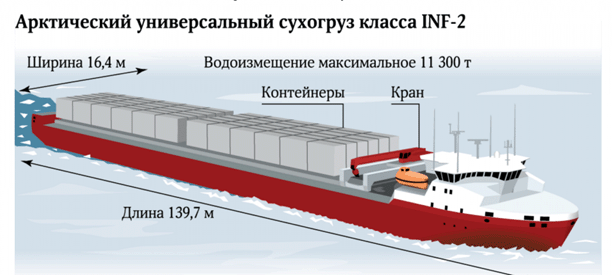
Construction starts in 2020 of the 140 meters long ice-classed vessel, approved for carrying irradiated nuclear fuel and High-Level radioactive waste, Izvestia reports.
Beneath the deck, it will be space for 40 to 70 special transport containers for spent nuclear fuel and the upper deck has space for containers with radioactive waste. The design, named INF-2, is made by Krylov State Research Centre in St. Petersburg, a design bureau that has Russia’s latest generation of nuclear powered icebreakers, submarines and warships on its list of merits.
In addition to sailing along the north coast of Siberia, the nuclear waste cargo vessel can make voyages up the Siberian Rivers like Ob and Yenisei, where several of Russia’s nuclear facilities are located, like the storage and planned reprocessing plant in Zheleznogorsk (former Krasnoyarsk-26).
Today, all transport of spent nuclear fuel from icebreakers, submarines and nuclear power plants from northwest Russia to the reprocessing plant in Mayak north of Chelyabinsk go by train through the most inhabited areas of Russia.
Where will the vessel sail?
Andrey Zolotkov, a nuclear expert and former head of the environmental group Bellona in Murmansk says the news that such cargo vessel will be built raises many questions.
«When stating that radioactive waste will be transported out of the Arctic and the Far East, where, interestingly will it then be taken?» asks Zolotkov. He does not immediately see an urgent need for transportation of spent nuclear fuel and radioactive waste, but agrees that transport to locations along the Siberian rivers could be an option.
«But, maybe they link this vessel to the plans for new floating and smaller nuclear power plants in the Arctic.»
Andrey Zolotkov, that earlier worked on board Atomflot’s service vessel «Imandra» says the icebreaker fleet will need a new service vessel as well in the future.
«Such vessel could very well replace «Imandra» for storage of spent nuclear fuel from icebreakers,» he says.
Floating nuclear power plant
Krylov State Research Centre says on its portal that one of the tasks for such vessel could be to transport the spent nuclear fuel from Bilibino nuclear heat power plant in Pevek on the Chukotka Peninsula. Bilibino is the world’s northernmost nuclear plant and shutdown procedure is likely to start in 2019. As a replacement, Russia’s first floating nuclear power plant, the «Akademik Lomonosov» will be placed in Pevek.
Another task for such new vessel, supposed to be operated in a consortium consisting of Rosatom and the military, could be to transport solid radioactive waste to a future repository. Location of such repository is yet to be decided; one option under consideration and approved by county authorities in Arkhangelsk is is the Arctic archipelago of Novaya Zemlya.
There are today stored tens of thousands of cubic meters of solid radioactive waste both on the Kola Peninsula, in Severodvinsk by the White Sea and at naval yards in the Far East.
On the Kola Peninsula, the Italian built vessel «Rossita» is later this year ready to start transport of containers with spent nuclear fuel out of the Andreeva Bay. The containers will be taken to Atomflot in Murmansk where they will be reloaded to railwagons for transport further to Mayak. «Rossita» is not suitable for voyages along the Northern Sea Route or into the river systems in Siberia.
Earlier, the Russian Northern Fleet had its own transport and storage vessels of the Malina-class (Project 2020) for spent nuclear fuel from submarines.
French utility Engie backs out of UK Moorside nuclear project
 UK’s Moorside nuclear project in turmoil as Toshiba’s French partner backs out, Guardian, 5 Apr 17,
Troubled tech giant forced to take sole ownership of NuGen after Engie sells stake, adding to uncertainty over plan for three reactors Toshiba has been forced to buy out the French utility Engie from a project to build three nuclear reactors in Moorside, northwest England, further straining the Japanese company’s finances and adding to uncertainty over the project.
Engie said on Tuesday it was exercising its right to sell its 40% stake in the NuGen venture to Toshiba following the bankruptcy of the Japanese firm’s Westinghouse nuclear power plant business. Toshiba will pay 15.3 billion yen ($138.5m) for the stake.
Toshiba is now the sole owner of NuGen, but has said it is looking for more investors to join the $15-20bn project or to sell out altogether…..
EDF’s £18bn Hinkley Point C nuclear project in Somerset got the final go-ahead in 2016 after several years of delay, but only after securing backing from the French government.
Korea Electric Power Corp (Kepco) is a potential investor: its chief executive said last month it was in talks to buy a stake in NuGen.
Britain’s energy minister is currently in South Korea for talks on future collaboration between the two countries, including nuclear projects, a government spokeswoman said…….https://www.theguardian.com/business/2017/apr/04/toshiba-moorside-nuclear-nugen-engie-reactor
Brexit brings bad news for world’s biggest active nuclear fusion project
Brexit brings nuclear (con)fusion http://www.politico.eu/article/world-leading-nuclear-fusion-project-threatened-by-brexit/ The world’s biggest active nuclear fusion project could lose EU funding just as it gears up for its grand finale. By SARA STEFANINI , 4/6/17, CULHAM, England — Just as European scientists here gear up to put decades of experiments to the test and try to bottle up the nuclear reaction that powers every star in the universe, Brexit is throwing the future of their work into doubt.
The 34-year-old Joint European Torus (JET), which sits in the Culham Centre for Fusion Energy’s retro 1960s laboratory, is a crucial part of an international research push on nuclear fusion that hopes to, one day, fuel homes and cities with energy free of greenhouse gases and waste.
Despite its location in the Oxfordshire meadows, JET is an EU venture through and through. The hundreds of scientists, engineers and technicians who visit the center to conduct experiments, as well as the parts used to assemble the world’s biggest nuclear fusion reactor so far, come from all around the Union.
Crucially, so does the €283 million that underpins the JET program for the five years through 2018. New European Commission funding, at least for 2019 and 2020, looked pretty certain — until Britain’s referendum, and London’s announcement in January that it would leave the European atomic energy community, Euratom, once the U.K. leaves the block in two years.
Talks to renew JET’s funding are now on hold, according to Culham center officials. What happens after 2018 depends largely on the outcome of Brexit negotiations.
The uncertainty could delay or even derail the JET program’s grand finale: Heating two hydrogen isotopes — heavy hydrogen (deuterium), which comes from water, and super-heavy hydrogen (tritium), from lithium — to temperatures hotter than the center of the sun.
“New Generation” reactors the saviours of the nuclear industry ? – Not very likely.
As things stand, no country, company or utility has any intention of betting billions on building an SMR supply chain. The prevailing scepticism is evident
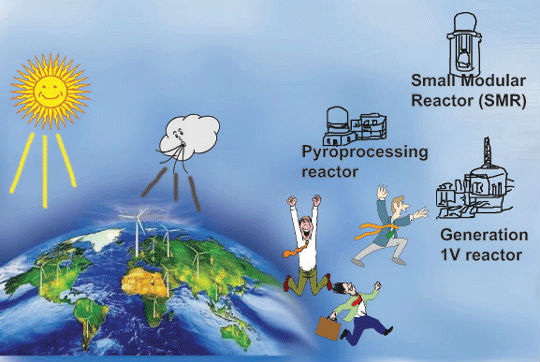
Lobbyists debate responses to the nuclear power crisis, Online opinion By Jim Green – , 27 March 2017 Lobbyists debate solutions to the crisis “……… The four Third Way / Breakthrough Institute authors conclude that “a radical break from the present light-water regime … will be necessary to revive the nuclear industry”. Exactly what that means, the authors said, would be the subject of a follow-up article.
So readers were left hanging – will nuclear power be saved by failed fast-reactor technology, or failed high-temperature gas-cooled reactors including failed pebble-bed reactors, or by thorium pipe-dreams or fusion pipe-dreams or molten salt reactor pipe-dreams or small modular reactorpipe-dreams? Perhaps we’ve been too quick to write-off cold fusion?
The answers came in a follow-up article on February 28. The four Third Way / Breakthrough Institute authors argue that nuclear power must become substantially cheaper and this will not be possible “so long as nuclear reactors must be constructed on site one gigawatt at a time. … At 10 MW or 100 MW, by contrast, there is ample opportunity for learning by doing and economies of multiples for several reactor classes and designs, even in the absence of rapid demand growth or geopolitical imperatives.”
Other than their promotion of small reactors and their rejection of large ones, the four authors are non-specific about their preferred reactor types. Any number of small-reactor concepts have been proposed.
Small modular reactors (SMRs) have been the subject of much discussion and even more hype. There’s quite a bit of R&D ‒ in the US, the UK, South Korea, China and elsewhere. But only a few SMRs are under construction: one in Argentina, a twin-reactor floating nuclear power plant in Russia, and three SMRs in China (including two high-temperature gas-cooled reactors). The broad picture for SMRs is much the same as that for fast neutron reactors: lots of hot air, some R&D, but few concrete plans and even fewer concrete pours.
There isn’t the slightest chance that SMRs will fulfil the ambition of making nuclear power “substantially cheaper” unless and until a manufacturing supply chain is mass producing SMRs for a mass market ‒ and even then, it’s doubtful whether the power would be cheaper and highly unlikely that it would be substantially cheaper. After all, economies-of-scale have driven the long-term drift towards larger reactors.
As things stand, no country, company or utility has any intention of betting billions on building an SMR supply chain. The prevailing scepticism is evident in a February 2017 Lloyd’s Register report based on “insights and opinions of leaders across the sector” and the views of almost 600 professionals and experts from utilities, distributors, operators and equipment manufacturers. Respondents predicted that SMRs have a “low likelihood of eventual take-up, and will have a minimal impact when they do arrive”.
In the absence of a mass supply chain, SMRs will be expensive curiosities. The construction cost of Argentina’s 25 MWe CAREM reactor is estimated at US$446 million, which equates to a whopping US$17.8 billion / GW. Estimated construction costs for the Russian floating plant have increased more than four-fold and now equate to over US$10 billion / GW.
Small or large reactors, consolidation or innovation, conventional reactors or Generation IV pipe-dreams … it’s not clear that the nuclear industry will be able to recover however it responds to its current crisis.http://onlineopinion.com.au/view.asp?article=18929&page=0
A declassified report describes strange UFO incident near a nuclear station
DECLASSIFIED: TR-3B UFO staked out nuclear power plant, claims shock government report http://www.express.co.uk/news/weird/783479/TR-3B-UFO-Cooper-Nuclear-Station-Nebraska-Black-Vault A TRIANGLE-shaped UFO hovered above a nuclear power plant for two consecutive nights newly declassified government files have revealed. By JON AUSTIN, Mar 24, 2017 Papers released under freedom of information laws describe reports by a former security officer at the power plant describing the strange incident.
The unnamed officer worked at the Cooper Nuclear Station near Brownville, Nebraska, according to the files released by the Nuclear Regulatory Commission (NRC).
The incident was described as an “unidentified flying object violating the protected area at the station”.
According to the documents, the report was only received by the former employee in June 2010.
The report said: “An unidentified flying (UFO) object violated the protected area at Cooper Nuclear Station between 1986 and 1989, but the event was not reported to the NRC as required.
“The CI [confidential informant] described an event that occurred during his employment as a security officer.
“He was employed there from 1986 through 1989 and did not remember specifically when during that time the event occurred.
“While posted at the intake structure one night, he observed an ‘unidentified flying object’ fly down the Missouri River about 150 feet in the air and hover in front of the intake. He observed it for a few moments and then contacted a fellow security officer who also observed it.”
It said that after they watched it together, the object went back up the river.
Colleagues did not believe the pair, it was reported.
It said the following evening, the officer saw the UFO return.
He did not tell anyone until it came into the protected area and hovered just north of the reactor building.
The man described it as triangular in shape with a rotating circle of lights on the bottom. This matches the description of the alleged TR-3B triangular UFO, which some conspiracy theorists claim is a secret US spy craft developed using reverse engineered alien technology taken from crashed flying saucers.
It was also reportedly silent and a third of the size of the reactor building.
He the called the security room and most officers on shift reportedly saw it.
The report addedL “These individuals included (names reacted), all of whom still work at the plant today.
“After hovering there for a few minutes, the UFO exited the protected area and returned back up the river to the north as it had the previous night.
“The CI said that he never saw the UFO at the plant again after that evening.”The whistleblower said the incident should have been reported as a violation of the protected area space but was not reported.
The documents show that Nick Taylor, the NRC senior resident inspector, searched for corroborating documents from the time, but found nothing.
However, he said: “I’d be careful about concluding that if an event wasn’t recorded in CAP [Corrective Action Program] that it did not occur.”
The files were published on UFO website TheBlackVault.com, whose founder John Greenewald requested they be released.
The website includes millions of declassified documents, many obtained by Mr Greenewald.
A computer model to simulate how 20 MILLION people would react to nuclear bomb in New York City
Scientists to simulate how 20 MILLION people would react to nuclear bomb in New York City . http://www.mirror.co.uk/news/world-news/scientists-simulate-how-20-million-10054846 Experts are building a computer model which will test how people and buildings would respond to a nuclear blast 18 MAR 2017 Scientists are testing how 20 million people would react to a nuclear attack in New York City.
Experts at the Center for Social Complexity in Virginia have been awarded a $450,000 (£363,000) grant to study the aftermath of a blast in the Big Apple.
The model is also expected to show how buildings and the environment would be affected.The simulated bombs will have a strength of up to 10 kilotons – half the amount used in the Hiroshima attack.
Professor William Kennedy predicted survivors would follow instructions and stay in place instead of running wildly on the streets in search of loved ones.
He told the magazine: “We’ve found that people seem to be reasonably well behaved [Ed. oh isn’t that nice?] and do what they’ve been trained to, [Ed. very good. so it’ll all be OK? ] or are asked or told to do by local authorities. Reports from 9/11 show that people walked down many tens of flights of stairs, relatively quietly, sometimes carrying each other, to escape buildings. “We’re finding those kinds of reports from other disasters as well—except after Hurricane Katrina.”
The project is expected to take three years.
But professor Kennedy said he hoped to start experiments in the next six months and report some results from next year.
UK plans for small nuclear reactors stalling. Bechtel pulls out.
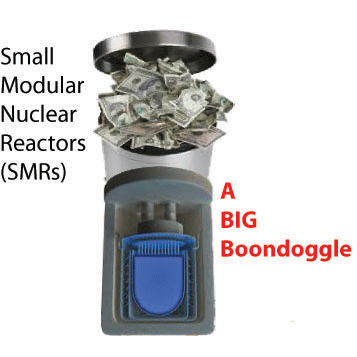 Bechtel pulls out of mini-nuclear development, Construction News, 17 MARCH, 2017Bechtel is to pull out of small modular reactor development, the US engineering giant has confirmed. The company said it would no longer be attempting to create its own SMR reactor after it was unable to find investment for its programme, or a utility company that would provide a site.
Bechtel’s SMR aspirations were as part of mPower, a joint venture with energy giant Babcock & Wilcox…..
Bechtel will take itself out of the government’s SMR reactor design competition.
In March 2016 the government launched its £250m SMR competition which set out to identify the preferred reactor technology to be rolled out across the UK over the next 15 years. The Bechtel team was listed as one of the 33 parties to have made it past the first round of the competition, including engineering firms such as Atkins and contractors such as Costain.
Alongside firms such as Westinghouse and NuScale Power, the mPower JV was one of the companies capable of developing the technology after its reactor design was recommended for “further government investigation” by the National Nuclear Laboratory in 2014.
The competition has stalled ever since, with sources telling Construction News that they have been largely left in the dark by the government over the next steps……
NRC Accepts NuScale Small Modular Reactor Design Certification Application
Power Magazine, 03/16/2017 | Aaron Larson The Nuclear Regulatory Commission (NRC) has accepted NuScale Power’s small modular reactor (SMR) design certification application and will provide a design review schedule soon.
The NRC’s acceptance marks a major milestone for the first SMR design to ever attempt obtaining U.S. certification. NuScale, in which Fluor Corp. is a majority investor, submitted its application on January 12.
The certification process can take several years. The NRC set a 40-month target for completion, NuScale said. During that time, the NRC studies the reactor design to determine if it meets U.S. safety requirements. If a certification is issued, it is valid for 15 years and companies can reference the certified design when applying for combined licenses……http://www.powermag.com/nrc-accepts-nuscale-small-modular-reactor-design-certification-application/
Bogus claims made for Transatomics’ molten salt nuclear reactor
Molten Salt Reactor Claims Melt Down Under Scrutiny 03/08/2017 more http://www.powermag.com/blog/molten-salt-reactor-claims-melt-down-under-scrutiny/ Kennedy Maize It was an astonishing event when two MIT nuclear engineering graduate students at the end of 2015 announced they had come up with a revolutionary design for a molten salt nuclear reactor that could solve many of the technological problems of conventional light-water 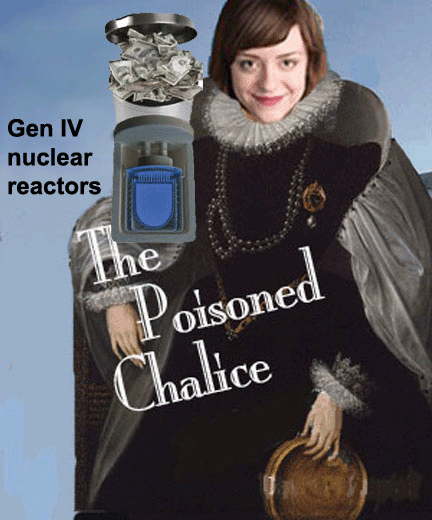 reactors. Cofounders of the firm Transatomic – Leslie Dewan and Mark Massie – hyped their technology as able to run on conventional spent fuel, and “generate up to 75 times more electricity per ton of mined uranium than a light-water reactor.”
Their claims surfaced in MIT’s highly regarded magazine, Technology Review, under the headline, “What if we could build a nuclear reactor that costs half as much, consumes nuclear waste, and will never melt down?”
Dewan and Massie raised millions of dollars in venture capital, including a chunk of Peter Theil’s Founders Fund. Transatomic said it would have a demonstration reactor in operation by 2020. The entrepreneurs touted their technology, which had its roots in work of the legendary Alvin Weinberg at Oak Ridge National Laboratory in the 1950s, as passively safe and more efficient than conventional nuclear generating technology.
Then it came under scrutiny from the MIT nuclear graybeards. The grad students got it wrong. Very wrong.
Transatomic’s response: Never mind.
The hyped claims for the technology prompted MIT physics professor Kord Smith to raise his eyebrows. As Technology Review reported, somewhat shamefacedly, Smith thought the claims for the technology were bogus, based on the physics, notified the MIT hierarchy, and launched an inquiry. The magazine quoted him, “I said this is obviously incorrect based on basic physics.” He asked the company to run a test, which ended up confirming that “their claims were completely untrue.”
Transatomic recalculated its hyperbolic claims, and posted the results. It concluded that “75 times” was fantastic, and the real figure was “twice,” still a worthwhile increase in fuel efficiency, but hardly earth shattering. The new analysis also concluded that the technology could not use spent fuel to power its reactor technology, undercutting a major claimed advantage for the technology.
Founder Leslie Dewan told Technology Review that she now hopes to develop a demonstration reactor by 2021. But any advanced technology of this sort that meets Nuclear Regulatory Commission rules would be decades away.
Was this hyperbolic advancement of the venerable molten salt technology intentional? MIT’s Smith, who blew the whistle on the claims, says it was innocent. The founders didn’t subject their initial calculations and claims to any kind of peer review. Smith told Technology Review, “They didn’t do any of this intentionally. It was just a lack of experience and perhaps overconfidence in their own ability. And then not listening carefully enough when people were questioning the conclusions they were coming to.”
In other words, this was another case of technology hubris, an all-to-common malady in energy, where hyperbolic claims are frequent and technology journalists all too credulous.
Uneasy collaboration between “old” nukes and “new ” nukes

SOICHI INAI, Nikkei staff writer NEW YORK — As part of its strategy to service aging nuclear plants, GE Hitachi Nuclear Energy (GEH) will develop a cutting-edge small modular reactor in cooperation with Advanced Reactor Concepts, the company said Monday………
GEH has been targeting older plants with its own SMR currently under development, and decided to bring on board Advanced Reactor Concepts — also known as Arc Nuclear — due to its expertise with sodium-cooled reactor technology, key to producing SMRs.
The two companies will initially work on a next-generation SMR in Canada.
SMRs manufactured by GEH and Advanced Reactor Concepts each have about 10% the power-generating capacity as Westinghouse’s AP1000 reactor.http://asia.nikkei.com/Business/Companies/GE-Hitachi-Nuclear-developing-new-SMR-with-US-company
Small Modular Reactors have little hope of saving the nuclear industry
Terminal decline? Fukushima anniversary marks nuclear industry’s deepening crisis, Ecologist, Jim Green / Nuclear Monitor 10th March 2017
 “……..Small is beautiful? The four Third Way / Breakthrough Institute authors argue that
 nuclear power must become substantially cheaper – thus ruling out large conventional reactors “operated at high atmospheric pressures, requiring enormous containment structures, multiply redundant back-up cooling systems, and water cooling towers and ponds, which account for much of the cost associated with building light-water reactors.”
Substantial cost reductions will not be possible “so long as nuclear reactors must be constructed on site one gigawatt at a time. … At 10 MW or 100 MW, by contrast, there is ample opportunity for learning by doing and economies of multiples for several reactor classes and designs, even in the absence of rapid demand growth or geopolitical imperatives.”
Other than their promotion of small reactors and their rejection of large ones, the four authors are non-specific about their preferred reactor types. Any number of small-reactor concepts have been proposed.
Small modular reactors (SMRs) have been the subject of much discussion and even more hype. The bottom line is that there isn’t the slightest chance that they will fulfil the ambition of making nuclear power “substantially cheaper” unless and until a manufacturing supply chain is established at vast expense.
And even then, it’s doubtful whether the power would be cheaper and highly unlikely that it would be substantially cheaper. After all, economics has driven the long-term drift towards larger reactors.
As things stand, no country, company or utility has any intention of betting billions on building an SMR supply chain. The prevailing scepticism is evident in a February 2017 Lloyd’s Register report based on “insights and opinions of leaders across the sector” and the views of almost 600 professionals and experts from utilities, distributors, operators and equipment manufacturers.
The Lloyd’s Register report states that the potential contribution of SMRs “is unclear at this stage, although its impact will most likely apply to smaller grids and isolated markets.” Respondents predicted that SMRs have a “low likelihood of eventual take-up, and will have a minimal impact when they do arrive”.
The Third Way / Breakthrough Institute authors are promoting small reactors because of the spectacular failure of a number of large reactor projects, but that’s hardly a recipe for success. An analysis of SMRs in the Bulletin of the Atomic Scientists sums up the problems:
Without a clear-cut case for their advantages, it seems that small nuclear modular reactors are a solution looking for a problem. Of course in the world of digital innovation, this kind of upside-down relationship between solution and problem is pretty normal. Smart phones, Twitter, and high-definition television all began as solutions looking for problems.
“In the realm of nuclear technology, however, the enormous expense required to launch a new model as well as the built-in dangers of nuclear fission require a more straightforward relationship between problem and solution. Small modular nuclear reactors may be attractive, but they will not, in themselves, offer satisfactory solutions to the most pressing problems of nuclear energy: high cost, safety, and weapons proliferation.”
Small or large reactors, consolidation or innovation, Generation 2/3/4 reactors … it’s not clear that the nuclear industry will be able to recover – however it responds to its current crisis……..http://www.theecologist.org/News/news_analysis/2988749/terminal_decline_fukushima_anniversary_marks_nuclear_industrys_deepening_crisis.htm
China planning nuclear power for space projects
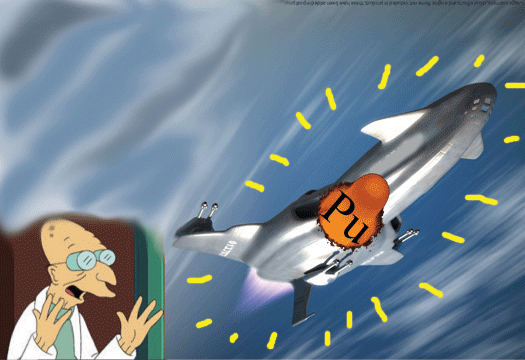 China plotting SPACE INVASION as groundbreaking nuclear programme announced, Daily Star UK , 10 Mar 17 CHINA is going to use nuclear power as part of the superpower’s ultimate goal of dominating space. The country is testing and developing nuclear technology that can be used as part of its galaxy exploration plan.
Wang Siren, the vice chairman the China Atomic Energy Authority, confirmed the news yesterday.
He said nuclear power is going to be the most viable source of energy for conducting space projects, such as those planned for Jupiter and Mars…..
The announcement comes amid increasing fears of a potential cosmic conflict as countries battle it out for space dominance…..
Last year, a US official warned that the use of intergalactic weapons could have devastating consequences for people on Earth…..http://www.dailystar.co.uk/news/latest-news/595456/china-space-war-nuclear-power-russia-weapons-us-rockets-missiles
1 This Month
29 Jan. Thursday 7-8 p.m. Webinar – World’s Largest Nuclear Station in Port Hope, ON?
To see nuclear-related stories in greater depth and intensity – go to https://nuclearinformation.wordpress.com/



31st January – Challenging the War Machine – a DECLASSIFIED UK SUMMIT

Website of the Week
Now until to February 10, 2026 Radioactive waste storage in France: the debate is finally open! How to participate?
-
Archives
- January 2026 (288)
- December 2025 (358)
- November 2025 (359)
- October 2025 (376)
- September 2025 (258)
- August 2025 (319)
- July 2025 (230)
- June 2025 (348)
- May 2025 (261)
- April 2025 (305)
- March 2025 (319)
- February 2025 (234)
-
Categories
- 1
- 1 NUCLEAR ISSUES
- business and costs
- climate change
- culture and arts
- ENERGY
- environment
- health
- history
- indigenous issues
- Legal
- marketing of nuclear
- media
- opposition to nuclear
- PERSONAL STORIES
- politics
- politics international
- Religion and ethics
- safety
- secrets,lies and civil liberties
- spinbuster
- technology
- Uranium
- wastes
- weapons and war
- Women
- 2 WORLD
- ACTION
- AFRICA
- Atrocities
- AUSTRALIA
- Christina's notes
- Christina's themes
- culture and arts
- Events
- Fuk 2022
- Fuk 2023
- Fukushima 2017
- Fukushima 2018
- fukushima 2019
- Fukushima 2020
- Fukushima 2021
- general
- global warming
- Humour (God we need it)
- Nuclear
- RARE EARTHS
- Reference
- resources – print
- Resources -audiovicual
- Weekly Newsletter
- World
- World Nuclear
- YouTube
-
RSS
Entries RSS
Comments RSS
 nuclear-news