NASA reveals ‘nuclear engine’ that could provide power to the first humans on Mars
NASA plans to test the Kilopower engines on Earth this year
Will use a uranium rector the size of a toilet roll to create heat
High efficiency Stirling engine would then convert this to electricity, By Mark Prigg For Dailymail.com, 15 November 2017 |NASA’s Space Technology Mission Directorate (STMD) has provided multi-year funding to the Kilopower project.
The technology could produce from one to 10 kilowatts of electrical power, continuously for 10 years or more. The average U.S. household runs on about five kilowatts of power.
Testing is due to start in November and go through early next year, with NASA partnering with the Department of Energy’s (DOE) Nevada National Security Site to appraise fission power technologies.
‘The Kilopower test program will give us confidence that this technology is ready for space flight development.
‘We’ll be checking analytical models along the way for verification of how well the hardware is working,’ said Lee Mason, STMD’s principal technologist for Power and Energy Storage at NASA Headquarters.
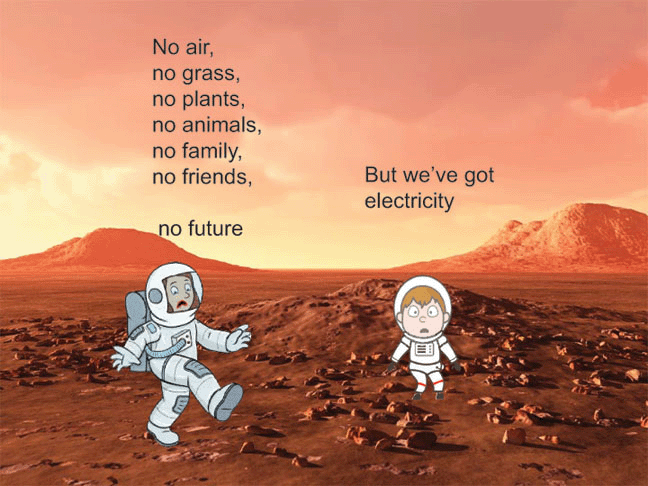
NASA is set to begin testing a radical ‘nuclear engine’ that could provide power for astronauts on the Martian surface.
Dubbed the ‘Kilopower’ it would use a uranium rector the size of a toilet roll to create heat.
The roadmap was released by the China Aerospace Science and Technology Corporation (CASC), China’s primary space contractor. CASC is the company that builds China’s successful Long March family of rockets, and its roadmap sets the company’s goals from the end of this year all the way out to 2045.
The first goal is to have the next-gen Long March 8 rocket ready by 2020. This rocket is currently in development and designed to be a low-cost, light payload rocket that can carry small satellites to orbit.
Then, in 2025, CASC plans to have developed a reusable space plane that can take off and land horizontally. This space plane would be a two-stage-to-orbit spacecraft primarily used for space tourism. The company hopes to improve on this design and complete a single-stage-to-orbit plane by 2030.
This plan is, in a word, ambitious. While a few single-stage-to-orbit aircraft have been considered in the past, none have made it to the prototype stage and all have been abandoned as impractical. But CASC’s plan is not done there.
By 2035 the company wants to make its entire line of rockets reusable, and by 2040 it hopes to have an entirely new line of launch vehicles. These will include a nuclear-powered space plane and other vehicles capable of “multiple interstellar round-trips, exploiting space resources through asteroid mining and constructing megaprojects such as a space-based solar power station,” whatever that means.
Of course, just because CASC puts these ambitious goals in a roadmap doesn’t mean any of them will actually happen, but it does show that the Chinese space community is confident about what they think they’ll achieve over the next few decades. We’ll just have to wait and see if that confidence will pay off.
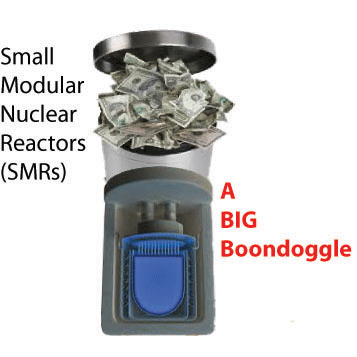
The Financial Times reports that the Government is preparing to revive the faltering effort to create a new generation of small-scale nuclear reactors in spite of an official analysis that cast doubt on the economic case for the technology. Talks have intensified in recent weeks between government officials and companies including Rolls-Royce, the UK engineering group, over potential public funding to support development of so-called small modular reactors (SMRs).
Development of SMRs is regarded as crucial to the future of the nuclear industry as it struggles to remain competitive against the rapidly falling cost of renewable wind and solar power. Support for SMRs is expected to be part of a wider commitment to nuclear engineering in a new industrial strategy to be unveiled by the government this month.
However, the enthusiasm has been complicated by a technology assessment, commissioned by the business department and carried out by EY, the accounting firm, which reached a negative verdict on the cost-effectiveness of SMRs. The findings are expected to be published in the coming weeks and will confront the government with awkward questions about why public money should be used to help commercialise the unproven technology.
Competitors are expecting the government’s funding for SMRs to be split into three areas, with the largest portion being committed to technology ready for rapid deployment over the next decade. In the future there may also be funding for more experimental technology, with a third area of potential financial support for suppliers working alongside SMR developers, according to people briefed on the government’s plans. The most intense competition for funding is in the first of these areas, with Rolls-Royce vying with rivals including NuScale and Westinghouse of the US. (1)
At the Tory Party Conference the Policy Exchange organised a fringe meeting entitled “A Nuclear Reactor in Every Town”. According to Matthew Rooney, who is the Policy Exchange’s Energy and Environment Research Fellow, “It is fair to say large nuclear reactors are not doing very well in the nuclear world” as evidenced by Hinkley Point C “It is very difficult in liberalized economies to fund large nuclear reactor projects these days and that is where small modular reactors could come in.” Small modular reactors (SMRs), he said, offer the potential to provide scalable and reliable low carbon power and heat. (2)
It’s easy to see why Rolls Royce and other companies in the nuclear engineering business are pushing the UK government finance the development a new generation of SMRs says Oliver Tickell, writing in the Ecologist. Whether the project succeeds or fails, there are juicy profits to be had for them at taxpayers’ expense. But it is much harder to see why the Government might fall for the industry’s techno-optimism which is pure fantasy for a second time in a little over a decade. (3)
According to a recent report by Rolls-Royce and its partners in the ‘SMR Consortium’ (SMRC), a UK SMR program could create 40,000 skilled jobs, contribute £100 billion ($132 billion) to the economy and open up a potential £400 billion global export market. Nuclear Industries Association chairman Lord (John) Hutton claims in the foreword that a UK SMR programme could “help the UK become a vibrant, world-leading nuclear nation.” He asserts his belief that “it is fundamental for the UK to meet its 2050 decarbonisation targets and will deliver secure, reliable and affordable electricity for generations to come.”
The SMRC report envisages an approximate doubling of the UK’s 9.5GW existing nuclear capacity by 2030, then another doubling by 2050 to around 40GW. That implies that come 2050, SMRs would be delivering some 30GW – the output of 100 300MW units scattered around the UK.
There are just two problems with the rosy scenario, says Tickell. First, the techno-optimism that oozes from every page is a fantasy. The cost of renewables is falling so fast that nuclear power will be utterly irrelevant in meeting decarbonisation targets. There is no £400 billion export market. Who would want SMRs in 2050, when their power will be 50-100 times more expensive than solar?
Secondly, nuclear power stations have got bigger to achieve economies of scale: it’s much cheaper to build a single 1.2GW unit than four 300MW units, or a dozen 100MW units. There is nothing new about SMRs – they have been powering submarines and aircraft carriers ever since the 1950s. If there really are huge cost savings to be achieved from the mass production of SMRs, how come they have not already been achieved?
We now know thanks to Andy Stirling and Philip Johnstone of Sussex University that the government wants to use the civilian nuclear programme to generate expertise, and technology, for military use, especially reactors for Trident nuclear submarines. Lord Hutton gave the game away in his introduction to the SMRC report when he wrote: “A UK SMR programme would support all 10 ‘pillars’ of the Government’s Industrial Strategy and assist in sustaining the skills required for the Royal Navy’s submarine programme.”
Senior civil servants revealed that the government’s decision to build a new generation of civil nuclear power stations starting with Hinkley Point is linked to maintaining enough skills to keep Britain’s nuclear deterrent. The disclosure came at a hearing of the Commons Public Accounts Committee looking at the huge cost of building Hinkley Point power station which critics see as uneconomic and not properly costed.
Stephen Lovegrove told the committee “I was in regular discussion with Jon Thompson, former Permanent Secretary at the MOD, to say that as a nation we are going into a fairly intense period of nuclear activity … We are building the new SSBNs (nuclear armed nuclear submarines) and completing the Astutes … We are completing the build of the nuclear submarines which carry conventional weaponry. We have at some point to renew the warheads, so there is very definitely an opportunity here for the nation to grasp in terms of building up its nuclear skills.” (4)
With regard to Hinkley, Stirling and Johnstone say there is a “remarkable persistence and intensity of UK Government attachments to what is increasingly recognised as an economically untenable project.” The persistence of this nuclear attachment looks to be at least partly due to a perceived need to subsidise the costs of operating and renewing the UK nuclear-propelled submarine fleet. (5)
The governments new Clean Growth Strategy includes, amongst other things, £20m R&D/innovation funding for low carbon heat and energy efficiency, but that is dwarfed by the £480m proposed for nuclear R&D including R&D on SMRs. In terms of low carbon research priorities there are arguably more urgent options to explore such as Power to Gas (P2G) especially. (see Balancing Green Energy, nuclear News No.100 http://www.no2nuclearpower.org.uk/nuclearnews/NuClearNewsNo100.pdf) The Government’s funding priorities need to be debated further. (6) http://www.no2nuclearpower.org.uk/nuclearnews/NuClearNewsNo101.pdf
For many in the nuclear industry, having watched all their much-touted GW-scale reactors go down the pan, and having had to accept that their long-cherished dream of a new generation of fast-breeder reactors will never materialise, SMRs are almost the last resort.
There are literally dozens of different SMR designs out there, with the USA, Russia, South Korea, China and now the UK bigging up the superiority of their particular whizz-bang design – but there are NO CLIENTS anywhere in the world….. billions of dollars ploughed into one prototype or another, but very little to show for it at the end of the day.
Just as I don’t believe we’ll ever see Hinkley Point finished and generating electricity, nor do I believe that a new generation of SMRs will ever materialise, ensuring that the insane dream of the UK as ‘a vibrant nuclear nation’ will remain just that – an insane dream.
Small Modular Reactors: The Nuclear Industry’s Latest Pipe Dream, http://www.jonathonporritt.com/blog/small-modular-reactors-nuclear-industrys-latest-pipe-dreamJonathon Porritt, 4 Nov 17 You’ve got to hand it to the nuclear industry: they’re one resilient bunch of never-say-die hard-arses! By any standards, 2017 has been an annus horribilis for the industry, with one body blow after another, all around the world. And 2016 wasn’t that much better either.
This is spelled out in almost excruciating detail in this year’s ‘World Nuclear Industry Status Report’ (WNISR), an annual stocktake that dispassionately lays out what’s been happening in the preceding year from technological, engineering, political and financial points of view. Continue reading →
FT 7th Nov 2017,British ministers are preparing to revive the UK’s faltering effort to
create a new generation of small-scale nuclear power plants in spite of an
official analysis that cast doubt on the economic case for the technology.
Talks have intensified in recent weeks between government officials and
companies including Rolls-Royce, the UK engineering group, over potential
public funding to support development of so-called small modular reactors
(SMRs).
Greg Clark, business secretary, is keen to put the UK at the
forefront of technology seen as a more affordable alternative to
large-scale nuclear reactors such as those under construction at the £20bn
Hinkley Point C plant in south-west England.
Development of SMRs is regarded as crucial to the future of the nuclear industry as it struggles
to remain competitive against the rapidly falling cost of renewable wind
and solar power. The UK faces competition from the US, Canada and China in
its effort to establish a leading position in the technology.
Support for SMRs is expected to be part of a wider commitment to nuclear engineering in
a new industrial strategy to be unveiled by the government this month.
However, the enthusiasm has been complicated by a technology assessment, commissioned by the business department and carried out by EY, the accounting firm, which reached a negative verdict on the cost-effectiveness of SMRs. The findings are expected to be published in the coming weeks and
will confront the government with awkward questions about why public money
should be used to help commercialise the unproven technology. https://www.ft.com/content/bddfda80-c314-11e7-b2bb-322b2cb39656
ENTHUSIASM for space travel has been mounting since Australia hosted the recent International Astronautical Congress (IAC), held in Adelaide in September.
“ … more than 3000 of the world’s top space experts wildly cheered [and] all aspects of Australian society were united on the need for a national agency.”
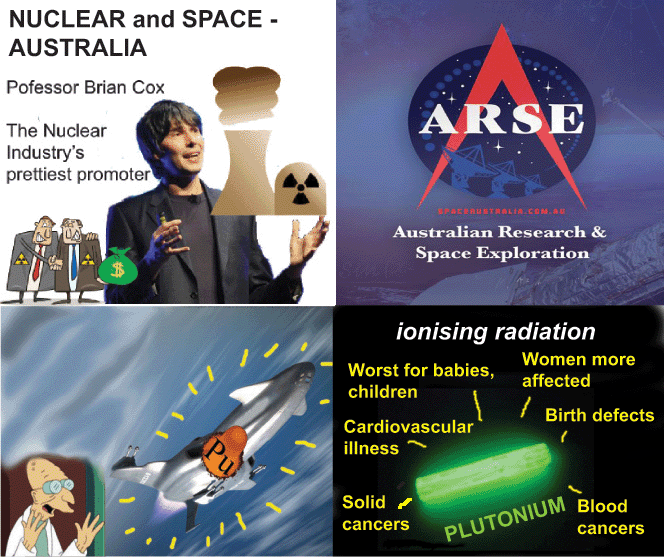
In November, the very brilliant and appealing space travel and nuclear power enthusiast, Professor Brian Cox is to tour Australia! Champion astronaut Scott Kelly has just published his exciting book, Endurance: a Year in Space, A Lifetime of Discovery.
Dare anyone throw cold water on all this joy?
Intriguingly, the Australian Government, while proudly hyping up this initiative, has not yet come up with a title for the new agency. However, someone else has and they have set up an elegant and professional-looking website for it: Australian Research and Space Exploration (ARSE).
Let’s start with that most important consideration — money
Although everyone says that space exploration is going to be an economic bonanza, I can’t see how it’s actually going to bring in money. There are some vague suggestions about finding mineral resources on other planets. Even NASA seems hard-put to find any real commercial benefits.
They discuss a few useful scientific and medical technologies — for example, water purification techniques and advanced eye surgery. These are side benefits of space research but surely could have been developed more cheaply with research on Earth directly intended for the purpose. I am reminded of the “benefits” of man walking on the moon in 1966 – we got Teflon – and even that didn’t turn out so well.
What about the costs of space exploration, space travel and sending a man to Mars? It is very hard to locate actual figures. Even three years ago, NASA’s space travel research cost taxpayers US$17.6 billion (AU$22.9 billion) — and costs have surely risen by now. A huge part of the cost is in fitting and fuelling the space rockets’ thermoelectric generators with the production of the plutonium fuel being the most costly part of the expense.
Plutonium fuel
Plutonium 238 fuelled Voyager 1, which is expected to keep going until 2025, the New Horizons trip to Pluto and Cassini, which recently crashed into Saturn. NASA is sanguine about risks of a space exploration accident, claiming that it’s a low probability.
Karl Grossman has described a previous accident, dispersing plutonium widely and the risks involved in the Cassini project thus:
‘ … the Plutonium-238 used in space devices is 280 times more radioactive than the Plutonium-239 used in nuclear weapons.’
A very small amount of Plutonium-238, that cannot be seen, felt, or measured with a Geiger counter is enough to kill you. One nanoparticle inhaled and lodged in the lungs is enough to give anyone lung cancer. In experiments with dogs, there was no dose low enough to NOT cause the death of these animals. Just one nanoparticle the size of dust (1 microgram) that could not even be seen, was enough to kill every dog tested.
There is a long list of space travel accidents, including 19 rocket explosions causing fatalities, as well as nine other crashes/accidents causing fatalities. There seems to be no published research on rockets and space debris that have ended up in the oceans. We can assume that such ocean debris does exist, including the long-lasting radioactive particles of plutonium, to be carried thousands of miles by ocean currents.
Ocean crashes are sometimes reported, but the public is generally unaware of the space junk and the plutonium that goes into the oceans. NASA is very coy about publicly stating that the rocket’s rockets’ thermoelectric generators are, in fact, fuelled by plutonium.
NASA continues research on solar-powered space flights, but that idea seems out of fashion at the moment.
The human toll of space travel
The human toll of space travel is not emphasised. However, Scott Kelly, who holds the U.S. record for time spent in space, has been quite frank about this in his new book. As an identical twin, Scott is an especially useful person for studying the effects of space on the body.
He became, in fact, a laboratory research animal — a sacrificial lamb, perhaps, in the cause of space research:
‘I lost bone mass, my muscles atrophied and my blood redistributed itself in my body, which strained and shrank the walls of my heart. More troubling, I experienced problems with my vision, as many other astronauts had. I had been exposed to more than 30 times the radiation of a person on Earth, equivalent to about ten chest X-rays every day. This exposure would increase my risk of a fatal cancer for the rest of my life.’
Despite Scott’s extraordinary health problems, which linger to this day, he is optimistic and keen about human travel to Mars.
Which brings us to the biggest consideration: the ethics of all this.
I am fascinated that it is stated in Wikipedia, in assessing the cost of sending humans to Mars (over US$500 billion or AU$651 billion), that:
‘The largest limiting factor for sending humans to Mars is funding.’
I think that the human cost should be a bigger “limiting factor”. There’s still the problem of lethal radiation on the trip and on Mars. Plus it’s a one-way trip. Scott Kelly has detailed, especially, the mental distress of being stuck in a spacecraft for months, isolated from human society and from loved ones, as well as the physical problems. Despite all this, Scott is keen on space travel and humans going to Mars. He is carried along, it seems, by a love of adventure, of risk, of achievement and fame.
Comfortable old white men in suits are planning the Mars trip; Younger, enthusiastic young men and women, like Scott Kelly, are mesmerised by the adventure and perceived “glory”. Should we be encouraging them on this suicide mission?
We are constantly being told of the benefits to come, in space travel. What benefits? Are they greater than the huge environmental and personal risks? And the financial costs – the US$500 billion (AU $651 billion), paid for by the tax-payer? That money could go to meet real human needs. There’s something wrong with our priorities when we mindlessly accept enthusiasm for technology, innovation, and so on, as better than healing the health of this planet and its populations.
Nuclear power
And there is one other issue — nuclear power. The space hype coincides with the current drastic downturn in the fortunes of the nuclear industry. To continue with space research/travel, plutonium is needed. And the only way to get it is from nuclear reactors. Space science could be a lifeline for the failing nuclear industry.
It’s no coincidence that the International Astronautical Congress was held in Adelaide — Australia’s hub of nuclear ambition. It’s no coincidence that Professor Brian Cox is visiting, hot from his recent pep talks to the nuclear industry in Wales.
The government is due to announce a £250 million support package for ‘small modular reactors’ his week, just as the price of wind and solar power contracts fall 10% below UK wholesale prices. OLIVER TICKELL argues that the Britain’s ‘civilian’ nuclear power expenditure is actually a camouflaged subsidy to the UK’s Trident nuclear missile system.
It’s easy to see why Rolls Royce and other companies in the nuclear engineering business are pushing the UK government finance the development a new generation of ‘small modular reactors’ or SMRs. Whether the project succeeds or fails, there are juicy profits to be had for them at taxpayers expense.
Rather harder to understand is why the government should see the slightest merit in the idea.
According to a recent report by Rolls-Royce and its partners in the ‘SMR Consortium’ (SMRC), a UK SMR program could create 40,000 skilled jobs, contribute £100 billion ($132 billion) to the economy and open up a potential £400 billion global export market.
Nuclear Industries Association chairman Lord (John) Hutton claims in the foreword that a UK SMR programme could “help the UK become a vibrant, world-leading nuclear nation.” He asserts his belief that “it is fundamental for the UK to meet its 2050 decarbonisation targets and will deliver secure, reliable and affordable electricity for generations to come.”
The SMRC report envisages an approximate doubling of the UK’s 9.5 GW existing nuclear capacity by 2030, then another doubling by 2050 to around 40GW. That implies that come 2050, SMRs would be delivering some 30GW – the output of 100 300MW units scattered around the UK.
There are just two problems with the rosy scenario. First, the techno-optimism that oozes from every page is a fantasy. Nuclear power stations have got bigger to achieve economies of scale: it’s much cheaper to build a single 1.2GW unit than four 300MW units, or a dozen 100MW units.
As an illustration of the principle, take a look at the wind power industry. One of the main reasons why offshore wind has come down so much in cost is the move to ever-larger wind turbines. A single new 8MW turbine may now be bigger than an entire wind farm of 20 years ago.
This story goes all the way back to the 1950s …
But first we must realise – there is nothing new about SMRs! They have been powering submarines and aircraft carriers ever since the since USS Nautilus was launched in 1955, over 60 years ago. And the world’s first purely civilian nuclear plant, at Shippingport in the USA, a 60MW SMR, went live in 1957. While civilian reactors got bigger, many hundreds of SMRs have been built and deployed for naval use.
Now if there really are huge cost savings to be achieved from the mass production of SMRs, how come they have not already been achieved? What is that that generations of super-smart nuclear engineers have missed? Industry claims of less complex financing and ‘process engineering’ may ring a little hollow, but – for the sake of argument – let’s accept that all the claimed cost reductions can be achieved. On the SMRC’s projections,
“The levelised cost of electricity (LCOE) generated by a FOAK [first of a kind] UK SMR power station is forecast under £75 per MWh and this reduces to a forecast £65 per MWh by station number five. In the medium term the target is even lower at £60 per MWh.”
This is a good bit cheaper than the inflation-proof £92.50 / MWh (in 2013 money) the government has promised to pay for Hinkley C’s power for 35 years following the plant’s opening. But it’s a lot higher than current wholesale power prices of around £42 / MWh.
The ever shrinking cost of renewable energy
Last month the price of offshore wind power reached a new low of £57.50 per MWh in an auction for contracts, guaranteed for just 15 years. Onshore wind is even cheaper: contracts awarded in Germany in May reached another new low of €42.80 / MWh (£38.24) – less than current UK wholesale power prices. And Germany’s latest solar auction, a few days ago, delivered bids as low as €42.90 per MWh. Both these technologies appear viable with no subsidy at all.
The cost of solar PV panels continues its precipitous decline. Recent figures show the cost of panels in the Netherlands declining at 11% per year, or 50% every five years. The trend may continue for a long time to come.
Extrapolate these declining renewable cost trends to 2030, and we can expect solar power to cost around £10 per MWh, with wind at £20-30 per MWh. By 2050, wind power costs will surely have halved again, with solar around £1 per MWh. So what will be the use of nuclear power at £60-75 per MWh?
Of course there will be costs in integrating large volumes of variable, non-despatchable power supply into the grid. It will mean using ‘dynamic demand’ or ‘smart grid’ technologies, energy storage in giant batteries and hydropower stations, large scale power-to-gas and power-to-liquid-fuel conversion (in turn displacing fossil fuels from transport) … and the base cost of power will be astonishingly low by current standards, not just in the UK but all over the world.
So Lord Hutton’s hyperbolic claims are wholly erroneous. Nuclear power will be utterly irrelevant in meeting decarbonisation targets. There is no £400 billion export market. Who would want SMRs in 2050, when their power will be 50-100 times more expensive than solar?
The ‘nuclear deterrent’
We now know (thanks to Andy Stirling and Philip Johnstone of Sussex University) that the government wants to use civilian nuclear programme to generate expertise, technology, for military use, especially reactors for Trident nuclear submarines. What better way than to pour billions of pounds into SMRs under the pretence that the technology is for civilian use?
Actually Lord Hutton himself gave the game away when he wrote: “A UK SMR programme would support all 10 ‘pillars’ of the Government’s Industrial Strategy and assist in sustaining the skills required for the Royal Navy’s submarine programme.”
More recently, on 10th October, defence procurement minister Harriet Baldwin MP replied to a question by Caroline Lucas MP that, “[i]n all discussions it is fully understood that civil and defence sectors must work together to make sure resource is prioritised appropriately for the protection and prosperity of the United Kingdom.”
But there are signs that BEIS Secretary Greg Clarke may be getting tired of subsidising the UK’s nuclear missiles. In 2015 former Chancellor George Osborne announced a £250 million SMR competition for the most promising ideas. The outcomewas to be published last autumn. it wasn’t. By May 2017, the nuclear industry and its backers in the House of Lords were panicking. Then the SMRCs report ‘UK SMR: A National Endeavour‘ was issued this 20th September in a desperate attempt to ginger up the process. It has failed – so far.
Could a sudden fit of common sense, logical thinking and sound economics have come across senior UK ministers? Probably not. The Telegraphreports today that BEIS is to publish the competitions ‘results’ in a study this week, announcing Rolls Royce and its SMRC partners as the winners. “We are currently considering next steps for the SMR programme and we will communicate these in due course”, a BEIS spokesman said.
This Author
Oliver Tickell is contributing editor at Resurgence & Ecologist magazine and a former editor of The Ecologist.
Washington Post 20th Oct 2017,The world’s biggest scientific experiment is on course to become the most expensive source of surplus power. Components of the 20 billion-euro ($24 billion) project are already starting to pile up at a construction site in the south of France, where about 800 scientists plan to test whether they can harness the power that makes stars shine.
Assembly of the machine will start in May. Unlike traditional nuclear plants that split atoms, the
so-called ITER reactor will fuse them together at temperatures 10-times hotter than the Sun — 150 million degrees Celsius (270 million Fahrenheit). Its startling complexity, with more than a million pieces and sponsors in 35 countries, mean questions remain about over whether the reactor will work or if it can deliver electricity at anything like the cost of more traditional forms of clean energy.
With wind-farm developers starting to promise subsidy-free power by 2025 and electricity demand
stagnating, even the project’s supporters are asking whether ITER will ever make sense. “I’m dubious,” said Chris Llewellyn Smith, director of energy research at Oxford University who has spoken in favor of the research project. “The cost of wind and solar has come down so rapidly, so the competition has become harder to beat than you could have conceivably imagined a decade ago.” http://washpost.bloomberg.com/Story?docId=1376-OY3SHX6S972801-2RKS837QMLNSJG9Q1LHCUFO248
Designs for ‘mini’ nuclear power plants proposed by Rolls-Royce led group set to be given go-ahead, Telegraph Alan Tovey 22 OCTOBER 2017
An important report assessing the viability of new “mini” nuclear power plants for the UK to be published this week is expected to give the green light to develop designs proposed by a British consortium led by Rolls-Royce.
The Department for Business, Energy and Industrial Strategy (BEIS) is set to issue a study which formally ends a competition between different types of low-carbon power generation to assess which should be supported.
Industry sources say a concurrent Techno-Economic Assessment for the government by EY concludes that designs for small nuclear reactors (SMRs) from the Rolls consortium are the more likely to succeed.
Even if it works, it will be expensive relative to alternatives, By Anna Hirtenstein, 21 Oct 17,
The world’s biggest and most expensive science experiment is likely to be threatened by the advance of renewable energy. Questions remain about whether the ITER nuclear fusion project will work at all, let alone provide electricity at anything like the cost of more traditional forms of clean energy. Solar power has plummeted 62 percent in the past five years, wind has followed a similar trend and even the best-case scenario would result in fusion being significantly pricier than renewables.
Why “stupid” machines matter: Autonomous weapons and shifting norms, Bulletin of the Atomic Scientists, Ingvild Bode, Hendrik Huelss 13 Oct 17, In August, a group of experts on robotics and artificial intelligence released an open letter to the UN Convention on Certain Conventional Weapons. The well-publicized letter called on the convention “to find a way to protect us all from” the dangers of autonomous weapons systems—and drew attention to a lack of international regulation on autonomous weapons (often understood as weapons that “once activated, can select and engage targets without further human intervention”).
In 2013 the convention added autonomous weapons to the list of weapons it might consider restricting or outlawing. But parties to the convention remain far from agreement on how to define “lethal autonomous weapons systems” or “appropriate human control of autonomous weapons”—a necessary precursor to further discussions on the topic or to a pre-emptive ban of the sort advocated by the Campaign to Stop Killer Robots.
In December of last year, the convention established a Group of Governmental Experts, with a mandate to discuss lethal autonomous weapons systems—but the group’s first meeting has been postponed twice for budgetary reasons. It is now scheduled for next month.
Deliberative processes that might examine autonomous weapons from the perspective of the laws of war—processes, that is, that could result in new regulations—are notoriously sluggish. Meanwhile, autonomous weapons technology is developing apace. Nations such as the United States, China, Russia, South Korea, and the United Kingdom continue to develop autonomous weapons and related dual-use technologies, meaning that deployment of these weapons could become a fait accompli before any pre-emptive ban can be negotiated.
The current debate over autonomous weapons exhibits two important shortcomings. First, though it is important to examine autonomous weapons from the legal and regulatory perspective, doing so can fail to capture the reality that autonomous weapons, and the practices associated with their development and deployment, can alter norms themselves. For example, practices surrounding autonomous weapons can produce new understandings, outside and beyond international law, of when and how using force is appropriate. As Herbert Lin has written in the Bulletin, the unrestricted submarine warfare of World War II undermined agreed-upon norms about the conduct of war; other such examples are not hard to find.
Second, when observers discuss autonomous weapons’ game-changing potential in international relations and security policy, they often overemphasize the technologically sophisticated autonomous weapons of the future. (This tendency is shaped by popular culture’s “Terminator” vision of humanoid monsters and is affected by the lack of a consensus definition of “autonomous weapons” or “autonomy.”) Overemphasizing technologically sophisticated weapons seems to result in a belief that the international community should just wait to see whether “killer robots” indeed become reality. However, no matter how important advanced artificial intelligence will be for future weapons systems, it is “stupid” autonomous weapons that require attention now.
(This issue has been discussed, for example, by Noel Sharkey, an emeritus professor of artificial intelligence and robotics at the University of Sheffield—and, in a broader context, by Toby Walsh, a professor of artificial intelligence at the University of New South Wales.)
To sort out these problems, it is helpful to contrast autonomy with mere automation. Drawing on definitions from basic robotics, automated machines can be said to run according to fixed and preprogrammed sequences of action. Autonomous systems, meanwhile, are defined by their ability to adapt: An autonomous device’s “actions are determined by its sensory inputs, rather than where it is in a preprogramed sequence.” This level of autonomy is easy to achieve—one need only think of robotic vacuum cleaners. But where weapons are concerned, even this level of autonomy contests the idea of appropriate human control. And importantly, unlike the humanoid killer robots of possible future scenarios, this level of autonomy already exists………
It is sometimes presumed that autonomous weapons will demonstrate ethical superiorityover humans. Any such superiority is still hypothetical, but autonomous weapons might lack potentially problematic emotions such as fear, anger, or vengefulness. Presumed ethical superiority leads to further procedural arguments for constructing autonomous weapons as “better soldiers” that will outperform humans morally and in terms of compliance with international humanitarian law. If this argument becomes more dominant, the widespread development and deployment of autonomous weapons will become more likely—further escalating the possibility that procedural norms will affect the public and legal norms that underlie international law and notions of legitimacy.
The US military’s pervasive and accelerating deployment of drones, and drones’ centrality in US security policy, show that practices indeed shape norms. Drones have become “preferred” security instruments due to specific rationales based on procedural norms. Autonomous weapons’ versatility, the dual-use character of their main features, and the technological rivalry among major powers qualify them as very important instruments—and this makes their regulation more difficult. Whenever procedural norms prevail over legal and ethical norms, the latter category, unfortunately, is likely to yield or adapt.
To be sure, some types of autonomous weapons might be banned in the future. But practices now being established regarding autonomous weapons are already setting standards about the future use of force. This trend should be monitored much more closely—regardless of whether the Convention on Certain Conventional Weapons, governments, and nongovernmental organizations find common ground in their struggle to define what autonomous weapons are in the first place. https://thebulletin.org/why-%E2%80%9Cstupid%E2%80%9D-machines-matter-autonomous-weapons-and-shifting-norms11189
Abstract (Abstract is Copyleft, duplication permitted but only with attribution and link to original )
The International Thermonuclear Experimental Reactor (ITER) is the largest and most expensive science experiment on Earth today. Public outreach for the experimental fusion reactor, under the direction of Laban Coblentz, the head of the ITER communications office, has led journalists and the public to believe that, when completed, the reactor will produce 10 times more power than goes into it.
It will do no such thing. The $22 billion reactor is designed to produce only 1.6 times more thermal power than it consumes in electric power. Using a more conservative calculation, the reactor will lose more power than it produces. The planned output power of the reactor has been reported correctly, but the input power for the reactor has been widely reported, incorrectly, as 50 megawatts. The actual input power value, rarely discussed publicly, will be significantly larger.
For decades, some proponents of thermonuclear fusion research have used a double meaning for the phrase “fusion power” yet failed to inform the public, the news media, or legislators about the existence of this dual meaning. This ambiguity has caused non-experts to think that power production rates from large-scale thermonuclear fusion experiments show greater technological progress than has actually occurred. As a result, people who are not fusion experts think that ITER will achieve a power production rate, or power amplification, six times larger than its design specification. ITER will produce power at a rate of only two-thirds of the rate it will consume power, when comparing electric power input to equivalent electric power output.
Some fusion proponents have used the secondary meaning of “fusion power” to convince non-experts that the record-setting 1997 fusion experiment in the Joint European Torus (JET) reactor in the U.K. had produced thermal power at a rate of 65 percent of the electric power consumed by the reactor and, therefore, that the reactor had come close to producing power at a rate equal to the rate of power consumed. In fact, in that experiment, the reactor produced power in heat at a rate of less than 2 percent of the power in electricity it consumed. Coblentz and the ITER communications group have used the same double meaning to promote the publicly funded $22 billion ITER reactor, under construction now in southern France.
Fusion research insiders know that the current primary goal of ITER is not to demonstrate power amplification of the reactor. Instead, they know, the main goal is the power amplification of the fusion plasma, a significantly different measurement. Fusion experts say that non-experts understand the distinction, but nearly all evidence, as shown for example in news coverage by The New York Times, Scientific American, Bloomberg, Forbes and BBC News, is to the contrary. The double meaning of the phrase “fusion power” went unnoticed for years and has misled experienced journalists, scientists, members of the public and elected officials…….http://news.newenergytimes.net/
Why is it that the citizens of teh United States put up with their tax money going to produce toxic plutonium for useless dangerous space travel and even more useless dangerous and illegal nuclear weapons.?
What happens when a spacecraft powered by plutonium crashes into a city?
Report: It’s space travel power versus pits at Los Alamos By Mark Oswald / Journal Staff Writer, Thursday, October 5th, 2017 SANTA FE – At Los Alamos National Laboratory, a mandate to produce more of the plutonium triggers for nuclear weapons is bumping up against goals to produce power systems for NASA’s “long duration space missions.”
The U.S. Government Accountability Office reports that lab officials say that plutonium work for NASA systems “must compete with other priorities for facility space” at the LANL’s plutonium facility, specifically production of nuclear weapons “pits.”
The problem could significantly effect a key step in production of “radioisotope power systems” (RPS) and delay delivery of the systems for NASA’s missions, says the GAO report.
RPS produce power by converting heat from decay of plutonium-238 into electricity and can operate where solar panels or batteries would be ineffective and can operate for more than a decade, according to the report.
An RPS is currently used to power the roving Mars Science Laboratory, known as Curiosity, that has been exploring the Red Planet since 2012. Other missions in the coming years are slated to use the power systems, including another rover, Mars 2020.
The GAO was asked to review the situation in part because the National Academy of Sciences has expressed concern about future NASA missions because of a diminishing supply of plutonium-238. Until 2015, it hadn’t been made in the U.S. for more than 25 years. Various laboratories within the Department of Energy are involved. The GAO report says LANL maintains capability for producing Pu-238 and its work involves Pu-238 storage, chemical processing, analysis, fuel processing and encapsulation of Pu-238…..
LANL is also under orders to produce as many as 80 plutonium pits by 2030, as part of an expansive update of the nation’s nuclear arsenal. None have been made for several years.
The GAO report says the National Nuclear Security Administration, a semi-autonomous agency within DOE that includes LANL and the rest of the U.S. nuclear weapons complex, is currently “focused primarily” on making pits and has not coordinated with the Pu-238 program in connection with potential modifications of the Los Alamos plutonium facility…….https://www.abqjournal.com/1074021/report-its-space-travel-power-versus-pits-at-los-alamos.html
SMR Supply Chains, Costs, are Focus of Key Developments, Neutron Bytes, Dan Yurman October 4, 2017
Small modular reactors won’t be able to compete with natural gas plants combined with renewables unless and until they get enough orders to justify building factories to manufacture them in a mass production environment.
Holtec Opens SMR Manufacturing Center in New Jersey
In September Holtec announced the grand opening of a $360M, 50 acre SMR manufacturing center in Camden, N.J. The firm was incentivized by the State of New Jersey to locate there with $260M in tax breaks. According to Holtec the Camden plant will eventually employ up to 1,000 people……….
Dr. Singh, Holtec’s President and CEO, declared the factory to be “Ground Zero” for the renaissance of nuclear energy and heavy manufacturing in America.
“It will serve as the launching pad for the regeneration of manufacturing in the United States.”
He added, “We will build nuclear reactors here, and they will sail from the port of Camden to hundreds of places around the world.”
Is Holtec Headed for Ukraine to Manufacture SMRs for Europe & Asia?
The maturing of an American supply chain to support mass production of components for SMRs might develop, but not all of it may be in the U.S. Holtec International, is reportedto be in talks about planning to arrange the production of small modular reactors (SMRs) for nuclear power plants in Ukraine, and for export to Europe and Asia.
The Interfax wire service report, which was not confirmed by Holtec, comes on the heels of the firm’s grand opening of a $360M nuclear energy component manufacturing center in Camden, NJ. It is the second report in three months providing details of Holtec International’s discussions with Energoatom. However, a spokesperson for Holtec declined to comment on these discussions as reported by Interfax.
The Intefax report quotes Energoatom National Nuclear Energy Generating Company of Ukraine President Yuriy Nedashkovsky who said,
“There is a very interesting offer made by Holtec International CEO Kris Singh to President of Ukraine Petro Poroshenko – to create a hub in Ukraine, distributing small modular reactors to Europe, Asia and Africa, with the localization of production and a large number of equipment at Ukrainian enterprises.”
According to Nedashkovsky, Ukraine’s Turboatom has already been involved in the project, as it has the required turbines in its production line.
“This project has already been developed conceptually. The launch of licensing procedures (in the U.S.) is expected next year, and an active phase of construction – approximately in 2023.” Nedashkovsky added.
Talking of the long-term prospects, Nedashkovsky noted that the demand for small modular reactors after 2025 was estimated to grow over time.
Is the Ukraine SMR Story Ahead of Holtec’s Headlights?
What’s unclear is whether Nedashkovsky was speaking off-the-top-of-his-head, commenting officially on behalf of Holtec International, Continue reading →
SMR Supply Chains, Costs, are Focus of Key Developments, Neutron Bytes, Dan Yurman October 4, 2017 “…….Westinghouse Says It Remains Committed To UK SMR Development
(NucNet) Westinghouse Electric Company said last week it remains committed to developing a 225-MW small modular reactor (SMR) that the company believes will allow the UK to move from buyer to global provider of SMR technology.
The company said in a statement that more than 85% of its SMR’s design, license and procurement scope can be delivered by the UK. The fuel would be manufactured at its Springfields facility in northern England.
“This is a special offering that only Westinghouse, with UK partners, can deliver,” the statement said.
Media reports in the UK have suggested that ministers are ready to approve the development of a fleet of SMRs to help guard against electricity shortages as older nuclear power stations are decommissioned………
Westinghouse said it filed for bankruptcy protection in the US to protect its core businesses and give the company time to restructure for continuing operation.













 nuclear-news