‘Great British Nuclear Fantasy’ Mirrors SMR Hype in Canada

While Canada touts small modular nuclear reactors and U.S. investors run for cover, the United Kingdom will waste billions watching the industry slowly crumble, writes veteran journalist Paul Brown.
Paul Brown, Dec 01, 2024, https://energymixweekender.substack.com/p/great-british-nuclear-fantasy-mirrors
According to the United Kingdom’s Labour government, the country is forging ahead with large nuclear stations and a competition to build a new generation of small modular reactors.
Great British Nuclear, a special organization created by the last Conservative administration and continued by Labour, is charged with finding sites for new large reactors and getting a production line running to produce the best small modular reactors. These will be mass produced in as yet non-existent factories.
The state of play in the UK mirrors the unbridled hype in Canada, with provinces like Ontario putting nuclear ahead of more affordable, more genuinely green energy options and the industry brazenly hiring departing provincial cabinet ministers to guide its lobbying efforts. That’s in spite of independent analysts declaring SMRs a “Hail Mary” unlikely to succeed and pointing out that, in contrast to the private power market in the U.S., Canada’s mostly public utilities make it easier for SMR proponents to avoid transparency on costs—and let taxpayers/ratepayers assume the risk if things go wrong.
The UK government is cheered on by both the country’s trade unions and the right-wing press which otherwise spends much time attacking the renewables industry and pouring scorn on Labour’s drive to reach net zero.
However, two distinguished academics who have much spent of their careers studying the electricity industry have produced a comprehensive study that says this latest nuclear “renaissance” won’t happen. Better for the country to cut its losses now and cancel the program than continue to waste billions more pounds letting the nuclear industry crumble slowly, they say.
Prof. Stephen Thomas, emeritus professor of energy policy at Greenwich University in London and Prof. Andy Blowers, emeritus professor of social studies at the Open University, pull no punches. Their report is titled: “It is time to expose the Great British Nuclear Fantasy once and for all.”
Currently, the French electricity giant EDF is building two 1,600-megawatt European pressurized water reactors at Hinkley Point in Somerset. The project is 13 years later than EDF’s original schedule, and the cost has escalated from £18 billion when contracts were signed in 2016 to £35 billion in 2024 (and that is in 2015 prices). The first of the two reactor’s start-up date has this year been postponed until 2030 at the earliest.
With this flagship project costing so much, EDF, already deeply in debt, has declined to finance the second planned twin reactors of the same design at Sizewell C in Suffolk. Site preparation work for this station is under way and the British government has sunk £8 billion into the project already without yet making a final investment decision, even though it was promised earlier this year. This is because the government cannot yet find the private capital required to build the reactors. The two professors say the government should cut its losses now and pull the plug on the project.
Even more pointless according to the two academics is the small modular reactor competition which has four companies, Rolls Royce, Westinghouse, Holtec, and GE Hitachi, putting forward designs. All have the same basic idea, which is to build the reactors in factories and assemble them at sites all over Britain. This, they claim, would be more efficient than building large reactors, and therefore produce cheaper electricity.
The government has said it is prepared to spend £20 billion through 2038 to get these up and running. But the report points out that none of the designs have been completed, let alone tested, so there is no evidence that the claims for them can be justified. They point out nuclear power has “a long history of over-promising and not delivering.”
“Rigorous regulatory and planning processes are essential but are necessarily time-consuming, expensive, and place significant hurdles in the way of an accelerated nuclear program,” the report states. “Some projects may fail to gain site licences or planning permission and all will face substantial delays to the commencement of development.”
The report also points to climate change as a potential problem, since nearly all the potential sites are on coastlines vulnerable to sea level rise and storm surges.
“Despite the sound and fury, the Great British Nuclear project is bound to fail,” Blowers and Thomas conclude.
“No amount of political commitment can overcome the lack of investors, the absence of credible builders and operators, or available technologies, let alone secure regulatory assessment and approval,” they write. “Moreover, in an era of climate change, there will be few potentially suitable sites to host new nuclear power stations for indefinite, indeed unknowable, operating, decommissioning, and waste management lifetimes.”
The two authors acknowledge that “abandoning Sizewell C and the SMR competition will lead to howls of anguish from interest groups such as the nuclear industry and trade unions with a strong presence in the sector. It will also require compensation payments to be made to organizations affected. However, the scale of these payments will be tiny in comparison with the cost of not abandoning them.”
So “it is our hope that sanity and rationality may prevail and lead to a future energy policy shorn of the burden of new nuclear and on a pathway to sustainable energy in the pursuit of net zero.”
Christian Nationalism Marches on With ‘Bible-Infused’ Texas Curriculum
“What we’re seeing here in Texas with these lessons is a larger national push to promote the idea that American identity and Christian identity are woven together, are one in the same,” said one professor.
Jessica Corbett, Nov 22, 2024, Common Dreams
Parents, teachers, and other critics of Christian nationalism were outraged by a Texas board’s Friday vote to approve a “Bible-infused” curriculum for elementary school students—part of a broader right-wing push to force Christianity into public education.
“They chose politics over what’s best for students, promoting an evangelical Christian religious perspective and undermining the freedom of families to direct the religious education of their own children,” declared the Texas Freedom Network, accusing the State Board of Education (SBOE) of ignoring warnings from religious studies experts, national media attention, and overwhelming negative feedback from the people they’re elected to serve.”
Like a preliminary vote Tuesday, eight of the SBOE’s 15 members voted to approve Bluebonnet Learning, instructional materials proposed by the Texas Education Agency. Three Republicans joined all four Democrats in opposing the curriculum. The deciding vote in favor of it was cast by Leslie Recine, a Republican recently appointed by GOP Gov. Greg Abbott to temporarily fill a vacant seat.
“In a state as diverse as Texas, home to millions of people from countless faiths and beliefs, the Texas Republicans on the State Board of Education voted to incorporate Biblical teachings into the state curriculum—completely undermining religious freedom,” said Texas Democratic Party Chair Gilberto Hinojosa in a statement after the final vote.
“This move has ultimately violated parents’ rights to guide their children’s faith while presenting teachers with additional needless challenges,” Hinojosa argued. “Our public schools should be focused on equipping students with the education and skills they need to succeed beyond grade school whether it’s pursuing a higher education or entering the workforce. The teaching of religious doctrine should stay in our places of worship where it belongs.”
Although the curriculum isn’t required, The Texas Tribunereported, “the state will offer an incentive of $60 per student to districts that adopt the lessons, which could appeal to some as schools struggle financially after several years without a significant raise in state funding.”
“Christian nationalists have bought their way into every governing body of the state, including the SBOE. And they will not stop with inserting Biblical content in English textbooks.”
Bluebonnet Learning features lessons from Christianity in reading and language arts materials for kindergarten through fifth grade………………………
Zeph Capo, president of the Texas arm of the American Federation of Teachers, urged districts “to resist the dollars dangled before them and refuse to use Bluebonnet Learning materials,” arguing that they violate the code of ethics for the state’s educators and “the separation of church and state by infusing lessons with Bible-based references more appropriate for Sunday Schools than public schools.”…………………………………………………………………….
Noting the current “moment of profound political division,” the union leader added that the vote “is the latest evidence that Christian nationalists have bought their way into every governing body of the state, including the SBOE. And they will not stop with inserting Biblical content in English textbooks. We can anticipate what will come next, whether that’s the erasure of contributions of marginalized populations in social studies or the minimalization of climate change in science.
The curriculum push coincides with an SBOE effort to restrict library materials. The ACLU of Texas said on social media that “the same politicians censoring what students can read now want to impose state-sponsored religion onto our public schools.”
The Tribunereported Thursday that “10 members on the board responsible for determining what Texas’ 5.5 million public schoolchildren learn in the classroom voted to call on the Texas Legislature, which convenes in January, to pass a state law granting them authority to determine what books are appropriate for school-age children.
Earlier this week, Mark Chancey, a religious studies professor at Southern Methodist University, toldFox 4 that he supports teaching religion in public schools, but in a fair and unbiased way, and he doesn’t agree with the state proposal…………………………………………………………..
At the federal level, Trump—who is set to return to the White House in January—has advocated for dismantling the U.S. Department of Education. For now, he has named Linda McMahon, a former wrestling executive accused of enabling sexual abuse of children, as his pick for education secretary. https://www.commondreams.org/news/christianity-in-schools?utm_source=Common+Dreams&utm_campaign=08cb74510b-Weekend+Edition%3A+Sun.+11%2F24%2F24&utm_medium=email&utm_term=0_-3b949b3e19-600558179
Nuclear hype ignores high cost, long timelines

November 18, 2024, Dennis Wamsted and David Schlissel, https://ieefa.org/articles/nuclear-hype-ignores-high-cost-long-timelines?fbclid=IwY2xjawGqDMZleHRuA2FlbQIxMQABHa4pEgK_ocKG9gTiE0qK663dfc6SmO8F381Rlg6kefl44j9IUxx51qLUkg_aem_lYNxB1cdtOXGZOwGA6HDYQ
Nuclear options are years away, while solar, wind, storage and geothermal are clean, cost-effective options ready now
Key Takeaways:
Nuclear power is being touted as a solution to meeting electricity demand spurred by the growth of artificial intelligence and data centers.
Announcements of new SMR plans have one thing in common: They’ve been very short on details.
Solar and geothermal plants are being built for less money and in much less time than even the most optimistic SMR designs.
Increasingly, nuclear power is being touted as a solution to meet growing electricity demand, but a new briefing note from the Institute for Energy Economics and Financial Analysis (IEEFA) shows that the hype is ignoring the fact that nuclear projects are expensive and take too long to get online.
The growth of artificial intelligence (AI) and data centers is creating increased demand for electricity, and announcements that the need will be met with nuclear—specifically, small modular reactors (SMRs)—have been coming quickly. The nuclear announcements are not only short on details, but also gloss over the fact that SMRs will not come online soon enough to meet the growing demand.
“It is time for companies and investors to stop and take a deep breath,” said Dennis Wamsted, IEEFA energy analyst and co-author of the report. “Restarting a limited number of recently closed conventional reactors is entirely different than building unproven and unlicensed SMRs. While some SMRs might bring additional power down the road, the reality is that solar and geothermal plants are being built for less money and faster than even the most optimistic SMR designs.”
The rush for electricity to power rising AI and data center demand is an issue that needs addressing now. SMRs are a next-decade resource, at best. Clean, cost-effective power options are available today for big tech and additional electricity needs. Utilities, developers, and large power users need to focus there and stop betting on expensive, unproven nuclear technologies that will not generate meaningful amounts of power for years to come.
Media Coverage of Amsterdam Soccer Riot Erases Zionist Hatred and Violence

Elsie Carson-Holt 15 Nov 24, https://fair.org/home/media-coverage-of-amsterdam-soccer-riot-erases-zionist-hatred-and-violence/
When violence broke out in Amsterdam last week involving Israeli soccer fans, Western media headlines told the story as one of attacks that could only be explained by antisemitism. This is the story right-wing Israeli Prime Minister Benjamin Netanyahu wants them to tell: “On the streets of Amsterdam, antisemitic rioters attacked Jews, Israeli citizens, just because they were Jews” (Fox News, 11/10/24).
Yet buried deep within their reports, some of these outlets revealed a more complicated reality: that many fans of Israel’s Maccabi Tel Aviv Football Club had spent the previous night tearing down and burning Palestinian flags, attacking a taxi and shouting murderous anti-Arab chants, including “Death to the Arabs” and “Why is there no school in Gaza? There are no children left there” (Defector, 11/8/24).
As Marc Owen Jacobs of Zeteo (11/9/24) wrote, the media coverage revealed
troubling patterns in how racial violence is reported; not only is anti-Arab violence and racism marginalized and minimized, but violence against Israelis is amplified and reduced to antisemitism.
Buried context
“Israeli Soccer Fans Attacked in Amsterdam,” announced NBC News (11/8/24). That piece didn’t mention until the 25th paragraph the Maccabi fans’ Palestinian flag-burning and taxi destruction, as if these were minor details rather than precipitating events.
Similarly, the Washington Post (11/8/24)—“Israeli Soccer Fans Were Attacked in Amsterdam. The Violence Was Condemned as Antisemitic”—didn’t mention Maccabi anti-Arab chants until paragraph 22, and didn’t mention any Maccabi fan violence.
James North on Mondoweiss (11/10/24) summed up the New York Times article’s (11/8/24) similar one-sided framing:
The Times report, which started on page 1, used the word “antisemitic” six times, beginning in the headline. The first six paragraphs uniformly described the “Israeli soccer fans” as the victims, recounting their injuries, and dwelling on the Israeli government’s chartering of “at least three flights to bring Israeli citizens home,” insinuating that innocent people had to completely flee the country for their lives.
Also at Mondoweiss (11/9/24), Sana Saeed explained:
Emerging video evidence and testimonies from Amsterdam residents (here, here and here, for instance) indicate that the initial violence came from Maccabi Tel Aviv fans, who also disrupted a moment of silence for the Valencia flood victims.
But despite that footage and Amsterdammer testimonies, coverage—across international media, especially in the United States—has failed to contextualize the counter-attacks against the anti-Arab Israeli mob.
Misrepresented video
Several news outlets outright misrepresented video from local Dutch photographer Annet de Graaf. De Graaf’s video depicts Maccabi fans attacking Amsterdam locals, yet CNN World News (11/9/24) and BBC (11/8/24) and other outlets initially labeled it as Maccabi fans getting attacked.
De Graaf has demanded apologies from the news outlets and acknowledgement that the video was used to push false information. CNN World News‘ video now notes that an earlier version was accompanied by details from Reuters that CNN could not independently verify. BBC’s caption of De Graaf’s footage reads “Footage of some of the violence in Amsterdam—the BBC has not been able to verify the identity of those involved.”
The New York Times (11/8/24) corrected its misuse of the footage in an article about the violence:
An earlier version of this article included a video distributed by Reuters with a script about Israeli fans being attacked. Reuters has since issued a correction saying it is unclear who is depicted in the footage. The video’s author told the New York Times it shows a group of Maccabi fans chasing a man on the street—a description the Times independently confirmed with other verified footage from the scene. The video has been removed.
‘Historically illiterate conflation’
Jacobin (11/12/24): “Far from acting like tsarist authorities during a pogrom, the police in Amsterdam seem to have cracked down far harder on those who attacked Maccabi fans than the overtly racist Maccabi hooligans who started the first phase of the riot.”
It is undoubtedly true that antisemitism was involved in Amsterdam alongside Israeli fans’ anti-Arab actions; the Wall Street Journal (11/10/24) verified reports of a group chat that called for a “Jew hunt.” But rather than acknowledging that there was ethnic animosity on both sides, some articles about the melee (Bret Stephens, New York Times, 11/12/24; Fox News, 11/10/24; Free Press, 10/11/24) elevated the violence to the level of a “pogrom.”
Jacobin (11/12/24) put the attacks in the context of European soccer riots:
There were assaults on Israeli fans, including hit-and-run attacks by perpetrators on bicycles. Some of the victims were Maccabi fans who hadn’t participated in the earlier hooliganism. In other words, this played out like a classical nationalistic football riot—the thuggish element of one group of fans engages in violence, and the ugly intercommunal dynamics lead to not just the perpetrators but the entire group of fans (or even random people wrongly assumed to share their background or nationality) being attacked.
But Jacobin pushed back against media using the word “pogrom” in reference to the soccer riots:
Pogroms were not isolated incidents of violence. They were calculated assaults to keep Jews locked firmly in their social place…. Pogroms cannot occur outside the framework of a society that systematically denies rights to a minority, ensuring that it remains vulnerable to the violence of the majority. What happened in Amsterdam, however, bears no resemblance to this structure. These were not attacks predicated on religious or racial oppression. They were incidents fueled by political discord between different groups of nationalists….
Furthermore, using that designation to opportunistically smear global dissent against Israel’s atrocities in Gaza as classically antisemitic only serves to trivialize genuine horrors. This historically illiterate conflation should be rejected by all who truly care about antisemitism.
Breaking with the Netanyahu government’s spin, former Israeli President Ehud Olmert said that the riots in Amsterdam were “not a continuation of the historic antisemitism that swept Europe in past centuries.” Olmert, unlike Western media coverage of the event, seemed to be able to connect the violence in Amsterdam to anti-Arab sentiment in his own country. In a more thoughtful piece than his paper’s news coverage of the event, New York Times columnist Thomas Friedman (11/13/24) quoted Olmert extensively:
The fact is, many people in the world are unable to acquiesce with Israel turning Gaza, or residential neighborhoods of Beirut, into the Stone Age—as some of our leaders promised to do. And that is to say nothing of what Israel is doing in the West Bank—the killings and destruction of Palestinian property. Are we really surprised that these things create a wave of hostile reactions when we continue to show a lack of sensitivity to human beings living in the center of the battlefield who are not terrorists?
The events in Amsterdam called for nuanced media coverage that contextualized events and condemned both anti-Jewish and anti-Arab violence. Instead, per usual, world leaders and media alike painted Arabs and Pro-Palestine protesters as aggressors and Israelis as innocent victims.
Nuclear lobby continues its infiltration of education

Alde Valley Academy students design Sizewell C power station
Alde Valley Academy students design Sizewell C power station. Students were
tasked with a unique challenge to design the planned Sizewell C nuclear
power station using digital Lego bricks.
East Anglian Daily Times 8th Nov 2024
Dangerous Hype: Big Tech’s Nuclear Lies

M.V. Ramana, November 1, 2024, https://www.counterpunch.org/2024/11/01/big-techs-nuclear-lies/
In the last couple of months, Microsoft, Google, and Amazon, in that order, made announcements about using nuclear power for their energy needs. Describing nuclear energy using questionable adjectives like “reliable,” “safe,” “clean,” and “affordable,” all of which are belied by the technology’s seventy-year history, these tech behemoths were clearly interested in hyping up their environmental credentials and nuclear power, which is being kept alive mostly using public subsidies.
Both these business conglomerations—the nuclear industry and its friends and these ultra-wealthy corporations and their friends—have their own interests in such hype. In the aftermath of catastrophic accidents like Chernobyl and Fukushima, and in the face of its inability to demonstrate a safe solution to the radioactive wastes produced in all reactors, the nuclear industry has been using its political and economic clout to mount public relations campaigns to persuade the public that nuclear energy is an environmentally friendly source of power.
Tech giants like Microsoft, Amazon, and Google, too, have attempted to convince the public they genuinely cared for the environment and really wanted to do their bit to mitigate climate change. In 2020, for example, Amazon pledged to reach net zero by 2040. Google went one better when its CEO declared that “Google is aiming to run our business on carbon-free energy everywhere, at all times” by 2030. Not that they are on any actual trajectory to meeting these targets.
Why are they making such announcements?
Greenwashing environmental impacts
The reasons underlying these companies investing in such PR campaigns is not hard to discern. There is growing awareness of the tremendous environmental impacts of the insatiable appetite for data from these companies, as well as the threat they pose to already inadequate efforts to mitigate climate change.

Earlier this year, the Wall Street company Morgan Stanley estimated that data centers will “produce about 2.5 billion metric tons of carbon dioxide-equivalent emissions through the end of the decade”. Climate scientists have warned that unless global emissions decline sharply by 2030, we are unlikely to limit global temperature rise to 1.5 degrees Celsius, a widely shared target. Even without the additional carbon dioxide emitted into the air as a result of data centers and their energy demand, the gap between current emissions and what is required is yawning.

But it is not just the climate. As calculated by a group of academic researchers, the exorbitant amounts of water required in the United States “to operate data centers, both directly for liquid cooling and indirectly to produce electricity” contribute to water scarcity in many parts of the country. This is the case elsewhere, too, and communities in countries ranging from Ireland to Spain to Chile are fighting plans to site data centers.
Then, there are the indirect impacts on the climate. Greenpeace documented, for example, that “Microsoft, Google, and Amazon all have connections to some of the world’s dirtiest oil companies for the explicit purpose of getting more oil and gas out of the ground and onto the market faster and cheaper.” In other words, the business models adopted by these tech behemoths depend on fossil fuels being used for longer and in greater quantities.

In addition to the increasing awareness about the impacts of data centers, one more possible reason for cloud companies to become interested in nuclear power might be what happened to cryptocurrency companies. Earlier this decade, these companies, too, found themselves getting a lot of bad publicity due to their energy demands and resulting emissions. Even Elon Musk, not exactly known as an environmentalist, talked about the “great cost to the environment” from cryptocurrency.
The environmental impacts of cryptocurrency played some part in efforts to regulate these. In September 2022, the White House put out a fact sheet on the climate and energy implications of Crypto-assets, highlighting President Biden’s executive order that called on these companies to reduce harmful climate impacts and environmental pollution. China even went as far as to banning cryptocurrency, and its aspirations to reducing its carbon emissions was one factor in this decision.
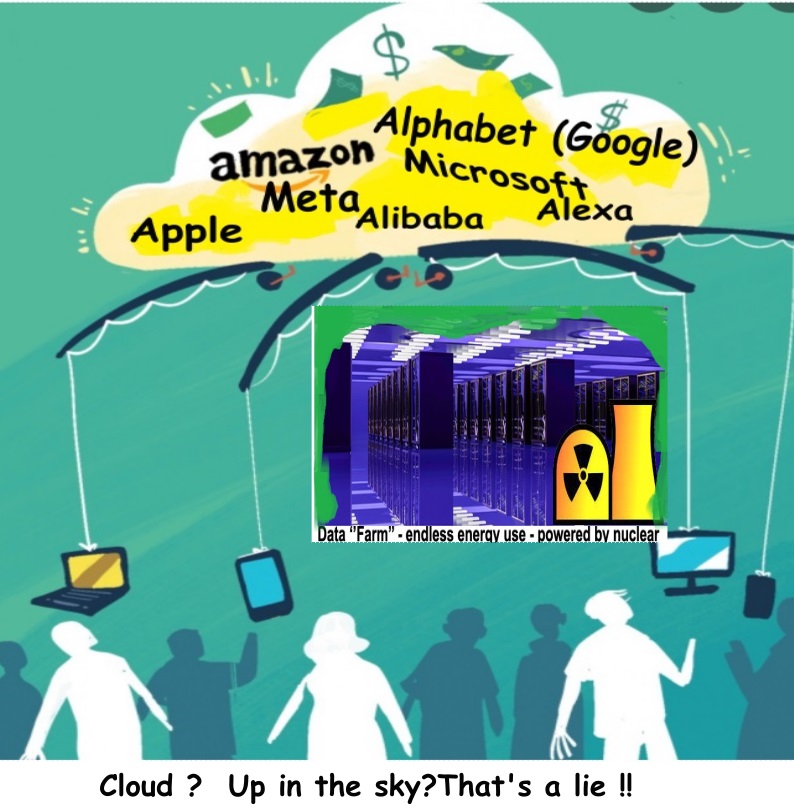
Crypto bros, for their part, did what cloud companies are doing now: make announcements about using nuclear power. Amazon, Google, and Microsoft are now following that strategy to pretend to be good citizens. However, the nuclear industry has its reasons for welcoming these announcements and playing them up.
The state of nuclear power
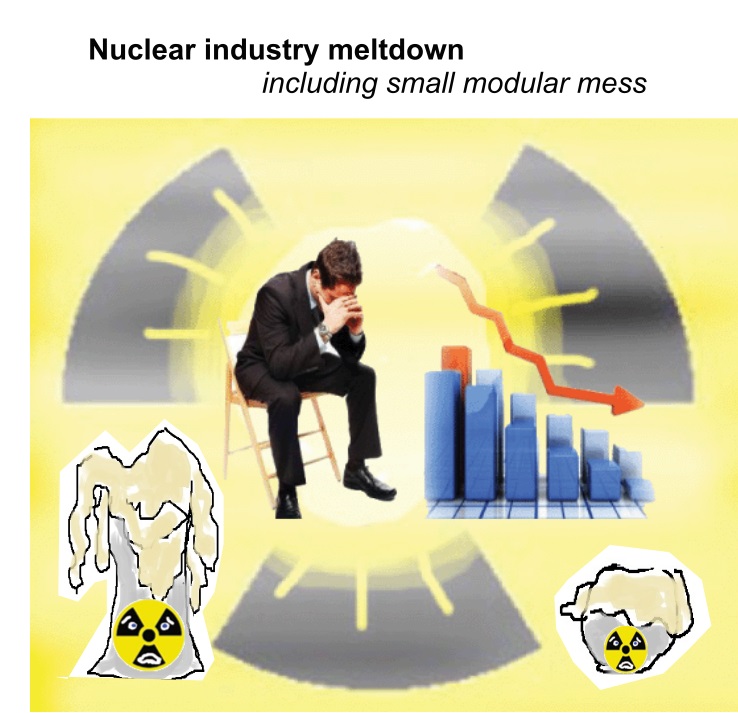
Strange as it might seem to folks basing their perception of the health of the nuclear industry on mainstream media, that technology is actually in decline. The share of global electricity produced by nuclear reactors has decreased from 17.5% in 1996 to 9.15% in 2023, largely due to the high costs of and delays in building and operating nuclear reactors.
A good illustration is the Vogtle nuclear power plant in the state of Georgia. When the utility company building the reactor sought permission from the Nuclear Regulatory Commission in 2011, it projected a total cost of $14 billion, and “in-service dates of 2016 and 2017” for the two units. The plant became operational only this year, after the second unit came online in March 2024, at a total cost of at least $36.85 billion.
Given this record, it is not surprising that there are no orders for any more nuclear plants.

As it has been in the past, the nuclear industry’s answer to this predicament is to advance the argument that new nuclear reactor designs would address all these concerns. But that has, yet again, proved not to be the case. In November 2023, the flagship project of NuScale, the small modular reactor design promoted as the leading one of its kind, collapsed because of high costs.
Supporters of nuclear power are now using another time-tested tactic to promote the technology: projecting that energy demand will grow so much that no other source of power will be able to meet these needs. For example, UK energy secretary Ed Davey resorted to this gambit in 2013 when he said that the Hinkley Point C nuclear plant was essential to “keep the lights on” in the country.
Likewise, when South Carolina Electric & Gas Company made its case to the state’s Public Service Commission about the need to build two AP1000 reactors at its V.C. Summer site—this project was subsequently abandoned after over $9 billion was spent—it forecast in its “2006 Integrated Resource Plan” that the company’s energy sales would increase by 22 percent between 2006 and 2016, and by nearly 30 percent by 2019.
This is the argument that the growth in data centres, propped up in part by the hype about generative artificial intelligence, has allowed proponents of nuclear energy to put forward. It remains to be seen whether this hype about generative AI actually materializes into a long-term sustainable business: see, for example, Ed Zitron’s meticulously documented argument for why OpenAI and Microsoft are simply burning billions of dollars and why their business model might “simply not be viable”.
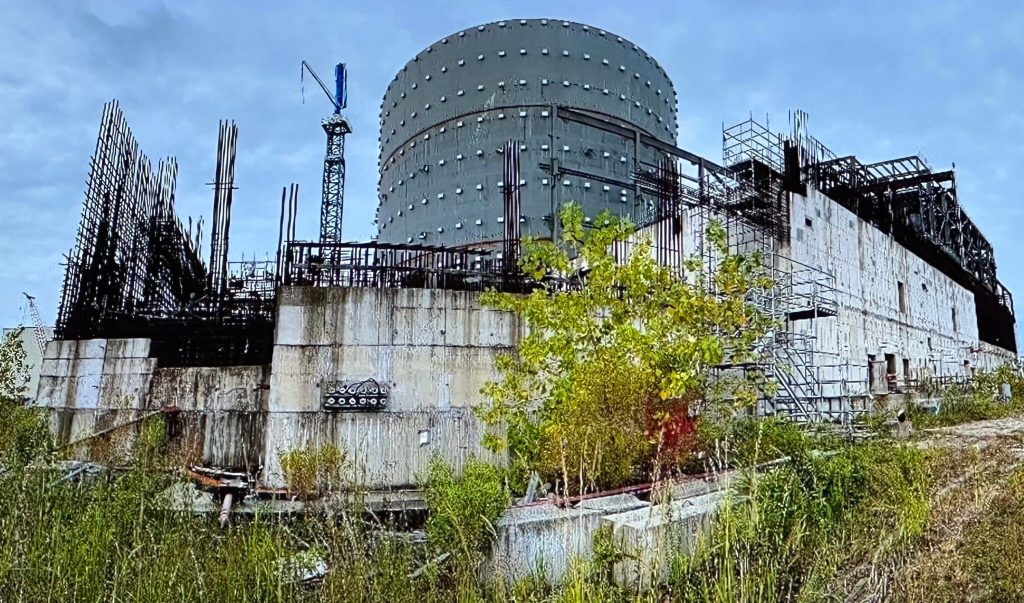
In the case of the V.C. Summer project, South Carolina Electric & Gas found that its energy sales actually declined by 3 percent compared to 2006 by the time 2016 rolled around. Of course, that did not matter, because shareholders had already received over $2.5 billion in dividends and company executives had received millions of dollars in compensation, according to Nuclear Intelligence Weekly, a trade publication.
One wonders which executives and shareholders are going to receive a bounty from this round of nuclear hype.
What about emissions?
Will the investments in nuclear power by companies like Google, Microsoft, and Amazon help reduce emissions anytime soon?

The project expected to have the shortest timeline is the restart of the Three Mile Island Unit 1 reactor, which Constellation Energy projects will be ready in 2028. But if the history of reactor commissioning is anything to go by, that deadline will come and go without any power flowing from it.
Restarting a nuclear plant that has been shutdown has never been done before. In the case of the Diablo Canyon nuclear plant in California, which hasn’t been shut down but was slated for decommissioning in 2024-25 till Governor Gavin Newsom did a volte-face, the Chair of the Diablo Canyon Independent Safety Committee explained why doing so was very difficult: “so many different programs and projects and so on have been put in place over the last half a dozen years predicated on that closure in 2024-25 and each one of those would have to be evaluated and some of them are okay, and some of them won’t be and some are going to be a real stretch and some are going to cost money and some of them aren’t going to be able to be done maybe”.

The cost of keeping Diablo Canyon open has been estimated by the plant’s owner at $8.3 billion and by independent environmental groups at nearly $12 billion. There are no reliable cost estimates for reopening Three Mile Island, but Constellation Energy, the plant’s owner, is already seeking a taxpayer-subsidized loan that would likely save the company $122 million in borrowing costs.
One must also remember that Microsoft already announced an agreement with Helion Energy, a company backed by billionaire Peter Thiele, to get nuclear fusion power by 2028. The chances of that happening are slim at best. In 2021, Helion announced that it had raised $500 million to build its fusion generation facility that would demonstrate “net electricity production” in three years, i.e., “in 2024”. That hasn’t happened so far. But going back further, one can see a similar and unfulfilled claim from 2014: then, the company’s chief executive had told the Wall Street Journal that the company hoped that its product would generate more energy than it would use “in the next three years” (i.e., in 2017). It is quite likely that Microsoft’s decision-makers knew of how unlikely it is that Helion will be able to supply nuclear fusion power by 2028. The publicity value is the most likely reason for announcing an agreement with Helion.
What about the small modular nuclear reactor designs—X-energy and Kairos—that Amazon and Google are betting on? Don’t hold your breath.
X-energy is an example of a high-temperature gas-cooled reactor design that dates back to the 1940s. There have been four reactors based on similar concepts that were operated commercially, two in Germany and two in the United States, respectively, and test reactors in the United Kingdom, Japan, and China. Each of these reactors proved problematic, suffering a variety of failures and unplanned shutdowns. The latest reactor with a similar design was built in China. Its performance leaves much to be desired: within about a year of being connected to the grid, its power output was reduced by 25 percent of the design power capacity, and even at this lowered capacity, it operated in 2023 with a load factor of just 8.5 percent.

Kairos, on the other hand, will be challenged by its choice of molten salts as coolant. These are chemically corrosive, and decades of search have identified no materials that can survive for long periods in such an environment without losing their integrity. The one empirical example of a reactor that used molten salts dates back to the 1960s, and this experience proved very problematic, both when the reactor operated and in the half-century thereafter, because managing the radioactive wastes produced before 1970 continued to be challenging.
Simply throwing money will not overcome these problems that have to do with fundamental physics and chemistry.
Just a dangerous distraction
Although Amazon, Google, and Microsoft claim to be investing in nuclear energy to meet the needs of AI, the evidence suggests that their real motive is to greenwash themselves.
Their investments are small and completely inadequate with relation to how much is needed to build a reactor. But their investments are also very small compared to the bloated revenues of these corporations. So, from the viewpoint of top executives, investing in nuclear power must seem a cheap way to reduce bad publicity about their environmental footprints. Unfortunately, “cheap” for them does not translate to cheap for the rest of us, not to mention the burden to future generations of human beings from worsening climate change and, possibly, increased production of radioactive waste that will stay hazardous for hundreds of thousands of years.
Because nuclear power has been portrayed as clean and a solution to climate change, announcements about it serve as a flashy distraction to focus public attention on. Meanwhile, these companies continue to expand their use of water and draw on coal and especially natural gas plants for their electricity. This is the magician’s strategy: misdirecting the audience’s attention while the real trick happens elsewhere. Their talk about investing in nuclear power also distracts from the conversations we should be having about whether these data centers and generative AI are socially desirable in the first place.
There are many reasons to oppose and organize against the wealth and power exercised by these massive corporations, such as their appropriation of user data to engage in what has been described as surveillance capitalism, their contracts with the Pentagon, and their support for Israel’s genocide and apartheid. Their investment into nuclear technology, and more importantly, hyping it up, offers one more reason. It is also a chance to establish coalitions between groups involved in very different fights.
M. V. Ramana is the Simons Chair in Disarmament, Global and Human Security at the School of Public Policy and Global Affairs, University of British Columbia and the author of The Power of Promise: Examining Nuclear Energy in India.
‘You couldn’t make this up’: Expert pans Ontario nuclear option

SMH, By Bianca Hall and Nick O’Malley, October 28, 2024
Ontario subsidises its citizens’ electricity power bills by $7.3 billion a year from general revenue, an international energy expert has said, contradicting the Coalition’s claim that nuclear reactors would drive power prices down in Australia.
Opposition Leader Peter Dutton has repeatedly cited the Canadian province as a model for cheaper power prices from nuclear.
“In Ontario, that family is paying half of what the family is paying here in Perth for their electricity because of nuclear power,” Dutton said in March. “Why wouldn’t we consider it as a country?”
In July, Dutton said Canadian consumers paid about one-quarter of Australian prices for electricity.
Professor Mark Winfield, an academic from York University in Canada who specialises in energy and environment, on Monday said the reaction among people in Ontario to the comparison had ranged from disbelief to “you couldn’t make this up”.
Ontario embarked on a massive building spree between the 1960s and the 1990s, Winfield told a briefing hosted by the Climate Council and the Smart Energy Council.
In the process, he said, the provincial-owned utility building the generators “effectively bankrupted itself”. About $21 billion in debt had to be stranded to render the successor organisation Ontario Power Generation economically viable.
In 2015, the Canadian government approved a plan to refurbish 10 ageing reactors, but Winfield said the refurbishment program had also been beset by cost blowouts.
“The last one, [in] Darlington, east of Toronto, was supposed to cost $C4 billion and ended up costing $C14 [billion],” Winfield said.
“And that was fairly typical of what we saw, of a cost overrun in the range of about 2.5 times over estimate.”
In Melbourne, Dutton said while he respected new Queensland Premier David Crisafulli’s opposition to nuclear, he would work with “sensible” premiers in Queensland, South Australia and NSW on his plan, if he was elected………………………………………………..
Winfield said household bills were kept artificially low under the Ontario model, despite the high cost of refurbishing ageing nuclear facilities.
“There’s a legacy of that still in the system that we are effectively subsidising electricity bills to the tune of about $C7.3 billion a year out of general revenues. That constitutes most of the provincial deficit; that’s money that otherwise could be going on schools and hospitals.”
Dutton’s comments came as a parliamentary inquiry into the suitability of nuclear power for Australia continued in Canberra. Experts provided evidence on how long it would take to build a nuclear fleet, and the potential cost and impact on energy prices compared with the government’s plan to replace the ageing coal fleet with a system of renewables backed by storage and gas peakers.
……………………………………………………….. In its annual GenCost, CSIRO estimated earlier this year that a single large-scale nuclear reactor in Australia would cost $16 billion and take nearly two decades to build, too late for it to help meet Australia’s international climate change commitments, which requires it to cut emissions 43 per cent by 2030. It found renewables to be the cheapest option for Australia.
Dutton has so far refused to be drawn on the costs of his nuclear policy. Opposition energy spokesman Ted O’Brien said the Coalition would release costings before the next federal election, which must be held by May.
O’Brien told this masthead “expert after expert” had provided evidence that nuclear energy placed downward pressure on power prices around the world. ……………. https://www.smh.com.au/environment/climate-change/you-couldn-t-make-this-up-expert-pans-ontario-nuclear-option-20241028-p5klx1.html
Alistair Osborne: Nuclear is waste of time and money

The National Audit Office has found that the Sellafield nuclear waste dump is still a mess,
with costs spiralling and projects delayed. As rebranding jobs go, it’s
hard to beat. Somehow, the nuclear lobby has managed to convince
politicians that the industry is not only green, but “clean”.
Just about all of them have fallen for it, not least our energy supremo Ed
Miliband. Here he is last month: “Homegrown clean energy from renewables
and nuclear offers us a security that fossil fuels simply cannot
provide”. On the energy security point, fair enough. But isn’t he
forgetting something about nukes that you don’t get with windmills and
sunbeams?
Luckily, the National Audit Office is not so easily taken in, as
it’s just proved with a nice reality check: its latest report on
Sellafield, the radioactive waste dump in Cumbria owned by the state-backed
Nuclear Decommissioning Authority (NDA). True, there is a glimmer of good
news: the spending watchdog says the “management of major projects has
begun to improve”. But it must have been off a chronically low base,
given the problems the NAO finds.
As it notes, of the NDA’s 17 sites
“Sellafield is the UK’s most complex and challenging”: home to
“seven former nuclear reactors” and Britain’s “entire stockpile of
civilian-owned plutonium”. Indeed, much of the “highly hazardous”
stuff knocking around has been deemed by the government to “pose an
intolerable risk”. Cleaning it up is a thankless task, too. On NDA
estimates, it “will take until 2125”.
Times 23rd Oct 2024, https://www.thetimes.com/business-money/companies/article/nuclear-is-waste-of-time-and-money-ljmxhqklh
Nuclear lobby propagandises to kids AGAIN!


They did this in the past – with rather pathetic little comics and posters
Like this one, from Canadian uranium company Cameco
Department of Energy Goes Nuclear with New Comic Book – Office of Nuclear Energy, 23 Oct 24
What does dodgeball have to do with nuclear power?
You can find out in a new comic book released by the U.S. Department of Energy (DOE) that’s geared toward young readers.
The Spark Squad Nuclear comic book follows middle schoolers Jasmine, Aria and Thomas on their quest to collect enough “joules” to qualify for the regional power fair.
The students quickly find out just how “energy dense” uranium fuel is after meeting Aria’s old friend Dakota at a nearby coal facility, which was recently converted to a nuclear power plant.
Dakota then asks for the Spark Squad’s help to initiate a chain reaction by getting enough uranium particles to play dodgeball with “neutron balls” to split apart other Uranium-235 atoms.
This epic game of dodgeball results in a sustained nuclear reaction AND more than enough joules for the students to qualify for regionals!………….
Spark-ing Interest in Nuclear Energy
The Spark Squad comic book and video were created by DOE to make nuclear power more accessible to younger audiences.
We developed a special activity called “Dodgeball Fission” and also worked with our national labs to create a STEM toolkit for the comic book to help engage learners of all ages. It can be used both in-school and out-of-school with standards-aligned, ready-to-use activities for educators.
Nuclear and STEM
The United States operates the largest fleet of reactors in the world with 94 units located at 54 sites across the country.
And, if you don’t live near one of these plants, then you might not know just how good of a neighbor nuclear can be.
These plants support thousands of high-paying jobs with salaries that are typically 30 percent higher than the local average.
Nuclear plants also contribute millions of dollars each year to their communities through federal and state taxes that are used to improve local infrastructure projects and schools.
DOE estimates our nuclear capacity could triple by 2050 to help meet our rising energy demand with clean power.
That means hundreds of thousands of new jobs could be created in the sector as current nuclear plants work to extend their operations and new plants come online.
To help cultivate this future workforce, it’s important to engage youth at an early age with activities like this comic book and the accompanying activities to spark their interest in future STEM careers.
You can also check out earlier Spark Squad comic books as the team explores hydropower.
The Spark Squad comic books were produced through a collaborative effort between the Office of Nuclear Energy, the Office of Energy Efficiency and Renewable Energy, the National Renewable Energy Laboratory, and Chromosphere Studio.
To explore more STEM activities related to nuclear power, check out our Navigating Nuclear Curriculum or visit our full suite of DOE STEM resources.
Nuclear lobby continues to infiltrate education
Pupils from Alde Valley Academy have joined the Sizewell C Youth Council.
This initiative aims to provide the nuclear power project with insights
into the needs of local young people. The students, from Years 7 to 11,
will have regular meetings with joint managing director, Julia Pyke, and
other project leaders. They will discuss local needs, aspirations, and the
project’s progress. Julia Pyke, Sizewell C joint managing director, said:
“Consultation for big infrastructure projects can sometimes be skewed
towards older people.
East Anglian Daily Times 21st Oct 2024
https://www.eadt.co.uk/news/24658473.alde-valley-academy-pupils-join-sizewell-c-youth-council/
Refuting myths about nuclear and renewable energy
15 Oct 2024, Mark Diesendorf, https://renew.org.au/renew-magazine/renew/refuting-myths-about-nuclear-and-renewable-energy/
There’s a lot of talk at present about nuclear energy being a strong contender in Australia’s energy market. But how much is political spin getting in the way of fact? Dr Mark Diesendorf unpacks some of the myths that are out there.
The AUKUS agreement has given renewed stimulus to the nuclear energy lobby. With campaign support from the Murdoch press, they have increased their efforts to denigrate renewable energy and to promote nuclear energy and fossil gas in its place.
Because of the sheer volume of their campaign and the difficulty of publishing fact checks and refutations in the mass media, public opinion polls indicate that some people seem to be taking the misleading claims of the nuclear lobby seriously. In this article, I seek to refute the principal myths the lobby is disseminating.
Myth: Renewables cannot supply 100% electricity
Denmark, South Australia and Scotland already obtain 88%, 74% and 62% of their respective annual electricity generations from renewables, mostly wind. Scotland actually supplies the equivalent of 113% of its electricity consumption from renewables; the difference between its generation and consumption is exported by transmission line.
All three jurisdictions have achieved this with relatively small amounts of hydroelectricity, zero in South Australia. Given the political will, South Australia and Denmark could reach 100% net renewables generation by 2030, as indeed two northern states of Germany have already done. The ‘net’ means they trade some electricity with neighbours but on average will be at 100% renewables.
Computer simulations by several research groups, including ours at UNSW, using real hourly wind, solar and demand data spanning several years, show that the Australian electricity system could be run entirely on renewable energy, with the main contributions coming from solar and wind. System reliability can be maintained by a combination of storage, building excess generating capacity for wind and solar (which is cheap), key transmission links, and demand management encouraged by transparent pricing.
Storage to fill infrequent troughs in generation from the variable renewable sources will comprise existing hydro, pumped hydro (mostly small-scale and off-river), and batteries. Geographic dispersion of renewables will also assist.
For the rare extended periods of Dunkelflaute (literally ‘dark doldrums’), gas turbines with stores of biofuels or green hydrogen could be kept in reserve as insurance.
Coal and nuclear power stations are too inflexible in operation to be useful as backup—they require a whole day to start up from cold and, when operating, have difficulty and increased costs in attempting to vary their output to follow the peaks and troughs in demand.
Myth: We need baseload power stations
This is an old, discredited claim that refers to the past when variable renewables (wind and solar) were absent and the fossil fuelled electricity supply system consisted mainly of two types of power station: baseload and peak load.
Baseload power stations, such as coal and nuclear, operate 24/7 at maximum power output, except then they break down or undergo planned maintenance. Because of their inflexibility in operation, the former system also needed to supplement baseload with peak load power stations, hydro-electric and gas turbines. Peak load stations can vary their output rapidly in response to rapid changes in demand or breakdowns in baseload supply.
When a nuclear power reactor breaks down, it can be useless for weeks or months. For a conventional large reactor rated at 1000 to 1600 megawatts, the impact of breakdown on electricity supply can be disastrous. Big nuclear needs big back-up, which is expensive. Small modular reactors are not commercially available nor likely to be in the foreseeable future.
A renewable electricity system, including storage, delivers the same reliability, and hence the same economic value, as the traditional fossil fuelled system based on a mix of baseload and peak-load power stations.
Myth: Gas can fill the gap until nuclear is constructed
As a fuel for electricity generation, fossil gas in eastern Australia is many times more expensive per kilowatt-hour than coal, so it’s not generally used for baseload power. Instead, it’s used for fuelling gas turbines for meeting the peaks in demand and helping to fill troughs in supply. For this purpose, it contributes about 5% of Australia’s annual electricity generation. But, as storage expands, fossil gas will become redundant in the electricity system.
The fact that baseload gas-fired electricity generation continues temporarily in Western Australia results from a unique history. Unlike the eastern states, WA has a Domestic Gas Reservation Policy that insulates domestic customers from the high export prices of gas. However, most new gas supplies would have to come from high-cost unconventional sources.
South Australia has an ancient, struggling, gas-fired power station, Torrens Island, that was originally regarded as baseload, but can no longer perform as baseload. It will be closed in 2026 and replaced with renewables and batteries. South Australia will soon have 100% renewable electricity without a single baseload power station.
Myth: Nuclear energy is cheaper than renewables
Assuming that Australia would not buy nuclear reactors from China or Russia, the only choices are the European Nuclear Reactor and the Westinghouse AP-1000 (or variants thereof). The former type is under construction in Finland, France and the UK. In each case, construction times have greatly increased and original cost estimates have tripled or more.
In South Carolina USA, two AP-1000 reactors were abandoned while under construction due to delays and cost escalation—under state law the electricity customers had to pay for the failed project. In Georgia USA, two AP-1000 reactors have just been completed at double the original cost. They are the only new nuclear power reactors commenced in the USA since the 1970s and completed. Nuclear power projects bankrupted Westinghouse in 2017.
South Korea is exporting its modification of the Westinghouse reactor, the APR-1400, subsidised by an unknown amount by its government. Its only export project so far, the Barakah project in UAE, is three years behind schedule—the extent of its cost overrun is unknown.
The state-owned Korean Electric Power Company (KEPCO) has a debt equivalent to US$149 billion resulting mainly from its nuclear investments.
All expert studies—e.g. by CSIRO, AEMO, and the multinational investment advisor Lazard—find that nuclear is the most expensive electricity generating technology, while solar PV and wind are the cheapest. This is true after including the cost of ‘firming’ renewables with storage.
Contrary to the claims of some nuclear proponents, the levelised cost method used in these studies takes account of the different lifetimes of the technologies. It also includes the cost of connecting the power stations to the main grid. While renewables will need a few additional major high-voltage transmission links, so would nuclear.
Myth: Nuclear energy can co-exist with large contributions from renewables
This myth has two refutations:
- Nuclear is too inflexible in operation to be a good partner for variable wind and solar. Its very high capital cost necessitates running it constantly at full power, not just during periods of low sun or wind. This would mean offloading renewables, although they are much cheaper to operate.
- On current growth trends of renewables, there will be no room for nuclear energy in South Australia, Victoria or NSW. The 2022 shares of renewables in total electricity generation in each of these states were 74%, 37% and 33% respectively. Rapid growth from these levels is likely. It’s already too late for nuclear in SA. Provided the growth of renewables is not deliberately suppressed in NSW and Victoria, these states too will reach 100% renewables long before the first nuclear power station could go online
Myth: There is insufficient land for wind and solar
Although a wind farm may span a large area, its turbines, access road and substation together occupy a tiny fraction of that area, typically about 2%. Most wind farms are built on land that was previously cleared for agriculture and are compatible with all forms of agriculture. Off-shore wind occupies no land.
Solar farms are increasingly being built sufficiently high off the ground to allow sheep to graze beneath them, providing welcome shade. This practice, known as agrivoltaics, provides additional farm revenue that’s especially valuable during droughts. Rooftop solar occupies no land.
Myth: Nuclear energy is safe
Nuclear energy is dangerous for three reasons: its contribution to the proliferation of nuclear weapons, the impacts of nuclear accidents and the task of managing high-level nuclear wastes for 100,000 years or more.
The two principal nuclear explosives are Uranium-235 and Plutonium-239. Both can be obtained from the nuclear energy supply chain.
Under the cloak of nuclear energy, several countries—the UK, France, India, Pakistan, North Korea and South Africa—have produced nuclear weapons either by further enrichment of uranium to increase the concentration of Uranium-235 beyond the level (3-4%) required for nuclear energy or by extracting Plutonium-239 from the spent fuel of their nuclear power reactors.
In addition, the following countries have attempted to use nuclear power to produce nuclear explosives while cloaking their development of nuclear weapons: Algeria, Argentina, Australia, Brazil, Libya, South Korea and Taiwan.
Fortunately, they did not complete their programs for various reasons. Nuclear power and nuclear weapons are intimately linked.
The most serious nuclear accidents were the Kyshtym disaster in the former USSR in 1957, the partial meltdown at Three Mile Island in the USA in 1979, Chernobyl in Ukraine in 1986, and Fukushima in Japan in 2011. Except for Three Mile Island, which took the US to the brink of a major disaster, each of these accidents have likely caused many thousands of cancer deaths from exposure to ionising radiation.
There are no operating permanent repositories for high-level nuclear wastes. Finland is the only country that’s close to completing a deep underground repository. The USA spent billions developing one at an unsuitable site in Nevada and then had to abandon it.
At present, high-level wastes are in temporary storage above ground at nuclear reactor sites, either in steel and concrete casks or in pools of water.
The contrast between nuclear and renewable energy technologies is demonstrated by their respective responses to the earthquake and tsunami that struck the Pacific coast of Japan in 2011.
At the Fukushima Daichi nuclear power station, three of the six nuclear reactors melted down, accompanied by hydrogen explosions that expelled vast amounts of radioactive materials into the environment.
Further down the coast at Kamisu, the tsunami passed through a near-shore wind farm located in the surf (see picture) without stopping it. It was only shut down when the grid went down and recommenced operating when the grid was restored three days later.
In summary
Renewables—solar, wind and existing hydro—together with storage and energy efficiency, can supply all Australia’s electricity and ultimately all energy, including transportation and heating.
Nuclear energy is too dangerous, too expensive, too slow to build, and too inflexible in operation to be a good partner for wind and solar. A nuclear scenario would inevitably involve the suppression of clean, inexpensive, safe renewables.
Nuclear lobby takes over tertiary education, with blatant lies about “clean” “green” nuclear

X-energy plans fleet of 40 Xe-100 reactors across the UK. More than 100
businesses from across Teesside and the UK met to learn how they can work
with X-energy on its proposed nuclear new build project. X-energy, along
with deployment partner Cavendish Nuclear, discussed the potential fleet
production of its Xe-100 advanced modular nuclear reactors, likely
timescales, scope of contracts for companies of all sizes across multiple
sectors, and what is required to win business. The event at Hartlepool
College of Further Education was followed by a workshop…………… https://www.thenorthernecho.co.uk/news/24645271.x-energy-plans-fleet-40-xe-100-reactors-across-uk/
Hartlepool College of Further Education hosts 70 businesses to set out opportunities for X-energy’s multi-billion pound Hartlepool nuclear reactor project
By Madeleine Raine, 8 October 24
More than 100 representatives from local and national companies are meeting in Hartlepool to hear about the opportunities offered by X-energy’s proposed nuclear reactor project.
On Tuesday, October 8, businesses from across the UK are coming together at Hartlepool College of Further Education to find out about the role regional and British engineering, manufacturing and construction companies can have in building the next generation of [?] clean power production nationwide.
X-energy and deployment partner Cavendish Nuclear are going to be discussing the potential production of advanced modular nuclear reactors…………………………………………
“What X-energy is proposing with its AMR technology will make Hartlepool the epicentre of this country’s transition to a [?] green energy superpower with billions of pounds worth of generational investment”………………………….. https://www.hartlepoolmail.co.uk/news/people/hartlepool-college-of-further-education-hosts-70-businesses-to-set-out-opportunities-for-x-energys-multi-billion-pound-hartlepool-nuclear-reactor-project-4814707
Sellafield’s “Social Impact Multiplied” Wins Greenwash Award for “The Edge” Water Sports Centre in Contaminated Harbour.

On , By mariannewildart
To mark the 67th Anniversary of the Windscale Fire: Sellafield’s “Social Impact Multiplied” Wins Greenwash Award for “The Edge” Water Sports Centre in Whitehaven Harbour. The Edge was planned to open in 2022 but like all nuclear projects is running late and is still under construction.
The George Monbiot Award for Nuclear Greenwashing is presented this year to Sellafield’s “Social Impact Multiplied” for their funding of the £5Million water sports centre at Whitehaven harbour. The award organised by Lakes Against Nuclear Dump, alongside Close Capenhurst and North Cumbria CND will be made on the 10th October, the 67th anniversary of the Windscale fire, the UKs worst nuclear accident to date following the UK’s mad rush to produce atomic bombs.
The Nuclear Greenwashing award is tongue in cheek and named after the famously pro-nuclear Guardian journalist George Monbiot who declared in 2011 “How the Fukushima disaster taught me to stop worrying and embrace nuclear power”.
Campaigners say that this “conversion” by Monbiot was instrumental in greenwashing the nuclear industry and effectively quashing opposition to new nuclear build at Hinkley Point C.
Lakes Against Nuclear Dump have sent silt samples from Whitehaven harbour to Eberline laboratory at Oak Ridge, USA who have found the highly radioactive element AM241 present in the silt at levels which if ingested or inhaled would be dangerous to health. The National Nuclear Laboratory at Sellafield describes AM241 as “intensely radioactive” and remaining so for many generations into the future..The regulators insist “levels are safe” in correspondence with campaigners who point out that there is no “safe level” of ingestion or inhalation of radioactivity, even so called “low dose” is cumulative…………………………….
Campaigners point out that “Sellafield are well aware that the silt in Whitehaven harbour contains a cocktail of radioactive isotopes from their operations, alongside this there is the continuing acid mine pollution pouring into Queen’s Dock from old coal mines……………………
Campaigners urge Sellafield and the UK government to take full responsibility for the damage to the environment and human health by nuclear and mining blight in Whitehaven harbour instead of shamelessly greenwashing devastating pollution. https://mariannewildart.wordpress.com/2024/10/10/sellafields-social-impact-multiplied-wins-greenwash-award-for-the-edge-water-sports-centre-in-contaminated-harbour/?fbclid=IwY2xjawF1PI5leHRuA2FlbQIxMQABHZUCqPj8uRxd0NDTt_2ovDKLWj9Hd_7cGEbKmDBDZgK_APILKkCJ5qg7Mw_aem_8lHUOhxrfEooARrUCKnKvA
At last – one corporate newsmedia admits there is no “cloud” – only dirty great steel structures
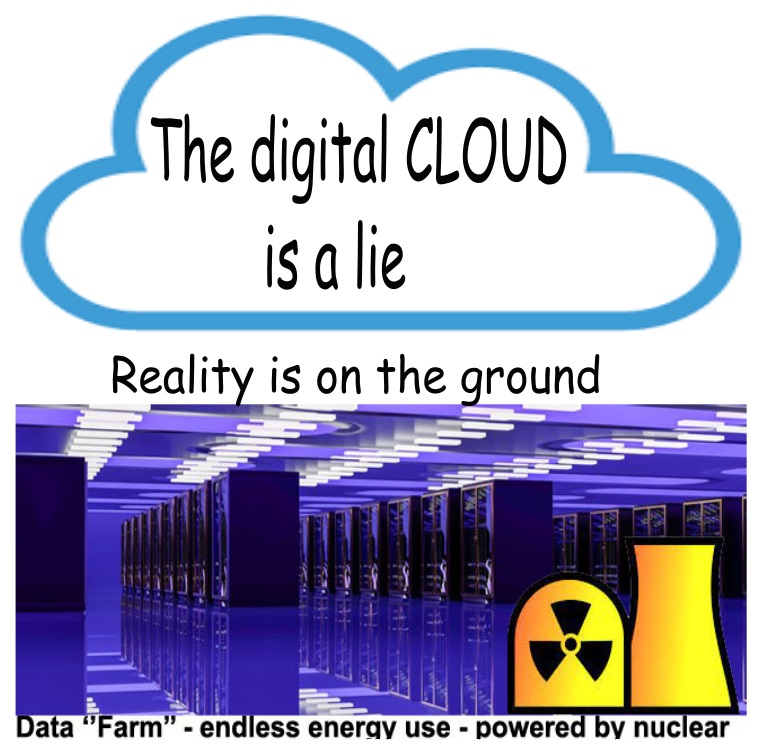
Stopping the great AI energy squeeze will need more than data centres
Amazon Web Services is currently rolling out €30bn of investments in
Europe amid a boom in artificial intelligence, according to Neil Morris,
its Irish head. But none of that bonanza is going to Ireland, because
Amazon officials worry about future energy constraints.
Indeed, there are reports that the company has already been rerouting some cloud activity
because of this. And while the Irish government has pledged to expand the
grid, mostly via wind farms, this is not happening fast enough to meet
demand. The water infrastructure is creaking too. Yes, you read that right:
an (in)famously wet and windy country is struggling to sustain tech with
water and wind power. There are at least four sobering lessons here. First,
this saga shows that our popular discourse around tech innovation is, at
best, limited and, at worst, delusional.
More specifically, in modern
culture we tend to talk about the internet and AI as if it they were a
purely disembodied thing (like a “cloud”). As a consequence,
politicians and voters often overlook the unglamorous physical
infrastructure that makes this “thing” work, such as data centres,
power lines and undersea cables.
But this oft-ignored hardware is essential
to the operation of our modern digital economy, and we urgently need to pay
it more respect and attention. Second, we need to realise this
infrastructure is also increasingly under strain. In recent years the
energy consumption of data centres has been fairly stable, because rising
levels of internet usage were offset by rising energy efficiency.
However, this is now changing fast: AI queries use around 10 times more energy than
existing search engines. Thus the electricity consumption of data centres
will at least double by 2026, according to the International Energy Agency
— and in the US they are expected to consume nine per cent of all
electricity by 2030. In Ireland the usage has already exploded to over a
fifth of the grid — more than households.
FT 4th Oct 2024,
https://www-ft-com.ezphost.dur.ac.uk/content/4fd66b27-f51b-4029-af3a-f5521368046f
It is Time to Expose the Great British Nuclear Fantasy Once and for All

Thomas, Stephen and Blowers, Andrew, It is Time to Expose the Great British Nuclear Fantasy Once and for All (September 30, 2024). Available at SSRN: https://ssrn.com/abstract=4971427 or http://dx.doi.org/10.2139/ssrn.4971427
Abstract
In April 2022, the then UK Prime Minister, Boris Johnson, set a target of 24GW of new nuclear capacity to be completed in Great Britain by 2050. At the heart of the proposal was the creation of a new government owned entity, Great British Nuclear (GBN), with a mission of ‘helping projects through every stage of the development process and developing a resilient pipeline of new builds’ designed to ensure energy security and to meet the UK’s commitment to achieving net zero.
Despite the sound and fury, the GBN project is bound to fail. Its contribution to achieving net zero by 2050 will be nugatory. No amount of political commitment can overcome the lack of investors, the absence of credible builders and operators or available technologies let alone secure regulatory assessment and approval
Moreover, in an era of climate change there will be few potentially suitable sites to host new nuclear power stations for indefinite, indeed unknowable, operating, decommissioning and waste management lifetimes. And there are the anxieties and fears that nuclear foments, the danger of accidents and proliferation and the environmental and public health issues arising from the legacy of radioactive waste scattered on sites around the country.
1 This Month

of the week – Shut Down Drone Warfare!


Tell the Ukrainian Government to Drop Prosecution of Peace Activist Yurii Sheliazhenko

Petition to revoke the licensing of the Near Surface Nuclear Disposal Facility (NSDF) at Chalk River. https://www.ourcommons.ca/petitions/en/Petition/Details?Petition=e-7247
To see nuclear-related stories in greater depth and intensity – go to https://nuclearinformation.wordpress.com
-
Archives
- April 2026 (44)
- March 2026 (251)
- February 2026 (268)
- January 2026 (308)
- December 2025 (358)
- November 2025 (359)
- October 2025 (376)
- September 2025 (257)
- August 2025 (319)
- July 2025 (230)
- June 2025 (348)
- May 2025 (261)
-
Categories
- 1
- 1 NUCLEAR ISSUES
- business and costs
- climate change
- culture and arts
- ENERGY
- environment
- health
- history
- indigenous issues
- Legal
- marketing of nuclear
- media
- opposition to nuclear
- PERSONAL STORIES
- politics
- politics international
- Religion and ethics
- safety
- secrets,lies and civil liberties
- spinbuster
- technology
- Uranium
- wastes
- weapons and war
- Women
- 2 WORLD
- ACTION
- AFRICA
- Atrocities
- AUSTRALIA
- Christina's notes
- Christina's themes
- culture and arts
- Events
- Fuk 2022
- Fuk 2023
- Fukushima 2017
- Fukushima 2018
- fukushima 2019
- Fukushima 2020
- Fukushima 2021
- general
- global warming
- Humour (God we need it)
- Nuclear
- RARE EARTHS
- Reference
- resources – print
- Resources -audiovicual
- Weekly Newsletter
- World
- World Nuclear
- YouTube
-
RSS
Entries RSS
Comments RSS
 nuclear-news