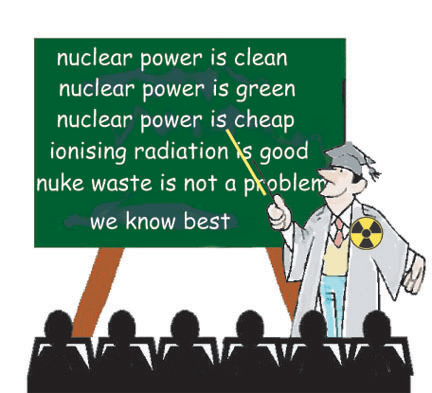
 More young professionals qualify as future nuclear leaders: 2017 Japan-IAEA Joint Nuclear Energy Management School, “……….On the margins of the School, the IAEA signed Practical Arrangements with the Japan Atomic Energy Agency (JAEA), the Japan Atomic Industrial Forum (JAIF), and the JAIF International Cooperation Center (JICC). The Practical Arrangements formalize cooperation in the area of nuclear human resource development, including knowledge management, education, training and outreach. The JAEA, JAIF and JICC serve as secretariats of the Japan Nuclear Human Resource Development Network and also collaborate with the IAEA as the NEM School organizers, together with the National Institute of Technology, Fukushima College and the University of Tokyo.
Debunking the myths about nuclear fusion – The ITER Power Amplification Myth
 The ITER Power Amplification Myth – By Steven B. Krivit –New Energy Times, 6 Oct 17
Short link: http://tinyurl.com/y9lvf79j
This is the third of three reports about the claims by representatives and proponents of the International Thermonuclear Experimental Reactor (ITER). “The Selling of ITER” published on Jan. 12, 2017. “Former ITER Spokesman Confirms Accuracy of New Energy Times Story” published on Jan. 19, 2017.
Abstract (Abstract is Copyleft, duplication permitted but only with attribution and link to original )
The International Thermonuclear Experimental Reactor (ITER) is the largest and most expensive science experiment on Earth today. Public outreach for the experimental fusion reactor, under the direction of Laban Coblentz, the head of the ITER communications office, has led journalists and the public to believe that, when completed, the reactor will produce 10 times more power than goes into it.
It will do no such thing. The $22 billion reactor is designed to produce only 1.6 times more thermal power than it consumes in electric power. Using a more conservative calculation, the reactor will lose more power than it produces. The planned output power of the reactor has been reported correctly, but the input power for the reactor has been widely reported, incorrectly, as 50 megawatts. The actual input power value, rarely discussed publicly, will be significantly larger.

For decades, some proponents of thermonuclear fusion research have used a double meaning for the phrase “fusion power” yet failed to inform the public, the news media, or legislators about the existence of this dual meaning. This ambiguity has caused non-experts to think that power production rates from large-scale thermonuclear fusion experiments show greater technological progress than has actually occurred. As a result, people who are not fusion experts think that ITER will achieve a power production rate, or power amplification, six times larger than its design specification. ITER will produce power at a rate of only two-thirds of the rate it will consume power, when comparing electric power input to equivalent electric power output.
Some fusion proponents have used the secondary meaning of “fusion power” to convince non-experts that the record-setting 1997 fusion experiment in the Joint European Torus (JET) reactor in the U.K. had produced thermal power at a rate of 65 percent of the electric power consumed by the reactor and, therefore, that the reactor had come close to producing power at a rate equal to the rate of power consumed. In fact, in that experiment, the reactor produced power in heat at a rate of less than 2 percent of the power in electricity it consumed. Coblentz and the ITER communications group have used the same double meaning to promote the publicly funded $22 billion ITER reactor, under construction now in southern France.
Fusion research insiders know that the current primary goal of ITER is not to demonstrate power amplification of the reactor. Instead, they know, the main goal is the power amplification of the fusion plasma, a significantly different measurement. Fusion experts say that non-experts understand the distinction, but nearly all evidence, as shown for example in news coverage by The New York Times, Scientific American, Bloomberg, Forbes and BBC News, is to the contrary. The double meaning of the phrase “fusion power” went unnoticed for years and has misled experienced journalists, scientists, members of the public and elected officials…….http://news.newenergytimes.net/
South Africa – lovely! they have a nuclear power utility educating kids about nuclear power!!!
SA utility educates youth on nuclear ESI Africa, 6 Oct 17
Eskom has recently launched its first school’s nuclear debate programme in Port Elizabeth in the Eastern Cape Province.
The School Nuclear Debate initiative is part of Eskom’s five-year Schools Adoption & Skills Development programme……….“Eskom aims to create awareness about the most important aspects of nuclear power, to bring facts to the fore and to debate, correct myths, fears and misconceptions that may exist regarding nuclear power.”
From Nuclear Fusion Fraud to Physics Fortune
 The ITER Power Amplification Myth Oct. 6, 2017 – By Steven B. Krivit –
Short link: http://tinyurl.com/y9lvf79j
This is the third of three reports about the claims by representatives and proponents of the International Thermonuclear Experimental Reactor (ITER). “The Selling of ITER” published on Jan. 12, 2017. “Former ITER Spokesman Confirms Accuracy of New Energy Times Story” published on Jan. 19, 2017.

From Fusion Fraud to Physics Fortune
“………..The ITER project, supported by a widespread misunderstanding of its promised results, funded by billions in cash, resources and materials, will not deliver a practical demonstration of fusion power, but merely a scientific demonstration of a sustained fusion reaction. Yet on July 3, 2017, the Chinese Experimental Advanced Superconducting Tokamak reactor already did this, for 101 seconds. When built, ITER will merely do it for four times longer.
Oddly, the quest for practical nuclear fusion on Earth was born out of fraud. The ITER Web site recognizes this, with a page titled “Proyecto Huemul: From Fusion Fraud to Physics Fortune.”
The story began in 1948 in Argentina when Austrian scientist Ronald Richter proposed his idea for a fusion device to President Juan Perón. Perón agreed to fund the concept, and on March 24, 1951, Perón held a press conference at which he announced that his country had achieved practical, controlled nuclear fusion. By 1952, however, after independent investigators reported no evidence to support the claims, the project was shut down. The ITER page calls it “the scientific fraud of the century.”
Yet in 1951, before the Argentinian project was shut down, the project caught the attention of Lyman Spitzer, an astrophysicist at Princeton University. Spitzer, in turn, approached the U.S. Atomic Energy Commission and convinced it to fund his own fusion research concept. Thus, the U.S. controlled nuclear fusion era began at the Princeton Plasma Physics Laboratory, and the worldwide race for fusion energy began.
Since construction on ITER began in 2007, nuclear fusion news stories have been tagged with titillating headlines about unlimited energy. A CNN story headline is typical: “Is Nuclear Fusion About to Change Our World?” Every incremental step forward in temperature, pressure, or plasma confinement time has been a “breakthrough.” Each breakthrough, according to the news stories, has brought the dream of harnessing the power of the sun on Earth one step closer to reality. Rarely have the stories featured any critical assessment or analysis.
One journalist wrote that physicists at the Department of Energy’s Princeton Plasma Physics Laboratory had “demonstrated” how a new fusion reactor design could lead to the first commercially viable nuclear fusion power plant. The demonstration was merely on paper. The article featured a photo of a reactor. But it wasn’t the reactor described in the article. That reactor hadn’t been built yet.
As the comics below show, the very same Princeton Plasma Physics Laboratory — back in 1975 when the DOE was called the Atomic Energy Commission — told journalists it was a big step closer to virtually limitless pollution-free energy thanks to “breakthroughs” in plasma density and temperature.
Then there’s MIT scientist Earl Marmar, who told journalists this year that the technology exists to have fusion energy in 13 years if only it is funded aggressively enough.
Vision and hope are wonderful and necessary components of the human experience. But false hope and worthless promises — laced with misleading claims — do not represent the science accurately. They do not represent the integrity of all scientists involved in the research.
The false idea that the JET reactor produced 65% of the power it consumed has been deeply planted in the minds of the public and journalists. The same goes for the false idea that the ITER reactor will produce 10 times the power it consumes. These two myths serve to misrepresent the status of fusion energy research and, specifically, the ITER project……http://news.newenergytimes.net/2017/10/06/the-iter-power-amplification-myth/#more-44064
James Hansen – great on climate change – wrong on Generation IV nuclear reactors

The risks……..in fact, thorium has been used to produce fissile material (uranium-233) for nuclear weapons tests.
Waste…. “Even integral fast reactors (IFRs), which recycle most of their waste, leave behind materials that have been contaminated by transuranic elements and so cannot avoid the need to develop deep geologic disposal.”
Generation IV economics…..The US Government Accountability Office’s 2015 report noted that technical challenges facing SMRs and advanced reactors may result in higher-cost reactors than anticipated, making them less competitive with large light-water reactors or power plants using other fuels.
James Hansen’s Generation IV nuclear advocacy: a deconstruction of nuclear fallacies and fantasies http://www.theecologist.org/News/news_analysis/2989318/james_hansens_generation_iv_nuclear_advocacy_a_deconstruction_of_nuclear_fallacies_and_fantasies.html, Dr Jim Green, 3rd October, 2017
Climate scientist James Hansen’s claims about Generation IV nuclear concepts simply don’t stack up, argues JIM GREEN Dr James Hansen is rightly admired for his scientific and political work drawing attention to climate change. His advocacy of nuclear power ‒ and in particular novel Generation IV nuclear concepts ‒ deserves serious scrutiny.
In a nutshell, Dr Hansen (among others) claims that some Generation IV reactors are a triple threat: they can convert weapons-usable (fissile) material and long-lived nuclear waste into low-carbon electricity. Let’s take the weapons and waste issues in turn. Continue reading
USA nuclear industry – desperate advertising campaign to win hearts and minds
 Nuclear – Power The Extraordinary – New Ad Campaign Touting Marvels of
  Atomic Technology, Forbes, Rod Adams, 30 Sept 17, The Nuclear Energy Institute (NEI) announced in early September that was starting a new advertising campaign with completely reimagined creative materials.Using the general tagline of “Nuclear. Power the Extraordinary” the U.S. nuclear industry’s trade organization will be speaking “to the critical role that nuclear technology plays in our lives. With dramatic visuals, the new campaign captures the far-reaching benefits that nuclear technology brings to air quality, economic vitality, public health and exploration of new worlds.”……..
Since taking over as NEI’s President and CEO last year, Maria Korsnick has emphasized the importance of taking a new approach to maximizing nuclear energy’s “immense potential.” She has stressed the need for the industry to advocate for itself.
“I am truly passionate about the role that nuclear energy can play for our nation and the world. I consider it the unsung hero of our energy mix…My focus is to get nuclear energy recognized as an essential part of the nation’s industrial and electrical infrastructure.”……..
The ads will initially be heard and seen in key state battle grounds like Pennsylvania, Ohio and New York as well as in the Washington, DC area……… https://www.forbes.com/sites/rodadams/2017/09/30/nuclear-power-the-extraordinary-new-ad-campaign-touting-marvels-of-atomic-technology/#5164c1302ef5
Glamour nuclear spruiker Brian Cox – in Cumbria, then Australia
Brian Cox is a very personable and knowledgeable TV star and particle physics expert. He is also a promoter of the nuclear industry. He is a big fan of plutonium -powered space travel. He’s to tour Australia in November,.
Currently, Cox is in Cumbria, UK, addressing schoolchildren groups, and revving up enthusiasm for science and technology. All good, yes. He enthuses about the opportunity for top jobs in high tech in Cumbria. Good? Yes, but – where are these future jobs? Well – in the nuclear industry, which is desperately trying to get a new nuclear power station built.
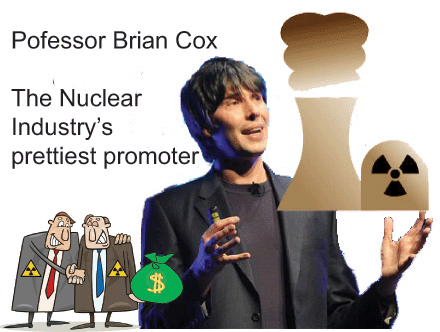
 Whitehaven News 29th Sept 2017, Television star Professor Brian Cox says Cumbria has a world-leading industry which warrants talent – but there’s a shortage of scientists and engineers. But he hopes to change that by helping to bring the prestigious Infinity Festival to the area and inspiring hundreds of teenagers to follow their dreams. Professor Cox was the star speaker at today’s festival which was held at West Lakes Academy in Egremont. More than 200 schoolchildren, aged 13 and 14, attended the event from schools across the whole of the county. http://www.whitehavennews.co.uk/news/Professor-Brian-Cox-visits-Egremont-and-declares-Cumbria-is-a-world-leading-high-tech-industry-941aa057-9b77-46a5-8eac-6e92f0341783-ds
Famous scientist argues for ‘stable’ forms of energy, The famous scientist Professor Brian Cox has told guests at the opening of a new exhibition in Whitehaven that nuclear power should be an important source of energy in the UK.
He argues that education is important for accepting nuclear energy: http://www.itv.com/news/border/story/2014-05-30/professor-brian-cox-opens-beacon-museum/
Australian nuclear shill Ben Heard’s attack on renewable energy: refuted by 6 international academics
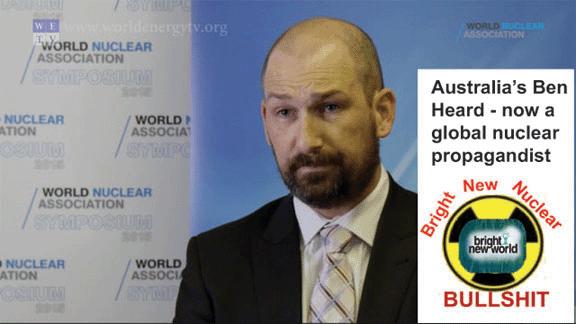
 Response to ‘Burden of proof: A comprehensive review of the feasibility of 100% renewable-electricity systems’ AUTHORS W. Browna,(a) , T. Bischof-Niemz (b) , K. Blok(c) , C. Breyerc(d) , H. Lund (e) , B.V. Mathiesen (f ) (Their university positions are listed at the end of this post) September 2017
Abstract A recent article ‘Burden of proof: A comprehensive review of the feasibility of 100% renewable-electricity systems’ [by Ben Heard, Barry Brook, Tom Wigley and Corey Bradshaw] claims that many studies of 100% renewable electricity systems do not demonstrate sufficient technical feasibility, according to the authors’ criteria.
Here we analyse the authors’ methodology and find it problematic. The feasibility criteria chosen by the authors are important, but are also easily addressed at low cost, while not affecting the main conclusions of the reviewed studies and certainly not affecting their technical feasibility.
A more thorough review reveals that all of the issues have already been addressed in the engineering and modelling literature. Nuclear power, as advocated by some of the authors, faces other, genuine feasibility problems, such as the finiteness of uranium resources and a reliance on unproven technologies in the medium- to long-term. Energy systems based on renewables, on the other hand, are not only feasible, but already economically viable and getting cheaper every day.
Contents Continue reading
Kazakhstan’s international low-enriched uranium bank makes the world LESS SAFE
Banking on Uranium Makes the World Less Safe https://www.counterpunch.org/2017/09/08/banking-on-uranium-makes-the-world-less-safe/ There is a curious fallacy that continues to persist among arms control groups rightly concerned with reducing the threat of the use of nuclear weapons. It is that encouraging the use of nuclear energy will achieve this goal.
This illogical notion is enshrined in Article IV of the nuclear Non-Proliferation Treaty (NPT) which rewards signatories who do not yet have nuclear weapons with the “inalienable right” to “develop research, production and use of nuclear energy for peaceful purposes.”
Now comes the international low-enriched uranium bank, which opened on August 29 in Kazakhstan, to expedite this right. It further reinforces the Article IV doctrine— that the spread of nuclear power will diminish the capability and the desire to manufacture nuclear weapons.
The uranium bank will purchase and store low-enriched uranium, fuel for civilian reactors, ostensibly guaranteeing a ready supply in case of market disruptions. But it is also positioned as a response to the Iran conundrum, a country whose uranium enrichment program cast suspicion over whether its real agenda was to continue enriching its uranium supply to weapons-grade level.
The bank will be run by the International Atomic Energy Agency, whose remit is “to accelerate and enlarge the contribution of atomic energy.” Evidently the IAEA has been quite successful in this promotional endeavor since the agency boasts that “dozens of countries today are interested in pursuing nuclear energy.”
A caveat here, borne out by the evidence of nuclear energy’s declining global share of the electricity market, is that far more countries are “interested” than are actually pursuing nuclear energy. The IAEA numbers are more aspiration than reality.
Superficially at least, the bank idea sounds sensible enough. There will be no need to worry that countries considering a nuclear power program might secretly shift to nuclear weapons production. In addition to a proliferation barrier, the bank will serve as a huge cost savings, sparing countries the expense of investing in their own uranium enrichment facilities.
The problem with this premise is that, rather than make the planet safer, it actually adds to the risks we already face. News reports pointed to the bank’s advantages for developing countries. But developing nations would be much better off implementing cheaper, safer renewable energy, far more suited to countries that lack major infrastructure and widespread electrical grid penetration.
Instead, the IAEA will use its uranium bank to provide a financial incentive to poorer countries in good standing with the agency to choose nuclear energy over renewables. For developing countries already struggling with poverty and the effects of climate change, this creates the added risk of a catastrophic nuclear accident, the financial burden of building nuclear power plants in the first place, and of course an unsolved radioactive waste problem.
No country needs nuclear energy. Renewable energy is soaring worldwide, is far cheaper than nuclear, and obviously a whole lot safer. No country has to worry about another’s potential misuse of the sun or wind as a deadly weapon. There is no solar non-proliferation treaty. We should be talking countries out of developing dangerous and expensive nuclear energy, not paving the way for them.
There is zero logic for a country like Saudi Arabia, also mentioned during the uranium bank’s unveiling, to choose nuclear over solar or wind energy. As Senator Markey (D-MA) once unforgettably pointed out: “Saudi Arabia is the Saudi Arabia of solar.” But the uranium bank could be just the carrot that sunny country needs to abandon renewables in favor of uranium.
This is precisely the problem with the NPT Article IV. Why “reward” non-nuclear weapons countries with dangerous nuclear energy? If they really need electricity, and the UN wants to be helpful, why not support a major investment in renewables? It all goes back to the Bomb, of course, and the Gordian knot of nuclear power and nuclear weapons that the uranium bank just pulled even tighter.
Will the uranium bank be too big to fail? Or will it even be big at all? With nuclear energy in steep decline worldwide, unable to compete with renewables and natural gas; and with major nuclear corporations, including Areva and Westinghouse, going bankrupt, will there even be enough customers?
Clothed in wooly non-proliferation rhetoric, the uranium bank is nothing more than a lupine marketing enterprise to support a struggling nuclear industry desperate to remain relevant as more and more plants close and new construction plans are canceled. The IAEA and its uranium bank just made its prospects a whole lot brighter and a safer future for our planet a whole lot dimmer.
EDF’s unreliable claims of “flexible nuclear generation”
Nuclear Load Following. PV Magazine 5th Sept 2017 In 2015, Électricité de France put out a pamphlet titled Flexible nuclear generation to foster the development of renewable energy as one of its
“50 Solutions for the Climate.” The pamphlet boasts of the flexibility
of EDF’s nuclear fleet, showing a 1.3 GW nuclear power plant increasing
and decreasing its output by 70% within 30 minutes. The documentation
centers on the Golfech plant, and shows these impressive feats of rapid
ramping, with two cycles up and down within a 24 hour period. And while EDF
noted that such cycling was prompted by daily changes in demand, it also
stresses that such capabilities will be able to make nuclear power a good
complement to the fluctuating output of wind and solar on the grid.
However, in Northern Germany a situation has played out which challenges
this line of reasoning. In February the Brokdorf nuclear power plant was
taken offline after damage to its fuel rods was found. According to a local
nuclear supervisory authority, the operation of the plant in
“load-following” mode had contributed to unexpected oxidation of the
rods. As of July, the plant was operating in “safe mode,” and
politicians from Germany’s Green Party are calling on a Swiss reactor
near the German border with similar problems to be shut down.
So can nuclear accompany high levels of renewable energy? This is a technical and
economic question, and one that has ramifications for the future of the
technology. Nuclear power plants are regularly ramped up and down in
France, to partially respond to the shift in electricity demand from day to
night. Additionally, in other nations plants such as the Brokdorf facility
are ramped to respond to fluctuations in wind and solar generation,
although the vast majority of nuclear power plants are not.
The nuclear industry claims that all currently deployed boiling water reactors (BWR)
and pressurized water reactors (PWR), which make up the entire nuclear
fleet in the United States and the majority in Europe, can ramp quickly.
However, IASS Potsdam Senior Fellow Craig Morris, who has written
extensively about nuclear energy and renewables, has stated that “no
nuclear fleet worldwide is ramping to any significant extent, so we
actually have no idea whether ramping will work in practice.”
While developed nations should prioritize rapid decarbonization over short-term
costs, there is not now and never will be an unlimited amount of money to
pour into this problem. The nuclear industry knows this, and as such the
attempt to cast nuclear power plants as a suitable accompaniment to high
levels of wind and solar is ultimately a desperate act by an industry which
is in severe crisis in both Europe and the United States.
Nuclear reactors may be able to ramp (within limitations), but ultimately nuclear is
fighting for space on the grid with wind and solar. As such the building of
new nuclear power plants, and in some cases the extension of licenses for
old ones, can limit the transition to renewable energy https://www.pv-magazine.com/magazine-archive/balancing-act/
Nuclear power is on the nose, so the industry is launching an advertising campaign
 In advertising blitz, nuclear industry seeks reset, AXIOS.com ,Amy Harder, Sep 5 17
The beleaguered nuclear industry is launching an advertising campaign Tuesday that casts the decades-old electricity resource in a new light…. The campaign, by the Nuclear Energy Institute, will try to reset nuclear’s appeal in Washington as an electricity source but also more broadly, such as its role in space exploration and medical care.
Debunking the hype about Generation IV “new nuclear”
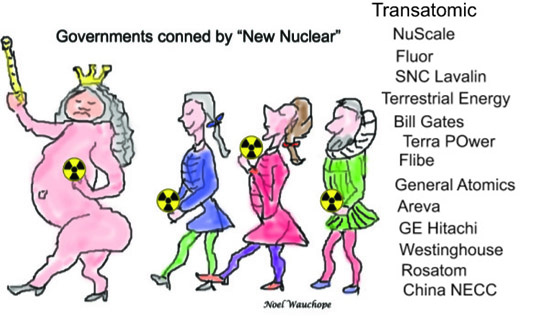 James Hansen’s Generation IV nuclear fallacies and fantasies, REneweconomy, Jim Green, 28 Aug 2017, http://reneweconomy.com.au/james-hansens-generation-iv-nuclear-fallacies-fantasies-70309/
The two young co-founders of nuclear engineering start-up Transatomic Power were embarrassed earlier this year when their claims about their molten salt reactor design were debunked, forcing some major retractions.
The claims of MIT nuclear engineering graduates Leslie Dewan and Mark Massie were trumpeted in MIT’s Technology Review under the headline, ‘What if we could build a nuclear reactor that costs half as much, consumes nuclear waste, and will never melt down?’
MIT physics professor Kord Smith debunked a number of Transatomic’s key claims. Smith says he asked Transatomic to run a test which, he says, confirmed that “their claims were completely untrue.”
Kennedy Maize wrote about Transatomic’s troubles in Power Magazine: “[T]his was another case of technology hubris, an all-to-common malady in energy, where hyperbolic claims are frequent and technology journalists all too credulous.” Pro-nuclear commentator Dan Yurman said that “other start-ups with audacious claims are likely to receive similar levels of scrutiny” and that it “may have the effect of putting other nuclear energy entrepreneurs on notice that they too may get the same enhanced levels of analysis of their claims.”
Well, yes, others making false claims about Generation IV reactor concepts might receive similar levels of scrutiny … or they might not. Arguably the greatest sin of the Transatomic founders was not that they inadvertently made false claims, but that they are young, and in Dewan’s case, female. Ageing men seem to have a free pass to peddle as much misinformation as they like without the public shaming that the Transatomic founders have been subjected to. A case in point is climate scientist James Hansen ‒ you’d struggle to find any critical commentary of his nuclear misinformation outside the environmental and anti-nuclear literature.
Hansen states that 115 new reactor start-ups would be required each year to 2050 to replace fossil fuel electricity generation ‒ a total of about 4,000 reactors. Let’s assume that Generation IV reactors do the heavy lifting, and let’s generously assume that mass production of Generation IV reactors begins in 2030. That would necessitate about 200 reactor start-ups per year from 2030 to 2050 ‒ or four every week. Good luck with that.
Moreover, the assumption that mass production of Generation IV reactors might begin in or around 2030 is unrealistic. A report by a French government authority, the Institute for Radiological Protection and Nuclear Safety, states: “There is still much R&D to be done to develop the Generation IV nuclear reactors, as well as for the fuel cycle and the associated waste management which depends on the system chosen.”
Likewise, a US Government Accountability Office report on the status of small modular reactors (SMRs) and other ‘advanced’ reactor concepts in the US concluded: “Both light water SMRs and advanced reactors face additional challenges related to the time, cost, and uncertainty associated with developing, certifying or licensing, and deploying new reactor technology, with advanced reactor designs generally facing greater challenges than light water SMR designs. It is a multi-decade process …”
An analysis recently published in the peer-reviewed literature found that the US government has wasted billions of dollars on Generation IV R&D with little to show for it. Lead researcher Dr Ahmed Abdulla, from the University of California, said that “despite repeated commitments to non-light water reactors, and substantial investments … (more than $2 billion of public money), no such design is remotely ready for deployment today.”…… http://reneweconomy.com.au/james-hansens-generation-iv-nuclear-fallacies-fantasies-70309/
Women seen as powerful advocates for the nuclear lobby
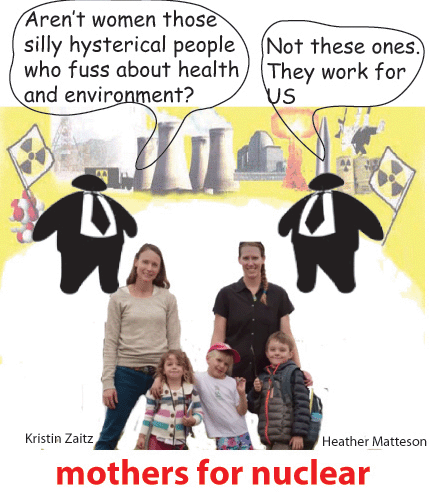 American Women Step Up as Nuclear Energy Advocates VOA August 25, 2017 Michelle Quinn
Women seen as powerful advocates,
Industry experts say that women who work in nuclear power can be powerful advocates for nuclear. They can help change attitudes of other women who tend to be more skeptical than men about nuclear energy’s benefits.
At the recent U.S. Women in Nuclear conference in San Francisco, women working in the industry talked about how more should be done to make nuclear power’s case to the public, and how they may be the best suited to do it.
“As mothers, I think we also have an important role to play in letting the public know that we support nuclear for the future, for our children,” said Matteson. “And we don’t know other mothers supporting nuclear power in a vocal way. We thought there was a gap to fill.”
Young women say they look at careers in this industry because they are socially minded.
‘Do something good for the world’
“I went into this wanting to do something good for the world,” Lenka Kollar, business strategy director at NuScale, a firm in Oregon that designs and markets small modular reactors. “Wanting to bring power to people. There are still more than a billion people in the world who don’t have electricity.”
Critics of nuclear energy say it doesn’t matter who is promoting it.
“Using mothers’ voices to argue for a technology that is fundamentally dangerous and that has been demonstrated by disasters like Fukushima to be not safe for the communities that surround the power plants or even cities that are hundreds of miles away is disingenuous,” said Kendra Klein, a staff scientist with Friends of the Earth, an environmental group…….https://www.voanews.com/a/american-women-step-up-as-nuclear-energy-advocates/4000185.html
IAEA funding school for developing countries’ “nuclear leaders”
More young professionals qualify as future nuclear leaders: 2017 Japan-IAEA Joint Nuclear Energy Management School, “……….On the margins of the School, the IAEA signed Practical Arrangements with the Japan Atomic Energy Agency (JAEA), the Japan Atomic Industrial Forum (JAIF), and the JAIF International Cooperation Center (JICC). The Practical Arrangements formalize cooperation in the area of nuclear human resource development, including knowledge management, education, training and outreach. The JAEA, JAIF and JICC serve as secretariats of the Japan Nuclear Human Resource Development Network and also collaborate with the IAEA as the NEM School organizers, together with the National Institute of Technology, Fukushima College and the University of Tokyo.Background The NEM School was launched in 2010 in cooperation with the Abdus Salam International Centre for Theoretical Physics (ICTP) in Trieste, Italy. The purpose of the School is to help address the need for an expanded global cadre of nuclear professionals, brought about by the increased worldwide interest in the use of nuclear technologies – from electricity generation to medical, agricultural and industrial uses. Since then, besides the annual NEM School hosted in Trieste, regional schools have been conducted in the UAE, Japan, the USA, South Africa and Russian Federation, benefitting more than 600 students from all over the world. The NEM School enables the transfer of IAEA-specific knowledge to Member States, furthering their capacity building efforts.
The NEM School focuses mainly on training of young professionals with managerial potential from developing countries on the different aspects of the nuclear energy sector. …..https://www.iaea.org/newscenter/news/more-young-professionals-qualify-as-future-nuclear-leaders-2017-japan-iaea-joint-nuclear-energy-management-school
The key to reversing climate change – the education of women
Educated women are the key to reversing climate change https://thenextweb.com/science/2017/08/24/educated-women-are-the-key-to-reversing-climate-change/#.tnw_mQzgoobNby RACHEL KASER — One author and activist thinks he’s found the answer to reversing climate change: the education and empowerment of women.
North Korea: new video threatens USA – but not in English – aimed at the home audience?

 ‘The fate of the sinful U.S. ends here’: North Korea threatens to envelop Guam in missiles in new video
North Korea is not known for subtlety in its propaganda videos, and the latest clip shows a North Korean missile headed toward the U.S. territory , National Post 22 Aug 17 The Trump administration should be “keeping its eyes and ears open from now on,” North Korea has warned in an incendiary new video that shows senior security officials being engulfed in flames and U.S. President Donald Trump looking over a field of white crosses with the warning: “The fate of the sinful United States ends here.”
North Korea is not known for subtlety in its propaganda videos, and the latest clip, published by the Uriminzokkiri outlet, shows a North Korean missile headed toward the U.S. territory of Guam, which Pyongyang has been threatening to “envelop” with missiles.
The video was released on the eve of the Ulchi Freedom Guardian exercises between the American and South Korean militaries, which started Monday. The annual drills are mainly computer-based, but they nevertheless annoy North Korea and come at a particularly sensitive time.
Just this month, as tensions between Washington and Pyongyang mounted following the launch of North Korea’s second intercontinental ballistic missile, Trump warned North Korea that it stood to feel the “fire and fury” of the American military…….
The video ends with a calendar showing the days of the Ulchi Freedom Guardian exercises (although they got the day wrong, showing them as starting on Sunday when they, in fact, started on Monday.)
Over the top come the words: “Time is not on the U.S.’s side.”
Is it just more bluster, or a real threat? Well, here’s a reason not to be too worried: The video was entirely in Korean. http://nationalpost.com/news/world/the-fate-of-the-sinful-u-s-ends-here-north-korea-threatens-to-envelop-guam-in-missiles-in-new-video/wcm/6ff2f547-bd6c-41b1-942d-dd33d2c7afe5
1 This Month
Chernobyl: The Lost Tapes – A good documentary on Chernobyl on SBS available On Demand for the next 3 weeks– https://www.sbs.com.au/ondemand/tv-program/chernobyl-the-lost-tapes/2352741955560

of the week–London Campaign for Nuclear Disarmament

Tell the Ukrainian Government to Drop Prosecution of Peace Activist Yurii Sheliazhenko
To see nuclear-related stories in greater depth and intensity – go to https://nuclearinformation.wordpress.com
-
Archives
- April 2026 (152)
- March 2026 (251)
- February 2026 (268)
- January 2026 (308)
- December 2025 (358)
- November 2025 (359)
- October 2025 (376)
- September 2025 (257)
- August 2025 (319)
- July 2025 (230)
- June 2025 (348)
- May 2025 (261)
-
Categories
- 1
- 1 NUCLEAR ISSUES
- business and costs
- climate change
- culture and arts
- ENERGY
- environment
- health
- history
- indigenous issues
- Legal
- marketing of nuclear
- media
- opposition to nuclear
- PERSONAL STORIES
- politics
- politics international
- Religion and ethics
- safety
- secrets,lies and civil liberties
- spinbuster
- technology
- Uranium
- wastes
- weapons and war
- Women
- 2 WORLD
- ACTION
- AFRICA
- Atrocities
- AUSTRALIA
- Christina's notes
- Christina's themes
- culture and arts
- Events
- Fuk 2022
- Fuk 2023
- Fukushima 2017
- Fukushima 2018
- fukushima 2019
- Fukushima 2020
- Fukushima 2021
- general
- global warming
- Humour (God we need it)
- Nuclear
- RARE EARTHS
- Reference
- resources – print
- Resources -audiovicual
- Weekly Newsletter
- World
- World Nuclear
- YouTube
-
RSS
Entries RSS
Comments RSS
 nuclear-news