There’s a lot of hype around small modular reactors.
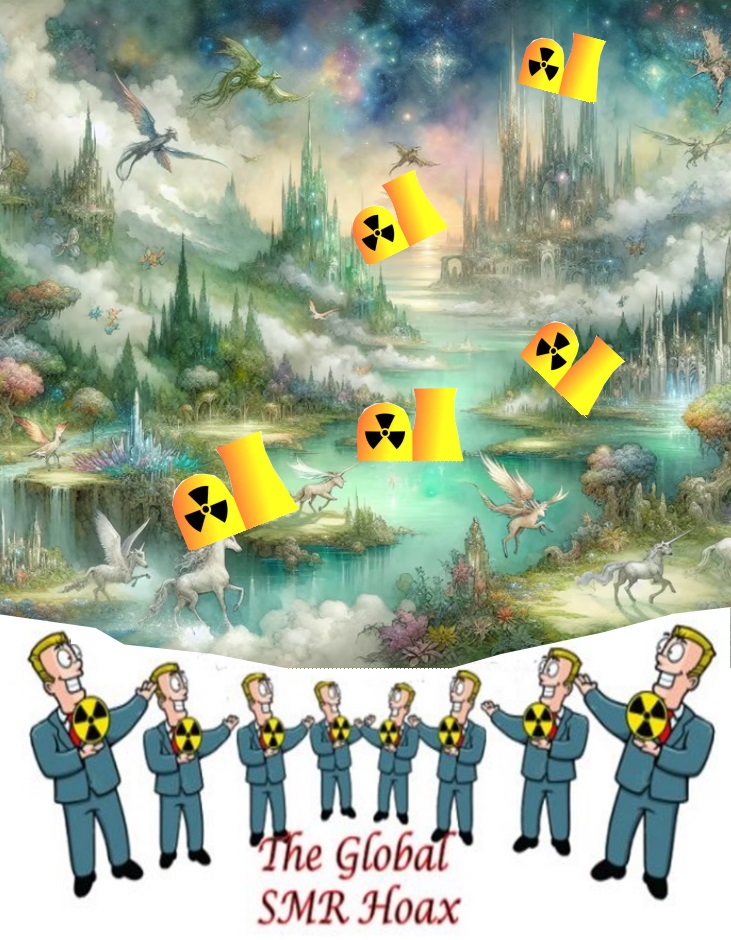
From Steve Thomas, Emeritus Professor of Energy Policy, University of Greenwich, London SE10, UK, 30 Jan 26 https://www.ft.com/content/085e92e6-2f7f-4381-9416-0aa59fa3a3
Richard Ollington (“Small nuclear reactors are worth the wait”, Opinion, January 16) makes three claims. First, that small modular reactors (SMRs) will get quicker and easier to build, citing the French programme as evidence. Second, Russia is building large numbers of SMRs and third, improving existing reactors and reviving retired ones could add 40GW of nuclear capacity. None of these claims stands up to scrutiny. Over the 15 years of the French programme, the real cost of reactors increased by some 60 per cent. Construction of the first eight reactors averaged 70 months while the last eight averaged 135 months.
Russia has completed only two SMRs and has one under construction. The two completed ones are barge-mounted reactors providing heat and power to an isolated Siberian community. They took 13 years to build and have a reliability of 40 per cent. Restarting two retired reactors (1.6GW), one owned by Meta, the other by Microsoft, is actively being considered, but awaits approval from the US Nuclear Regulatory Commission before decisions can be taken to bring them back to life. The increasing concentration of carbon in the atmosphere will not wait a decade to see if the ambitious claims for SMRs are met. So even if we were to believe the hype surrounding SMRs, we cannot afford to wait to see if they prove viable.
The Justifications For War With Iran Keep Changing
The justifications for war with Iran keep changing. First it’s nukes, then it’s conventional missiles, then it’s protesters, and now it’s back to nukes again. Kinda seems like war with Iran is itself the objective, and they’re just making up excuses to get there.
As the US moves war machinery to the middle east and holds multi-day war games throughout the region, President Trump and his handlers have been posting threats to the Iranian government on social media warning them to “make a deal” on nuclear weapons.
The following appeared on Trump’s Truth Social account on Wednesday:
“A massive Armada is heading to Iran. It is moving quickly, with great power, enthusiasm, and purpose. It is a larger fleet, headed by the great Aircraft Carrier Abraham Lincoln, than that sent to Venezuela. Like with Venezuela, it is, ready, willing, and able to rapidly fulfill its mission, with speed and violence, if necessary. Hopefully Iran will quickly “Come to the Table” and negotiate a fair and equitable deal — NO NUCLEAR WEAPONS — one that is good for all parties. Time is running out, it is truly of the essence! As I told Iran once before, MAKE A DEAL! They didn’t, and there was “Operation Midnight Hammer,” a major destruction of Iran. The next attack will be far worse! Don’t make that happen again. Thank you for your attention to this matter! President DONALD J. TRUMP”
It’s interesting that we’re back on the subject of needing to bomb Iran because of nuclear weapons, given that just a couple of weeks ago we were being told it was very, very important for the US to bomb Iran because of Iran’s mistreatment of protesters. Earlier this month Trump was openly saying “Iranian Patriots, KEEP PROTESTING — TAKE OVER YOUR INSTITUTIONS!!!… HELP IS ON ITS WAY” while issuing threats to the Iranian government not to respond violently to the uprising. The president then backed off of these threats, reportedly at the urging of Benjamin Netanyahu who told him Israel needed more time to prepare for war.
Prior to that, Trump was saying he would bomb Iran if it continued expanding its conventional missile program. Asked about reports that the US and Israel were discussing plans to strike Iran to stop it from building on its ballistic missile arsenal and reconstructing its air defenses that were damaged in the Twelve Day War, the president told the press “I hope they’re not trying to build up again because if they are, we’re going have no choice but very quickly to eradicate that buildup.”
The US justified its airstrikes on Iranian energy infrastructure during the Twelve Day War by citing concerns that Tehran was building a nuclear weapon, after which Trump confidently proclaimed that “All three nuclear sites in Iran were completely destroyed and/or OBLITERATED. It would take years to bring them back into service.”
And yet here we are a few months later back on the subject of nuclear weapons, with the US president citing urgent concerns over nukes to justify its renewed brinkmanship with Iran.
I kinda think they’re lying to us, folks.
Artificial intelligence will not revive the nuclear industry
by beyondnuclearinternational, https://beyondnuclearinternational.org/2026/01/25/artificial-intelligence-will-not-revive-the-nuclear-industry/
On the contrary, we need renewable energy and natural intelligence, writes Stéphane Lhomme
The current boom in artificial intelligence is accompanied by a massive increase in energy and water consumption, and, according to what we are told, this phenomenon is only just beginning and will grow exponentially.
However, far from taking measures to stop or at least slow down this phenomenon, industrial and political leaders are instead competing with announcements and decisions to support it. As a result, various countries, including France, are trying to attract data centers by promising their owners, mainly the famous GAFAM (Google, Amazon, Facebook, Apple, Microsoft), to provide them with cheap and, above all, “green” electricity.
France is offering its nuclear power because, as everyone knows, nuclear power is “clean”… if we are willing to forget the devastation caused by uranium mines, the massive radioactive, chemical, and thermal discharges from power plants into rivers and oceans, radioactive waste, and the occasional contamination of an entire country or continent (during disasters such as Fukushima and Chernobyl).

During the World Nuclear Energy Exhibition (WNE) held in Paris from November 4 to 6, 2025, the vast majority of the media reported the countless announcements about a supposed “return to favor of nuclear power,” which, however, is just as illusory as the “great return of nuclear power” announced in the early 2000s – already accompanied by much fanfare at the time – by the same media outlets and sometimes the same journalists, who are taking advantage of the general amnesia of our “information” societies.
Despite the efforts of the high priestess of nuclear power at the time, Ms. Lauvergeon, revered by most of the media (always the same ones!) before leading her company Areva into bankruptcy (we are still waiting for the investigations that have been ongoing for 15 years to result in a trial), there was no “great comeback.”
Producing 17.1% of the world’s electricity in 2001, nuclear power has since seen its share steadily decline to below 10% in 2020 and below 9% in 2024 (8.97% to be exact). A veritable collapse as a “return to favor.” But we would have to believe that this time, buoyed by GAFAM and their unlimited checkbooks, the nuclear industry will truly experience a golden age (or rather a plutonium age). Let’s take a look at some of the thunderous announcements made in recent months.
Last June, Google announced that it would be relying on nuclear fusion to power its data centers! Let’s just remember that for 70 years, the major nuclear powers have failed completely in this endeavor, even when they joined forces in the Iter project in Cadarache (Bouches-du-Rhône). If nuclear fusion really is what powers Google, then this search engine is bound to shut down quickly!

In fact, last October, Google fell back on a plan B: restarting the Duane Arnold nuclear power plant in Iowa, which had been shut down since 2020. Never one to be late in relaying the nuclear industry’s announcements, AFP produced a dispatch reminding readers that this was the third project of its kind.
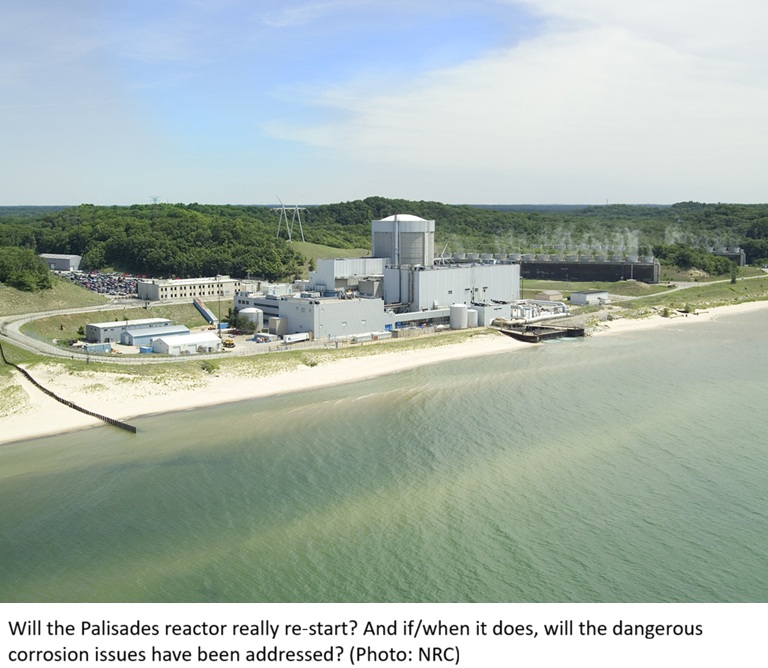
Indeed, the restart of the Palisades nuclear power plant in Michigan has been announced for 2023. But almost no one mentioned the official report of October 2024 revealing that the reactor, which had been shut down for several years, was severely affected by corrosion.
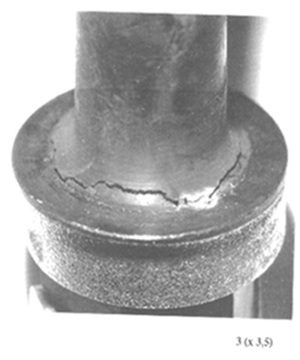
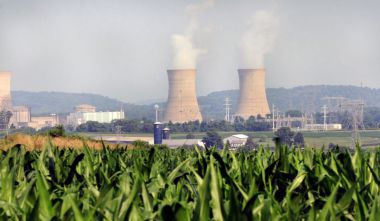
In reality, it is highly likely that this plant will never restart, nor will the Duane Arnold or Three Mile Island plants: in the latter case, the plan is to restart reactor 1, which was shut down in 2019, and not reactor 2 (whose core melted during a serious accident in 1979), as reported by the media, which we will charitably describe as inattentive.
Another avenue for the supposed “return to favor of nuclear power” and its ability to fuel the insane consumption of AI is that of the famous SMRs, small modular reactors, which are of course touted as being “safe, easy to build, and inexpensive.” So all we had to do was think of it.

However, the 127 SMR projects identified worldwide by the OECD’s Nuclear Energy Agency, far from making this idea a reality, show instead a total lack of focus: many start-ups are chasing subsidies generously granted by politicians who are ignorant and, above all, terrified of being seen as dinosaurs who have missed the boat on renewal.
The SMR bubble is about to burst. In France, the main start-ups (Naarea, Newcléo, Jimmy, etc.) are in serious difficulty or have already suspended payments, and EDF’s Nuward project has been postponed indefinitely. In the US, the only project that had made any progress, NuScale, has already closed down.

After initially announcing the construction of new nuclear reactors (large or SMRs), then falling back on restarting shut-down reactors, GAFAM companies are now cautiously turning to existing facilities. In the US, for example, gas-fired power plants are being called upon. In addition, Meta (Facebook) has signed an agreement to purchase the output of the Clinton nuclear power plant (Illinois), a plant that is currently in operation: this is safer than relying on virtual or shut-down plants!
It is already clear that, wherever data centers are built, GAFAM will monopolize electricity production to the detriment of the population. This situation, which one might have thought was the stuff of science fiction, is already a reality in the US, for example in Virginia, Georgia, and Arizona, where the population is deprived of water, which is monopolized for cooling the numerous data centers built in these states, which attracted them by exempting them from taxes (again to the detriment of the population).
The same is true, for example, in Chile and already, or soon, in all countries that have had the bad idea of welcoming these famous data centers. Selfishly, we can only hope that, despite the grandstanding of the showman Macron, France will fail to attract data centers. It will then be the “winners” of this absurd race who will fall victim to GAFAM, and thus there will be electricity and water left for the needs of the French population. It should also be noted that various countries are beginning to take measures to slow down or suspend the installation of data centers.
Unfortunately, it is to be feared that nothing and no one will put a stop to the madness of AI and its senseless consumption of electricity (not to mention the “mining” of bitcoins and other cryptocurrencies, an activity that also consumes a tremendous amount of energy and water).
However, contrary to what is claimed in the numerous articles mentioned above, nuclear power will not be able to meet this demand: as demonstrated by the failures of large reactors—EPR (France) and AP1000 (USA)—as well as SMRs, the construction of nuclear power plants is far too uncertain, slow, and costly.
Moreover, according to the International Energy Agency, since 2020, 90% of new electricity generation capacity worldwide has been renewable, which is much cheaper than nuclear power and, above all, can be brought online very quickly. AI will therefore not save nuclear power; quite the contrary: once they have finished with their absurd announcements, even the GAFAM companies will turn away from it and choose realistic options. That said, while it is of course much better for electricity to be renewable rather than nuclear, one wonders where the progress will be if it is monopolized to power AI rather than meet the needs of the population.
On this subject, there is still time to cancel the senseless EPR reactor projects (even renamed EPR2 to make them seem like an improvement), which EDF is proving incapable of building and operating, and to devote the available money to realistic, decentralized energy efficiency and renewable energy projects that are supported by and for the population: Natural intelligence and renewables rather than artificial “intelligence” and nuclear power.
Stéphane Lhomme is the founder and director of Observatoire du nucléaire. This article was originally published by Observatoire du nucléaire.
3 Myths About the Shah of Iran — “Dictator, CIA Puppet, Brutal”
Quick article debunking Cold War-era propaganda that’s still being repeated
SL Kanthan, Jan 22, 2026, https://slkanthan.substack.com/p/3-myths-about-the-shah-of-iran-dictator?utm_source=post-email-title&publication_id=844398&post_id=185383071&utm_campaign=email-post-title&isFreemail=true&r=ln98x&triedRedirect=true&utm_medium=email
Now that Iran is experiencing the biggest protests since the Islamic Revolution of 1979, there is renewed interest in the history of the country during the Shah era. This is a short article to debunk three myths about the Shah of Iran. I have written a much longer article on this topic — here is the link. Okay, let’s look at the myths and debunk/clarify them.
The three talking points to demonize Mohammad Reza Pahlavi are:
- He was a dictator
- He was a puppet of the US, since he was installed by the CIA in the 1953 coup
- He ran a brutal secret police known as the SAVA
All of these accusations have some truths and some lies. The claims are exaggerated and miss the context.
Shah being a Dictator
First, the Shah was a monarch and would be considered a “dictator” by today’s Western standards. But, in those years, most countries in the world were under dictatorships — left or right. From the Soviet Union and the Eastern bloc to China and the Middle East to Latin America and even Spain and South Korea, dictators ruled the world!
What matters is this: Iranians had incomparably more political freedom, more economic freedom and more social freedom under the Shah than under the current theocratic regime in Iran.
Below [on original] is a photo of protesters — in Tehran from 1978 — with a sign that says, “Down with the Shah, the blood-sucker.” Can you imagine a similar sign today that says, “Down with Khamenei, the blood-sucker”? The protesters will be hanged from a crane.
Anti-Shah groups such as liberal university students, communists (like the Tudeh Party), and Islamic extremists thrived in Iran under the Shah. A terrorist group named as Fedayeen of Islam tried to assassinate the Shah — they fired five bullets, of which 4 narrowly missed, and one hit him in the shoulder.
Ironically, all the anti-Shah groups were brutally suppressed and eliminated by their former ally, Khomeini, after the revolution.
Within a month after coming to power, Khomeini denounced leftist Iranians as “non-Muslims” who “are at war with the philosophical beliefs of Islam.”
One year later, the Ayatollah openly declared a jihad on Iran’s liberals, Marxists and communists.
During the Shah’s rule, Iran had a parliament (majlis) which was freely elected by the people. In fact, one of the Prime Ministers — Mossadegh — was so powerful that the Shah had to flee the country for a couple of days in 1953!
The simple fact is that, if the Shah were a true dictator, there would have been no revolution in 1979!
Shah was a Puppet of the USA
This is a Soviet-era propaganda that is still being repeated today — remember that during the Cold War, both the US and the USSR were fighting over control of Iran, a very strategic country in terms of resources, influence and location.
The USSR was funding communist groups within Iran to destabilize the Shah’s government. And from radio stations near the Iranian border, the Soviets were blasting anti-Shah propaganda 7 hours a day.
The Shah was a very Westernized man who gravitated towards the US/Europe. But, of course, in such relations, the US would naturally have more power.
But he was not a “puppet.” In fact, the CIA complained in a classified psychological profile that the Shah was a “megalomaniac” who followed his “own plans, while disregarding US interests.” Not the description of a subservient leader.
The Shah also met with Soviet leaders in an act of extraordinary diplomacy during the intense Cold War. Here he is [on original] in Moscow with his wife Soraya in 1956:
About that infamous 1953 CIA coup: It was a coup to stop a coup
Contrary to the popular myth, the Shah was NOT installed by the CIA in a 1953 coup. He had actually come to power in 1941– that was 12 years before the coup and even 6 years before the CIA was created!
But… here is the nuance. The CIA certainly carried out the coup and helped the Shah, who had left/fled the country for 3–4 days.
Here is what happened:
Iranian Prime Minister Mossadegh was an influential and ambitious populist, who nationalized the oil sector in 1951. But it was a total disaster — Iran’s oil production fell a staggering 95% over the next two years, as the British withdrew all their technicians, and Iranians did not have the skill to operate the refineries.
At that point, the Shah tried to fire Mossadegh, but couldn’t. (So much for being a brutal dictator). Afraid of a coup or worse (assassination), the Shah fled to Italy for a couple of days.
At the same time, powerful Western oil interests and the deep state (MI6/CIA) were waiting for an opportunity to get rid of Mossadegh. Hence the CIA coup of 1953.
It was a coup to stop a coup.
SAVAK — The Shah’s Brutal Secret Police
After the 1953 coup discussed above, the Shah sought help from the West. That’s why SAVAK was created in 1957 with help from the CIA and MI6. Yes, SAVAK was ruthless, operated outside the law, and engaged in spying, arrests, torture etc.
But guess what happened after the Islamic Revolution? SAVAK was not dismantled, but simply renamed as SAVAMA! In fact, the deputy chief of SAVAK — General Hossein Fardoust — became the head of SAVAMA. All the infrastructure, files, intelligence, torture methods, along with most intel agents continued under Khomeini.
The anti-Shah people never talk about this inconvenient fact.
Conclusion
For ideologues on the far left, a good dictator is an anti-American dictator. So, they worship Stalin, Fidel Castro, Islamic regime in Iran etc., while hating on the Shah.
This is a short summary. You can read my much longer article on Substack:
Government funding for Saskatchewan SMR test facility
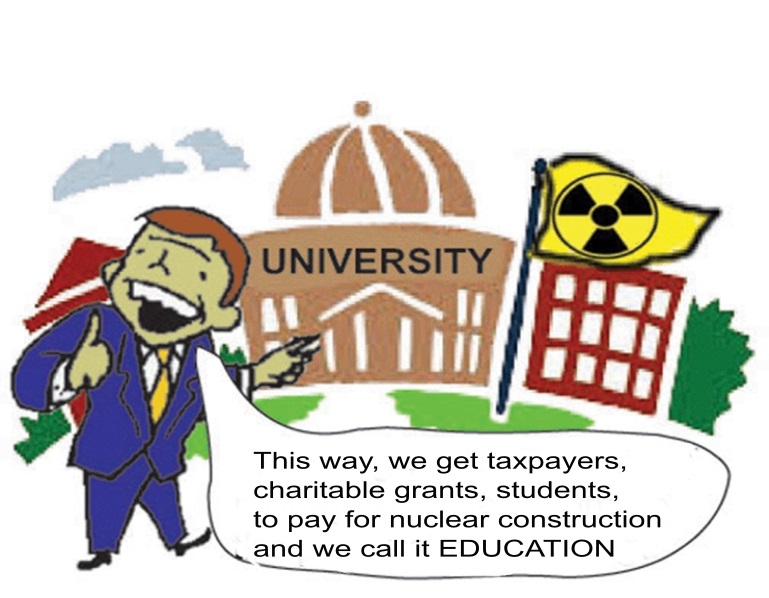
World Nuclear News 20th Jan 2026
Western Canada’s first Small Modular Reactor Safety, Licensing, and Testing Centre at the University of Regina is to receive nearly CAD6 million (USD4.3 million) in funding from the federal and provincial governments.
The facility – the SMR-SLT – will be located at the Innovation Saskatchewan Research and Technology Park. It will house two test loops that simulate a part of a small modular reactor (SMR), modelling water-cooled systems using electrical heat, allowing researchers to test components under conditions similar to those in operating reactors.
The funding was announced by Buckley Belanger, Canada’s Secretary of State (Rural Development), on behalf of Minister of Emergency Management and Community Resilience and Minister responsible for Prairies Economic Development Canada Eleanor Olszewski. The federal government is investing CAD1.96 million (USD1.4 million) in the SMR-SLT through Olszewski’s department, PrairiesCan – a federal government department supporting business growth, innovation and community economic development across Alberta, Saskatchewan and Manitoba.
Provincial government support for the project is through SaskPower, the principal supplier of electricity in Saskatchewan, and a Crown Corporation – a commercial entity owned by the Government of Saskatchewan. It will be investing CAD4 million in the SMR-LT……………………..
Innovation Saskatchewan is contributing CAD1 million plus an in-kind contribution of the leased space at the Innovation Saskatchewan R+T Park for the first three years of operation. Canadian Nuclear Laboratories (CNL) will also provide in-kind design support. The centre will be led by University of Regina researchers, with the Global Institute for Energy, Minerals and Society (GIEMS) partnership between the University of Regina, University of Saskatchewan, and Saskatchewan Polytechnic playing a key role to ensure all three institutions have access to the test loops for training and research, SaskPower said.
The government of Saskatchewan signalled its commitment to incorporating nuclear capacity into its provincial electricity system in a long-term policy document released last year. SaskPower has previously selected GE Hitachi Nuclear Energy’s BWRX-300 SMR for potential deployment in the province in the mid-2030s and has identified two potential sites for SMR deployment, both in the Estevan area in the south-east of the province…………………
Arthur Situm, Canada Research Chair in SMR Safety and Licensing at the University of Regina, said the facility will help train the next generation of nuclear professionals by providing hands-on experience with safety systems and processes that define modern nuclear technology.
“Together, this work positions the University of Regina and Saskatchewan as a leader in safe, responsible, small modular reactor research with a global impact,” he said on YouTube…….
https://www.world-nuclear-news.org/articles/government-funding-for-saskatchewan-smr-test-facility
Caitlin Johnstone: You Know They’re Lying About Iran
Caitlin Johnstone, Jan 15, 2026, https://www.caitlinjohnst.one/p/you-know-theyre-lying-about-iran?utm_source=post-email-title&publication_id=82124&post_id=184538794&utm_campaign=email-post-title&isFreemail=true&r=1ise1&triedRedirect=true&utm_medium=email
You’ve seen this all before. They run the same script over and over again. You know all the beats. The formula never changes.
“Oh no, the people in the targeted nation are being oppressed! They need freedom and democracy!”
“Hey, I bet we could use our powerful military to help them get the freedom and democracy! Wouldn’t that be swell?”
“Oh gosh, there are some people who don’t think we should use our powerful military to help the people in the targeted nation get freedom and democracy! They must have some sinister, suspicious loyalty to the Evil Regime which rules the targeted nation!”
“Look, I get that sometimes in the past we have used our powerful military in ways that were mean and unhelpful, but you need to understand that the Evil Regime is also very, very bad. Two things can be true at the same time, you know!”
“Oh no, now the Evil Regime is committing atrocities! You know it’s true because it’s in the news, and the news isn’t allowed to lie! We’ve got to DO something! We can’t just DO NOTHING!”
Don’t fall for it.
Don’t fall for the propaganda.
Don’t fall for the imperial concern trolling about human rights.
Don’t fall for the nuance policing and both-sidesing of the empire’s operatives and useful idiots.
Don’t let the empire apologists shout you down and shut you up.
Stand your ground. This is exactly what it looks like. You are right, and they are wrong.
They’re not doing anything new. They’re using the same old script. Hell, they’re even using a lot of the same actors. This is the same bullshit as always.
Once you’ve seen enough Hollywood movies, you get familiar with the formula. Boy meets girl, but he’s got some kind of secret or character flaw that will be discovered by the girl about three-quarters of the way through the film, it will seem as though all is lost, but he wins her back in the end. They churn out variations of this movie year after year, following the same formula every time.
This is like that. You’ve seen enough of these to know the formula by now.
Trust your gut. Have confidence in your own inner vision. You’ve got this.
There’s probably going to be a whole lot of narrative distortion dumped into the information ecosystem in the coming days, but they’re not going to make a sucker out of you.
You’re seeing things much too clearly now.
Who is to blame for blocking a new ‘golden era’ for nuclear power?
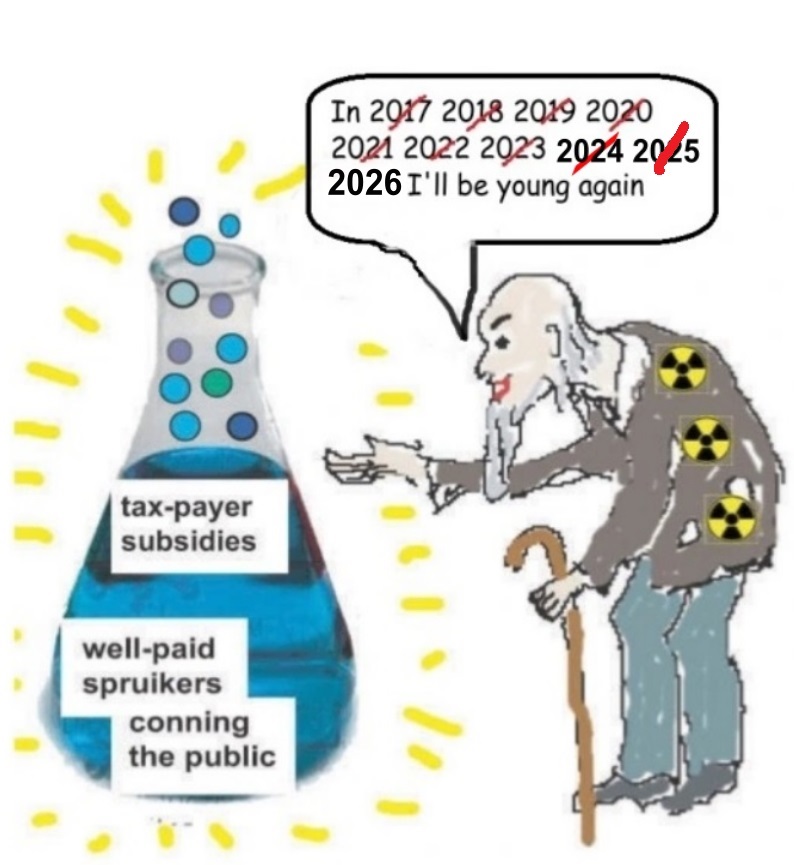
It is not the regulators or we so-called ‘blockers’ who are the main impediment to nuclear. It is the systemic failure of the nuclear industry to produce viable projects such as the much-hyped but non-existent Small Nuclear Reactors; its predictable inability to prevent cost overruns or to meet deadlines; let alone its lack of credible ideas to deal adequately with risk, safety and the management of its dangerous and interminable wastes. Nuclear is an industry that is bound to fail
7 January 2026, https://www.banng.info/news/regional-life/who-is-to-blame-for-blocking-nuclear-power/
Andrew Blowers tackles this question in the January edition of Regional Life magazine
The mantra that nuclear technology ‘is essential for achieving national security, energy security and Net Zero targets’ proclaimed by the Government’s Nuclear Regulatory Task Force has become the unequivocal, if deeply flawed, basis for government policy. The Government has pledged to ‘turbo-charge the build-out of new nuclear power stations and enter a ‘golden era’ of nuclear power.
Standing in its way are ‘gold-plated’ regulations and community groups like BANNG committed to protecting local environments, ecology and human health. The Task Force Review report just published (December) asserts, entirely without supporting evidence, that ‘The primary barrier’ to revitalising nuclear’s role is ‘systemic failure within the regulatory framework’.
So, here we have a familiar confrontation between energy and economic growth on the one side and environmental protection on the other. We have been here before. Every decade or so a new nuclear revival is promised but, after much huffing and puffing very little materialises. At the beginning of the century Tony Blair declared new nuclear was back ‘with a vengeance. In 2011 eight sites, including Bradwell, were declared ‘potentially suitable’ for new nuclear power plants.
In the event, only one, Hinkley Point, materialised and has become notorious for being too late, promised for 2017 but unlikely to power up until the next decade. Its cost overruns have become legendary. According to the Government, the culprits are environmental regulations and campaign groups who insist that previously agreed audio fish deterrents (AFDs) must be installed to help save millions of fish from becoming entrained and entrapped in the colossal intake and outflow pipes going into the Severn estuary. The developer has prevaricated, proposing cheaper but environmentally destructive methods of abatement. Politicians, including Sir Keir Starmer, have mindlessly mocked the ADF as a ‘fish disco’. It makes one wonder how they might deride oysters from the Blackwater if they stood in the way of nuclear power at Bradwell.

It is not the regulators or we so-called ‘blockers’ who are the main impediment to nuclear. It is the systemic failure of the nuclear industry to produce viable projects such as the much-hyped but non-existent Small Nuclear Reactors; its predictable inability to prevent cost overruns or to meet deadlines; let alone its lack of credible ideas to deal adequately with risk, safety and the management of its dangerous and interminable wastes. Nuclear is an industry that is bound to fail.
Meanwhile the importance of regulations imposed by independent regulators designed to protect people and the environment cannot be overstressed. And the essential role of community groups and councils in seeking to ensure the environmental protection and health and wellbeing of the places they represent is something to be cherished, not denigrated. It is a pity the Government does not see it that way.
7 January 2026
Andrew Blowers tackles this question in the January edition of Regional Life magazine
The mantra that nuclear technology ‘is essential for achieving national security, energy security and Net Zero targets’ proclaimed by the Government’s Nuclear Regulatory Task Force has become the unequivocal, if deeply flawed, basis for government policy. The Government has pledged to ‘turbo-charge the build-out of new nuclear power stations and enter a ‘golden era’ of nuclear power.
Standing in its way are ‘gold-plated’ regulations and community groups like BANNG committed to protecting local environments, ecology and human health. The Task Force Review report just published (December) asserts, entirely without supporting evidence, that ‘The primary barrier’ to revitalising nuclear’s role is ‘systemic failure within the regulatory framework’.
So, here we have a familiar confrontation between energy and economic growth on the one side and environmental protection on the other. We have been here before. Every decade or so a new nuclear revival is promised but, after much huffing and puffing very little materialises. At the beginning of the century Tony Blair declared new nuclear was back ‘with a vengeance. In 2011 eight sites, including Bradwell, were declared ‘potentially suitable’ for new nuclear power plants.
In the event, only one, Hinkley Point, materialised and has become notorious for being too late, promised for 2017 but unlikely to power up until the next decade. Its cost overruns have become legendary. According to the Government, the culprits are environmental regulations and campaign groups who insist that previously agreed audio fish deterrents (AFDs) must be installed to help save millions of fish from becoming entrained and entrapped in the colossal intake and outflow pipes going into the Severn estuary. The developer has prevaricated, proposing cheaper but environmentally destructive methods of abatement. Politicians, including Sir Keir Starmer, have mindlessly mocked the ADF as a ‘fish disco’. It makes one wonder how they might deride oysters from the Blackwater if they stood in the way of nuclear power at Bradwell.
It is not the regulators or we so-called ‘blockers’ who are the main impediment to nuclear. It is the systemic failure of the nuclear industry to produce viable projects such as the much-hyped but non-existent Small Nuclear Reactors; its predictable inability to prevent cost overruns or to meet deadlines; let alone its lack of credible ideas to deal adequately with risk, safety and the management of its dangerous and interminable wastes. Nuclear is an industry that is bound to fail.
Meanwhile the importance of regulations imposed by independent regulators designed to protect people and the environment cannot be overstressed. And the essential role of community groups and councils in seeking to ensure the environmental protection and health and wellbeing of the places they represent is something to be cherished, not denigrated. It is a pity the Government does not see it that way.
Academic Freedom on Life Support: Trump’s War on Knowledge Exposed
January 6, 2026 https://scheerpost.com/2026/01/06/academic-freedom-on-life-support-trumps-war-on-knowledge-exposed/
In this episode of Scheer Intelligence, Robert Scheer speaks with Professor Steve Macek about what he calls an unprecedented assault on academic freedom in the United States. From federal investigations into Columbia and UCLA to state‑level crackdowns in Florida and Texas, Macek argues that the country is witnessing a new form of political interference — one that targets universities, scholars, and even entire fields of study.
Scheer and Macek trace the historical lineage from McCarthyism to the present, examining how both major political parties have contributed to a climate of fear, surveillance, and self‑censorship on campus. They discuss the weaponization of antisemitism accusations, the precariousness of adjunct faculty, the chilling effect on student activism, and the broader erosion of institutions that produce knowledge.
This conversation is essential for anyone concerned about free inquiry, democratic debate, and the future of higher education.
Exposing the World Nuclear Association’s Bullshit
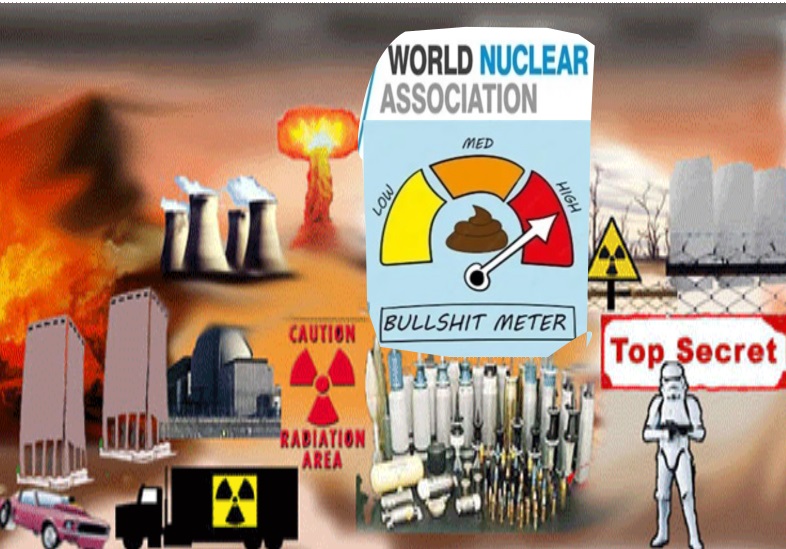
5 January 2026 Noel Wauchope https://theaimn.net/the-world-nuclear-association-looks-forward-to-a-successful-2026/
From an edited transcript of World Nuclear Association Director General Sama Bilbao y León’s World Nuclear News podcast interview.
“What do you think are the main priorities for the year ahead?“
“I think that for everybody in the global nuclear industry, it is essential that we move from ambition to action, to see real projects deployed, many of them.We also need to see many final investment decisions, and see more countries moving forward with nuclear projects.”

COMMENT: Well, the nuclear industry has certainly been big on ambition. But in 2025, not so much on action. It has been bogged down with financial wrangling over the costs of new projects, such as the UK’s Hinkley Point C, and Sizewell C projects, and of the plethora of small nuclear reactor wannabe.
“Finance continues to be an important piece of the puzzle, and in more and more projects we see private investors understanding how they can contribute. We are seeing this in Poland, we saw this in the UK, and I think that we are going to see this in many other jurisdictions. We will continue to work on the supply chain.” This year we will have our second World Nuclear Supply Chain Conference. We are really pleased that it is going to be held in Manila in the Philippines… Also, we are looking closely at India’s plans.”

“This year we will have our second World Nuclear Supply Chain Conference. We are really pleased that it is going to be held in Manila in the Philippines. The ASEAN region is moving forward with nuclear projects very, very quickly and most of the countries are growing their economies incredibly quickly, which of course translates into enormous energy demand. And many of them – Vietnam, Indonesia, Malaysia, Philippines, Singapore – they are really looking at nuclear as a key piece of the puzzle.”

COMMENT: There’s a fair bit of confusion in the Western world about who’s to pay for the setting up of a few very big nuclear reactors, of thousands of “small’ and “mini” reactors, of the security costs, and the huge decommissioning and waste disposal costs. Even government-run nuclear in Russia finds this a financial burden, while China, still pursuing some new nuclear, is investing massively in solar and wind. No wonder the World Nuclear Association is keen to sell to the “third world.”

“We are seeing the realignment of some of the laws in India, the Atomic Energy Act and also the liability laws, that are going to hopefully incentivise international cooperation, international participation in the Indian market. because India has incredible ambitions for 100 GW of new nuclear by 2047. India has great capabilities itself, but global contributions could also be fabulous for these ambitions. The changes also encourage more involvement from the Indian private sector, which could be really game-changing.”
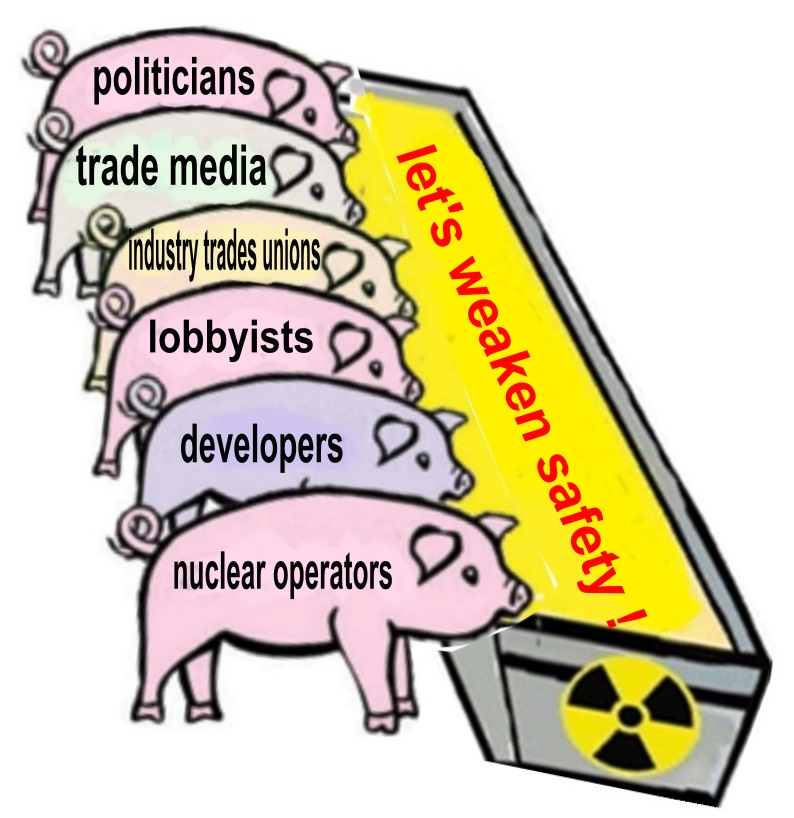
COMMENT: India’s new law undercuts the operator’s cost of nuclear incidents while allowing foreign suppliers to walk away with no liability. This is in line with moves in the USA to weaken safety regulations.
“One of the big issues for the public is nuclear waste.”
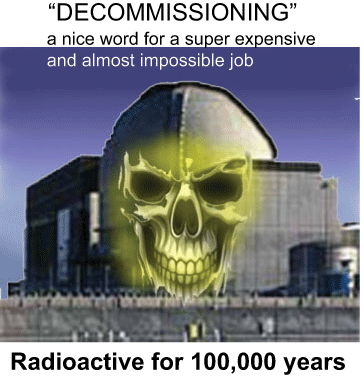
“That is true, but I think that in 2026 we are going to see the entering into operation of the geological repository in Onkalo, Finland. I think this will be a key opportunity to show the world that the questions about what to do with nuclear waste and used nuclear fuel are not a technology problem. It is actually most often a problem of policy, politics, and political will. So I think it is great that Finland is being proactive. I think that Sweden is a minute behind, and then France is also very close by. So I think it will be a key year for that part of the fuel cycle also.
COMMENT: Not that simple. Further delay in Finnish repository licence review. A multi-million dollar dispute rages over Olkiluoto 3 – only lawyers will win. Sweden is building the world’s second nuclear waste storage site amid safety concerns. Sweden’s nuclear waste plan is a 100,000 year gamble. France’s plan to bury accumulated highly radioactive waste at Bure, 250 kilometres east of Paris, remains at an impasse.
April will see the 40th anniversary of the Chernobyl accident
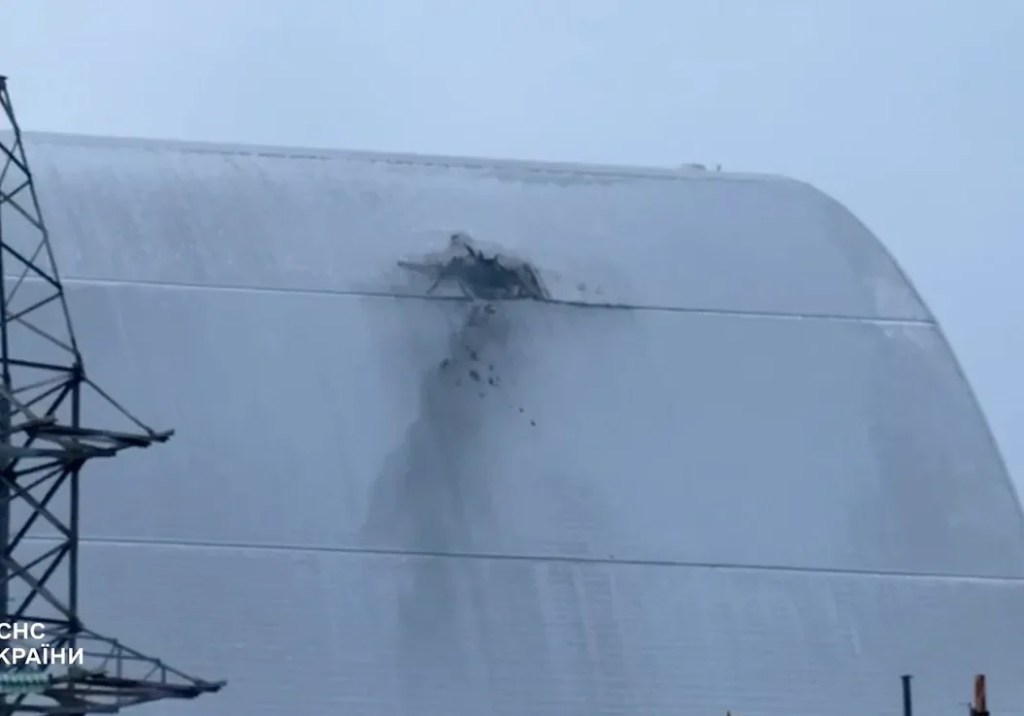
COMMENT Doncha love the way these nuclear hypocrites turn every bad thing into a plus?
Chernobyl’s so good as a lesson. Never mind the fact that the damaged protection dome is spewing radiation out, and they can’t get rid of the toxic melded waste inside .
“It is always good to look back and make sure that we have really learned all the lessons and taken the opportunities for improvement from previous events. 2026 will also be the 15th anniversary of Fukushima. I think that the industry has been very good at reflecting on these events and extracting all the lessons to be learned.”

“I think that the safety culture at a global level continues to be better than ever. I think that international collaboration has always been great in nuclear, but certainly the collaboration that ensued after Chernobyl, and certainly after Fukushima is a testament to how well the nuclear industry is collaborating. “
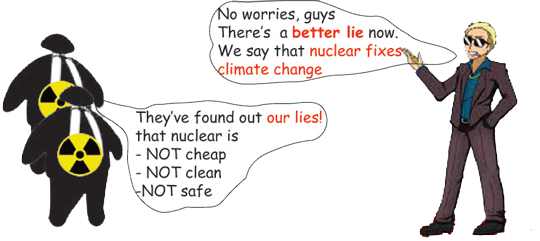
COMMENT. Note that here the WNA boasts that nuclear power helps action on climate change, (but later on, boasts its partnership with with fossil fuel industries)
“but they need to be put in context with the impacts of things like using fossil fuels on human health, on the environment and obviously on climate change. We really need to look at the entire life-cycle of all energy sources and to recognise that there is not one energy source that is a silver bullet for anything. I think that perhaps Fukushima’s anniversary and Chernobyl’s anniversary will be an opportunity for us as a society to become more pragmatic and realistic about the risks and opportunities of all these technologies.”
What do you think are the key planned events for the year?
“We hit the ground running at Davos at the World Economic Forum this year, from 19 January – this is perhaps the second time that nuclear energy is really going to be visible there, so we are excited about that opportunity. Immediately after Davos there is India Energy Week in Goa, which is the second-largest energy conference in the world.”
“In March, we will be at CERAWeek in Texas, a very important event where we are bringing together nuclear energy with many of these large energy users, in particular the oil and gas industry, that are really aligning themselves to best understand how nuclear can contribute to their decarbonisation and energising efforts. “
“And then, in April, we will have the World Nuclear Fuel Cycle Conference in Monaco. In May, we will be in Manila at the World Nuclear Supply Chain Conference, and World Nuclear University’s Summer Institute will be in the summer in Lyon in France. And of course we will come back together in September here in London for the World Nuclear Symposium, which will be even bigger and better than the one that we did in 2025. We really wanted to bring the nuclear and finance communities together to answer each other’s questions and demystify nuclear, so financiers recognise that nuclear projects are nothing more, nothing less, than large infrastructure projects. We are now working together with the finance community to put together a nuclear financing guide to pull together best practices and lessons learned to support financiers and nuclear developers going forward. “
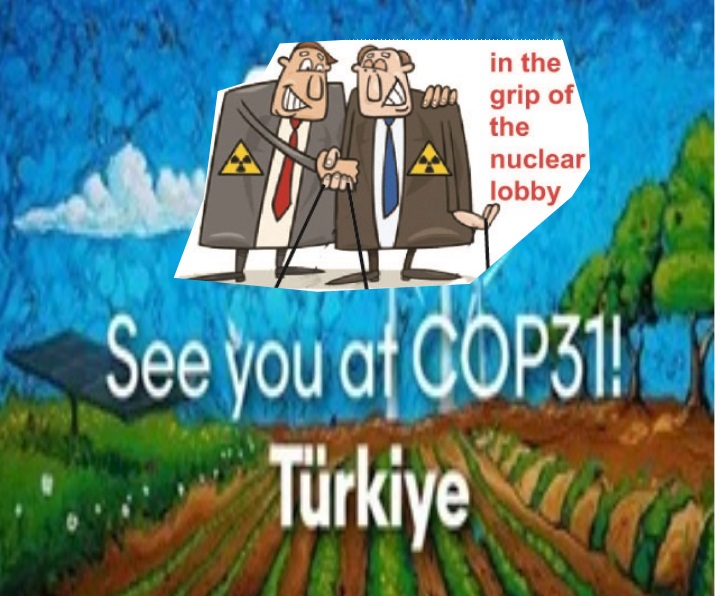
COMMENT. Note that while the nuclear lobby pretends to solve climate change, in reality they’re not only in cahoots with oil and gas lobbies, but they intend to take over global climate action, as they planned for in previous COPs
“Later in the year, there will be Africa Energy Week at the end of September in Cape Town, and Singapore International Energy Week is a great opportunity to bring together all those ASEAN countries. There will also be the World Energy Congress taking place in Saudi Arabia and also COP31 in Turkey. So if people thought that 2025 was crazy, I think it is clear that 2026 is looking like it will be just as busy.”
“So interesting times ahead…
“Definitely. This is the time. We’ve been discussing how the stars are aligning for nuclear energy and I think that we are there. The stars are definitely aligned. This is the moment where we, the global nuclear industry, really need to be proactive and active and make the most of this opportunity. We really need to work together with our governments. We need to work together definitely with the nuclear regulators, with the finance community, with large energy users, and we cannot leave behind civil society. We have seen major improvements in public acceptance and interest in nuclear, but we need to continue to be proactive to engage with civil society, to make sure that no question is left unanswered. ”
COMMENT: A lot of questions not even asked. The mind boggles. Not a mention of the now terrifying possibilities of cheap little drones targeting nuclear reactors, and nuclear waste pools. Not a mention of the fearful progress being made on smaller nuclear “tactical weapons”. Not a mention of the new Highly Enriched nuclear fuels for new generation nuclear reactors – that bring big risks of nuclear weapons proliferation. And of course, in the current energy economics – really no need for new nuclear reactors. (except to provide technical staff, academic “cover” and hidden funding for the nuclear weapons industry).
https://www.world-nuclear-news.org/articles/in-quotes-what-to-watch-out-for-in-2026
The Israeli army is creating a ‘new security reality’ in the northern West Bank to advance colonization
In recent weeks, the Israeli army has launched a renewed military campaign in the northern West Bank. Palestinians say these operations aim to establish a new “security reality” to facilitate the rebuilding of Israeli settlements dismantled in 2005.
Mondoweiss, By Shatha Hanaysha December 16, 2025
On December 3, Israeli forces raided a home in the town of Qabatiya, south of Jenin, tearing down a map of Palestine hanging on the wall and confiscating another. The homeowners, a woman and her 11-year-old daughter, were detained for several hours and subjected to on-site field interrogations as Israeli troops vandalised the rest of the house before eventually withdrawing.
Noura Muhammad, the homeowner, told Mondoweiss that Israeli soldiers broke down the front door when they arrived, immediately asking her whether there was any “gold or money” in the house.
She added that after detaining her and her daughter alongside their neighbors, the soldiers interrogated the child, asking, “What do you want to be when you grow up?”
“They were attempting to get inside my daughter’s head to understand the future,” Noura told Mondoweiss, explaining that this is a common question that Israeli soldiers ask children to see whether they answer that they want to become resistance fighters. “They’re asking because they’re afraid of that future,” she explains.
In another home, a Palestinian youth with EU citizenship who spoke to Mondoweiss on the condition of anonymity said that Israeli soldiers had detained and interrogated him for hours, while telling him, “Why are you here? Leave the land of Israel.”
These are not isolated incidents. Over the past several weeks, the Israeli army has launched a renewed military campaign in the northern West Bank, first in Tubas and its neighboring villages and then extending to areas such as Jenin, where Israeli soldiers executed two young men in late November. Since then, Israeli forces have repeatedly conducted raids into cities and towns, imposed curfews, invaded homes before converting them into military outposts, forcibly displaced residents, and detained, interrogated, and arrested hundreds of young men.
But what is behind this renewed military campaign, and why is it unfolding only now? While the official Israeli narrative claims that it is “combating terrorism,” locals in Jenin and other parts of the north say it is really about establishing a new reality on the ground of total Israeli dominance. The objective: to create the necessary “security conditions” to allow the unhindered resettlement of areas of Jenin that Israel had evacuated in 2005.
Military escalation as land confiscation
Israel is attempting to create a new status quo in the West Bank as part of its objective of altering the north’s geography. It is doing so by seizing and repurposing Palestinian land to serve colonization and settler infrastructure, and the ongoing military activities in these areas are a part of that effort, locals say…………………………………………………………………………………………………………..
Israel moves to reinstate evacuated settlements
The colonization of these lands occurs through both military and semi-legal means, according to Amir Daoud, Director of Publishing and Documentation at the Colonization & Wall Resistance Commission. The first stage of the colonization process starts with the seizure of land following the issuing of a military order related to road construction, Daoud says. He explains that such orders aim to establish an Israeli military foothold over the land before eventually handing it over to settler groups, complete with a permanent infrastructure that the army would have built for ostensibly military purposes. In the second stage of this process, Daoud continues, settlement activity gradually yet systematically returns to the area under the army’s control following the passing of amendments to Israeli laws
regulating settlement construction. In the case of the Jenin area, this was achieved through the amendment (and eventual repeal) of the Disengagement Law of 2005, which led in that year to the unilateral Israeli withdrawal of all settlements from Gaza and four settlements from the northern West Bank……………………………………………………………………………………………………..
‘Functional coordination’ between settlers and the army
Daoud explains that the pattern has become clear: settlers build a road illegally, after which the army intervenes by issuing a military order that declares it a closed military zone, thereby granting the road “legal cover.” Later, it becomes a civilian settlement or is used to expand settlement infrastructure…………………..
For this strategy to be effective, there must be a degree of coordination between settlers and the military. Daoud describes this as “functional coordination,” and the way it works is that settlers first impose their presence on the ground by constructing supposedly “unauthorized” outposts, and then the army converts it into a fixed reality by converting it into a closed military zone, only to later be opened up for civilian use.
Daoud also stresses that the ongoing military operations in the north can only be understood as part of the effort to create a “new security reality” that is more conducive to settlement expansion……….
The resulting picture is one in which military and settler activities are proceeding in an integrated manner, Daoud stresses; it is all part of a single project aimed at “reshaping the geography and demography” of the northern West Bank………………………………………………….. https://mondoweiss.net/2025/12/the-israeli-army-is-creating-a-new-security-reality-in-the-northern-west-bank-to-advance-colonization/
Torness Nuclear Power Station welcomes East Lothian schoolchildren.
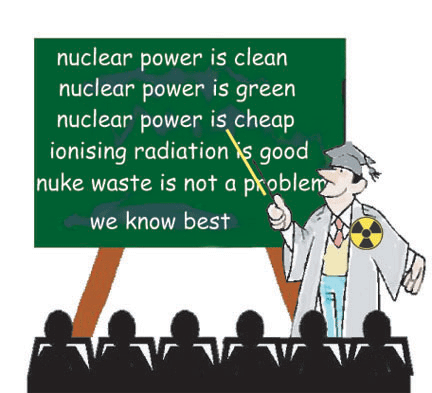
East Lothian Courier, By Cameron Ritchie, 15th December
MORE than 100 pupils from three primary schools have swapped the classroom for touring Scotland’s nuclear power station.
Torness Power Station, near Dunbar, welcomed youngsters from Haddington’s Letham Mains Primary School, as well as Coldstream Primary School and Berwick Middle School, as part of its annual ‘Christmas Cracker’ event.
The scheme offers a unique insight into life at the station and the wide variety of roles that keep it running.
Faith Scott, visitor centre co-ordinator at the power station, said: “The Christmas Cracker event is one of the highlights of our calendar.
“It is a fantastic opportunity for pupils to see how the station operates and discover the range of careers available on site.”
While nearly all primary pupils study science, technology, engineering and maths (STEM) subjects, only a small fraction continue into STEM careers.
Events like the ‘Christmas Cracker’ are designed to encourage pupils to continue studying STEM subjects.

Does Britain really need nuclear power?

Well, the answer was supplied in 2023 by the Rishi Sunak administration which admitted that the main reason for its continued eye-watering financial support for civil reactors was that they provided needed technical support and expertise for the government’s nuclear weapons programme.
Well, the answer was supplied in 2023 by the Rishi Sunak administration which admitted that the main reason for its continued eye-watering financial support for civil reactors was that they provided needed technical support and expertise for the government’s nuclear weapons programme.
It doesn’t, but the link to nuclear weapons is the key driver, writes Ian Fairlie
In recent months, the government has continued to promote nuclear reactors. For example, the Energy Secretary is now asking GB Energy to assess sites to be used to host new nuclear reactors. And the Prime Minister continues to push for so-called Small Modular Reactors and has backed the US President’s wishful thinking of ‘a golden age of nuclear’.
But these announcements and proposals are mostly pie-in-the-sky statements and should be treated with a pinch (or more) of salt, as the reality is otherwise.
Let’s look at what is happening in the rest of the world. Last year, a record 582 GW of renewable energy generation capacity was added to the world’s supplies: almost no new nuclear was added.
Indeed, each year, new renewables add about 200 times more global electricity than new nuclear does.
Of course, there are powerful economic arguments for this. The main one is that the marginal (i.e. fuel) costs of renewable energy are close to zero, whereas nuclear fuel is extremely expensive. Nuclear costs – for both construction and generation – are very high and rising, and long delays are the norm. For example, the proposed Sizewell C nuclear station is now predicted to cost £47 billion, with the government and independent experts acknowledging even this estimate may rise significantly. The upshot is that new nuclear power means massive costs, a poisoned legacy to future generations, and whopping radioactive pollution.
Given these manifest disadvantages, independent commentators have questioned the government’s seeming obsession with nuclear power. It is not that nuclear provides a good solution to global warming: it doesn’t. The United Nations’ Intergovernmental Panel on Climate Change (IPCC) reports that renewables are now 10 times more efficient than new nuclear at CO2 mitigation.
It’s not that AI centres will need nuclear: the International Energy Agency expects data centres will cause a mere 10% of global electricity demand growth to 2030. And it forecasts that the renewables will supply 10 to 20 times the electricity required for data-centre growth, with Bloomberg NEF predicting a 100-fold renewables expansion.
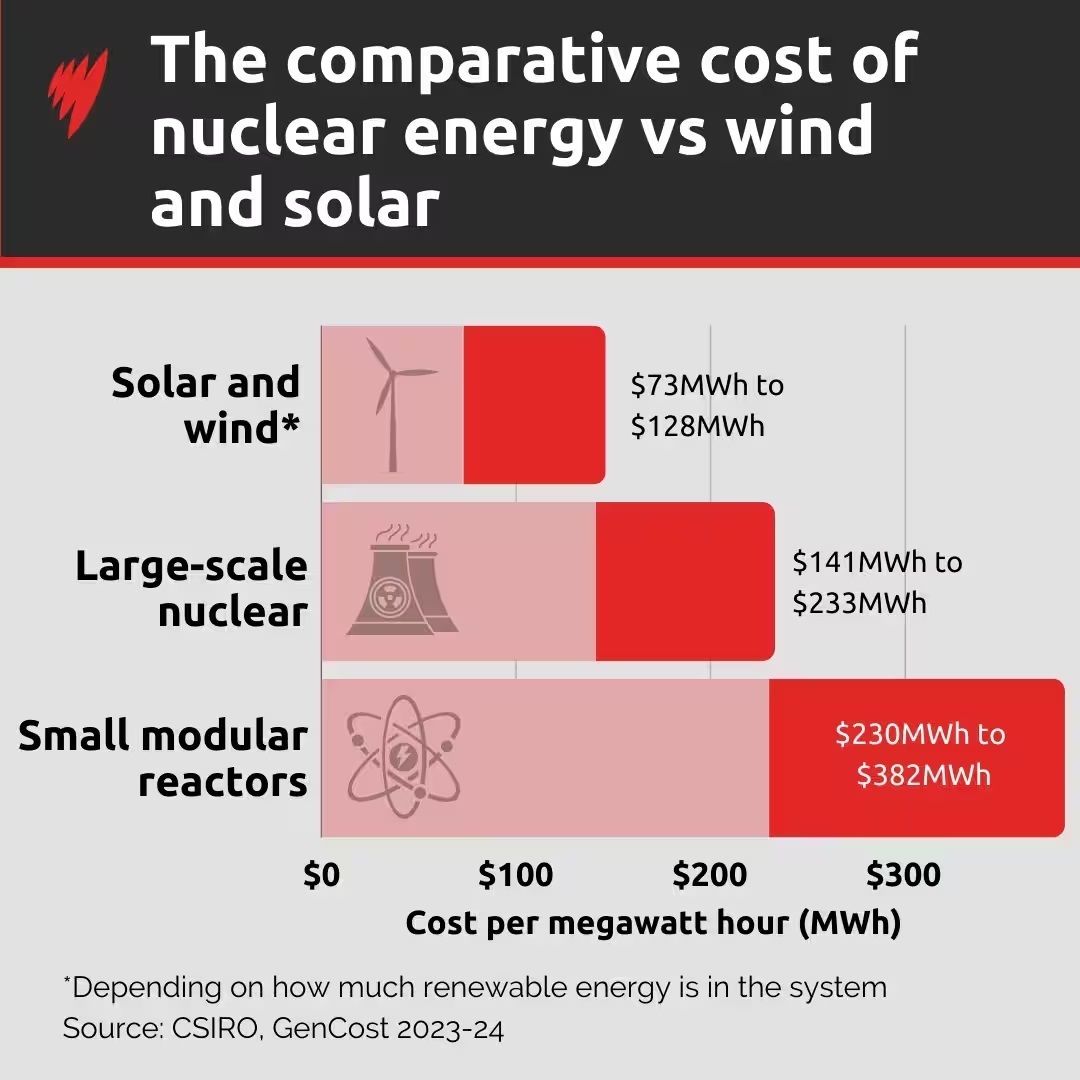
As for so-called Small Modular Reactors, the inconvenient truth is that these designs are all just paper designs and are a long way off. They would also be more expensive to run than large reactors per kWh – the key parameter. And as the former Chair of the US government’s Nuclear Regulatory Commission (NRC) says, SMRs will produce more chemical and radioactive waste per KW produced than large reactors.
Given a UK Treasury strapped for cash, the unsolved problem of radioactive nuclear waste, the spectre of nuclear proliferation, and it’s being a target in future wars, many wonder why the government is so fixated with nuclear power.
Well, the answer was supplied in 2023 by the Rishi Sunak administration which admitted that the main reason for its continued eye-watering financial support for civil reactors was that they provided needed technical support and expertise for the government’s nuclear weapons programme.
Here is CND’s look at those links between nuclear power and nuclear weapons:
Nuclear weapons and nuclear power share several common features and there is a danger that having more nuclear power stations in the world could mean more nuclear weapons.
The long list of links includes their histories, similar technologies, skills, health and safety aspects, regulatory issues and radiological research and development. For example, the process of enriching uranium to make it into fuel for nuclear power stations is also used to make nuclear weapons. Plutonium is a by-product of the nuclear fuel cycle and is still used by some countries to make nuclear weapons.
The long list of links includes their histories, similar technologies, skills, health and safety aspects, regulatory issues and radiological research and development. For example, the process of enriching uranium to make it into fuel for nuclear power stations is also used to make nuclear weapons. Plutonium is a by-product of the nuclear fuel cycle and is still used by some countries to make nuclear weapons.
There is a danger that more nuclear power stations in the world could mean more nuclear weapons. Because countries like the UK are promoting the expansion of nuclear power, other countries are beginning to plan for their own nuclear power programmes too. But there is always the danger that countries acquiring nuclear power technology may subvert its use to develop a nuclear weapons programme. After all, the UK’s first nuclear power stations were built primarily to provide fissile material for nuclear weapons during the Cold War. Nuclear materials may also get into the wrong hands and be used to make a crude nuclear device or a so-called ‘dirty bomb’.
The facts
Some radioactive materials (such as plutonium-239 and uranium-235) spontaneously fission in the right configuration. That is, their nuclei split apart giving off very large amounts of energy. Inside a warhead, trillions of such fissions occur inside a small space within a fraction of a second, resulting in a massive explosion. Inside a nuclear reactor, the fissions are slower and more spread out, and the resulting heat is used to boil water, to make steam, to turn turbines which generate electricity.
However, the prime use of plutonium-239 and uranium-235, and the reason they were produced in the first place, is to make nuclear weapons.
Nuclear reactors are initially fuelled by uranium (usually in the form of metal-clad rods). Uranium is a naturally-occurring element like silver or iron and is mined from the earth. Plutonium is an artificial element created by the process of neutron activation in a reactor.
Nuclear secrecy
The connections between nuclear power and nuclear weapons have always been very close and are largely kept secret. Most governments take great pains to keep their connections well hidden.
The civil nuclear power industry grew out of the atomic bomb programme in the 1940s and the 1950s. In Britain, the civil nuclear power programme was deliberately used as a cover for military activities.
Military nuclear activities have always been kept secret, so the nuclear power industry’s habit of hiding things from the public was established right at its beginning, due to its close connections with military weapons. For example, the atomic weapons facilities at Aldermaston and Burghfield in Berkshire, where British nuclear weapons are built and serviced, are still deleted from Ordnance Survey maps, leaving blank spaces.
It was under the misleading slogan of ‘Atoms for Peace’, that the Queen ceremonially opened what was officially described as Britain’s first nuclear power station, at Calder Hall in Cumbria, in 1956. The newsreel commentary described how it would produce cheap and clean nuclear energy for everyone.
This was untrue. Calder Hall was not a civil power station. It was built primarily to produce plutonium for nuclear weapons. The electricity it produced was a by-product to power the rest of the site.
Fire at Windscale piles………………………………………………………………..
Subsidising the arms industry
The development of both the nuclear weapons and nuclear power industries is mutually beneficial. Scientists from Sussex University confirmed this once again in 2017, stating that the government is using the Hinkley Point C nuclear power station to subsidise Trident, Britain’s nuclear weapons system.
As part of a Parliamentary investigation into the Hinkley project, it emerged that without the billions of pounds ear-marked for building this new power station in Somerset, Trident would be ‘unsupportable’. Professor Andy Stirling and Dr Phil Johnstone argued that the nuclear power station will ‘maintain a large-scale national base of nuclear-specific skills’ essential for maintaining Britain’s military nuclear capability.
This could explain why Prime Minister Theresa May continues to support subsidising a project which looks set to cost the taxpayer billions. Subsidies which go to an industry which still can’t support itself sixty years after it was first launched.
What to do with the radioactive waste?
……………………………………………………………………………………………………………………………………………….The safe, long-term storage of nuclear waste is a problem that is reaching crisis point for both the civil nuclear industry and for the military.
During the Cold War years of the 1950s and 1960s, the development of the British atomic bomb was seen as a matter of urgency. Dealing with the mess caused by the production, operating and even testing of nuclear weapons was something to be worried about later, if at all.
For example, the Ministry of Defence does not really have a proper solution for dealing with the highly radioactive hulls of decommissioned nuclear submarines, apart from storing them for many decades. As a result, 19 nuclear-powered retired submarines are still waiting to be dismantled, with more expected each year. Yet Britain goes on building these submarines………………………………………………………………………………………………………………………………………………………….
Reprocessing…………………………………………………………………………
Terrorism
A major objection to reprocessing is that the plutonium produced has to be carefully guarded in case it is stolen. Four kilos is enough to make a nuclear bomb. Perhaps even more worrying, it does not have to undergo fission to cause havoc: a conventional explosion of a small amount would also cause chaos. A speck of plutonium breathed into the lungs can cause cancer. If plutonium dust were scattered by dynamite, for example, thousands of people could be affected and huge areas might have to be evacuated for decades.
Conclusion
The many connections between nuclear power and nuclear weapons are clear. Nuclear power has obvious dangers and its production must be stopped. We need a safe, genuinely sustainable, global and green solution to our energy needs, not a dangerous diversion like nuclear power. CND will continue to campaign to stop new nuclear power stations from being built, as well as for an end to nuclear weapons.
Ian Fairlie is an independent consultant on radioactivity in the environment. https://beyondnuclearinternational.org/2025/12/14/does-britain-really-need-nuclear-power/
Severn Estuary Interests Group responds to Nuclear Review (Fingleton Report) challenging misleading environmental narrative
Friday 5 December 2025, https://www.somersetwildlife.org/news/severn-estuary-interests-group-responds-nuclear-review-fingleton-report-challenging-misleading
The Nuclear Review, or Fingleton Report, calls for a radical reset of Britain’s approach to nuclear regulation and potentially to National Strategic Infrastructure Projects as a whole.
The report and surrounding reporting and commentary perpetuates the damaging government narrative that environmental protections are preventing development.
The original government decision was to build a power station on one of the most highly protected ecological sites in the UK and Europe. The Severn Estuary is both a Special Area of Conservation and a Special Protection Area – a globally significant habitat supporting vast populations of migratory fish, internationally important bird species, and diverse invertebrate communities.
The impact of the nuclear power station on these important and vulnerable habitats and species will be immense and will continue for 70 years. HPC will extract the equivalent of one Olympic-sized swimming pool every 12 seconds, force it through the reactor system at high velocity, and then discharge it back into the estuary significantly heated. The idea that these impacts are trivial is pure misinformation.
The data cited in the Nuclear (Fingleton) Report is inaccurate. It is data collected in relation to Hinkley Point B, an older and now decommissioned nuclear power station, and extrapolated for HPC. The designs of these power stations are not the same.
The data ignore fish behaviour in the estuary resulting in assumptions that much lower numbers will be impacted than the reality. The importance of the estuary for fish spawning is largely ignored and juveniles that can’t be counted but will be sucked through the cooling system. The impact on species and habitats will be extremely damaging in a Special Protection Area and Special Area of Conservation.
It is also important to place current claims about cost increases in a proper context. Hinkley Point C was originally expected to be operational in 2017 at a cost of £18 billion. It is now projected for 2031 at a cost of £46 billion. EDF itself has attributed these enormous delays and overruns to inflation, Brexit, Covid, civil-engineering challenges, and an extended electromechanical phase. Given the scale of these industry-driven issues, it is frankly unworthy to mock those seeking to uphold the legal requirement for EDF to install an acoustic fish deterrent on the enormous cooling-water intakes.
The real issue here is the developer’s approach, not the environmental regulations that function to protect nature. EDF devised the mitigation measures themselves, rejecting offers of collaboration from local experts. This, as with the notorious HS2 bat-tunnel debacle – has inflated costs precisely because expert ecological advice was not incorporated early enough. The continuing narrative that environmental safeguards are the “blocker”, or that only “a few individual animals” benefit from mitigation or compensation, is a deliberate and politically convenient distortion of the evidence.
Simon Hunter, CEO of Bristol Avon Rivers Trust said: “When developers fail to consult meaningfully, ignore local expertise, and attempt to sidestep environmental safeguards, costs rise and nature pays the price. Many countries would never have permitted a development of this scale in such a sensitive location in the first place. The situation at HPC is not an indictment of environmental protection, but of poor planning, weak accountability, and a persistent willingness to blame nature for the consequences of human decisions.”
Georgia Dent, CEO of Somerset Wildlife Trust said: “The government seems to have adopted a simple, reductive narrative that nature regulations are blocking development, and this is simply wrong. To reduce destruction of protected and vulnerable marine habitat to the concept of a ‘fish disco’ is deliberately misleading and part of a propaganda drive from government. Nature in the UK is currently in steep decline and the government has legally binding targets for nature’s recovery, and is failing massively in this at the moment. To reduce the hard-won protections that are allowing small, vulnerable populations of species to cling on for dear life is absolutely the wrong direction to take. A failing natural world is a problem not just for environmental organisations but for our health, our wellbeing, our food, our businesses and our economy. There is no choice to be made; in order for us to have developments and economic growth we must protect and restore our natural world. As we have said all along in relation to HPC, how developers interpret and deliver these environmental regulations is something that can improve, especially if they have genuine, meaningful and – most importantly – early collaboration with local experts.”
The Severn Estuary Interests Group, a collaboration of organisations that prioritise the health and resilience of the estuary for nature and people, is able to say based on decades of experience, that the environmental rules and regulations are not the reason EDF have found themselves spending an alleged £700m on fish protection measures. The Fingleton Report and subsequent reporting has failed to acknowledge some important points with regard to the building of Hinkley Point C:
Michael Mann To Bill Gates: What World Are You Living In?
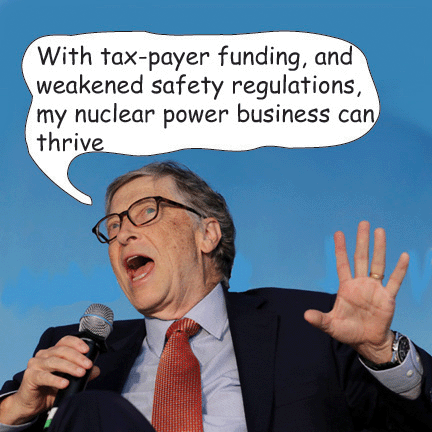
Bill Gates pictures himself as a technology and system innovator. In
October, the billionaire philanthropist recontextualized climate action,
global health, and development as mutually exclusive and in competition
with each other in advance of the international climate summit, COP30.
With his status as one of the original Silicon Valley tech bros, Gates wrote a
memo that minimized the inevitable consequences of climate change, saying,
“It will not lead to humanity’s demise. People will be able to live and
thrive in most places on Earth for the foreseeable future.”
Climate scientist Michael Mann disagrees heartily. “What world is Gates living in?” Mann asks. “The idea that climate action must come at the expense of efforts to address human health is a provable fallacy.” As Gates
downplays the role of clean energy and rapid decarbonization, Mann advises us that, “for those who have been following Gates on climate for some time, his so-called sudden ‘pivot’ isn’t really a ‘pivot’ at all.
It’s a logical consequence of the misguided path he’s been headed down
for well over a decade.” What Gates paints over is his investments in
fossil fuel-based infrastructure (ie. natural gas with carbon capture and
enhanced oil recovery) through his venture capital group, Breakthrough
Energy Ventures.
He has financed what he positions as profitable
geoengineering interventions like spraying massive amounts of sulfur
dioxide into the stratosphere to block out sunlight and cool the planet.
Gates chooses to target sectors that face numerous decarbonizing
challenges, like steel or air travel, instead of acknowledging the energy
infrastructure that can readily be decarbonized now.
He favors hypothetical
new energy tech, including modular nuclear reactors that Mann says
“couldn’t possibly be scaled up over the time frame in which the world
must transition off fossil fuels.”
Clean Technica 29th Nov 2025, https://cleantechnica.com/2025/11/29/michael-mann-to-bill-gates-what-world-are-you-living-in/
Educators Worry Palestine Censorship Could Reshape Public Education Entirely.

lawmakers who sponsored House Bill (HB) 937 seemed more committed to preventing teachers and pupils from criticizing Israel than preventing discrimination against Jewish students
New efforts to shut down honest discussion of Palestine could restrict everything from literature to science classes.
By Marianne Dhenin , Truthout, November 29, 2025
A wave of bills introduced this year in state legislatures across the country sought to censor Palestine-related education in public schools. Several passed with the support of pro-Israel Democratic lawmakers, a trend that educators and First Amendment advocates told Truthout reflects the alignment of pro-Israel groups with MAGA forces. As these efforts continue, many said they fear public education could be reshaped far beyond social studies classrooms and the topics of Israel and Palestine.
“The censorship of Palestinians is the same as the ‘Don’t Say Gay,’ and the anti-critical race theory attacks on Black history,” Nora Lester-Murad, an organizer with the #DropTheADLfromSchools effort, told Truthout. The Anti-Defamation League (ADL) is one of a number of pro-Israel groups supporting regressive public education legislation across the country. “Yes, it’s Zionist, and yes, it’s promoting Israel, but it’s also part of this right-wing effort to take public education in a direction that’s away from critical thinking and that’s anti-liberatory.”
This year, legislators in at least eight states — including Arizona, Arkansas, Kansas, Kentucky, Missouri, Nebraska, Oklahoma, and Tennessee — introduced bills that would directly adopt the International Holocaust Remembrance Alliance (IHRA) definition of antisemitism in public schools. That definition equates criticism of Israel with antisemitism. Dozens of civil society and rights groups, as well as unions of educators, have warned against its adoption because of its power to chill or suppress speech critical of Israel or Zionism.
Michael Berg, an organizer with Jewish Voice for Peace (JVP) in Missouri, said lawmakers who sponsored House Bill (HB) 937 seemed more committed to preventing teachers and pupils from criticizing Israel than preventing discrimination against Jewish students. “They were attached to the IHRA definition, so it shows that it’s very specifically about speech about Israel,” he said. Organizers succeeded in stopping HB 937 in Missouri this year, but Berg told Truthout they are already preparing to fight a new iteration of the bill in the upcoming legislative session.
Other states have made similar efforts, including California, where Democrats hold a supermajority in the state assembly. There, this year’s Assembly Bill (AB) 715 was the latest in a series introduced under the guise of curbing antisemitism, but whose critics argue are censorship bills that undermine the implementation of earlier legislation mandating ethnic studies courses in public schools. AB 715 does not define antisemitism, but calls for using the Biden-era United States National Strategy to Counter Antisemitism as “a basis to inform schools on how to identify, respond to, prevent, and counter antisemitism.” That white paper claims that “the United States has embraced” IHRA’s definition as a “valuable tool” in countering antisemitism. Gov. Gavin Newsom signed AB 715 into law in October; the American-Arab Anti-Discrimination Committee (ADC) filed a suit challenging the law in federal court in November.
Meanwhile, this August in Massachusetts, another Democratic stronghold, the state’s Special Commission on Combating Antisemitism approved recommendations meant to curb antisemitism in schools. The recommendations call on districts to teach IHRA’s definition of antisemitism in anti-bias trainings for teachers and school administrators. A statewide coalition of labor unions, civil rights groups, and progressive Jewish organizations warned that rather than countering antisemitism, the recommendations “pit some Jewish students against other marginalized populations” and will likely “undermine safe learning and working environments for students and teachers.”
These moves dovetail with a federal agenda to remake the nation’s public schools and historical programming at other public institutions, such as museums and national parks. Since his return to office, President Donald Trump has signed executive orders demanding an end to “radical indoctrination in K-12 schooling” and “restoring truth and sanity to American history.” The administration advocates teaching a whitewashed and aggrandizing version of the nation’s past that Trump, in one executive order, called “patriotic education.”…………………………………………………………………………………………………………………………………………………..
The recent wave of bills limiting Palestine-related speech in public schools also harms students. “We believe that antisemitism is being used to censor education on Palestine, and we believe that our students have a right to understand both sides of an issue,” Seth Morrison, spokesperson for JVP’s Bay Area chapter and an organizer with CCDPE, told Truthout. “We’re not saying don’t talk about Israel or don’t talk about the Holocaust. What we’re saying is that there are many open issues here and that Arab and Muslim students especially are being intimidated and censored because of IHRA and related activities.”…………………………………………………………………………………….. https://truthout.org/articles/educators-worry-palestine-censorship-could-reshape-public-education-entirely/
1 This Month
23-25 October – on Zoom – World BEYOND War’s annual global conferenc


Shut down the radiation-damaged Heysham nuclear reactors now
To see nuclear-related stories in greater depth and intensity – go to https://nuclearinformation.wordpress.com

Say No to NASA’s Reckless Nuclear Reactor on the Moon
Say No to NASA’s Reckless Nuclear Reactor on the Moon

-
Archives
- October 2026 (247)
- September 2026 (339)
- August 2026 (330)
- July 2026 (355)
- June 2026 (287)
- May 2026 (306)
- April 2026 (356)
- March 2026 (251)
- February 2026 (267)
- January 2026 (308)
- December 2025 (358)
- November 2025 (359)
-
Categories
- 1
- 1 NUCLEAR ISSUES
- business and costs
- climate change
- culture and arts
- ENERGY
- environment
- health
- history
- indigenous issues
- Legal
- marketing of nuclear
- media
- opposition to nuclear
- PERSONAL STORIES
- politics
- politics international
- Religion and ethics
- safety
- secrets,lies and civil liberties
- spinbuster
- technology
- Uranium
- wastes
- weapons and war
- Women
- 2 WORLD
- ACTION
- AFRICA
- Atrocities
- AUSTRALIA
- Christina's notes
- Christina's themes
- culture and arts
- Events
- Fuk 2022
- Fuk 2023
- Fukushima 2017
- Fukushima 2018
- fukushima 2019
- Fukushima 2020
- Fukushima 2021
- general
- global warming
- Humour (God we need it)
- Nuclear
- RARE EARTHS
- Reference
- resources – print
- Resources -audiovicual
- Weekly Newsletter
- World
- World Nuclear
- YouTube
-
RSS
Entries RSS
Comments RSS

