Extra funding revealed to fuel nuclear fusion energy training and research

The UK Atomic Energy Authority (UKAEA), University of York and University
of Edinburgh, will invest £7.8m over the next five years to advance fusion
energy research and post-graduate training. The funding will be distributed
through UKAEA’s Fusion Opportunities in Skills, Training, Education and
Research (FOSTER) Programme, which aims to develop the next generation of
fusion energy specialists. This investment is intended to create new
opportunities across collaborating universities for students to access
level Seven (master’s degree) qualifications in fusion and relevant
fields, supporting the FOSTER Programme’s mission to build a diverse
fusion skills ecosystem.
Business Desk 3rd Sept 2025, https://www.thebusinessdesk.com/yorkshire/news/2143485-extra-funding-revealed-to-fuel-nuclear-fusion-energy-training-and-research
Alberta Revives Its Nuclear Energy Dreams.

And a cabinet minister gets a free trip for ‘Canada-UK Nuclear Day’ in London.
TheTyee, David Climenhaga 28 Aug 2025
Alberta Affordability Minister Nathan Neudorf jetted off Wednesday for a nice 10-day holiday in the United Kingdom — mostly at his own expense.
Not entirely at his own expense, though, since Alberta taxpayers will presumably be picking up the tab for his airfare in his other cabinet role as minister of utilities (with the exception, this being Alberta, of utilities that generate electricity of the renewable sort).
That ministerial job got him a nice invite to the World Nuclear Symposium in London and a corking “Canada-U.K. Nuclear Day” party on Wednesday at Canada House.
If you’re thinking you probably couldn’t afford a vacation like that, it’s nice to know the minister of making sure you can afford stuff (how’s that going, anyway?) will have the opportunity to “explore nuclear energy in London,” as the Alberta government’s news release put it Wednesday, with well-heeled nuclear industry lobbyists, CEOs and the like from all over the world.
In all, the MLA for Lethbridge-East (and perhaps soon to be the MLA for the new riding of Lethbridge-Gerrymander) will get to spend 15 days in Blighty, at least five of them in a very nice hotel, I’m sure.
“Alberta’s government is working hard to secure an affordable, reliable and sustainable energy future and nuclear can play a key role,” Neudorf said in the inevitable canned quote in the government’s news release Wednesday. “Gatherings like this one are an excellent opportunity to connect with international partners and I look forward to learning more about the potential of this technology and how it can fit into Alberta’s energy mix.”
I’ll bet. There’s nothing cheap about nuclear power. Even the so-called “small modular reactors” that the United Conservative Party is so enamoured of are multibillion-dollar megaprojects, and they never come in on budget. Indeed, SMRs may be nuclear reactors, but they’re not small and they’re not really modular. The term is a marketing gimmick.
“Nuclear projects are almost always subject to time and cost overruns,” explained the Calgary-based Pembina Institute in a news release this week, “with some being delayed by up to a decade and costing double the original projected amount.”
If you want cheap and reliable energy, as the Pembina news release rather plaintively pointed out, wind, solar and battery storage would be just the ticket. Those are things that Neudorf and the United Conservative Party aren’t about to consider, though, probably because of the turbines that spoiled the view at Donald Trump’s golf course in Scotland.
Nevertheless, tout le monde nuclear energy will be in London — even a senior official of Rosatom, the Russian state atomic energy corporation. (That said, you have to dig a bit to suss out the Rosatom connection.)
Meanwhile, the Alberta government wants to hear what you think about nuclear power — presumably as long as it’s the same as what they think. Otherwise, get lost!
Premier Danielle Smith struck yet another panel Monday, this one to sell Albertans on the idea of adopting nuclear power — pardon me, “to join the conversation on nuclear energy in the province.”
There’s even a survey — and I can tell you it’s not quite as obviously biased as the “Alberta Next” surveys, although I’d say it’s been designed to help suss out voter concerns so that talking points can be drafted quickly to tell you to have no fear for atomic energy……………………………………
If you worry about this stuff, nothing’s going to happen any time soon except more lobbying and conferences in interesting locales for UCP ministers to attend.
A small modular reactor project has never been successfully completed outside of China and Russia. Indeed, some say Rosatom’s Akademik Lomonosov, dubbed by some the “floating Chernobyl,” may be the world’s only working small modular reactor…..https://thetyee.ca/Opinion/2025/08/28/Alberta-Revives-Nuclear-Energy-Dreams/
Only Liars And Manipulators Say Gaza Isn’t Starving.
Caitlin Johnstone, Aug 24, 2025, https://www.caitlinjohnst.one/p/only-liars-and-manipulators-say-gaza?utm_source=post-email-title&publication_id=82124&post_id=171779133&utm_campaign=email-post-title&isFreemail=true&r=1ise1&triedRedirect=true&utm_medium=email
Israeli news outlet Haaretz has published a harrowing report on starvation in Gaza which further discredits the Israeli narrative that the photos of skeletal children we’ve been seeing are antisemitic Hamas propaganda, for anyone who’s still clinging to delusions about such things.
Haaretz reporters were taken by doctors on video tours of hospitals in Gaza, conducting interviews with numerous medical personnel and obtaining many photos of civilians showing signs of extreme starvation. Throughout the report we encounter story after story of severely emaciated children, mothers unable to breastfeed starving babies because of their own starvation, people with preexisting conditions severely exacerbated by malnutrition, diseases spreading due to crippled healthcare infrastructure and ruined immune systems, and wounds failing to heal due to inadequate food intake.
The article is one of the more uncomfortable things I’ve seen throughout the entirety of this genocide, and that’s saying something.
“What we saw there left no room for doubt about the scale of the horror,” write Haaretz reporters Yarden Michaeli and Nir Hasson.
“Seventeen youngsters had deteriorated into a state of severe malnutrition without preexisting health conditions; 10 suffered from previous illnesses,” they write, saying “Anyone who claims that the images of starvation in the Gaza Strip are a result of acute genetic or other diseases, and not due to a grave shortage of food, are lying to themselves.”
This comes as the UN-backed Integrated Food Security Phase Classification (IPC) formally declares that the people of Gaza are suffering from a famine that “is entirely man-made”, which must be halted and reversed with extreme urgency.
Israel has of course denounced the IPC’s findings as antisemitic Hamas propaganda, with the Israeli Foreign Ministry saying that “The entire IPC document is based on Hamas lies laundered through organizations with vested interests,” and Benjamin Netanyahu branding the report “a modern blood libel, spreading like wildfire through prejudice.”
You might find this response ridiculous, and of course it is, but really, what else does Israel have left? When all major human rights institutions are accusing you of horrific crimes, your only options are either (A) admit the obvious fact that there’s no way every single mainstream humanitarian organization is lying about your actions, or (B) claim that they’re all in on a giant globe-spanning conspiracy because of a nefarious prejudice against your religion.
Of course they’re going to go with (B). This is Israel we’re talking about, after all.
When a nation keeps having to publish denials that it is intentionally starving civilians, you can safely assume it’s because that nation is intentionally starving civilians. If you saw someone on social media loudly denying the latest allegations that they are a child molester over and over again for two years, you probably wouldn’t let them babysit your kids.
I have never once felt the need to publish a denial that I am intentionally starving people, because I have never intentionally starved anyone. It’s not something I’ve ever found myself needing to say even one time, let alone many many times constantly.
You don’t see the government of Ireland constantly denying that Ireland is intentionally starving civilians, because Ireland is not intentionally starving civilians.
You don’t see pro-China spinmeisters frantically churning out propaganda denying that China is intentionally starving civilians, because China is not intentionally starving civilians.
You don’t see Brazilian internet trolls aggressively swarming the comments of anyone who says Brazil is intentionally starving civilians, because Brazil is not intentionally starving civilians.
You don’t see the Pakistani government paying social media influencers to assert on their platforms that Pakistan is not intentionally starving civilians, because Pakistan is not intentionally starving civilians.
You see an intense campaign of narrative management aimed at denying that Israel has been intentionally starving civilians because Israel is intentionally starving civilians. That’s why all the constant government denials, the endless propaganda and spin pieces and PR stunts, and relentless online trolling operations have been necessary.
Most Israel apologia at this point is just people pretending to believe things they don’t really believe. Palestinians aren’t really being starved. Gaza looks like a gravel parking lot because Hamas put explosives in all the buildings. The IDF has a low civilian-to-combatant kill ratio. Gaza’s entire healthcare infrastructure was destroyed because Hamas was hiding under all the hospitals. Nobody actually believes these things. They’re just pretending to believe them in order to justify genocidal atrocities and help ensure that they continue.
Trump Declares Victory After Putin Summit: The Spin Begins.
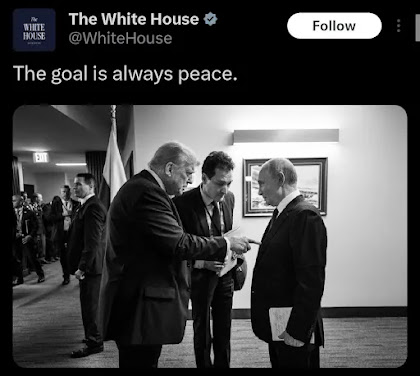
17 August 2025, Roswell, https://theaimn.net/trump-declares-victory-after-putin-summit-the-spin-begins/
The Trump-Putin summit concluded with no ceasefire or formal deal on Ukraine after nearly three hours of talks. Yet, President Trump and his supporters are framing it as a resounding success, turning a diplomatically thin outcome into a narrative of triumph.
If you listened to Trump and his loyalists, you’d think history had just been made. Trump hailed the meeting as “very productive,” rating it a “10” in a Fox News interview with Sean Hannity. He emphasised “great progress” and “many points agreed to,” though specifics remain elusive. The White House, through Press Secretary Karoline Leavitt, praised it was a restoration of dialogue benefiting U.S. interests – a claim critics argue overlooks the lack of enforceable commitments. Trump leveraged Putin’s remark that the Ukraine invasion “might not have happened” under his watch, spinning it as proof of his foreign policy prowess and a fix for “Democrat mess-ups.” The summit’s optics – red carpets, a joint press conference, and Putin’s ride in “The Beast” limo – were highlighted as symbols of American dominance, though skeptics dismissed them as stagecraft masking substantive failures.
MAGA’s Victory Lap
MAGA supporters amplified the victory lap, flooding social media with memes of Trump as a peacemaker, insisting that the world had witnessed leadership in action. Posts celebrated Putin’s praise as a global endorsement, with one user calling it a “clear winner for America” due to the “USA dominance narrative.” Others blamed Democrats for the war, framing the no-deal outcome as a deliberate dump of the “forever war” on Europe, setting the stage for future deals. The grandeur of flyovers and applause was touted as evidence of Trump’s negotiation mastery, dismissing critics as panicked. Yet, foreign policy analysts noted that without tangible concessions from Russia – such as troop withdrawals or guarantees on Ukrainian sovereignty – the summit risked being remembered as a photo op rather than a turning point.
The Spin vs. Reality
With no concrete outcomes, the summit’s legacy hinges on whose narrative sticks. Trump’s camp bets on spectacle overshadowing substance, while opponents warn that legitimising Putin without concessions undermines international law. As details emerge – and if Russian attacks continue – the “success” narrative may face harder scrutiny. For now, the world is left parsing theatrics from geopolitics, with Ukraine’s fate hanging in the balance.
The ‘third nuclear age’ is a politically motivated label that seeks to justify a renewed arms race.

Tom Vaughan, Lecturer in International Security, University of Leeds, August 16, 2025, https://theconversation.com/the-third-nuclear-age-is-a-politically-motivated-label-that-seeks-to-justify-a-renewed-arms-race-263009
In August 1945 the United States dropped atomic bombs on the Japanese cities of Hiroshima and Nagasaki, killing more than 200,000 people, overwhelmingly civilians. Eighty years on from this slaughter – which the then US army commander and later president Dwight D. Eisenhower called “completely unnecessary” – is an apt time to ask how the world has changed since Japan’s skies lit up with atomic fire.
Many in the military as well as academics and nuclear theorists argue that a “third nuclear age” has begun. By this they mean that a new and different set of nuclear threats are emerging which fundamentally challenge the existing tenets of nuclear “deterrence”. The response, some argue, is to invest heavily in our nuclear weapons systems to secure ourselves against this new age of uncertainty.
To understand this claim, it’s worth looking back at the history of the nuclear era. Most (but not all) scholars working on “nuclear ages” accept that the first nuclear age, between 1945 and 1991, was characterised by the cold war nuclear stand-off between the world’s two nuclear armed superpowers: the US and the Soviet Union.
The second nuclear age, from 1991 to 2014, is usually understood to have started when the cold war ended. Policymakers worried about “proliferation” – the spread of nuclear weapons to new states and even non-state terrorist groups. Western policy focused on countering this process, often through military means.
The third nuclear age, which is thought to have begun in 2014, it thought to reflect a new set of challenges. This will involve the entry of more nuclear-armed states into the fray, erosion of longstanding non-proliferation and arms control agreements and the development of so-called “strategic non-nuclear weapons”. This term refers to non-nuclear technologies, including artificial intelligence (AI) command and control networks, hypersonic missiles and advanced missile defence systems.
There are fears that non-nuclear armed “adversaries” might use these systems to directly attack other states’ nuclear arsenals, undermining their ability to deliver a retaliatory nuclear strike. This is likely to pose a challenge to established practices on which the doctrine of nuclear deterrence is based.
But how much has really changed in the past decade? No new nuclear powers have emerged – the most recent was North Korea in 2006. China, often seen as the bogeyman of the third nuclear age, has had a nuclear weapons capability since 1964. AI integration into nuclear command and control systems, while extremely risky, has yet to happen.
Reliable missile defence against modern nuclear warheads is still widely considered to be technologically impossible. The impact of hypersonic missiles on the calculus of nuclear deterrence is debated, since intercontinental ballistic missiles (ICBMs) are already very fast.
In short, what’s different this time around?
Western-centric thinking
A more penetrating line of questioning is to ask about the politics underlying the idea of a third nuclear age. Ideas are never neutral, and they shape our understanding of the world. The third nuclear age concept (like that of the second nuclear age before it) came out of the US defence establishment, which was trying to understand how it could remain globally dominant against challenges to its supremacy from China.
The idea has since been filtered through academia and back into the policy world, where it has started to gain “common sense status”: as night follows day, the dawn of the third nuclear age is around the corner. But this is neither objective nor inevitable. It’s a conceptual tool for thinking about nuclear politics in a particular way.
It’s a US-centric perspective reflecting a fear that western dominance of the nuclear arena is under threat. US and allied militaries need to progressively integrate new technologies into their nuclear systems and modernise their arsenals to deal with a “more uncertain” world, ignoring the fact that massive risk and uncertainty have always been a built-in feature of nuclear deterrence strategies.
Here, the biggest threats to nuclear stability come not from the thousands of nuclear warheads held by the established nuclear weapons states, but from would-be disruptors who can threaten nuclear arsenals with non-nuclear systems – echoing old second nuclear age fears about proliferation.
This is why Iran remains a villain of the story alongside China, as we can see from the hyperbole about Iran’s “hypersonic” missile capabilities and how its behaviour gave Israel and the US the excuse to launch “counter-proliferation” strikes against its nuclear facilities in June this year.
It bears repeating that Iran is still not a nuclear-armed state. But the new emphasis placed on non-nuclear technologies in third nuclear age thinking also puts states which don’t even have nuclear programmes in the crosshairs of Iraq-style wars of aggression in the name of “counter-proliferation”.
New arms race
To be crystal clear: the nuclear world is as dangerous as ever. The problem is that third nuclear age thinking, with its focus on supposedly unprecedented disruptions, leads us to think that new solutions are necessary. “Old” ideas about nuclear disarmament become irrelevant, because the instabilities introduced by new technologies supposedly make it impossible for nuclear weapons states to give up their arsenals.
The third nuclear age becomes a conceptual stalking horse for a fresh nuclear arms race.
When the British armed forces chief Admiral Sir Tony Radakin warned of a dawning third nuclear age in December 2024, he was not making a neutral observation. He was arguing for resources to be funnelled into nuclear modernisation at the expense of welfare and healthcare programmes. Today, before any modernisation, Britain maintains a first-strike deliverable total of 31 megatons of nuclear explosive power. That’s more than 2,000 Hiroshimas’ worth of destruction.
So we should be sceptical of this concept. The threat of nuclear annihilation has been with us since August 1945 and comes – as always – from nuclear weapons and the states who operate them.
80 Years of Lies: The US Finally Admits It Knew It Didn’t Need to Bomb Hiroshima and Nagasaki.

Japan was already defeated and dropping the bomb was completely unnecessary…[it was] no longer mandatory as a measure to save American lives. It was my belief that Japan was, at this very moment, seeking a way to surrender with a minimum loss of face.” – Dwight D. Eisenhower, Supreme Allied Commander in Europe and future president
By Alan MacLeod / MintPress News, https://www.mintpressnews.com/hiroshima-nagasaki-us-nuclear-lies/290336/ August 7, 2025
As we commemorate the 80th anniversary of the Hiroshima and Nagasaki atomic bombings, the world is drifting as close to another nuclear confrontation as it has been in decades.
With Israeli and American attacks on Iranian nuclear energy sites, India and Pakistan going to war in May, and escalating violence between Russia and NATO-backed forces in Ukraine, the shadow of another nuclear war looms large over daily life.
Eighty Years Of Lies
The United States remains the only nation to have dropped an atomic bomb in anger. While the dates of August 6 and August 9, 1945, are seared into the popular conscience of all Japanese people, those days hold far less salience in American society.
When discussed at all in the U.S., this dark chapter in human history is usually presented as a necessary evil, or even a day of liberation—an event that saved hundreds of thousands of lives, prevented the need for an invasion of Japan, and ended the Second World War early. This, however, could not be further from the truth.
American generals and war planners agreed that Japan was on the point of collapse, and had, for weeks, been attempting to negotiate a surrender. The decision, then, to incinerate hundreds of thousands of Japanese civilians was one taken to project American power across the world, and to stymie the rise of the Soviet Union.
“It always appeared to us that, atomic bomb or no atomic bomb, the Japanese were already on the verge of collapse,” General Henry Arnold, Commanding General of the U.S. Army Air Forces in 1945, wrote in his 1949 memoirs.
Arnold was far from alone in this assessment. Indeed, Fleet Admiral William Leahy, the Navy’s highest-ranking officer during World War II, bitterly condemned the United States for its decision and compared his own country to the most savage regimes in world history.
As he wrote in 1950:
It is my opinion that the use of this barbarous weapon at Hiroshima and Nagasaki was of no material assistance in our war against Japan. The Japanese were already defeated and ready to surrender. My own feeling was that in being the first to use it, we had adopted an ethical standard common to the barbarians of the Dark Ages.”
By 1945, Japan had been militarily and economically exhausted. Losing key allies Italy in 1943 and Germany by May 1945, and facing the immediate prospect of an all-out Soviet invasion of Japan, the country’s leaders were frantically pursuing peace negotiations. Their only real condition appeared to be that they wished to keep as a figurehead the emperor—a position that, by some accounts, dates back more than 2,600 years.
“I am convinced,” former President Herbert Hoover wrote to his successor, Harry S. Truman, “if you, as President, will make a shortwave broadcast to the people of Japan—tell them they can have their emperor if they surrender, that it will not mean unconditional surrender except for the militarists—you’ll get a peace in Japan—you’ll have both wars over.”
Many of Truman’s closest advisors told him the same thing. “I am absolutely convinced that had we said they could keep the emperor, together with the threat of an atomic bomb, they would have accepted, and we would never have had to drop the bomb,” said John McCloy, Truman’s Assistant Secretary of War.
Nevertheless, Truman initially took an absolutist position, refusing to hear any Japanese negotiating caveats. This stance, according to General Douglas MacArthur, Commander of Allied Forces in the Pacific, actually lengthened the war. “The war might have ended weeks earlier,” he said, “If the United States had agreed, as it later did anyway, to the retention of the institution of the emperor.” Truman, however, dropped two bombs, then reversed his position on the emperor, in order to stop Japanese society from falling apart.
At that point in the war, however, the United States was emerging as the sole global superpower and enjoyed an unprecedented position of influence. The dropping of the atomic bomb on Japan underscored this; it was a power play, intended to strike fear into the hearts of world leaders, especially in the Soviet Union and China.
First Japan, Then The World
Hiroshima and Nagasaki drastically curbed the U.S.S.R.’s ambitions in Japan. Joseph Stalin’s forces had invaded and permanently annexed Sakhalin Island in 1945 and planned to occupy Hokkaido, Japan’s second-largest island. The move likely prevented the island nation from coming under the Soviet sphere of influence.
To this day, Japan remains deeply tied to the U.S., economically, politically, and militarily. There are around 60,000 U.S. troops in Japan, spread across 120 military bases.
Many in Truman’s administration wished to use the atom bomb against the Soviet Union as well. President Truman, however, worried that the destruction of Moscow would lead the Red Army to invade and destroy Western Europe as a response. As such, he decided to wait until the U.S. had enough warheads to completely destroy the U.S.S.R. and its military in one fell swoop.
War planners estimated this figure to be around 400. To that end, Truman ordered the immediate ramping up of production. Such a strike, we now know, would have caused a nuclear winter that would have permanently ended all organized life on Earth.
The decision to destroy Russia was met with stiff opposition among the American scientific community. It is now widely believed that Manhattan Project scientists, including Robert J. Oppenheimer himself, passed nuclear secrets to Moscow in an effort to speed up their nuclear project and develop a deterrent to halt this doomsday scenario. This part of history, however, was left out of the 2023 biopic movie.
By 1949, the U.S.S.R. was able to produce a credible nuclear deterrent before the U.S. had produced sufficient quantities for an all-out attack, thus ending the threat and bringing the world into the era of mutually assured destruction.
“Certainly prior to 31 December 1945, and in all probability prior to 1 November 1945, Japan would have surrendered even if the atomic bombs had not been dropped, even if Russia had not entered the war, and even if no invasion had been planned or contemplated,” concluded a 1946 report from the U.S. Strategic Bombing Survey.
Dwight D. Eisenhower, Supreme Allied Commander in Europe and future president, was of the same opinion, stating that:
Japan was already defeated and dropping the bomb was completely unnecessary…[it was] no longer mandatory as a measure to save American lives. It was my belief that Japan was, at this very moment, seeking a way to surrender with a minimum loss of face.”
Nevertheless, both Truman and Eisenhower publicly toyed with the idea of using nuclear weapons against China to stop the rise of Communism and to defend their client regime in Taiwan. It was only the development of a Chinese warhead in 1964 that led to the end of the danger, and, ultimately, the détente era of good relations between the two powers that lasted until President Obama’s Pivot to Asia.
Ultimately, then, the people of Japan were the collateral damage in a giant U.S. attempt to project its power worldwide. As Brigadier General Carer Clarke, head of U.S. intelligence on Japan wrote, “When we didn’t need to do it, and we knew we didn’t need to do it, and they knew that we knew we didn’t need to do it, we used them [Japanese citizens] as an experiment for two atomic bombs.”
Tiptoeing Closer To Armageddon
The danger of nuclear weapons is far from over. Today, Israel and the United States – two nations with atomic weaponry – attack Iranian nuclear facilities. Yet their continued, hyper-aggressive actions against their foes only suggest to other countries that, unless they too possess weapons of mass destruction, they will not be safe from attack. North Korea, a country with a conventional and nuclear deterrent, faces no such air strikes from the U.S. or its allies. These actions, therefore, will likely result in more nations pursuing nuclear ambitions.
Earlier this year, India and Pakistan (two more nuclear-armed states) came into open conflict thanks to disputes over terrorism and Jammu and Kashmir. Many influential individuals on both sides of the border were demanding their respective sides launch their nukes – a decision that could also spell the end of organized human life. Thankfully, cooler heads prevailed.
Meanwhile, the war in Ukraine continues, with NATO forces urging President Zelensky to up the ante. Earlier this month, President Trump himself reportedly encouraged the Ukrainian leader to use his Western-made weapons to strike Moscow.
It is precisely actions such as these that led the Bulletin of Atomic Scientists to move their famous Doomsday Clock to 89 seconds to midnight, the closest the world has ever been to catastrophe.
“The war in Ukraine, now in its third year, looms over the world; the conflict could become nuclear at any moment because of a rash decision or through accident or miscalculation,” they wrote in their explanation, adding that conflicts in Asia could spiral out of control into a wider war at any point, and that nuclear powers are updating and expanding their arsenals.
The Pentagon, too, is recruiting Elon Musk to help it build what it calls an American Iron Dome. While this move is couched in defensive language, such a system – if successful – would grant the U.S. the ability to launch nuclear attacks anywhere in the world without having to worry about the consequences of a similar response.
Thus, as we look back at the horrors of Hiroshima and Nagasaki 80 years ago, we must understand that not only were they entirely avoidable, but that we are now closer to a catastrophic nuclear confrontation than many people realize.
Hiroshima’s history lesson

by beyondnuclearinternational, https://beyondnuclearinternational.org/2025/08/03/hiroshimas-history-lesson/
By April 1945, with the Nazi regime in a state of collapse and Japan’s defeat imminent, the threat that served as the original justification for the bomb’s development had all but vanished.
The true target of the first atomic bomb wasn’t, in fact, Tokyo, but Moscow, with the people of Hiroshima and Nagasaki sacrificed on the altar of American global imperial ambition.
Szilard emphasized that the atomic bomb wasn’t just a more powerful weapon but a fundamental transformation in the nature of warfare, an instrument of annihilation.

Oppenheimer explained, “When you see something that is technically sweet, you go ahead and do it and you argue about what to do about it only after you have had your technical success. That is the way it was with the atomic bomb.”
That climate of deference fostered a culture of complicity, where questions of social responsibility were subordinated to uncritical faith in authority.
What Can We Learn From the Birth of the Nuclear Era?
By Eric Ross, Common Dreams
In recent months, nuclear weapons have reemerged in global headlines. Nuclear-armed rivals India and Pakistan approached the brink of a full-scale war, a confrontation that could have become an extinction-level event, with the potential to claim up to 2 billion lives worldwide.
The instability of a global order structured on nuclear apartheid has also come into sharp relief in the context of the recent attacks on Iran by Israel and the United States. That system has entrenched a dangerous double standard, creating perverse incentives for the proliferation of world-destroying weaponry, already possessed by nine countries. Many of those nations use their arsenals to exercise imperial impunity, while non-nuclear states increasingly feel compelled to pursue nuclear weapons in the name of national security and survival.
Meanwhile, the largest nuclear powers show not the slightest signs of responsibility or restraint. The United States, Russia, and China are investing heavily in the “modernization” and expansion of their arsenals, fueling a renewed arms race. And that escalation comes amid growing global instability contributing to a Manichean world of antagonistic armed blocs, reminiscent of the Cold War at its worst.
The nuclear threat endangers not only global peace and security but the very continuity of the human species, not to speak of the simple survival of life on Earth. How, you might wonder, could we ever have arrived at such a precarious situation?
The current crisis coincides with the 80th anniversary of the Trinity Test, the first detonation of an atomic weapon that would soon obliterate the Japanese cities of Hiroshima and Nagasaki and so inaugurate the atomic age. So many years later, it’s worth critically reassessing the decisions that conferred on humanity such a power of self-annihilation. After all, we continue to live with the fallout of the choices made (and not made), including those of the scientists who created the bomb. That history also serves as a reminder that alternative paths were available then and that another world remains possible today.
A Tale of Two Laboratories
In the summer of 1945, scientists and technicians at Los Alamos National Laboratory in New Mexico worked feverishly to complete the construction of the atomic bomb. Meanwhile, their colleagues at the University of Chicago’s Metallurgical Laboratory mounted a final, ultimately unsuccessful effort to prevent its use.
The alarm spreading in Chicago stemmed from a sobering realization. The Manhattan Project that they had joined on the basis of a belief that they were in an existential arms race with Nazi Germany had, by then, revealed itself to be a distinctly one-sided contest. Until then, the specter of a possible German atomic bomb had conferred a sense of urgency and a veneer of moral legitimacy on what many scientists otherwise recognized as a profoundly unethical undertaking.
Prior to the fall of Berlin, Allied intelligence had already begun to cast serious doubt on Germany’s progress toward developing an atomic weapon. By April 1945, with the Nazi regime in a state of collapse and Japan’s defeat imminent, the threat that served as the original justification for the bomb’s development had all but vanished.
No longer represented as a plausible deterrent, the bomb now stood poised to become what Los Alamos Director J. Robert Oppenheimerwould describe shortly after the war as “weapons of terror, of surprise, of aggression… [used] against an essentially defeated enemy.”
For the scientists at Chicago, that new context demanded new thinking. In June 1945, a committee of physicists led by James Franck submitted a report to Secretary of War Henry Stimson warning of the profound political and ethical consequences of employing such a bomb without exhausting all other alternatives. “We believe,” the Franck Report stated, “that the use of nuclear bombs for an early, unannounced attack against Japan [would be] inadvisable.” The report instead proposed a demonstration before international observers, arguing that such a display could serve as a gesture of goodwill and might avert the need to use the bombs altogether.
One of that report’s signatories, Leo Szilard, who had been among the bomb’s earliest advocates, further sought to prevent what he had come to recognize as the catastrophic potential outcome of their creation. With Germany defeated, he felt a personal responsibility for reversing the course he had helped set in motion. Echoing concerns articulated in the Franck Report, he drafted a petition to be circulated among the scientists. While acknowledging that the bomb might offer short-term military and political advantages against Japan, he warned that its deployment would ultimately prove morally indefensible and strategically self-defeating, a position which would also be held by 6 of the 7 U.S. five-star generals and admirals of that moment.
Szilard emphasized that the atomic bomb wasn’t just a more powerful weapon but a fundamental transformation in the nature of warfare, an instrument of annihilation. He already feared Americans might come to regret that their own government had sown the seeds of global destruction by legitimizing the sudden obliteration of Japanese cities, a precedent that would render a heavily industrialized, densely populated country like the United States especially vulnerable.
Moreover, he concluded that using such weapons of unimaginable destructive power without sufficient military justification would severely undermine American credibility in future arms control efforts. He observed that the development of the bomb under conditions of extreme wartime secrecy had created an abjectly anti-democratic situation, one in which the public was denied any opportunity to deliberate on such an irrevocable and consequential decision.
As Eugene Rabinowitch, a co-author of the Franck Report (who would later co-found The Bulletin of Atomic Scientists), would note soon after, the scientists in Chicago were growing increasingly uneasy in the face of escalating secrecy: “Many scientists began to wonder: Against whom was this extreme secrecy directed? What was the sense of keeping our success secret from the Japanese? Would it have helped them to know that we had an atomic bomb ready?”
Rabinowitch concluded that the only “danger” posed by such a disclosure was that the Chicago scientists might be proven right, and Japan might surrender. “Since there was no justifiable reason to hold the bomb secret from the Japanese,” he argued, “many scientists felt that the purpose of deepened secrecy was to keep the knowledge of the bomb… from the American people.”
In other words, officials in Washington were concerned that a successful demonstration might deprive them of the coveted opportunity to use the bomb and assert their newly acquired monopoly (however temporary) on unprecedented power.
The Road to Trinity and the Cult of Oppenheimer
Seventy scientists at Chicago endorsed the Szilard Petition. By then, however, their influence on the project had distinctly diminished. Despite their early contributions, notably the achievement of the first self-sustained nuclear chain reaction in December 1942, the project’s center of gravity had shifted to Los Alamos.
Recognizing this, Szilard sought to circulate the petition among his colleagues there, too, hoping to invoke a shared sense of scientific responsibility and awaken their moral conscience in the critical weeks leading up to the first test of the weapon. Why did that effort fail? Why was there so little dissent, debate, or resistance at Los Alamos given the growing scientific opposition, bordering on revolt, that had emerged in Chicago?
One answer lies in Oppenheimer himself. In popular culture and historical scholarship, his legacy is often framed as that of a tragic figure: the reluctant architect of the atomic age, an idealist drawn into the ethically fraught task of creating a weapon of mass destruction compelled by the perceived exigencies of an existential war.
Yet the myth of him as a Promethean figure who suffered for unleashing the fundamental forces of nature onto a society unprepared to bear responsibility for it obscures the extent of his complicity. Far from being a passive participant, in the final months of the Manhattan Project, he emerged as a willing collaborator in the coordination of the coming atomic bombings of Hiroshima and Nagasaki.
When Oppenheimer and physicist Edward Teller (who would come to be known as “the father of the hydrogen bomb”) received Szilard’s petition, neither shared it. While Oppenheimer offered no response, Teller provided a striking explanation: “The things we are working on are so terrible that no amount of protesting or fiddling with politics will save our souls.” He further rejected the idea that he held any authority to influence the bomb’s use. “You may think it is a crime to continue to work,” he conceded, “but I feel that I should do the wrong thing if I tried to say how to tie the little toe of the ghost to the bottle from which we just helped it escape.”
Teller later claimed to be in “absolute agreement” with the petition, but added that “Szilard asked me to collect signatures… I felt I could not do so without first seeking Oppenheimer’s permission more directly. I did so and Oppenheimer talked me out of it, saying that we as scientists have no business meddling in political pressure of that kind… I am ashamed to say that he managed to talk me out of [it].”
Teller’s explanation was likely self-serving given his later acrimonious rift with Oppenheimer over the hydrogen bomb. Yet further evidence indicates that Oppenheimer actively sought to suppress debate and dissent. Physicist Robert Wilson recalled that upon arriving at Los Alamos in 1943, he raised concerns about the broader implications of their work and the “terrible problems” it might create, particularly given the exclusion of the Soviet Union, then an ally. The Los Alamos director, Wilson remembered, “didn’t want to talk about that sort of thing” and would instead redirect the conversation to technical matters. When Wilson helped organize a meeting to discuss the future trajectory of the project in the wake of Germany’s defeat, Oppenheimer cautioned him against it, warning that “he would get into trouble by calling such a meeting.”
The meeting nonetheless proceeded, with Oppenheimer in attendance, though his presence proved stifling. “He participated very much, dominating the meeting,” Wilson remembered. Oppenheimer pointed to the upcoming San Francisco Conference to establish the United Nations and insisted that political questions would be addressed there by those with greater expertise, implying that scientists had no role to play in such matters and ought to abstain from influencing the applications of their work.
Reflecting on his mindset at the time, Oppenheimer explained, “When you see something that is technically sweet, you go ahead and do it and you argue about what to do about it only after you have had your technical success. That is the way it was with the atomic bomb.” In a similar vein, his oft-quoted remark that “the physicists have known sin” was frequently misinterpreted. He was not referring, he insisted, to the “sin” of the destruction of Hiroshima and Nagasaki, but to pride for “intervening explicitly and heavy-handedly in the course of human history.”
When situated within this broader context of a professed commitment to scientific detachment, Oppenheimer’s behavior becomes more intelligible. In practice, however, his stated ideals stood in stark contrast to his conduct. While he claimed to reject political engagement, he ultimately intervened in precisely such a manner, using his position to advocate forcefully for the bomb’s immediate military use against Japan without prior warning. He emerged as a leading opponent of any prospective demonstration, cautioning that it would undermine the psychological impact of the bomb’s use, which could only be realized through a sudden, unannounced detonation on a relatively untouched, non-military target like the city of Hiroshima. This position stood in sharp contrast to that of the Chicago scientists, of whom only 15% supported using the bomb in such a manner.
That climate of deference fostered a culture of complicity, where questions of social responsibility were subordinated to uncritical faith in authority. Reflecting on that dynamic, physicist Rudolf Peierlsacknowledged, “I knew that Oppenheimer was on a committee and was briefing with the high-ups. I felt there were two things one could rely on: Oppenheimer to put the reasonable ideas across, and that one could trust people. After all, we are not terrorists at heart or anything… Both these statements might now be somewhat optimistic.”
Ultimately, the only member of Los Alamos to register dissent was Joseph Rotblat, who quietly resigned on ethical grounds after learning in November 1944 that there was no active Nazi atomic bomb program. His departure remained a personal act of conscience, however, rather than an effort to initiate a broader moral reckoning within the scientific community.
“Remember Your Humanity”
The legacy of Oppenheimer, a burden we all now carry, lies in his mistaking proximity to power for power itself. Rather than using his influence to restrain the bomb’s use, he exercised what authority he had to facilitate its most catastrophic outcome, entrusting its consequences to political leaders who soon revealed their recklessness. In doing so, he helped lay the groundwork for what President Dwight D. Eisenhower would, in his farewell address to Congress in 1961, warn against as “the disastrous rise of misplaced power.”
Yet we are not doomed. This history should also remind us that the development and use of nuclear weapons was not inevitable. There were those who spoke out and a different path might well have been possible. While we cannot know exactly how events would have unfolded had dissent been amplified rather than suppressed, we can raise our own voices now to demand a safer, saner future. Our collective survival may well depend on it. How much longer a world armed with nuclear weapons can endure remains uncertain. The only viable path forward lies in renewing a commitment to, as Albert Einstein and Bertrand Russell urged, “remember your humanity, and forget the rest.” With ever more nations developing increasingly powerful arsenals, one thing remains clear: As the Doomsday Clock moves ever closer to midnight, there is no time to waste.
Eric Ross is an organizer, educator, researcher, and PhD Candidate in the History Department at the University of Massachusetts Amhers
Genocide’s Hard When You’ve Got a PR War to Win.

Israel is inviting over 500 delegations of social media influencers to tour Israel and learn the right message to spread to their millions of followers because Israel realizes it is losing the PR war.
For Israel this is the hard part: completing a genocide while making it look like you are not completing a genocide. In an age of mobile telephone cameras and wireless transmission of images from virtually anywhere by anyone, genocide while few are looking is a thing of the past.
Israel’s quest to cleanse Gaza of Palestinians through expulsion or extermination keeps getting interrupted for photo ops of aid airlifts or a few aid trucks to satisfy feigned Western grievance, writes Joe Lauria.
Joe Lauria, Consortium News, July 28, 2025, https://consortiumnews.com/2025/07/28/genocides-hard-when-you-have-to-win-the-pr-war-too/
Winning the public relations war is proving to be a lot more difficult for Israel than the genocide against the Palestinian people.
As the conscience of Western publics pushes their governments to stop supporting Israel’s historic crimes, U.S. and European governments are forced to make displays of scolding Israel.
But that act is getting old. The money and guns keep flowing as the killing and starvation keeps growing.
Western allies want Israel to make a gesture that it still has a shred of humanity left. At various junctures during the slaughter, U.S. and European governments have disingenuously leveled criticism of Israel’s treatment of Palestinian civilians to keep their own populations at bay.
For instance, during the last U.S. presidential campaign, with a large number of Democrats condemning Israel for their actions, Joe Biden and then Kamala Harris had to issue criticism of Israel while insincerely repeating that they were working “tirelessly” for a ceasefire.
This was fake because if the Biden or now Trump administrations really want to stop the killing they can do it almost immediately: tell Israel no more guns and money if the killing doesn’t stop.
The German authorities, who seem to relish the opportunity to enforce a new genocide, could do the same, as Germany is Israel’s second largest arms supplier after the U.S.
Losing on the PR Front
Whenever Western governments start feeling the heat they tell Israel to cool it for a while and stage some kind of show of humanitarian aid.
Israel usually complies because they are fighting two wars: one of ethnic cleansing and/or extermination of the Palestinians, and the other a public relations war with the Western public, particularly its youth.
As Consortium News reported last week, Israel is inviting over 500 delegations of social media influencers to tour Israel and learn the right message to spread to their millions of followers because Israel realizes it is losing the PR war.
The daily Haaretz reported:
“Foreign Ministry officials say the tour delivers significant media, advocacy, and diplomatic benefits – and represents a strategic shift, as traditional outreach is no longer sufficient to shape public opinion. … We’re working with influencers, sometimes with delegations of influencers. Their networks have huge followings, and their messages are more effective than if they came directly from the ministry.”
On Friday, Britain, France and Germany issued a joint statement saying the Gaza “humanitarian catastrophe must end now.” They said Israel must “immediately lift restrictions on the flow of aid.”
“The humanitarian catastrophe that we are witnessing in Gaza must end now,” the joint statement says. “Withholding essential humanitarian assistance to the civilian population is unacceptable.”
Italy separately said, “We can no longer accept carnage and famine.” Barack Obama chimed in too, also on Friday. On Monday, Donald Trump said: “There is real starvation in Gaza — you can’t fake that.”
France said it would recognize the State of Palestine, a step too far for Britain, Germany and Italy, and which the U.S. condemned.
These leaders’ consciences would be shocked if they indeed have a conscience. They’ve seen reports like this one from the BBC confirming that desperately starving people have been shot and killed as they try to reach the only food aid distribution points by the Israeli forces and private U.S. contractors.
And yet they keep sending 2,000 lbs. bombs and F-35 spare parts.
Nevertheless, Israel realizes it must win the PR war fought not against the Western leaders who back them, but against the Western public. (Western leaders are engaged in their own PR war with their people.) Thus on Sunday Israel announced it would begin an airlift of food into Gaza.
It’s surely part of a genocidal plan to occasionally respond to this criticism, hold some fire and make a big show of letting in aid before resuming the gruesome task. It sure makes finishing a genocide more difficult.
The Hard Part
For Israel this is the hard part: completing a genocide while making it look like you are not completing a genocide. In an age of mobile telephone cameras and wireless transmission of images from virtually anywhere by anyone, genocide while few are looking is a thing of the past.
One way to mislead the public is to kill at a pace intended to fool them into thinking there is more or less routine combat going on in Gaza and an unfortunate number of civilians are just being killed in the crossfire. (There was an uproar over the Australian Broadcasting Corporation last week ignorantly reporting the deliberate murder of unarmed, starving civilians at the aid distribution points as having died in “the crossfire.”)
So Israel needs to keep the official daily death toll in Gaza to around 100. Don’t start wiping out entire encampments, killing thousands a day. Make it look more or less like a normal war. Leave doubt in people’s minds. Netanyahu did say this would take a very long time.
Israeli Defense Minister Israel Katz openly says the plan is to concentrate the entire 2 million plus population of Gaza in a camp in the south to ready them for expulsion. And if Egypt and others refuse to take them? The rate of killing in this concentration camp may well explode if Western governments keep tolerating this evil.
But for now, the rate of killing allows a propagandist like Bret Stephens to argue in The New York Times that it can’t be genocide because the killing is too slow. He actually wrote this:
“If the Israeli government’s intentions and actions are truly genocidal — if it is so malevolent that it is committed to the annihilation of Gazans — why hasn’t it been more methodical and vastly more deadly? Why not, say, hundreds of thousands of deaths, as opposed to the nearly 60,000 that Gaza’s Hamas-run Health Ministry, which does not distinguish between combatant and civilian deaths, has cited so far in nearly two years of war? It’s not that Israel lacks the capacity to have meted vastly greater destruction than what it has inflicted so far.”
Quick, somebody show the Genocide Convention to Stephens. It defines genocide in black and white:
(d) Imposing measures intended to prevent births within the group; (e) Forcibly transferring children of the group to another group.”
“In the present Convention, genocide means any of the following acts committed with intent to destroy, in whole or in part, a national, ethnical, racial or religious group, as such:
(a) Killing members of the group;
(b) Causing serious bodily or mental harm to members of the group;
(c) Deliberately inflicting on the group conditions of life calculated to bring about its physical destruction in whole or in part;
Stephens falls prey to a common misconception of genocide, namely that it depends on the number of people killed. Acts must be “committed with intent to destroy, in whole or in part.”
The hardest part of proving genocide is intent. Israeli leaders have provided folders full of statements of genocidal intent. It was then followed by actions that systematically destroyed the conditions of life for the Palestinians of Gaza.
One by one they wiped out the infrastructure of Palestinian culture and civilization: schools, universities, mosques, churches, museums, theaters, libraries, hospitals and incalculable residential buildings, while people were still living in them. There has been a wholesale assassination of journalists, artists, academics and doctors — and an imposed starvation.
This is textbook genocide.
The Big Lie sent out from Israel, parroted almost word-for-word by the likes of Stephens and Alan Dershowitz, Israel-defender supremo, and by an Israeli zealot who appeared on Piers Morgan’s show last, week with piercing, fanatical eyes is this: This is war, unfortunately civilians get killed and there is no army in the world that takes greater care to avoid civilian casualties than Israel’s, none.
The zealot with Morgan went a step further to say he was “proud” of the conduct of the IDF in Gaza, to which Haaretz columnist Gideon Levy, also on the panel, said, “I’m sorry, only Nazis spoke like that.”
There is also a Big Truth. If Western governments and media repeated it and more crucially acted upon it, it would cause Israel to lose both wars: public relations and the elimination of the Palestinian people.
The world is waiting.
Nuclear power drive obsesses over baseload: Do we need it?
Lately there has been a mounting noise on behalf of more nuclear power in
Scotland, pleas for John Swinney to do a u-turn on his ruling out of new
nuclear reactors.
Calls for Scotland to embrace nuclear have been greeted
with a certain amount of enthusiasm in some quarters, including many SNP
voters. But what troubles me, in the current debate, is that all too often
it feels like we are stuck in an old vision of the grid – and one of the
terms that suggests this is ‘baseload’.
Baseload is defined as the
minimum amount of electricity required by a grid to meet the continuous
demand for power over a day. Currently, it’s mostly used to refer to the
generating capacity that we need to always be there if the wind stops and
the sun doesn’t shine. Britain Remade, for instance, talks about nuclear
in terms of “clean, reliable baseload power”.
But what if nuclear is actually a technology that does not suit a modern renewable grid? What if wind and nuclear are not good bedfellows and, as a baseload, new plants
will only make our electricity more expensive?
In a recent Substack, David Toke, author of Energy Revolutions: Profiteering versus Democracy, described the “accepted truth” in the media that new nuclear power is
needed because there is no other practical or cheaper way to balance
fluctuating wind and solar power, as “demonstrably false”.
He said it
“runs counter to the way that the UK electricity grid is going to be
balanced anyway” – which, he noted, is by gas engines and turbines
“that are hardly ever used”. Simple gas fired power plants, he said,
are many times cheaper per MW compared to nuclear power plant.
Toke advocated for a system balanced by more batteries and other storage as well
as gas turbines or engines which will proved “capacity” rather than
generate much energy. He has a strong point. Of course, the problem with
gas, is that it is, famously, a fossil fuel and produces greenhouse gas
emissions.
However, if, as Toke says, that gas is an increasingly small
percentage of electricity generation, about handling the moments when
demand is not met by wind and solar, the 5% predicted by the UK
Government’s Clean Power 2030 Action Plan, to be what we require, perhaps
that’s no big deal. It’s a bigger deal, though, if the gas power
station emissions required to balance the grid are, as another Substack
write calculated recently more like 19 percent.
Interestingly, Toke, whose
main criticisms of nuclear are its high cost of electricity generation and
lack of grid balancing flexibility, also noted that if we are thinking
about the financial costs of reducing emissions we might be better off
spending our money in other ways. For instance: “setting up a scheme to
pay £15000 each to 500,000 residents not on the gas grid to switch to heat
pumps will likely save as much carbon as Sizewell C is likely to
save”.
But it seems to me the question is not whether nuclear power is
simply right or wrong, but what its place is within the kind of modern grid
we are developing, a grid which faces transmission challenges between
Scotland, already producing more energy than it uses, and elsewhere, and
whether the costs are worth it. Too often those that argue for nuclear sell
it via the concept ‘baseload’.
But you only have to do a quick scan of
the internet to see it is brimming also with articles about how baseload is
extinct or outdated. These critics point out that what the grid actually
needs is more flexible sources, both of storage and power. One of the
problems is that traditional nuclear power stations tend to be all on or
all off. Torness, for instance, has either one or both of its reactors,
either at full or zero capacity.
That kind of inflexibility in nuclear
plants has already led to constraint payments being made to wind farms,
which have been switched off because there was too little demand even as
the nuclear power stations kept producing. In 2020 energy consultants
Cornwall Insight estimated the quantity in MWh of constraints that could
have been avoided had nuclear power plants in Scotland been shut during two
recent years. It found that, in 2017, 94 per cent worth of windfarm output
that had been turned off (constrained) could have been generated had
nuclear power plant not been operating.
Herald 29th July 2025, https://www.heraldscotland.com/opinion/25350226.nuclear-power-drive-obsesses-baseload-need/
Sizewell C to build further education campus in Leiston.

Education and employment leaders have hailed new plans for an education campus in Leiston as a “landmark moment”.
The education campus will include College on the Coast, a new permanent further education college delivered in partnership with Suffolk New College, that will provide technical, vocational, and academic pathways aligned to the workforce needs of the new nuclear power plant and the wider energy, infrastructure and engineering sectors.
Sizewell C announced further details of the centre, which will include a post-16 college, at a well-attended public exhibition in July.
A planning application for the College on the Coast and Apprentice Hub, on the eastern edge of Leiston, will be submitted in the coming months. ………..
East Anglian Daily Times 31st July 2025, https://www.eadt.co.uk/news/25353049.sizewell-c-build-education-campus-leiston/
Small Modular Reactors: Déjà Vu All Over Again
Arnie Gundersen, August 1, 2025, https://www.counterpunch.org/2025/08/01/small-modular-reactors-deja-vu-all-over-again/
Storm clouds began to form in America’s Atoms for Peace construction program during the late 1950s. Clear-headed analysts identified many pitfalls in constructing commercial atomic power reactors that continue now, 70 years later. This February 10, 1958, opinion piece in Time Magazinewas not just prescient for the failure of the Atoms for Peace program, but also applies to the Small Modular Reactor (SMR) marketing ploy in 2025:
“Industry Asks More Government Help to Speed Program”
… to many U.S. businessmen, a stronger atomic defense is only one side of the coin… they insist that commercial nuclear power must be sped up, or else the U.S. will fall far behind other nations.
The main argument is over how much help the U.S. Government should give private industry. AEC’s [Atomic Energy Commission]position is that nuclear power for peaceful purposes should be largely a private venture, with AEC supplying only limited funds.
Originally, businessmen supported the idea, lest nuclear energy grow into a giant public-power program. Now their position has changed. Even the stoutest private power men feel that the program needs a strong infusion of Government aid because commercial nuclear power is so new, so complex, and so costly that private companies cannot carry the burden alone. …“There isn’t a reactor manufacturer in the U.S. who doesn’t favor Government assistance to get them over the hump.”
The big hump is the fact that conventional U.S. power is so cheap—and nuclear power so expensive—that the U.S. itself has no pressing domestic need for a crash program. … U.S. industry is learning, to its sorrow, that there is a vast gulf between atomic power in the lab and in commercial quantities. Costs have shot up to the point where they discourage even the richest companies… Even the biggest companies find the going rough…. G.E., like the others, thinks that if it could build three big plants in a row, it could learn enough to produce competitive power. But G.E. has no plans at the moment. As one reactor builder says: “Private industry has found that there is no money in atomic energy and no prospect of making any money”… For U.S. consumers, the lag in the commercial nuclear program is no great worry…the U.S. can afford to wait…. There is little doubt among nuclear experts that the U.S. must push ahead much faster than AEC Chairman Strauss is willing to go…. But until nuclear power becomes competitive with present power, he wants the Federal Government to make cash contributions to pay most of the difference between nuclear-and conventional-power construction costs… “The only way our country can achieve competitive nuclear power is through the building of a series of full-scale plants …. Our program must be accelerated.” [1][Emphasis Added]
Several themes from the 1958 Time Magazine opinion piece are identical to today’s unfounded marketing ploys announced by SMR manufacturers and supporters.
First, SMR corporations appeal to nationalistic pride by asserting that the U.S. will fall far behind other nations.
Second, the financial demands by today’s SMR investors and manufacturers are almost identical to those made during the 1950s that emphasized the need for Government subsidies. “There isn’t a reactor manufacturer in the U.S. who does not favor Government assistance to get them over the hump.”
Third, there is an unfounded belief that repeatedly building the same design will somehow reduce costs. “G.E., like the others, thinks that if it could build three big plants in a row, it could learn enough to produce competitive power.”
Forth, the Small Modular Reactor vendors are creating a sense of urgency, pushing nuclear regulators faster than necessary.
“There is little doubt among nuclear experts that the U.S. must push ahead much faster than AEC Chairman Strauss is willing to go…The only way our country can achieve competitive nuclear power is through the building of a series of full-scale plants …Our program must be accelerated.”
Fifth, much less expensive and proven technologies are available to produce electricity, so there is no reason to develop a new, untested, cost-prohibitive SMR nuclear technology. “For U.S. consumers, the lag in the commercial nuclear program is no great worry… the U.S. can afford to wait. …But until nuclear power becomes competitive with present power, he wants the Federal Government to make cash contributions to pay most of the difference between nuclear and conventional-power construction costs”
Following the 1958 Time Magazine Opinion, the business-friendly Forbes Magazine published an excellent one-sentence summary 30 years later pronouncing the utter failure of every single U.S. atomic construction project. By 1985, the economic debacle of building nuclear plants had reached the front cover of Forbes Magazine.
The failure of the U.S. nuclear power program ranks as the largest managerial disaster in business history, a disaster on a monumental scale.[2]
Forbes was one of the first major business magazines to identify the adverse economic implications associated with nuclear power. As a financial magazine, it was a nuclear agnostic, conceptually neither in favor of nor against nuclear, it had no dog in the nuclear fight! It was following the money. In the intervening 40 years since the prescient Forbes cover story, nuclear remains much more costly than renewable alternatives.
The financial and schedule collapse of every nuclear project ever proposed in the U.S. during the last 60 years has been well-documented in thousands of mainstream media articles, in academia, assessments by financial analysts, Statehouses, and, of course, in Congress, before Federal Agencies, and in review by Environmental watchdogs and community nonprofits. Yet in 2025, policymakers and politicians remain enthralled with yet another of the nuclear industry’s latest marketing ploy disguised this time as the Small Modular Reactor.
To rephrase Yogi Berra, Building Small Modular Reactors appears to be “Déjà vu all over again”.
NOTES
1. February 10, 1958, Time Magazine ↑
2. Forbes Magazine, Cover Story, February 1985 ↑
Arnie Gundersen is the Chief Engineer, board member, and resident “science guy” at the Fairewinds Energy Education NGO. Since the catastrophe at Fukushima, Arnie focuses his energy worldwide on the migration of radioactive microparticles. During his multiple trips to Japan, Arnie has met and trained community-volunteer citizen-scientists to study the migration of radioactive microparticles from Fukushima in two co-authored peer-reviewed scientific articles.
Trump’s Fantasy Bid for the Nobel Peace Prize

1 August 2025 Michael Taylor, https://theaimn.net/trumps-fantasy-bid-for-the-nobel-peace-prize/
In what may go down as one of the most surreal moments of Donald Trump’s second presidency, White House Press Secretary Karoline Leavitt stood before the press corps and delivered a speech so dripping with delusion that it would have made even the most seasoned propagandist blush.
With a straight face and a tone of practiced reverence, she read from a statement that claimed:
“The President has now ended conflicts between Thailand and Cambodia, Israel and Iran, Rwanda and the Democratic Republic of the Congo, India and Pakistan, Serbia and Kosovo, and Egypt and Ethiopia. This means President Trump has brokered, on average, about one peace deal or ceasefire per month during his six months in office. It is well past time that President Trump was awarded the Nobel Peace Prize.”
The language bore all his hallmarks: self-congratulation, historical revisionism, and the casual rewriting of reality. If you closed your eyes, you could practically hear Trump dictating it himself, likely from a golf cart: “No president has ever done more for peace… The world is calmer because of President Trump.”
Meanwhile, America burns.
Cities across the country remain divided and anxious. Violent crime is rising in some areas. Racial tensions have intensified under his inflammatory rhetoric. Migrants are being plucked off the streets and separated from their families under legally murky executive actions. The economy, battered by trade wars and broken promises, limps along. The climate crisis – arguably the greatest threat to long-term peace – continues to be denied by the administration altogether.
And yet, here we are, talking about a Nobel Peace Prize.
It’s not that Americans don’t value peace. It’s that they can see through a bad sales pitch. The spectacle was not only cringeworthy, it was offensive. Offensive to genuine peacemakers. Offensive to Americans living pay to pay. Offensive to veterans of actual wars.
To be clear, this isn’t the first time Trump has floated his Nobel ambitions. He’s been obsessed with the prize since taking office the first time. He has tweeted about it. Endlessly. He rages that Obama – a lesser president than himself – has one in his trophy cabinet while his own cupboard is bare. But now, with his second term spiraling and his political capital shrinking, the pursuit of a symbolic trophy has become a sad distraction – a transparent bid for legacy over substance.
This press conference wasn’t about peace. It was about ego. It was about shifting the narrative from legal troubles and legislative failures to a grandiose alternate reality where Donald Trump is not just a divisive figure but a global peacemaker.
The Nobel Peace Prize stands for something: diplomacy, de-escalation, justice. Not manufactured press releases. Not fantasies of greatness. And certainly not a list of imaginary accomplishments recited by a spokesperson who knows better, but has clearly chosen not to care.
UK Government abandons plan to greenwash nuclear in a new taxonomy

28th July 2025, https://www.nuclearpolicy.info/news/government-abandons-plan-to-greenwash-nuclear-in-a-new-taxonomy/
Much to the delight of the Nuclear Free Local Authorities, the UK Government has abandoned the latest plan to introduce a new taxonomy for ‘green’ energy technologies. Why? Because, in the small print, Ministers wanted to include nuclear so the plan would have amounted to ‘greenwashing’ the industry.
The government recently published its response to a consultation conducted earlier this year by the Treasury. In the consultation, a taxonomy was described as ‘a classification tool which provides its users with a common framework to define which economic activities support climate, environmental or wider sustainability objectives.’
It should have been a mechanism to facilitate further investment in ‘green’ energy projects, but the proposal was in the NFLA’s view fatally flawed as in the small print the consultation document obliquely included nuclear.
28th July 2025
Government abandons plan to greenwash nuclear in a new taxonomy
Much to the delight of the Nuclear Free Local Authorities, the UK Government has abandoned the latest plan to introduce a new taxonomy for ‘green’ energy technologies. Why? Because, in the small print, Ministers wanted to include nuclear so the plan would have amounted to ‘greenwashing’ the industry.
The government recently published its response to a consultation conducted earlier this year by the Treasury. In the consultation, a taxonomy was described as ‘a classification tool which provides its users with a common framework to define which economic activities support climate, environmental or wider sustainability objectives.’
It should have been a mechanism to facilitate further investment in ‘green’ energy projects, but the proposal was in the NFLA’s view fatally flawed as in the small print the consultation document obliquely included nuclear.
The NFLAs opposed this plan and Dr Paul Dorfman, who kindly drafted our response, explained why: ‘The ‘UK Green Consultation’ document stated that, ‘Subject to stakeholder feedback on the value and use cases of a UK Green Taxonomy, the government proposes that nuclear energy will be classified as green in any future UK Green Taxonomy’ – a ‘horse and cart’ situation that brought into question the role, process and purpose of consultation, with all that has implications for trust in government.
Now Emma Reynolds MP, Economic Secretary to the Treasury, has stated that Ministers have abandoned the plan: ‘the government has concluded that a UK Taxonomy would not be the most effective tool to deliver the green transition and should not be part of our sustainable finance framework.’ Ms Reynolds claimed that ‘other policies were of higher priority to accelerate investment into the transition to Net Zero and limit greenwashing.’
The NFLAs support the aspiration to achieve Net Zero, but nuclear, as a technology associated with resource intensive activities, environmental damage and contamination, and a deadly legacy of radioactive waste, is in the NFLA’s view most certainly not ‘green’ and its inclusion would have amounted to ‘greenwashing’.
Dr Paul Dorfman succinctly expressed our relief at the government’s U-turn: ‘In this contest, it seems fair that Government has taken a considered step back and has made the right decision not to pursue this Taxonomy.’
The decision appeared to have a near immediate impact with Schroders Greencoat, which describes itself as ‘a specialist renewables infrastructure investor’, widely reported to have decided to withdraw as a prospective investor in Sizewell C. Stop Sizewell C executive director Alison Downes said: “It’s welcome news that Schroders Greencoat won’t be investing in Sizewell C. Based on our dialogue with Schroders, we attribute this to the government deciding not to adopt a green taxonomy, which thankfully has the outcome that nuclear energy cannot be erroneously labelled ‘green’”.
Abuse of Ubuntu in nuclear money grabbing
Just be aware of what kind of types are behind nuclear propaganda on
the beautiful continent nowadays…
Jan Haverkamp, 29 July 25
This is really extremely tasteless. Not only the abuse of Ubuntu, but
also the fact that DeepGEO envisions “Creating intergenerational
equity by solving the challenge of spent nuclear fuel and building
prosperity for our partners.” = grabbing money to dump radioactive
waste in Ghana, Somaliland, and break the law in Finland (which bans
import of radioactive waste)…
Just be aware of what kind of types are behind nuclear propaganda on
the beautiful continent nowadays…
WORLD NUCLEAR NEWS
https://world-nuclear-news.org/articles/deepgeo-and-allweld-partner-for-nuclear-energy-in-africa
DeepGeo and Allweld partner for nuclear energy in AfricaFriday, 25
July 2025US-based Deep Geo Inc and South Africa-based Allweld Nuclear
and Industrial have signed a memorandum of understanding to support
the development of new nuclear power capacity in Africa.
DeepGeo is best known for its proposals to develop multinational
repositories in Ghana, Somaliland and potentially Finland and Canada.
Allweld is an Engineering Solutions company which has been serving the
nuclear and other sectors in South Africa and beyond since the early
1960s.
The two will work together to promote DeepGeo’s Ubuntu Nuclear Energy,
a nuclear project company aiming “to lead the development of
standardised fleets of nuclear power plants across Africa and beyond”,
pursuing a “commercial, regional approach” working with one or two
technology partners so it can realise standardisation across projects
and “progressively localise the supply chain so that more benefits can
be realised by the building countries”.
Link Murray, President of DeepGEO, said: “Allweld has a stellar
international reputation for quality workmanship, reliability, and
employee development. It is a natural partner for supporting our
regional and cooperative approach to nuclear energy development in
Africa – Ubuntu Nuclear Energy. Allweld’s inspired and innovative
leadership is helping us to break open Africa’s nuclear
gridlock.”Mervyn Fischer, Allweld CEO, said: “DeepGEO is a vibrant and
active nuclear company that is clearly deeply committed to the
expansion and sustainability of nuclear energy. If the nuclear
industry expects to make rapid progress, it can’t continue to do
things the same way they have been done before. We need to embrace
innovative solutions. African countries, especially, have the clear
potential to leapfrog their European and American peers by adopting
regional and harmonised approaches.”Ubuntu Nuclear Energy says it is
currently working towards establishing its initial projects and is
seeking early-stage investment and looking to finalise its technology
and supply chain partners.
The MoU says “DeepGEO intends to preferentially partner with Allweld
to support the construction, operation and maintenance of its nuclear
project opportunities in Africa, and potentially globally … Allweld
agrees to lend its support to DeepGEO/Ubuntu Nuclear Energy as a
technical expert and business partner to support its sales and
investment”.And it says the two companies “seek to advance the goal of
Africa reaching full independence in the peaceful uses of nuclear
sciences and technologies”.
Google Helped Israel Spread War Propaganda to 45 Million Europeans

By Alan MacLeod / MintPress News, July 10th, 2025 https://www.mintpressnews.com/israel-europe-youtube-ad-campaign/290163/
While it continues its conflict with its neighbors, Israel is fighting another war just as intensely, spending gigantic amounts of money bombarding Europe with messaging justifying their actions, and scaremongering Europeans that Iranian nuclear missiles will soon be turning their cities into rubble.
A MintPress study has found that, since it struck Iran on June 13, the Israeli Government Advertising Agency has paid for tens of millions of advertisements on YouTube alone. In clear breach of Google’s policies, these ads justify and lionize the attack as a necessary defense of Western civilization, and claim that Israel is carrying out “one of the largest humanitarian missions in the world” in Gaza.
The countries most targeted by this campaign include the United Kingdom, France, Italy, Germany, and Greece.
Information War
“A fanatical regime firing missiles at civilians, while racing towards nuclear weapons. While Iran deliberately targets cities, Israel acts with precision to dismantle this threat.” Thus starts one Israeli government ad that hundreds of thousands of YouTube viewers in Europe have been compelled to watch.
“Terror architects behind the elimination of Israel plan: eliminated. Israel targets only military and terror sites, not civilians. But the threat remains,” the voiceover continues, over ominous music and high-tech graphics. “We will finish the mission for our people, for humanity. Israel does what must be done,” it concludes.
“Iran’s ballistic missile program isn’t just a threat to Israel, it is a threat to Europe and the Western world,” another, seen by 1.5 million viewers in just three weeks, claims. “Iran is developing missiles with ranges of approximately 4000 km. That places Europe within the regime’s striking distance,” it adds, as graphics show virtually the entire continent turning blood red, signifying a nuclear attack. “This isn’t tomorrow’s threat. It is today’s reality. The threat posed by the Iranian regime must be stopped. Israel does what must be done.”
Ominous messages like these, translated into multiple languages, have reached tens of millions of people across Europe. Other Israeli government ads take a different tack, attempting to present Israel as a virtuous victim and an unwilling participant in war. As one commercial notes:
Imagine this: you are holding your newborn in a hospital room. Then the air raid sirens go off. Iran fires ballistic missiles at hospitals, at innocent Israelis. Patients, doctors, newborn babies: deliberately targeted. While Iran aims at families and children, Israel responds with precision, striking military sites. This is not a war of choice. Those who target civilians and hospitals become the target.”
The claims made in such videos are often highly questionable. For example, around 935 Iranians were killed in Israeli strikes, compared to just 28 Israelis, suggesting Israel is far less careful to avoid civilian deaths than its opponent. Indeed, since October 2023, Israel has repeatedly and deliberately targeted hospitals. The World Health Organization has documented at least 697 Israeli strikes on medical facilities.
Ninety-four percent of Gaza’s hospitals have been destroyed or damaged, and more than 1,400 medical personnel have been killed. This includes Dr. Adnan al-Bursh, head of orthopedics at al-Shifa Hospital, who was reportedly raped to death by Israeli prison guards. According to UNICEF, Israel has killed or injured over 50,000 Palestinian children. An American nurse who worked in Gaza told MintPress News that IDF soldiers regularly shoot boys in the genitals to prevent them from reproducing.
Despite this, Israeli advertising presents the country as the savior of the Palestinian people. One Ministry of Foreign Affairs video, set to epic, inspiring music, describes Israel as undertaking “One of the largest humanitarian operations in the world right now.” “This is what real aid looks like. Smiles don’t lie. Hamas does,” it concludes.
Francesca Albanese, the United Nations special rapporteur on the Occupied Palestinian Territories, called the commercial “scandalous” and directly challenged YouTube: “How can this be allowed?” The video has been translated into Italian, French, German, and Greek, and has been viewed by nearly seven million people on YouTube alone.
Transparently Inorganic
All referenced videos appear in the Google Ads Transparency Center as paid content from the Israeli Government Advertising Agency, and there is strong evidence that few, if any, of their millions of views are organic. The five versions of the “Gaza Humanitarian Aid” video, for example, collectively have only a few thousand “likes”—barely 1% of what would be generally expected of videos with this amount of views—and only two comments in total.
The difference between organic and paid content is clearer in videos that Israel has not promoted. Other videos on Israel’s Ministry of Foreign Affairs YouTube channel receive only tens of views per day, not millions, which strongly suggests that close to 100% of their traffic is paid advertising.
The scale of this public relations operation is difficult to overstate. Even as the Israeli government hikes taxes and slashes domestic spending, its foreign PR budget has grown by more than 2,000%, the Foreign Ministry receiving $150 million more for public diplomacy.
Much of that money is evidently being spent on ads. In the past month, the Israeli Ministry of Foreign Affairs has uploaded videos that have topped 45 million views on YouTube alone. The countries most targeted include the United Kingdom, France, Italy, Germany, and Greece.
Greece is a particularly noteworthy case. Over the past 12 months, the Israeli government advertising agency has funded 65 separate YouTube ad campaigns targeting the country.
The Greek version of a recent ad—titled “An efficient system is in place, delivering aid where it’s needed”—presents Israel as a benevolent bringer of life to Gaza and has garnered over 1 million views in just four days, equivalent to nearly 10% of Greece’s entire population. The video currently has no comments and fewer than 3,000 likes.
The Israeli Ministry of Foreign Affairs uploads its videos in English, French, German, Italian, and Greek. Countries that do not speak these languages—such as Slovakia, Denmark, and the Netherlands—are still targeted, though users there generally receive the English version.
Israel has avoided targeting nations whose governments have formally condemned its actions, such as Ireland or Spain, spending nothing to reach those populations. The Netanyahu administration, evidently, has decided to attempt to shore up support in allied countries, even as their populations increasingly turn against Israel.
While many of these figures might shock readers, this investigation only examined the advertising campaign of a single organization, the Israeli Government Advertising Agency, and on a single platform, YouTube. It does not include other Israeli government and non-governmental groups, nor the myriad organizations collectively comprising the pro-Israel lobby in the West.
Israel has also attempted to influence the debate on other platforms, including Facebook, Instagram, TikTok, and Twitter. What is presented here is merely the thinnest slice of a much broader operation.
Israel and Silicon Valley
Some videos the Israeli government has released attempt to portray Israel in a positive light, but instead perpetuate racist stereotypes about Western civilization and its supposed superiority. In one ad, Benjamin Netanyahu states (emphasis added):
I want to assure the civilized world, we will not let the world’s most dangerous regime get the world’s most dangerous weapons. The increasing range of Iran’s ballistic missiles would bring that nuclear nightmare to the cities of Europe and eventually to America.”
Thus, the Israeli prime minister implies that Iran’s threat matters only if it endangers the so-called “civilized world,” that is, Europe and North America. “Never again is now. Today, Israel has shown that we have learned the lessons of history,” Netanyahu continues, directly comparing the 12-Day War (which Israel started) to the Holocaust. “When enemies vow to destroy you, believe them. When enemies build weapons of mass death, stop them. As the Bible teaches us, when someone comes to kill you, rise and act first.”
Google’s advertising rules explicitly prohibit commercials that “display shocking content or promote hatred, intolerance, discrimination, or violence.” Yet many of the ads described here explicitly justify Israeli aggression.
MintPress News contacted Google to ask how much the Israeli government’s advertising agency spent on ads, how many impressions those ads generated, whether the company had a response to Albanese’s comments, and whether the videos violated its policies.
Google did not answer the first three questions and reiterated that it has “strict ad policies that govern the types of ads we allow on our platform.” “These policies are publicly available, and we enforce them consistently and without bias. If we find ads that violate those policies, we swiftly remove them,” the company added, implying that it does not consider the ads a violation of its standards.
Few who have studied Google’s connections to the Israeli government will be surprised that the Silicon Valley giant grants enormous leeway to the Netanyahu administration. Former CEO Eric Schmidt is known as one of Israel’s most vocal supporters. Google has been financially invested in Israel since at least 2006, when it opened its first offices in Tel Aviv. In 2012, at a meeting with Netanyahu himself, Schmidt declared that “the decision to invest in Israel was one of the best that Google has ever made.”
Company co-founder Sergey Brin has also come to the defense of Israel, denouncing the United Nations as “transparently anti-Semitic” and telling Google staff that using the word “genocide” to describe Israeli actions in Gaza is “deeply offensive to many Jewish people who have suffered actual genocides.”
Earlier this year, with the Israeli economy in dire straits following its 18-month campaign against its neighbors, Schmidt’s company came to the rescue, injecting billions into Israel in a record-setting acquisition. Google purchased local cybersecurity firm Wiz for $32 billion. The monumental sum paid—equivalent to 65 times Wiz’s annual revenue and boosting the Israeli economy by 0.6%—left some analysts wondering if the deal had more to do with underwriting the Israeli economy than making a shrewd business investment.
It also raises questions about the safety of Google users’ most sensitive personal data, given that Wiz was founded and continues to be staffed by former Israeli spies from the intelligence group, Unit 8200.
Google has a long history of working closely with Israeli intelligence. A 2022 MintPress News investigation identified at least 99 former Unit 8200 agents employed by Google.
Among them is Gavriel Goidel, head of strategy and operations for Google Research. Goidel joined Google in 2022 after a six-year career in military intelligence, during which he rose to become Head of Learning at Unit 8200. There, he led a large team of operatives who sifted through intelligence data to “understand patterns of hostile activists,” according to his own account.
The Turning Tide
Google is far from the only tech giant recruiting Israeli spies to run their most politically sensitive departments. The same study found that hundreds of former Unit 8200 intelligence agents are employed at companies such as Meta (formerly Facebook), Microsoft, and Amazon. And a significant amount of what America reads about the Middle East is also written by ex-Israeli spies.
A MintPress investigation from earlier this year uncovered a network of Unit 8200 alums working in top newsrooms across America.
Wikipedia is another key theater of war for the Israeli state. A project overseen by future Prime Minister Naftali Bennett deployed thousands of young Israelis to monitor and edit the online encyclopedia, removing troublesome facts and framing articles more favorably in Israel’s favor. Those who made the most edits would receive rewards, including free hot air balloon rides.
The Ministry of Foreign Affairs has also launched a campaign to harass and intimidate American students, establishing a “task force” to carry out psychological operations aimed at, in its own words, “inflicting economic and employment consequences” against pro-Palestine protestors. While Foreign Minister Eli Cohen heads the task force, it stresses that its actions “should not have the signature of the State of Israel on it.”
Amid mounting criticism, the Israeli government has sought to turn the tide by inviting influencers for direct talks with Netanyahu. In April, the Israeli prime minister met face-to-face with conservative internet personalities, including Tim Pool; Dave Rubin; Sean Spicer; Bethany Mandel; David Harris Jr.; Jessica Krause; Seth Mandel; and Mollie Hemingway, where they discussed how best to sell war with Iran to Western publics, and how to counter anti-Zionist sentiment online.
Other social media personalities report having been offered large sums of money in exchange for a few words of support for Israel.
In terms of turning the tide of European public opinion, Israel has its work cut out for it. A recent YouGov survey found the country was widely reviled across the continent. More than 20 times as many Italians, for instance, hold “very unfavorable” (43%) views of Israel than “very favorable” ones (2%).
Even in Germany, where popular support for Israel is highest, only 21% said they hold favorable opinions of the state (including only 4% highly favorable), with 65% displaying open opposition (including 32% who strongly dislike it).
A massive plurality of Britons, meanwhile, agreed with the statement: “Israel treats the Palestinians like the Nazis treated the Jews.” Forty-eight percent answered in the affirmative, as opposed to just 13% who disagreed. This is despite European governments offering full-throated support to Israel, and even criminalizing pro-Palestine protests and persecuting journalists who oppose Western support for Tel Aviv.
The government of Israel is spending millions of dollars daily on gigantic advertising campaigns aimed at turning the tide of public opinion. To that end, it is developing a PR network as sophisticated as the advanced weapons systems it uses on its neighbors. On YouTube alone, its paid advertising, translated into five languages, has reached at least 45 million people in the past month. Whether this strategy will ultimately prove effective remains unclear. After all, it is difficult to convince the public to support a genocide.
1 This Month

of the week – Shut Down Drone Warfare!


Tell the Ukrainian Government to Drop Prosecution of Peace Activist Yurii Sheliazhenko

Petition to revoke the licensing of the Near Surface Nuclear Disposal Facility (NSDF) at Chalk River. https://www.ourcommons.ca/petitions/en/Petition/Details?Petition=e-7247
To see nuclear-related stories in greater depth and intensity – go to https://nuclearinformation.wordpress.com
-
Archives
- April 2026 (44)
- March 2026 (251)
- February 2026 (268)
- January 2026 (308)
- December 2025 (358)
- November 2025 (359)
- October 2025 (376)
- September 2025 (257)
- August 2025 (319)
- July 2025 (230)
- June 2025 (348)
- May 2025 (261)
-
Categories
- 1
- 1 NUCLEAR ISSUES
- business and costs
- climate change
- culture and arts
- ENERGY
- environment
- health
- history
- indigenous issues
- Legal
- marketing of nuclear
- media
- opposition to nuclear
- PERSONAL STORIES
- politics
- politics international
- Religion and ethics
- safety
- secrets,lies and civil liberties
- spinbuster
- technology
- Uranium
- wastes
- weapons and war
- Women
- 2 WORLD
- ACTION
- AFRICA
- Atrocities
- AUSTRALIA
- Christina's notes
- Christina's themes
- culture and arts
- Events
- Fuk 2022
- Fuk 2023
- Fukushima 2017
- Fukushima 2018
- fukushima 2019
- Fukushima 2020
- Fukushima 2021
- general
- global warming
- Humour (God we need it)
- Nuclear
- RARE EARTHS
- Reference
- resources – print
- Resources -audiovicual
- Weekly Newsletter
- World
- World Nuclear
- YouTube
-
RSS
Entries RSS
Comments RSS
 nuclear-news