Response to ‘Burden of proof: A comprehensive review of the feasibility of 100% renewable-electricity systems’
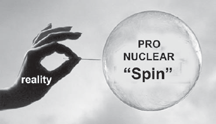 Science Direct 18 May 18
- https://doi.org/10.1016/j.rser.2018.
Highlights
- •We respond to a recent article that is critical of the feasibility of 100% renewable-electricity systems.
- •Based on a literature review we show that none of the issues raised in the article are critical for feasibility or viability.
- •Each issue can be addressed at low economic cost, while not affecting the main conclusions of the reviewed studies.
- •We highlight methodological problems with the choice and evaluation of the feasibility criteria.
- •We provide further evidence for the feasibility and viability of renewables-based systems.
-
Abstract
A recent article ‘Burden of proof: A comprehensive review of the feasibility of 100% renewable-electricity systems’ claims that many studies of 100% renewable electricity systems do not demonstrate sufficient technical feasibility, according to the criteria of the article’s authors (henceforth ‘the authors’). Here we analyse the authors’ methodology and find it problematic. The feasibility criteria chosen by the authors are important, but are also easily addressed at low economic cost, while not affecting the main conclusions of the reviewed studies and certainly not affecting their technical feasibility. A more thorough review reveals that all of the issues have already been addressed in the engineering and modelling literature. Nuclear power, which the authors have evaluated positively elsewhere, faces other, genuine feasibility problems, such as the finiteness of uranium resources and a reliance on unproven technologies in the medium- to long-term. Energy systems based on renewables, on the other hand, are not only feasible, but already economically viable and decreasing in cost every year
-
1. Introduction
………..https://www.sciencedirect.com/science/article/pii/S1364032118303307
Nuclear propagandist Ben Heard attacked renewable energy’s potential: scientists refute him
Can we get 100 percent of our energy from renewable sources? https://www.eurekalert.org/pub_releases/2018-05/luot-cwg051718.php New article gathers the evidence to address the sceptics LAPPEENRANTA UNIVERSITY OF TECHNOLOGY
Is there enough space for all the wind turbines and solar panels to provide all our energy needs? What happens when the sun doesn’t shine and the wind doesn’t blow? Won’t renewables destabilise the grid and cause blackouts?
 In a review paper last year in the high-ranking journal Renewable and Sustainable Energy Reviews, Master of Science Benjamin Heard (at left) and colleagues presented their case against 100% renewable electricity systems. They doubted the feasibility of many of the recent scenarios for high shares of renewable energy, questioning everything from whether renewables-based systems can survive extreme weather events with low sun and low wind, to the ability to keep the grid stable with so much variable generation.
Now scientists have hit back with their response to the points raised by Heard and colleagues.The researchers from the Karlsruhe Institute of Technology, the South African Council for Scientific and Industrial Research, Lappeenranta University of Technology, Delft University of Technology and Aalborg University have analysed hundreds of studies from across the scientific literature to answer each of the apparent issues. They demonstrate that there are no roadblocks on the way to a 100% renewable future.
“While several of the issues raised by the Heard paper are important, you have to realise that there are technical solutions to all the points they raised, using today’s technology,” says the lead author of the response, Dr. Tom Brown of the Karlsruhe Institute of Technology.
“Furthermore, these solutions are absolutely affordable, especially given the sinking costs of wind and solar power,” says Professor Christian Breyer of Lappeenranta University of Technology, who co-authored the response.
Brown cites the worst-case solution of hydrogen or synthetic gas produced with renewable electricity for times when imports, hydroelectricity, batteries, and other storage fail to bridge the gap during low wind and solar periods during the winter. For maintaining stability there is a series of technical solutions, from rotating grid stabilisers to newer electronics-based solutions. The scientists have collected examples of best practice by grid operators from across the world, from Denmark to Tasmania.
The response by the scientists has now appeared in the same journal as the original article by Heard and colleagues.
“There are some persistent myths that 100% renewable systems are not possible,” says Professor Brian Vad Mathiesen of Aalborg University, who is a co-author of the response.
“Our contribution deals with these myths one-by-one, using all the latest research. Now let’s get back to the business of modelling low-cost scenarios to eliminate fossil fuels from our energy system, so we can tackle the climate and health challenges they pose.”
For more information, please contact:
Tom Brown, Young Investigator Group Leader, Karlsruhe Institute of Technology | tom.brown@kit.edu
Kornelis Blok, Professor, Delft University of Technology | k.blok@tudelft.nl
Christian Breyer, Professor, Lappeenranta University of Technology | christian.breyer@lut.fi
Brian Vad Mathiesen, Professor, Aalborg University | bvm@plan.aau.dk
The research papers for further information:
National Geographic now a stooge for the International Church of Nuclear

Wild Edens” i s a new documentary series from National Geographic, initiated by Russia’s Rosatom State Atomic Energy Corporation
The first film in the series premiered at the X International Forum ATOMEXPO 2018, held on May 14-16 in Sochi (Russia). The documentary will be broadcast on the National Geographic channel in summer 2018.
The premiere was introduced by Ben Heard, from Australia. Pretty much unknown in Australia, Heard is very well known and revered by the global lobbyists for “new nuclear” – Small Modular Nuclear Reactors, – by Rosatom, by the South African nuclear lobby, and American companies like Terrestrial Energy.
Wild Edens promises to focus on climate change. Heard is happy to “ see a major corporation like Rosatom step boldly forward in this way and claim this issue on behalf of nuclear technologies“.
The series is filmed in the world’s most stunning untouched places and their inhabitants – wildlife and fauna alike, endangered by the effects of climate change” – blah blah
Like a few other recent documentaries ( “Pandora’s Promise”, “Twisting the Dragon’s Tail” and a Brian Cox documentary) – this will be a very soft sell for the nuclear industry.
It will surely be very beautiful, informative about wild places, and worth watching. Just be aware of the underlying religious propaganda about:
- nuclear power being the essential cure for climate change
- nuclear power being clean and green
- nuclear waste problem being solved now, or will be solved.

Ben Heard launches the project
So-called “independent” think tanks, e.g Britain’s Policy Exchange, paid to favour companies –
 Times 12th May 2018 , Independent think tanks are being paid by companies to write policy reports
and to gain access to senior politicians. In the past year leading charitable think tanks have earned millions of pounds from private organisations that want to have influence in Whitehall, research by The Times has found.
The think tanks have commissioned research and published reports in areas of interest to their corporate sponsors and arranged events to discuss them with politicians. Some, such as Policy Exchange, have refused to publish details of their funders. One senior figure at a think tank said that the arrangement allowed companies to “launder their interests” through independent groups with close links to officials.
All the reports seen by this newspaper drew conclusions favourable to the companies concerned. Policy Exchange published a report calling on ministers to invest in small nuclear reactors. The report was funded by Rolls-Royce, the British engineering company that has significant investment in the technology, but this was not stated in the report.
Instead the acknowledgment section thanked “Rolls-Royce for its support of the Energy and Environment Unit”. It did not disclose the funding or the possible conflict of interest. Rolls-Royce said: “While Rolls-Royce funded the report on SMRs [the reactors], the independent research was conducted by Policy Exchange and we categorically had no influence.”
https://www.thetimes.co.uk/article/big-companies-buy-influence-with-funding-for-think-tanks-6x85mpx9q
Nuclear industry ‘s struggle to survive – launches huge public relations push
Given that offshore wind is expected to continue falling in price and is being built at the moment, unlike nuclear, the economic case for new reactors in the U.K. appears to diminish by the day.
Similar challenges face nuclear elsewhere in Western Europe.
But the situation in the U.S. is even worse. In America it is now no longer economically viable to keep existing plants running, let alone build new ones.
 How the Nuclear Industry Is Fighting Back, The beleaguered nuclear power sector has launched a charm offensive in a bid to stay relevant. Greentech Media , APRIL 30, 2018 The West’s nuclear industry has embarked on its biggest public relations push ever in a bid to stay relevant to policymakers increasingly focused on renewables.
Recent weeks have seen a coordinated campaign by two of the sector’s top agencies to claw back support for a technology that is struggling to remain economically viable and is in danger of being sidelined in discussions over future energy pathways in Europe and North America.
In the U.S., the Nuclear Energy Institute (NEI) kicked off proceedings in an apparently low-key fashion. With little fanfare, the Institute’s website had a facelift in early March, dispensing with its former staid design and adopting a more modern look with bold type and plenty of video.
In the place of headlines about developments in nuclear technology, the NEI’s site now plays inspirational messages over images of children, cityscapes and electric cars. “Carbon-free. Available 24/7. Powering communities,” it says. “Vital to our clean energy future.”
Soon after, the NEI began talking up its annual briefing for the financial community, which, for the first time, was being streamed live on Facebook.
 Ominously for an industry where new developments always seem plagued with delays, the livestreaming event started late due to technical problems.
Once underway, NEI president and CEO Maria Korsnick lost no time in stating the case for ongoing nuclear energy support. . …..
OECD’s nuclear group weighs in Less than 24 hours after the NEI event, the Nuclear Energy Agency of the Organization for Economic Co-Operation and Development (OECD) took the helm of the industry’s communications machine with the launch of a major report.
The Full Costs of Electricity Provision was unveiled by the NEA’s director-general, William D. Magwood IV, and senior economist, Jan Horst Keppler, along with NEI’s senior director of policy development, Matthew Crozat, and nuclear advocate Kirsty Gogan. …..
A glance through the 214-page document shows it to be a serious attempt by the NEA to reframe the parameters of current energy policy discussions and head off one of two major threats facing the sector.
While nobody disputes nuclear power’s ability to deliver significant quantities of baseload, [?] carbon-free energy, the industry has long wrestled with safety concerns and more recently found itself outflanked by the economics of Western electricity markets.
It is likely that the nuclear sector has learned to take safety accusations in its stride. For years, advocates have been claiming that nuclear power is safer than any other form of electricity generation (although Greenpeace disputes this).
Those arguments didn’t stop nations such as Germany or Italy from turning against nuclear in the wake of the Fukushima Daiichi disaster, however.
And more recently, nuclear plant operators in Europe and, particularly, the U.S. have been worrying over an even bigger concern: cost. In markets such as the U.K., new nuclear is looking increasingly pricey next to renewables.
Last September, for instance, offshore wind — theoretically one of the most expensive forms of mainstream renewable energy generation — undercut the strike price for the U.K.’s Hinkley Point C project by almost 38 percent.
Given that offshore wind is expected to continue falling in price and is being built at the moment, unlike nuclear, the economic case for new reactors in the U.K. appears to diminish by the day, even though the government has restated its commitment to a diverse energy mix.
Similar challenges face nuclear elsewhere in Western Europe. Only two commercial nuclear reactors, Flamanville 3 and Olkiluoto 3, are under construction in the European Union. Both are massively delayed and over budget. But the situation in the U.S. is even worse.
In America it is now no longer economically viable to keep existing plants running, let alone build new ones.
The dire situation facing reactors in U.S. markets flooded with cheap gas and renewables is prompting desperate measures from plant owners in states such as Minnesota and New Jersey. And the NEA report is designed to force a rethink in how these markets are set up. …… Its main finding is that the external costs of the normal operations of electricity generation exceed the costs of other phases of the life cycle of electricity generation, as well as the costs of major accidents, “by at least one order of magnitude.”
…… The problem is that the NEA’s clear interest in promoting nuclear energy somewhat taints the impartiality of the report, opening it up to criticism from observers.
….A one-sided interpretation? Amory Lovins, the notoriously anti-nuclear Rocky Mountain Institute (RMI) chief scientist and co-founder, pulled no punches over the NEA’s attempt to calculate all-in energy costs. A large body of literature, with widely varying quality and independence, has already done this, he said.
“NEA endorses a one-sided interpretation of that literature,” he said. “The workshop that framed and steered this report was co-chaired by two well-known nuclear advocates, making NEA an extension and official endorser of the nuclear industry’s main advocacy group.”
He offered up a long list of potential flaws in the report, including selective citations, assumed rather than observed technology costs, no analysis of financing cost, no mention of risk premiums or construction times, the use of old pricing data, and factually incorrect claims.
Some points of the analysis are largely or wholly correct, but most sections and the broad conclusions are not, he told GTM. “They will be credible only to the credulous or already-committed,” he said. …
Investigative journalist Gareth Porter refutes the spin and deception in claims that Iran is a nuclear threat
Is Iran really a nuclear threat? https://www.aljazeera.com/indepth/features/iran-nuclear-threat-180423110553667.html Investigative journalist Gareth Porter dispels some of the myths surrounding Iran’s nuclear programme, by Mersiha Gadzo, 24 Apr 2018
Nuclear corporation Rosatom parterners with National Geographic – to promote nuclear power!
Energy Live News 19th April 2018 , The boss of ROSATOM in Europe has told ELN the future for nuclear power is
all about communication. Andrey Rozhdestvin was very open and direct when I
spoke to him earlier this week in Madrid, where the Russian nuclear giant
ROSATOM was launching its partnership with National Geographic, sponsoring
a series of new wildlife documentaries.
It’s one its ways of trying to trigger public dialogue on the issue of nuclear power. ROSATOM says the
documentaries will be talking about how to tackle climate change and they
of course believe nuclear energy, which is carbon-free generation, is part
of the answer.
https://www.energylivenews.com/2018/04/19/talk-to-the-people-says-russian-nuclear-chief/
Nuclear lobby no longer touts Peaceful Nuclear Power – now it’s Essential for Nuclear Weapons
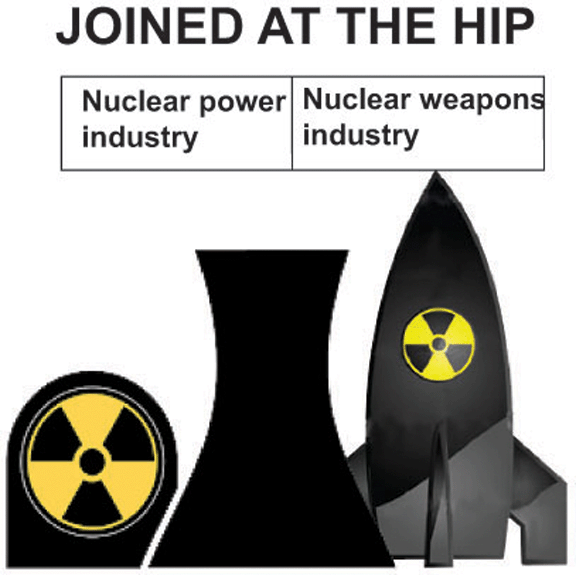 Should Nuclear Energy Be a U.S. National Security Concern? Inside Sources March 29, 2018 by Erin Mundahl Sixty years ago, nuclear power was the energy of the future, promising a nearly limitless supply of clean, cheaper power. That future has yet to arrive. In fact, today, utilities are increasingly transitioning out of nuclear generation, shuttering aging reactors and shelving plans to reinvest in new technology. This is more than just a shift from one fuel to another, says David Gattie, an associate professor of environmental engineering at the University of Georgia. The decline in interest in nuclear energy has significant impacts on America’s national security.
“Nuclear energy is a unique resource because of its unmatched energy density and dual-purpose utility for electric power generation and nuclear weaponry,” Gattie writes in a recently published paper………. Although American scientists began the atomic age, more recently, research and development in nuclear technology, including civilian nuclear, has decreased to a level that threatens American primacy and, by extension, national security….
The U.S. is running the risk of falling behind the rest of the world in terms of nuclear technology, rather than maintaining its position of global leader.
To combat this trend, Gattie advocates specific legislative action to provide fixed support for nuclear research and development. For the purposes of longevity, this would optimally be a legislative, rather than executive action. This space to resurrect research in technologies like molten salt and breeder reactors would signal that the U.S. is committed to the future of nuclear energy. http://www.insidesources.com/nuclear-energy-should-be-a-us-national-security-concern/
Inside the vast web of PR firms popularizing the Saudi crown prince

@_ChrisMaguire
They mention Burson-Marsteller but avoid mentioning WPP LLC (Its parent company) who are behind the scenes covering up SCL (Cambridge Analytica) election voting scandals, The BP Gulf Oil Disaster, The Fukushima nuclear disaster etc etc. A great bit of investigative Journalism by Christine Maguire here;
“…Previously, the small firm didn’t have a record of dealing with governments, but has ties to Trump. President Jacob Daniels was chief of staff at Trump’s Michigan campaign and owner Robert Stryk is a Republican operative who represented former Trump campaign manager Corey Lewandowski.
The list of US firms on the Saudi payroll is extensive. Other companies include The Harbour Group, Burson-Marsteller, Hill & Knowlton, King & Spalding, Brownstein Hyatt Farber Schreck LLP, Fleishman-Hillard Inc, Hogan & Hartson. The FT reported in September the kingdom’s information ministry was seeking to set up ‘hubs’ in Europe and Asia “to promote the changing face of KSA to the rest of the world and to improve international perception of the kingdom.”
Despite the best efforts of the multitude of PR firms, Saudi Arabia’s attempts to completely rebrand have fallen short. Bin Salman’s war in Yemen and the subsequent blockade on aid remains a sore point. Then there’s his November crackdown on corruption, which saw hundreds of businessmen and members of the royal family imprisoned in a luxury hotel where accusations of torture soon emerged.
The kingdom’s much-touted reform when it comes to women is the best PR for the country. However, with multiple reports that bin Salman has imprisoned his own mother to prevent her from influencing his father, not to mention the other obstacles imposed on the women of Saudi Arabia, the crown prince has a long way to go before he can truly be considered any sort of feminist, as Amnesty International noted on Thursday….”
https://www.rt.com/news/422858-saudi-pr-firms-yemen-terrorism/
Further reading here;
https://www.sourcewatch.org/index.php/WPP
And here;
Beware the reputation managers
May 2011 (Post Fukushima)
“…Crisis management may, in its turn, mitigate the cost and impact of disasters, even those that are the product of mismanagement. Anterooms to the executive suite are suddenly crowded with advisers eager to point out that BP’s bill would have been lower if it had fostered better political connections before, and communicated and lobbied differently after, the Gulf of Mexico catastrophe. ...”
https://www.ft.com/content/cb24bd52-7fe4-11e0-b018-00144feabdc0
Image source;
http://adage.com/article/global-news/wpp-lead-deal-maker-54-acquisitions-2013/291800/
NOTE
Please note that the extensive articles posted on this blog on this companies connection to industrial disaster crisis management for governments and corporations, that mentioned WPP LLC complicity to the Fukushima nuclear disaster are not accessible as the new Google search algorythm (since July 2017) seems to block much of the content posted on this (and other websites, blogs etc) blog (Shaun aka arclight2011). Some evidence for that here;
The nuclear industry and science myths- theme for April 18
The nuclear lobby is more of a religious cult than a science body. It relies a lot on the prevailing myth about “hard” science being somehow better than “soft science”. The nuclear doctrine is that if you’re not an expert in the “hard”sciences, then you cannot have a valid opinion.
There were no biologists, geneticists, ecologists involved in the origin of nuclear weapons and nuclear power. It seems the same today, even though the most zealous nuclear lobbyists proclaim themselves as “environmentalists”. But their propaganda gives them away – shows their ignorance of those complex, nuanced sciences that are downgraded in the present global drive for unbridled technology development.

One hardly dares mention studies like sociology, anthropology, ethnic studies … even economics – these are dismissed, too, as “soft” .
But all these downgraded subjects are the ones we should be addressing, if the world is to be saved from the twin horrors of nuclear devastation and climate change.
“Fukushima Pride” – publicity event to promote Fukushima food in Paris
 Fukushima food promoted in Paris https://www3.nhk.or.jp/nhkworld/en/news/20180325_07/ The governor of Japan’s Fukushima Prefecture is in Paris to promote farm products that are suffering from a damaged reputation following the 2011 nuclear accident.
Masao Uchibori is visiting Europe following the 7th anniversary of the massive earthquake and tsunami that triggered the accident at the Fukushima Daiichi nuclear power plant.
Uchibori organized the “Fukushima Pride” tasting event on Saturday at a shopping mall near Paris. Rice and fruit products were handed out to shoppers.
One visitor said she likes the dried peaches a lot and is not concerned about the safety of Fukushima produce now that it is widely circulated.
France has seen Japanese cuisine surge in popularity, which is pushing up the import of luxury foodstuffs and sake rice wine.
Uchibori expressed hope that France will help Fukushima overcome lingering concerns about the safety of its food and make inroads into the global market.
The Japanese government has been calling on other countries to lift import restrictions on its food products, after they cleared radiation screening.
In December, the European Union lifted import controls on some produce and seafood from regions affected by the nuclear accident.
Sanitising the Fukushima nuclear waste situation: Japanese newspaper succumbs to pressure

The Great Train Photo Robbery https://beyondnuclearinternational.org/2018/03/13/the-great-train-photo-robbery/
Nuclear lobby gearing up to convert youth to the nuclear faith
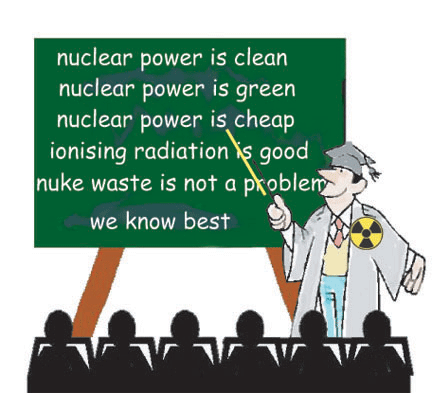
Investing in Youth: IAEA, International Youth Nuclear Congress Sign Agreement,
Henry Sokolski Blows Up 5 Myths about Saudi Arabia’s Nuclear Program
 5 Myths about Saudi Arabia’s Nuclear Program, Enabling Riyadh would only make the region’s nuclear landscape riskier. http://nationalinterest.org/feature/5-myths-about-saudi-arabias-nuclear-program-24771
Much has been written about Saudi Arabia’s plans for nuclear power since the Trump administration announced last fall that it would conclude a civilian nuclear cooperative agreement with Riyadh. Almost all of this commentary suggests Washington must accommodate the kingdom’s desire to enrich uranium and reprocess plutonium, two activities that bring states to the brink of making bombs. In particular, commentators repeatedly raise five points—none of which are sound.
Myth #1: Saudi Arabia needs nuclear power to meet its growing electrical demand.
Most recently, the Saudis announced that instead of sixteen large power reactors, they are only building two. Some have argued that this slippage reflects the kingdom’s desire to finance reactor construction with its oil revenues. With the price of oil dropping from $100 a barrel several years ago to roughly $60 a barrel today, the schedule for nuclear construction had to slide. If true, this suggests the Saudi nuclear “imperative” is less than urgent.
A more compelling explanation is that Saudis don’t need nuclear power. In fact, recent studies found that the Saudis could more cheaply meet their energy and environmental requirements by developing its natural-gas resources and investing in renewables—photovoltaic, concentrated solar power and wind. They also found economic value in upgrading the kingdom’s electrical grid and reducing subsidies that artificially drive up electrical demand. This should not be surprising. The United Arab Emirates, Riyadh’s next-door neighbor, which began construction of four power reactors several years ago, just announced that the UAE would not be building any more nuclear plants. Why? Cheaper alternatives: in addition to plentiful natural gas and wind resources, the Emirates are now investing in photovoltaic systems and solar thermal storage systems, which together can operate twenty-four hours a day more cheaply than nuclear. These findings also apply to Saudi Arabia.
Myth #2: Without a formal nuclear cooperative agreement with Riyadh, America will forgo billions of dollars of nuclear hardware and know-how exports to the kingdom.
This point presumes that the kingdom will stick with its 2012 energy plan, which it has already backed away from. It also mistakenly assumes that America still manufactures export reactors. The only American-headquartered firm that is actively interested in exporting to the kingdom is Westinghouse. It is entirely foreign owned and is a reactor designer, not a manufacturer. It’s currently in bankruptcy proceedings, and is eager to be bought by a Canadian holding firm. Naturally, Westinghouse would like its prospective buyers to believe that it has a clear shot at the Saudi market.
Unfortunately it’s, at best, a long shot. Westinghouse’s design, the AP1000, has yet to operate anywhere. The reactor’s construction is embarrassingly behind schedule and over budget both in China and the United States. Mismanagement by Westinghouse caused two reactors in South Carolina to be terminated after an expenditure of $9 billion, which, in turn, nearly bankrupted Westinghouse’s Japanese owner, Toshiba. Finally, American nuclear know-how and other nonnuclear electrical generating parts can and have been exported in support of non-American reactors abroad without a formal nuclear cooperative agreement. These goods would likely make up a majority of American nuclear exports to the kingdom but, again, their export does not require negotiating a nuclear cooperative agreement.
Myth #3: If Westinghouse does not win the bid, the Russians or Chinese will, reducing American nuclear influence in the region.
This argument is perhaps the most egregious. Consider: an unspoken motive for the kingdom to pursue a nuclear program is to develop an option to make nuclear weapons, if needed, to deter Iran. This would all but preclude buying Russian. Rosatom, after all, is building Iran’s reactors. If Saudi Arabia buys Russian, it is all but asking Moscow to let Iran know exactly what the kingdom is doing in the nuclear realm. Consider also Russia’s recent ill-fated nuclear dealings with South Africa (a contributing factor in forcing President Zumafrom office) and Turkey (where Rosatom’s financial inflexibility prompted Turkey’s private financiers, who were underwriting half of the undertaking, to pull out of the project).
As for buying Chinese, doing so is also risky. The Chinese recently encountered “safety concerns” that delayed operation in Taishan of both its Westinghouse AP1000, and a French-based design. As for China’s top export nuclear design, the Hualong One (HPR 1000) reactor, the British won’t be done certifying it until 2022. China’s other possible export system, the CAP 1400, based on the yet-unproven AP1000, has yet to operate anywhere.
What’s left? The kingdom’s original bid requirements were for two reactors that would produce 2,800 megawatts. The only country that has a reactor that is operating, that is properly licensed, and that has been built roughly on time and on budget that could meet this requirement is Korea’s APR-1400. The Saudis only changed their original bid requirements after the United States, China, Russia and France all complained. Given Korea’s relative success in building four APR-1400 reactors on time and on budget in the United Arab Emirates, and its success in operating a licensed APR-1400 in South Korea, the Korean reactor is still the odds-on favorite to win the Saudi bid.
No, it doesn’t. Saudi nuclear backers argue that the kingdom should enrich, given the uranium reserves the Saudis have discovered. Uranium, however, is plentiful globally and priced at historic lows (less than $22 a pound), as are uranium-enrichment services. More important, the kingdom would have to spend billions on a variety of plants to enrich uranium and produce its own nuclear fuel. Starting such an undertaking might make economic sense if the kingdom had roughly a dozen large reactors up and running. It currently has none, and has only opened a process to buying two.
Myth #5: United States has more to gain by accommodating Saudi Arabia’s demand that it be allowed to enrich uranium than resisting it.
Trumpeting these myths, proponents of a permissive U.S.-Saudi nuclear deal argue that Washington lacks the leverage to secure a Saudi pledge not to make enrich or reprocess. The best Washington can do, it is argued, is to ask Riyadh to defer such dangerous nuclear activities for several years. Some even suggestthat acceding to Riyadh’s wishes is in Washington’s interest, since allowing the Saudis the capacity to make nuclear weapons–usable fuels might help “deter” Iran from acquiring nuclear weapons.
None of this seems sound. As already noted, the Korean APR-1400 is most likely to win the Saudi contract. Given this reactor’s American technical content, senior Korean officials are convinced they cannot export it to the kingdom unless the Saudis first reach a nuclear cooperative agreement with the United States. For this reason (and others besides), Seoul is inclined to take American guidance. Meanwhile, President Trump is trying to get the European parties to the Iran nuclear deal to devise a tighter follow-on understanding. A riskier approach would be for the United States to break from its policy (solidified in the 2009 U.S.-UAE nuclear cooperative agreement) to get non-weapons states in the Middle East to forswear enriching and reprocessing.
Besides the odd optics of looking like a version of the 2015 Iran nuclear deal (which President Trump says is “the worst deal ever”), allowing Riyadh to enrich and reprocess would immediately excite the humors of the UAE and Egypt. Both have U.S. nuclear cooperative agreements that allow them to request their agreements be modified if the United States offers any of their neighbors a more generous nuclear deal. Then there’s Morocco and Turkey: their nuclear agreements with Washington are up for renewal in 2021 and 2023. They too are likely to ask for equal treatment as soon as possible. How this serves anyone’s long-term interest is, at best, unclear.
Henry Sokolski is executive director of the Nonproliferation Policy Education Center and the author of Underestimated: Our Not So Peaceful Nuclear Future. He served as deputy for nonproliferation policy in the office of the U.S. secretary of defense from 1989 to 1993.
If Saudi Arabia is to have a prosperous economic future, we are told, it must meet its growing power requirements by burning less oil. For this, nuclear proponents insist, the Saudis need sixteen large reactors. Although often repeated, this is not true. In 2012, the Saudis announced their intention to build sixteen reactors by 2032. By 2017, Saudi planners had pushed this back to 2040. Shortly thereafter, Crown Prince Mohammed bin Salman backed an national development plan for 2030 that didn’t mention nuclear power, but instead focused on investing in renewables.
Most recently, the Saudis announced that instead of sixteen large power reactors, they are only building two. Some have argued that this slippage reflects the kingdom’s desire to finance reactor construction with its oil revenues. With the price of oil dropping from $100 a barrel several years ago to roughly $60 a barrel today, the schedule for nuclear construction had to slide. If true, this suggests the Saudi nuclear “imperative” is less than urgent.
A more compelling explanation is that Saudis don’t need nuclear power. In fact, recent studies found that the Saudis could more cheaply meet their energy and environmental requirements by developing its natural-gas resources and investing in renewables—photovoltaic, concentrated solar power and wind. They also found economic value in upgrading the kingdom’s electrical grid and reducing subsidies that artificially drive up electrical demand. This should not be surprising. The United Arab Emirates, Riyadh’s next-door neighbor, which began construction of four power reactors several years ago, just announced that the UAE would not be building any more nuclear plants. Why? Cheaper alternatives: in addition to plentiful natural gas and wind resources, the Emirates are now investing in photovoltaic systems and solar thermal storage systems, which together can operate twenty-four hours a day more cheaply than nuclear. These findings also apply to Saudi Arabia.
Myth #2: Without a formal nuclear cooperative agreement with Riyadh, America will forgo billions of dollars of nuclear hardware and know-how exports to the kingdom.
This point presumes that the kingdom will stick with its 2012 energy plan, which it has already backed away from. It also mistakenly assumes that America still manufactures export reactors. The only American-headquartered firm that is actively interested in exporting to the kingdom is Westinghouse. It is entirely foreign owned and is a reactor designer, not a manufacturer. It’s currently in bankruptcy proceedings, and is eager to be bought by a Canadian holding firm. Naturally, Westinghouse would like its prospective buyers to believe that it has a clear shot at the Saudi market.
Unfortunately it’s, at best, a long shot. Westinghouse’s design, the AP1000, has yet to operate anywhere. The reactor’s construction is embarrassingly behind schedule and over budget both in China and the United States. Mismanagement by Westinghouse caused two reactors in South Carolina to be terminated after an expenditure of $9 billion, which, in turn, nearly bankrupted Westinghouse’s Japanese owner, Toshiba. Finally, American nuclear know-how and other nonnuclear electrical generating parts can and have been exported in support of non-American reactors abroad without a formal nuclear cooperative agreement. These goods would likely make up a majority of American nuclear exports to the kingdom but, again, their export does not require negotiating a nuclear cooperative agreement.
Myth #3: If Westinghouse does not win the bid, the Russians or Chinese will, reducing American nuclear influence in the region.
This argument is perhaps the most egregious. Consider: an unspoken motive for the kingdom to pursue a nuclear program is to develop an option to make nuclear weapons, if needed, to deter Iran. This would all but preclude buying Russian. Rosatom, after all, is building Iran’s reactors. If Saudi Arabia buys Russian, it is all but asking Moscow to let Iran know exactly what the kingdom is doing in the nuclear realm. Consider also Russia’s recent ill-fated nuclear dealings with South Africa (a contributing factor in forcing President Zumafrom office) and Turkey (where Rosatom’s financial inflexibility prompted Turkey’s private financiers, who were underwriting half of the undertaking, to pull out of the project).
As for buying Chinese, doing so is also risky. The Chinese recently encountered “safety concerns” that delayed operation in Taishan of both its Westinghouse AP1000, and a French-based design. As for China’s top export nuclear design, the Hualong One (HPR 1000) reactor, the British won’t be done certifying it until 2022. China’s other possible export system, the CAP 1400, based on the yet-unproven AP1000, has yet to operate anywhere.
What’s left? The kingdom’s original bid requirements were for two reactors that would produce 2,800 megawatts. The only country that has a reactor that is operating, that is properly licensed, and that has been built roughly on time and on budget that could meet this requirement is Korea’s APR-1400. The Saudis only changed their original bid requirements after the United States, China, Russia and France all complained. Given Korea’s relative success in building four APR-1400 reactors on time and on budget in the United Arab Emirates, and its success in operating a licensed APR-1400 in South Korea, the Korean reactor is still the odds-on favorite to win the Saudi bid.
Myth # 4: It makes economic sense for the kingdom to enrich uranium to fuel its own reactors.
No, it doesn’t. Saudi nuclear backers argue that the kingdom should enrich, given the uranium reserves the Saudis have discovered. Uranium, however, is plentiful globally and priced at historic lows (less than $22 a pound), as are uranium-enrichment services. More important, the kingdom would have to spend billions on a variety of plants to enrich uranium and produce its own nuclear fuel. Starting such an undertaking might make economic sense if the kingdom had roughly a dozen large reactors up and running. It currently has none, and has only opened a process to buying two.
Myth #5: United States has more to gain by accommodating Saudi Arabia’s demand that it be allowed to enrich uranium than resisting it.
Trumpeting these myths, proponents of a permissive U.S.-Saudi nuclear deal argue that Washington lacks the leverage to secure a Saudi pledge not to make enrich or reprocess. The best Washington can do, it is argued, is to ask Riyadh to defer such dangerous nuclear activities for several years. Some even suggestthat acceding to Riyadh’s wishes is in Washington’s interest, since allowing the Saudis the capacity to make nuclear weapons–usable fuels might help “deter” Iran from acquiring nuclear weapons.
None of this seems sound. As already noted, the Korean APR-1400 is most likely to win the Saudi contract. Given this reactor’s American technical content, senior Korean officials are convinced they cannot export it to the kingdom unless the Saudis first reach a nuclear cooperative agreement with the United States. For this reason (and others besides), Seoul is inclined to take American guidance. Meanwhile, President Trump is trying to get the European parties to the Iran nuclear deal to devise a tighter follow-on understanding. A riskier approach would be for the United States to break from its policy (solidified in the 2009 U.S.-UAE nuclear cooperative agreement) to get non-weapons states in the Middle East to forswear enriching and reprocessing.
Besides the odd optics of looking like a version of the 2015 Iran nuclear deal (which President Trump says is “the worst deal ever”), allowing Riyadh to enrich and reprocess would immediately excite the humors of the UAE and Egypt. Both have U.S. nuclear cooperative agreements that allow them to request their agreements be modified if the United States offers any of their neighbors a more generous nuclear deal. Then there’s Morocco and Turkey: their nuclear agreements with Washington are up for renewal in 2021 and 2023. They too are likely to ask for equal treatment as soon as possible. How this serves anyone’s long-term interest is, at best, unclear.
Henry Sokolski is executive director of the Nonproliferation Policy Education Center and the author of Underestimated: Our Not So Peaceful Nuclear Future. He served as deputy for nonproliferation policy in the office of the U.S. secretary of defense from 1989 to 1993.
It’s a myth that thorium nuclear reactors were ever commercially viable
 Dispelling Claim 2: Thorium did not get a chance in the nuclear energy development because it is not usable for military purposes Thorium ‒ a better fuel for nuclear technology? Nuclear Monitor, by Dr. Rainer Moormann 1 March 2018
In the early stages of nuclear technology in the USA (from 1944 to the early 1950s), reprocessing technology was not yet well developed. Better developed were graphite moderated reactors that used natural uranium and bred plutonium.
For the use of thorium (which, other than uranium, does not contain fissile components), enriched uranium or possibly plutonium would have been indispensable.
Initially, neither pathway for thorium development was chosen because it would have automatically reduced the still limited capacity for military fissile materials production. (Thorium has a higher capture cross section for thermal (that means slow) neutrons than U-238. For that reason, it needs as fertile material in reactors a higher fissile density than U-238.)
Only when the US enrichment capacity at about 1950 delivered sufficient enriched uranium, the military and later civil entry into thorium technology started: in 1955 a bomb with U-233 from thorium was exploded, and a strategic U-233 reserve of around 2 metric tons was created. The large head-start of the plutonium bomb could not be overtaken any more, and plutonium remained globally the leading military fission material (although, according to unconfirmed sources, Indian nuclear weapons contain U-233).
The US military research concluded in 1966 that U-233 is a very potent nuclear weapon material, but that it offers hardly any advantages over the already established plutonium. Because light water reactors with low-enriched uranium (LEU) were already too far developed, thorium use remained marginal also in civil nuclear engineering: for instance, the German “thorium reactor” THTR-300 in Hamm operated only for a short time, and in reality it was a uranium reactor (fuel: 10% weapon-grade 93% enriched U-235 and 90% thorium) because the amount of energy produced by thorium did not exceed 25%.
1 This Month
Chernobyl: The Lost Tapes – A good documentary on Chernobyl on SBS available On Demand for the next 3 weeks– https://www.sbs.com.au/ondemand/tv-program/chernobyl-the-lost-tapes/2352741955560

of the week–London Campaign for Nuclear Disarmament

Tell the Ukrainian Government to Drop Prosecution of Peace Activist Yurii Sheliazhenko
To see nuclear-related stories in greater depth and intensity – go to https://nuclearinformation.wordpress.com
-
Archives
- April 2026 (152)
- March 2026 (251)
- February 2026 (268)
- January 2026 (308)
- December 2025 (358)
- November 2025 (359)
- October 2025 (376)
- September 2025 (257)
- August 2025 (319)
- July 2025 (230)
- June 2025 (348)
- May 2025 (261)
-
Categories
- 1
- 1 NUCLEAR ISSUES
- business and costs
- climate change
- culture and arts
- ENERGY
- environment
- health
- history
- indigenous issues
- Legal
- marketing of nuclear
- media
- opposition to nuclear
- PERSONAL STORIES
- politics
- politics international
- Religion and ethics
- safety
- secrets,lies and civil liberties
- spinbuster
- technology
- Uranium
- wastes
- weapons and war
- Women
- 2 WORLD
- ACTION
- AFRICA
- Atrocities
- AUSTRALIA
- Christina's notes
- Christina's themes
- culture and arts
- Events
- Fuk 2022
- Fuk 2023
- Fukushima 2017
- Fukushima 2018
- fukushima 2019
- Fukushima 2020
- Fukushima 2021
- general
- global warming
- Humour (God we need it)
- Nuclear
- RARE EARTHS
- Reference
- resources – print
- Resources -audiovicual
- Weekly Newsletter
- World
- World Nuclear
- YouTube
-
RSS
Entries RSS
Comments RSS
 nuclear-news