Beyond Nuclear questions Union of Concerned Scientists’ support for bailouts for “top ranked” nuclear plants
 Appalling safety culture should eliminate nuclear power from subsidies https://beyondnuclearinternational.org/2018/11/11/appalling-safety-culture-should-eliminate-nuclear-power-from-subsidies/ November 11, 2018 Union of Concerned Scientists ignores its earlier report by now endorsing “top ranked” nuclear plants for bailouts, By Paul Gunter, Beyond Nuclear
A controversial new report from the Union of Concerned Scientists suggests that closing aging US nuclear plants — and not subsidizing the cost of building new ones — will increase carbon emissions. The assumption is that nuclear plants that close will be replaced by coal or natural gas-fired plants.
California, which has only one nuclear power plant still operating at Diablo Canyon, will replace it, and the already shuttered San Onofre reactors, entirely with renewable energy. When Nebraska closed its flooded Ft. Calhoun nuclear plant, it was wind energy, not fossil fuels, that stepped in to fill the new generation void.
Following a major revision of its reactor safety oversight process in 2000, the NRC listed one nuclear plant— Davis-Besse in Ohio — as being maintained as one of the safest reactors in the country. In fact, while holding its newly top-rated position as a “Column 1” facility, Davis-Besse was in perilous condition. An undetected leak of corrosive reactor coolant had been allowed to eat through a 6 ¾ inch-thick carbon steel wall of the reactor pressure vessel head.
All during the time of operation, FirstEnergy Nuclear, the operator of Davis-Besse, and the onsite NRC inspectors, ignored the thick accumulation of iron oxide particulate settling on catwalks inside the reactor building, and the daily replacement of containment air filters, without investigating where the cloud of rust was originating.
The NRC has since revised its oversight process once again. But neither the federal agency nor the nuclear industry have demonstrated an improvement in “safety culture” and continue to fall short in questioning and reporting the development of reactor hazards.
In fact, the former UCS senior reactor safety engineer, David Lochbaum, also an author on the latest report, is quoted in the 2017 analysis, “the data suggest that the NRC’s management is just as dismissive of indications that it has a poor safety culture. When it comes to chilled work environments, the NRC may have the largest refrigerator in town.”
The November 2018 UCS report also makes the assertion that offering low-carbon incentives to both renewables and new and existing nuclear plants will raise all boats. However, this is not supported by the reality on the ground. For example, the decision by New York to prop up its aging and uneconomical upstate nuclear plants is costing the state nearly $500 million per year – 200 times as much as it is spending on developing renewables. Preventing the early closure of nuclear plants serves as a hindrance to renewable energy development, exacerbating, rather than ameliorating carbon emissions and the climate crisis.
Small Modular Reactors not commercially viable, but nuclear companies want the government handouts
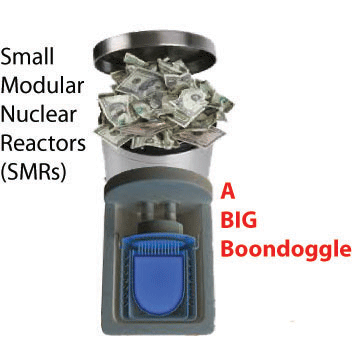 there is no market for the expensive electricity that SMRs will generate. Many companies presumably enter this business because of the promise of government funding. No company has invested large sums of its own money to commercialize SMRs.
Are Thousands of New Nuclear Generators in Canada’s Future? https://thetyee.ca/Opinion/2018/11/07/Nuclear-Generators-Canada-Future/Ottawa is pushing a new smaller, modular nuclear plant that could only pay off if mass produced. By M.V.  RamanaM. V. Ramana is the Simons Chair in Disarmament, Global and Human Security at the School of Public Policy and Global Affairs at UBC, and the author of The Power of Promise: Examining Nuclear Energy in India, Penguin Books, New Delhi (2012)
Canada’s government is about to embrace a new generation of small nuclear reactors that do not make economic sense.
Amidst real fears that climate change will wreak devastating effects if we don’t shift away from fossil fuels, the idea that Canada should get deeper into nuclear energy might seem freshly attractive to former skeptics.
For a number of reasons, however, skepticism is still very much warranted.
On Nov. 7, Natural Resources Canada will officially launch something called the Small Modular Reactor Roadmap. The roadmap was previewed in February of this year and is the next step in the process set off by the June 2017 “call for a discussion around Small Modular Reactors in Canada” issued by Canadian Nuclear Laboratories, which is interested in figuring out the role the organization “can play in bringing this technology to market.”
Environmental groups and some politicians have spoken out against this process. A petition signed by nearly two dozen civil society groups has opposed the “development and deployment of SMRs when renewable, safer and less financially, socially and environmentally costly alternatives exist.”
SMRs, as the name suggests, produce relatively small amounts of electricity in comparison with currently common nuclear power reactors. The last set of reactors commissioned in Canada is the four at Darlington. These started operating between 1990 and 1993 and can generate 878 megawatts of electricity (although, on average, they only generate around 75 to 85 per cent of that). In comparison, SMRs are defined as reactors that generate 300 MW or less — as low as 5 MW even. For further comparison, the Site C dam being built in northeastern B.C. is expected to provide 1,100 MW and BC Hydro’s full production capacity is about 11,000 MW.
Various nuclear institutions, such as Canadian Nuclear Laboratories, Canadian Nuclear Association and the CANDU Owners Group are strongly supportive of SMRs. Last October, Mark Lesinski, president and CEO of CNL announced: “Small modular reactors, or SMRs, represent a key area of interest to CNL. As part of our long-term strategy, announced earlier this year, CNL established the ambitious goal of siting a new SMR on a CNL site by 2026.”
Likewise, the CANDU Owners Group announced that it was going to use “their existing nuclear expertise to lead the next wave of nuclear generation — small modular reactors, that offer the potential for new uses of nuclear energy while at the same time offering the benefits of existing nuclear in combating climate change while providing reliable, low-cost electricity.”
A fix for climate change, says Ottawa
Such claims about the benefits of SMRs seems to have influenced the government too. Although NRCan claims to be just “engaging partners and stakeholders, as well as Indigenous representatives, to understand priorities and challenges related to the development and deployment of SMRs in Canada,” its personnel seem to have already decided that SMRs should be developed in Canada.
“The Government of Canada recognizes the potential of SMRs to help us deliver on a number of priorities, including innovation and climate change,” declared Parliamentary Secretary Kim Rudd. Diane Cameron, director of the Nuclear Energy Division at Natural Resources Canada, is confident: “I think we will see the deployment of SMRs in Canada for sure.” Such talk is premature, and unwise.
Canada is a late entrant to this game of talking up SMRs. For the most part it has only been talk, with nothing much to show for all that talk. Except, of course, for millions of dollars in government funding that has flown to private corporations. This has been especially on display in the United States, where the primary agency that has been pumping money into SMRs is the Department of Energy.
In 2001, based on an overview of around 10 SMR designs, DOE’s Office of Nuclear Energy concluded that “the most technically mature small modular reactor designs and concepts have the potential to be economical and could be made available for deployment before the end of the decade, provided that certain technical and licensing issues are addressed.” Nothing of that sort happened by the end of that decade, i.e., 2010. But in 2012 the U.S. government offered money: up to $452 million to cover “the engineering, design, certification and licensing costs for up to two U.S. SMR designs.” The two SMR designs that were selected by the DOE for funding were called mPower and NuScale.
The first pick was mPower and, a few months later, the DOE projected that a major electricity generation utility called the Tennessee Valley Authority “plans to deploy two 180 megawatt small modular reactor units for commercial operation in Roane County, Tennessee, by 2021, with as many as six mPower units at that site.”
The company developing mPower was described by the New York Times as being in the lead in the race to develop SMRs, in part because it had “the Energy Department and the T.V.A. in its camp.”
But by 2017, the project was essentially dead.
Few if any buyers
Why this collapse?
In a nutshell, because there is no market for the expensive electricity that SMRs will generate. Many companies presumably enter this business because of the promise of government funding. No company has invested large sums of its own money to commercialize SMRs.
An example is the Westinghouse Electric Co., which worked on two SMR designs and tried to get funding from the DOE. When it failed in that effort, Westinghouse stopped working on SMRs and shifted its focus to decommissioning reactors that are being shut down at an increasing rate, which is seen as a growing business opportunity. Explaining this decision in 2014, Danny Roderick, then president and CEO of Westinghouse, said: “The problem I have with SMRs is not the technology, it’s not the deployment — it’s that there’s no customers…. The worst thing to do is get ahead of the market.”
Many developing countries claim to be interested in SMRs but few seem to be willing to invest in the construction of one. Although many agreements and memoranda of understanding have been signed, there are still no plans for actual construction. Examples are the cases of Jordan, Ghana and Indonesia, all of which have been touted as promising markets for SMRs, but none of which are buying one because there are significant problems with deploying these.
A key problem is poor economics. Nuclear power is already known to be very expensive. But SMRs start with a disadvantage: they are too small. One of the few ways that nuclear power plant operators could reduce the cost of nuclear electricity was to utilize what are called economies of scale, i.e., taking advantage of the fact that many of the expenses associated with constructing and operating a reactor do not change in linear proportion to the power generated. This is lost in SMRs. Most of the early small reactors built in the U.S. shut down early because they couldn’t compete economically.
Reactors by the thousands?
SMR proponents argue that they can make up for the lost economies of scale in two ways: by savings through mass manufacture in factories, and by moving from a steep learning curve early on to gaining rich knowledge about how to achieve efficiencies as more and more reactors are designed and built. But, to achieve such savings, these reactors have to be manufactured by the thousands, even under very optimistic assumptions about rates of learning. Rates of learning in nuclear power plant manufacturing have been extremely low. Indeed, in both the United States and France, the two countries with the highest number of nuclear plants, costs went up, not down, with construction experience.
In the case of Canada, the potential markets that are most often proffered as a reason for developing SMRs are small and remote communities and mines that are not connected to the electric grid. That is not a viable business proposition. There are simply not enough remote communities, with adequate purchasing capacity, to be able to drive the manufacture of the thousands of SMRs needed to make them competitive with large reactors, let alone other sources of power.
There are thus good reasons to expect that small modular reactors, like large nuclear power plants, are just not commercially viable. They will also impose the other well-known problems associated with nuclear energy — the risk of severe accidents, the production of radioactive waste, and the linkage with nuclear weapons — on society. Rather than seeing the writing on the wall, unfortunately, NRCan and other such institutions are regurgitating industry propaganda and wasting money on technologies that will never be economical or contribute to any meaningful mitigation of climate change. There is no justification for such expensive distractions, especially as the climate problem becomes more urgent. ![[Tyee]](https://ci4.googleusercontent.com/proxy/-dbM2-hlkJWqmnDhMjXoXTKhgMN4lAbQ2wyqv_IW2Qs-IMWKHJAwJI-q0jLCPSZjrmKGcsJD2R_OTYg=s0-d-e1-ft#https://thetyee.ca/ui/img/ico_fishie.png)
Frazer Nash nuclear helps nuclear lobby to infiltrate academia

|
C2I 2018: South-West Nuclear Hub delivers access to nuclear skills
Category: Academic Innovator Supported by a £2.5m Catalyst Fund grant from HEFCE and £5m from the University of Bristol, the hub takes advantage of its proximity to a number of nuclear operations. These include the Magnox power station at Oldbury in Gloucestershire, decommissioning reactors at Berkeley, also Gloucestershire, Hinkley Point A in Somerset and Winfrith in Dorset, and the growing construction site for the new EPR reactor at Hinkley Point. Further afield but still within reach are another decommissioning power station at Trawsfynydd in Snowdonia and Wylfa on Anglesey. It also counts the nuclear fusion research centre at Culham in Oxfordshire, the Harwell research Centre and the nuclear submarine dismantling programme at Devonport as within its catchment area. Bristol and Oxford universities are already linked by a joint nuclear research centre (NRC) and the hub leverages this collaboration. …….Each research theme has a senior academic lead coordinating activity and identifying potential connections with other universities, including Oxford and the nearby University of the West of England……. The Nucleate centre is to be another collaboration, with partnerships between the University of Bristol, National laboratory and EDF Energy ……. Public engagement is also a key focus of the hub. It coordinates both national and regional outreach activities, which include a nuclear seminar series of public lectures. The hub acts as an independent gateway for promoting public understanding of nuclear energy, framing it within the context of climate change mitigation…….. The Headline sponsor for C2I2018 is Frazer-Nash Consultancy https://www.theengineer.co.uk/academic-innovator-south-west-nuclear-hub/
|
|
|
The global nuclear industry sneaks into international governments’ “clean” energy movement
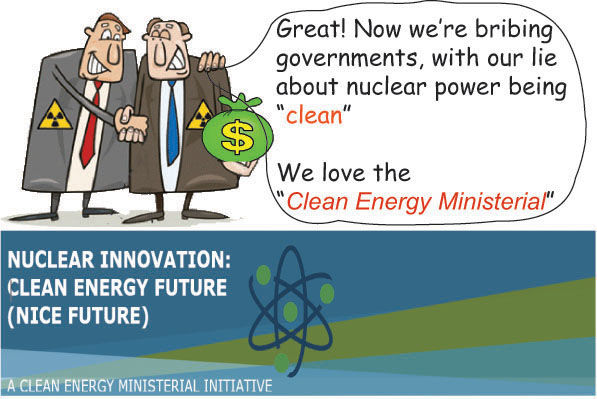
 USA – Canada – Japan – the ministerial nuclear suckers came out of the woodwork – Dan Brouillette, Kim Rudd, Masaki Ogushi, Rick Perry … and also Dr. Matar Al Neyadi, and Denis Janin, immediate past President of the International Youth Nuclear Congress, and who else – in this secretive nuclear white anting of the global movement?
|
Countries Launch a Nuclear Innovation Initiative under the Clean Energy Ministerial NICE Future initiative will address improved power system integration through innovative, integrated, and advanced energy systems and applications, such as nuclear-renewable systems, combined uses of heat and power, hydrogen production, and industrial decarbonization. It will highlight the opportunities for nuclear energy technologies to reduce emissions and air pollution from power generation, industry, and end-use sectors. “I would like to acknowledge the countries and organizations that have joined the United States, Canada, and Japan in the creation and launch of the NICE Future initiative,” said Deputy Secretary Brouillette. “Secretary Rick Perry and I are quite proud of this initiative and the ambitious program it sets forth. Having nuclear included at the Clean Energy Ministerial will create greater global recognition of its many unique benefits.” Nuclear energy is an important contributor to global clean energy supply, both as a primary source of clean energy and by enabling other clean energy sources.
“Nuclear energy’s vitally important but under-recognized contributions to clean air are made even greater by constant innovation,” said U.S. Secretary of Energy Rick Perry. “The NICE Future initiative highlights these contributions by reimagining nuclear’s advanced uses and applications. Nuclear provides a cleaner, safer, more reliable, and more resilient energy supply for our world.” “Canada is excited to be a part of this initiative. Nuclear energy is already an important part of Canada’s energy mix and innovative nuclear technologies, including Small Modular Reactors, have a key role to play in the transition to a low-carbon economy” said Kim Rudd, Parliamentary Secretary to Canada’s Minister of Natural Resources. “As a non-emitting source of energy, nuclear is, and will continue to be, an important part of our energy mix.” Japanese Parliamentary Vice-Minister of Economy, Trade and Industry Masaki Ogushi stated, “I expect this initiative would bring the wisdom of the world on nuclear innovation together, and contribute to policy making for realizing clean energy systems that solve challenges in each country. Our aim is to promote nuclear innovation utilizing out-of-the-box ideas from the private sector, pursuing the development of reactors with new concepts, including harmonization with renewable energy, combined with enhanced safety, efficiency, and flexibility.” Several NICE Future initiative participants and stakeholders gathered on the sidelines of CEM9 for a launch event, moderated by Mr. Denis Janin, immediate past President of the International Youth Nuclear Congress….. Others noted nuclear energy’s strategic benefits. “Nuclear energy in the UAE plays a strategic role as a clean energy source that will reduce greenhouse gas emissions in the energy sector, diversify our energy portfolio, and is already creating highly-skilled employment opportunities which support long-term sustainability,” pointed out Dr. Matar Al Neyadi, Undersecretary of the Ministry of Energy of the United Arab Emirates (UAE). ……… Countries participating in the NICE Future Initiative include the United States, Canada, Japan, Argentina, Poland, Romania, Russia, United Arab Emirates, and the United Kingdom. More countries have indicated strong interest. The International Energy Agency (IEA) and the OECD Nuclear Energy Agency (NEA) have noted their interest and support for the initiative. The U.S. DOE National Renewable Energy Laboratory will serve as an initiative operating agent. http://www.cleanenergyministerial.org/news-clean-energy-ministerial/countries-launch-nuclear-innovation-initiative-under-clean-energy |
|
“Clean Energy Ministerial”: despite Canada’s Liberal claims, nuclear power will not save the environment
 Despite Liberal claims, nuclear power will not save the environment http://rabble.ca/columnists/2018/10/despite-liberal-claims-nuclear-power-will-not-save-environment, Ole Hendrickson October 23, 2018 Want a shiny new nuclear reactor in your community? Justin Trudeau has a deal for you.
In the lead-up to the 2015 election, he said the economy and environment “go together like paddles and canoes. Unless you have both, you won’t get to where you are going.” Such vacuous statements helped him win a majority government.
Did Liberal voters think “real change” would mean maintaining fossil fuel subsidies, buying the Kinder Morgan pipeline, and promoting new nuclear reactors?
When the Liberals renamed the cabinet committee on “Environment, Climate Change and Energy” to “Environment and Clean Growth” on August 28, 2018, Trudeau’s office said this “reflects the government’s commitment to addressing climate change through growing the economy.” But putting “clean” in front of “growth” is a con job — like putting “sustainable” in front of “development.”
Behind closed doors in the “clean growth” cabinet committee, the minister of natural resources will discuss next year’s “Clean Energy Ministerial” — a gathering of energy ministers from the world’s richest nations, hosted by Canada.
One of Canada’s objectives for this meeting, together with the U.S., is to advance plans for the “next generation” of nuclear reactors. In preparation, a federal nuclear reactor “road map” will be released next month at a Canadian Nuclear Society conference in Ottawa subsidized by the Trudeau government.
For the one-percenters, “clean growth” includes nuclear power. The military industrial complex needs nuclear power and nuclear weapons just as much as it needs fossil fuels.
Government officials and lobbyists who call nuclear power “clean energy” cannot provide a shred of evidence that a new generation of reactors will help Canada and other nations achieve the Paris Agreement greenhouse gas reduction targets.
The real point of this exercise is to perpetuate the military industrial complex.
The nuclear industry is desperately casting about for ways to attract young scientists and engineers. It promotes fantasies of reactor technologies that will provide carbon-free electricity, eliminate existing nuclear waste stockpiles, desalinate ocean water, power remote Indigenous communities, and enable travel to Mars.
But these technologies have been around for decades. They are enormously expensive. They require huge government subsidies, waste taxpayer dollars and generate budget deficits characteristic of the U.S. military industrial complex.
Climate justice incompatible with economic growth
Addressing climate change through economic growth is an ecocidal fantasy. To claim that humans can appropriate more and more of the planet’s resources, and still protect the environment and halt climate change is ludicrous.
This is business as usual — continuation of the “great acceleration” created by post-Second World War governments who transformed the war machine into the “peacetime” military industrial complex.
Politicians and corporate executives — the one-percenters — have no intention of putting the brakes on this machine. They need to fuel the nuclear sub fleets in the U.S. and U.K., and the armoured vehicles that Canada makes and sells to Saudi Arabia. They will try to extract every last gram of uranium and drop of oil. Nuclear and fossil fuels are both the means and end of war.
Ultimately, the military industrial complex is waging war against the planet, against ourselves and against all living creatures. The Earth is in great peril.
Revolution is brewing. Activists, Indigenous and non-Indigenous alike are rejecting these corporate-driven technological fantasies. Energy is changing. The capitalist system will not survive. But what will replace it?
Ole Hendrickson is a retired forest ecologist and a founding member of the Ottawa River Institute, a non-profit charitable organization based in the Ottawa Valley.
Photo: European Parliament/Flickr
Trump administration heads for the dodgy science of the radiation sceptics
| Is a Little Radiation Good For You? Trump Admin Steps Into Shaky Science, Discover Magazine, By Nathaniel Scharping | October 5, 2018
For decades, studies have shown that even low doses of radiation are harmful to humans. This week, the Associated Press reported that the Trump administration may be reconsidering that. The Environmental Protection Agency seemed to be looking at raising the levels of radiation considered dangerous to humans based on a controversial theory rejected by mainstream scientists. The theory suggests that a little radiation might actually be good for our bodies. In April, an EPA press release announced the proposal and included supporting comments from a vocal proponent of the hypothesis, known as hormesis. It prompted critical opinion pieces and sparked worry among radiation safety advocates.
The debate cuts to the heart of the debate over the effects of low doses of radiation and reveals how difficult it is to craft clear guidelines in an area where scientific evidence is not clear cut. Radiation DebateWhen radiation damages our DNA, the body steps in to make repairs. Hormesis suggests that hitting the body with a little more radiation should kick our defensive mechanisms into overdrive. According to proponents of the theory, this results in the production of anti-oxidants and anti-inflammatory compounds that reduce our risk for cancer and heart disease, among other things. That’s why hormesis backers want the EPA to raise the level of acceptable radiation, pointing out that it would also save millions in safety costs. It sounds convincing, and proponents have dozens of studies to point to that they say back up their claims. But, “Large, epidemiological studies provide substantial scientific evidence that even low doses of radiation exposure increase cancer risk,” says Diana Miglioretti, a professor in biostatistics at the University of California, Davis in an email. “Risks associated with low-doses of radiation are small; however, if large populations are exposed, the evidence suggests it will lead to measurable numbers of radiation-induced cancers.” Long-term studies of Hiroshima and Nagasaki bombing survivors show higher cancer risks. Marshall Islanders exposed to radiation from atomic bomb tests suffered a higher risk of thyroid disease. And patients who get CT scans, which deliver a dose of radiation equal to thousands of X-rays, saw cancer risks go up afterward. Researchers also found that radiation from childhood CT scans can triple the risk of leukemia and, at higher doses, triple the risk of brain cancers as well. Another found that low-dose radiation increased the risk of breast cancer among some some women. And large-scale reviews of the evidence for hormesis find that it is decidedly lacking. Two studies, one in 2006 by the National Research Council, and another in 2018 by the National Council and Radiation Protection and Measurements looking at 29 studies of radiation exposure find no evidence for hormesis, and reiterate that the evidence points toward radiation being bad for us even at low doses. Scientific UncertaintyIt’s difficult to study low doses of radiation, though, and that’s where much of the controversy comes from. At doses below a few hundred millisieverts (mSv), a radiation unit that accounts for its effects on the body, it becomes extraordinarily hard to separate out the effects of radiation from other things like lifestyle or genetics. Research on the effects of these small radiation doses often use data sets involving thousands of people to compensate for the minimal effect sizes, but even then it’s often not enough to be certain what’s happening. “Data collected at low doses (defined by the scientific community [as] exposures less than 100 mSv) suffers from a ‘signal to noise’ problem which limits our ability to conclusively state effects one way or another,” says Kathryn Higley, head of the school of nuclear science and engineering at Oregon State University in an email. A single CT scan delivers anywhere from 1 to 15 mSv, but some patients need many scans during the course of their treatment, increasing the total dose. Workers cleaning up after the Fukushima meltdown received radiation doses above 100 mSv in some cases. And current U.S. standards limit radiation workers to no more than 50 mSv of exposure per year. Many studies indicate that there are dangers at that level, but it’s often an assumption. Those studies base their suppositions on what’s called the linear no-threshold model, which extrapolates more reliable data from studies of higher doses of radiation to lower doses. Though it may be an educated guess, for decades large-scale studies have indicated this is true. ……….. The EPA in recent days appeared to back away from the suggestion that it supported hormesis. The agency released a statement in response to the APstory affirming that it intends to continue using the linear no-threshold model when constructing radiation guidelines, something that contradicts Calabrese’s comments in the April press release. “The proposed regulation doesn’t talk about radiation or any particular chemicals. EPA’s policy is to continue to use the linear-no-threshold model for population-level radiation protection purposes which would not – under the proposed regulation that has not been finalized – trigger any change in that policy,” said an EPA spokesman in response to a request for comment. Radiologist Rebecca Smith-Bindman says the vast bulk of the evidence suggests even small amounts of radiation are harmful. We shouldn’t base our policies on an unproven theory, she adds. “There is extensive evidence that ionizing radiation will cause cancer,” says Smith-Bindman, a professor of radiology at the University of California, San Francisco in an email exchange. “These data come from a range of different sources, including epidemiological data (such as studies of patients who have received diagnostic and therapeutic radiation and from environmental exposures and accidents), from animal studies and from basic science studies. While it is more difficult to precisely quantify the exposures — which will vary by many factors, such as age at exposure, and source of radiation, etc. — there is no uncertainty among the scientific community that radiation will cause cancer.” She says that pointing to issues with the linear no-threshold model misses the point. Though it may not be totally accurate at very low doses, she says it’s unfair to use that uncertainty to cast doubt on data about radiation where there’s solid evidence. …….. Miglioretti says “Based on the large body of evidence to date, I believe that revising the regulations to increase allowable radiation exposure limits will lead to an increase in the number of radiation-induced cancers in this country.” That’s in line with what multiple experts Discover contacted believe — that radiation can harm even at low doses and raising limits would endanger the public, though the increase in risk would likely be small. It’s not clear at the moment whether the EPA proposal to raise limits will pass, though it does follow in the footsteps of other Trump administration proposals to weaken safety standards. At the moment, it’s unclear what the effects on the public if the EPA raises radiation limits. “Perhaps it might make nuclear power plants less expensive to build. It might lower the cost of cleanup of radioactively polluted sites,” says David Brenner, director of the Center for Radiological Research at Columbia University in an email. “But [it] begs the question of whether cleanup to a less rigorous standard is desirable.” http://blogs.discovermagazine.com/crux/2018/10/05/epa-trump-administation-radiation-guidelines/#.W99ZFtIzbGg
|


2020 Olympics as PR for the global nuclear industry? Fukushima to start the events

Disaster-stricken prefecture will host first event of the 2020 games https://asia.nikkei.com/Politics/Abe-and-IOC-chief-to-visit-Fukushima-Olympics-venue
Bach will visit Japan to attend a two-day general assembly meeting of the Association of National Olympic Committees starting Nov. 28, followed by an IOC Executive Board session, both to be held in Tokyo.
The Olympic torch relay will start in Fukushima Prefecture on March 26, 2020, with the flame scheduled to be lit in the ancient Greek city of Olympia on March 12 the same year, a day after the ninth anniversary of the 2011 disaster.
The city of Fukushima will host six softball games including a match played by the Japan team on July 22 as the first event of the Olympic Games.
University of California being used by the nuclear weapons industry
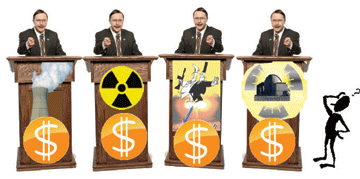 California is complicit in the buildup of nuclear weapons http://www.latimes.com/opinion/op-ed/la-oe-fihn-californias-central-role-in-nuclear-arems-race-20181024-story.html, By BEATRICE FIHN, OCT 24,
 2018 A new nuclear arms race is underway, with California at the center, though it’s not clear its citizens realize it. 2018 A new nuclear arms race is underway, with California at the center, though it’s not clear its citizens realize it.
|
|
Australian commercial TV station now selling its soul to the nuclear industry?
 The 60 Minutes Fukushima nuclear infomercial, Independent Australia Noel Wauchope 23 October 2018 A FEW YEARS AGO, Australian Channel 9’s 60 Minutes did an excellent investigation of the Fukushima nuclear accident.
This Fukushima investigation was compered by Liz Hayes. I recall that, at the time, the program was a much more thorough, serious and well-resourced presentation than anything put forward by even the ABC or SBS.
However, I was pretty appalled at the latest 60 Minutes coverage of the Fukushima issue, which screened on Sunday (21 October) titled, Is nuclear power the solution to our energy crisis?
The main message of this program is a call to scrap Australia’s legislation against establishing the nuclear industry. The argument given is that we need nuclear power because it is supposedly cheap and dependable. We also need it because it is supposedly essential to combat climate change.
This time, the reporter is not Liz Hayes. It’s Tom Steinfort, who is described as a “seasoned Channel 9 star”. Does a seasoned Channel 9 star just accept without question the claims made in this episode?
Among claims made:
- that the evacuation of the Fukushima prefecture was unnecessary — which implies that the Japanese Government and scientists acted stupidly;
- that there were no deaths and will not be any deaths resulting from the radiation from the meltdown, a point on which many experts disagree;
- that nuclear power is essential to tackle climate change, despite recent research which doubts its usefulness.
- that cancer deaths from the Chernobyl nuclear disaster will amount to only 40-160, despite a comprehensive Russian-UK investigation estimating over a million deaths; and
- the downgrading of renewable energies, which the latest research recommends for Australia.
So, what do we make of this latest offering about Fukushima, from 60 Minutes? It must have taken a lot of money and a lot of negotiation to get a 60 Minutes camera team inside the Fukushima nuclear station. I assume that the negotiations were largely arranged by Ben Heard, who has influential nuclear contacts overseas — particularly in Russia and South Africa, where he has been a prominent nuclear spokesperson. In Russia, Heard launched Rosatom National Geographic — a nuclear soft sell environmental program.
I think that we can be sure of one thing. As Japan plans for the 2020 Olympics – some sections of which are to take place in Fukushima Prefecture – the Japanese Government is not likely to permit a team with any anti-nuclear perspective access to the crippled nuclear power plant.
The 60 Minutes media team would have had to have the Japanese authorities on side. I would bet, some companies keen to set up the nuclear industry in Australia would also be on side and keen to assist.
There have been rumblings, too, of yet another resurgence for nuclear energy in Australia, with Prime Minister Scott Morrison declaring that he is ‘open to the idea of nuclear power’ and that ‘the source of Australia’s energy doesn’t bother him and he isn’t interested in an ideological debate’.
Is it too much to hope that Channel 9 might do something to correct this nuclear infomercial and give us a different, more comprehensive view, rather than one blessed by Japanese authorities and the nuclear power lobby? https://independentaustralia.net/business/business-display/the-60-minutes-fukushima-nuclear-infomercial,12023
Here’s an example of the uncritical journalistic hype over the nuclear lobby’s new filmic advertisement
(Low on facts – high on uncritical enthusiasm)

A new documentary puts fresh, young faces on the old debate over nuclear power, Grist , on Oct 18, 2018“…….. David Schumacher’s new documentary, The New Fire,…. profiles young people working to invent better versions of nuclear power plants. There’s the couple with a simple reactor design who started the company, Oklo. And there’s the Bill Gates-backed TerraPower. …..the movie serves up hope and enthusiasm……..
 heroic and charming and just completely iconoclastic. They shattered the standard image of nuclear engineers……
Nuclear weapons join the other cruel killing methods now pitched as games – entertainment
I am not surprised that nuclear devastation is being pitched as a gameplay feature in a video game. I don’t see it as being substantially different from all of the other horrors that we have made fun through the interactive power of video games. Our main mode of engaging with beings in video games remains killing them with blades, guns, and the protagonist’s own hands. I am not morally outraged by this. Instead, the frivolity of it, its “epic” implementation, just makes me feel so tired.
When the detonation of a nuclear weapon is made into a game mechanic and declared “pretty @#%$^@ epic,” I see this simply as a symptom of how insulated games are from the world at large. While films have all the same ways of depicting violence that games have, I have a hard time thinking of a non-satirical film that revels in the absolute annihilation of nuclear war. Dr. Strangelove points out how inept the leaders of the Cold War were, but it obviously does not see the detonation of a nuclear weapon as a fun or optimal output.
Our biggest video games have made executions, stabbings, headshots, and eviscerations completely ordinary. A year without any of those things would be a shocking anomaly, a true blow to the entertainment economy, and it would mean that most of our most profitable game franchises did not release an entry. And now nuclear weapons have been absorbed into this system that sees everything as a potential mechanic and a way of entertaining and maintaining players. In Fallout 76, detonating a nuclear device is just a way to generate more gameplay. From what we’ve seen of the game so far, it is robbed of any significance beyond its mechanical function. ……..
All of our blockbuster games tend toward making the player feel powerful. They want to be fun, to embrace the player, to allow them to feel like they have agency in relation to the world around them. As far as I can tell, there is nothing than will not be sacrificed or compromised in the drive to accomplish that goal. Our biggest games, like the Fallout games, are simply after their players feeling strong. Anything that keeps players from feeling strong must be minimized……..
No matter who you are, no matter how powerful you think you are, the reality is that nuclear war will either destroy you or make your life unlivable in its current shape. This reality is fundamentally at odds with how the design of blockbuster video games work. That means that taking nuclear weapons seriously in a blockbuster game is impossible……..
The problem with video games and nuclear weapons doesn’t have anything to do with nuclear weapons themselves. They are simply a human evil, the ultimate symbol of what kind of nightmare we are willing to bring to bear on one another in our quest for dominance and violence. The problem in the relationship between video games and nuclear weapons is video games.
Unlike our friends over at Motherboard, there is not a part of me that finds joy in the adoption of nuclear weapons as yet another thing that is horribly violent and played for laughs in a game. It is impossible for me to think about nuclear weapons without thinking about the shadows blasted into stone at Hiroshima. I think about the rotting flesh of The Day After. I think about the unfathomable human cost of nuclear weapons, which includes the cancers grown under the aegis of environmental drift of radioactive particles………https://waypoint.vice.com/en_us/article/7x3qjz/fallout-76-nukes-bad-nuclear-weapons?utm_source=wptwitterus
Residents near West Lake Landfill might not be impressed at EPA’s spin – “radiation is good for you”
 Editorial: Attention West Lake residents: EPA says radiation is good for you. https://www.stltoday.com/opinion/editorial/editorial-attention-west-lake-residents-epa-says-radiation-is-good/article_8b288c51-b064-5646-8123-73f943459d57.html By the Editorial Board 15 Oct 18
UN’s Intergovernmental Panel on Climate Change (IPCC) focuses on renewables, dismisses nuclear power
Dr Jim Green, Nuclear Monitor #867, 15 Oct 2018
 https://www.wiseinternational.org/nuclear-monitor/867/nuclear-monitor-867-15-october-2018
The UN’s Intergovernmental Panel on Climate Change (IPCC) has issued a landmark report warning that global warming must be kept to 1.5˚C, requiring “rapid and far-reaching” transitions in land, energy, industry, buildings, transport, and cities.1
The world must invest US$2.4 trillion in clean energy every year through 2035 and cut the use of coal-fired power to almost nothing by 2050 to avoid catastrophic damage from climate change, according to the IPCC. To put the US$2.4 trillion figure in context, about US$1.8 trillion was invested in energy systems globally in 2017, of which about 42% was invested in electricity generation and about 18.5% in renewables.2
Unsurprisingly, the World Nuclear Association (WNA) used the IPCC report to promote nuclear power.

WNA Director General Agneta Rising said the IPCC report “makes clear … the necessity of nuclear energy as an important part of an effective global response” to climate change and that it “highlights the proven qualities of nuclear energy as a highly effective method of reducing greenhouse gas emissions, as well as providing secure, reliable and scalable electricity supplies.”3 In a separate statement, the WNA falsely claimed that nuclear power increases under all of the IPCC scenarios compatible with limiting warming to 1.5˚C.4
Almost all of the WNA’s claims are false or exaggerated. The IPCC report raises numerous concerns about nuclear power (discussed below). In general terms, nearly all of the scenarios presented in the IPCC report envisage a decline in nuclear power generation to 2030 followed by an upswing.5 No logical rationale ‒ or any rationale at all ‒ is provided to support the upswing from 2030 to 2050.
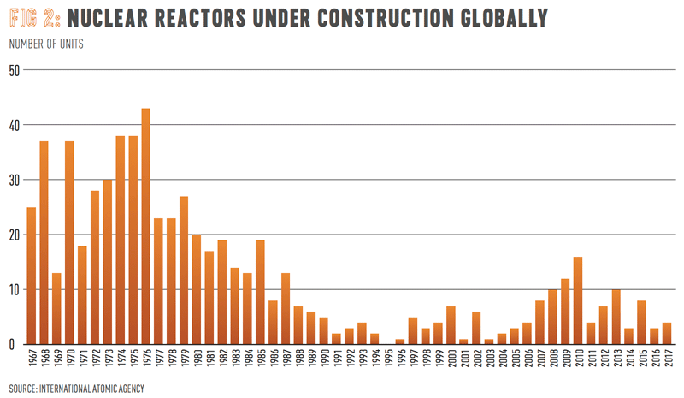
The points that jump out from the IPCC’s low-carbon 1.5°C scenarios are that nuclear accounts for only a small fraction of energy/electricity supply (even if nuclear output increases) whereas renewables do the heavy lifting. For example, in one 1.5°C scenario, nuclear power more than doubles by 2050 but only accounts for 4.2% of primary energy whereas renewables account for 60.8%.6 In another 1.5°C scenario, nuclear nearly doubles by 2050 but its contribution to total electricity supply falls to 8.9%, compared to 77.5% for renewables.7
The IPCC report notes that: “Nuclear power increases its share in most 1.5°C pathways by 2050, but in some pathways both the absolute capacity and share of power from nuclear generators declines. There are large differences in nuclear power between models and across pathways … Some 1.5°C pathways no longer see a role for nuclear fission by the end of the century, while others project over 200 EJ / yr of nuclear power in 2100.”8
Nuclear lobbyist Michael Shellenberger has a very different take on the IPCC report to the WNA … and most of his claims are false as well.9 Shellenberger takes the IPCC to task for stating that nuclear power risks nuclear weapons 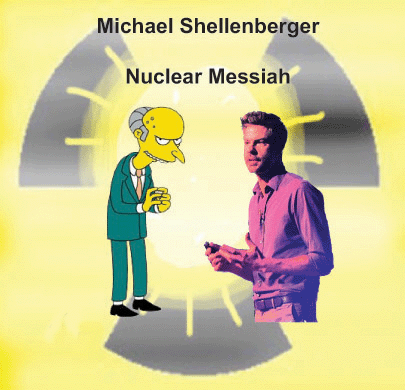 proliferation.10,11 That is “unsubstantiated fear-mongering”, he claims, although Shellenberger himself has written at length about the manifold and repeatedly-demonstrated connections between nuclear power and weapons.12 “No nation has used its civilian nuclear plants to create a weapon”, Shellenberger now claims ‒ which is garbage.13
Shellenberger seems troubled by the IPCC’s claims about a possible connection between nuclear power and childhood leukemia ‒ but he doesn’t explain why. The IPCC’s comments are modest: “Increased occurrence of childhood leukaemia in populations living within 5 km of nuclear power plants was identified by some studies, even though a direct causal relation to ionizing radiation could not be established and other studies could not confirm any correlation (low evidence/agreement in this issue).”10 In fact the evidence of a link is stronger than the IPCC suggests.14,15
Shellenberger complains about “biased and misleading cost comparisons” in the IPCC report though the report simply notes that nuclear power provides an example of “where real-world costs have been higher than anticipated … while solar PV is an example where real-world costs have been lower”.16
Shellenberger claims that solar and wind contributed 1.3% and 3.9% to global electricity supply in 2017 ‒ the true figures are 1.9% and 5.6%.17 He fails to note that all renewables combined supplied 26.5% of global electricity supply in 2017 (2.5 times more than nuclear) or that renewable supply has doubled over the past decade while nuclear power has been stagnant.
References: Continue reading
Global nuclear lobby desperate to market an array of non existent Small and Medium Nuclear Reactors (SMRs)
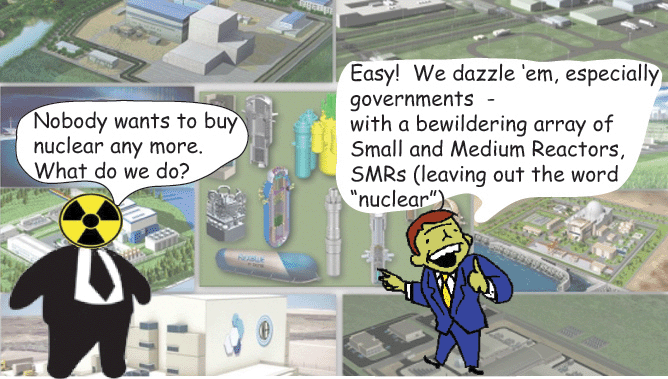
Significant advances have been made in recent years on SMRs, some of which will use pre-fabricated systems and components to shorten construction schedules and offer greater flexibility and affordability than traditional nuclear power plants. Some 50 SMR concepts are at various stages of development around the world, with commercial operations expected to begin in the coming years.
Following an IAEA meeting in September on SMR design and technology, energy experts from around Europe gathered at the Agency’s Vienna headquarters for a workshop earlier this month to discuss infrastructure, economic and finance aspects of SMRs. The meetings are part of an ongoing SMR project involving the IAEA Departments of Nuclear Energy, Nuclear Safety and Security and Technical Cooperation. In addition, representatives of regulatory authorities and other stakeholders also met this month at the IAEA’s SMR Regulators’ Forum, which exchanges experiences on SMR regulatory reviews.
Many IAEA Member States are interested in the development and deployment of SMRs as a cleaner alternative to fossil fuels and for reducing greenhouse gas emissions,” said IAEA Deputy Director General Mikhail Chudakov, Head of the Department of Nuclear Energy. “The IAEA’s flurry of recent activities on SMRs is part of our efforts to respond to Member State requests for assistance on this exciting emerging technology.”
The IAEA recently released two new publications on SMRs: Deployment Indicators for Small Modular Reactors, which provides Member States with a methodology for evaluating the potential deployment of SMRs in their national energy systems; and an updated edition of Advances in Small Modular Reactor Technology Developments, which provides a concise overview of the latest status of SMR designs around the world and is intended as a supplement to the IAEA’s Advanced Reactor Information System (ARIS)…….https://www.iaea.org/newscenter/pressreleases/iaea-showcases-global-coordination-on-small-medium-sized-or-modular-nuclear-reactors-smrs
The nuclear industry’s deceptive narrative about Fukushima earthquake in March 2011
The status of “Station Blackout” is a serious one.
“it will be many years before the Japanese people know exactly what happened at Fukushima Daiichi on 11 March 2011. One of the key mysteries was role, if any, the magnitude 9 earthquake played in damaging the plant’s reactor cooling systems. Until lethal levels of radiation inside the reactors fall and workers can carry out comprehensive investigations, the truth about the tremor’s impact will remain a subject of conjecture and contention”
Mr. Takamatsu states with expert authority that the pipes of cooling system ware not designed for the 50 second vibration of the magnitude quake. Barry Brook, kangaroo expert, disagrees and tells the world the quake caused no damage at Fukushima. Yet Mr. Brook must surely know the earthquake caused grid blackout. For reactors are all shut down by earthquakes. A solar plant would have kept generating until the last panel shattered. No one would have been evacuated from such a solar plant.
I submit that Prof. Barry Brook’s description of the effects of earthquake upon the Fukushima Diiachi on 11 March 2011 is totally ignorant of the facts as presented by many qualified experts and fly in the face of the independent commission set up by the Japanese Parliament (Diet). It is confirmed that expert investigators concern aspects of TEPCO’s explanations regarding the quake are “irrational”.
Thus any narrative based upon the nuclear industry view, in line with TEPCO’s may fairly be said to be “irrational”. For the industry view is that there is no possibility of quake damage to any structure or sub structure, such as coolant pipes and valves.
Earthquake Damage At Fukushima – is Industry’s Narrative Truthful or Certain? Nuclear History, 16 Oct 18 I am again going to contrast the statements made by Barry Brook in regard to the events and outcomes at Fukushima Daiichi in 2011 with the facts as presented by Mark Willacy. These facts are published in Willacy’s book, “Fukushima – Japan’s tsunami and the inside story of the nuclear meltdowns”, Willacy, M., Pan Macmillan, copyright 2013, Mark Willacy.
However, I will also include information related to the events which were first published and discussed in 2011. ………..
The earthquake generated the tsunami. What else did the earthquake cause?
In this blog I have included posts which give the IAEA considerations for the electrical grids which are connected to nuclear power plants. The IAEA states that the level of engineering and resilience built into such grids may be a significant additional cost for any nation considering generation to nuclear power.
It comes as no surprise then the electrical grid connected to the Fukushima Daiichi NPP failed for two reasons. 1. The earthquake caused all the nuclear reactors connected to the same grid to rapidly shut down. Thus the earthquake caused a blackout due to cessation of electrical generation. 2. The physical grid infrastructure – poles and wires – were damaged by the earthquake. At Fukushima this meant that more than one of the reactors was physically separated from the grid by the earthquake.
It can therefore be seen that the earthquake meant A. Fukushima Diiachi could not generate nuclear electricity as the quake had shut the reactors down. B. The Fukushima Diiachi Nuclear Power Plant was in Station Blackout for one reason: earth quake damage to nuclear infrastructure – the electrical grid. Continue reading
1 This Month
19 February – VIRTUAL EVENT-Decision Time: AI and Our Nuclear Arsenal
12:45 p.m. Central / 1:45 p.m. Eastern
To see nuclear-related stories in greater depth and intensity – go to https://nuclearinformation.wordpress.com
-
Archives
- February 2026 (161)
- January 2026 (308)
- December 2025 (358)
- November 2025 (359)
- October 2025 (376)
- September 2025 (258)
- August 2025 (319)
- July 2025 (230)
- June 2025 (348)
- May 2025 (261)
- April 2025 (305)
- March 2025 (319)
-
Categories
- 1
- 1 NUCLEAR ISSUES
- business and costs
- climate change
- culture and arts
- ENERGY
- environment
- health
- history
- indigenous issues
- Legal
- marketing of nuclear
- media
- opposition to nuclear
- PERSONAL STORIES
- politics
- politics international
- Religion and ethics
- safety
- secrets,lies and civil liberties
- spinbuster
- technology
- Uranium
- wastes
- weapons and war
- Women
- 2 WORLD
- ACTION
- AFRICA
- Atrocities
- AUSTRALIA
- Christina's notes
- Christina's themes
- culture and arts
- Events
- Fuk 2022
- Fuk 2023
- Fukushima 2017
- Fukushima 2018
- fukushima 2019
- Fukushima 2020
- Fukushima 2021
- general
- global warming
- Humour (God we need it)
- Nuclear
- RARE EARTHS
- Reference
- resources – print
- Resources -audiovicual
- Weekly Newsletter
- World
- World Nuclear
- YouTube
-
RSS
Entries RSS
Comments RSS
 nuclear-news