Correcting Alan Finkel’s nuclear fallacies

30 Oct 21 Friends of the Earth has written to Dr. Alan Finkel, Special Adviser to the Australian Government on Low Emissions Technology, correcting a number of his recent statements regarding nuclear power. The letter is online.
Dr. Jim Green, national nuclear campaigner with Friends of the Earth, said:
“Dr. Finkel is honest and intelligent ‒ which is more than can be said for some of the ideologues and idiots promoting nuclear power ‒ but his recent statements regarding nuclear power contain a number of inaccuracies.
“Dr. Finkel’s claim that the Fukushima disaster resulted in a “handful” of radiation deaths is inaccurate. The World Health Organization projects increases in all solid cancers, breast cancer, leukaemia and thyroid cancer. In addition, around 2,000 indirect deaths have been recorded. The economic costs amount to hundreds of billions of dollars and there is an incalculable human toll for the 160,000 evacuees from the disaster.
“Dr. Finkel’s claim that safety is the number one imperative underpinning the design of modern reactors is an industry claim that cannot be substantiated. Nuclear power is, in the words of Bob Carr, “cripplingly expensive” and far more expensive than renewables. The nuclear industry is trying to compete economically ‒ mostly by gouging taxpayers and electricity ratepayers ‒ and that is the number one imperative driving everything the industry does.
“Dr. Finkel’s comments about the ‘beauty’ of small modular reactors ignore the fact that the only SMR operating anywhere in the world, a Russian plant, was nine-years behind schedule, six times over-budget, produces power at an exorbitant A$270 per megawatt-hour, and is used to power fossil fuel mining operations in the Arctic. It is ugly in every respect.
“Dr. Finkel’s claim that high-level nuclear waste is being disposed of in a deep underground repository in Finland is false. The 2006 Switkowski report anticipated completion of this repository in 2010. Now, completion is anticipated in the mid-2020s. No waste has been disposed of.
“The only operating deep underground repository for nuclear waste is in the United States and was closed for three years after a chemical explosion in an underground waste barrel in 2014 ‒ the culmination of staggering mismanagement and regulatory failures.
“Here in Australia, the federal government is trying to establish a national nuclear waste dump on farming land near Kimba in SA despite the unanimous opposition of Barngarla Traditional Owners and NH&MRC guidelines which state that farming land should not be used for nuclear waste repositories.”
“The viability of renewables coupled with multiple storage technologies and demand management is a work in progress but there are promising signs. For example, South Australia has reached a 60% renewable share and the Liberal state government is enthusiastically pursuing a 100% net renewables target by 2030. Moreover, the SA Liberal government states that nuclear is not viable now and will not be viable for the foreseeable future.
“Calls for a discussion about nuclear power overlook the fact that there have been four inquiries over the past five years. The Prime Minister said just a few days ago that the federal government has no intention of repealing legislation banning nuclear power, and no state government is interested.
“Surely this is the time to have a breather from the seemingly endless nuclear debate, rather than starting yet another discussion?”
Nuclear power, as well as nuclear weapons, must be opposed: George Monbiot gets it wrong
Nuclear power, as well as nuclear weapons, should be opposed, https://www.thenational.scot/community/19674158.nuclear-power-well-nuclear-weapons-opposed/ Tor Justad, Chair, HANT (Highlands Against Nuclear Weapons), 27 Oct 21,
I REFER to two recent items in the Sunday National – an interview with environmentalist George Monbiot headed “A chance to lead” (Oct 17) and an item headed “Pressure Grows on Scottish Government to oppose nuclear fusion site” on Oct 24.
HANT (Highlands Against Nuclear Transport) is a campaigning group opposing both nuclear weapons and nuclear power, which aligns with current SNP/Scottish Greens government policy.
There is much to commend in George Monbiot’s article, in which he states his belief that the Scottish Government could show the world a way out of the climate crisis and in particular the idea of pursuing “public luxury” with more public facilities, transport, health services and public land ownership as opposed to increasing private wealth and inequality.
However, he fails to mention his support for nuclear power, which he described in an article in The Guardian in 2011 headed “Why Fukushima made me stop worrying and love nuclear power” in which he argued that nuclear was safer than coal and should be supported together with renewables, which he also has doubts about.
He claimed the effect of Fukushima was small for people and planet – clearly untrue, as 150,000 people had to be evacuated from the area and radiation spread over a wide area. 18,000 people were killed by the tsunami which caused the disaster – the clean-up by thousands of workers will continue for 30 years.
In relation to nuclear fusion, HANT stated its opposition to a pilot project proposed for Dounreay in Caithness and it has recently been announced that the bid for the project was unsuccessful.
HANT supports Scottish CND’s opposition to the nuclear fusion project proposed for Ardeer in Ayrshire and urges the Scottish Government to oppose this project.
Attempts to harness nuclear fusion have been made in several countries for the last 70 years costing millions of pounds without success, and as Scottish CND points out there are concerns about safety, the production of waste and the potential link to nuclear weapons production.
Both support for new nuclear and support for nuclear fusion projects, along with proposals for small modular reactors, are all desperate attempts by the nuclear industry to revive nuclear at a time when it is in decline worldwide.
HANT would urge the Scottish Government to maintain its policy of opposition to nuclear weapons and to nuclear power of any kind.
Countering the nuclear lobby’s deceptive spin about ionising radiation
The video below is several years old. Children in Ukraine and Belarus are still suffering with cancers and other serious health effects of the nuclear disaster. The ABC ‘s ”Foreign Correspondent” recently covered their plight, which is still terrible, but the video of that seems to be unavailable.
Extract from The nuclear industry’s updated songsheet remains outdated, Pearls and Irritations, By Mark Diesendorf, 22 Oct 21
”…………. Another misleading pro-nuclear statement revived following the Fukushima Daiichi disaster in 2011 is that no excess cancer incidence has been observed around Fukushima, implying that no cancers will be induced. The logical error is to assume that the absence of evidence implies no impact.
For a start, it is still too early for most types of cancer, which have latent periods of 20–60 years, to appear around Fukushima. The only cancers likely to appear within a decade after exposure are thyroid cancer and leukemia. A large increase in thyroid cancers has been observed in the region, but their cause is debated by some on the grounds that the increase could be the result of better screening. Leukemia is an uncommon disease and so even a large percentage increase would be impossible to verify statistically with high confidence. (See UNSCEAR 2020b)
Fortunately for the citizens of Tokyo, the wind was mostly blowing offshore during the meltdowns of three Fukushima reactors, sending about 80 per cent of the emitted radioactive material out over the Pacific. Soon after the disaster an exclusion zone was established around the power station and more than 100,000 people evacuated. For these reasons, Fukushima tells us very little about radiation-induced cancers.
Most of the evidence that low-level radiation is carcinogenic comes from detailed studies of the survivors of Hiroshima and Nagasaki, medical professionals who worked with radiation, uranium miners, children living near nuclear power stations, and children who were exposed in utero in the bad old days when pregnant women were routinely x-rayed. This is the basis of the linear-no-threshold model, the scientific understanding that the number of cancers induced by ionising radiation is proportional to the dose received and that there’s no threshold. Therefore, even natural background radiation, to which we are all exposed, and medical x-rays contribute very small fractions of cancer prevalence…………https://johnmenadue.com/the-nuclear-industrys-updated-songsheet-remains-outdated/
Terra Power’s Natrium nuclear reactor will be an economic lemon

This host of factors makes it reasonably certain that the Natrium will not be economically competitive.
In other words, even if has no technical problems, it will be an economic lemon.
Ramana, Makhijani: Look before you leap on nuclear https://trib.com/opinion/columns/ramana-makhijani-look-before-you-leap-on-nuclear/article_4508639b-d7e6-50df-b305-07c929de40ed.html, Oct 16, 2021
The Cowboy State is weighing plans to host a multi-billion dollar “demonstration” nuclear power plant — TerraPower’s Natrium reactor. The long history of similar nuclear reactors, dating back to 1951, indicates that Wyoming is likely to be left with a nuclear lemon on its hands.

The Natrium reactor design, which uses molten sodium as a coolant (water is used in most existing commercial nuclear reactors), is likely to be problematic. Sodium reacts violently with water and burns if exposed to air, a serious vulnerability. A sodium fire, within a few months of the reactor starting to generate power, led to Japan’s Monju [at left] demonstration reactor being shut down.

At 1,200 megawatts, the French Superphénix was the largest sodium-cooled reactor, designed to demonstrate commercial feasibility. Plagued by operational problems, including a major sodium leak, it was shut down in 1998 after 14 years, having operated at an average capacity of under 7 percent compared to the 80 to 90 percent required for commercial operation. Other sodium-cooled reactors have also experienced leaks, which are very difficult to prevent because of chemical interactions between sodium and the stainless steel used in various reactor components. Finally, sodium, being opaque, makes reactor maintenance and repairs notoriously difficult.
Sodium-cooled reactors can experience rapid and hard-to-control power surges. Under severe conditions, a runaway chain reaction can even result in an explosion. Such a runaway reaction was the central cause of the 1986 Chernobyl reactor explosion, though that was a reactor of a different design. Following Chernobyl, Germany’s Kalkar sodium-cooled reactor, about the same size as the proposed Natrium, was abandoned without ever being commissioned, though it was complete.
All these technical and safety challenges naturally drive up the costs of sodium-cooled reactors, making them significantly more expensive than conventional nuclear reactors. More than $100 billion, in today’s dollars, has been spent worldwide in the attempt to commercialize essentially this design and associated technologies, to no avail.
The Natrium design, being even more expensive than present-day reactors, will therefore be more expensive than practically every other form of electricity generation. The Wall Street firm, Lazard, estimates that electricity from new nuclear plants is several times more than the costs at utility-scale solar and wind power plants. Further, the difference has been increasing.
To this bleak picture, Terrapower has added another economically problematic feature: molten salt storage to allow its electric output to vary. Terrapower hopes this feature will help it integrate better into an electricity grid that has more variable electricity sources, notably wind and solar.
Molten salt storage would be novel in a nuclear reactor, but it is used in concentrating solar power projects, where it can cost an additional $2,000 per kilowatt of capacity. At that rate, it could add a billion dollars to the Natrium project.
This host of factors makes it reasonably certain that the Natrium will not be economically competitive. In other words, even if has no technical problems, it will be an economic lemon.
To top it all off, the proposed Wyoming TerraPower demonstration project depends on government funds. Last year, the Department of Energy awarded TerraPower $80 million in initial taxpayer funding; this may increase $1.6 billion over seven years, “subject to the availability of future appropriations” and Terrapower coming up with matching funds.
Despite government support, private capital has recently abandoned a more traditional project, the mPower small modular reactor, resulting in its termination in 2017. And it was Congress that refused to appropriate more money for the sodium-cooled reactor proposed for Clinch River, Tennessee when its costs skyrocketed, thereby ending the project in 1983.
A much harder look at the facts is in order, lest Wyoming add to the total of many cancelled nuclear projects and abandoned construction sites. Of course, the Natrium lemon might be made into lemonade by converting it to an amusement park if it is never switched on, like the Kalkar reactor, now refashioned into Wunderland Kalkar, an amusement park in Germany, near the border with the Netherlands. For energy, the state might look to its natural heritage – its wind power potential is greater than the combined generation of all 94 operating U.S. nuclear reactors put together, which are on average, about three times the size of Natrium.
M. V. Ramana is Professor and Simons Chair in Disarmament, Global and Human Security and the Director of the Liu Institute for Global Issues at the School of Public Policy and Global Affairs, University of British Columbia. Dr. Ramana holds a Ph.D. in Physics from Boston University.
Arjun Makhijani, President of the Institute for Energy and Environmental Research, holds a Ph.D. in engineering (nuclear fusion) from the University of California at Berkeley.
UK Climate denialist group rebrands itself as ”Net Zero Watch (NZW)”
| THE Scottish Greens have called on Boris Johnson to remove “dangerous Trumpian extremism” from his party if he is to have any credibility with world leaders ahead of COP26. It comes as a climate change denial group recently changed its name and main focus – while counting a long-serving Tory MP amongst its biggest backers. There are indications that more are likely to join. The new Net Zero Watch (NZW) website was unveiled yesterday (October 11) with the stated aim of talking about the “serious implications of expensive and poorly considered climate change policies”. The group isa rebranding of the campaigning arm of the climate change sceptical lobby group Global Warming Policy Foundation (GWPF) with the Global Warming Policy Forum disappearing from the internet on Monday with the URL redirecting to the NZW website. NZW has chosen to align itself with public anxiety over the costs of net-zero emissions goals to the taxpayer at a time when the UK is experiencing fuel shortages. One of the group’s main proponents is former Brexit minister and Conservative MP Steve Baker (below) who has been taking aim at UK Government experts for their plans to move towards renewables as the main source of energy. The National 12th Oct 2021 https://www.thenational.scot/news/19641580.boris-johnson-warned-senior-tories-peddle-climate-conspiracies-ahead-cop26 |
First George Monbiot Award for Nukiller Greenwash to Springfields Nuclear Fuel Manufacturing Plant in Cumbria – On Anniversary of the Windscale Fire — RADIATION FREE LAKELAND

PRESS RELEASE Springfields Nuclear Fuel Manufacturing Plant Wins the first George Monbiot Nukiller Greenwash award. To mark the anniversary of the 1957 Windscale [ Sellafield ] fire in Cumbria, the Close Capenhurst Campaign and Radiation Free Lakeland have awarded the first George Monbiot Award to the Springfields Nuclear Fuel Manufacturing plant in Lancashire. George Monbiot […]
First George Monbiot Award for Nukiller Greenwash to Springfields Nuclear Fuel Manufacturing Plant in Cumbria – On Anniversary of the Windscale Fire — RADIATION FREE LAKELAND
Independent scientists speak the truth about ionising radiation.


How monolithic institutions decide what is safe for the rest of us, Beyond Nuclear, By Christine Fassert and Tatiana Kasperski, 12 Sept 21,
”………………..The condemnation of this [ Fukushima area radiation] threshold came first of all from within: the special adviser on radiation protection of the Prime Minister’s Office, Professor Toshiso Kosako, resigned in tears on April 30, 2011:
“I cannot accept such a threshold, being applied to babies, children, and elementary school students, not only from an academic point of view, but also because of my humanistic values,” he said.
Many critiques
At the international level, the decision to raise the threshold was also criticized by the two successive UN Special Rapporteurs, Anand Grover and Baskut Tuncak. Moreover, the two experts question the very foundations of radiation protection, which rely on the ALARA principle: As Low as Reasonably Achievable.
This “reasonably” indicates that criteria other than health are taken into account, which Grover criticizes, referring to the “right to health”. Indeed, the rapporteur points out that “the ICRP recommendations are based on the principle of optimization and justification, according to which all government actions should maximize the benefits over the detriments. Such a risk-benefit analysis is not in line with the framework of the right to health, because it gives priority to collective interests over individual rights”.
Tuncak echoes Grover’s criticism in his October 2018 report, stating that “the Japanese government’s decision to increase what is considered the acceptable level of radiation exposure by a factor of 20 is deeply troubling.”
Better protecting individuals
Similar arguments were also used by Belarusian and Ukrainian scientists who, in the late 1980s, opposed the lifetime dose limit of 35 rem (350msv) over a maximum period of 70 years from the time of the accident — a limit that Soviet experts in Moscow, with the support of ICRP representatives, including the head of the French Central Service for Protection against Ionizing Radiation, Pierre Pellerin, were trying to impose as the basis for all post-accident response measures.
The Belarusian and Ukrainian researchers considered the 35 rem criterion to be unacceptable not only from a scientific point of view but also, and above all, from an ethical point of view.
They pointed out that under the conditions of scientific uncertainty about the effects of ionizing radiation, it was dangerous to underestimate the risks that radioactivity represented for the inhabitants of the affected territories, and they considered that the country’s authorities had a moral obligation to devote all the necessary means to greater protection of the inhabitants of the affected regions, especially the most vulnerable individuals.
The danger of low doses
The protagonists of the optimization of radiation protection in the post-accident context insist on the absence of studies proving significant health effects below these thresholds.
For a long time, the arguments for and against these thresholds have been discussed in the public arena and by social scientists in terms of scientific and medical “controversies” — opposing scientists connected to the nuclear sphere who have long denied the harmfulness of low doses, to scientists outside this sphere who consider that the risks were underestimated.
The question of the level of danger of low doses of radioactivity is one of the best known examples of such controversies, which regularly resurface despite the development of scientific knowledge about these risks.
This debate did not arise at the time of the Fukushima accident, but has been going on for a long time and is part of the “motives” also found in the debates about Chernobyl as well as other nuclear accidents such as Kyshtym, in Russia, in 1957………………… https://beyondnuclearinternational.org/2021/09/12/vested-interests/
Global nuclear agencies get together to launch the big propaganda show ”Group of Vienna” ahead of COP26
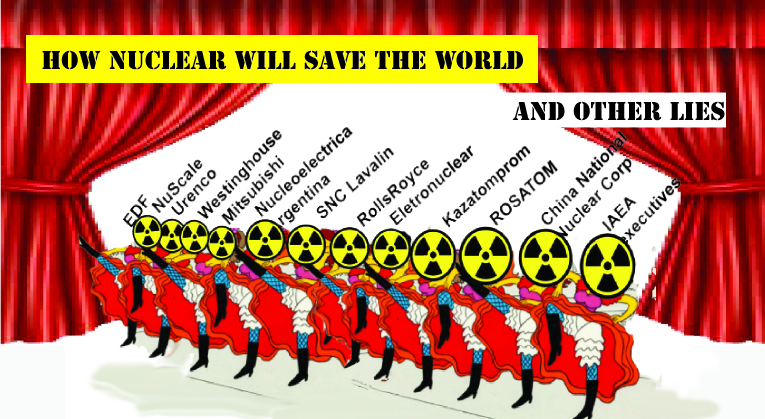
Global nuclear leaders unite in Vienna to create group for future advocacy of industry Power Engineering, 1 Oct 21, The heads of the International Atomic Energy Agency and more than a dozen industry leading firms are going to work more closely together on promoting the role of nuclear technology in dealing with major global challenges.
Those challenges include climate change, disease, hunger and more. Lofty goals, for certain, but the newly formed Group of Vienna believe that their industry is key to helping solve pressing issues worldwide.
IAEA Director General Rafael Mariano Grossi helped guide formation of the so-called Group of Vienna, which includes his agency’s chief executives and top leaders from 13 companies and utilizes in U.S., China, Russia, South America and Europe. They met in Vienna during the latest IAEA general conference……..
In addition to IAEA executives, the Group of Vienna includes founding members from China National Nuclear Corp., EDF, Eletronuclear, NA Kazatomprom, Mitsubishi Heavy Industries, Nucleoelectrica Argentina, NuScale Power, Rolls Royce SMR, ROSATOM, SNC-Lavalin Group, Urenco and Westinghouse Electric Co.
The high-level panel resolves to meet regulatory to discuss the latest developments in the nuclear field and how those contributions can factor into global challenges…..
New-build projects are extremely expensive to complete, such as the $27 billion Vogtle Unit 3-4 expansion in Georgia and the Hinkley Point C in the UK. https://www.power-eng.com/nuclear/global-nuclear-leaders-unite-in-vienna-to-create-group-for-future-advocacy-of-industry/
No, a nuclear-powered superyacht won’t save the world

Earth to CNN: No, a nuclear-powered superyacht won’t save the world, https://thebulletin.org/2021/09/earth-to-cnn-no-a-nuclear-powered-superyacht-wont-save-the-world/ By Dawn Stover | September 28, 2021 Who knew that a sexy nuclear superyacht could save us from climate catastrophe? That was the awesome news from CNN’s travel desk yesterday.
CNN wasn’t alone. Forbes, BBC Science Focus Magazine, and a host of other media outlets have previously hailed the world-rescuing potential of what CNN described as “an emissions-free megaship that will pit together climate scientists and the wealthy in a daring quest to save the planet.”
“Pit together” sounds like an apt description of a would-be merger between luxury tourism and climate action. You can put those two things together in a sentence, but in the real world they mix about as easily as oil and water.
And there’s another big problem with the plan for this overhyped 300-meter-long vessel and its global research: Earth 300, as the $700 million superyacht is called, will be powered by a molten salt nuclear reactor that doesn’t exist yet and won’t be certified for at least five years. The company’s website illustrates the reactor with a scale model of an experiment done in the 1960s at Oak Ridge National Laboratory.
The website also says the scientists onboard Earth 300 will have the world’s first ocean-going quantum computer. But that, too, has yet to be built.
Meanwhile, the climate crisis needs immediate attention. “We really are out of time,” UN Secretary-General António Guterres warned this month.
While they wait for a modular nuclear reactor that might never come, the developers of Earth 300 say they will use green synthetic fuels. These are liquid fuels derived from coal or natural gas in a process that captures carbon. However, they are much more expensive than fossil fuels. Aaron Olivera, the entrepreneur behind Earth 300, told CNN he plans to “eventually” retrofit the yacht with a reactor being developed by the UK company Core Power in collaboration with TerraPower, a US nuclear engineering firm chaired by Bill Gates.
Globally, there are at least 171 motorized megayachts that are 75 meters (246 feet) or more in length. Jeff Bezos, the world’s richest man, is rumored to be buying a superyacht so big that it will have a dock for its own “support yacht.” Eclipse, an even bigger superyacht owned by Russian-Israeli billionaire businessman Roman Abramovich, has its own missile defense system. The largest yacht currently operating, Azzam, is 180 meters (590 feet) long and consumes 13 metric tons of fuel per hour at its top speed of 33 knots. That’s about 0.01 miles (or a little over 50 feet) per gallon.
And the customers Olivera would like to attract—the wealthiest people in the world—also tend to have the world’s largest carbon footprints, thanks in no small part to their habit of traveling aboard superyachts and private airplanes. According to calculations by two researchers at Indiana University, a superyacht with a permanent crew and helicopter pad is “by far the worst asset to own from an environmental standpoint.”
Earth 300’s luxury suites will each rent for $300,000 a day, which presumably will cover the personnel and expenses needed to operate the ship and its 22 scientific laboratories. But construction won’t begin until 2025 at the earliest, and any groundbreaking scientific discoveries or billionaire epiphanies that could help stabilize the climate are even further into the future.
Construction is already delayed on another 600-foot-long yacht that will combine climate research with charters for paying customers. Financed by Kjell Inge Røkke, a Norwegian billionaire who made his fortune in fishing and oil drilling, REV Ocean will investigate climate change and ocean acidification, plastic pollution, and overfishing, but the nonprofit project is at least three years behind schedule.
Who will be aboard these superyachts? CNN asked Olivera which famous people he’d like to host on his future ship, and he named Elon Musk, Michelle Obama, Greta Thunberg, Naomi Klein and Yvon Chouinard. Like the superyacht itself, some of those potential guests seem more aspirational than realistic.
Greta Thunberg doesn’t take airplanes or motor yachts. Elon Musk doesn’t take vacations. And Bill Gates may be hurt that he’s not on the A-list.
With breathless enthusiasm, media applauds another nuclear lobby confidence trick – ”Earth 300”

Full of deceptive words and phrases – “clean” ”emissions-free” ”solutions to climate change” ”safe and sustainable atomic energy from a molten salt reactor” – journalists can hardly contain themselves as they regurgitate the propaganda from the nuclear lobby. Not so long ago, nuclear proponents were climate change deniers. Now they see that getting on the climate change bandwagon is their only chance to get taxpayers’ money, to fund their failing industry.
Tickets for this nuclear-powered superyacht will cost $3 million for VIPs and be free to scientists and students selected to help study climate change., Business Insider, APR 13, 2021,
The striking behemoth has been dubbed Earth 300‚ with a stated mission to carry out research expeditions in order to “confront earth’s greatest challenges,” according to Jefferson. Featuring naval architecture by NED, it spans an insane 984 feet—300 meters, hence the suffix—which makes it even longer than RMS Titanic (883 feet). The majority of that real estate has been dedicated to scientific equipment and tech straight from Silicon Valley.
The vessel will reportedly be powered by nuclear tech known as molten salt reactors (MSRs). ……he project has gained a number of partners, including IBM, RINA, Triton Submarines and EYOS Expeditions. Iddes anticipates Earth 300 will launch in 2025,- Robb Report 14 Apr 21,
Australia the sucker for cash-strapped U.S, and U.K submarine companies General Dynamics and BAE Systems

UK Prime Minister Boris Johnson is close to BAE, the UK defence contractor whose nuclear subs program is struggling. The submarine program in the US too is foundering, so the game plan by our AUKUS partners is to rope in the dopey Aussies for a hundred billion dollars-plus to finance their distressed submarine sectors.
Both US submarine builder General Dynamics and its British counterpart BAE are looking for a new income stream from Downunder.
$66 Billion Reasons: did Scott Morrison get the French submarines right? By Michael West| September 30, 2021 ….. Michael West investigates the awkward AUKUS alliance and whether Scott Morrison made the right call on French submarines.As if ……….being dead last in the developed world on climate action , Scott Morrison and his Coalition have now burnished their reputation for incompetence on the global stage.
In one fell swoop, the sudden AUKUS declaration, they have achieved a stunning betrayal of the French, further peeved our biggest trading partner China, upset half of Europe, shown the bird to New Zealand and our neighbours in the Asian region, and waved an open cheque-book at the US and the UK military industrial complex.
Yet, in their ardour to crawl back to the Mother Country and bat their debutante eyes at Washington, they appear to have got something right: axing the French submarines. Are our self-described band of “Superior Economic Managers” accidental heroes, or did they mean to get it right?
If they double down and splash $100b plus on nuclear submarines, they will have got it doubly wrong.
Defence correspondent Michelle Fahy has documented here the $90b shocker which is Australia’s deal with French shipbuilder Naval Group. Naval itself has an ugly history of corruption and there are serious questions about how the deal came about in the first place, indeed serious questions about the billions in public money smoked every year in Defence procurement.
Murder, corruption, bombings – the company at centre of Australia’s submarine deal
The arms company at the centre of a deadly criminal saga and numerous global corruption scandals, Naval Group, was selected by the Australian government to build our new fleet of submarines – a deal heralded as ‘one of the world’s most lucrative defence contracts’. How did this happen? In this special investigation Michelle Fahy discovers significant gaps in anti-bribery and corruption measures.
Yet there is upside. Scott Morrison and co have junked a deal which would have delivered a fleet of expensive, obsolete submarines 20 years too late for the war which the government’s champions in the media keep telling us we might have to fight against China. Even though a war with China is nothing more than a grotesque proposition, scaremongering by the weapons lobby and media to distract from corruption and mismanagement at home. Media war porn.
The same might be said of the F-35 Strike Fighter debacle and the BAE frigates scandal. Every large defence procurement is marred by billions of dollars in waste. But here’s the thing with the subs; there is a solid body of work which suggests submarines are already obsolete, nuclear or not. They can be tracked; they are a titanic waste of money.
The National Security College (Federal Government and ANU) published a working paper in May 2020 saying nuclear powered ballistic missile submarines will be detectable at sea.
Meanwhile, the French are complaining we owe them $US66 billion for reneging on the deal with Naval. That’s an ambit claim, to be sure. It might cost the government $5b-$10b all up, some already sunk, the rest to stave off an embarrassing court action; but the result so far is: one, no obsolete subs deal with the French, and two, only a mooted nuclear subs deal with the Brits and Americans which may never happen. Hopefully.
UK Prime Minister Boris Johnson is close to BAE, the UK defence contractor whose nuclear subs program is struggling. The submarine program in the US too is foundering, so the game plan by our AUKUS partners is to rope in the dopey Aussies for a hundred billion dollars-plus to finance their distressed submarine sectors.
The doctrine of the gullible Aussie is getting airplay in the US press. According to war contractor expert Charles Tiefer in Forbes:
“Under the cloud of smoke around the Australian submarine deal, are the unspoken aspects of the enrichment of American military contractors. There is no public mention of which American contractors will build the expensive parts of the expensive Australian submarines.”
Both US submarine builder General Dynamics and its British counterpart BAE are looking for a new income stream from Downunder.
Should the Coalition stay true to its track record of dithering though, it may soon become evident that submarines in general are a leviathan waste of money and public money ought to be expended on something less wasteful.
Scott Morrison might, unwittingly, have got it right. He might not have to spend much on submarines at all. The question then becomes, what has he got us into?
Back to the future
As three former prime ministers in Paul Keating, Malcolm Turnbull and Kevin Rudd have already pointed out, AUKUS puts Australians in greater danger, renders Australia a vassal to foreign power and antagonises our neighbours in the region.
Depending on how you count them, there are probably already four US bases in operation now:
- Pine Gap near Alice Springs, Northern Territory,
- Naval Communication Station Harold E. Holt, north of the town of Exmouth, Western Australia,
- Robertson Barracks in Darwin, Northern Territory,
- Australian Defence Satellite Communications Station near Geraldton, WA.
However, the US military already has access to all major Australian Defence Force (ADF) training areas, northern Australian RAAF airfields, port facilities in Darwin and Fremantle, and probably future access too to an expanded Stirling naval base in Pe
Under AUKUS, this may just be the beginning. It was largely ignored during the AUKUS media blitz and the dramatic cuckolding of the French but Peter Dutton had this to say at his press conference on September 16,
Unveiling plans for new facilities on Australian soil for US naval, air, and ground forces would entail “combined logistics, sustainment, and capability for maintenance to support our enhanced activities, including … for our submarines and surface combatants”. That is on top of “rotational deployments of all types of US military aircraft to Australia”.
If the plan is to shred Australia’s sovereignty and make us a target for China, he is succeeding with aplomb. We are about to be swamped by US military.
Forward to the past
It is poetic too, that at this very time we are striking even stronger and even more unnecessary ties with Westminster and Washington. Boris Johnson’s government is beset by the chaos which is Brexit, such chaos now that it has spawned a global energy emergency. While the EU has the wobbles on its trade deal with Australia, Boris is in the market for a friend.
It is poetic too, that at this very time we are striking even stronger and even more unnecessary ties with Westminster and Washington. Boris Johnson’s government is beset by the chaos which is Brexit, such chaos now that it has spawned a global energy emergency. While the EU has the wobbles on its trade deal with Australia, Boris is in the market for a friend………… https://www.michaelwest.com.au/aukus-french-submarines-scott-morrison/
25 September Protest against UK university’s Nuclear Futures Institute, as nuclear suffers a new setback

DANGER – NUCLEAR COLLEGE! News / By Stop Wylfa 23 Sep 21,
Members and supporters will meet at Bangor Town Clock on the High Street at 1.45 Saturday afternoon, September 25 before moving ahead to Pontio to hold an artistic and symbolic protest against Bangor University’s Nuclear Futures Institute.
Nuclear power’s crebibility has suffered another setback this week from the direction of the first chairman of the Climate Change Committee, Lord Turner. A prominent businessman and ex-chairman of the Financial Services Authority and the Pensions Commission, Lord Turner said he has changed his mind about nuclear power, saying it is no longer needed.
Today, Thursday Serptember 23, the Ser Cymru professor for Nuclear Policy and Regulation at Bangor University, Laurence Williams OBE will present evidence to the Welsh Affairs Committee at Westminster regarding the Wylfa site alongside a number of other individuals who are members of the “nuclear village”. This is a totally onesided and undemocratic session which does not consider any anti-nuclear views. The Committee should convene another session to include campaigning movements such as PAWB, CND Cymru and Greenpeace. it would also be a simple matter to invite Lord Turner to explain his new position on nuclear power.
Already the ”nuclear for climate for COP26 ” deceitful propaganda is underway, with a ”clean energy certificate”

The scheme provides an accreditation system based on internationally recognised standards and lays the foundations for a market for trading renewable and nuclear energy attributes.
Abu Dhabi launches clean energy certificate scheme, WNN, 22 September 2021
The Abu Dhabi Department of Energy (DoE) has issued a regulatory policy for implementing a clean energy certificates scheme it says will cater to a growing appetite among businesses and consumers to contribute to the fight against climate change. The scheme provides an accreditation system based on internationally recognised standards and lays the foundations for a market for trading renewable and nuclear energy attributes.
The Regulatory Policy for Clean Energy Certificates, which was announced by the department on 29 August, is part of its commitment to drive the transition to a sustainable decarbonised energy sector. ……………………….. https://world-nuclear-news.org/Articles/Abu-Dhabi-launches-clean-energy-certificate-scheme
Vested interests — controlling the news about nuclear safety

Who controls the truth about a nuclear disaster?
The end of the monopoly of these experts would allow a proper debate on the risks of nuclear energy. At a time when many voices are speaking out in favor of the development of atomic energy as the lesser evil in the face of climate change, such a debate is urgent.
How monolithic institutions decide what is safe for the rest of us, Beyond Nuclear, By Christine Fassert and Tatiana Kasperski, 12 Sept 21,
In December 2020, twenty years after the final closure of the Chernobyl nuclear power plant, the Ministry of Culture of Ukraine announced its intention to prepare an application to include certain objects in the exclusion zone around Chernobyl in the UNESCO World Heritage List….
The Chernobyl site would symbolize the long history of accidents that have marked the atomic age, from Kychtym and Windscale (1957), to Three Mile Island (1979) and Fukushima (2011), whose tenth anniversary we commemorated this year.
Moreover, the Chernobyl accident constitutes a particular moment in this history, namely the beginning of the institutionalization of the international management of the consequences of nuclear accidents, whose impact became fully apparent at the time of the Fukushima accident.
A small group of organizations
If the origins of accidents are most often explained by factors related to the development of the nuclear industry and its regulatory bodies at the national level, the “management” of their consequences gradually extends beyond national borders
In this respect, Chernobyl established the monopolization of the authoritative knowledge of ionizing radiation by a small group of organizations — the International Atomic Energy Agency (IAEA), the International Commission on Radiological Protection (ICRP) and the United Nations Scientific Committee on the Effects of Atomic Radiation (UNSCEAR).
Through a series of alliances and co-options, these organizations formed a monolithic bloc on the issue of radiological risk.
Relegated to a militant marginality
From that moment on, divergent points of view were de-legitimized and relegated to a form of militant marginality. These included the positions of such individuals as “dissident” scientist Keith Baverstock who directed the radiation protection program at the World Health Organization’s Regional Office for Europe, and those of such organizations as the International Association of Physicians for the Prevention of Nuclear War (IPPNW).
This monopoly translates into an internationalization of accident management that relies on a series of tools designed to establish a “normalization” of the post accident situation through the depoliticization of the management of risks related to radioactive fallout. They enshrine the power of experts close to international nuclear organizations to determine what sacrifices in terms of health and the environment are acceptable.
As physicists Bella and Roger Belbéoch point out:
“Far from calling into question the power they have secured for themselves in society, the nuclear disaster allows them to constitute themselves into a unified international body with even greater powers. It is at the moment when the scientific experts can no longer promise anything other than disaster management that their power inevitably takes hold.”
Fukushima
This monopoly over knowledge and management of an accident was very much present in Japan in 2011, when the Japanese authorities put in place measures, which, by largely referring to international standards, warded off objections: the accident was dealt with by the experts.
However, a shift occurred in this monopoly when a UN rapporteur, Anand Grover, severely criticized Tokyo’s management of the disaster.
At the same time, new conceptual tools proposed by the social sciences, such as the “production of ignorance”, offer a framework for analysis that makes it possible to extend the criticisms beyond the domain of a purely expert debate, opening the way to a re-politicization of the accident and its consequences.
Making nuclear accidents manageable
But, first of all, how can you make a nuclear accident manageable when, as was the case at Chernobyl and Fukushima, it causes very large releases of radioactive particles, spreading around the globe and causing long-term contamination of tens of thousands of square kilometers?
Hundreds of thousands of people have been evacuated or relocated from these territories, and hundreds of thousands of others continue to live in an environment affected by radioactivity.
Zoning, that is, the division of these territories into several “zones” according to the density of contamination and the necessary protective measures, was the first instrument that made it possible, in Japan and in the former Soviet Union, to make the accident manageable……
This zoning mechanism set up by the Japanese government is part of a regulatory framework established by the two major international nuclear institutions, the IAEA and the ICRP. The ICRP sets the dose limit for the public at 1 millisievert (mSv)/year. Since 2007, the ICRP has authorized government authorities to raise this threshold (from 1 to 20 mSv/year) in the case of a nuclear accident.
When the Japanese authorities, like the Soviet authorities in 1986, chose to raise the threshold following the accident, they justified it in terms of the virtual absence of any health risks.
The radiological threshold
The mechanism is based in particular on the choice of a radiological threshold from which the population will be evacuated.
In Japan, government officials consider that the risk of developing cancer from exposure to a dose of 100mSv or less is so low according to “the international (scientific) consensus, (that) it is made undetectable by the carcinogenic effects of other factors.”
Limiting evacuations and compensations
The sociologist and historian of science Sezin Topçu shows how this zoning mechanism, which has become an indispensable element of nuclear accident management, is above all a way of limiting evacuation and compensation for damage caused by an accident, since its costs (economic, political or social) would be prohibitive for the nuclear industry and the State.
This optimization approach is also enshrined at the international level in the recommendations issued by the IAEA and the ICRP.
For example, in the case of Japan, the threshold of 20 mSv/year appears to have been chosen in part to avoid evacuating the Naka Dori region and its major cities: the established zone borders made it possible to exclude such cities in the center of the prefecture, including Fukushima, from evacuation orders…………………………..
Mechanisms of ignorance production
More recently, however, various social scientists have proposed an analysis of the promotion of a reassuring stance on these dangers as part of the mechanisms of ignorance production.
The production of ignorance, which can be both involuntary and intentional, was initially studied for a number of risks, such as tobacco.
Approaching radiological risks in terms of the production of ignorance makes it possible to break with the “exceptionalism” with which the nuclear issue has long been associated, and to consider the dangers of ionizing radiation within the broader field of health risks and its banal issues of power.
Minimizing gravity
The internationalized management of nuclear disasters is in fact based on various mechanisms of ignorance production. For instance, the sociologist of science, Olga Kuchinskaya,- describes the “politics of invisibility” that were adopted after the Chernobyl disaster.
She points out that the public visibility of the effects of ionizing radiation depends on the existence of material infrastructures – such as measuring devices, information systems and equipment — but also institutional infrastructures (for example, following a cohort of people in order to make health effects visible depends on this articulation between material and institutional elements).
This infrastructure is very costly and, in the case of Chernobyl, has not been maintained over time. Moreover, the assessment of the effects of radiation was essentially taken care of by international institutions, while local doctors and researchers, for their part, revealed a completely different and much more alarming picture of the health situation.
Kate Brown describes how various international bodies, primarily the IAEA and WHO, worked to redefine the health effects of Chernobyl, to minimize their severity, and thus actively to produce “ignorance” about the impact of the disaster.
This non-knowledge was in fact a crucial instrument that made the disaster “manageable” and allowed, as Adriana Petryna points out, “the deployment of authoritative knowledge, especially when applied to the management of the exposed population”.
The monopoly of international experts, until when?
By addressing the “exceptional” character of nuclear energy and ionizing radiation, these criticisms, whether they are made within UN bodies or by social science researchers, open the way to questioning the monopoly of international nuclear institutions in assessing radiological risk and framing so-called “post-accident” policies.
A re-politicization of the management of accident consequences that brings the “management” of a nuclear accident into the broader framework of human rights therefore becomes possible.
When the next nuclear accident occurs, it is not a given that citizens will accept the “inevitability” of the power of international experts to decide, on their behalf, what constitutes an acceptable risk.
The end of the monopoly of these experts would allow a proper debate on the risks of nuclear energy. At a time when many voices are speaking out in favor of the development of atomic energy as the lesser evil in the face of climate change, such a debate is urgent.
This article was first published in The Conversation in French on April 26, 2021, as well as on Beyond Nuclear International. English translation provided by the authors.
Christine Fassert is a social anthropologist at Université Paris 1 Panthéon-Sorbonne. Tatiana Kasperski is a research associate– Department of Humanities at Universitat Pompeu Fabra https://beyondnuclearinternational.org/2021/09/12/vested-interests/
1 This Month
Chernobyl: The Lost Tapes – A good documentary on Chernobyl on SBS available On Demand for the next 3 weeks– https://www.sbs.com.au/ondemand/tv-program/chernobyl-the-lost-tapes/2352741955560

of the week–London Campaign for Nuclear Disarmament

Tell the Ukrainian Government to Drop Prosecution of Peace Activist Yurii Sheliazhenko
To see nuclear-related stories in greater depth and intensity – go to https://nuclearinformation.wordpress.com
-
Archives
- April 2026 (126)
- March 2026 (251)
- February 2026 (268)
- January 2026 (308)
- December 2025 (358)
- November 2025 (359)
- October 2025 (376)
- September 2025 (257)
- August 2025 (319)
- July 2025 (230)
- June 2025 (348)
- May 2025 (261)
-
Categories
- 1
- 1 NUCLEAR ISSUES
- business and costs
- climate change
- culture and arts
- ENERGY
- environment
- health
- history
- indigenous issues
- Legal
- marketing of nuclear
- media
- opposition to nuclear
- PERSONAL STORIES
- politics
- politics international
- Religion and ethics
- safety
- secrets,lies and civil liberties
- spinbuster
- technology
- Uranium
- wastes
- weapons and war
- Women
- 2 WORLD
- ACTION
- AFRICA
- Atrocities
- AUSTRALIA
- Christina's notes
- Christina's themes
- culture and arts
- Events
- Fuk 2022
- Fuk 2023
- Fukushima 2017
- Fukushima 2018
- fukushima 2019
- Fukushima 2020
- Fukushima 2021
- general
- global warming
- Humour (God we need it)
- Nuclear
- RARE EARTHS
- Reference
- resources – print
- Resources -audiovicual
- Weekly Newsletter
- World
- World Nuclear
- YouTube
-
RSS
Entries RSS
Comments RSS
 nuclear-news