The nuclear lobby continues to buy universities- University of Wyoming well and truly bought.

University of Wyoming Receives Faculty Advancement Grant From Nuclear Regulatory Commission
UW, April 21, 2023
The U.S. Nuclear Regulatory Commission’s (NRC) Office of Nuclear Regulatory Research recently announced the University of Wyoming has been selected for a Faculty Development Advancement Award as part of the NRC’s University Nuclear Leadership Program.
The award was announced in person by Commissioner Annie Caputo and Raymond Furstenau, director of the Office of Nuclear Regulatory Research from the NRC, at UW’s Research Explorations for Nuclear Energy in Wyoming (RENEW) event April 14.
“We are pleased to welcome the University of Wyoming as a NRC University Nuclear Leadership Program grant recipient,” Furstenau says. “The university’s proposal is exactly the type of activity we were aiming for with this grant program.”
The $600,000 award is intended to support new faculty in the nuclear-related fields of nuclear engineering, health physics and radiochemistry, and it advances the NRC’s goal of focusing on university-led projects that complement current and future research needs.
UW’s School of Energy Resources (SER) will augment the funding with an additional $100,000……………………… https://www.uwyo.edu/uw/news/2023/04/uw-receives-faculty-advancement-grant-from-nuclear-regulatory-commission.html
Pentagon fake news about Chinese fast breeder reactors
Assistant Secretary of Defense John Plumb knew better when characterizing Russia-China reactor cooperation as a nuclear weapon threat
Asia Times, By JONATHAN TENNENBAUM, APRIL 3, 2023
The US Department of Defense and numerous private commentators allege that Russian-Chinese cooperation on fast breeder reactors will provide plutonium for large numbers of Chinese nuclear weapons. Assistant Secretary of Defense John Plumb told Congressional hearings on March 8:
“It’s very troubling to see Russia and China cooperating on this. They may have talking points around it, but there’s no getting around the fact that breeder reactors are plutonium, and plutonium is for weapons. So I think the [Defense] Department is concerned. And of course, it matches our concerns about China’s increased expansion of its nuclear forces as well, because you need more plutonium for more weapons.”
The Pentagon knows better than this. Anyone conversant with fast breeder reactor technology is aware that the type of plutonium that can be produced in such reactors is much less suitable for nuclear weapons than the plutonium produced in other reactor types, whose design and construction China has long mastered.
It is therefore nonsensical to charge that the main goal of the Chinese fast breeder program is weapons-related. Rather, the motivation for the program is consistent with that of other nations that have pursued fast breeder reactor designs, including greater efficiency in the utilization of nuclear fuel, reduction in the amount and toxicity of nuclear waste and greater independence from outside fuel supplies.
Here are the details, point by point. They speak for themselves:………………………………………………………………………………… more https://asiatimes.com/2023/04/pentagon-fake-news-about-chinese-fast-breeder-reactors/
ARMY PUTTING ‘OUTRAGEOUS SPIN’ ON DEPLETED URANIUM SCIENCE

Scientist cited by British military to justify sending depleted uranium shells to Ukraine had previously criticised use of such ammunition in Iraq.
DECLASSIFIED UK, PHIL MILLER, 28 MARCH 2023
- Sole body cited by UK military to defend Ukraine receiving depleted uranium weapons has not published new research on the subject for over 20 years
- Italy’s defence ministry has compensated soldiers who developed cancer after exposure to depleted uranium on service in the Balkans
- After the invasion of Iraq, the UK military accepted it had a ‘moral obligation’ to help clear depleted uranium debris from the rounds it had fired.
The Ministry of Defence claimed last week that research by the Royal Society – Britain’s premier scientific group – supported its controversial decision to send depleted uranium tank shells to Ukraine.
An MoD official briefed the media: “Independent research by scientists from groups such as the Royal Society has assessed that any impact to personal health and the environment from the use of depleted uranium munitions is likely to be low.”
The Royal Society was cited despite the group rebuking the Pentagon in 2003 for using their exact same research to justify American tanks firing the weapon in Iraq, Declassified UK has found.
When contacted, the scientific body told us: “In 2001/02, the Royal Society published two reports on the health hazards of depleted uranium munitions.” It provided links for the first and second report.
Their spokesperson added that depleted uranium “isn’t an active area of policy research for the Society, [and] we haven’t updated or published on this topic since those reports.”
In 2003, the US military used those Royal Society reports to defend the use of depleted uranium (DU) by coalition forces in Iraq.
That triggered a complaint to the media, with the Guardian saying the Royal Society was “incensed because the Pentagon had claimed it had the backing of the society in saying DU was not dangerous.
“In fact, the society said, both soldiers and civilians were in short and long term danger. Children playing at contaminated sites were particularly at risk.”
The chairman of the Royal Society’s working group on depleted uranium, Professor Brian Spratt, was quoted as warning that “a small number of soldiers might suffer kidney damage and an increased risk of lung cancer if substantial amounts of depleted uranium are breathed in, for instance inside an armoured vehicle hit by a depleted uranium penetrator.”
“In addition, large numbers of corroding depleted uranium penetrators embedded in the ground might pose a long-term threat if the uranium leaches into water supplies.”
He recommended that fragments from depleted uranium shells should be cleared up and long-term sampling of water supplies needed to be conducted.
Spratt also countered claims about the safety of depleted uranium made by the UK’s then defence secretary Geoff Hoon, stressing: “It is is highly unsatisfactory to deploy a large amount of material that is weakly radioactive and chemically toxic without knowing how much soldiers and civilians have been exposed to it.”
………………………………………….. Shells containing more than 2.3 tonnes of depleted uranium were fired by British forces in operations against Iraq in 1991 and 2003.
US troops fired far larger quantities, especially around the city of Fallujah, where it has been blamed for birth defects and a spike in cancer cases.
Contamination
The ammunition was also used by NATO on operations in Bosnia, Serbia, Montenegro and Kosovo during the breakup of Yugoslavia.
Italian soldiers who developed cancer after serving on those missions in the Balkans have successfully sued their defence ministry for compensation. Serbians have attempted similar litigation against NATO.
A study conducted in Kosovo by the UN Environment Programme (UNEP) shortly after that conflict ended found “only low levels of radioactivity”.
However, they were not able to consider the long term consequences and only inspected 11 out of 112 sites where DU had been fired.
A later UNEP study in Serbia did find more significant corrosion of DU shells and that many of them were lodged deep in the ground.
A subsequent report by the UN in Bosnia found drinking water had been contaminated, albeit at low levels…………………………………………….. more https://declassifieduk.org/exclusive-army-putting-outrageous-spin-on-depleted-uranium-science/
Welsh anti-nuclear groups warn on the nuclear lobbyists behind the new Freeport bid for Anglesea.
Anti-nuclear activists are ringing warning bells that this week’s
announcement of a new Freeport for Anglesey represents a way in for
unwanted new nuclear developments on the island, with at least six backers
of the bid having direct connections to the industry.
Named amongst the sponsors of the Freeport bid are leading nuclear industry businesses,
Assystem, Bechtel, Last Energy, Molten Flex, Rolls-Royce SMR, and New Cleo,
all of which are vying to develop and locate new nuclear power plants at
the Wylfa site on the island and elsewhere in the UK.
All are competing for
public attention and public funds by issuing media releases that frequently
make outrageous claims to be on the verge of making a UK-wide product
roll-out.
Yet most of their nuclear power plant designs being (as yet)
unproven, unauthorised, and unbuilt so-called Small Modular Reactors.
Other members of the Freeport consortia include Bangor University, with its
Nuclear Future Institute; M-Sparc, with its connections to the University’s
nuclear department; and the Association of North and Mid-Wales Councils,
which include unabashed nuclear enthusiasts, Ynys Mon and Gwynedd Councils.
Six Welsh anti-nuclear groups – CADNO, CND Cymru, Cymdeithas yr iaith (the
Welsh Language Society), PAWB (Pobl Atal Wylfa B / People against Wylfa-B),
WANA (The Welsh Anti-Nuclear Alliance) and the Welsh NFLA (Nuclear Free
Local Authorities) met in Caernarfon, Gwynedd in July 2022 and signed a
Declaration pledging their opposition to new nuclear power plants and to
fight for a green and sustainable future for Wales.
These Welsh
anti-nuclear campaigners are concerned about the lack of transparency and
public engagement about the extensive involvement of nuclear players in the
Freeport bid and are terribly disappointed that, aside from one marine
energy business, there are not more genuinely green energy producers in the
mix.
NFLA 3rd April 2023
Small Modular Nuclear Reactors may not be the holy grail for energy security, net zero
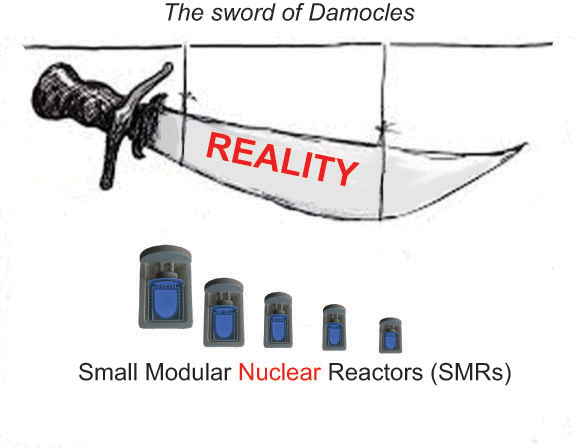
So, if SMRs are the current political flavour of the month, how have we reached this position when there is still no formal approval of the technology from regulators, let alone practical evidence of how it can operate in the real world?
It’s possible to achieve both energy security and the UK’s climate goals without blowing the budget on next-gen nuclear technologies, according to Andrew Warren.
Andrew Warren, Chairman of the British Energy Efficiency Federation. https://electricalreview.co.uk/2023/03/29/smrs-may-not-be-the-holy-grail-for-energy-security-net-zero/
Electrical Review covered in-depth the array of announcements that were made during the Spring Budget, but there was arguably one announcement above all that was most pertinent to the net zero drive. That was when Chancellor Jeremy Hunt reconfirmed – for the fifth time – that the Government intends to create a new Great British Nuclear agency.

It is a name that of itself may bring comfort to all those living on the nuclear-free island of Ireland.
So what will this agency do? Well, the Chancellor explained that, when launched, it will run a competition this year for the UK’s first Small Modular Reactor (SMR). The plan is for it to eventually award £1 billion in co-funding to a winner to build out an SMR plan.
This competition has some distinct echoes. Back in March 2016, the Government launched a competition to identify the best value SMR design for the UK. To the best of my knowledge, nobody has ever claimed that prize, of £250 million.
This re-announcement prompted me to consider the background to this Budget announcement.
It comes at a time in which private sector funding for larger nuclear power stations is proving to be extremely difficult. There is a lengthy list of large pension funds that have publicly refused to get involved with providing capital for the hapless Sizewell C pressurised water reactor project in Suffolk. Meanwhile, European Commission President Ursula von der Leyen is rumoured to be promoting the inclusion of SMRs within the European green investment taxonomy, whilst simultaneously excluding pressurised water reactors which make up most of the existing nuclear fleet.
So, if SMRs are the current political flavour of the month, how have we reached this position when there is still no formal approval of the technology from regulators, let alone practical evidence of how it can operate in the real world?

In January, the UK Government announced that six SMR vendors had applied for their designs to be formally assessed with a view to commercialisation in Britain. The companies have joined a much publicised Rolls-Royce-led consortium and will be subjected to an assessment process carried out by the UK’s Office of Nuclear Regulation (ONR), which will look in exhaustive detail at reactor designs proposed for construction.
Designs that successfully complete the Generic Design Assessment (GDA) – which is expected to take between four and five years – will then be ready to be built anywhere in the country, subject to meeting site-specific requirements.
Why do we need new reactor designs?
Recent results of orders placed for larger nukes are uniformly poor, with reactors invariably late and over budget. Some of the worst cases, notorious projects in Olkiluoto, Finland and Flamanville, France, have seen construction periods of 18 years and costs of three to four times above the expected level.

So, SMRs are being increasingly seen as the new saviours for the nuclear industry. This category embodies a range of technologies, uses and sizes, but relies heavily on features that were the selling points for larger designs. They are smaller than current stations which produce 1,200MW to 1,700MW of electricity. Instead, sizes range from 3MW to about 500MW. The Rolls-Royce design is a 470MW pressurised water reactor, which is bigger than one of the reactors at Fukushima in Japan that suffered serious damage in the 2011 tsunami.
These advanced designs are not new – sodium-cooled fast reactors and high temperature reactors were built as prototypes in the 1950s and 1960s – but successive attempts to build demonstration plants have been short-lived failures. It is hard to see why these technologies should now succeed given their poor record.
A particular usage envisaged for some of the technologies is production of hydrogen. However, as Professor Stephen Thomas of Greenwich University recently pointed out to me, to produce hydrogen efficiently, reactors would need to provide heat at 900°C. This, he said, is “a temperature not yet achieved in any power reactor, not feasible for a pressurised water reactor or boiling water reactor and one that will require new exotic and expensive materials.”
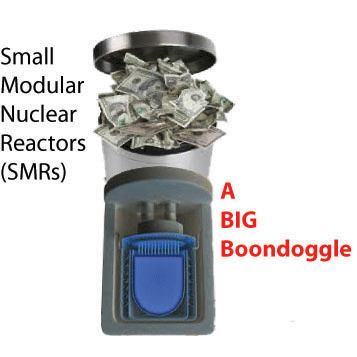
Developers of SMRs like to give the impression that their designs are ready to build, the technology proven, the economic case established and all that is holding them back is Government inactivity. However, taking a reactor design from conception to commercial availability is a lengthy and expensive process taking more than a decade and certainly costing more than £1 billion.
How can the economics of SMRs be tested?
The main claim for SMRs over their predecessors is that being smaller, they can be made in factories as modules using cheaper production line techniques, rather than one-off component fabrication methods being used at Hinkley Point C. The idea is that the module would be delivered to the site on a truck essentially as a ‘flatpack’. This would avoid much of the on-site work which is notoriously difficult to manage and a major cause of the delays and cost overruns that every European large reactor project suffers from.
However, any savings made from factory-built modules will have to compensate for the scale economies lost. A 1,600MW reactor is likely to be much cheaper than 10 reactors of 160MW.
And it will be expensive to test the claim that production line techniques will compensate for lost scale economies. The first reactor constructed will need to be built using production lines if the economics are to be tested. But once the production lines are switched on, they must be fed. Rolls-Royce assumes its production lines will produce two reactors per year and that costs will not reach the target level until about the fifth order. So, if we assume the first reactor takes five years to build, there will be another nine reactors in various stages of construction before a single unit of electricity has been generated from the first, and the viability of the design tested.
This could mean that perhaps about 15 SMRs will need to be under construction before the so-called ‘nth of a kind’ settled-down cost is demonstrated. But once the initial go ahead is given, there will be pressure on the Government to continue to place orders before the design is technically and economically proven, so the production lines do not sit idle.
Will SMRs be a major contributor to meeting the UK’s climate change targets?

The selling point for nuclear power is that it is a relatively low-carbon source of power that can replace fossil fuel electricity generation in the UK and elsewhere. However, by the time SMRs might be deployable in significant numbers, realistically after 2035, it will be too late for them to contribute to reducing greenhouse gas emissions. Electricity is acknowledged to be the easiest sector to decarbonise. If the whole economy is to reach net zero emissions by 2050, then this sector will have to reach that point long before then, probably by 2035. So SMRs appear to be too little, too late.

There is also a fear that SMRs will create more waste than conventional reactors, according to a study recently published in Proceedings of the American National Academy of Sciences. The research notes that SMRs would create far more radioactive waste, per unit of electricity they generate, than conventional reactors by a factor of up to 30. Some of these smaller reactors, with molten salt and sodium-cooled designs, are expected to create waste that needs to go through additional conditioning to make it safe to store in a repository.
And yet, despite the past failures of nuclear power and increasing public scepticism, there remains an appetite within the British Government to give the nuclear industry one more chance.
It remains to be seen whether the Government follows its instinct to continue supporting the sector or whether the amount of public money at risk makes such a decision politically impossible, given the massive underwriting these projects require by consumers and taxpayers.
Nuclear’s specious claims
The claims being made for SMRs will be familiar to long-time observers of the nuclear industry: costs will be dramatically reduced; construction times will be shortened; safety will be improved; there are no significant technical issues to solve; nuclear is an essential element to our energy mix.
In the past such claims have proved hopelessly over-optimistic and there is no reason to believe results would turn out differently this time. Indeed, the nuclear industry may well see itself in this ‘last-chance saloon’.
The risk is not so much that large numbers of SMRs will be built; it is my belief that they won’t be. The risk is that, as in all the previous failed nuclear revivals, the fruitless pursuit of SMRs will divert resources away from options that are cheaper, at least as effective, much less risky, and better able to contribute to energy security and environmental goals. Given the climate emergency we face, surely it is time to finally turn our backs on this failing technology.
Andrew Warren is a former special advisor to the House of Commons environment committee. Special thanks to Greenwich University’s Professor Stephen Thomas for his advice for this piece.
Elon Musk is remaking Twitter into a climate denier sanctuary
by ketanjoshi85 [very good graphs]
As I wrote recently here on my site, Elon Musk’s reputation as a ‘climate hero’ has been badly exaggerated. Every good thing he’s contributed to sits alongside a collection of actively counter-productive things. One of those things is killing a space that climate activists, communicators and experts used regularly – that is, Twitter. Still my core social media space, but a broken, burning one……………………………………………………………………….
The gradual rebirth of climate denier Twitter
It feels like something more fundamental in site dynamic has changed – particularly around which accounts and tweets get boosted and promoted.
I recently noticed that climate deniers, or climate delayers (who argue for no or slow climate action) have had massive increases in their followings, whereas pro-climate accounts have either lost followers, or gained very few of them. Musk has himself been cosying up with climate deniers, boosting, for instance, a conspiracy theory video from Australian climate denier and member of far-right xenophobic party One Nation, Senator Malcolm Roberts. “[Musk is] doing a marvellous job of rekindling freedom of speech,” Roberts told the SMH. “That alone is worthy of high praise.”
Berlin-based researcher Travis Brown has been tracking various changes at Twitter under Musk’s rule; particularly how the roll-out of the paid service ‘Twitter Blue’ has been going (I did an ad-hoc data snapshot of climate denial among Blue accounts, and…it’s bad). Being able to pay a tiny fee to simulate trustworthiness and get boosted into prominence in both algorithmic feeds and the sorting of replies on Twitter is invaluable for climate deniers.
It is, of course, very relevant given that Musk has just announced that the only tweets appearing in the algorithmic ‘For You’ feed will be those who’ve paid to subscribe to Twitter. Musk think he’s onto a solid grift here; offering prominence to those who are so deeply shit in their speech that they’ve failed to earn it.
Another recent analysis by ISD found that “fringe climate denialist websites have gained a foothold in online conversation with thousands of daily mentions on Twitter by highly followed climate-denying actors, pundits and outlets”. They also found that “some actors identified as ‘super-spreaders’ of climate misinformation by ISD and CAAD linked to the fringe websites”, including notorious denier accounts Patrick Moore, Steve Milloy and Peter Clack…………………………………………………………………..
Though my account selection method was somewhat ad-hoc, there’s basically no denying how significantly Musk-Twitter has caused a massive audience boost for climate deniers and delayers. To some degree, this had already kicked off around mid 2022, prior to Musk’s official purchase, but whatever dials Musk turned has accelerated this phenomenon significantly…………………………………………………………………
The change of ownership has had both direct and indirect influence in denier prominence on Twitter, accelerating this pre-existing problem. There’s been a general emboldening of the worst, most cruel right-wing accounts. There’s a spring in their step – their man is in the top job. And climate is a big focus for them.
A specific change to the algorithm to boost tweets ‘outside’ of one’s political sphere has resulted in far, far more eyeballs on right-wing content (in addition to being the core reason I get ferociously racist responses to innocuous things I post). And Twitter Blue subscriptions are helping grant legitimacy and prominence to the worst, pro-fossil deniers, as shown by journalist David Vetter. “As a platform, Twitter is now fully weaponized to undermine science, climate action and global sustainable development”, he wrote.
Some of the reason pro-climate accounts have lost followers has been people leaving Twitter. Musk has been publicly endorsing far-right and right-wing views,……………………………………………………………….. more https://ketanjoshi.co/2023/03/28/musk-is-remaking-twitter-into-a-climate-denier-sanctuary/
“Clean, clean, clean!”-says Canada’s budget – But still, nuclear power is still dirty

It is time to formally (and very publicly) demand an end, with public retraction, of the false and misleading use of the term “clean” when referring to nuclear energy on the part of provincial and federal levels of government as well as members of the nuclear industry and their advertising media (many articles we see are actually paid advertisements looking like news reports).
The nuclear energy generation’s constant production and release of Category 1 carcinogens and having perpetually poisonous wastes as byproducts completely disqualifies nuclear energy from being described as “clean”
Page 81:
“Budget 2023 announces that the Canada Infrastructure Bank will invest
at least $10 billion through its Clean Power priority area, and at least
$10 billion through its Green Infrastructure priority area. This will allow
the Canada Infrastructure Bank to invest at least $20 billion to support
the building of major clean electricity and clean growth infrastructure
projects. These investments will be sourced from existing resources.
These investments will position the Canada Infrastructure Bank as the
government’s primary financing tool for supporting clean electricity generation,
transmission, and storage projects, including for major projects such as the
Atlantic Loop.“
We’ve been focused on funds coming from the Strategic Innovation Fund (SIF) that has an $8 billion envelope and has been the main source of direct funding to SMR companies so far.
However it was the Canada Infrastructure Bank (CIB) that gave a $970 million “low interest loan” to Ontario Power Generation for its SMR last October.
So the CIB now has $20 billion to spend on ‘clean’ projects? OMG.
We know through an Access to Information request that Moltex made its sales pitch to the CIB and most probably others have been lining up at the CIB trough. Normally we would assume the CIB could not lend money to Moltex because it’s a startup with no funds of its own aside from previous public grants. But who knows? Now after the announcement a few hours before the budget that SNC Lavalin is a minority partner in Moltex, maybe they would qualify for a CIB “loan.” Follow the money, follow the money…..
To be continued, obviously…
the alarming news is that these fiscal incentives include “processing or recycling of nuclear fuels” which is currently not permitted in Canada. We are expecting the new radioactive waste management policy to be released in the next few days. If the policy has changed to allow plutonium reprocessing, it will be indicated there.
“Great British Nuclear” launch – an eccentric fraud by the UK government.

UK to finally harness full power of green energy with new Great British
Nuclear scheme. Jeremy Hunt has confirmed nuclear power will be classed as
“environmentally sustainable” in a bid to boost investment in the energy
sector. The Chancellor said today he would launch “Great British Nuclear”
to bring down costs.
Andy Stirling, Professor of Science and Technology
Policy at the Science Policy Research Unit at the University of Sussex,
told Express.co.uk: “Amid the complete eclipse of nuclear power by
renewables, the position being taken by the UK Government is now growing so
eccentrically flawed as to become a major investment-threatening risk in
its own right. “To characterise nuclear as ‘cheap’ is to completely forego
credibility.
This is even more so, if promises are relied on around a new
generation of military-derived ‘small modular reactors’ that are
currently undeveloped, untested, unlicensed, unpiloted, unsited and
unbuilt.
“The National Infrastructure Commission confirms that renewables
and storage offer much more affordable, effective and rapid zero carbon
alternatives than even the most attractive nuclear options. The track
record of nuclear and renewables accentuate this picture.
“By attaching such a strong priority to nuclear power, the UK Government is not only
jeopardising economic, secure clean energy. With other nations prioritising
renewables more strongly, the UK thereby continues to forego the full
domestic employment and industrial benefits of unique UK renewable
resources.”
Express 15th March 2023
https://www.express.co.uk/news/politics/1746665/energy-crisis-nuclear-jeremy-hunt-budget
“Atomic Bamboozle” Probes False Hopes for the Future of Nuclear Power
“Atomic Bamboozle” Probes False Hopes for the Future of Nuclear Power.
Portland documentarian Jan Haaken returns with another powerful and
provocative film. “Every tool in the toolbox.” Documentarian Jan Haaken
has heard recent proponents of nuclear power employ the phrase “like a
mantra” when discussing the fight against climate change.
Having made a two-part film about that planetary emergency (Necessity), Haaken
understands the fight. But not every tool is worth reaching for, posits her
new documentary, Atomic Bamboozle. Haaken, a professor emeritus of
psychology at Portland State University and director of documentaries about
abortion providers (Our Bodies Our Doctors), dairy farmers (Milk Men) and
drag queens (Queens of Heart), now explores what she calls a
“repackaging” of nuclear power in the form of small modular reactors,
or SMRs. Interviewing physicists, activists and conservationists, the
46-minute film portrays a nuclear industry rising quickly while downplaying
nuclear power’s most crucial and recurring issues—those unresolved and
unchanged by SMRs.
Willamette Week 7th March 2023
A SIX WAR MONGERING THINK TANKS AND THE MILITARY CONTRACTORS THAT FUND THEM
By Amanda Yee, Orinoco Tribune., March 12, 2023 https://popularresistance.org/six-war-mongering-think-tanks-and-the-military-contractors-that-fund-them/
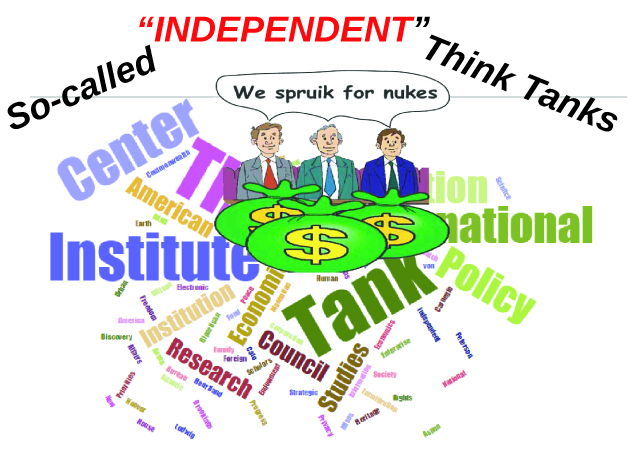
From producing reports and analysis for U.S. policy-makers, to enlisting representatives to write op-eds in corporate media, to providing talking heads for corporate media to interview and give quotes, think tanks play a fundamental role in shaping both U.S. foreign policy and public perception around that foreign policy. Leaders at top think tanks like the Atlantic Council and Hudson Institute have even been called upon to set focus priorities for the House Intelligence Committee. However, one look at the funding sources of the most influential think tanks reveals whose interests they really serve: that of the U.S. military and its defense contractors.
This ecosystem of overlapping networks of government institutions, think tanks, and defense contractors is where U.S. foreign policy is derived, and a revolving door exists among these three sectors. For example, before Biden-appointed head of the Pentagon Lloyd Austin took his current position, he sat on the Board of Directors at Raytheon. Before Austin’s appointment, current defense policy advisor Michèle Flournoy was also in the running for the position. Flournoy sat on the board of Booz Allen Hamilton, another major Pentagon defense contractor. These same defense contractors also work together with think tanks like the Center for Strategic and International Studies to organize conferences attended by national security officials.
On top of all this, since the end of the Cold War, intelligence analysis by the CIA and NSA has increasingly been contracted out to these same defense companies like BAE Systems and Lockheed Martin, among others — a major conflict of interest. In other words, these corporations are in the position to produce intelligence reports which raise the alarm on U.S. “enemy” nations so they can sell more military equipment!
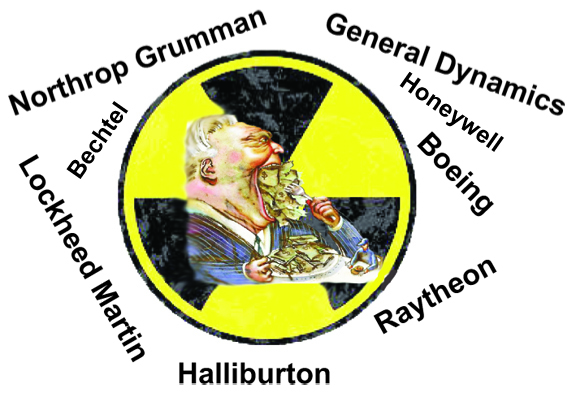
And of course these are the same defense companies that donate hundreds of thousands of dollars each year to think tanks. Given all this, is it any wonder the U.S. government is simultaneously flooding billions of dollars of weaponry into an unwinnable proxy war in Ukraine while escalating a Cold War into a potential military confrontation with China?
The funding to these policy institutes steers the U.S. foreign policy agenda. To give you a scope of how these contributions determine national security priorities, listed below are six of some of the most influential foreign policy think tanks, along with how much in contributions they’ve received from “defense” companies in the last year.
All funding information for these policy institutes was gathered from the most recent annual report that was available online. Also note that this list is compiled from those that make this information publicly available — many think tanks, such as the hawkish American Enterprise Institute, do not release donation sources publicly.
1 – Center for Strategic and International Studies
According to their 2020 annual report
$500,000+: Northrop Grumman Corporation
$200,000-$499,999: General Atomics (energy and defense corporation that manufactures Predator drones for the CIA), Lockheed Martin, SAIC (provides information technology services to U.S. military)
$100,000-$199,999: Bechtel, Boeing, Cummins (provides engines and generators for military equipment), General Dynamics, Hitachi (provides defense technology), Hanwha Group (South Korean aerospace and defense company), Huntington Ingalls Industries, Inc. (largest military shipbuilding company in the United States), Mitsubishi Corporation, Nippon Telegraph and Telephone Corporation (provides intelligence and information technology services to U.S. military), Qualcomm, Inc. (semiconductor company that produces microchips for the U.S. military), Raytheon, Samsung (provides security technology to the U.S. military), SK Group (defense technology company)
$65,000-$99,999: Hyundai Motor (produces weapons systems), Oracle
$35,000-$64,999: BAE Systems
2 – Center for a New American Security
From fiscal year 2021-2022
$500,000+: Northrop Grumman Corporation
$250,000-$499,999: Lockheed Martin
$100,000-$249,000: Huntington Ingalls Industries, Neal Blue (Chairman and CEO of General Atomics), Qualcomm, Inc., Raytheon, Boeing.
$50,000-$99,000: BAE Systems, Booz Allen Hamilton, Intel Corporation (provides aerospace and defense technology), Elbit Systems of America (aerospace and defense company), General Dynamics, Palantir Technologies
3 – Hudson Institute
According to their 2021 annual report
$100,000+: General Atomics, Linden Blue (co-owner and Vice Chairman of General Atomics), Neal Blue, Lockheed Martin, Northrop Grumman.
$50,000-$99,000: BAE Systems, Boeing, Mitsubishi Heavy Industries
The Comprehensive Crisis in the US and the Revolutionary Way Forward
4 – Atlantic Council
According to their 2021 annual report
$250,000-$499,000: Airbus, Neal Blue, SAAB (provides defense equipment)
$100,000-$249,000: Lockheed Martin, Raytheon
$50,000-$99,000: SAIC
5 – International Institute for Strategic Studies
Based in London. From fiscal year 2021-2022
£100,000+: Airbus, BAE Systems, Boeing, General Atomics, Lockheed Martin, Raytheon, Rolls Royce (provides military airplane engines)
£25,000-£99,999: Northrop Grumman Aerospace Systems, Northrop Grumman Corporation
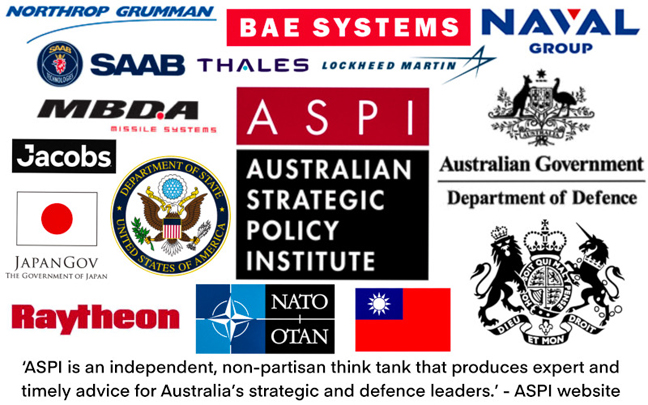
6 – Australian Strategic Policy Institute
Note: ASPI has been one of the primary purveyors of the “Uyghur genocide” narrative
From their 2021-2022 annual report
$186,800: Thales Australia (aerospace and defense corporation)
$100,181: Boeing Australia
$75,927: Lockheed Martin
$20,000: Omni Executive (aerospace and defense corporation)
$27,272: SAAB Australia
Lesson from Fukushima: Collusion in the nuclear domain
Nuclear power became an unstoppable force, immune to scrutiny by civil society. Its regulation was entrusted to the same government bureaucracy responsible for its promotion.”
Canada has not heeded these warnings. ……. The CNSC, mandated to protect the public and the environment, lobbied government to abolish full impact assessments for most “small modular nuclear reactors” (SMN
By Gordon Edwards & Susan O’Donnell | Opinion | March 13th 2023 https://www.nationalobserver.com/2023/03/13/opinion/lesson-fukushima-collusion-nuclear-domain
—
This month marks the 12th anniversary of the Fukushima disaster, when three nuclear reactors in Japan suffered catastrophic meltdowns.
A tsunami knocked out the reactors’ cooling systems. The plant was shut down, but radioactivity sent temperatures soaring past the melting point of steel.
Radioactive gases mingled with superheated steam and explosive hydrogen gas, which detonated, spreading radioactive contamination over a vast area; 120,000 people were evacuated and 30,000 are still unable to go home.
Radioactively contaminated water from the stricken reactors has accumulated in 1,000 gigantic steel tanks, and despite objections from China, Korea and local fishers, Japan plans to dump it into the Pacific Ocean soon.
What caused this catastrophe? Most people blame the tsunami. The commission of investigation in Japan concluded otherwise. In its report to the National Diet, the commission found the root cause was a lack of good governance.
The accident “was the result of collusion between the government, the regulators and TEPCO [the nuclear company], and the lack of governance by said parties. They effectively betrayed the nation’s right to be safe from nuclear accidents. Therefore, we conclude that the accident was clearly ‘man-made.’ We believe that the root causes were the organizational and regulatory systems that supported faulty rationales for decisions and actions…”
The commission chairman wrote: “What must be admitted — very painfully — is that this was a disaster ‘made in Japan.’ Its fundamental causes are to be found in the ingrained conventions of Japanese culture: our reflexive obedience; our reluctance to question authority; our devotion to ‘sticking with the program’; our groupism; and our insularity… Nuclear power became an unstoppable force, immune to scrutiny by civil society. Its regulation was entrusted to the same government bureaucracy responsible for its promotion.”
Canada has not heeded these warnings. After Justin Trudeau was elected in 2015, his government did away with environmental assessments for any new reactors below a certain size, thus eliminating scrutiny by civil society. This leaves all decision-making in the hands of the Canadian Nuclear Safety Commission (CNSC) — an agency previously identified by an expert review panel as a captured regulator.
The CNSC, mandated to protect the public and the environment, lobbied government to abolish full impact assessments for most “small modular nuclear reactors” (SMNRs).
Back in 2011, in the midst of the media frenzy about the triple meltdown, Canadians were testifying at federal environmental assessment hearings for up to four large nuclear reactors to be built by Ontario Power Generation (OPG) at Darlington, about 50 kilometres east of Toronto’s edge. The Fukushima disaster was cited repeatedly as a warning.
The panel approved OPG’s plan, but the Ontario government was thunderstruck by the price tag, reputed to be over $14 billion per unit, and cancelled the project.
Now OPG wants to build a smaller reactor at the Darlington site. Since a full impact assessment has been ruled out, CNSC is using the report from 12 years ago as the basis for public interventions. The reactor now proposed (the BWRX-300) has no similarity to any of the reactors that were under consideration then or to any operating today in Canada. Ironically, it is a “miniaturized” version of those that melted down at Fukushima.
CNSC is legally linked to the minister of Natural Resources, who is also tasked with promoting the nuclear industry at home and abroad. The International Atomic Energy Agency (IAEA) warns that regulators must be independent of any agency promoting the industry.
One day after Canada’s Infrastructure Bank gave OPG a $970-million “low-interest loan” to develop the BWRX-300 at Darlington, the minister boasted to a Washington audience that it would soon become Canada’s first commercial SMNR.
CNSC president Rumina Velshi lauded the speed at which the licensing is proceeding, saying that Canada would be the first western country to approve an SMNR built for the grid.
CNSC is at least two years from approving the reactor. Nevertheless, OPG held a ground-breaking ceremony at Darlington in December. The licence to construct seems a foregone conclusion. When asked, CNSC freely admitted that from the day of its inception, it has never refused to grant a licence for any major nuclear facility.
Government, regulator and industry are already on board. Collusion? Or just co-operation?
Gordon Edwards is president and co-founder of the Canadian Coalition for Nuclear Responsibility, a not-for-profit corporation established in 1975. He is a retired professor of mathematics and science at Vanier College in Montreal.
Susan O’Donnell is an adjunct professor at St. Thomas University and a member of the Coalition for Responsible Energy Development in New Brunswick.
Australia, Albanese, and the subs: a looming “Goat Rodeo”

one American commentator has already labelled the tripartite AUKUS project a looming “Goat Rodeo”. For which Google provided the following explanation : “a slang term for something going totally, unbelievably, disastrously wrong, and there’s nothing left to do but to sit back and watch the trainwreck. In other words, a goat rodeo is a chaotic situation, fiasco, or, more vulgarly, a s…show.”
Australia will have absolutely no sovereignty over the USN submarines
Pearls and Irritations, By Mack WilliamsMar 13, 2023
Details of the proposed AUKUS submarine deal to be announced next week in San Diego are leaking out all around the world. It seems that it will be much more complicated and expensive than intended at the outset of the path to the Holy Grail of an “optimal” solution. Already there are ominous signs that the three countries cannot even harmonise their rush into PR to launch the program.
Reflecting the reaction of a growing number of gobsmacked Australians to the extraordinary explosion of rumoured detail of the tripartite project, one American commentator has already labelled the tripartite AUKUS project a looming “Goat Rodeo”. For which Google provided the following explanation : “a slang term for something going totally, unbelievably, disastrously wrong, and there’s nothing left to do but to sit back and watch the trainwreck. In other words, a goat rodeo is a chaotic situation, fiasco, or, more vulgarly, a s…show.”
The claimed details of the project have been well covered in the media but what do they mean?
Sovereignty
A word in which Prime Minister Albanese has come to place great faith – and avoid others like “dependency” which has been expunged from the discussions. In a TV interview in India, Albanese has asserted that “Australia will retain, absolutely, our sovereignty — absolute sovereignty, 100 per cent. it is very important [for] Australia, as a sovereign nation state — and that’s something that’s respected by all of our partners as well.” It is arrant nonsense to claim “absolute” sovereignty when our geostrategic interests have become so enmeshed with those of the US – and have been for some time.
Let us not forget how we needed the US to weigh in with Indonesia before we launched the East Timor operation. Or more recently when Julia Gillard folded to US pressure for the rotational deployment of US Marines and greater USAF use of airfields in Northern Australia and our Defence force posture plans in return for a visit by President Obama. And so this has developed over subsequent years with embedment of senior Australian defence officers in the US IndoPacific Command in Hawaii and elsewhere, our increasing dependence on the US dominated Five Eyes intelligence network (despite some of its failures) and, of course, our ready participation in the disastrous US controlled “coalitions of the willing “ in Afghanistan and Iraq. And the conga line of US service and Pentagon chiefs which has graced our shores in the past year with their megaphones proffering “advice” on Australian strategic policy and defence procurement . Imagine if any other foreign country had done this in Australia with the DSR and submarine project underway !
Even without that background to just how “absolute” our sovereignty has not been, the details of the project definitely take this a significant step further. It is here where the spin from the US and Australia has already diverged. Defence Minister Marles has the temerity today to posit that there will not be any submarine “capability” gap because the Collins class subs are still very much in operation and will be around as we wait for the first of the new submarines to become operational.
(The Collins class, of course, does not have anything like the operational capability or weapons system of the new submarines).
But the US leaks have argued that the capability gap will be covered by US nuclear powered submarines expanding their current operations by regular visits in our region to Stirling in WA. The USN has long been keen to establish some homeporting arrangements there for its nuclear powered submarines and aircraft carriers. US media are also reporting that the early US Virginia class submarines to be delivered would be under US command with that gradually phasing out to mixed crews before eventually being run by the Australians. So Australia will have absolutely no sovereignty over the USN submarines in the first 15 years or so – and probably only very limited consultation with the Americans about their operations – which naturally are always so tightly held. For the following 10 years or so the command and control lines will be at best messy until the second set of submarines emerge. The British will want part of that action! So Albanese could well end up being the one with the credibility gap! As another US commentator has rightly pointed out that will be for politicians years down the track to sort!
Where will they be built?
Another key question on which there is some diverging spin. In keeping with his overall political strategy, Albanese has presented the deal so far as being a major plank in his efforts to boost manufacturing and R&D in Australia (and help argue the case for the huge budget damage the submarines alone will do). From the US side the push has been to emphasise how big a contribution the construction ( seemingly of all 5 or so) will be to US manufacturing and shipbuilding in particular. Some of the leaks have pointed out that very significant Australian funding will be required to US shipbuilders to expand their capacity to manufacture the Australian submarines. There has also been some persistently strong arguments in the US that the deal will exert too much pressure on US industry’s capacity.
A recent article in Foreign Policy summarised these concerns :
“But is it going to work? That’s been the major question all along through phase one of AUKUS, which has been beset by sticky U.S. export control and intelligence-sharing rules that have depth-charged key features of submarine design. First, the United States has to expand its own shipyard output to send five nuclear-powered submarines to Australia as well as make sure Congress is on board. Second, even if all goes to plan, the land Down Under will be operating a Frankenstein-like Navy with nuclear subs from two different countries, a potential nightmare for training and spare parts—and presumably, and most importantly, reactor maintenance and little details like that.”
Then there is the British spin. It seems clear from Prime Minister Sunak’s exuberant reaction to the leaks that they have probably received more out of the deal than they might have expected. No doubt BaE (in which the UK Government has a major interest and which also has bought out ASC in Adelaide) which runs the Astute class construction program in Barrow has been a major player in what appears to have been a relatively recent improvement in their prospects. This is also what Peter Dutton’s curious intervention would suggest as the Astute track record has been littered with failures, delays and cost overruns. ……………..
How much will it all cost?
Without confirmed details this cannot be estimated. But there is a consensus that it will well exceed not only the original French submarine but go well beyond.
Is the Virginia class submarine the best answer ?
In his rush to announce his preference for the Virginia class submarine over a new British design, Dutton placed weight on it being a simpler solution given that it was a proven design. But as I pointed out earlier this year in these columns (Nuclear submarines: from “optimal” to “the best they can get”) the Virginia has been the subject of detailed criticism from the Congressional Research Service and the GAO over its maintenance problems.
“Just last December the US Congressional Research Service issued a very detailed report (Navy Virginia (SSN-774) Class Attack Submarine Procurement: Background and Issues for Congress) outlining the significant delays in SSN repair and maintenance. It contains frequent references to serious concern expressed by a range of US Admirals with command responsibility for submarines. There have been similar criticisms from the GAO in recent years about the poor performance on SSN maintenance reducing significantly the already deficient number of SSN’s the USN can deploy.” https://johnmenadue.com/albanese-and-the-subs-the-goat-rodeo/—
How the nuclear lobby scuttled the EU’s anti-greenwashing tool
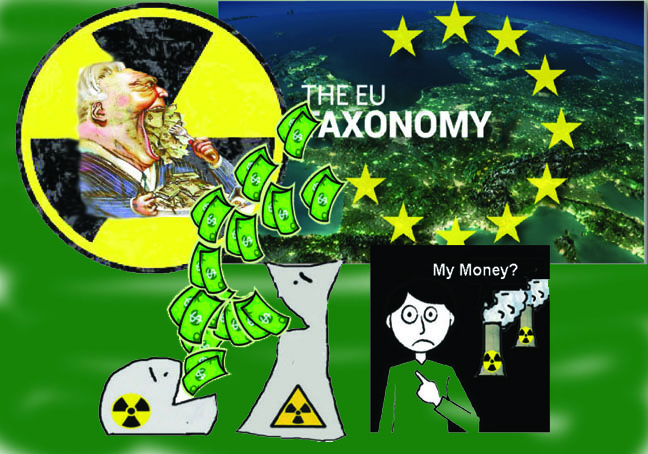
Succumbing to member states’ pressure and giving nuclear energy a “sustainable” label in a key regulation could derail the EU’s climate progress.
Aljazeera, Christiana Mauro, Senior advisor at the Biosphere Institute , Kacper Szulecki, Research professor in climate governance, 8 Mar 23,
One year ago, hopes were high for what was considered to be the most important environmental legislation in Europe. The European Union’s taxonomy regulation was meant to become the global “gold standard” for science-based policy that directs investment towards climate-friendly goals.
Their argument is that the “sustainable” label given to nuclear energy and natural gas breaches the EU’s climate commitments, violates EU environmental law and is incompatible with the “do no significant harm” criteria of the taxonomy regulation itself. The EC refused to revoke the act leading the complainants to launch a lawsuit at the European Court of Justice.
As we await the court’s decision, it is important to recall how this legislation was undermined by the nuclear lobby and what the consequences will be if it is not struck down
………………………………………………………………the EU taxonomy regulation ….. was supposed to be a list of scientifically-based technical criteria to set apart economic activities that are genuinely sustainable from those that are harming the environment.
It defined environmentally sustainable activities as contributing substantially to specific environmental objectives that will speed up the decarbonisation of the economy, comply with safeguards and “do no significant harm” to the environment.
Nuclear energy and natural gas initially failed to meet the taxonomy criteria. Of course, that went against big interests in the energy sector and predictably a lobbying blitz was launched to reverse this decision.

A report by Reclaim Finance, an NGO which scrutinises the impacts of financial actors on climate, revealed a lobbying campaign worth millions of euros was initiated to amend the regulation in favour of the natural gas and nuclear industries.
Lobbyists met frequently with EU representatives during critical phases of the deliberations over the taxonomy. Russia, which would have been a major financial and geopolitical beneficiary of the financial incentives that would ensue from the inclusion of gas and nuclear, was an extremely active “stakeholder” during the entire legislative process.
But there were also EU countries which sought to put pressure on the European Commission to change the regulation’s provisions. At the forefront of that effort were Poland, France, the Czech Republic, Hungary, Romania, Slovakia and Slovenia, whose leaders wrote a joint letter arguing for the inclusion of nuclear power in the regulation.
The document used various common claims and arguments in support of nuclear sustainability. We were part of a team of fact-checkers from four EU countries who determined that 20 statements in the letter were false or misleading.
Among them were assertions that nuclear power is “environmentally friendly”, “essential to the transition towards clean energy sources”, a “promising source of hydrogen” and “affordable”.
A full analysis of the letter can be found here.
Why nuclear energy is not green
Why nuclear energy is not green is perhaps less obvious to the general public than natural gas. This likely is due to efforts by governments – such as the seven mentioned above – and organisations to mislead it.
False narratives of “clean” nuclear are also peddled by intergovernmental organisations such as the International Atomic Energy Agency (IAEA), the OECD, and the UN Economic Commission for Europe (UNECE).

A common claim – which is also made in the letter to the EC – is that nuclear energy has a low carbon emission status. But if nuclear power can be said to produce lower carbon emissions, it is only true at the point of generation. When the entire life cycle of nuclear power plants is taken into consideration this contention crumbles.
Nuclear energy’s “upstream” activities that are necessary for operation, such as mining uranium, as well as transporting fuel, building and then decommissioning a power plant, and managing the radioactive waste that is a by-product of the process – are all linked to CO₂ emissions. Thus, the carbon footprint of nuclear energy generation is considerable, and according to some estimates, considerably higher than that of renewables.

Nuclear technology also needs significant amounts of cooling water and creates waste that is so toxic to the environment that no permanent storage solution has been developed for 70-odd years. It also represents a risk of seriously and permanently harming large swaths of territories in the case of an accident – which is now growing amid the current militarisation of civil nuclear facilities in Ukraine.
Posing an unmanageable danger to the environment, nuclear power falls short, even as a so-called “transitional activity”, defined in the regulation as an economic activity for which low-carbon alternatives are not available. This is because its financing today would derail the implementation of renewables by diverting investment away from them.
As Amory Lovins, a Stanford University professor and energy expert, says: “a low- or no-carbon energy source that costs more or takes longer to deploy will make climate change worse than one that is cheaper or faster, because the latter could have saved more carbon per euro and per year.”
Energy demand in Europe can easily be met by non-nuclear power sources, and considering the unreliability of nuclear power, with its ageing and deteriorating reactors, and vulnerability to extreme weather events, it is unlikely to have any energy contribution to make at all in the transition to renewables.
Even the most favourable calculations of the cost of nuclear energy show no advantage over renewable, which is seeing costs of deployment plummeting.
Government schemes keep consumer nuclear electricity prices artificially low. In fact, nuclear energy can only be made “competitive” with “hugely significant” government financing, as the EU Energy Commissioner inadvertently admitted in a recent speech. Hence, the seven governments’ letter also pleaded for “active support” for nuclear energy.
The profusion of nuclear delusions
There is a long history of attempts to link nuclear technology to overoptimistic technocratic environmental achievements that never materialise.
Media-hyped nuclear fiction abounds. For example, a recent fusion experiment in the US was touted as a major milestone in the search for an abundant source of clean energy. Predictably, it had a rather anticlimactic ending for anyone paying attention.
The energy generated in the experiment was significantly less than the amount needed to power the lasers involved in it. And the laboratory where the celebrated breakthrough took place was established to develop thermonuclear weapons, not civil nuclear energy projects, which explains its multibillion-dollar budget.
Such nuclear myths are usually debunked by independent experts whose critical voices are often buried beneath irresponsibly promoted fantasies. The morass of disinformation is meant in part to mask the industry’s own failures, but also the military interests of nuclear governments, by pushing unsupported theories to legitimise public funding. It is meant to confuse, demoralise and disable any organised effort to change things.
And the media, instead of challenging this intentional misleading of the public, has played a part in it. European media, for example, reported on the letter of the seven EU countries lobbying for nuclear to be included in the EU taxonomy regulation without checking the veracity of its claims.
Thus, a misinformed public and passive media have allowed political actors to influence regulations that are supposed to be politically neutral. Well-intentioned, vital, and comprehensive legislation, years in the making, has been subverted.
In its current form, this delegated act is likely to derail key 2030 and 2050 climate goals, and damage the Green Deal by influencing negatively green taxonomies being developed around the world. It will encourage greenwashing practices, redirect capital flows towards polluting sectors, and upset progress made on implementing the objectives of the Paris Agreement. https://www.aljazeera.com/opinions/2023/3/8/how-the-eus-most-promising-anti-greenwashing-tool-was-scuttled
Nuclear and space lobbies increase their grip on universities, a new example in UK
Bangor University in Wales will develop a nuclear thermal fuel system to
support deep space exploration with funding provided by the UK Space
Agency. It is one of eight projects receiving a total of GBP1.6 million
(USD1.9 million) in funding through the agency’s Enabling Space Exploration
fund.
World Nuclear News 7th March 2023
https://www.world-nuclear-news.org/Articles/Welsh-university-to-develop-space-nuclear-propulsi
The extraordinary popularity of renewable energy university courses

The number of students on renewables-related courses in Scotland has
soared by 70% in four years, figures reveal. Scottish Renewables found that
22,000 undergraduates were studying subjects which cover the sector,
ranging from engineering to maths. The same survey in 2019 reported around
13,000 young people studying in similar areas. Scottish Renewables said it
demonstrated the attractiveness of the industry.
BBC 7th March 2023
1 This Month
Chernobyl: The Lost Tapes – A good documentary on Chernobyl on SBS available On Demand for the next 3 weeks– https://www.sbs.com.au/ondemand/tv-program/chernobyl-the-lost-tapes/2352741955560

of the week–London Campaign for Nuclear Disarmament

Tell the Ukrainian Government to Drop Prosecution of Peace Activist Yurii Sheliazhenko
To see nuclear-related stories in greater depth and intensity – go to https://nuclearinformation.wordpress.com
-
Archives
- April 2026 (127)
- March 2026 (251)
- February 2026 (268)
- January 2026 (308)
- December 2025 (358)
- November 2025 (359)
- October 2025 (376)
- September 2025 (257)
- August 2025 (319)
- July 2025 (230)
- June 2025 (348)
- May 2025 (261)
-
Categories
- 1
- 1 NUCLEAR ISSUES
- business and costs
- climate change
- culture and arts
- ENERGY
- environment
- health
- history
- indigenous issues
- Legal
- marketing of nuclear
- media
- opposition to nuclear
- PERSONAL STORIES
- politics
- politics international
- Religion and ethics
- safety
- secrets,lies and civil liberties
- spinbuster
- technology
- Uranium
- wastes
- weapons and war
- Women
- 2 WORLD
- ACTION
- AFRICA
- Atrocities
- AUSTRALIA
- Christina's notes
- Christina's themes
- culture and arts
- Events
- Fuk 2022
- Fuk 2023
- Fukushima 2017
- Fukushima 2018
- fukushima 2019
- Fukushima 2020
- Fukushima 2021
- general
- global warming
- Humour (God we need it)
- Nuclear
- RARE EARTHS
- Reference
- resources – print
- Resources -audiovicual
- Weekly Newsletter
- World
- World Nuclear
- YouTube
-
RSS
Entries RSS
Comments RSS
 nuclear-news