More fusion hot air, literally!
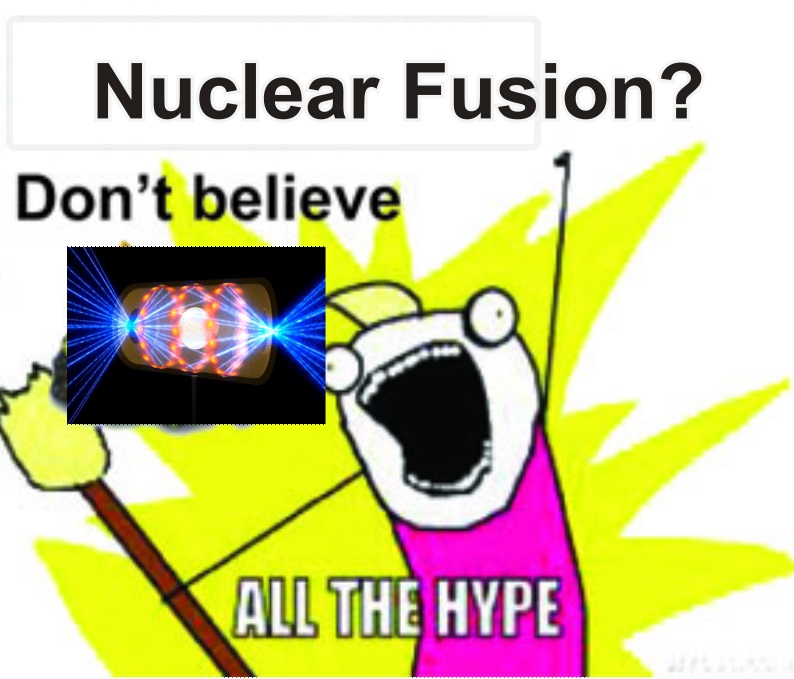
Megajoules and megaheadlines are all meganonsense
By Linda Pentz Gunter, https://beyondnuclearinternational.org/2024/03/04/more-fusion-hot-air-literally/ 4 Mar 24
Another week, more fusion news, cue another overblown headline, as the mainstream media once again paid homage to industry hype, digesting nuclear propaganda soundbites without even a hiccup.
On February 8, we learned that the Joint European Torus fusion project, also known as JET, had broken its own record in energy output during a last gasp attempt to make fusion work. The 40-year old project is now closed down for good.
The moment — and just a fleeting moment it truly was, lasting a mere 5.2 seconds — was duIy celebrated as another breakthrough for fusion.
“Nuclear fusion: new record brings dream of clean energy closer,” trumpeted the BBC who were especially smug since Torus is based in the UK.
“Nuclear Fusion World Record Smashed in Major Achievement”, said Science Alert.
“Scientists have made a record-setting fusion energy breakthrough,” blared the headline on Vice.
Below – A jolly video about JET in which the narrator’s voice perhaps generates more energy than the reactor itself.
What actually happened? JET generated 69 megajoules of energy in those 5.2 seconds, breaking its previous record of 59 megajoules over 5 seconds in 2021.
For those of us who don’t go about measuring things in megajoules, I deferred to our colleague, physicist, M.V. Ramana, for an explanation.
What are they really talking about here and is it actually a breakthrough?
“One can start with the annual average consumption of one US household,” Ramana said. “That’s about 10,500 kilowatt hours which is equivalent to 37,800 megajoules. Essentially using one hour = 3,600 seconds, and one joule = one watt-second.”
Head already spinning, I hoped he would do the rest of the math. He did.
“The 69 megajoules generated by JET”, Ramana explained, “is equivalent to roughly 0.06 percent of the electricity consumed by an average US household.”
So a minuscule contribution. But here’s the catch. “The JET machine produced 69 megajoules, but this is all heat,” explained Ramana. “Only about a third of that can be converted into electricity under ideal circumstances.”
Mostly heat, and hardly any electricity. So what the JET fusion so-called breakthrough actually delivered was all hot air. Literally!
Then came some more hot air. “First ‘private’ nuclear reactor to power 2 million British homes” ran another headline. The private sector nuclear company in question is Westinghouse. Yes, that Westinghouse! The one whose executives are in jail over a failed new nuclear power plant project in South Carolina. The Westinghouse that went bankrupt, forcing its mega-giant parent company, Toshiba, to shed not only Westinghouse but all Toshiba’s nuclear assets to avoid going down with the Westinghouse ship.
The same Westinghouse that is now $20 billion over budget at its other new nuclear project at Vogtle in Georgia.
But the British press were all “oh joy, oh rapture unforeseen” over this announcement, a project that has about as much credibility as the whimsical plot of HMS Pinafore.
And finally, we learned that Michigan governor, Gretchen Whitmer, is seeking another $150 million to restart the old and decrepit Palisades nuclear plant.
Palisades has been closed for almost two years and the company that would re-open and run it, Holtec, which specializes in decommissioning and radioactive waste management, has zero experience running a nuclear power plant.
This latest ask comes on top of $150 million already approved last year for a Palisades restart and could be augmented by a $1.5 billion loan from the federal government as well.
All of this nuclear nonsense comes on the heels of other hyperbole surrounding previous so-called advances in fusion (see our earlier coverage here and here), misrepresented almost universally as an imminent answer to our worsening climate crisis.
But, as the song goes in Pinafore, “Things are seldom what they seem.”
Linda Pentz Gunter is the international specialist at Beyond Nuclear and writes for and edits Beyond Nuclear International
The nuclear narrative.

What is a narrative? ……… In other words, it is about occupying public space to disseminate enchanting stories that give pride of place to industry, multinationals, investors, billionaires, each greener than the last.
Jean-François Nadeau, March 4, 2024, https://www.ledevoir.com/opinion/chroniques/808350/chronique-narratif
The future of the world, at least according to the head of the AtkinsRéalis firm, lies in nuclear power. This company, formerly known as SNC-Lavalin, has changed its name. The scandals that have affected her, she asserts, belong to the past.
For its campaign to promote atomic energy, AtkinsRéalis secured the services of two former prime ministers: Jean Chrétien and Mike Harris. In 2019, as revealed by Radio-Canada, Jean Chrétien had already gone so far as to propose, with astonishing lightness, storing foreign nuclear waste in Labrador. In a letter, the former prime minister wrote to a Japanese firm: “Canada has been the largest supplier of nuclear fuel for years, and I have always thought it would be appropriate for Canada to become, at the end of account, the steward and guarantor of the safe storage of nuclear waste after their first service cycle. »
No carbon neutrality without nuclear power , repeats the boss of AtkinsRéalis like an advertising slogan. We must replace fossil fuels, while doubling or tripling, thanks to nuclear power, the production of electricity, he pleads. There is no question, in this presentation, of rethinking a model of society based on an infinite expansion of consumption. Always more cars, as long as they are electric. Always more heating, regardless of the fact that our buildings are thermal sieves. In other words, what continues to matter is growth. And the increase in AtkinsRéalis’ turnover is largely due to nuclear power, as noted by Le Devoir .
Last week, Minister Pierre Fitzgibbon reiterated again that he was not closing the door to the return of nuclear power. Since the arrival of Michael Sabia at the head of Hydro-Québec , the signals pointing in the direction of this revival have multiplied. “I think that as a government, in the ministry, at home, we must stay on the lookout for what is happening in nuclear power,” the minister further affirmed in front of an audience of business people. To have such projects accepted, the minister specified that “you simply have to have a good narrative”. In Quebec, he laments, “we have not had any narrative on nuclear power” since the closure of Gentilly-2 .
What is a narrative? In 1928, Edward Bernays, the founding father of the public relations and advertising industry, called these language elements capable of manipulating public opinion propaganda . This word ended up, as we know, having unfavorable connotations. Others were therefore substituted. Here is the latest addition, used in all sauces: the narrative . In other words, it is about occupying public space to disseminate enchanting stories that give pride of place to industry, multinationals, investors, billionaires, each greener than the last.

Pierre Fitzgibbon shows interest in mini nuclear reactors. The boss AtkinsRéalis also praises this technology, which is far from wonderful. Nobody says too loudly that these types of plants produce more nuclear waste per megawatt. These mini power plants would produce up to thirty times more radioactive waste than conventional nuclear power plants.
In his “narrative”, the boss of AtkinsRéalis barely concedes that the management of radioactive materials constitutes a serious danger for humanity.
In Ontario, a large dump for radioactive waste was approved on January 9. Tons of heavy metals, dangerous radioactive elements, plutonium, uranium, etc. will pile up there for a century, not far from the Ottawa River. The whole thing promises to occupy, for eternity, an area equivalent to 70 National Hockey League ice rinks.
In France, 280 km of underground galleries are being built to store nuclear waste. To give an idea, the galleries of the Montreal metro total 71 km. This giant sarcophagus will be the largest construction site in Europe. In these galleries, the most dangerous waste will be able to spew radioactivity for 100,000 years.
So that the hydrogen and the fumes released from this collection of waste do not explode, it is necessary to continually ventilate. Which requires electricity. A power outage, if it lasts more than a week, could be catastrophic. Obviously, electrical problems, cataclysms, wars, terrorists, this will never happen in a hundred years. Not again in a thousand years, probably. Moreover, at the entrance to these sites, in what language should we warn future generations not to dig?
The speech of the boss of AtkinsRéalis is very similar to that which is also being given these days by the cereal manufacturer Kellogg’s. Gary Pilnick, its CEO, is sad to see the cost of food soaring. However, he does not recommend reviewing the profit margins on which the food giants are fattening, nor the exploitation system which governs this surge in prices. He simply suggests eating cereal at dinner, so that consumers can lower their bills and cereal manufacturers can make more money. At the bottom of the scale, this makes no difference to the misfortunes of the majority. Agricultural producers in Quebec, for example, find themselves this year with the lowest net incomes since 1938, they say.
Nuclear industries operate according to the same elastic logic which consists of making money at all costs. Our dependence on automobiles and energy-intensive lifestyles suits them. And it is enough, to hear them, to continue to rush forward, head down, to escape from a reality that is ruining the future. Their technologies promise to fix everything. As long as you are willing to swallow their narrative first, like soft cereal .
What’s fueling the commercial fusion hype?

Despite its lack of promise for civilian use, the Energy Department and the White House have used the Livermore controlled fusion experiment results to boost the effort to harness fusion power for civilian purposes. In December 2022, Energy Secretary Jennifer Granholm announced with great fanfare that a laser pulse ignited a fusion reaction that produced more energy than was supplied by the light beams
In her energy balance, however, the energy secretary forgot to account for the energy it took to create the laser beams. This energy input, when added, drastically reverses her conclusion
By Victor Gilinsky | February 20, 2024,
https://thebulletin.org/2024/02/whats-fueling-the-commercial-fusion-hype/
Recent White House and Energy Department pronouncements on speeding up the “commercialization” of fusion energy are so over the top as to make you wonder about the scientific competence in the upper reaches of the government.
In April 2022, the White House launched what it called a “bold decadal vision” for a 10-year program to “accelerate the realization of commercial fusion energy.” The “bold” part is the proposal, in questionable analogy with high-speed computing, to do in parallel all the development steps that are typically done sequentially to bring a new technology to the market. According to the White House, this parallel processing would include: technology development, preparing a regulatory system (including rules for fusion reactor exports), securing the supply chain, identifying high-value markets, training a diverse workforce, and gaining public support, all “to support the rapid scale-up of fusion energy facilities.”
The special attraction of fusion is of course that it offers a potential source of abundant carbon-free energy that does not generate radioactive nuclear waste. But just because it would be nice if controlled fusion could work doesn’t mean it’s on the verge of doing so. The hard truth is that scientists and engineers don’t even know yet whether controlled fusion can be achieved to make useful work, at least anywhere outside the sun (and other stars, of course).
A historical perspective is useful to understand where the hype about commercial fusion is coming from.
We have known about fusion powering the sun since Hans Bethe explained it in 1939. This was also almost exactly when Otto Hahn and Fritz Strassmann discovered uranium fission (and Lise Meitner and her nephew Otto Frisch explained it). Then in 1942, Enrico Fermi and a small number of co-workers demonstrated a controlled fission chain reaction in a squash court at the University of Chicago. Fermi spent about $50 million in today’s dollars on building his 20-foot-tall atomic pile.
More than 80 years later, the corresponding control-of-fusion principle has yet to be demonstrated experimentally and the US government already made $35 billion in cumulative fusion expenditure—with probably a comparable investment abroad—without yet knowing what works.
The White House’s approach to attain success appears based on the idea that enthusiasm and coordination of all diverse stakeholders backed up with enough money can solve a so-far-unsolved scientific problem. Administration spokespersons mention projects that were successfully accelerated in this way, like the 1969 trip to the moon. Sure, this was indeed a hugely successful monumental project at the time, but no one involved doubted it was possible to do. All the necessary component technologies, like rockets and communications, were in hand on a smaller scale. In the case of fusion power reactors, no one is yet sure what they would look like, let alone if they will turn out to be possible and practicable.
The main research track today in fusion energy is “magnetic confinement”—configuring magnetic fields to keep in place a plasma of thermonuclear fuel 10 times hotter than the sun’s core within a donut-shaped magnetic “bottle.” Dozens of such machines—known as “tokamaks,” a Russian-language transliteration for toroidal chamber with axial magnetic field—have been built around the world since the 1950s, but none got close to demonstrating a net energy gain. Controlled fusion, it turns out, is an extremely difficult problem. To solve it, fusion experts have concluded the key is to have a large enough facility.
The world’s largest experimental fusion machine—ITER (initially the International Thermonuclear Experimental Reactor, also meaning “the way” in Latin)—is nearing completion in France. It is a highly complex scientific and engineering project. ITER publicity describes the building housing the reactor as “slightly taller than the Arc de Triomphe in Paris,” and that the building foundation will support some 400,000 metric tons—“more than the weight of New York’s Empire State Building.” Started in 2006, ITER is a 35-country megaproject that was supposed to be completed in 2016 at a cost of $6 billion. The reactor is currently projected to start up in 2025, but even that appears to be an optimistic date, as is the total budget estimate of about $22 billion.
The initial design objective is to produce a fusion plasma with thermal power 10 times greater than the injected thermal power. Even if successful, this net power output would not yet be the fusion equivalent of Fermi’s 1942 experimental nuclear pile, which proved the controlled fission concept. Nor would ITER’s more ambitious subsequent goal of maintaining this plasma for eight minutes. To get to proof of principle would likely take another step or an upgrading of ITER.
The Lawrence Livermore National Laboratory’s weapons laboratory pursued another approach of “internal confinement,” to create a fusion reaction at its National Ignition Facility (NIF) and claimed it could have power application. NIF uses light pulses from a concentric battery of powerful lasers to heat a small target containing a tiny bead of frozen thermonuclear fuel. This is, in effect, a miniature (secondary) thermonuclear bomb, with the lasers playing the role of the triggering fission reactions (primary). The light heats the container material sufficiently to ablate and swiftly compress the fuel to the point of detonation, which lasts some billionths of a second. The experiment was directed primarily at developing a useful diagnostic tool for weapons research. In power application, you would have to repeat the explosions at an extraordinarily fast rate, which is a tall order.
Despite its lack of promise for civilian use, the Energy Department and the White House have used the Livermore controlled fusion experiment results to boost the effort to harness fusion power for civilian purposes. In December 2022, Energy Secretary Jennifer Granholm announced with great fanfare that a laser pulse ignited a fusion reaction that produced more energy than was supplied by the light beams: “This milestone moves us one significant step closer to the possibility of zero carbon abundant energy powering our society … a huge step forward to the president’s goal of achieving commercial fusion within a decade.” (Update: In less than nine years from now.)
In her energy balance, however, the energy secretary forgot to account for the energy it took to create the laser beams. This energy input, when added, drastically reverses her conclusion, with the fusion output then amounting to only about one percent of the input. This is not disqualifying from a scientific point of view, but it obviously is in a power generating application. Still, this hasn’t stopped the Energy Department from including Livermore’s fusion ignition experiment in a promotional video on the “7 moments that changed nuclear energy history.” The clip claims “[t]he Lab was the first to produce more energy from a fusion reaction than was used to start the process,” again forgetting the energy it took to power the lasers.
Exploding Alberta’s Myths about Small Nuclear Reactors

Small nuclear reactors are unproven and years away from being in use. But the Alberta government is presenting them as a way to keep fossil fuels flowing.
The untested technology is more about greenwashing than about cutting emissions.
Tim Rauf 15 Feb 2024, The Tyee
Alberta’s government is really excited about nuclear power.
More specifically, about novel and unproven small modular nuclear reactors. It hopes to use these to help lower the province’s carbon emissions while letting the energy industry continue operating as usual — an enticing prospect to the government given its intention to increase oil and gas production, while still having the energy sector get to net zero by 2050.
Small modular nuclear reactors produce less than one-third of the electricity of a traditional reactor.
The premise is that small reactors are easier to place and build, and cheaper.
Alberta hitched its horse to this wagon with Ontario, New Brunswick and Saskatchewan in 2022, taking part in a strategic plan for small modular reactor development and deployment. Alberta Innovates, the province’s research body, had a feasibility study conducted for it by Pacific Northwest National Laboratory. The study focused on using the reactors for greenhouse-gas-free steam emissions for oilsands projects, electricity generation in our deregulated market and providing an alternative to diesel when supplying power to remote communities.
More recently, Ontario Power Generation and Capital Power out of Edmonton entered into an agreement to assess SMRs for providing nuclear energy to Alberta’s grid. Nathan Neudorf, Alberta’s minister of affordability and utilities, was gleeful. “This partnership represents an exciting and important step forward in our efforts to decarbonize the grid while maintaining on-demand baseload power,” he said of the announcement.
All of this buzz makes it seem like SMRs are just over the horizon, an inevitability that will allow the province to evolve to have a cleaner, modern energy landscape.
But small modular reactors are nowhere near ready for deployment, and won’t be in Alberta for about a decade. That means for 10 years, they’ll provide no GHG-free steam to mitigate emissions.
“It’s still in the design phase,” Kennedy Halvorson said, speaking about the reactors. Halvorson is a conservation specialist with the Alberta Wilderness Association. The reactors are “so far off from being able to be used for us,” Halvorson added. “The earliest projections would be 2030. And we need to be reducing our emissions before 2030. So, we need to have solutions now, basically.”
With SMRs unable to stem the emissions tide for years, it’s confusing as to how they could make enough of a difference to get Alberta to net zero by 2050 (in line with United Nations emissions reduction targets to keep global warming to no more than 1.5 degrees).
Capital Power made similar projections………………………………………………………………………..
Construction itself is only one piece. Adding to that is the need to build a regulatory framework, which Alberta doesn’t have for nuclear…………………………………………………….
Ontario’s nuclear troubles
Listening to these public voices is prudent. We can look east to see what happens when the government and power utilities sidestep the process of getting explicit consent from communities that stand to be affected.
With its status as the nuclear activity hub in Canada, we can use Ontario as a litmus test of sorts and gauge Canada’s track record of care with nuclear. The report card isn’t great. There have been multiple cases of improper consultation with Indigenous Peoples on whose lands the waste, production or extraction sites are placed………………………………………………………………………..
Small reactors face a critical economic challenge
Adding to the timeline troubles are questions as to whether small reactors truly offer that much of an economic advantage, if any, compared with their larger counterparts.
In a previous article Ramana wrote, he pointed to the first reactors as an indication of the answer.
The first reactors started off small. Their size, though, coupled with the exorbitant price tag of nuclear development, meant they couldn’t compete with fossil fuels.
The only thing they could do to reduce the disadvantage was to build larger and larger reactors, Ramana said.

A large reactor that could produce five times as much electricity didn’t cost five times as much to build, he said, improving the return from the investment.
Economically the SMR can’t seem to compete with its larger sibling. Adding this to the delays abundant with nuclear, controversies around construction and communities, and the misalignment of timelines for meeting climate commitments, we need to ask why we’re seeing such a fervent enthusiasm for small modular reactors.
Greenwashing by any other name
The answer is likely a simple one: The Alberta government wants to keep the taps on. Their friends in the energy industry do too. Like carbon capture and sequestration before it, SMRs are the next way to stave off pesky talk of divestment and transition…………………………………………………………….
Deflecting and delaying isn’t the only greenwashing happening either, Halvorson argued. She noted there’s a special kind of tactic that comes with nuclear and other “clean” technology, where only carbon dioxide and greenhouse gas offsets are counted.
“When we reduce it all to just how much CO2 something emits, we’re not getting the full picture of environmental impacts,” Halvorson said. She pointed to water use in nuclear as an example.

“Most nuclear technologies require a massive input of water to work. And as we know, right now we’re in a drought in Alberta. Our water resources are so precious. We already have industries that are using way too much water as is, in a way that’s not allowing our environments and ecosystems to replenish their reserves, like their water resources,” she said.
Despite the cheerleading for nuclear Alberta, where small nuclear reactors will let us enjoy the fruits of fossil fuels (and even produce more) in a cleaner way, the bones don’t read that way. The argument that we can keep on drilling so long as we have that newest silver bullet hasn’t stood up to scrutiny before, and it doesn’t now. https://thetyee.ca/Analysis/2024/02/15/Exploding-Alberta-Myths-Small-Nuclear-Reactors/
Russian ‘nukes in space’ scare by Biden admin is nonsense
Russian ‘nukes in space’ scare by Biden admin is BS, Bruce K. Gagnon,
https://space4peace.blogspot.com/2024/02/russian-nukes-in-space-scare-by-biden.html
Remember in 2003 how the New York Times reported that Iraq had WMD which then justified the Bush administration’s ‘shock and awe’ attack? At the time so-called ‘intelligence agencies’ in the US claimed that it was all true.
It wasn’t.
Fast forward to 2024 and we hear reports from the same corporate media rag that intel reveals Russia has a new super-duper nuclear weapon that can destroy US satellites in space.
Suddenly its all over the news just days after the Vladimir Putin interview with Tucker Carlson is seen by hundreds of millions (maybe billions by now) around the world.
Desperation hits the White House. ‘We’ve got to come up with something big to trash Russia in order to get Congress to vote for the billions for the Ukraine war’.
And so they did.
It’s all BS.
The 1967 Outer Space Treaty banned weapons of ‘mass destruction’ in space. At the time the US and USSR were worried about one side blowing things up with nukes in space. Thus the incentive for the treaty.
Both sides today have anti-satellite weapons (ASAT) capabilities using kinetic weapons that just crash into a satellite – no explosives involved. So Russia would not need nukes to do the job if they wanted to. Likely lasers are also available to both sides to carry out the task as well.
The US last tested an ASAT in 2008 in Operation Burnt Frost when they launched an ‘interceptor missile’ from a Navy Aegis destroyer that went into space and knocked out an old US satellite.
US, India, China and Russia have developed anti-satellite weapons of some kind – mostly the kinetic variety.
The Kremlin spokesman Dmitry Peskov responded to White House claims about the ‘new secret Russian nuclear weapon’ by saying:
“It’s clear that the White House is trying, by hook or by crook, to push Congress to vote on a bill to approve funding [for Ukraine]. We’ll see what tricks the White House will use,” he said.
PAROS
And remember that Russia and China every year for at least the last 25-30 years go to the UN and introduce a new treaty called Prevention of an Arms Race in Outer Space (PAROS) to ban all weapons that fall outside of the 1967 treaty. In other words, all the new high-tech space weapons that are not covered in the Outer Space Treaty.
The US and Israel routinely block the treaty negotiations (during both Republican and Democrat administrations) saying, ‘There is no problem in space thus no need for a new treaty’. Very self serving.
I believe the Russians have a long history of generally honoring treaties while the US does not.It was the US that pulled about of the ABM Treaty (Anti-ballistic missile) that outlawed the building, testing and deployment of ‘missile defense’ systems which are key elements in Pentagon first-strike attack planning.
The US refuses to renounced first-strike while China and Russia have done so for many years.
So who is really the aggressor in space?
When the US claims it will be the ‘Master of Space’ (to ‘control and dominate space and deny other nations access to space’) one must examine closely just who is leading the race to militarize and weaponize space.
See the 1997 US Space Command document ‘Vision for 2020’ that lays that all out here.
Incidentally, the US Space Force was created in 2020 – right on schedule you might say.
Beware of those who promote corporate media reporting of White House lies and deception to keep war$ going.
The War on Gaza: Public Relations vs. Reality

Wednesday, February 14th, 2024, By Robert C. Koehler, m http://commonwonders.com/the-war-on-gaza-public-relations-vs-reality/
For its victims, war is . . . yes, hell. For the rest of us — the onlooking and supportive patriots — war is an abstraction embedded in ignorance, a.k.a., public relations, served up for public consumption.
At least that’s the way it’s supposed to be. The reality of war should never directly confront the official PR of those waging it. If it does, God help the war industry!
But that’s what’s happening now, as public support for U.S. complicity in Israel’s devastation of Gaza diminishes, indeed, starts turning to outrage. Official spokesmen for the Biden administration, such as John Kirby, strategic communications coordinator for the National Security Council, are forced to start mixing apologetic language in with their unwavering support for the bombing and murder of civilians . . . excuse me, Israel’s right to defend itself.
“Civilian deaths are happening, and happening at a rate that obviously we’re not comfortable with,” Kirby said in a New Yorker interview. “But,” he quickly added, “it doesn’t mean that they are intentionally trying to wipe the people of Gaza off the map the same way that Hamas wants to wipe the Israeli people off the map.”
Wow, Israel’s actions and official declarations of intent to obliterate Palestine are making the U.S. government uncomfortable. (But Hamas is still the bad guy.) Oh, if only fragments of actual truth about the war could penetrate such an interview. For instance:
And it was mostly — I mean, the majority of the patients that I treated were children, anywhere from the age of 2 to 17. I mean, I saw horrific eye and facial injuries that I’ve never seen before, eyes shattered in two 6-year-old children with shrapnel that I had to take out, eyes with shrapnel stuck inside, facial injuries. I saw orthopedic injuries where — you know, limbs just cut off and dangling. I saw abdominal injuries that were just horrific. And it was just mass chaos. There were children on the floor, unattended to, with head trauma, people suturing patients without anesthesia on the ground. It was just mass chaos and really horrific, horrific scenes.”
The speaker is Dr. Yasser Khan, a Canadian ophthalmologist recently back from a humanitarian mission at the European Hospital in Khan Younis, in southern Gaza, near Rafah. He was interviewed by Democracy Now! I wish John Kirby could have been there.
The hospital, he said, was “about 300, 400 percent over capacity. There was patients and bodies lying all over the hospital floor, inside and outside. They had orthopedic devices coming from their legs or their arms. They were getting infected, they were in pain, because they were on the floor, so the conditions weren’t very sterile. And if they survived amputation the first time, the infection would get them . . .”
His words go on and on. OK, you (I mean Kirby) might say, this is war. People get hurt. But Israel has to “defend itself.”
This is self-defense?
“They have killed over 300 or 400 healthcare workers, doctors, nurses, paramedics. Ambulances have been bombed. This has all been a systematic sort of — you know, by destroying the healthcare system, you’re contributing to the genocide.”
Khan also notes: “They’ve attacked the sewage system, the water system, so the sewage mixes with the drinking water. And you get diarrheal diseases, bacterial diseases. You know, cholera, typhoid is not far away. Hepatitis A is epidemic there now. They’re living in cramped spaces.”
And it gets even more insane: “What’s going on is now there’s 10,000 to 15,000 bodies that are decomposing. So, it’s raining season right now in Gaza. So all the rainwater mixes with the decomposing bodies, and that bacteria mixes with the drinking water supply, and you get further disease.”
Israel has the right to defend itself. But come on, guys, be a little bit more careful. Kill fewer children. Try not to poison the water. You might say this is public relations with a limp. Meanwhile, the International Court of Justice has ordered Israel to “refrain” from taking action that could be considered genocidal and, good God, “take measures to improve the humanitarian situation for Palestinian civilians in the enclave,” as Reuters reports.
But it’s war itself — regardless of “intent” — that is causing this hell. The act of war, the weapons of war, the political-economic structure of the globe that is based on endless war and domination, seems never to face serious condemnation, at least not in any official sense. But if we feed war, we feed hell.
Perhaps there’s one bit of recent news about a challenge to the global war industry, and its public relations perpetrators, that isn’t simply a scream from the political margins or cries from the victims. It’s the Transatlantic Civil Servants’ Statement on Gaza, a statement, released on Feb. 2, signed by more than 800 civil servants from the United States, the European Union and about a dozen European countries, declaring: “It Is Our Duty To Speak Out When Our Governments’ Policies Are Wrong.”
The statement declares the Gaza pummeling “one of the worst human catastrophes of this century.” And it calls on its countries to halt all military support to Israel and use their leverage “to secure a lasting ceasefire and full humanitarian access in Gaza and a safe release of all hostages” and “develop a strategy for lasting peace.”
A strategy for lasting peace? That’s another way of calling for an end to war. It’s about time.
Nuclear Illusions Hinder Climate Efforts as Costs Keep Rising

a long line of nuclear illusionists advocating grandiose goals for nuclear energy without any evidence to suggest they could be achieved, and much to suggest why they never will be.
“In recent years the nuclear industry seems to have quietly changed its business model from making and selling products to harvesting subsidies for fantasies”
the timelines will shrink, and the mirage will fade. Money will be wasted and global warming will continue.
The federal government also continues to fund efforts to develop “new” designs for smaller reactors that are proving far less economic than larger ones and will struggle to succeed. Two government showcase projects have already collapsed for lack of customer interest.
Stephanie Cooke, 12 Feb 2024 Energy Intelligence Group, Stephanie Cooke, Washington, https://www.energyintel.com/0000018d-7a5e-d1ef-a5cd-fe7e077c0000
The price tag for new nuclear plants just got a lot higher — at up to £46 billion ($58 billion) for two French reactors under construction in the UK — but don’t expect that to deter enthusiasm for nuclear energy. According to former US Energy Secretary Ernest Moniz, the world “will soon need to build the equivalent of about 50 large nuclear power reactors per year until 2050” to mitigate climate change. Moniz admits that’s a challenge, but nevertheless possible if nations “rethink how to build, regulate and finance nuclear technology.” Moniz comes from a long line of nuclear illusionists advocating grandiose goals for nuclear energy without any evidence to suggest they could be achieved, and much to suggest why they never will be.
In 1998, when the future of nuclear energy looked grim, a group of nuclear worthies convened in Paris for an International Conference on Preparing the Ground for Renewal of Nuclear Power. It was the fourth such attempt since the initial conference on the topic in 1979. In opening remarks later published, a former General Electric executive, Bertram Wolfe, proclaimed that “if one assumes nuclear energy will be needed to provide one-third of the world’s energy by the middle of the next century,” 100-200 new reactors per year would have to be added over the next 50 years.
Global warming was seen as a potential, though still-distant threat, but enough of one to argue for more nuclear energy as a “precautionary” measure against it, according to another speaker, Chauncey Starr, who had founded and presided over the US Electric Power Research Institute. Starr dismissed renewables as the “visionary goal” of an “anti-nuclear environmental community” embraced by politicians that “either suffer from the childlike innocence of the ignorant” or “knowingly engaged in political duplicity.” By 2060, hydro and renewables would “very optimistically” account for only 23% of worldwide electricity consumption, Starr predicted, and they would be heavily dependent on subsidies. He was off by several decades. That benchmark was surpassed in 2016, according to the 2023 BP Statistical Review of World Energy.
It was the nuclear crowd that suffered from ignorance, and illusionary ideas. One prominent industry executive at the time, Shelby Brewer, proclaimed in Paris that recent deregulation of US wholesale electricity markets would have “a positive impact on nuclear power” because utilities no longer subject to state regulated rates of return would be more likely to build new reactors. “Power generators will focus explicitly on price competitiveness, cost effectiveness and equity return — a new set of dynamics for the industry.” He wound up by declaring that “the salvation of US nuclear power lies with Adam Smith, not Uncle Sam.”
Real World Experience
In the real world, annual reactor construction starts worldwide since then were far from 200, 100 or even 50 — the highest number was 15 (in 2010). In the 14 years since, construction began on a total of 84 reactors of which 41 were in China, meaning that outside China, just three were started per year on average.
Deregulation was hardly the panacea Brewer predicted either. When reactors in US deregulated markets couldn’t compete against natural gas or renewables, operators were forced to turn to Uncle Sam for subsidies or shut down. Despite subsidies on offer for new nuclear power plants, only one was ever built — in the regulated state of Georgia — with ratepayers forced to foot the bill for financing and construction. The only other US reactor start-up, Watts Bar-2, was commissioned in 2016, but construction on that started in the 1980s, stopped, and then restarted.
The federal government also continues to fund efforts to develop “new” designs for smaller reactors that are proving far less economic than larger ones and will struggle to succeed. Two government showcase projects have already collapsed for lack of customer interest.
“In recent years the nuclear industry seems to have quietly changed its business model from making and selling products to harvesting subsidies for fantasies,” says Amory Lovins, adjunct professor of civil and environmental engineering at Stanford, and cofounder and chairman emeritus of RMI (formerly Rocky Mountain Institute). “A dollar astutely invested in influence campaigns, and sometimes corruption, seems to be able to yield on the order of $10-$100+ in subsidies — for as long as they last. So long as the band plays on, it looks like good work if you can get it.”
Compared with the industry’s past cheerleaders, Moniz appears relatively modest in what he proposes, and he admits that 50 reactors per year is a tall order, “two-thirds more than were built at nuclear power’s peak in the early 1980s.”
His ideas for overcoming the challenges are worn: A “new system” to “deliver standardized products rather than costly and risky one-off multidecade projects.” Including small modular reactors and advanced reactors, there are probably 100 or more designs around the globe in various stages of development. How do you standardize out of that? The only “new nuclear” in the West are the four multidecade projects in Finland, France, the US and UK — all exorbitantly over-budget and by definition economically highly risky. Of the six reactors in question, only two are generating power — one each in Finland and the US.
Airline Industry Model
Moniz looks to the airline industry for a model in the way nuclear plants could be built and regulated. Smaller reactors especially could be produced by “assembly-line methods” and new reactor designs certified by an “international body charged with issuing a single globally accepted generic certification for reactor designs.”
This overlooks the fact that the nuclear power industry is driven by geopolitics and its historic and symbiotic relationship with nuclear weapons. Competition is intense in reactor export markets, with supplier countries jealously guarding their areas of influence and seeking the means for continued influence over decades, as reactors are sited, built and then decommissioned.
The aviation industry is driven by real demand. People who want to fly don’t have alternatives to boarding an airplane; customers who need electricity have many other low-carbon options besides reactors. No airline wants a fatal crash, so it makes sense that pilots, especially if they’re flying to other countries, follow a universal set of norms, and that aviation authorities from several countries are often involved in certifying new aircraft designs.
“To ignore or pretend to ignore that there is so much difference is an insult to readers’ intelligence,” writes Yves Marignac of Institut negaWatt in an email. “To even consider the possibility that things could change so that the conditions for this international free, standardized, ‘orderbook’ approach can be met, furthermore in a timeframe that is consistent with objectives such as delivering on 50 large reactors per year soon, is wishful thinking pushed to a record high!”
Along with the announcement of Hinkley Point C’s massive cost increase came news that the first of two reactors wouldn’t be commissioned until at least 2029, and possibly as far out as 2031. This is not stopping plans for more nuclear power in both the UK and France, with London promising eight new reactors by 2050, and Paris calling for six reactors by 2035, with as many as eight more after that. These goals, billed as part of the “global solution” to climate change, are no more than a distant mirage.
As the two countries haggle over who pays the exorbitant costs at Hinkley Point C, the timelines will shrink, and the mirage will fade. Money will be wasted and global warming will continue. “The costlier and slower new reactors are, the less fossil fuel they can displace per dollar and per year, compared to a like investment in renewables and efficient use — thereby making climate change worse, not better,” argues Lovins. “Climate effectiveness requires that we count carbon, cost and speed — not just carbon.”
It’s time to close the curtain on illusionist theater in energy policy-making. It’s a show that’s long since run its course.
Stephanie Cooke is the former editor of Nuclear Intelligence Weekly and author of In Mortal Hands: A Cautionary History of the Nuclear Age. The views expressed in this article are those of the author.
Rich men with the wrong answers – nuclear power has no future and yet they persist

None of these realities deter the pro-nuclear lobby, now led most shamefully by the International Atomic Energy Agency itself. Even as its chief, Rafael Grossi, wrings his hands over the immense dangers posed by Ukraine’s 15 reactors embroiled in a war, he and his agency are planning what it boasts is the “first-ever” Nuclear Energy Summit, to be held in late March in Brussels in partnership with the Belgian government.
By Linda Pentz Gunter https://beyondnuclearinternational.org/2024/02/11/rich-men-with-the-wrong-answers/
Pro-nukers warned coal use would rise as reactors closed in Germany. The opposite happened.
Remember all those doomsayers from the pro-nuclear mythology unit who cast Germany’s Energiewende — or green energy revolution — as a catastrophic failure? They claimed, totally erroneously or deliberately misleadingly, that the country’s choice to close all its nuclear power plants guaranteed an increase in fossil fuel use and especially coal.
Germany vehemently denied those false predictions since they clearly knew that the country’s renewables were more than able to replace nuclear and fossil fuels. And so it has come to pass.
Germany’s use of lignite, or brown coal, dropped to its lowest level in 60 years in 2023. Even more dramatically, its hard coal use is at the lowest level since 1955. All of this happened at the same time as Germany was closing its last three reactors.
Meanwhile, according to reporting by Clean Energy Wire (CLEW), and citing an analysis (in German) from the research institute, Fraunhofer ISE, renewables “contributed a record share of more than half of the country’s power consumption” in 2023.
“The country sourced nearly 60 percent (59.7%) of its net power production from renewables, which generated a total of 260 terawatt hours (TWh), an increase of 7.2 percent compared to 2022,” the report said.
The 2022 uptick of coal production in Germany was entirely driven by high gas prices and a shortfall of French nuclear power production. The French nuclear sector was so unreliable that 50% of its reactors were out of action in April 2022, and again in November 2022, just as winter electricity usage began to rise.
Consequently, France had to import electricity to keep the lights on and the heat running.

Far from eating crow, the pro-nuclear boosters like Ted Nordhaus, who co-founded the Breakthrough Institute (BTI), are still crowing about the benefits of nuclear power. Nordhaus couldn’t wait to take ownership of his latest scheme, apparently long in the plotting, to dismantle the U.S. Nuclear Regulatory Commission in order to eliminate the industry’s most burdensome (i.e. costly) hassle of having to worry about inconvenient things like reactor safety. Efforts to do just that are now underway in Congress.
“Through years of rigorous research and engagement with the NRC, BTI has pinpointed crucial opportunities to modernize the regulatory framework that will lay the foundation for streamlined and efficient nuclear reactor licensing,” boasts the company’s website.
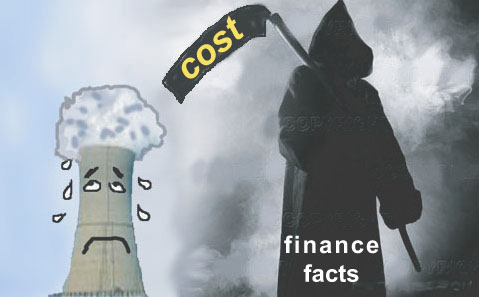
Meanwhile, we learn that the struggling Vogtle 3 and 4 new reactor project in Georgia, already 20 billion dollars over budget and years late, is set once again to further gouge ratepayers for the mistakes and failures of Georgia Power. And across the pond that the UK twin EPR project will likely top $59 billion with a completion date originally set for 2017 now pushed back to “after 2029”.
None of these realities deter the pro-nuclear lobby, now led most shamefully by the International Atomic Energy Agency itself. Even as its chief, Rafael Grossi, wrings his hands over the immense dangers posed by Ukraine’s 15 reactors embroiled in a war, he and his agency are planning what it boasts is the “first-ever” Nuclear Energy Summit, to be held in late March in Brussels in partnership with the Belgian government.
The IAEA has now become possibly the world’s most aggressive marketer of nuclear power and is still crowing about what it sees as a triumph at COP28, a veritable nuclear coup d’etat. In reality, this encompassed a miserable 24 countries signing onto an absurd fantasy propaganda statement that the world can and must triple global nuclear capacity by 2025.

Is there any point to the COP anymore? (Was there ever?) It has become one big carbon footprint junket, taken over by the oil companies, and hijacked by the nuclear industry and the IAEA, while making pledges rarely kept. The next one, in Azerbaijan, is chaired by yet another oil executive and has precisely zero women on its 28-member organizing committee.

The COP28 triple nuclear declaration was followed by an outrageously presumptuous assertion, by former U.S. energy secretary, Ernest Moniz (with Armond Cohen) in a Boston Globe oped, that, quote, “The world wants to triple nuclear energy.” (The Globe published our reply on January 17.)
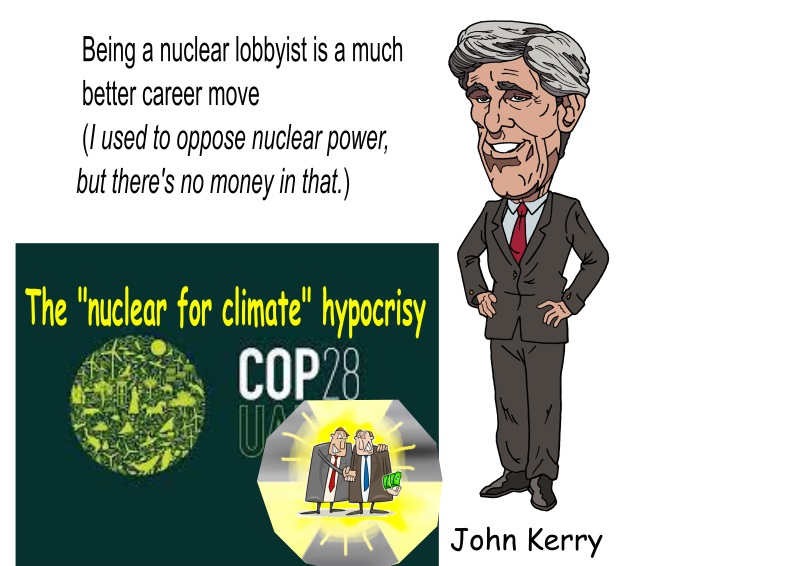
Are we tired yet of absurdly rich, mostly White men pronouncing what they have decided the world wants from the comfort of their ivory towers? We are one such elitist down now with the retirement of 80-year old multi-millionaire John Kerry as US climate envoy. As of January 2024, Kerry’s net worth was $250 million, but that’s after divesting himself from his shares in fossil fuel, nuclear power and nuclear weapons companies.
Kerry has been replaced by, yes, drumroll, another old, rich, White man in the person of perennial White House advisor, John Podesta, founder of the Center for American Progress. Podesta, a stripling at 75, is a mere pauper compared to Kerry with a net worth of just $10 million-$13 million depending on sources, none of which are fully reliable.
Where Podesta might stand on nuclear power is a little murky, although one assumes he will tow the Biden/Kerry line and evangelize accordingly. He is on the record as considering nuclear power as a producer of hydrogen, telling Cipher in a September 2023 interview: “I think the questions around how to utilize existing nuclear and the production of hydrogen are definitely on the table.”
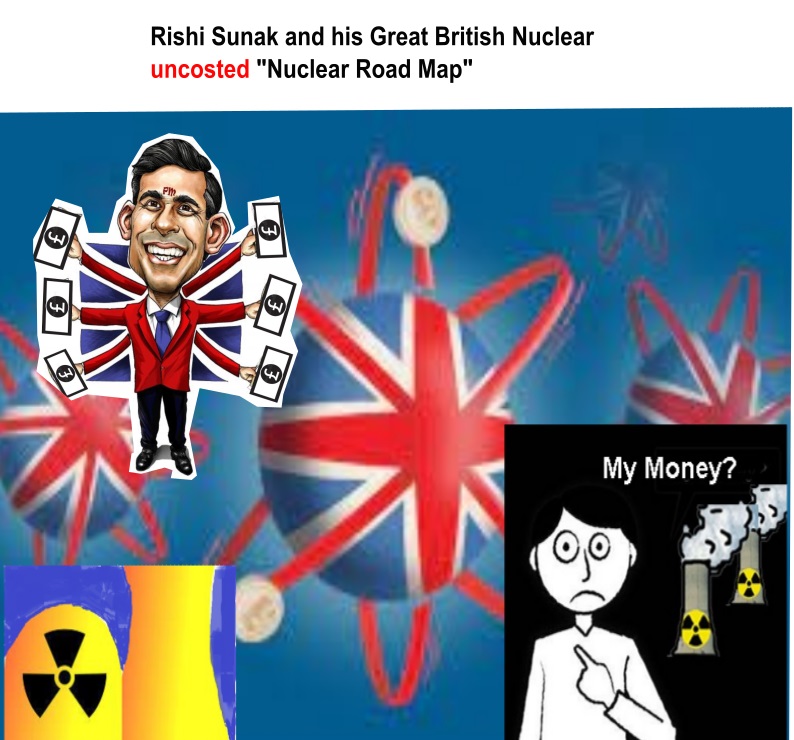
And then there’s Rishi Sunak, prime minister of the UK, who, together with his even richer wife, has a net worth of $670 million. Despite all the evidence of extreme costs, rising sea-levels and agonizingly slow timelines, on January 11, Sunak’s government announced its plan for the country’s “biggest expansion of nuclear power for 70 years to create jobs, reduce bills and strengthen Britain’s energy security.”
Nuclear power of course can achieve none of these. The electricity even of the current new nuclear reactors nearing completion at Hinkley Point will be almost triple the price Britons are currently paying. Promised new jobs will evaporate along with the new reactor plans, as we have already seen elsewhere — the V.C Summer and NuScale projects being prime examples.
To achieve so-called energy security and get off its reliance on imported Russian reactor fuel, Sunak’s government also announced it would invest $381 million to produce the fuel domestically.
This is all a colossal betrayal of working people and their needs, with money squandered on illusory, expensive and irrelevant nuclear projects whose only purpose is to sustain the UK’s nuclear arsenal, one that could destroy the world many times over.
What Moniz, Kerry, Grossi, Sunak and other nuclear-promoting leaders need to understand is what the world actually wants, alongside peace, is fast, affordable and safer renewable energy, not another Chornobyl.
“In The War Of Propaganda, It Is Very Difficult To Defeat The United States”

“Highly emotive terms for the killing of civilians like ‘slaughter,’ ‘massacre,’ and ‘horrific’ were reserved almost exclusively for Israelis who were killed by Palestinians, rather than the other way around,”
Got it? In Ukraine people die from bombs because Russia launched Russian airstrikes and killed them very Russianly, whereas in Gaza people get hurt by explosions because they got too close to some type of explosive material.
CAITLIN JOHNSTONE, FEB 11, 2024
“…………………… “In the war of propaganda it is very difficult to defeat the United States because the United States controls all the world’s media and many European media,” Putin replied, adding, “The ultimate beneficiary of the biggest European media are American financial institutions.”
… Putin is definitely correct about the strength of the American propaganda machine. Of all the fronts one could possibly choose to challenge the United States on, propaganda is surely the least favorable. The US empire has by far the most sophisticated and effective propaganda machine ever to have existed, operating with such complexity that most people don’t even know it exists.
…………………………………………………………………In reality the nature of the US-centralized empire allows it to run a massive, nonstop international propaganda campaign through mass media platforms which are mostly privately owned. A diverse network of factors feeds into this dynamic which I’ve detailed in my unusually lengthy article “15 Reasons Why Mass Media Employees Act Like Propagandists”, but the gist of it is that anyone who’s wealthy enough to control a mass media platform is going to have a vested interest in preserving the status quo upon which their wealth is premised, and they will cooperate with establishment power structures in various ways toward that end.
The fact that these mass media outlets look independent but function as propaganda organs for the US empire allows its propaganda to fly into people’s minds without triggering any gag reflex of critical thinking or skepticism, which wouldn’t be the case if people knew those outlets were feeding them propaganda. Propaganda only really has persuasive power if you don’t know it’s happening to you.
The invisibility of US propaganda is further aided by the subtle methods by which it is administered, which we’ve seen exemplified beautifully in the coverage of Israel’s ongoing US-backed mass atrocity in Gaza.
In an article titled “Coverage of Gaza War in the New York Times and Other Major Newspapers Heavily Favored Israel, Analysis Shows,” The Intercept reports that a review of 1,000 articles from the New York Times, the Washington Post, and the Los Angeles Times about Israel’s war on Gaza found that the outlets consistently used word choices which served Israeli information interests.
“Highly emotive terms for the killing of civilians like ‘slaughter,’ ‘massacre,’ and ‘horrific’ were reserved almost exclusively for Israelis who were killed by Palestinians, rather than the other way around,” The Intercept’s Adam Johnson and Othman Ali report. “The term ‘slaughter’ was used by editors and reporters to describe the killing of Israelis versus Palestinians 60 to 1, and ‘massacre’ was used to describe the killing of Israelis versus Palestinians 125 to 2. ‘Horrific’ was used to describe the killing of Israelis versus Palestinians 36 to 4.”
This is the sort of manipulation that a casual news consumer wouldn’t notice. Unless you’re on alert for bias and are keeping track of what words are and aren’t being used where, you’re probably not going to notice the absence of emotionally-charged words when reporting on Palestinians who are killed by Israelis.
This type of slant shows up in all sorts of ways, like today’s headlines about the IDF killing a six year-old Palestinian girl named Hind Rajab along with her family. Reliable propaganda organs of the empire like CNN, The New York Times and the BBC have respectively gone with the headlines “Five-year-old Palestinian girl found dead after being trapped in car under Israeli fire”, “Missing 6-Year-Old and Rescue Team Found Dead in Gaza, Aid Group Says,” and “Hind Rajab, 6, found dead in Gaza days after phone calls for help”. In contrast, Al Jazeera reports on the same story with the headline “Body of 6-year-old killed in ‘deliberate’ Israeli fire found after 12 days,” and Middle East Eye goes with “Hind Rajab: Palestinian girl found dead after being trapped under Israeli fire for days”.
It’s easy to spot the difference when they’re placed next to each other like I just did, but unless you’re really watching out for it and have a good background on what’s going on here you’re likely to miss what’s happening. If you’re like most people and don’t read past the headline, you’d never know from the imperial media headlines that the child was killed by Israel, and you’d certainly never know about her terrified phone call for help while trapped by IDF fire and surrounded by the bodies of her dead relatives. If you look to the legacy media and its algorithmically-boosted online iterations for information about the world, you went one more day with a distorted perspective of what’s happening in Gaza.
The western press constantly write headlines like this when trying to minimize the impact of someone’s death at the hands of a party they sympathize with, particularly with regard to Palestinians. Last month the BBC published an article titled “Record number of civilians hurt by explosives in 2023”, as though they were mishandling fireworks or something instead of being actively killed by Israeli bombs. The BBC later revised their atrocious headline, but revised it in the opposite direction, replacing “Record number” with “High number” to further minimize the impact.
Contrast this with the BBC’s headlines when it’s reporting on Ukrainians killed by Russian airstrikes . Here’s a recent one titled “Ukraine war: Russian air strikes claim five lives in Kyiv and Mykolaiv”, and another titled “Ukraine war: Baby killed in Russian strike on Kharkiv hotel”.
Got it? In Ukraine people die from bombs because Russia launched Russian airstrikes and killed them very Russianly, whereas in Gaza people get hurt by explosions because they got too close to some type of explosive material.
Last week The Washington Post ran an opinion piece titled “Is America complicit in Israel’s bloody war in Gaza?”, which is already a ridiculously skewed headline because the answer is self-evidently yes — implying that there’s any question of this skews things in America’s favor. But even this was too much for the Post’s editors, who re-titled the piece “Has the Israel-Gaza war changed your feelings about being American?” to keep Americans from thinking too hard about Israel’s bloody war in Gaza and their country’s complicity in it.
In a Wednesday article titled “Biden Tries Again With Arab Americans in Michigan”, New York Times editorial board member Farah Stockman wrote the absolutely insane line “The Oct. 7 Hamas attack on Israel seems to be affecting Biden’s election prospects.” And then The New York Times actually printed it.
Read that line again. She’s saying Arab Americans are rejecting Biden because of the October 7 Hamas attack, which is of course absurd; they’re rejecting Biden because he’s backing a genocide in Gaza. She wrote this nonsensical line because in the New York Times you can’t say things like “Israel’s genocide in Gaza” or “the president’s facilitation of crimes against humanity”, and you won’t be hired if you’re the sort of person who’d be inclined to. Instead we’re pretending that for some inexplicable reason Arab Americans are just hopping mad at Biden because October 7 happened.
But again, these little manipulations fly under the radar if you’re not on the lookout for them. Such is the brilliance of the US empire’s invisible propaganda machine. That’s why it’s very difficult to win a propaganda war against the United States, that’s why westerners have been so successfully manipulated into accepting a status quo of endless war, ecocide, injustice and exploitation, and that’s why the world looks the way it looks right now.
Nuclear expert Mycle Schneider on the COP28 pledge to triple nuclear energy production: ‘Trumpism enters energy policy’.

The entire logic that has been built up for small modular reactors is with the background of climate change emergency. That’s the big problem we have………………… Climate change emergency contains the notion of urgency. And so we are talking about something where the time factor needs to kick in………………….. And if we are talking about SMRs picking up any kind of substantial amounts of generating capacity in the current market, if ever, we’re talking about the 2040s at the very earliest.
Now, we’re talking of tens of $billions that are going into subsidizing nuclear energy, especially as I said existing nuclear power plants.
The pledge was worded as a commitment “to work together to advance a global aspirational goal of tripling nuclear energy capacity from 2020 by 2050″………… “This pledge is completely, utterly unrealistic.”…………………….“It’s like Trumpism enters energy policy.”

The Bulletin, By François Diaz-Maurin | December 18, 2023
Last week, a group of independent energy consultants and analysts released the much-anticipated 2023 edition of the World Nuclear Industry Status Report 2023 (WNISR). In over 500 pages, the report provides a detailed assessment of the status and trends of the international nuclear industry, covering more than 40 countries. Now in its 18th edition, the report is known for its fact-based approach providing details on operation, construction, and decommissioning of the world’s nuclear reactors. Although it regularly points out failings of the nuclear industry, it has become a landmark study, widely read within the industry. Its release last week was covered by major energy and business news media, including Reuters (twice) and Bloomberg.
On December 2, the United States and 21 other countries pledged to triple the global nuclear energy capacity by 2050. The declaration, made during the UN climate summit of the 28th Conference of the Parties (COP28) in Dubai, United Arab Emirates, sought to recognize “the key role of nuclear energy in achieving global net-zero greenhouse gas emissions-carbon neutrality by or around mid-century and in keeping a 1.5-degree Celsius limit on temperature rise within reach.” The pledge was worded as a commitment “to work together to advance a global aspirational goal of tripling nuclear energy capacity from 2020 by 2050.” It was aspirational—and ambitious.
To discuss this pledge against the nuclear industry’s current trends and status, I sat down with Mycle Schneider, lead author of the World Nuclear Industry Status Report.
………… Diaz-Maurin: It’s undoubtedly a landmark report. With over 500 pages, it’s also massive. In a nutshell, what should our readers know about the main developments in the world nuclear industry over the past year?
Schneider: It really depends on from which angle you approach the issue. I think, overall, the mind-boggling fact is that the statistical outcome of this analysis is dramatically different from the perception that you can get when you open the newspapers or any kind of media reporting on nuclear power. Everybody gets the impression that this is kind of a blooming industry and people get the idea that there are nuclear power plants popping up all over the world.
But what we’ve seen is that some of the key indicators are showing a dramatic decline. In fact, the share of nuclear power in the world commercial electricity mix has been dropping by almost half since the middle of the 1990s. And the drop in 2022 was by 0.6 percentage points, which is the largest drop in a decade, since the post-Fukushima year 2012.
We have seen a four percent drop in electricity generation by nuclear power in 2022, which, if you take into account that China increased by three percent and if you look at the world, means that the drop was five percent outside China. So it’s significantly different from the perception you can get, and we can dig into some of the additional indicators. For example, constructions [of new reactors] give you an idea what the trends are and what the dynamic is in the industry. And so, when you look at constructions you realize that, since the construction start of Hinkley Point C in the United Kingdom in late 2019 until the middle of 2023, there were 28 construction starts of nuclear reactors in the world. Of these, 17 were in China and all 11 others were carried out by the Russian nuclear industry in various countries. There was no other construction start worldwide.
………………………………………………………………………………..The point is that we have had actually an increasing capacity that generates less. And, for obvious reasons, the most dramatic drop was in France. The French reactor performance has been in decline since 2015. That is, to me, one of the really remarkable outcomes in recent years. If you compare the year 2010 to 2022, in France, the drop [in electricity generated] was 129 terawatt hours. What happened is basically that, from 2015 onward, the trend line was toward a reducing electricity generation due to an accumulation of events, which are important to understand.
It’s not so much the stress corrosion cracking [in reactor vessels] that everybody has been talking about or another technical phenomenon that hit the French nuclear power plants worst, although it’s true it had a significant impact and was totally unexpected. So, it’s not an aging effect, although you do have aging effects on top of it because a lot of reactors are reaching 40 years and need to pass inspections and require refurbishment, etc. But you had climate effects in France too. And strikes also hit nuclear power plants. You don’t have that in other countries. So, it’s the accumulation of effects that explain the decline in electricity generation. This unplanned and chaotic drop in nuclear power generation in France compares with the loss of nuclear generation in Germany of 106 terawatt hours between 2010 and 2022, but in this case due to a planned and coordinated nuclear phaseout.
Diaz-Maurin: That is an interesting way to look at the data. What is the biggest risk of keeping existing reactors operating up to 80 years, as some suggest, or even more?
Schneider: Well, nobody knows. This has never been done. It’s like: “What’s the risk of keeping a car on the street for 50 years?” I don’t know. It’s not the way you do things, usually. First, I should say that we’re not looking at risk in that Status Report. This is not the subject of the report. But the lifetime extension of reactors raises the questions of nuclear safety—and security, which has always been a topic for the Bulletin.
If you have a reactor that has been designed in the 1970s, at the time nobody was talking or even thinking about drones or hacking, for example. People think of drones in general as a means to attack a nuclear power plant by X Y, Z. But in fact, what we’ve seen in the past are numerous drone flights over nuclear facilities. And so, there is the danger of sucking up information during those overflights. This raises security risks in another way. So, this idea of modernizing nuclear facilities continuously is obviously only possible to some degree. You can replace everything in a car, except for the body of the car. At some point, it’s not the same facility anymore. But you can’t do that with a nuclear power plant.
Diaz-Maurin: Talking about old facilities, Holtec International—the US-based company that specializes in nuclear waste management—say they want to restart the shutdown Palisades generating station in Michigan. Is it good news?
Schneider: To my knowledge, the only time that a closed nuclear power plant has been restarted was in Armenia, after the two units had been closed [in 1989] after a massive earthquake. We don’t have precise knowledge of the conditions of that restart, so I’m not so sure that this would be a good reference case. One has to understand that when a nuclear reactor is closed, it’s for some reason. It is not closed because [the utility] doesn’t like to do this anymore. In general, the most prominent reason [for closing reactors] over the past few years was poor economics.
This is, by the way, one of the key issues we’ve been looking at in the 2023 report: These entirely new massive subsidy programs in the US in particular didn’t exist [a year ago]. There were some limited programs on state level. Now these state support programs have been increased significantly and they are coupled in with federal programs, because the reactors are not competitive. So we’re talking really about a mechanism to keep these reactors online. That Palisades would restart is unique, in Western countries at least. For a plant that has been set to be decommissioned to restart, this has never been done. And, by the way, Holtec is not a nuclear operator. It is a firm that has specialized in nuclear decommissioning.
Now, that companies like Holtec can actually buy closed nuclear power plants and access their decommissioning funds with the promise to dismantle faster than would have been done otherwise, this is an entirely recent approach with absolutely no guarantee that it works. Under this scheme, there is no precedent where this has been done from A to Z. And obviously, there is the risk of financial default. For instance, it is unclear what happens if Holtec exhausts the funds before the decommissioning work is complete. Holtec’s level of liability is unclear to me prior to the taxpayer picking up the bill.
Diaz-Maurin: At Palisades, Holtec’s plan is to build two small modular reactors.
Schneider: Holtec is not a company that has any experience in operating—even less constructing—a nuclear power plant. So having no experience is not a good sign to begin with. Now, when it comes to SMRs—I call them “small miraculous reactors”—they are not existing in the Western world. One must be very clear about that. There are, worldwide, four [SMR] units that are in operation: two in China and two in Russia. And the actual construction history [for these reactors] is exactly the opposite to what was promised. The idea of small modular reactors was essentially to say: “We can build those fast. They are easy to build. They are cheap. It’s a modular production. They will be basically built in a factory and then assembled on site like Lego bricks.” That was the promise.
For the Russian project, the plant was planned for 3.7 years of construction. The reality was 12.7 years. In China, it took 10 years instead of five. And it’s not even only about delays. If you look at the load factors that were published by the Russian industry on the Power Reactor Information System (PRIS) of the IAEA, these SMRs have ridiculously low load factors, and we don’t understand the reasons why they don’t produce much. We know nothing about the Chinese operational record.
Diaz-Maurin: Last month, NuScale, the US-based company that develops America’s flagship SMR, lost its only customer, the Utah Associated Municipal Power System, a conglomerate of municipalities and utilities. This happened allegedly after a financial advisory firm reported on NuScale’s problems of financial viability. Have you followed this demise?
Schneider: Yes, of course. What happened there is that NuScale had promised in 2008 that it would start generating power by 2015. We are now in 2023 and they haven’t started construction of a single reactor. They have not even actually a certification license for the model that they’ve been promoting in the Utah municipal conglomerate. That’s because they have increased [the capacity of each module] from originally 40 megawatts to 77 megawatts.
Diaz-Maurin: Why is that? Is it a matter of economy of scale?
Schneider: Yes, of course. You need to build many modules if you want to get into economies of scale by number, if you don’t get into it by size. This is actually the entire history of nuclear power. So NuScale sought to increase the unit size in Utah. But then the deal with the municipalities collapsed after the new cost assessment in early 2023 showed that the six-module facility NuScale had planned would cost $9.3 billion, a huge increase over earlier estimates. It’s about $20,000 per kilowatt installed—almost twice as expensive as the most expensive [large-scale] EPR reactors in Europe.
Diaz-Maurin: Is it the same with the waste generated? Some analysts looking at the waste streams of SMRs conclude that smaller reactors will produce more radioactive materials per unit of kilowatt hour generated compared to larger reactors.
Schneider: That’s the MacFarlane and colleagues’ paper, which is pretty logical if you think about it. If you have a small quantity of nuclear material that irradiates other materials, then it’s proportionally more per installed megawatt than for a large reactor in which there is a larger core.
,………………Schneider: many technologies have been supported under the Inflation Reduction Act and many others will continue to receive significant support. But the problem here is different. The entire logic that has been built up for small modular reactors is with the background of climate change emergency. That’s the big problem we have.
Diaz-Maurin: Can you explain this?
Schneider: Climate change emergency contains the notion of urgency. And so we are talking about something where the time factor needs to kick in. If we look at how other reactor technologies have been introduced, a lot of them were supported by government funding, like the EPR in Europe or Westinghouse’s AP-1000 in the United States. Comparatively, the current status of SMR development—whether it’s NuScale, which is the most advanced, or others—corresponds to that of the middle of the 1990s [of the large light-water reactors]. The first EPR started electricity generation in 2022 and commercial operation only in 2023. And it’s the same with the AP-1000. By the way, both reactor types are not operating smoothly; they are still having some issues. So, considering the status of development, we’re not going to see any SMR generating power before the 2030s. It’s very clear: none. And if we are talking about SMRs picking up any kind of substantial amounts of generating capacity in the current market, if ever, we’re talking about the 2040s at the very earliest.
Diaz-Maurin: And that’s exactly where I want to turn the discussion now: nuclear and climate. At the COP28 last week in Dubai, 22 countries pledged to triple the global nuclear energy capacity of 2020 by 2050. What do these countries have in common when it comes to nuclear energy? In other words, why these 22 countries and not others?
Schneider: Most of them are countries that are already operating nuclear power plants and have their own interest in trying to drag money support, most of which by the way would go into their current fleets. Take EDF [France’s state-owned utility company], for example. Through the French government, EDF is lobbying like mad to get support from the European Union—European taxpayers’ money—for its current fleet. It’s not even for new construction, because the French know that they won’t do much until 2040 anyway. There is also another aspect that is related and that illustrates how this pledge is completely, utterly unrealistic.
The pledge to triple nuclear energy capacity is not to be discussed first in terms of pros or cons, but from the point of view of feasibility. And from this point of view, just looking at the numbers, it’s impossible. We are talking about a target date of 2050, which is 27 years from now. In terms of nuclear development, that’s tomorrow morning. If we look at what happened in the industry over the past 20 years since 2003, there have been 103 new nuclear reactors starting operation. But there have been also 110 that closed operation up until mid 2023. Overall, it’s a slightly negative balance. It’s not even positive. Now if you consider the fact that 50 of those new reactors that were connected to the grid were in China alone and that China closed none, the world outside China experienced a negative balance of 57 reactors over the past 20 years.
………………………………………….Now, if we look forward 27 years, if all the reactors that have lifetime extension licenses (or have other schemes that define longer operation) were to operate until the end of their license, 270 reactors will still be closed by 2050. This is very unlikely anyway because, empirically, reactors close much earlier: The average closing age over the past five years is approximately 43 years, and hardly any reactor reached the end of its license period. But even if they did, it would be 270 reactors closed in 27 years.
You don’t have to do math studies to know that it’s 10 per year. At some point it’s over. Just to replace those closing reactors, you’d have to start building, operating, grid connecting 10 reactors per year, starting next year. In the past two decades, the construction rate has been of five per year on average. So, you would need to double that construction rate only to maintain the status quo. Now, tripling again that rate, excuse me, there is just no sign there. I am not forecasting the future, but what the industry has been demonstrating yesterday and what is it is demonstrating today shows that it’s simply impossible, from an industrial point of view, to put this pledge into reality. To me, this pledge is very close to absurd, compared to what the industry has shown.
Diaz-Maurin: Based on your report, just to replace the closures, the nuclear industry would need to build and start operating one new reactor of an average size of 700-megawatt per month. And tripling the global capacity would require an additional 2.5 new reactors per month.
Schneider: Exactly; it’s a little less if you talk in terms of capacity. The capacity to be replaced by 2050 of those 270 units would be 230 gigawatts. Now, if small modular reactors were to be a significant contributor to this pledge, hundreds or even thousands of these things would need to be built to come anywhere near that objective. It’s impossible. We should come back to reality and discuss what’s actually feasible. Only then can we discuss what would be the pros and cons of a pledge.
But there was another pledge at the COP28, which is to triple the output of renewable energies by 2030. That’s seven years from now. To me, this pledge on renewable energy, if implemented, is the final nail in the coffin of the pledge on nuclear energy. It is very ambitious. Don’t underestimate that. Tripling renewables in seven years is phenomenally ambitious.
Diaz-Maurin: Is it feasible?
Schneider: Very difficult to say. But one important thing is that it’s not 22 countries. It’s over 100 countries that have already pledged their commitment to this objective. Also, a key player—if not the key player—is China. An important finding of our Status Report is that China generated for the first time in 2022 more power with solar energy than with nuclear energy. And this happened despite China being the only country to have been building [nuclear capacity] massively over the past 20 years. But still, the country is now generating more power with solar than with nuclear. The good news for the [renewable] pledge is that China is more or less on track with that tripling target. The rest of the world would have to speed up on renewables in a dramatic way to achieve this pledge. But at least China’s example shows that it’s feasible. That’s the interesting part. Because, on the contrary, there is no country—not even China—demonstrating that the nuclear pledge is possible.
Diaz-Maurin: If it’s not feasible, does the nuclear pledge impede other climate actions that are urgently needed then?
Schneider: That’s a good question. I think it’s a terrible signal, indeed. It’s like Trumpism enters energy policy: It’s a pledge that has nothing to do with reality, and it doesn’t matter. It is giving you the impression that it is feasible, that it is possible. And all that completely dilutes the attention and capital that are urgently needed to put schemes into place that work. And it doesn’t start with renewables, that’s very important to stress. It starts with sufficiency, efficiency, storage, and demand response. Only later comes renewable energy.
But these options are all on the table. They’re all demonstrated to be economic and competitive. That’s not the case with nuclear energy. It’s a pledge that has no realistic foundation that is taking away significant funding and focus. It used to be negligible funding. Up until a few years back, we were talking at most tens of millions of dollars. Now, we’re talking of tens of billions that are going into subsidizing nuclear energy, especially as I said existing nuclear power plants………………………………………………………………………………………………………………………………..
Schneider: What really has motivated most of my work over the past decades is that I can’t stand what you would call today “fake news.” All my work since the 1980s has been actually driven by the attempt to increase the level of information in—and having some kind of impact on—the decision-making process. To offer a service to civil society so it can take decisions based on facts, not beliefs. When I see what happens in terms of misinformation around nuclear power, it’s scary.
I think, today, the Status Report is probably more important than ever. Because there’s such an unbelievable amount of hype out there. It’s almost becoming an issue for psychologists. It has less and less to do with rationality because the numbers are clear. They are utterly clear: The cost figures are clear; the development is clear; the trend analysis is clear. So it is clear, but it doesn’t matter. It’s like the claim of stolen elections of Trump supporters. All court cases have shown that this was not the case. But, for half of the US population, it doesn’t matter. And I find this absolutely scary. When it comes to issues like nuclear power, it’s fundamental that decisions are made on the basis of facts.
Diaz-Maurin: Why is that?
Schneider: Because the stakes are incredibly high. First because of the capital involved. Researchers studying corruption cases know that the size of large projects’ contracts is a key driver for corruption. And the nuclear industry has been struggling with all kinds of mechanisms that are fraud yields. Financial corruption is only one issue.
Another is falsification. For a long time, we thought Japan Steel Works [JSW] was the absolute exemplary industry. Japanese factories used to build high quality and highly reliable key forged parts for nuclear power plants. It turns out, they have been falsifying quality-control documentation in hundreds of cases for decades. Corruption and falsification are two of the issues affecting the nuclear industry.
And, of course, the Bulletin has had a long focus on military issues related to nuclear energy. When we are talking about issues like SMRs, the key issue is not whether they are going to be safer or not, because there are not going to be many around anyway. So, safety is not the primary issue. But once you start signing cooperation agreements, it opens the valves to the proliferation of nuclear knowledge. And that is a big problem, because this knowledge can always be used in two ways: One is military for nuclear explosives, and the other is civilian for nuclear electricity and medical applications. Opening these valves on the basis of hype or false promise is a disaster. And the ones most actively opening these valves are the Russians. They are educating thousands of people from all around the world in nuclear materials and nuclear technology. In the United States, part of the thinking appears to say: “Oh, for God’s sake, better we train these people.” https://thebulletin.org/2023/12/nuclear-expert-mycle-schneider-on-the-cop28-pledge-to-triple-nuclear-energy-production-trumpism-enters-energy-policy/?utm_source=Newsletter&utm_medium=Email&utm_campaign=MondayNewsletter12182023&utm_content=NuclearRisk_TripleNuclear_11182023
To be responsible does not mean being intimidated in favor of nuclear power
Jean-François Nadeau, February 5, 2024, https://www.ledevoir.com/opinion/chroniques/806606/chronique-etre-responsable
Thus, nothing prevents relaunching the nuclear reactor in Gentilly, according to the very words of a study commissioned by Hydro-Québec .
Nothing. Otherwise money. A lot of money.
Nothing. Otherwise common sense.
It would not be before 2035, we are told. Given the time it takes to get this type of operation underway, it’s tomorrow.
The study was carried out by AtkinsRéalis. A firm previously known as SNC-Lavalin. They are the prime contractors for Canada’s CANDU nuclear reactors. Basically, it’s a bit like asking the oil industry to comment on the appropriateness of oil wells.
When will the day come when foxes will be invited, for their part, to explain to us what we should think of henhouses?
In August 2023, the new management of Hydro-Québec affirmed, against all expectations, that it would be “irresponsible at this time” not to closely consider the relaunch of nuclear power on the banks of the St. Lawrence. Irresponsible?
Minister Fitzgibbon, the man who claims not to be buyable for only $100, immediately gave several signs of satisfaction, while formulating considerations favorable to nuclear power.
It is difficult to imagine that, in the name of reason, we are not totally mobilized against the absurdity of such nuclear energy production programs in Quebec. Are we to believe that the idea of progress, at least for some, does not necessarily lead to progress of the mind?
The reactors have improved, they say. However, accidents or incidents are always possible, as current events have continued to prove to us. Three Mile Island, Chernobyl and Fukushima are not nothing. In Japan, more than a million cubic meters of contaminated water have just been thrown into the ocean, due to a lack of space to store it ad vitam aeternam . What will be the consequences on marine life?
In May 1977, the Gentilly 1 reactor was shut down due to a breakdown. Ten tons of heavy water, loaded with 31,000 curies of tritium, escaped from the power plant into the St. Lawrence River. After only five years of activity, Gentilly 1 was finished. However, it was necessary to wait until 1984 to remove the fuel, without resolving the issue of radioactive waste. In all, Gentilly 1 only operated for the equivalent of 183 days. This plant cost $128 million to build, the equivalent of more than $900 million in 2024.
The new power plant, Gentilly 2, will replace it. Small iodine tablets are distributed to the surrounding population. Until 2012, citizens were instructed to swallow them, in the event of a problem, to try to save at least their thyroid gland… Too expensive, the site was finally closed in 2012. But it would be necessary to wait until 2060 for it to be completely secure. Here again, the question of radioactive waste proves to be an impossible puzzle.
In Ontario, in Chalk River, the green light has just been given, despite objections, to the construction of a facility to manage nuclear waste . There, two serious nuclear accidents occurred in 1952 and 1958. They required the intervention of the army. It was close for everything to slide towards the worst. Among the specialists rushed to the site was a future president of the United States: Jimmy Carter. More than half a century later, the soldiers who worked, like Carter, on the decontamination of Chalk River were offered by Ottawa — as long as they were still alive — a large check for… $24,000.
Justified in pirouettes in the name of the fight against climate change , the enthusiasm for nuclear energy is not about to diminish. Neither are its risks. At what price ? In the summer of 2023, the Canadian government indicated that it wanted to revise upwards the compensation regime adopted in 2016 in the event of a nuclear accident. Ottawa now committed to paying $1 billion as a compensation ceiling rather than the $75 million initially planned. An increase commensurate with awareness of the risks.
An irradiated body, shaken by nausea, doomed to wither from the conjunction of cancers, how is it truly “compensated”?
Nuclear power constitutes a danger and a burden on the future of humanity that Quebec can very well do without.
I hear from here saying this: “Oh! Mr. Nadeau… You are exaggerating so much! Civilian nuclear power plants, after all, are not to be confused with nuclear weapons. Let’s see, Mr. Nadeau! »
Radiations do not know whether they are military or civilian. They always put us within death’s reach, no matter in the name of which flag they are produced. Who will deny today that the nuclear technology transferred by Canada to India allowed this country to develop bombs? Has Canada therefore become friends with New Delhi?
The Zaporizhia nuclear power plant in Ukraine is not a military site. Despite disregard for life, she nevertheless serves as a target in the conflict with Russia.
Who will tomorrow be the new leaders capable of contemplating, like those of today, the destruction of humanity without flinching? Should we ignore the fact that Nero, Genghis Khan and Napoleon have constantly found themselves reincarnated until today?
Even complete strangers can have designs that are dangerous to say the least. In 1982, an Israeli-Swiss engineer, Chaïm Nissim, launched an attack on a nuclear site in France. He was armed with a rocket launcher. What could happen like this now, at a time when low-cost drones make it possible to discreetly carry fire and death everywhere from a clear blue sky?
Being responsible does not mean bowing down or being intimidated in favor of nuclear power in front of hired engineers or passing politicians.
Ontario counts nuclear power as “Green”.

Ontario to include nuclear power projects in its green bonds, JEFF GRAYQUEEN’S PARK REPORTER, TORONTO, 2 Feb 24
Ontario has rewritten the rules for its multibillion-dollar green bond program and will now for the first time be able to use the proceeds for nuclear-power projects, the latest in a series of pro-nuclear moves made by the Progressive Conservative government.
The Ontario Financing Authority, which issues the province’s bonds, unveiled a new framework on Thursday for green bonds, which Ontario offers when it borrows money to finance capital projects that advance environmental goals.
While the program previously funded a range of infrastructure, it specifically excluded nuclear power. The new framework now includes a provision for “the deployment of nuclear energy to generate electricity and/or heat.”…….
The province has just pledged several large, and costly, expansions of nuclear power as it seeks to expand its electricity grid to meet future demand. This week, it announced the refurbishment of four 40-year-old reactors at Ontario Power Generation’s aging Pickering power station east of Toronto. That project is expected to take more than a decade and cost billions, although the government released no total cost estimate and a feasibility study is not being released to the public……………
The change made on Thursday is not the first time a debt issuer has tested whether the global market for so-called green bonds is willing to embrace nuclear power. Privately held Bruce Power, which operates the province’s largest nuclear power plant, on the shores of Lake Huron, in Tiverton, Ont., issued what was billed as the world’s first nuclear green bond back in 2021, as it sought financing for a massive refurbishment project. Provincially owned Ontario Power Generation has also recently issued a nuclear green bond.
The federal government moved to include nuclear in its green bond program late last year, after objections from the nuclear industry when Ottawa initially failed to include the sector. The European Union has made similar changes, and is being challenged over them in court by the environmental group Greenpeace.
Ontario, which is among the largest sub-sovereign debt issuers in the world, has issued green bonds for a decade. It is the largest issuer of these bonds in Canadian dollars, outstripping the federal government and all other provinces combined, at $16.5-billion. It is expected to issue its first green bonds under the new regime before March 31………………….
Keith Stewart, a senior energy strategist with Greenpeace Canada, said nuclear power should not be considered green enough for green bonds, the way renewable solar and wind power are. He noted that there is still no permanent solution for the radioactive waste it produces.
“If you are getting some kind of a bonus for being green, you should have really high standards for that,” he said.
Detailed response to a barrage of nuclear nonsense from Zion Lights.

Bulls, bears and ignorant nuclear propagandists. Detailed response to a barrage of nuclear nonsense from Zion Lights.
Jim Green, 27 Jan 24
This is a response to Zion Lights’ January 2024 article ‘Bulls and bears: a nuclear update’. Lights is a British nuclear power advocate who previously worked for self-confessed liar, climate denier and MAGA lunatic Michael Shellenberger. You can read more about Lights here and Shellenberger here.
Lights’ comments below are prefaced with her initials and placed in quote marks and in bold, and my responses are prefaced with my initials (JG ‒ Jim Green). I haven’t responded to everything in Lights’ article, which you can read in full here.
ZL: “In a world-first, 22 nations signed up to triple nuclear energy generation by 2050 at COP28 in Dubai this year, which illustrates how strongly the tide has turned in favour of the technology. Should they follow through on these commitments, the world could enter a new era of energy abundance and growth.”
JG response:
* 22 countries signed up to the nuclear pledge, 170 chose not to.
* The goal of tripling nuclear power by 2050 is laughable. David Appleyard, editor of Nuclear Engineering International, did the math: “Now 2050 still sounds like a long way off, but to triple nuclear capacity in this time frame would require nuclear deployment to average 40 GW [gigawatts] a year over the next two and half decades. The cruel reality is that’s more than six times the rate that has been seen over the last decade.”
* The nuclear renaissance of the late-2000s was a bust due to the Fukushima disaster, catastrophic cost overruns with reactor projects, and nuclear power’s inability to compete economically with renewables. The latest renaissance is heading the same way, i.e. nowhere. Nuclear power went backwards last year. There was a net loss of 1.7 GW of capacity.
* There were just six reactor construction starts in 2023. Only one outside China. One!
* The number of operable power reactors is 407 to 413 depending on the definition of operability, well down from the 2002 peak of 438.
*Nuclear power’s share of global electricity generation has fallen to 9.2%, its lowest share in four decades and little more than half of its peak of 17.5% in 1996.
* Over the two decades 2004-2023, there were 102 power reactor startups and 104 closures worldwide: 49 startups in China with no closures; and a net decline of 51 reactors in the rest of the world.
* Despite the drop in the number of operable reactors, and the sharp drop in nuclear power’s share of electricity generation, nuclear capacity (GW) and generation (TWh) have remained stagnant for the past 20 years due to increased capacity factors and reactor uprates (360 GW capacity in 2003, 374 GW in 2022; 2505 TWh in 2003, 2487 TWh in 2022). Thus it is possible, as Lights states (citing the International Energy Agency ‒ IEA), that nuclear power generation will reach an all-time high globally by 2025. If that happens, and it may not, it will be a pyrrhic victory for the industry, and it will be increasingly difficult to sustain, because of the ageing of the global reactor fleet. In 1990, the mean age of the global power reactor fleet was 11.3 years. Now, it is nearly three times higher at 31.4 years. The mean age of reactors closed from 2018‒2022 was 43.5 years. The problem of ageing reactors is particularly acute in two of the three largest nuclear power generating countries: the US reactor fleet has a mean age of 42.1 years, and in France the mean age is 37.6 years.
* Due to the ageing of the reactor fleet, the IAEA anticipates the closure of 10 reactors (10 GW) per year from 2018 to 2050. Thus the industry needs an annual average of 10 reactor construction starts, and 10 reactor startups (grid connections), just to maintain its current output. Over the past decade (2014-23), construction starts have averaged 6.1 and reactor startups have averaged 6.7. Former World Nuclear Association executive Steve Kidd noted in 2016 that “the industry is essentially running to stand still.” In the coming years and decades, the industry will have to run faster just to stand still ‒ it will have to build more reactors than it has been just to replace ageing reactors facing permanent closure. Growth ‒ even marginal, incremental growth ‒ becomes increasingly difficult and Lights’ nonsense about tripling nuclear power is thus seen as the nonsense that it is.
* The International Energy Agency (IEA) has just released its ‘Renewables 2023’ report and it makes for a striking contrast with the nuclear industry’s malaise. Nuclear power suffered a net loss of 1.7 GW capacity in 2023, whereas renewable capacity additions amounted to a record 507 GW, almost 50% higher than 2022.
* Nuclear power accounts for a declining share of global electricity generation (currently 9.2%) whereas renewables have grown to 30.2%. The IEA expects renewables to reach 42% by 2028 thanks to a projected 3,700 GW of new capacity over the next five years in the IEA’s ‘main case’ (while the IEA’s ‘accelerated case’ envisages growth of 4,500 GW). To put those numbers in context, global nuclear power capacity is 372 GW. There is little to no chance of nuclear power regaining a 10% share of global electricity generation.
* Solar and wind combined have already surpassed nuclear power generation and the IEA notes that over the next five years, several other milestones will likely be achieved: in 2025, renewables surpass coal; also in 2025, wind surpasses nuclear; and in 2026, solar PV surpasses nuclear.
* An estimated 96% of newly installed, utility-scale solar PV and onshore wind capacity had lower generation costs than new coal and natural gas plants in 2023, the IEA states. (Wind and solar became cheaper than nuclear power about a decade ago and the gap continues to widen.)
Ed note. Jim Green goes on to demolish Zion Lights’ arguments on a number of fronts: – South Korea’s nuclear “success” - China’s supposed nuclear progress – India’s nuclear ambitions – Japan supposedly rushing back into nuclear power – France’s grand nuclear plans – UK’s nuclear projects – USA’s nuclear projects - Sweden’s efforts…………………………………………………………………………………
more https://jimkgreen1.substack.com/p/bulls-bears-and-ignorant-nuclear
Tripling nuclear power: public relations fairy dust

January 2024, https://preview.mailerlite.io/emails/webview/664455/111177290781558405
| The federal government recently endorsed two similar nuclear fantasies. This month, Natural Resources Canada published a statement endorsing a plan to work with other countries to “advance a global aspirational goal of tripling nuclear energy capacity from 2020 by 2050.” The global nuclear declaration attracted endorsements from only 22 countries. In contrast, the official COP28 pledge to triple renewable energy by 2030 was signed by 123 countries and adopted by consensus as the official COP declaration.Earlier, in 2023, the Canadian energy regulator projected a tripling of Canadian nuclear generation capacity by 2050. Why is Canada engaged in a nuclear fantasy? |
Nuclear power plants operate in only two provinces. About 60% of Ontario’s electricity is produced by 18 nuclear power reactors. New Brunswick’s one power reactor produces about 19% of the electricity used in that province, when it’s not shut down. The federal energy regulator models envision tripling nuclear capacity by building small modular nuclear reactors in Prince Edward Island, New Brunswick, Quebec, Ontario, Manitoba, Saskatchewan, Alberta and British Columbia.
Ontario Power Generation (OPG) is promising that its SMR design will be the first in the world to be deployed commercially starting in 2030, although the design has not yet been licenced to build in Canada or anywhere else.
Assuming that this unit is chosen for widespread deployment in Canada, nearly 90 would need to be built and operating effectively on the grid between 2030 and 2050 to achieve the proposed tripling. Given the known construction time overruns for nuclear power plants, this is impossible.
Environment and Climate Change Canada published the official COP28 statement that does not mention nuclear energy. Instead, it highlights “groundbreaking goals to triple renewable energy, double energy efficiency, and, for the first time ever… a historic consensus to move away from fossil fuels in energy systems.”
Tripling renewable energy and doubling energy efficiency by 2030 is sensible and doable, as long as the requisite political will is present. It is past time to get real about the energy generation technologies we need to be supporting.
Why nuclear reactors are not the future of energy despite what UK Government would have you think.

– Dr Richard Dixon. The UK Government is trying to create the impression that it’s all go for nuclear. It isn’t.
The UK’s nuclear enthusiasts have been on another PR offensive, with
announcements of new reactors and possible life extensions to old reactors.
All of it denying the reality that nuclear is much too slow to build and
much too expensive to be part of our future energy strategy. Globally
nuclear is in terminal decline. In the last five years more renewable
electricity has been generated by just new schemes around the world than by
all the world’s nuclear reactors. And twice as much again is expected to
be constructed in the next five years, taking renewables output to five
times that of nuclear.
Of course the motivation for this burst of
co-ordinated PR is clear, the $20bn for Sizewell C hasn’t been raised so
the UK Government is desperately trying to give the impression that it’s
all go for nuclear in the UK. When it clearly isn’t.
Scotsman 17th Jan 2024
1 This Month

18 March Webinar @ 1 PM EST: An Assessment of SMR Projects: The Case of Canada
register for the zoom:
https://us02web.zoom.us/webinar/register/WN_o8BIIOUvQ2ONJR1nta65DQ#/registration

of the week – STOP SMALL MODULAR REACTORS IN CANADA
To see nuclear-related stories in greater depth and intensity – go to https://nuclearinformation.wordpress.com
-
Archives
- February 2026 (256)
- January 2026 (308)
- December 2025 (358)
- November 2025 (359)
- October 2025 (376)
- September 2025 (258)
- August 2025 (319)
- July 2025 (230)
- June 2025 (348)
- May 2025 (261)
- April 2025 (305)
- March 2025 (319)
-
Categories
- 1
- 1 NUCLEAR ISSUES
- business and costs
- climate change
- culture and arts
- ENERGY
- environment
- health
- history
- indigenous issues
- Legal
- marketing of nuclear
- media
- opposition to nuclear
- PERSONAL STORIES
- politics
- politics international
- Religion and ethics
- safety
- secrets,lies and civil liberties
- spinbuster
- technology
- Uranium
- wastes
- weapons and war
- Women
- 2 WORLD
- ACTION
- AFRICA
- Atrocities
- AUSTRALIA
- Christina's notes
- Christina's themes
- culture and arts
- Events
- Fuk 2022
- Fuk 2023
- Fukushima 2017
- Fukushima 2018
- fukushima 2019
- Fukushima 2020
- Fukushima 2021
- general
- global warming
- Humour (God we need it)
- Nuclear
- RARE EARTHS
- Reference
- resources – print
- Resources -audiovicual
- Weekly Newsletter
- World
- World Nuclear
- YouTube
-
RSS
Entries RSS
Comments RSS
 nuclear-news