UN report demolishes Israeli propaganda campaign against UNRWA
Israel has waged a multi-year campaign against the UN aid group for Palestinian refugees in hopes of eradicating the right of return
The Cradle, News Desk, APR 22, 2024
Israel has failed to provide any evidence of its claims that employees of the UN Relief and Works Agency (UNRWA) are members of “terrorist organizations,” according to an independent review led by former French foreign minister Catherine Colonna.
In January, Israel claimed without evidence that some UNRWA staff – until then the primary conduit of humanitarian aid into the besieged and bombed Gaza Strip – were members of Hamas and Palestinian Islamic Jihad (PIJ) and had participated in the Hamas-led attack on Israeli military bases and settlements on 7 October, known as Operation Al-Aqsa Flood.
The Israeli allegations promptly caused the US and other western nations to cut funding to UNRWA. This came amid reports from rights groups that Israel was using starvation as a weapon against the 2.3 million Palestinians in Gaza.
The Guardian reported on 22 April that the “Colonna report,” which was commissioned by the UN in the wake of Israeli allegations, found that UNRWA had regularly supplied Israel with lists of its employees for vetting, and that “the Israeli government has not informed UNRWA of any concerns relating to any UNRWA staff based on these staff lists since 2011.”
The Guardian added that most donor nations have resumed their funding in recent weeks. However, UK ministers had said they would wait for the Colonna report to decide whether to resume funding. The US Congress has since banned any future financial support of UNRWA.
The Colonna review was drafted with the help of three Nordic research institutes and will be published later on Monday.
It confirms that Israel has yet to provide any evidence of its claims………………………………………………..
more https://thecradle.co/articles/un-report-demolishes-israeli-propaganda-campaign-against-unrwa
Cruelty of Language — The New York Times’ Leaked Gaza Memo
The Intercept reporting on this issue matters greatly. Aside from the leaked memos, the dishonesty of language used by the New York Times – compassionate towards Israel and indifferent to Palestinian suffering – leaves no doubts that the NYT, like other US mainstream media, continues to stand firmly on Tel Aviv’s side.
By Ramzy Baroud, April 18, 2024, https://znetwork.org/znetarticle/cruelty-of-language-leaked-ny-times-memo-reveals-moral-depravity-of-us-media/—
The New York Times coverage of the Israeli carnage in Gaza, like that of other mainstream US media, is a disgrace to journalism.
This assertion should not surprise anyone. US media is driven neither by facts nor morality, but by agendas, calculating and power-hungry. The humanity of 120 thousand dead and wounded Palestinians because of the Israeli genocide in Gaza is simply not part of that agenda.
In a report – based on a leaked memo from the New York Times – the Intercept found out that the so-called US newspaper of record has been feeding its journalists with frequently updated ‘guidelines’ on what words to use, or not use, when describing the horrific Israeli mass slaughter in the Gaza Strip, starting on October 7.
In fact, most of the words used in the paragraph above would not be fit to print in the NYT, according to its ‘guidelines’.
Shockingly, internationally recognized terms and phrases such as ‘genocide’, ‘occupied territory’, ‘ethnic cleansing’ and even ‘refugee camps’, were on the newspaper’s rejection list.
It gets even more cruel. “Words like ‘slaughter’, ‘massacre’ and ‘carnage’ often convey more emotion than information. Think hard before using them in our own voice,” according to the memo, leaked and verified by the Intercept and other independent media.
Though such language control is, according to the NYT, aimed at fairness for ‘all sides’, their application was almost entirely one-sided. For example, a previous Intercept report showed that the American newspaper had, between October 7 and November 14, mentioned the word ‘massacre’ 53 times when it referred to Israelis being killed by Palestinians and only once in reference to Palestinians being killed by Israel.
By that date, thousands of Palestinians had perished, the vast majority of whom were women and children, and most of them were killed inside their own homes, in hospitals, schools or United Nations shelters. Though the Palestinian death toll was often questioned by US government and media, it was later generally accepted as accurate, but with a caveat: attributing the source of the Palestinian number to the “Hamas-run Ministry of Health in Gaza”. That phrasing is, of course, enough to undermine the accuracy of the statistics compiled by healthcare professionals, who had the misfortune of producing such tallies many times in the past.
The Israeli numbers were rarely questioned, if ever, although Israel’s own media later revealed that many Israelis who were supposedly killed by Hamas died in ‘friendly fire’, as in at the hands of the Israeli army.
And even though a large percentage of Israelis killed during the Al-Aqsa Flood Operation on October 7 were active, off-duty or military reserve, terms such as ‘massacre’ and ‘slaughter’ were still used in abundance. Little mention was made of the fact that those ‘slaughtered’ by Hamas were, in fact, directly involved in the Israeli siege and previous massacres in Gaza.
Speaking of ‘slaughter’, the term, according to the Intercept, was used to describe those allegedly killed by Palestinian fighters vs those killed by Israel at a ratio of 22 to 1.
I write ‘allegedly’, as the Israeli military and government, unlike the Palestinian Ministry of Health, are yet to allow for independent verification of the numbers they produced, altered and reproduced, once again.
The Palestinian figures are now accepted even by the US government. When asked, on February 29, about how many women and children had been killed in Gaza, US Defense Secretary Lloyd Austin said: “It’s over 25,000”, going even beyond the number provided by the Palestinian Health Ministry at the time.
However, even if the Israeli numbers are to be examined and fully substantiated by truly independent sources, the coverage of the New York Times of the Gaza war continues to point to the non-existing credibility of mainstream American media, regardless of its agendas and ideologies. This generalization can be justified on the basis that NYT is, oddly enough, still relatively fairer than others.
According to this double standard, occupied, oppressed and routinely slaughtered Palestinians are depicted with the language fit for Israel; while a racist, apartheid and murderous entity like Israel is treated as a victim and, despite the Gaza genocide, is, somehow, still in a state of ‘self-defense’.
The New York Times shamelessly and constantly blows its own horn of being an oasis of credibility, balance, accuracy, objectivity and professionalism. Yet, for them, occupied Palestinians are still the villain: the party doing the vast majority of the slaughtering and the massacring.
The same slanted logic applies to the US government, whose daily political discourse on democracy, human rights, fairness and peace continues to intersect with its brazen support of the murder of Palestinians, through dumb bombs, bunker busters and billions of dollars’ worth of other weapons and munitions.
The Intercept reporting on this issue matters greatly. Aside from the leaked memos, the dishonesty of language used by the New York Times – compassionate towards Israel and indifferent to Palestinian suffering – leaves no doubts that the NYT, like other US mainstream media, continues to stand firmly on Tel Aviv’s side.
As Gaza continues to resist the injustice of the Israeli military occupation and war, the rest of us, concerned about truth, accuracy in reporting and justice for all, should also challenge this model of poor, biased journalism.
We do so when we create our own professional, alternative sources of information, where we use proper language, which expresses the painful reality in war-torn Gaza.
Indeed, what is taking place in Gaza is genocide, a horrific slaughter and daily massacres against innocent peoples, whose only crime is that they are resisting a violent military occupation and a vile apartheid regime.
And, if it happens that these indisputable facts generate an ’emotional’ response, then it is a good thing; maybe real action to end the Israeli carnage of Palestinians would follow. The question remains: why would the New York Times editors find this objectionable?
Crackdown On Students And Information As Genocide Widens
Students are showing what normal human beings do when faced with evidence of unspeakable cruelty on a massive scal
LISA SAVAGE, APR 24, 2024, https://went2thebridge.substack.com/p/crackdown-on-students-and-information?r=3alev&utm_campaign=post&utm_medium=web&triedRedirect=true [includes extracts and video from social media]
Students at college campuses across the U.S. are rejecting Israel’s genocide in Gaza, and their encampments are spreading rapidly following violent repression by police at Columbia University. In addition to calling the NYPD on their own students, the geniuses in administration locked students out of their dorms and meal plans, and suspended them. Once they were suspended they could be arrested for trespassing — on a campus where their families have paid tens of thousands each year to house, feed, and educate them.
This repression has only caused the resistance at Columbia to grow.
Students don’t get their information about atrocities against the Palestinians from mainstream media that were long since captured by the military-industrial complex. Instead, they get their information from eye witness accounts shared on social media.
Is it any wonder that Congress in its wisdom just enshrined domestic spying as law and ramped up liability for social media companies and everyone who works there for sharing what the government deems “misinformation”?
It is said that truth is the first casualty of war. Since the U.S. has been continuously at war for decades, the ever tightening screws of information control are absolutely key to the WW3 project. World wars start with genocide (WWI was Armenians, WWII was European Jews). Before the 21st century these were conducted secretly, keeping the details from ordinary people until after the fact. Nowadays we watch genocide unfolding in real time, with new mass graves at Gaza’s Nasser Hospital the latest in the atrocity parade.
Students are showing what normal human beings do when faced with evidence of unspeakable cruelty on a massive scale: grieve, and turn the anger of grief into action.
The fantasy of reviving nuclear energy.

Tripling the World’s Nuclear Energy Capacity Is a Fantasy: Stephanie Cooke.
World leaders are not unaware of the nuclear industry’s long history of
failing to deliver on its promises, or of its weakening vital signs. Yet
many continue to act as if a “nuclear renaissance” could be around the
corner even though nuclear energy’s share of global electricity generation
has fallen by almost half from its high of roughly 17 percent in 1996.
In search of that revival, representatives from more than 30 countries
gathered in Brussels in March at a nuclear summit hosted by the
International Atomic Energy Agency and the Belgian government.
Thirty-four nations, including the United States and China, agreed “to work to fully
unlock the potential of nuclear energy,” including extending the lifetime
of existing reactors, building new nuclear power plants and deploying
advanced reactors.
Yet even as they did so, there was an acknowledgment of
the difficulty of their undertaking. “Nuclear technology can play an
important role in the clean energy transition,” Ursula von der Leyen, the
president of the European Commission, told summit attendees.
But she added that “the reality today, in most markets, is a reality of a slow but
steady decline in market share” for nuclear power. The numbers underscore
that downturn. Solar and wind power together began outperforming nuclear
power globally in 2021, and that trend continues as nuclear staggers along.
Solar alone added more than 400 gigawatts of capacity worldwide last year,
two-thirds more than the previous year. That’s more than the roughly 375
gigawatts of combined capacity of the world’s 415 nuclear reactors, which
remained relatively unchanged last year.
At the same time, investment in
energy storage technology is rapidly accelerating. In 2023, BloombergNEF
reported that investors for the first time put more money into stationary
energy storage than they did into nuclear.
New York Times 18th April 2024
Hinkley Point C joins Community Interest Company “Passion for Somerset”

MNR Journal, By Jacob Manuschka, AI Assisted Reporter, 11th April
A NUCLEAR power station that will provide zero-carbon electricity has joined a not-for-profit Somerset organisation as a principal partner.
Hinkley Point C, the first in a new generation of nuclear power stations providing electricity for around six million homes, has teamed up with Passion for Somerset.
Passion for Somerset is a not-for-profit Community Interest Company that works with individuals, communities and businesses throughout the county.
Stacy Walker, Hinkley Point C stakeholder relations manager, said: “Britain’s new nuclear power station at Hinkley Point C has seen another year of incredible engineering from under the seabed to the top of the world’s largest land-based crane, Big Carl………………………………… https://www.bridgwatermercury.co.uk/news/24246032.hinkley-point-c-joins-passion-somerset-organisation/
U.S. adds to the $1billion already granted to education for the nuclear industry

U.S. Department of Energy Awards $19.1 Million to Support Students and Faculty Advancing Nuclear Energy Technology
WASHINGTON, D.C. — The U.S. Department of Energy (DOE) today announced more than $19.1 million to support nuclear energy research and development, university nuclear infrastructure, and undergraduate and graduate education. Projects will help expand access to nuclear energy, moving the nation closer to meeting the Biden-Harris Administration’s goal of net-zero emissions by 2050. ……………..
Since 2009, DOE’s Office of Nuclear Energy has awarded almost $1 billion to advance nuclear energy research and support the education and training of future nuclear energy visionaries and leaders. Awards being announced today include: …………………………………………………….. https://www.energy.gov/ne/articles/us-department-energy-awards-191-million-support-students-and-faculty-advancing-nuclear
As Support For Gaza Goes Mainstream, Don’t Let The Empire Co-Opt The Movement

CAITLIN JOHNSTONE, APR 06, 2024, https://www.caitlinjohnst.one/p/as-support-for-gaza-goes-mainstream?utm_source=post-email-title&publication_id=82124&post_id=143329859&utm_campaign=email-post-title&isFreemail=true&r=1ise1&triedRedirect=true&utm_medium=email
Opposition to the slaughter in Gaza appears to be getting more mainstream, which is obviously great, but when political impulses go mainstream it means there’s going to be a massive and concerted effort to funnel public sentiment in a direction that doesn’t damage the interests of the empire.
They’re going to try to blame this all on Netanyahu.
They’re going to insist that Israel itself is fine and the only thing that went wrong was a fluke incident in which an aberrational right wing faction briefly got into power.
They’re going to try to wash the western empire’s hands of the mass atrocities it directly facilitated in Gaza.
They’re going to try to frame Biden as a basically decent politician who found himself trapped in an impossible situation.
They’re going to keep pretending a two-state solution is right around the corner and doing everything they can to stall out meaningful change on Palestinian rights, while blaming any obstacles to peace on the Palestinian resistance.
They’re going to pollute the information ecosystem with a deluge of messaging which is all designed to counter the notion that Gaza means the entire status quo needs to be overhauled — with regard to Israel-Palestine, with regard to US foreign policy, with regard to the US government itself, and with regard to the western power structure in general.
They’re going to say everything they need to say to ensure that everyone understands that the basic status quo in Israel, the United States and the western world is working perfectly fine, and this was all just an innocent little oopsie poopsie caused by a few bad apples.
They’ll justify, they’ll excuse, they’ll exonerate, and then they’ll distract, moving public attention on to the next big thing and allowing the amnesia of the daily news churn to wash Gaza from our attention — all while pretending to be on our side.
This messaging will need to be fought tooth and claw. We cannot allow them to neuter this political moment with spin and propaganda. We need to make sure their criminality remains front and center of public awareness, and we need to push for the real revolutionary changes that Gaza plainly proves are needed.
Let mainstream sentiment turn against the current Israeli regime and bring an end to the butchery in Gaza, but don’t let the imperial narrative managers co-opt anything. Don’t let them hijack the zeitgeist that’s been building.
View all words and actions of the western political-media class with aggressive skepticism, and push back forcefully every time they try to push public sentiment in a direction that advantages the empire.
Small Nuclear Reactors – free and comprehensive information from SMRs Education Task Force

The SMRs Education Task Force is a network of groups in Canada concerned and active on the nuclear file. Together we have many decades of experience providing information to Canadians about nuclear issues, including the proposed small modular nuclear reactors (SMRs). We are providing this bulletin free of charge to encourage more informed awareness of SMRs and their potential implications for communities across the country.
TODAY. The nuclear lobby’s new “prime wheeze” – Community Interest Companies
The UK, famous for comedy, had a great character, Bertie Wooster, who kept thinking up wonderful (useless and silly) new ideas, that he called “Prime Wheezes”. In true Bertie Wooster tradition, the nuclear lobby does the same.
They usually go for “registered charities” – and there’s any number of these, that the industry creates, really nuclear front groups, that pose as genuinely working for the public good.
So why is the nuclear lobby now going for the non-profit Community Interest Companies (CICs)?
Some of the reasons:
- The nuclear industry can get approval and respectability, “piggy-back” on a lot of genuinely positive and popular businesses in an existing CIC.
- The CIC business model can incorporate a wider range of social aims than are allowed for charities. This is because the definition of community interest within the test applied to a CIC is broader than the Public Benefit Test for charities.
- easier to set up than is a charity..
- murkiness of funding – relatively easy from private donors, grants or community development finance
- can more easily buy and sell commercially.
- It is a lightweight structure, it is unencumbered by bureaucracy. It can be set up in a couple of days
- it is like a standard profit-making company then, but with social objectives supposedly built in.
- it avoids the accountability mechanisms that charities have, e.g a CIC can have just one director. It does have a (poorly funded) government regulator, Office of the Regulator of Community Interest Companies, but there appears to be no pro-active monitoring of whether CICs are operating for community benefit.
- Directors and functioning can change overtime, not encumbered by rules that ensure its social aims. The directors of a CIC can pay themselves whatever they can argue could reasonably be seen as necessary.
- any money in the organisation can very easily be siphoned out to profit-making enterprises.
- No legal requirement to have a democratic structure
In Somerset UK, where there is community anxiety about the development of Hinkley Point C nuclear station, and its effect on the environment – what better prime wheeze for the nuclear lobby, than to join an existing reputable Community Interest Company?
Hinkley Point C, has teamed up with the CIC Passion for Somerset. as a principal partner.
Missing Links in Textbook History: War


According to the Institute for National Strategic Studies: “The most highly prized attribute of private contractors is that they reduce troop requirements by replacing military personnel. This reduces the military and political resources that must be dedicated to the war.”
By Jim Mamer , ScheerPost, 28 Mar 24
In the councils of government, we must guard against the acquisition of unwarranted influence, whether sought or unsought, by the military- industrial complex. The potential for the disastrous rise of misplaced power exists and will persist.
— President Dwight D. Eisenhower’s Farewell Address (1961)
n the late 1980s I had a student in an American history class who said that the United States won the war in Vietnam. I felt dizzy. Maybe I had misunderstood. So, I asked him to explain. “My father,” he told the class, “said that we had won the war because we won most of the battles and we killed more of them than they killed of us.”
My instinct was to attempt to impose logic on the discussion. American aircraft, I said, dropped millions of tons of bombs on Vietnam – more than twice what the U.S. dropped in all of World War II. That, of course, killed a lot of people, but it did not win the war.
That student was not convinced and I quickly realized that I would not change his mind. Not long after, I discovered that he and his father were not alone.
Ignorance or Amnesia?
The late Gore Vidal famously referred to this country as the “United States of Amnesia.” He had a point. As a society, we don’t seem to learn much from past experiences and even what we think we remember is often blurry.
In a 2003 episode of “Democracy Now!” Vidal reported that George W. Bush had managed to have a number of presidential papers put beyond the reach of historians for a great length of time. Making historical records unavailable, he predicted, will worsen America’s amnesia: “There will be no functioning historical memory … we are creating a lobotomized nation wherein the connections between essential parts of our history are severed from what is taught.”…………………………………………………………..
Glenn Greenwald blames some of the misunderstanding on journalists. He began a recent edition of System Update by talking about how journalists report on war. “One of the most important parts of journalism, when it comes to war, is to scrutinize, and investigate and debunk propaganda that comes from every side in every war.” Unfortunately, he concludes, journalists often fail to scrutinize, investigate and debunk.
I have argued some of the blame should be put on state approved textbooks which often fail, in Vidal’s words, to make the vital connections, due to what I call “missing links.
The Often-Invisible Agenda of Corporate Media
In 2005, Norman Solomon wrote an article titled “The Military-Industrial-Media Complex,” where he describes the connections of the military-industrial complex to corporate media.
“Firms with military ties routinely advertise in news outlets. Often, media magnates and people on the boards of large media-related corporations enjoy close links—financial and social—with the military industry and Washington’s foreign-policy establishment. Sometimes a media-owning corporation is itself a significant weapons merchant.”
Because so much of the media is now tied to corporate sponsors or serves the agenda of one political party most Americans are never exposed to real debate. Highly paid broadcasters may be fearful of offending their corporate paymasters when they report on a war involving the United States, especially when their reports have been given a veneer of credibility from “experts” drawn from the ranks of retired military officers, retired CIA personnel and former FBI officials.
As a result, there is virtually no media coverage of weapons manufacturers and the profits they make. Just imagine the impact it would make if reports from war zones that we are deeply involved with, like Gaza or Ukraine, were followed by listings of the profits made by various weapon-making conglomerates like Lockheed Martin, Mitsubishi, Boeing, General Dynamics or Raytheon?
How much do we know about American Wars?
To understand the gravity of the situation it helps to have a sense of how many American wars have been fought and how many conflicts we are currently involved with. The numbers differ according to the source largely because wars are sometimes grouped under umbrella terms like the Caribbean wars, the Cold War or the War on Terror.
According to Wikipedia, the United States has been involved in 107 wars since its founding and 41 of these were fought against the Indigenous peoples of North America. Most of these wars are ignored by schools, textbooks and the media, but the pressure to become involved in additional conflict is ever-present and comes from a variety of sources.
When Dick Cheney was Secretary of Defense for President George Bush Sr., he contracted engineering company Kellogg, Brown & Root (then part of Halliburton) to identify traditional military jobs that could be taken over by private sector contractors. It turned out there were a lot of jobs for the private sector and ever since the use of contractors has grown in positions like conducting intelligence, training local military, handling security and assisting in drone warfare.
At times the number of private contractors has been larger than that of enlisted troops……………………………
According to the Institute for National Strategic Studies: “The most highly prized attribute of private contractors is that they reduce troop requirements by replacing military personnel. This reduces the military and political resources that must be dedicated to the war.”
Public Citizen reports that “Every year, the defense industry donates millions of dollars to the campaigns of members of Congress, creating pressure on the legislative branch to fund specific weapons systems, maintain an extremely high Pentagon budget, and add ever more military spending.”
They also report that the pressure to spend more is constant, even though “nearly 50% of the Pentagon budget” already goes to private contractors. According to the report, in 2022 the weapons/defense industry donated $10.2 million to the 84 members of the House and Senate Armed Services Committees.
Even the language employed to report on war is structured to confuse. Invented phrases resemble Orwell’s Newspeak, from the novel 1984, meant to prevent too much thought. How else to explain the birth of misleading terms like “protective reaction strike” (an attack) “enhanced interrogation techniques” (torture), “extraordinary rendition” (kidnapping), “collateral damage” (extra dead), or “targeted killings” (usually with a lot of collateral damage).
The Art of Promoting Misunderstanding
What you do in this world is a matter of no consequence. The question is,
What can you make people believe that you have done?
……………………………………………………………………………………………………………………. High school textbooks all discuss early American wars, but usually without analysis. What follows are examples of how three early wars are discussed in textbooks………………………………………………………………………………………………………………
Are we headed toward Forever Wars?
Republicans and Democrats disagree today on many issues, but they are united in their resolve that the United States must remain the world’s greatest military power. This bipartisan commitment to maintaining American supremacy has become a political signature of our times.
— Andrew J. Bacevich, American Imperium 2016
……………………………..describing our history as one damn war after another.
How else to respond to the Wikipedia list of 107 wars involving the United States since 1787. And the wars continue. In his book “The United States of War,” David Vine reports that, “In the nearly two decades since U.S. forces invaded Afghanistan and Iraq, the U.S. military has fought in at least 22 countries.”
In his analysis of American wars Andrew Bacevich writes that “the constructed image of the past to which most Americans habitually subscribe prevents them from seeing other possibilities.” This “constructed image” is basically one of the United States as largely innocent of aggression, but forced by circumstance to defend itself.
In order to identify the missing links in the textbook treatments of American wars, it is important to look beyond the minutiae of single events and the unique characteristics of each conflict and look for common threads in the motivations towards engaging in war.
We have a government financed and influenced by Eisenhower’s military-industrial complex idea, and a population which seems either uninformed or uninterested.
The combination invites a future of permanent war.
Common threads include the ever-present assertion that the United States is defending itself whenever it goes to war and that includes wars engaged in while assembling a nation that would span the continent, as the song goes, “from sea to shining sea.”
How accurate were American claims of self-defense regarding American participation in the three early wars I reviewed?
…………………………………………………… If Andrew Bacevich is correct in saying we in the U.S. have a bipartisan congressional commitment to maintaining American supremacy, then more wars are inevitable. If we are to escape a future of forever wars, all justifications for war should be questioned and debated before the killing starts. https://scheerpost.com/2024/03/28/missing-links-in-textbook-history-war/
Nuclear and weapons industry propaganda to schools
NRS Dounreay and socio economic partners hosted the second FIRST® LEGO® League Challenge North Highland Tournament in March with local schools taking part.
North Highlands team headed for international robot challenge. NRS
Dounreay and socio-economic partners hosted the second FIRST® LEGO®
League Challenge North Highland Tournament in March with local schools
taking part. Each team participated in 3 short robot games and presented to
a panel of judges where they were judged on their robot design, innovation
project and core values such as team work. They are also judged throughout
the tournament and games on their ‘gracious professionalism’; their
behaviours within their own team and towards other teams.
Nuclear Restoration Services 25th March 2024
https://www.gov.uk/government/news/north-highlands-team-headed-for-international-robot-challenge
Cancer “epidemic” in the Young as Radioactive Wastes are Increasingly Dispersed to the Environment meanwhile Nuclear given “green” status in Brussels.

BY MARIANNEWILDART https://mariannewildart.wordpress.com/2024/03/24/cancer-epidemic-in-the-young-as-radioactive-wastes-are-increasingly-dispersed-to-the-environment-meanwhile-nuclear-given-green-status-in-brussels/
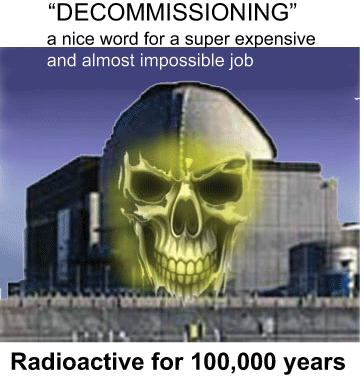
“Decommissioning” old and redundant nuclear plants sounds great and is greenwashed by the nuclear industry and Government as “Nuclear Restoration Services” . But in reality “decommissioning” means dispersal of nuclear wastes to the air, sea and land. Laws have been changed (despite opposition by Radiation Free Lakeland and others) to facilitate this by “moving waste up the heirarchy” ie what once was banned as too dangerous in landfill, incinerators and radioactive scrap metal is now routinely dispersed to the public realm. This also means that far higher level wastes are proposed for Geological Disposal than was the case in the 1990s when the NIREX inquiry stopped plans for intermediate and low level wastes in a deep nuclear dump.
In the same week the “Princess of Wales reveals diagnosis, doctors warn of mysterious cancer ‘epidemic” but the finger of suspicion never falls on the increase in radioactive wastes now being chucked into the public realm – nope the public are asked to fill in polls on whether they think processed food, lack of exercise, smoking is to blame for increase in cancers. In other words folks – “its your fault” despite the increased burden on your body from radiation and chemicals in the public realm.

Also in the same week EU ‘leaders’ in Brussels met to sign a Declaration pushing new nuclear “as part of the transition to a net-zero-emissions society”. The International Atomic Energy Agency’s Nuclear Energy Summit in Brussels on March 21 was protested by more than 40 organisations and we support that protest. But our support was tempered with the knowledge that rather than shouting about the radioactive and chemical toxic burden on the planet and people NGOs have for too long focussed on the narrative that nuclear is not a “climate solution.” NGOs “aim is to highlight that nuclear energy is a dangerous distraction from real climate solutions.” It is good to see opposition but by not pushing hard against the full consequences of nuclear (this is especially true of NGOs in the UK with few exceptions ) , the industry has been given a free ride to push its ‘climate solution’ agenda in the knowledge that it will not be overly tarnished by NGOs’ in the public ’s perception as Poison Power.
Of course it is a climate solution in the sense that the nuclear mafia agenda for the planet and its human and non-human inhabitants mean that we will not be in the least bit concerned about the climate.
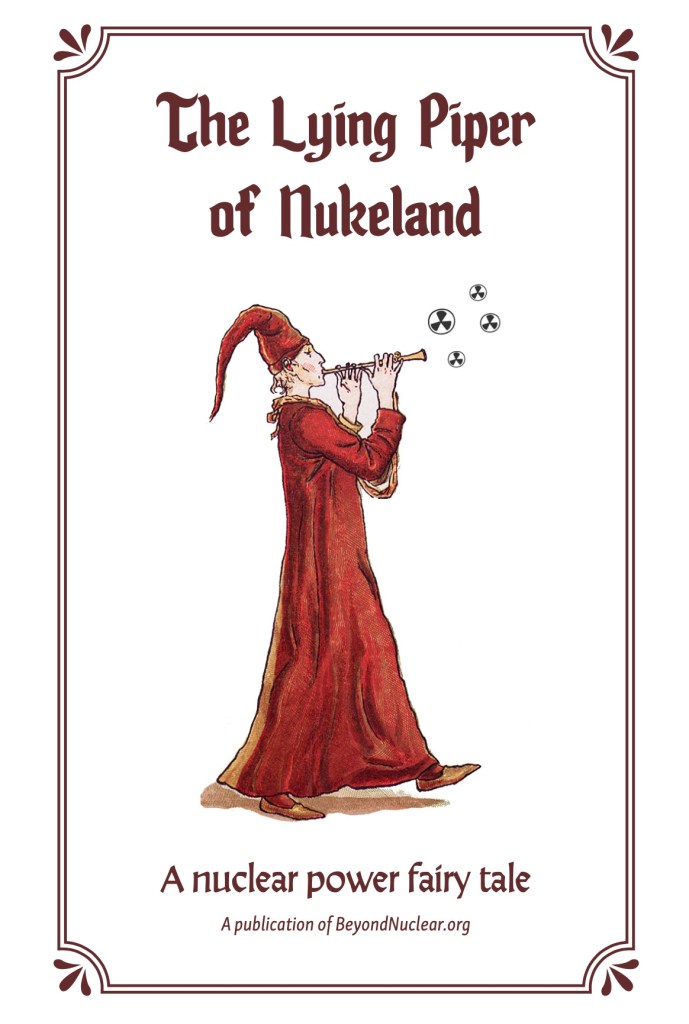
Beyond Nuclear reported from Brussels and produced an excellent leaflet “The Lying Piper of Nukeland” :
The IAEA and 30 countries that met in Brussels on March 21, spun false nuclear fairy tales, then issued a suitably “solemn pledge” to expand nuclear power, effectively announcing their own funeral. Many European groups protested in Brussels at the expo center where the summit was held .
A Barely-Disguised Genocide

CAITLIN JOHNSTONE, MAR 24, 2024, https://www.caitlinjohnst.one/p/a-barely-disguised-genocide?utm_source=post-email-title&publication_id=82124&post_id=142907577&utm_campaign=email-post-title&isFreemail=true&r=1ise1&triedRedirect=true&utm_medium=email
I just read a New York Times piece about the bodies that are trapped beneath the rubble in Gaza which said the Gaza Health Ministry estimates that there are 7,000 people listed as missing, but adds that that figure “has not been updated since November.”
November. There is no chance that any of the numbers we’re getting out of Gaza are up to date, including the death counts. Their infrastructure is shot and the scene there is just too chaotic. Nobody can keep track of anything anymore.
ISIS keeps attacking the enemies of the US and Israel for some strange and mysterious reason while funding for the main humanitarian group in Gaza gets cut due to completely unevidenced claims of Hamas affiliation. Re-fund UNRWA; de-fund ISIS.
❖
It’s funny to see the US proposing a fake UN “ceasefire” resolution which doesn’t actually demand a ceasefire when it’s public knowledge that the US could single-handedly create a ceasefire by telling Israel it will stop receiving US weapons if it doesn’t negotiate one right now.
❖
Ben Shapiro just cancel cultured Candace Owens out of a job for saying Palestinians are human beings and Alex Jones has condemned Israel’s genocidal atrocities before most Democrats on Capitol Hill have. American right wing punditry is a trip, man.
It sure is a crazy coincidence how all this stuff about difficulty with food distribution, collateral damage, human shields, the need to eliminate Hamas etc just happens to combine to create a situation that looks exactly the same as committing a genocide against an undesirable population.
They’re just doing a horrible thing they’ve wanted to do for ages and then using narrative to cover it up. Oh noes, it turns out it’s really hard to get food and medical supplies to this undesirable population! Oh noes, it turns out the bad guys are hiding in the hospitals and the civilian infrastructure! Oh noes, it turns out the bad guys are hiding behind large numbers of women and children! Oh noes, it turns out we’re going to need you all to move off of the land we’ve been coveting for generations!
It’s a sick joke that not even a child would fall for, but you see western government officials and major news outlets treating it seriously every goddamn day. It’s a barely-disguised genocide happening right out in the open, and the people responsible for telling the public what’s going on in the world are pretending it’s actually a very unfortunate series of highly convenient coincidences. There’s an elephant in the room wearing a cardboard crown as a disguise, and they’re all calling it Your Highness and telling everyone the king has come to visit.
Israel routinely massacres civilians who are waiting for food, attacks hospitals, picks off civilians with drones and snipers, and is deliberately starving the frailest and most defenseless people in Gaza to death, but the western political-media class keep calling this a “war”.
❖
People who wish to conflate Zionism with Jewishness often argue that most Jews are Zionists, but so what if they are? Most westerners are propaganda-addled imperialists, but if I didn’t believe westerners can and do snap out of that worldview I wouldn’t be doing what I do here.
In any system where people are being indoctrinated at mass scale by the powerful you’re going to see the majority of that population buying into the indoctrination, but conflating the people with the political ideology they’re indoctrinated with serves only to confuse and distort. If people had conflated “Nazism” with “Germany” that logic could have been used to justify exterminating every German after WWII, but because that distortion wasn’t made it opened up the possibility of de-indoctrinating the nation from that pernicious worldview.
Betting on the possibility of a better future means drawing a distinction between the people and the unhealthy worldviews they’ve been indoctrinated with, whether that’s Zionism, western imperialism, or anything else. We can only have a healthy world when the people snap out of their propaganda-induced coma and shake off the power-serving worldviews of this diseased civilization.
The Lying Piper of Nukeland:The IAEA’s nuclear fairy tales are leading nations — and all of us — into climate catastrophe
On March 21, more than 40 groups, mainly from Europe, protested the false promises and nuclear fairy tales being spun at the March 21 International Atomic Energy Agency’s Nuclear Energy Summit in Brussels. Prior to our fairy tale-themed rally close to the venue we issued a declaration signed by 621 organizations from across the world and issued a press release.
Our fairy tale handout parodied the story of nuclear power — see the text below. Beyond Nuclear also published a pamphlet exposing the hypocrisies and conflicts of interest of the IAEA. Feel free to download both and to distribute freely.
The IAEA’s nuclear fairy tales are leading nations — and all of us — into climate catastrophe
by By Linda Pentz Gunter beyondnuclearinternational, https://beyondnuclearinternational.org/2024/03/22/the-lying-piper-of-nukeland
At the end of the one-day summit, the IAEA and 34 countries issued a pledge “to work to fully unlock the potential of nuclear energy“, code for taking taxpayer money and going with a begging bowl to the World Bank.
Once upon a time… long ago, a Piper arrived in Carbonville. The people of Carbonville welcomed him warmly because they had heard that when he played his flute he had magical powers.
“Oh Piper!” they cried. “Here in Carbonville it is always dark and cold. It is smokey and polluted. Can you help us find a better way to create warmth and light?”
The Piper was happy to oblige. “I know just the answer,” he told them. “It’s called nuclear power! It’s safe, cheap and reliable. Very soon you will have warmth and light that is too cheap to meter!”
The people of Carbonville were so excited to get shiny new nuclear power plants that they took a vote and changed the name of their town to Nukeland.
The Piper began to play and very soon beautiful drawings of nuclear power plants started to appear for the people of Nukeland to admire. But several years passed and nothing else happened.
“What use are these drawings?” the people said. “We need warmth and light!”
“Be patient,” said the Piper. “I will bring you 15 nuclear power plants and you will have all the heat and light you need. I just need five gold coins to get them started.”
The people of Nukeland were very poor but they did without and saved up until they had five gold coins. They gave them to the Piper and once again he began to play.
The people of Nukeland watched as their fields were plowed under and their trees cut down and the land paved with concrete in readiness for the nuclear power plants. But still none appeared.
“I need more gold!” cried the Piper. “Just five more gold coins and your nuclear plants will be here”.
“You said it would only cost us five gold coins,” cried the people. “Now you’re charging us double!”
But all the same, the people paid the Piper another five gold coins. Many more years passed while the people of Nukeland froze in the dark, and then one day three nuclear power plants were finally done.
The people of Nukeland were shocked. Three nuclear power plants weren’t nearly enough to bring heat and light to everyone. “Why are there only three?” they asked the Piper. “You promised us 15. We paid for 15.”
The Piper just shrugged. “Now you will have the heat and light you wanted!” he exclaimed. “Those of you who can pay for it.”
So only the richest people who could afford the nuclear energy got light and heat even though everyone in the land had paid for the nuclear power plants.
And when the nuclear power plants opened, the Piper brought in all his friends and relatives to run them. “What about all the jobs you promised us?” demanded the people of Nukeland.
“You people are imbeciles,” snapped the Piper. “We need experts.” And even though the Piper’s friends and relatives knew as little as he did about nuclear power plants, they all got jobs at the plants, leaving the people of Nukeland to starve.
The Piper went to the newspapers to brag about his achievement. “Nuclear power is the answer to all your problems,” he cried. “Yes it is!” the editors agreed and wrote it in their newspapers.
But one reporter, the youngest of them all, wasn’t so sure. “Surely,” she said, “it would be easier, quicker and cheaper to harness the power of the sun when it is shining and capture the power of the wind when it is blowing?” she asked. “What if we turned that into heat and light?”
“Nonsense!” cried the Piper. “Nonsense!” agreed the editors, who never asked any questions. And they wrote it in their newspapers.
Soon, the Youngest Reporter began to notice that, along with the electricity for the rich people who could pay for it, the nuclear power plants also produced an evil, toxic waste. And no one knew what to do with it.
“What about all the waste?” she asked the Piper. “Not my problem,” said the Piper. “Someone else will come along later and deal with it.”
Then the Youngest Reporter discovered that the people working at the nuclear power plant and the people living nearby and especially the children, were falling sick with strange diseases never before seen in Nukeland.
”It’s the nuclear power plant that’s making you sick,” the Youngest Reporter told the people of Nukeland.
“Scaremonger!” cried the Piper. “Ignore her,” he told the people of Nukeland. “She’s too emotional. She doesn’t understand science.”
So the people ignored the Youngest Reporter even though most of them could not afford to buy the power from the nuclear plants and were still living in the cold and dark.
And then, one day, one of the nuclear power plants blew up and a great poison rained down on the land and many many more people got sick and many of them died.
And the Youngest Reporter who no one had listened to wept. “There was another way,” she said, “and it was right there in front of us all the time. The sun and the wind are free and safe and fast and cheap.”
And the people of Nukeland finally agreed. “We should never have listened to the Lying Piper,” they said. “He took our money and wasted our time. He made us sick and led us down a dead end. We made a terrible mistake.”
And they didn’t live happily ever after.
Linda Pentz Gunter is the international specialist at Beyond Nuclear and writes for and edits Beyond Nuclear International.
Zion Lights and her lying, climate-denying mentor Michael Shellenberger

The only nuclear industry that is booming is nuclear decommissioning ‒ the World Nuclear Association anticipates US$111 billion (A$145 billion) worth of decommissioning projects to 2035. [written in 2017 – but nothing’s changed]
Zion Lights was sucked into nuclear advocacy by self-confessed liar, climate denier and MAGA lunatic Michael Shellenberger.
JIM GREEN, https://jimkgreen1.substack.com/p/zion-lights-and-her-lying-climate 21 Mar 24
The latest substack missive from British nuclear power advocate Zion Lights reflects the cognitive dissonance that all nuclear advocates must be experiencing. Mixed in with anger and nuttiness. In the UK, if the two Hinkley Point C reactors are ever completed (the only two reactors under construction in the UK), the cost will be at least A$44 billion per reactor and it will be at least 25 years between the announcement that new reactors will be built and grid-connection of the reactors. If we allow for the usual pattern of overruns and delays, the figures are likely to be A$50+ billion per reactor, and 30 years between announcement and grid-connection.
Since the last reactor startup in the UK (Sizewell B in 1995), 24 reactors have been permanently shut-down. If the Hinkley Point C reactors begin operating in the early- to mid-30s, it will be 35‒40 years between reactors startups in the UK, during which time there will have been 32 permanent reactor-shutdowns. Only Sizewell B is likely to be operating.
If not for the military connections (which Lights studiously ignores), Hinkley Point C would likely be abandoned and plans for more reactors would also be abandoned.
Lights was sucked into nuclear advocacy by self-confessed liar, climate denier and MAGA lunatic Michael Shellenberger. You can read more about Lights here, Shellenberger here, and you can read Extinction Rebellion’s important statement about both of them here. The Extinction Rebellion statement concludes: “Zion Lights, Michael Shellenberger, the Breakthrough Institute and their associated deniers and delayers are intentionally spreading doubt about the severity of the [climate] crisis and the action needed to respond to it.”
Presumably Lights did at least some research beforehand but still thought it a good idea to work for self-confessed liar and climate denier Shellenberger.
I mention Shellenberger because Lights’ latest substack post is nothing more than a cut-and-paste of lies and distortions that Shellenberger has been peddling for decades. Lights might at least have the decency to come up with her own lies and distortions.
That being the case, I won’t trawl through Lights’ post here. Instead, here is an article about Shellenberger which covers the same ground. “Nuclear power will solve global warming and feed all the world’s children.”
Is there a future for ‘pro-nuclear environmentalism’?
Jim Green, 30 Oct 2017, RenewEconomy. For a longer version of this article please click here.
Michael Shellenberger is visiting Australia this week. He has been a prominent environmentalist (of sorts) since he co-authored the 2004 essay, The Death of Environmentalism. These days, as the President of the California-based ‘Environmental Progress’ lobby group, he is stridently pro-nuclear, hostile towards renewable energy and hostile towards the environment movement.
Shellenberger is visiting to speak at the International Mining and Resources Conference in Melbourne. His visit was promoted by Graham Lloyd in The Australian in September. Shellenberger is “one of the world’s leading new-generation environmental thinkers” according to The Australian, and if the newspaper is any guide he is here to promote his message that wind and solar have failed, that they are doubling the cost of electricity, and that “all existing renewable technologies do is make the electricity system chaotic and provide greenwash for fossil fuels.”
Trawling through Environmental Progress literature, one of their recurring themes is the falsehood that “every time nuclear plants close they are replaced almost entirely by fossil fuels”. South Korea, for example, plans to reduce reliance on coal and nuclear under recently-elected President Moon Jae-in, and to boost reliance on gas and renewables. But Shellenberger and Environmental Progress ignore those plans and concoct their own scare-story in which coal and gas replace nuclear power, electricity prices soar, thousands die from increased air pollution, and greenhouse emissions increase.
Fake scientists and radiation quackery
Environmental Progress’ UK director John Lindberg is described as an “expert on radiation” on the lobby group’s website. In fact, he has no scientific qualifications. Likewise, a South Korean article falsely claims that Shellenberger is a scientist and that article is reposted, without correction, on the Environmental Progress website.
Shellenberger says that at a recent talk in Berlin: “Many Germans simply could not believe how few people died and will die from the Chernobyl accident (under 200) and that nobody died or will die from the meltdowns at Fukushima. How could it be that everything we were told is not only wrong, but often the opposite of the truth?”
There’s a simple reason that Germans didn’t believe Shellenberger’s claims about Chernobyl and Fukushima ‒ they are false.
Continue reading1 This Month

of the week – Shut Down Drone Warfare!


Tell the Ukrainian Government to Drop Prosecution of Peace Activist Yurii Sheliazhenko

Petition to revoke the licensing of the Near Surface Nuclear Disposal Facility (NSDF) at Chalk River. https://www.ourcommons.ca/petitions/en/Petition/Details?Petition=e-7247
To see nuclear-related stories in greater depth and intensity – go to https://nuclearinformation.wordpress.com
-
Archives
- April 2026 (79)
- March 2026 (251)
- February 2026 (268)
- January 2026 (308)
- December 2025 (358)
- November 2025 (359)
- October 2025 (376)
- September 2025 (257)
- August 2025 (319)
- July 2025 (230)
- June 2025 (348)
- May 2025 (261)
-
Categories
- 1
- 1 NUCLEAR ISSUES
- business and costs
- climate change
- culture and arts
- ENERGY
- environment
- health
- history
- indigenous issues
- Legal
- marketing of nuclear
- media
- opposition to nuclear
- PERSONAL STORIES
- politics
- politics international
- Religion and ethics
- safety
- secrets,lies and civil liberties
- spinbuster
- technology
- Uranium
- wastes
- weapons and war
- Women
- 2 WORLD
- ACTION
- AFRICA
- Atrocities
- AUSTRALIA
- Christina's notes
- Christina's themes
- culture and arts
- Events
- Fuk 2022
- Fuk 2023
- Fukushima 2017
- Fukushima 2018
- fukushima 2019
- Fukushima 2020
- Fukushima 2021
- general
- global warming
- Humour (God we need it)
- Nuclear
- RARE EARTHS
- Reference
- resources – print
- Resources -audiovicual
- Weekly Newsletter
- World
- World Nuclear
- YouTube
-
RSS
Entries RSS
Comments RSS
 nuclear-news