Australian government funds pro nuclear propaganda in schools – (even making it “fun”)

Education project focused on engaging next-generation nuclear science professionals in Australia and Japan.
ANSTO 11th October 2023 by ANSTO Staff
ANSTO has recently concluded up a successful cross-cultural nuclear science education project between Australia and Japan.
In collaboration with the Japan Atomic Energy Agency (JAEA) and the University of Tokyo, the project brought together 200 university students, 180 secondary school students and 40 schoolteachers across the two countries.
Participants learned about the history, cultural perspectives, career opportunities and applications of nuclear science in Australia and Japan in interactive presentations, demonstrations and discussions.
Engaging next-generation nuclear science professionals in Australia and Japan was funded by the Australian Department of Foreign Affairs and Trade’s 2022-23 Australia-Japan Foundation grant.
Dr Bridget Murphy, Education Manager (Secondary) at the Discovery Centre, was the ANSTO lead on the project.
“University students from both Australia and Japan were very interested in future career opportunities in nuclear science. They also had a broad range of questions about communicating science to the public effectively, radiation safety, the use of nuclear energy in combating climate change, and international collaboration in nuclear,” Dr Murphy said………….
Teachers from both Australia and Japan valued a cross-cultural perspective on the methods for teaching this subject in the classroom, using videos, hands-on and data-based approaches to instruction in nuclear science.
Professor Takeshi Iimoto of the University of Tokyo emphasised the role of project-based learning and suggested that even humour can make nuclear more understandable for school students.
ANSTO is pleased to continue professional development with teachers in Asia, building on past experience working with teachers internationally through the International Atomic Energy Agency (IAEA)………. https://www.ansto.gov.au/news/education-project-focused-on-engaging-next-generation-nuclear-science-professionals-australia #nuclear #antinuclear #NuclearFree #NoNukes #NuclearPlants #Australia
Military space groups in New Mexico expand recruitment and STEM education for children

STEM Education
AFRL’s STEM Academy provides curriculum and hands-on activities for students in kindergarten through high school including rocket launch competitions and simulated Mars missions.
Space News, Debra Werner, October 3, 2023 #nuclear #antinuclear #nuclear-free #NoNukes
“……….. Air Force Research Laboratory’s Space Vehicles Directorate along with other military space organizations at Kirtland, including the Space Systems Command Innovation and Prototyping Directorate and the Space Rapid Capabilities Office, are funding science, technology, engineering and math (STEM) education, expanding internship programs and bolstering local and long-distance recruitment efforts.
Since 2019 when Congress established the U.S. Space Force, demand for military, civilian and contractor space professionals across the country has grown. Demand is particularly acute in New Mexico, a state with about 2.1 million employees……………
Internships and Fellowships
AFRL brings high school, college and postgraduate researchers to Kirtland for summer internships. The goal is to “expose people to some of the things we do, because some of the things we do here are pretty cool,” Erwin said. “They can be offsets for things like not being able to pay people as much money” as private industry.
Science and engineering staff members at AFRL publish research topics online. Students can apply to work on specific topics.
“Those topics run all the way from things that are appropriate for a freshman in high school to advanced research, where we’re writing papers for journals and conferences for a PhD candidate,” Erwin said.
STEM Education
AFRL’s STEM Academy provides curriculum and hands-on activities for students in kindergarten through high school including rocket launch competitions and simulated Mars missions.
To meet growing demand, military space organizations seek to attract workers living in New Mexico and encourage other people to move there.
…….The Space Force, meanwhile, is working with state and local governments and nonprofits like the Space Valley Coalition and NewSpace Nexus on STEM programs that encourage New Mexico students to consider space careers and stay in-state.
The Innovation and Prototyping Acquisition Delta also is strengthening ties with universities.
“We are developing partnerships with universities within New Mexico and regional universities, like the University of Texas, El Paso, to leverage those recruitment pipelines for technical as well as programmatic talent,” Straight said………. https://spacenews.com/military-space-groups-in-new-mexico-expand-recruitment-and-stem/
UK’s nuclear lobby to take over education site?
South Gloucestershire and Stroud College (SGS) has made a move to put
Berkeley Green, its flagship Gloucestershire Science & Technology Park
(GSTP), up for sale. The news of the sale announced today comes in the wake
of a visit to the site by the government’s Great British Nuclear (GBN)
organisation, which is believed to be now likely to earmark Berkeley as a
centre for science and research in the next chapter for the UK’s nuclear
power investment.
GBN has been tasked with finalising six sites in the UK
for the new generation of small-medium nuclear reactors (SMRs). As well as
visiting Berkeley, it has also assessed South Gloucestershire’s nearby
decommissioned nuclear site at Oldbury as a possible location for the
reactors. Sources suggest the most likely scenario is for SMR installation
at Oldbury, with Berkeley’s site, in recognition of the academic investment
there since 2016, becoming a supportive centre for science, research and
training.
Punchline Gloucester 27th Sept 2023
https://www.punchline-gloucester.com/articles/aanews/sgs-berkeley-green-goes-up-for-sale
Australia: the normalisation of nuclear power and militarism in our schools
Solidarity Brakfast (transcript of podcast)
Saturday, 9 September 2023 – 7:30am to 9:00am https://www.3cr.org.au/solidaritybreakfast/episode/palestine-laboratory-ii-militarization-schools-ii-within-these-walls-ii
Annie interviews Sanne de Swart from ACE Nuclear-Free Collective (Friends of the Earth Melbourne) on the normalisation of nuclear power and militarism in our schools.
The issue of normalising nuclear weapons and nuclear power has become a hot topic. STEM competitions financed by weapons companies supported by the Ministry of Defence.
- Friends of the Earth Nuclear Free Collective has an email petition to Environment Ministers to show dissent on this and has other suggestions for actions https://www.melbournefoe.org.au/no_defence_curriculum
Sanne de Swart. Normalisation of nuclear promotion under the guise of STEM education. Nuclear propulsion submarine challenge is directed at primary school students. Very young kids groomed to take part in military preparation. Teachers approached FOE with their concernsVictorian teachers unions are resisting this, and the matter has been taken up by Australian teachers union. AEU federal executive has condemned the programme.Education department guidelines are not to accept sponsorships from tobacco companies. and weapons companies. The STEM hub is working together with Dept of Defence and with BAE weapons manufacturer to promote this nuclear submarine technology.. BAE has been taken to the UN over human rights issues. BAE has pecuniary interest in this promotion.
Vic Education Dept is in breach of their own policy by promoting this actively on their website. Use of financial support from large weapons companies in our schools is against Victorian education Dept policy, probably also the policy in NSW. and SA. STEM education – impression given that STEM has only relevance to fighting machines..
Sanne – But really the STEM hub – we will need the brightest minds for the transition to a greener, more liveable society, need engineering and science and technology. This programme is taking away from that need, and directing education towards militarism and war efforts.It also fails to acknowledge from a nuclear perspective the devastating history around nuclear, that Australia has, starting from the British nuclear bomb tests 70 years ago , through to uranium mining and trying to impose radioactive waste dumps on Aboriginal land, all of which disproportionately affects First Nations people.
The Victorian Education Department is very actively promoting the nuclear submarine project The whole government, with AUKUS deal, is preparing for war, and being quite straightforward about that. Probably the Ed Dept is working with the Defence Dept on the same pathTeachers are concerned that this happening in their classrooms. That it is so explicit. Even BAE Systems is saying they want to create an extraordinary workforce. ADF Careers are talking about the pipeline of recruits that they need. Real concerns from teachers that this will be taught in their classrooms, and that the military agenda will be perpetuated for children – which is irresponsible and unethical, because children under 18 – it is all about positive brand association, they cannot make those decisions, as adults can, they are being groomed from a very young age.
Primary school programmes.
There is a LEGO challenge that is ongoing – also run by weapons companies The weapons companies come in, and promote what they do as something exciting and innovative. There’s a programme called Beacon – it is targeted at years 4 to 6 students. It is funded by BAE Systems – it is less explicit – focussed towards AUKUS, but it’s focussed at lower socioeconomic areas and schools,. That makes it hard for schools to say “No” to them, because those come as well-resourced projects. It is quite insidious in the way that it is targeted at young children, to have that positive brand association with military and weapons companies.I think that this is happening in other countries as well. Teachers in Britainhave been working on this, tooFOE has a few calls for action, for teachers to become aware of this. Also parents are encouraged to take this up , FOE is contacting the government on the issue.There is a lack of alternative programmes for STEM education
Nuclear submarines challenge trains 10 year old children for war

By Sue WarehamSep 11, 2023 https://johnmenadue.com/nuclear-subs-challenge-trains-10-year-old-children-for-war/
It’s time for education ministers across the country to show leadership and protect our children from vested interests and pro-war propaganda.
On 19 June, the Defence Department launched its Nuclear-Powered Submarine Propulsion Challenge, for years 7 – 12 students across the nation. The program seeks to engage the enthusiasm of young people for the complex and hugely controversial nuclear submarine program, in the hope that some of the students will want to contribute to this form of war-fighting when they leave school.
The nuclear submarine proposal has implications that go far beyond the understanding of the students targeted for this program (which include those as young as 11 years). They include the nuclear weapons proliferation potential, the consequences of a war – possibly nuclear war – with China, for which the submarines are planned, the problem of high-level, long-lived nuclear waste for which there is no solution anywhere, and the matter of what else will suffer financially as we attempt the gargantuan task of paying for this program. In the absence of any awareness or understanding of this context, the schools program is little more than propaganda.
The program fits with the growing prevalence of private weapons company-sponsored STEM (science, technology, engineering and maths) programs in schools. Their purpose is to create positive brand name associations, such as happy memories, from which can flow varying degrees of attachment to the corporate brand. Company logos are displayed on all materials, and there is often direct contact between students, teachers and company representatives. An underfunded public education system is perfect for the companies’ purposes, because overstretched teachers will welcome material that might make their job a little easier.
There is ample evidence that children are very susceptible to the creation of positive associations with an advertised product. Even into adolescence, children don’t necessarily have the skills to critically assess the intentions behind persuasive marketing tactics, or understand what a brand or product really represents.
The militarisation of STEM education is not confined to our schools (and universities, which comprise a huge network in themselves of weapons company partnerships). The National Youth Science Forum has as its primary sponsor Lockheed Martin, the world’s biggest weapons maker. The Questacon National Science and Technology Centre in Canberra receives major funding for its Engineering is Elementary program from the Defence Department, with ADF engineers being actively involved in delivering the program.
The industry’s need is for a workforce socialised to accept warfare as inevitable and the industry itself as always a force for good. The “Minors and Missiles” report of the Medical Association for Prevention of War outlines the problem, its extent in Australia and how it can be addressed. The new organisation Teachers for Peace works to this end also.
In relation to the nuclear submarine challenge for schools, on 1 July the Adelaide Advertiser published an article “Kids, 10, training for to build a workforce for AUKUS, SA’s $368bn nuclear submarine project”, about the Beacon program in some schools, run in conjunction with weapons giant BAE Systems. Among other activities, it allows students to virtually load and fire weaponry, one student stating “It’s a lot more fun, it’s like playing a video game but it’s a lot more educational”. Such presentation of warfare and its associated hardware to children as a game – which extends also to our war commemoration – is an abuse of their right to aspire to live in a peaceful society.
An additional concern with the Nuclear-Powered Submarine Propulsion Challenge is that it anti-democratically circumvents strong community opposition to a technology – nuclear power – which has been consistently rejected by the Australian people. Barely a person in the country, including in our parliament, was even asked about the nuclear submarines, and yet the opposition to the proposal is strong, with much highly critical commentary. To ignore all that and go straight to the next generation with exciting prizes is reprehensible.
On 31 August, the Federal Executive of the Australian Education Union (AEU) passed a strong resolution reaffirming the AEU’s deep commitment to peace and its opposition to militarism. In relation to the nuclear submarine challenge, the resolution stated that the AEU “condemns this program, and the use of Australian schools by the Defence Department, in drawing secondary students into the government’s development of new industries focused on armament manufacture and industries associated with warfare.”
It continued “A politicised pro-AUKUS curriculum has no place in our schools, alongside other private industries who attempt to use schools as a vehicle for promotion of their own products and profits hidden behind spurious educational benefits for students.”
The AEU is to be applauded. It’s time for education ministers across the country to show the same leadership in protecting our children from vested interests and pro-war propaganda.
Australian Teachers in boycott of nuclear submarine project

The Australian: https://www.theaustralian.com.au/nation/teachers-to-ban-indoctrination-on-nuclear-submarines/news-story/d7d7c434d3f4ec2982fb52063eecf1a3?amp
The Australian Education Union will meet to discuss boycotting a science experiment that would see students design nuclear-powered submarines.
By natasha bita. August 29, 2023 The Australian: https://www.theaustralian.com.au/nation/teachers-to-ban-indoctrination-on-nuclear-submarines/news-story/d7d7c434d3f4ec2982fb52063eecf1a3?amp
Pacifist teachers are boycotting a Defence Department “brainwashing’’ program that asks children to design nuclear-powered submarines.
The Australian Education Union federal executive will meet this week to consider a national boycott of the science project, which requires high school students to design a nuclear-powered propulsion system for a submarine.
The union is furious that the Albanese government is spending $368bn on AUKUS nuclear-powered submarines at a time when most public schools are receiving less money than they were supposed to under the Gonski needs-based funding deal.
At a grassroots level, some teachers are boycotting the Nuclear-Powered Propulsion Challenge, which was launched by Deputy Chief of Navy Rear Admiral Jonathon Earley in June as a science, technology, engineering and maths competition.
The controversial STEM challenge asks students to work in teams to submit engineering plans for submarine nuclear propulsion.
Defence devised the program “to inspire students to discover how nuclear propulsion works and how it makes submarines more capable’’.
Winning students from each state and territory will visit HMAS Stirling in Western Australia, tour a Collins-class submarine, dine with submariners and use a training simulator to “drive” a submarine through Sydney Harbour.
AEU branch meetings in Victoria have resolved to block the project in schools, and environmental group Friends of the Earth is now pushing for a national boycott.
Friends of the Earth nuclear-free co-ordinator Sanne de Swart said the Defence Department had made a “blatant attempt to normalise nuclear power and indoctrinate children into building instruments of death’’.
She said the STEM project was “indoctrinating” students and failed to address the health and environmental risks of nuclear power.
“It fails to acknowledge Australia’s significant and devastating history with nuclear, including the atomic bomb tests, uranium mining and the attempts to impose nuclear waste dumps,’’ she said.
Union members at Virtual School Victoria voted to condemn the program.
“We resolve to refuse to refer students to this program or others like it, and we will refuse to promote it within our schools,’’ the branch stated.
A union meeting of public school teachers in the regional Victorian town of Benalla also called on the state’s Education Department to “cease all involvement in this and similar programs’’.
“The government spending of $368bn on AUKUS nuclear submarines will require whole new industries in Australia, and beginning to draw our brightest teenage students into a war industry is outrageous,’’ their motion states. “A politicised pro-AUKUS curriculum has no place in our schools.’’
Melbourne primary school teacher Emma Kefford is planning to vote for a boycott at a meeting of the AUE’s inner-city branch on Thursday. She said she was “pretty disturbed’’ that the Defence Department was providing curriculum material to schools.
“I think it contradicts some of the other values in the Australian curriculum,’’ she said. “These inventions seem pretty exciting to young people, but they’re often removed from the realities of war and the horrors it entails.’’
The Victorian Education Department promotes the challenge on its website, saying: “We’re encouraging schools to register teams of 3 to 5 students to work together on the project.’’
The South Australian government also promotes the program on its website, as a way to “get young Australian minds thinking like engineers and scientists, by completing activities based on nuclear submarine engineering’’.
A spokesman for federal Education Minister Jason Clare said he did not share the concerns. The Defence Department was asked how many schools were participating but did not respond.
TEACHERS ACT AGAINST SCHOOLS NUCLEAR SUBMARINES PROGRAM
the normalisation of militarisation and downplaying of nuclear risks in schools is a grave concern.
“Nuclear and military aspects in the curriculum fail to address health and environmental risks associated with both, as well as the drive to war,”
Education. 28 Aug 2023 https://www.nationaltribune.com.au/teachers-act-against-schools-nuclear-subs-program/
Children being taught to make weapons
Teachers are moving to boycott a new pro-nuclear-fuel brainwashing program being introduced into schools.
There’s growing momentum within unions to ban the Nuclear-powered Submarine Propulsion Challenge, which is a Defence Department initiative backed by the Federal and Victorian governments.
In a blatant attempt to normalise nuclear power and indoctrinate children into building instruments of death, the challenge asks students from years 7 to 12 to design a nuclear-powered propulsion system for a submarine.
Friends of the Earth (FoE) understands that motions calling for a boycott have already been passed in some chapters of the Australian Education Union.
One motion, passed at a recent branch meeting said: “We resolve to refuse to refer students to this program or others like it, and we will refuse to promote it within our schools. We call on the Department of Education to cease all involvement in this and similar programs.”
Another said: “We don’t intend to refer students to this program or others like it, or to promote it within our schools. We call on the Department of Education to cease all involvement in this and similar programs.”
Friends of the Earth is supporting the ban and has written to the Australian Education Union asking them to impose a nationwide boycott.
FoE Nuclear Free Coordinator Sanne De Swart said the normalisation of militarisation and downplaying of nuclear risks in schools is a grave concern.
“Nuclear and military aspects in the curriculum fail to address health and environmental risks associated with both, as well as the drive to war,” Sanne De Swart said.
“It fails to acknowledge Australia’s significant and devastating history with nuclear, including the atomic bomb tests, uranium mining and the attempts to impose nuclear waste dumps, all which have and continue to affect First Nations communities disproportionately .”
United Nations Institute for Training and Research (UNITAR) held a public youth pitch event “‘Peace & XX’ Ideation – Nuclear Disarmament and Sustainable Futures”
Mirage News, 11 Aug 23
United Nations Institute for Training and Research (UNITAR) held a public youth pitch event “‘Peace & XX’ Ideation – Nuclear Disarmament and Sustainable Futures” in Hiroshima.
.39 youth living in Japan held discussions on nuclear disarmament and non-proliferation and a sustainable future and select teams presented their ideas to expert panellists for their feedback.
Expert panelists congratulated all participants for the fruitful discussions and presentations and for taking the first step to realizing a sustainable future and stressed the importance of youth to continue to act and to disseminate messages to realize their ideal and sustainable future.
11 August 2023, Hiroshima, Japan – On 6 August 2023, the United Nations Institute for Training and Research (UNITAR) held a public youth pitch event “‘Peace & XX’ Ideation – Nuclear Disarmament and Sustainable Futures” at Eikei University in Hiroshima. Youth living in presented their ideas in groups on nuclear disarmament and non-proliferation for a sustainable future based on given sustainable development goals (SDGs) to expert panellists for their feedback.
The panellists were Ms Izumi NAKAMITSU, United Nations Under-Secretary-General and High Representative for Disarmament Affairs, Mr Hidehiko YUZAKI, Governor of Hiroshima Prefectural Government and President of Hiroshima for Global Peace, and Ms Mihoko KUMAMOTO, Director of the UNITAR Division for Prosperity and Hiroshima Office. Mr. Kenta SUMIOKA, Vice-Chair of Peace Culture Village supported as the facilitator of the event and Ms. Kumiko MORIMOTO, freelance announcer as the emcee.
The final presentations were live-streamed in English and Japanese for youth around the world………………………………………………………………………………………………………………………………………………………………..
About UNITAR
The United Nations Institute for Training and Research (UNITAR) is a dedicated training arm of the United Nations. In 2021, UNITAR trained 370,139 learners around the world to support their actions for a better future. In addition to our headquarters in Geneva, we have offices in Hiroshima, New York and Bonn and networks around the world……………. https://www.miragenews.com/unitar-hosts-peace-xx-youth-pitch-on-nuclear-1064342/
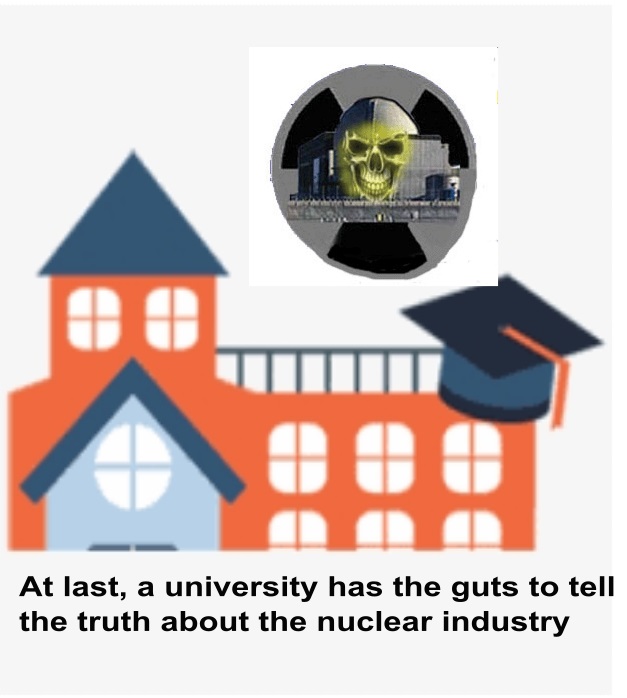
University of New Mexico Course Expands Understanding of Nuclear Impact
Mirage News, 28 Jul 23
New Mexico found itself at ground zero of a changed world on July 16, 1945 when scientists from the newly created Los Alamos National Laboratory detonated the world’s first atomic bomb, exposing nearby communities to radiation. Just 34 years later to the day, Church Rock, New Mexico became the site of the largest release of radioactive material ever to occur in the United States.
The impact of that history was something Bryan Kendall, who grew up in Albuquerque, hadn’t learned much about prior to enrolling in the Fall 2020 Nuclear New Mexico: Social and Environmental Impacts course at The University of New Mexico.
“It blew my mind that no one was talking about it. It drove a passion in me that has not subsided since,” Kendall said.
The course helped Kendall, who graduated earlier this year with a bachelor’s degree in mechanical engineering and a minor in sustainability studies, decide he would avoid working for an organization with an ongoing nuclear focus though he doesn’t fault those who do.
Though the name of the class has changed over time, the goal to provide critical, interdisciplinary nuclear education remains the same. Each course includes field trips to key sites around the state, guest speakers from organizations like the Tularosa Basin Downwinders Consortium and Tewa Women United, as well as a final project to apply learning to social or environmental justice.
Eileen O’Shaughnessy, an instructor and Ph.D. Candidate in Language, Literacy, and Sociocultural Studies with an emphasis on nuclear education, has taught the class for several years through Sustainability Studies, the Honors College, and this fall, Women and Gender Studies. Most recently, O’Shaughnessy co-taught with Associate Professor Myrriah Gómez, Ph.D., the author of the 2022 release Nuclear Nuevo México. Gómez has taught a similar course titled Atomic Bomb Cultures in the Honors College for many years. O’Shaughnessy’s upcoming course is titled The Atomic Bomb and Feminism and will explore topics like the hetero-patriarchal nuclear family, notions of apocalypse, anti-nuclear activism, environmental racism, nuclear colonialism, and more.
“I developed this class called Nuclear New Mexico based on my research that was a critical interdisciplinary look at the environmental, social, and cultural impacts of the nuclear industry, specifically on New Mexico, but also the world,” O’Shaughnessy said. “The beginning of the atomic age is located here, but it really rippled out from New Mexico.”
The class explores everything from uranium mining to the disposal and storage of radioactive materials and the outsized impact those processes have had on indigenous communities and communities of color.
…………………………………………….. O’Shaughnessy welcomes students from all disciplines into her class and has had many STEM and nuclear engineering students take the course……………………………………………………………………………………………………………………………. more https://www.miragenews.com/unm-course-expands-understanding-of-nuclear-1056101/
Survivors of Britain’s Cold War radiation experiments to have their stories recorded
Survivors of Britain’s Cold War radiation experiments are to have their
life stories recorded and stored in the British Library. The £250,000
scheme will lead to a documentary and resources to teach A-level students
about the Cold War and the impact the weapons testing programme had on the
men who took part in it, and their families.
Dr Chris Hill, one of the academics leading the project, said: “It’s about furthering their story, embedding it deeper in the public consciousness and confronting what is a
very problematic part of Britain’s history.”
Mirror 27th April 2023
https://www.mirror.co.uk/news/politics/nuclear-heroes-win-250000-documentary-29833221
The nuclear lobby continues to buy universities- University of Wyoming well and truly bought.

University of Wyoming Receives Faculty Advancement Grant From Nuclear Regulatory Commission
UW, April 21, 2023
The U.S. Nuclear Regulatory Commission’s (NRC) Office of Nuclear Regulatory Research recently announced the University of Wyoming has been selected for a Faculty Development Advancement Award as part of the NRC’s University Nuclear Leadership Program.
The award was announced in person by Commissioner Annie Caputo and Raymond Furstenau, director of the Office of Nuclear Regulatory Research from the NRC, at UW’s Research Explorations for Nuclear Energy in Wyoming (RENEW) event April 14.
“We are pleased to welcome the University of Wyoming as a NRC University Nuclear Leadership Program grant recipient,” Furstenau says. “The university’s proposal is exactly the type of activity we were aiming for with this grant program.”
The $600,000 award is intended to support new faculty in the nuclear-related fields of nuclear engineering, health physics and radiochemistry, and it advances the NRC’s goal of focusing on university-led projects that complement current and future research needs.
UW’s School of Energy Resources (SER) will augment the funding with an additional $100,000……………………… https://www.uwyo.edu/uw/news/2023/04/uw-receives-faculty-advancement-grant-from-nuclear-regulatory-commission.html
Nuclear and space lobbies increase their grip on universities, a new example in UK
Bangor University in Wales will develop a nuclear thermal fuel system to
support deep space exploration with funding provided by the UK Space
Agency. It is one of eight projects receiving a total of GBP1.6 million
(USD1.9 million) in funding through the agency’s Enabling Space Exploration
fund.
World Nuclear News 7th March 2023
https://www.world-nuclear-news.org/Articles/Welsh-university-to-develop-space-nuclear-propulsi
The extraordinary popularity of renewable energy university courses

The number of students on renewables-related courses in Scotland has
soared by 70% in four years, figures reveal. Scottish Renewables found that
22,000 undergraduates were studying subjects which cover the sector,
ranging from engineering to maths. The same survey in 2019 reported around
13,000 young people studying in similar areas. Scottish Renewables said it
demonstrated the attractiveness of the industry.
BBC 7th March 2023
Pentagon-Funded Plymouth University Cancels Anti-War Academic: the militarization of higher education.
Pentagon-Funded Plymouth University Cancels Anti-War Academic: Reflections on How the US Empire Conquered Higher Education, CouterPunch BY T.J. COLES 17 Feb 23,
The US Empire is in the final and most dangerous stages of its quest for what the Pentagon calls “full spectrum dominance.” Having invaded and fought proxy wars in the oil-rich Middle East, it is now trying to break nuclear-armed Russia in another proxy war before attempting “regime change” in nuclear-armed China. We need not tarry on the potential consequences. Professor Noam Chomsky called it 20 years ago: this is hegemony or survival. Which one do you choose?
As the Empire races towards its biggest bet, using humanity and all other species on the planet as gambling chips, anti-war comment is tolerated less and less. For those who want to know what happened to me, see the Annex of this article for the leaked emails and background. Meanwhile, consider what is taking shape.
DELETING THE ENEMY
Critics of Western imperialism are silenced by the Empire’s witting and unwitting minions in increasingly knee-jerk ways. Google, which was developed with CIA money, has de-ranked anti-war websites, driving traffic to state-corporate outlets that promote imperialism. After buying YouTube, it then went on a de-platforming spree, banning and de-monetizing “conspiracy theorists,” left and right, who dare deviate from the increasingly narrow orthodoxy of acceptable thought.
Under the new McCarthyism of RussiaGate, the US Federal Bureau of Investigation has used the pretext of countering foreign disinformation to suspend and terminate political accounts. In 2020, following an evidence-free CNN report alleging that it was a front for the sanctioned nation of Iran, the FBI and Department of Justice seized the US domain for the website of the American Herald Tribune, founded by Dr. Anthony James Hall, who retired from his Canadian university, Lethbridge, following pressure from the Zionist Lobby and from individuals who accused him of being a “conspiracy theorist”—a cheap smear tactic employed against me by a cabal of staff at Plymouth University.
Meanwhile, the Twitter Files have exploded the myth that “social media” are independent corporate actors. Likewise, journalist Dr. Alan Macleod has documented the dozens of former spies now employed to police content at Facebook.
SHAME IS THE GAME
The opinions of self-described fact-checkers—like the Poynter Institute—are amplified by state-corporate media which engage in public humiliation rituals in the hope that retailers will pull magazines, academic institutions will fire staff, digital providers will demonetize accounts, and web hosts will drop entire sites and/or content……….
As governments contract out censorship to “fact-checkers,” critics of Empire are demonetized. Consortium News and Mint Press have seen their PayPal accounts frozen. PayPal’s pro-Trump co-founder, Peter Thiel, has made many millions of dollars from Pentagon contracts. Between 2007 and ’19, US taxpayers gave his Palantir Technologies $1.5 billion via the Department of Defense, particularly to spy on Afghans and Iraqis.
ACADEMIC OBLIVION
The above examples show how the US military and intelligence continue to influence the infrastructure through which much of today’s information travels. Another target is academia. But how serious is the problem?……………………………………………………..
THE MILITARIZATION OF HIGHER EDUCATION
Universities serve a variety of purposes, one of which is the development of new weapons for the US military. In the past, white voices critical of Empire would be tolerated as long as their non-university work did not grind the gears of Empire. That’s how Professor Chomsky, for instance, was able to get arrested protesting mass murder in Vietnam while receiving Pentagon money to undertake his linguistics research.
The technological origins of “full spectrum dominance” can perhaps be traced back to the outgoing Reagan and incoming George H.W. Bush administrations, under whom the Pentagon founded the Multidisciplinary University Research Initiative to further integrate with education and develop tools for things like the so-called Star Wars program (Strategic Defense Initiative). One consequence is that higher education became significantly influenced—maybe not full-spectrum dominated—by the eternal war machine.
By 2015, the Department of Defense (DoD), which in more honest times was called the Department of War, was investing $250 million of taxpayer money in universities. In that year, the DoD decided to look for international partners, of which the Britain was a natural first-choice. The Pentagon’s Basic Research Office Director, Robin Staffin, said: “we decided it was time to formalize cooperation between the U.S. and the U.K.”
DARPA is the Pentagon’s taxpayer-funded innovation arm. It used to stand for the Advanced Projects Research Agency, but PR experts realized that they’d better prefix it with the word “Defense.” In 2016, venture capitalist-turned-DARPA Director, Arati Prabhakar, said: “DARPA is reliant on research universities as one part of this huge ecosystem … [We] draw from the deep foundational research, almost always at places like great universities.”
For instance, the DoD recently said that the universities of Alabama-Huntsville, Florida International, Texas A&M Engineering Experiment Station, and others, have received funding to develop solutions for—are you ready?—“monitoring the health and status of hypersonic aeroshells” (heat shields for space systems, which are core elements of “full spectrum dominance.” The “health and status” of ordinary Americans, who still don’t have free coverage, is less important). Other projects include thermodynamic ducts for hypersonic vehicles sponsored by the usual suspects, like Boeing and Lockheed Martin.
FUNDING PLYMOUTH UNIVERSITY: DARPA’S DRIVE…………………………………………………
CONCLUSION
As universities continue designing weapons of mass murder, thought criminals in Western countries continue to face deplatforming and public shaming. Are their personal fates as severe as those of dissident academics in US-UK-supported regimes, like Saudi Arabia? Of course not. But that is not the point. An obvious chilling effect is created in which scholars striving for social justice and indeed the survival of the planet are silenced. The witting an unwitting minions of Empire are too obtuse to realize that by issuing penalties for expressing opinions, those penalties may one day be imposed upon them.
ANNEX (HISTORY, EMAIL EVIDENCE, REBUTTAL):
MY STORY……………………………………………………………………………….as I have lost my University position as a result of my political views, it is worth considering exactly what I write for Nexus (article by article) and that my articles give a left-wing voice to the so-called conspiracy research community, which is often dominated by right-wingers and apolitical people.
As one can see below, the bulk of my work for Nexus consists of critiques and exposés of US military and intelligence agencies. …………………………………………………………
T. J. Coles is director of the Plymouth Institute for Peace Research and the author of several books, including Voices for Peace (with Noam Chomsky and others) and Fire and Fury: How the US Isolates North Korea, Encircles China and Risks Nuclear War in Asia (both Clairview Books). https://www.counterpunch.org/2023/02/17/pentagon-funded-plymouth-university-cancels-anti-war-academic-reflections-on-how-the-us-empire-conquered-higher-education/
Physicists push for nuclear science education. Their environmental colleagues not so sure
‘Cherish’ the power: Physicists issue call to arms over nuclear skills gap

Associate Professor Tilman Ruff, founder of the Nobel prize-winning International Campaign to Abolish Nuclear Weapons, said he feared the nation’s universities were becoming “academic prostitutes” for the nuclear industry – particularly firms that make nuclear weapons.
“The organisations that have historically funded nuclear research at universities have been those with interests in either uranium mining and nuclear power, or nuclear weapons. That’s the problem. There’s not big amounts of money in the more socially constructive areas.”
https://www.smh.com.au/national/cherish-the-power-physicists-issue-call-to-arms-over-nuclear-skills-gap-20221228-p5c92s.html By Liam Mannix, December 28, 2022
Australia’s physicists say we must learn to cherish nuclear science and invest in training a new generation of experts to run satellites, quantum computers and submarines.
But their colleagues in environmental science are wary of what such an investment might produce.
Australia’s physicists say we must learn to cherish nuclear science and invest in training a new generation of experts to run satellites, quantum computers and submarines.
Australia has committed to buying or building a fleet of American or British-designed nuclear submarines, with the first expected to be in the water late next decade.
They will probably require a crew and workforce of nuclear engineers, technicians and scientists – but Australia lacks a civil nuclear industry.
The nation is already struggling to fill key nuclear safety positions, let alone produce a new workforce, says Dr AJ Mitchell, senior lecturer in the Australia National University’s Department of Nuclear Physics and Accelerator Applications.
“The need is urgent. The captain of our first nuclear submarine is probably already in secondary school today,” he said. “This must be a sovereign capability. And it needs to start yesterday.
“We need to make people understand that ‘nuclear’ is not something to be scared of, but rather to cherish and appreciate.”
Mitchell is leading the development of a national vision for nuclear science, a project launched this month at the Australian Institute of Physics Congress in Adelaide. The strategy includes a national program of nuclear science education.
Nobel laureate and Australian National University vice-chancellor Brian Schmidt made waves last month when urged Australia not to “drag its feet” on the nuclear submarines issue.
The boats represented “one of the biggest training and workforce development challenges Australia has faced”, he said.
That warning adds to pre-existing concerns about the training of engineering and science graduates generally.
Australia has been slowly increasing its number of new engineers, but most of the workforce growth is from overseas labour, according to a report by Engineers Australia.
Fewer students are studying advanced mathematics or physics in year 12, while applications for engineering courses at university fell between 2010 and 2015. Australia has the third lowest number of engineers as a proportion of graduates among developed countries.
Changes to the way engineering courses are funded led the Group of Eight – a coalition of the country’s top research universities – to declare this year that the Australian model for the university education of engineers was “broken” and could not deliver enough skilled engineering graduates to meet the government’s infrastructure investment.
But not all scientists share a conviction that nuclear physics and engineering need investment.
“There is already controversy about the nuclear submarines deal, and anxiety in our region about some sort of arms race and nuclearisation,” said Associate Professor Peter Christoff, a climate policy researcher at the University of Melbourne and former assistant commissioner for the environment in Victoria.
“Significant funding for research into nuclear physics and engineering would send precisely the wrong signals to our regional neighbours and increase their anxieties that what we’re seeing is precisely the start of that nuclear arms race.”
Associate Professor Tilman Ruff, founder of the Nobel prize-winning International Campaign to Abolish Nuclear Weapons, said he feared the nation’s universities were becoming “academic prostitutes” for the nuclear industry – particularly firms that make nuclear weapons.
“The organisations that have historically funded nuclear research at universities have been those with interests in either uranium mining and nuclear power, or nuclear weapons. That’s the problem. There’s not big amounts of money in the more socially constructive areas.”
1 This Month

of the week – Shut Down Drone Warfare!


Tell the Ukrainian Government to Drop Prosecution of Peace Activist Yurii Sheliazhenko

Petition to revoke the licensing of the Near Surface Nuclear Disposal Facility (NSDF) at Chalk River. https://www.ourcommons.ca/petitions/en/Petition/Details?Petition=e-7247
To see nuclear-related stories in greater depth and intensity – go to https://nuclearinformation.wordpress.com
-
Archives
- March 2026 (237)
- February 2026 (268)
- January 2026 (308)
- December 2025 (358)
- November 2025 (359)
- October 2025 (376)
- September 2025 (257)
- August 2025 (319)
- July 2025 (230)
- June 2025 (348)
- May 2025 (261)
- April 2025 (305)
-
Categories
- 1
- 1 NUCLEAR ISSUES
- business and costs
- climate change
- culture and arts
- ENERGY
- environment
- health
- history
- indigenous issues
- Legal
- marketing of nuclear
- media
- opposition to nuclear
- PERSONAL STORIES
- politics
- politics international
- Religion and ethics
- safety
- secrets,lies and civil liberties
- spinbuster
- technology
- Uranium
- wastes
- weapons and war
- Women
- 2 WORLD
- ACTION
- AFRICA
- Atrocities
- AUSTRALIA
- Christina's notes
- Christina's themes
- culture and arts
- Events
- Fuk 2022
- Fuk 2023
- Fukushima 2017
- Fukushima 2018
- fukushima 2019
- Fukushima 2020
- Fukushima 2021
- general
- global warming
- Humour (God we need it)
- Nuclear
- RARE EARTHS
- Reference
- resources – print
- Resources -audiovicual
- Weekly Newsletter
- World
- World Nuclear
- YouTube
-
RSS
Entries RSS
Comments RSS
 nuclear-news