South Africa: leaked report shows Zuma government’s secret plans for nuclear power
 GORDHAN’S LEAKED REPORT DETAILS BEHIND-THE-SCENES PLAN TO PROCURE NUCLEAR ENERGY https://ewn.co.za/2018/11/08/gordhan-s-leaked-report-details-behind-the-scenes-plot-to-procure-nuclear-energy– Lindsay Dentlinger 9 Nov 18 Former President Jacob Zuma was insistent the country needed to enter into a nuclear deal. CAPE TOWN – Public Enterprises Minister Pravin Gordhan has detailed the behind-the-scenes machinations for government to procure more nuclear energy.
It’s contained in a statement that Gordhan is expected to deliver to the Zondo Commission of Inquiry into state capture next week.
It was leaked to the media overnight.
In it, Gordhan says former President Jacob Zuma was insistent the country needed to enter into a nuclear deal.
As the Finance Minister at the time, Gordhan says he warned Zuma that the process had to be above board to avoid another arms-deal scandal.
Gordhan says it was at a meeting at the presidential residence with Zuma and one of his advisors Senti Thobejane in 2013, that the former president made it clear he wanted South Africa to procure nuclear power.
Gordhan says he was not told ahead of the meeting what would be discussed, but he impressed on Zuma that costs, choice of supplier, due process and likely challenges should all be considered.
He says Treasury raised concerns with a draft agreement with Russia because of the firm fiscal commitments it aimed to enforce.
During his tenure as Finance Minister, Gordhan says Treasury officials insisted that proper evaluations of the true cost of nuclear power, and financial risks to the country be carried out.
He says once he was moved to the portfolio of Cooperative Governance, he was no longer privy to discussions around the nuclear deal.
Gordhan says he was also not present at the Cabinet meeting in December 2015 when the deal was approved.
But he points out that it was on the same day that Zuma announced Gordhan’s successor as Finance Minister, Nhlanhla Nene, would be replaced by Des van Rooyen. A move that sent markets and the local currency into a tailspin and culminated in Gordhan’s reappointment to the post just three days later.
(Edited by Zamangwane Shange)
Did Hungarian nuclear authorities fudge the measurement of water heating at Paks nuclear plant ?
 Police investigation into overheated river at Paks NPP after report by MEP Benedek Jávor, ATLATSZO English OROSZI BABETT by Babett Oroszi Police investigation into overheated river at Paks NPP after report by MEP Benedek Jávor, ATLATSZO English OROSZI BABETT by Babett OrosziEnglish version by Zsuzsanna Liptákné Horváth. 1 Nov 18 You can read the original, Hungarian-language story here. Hungarian police are investigating whether the water in the river Danube was warmer than 30 degrees at the Paks nuclear plant during the August heatwave. According to Hungarian regulations, if the water temperature reaches that point, the nuclear plant has to be shut off. It was not, but there is a suspicion that water temperature did reach 30 degrees. Hungarian MEP Jávor Benedekfiled a report at the police and now the case is being investigated.According to measurements by Átlátszó and Energiaklub, the temperature of the river Danube reached 30 °C during the August heatwave, exactly where the Paks nuclear plant’s cooling water enters the river. According to a 2001 government decree, the Paks nuclear plant must cease operations for environmental reasons if the temperature of the Danube reaches 30 °C anywhere in the 500 meters following the point where the cooling water is deposited into the river. The nuclear plant’s official thermometer never measured more than 30 °C in August, therefore the power plant or any of its blocks were not shut off. Concerned about the river’s ecosystem, MEP Benedek Jávor requested a police investigation. The first step that led to the current investigation was when Átlátszó and Energiaklub, a Hungarian NGO, measured the water temperature in August. Energiaklub had requested the official data about the river’s temperature before, filing a freedom of information request. However, during the time of the heatwave Paks stopped announcing their official data. Átlátszó’s group of experts had assumed that the temperature of the water rose above 30 °C. To prove this, and to protect wildlife in the river, we traveled to Paks and measured the water temperature. Before the point of entry of the nuclear plant’s cooling water, we measured 25-26 °C. Downstream, however, within 500 meters from the cooling water’s entry point, we measured above 30 °C at multiple locations. We took a video of the process and published an article about our unofficial data. These show that at every single location downstream where we measured the river’s temperature, it exceeded the 30 °C. The official numbers and Átlátszó’s findings do not match……… more https://english.atlatszo.hu/2018/11/01/police-investigation-into-overheated-river-at-paks-npp-after-report-by-mep-benedek-javor/ |
|
|
Former SCANA accountant tells how nuclear financial document was “doctored”
 SCANA accountant says CEO put her on medical leave over complaints about nuclear project, Independent Mail, COLUMBIA — In newly unsealed documents, a former SCANA employee says the utility’s then-chief executive, Kevin Marsh, put her on “special medical leave” after she went to him with concerns about a failing, $9 billion nuclear project.
Carlette Walker, once SCANA’s vice president of Nuclear Finance Administration, also testified that, in 2015, her bosses filed misleading testimony under her name with state regulators about how much the V.C. Summer Nuclear Station expansion project would cost.
Carlette Walker, once SCANA’s vice president of Nuclear Finance Administration, also testified that, in 2015, her bosses filed misleading testimony under her name with state regulators about how much the V.C. Summer Nuclear Station expansion project would cost.
“While I was out, they wrote testimony under my name, and they filed testimony under my name with the (lower cost) number that I had fought against,” Walker said in an April 24 deposition.
Walker’s full sworn statement — parts had been released before with sections blacked out, or redacted — was made public Thursday as the S.C. Public Service Commission began its weeks-long hearing into the nuclear-related power rates of SCE&G, SCANA’s electric subsidiary.
A spokesman for SCE&G said the utility would not comment except during the PSC hearing.
Previously, most of the pages of Walker’s 187-page deposition had been at least partially blacked out at SCE&G’s request. However, PSC hearing officer David Butler ruled Wednesday the entire document should be made public.
In her deposition, Walker said she had projected the cost to finish the floundering project was about $500 million higher than contractors had estimated. But, she said, her SCANA bosses submitted the contractors’ lower numbers — which she considered unrealistic — to regulators in her name while she was out of work on leave, taking care of her sick husband.
Another former SCE&G employee, Ken Browne, said in his deposition the contractor’s cost projections were based upon productivity rates that V.C. Summer construction workers never had attained. Work was going so slowly, the project could have taken far longer — until 2030 — to complete, Browne said.
According to Walker’s deposition, when Browne objected internally to SCE&G using the lower cost submitted to the PSC, under Walker’s name, he was “pretty much cussed out by (SCE&G outside attorney) Mitch Willoughby and put in his place, and so he just shut up.”
In the formerly redacted portions of her deposition, Walker said she went to both then-SCANA CEO Marsh and current CEO Jimmy Addison — then the company’s chief financial officer — with concerns about the nuclear project in the fall of 2015………. https://www.independentmail.com/story/news/2018/11/02/v-c-summer-nuclear-station-fiasco-scana-accountant-put-leave/1856615002/
Hackers accessed confidential documents about nuclear plants

 Hackers obtain nuclear power plant plans in France, DW, 2 Nov 18 Hackers have accessed confidential documents about nuclear plants and prisons in a cyberattack on a French firm, media reported. Some of the data was found on a rented server in Germany, according to the reports.
Thousands of sensitive documents pertaining to nuclear power plants, prisons and tram networks have been stolen from the servers of a French company in a cyberattack, German and French media have reported Friday.
The data illegally accessed from the French company Ingerop back in June amounted to more than 65 gigabytes, according to reports by German public broadcaster NDR, the daily Süddeutsche Zeitung and French newspaper Le Monde.
A spokeswoman from Ingerop quoted by NDR said more than 11,000 files from a dozen projects were obtained. They were said to include plans showing the planned locations of video cameras for a French high-security prison, documents about a planned nuclear-waste dump in northeastern France and personal information on more than a thousand Ingerop workers.
Some of the documents were connected with the Fessenheim nuclear plant on the border to Germany, reports said………https://www.dw.com/en/hackers-obtain-nuclear-power-plant-plans-in-france/a-46126878
Turkish President Recep Tayyip Erdogan to reveal evidence of Khashoggi murder “in all its nakedness.”

 World Awaits ‘Naked’ Truth on Saudi Killing https://www.bloomberg.com/news/articles/2018-10-22/world-awaits-naked-truth-on-saudi-killing, By Glen Carey, October 22, 2018, If Saudi leaders expected a reprieve from their account of how journalist and critic Jamal Khashoggi was killed in their Istanbul consulate, they’re likely to be sorely disappointed.
While President Donald Trump, a steadfast Saudi ally, defended de facto ruler Crown Prince Mohammed bin Salman, he said the explanation had been marked by “deception and lies.’’ Bipartisan members of the U.S. Congress said it lacked credibility. France demanded more information, while Germany suspended arms sales.
Even Saudi Foreign Minister Adel al-Jubeir called Riyadh’s attempt to cover up the murder “a tremendous mistake,” though he stuck to the government’s line that Khashoggi, a Washington Post columnist, died after “discussions” turned violent.
Western leaders are balancing concerns about his death with their strategic interests. Treasury Secretary Steven Mnuchin said the U.S. will continue its relationship with the world’s largest oil supplier, a major weapons buyer, while trying to “get to the bottom of what the facts are.”
Now the focus shifts to Turkish President Recep Tayyip Erdogan, who’s promised to reveal tomorrow what happened to Khashoggi “in all its nakedness.” If he provides credible evidence that differs from the kingdom’s description, pressure to hold Saudi Arabia’s senior leadership accountable will intensify.
USA nuclear regulators plan to reclassify Hanford High Level Nuclear Waste (HLW) as Low Level Wastes (LLW)
Regulators Discuss New Plans For Nuclear Waste At Hanford https://www.opb.org/news/article/hanford-nuclear-waste-plans-portland-oregon-meetings/, by Cassandra Profita Oct. 15, 2018 Federal and state energy regulators will hold back-to-back meetings in Portland on Tuesday for a proposal to reclassify some of the high-level nuclear waste at the Hanford Site in Washington.
The proposal has major implications for the nuclear waste that remains in Hanford’s storage tanks.
In recent years, the U.S. Department of Energy has been working to retrieve the nuclear waste left in storage tanks, and in one area known as C-Farm, they’ve removed as much as they can get.
“But there is some amount they were not able to get,” said Jeff Burright, nuclear waste remediation specialist with the Oregon Department of Energy. “And that equates to approximately 70,000 gallons of waste.”
The Energy Department wants to downgrade that remainder to “low-level radioactive waste,” so they can leave it in place and fill the tanks with grout. The area would then be sealed off to prevent the waste from migrating.
It’s the first step in a long closure process for about 10 percent of the storage tanks on the site. But the Oregon Department of Energy has raised concernsthat federal officials are moving too quickly. The state has filed public comments asking federal officials to do additional reviews before making any decisions.
“The movement of waste through the Hanford environment is a very complex process that we’re still trying to fully understand,” Burright said. “Despite their best efforts, there are still uncertainties over very long time scales that could represent future risk.”
Burright said closing the tanks could prevent the future removal of the 70,000 gallons of remaining waste should new technologies emerge. Plus, he said, there may be additional risks stemming from the million gallons of waste that have already leaked or spilled into the ground underneath the tanks on the site.
The Oregon Department of Energy is holding its own informational meetingon the issue at 6:30 p.m. after the U.S. Department of Energy’s informational meeting from 3-5 p.m. in Portland on Tuesday. Both meetings will be held at the same location, the Eliot Center at the First Unitarian Church, 1226 SW Salmon St.
The nuclear industry’s deceptive narrative about Fukushima earthquake in March 2011
The status of “Station Blackout” is a serious one.
“it will be many years before the Japanese people know exactly what happened at Fukushima Daiichi on 11 March 2011. One of the key mysteries was role, if any, the magnitude 9 earthquake played in damaging the plant’s reactor cooling systems. Until lethal levels of radiation inside the reactors fall and workers can carry out comprehensive investigations, the truth about the tremor’s impact will remain a subject of conjecture and contention”
Mr. Takamatsu states with expert authority that the pipes of cooling system ware not designed for the 50 second vibration of the magnitude quake. Barry Brook, kangaroo expert, disagrees and tells the world the quake caused no damage at Fukushima. Yet Mr. Brook must surely know the earthquake caused grid blackout. For reactors are all shut down by earthquakes. A solar plant would have kept generating until the last panel shattered. No one would have been evacuated from such a solar plant.
I submit that Prof. Barry Brook’s description of the effects of earthquake upon the Fukushima Diiachi on 11 March 2011 is totally ignorant of the facts as presented by many qualified experts and fly in the face of the independent commission set up by the Japanese Parliament (Diet). It is confirmed that expert investigators concern aspects of TEPCO’s explanations regarding the quake are “irrational”.
Thus any narrative based upon the nuclear industry view, in line with TEPCO’s may fairly be said to be “irrational”. For the industry view is that there is no possibility of quake damage to any structure or sub structure, such as coolant pipes and valves.
Earthquake Damage At Fukushima – is Industry’s Narrative Truthful or Certain? Nuclear History, 16 Oct 18 I am again going to contrast the statements made by Barry Brook in regard to the events and outcomes at Fukushima Daiichi in 2011 with the facts as presented by Mark Willacy. These facts are published in Willacy’s book, “Fukushima – Japan’s tsunami and the inside story of the nuclear meltdowns”, Willacy, M., Pan Macmillan, copyright 2013, Mark Willacy.
However, I will also include information related to the events which were first published and discussed in 2011. ………..
The earthquake generated the tsunami. What else did the earthquake cause?
In this blog I have included posts which give the IAEA considerations for the electrical grids which are connected to nuclear power plants. The IAEA states that the level of engineering and resilience built into such grids may be a significant additional cost for any nation considering generation to nuclear power.
It comes as no surprise then the electrical grid connected to the Fukushima Daiichi NPP failed for two reasons. 1. The earthquake caused all the nuclear reactors connected to the same grid to rapidly shut down. Thus the earthquake caused a blackout due to cessation of electrical generation. 2. The physical grid infrastructure – poles and wires – were damaged by the earthquake. At Fukushima this meant that more than one of the reactors was physically separated from the grid by the earthquake.
It can therefore be seen that the earthquake meant A. Fukushima Diiachi could not generate nuclear electricity as the quake had shut the reactors down. B. The Fukushima Diiachi Nuclear Power Plant was in Station Blackout for one reason: earth quake damage to nuclear infrastructure – the electrical grid. Continue reading
Donald Trump’s priority is profit from weapons sales to Saudi Arabia: murder of Washington Post journalist is irrelevant
 America deserves to know how much money Trump is getting from the Saudi government, His corruption is a national security issue. VOX, By A foreign government — an American ally, no less — can’t just murder a US resident with impunity while he’s on the soil of a NATO member state because they didn’t like his newspaper columns.
And yet that seems to be exactly what President Donald Trump wants to let Saudi officials do, explaining to reporters on Thursday that he does not want to respond to the murder of Washington Post columnist Jamal Khashoggi because “I don’t like stopping massive amounts of money coming into our country” and “I don’t like stopping an investment of $110 billion in the United States.”………. Why is Trump so willing to let the Saudis slide? Is Trump getting paid by Saudi Crown Prince Mohammed bin Salman, a.k.a. MBS, and the Saudis? Is his son-in-law, Jared Kushner? Normally, these would be absurd questions to raise about a president. But they are serious. Trump has commented before on his business ties to Saudi Arabia, bragging at a campaign rally in Alabama about how much business he did with Saudi interests. And he’s never fully aired the extent of his vast business and financial ties. Now, as the White House is preparing to make policy (or not) in a crucial moment, how can the public have any confidence that the president isn’t just looking out for his own interests and not the country’s?………..https://www.vox.com/policy-and-politics/2018/10/12/17964884/trump-saudi-money-khashoggi |
|
Energy firm with alleged Trump ties wants Memphis Light, Gas and Water to switch to unfinished nuclear power plant
Energy firm with alleged Trump ties wants MLGW to ditch TVA for its unfinished nuclear plant, Biz Journals By Samuel Hardiman – Staff Reporter, Memphis Business Journal, 10 Oct 18
Nuclear Development LLC said MLGW could save $400 million annually if it purchases power from the Bellefonte Nuclear Generating Station instead of from the TVA.
The plant in the north Alabama town of Hollywood could be complete by 2024 if the company receives the federal funding it’s seeking……….
Franklin Haney, a Chattanooga developer who is a principal with Nuclear Development, has come under scrutiny after allegedly offering President Donald Trump’s former associate, Michael Cohen, $10 million if he could help Haney land the federal loan.
MLGW is one of TVA’s largest customers. It accounted for 10 percent of the power provider’s operating revenues in 2017, according to filings with the Securities and Exchange Commission. https://www.bizjournals.com/memphis/news/2018/10/09/energy-firm-with-trump-ties-wants-mlgw-to-leave.html
SCANA kept quiet about a ‘potential fraud’ at SC nuclear project.
SCANA execs uncovered ‘potential fraud’ at SC nuclear project. They didn’t tell the cops. By Andrew Brown abrown@postandcourier.com, Oct 8, 2018 COLUMBIA — SCANA’s executives in 2015 learned about a million-dollar bid-rigging scheme during the construction of their South Carolina nuclear project but never reported the discovery to state and federal law enforcement officials.
Rather, they kept the matter quiet to avoid negative publicity about the project, according to a source with direct knowledge, avoiding unwanted attention from regulators and the public.
The alleged fraud highlights the secrecy that SCANA’s leaders cloaked the failed $9 billion project in over the past decade. The previously undisclosed episode has come to light amid continued debate about why the project failed and who is responsible.
Documents show SCANA’s employees confirmed Compuworld, a company based in Lexington County, undermined the purchasing rules for the V.C. Summer nuclear expansion project in order to win contracts to supply office furniture.
An investigation by SCANA’s corporate compliance office showed Alan Saleeby, Compuworld’s owner, submitted bids for his business and allegedly forged the applications for two other companies — allowing him to rake in money while making the purchases look competitive.
SCANA hired attorneys from Atlanta to complete background checks on all of the people involved in the scheme. They studied whether the utility had to report the questionable purchases under federal nuclear oversight regulations. And they considered “possible civil and criminal fraud claims” against Chicago Bridge and Iron, the contractor that approved the purchases.
News of the suspicious activity traveled quickly to SCANA’s top executives as the company’s leaders worked behind the scenes to fix other aspects of the struggling power project. One of the nuclear project’s top executives flagged the case for SCANA’s nuclear chief Jeff Archie. In an email, the executive described the purchases as “potential fraud.”
…….. the allegations leveled against Compuworld mark the most serious issue yet with the purchasing process at V.C. Summer — a project now considered the biggest economic failure in state history.
SCANA inadvertently disclosed its investigation into Compuworld earlier this year in legal bills it filed with the state Public Service Commission. But since then, SCANA’s attorneys have fought to keep other emails and documents about the investigation secret.
Eric Boomhower, SCANA’s spokesman, confirmed that the utility quietly settled the issue with Chicago Bridge and Iron in late 2015. He described the investigation into Compuworld as a “financial dispute.”
SCANA’s investigators referred to it simply as fraud.
……… The investigation became more serious when SCANA discovered evidence that Saleeby also was submitting bids for companies that were purportedly competing against Compuworld. Email addresses and the handwriting on some of the documents showed Saleeby was personally filing the other offers, too, guaranteeing that Compuworld came out on top……… https://www.postandcourier.com/business/scana-execs-uncovered-potential-fraud-at-sc-nuclear-project-they/article_0eb5960a-c63b-11e8-a6a0-cf8c595ea1ed.html
| ReplyForward |
“Transparency”- the Trump administration’s dirty trick to strangle access to reputable science on nuclear radiation
 Yes, radiation is bad for you. The EPA’s ‘transparency rule’ would be even worse. The Trump
  administration wants to strangle access to reputable science. https://www.washingtonpost.com/outlook/2018/10/08/yes-radiation-is-bad-you-epas-transparency-rule-would-be-even-worse/?noredirect=on&utm_term=.b7e530a79729 By Audra J. Wolfe, 8 Oct 18 Audra J. Wolfe is a Philadelphia-based writer, editor, and historian. She is the author of Freedom’s Laboratory: The Cold War Struggle for the Soul of Science.
Last Tuesday, a headline from the Associated Press sparked outrage in the ordinarily quiet world of science policy. The Environmental Protection Agency, the story suggested, was considering relaxing guidelines for low-dose ionizing radiation, on the theory that “a bit of radiation may be good for you.” Within hours, the AP had issued a correction. As it turned out, the EPA was not, after all, endorsing hormesis, the theory that small doses of toxic chemicals might help the body, much like sunlight triggers the production of vitamin D.
Instead, the EPA was doing something much scarier: It was holding hearings on the “Transparency Rule,” which would restrict the agency to using studies that make a complete set of their underlying data and models publicly available. The rule is similar to an “Open Science” order issued by the Interior Department last month, and incorporates language from the HONEST Act, a bill that passed in the House in 2017 but later stalled in the Senate. The HONEST Act originally required that scientific studies provide enough data that an independent party could replicate the experiment — which is simply not realistic for large-scale longitudinal studies.
Although these rules cite the need to base regulatory policy on the “best available science,” make no mistake: They aim to strangle access to reputable studies.
The Transparency Rule continues the Trump administration’s pattern of anti-science policies. The White House’s Office of Science and Technology Policy is a ghost town, with most of the major positions, including the director’s post, vacant since January 2017. Agencies and departments across the board, including the State Department and the Agriculture Department, are dropping their science advisers and bleeding scientific staff. It’s getting harder and harder for federal rulemakers to access expertise.
Understanding what’s wrong with “transparency,” at least as defined by these policies, requires a closer look at how scientists work. Let’s say you’re trying to understand the health effects of a one-time, accidental release of a toxic chemical. This incident might be epidemiologists’ only chance to investigate how this particular chemical interacts with both the air and the humans who breathe it, at varying doses, over a period of time. No matter how careful your approach, your study would fall short of the replicability standard.
You wouldn’t have baseline health information for the specific people who happened to be in the area. You might not have information on which residents had air filtration systems installed in their homes, or which residents were working outside when the incident took place. Your early results would, by definition, reflect only short-term health outcomes, rather than long-term effects. And you couldn’t replicate the study (with better controls) without endangering the health of thousands of people. In such cases, scientists have to extrapolate from existing, sometimes imperfect, data to protect the public.
Epidemiologists have community standards, including peer review, to evaluate these kinds of studies. A careful, peer-reviewed study of this hypothetical incident might well represent the “best available science” on this particular chemical. Regulators might rely on this study to establish the permissible levels of this chemical in the air we breathe. But now, let’s also say that this study took place 30 years ago. The leading scientists involved are dead, and no one kept their files. The raw data are, effectively, lost. Should scientists at the EPA be blocked from using the study?
Despite what made last week’s headlines, the EPA’s Oct. 3 hearing went beyond radiation. In fact, its lead witness, University of Massachusetts toxicologist Edward Calabrese, barely mentioned his theory of radiation hormesis. Instead, his testimony argued that the EPA should no longer rely on linear no-threshold (LNT) models for any number of hazards, including toxic chemicals and soil pollutants. In toxicology, LNT models assume that the biological effects of a given substance are directly connected to the amount of the exposure, with no minimum dose required. Radiation protections standards are based on LNT models; so are basic regulations involving ozone, particulate pollution, and chemical exposure.
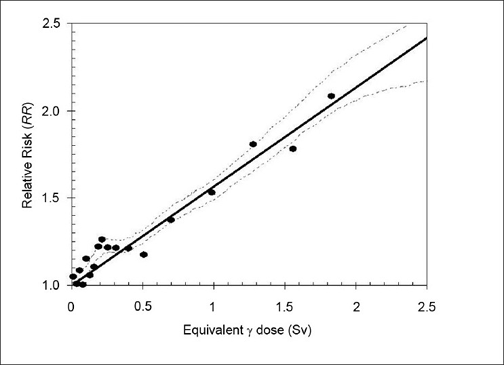
The original studies asserting a LNT model for low-dose ionizing radiation were conducted in the 1950s. Like our hypothetical epidemiologist investigating a toxic chemical release, the geneticists who tried to understand the biological effects of atomic radiation were working with imperfect data, much of which is no longer available. The concept of a “comprehensive data management policy” simply did not exist in 1955. These particular studies were primarily based on survivors of the atomic bombing of Hiroshima and Japan. The scientists also extrapolated from high-dose exposure data in fruit flies and mice and from unethical high-dose experiments conducted on humans.
These studies are imperfect, but focusing on their limitations misses the broader scandal. These studies took place during the heyday of atmospheric nuclear weapons testing, an era when both the United States and the Soviet Union were pumping the atmosphere full of radioactive nucleotides. Some of the areas near the testing zones received so much radiation that they are still uninhabitable today. The tests coated the entire planet with a scrim of radiation. The Atomic Energy Commission, the agency in charge of the United States’ nuclear weapons program, didn’t even attempt to investigate the potential health effects of this constant, low-dose exposure to ionizing radiation on the world’s population. Studies of low-dose radiation were expensive, inconvenient, and politically risky, potentially jeopardizing the weapons testing program and therefore the United States’ ability to fight the Soviet Union. From the government’s perspective, it was better not to know.
This week, a sensational headline distracted us from a broader crisis. Without government support for research of environmental hazards, the public’s health is left to either the whims of industry researchers, who have a strong incentive to play down their dangers, or to public advocacy groups, which are too easily smeared with charges of anti-industry bias. The “transparency” movement supposedly resolves this crisis of authority by giving the public access to the underlying data on which science is based, but it ignores the power dynamics that determine which research questions get asked, and why and how they’re answered.
In the past, Americans looked to their federal science agencies and science advisers to resolve these sorts of disputes. But a few weeks ago, the EPA announced that it, too, would be eliminating its Office of the Science Adviser. With the science offices empty, who will decide?
There is one bright spot in all of this: On Sept. 28, bipartisan legislation authorized the Energy Department to restart its low-dose radiation research program. But what about the other pollutants that the EPA supposedly regulates? Who will produce the kinds of science deemed acceptable under the “transparency” rule?
“Transparency” has become another way to cultivate institutional ignorance. Americans deserve better from the agencies that are supposed to protect them. In the case of environmental hazards, what you don’t know can hurt you.
Nuclear corruption: former South African government planned to conceal costs on nuclear plan
 State was willing to lie to SA over costs of Zuma’s nuclear plan, City Press News 24
Cabinet also decided to go ahead with the nuclear power deal on the grounds of hopelessly incorrect and over optimistic “facts” that the energy department presented to Cabinet – such as an assumption that the exchange rate would stay at R10 a dollar.
A top secret Cabinet notice and accompanying memorandum – which have now been declassified and were handed to the state capture commission last week, revealed for the first time how close South Africa was on the edge of an economic crisis, and how desperate Zuma and his cronies were to push through the nuclear power deal.
Last week, Finance Minister Nhlanhla Nene told the commission investigating the extent of state capture how Zuma chastised him because he wasn’t making quick enough progress over the nuclear deal.
During a state visit to Russia in July 2015, then minister of energy Tina Joemat-Pettersson wanted Nene to sign a one-page agreement.
It was a letter addressed to the Russian authorities, Nene said, adding that he couldn’t remember the precise details of the letter but he remembered that it effectively gave a guarantee to the Russian authorities over the nuclear programme, if they agreed to finance it.
Nene refused to sign it because it would have been catastrophic for the country, he said.
Zuma wasn’t impressed, because he wanted to be able to present something to President Vladimir Putin when they met.
A few months later, Joemat-Pettersson’s department was still forging ahead with the project, despite warnings from Treasury.
On December 9 2015, the day Cabinet approved the nuclear deal, Nene recalled been summoned into a meeting with then president Zuma. It lasted less than five minutes and he was informed that he was being removed from his role as finance minister.
He was replaced by Des van Rooyen, which set off a spiral of uncertainty for the markets.
The secret Cabinet notice showed that the government wanted to downplay the cost implications of the deal. Prices should not be communicated prior to the procurement process being completed, it said, and if any communication was to be done around the costs of the programme, it was decided to talk about the low end of the range……..
The numbers show that nuclear would have ruined South Africa
A nuclear engineer from a large Western nuclear power company, who also tendered for the project, told Rapport that the numbers were completely unrealistic.
The number of $2500 a kilowatt was from nuclear power stations being built in Asia – mainly China and Korea. It would be unrealistic to think that it would be possible to build a nuclear power station in South Africa at such a low price, he said.
“In South Africa, if everything goes according to plan, you could bank on it costing about $5000 per kilowatt,” he said.
Both the engineer and Serfontein said that, under the best circumstances, the project would cost more than R1 trillion.
If Cabinet had gone ahead with this binding agreement, it would have ruined South Africa financially, they both said………
At that time it was widely known that the Russian state-owned nuclear power company, Rosatom, would be the preferred bidder because Joemat-Pettersson had signed a framework agreement with Rosatom more than a year before, on September 22 2014, that would make the Russians the sole supplier for South Africa’s nuclear power programme.
Last year, the High Court set aside this agreement and framework agreements with other countries. https://city-press.news24.com/News/state-was-willing-to-lie-to-sa-over-costs-of-zumas-nuclear-plan-20181008
Federal indictment alleges that Russian military targeted USA nuclear company Westinghouse
|
Indictment: Russian military targeted Pa. nuclear power company, witf news, by Amy Sisk/StateImpact Pennsylvania | Oct 8, 2018 (Pittsburgh) — A federal indictment filed this week alleges Russian hackers targeted a nuclear power company near Pittsburgh beginning in 2014, in addition to anti-doping agencies throughout the world.The hackers, who are intelligence officers for the Russian military, tried to breach the network of Westinghouse Electric Company by sending emails to employees intending to trick them into entering login credentials on a webpage spoofing the company’s own network, according to the indictment.
Although the indictment says the hackers stole some credentials before redirecting the workers to the company’s actual network, Westinghouse and federal officials said the hacking attempt was unsuccessful. ………The indictment names seven Russian intelligence officials, who face charges ranging from conspiracy to wire fraud to aggravated identity theft. …..Brady said he believes all the defendants named in the indictment are now in Russia. The United States does not have an extradition treaty with Russia, so it’s unclear if the alleged hackers will come to Pittsburgh to face charges…….http://www.witf.org/news/2018/10/indictment-russian-military-targeted-pa-nuclear-power-company.php |
|
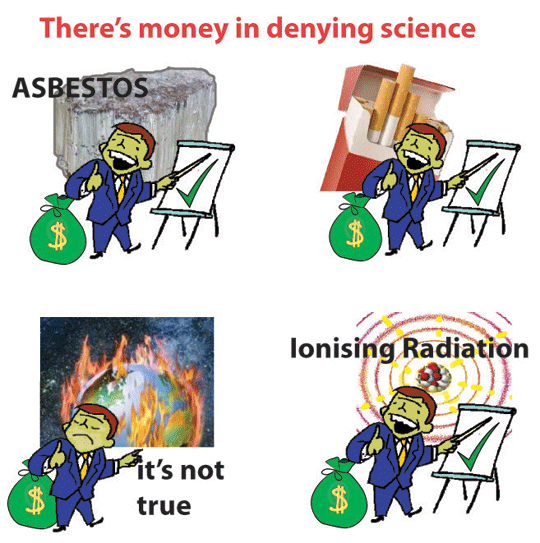
Science denial in USA government – first about climate change, now about ionising radiation
The radiation regulation is supported by Steven Milloy, a Trump transition team member for the EPA who is known for challenging widely accepted ideas about manmade climate change and the health risks of tobacco. He has been promoting Calabrese’s theory of healthy radiation on his blog.
the EPA proposal on radiation and other health threats represents voices “generally dismissed by the great bulk of scientists.”
“The individual risk will likely be low, but not the cumulative social risk,
Turning to scientific outliers, EPA says a little radiation may be healthy, WIVN.com, By: CBS/AP Oct 07, 2018 The Trump administration is quietly moving to weaken U.S. radiation regulations, turning to scientific outliers who argue that a bit of radiation damage is actually good for you — like a little bit of sunlight.
The government’s current, decades-old guidance says that any exposure to harmful radiation is a cancer risk. And critics say the proposed change could lead to higher levels of exposure for workers at nuclear installations and oil and gas drilling sites, medical workers doing X-rays and CT scans, people living next to Superfund sites and any members of the public who one day might find themselves exposed to a radiation release.
The Trump administration already has targeted a range of other regulations on toxins and pollutants, including coal power plant emissions and car exhaust, that it sees as costly and burdensome for businesses. Supporters of the EPA’s new proposal argue the government’s current no-tolerance rule for radiation damage forces unnecessary spending for handling exposure in accidents, at nuclear plants, in medical centers and at other sites.
“This would have a positive effect on human health as well as save billions and billions and billions of dollars,” said Edward Calabrese, a toxicologist at the University of Massachusetts who is to be the lead witness at a congressional hearing Wednesday on EPA’s proposal. “The regulatory agencies are kind of a cult, but they don’t know they’re part of a cult.”
Calabrese, who made those remarks in a 2016 interview with a California nonprofit, was quoted by EPA in its announcement of the proposed rule in April. He declined repeated requests for an interview with The Associated Press. The EPA declined to make an official with its radiation-protection program available……….
As recently as this March, the EPA’s online guidelines for radiation effects advised: “Current science suggests there is some cancer risk from any exposure to radiation.”
“Even exposures below 100 millisieverts” – an amount roughly equivalent to 25 chest X-rays or about 14 CT chest scans – “slightly increase the risk of getting cancer in the future,” the agency’s guidance said.
But that online guidance – separate from the rule-change proposal – was edited in July to add a section emphasizing the low individual odds of cancer: “According to radiation safety experts, radiation exposures of …100 millisieverts usually result in no harmful health effects, because radiation below these levels is a minor contributor to our overall cancer risk,” the revised policy says.
Calabrese and his supporters argue that smaller exposures of cell-damaging radiation and other carcinogens can serve as  stressors that activate the body’s repair mechanisms and can make people healthier. They compare it to physical exercise or sunlight.
Mainstream scientific consensus on radiation is based on deceptive science, says Calabrese, who argued in a 2014 essay for “righting the past deceptions and correcting the ongoing errors in environmental regulation.”……..
The radiation regulation is supported by Steven Milloy, a Trump transition team member for the EPA who is known for challenging widely accepted ideas about manmade climate change and the health risks of tobacco. He has been promoting Calabrese’s theory of healthy radiation on his blog.
But Jan Beyea, a physicist whose work includes research with the National Academies of Science on the 2011 Fukushima nuclear power plant accident, said the EPA proposal on radiation and other health threats represents voices “generally dismissed by the great bulk of scientists.”
The EPA proposal would lead to “increases in chemical and radiation exposures in the workplace, home and outdoor environment, including the vicinity of Superfund sites,” Beyea wrote.
At the level the EPA website talks about, any one person’s risk of cancer from radiation exposure is perhaps 1 percent, Beyea said.
“The individual risk will likely be low, but not the cumulative social risk,” Beyea said.
“If they even look at that – no, no, no,” said Terrie Barrie, a resident of Craig, Colorado, and an advocate for her husband and other workers at the now-closed Rocky Flats nuclear-weapons plant, where the U.S. government is compensating certain cancer victims regardless of their history of exposure.
“There’s no reason not to protect people as much as possible,” said Barrie.
U.S. agencies for decades have followed a policy that there is no threshold of radiation exposure that is risk-free.
The National Council on Radiation Protection and Measurements reaffirmed that principle this year after a review of 29 public health studies on cancer rates among people exposed to low-dose radiation, via the U.S. atomic bombing of Japan in World War II, leak-prone Soviet nuclear installations, medical treatments and other sources.
Twenty of the 29 studies directly support the principle that even low-dose exposures cause a significant increase in cancer rates, said Roy Shore, chief of research at the Radiation Effects Research Foundation, a joint project of the United States and Japan. Scientists found most of the other studies were inconclusive and decided one was flawed.
None supported the theory there is some safe threshold for radiation, said Shore, who chaired the review. If there were a threshold that it’s safe to go below, “those who profess that would have to come up with some data,” Shore said in an interview.
“Certainly the evidence did not point that way,” he said……..
The EPA tucked its proposed relaxation of radiation guidelines into its “transparency in science” proposal in April. The proposal would require regulators to consider “various threshold models across the exposure range” when it comes to dangerous substances. …….https://www.wivb.com/news/turning-to-scientific-outliers-epa-says-a-little-radiation-may-be-healthy/1505019288
When is radioactive waste NOT radioactive waste? When it is magically labelled “Exempt”

 Radiation Free Lakeland 3rd Oct 2018 , Nuclear mud isn’t the only waste. The industry is getting rid of waste by
sending it to landfill, ‘recycling’ – new routes are being found to
dump as much waste as possible.
The planned incinerator at Carlisle does not give any indication where the waste would be coming from. Radiation
Free Lakeland have written a letter of objection. The door is wide open to
a tsunami of radioactive waste being incinerated.
The private operators and even the regulators can get away with saying ‘ what dont be ridiculous
there is NO RADIOACTIVE WASTE planned for the new incinerator’. They said
this to us about radioactive wastes being dumped at Lillyhall. This is
because the waste that used to be classified as radioactive is now
classified as “exempt” for “free release” so by the magic touch of
a magic pen it is no longer radioactive.
https://mariannewildart.wordpress.com/2018/10/03/how-to-get-shot-of-nuclear-wastes/
1 This Month
29 Jan. Thursday 7-8 p.m. Webinar – World’s Largest Nuclear Station in Port Hope, ON?
To see nuclear-related stories in greater depth and intensity – go to https://nuclearinformation.wordpress.com/


31st January – Challenging the War Machine – a DECLASSIFIED UK SUMMIT


Website of the Week
Now until to February 10, 2026 Radioactive waste storage in France: the debate is finally open! How to participate?
-
Archives
- January 2026 (288)
- December 2025 (358)
- November 2025 (359)
- October 2025 (376)
- September 2025 (258)
- August 2025 (319)
- July 2025 (230)
- June 2025 (348)
- May 2025 (261)
- April 2025 (305)
- March 2025 (319)
- February 2025 (234)
-
Categories
- 1
- 1 NUCLEAR ISSUES
- business and costs
- climate change
- culture and arts
- ENERGY
- environment
- health
- history
- indigenous issues
- Legal
- marketing of nuclear
- media
- opposition to nuclear
- PERSONAL STORIES
- politics
- politics international
- Religion and ethics
- safety
- secrets,lies and civil liberties
- spinbuster
- technology
- Uranium
- wastes
- weapons and war
- Women
- 2 WORLD
- ACTION
- AFRICA
- Atrocities
- AUSTRALIA
- Christina's notes
- Christina's themes
- culture and arts
- Events
- Fuk 2022
- Fuk 2023
- Fukushima 2017
- Fukushima 2018
- fukushima 2019
- Fukushima 2020
- Fukushima 2021
- general
- global warming
- Humour (God we need it)
- Nuclear
- RARE EARTHS
- Reference
- resources – print
- Resources -audiovicual
- Weekly Newsletter
- World
- World Nuclear
- YouTube
-
RSS
Entries RSS
Comments RSS
 nuclear-news