Corbella: Wilson-Raybould’s version behind scandal is indisputable and nuclear, Calgary Herald, LICIA CORBELLA March 29, 2019 Was she or wasn’t she (inappropriately pressured?) That is the central question behind the SNC-Lavalin controversy. All other questions are peripheral.
The answer now is an unequivocal, indisputable ‘yes.’ This is no longer a question of she said/he said, or of women and men “experiencing things differently” — the so-called Gropegate defence.
Now Canadians have the proof. Canada’s former attorney general, Jody Wilson-Raybould, was pressured and threatened by federal Liberal government officials and politicians to help the Quebec engineering giant avoid a criminal trial by pursuing a deferred prosecution agreement
On Friday, the House of Commons justice committee released Wilson-Raybould’s 43-page document, that includes texts, emails and the context around that evidence as well as a transcript of a 17-minute telephone conversation she recorded between herself and Michael Wernick, the clerk of the Privy Council who recently resigned from his post as the country’s top bureaucrat in the wake of this scandal that his gripped the country since Feb. 7
……..Clearly, we now have the proof that the PMO inappropriately pressured the attorney general, not just he said/she said. That’s much more than a political bombshell. Canada’s reputation as a principled country that follows the rule of law has been terribly damaged. It’s also clear that the PM and many of the people around him have lied throughout this controversy. She has proof. They have lies. Ka-Boom!https://calgaryherald.com/opinion/columnists/corbella-wilson-rayboulds-version-behind-scandal-is-indisputable-and-nuclear
U.S. approved secret nuclear power work for Saudi Arabia
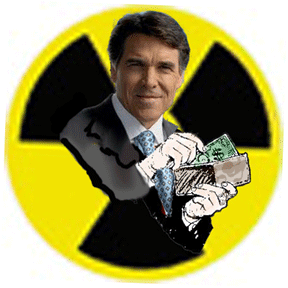
Timothy Gardner, 28 Mar 19, WASHINGTON (Reuters) – U.S. Energy Secretary Rick Perry has approved six secret authorizations by companies to sell nuclear power technology and assistance to Saudi Arabia, according to a copy of a document seen by Reuters on Wednesday.
The Trump administration has quietly pursued a wider deal on sharing U.S. nuclear power technology with Saudi Arabia, which aims to build at least two nuclear power plants. Several countries including the United States, South Korea and Russia are in competition for that deal, and the winners are expected to be announced later this year by Saudi Arabia.
Perry’s approvals, known as Part 810 authorizations, allow companies to do preliminary work on nuclear power ahead of any deal but not ship equipment that would go into a plant, a source with knowledge of the agreements said on condition of anonymity. The approvals were first reported by the Daily Beast.
The Department of Energy’s National Nuclear Security Administration (NNSA) said in the document that the companies had requested that the Trump administration keep the approvals secret.
“In this case, each of the companies which received a specific authorization for (Saudi Arabia) have provided us written request that their authorization be withheld from public release,” the NNSA said in the document. In the past, the Energy Department made previous Part 810 authorizations available for the public to read at its headquarters. ……..
On March 8, former U.S. Army intelligence analyst and whistleblower Chelsea Manning was jailed for refusing to testify to a grand jury investigating Wikileaks. Charged with contempt of court, her imprisonment can extend through the term of the grand jury, possibly 18 months. Manning was placed in administrative segregation after she arrived at the William G. Truesdale Adult Detention Center. She has been kept in her cell for 22 hours a day, and can’t be out of her cell while any other prisoners are out. She has no access to books or reading material.
On March 6, Manning had appeared before a Federal Grand Jury and refused to answer questions from prosecutors regarding information she had already disclosed during her 2013 court martial. She responded to each question with the following statement: “I object to the question and refuse to answer on the grounds that the question is in violation of my First, Fourth, and Sixth Amendment, and other statutory rights.” Manning objects to the secrecy of the grand jury process, and said she already revealed everything she knows during her court martial.
In 2010, Chelsea Manning was arrested and jailed without bond for exposing atrocities committed by the U.S. military. She was later sentenced to 35 years in prison, and released after nearly seven years behind bars when President Obama commuted her sentence in 2017.
Public will never know truth behind Three Mile Island, anti-nuclear energy advocates say https://www.witf.org/news/2019/03/public-will-never-know-truth-behind-three-mile-island-anti-nuclear-energy-advocates-say.phpby Ivey DeJesus/PennLive | Mar 26, 2019 The public will never know the truth behind some of the most basic facts about the nation’s worst nuclear disaster nor the actual amount of radiation that was released.Those were some of the messages underscored on Monday by the head of Three Mile Island Alert, an anti-nuclear advocacy group, and other advocates at a press conference in the Main Rotunda of the state Capitol.
Just days shy of the 40th anniversary of the partial meltdown at the Three Mile Island nuclear plant in Londonderry Township, TMI Alert’s Eric Epstein excoriated the nuclear industry for misrepresenting the facts of the accident, and in the process misleading and misinforming the public.
“Three Mile Island is an accident without an ending,” Epstein said. “There’s no bookends to it. If you look at the holy trinity of nuclear accidents, Three Mile Island, Chernobyl and Fukushima, we can probably pretty much tell you when they started. The reality is there is no ending. This is a funeral where the pallbearers need to stand in place for 500 years. That’s tough for a society that has the memory of a fruitfly.”
Epstein was joined by Tim Judson, executive director of Nuclear Information and Resource Service, and Arnie Gundersen, a nuclear engineer, who over the years converted from a proponent to an ardent critic.
Judson and Gundersen outlined the chain of events that took place on March 28, 1979, the start of the partial meltdown, as well as the levels of radiation released and subsequent impact on the health of the region.
Judson said the Three Mile Island story amounted to a “mistelling of history” of what could have been a preventable accident. He said that as a result of inconsistencies provided by the nuclear industry, the public was not given – nor will never have – a clear picture of the facts and the risks surrounding the meltdown.
Gundersen explained that because inadequate radiation monitors were in place at the time, officials were never able to get an accurate reading of radiation levels.
All analysis of radiation releases were based on mathematical corrections to estimates derived from off-site dose readings, he said.
“How much radiation was released? Nobody knows,” said Gundersen, who began a change of heart on nuclear energy in the 1990s when he served as an expert witness for plaintiffs in a lawsuit against Three Mile Island.
He is today chief engineer of Fairewinds Associates, an advocacy group for clean, renewable energy.
The Nuclear Regulatory Commission has long stood by its 40-year-old estimate that 10 million Curies of radiation were released. The NRC has also long held that the radiation released during the accident was well within levels deemed safe. The industry has reiterated that no one died or was harmed as a result of the accident.
Gundersen said that according to his own analysis of raw data, he calculated that 10 times that amount was released.
Epstein further excoriated legislative efforts to “bail out” Pennsylvania’s nuclear power plants, including Exelon Corp., current owner of TMI-1.
He said proposals to bail out the nuclear industry in Pennsylvania – to the tune of nearly $3 billion – were “fundamentally and manifestly unfair,” adding that Three Mile Island Alert categorically opposed any bailout.Proposed legislation would lead to the reclassification of Pennsylvania’s nuclear plants as “zero emission energy” and create new requirements on how electric companies purchase power.
Among the members of the audience, were several visitors from Fukushima, Japan, site of the 2011 post-tsunami nuclear disaster that led to the evacuation of a quarter of million people.
“The same (tactics) used to minimize the damage and risk of health is the same between Fukushima and TMI,” said Hiroko Aihara, a journalist from Fukushima.
She said citizen engagement has been pivotal in the case of Three Mile Island and continues to be so in the Fukushima aftermath.
“It’s very important to work together. To know we are not alone,” she said.
Aihara said the Japanese people – like residents of central Pennsylvania 40 years ago – were not provided with the truth.
“Many people are still suffering… about evacuation, radiation, contamination and economic situation,” she said. “We are still suffering or fighting the situation.”
Guardian 21st March 2019Brazil’s former president Michel Temer – who played a key role in the 2016 impeachment of his rival Dilma Rousseff – has been arrested by federal police while driving in São Paulo.
Judge Marcelo Breitas issued arrest warrants on Thursday for Temer and nine others in “Operation Radioactivity” – part of Operation Car Wash, the country’s largest ever corruption investigation, which has led to the convictions of numerous
members of Brazil’s political elite.
Federal prosecutors in Rio de Janeiro said Temer had led “a criminal organization”, which was involved in the construction of Brazil’s Angra 3 nuclear plant. According to prosecutors, Temer received a R$1m bribe in exchange for awarding three
companies a construction contract for the nuclear facility.
A convoy carrying uranium to a Brazilian nuclear plant was attacked by armed men, Task and Purpose, March 21, 2019 RIO DE JANEIRO (Reuters) – Armed men shot at members of a convoy transporting uranium to one of Brazil’s two working nuclear power plants on a coastal road in Rio de Janeiro state on Tuesday, police and the company managing the plant said.
They said the truck carrying the nuclear fuel and its police escort came under attack when it was passing by the town of Frade, about 30 km (19 miles) from Angra dos Reis, where the reactor is located.
Policemen guarding the convoy returned the attackers’ fire, police said. They said there were no injuries or arrests and the armed men fled……..
police escorting the truck fanned out alongside the road as a precautionary measure after hearing nearby gunshots. The armed men then started firing on some of the heavily armed “shock battalion” accompanying the shipment, Eletronuclear said.
Daniel Ellsberg Calls Chelsea Manning “an American Hero” Marjorie Cohn, Truthout, March 20, 2019 Two years after being released from prison where she had served seven years for exposing U.S. war crimes in Iraq and Afghanistan, Chelsea Manning was jailed once again for refusing to answer questions before a grand jury investigating WikiLeaks and its founder Julian Assange.
“I will not comply with this, or any other grand jury,” Manning declaredin a written statement. “Imprisoning me for my refusal to answer questions only subjects me to additional punishment for my repeatedly-stated ethical objections to the grand jury system.”
Noted whistleblower Daniel Ellsberg praised Manning. “Chelsea Manning is in jail again, this time for resisting a grand jury system whose secrecy and lack of witness rights makes it prone to frequent abuse,” Ellsberg told Truthout. “She is also resisting its current abuse, as it is used to attack freedom of the press by pursuing criminal charges for publication of the very war crimes and corruption she courageously revealed to WikiLeaks nine years ago.”
Manning wrote, “The grand jury’s questions pertained to disclosures from nine years ago, and took place six years after an in-depth computer forensics case, in which I testified for almost a full day about these events. I stand by my previous public testimony.”
Prosecutors inadvertently disclosed last summer that they had a sealed indictment against Assange. Since 2010, when WikiLeaks published the documents Manning leaked, the U.S. government has been gunning for Assange. “The Obama administration had decided against trying to charge him because of fears that establishing a precedent that his actions were a crime could chill investigative journalism,” Charlie Savage wrotein The New York Times.
Manning told the judge at her guilty plea hearing that no one at WikiLeaks asked or encouraged her to give them documents. “No one associated with WLO [WikiLeaks Organization] pressured me into sending any more information,” she said.
Before contacting WikiLeaks, Manning tried to interest TheWashington Post in publishing the documents, but she received no response. She was also unsuccessful in contacting TheNew York Times.
At the age of 22, Pfc. Manning, who was an Army intelligence analyst, gave hundreds of thousands of classified Pentagon and State Department documents about the wars in Iraq and Afghanistan to WikiLeaks. In 2013, Manning was sentenced to 35 years in prison. She ultimately served seven years, including time in pretrial custody, after Obama commuted the remainder of her sentence as he was leaving office.
Manning, a transgender woman, suffered in a male military prison and attempted suicide on two occasions in 2016. She was held in solitary confinement and was humiliated by being subjected to forced nudity during inspection for the first 11 months of her incarceration. United Nations Special Rapporteur on Torture Juan Méndez characterized her treatment as cruel, inhuman and degrading. He couldn’t determine whether it amounted to torture because he was not permitted to visit her under acceptable conditions……… https://truthout.org/articles/daniel-ellsberg-calls-chelsea-manning-an-american-hero/
Robert isn’t alone. He has documented the harassment and even murder of other whistleblowers who spoke out about contentious nuclear issues, or attempted to supply him with sensitive information.
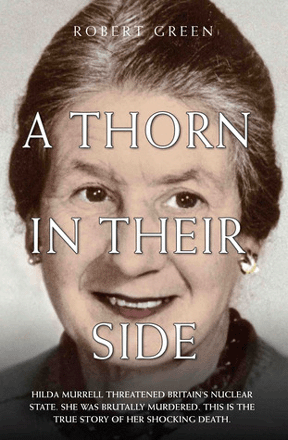
Was The Murder of British Anti-Nuclear Campaigner State Sanctioned? For many, the questions of who brutally murdered a 78-year-old rose-grower turned anti-nuclear campaigner outside her home town of Shrewsbury, England 34-years ago, and why, lack any satisfactory resolution, more than three decades after the tragic event. Speaking exclusively to Sputnik, her nephew Robert Green updates Kit Klarenberg on his search for the truth. Sputnik News 14 Mar 19
On the morning of March 21 1984, Hilda Murrell was preparing to make a presentation to the Sizewell B Inquiry, the first public planning investigation into the launch of a new nuclear power plant in the UK.A lifelong environmentalist, over the previous decade she’d become extremely concerned about hazards posed by nuclear power in both its energized and weaponized forms, and campaigned with ever-increasing fervor against its proliferation.
Hilda’s presentation was prepared with support from dissident scientists and activists, and offered expert insight on the risks posed by nuclear power and radioactive waste management.
Concerned attendees sat in the inquiry’s public gallery were likely much looking forward to her testimony, while many in the British nuclear industry were conversely no doubt dreading it, for much the same reasons – despite Hilda’s age, she was a formidable figure who commanded respect, and whose views demanded consideration.
Destiny Betrayed
The presentation would never come to pass. At around noon that day, Hilda’s home was broken into and she was abducted – apparently in her own car. The vehicle was later found abandoned in a country lane, five miles outside the town – three days later, her mutilated body was found by police in a copse a field away from her car.
Hilda had been beaten and stabbed multiple times before being left to die from hypothermia sometime later. The resultant police investigation produced no leads or suspects – at least officially – and was widely criticized as negligent and superficial.
Officers concluded Hilda disturbed an individual burglarizing her home, who then attacked and kidnapped her. In December that year, the delayed inquest into Hilda’s murder – at which only the doctor who carried out her autopsy, who later had his license revoked, and the local Detective Chief Superintendent, were permitted to give statements – reinforced this narrative, ignoring serious anomalies in the process, such as strong suggestions Hilda’s body had been moved after her death.
Alternative theories quickly proliferated among Hilda’s friends and family, the media and even members of parliament. Most commonly, it was suggested she was murdered due to her prominent anti-nuclear activities and opposition to the 1982 Falklands War – whether by individuals acting on behalf of the industry, or members of the security services. The latter theory was ardently supported by Labour MP Tam Dalyell, who repeatedly raised the issue in the House of Commons.“Whoever was in [Hilda’s] house had clearly been looking for something. [It] had been carefully searched and her papers gone through in an orderly manner. Her telephone had been cut off in such a way that, although it was dead from inside the house, anyone calling would hear it ringing out. The police agree that is a sophisticated way of doing things – not the actions of a common burglar taking a chance. I am certain persons in Westminster and Whitehall know a great deal more about the violent death of Hilda Murrell than they have so far been prepared to divulge,” Dalyell said December 19 1984.
Ever since, the intrepid rose-grower has rarely strayed very far from public consciousness. Her case has been dissected and immortalized in books, documentaries, plays and films, and as of 2018, it remains an enduring mystery, perhaps the most bizarre and baffling murder in the history of 20th century Britain – despite the conviction in May 2005 of Andrew George for Hilda’s abduction and murder.
Innocent Man Framed
George, a laborer in Shrewsbury who at the time of her killing was a 16-year-old truant from a foster home who couldn’t drive, was arrested June 2003 after a police review uncovered DNA and fingerprint evidence linking him with the crime. At his trial, he admitted being in Hilda’s house, but denied abducting or murdering her. The jury didn’t believe him, and he was sentenced to life imprisonment with a recommended minimum term of 15 years.Many, however, do believe George – among them Robert Green, a noteworthy anti-nuclear campaigner in his own right. He believes George – “a petty thief kind to old people” – was unjustly incarcerated, and DNA evidence withheld from the jury would not only likely acquit him, but establish beyond reasonable doubt at least one other male, whom Hilda scratched, and possibly another whose semen was on her cardigan, were involved in her murder.
Robert believes MI5 and/or the nuclear industry, with potential assistance from a private security agency, abducted Hilda and took her to a ‘safe house’ to interrogate her and retrieve any sensitive information she may have possessed, then identify its sources and neutralize them – but not before permanently silencing and disposing of her.
“Years ago I met a former IRA member, who said the abduction strongly echoed ‘snatch squad’ operations in Northern Ireland – the victim would be taken away for interrogation while someone disguised as the victim was driven in their own car as publicly as possible, to cause confusion and distract attention from abductors. The operation was made to look botched and amateurish – the cover of a bungling, sexually perverted burglar would help discredit any notion of state involvement.”
Robert Green,Hilda’s Nephew says:
“Chillingly, the former IRA operative later suggested such snatch squads were occasionally housed at Sir John Moore Army Barracks in central Shrewsbury – not far from Hilda’s home. A 28th anniversary meeting in the town yielded yet further troubling revelations. After the meeting, a man said his friend had explosive information to impart, but was too nervous to talk because he was subject to the Official Secrets Act.”
He said that early on the morning of March 21 1984, his friend had been helping guard the main gate of RAF Shawbury, not far from where Hilda was found. Four Dutch or Swiss agents who spoke perfect English came out of the base having been flown in. Claiming to be electrical engineers, they were “muscly, fit and scary to look at’” and spent no time in the base where they were supposed to be working. They returned four days later and were flown out. Moreover, he alleged the nearby Sundorne Territorial Army Centre, which was closed on dates coinciding with Hilda’s abduction and the discovery of her body, was where she was held. ……….
As a result of his attempts to bring his findings to public attention, Robert has been subjected to concerted harassment and surveillance by security services in both the UK and New Zealand, where he currently lives – a campaign that stepped up significantly when he began researching and writing A Thorn In Their Side, his book about the case. ……….
Trust fails to recover from nuclear disaster, Borneo Bulletin March 10, 2019 Simon Denyer ……….facts and spreadsheets supplied by the government are one thing.
Rebuilding trust among locals may be significantly harder, thanks to a culture of cover-ups and denials that contributed to the nuclear accident and continues to dog Japan’s efforts to restart its nuclear industry, experts say.
…….. at least 24 countries and territories ban some produce from Fukushima. South Korea and China still impose a total food ban. The US prohibits Fukushima produce such as mushrooms, leafy vegetables and broccoli. Fishermen now only ply the seas two days a week: Fish from Fukushima, which once enjoyed a high reputation in Tokyo’s fish market, is no longer the flavour of the day.
The government blames “harmful rumours”, a phrase that dominated the two-day press tour and has been labelled the fourth disaster to hit Fukushima, after the earthquake, tsunami and nuclear accident.
Yet there is a much deeper trust deficit that remains extremely hard to overcome.
Tokyo Electric Power Company (TEPCO), the operator of the ill-fated plant, spent two months after the nuclear disaster denying that a meltdown had occurred. TEPCO later apologised for a “cover-up” that remains the source of much bitterness among people here.
Katsunobu Sakurai, former mayor of the nearby town of Minamisoma, said TEPCO gave out very little information about the disaster during a chaotic evacuation that ultimately led to the deaths of 3,700 people, including many elderly people whose medical care was interrupted.
In 2012, TEPCO was forced to admit that it had failed to heed safety warnings before the accident, or even consider the risk of a large tsunami, because it feared doing so would undermine public confidence in the industry.
Experts say TEPCO has still failed to come clean about the problems associated with decommissioning the reactors and
Bags of nuclear waste generated after the meltdown of one of Fukushima’s nuclear power plants in 2011 are now stored in the nearby town of Naraha. MUST CREDIT: photo for The Washington Post by Shiho Fukada.
decontaminating the environment.
“To me, talking about ‘harmful rumours’ sounds like they are making someone else the bad guy or villain, as if they are blaming people for saying negative things because they don’t understand science and radiation,” said Riken Komatsu, a community activist in Onahama.
“But those who have lost our trust do not have the right” to talk about harmful rumours, Komatsu added.
The government and TEPCO say the nuclear power plant itself could take 30 or 40 years to decommission and estimates the cleanup will cost 22 trillion yen (USD200 billion).
But in 2015, the plant’s manager told London’s Times newspaper that the technological challenges involved in removing hundreds of tonnes of molten radioactive fuel from three reactors could mean decommissioning will take 200 years.
The Japan Center for Economic Research, a conservative think tank, estimates the cleanup bill could come to 50 trillion to 70 trillion yen (USD460 billion to 640 billion).
One of the biggest problems involves groundwater that seeps into the reactor buildings, mixes with cooling water and becomes radioactive.
TEPCO has been trying to limit water contamination ever since the accident, creating a mile-long “ice wall” of sunken, frozen soil around the reactors to keep water out, and another concrete wall to prevent it from reaching the ocean.
In 2016, TEPCO admitted that the ice wall was only slowing – but not preventing – water seeping in. Today, around 100 cubic metres of groundwater still become contaminated at Fukushima every day, and one million tonnes of radioactive water is stored in 994 huge tanks around the site.
A new tank fills up every seven to 10 days, and storage space is running out.
TEPCO had initially claimed that 26 out of 27 radioactive nuclides had been removed from that water through an advanced treatment system, living only tritium behind.
But after reports by Kyodo news and local media, and a protest by fishermen, the company acknowledged last September that 80 per cent of the tanks contain water that is still contaminated with dangerous radioactive elements, including strontium-90, a bone-seeking radionuclide that causes cancer.
Launching his successful bid for the 2020 Summer Olympics, Japanese Prime Minister Shinzo Abe said the situation at Fukushima was “under control”. One of his predecessors, Junichiro Koizumi said the water crisis showed that was a lie.
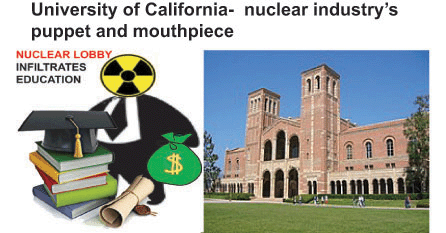
The future of all life: Indigenous sovereignty and the Fukushima nuclear disaster, Bay View, National Black Newspaper,by Harun Minhaj, March 4, 2019 “………..As the Caretakers of Mother Earth have warned, the nuclear establishment has been working tirelessly to cover up and downplay the consequences of this nuclear disaster. The University of California has long played an essential role in this establishment, as it designed the core physical package of every single nuclear warhead in the U.S. arsenal. And now, formerly secret documents show that UC played an indispensable role in the federal response to – and cover-up of – the Fukushima nuclear disaster.
The estimates secretly forecasted by the LLNL’s model predicted very high doses to children in California from radioactive iodine, which is known to cause serious thyroid illnesses. Subsequent measurements found that this model’s predictions of radiation exposure in California were far more accurate than lower estimates and actually underestimated the radiation found 30 km off the coast of Japan.
Yet the UC never issued a single health warning to anyone living on the West Coast prior to their exposure to this deadly radiation. Instead, at the very time that the UC’s LLNL was modeling “estimates of possible plume arrival times and dose for U.S. locations,” UC Berkeley scientists were at the forefront of corporate media coverage on outlets such as ABC7 proclaiming brazen falsehoods such as “there is no plume.”
The LLNL’s model was continually being refined and updated “based on meteorological analyses and available field data” to ensure its predictions were maximally accurate, yet UC Berkeley scientists were simultaneously telling the public that “you cannot predict how the weather is going to carry radiation particles over the West Coast, if anything at all.”
Even worse was the initial UC Berkeley claim that the radiation reaching California was “not harmful at all” and posed “no risk to California,” despite the LLNL’s forecast of very high doses to children in California from radioactive iodine.
Meanwhile, the head of UC Berkeley’s Nuclear Engineering Department secretly admitted that “it is possible that we will find that some people have received doses … that could exceed the levels that current Protective Action Guidelines are designed to prevent.” The Protective Action Guidelines (PAGs) are legal limits on radiation exposure set by the EPA designed to minimize the risk of harm, and this professor subsequently suggested that, should they be exceeded, “this could provide a basis for immediate action to change PAGs.”
When UC Berkeley began testing for radioactive iodine from the Fukushima fallout in California, it found levels in rainwater up to 181 times the EPA’s safe drinking water standards. And although rainwater and tap water should not be conflated, radioactive isotopes climb their way up the food chain in increasing concentrations in numerous ways, such as the soil of produce farms and the pastures of milk-giving cattle.
The UC cover-up of West Coast fallout
Far from being incidentally related to the case, the University of California’s Lawrence Livermore National Lab (LLNL) was in fact the federal contractor given the responsibility of projecting the damage or “dose” from Fukushima Daiichi’s fallout to Japan, the Pacific Ocean and U.S.-occupied Turtle Island.
And, indeed, radioactive materials from Fukushima were detected across California’s food web, while UC Berkeley’s own measurements showed that food items such as milk were regularly exceeding the EPA’s PAGs in both 2011 and 2012 until they stopped taking these measurements.
The response to these findings was once again denial and distortion. The EPA soon increased its PAG “safe limit” by more than 400 times, to such a high level that all of these findings would retroactively cease to be considered health risks.
In the meantime, UC Berkeley engineers once again asserted there was no cause to worry and falsely minimized these readings by conflating external radiation as received from plane travel with the more dangerous internal radiation received through ingesting radioactive particles, which remain in the body emitting radiation for much longer and have the ability to concentrate in specific vulnerable organs such as the thyroid.
But the initial epidemiological evidence is in, and it already shows a variety of illnesses and deaths across the West Coast significantly correlated with the arrival and presence of Fukushima fallout, such as over 100 additional fetal deaths and birth abnormalities in the state of Washington in 2011 and increased rates of congenital hyperthyroidism in California infants born shortly after the meltdowns – around 1,500 additional borderline and severe cases.
The EPA soon increased its PAG “safe limit” by more than 400 times, to such a high level that all of these findings would retroactively cease to be considered health risks.
The University of California totally failed to make public the initial LLNL projections of “very high doses” to California infants and provide adequate health warnings – such as avoiding contaminated milk or taking natural iodine supplements – despite having this legal responsibility both as a federal contractor and as the operator of California’s Poison Control System, which administers such warnings on behalf of the California Emergency Medical Services Authority for the entire state.
The UC cover-up of Pacific fallout and seafood contamination
As serious as the consequences of the fallout on California were, the radiation California and the West Coast received was only a small fraction (<2 percent) of the total, of which the majority (~80 percent) fell into the Pacific.
From the very beginning, UC scientists were involved in studying the Pacific die-offs. Indeed, it was UC scientists who declared when studying the 2011 marine invertebrate mass die-offs that “[N]o previously documented mortality event has been so severe over such a large region …” Yet these UC scientists who had been studying this epidemic from the very beginning have failed to ever monitor the sick and dead animals for radiation, despite one of the lead scientists admitting that Fukushima could not be ruled out as a cause.
When their major study was published in 2018, it included no consideration of Fukushima or radiation whatsoever. Apparently, it was a moot point – the UC’s website on the die-offs had already been claiming for years there was “no evidence” of Fukushima radiation having an impact, even though they had never looked for any despite having already admitted it couldn’t be ruled out.
To make matters worse, one of the principal UC authors of this study falsely claimed that Fukushima radiation could not have precipitated the die-off, because “many more creatures would be affected.” By this time, the unprecedented and concurrent die-offs of fish, marine mammals and sea birds had already been reported.
In denying the impact of Fukushima on the Pacific, these scientists are hardly alone. Overand overagain, UC professors – frequently in leadership positions and with government ties – have minimized the impact by relying on the widely debunked fallacy of “dilution.”
Yet dilution has been known to be a false solution to radiation for over 50 years now. In 1955, a once-secret memo from the U.S. Atomic Energy Commission (AEC) – then headquartered in Berkeley – noted that the “dissipation of radioactive fallout in ocean waters is not a gradual spreading out of the activity from the region with the highest concentration to uncontaminated regions, but that in all probability the process results in scattered pockets and streams of higher radioactive materials in the Pacific.”
This is due to a variety of reasons, including the flow of currents and the role played by sediment and debris in transporting radiation. Furthermore, studies have shown that the bioconcentration of radioactive particles up the food chain increasingly amplifies its prevalence in smaller and larger marine organisms by factors ranging from 3 to 300.
While this memo may have previously been secret, the “no threshold” model of radiation has been well-established for almost as long, and is the accepted foundation of radiation protection for the Environmental Protection Agency, National Academy of Sciences, and many other institutions.
In the 1960s, UC Berkeley Nuclear Scientist John Gofman established the Biomedical Research Division of the UC’s LLNL, when he was employed by the AEC to discredit findings which showed that “low level” radiation from nuclear weapons tests was exposing infants in surrounding areas to dangerous amounts of radiation.
Instead, Gofman’s research confirmed these dangers, and at the end of the decade he gave a report showing that there is no threshold beneath which radiation exposure is “safe”: lower levels correspond to a lower – but very real – risk of disease. Consequently, dilution does nothing more than spread the impact of radiation amongst a larger population vulnerable to disease, with each individual facing a lower risk but the overall aggregate impact remaining the same.
The AEC disliked these findings and forced Gofman out of the LLNL, illustrating the reprisals nuclear scientists often face for challenging the pro-nuclear establishment.
Numerous projections of the spread of Fukushima radiation in the Pacific Ocean have predicted that, far from becoming increasingly diluted, once the radiation leaves the immediate vicinity of the Fukushima shoreline it would actually become increasingly concentrated as it approaches the West Coast due to the dynamics of ocean currents, with eventual peak concentrations reaching levels up to 10 times higher than off the coast of the rest of Japan.
There is no threshold beneath which radiation exposure is “safe”: lower levels correspond to a lower – but very real – risk of disease.
What measurements are available not only confirm these projections, showing increasing concentrations traveling east across the Pacific Ocean roughly correlating to these models, they also show that the vast quantities of radioactive particles the Nordic PSA Group predicted would kill at least 50-100 million fish were indeed present throughout large areas of the Pacific Ocean.
In other words, a vast array of scientific knowledge, regulatory precedent, expert models, and empirical data directly contradicts the denials of the UC nuclear establishment that Fukushima’s radiation is of no concern in the Pacific due to “dilution.”
Once again, these denials have serious consequences not just in terms of the ecocidal impact of Fukushima Daiichi’s radiation on Pacific sea life. Based on the thoroughly disproven dilution fallacy, several prominent UC scientists have also denied that there are any health impacts from Fukushima radiation in the Pacific, including the risks entailed in eating contaminated seafood.
The Nordic Probabilistic Safety Assessment Group, however, founded by the nuclear utilities of Finland and Sweden and therefore not at all “anti-nuclear,” concluded in its 2011 report that even if seafood radiation levels from Fukushima stay below legal limits, more than 1 million people would die from just one of the elements of concern, cesium-137. They wrote:
“The fish, seafood, whale meat and seaweed consumed may have concentrations below legal limits, but the radioactive content will be increased from normal levels. As noted in Section 3.6.3, the ingestion dose could be substantial even if the legal limits for the foodstuff are preserved. This cycle will last for many generations, because of the food chain of fish and other marine fauna, and the radioactivity will be recycled and in fact the meat content will increase rather than decreasing by decay. Even if only one one-hundredth of the radioactivity (more than 1e15 Bq of CS137) were to enter this recirculation pattern, the collective whole body ingestion dose over many generations would exceed 1e7 Sv, sufficient to kill more than 1,000,000 people.”
As predictions of mass die-offs and increasingly concentrated radiation crossing the Pacific to the West Coast have already come true, ignoring the scientific evidence about the dangers this radiation poses to us too promises to have deadly consequences. With over 1 hundred million sea creatures having already perished as predicted by the nuclear utility-founded Nordic PSA Group, this institution’s estimate that more than 1 million people could also die if human consumption of Pacific seafood continues unabated is supported by a solid track record based on the scientific method, unlike the UC’s ongoing denials and distortions of even the most basic facts of the Fukushima disaster………….https://sfbayview.com/2019/03/the-future-of-all-life-indigenous-sovereignty-and-the-fukushima-nuclear-disaster/
The future of all life: Indigenous sovereignty and the Fukushima nuclear disaster, Bay View, National Black Newspaper,by Harun Minhaj, March 4, 2019 “…………The UC cover-up of the fallout in Japan
Further illustrating the international stakes and genocidal consequences of the UC cover-up is the role the university has played in Japan, where approximately 18 percent of the radioactive fallout landed.
Once again, the UC failed to warn the Japanese people of how serious the dangers posed by Fukushima’s fallout were, even as its secret model indicated the need to evacuate Tokyo, the largest metropolitan area in the world.
This recommendation was subsequently given by others such as Dr. Shigeru Mita, a physician who relocated his practice from Tokyo after observing symptoms of radiation sickness since 2011, and advises that inhabitants should leave the city due to the health consequences of the radiation there.
With over 1 hundred million sea creatures having already perished as predicted by the nuclear utility-founded Nordic PSA Group, this institution’s estimate that more than 1 million people could also die if human consumption of Pacific seafood continues unabated is supported by a solid track record based on the scientific method, unlike the UC’s ongoing denials and distortions of even the most basic facts of the Fukushima disaster.
Dr. Mita’s warning is buttressed by the epidemiological evidence, which indicates that the health consequences of Fukushima radiation are already taking a serious toll in Japan – and not just in Fukushima prefecture – including:
Thyroid cancer incidence more than doubling in Fukushima and several neighboring prefectures
A range of heart diseases increasing throughout Japan, with a 50 percent overall increase of heart attacks and 80 percent increase in Tokyo
Leukemia incidence more than doubling in Fukushima and several neighboring prefectures, with a 42 percent overall increase for Japan.
Backing up this epidemiological evidence is extensive radiation measurement, including one study which found that every one of its soil samples taken from a variety of places in Tokyo were so toxic that they would all be legally treated as radioactive waste by the U.S. government.
And yet once again, the UC is at the forefront of denying that there are any serious health risks for the Japanese population, even for those with the greatest exposure still living in Fukushima.
Consider the event hosted by the Lawrence Berkeley National Lab and the Japanese Ministry of the Environment at UC Berkeley in 2017. Together, UC Berkeley and the Japanese government claimed that Fukushima had been 97 percent decontaminated of radiation, and insisted that the real issue to worry about was that “negative perception still persists across Japan and the world, causing economic and psychological damage within the region.”
Not mentioned by either party was the epidemic increase of disease or the protests this Japanese Ministry has continuously faced in Fukushima for forcing residents to accept toxic radioactive soil repurposed for developing farmland and constructing roads. Evacuees are now being forced to return to Fukushima, despite radiation levels in their homelands measured at up to 100x the international legal limit.
One study … found that every one of its soil samples taken from a variety of places in Tokyo were so toxic that they would all be legally treated as radioactive waste by the U.S. government.
That the UC’s priority is not the well-being of Japan was tacitly admitted in a press releaseissued by the UC-managed Los Alamos National Lab (LANL), which includes a mere single sentence acknowledging that with the disaster, “At stake are Japan’s reputation, its public health and the health of its environment.” The next three paragraphs then elaborate in great detail the UC’s grave concern about the risk the disaster poses to Japan’s nuclear industry, while highlighting the cleanup’s priority of “rebuild[ing] public acceptance of nuclear power.”
The report ends with a celebration of “the arc of Los Alamos’s history with Japan” as being “truly awesome,” neglecting entirely to mention the central role this UC lab played in committing genocide against the Japanese people with the nuclear bombing of Hiroshima and Nagasaki. Hundreds of thousands of civilians were killed then by UC-designed nuclear weapons.
Today, the UC is once again playing a central role in denying and covering up the deadly effects of the Fukushima nuclear disaster, which continues today as yet another genocide.
Although UC Berkeley was recently ranked the “No. 1 public university” by US News in 2018, corporate media refuses to recognize how it has served as the foremost academic partner of the largest military empire in history. This shameful reality is a manifestation of the twisted vision outlined in Dr. Gray Brechin’s “Imperial San Francisco,” which describes in detail how the white supremacist founders of UC Berkeley envisioned it playing a pivotal role in extending American Empire, with the construction of Berkeley’s nuclear laboratory as the crowning fixture of its “annexation” of the Pacific.
As the U.S. military occupation of Japan continues to this day – with tens of thousands of soldiers and several bases still stationed in the country – the imperial and colonial dimension of the Fukushima disaster cannot be ignored. Fukushima Daiichi’s fuel was supplied by uranium forcibly extracted from aboriginal peoples’ land by permission of the Australian government.
Although UC Berkeley was recently ranked the “No. 1 public university” by US News in 2018, corporate media refuses to recognize how it has served as the foremost academic partner of the largest military empire in history.
After the nuclear catastrophe began, Date City residents received glass badges that measured radioactivity. About four and a half years of measurements collected from these glass badges were used by Ryugo Hayano, Professor emeritus from the University of Tokyo and Makoto Miyazaki from Fukushima Medical University (FMU) to initially publish two studies in the Journal of Radiological Protection (JRP). Radiation policy makers in Japan often reference the second of these two studies, indicating they trust the data and conclusions it offers. However, earlier this year, Shin-ichi Kurokawa (Professor Emeritus of The High Energy Accelerator Research Organization) and Akemi Shima (resident of Date City) contended that this research and the studies using it, are compromised by serious ethical violations and scientific misconduct.
Date City officials requested the studies subsequent to their adoption of a 5 mSv annual radiation exposure limit, which represents a huge increase of radiation exposure to residents. Date City has also limited decontamination efforts in certain areas, and the former mayor Shoji Nishida, requested that the International Atomic Energy Agency proclaim 5 mSv per year safe, instead of the current 1mSv. More detailed information is coming to light as a new mayor of Date City has been elected.
Kurokawa first raised concerns about the second study in a peer-reviewed August 2018 letter sent to JRP. The JRP, a U.K. journal, has yet to publish Kurokawa’s critique, so he published it on a Cornell University website in December 2018. Kurokawa also published a timeline and further critique of Hayano’s response to the letter in Harbor Business Online in February 2019, original article in Japanese. This research has also been reported on Retraction Watch, a website that tracks published troubled papers, although there are more serious concerns than those RW highlights.
Hayano has admitted (English translation here) to a miscalculation that underestimated doses to Date City residents by three times. Hayano also admits to destruction of the data on which the studies were based, claiming this “deletion” was in accordance with research protocol of the study. But Kurokawa disputes that, pointing out that data destruction is a violation of Japan’s ethical guidelines on handling human data – guidelines that instruct researchers to keep the data as long as possible. This destruction of data, and failure to publish a promised third study, appear to conceal evidence that found very high internal doses of radioactivity in some residents of Date City.
The Date City glass badge experiment
The research used glass badge data from approximately 59,000 Date City residents. These badges, paid for and distributed by Date City, supposedly measured the external radioactivity that each individual was exposed to beginning about August 2011, approximately 5 months after the nuclear catastrophe began, until the summer of 2015. The mayor’s office of Date City provided both the glass badge data and data on internal exposures for individual residents.
According to research protocols agreed to with FMU, Miyazaki and Hayano planned to publish three studies based on these data. The first, comparing individual external doses to survey results of airborne radiation from the Government of Japan, was published in 2016. The second, a prediction of lifetime dose and an evaluation of the effect of decontamination on doses to individuals, was published in 2017. The third study, examining the relationship between external doses and internal doses, will not be published. Instead it has been replaced by a study on a different topic.
Where things went wrong
Bad glass badge data
Perhaps the experiment was doomed from the start as the Miyazaki-Hayano studies admit some residents of Date City may not have worn the glass badges on their bodies or actually lived at the address registered for the badge. Such improper badge use would immediately compromise any conclusions reached concerning individual doses, but the researchers used the data anyway.
Mishandling and destruction of data
In addition to questionable glass badge measurements, Kurokawa contends the Miyazaki-Hayano research suffers from mishandling and destruction of data that violates ethical guidelines:
Residents (research subjects) of Date City were not informed of the content of the research prior to the research commencing, and were not given opportunity to refuse use of their data. Miyazaki, being a municipal advisor on radiation to Date City as well as a study author, should have known how to handle this properly, yet he did not.
Miyazaki and Hayano failed to note that some residents had not consented to use of their data, a fact obvious in the data supplied to them by Date City. They further failed to obtain consent from those residents prior to use of their data.
Hayano presented data before the research protocol was submitted to, and approved by, an FMU Ethics review committee.
Residents were not told of the papers once they were published, nor were they told that the Mayor’s office of Date City had requested the papers be published. This presented a conflict of interest since the Date City Mayor’s office had an agenda (see slides 21 & 26) of encouraging residents to increase “resilience” while living in a contaminated environment. For residents, this means consuming contaminated food and restricting decontamination efforts per Date City’s new 5 mSv annual exposure limit. A few months after Date Mayor Shoji Nishida announced this “resiliency” policy, Miyazaki was hired as radiation advisor to the city.
Miyazaki and Hayano violated research protocol by replacing the third studyoriginally agreed to, with a study that said nothing about internal versus external doses.
At the conclusion of the research, all of the data were destroyed. According to records obtained by an information request filed by Shima, Kurokawa’s co-author of the Kagaku article, Hayano created an integrated database at the request of Date City, but did not share this database with the city. Therefore, when the database was destroyed, Miyazaki and Hayano knew that Date City could not replicate it or the data it contained.
Kurokawa points out that research conducted in Japan must follow the ethical guidelinesbased on the Declaration of Helsinki for proper protocols in handling medical and health research involving human subjects, such as valuing welfare of the research subjects over that of scientific results. FMU approved the Miyazaki-Hayano research papers under these protocols – protocols this research seriously violated by not allowing people to control use of their own data and by destroying the data after publication so that neither researchers nor the research subjects, can access it or replicate the studies.
Underestimation of dose
In addition to the mishandling of data, Kurokawa has discovered discrepancies in the values of cumulative doses in paper 2, which appear to underestimate actual doses. Hayano has, by his own admission, underestimated individual doses by three times. Professor Hayano says that he will issue a correction (corrigendum) for this dose underestimation, but has failed to completely answer the additional serious discrepancies, and the ethical violations of mishandling and destruction of data Kurokawa notes.
Why the “phantom” third study matters
The missing third study was supposed to investigate correlation between external and internal individual doses – a correlation Miyazaki and Hayano had already hypothesizedwould not exist. However, upon reviewing other data in Date City reports, the opposite was found: “[there was very] clear correlation between the external and internal doses…some cases with very high levels of internal exposure measurements.” Kurokawa offers his own hypothesis as to why Miyazaki and Hayano never published a paper on this third research question:
The true reason for not publishing Paper 3 could be the discovery of a clear correlation between the external and internal doses with some residents showing internal exposure measurements of several thousand Bq even since 2015. Not publishing inconvenient results despite receiving the internal exposure dose data from Date City would have to be considered a violation of the Ethical Guidelines. (emphasis added)
This correlation also reveals that Date City’s “resiliency” plan is not protecting its residents. Miyazaki and Hayano’s unwillingness to address internal dose evidence in the Date City data also calls into question Hayano’s other research on internal doses issues such as monitoring of food and whole body scans of children, the last publication of which appears to be in 2015.
Mistaken assumptions based on faulty studies
Japan’s Radiation Council (JRC) on setting standards for protecting people from radiation often references this ethically and scientifically compromised research in discussions, particularly the second paper, which was the focus of Kurokawa’s critical letter. Hayano’s work is often mentioned by other scientists and press as indication that doses from Fukushima radiation are low, that decontamination efforts paid for by Date City funds, might not have been necessary, and that living in an environment contaminated by “low” levels of man-made radiation is acceptable.
Where was the peer-review?
For its part JRP has now determined at this time that a correction for the dose underestimation is all that is needed, while an investigation into the consent issue is conducted. JRP claims to adhere to the Declaration of Helsinki for proper protocols in handling medical and health research involving human subjects. However, data misuse and destruction should require retraction of the papers, not correction.
Kurokawa contends that underestimating 70-year lifetime doses by three times is a severe enough miscalculation that a mere correction will not suffice, implying the conclusions of the papers are now in jeopardy. Hayano is claiming, falsely, that JRPwants a rewrite of the paper. Even if JRP did want a rewrite, it is unclear how Hayano intends to accomplish this since the Date City data on which the original papers were based have been destroyed. Kurokawa states:
There is no way to rewrite a paper when the research has already completed and all the data have been destroyed. Even if Date City were to re-supply the data to FMU, it would be considered new research and a new research proposal would have to be submitted to the Ethics Review Committee at FMU. A resulting paper would no longer be a revised version, but an entirely different paper based on new research. A scientist should never conceal such information, let alone pretend as if what was requested by JRP was a rewritten paper when it was a corrigendum that was actually requested. (emphasis in original English translation)
To date, neither Miyazaki nor Hayano have responded in the customary fashion, which would be to answer Kurokawa’s original letter criticizing their published research point-by-point. Kurokawa has published an analysis of Miyazaki-Hayano paper 1 in the March issue of Kagaku in Japanese, and will be publishing detailed analysis of paper 2 in April 2019.
Thanks to Yuri Hiranuma for input and review of this article and for the translations used to write it. See Yuri’s blog.
With the scientifically unsound proposed Yucca Mountain radioactive waste dump now canceled, the danger of “interim” storage threatens. This means that radioactive waste could be “temporarily” parked in open air lots, vulnerable to accident and attack, while a new repository site is sought.
Liberal Party Canadian Prime Minister Justin Trudeau now faces calls from his Conservative Party challenger in this autumn’s election to resign over a scandal involving SNC-Lavalin, a giant engineering firm based in Montreal, Quebec. SNC-Lavalin has been accused of bribery, fraud, and other corruption over its practices in Libya. If convicted of such wrongdoing, SNC-Lavalin could be barred from Canadian federal contracts for a decade. (SNC-Lavalin has been previously barred for a decade from World Bank contracts.)
Holtec International has teamed with SNC-Lavalin to form a nuclear power plant decommissioning consortium. Already, the Holtec/SNC-Lavalin consortium has taken over ownership of the permanently shutdown Oyster Creek atomic reactor in NJ. This includes on-site irradiated nuclear fuel management.
Holtec & SNC-Lavalin are also vying for taking over the ownership of such other soon-to-be decommissioning nuclear power plants as Pilgrim in MA, and Palisades in MI.
Holtec is also the proponent for a national centralized interim storage facility for irradiated nuclear fuel in southeastern New Mexico.
Its partnership with a corrupt company like SNC-Lavalin calls into question Holtec’s own judgment.
However, Holtec itself has engaged in bribery, at the Tennessee Valley Authority’s Browns Ferry nuclear power plant; in addition, Holtec CEO Krishna Singh has been accused by whistleblowers Oscar Shirani (Commonwealth Edison/Exelon) and Dr. Ross Landsman (NRC Region 3) of attempting to bribe them into silence, re: QA violations (see below).
And Holtec CEO Krishna Singh has also made racist remarks re: his own African American and Puerto Rican American workers in Camden, NJ.
France TV Info 6th March 2019 A film about the Fukushima disaster censored in a commune that houses a
nuclear power plant. The Nuclear Exit Association planned a projection
eight years after the Fukushima accident in Japan. But the event was
canceled after the nearby nuclear plant contacted the town hall.
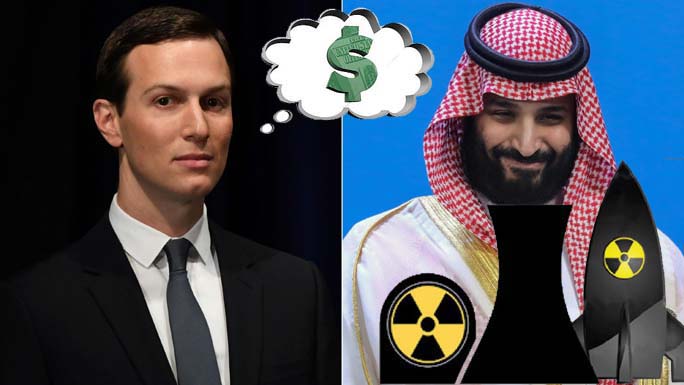
Trump’s endeavour to nuclearise Saudi Arabia is driven by family business interests and tacitly approved by Israel. Aljazeera, by Hamid Dabashi, 8 Mar 2019 Like chronic indigestion that refuses to go away, presidential son-in-law Jared Kushner is back causing much discomfort to the general public.
“Kushner meets Saudi’s MBS for the first time since Khashoggi murder,” Al Jazeera recently reported, “The meeting focused on ‘increasing cooperation’ between Washington and Riyadh, as well as the Middle East peace process.”
But there might be more on their plate than just another bogus “peace process”.
Kushner has two paramount concerns while sitting comfortably in the big pocket of Saudi Crown Prince Mohammed bin Salman (MBS): pursuing his own personal financial gains and helping Israel steal what is left of Palestine. MBS also has two objectives while playing with Kushner, like a shiny marble in his pocket: To confront Iran and to establish himself as a ruling tyrant not just in Saudi Arabia but throughout the Arab and Muslim world.
The slaughter of innocent men, women and children in Yemen and the butchery of Jamal Khashoggi are the first flowers of his dream of a Saudi Spring. But in his pursuit of power and glory through murder and destruction, MBS does not seem to be satisfied with using only conventional means. It appears that he is now harbouring a great desire to go nuclear and the Trump administration is more than willing to oblige.
As the New York Times recently revealed, the Trump administration has been pursuing a deal with Saudi Arabia to develop its nuclear energy sector. “By ramming through the sale of as much as $80 billion in nuclear power plants, the Trump administration would provide sensitive know-how and materials to a government whose de facto leader, Crown Prince Mohammed bin Salman, has suggested that he may eventually want a nuclear weapon as a hedge against Iran and has shown little concern for what the rest of the world thinks,” the newspaper claimed.
At the forefront of these efforts, of course, are Kushner and his business interests. It turns out a company that bailed out his family after an ill-conceived real estate deal in New York brought them close to bankruptcy now intends to sell nuclear reactors in Saudi Arabia.
That, along with other shenanigans, has gotten the US security establishment worried. Their attempts to cancel his security clearance, however, have been repeatedly overridden by his father-in-law.
Hence, Kushner remains undeterred in his pursuit to nuclearise Saudi Arabia.
In exposing this worrying reality, the US media, however, has made two very wrong assumptions: one, that a nuclear deal with Saudi Arabia somehow contradicts the interests of the Israeli leadership; two, that it is the result of some kind of a Gulf-money entrapment.
……. Given that President Donald Trump’s son-in-law has been the principal driving force behind a “peace plan” that aims to strip Palestinians of all their legitimate rights and legalise the Israeli occupation, it is hard to believe that he is now pursuing a policy that contradicts Israeli interests. …….
The reason why a Saudi nuclear programme is in the interest of the Israeli settler colony is very simple: It would fuel Saudi-Iranian rivalry, keeping them in a permanent state of war in the shadow of nuclear proliferation, which is good for Zionism, and of course, for the Israeli arms industry. It would keep the populations of both countries preoccupied with the imagined Sunni-Shia conflict and make them increasingly oblivious to the plight of the Palestinian people and the desecration of the holy sites in Jerusalem. …….. https://www.aljazeera.com/indepth/opinion/making-nuclear-mbs-190307135114759.html






 wrongdoing, SNC-Lavalin could be barred from Canadian federal contracts for a decade. (SNC-Lavalin has been previously barred for a decade from World Bank contracts.)
 However, Holtec itself has engaged in bribery, at the Tennessee Valley Authority’s Browns Ferry nuclear power plant; in addition, Holtec CEO Krishna Singh has been accused by whistleblowers Oscar Shirani (Commonwealth Edison/Exelon) and Dr. Ross Landsman (NRC Region 3) of attempting to bribe them into silence, re: QA violations (see below).


 nuclear-news