 Ecuador to hand over Assange’s entire legal defense to the United States 20 May 2019 https://wikileaks.org/Ecuador-to-hand-over.html
Three weeks before the U.S. deadline to file its final extradition request for Assange, Ecuadorian officials are travelling to London to allow U.S. prosecutors to help themselves to Assange’s belongings.
Neither Julian Assange nor U.N. officials have been permitted to be present when Ecuadorian officials arrive to Ecuador’s embassy in London on Monday morning.
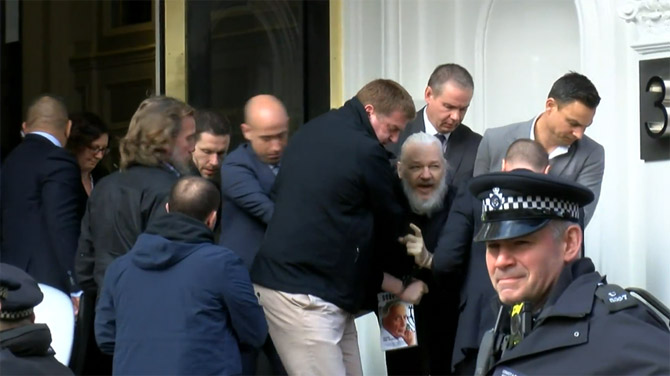
 The chain of custody has already been broken. Assange’s lawyers will not be present at the illegal seizure of his property, which has been “requested by the authorities of the United States of America”.
The material includes two of his manuscripts, as well as his legal papers, medical records and electronic equipment. The seizure of his belongings violates laws that protect medical and legal confidentiality and press protections.
The seizure is formally listed as “International Assistance in Criminal matters 376-2018-WTT requested by the authorities of the United States of America”. The reference number of the legal papers indicates that Ecuador’s formal cooperation with the United States was initiated in 2018.
Since the day of his arrest on 11 April 2019, Mr. Assange’s lawyers and the Australian consul have made dozens of documented demands to the embassy of Ecuador for the release and return of his belongings, without response. Continue reading →
May 23, 2019
Posted by Christina Macpherson |
civil liberties, SOUTH AMERICA, USA |
Leave a comment
Sweden Requests Detention of Assange as WikiLeaks Accuses U.S. of Illegally Seizing His Property https://www.democracynow.org/2019/5/20/headlines/sweden_requests_detention_of_assange_as_wikileaks_accuses_us_of_illegally_seizing_his_property
MAY 20, 2019 Swedish authorities issued a request Monday for the detention in absentia of WikiLeaks founder Julian Assange, who is facing rape charges in Sweden and is currently serving jail time in Britain for skipping bail in 2012. Last week, Swedish prosecutors reopened a sexual assault investigation into Assange which was dropped in 2017 because they said the case could not proceed while Assange was holed up at the Ecuadorean Embassy in London, where he lived for seven years before being forcefully removed by British police last month.
Assange has denied the accusation, and his lawyer representing him in Sweden said he has not been able to get hold of his client to discuss the detention order.
WikiLeaks’ Editor-in-Chief Kristinn Hrafnsson has previously said of Sweden’s case, “Since Julian Assange was arrested on 11 April 2019 there has been considerable political pressure on Sweden to reopen their investigation, but there has always been political pressure surrounding this case. Its reopening will give Julian a chance to clear his name. This case has been mishandled throughout.” Assange must reportedly serve 25 weeks of his British prison sentence before he can be released. Assange now faces possible extradition to both Sweden and the United States, where he is wanted for the publication of leaked documents by Army whistleblower Chelsea Manning which showed evidence of U.S. war crimes in Iraq.
In related news, WikiLeaks is reporting that Ecuador will allow U.S. prosecutors to go through and take possession of Assange’s belongings left in their London embassy. Assange reportedly has two manuscripts at his former living quarters; his lawyers have called it an illegal seizure of property.
|
May 21, 2019
Posted by Christina Macpherson |
civil liberties, UK |
Leave a comment
|
Chelsea Manning Is Going Back To Jail, Saying She’d Rather “Starve To Death” Than Testify About WikiLeaks, BuzzFeed News,
Manning was released for a week after the grand jury she had been subpoenaed to testify before expired. A judge ordered her detained again on Thursday.
Zoe Tillman, BuzzFeed News Reporter, May 16, 2019, ALEXANDRIA, Virginia — After a week of freedom, former Army intelligence officer Chelsea Manning was ordered back to jail on Thursday for once again refusing to testify before a federal grand jury.
Manning had been jailed for two months starting on March 8 after she refused to answer questions before a grand jury in Alexandria, Virginia, about WikiLeaks and the group’s founder Julian Assange — specifically, about the cache of classified military documents that she gave to WikiLeaks in 2010. She was released on May 9 because the term of the grand jury expired.
US District Judge Anthony Trenga ordered Manning jailed on Thursday following a two-hour hearing, half of which was sealed. During the second, public portion of the hearing, Trenga announced that he had once again found Manning in civil contempt, and decided that notwithstanding her pledge not to cooperate, he thought there was still a chance that more jail time could convince her otherwise. The government had argued that because Manning had an appeal pending during part of the previous two months she served, she spent part of her earlier jail time with some hope of release. …..
Manning, wearing a black jacket, shirt, pants, and boots, told the judge she would rather “starve to death” than change her opinion, and added that she meant that “literally.”
“The government cannot build a prison bad enough, cannot create a system worse than the idea that I would ever change my principles,” she said.
The judge has the power to keep Manning in jail until she testifies or until the term of the grand jury expires again. Trenga also imposed a fine — after 30 days in jail, a daily fine of $500 will kick in, and that amount will go up to $1,000 per day after 60 days. …….
After the previous grand jury expired earlier this month and Manning was released, prosecutors convened a new grand jury in the US District Court for the Eastern District of Virginia and issued a new subpoena to Manning, requiring her to come back and testify. Speaking to reporters before she went into the courthouse, Manning again vowed not to answer any questions.
“I will not cooperate with this or any other grand jury,” Manning said.
Grand jury proceedings are normally secret, but Manning and her support team confirmed that prosecutors want to ask her about WikiLeaks. A military court found Manning guilty of violating the Espionage Act in 2013, among other crimes, for leaking hundreds of thousands of military documents to WikiLeaks. She was sentenced to 35 years in prison. But in January 2017, in the final days of the Obama administration, former president Barack Obama commuted Manning’s sentence, and she was released in May of that year.
Assange is facing an indictment in the Alexandria court charging him with conspiring with Manning to hack into US Defense Department computer systems in 2010. Assange is in London — he was arrested on April 11 after spending years in the Ecuadorian Embassy as an asylum-seeker — and is contesting efforts by the US government to extradite him to the United States. It could be years before the extradition fight is resolved, however.
The Justice Department has 60 days after seeking a “provisional arrest” of Assange through UK authorities in mid-April to submit a final extradition package. Once that happens, prosecutors can’t add any more charges against him. It’s unclear if prosecutors want Manning to testify before the grand jury specifically about matters that could lead to more charges against Assange, or as part of a broader investigation with other subjects.
Manning has repeatedly challenged the lawfulness of the government’s effort to force her to testify, and said she believes she may have been under surveillance. The US Court of Appeals for the 4th Circuit summarily rejected her challenges to the subpoena and her incarceration the first time she was jailed. …….https://www.buzzfeednews.com/article/zoetillman/chelsea-manning-back-jail-wikileaks-assange
|
|
May 18, 2019
Posted by Christina Macpherson |
civil liberties, USA |
Leave a comment

Unusual secrecy around 1950s nuclear testing , The Saturday Paper, Martin McKenzie-Murray 18 May 19 Between 1952 and 1957, Britain tested 12 nuclear weapons in Australia – on the Montebello Islands off the Pilbara coast, and at Maralinga and Emu Fields in the South Australian outback. The tests were hurried, incautious and showed extraordinary disregard for Australian assistance and the local Indigenous people who had been forcibly but imperfectly evacuated from their land.
It was a clusterfuck,” says Elizabeth Tynan, an Australian historian, and the award-winning author of Atomic Thunder: The Maralinga Story. “The disregard was partly driven by the fact they were in a rush. They cut corners. They did it on the cheap – and it showed. They had very little regard for safety. Cavalier. They knew about the risks. There were international protocols. Many were disregarded. I met one man, he was a technician with the British effort in Australia, and he said of Indigenous Australians that they were ‘nothing to do with us – it was the Australian government’s responsibility’.”
For Susanne Roff growing up in Melbourne in the 1950s was uneventful. But later, living in Scotland with her husband, William Roff, an eminent historian, she developed a dogged, almost obsessive interest in this chapter of British history that remains cloaked in secrecy.
Once a month, Roff takes the train south from her home in a Scottish fishing village – to archives in London, Birmingham and Cambridge. She’s still looking for answers. “Why was the purportedly Australia-controlled Atomic Weapons Tests Safety Committee so ineffective?” she asks. “Why was the UK able to continue testing at Maralinga until barely six weeks before opening of the 1956 Olympics despite the known hazards to east coast populations? Why didn’t [Sir Mark] Oliphant ever speak out against the tests and contamination, including when he was governor of South Australia?”
Late last year, Roff had another question: Why, more than 60 years after the last nuclear test in Australia, had the British government suddenly vanished previously declassified documents about the tests from its national archives? Roff wasn’t alone in her surprise. The Campaign for Freedom of Information, a British not-for-profit organisation, described it as worrying.
All that was certain was that the files had been removed on the order of the Nuclear Decommissioning Authority.
“WE CAN BUT WONDER WHY THE WORLD’S THIRD ATOMIC AND THERMONUCLEAR POWER HAS SUDDENLY BECOME SO NERVOUS ABOUT EVENTS THAT HAPPENED DECADES AGO.”“The secrecy is arguably even worse today,” Tynan tells me. She is working on a second book about the British tests. “British service personnel have run into brick walls at every turn [in seeking compensation and acknowledgement]. One of the clues to the attitude of the British government is that it has not really ever properly acknowledged what they did. They were nuclear colonialists and they buggered up a part of our country. One former British personnel I met burst into tears when he thought about how Britain had never said sorry. The secrecy … seems incomprehensible. They continue to be secretive.”
But not all documents are closeted. Susanne Roff has some, which she shared with me – British intelligence files on Dr Eric Burhop, an Australian physicist who had worked on the Manhattan Project, which ran from 1939 to 1946. …….
Robert Menzies agreed to the testing immediately, without bothering to consult cabinet. For a time, only three people in the country knew of the agreement: the prime minister, treasurer and defence minister. He asked few questions of the British. “But it wasn’t pure patriotic sycophancy,” Tynan says of Menzies’ decision. “The pragmatic response was: vast reserves of uranium in Australia. It’s central to weaponry and power. It was completely valueless until the Manhattan Project. Then it became a valuable commodity. Australia had a lot of it. That was a very significant part of his reasoning. The other thing that would’ve informed Menzies’ thinking was that he was anxious to ensure Britain and America would protect Australia.”
They were also without the counsel of the Australians who had worked on the American tests – notably, Mark Oliphant and Eric Burhop. Both Susanne Roff and Elizabeth Tynan agree Oliphant would have been a strong head of the safety authority, which was otherwise feckless.
Both men were long suspected of being Communist spies, and may have been excluded to mollify US doubts about British security. The files on Burhop that I’ve seen are voluminous. The FBI, MI5 and ASIO all had records on him. In England and America, he was aggressively surveilled. His phone was tapped. Even Joseph Rotblat had his doubts about his former colleague. The British intelligence historian Andrew Brown has written: “Rotblat remained convinced that Burhop and other left-wing scientists … opposed the [proposed nuclear] moratorium not for their stated reasons but because it would perpetuate the USA’s monopoly and place the USSR at a dangerous disadvantage.”……
In 1984, Australia held a royal commission into the British tests. It found a litany of negligence and cover-ups. “Britain had to be dragged, kicking and screaming, to it,” Elizabeth Tynan says. Today, their attitude is much the same. In 2015, Fiji – frustrated by Britain’s refusal to compensate its people who suffered radiation poisoning during the Pacific tests – declared it would compensate citizens itself. “We are bringing justice to a brave and proud group of Fijians to whom a great injustice was done,” Fiji’s prime minister said. “Fiji is not prepared to wait for Britain to do the right thing.”
Meanwhile, in Britain’s national archives, the nuclear files are still gone. “The UK government has always [downplayed] risks to the servicemen who took part in the tests, the Aboriginal community in the immediate vicinity of them, and the general population downwind … as well as possible genetic effects on subsequent generations,” Susanne Roff says. “We see similar responses in relation to Fukushima in Japan. All the operational and scientific documents relating to the Australian tests that have been on open access in the National Archives have suddenly gone walkabout. We can but wonder why the world’s third atomic and thermonuclear power has suddenly become so nervous about events that happened decades ago.” https://www.thesaturdaypaper.com.au/news/law-crime/2019/05/18/unusual-secrecy-around-1950s-nuclear-testing/15581016008158
|
|
May 18, 2019
Posted by Christina Macpherson |
AUSTRALIA, history, OCEANIA, politics international, secrets,lies and civil liberties, UK, weapons and war |
Leave a comment
|
French watchdog investigates potential nuclear safety fraud https://www.reuters.com/article/france-nuclear-fraud/update-1-french-watchdog-investigates-potential-nuclear-safety-fraud-idUSL5N22P2X6 (Adds detail on falsification of identities)PARIS, May 13 (Reuters) – French nuclear regulator ASN said it had launched an investigation into elements of fraud and falsification regarding nuclear safety, after receiving several warnings from whistleblowers.
Last November, the ASN launched a website where the public can highlight irregularities regarding nuclear safety, which followed a 2016 scandal over falsified manufacturing documents at former nuclear reactor maker Areva and a string of problems with weldings and components at EDF nuclear reactors. Areva is now part of state-owned utility EDF and renamed Framatome.
The ASN said in a statement on Monday that since then it had received 22 warnings and had launched an investigation into a small number of these as they had the characteristics of potential fraud cases.
It also said it had already referred four cases to the criminal court. It declined to give more details about them.
The regulator did not identify any companies involved in the investigation.
EDF – which operates the 58 nuclear reactors that generate some three quarters of French electricity – said it could not immediately comment on ASN’s statement.
The ASN said that initial investigations had revealed several problems, such as the use of inappropriate materials, certain activities, such as welding, carried out by people who did not have the necessary skills, and safety controls that were either missing or executed by internal staff only.
The regulator said this could have a number of implications, such as modification of test results, falsification of the identity of staff having and the non-execution of certain operations such as the replacement of components. (Reporting by Geert De Clercq; Editing by Sudip Kar-Gupta and Jane Merriman)
|
|
May 14, 2019
Posted by Christina Macpherson |
France, secrets,lies and civil liberties |
Leave a comment

|
Apocalypse now? Cyber threats and nuclear weapons systems, European Leadership Network Julia Berghofer |Policy Fellow and Project Manager for the YGLN, 10 May 19, It is accepted that all states are vulnerable to cyber threats. Yet, a majority of states have yet to develop coherent cyber strategies or implement sufficient preventive measures. Despite the increase in severe cyber incidents directed at national power plants, companies and nuclear-related military equipment, the threat of cyber interference in national nuclear weapons systems is not being properly tackled. With multinational nuclear supply chains and nuclear command and control systems at risk of being compromised, this must be urgently addressed.
The more complex, the more vulnerable
Governments and legislators are struggling to keep pace with the rapid development of cyber capabilities. As military systems become more technically complex it would be easy to assume that they are more secure. The opposite is true. Increased automation and connectivity increases vulnerabilities to cyber attacks. Measures such as air-gapping a system (ie. de-connecting it from the internet) can fall short. A recent US Government Accountability Office (GAO) report assessed the cyber security of US weapons systems and found “mission critical cyber vulnerabilities in nearly all weapons systems […] under development.“ While the report does not make reference to any specific system type, one can reasonably assume that nuclear weapons systems are vulnerable to cyber attacks.
 Possible kinds of cyber attacks Possible kinds of cyber attacks
Cyber attacks can take many forms. Activities range from cyber espionage, data theft, infiltration of nuclear command, control and communications (NC3), denial of service/distributed denial of service (DoS/DDoS) attacks, false alarms (jamming and spoofing), sabotage and physical damage. When directed against nuclear weapons systems, in the worst possible case this may escalate to a deliberate or inadvertent exchange of nuclear weapons.
Another area of concern is the supply chain, comprised of any hardware and software components belonging to the nuclear weapons system, including NC3, platforms, delivery systems and warheads. The supply chain usually includes a string of companies and providers located in different countries with varying cyber security standards, which means there is room for manipulation and sabotage. Take, for instance, a computer chip produced in country A. If a vulnerability were inserted at the production stage it could then be remotely activated at a later point when the chip is integrated into the military system of country B. If the attacker happened to be an “insider“ with unlimited access to a military site, compromising military equipment could be easier. This could be done for instance through an infected USB drive when security standards in a military facility happen to be low, leaving the victim of the attack unaware of the manipulation up until it is too late.
Limited awareness of cyber risks to nuclear systems
There is a lack of awareness within the expert community and among decision-makers and a reluctance by states to implement measures such as common cyber security standards and the sharing of information on vulnerabilities. Among the nuclear weapons states, only in the United States have high-ranking officials, such as Gen. Robert Kehler (ret.) and Air Force Gen. John Hyten (STRATCOM), in two Senate Armed Service Committee hearings in 2013 and 2017 expressed their concerns about a potential cyber attack affecting the U.S. nuclear deterrent. One reason why decision-makers and governments are unwilling to take these steps could be that it seems too unrealistic or improbable a threat, merely belonging to the worlds of science fiction and doomsday scenarios. But there is no reason to assume that the warnings of the GAO, the U.S. 2017 Task Force on Cyber Deterrence or the Nuclear Threat Initiative (NTI) are exaggerated.
Certainly, there has not yet been a major cyber attack on a state-run nuclear weapons programme – at least none we have publicly heard of. But there are a string of examples of cyber interference in nuclear installations or parts of the  supply chain related to them. These include: the Stuxnet attack in 2010 affecting over 15 Iranian nuclear facilities which slowed down the development of Iran’s alleged nuclear weapons programme; a massive cyber attack on Lockheed Martin in 2009 during which thousands of confidential files on the U.S. F35 Lightning II fighter aircraft were compromised by hackers (they were also able to see information such as the location of military aircraft in flight); the 2017 hacking of the THAAD missile defence system in South Korea; the 2009 Conficker Worm attack on the French Marine Nationale; a 2011 cyber espionage campaign on the French nuclear company Areva; and deep worries over the WannaCry virus possibly targeting parts of the UK Trident system in 2017. supply chain related to them. These include: the Stuxnet attack in 2010 affecting over 15 Iranian nuclear facilities which slowed down the development of Iran’s alleged nuclear weapons programme; a massive cyber attack on Lockheed Martin in 2009 during which thousands of confidential files on the U.S. F35 Lightning II fighter aircraft were compromised by hackers (they were also able to see information such as the location of military aircraft in flight); the 2017 hacking of the THAAD missile defence system in South Korea; the 2009 Conficker Worm attack on the French Marine Nationale; a 2011 cyber espionage campaign on the French nuclear company Areva; and deep worries over the WannaCry virus possibly targeting parts of the UK Trident system in 2017.
What should decision-makers and policy-makers do?
|
|
May 11, 2019
Posted by Christina Macpherson |
2 WORLD, safety, secrets,lies and civil liberties, technology, weapons and war |
Leave a comment
|
Chelsea Manning released from jail after refusing to testify in Wikileaks case, Mirror UK
The former US army intelligence analyst spent 62 days in prison after refusing to testify over her histroy with Wikileaks, By Toby Meyjes Chelsea Manning has been released after being jailed for refusing to testify in a Wikileaks case, say reports.10 MAY 2019 The former US army intelligence analyst spent 62 days in prison for refusing to testify about her past association with the whistleblowing site.
However, despite her release she could be returned to custody as early as next week after her legal team was served a subpoena demanding she appears before a different grand jury on May 17, reports Gizmodo.
Her lawyers told the website: “Chelsea will continue to refuse to answer questions, and will use every available legal defense to prove to District Judge Trenga that she has just cause for her refusal to give testimony.”
Manning was previously jailed by US district judge Claude Hilton after being found in contempt of court.
Manning, a former US Army intelligence analyst, leaked more than 725,000 classified documents to the website, while serving in Iraq. …..
The files she handed over to the whisteblowing organisation, headed by Julian Assange, included a video of a US aircraft killing 12 people in Iraq.
In the footage, recorded in 2007, one crew member can be heard bragging ‘hahaha, I hit ’em.’
Manning confessed to her crimes in a 2013 court martial, pleading guilty to 10 offences. https://www.mirror.co.uk/news/us-news/breaking-chelsea-manning-released-jail-15023606
|
|
May 11, 2019
Posted by Christina Macpherson |
civil liberties, USA |
Leave a comment
|
Trump wants to negotiate nuclear deals. He should start with the one he already has. WP, By Editorial Board, May 8 2019
PRESIDENT TRUMP has been suggesting recently that he’s interested in negotiating a reduction of nuclear weapons stockpiles. After speaking Friday with President Vladimir Putin of Russia, Mr. Trump said they discussed “a nuclear agreement” in which “we get rid of some of the tremendous firepower that we have right now.” On April 4, meeting with China’s vice premier, Liu He, Mr. Trump said, “Between Russia and China and us, we’re all making hundreds of billions of dollars’ worth of weapons, including nuclear, which is ridiculous.” If he’s serious, it is important that Mr. Trump focus on practical measures to reduce the nuclear danger, not negotiating feints.
The Post reported April 25 that Mr. Trump has “ordered his administration to prepare a push for new arms-control agreements with Russia and China.” The exact nature of his order isn’t known, but Mr. Trump is right to be concerned that many areas of nuclear weapons and systems to deliver them are not covered by treaties and agreements. Soon, the 1987 Intermediate-Range Nuclear Forces Treaty between the United States and Russia will be history; the Trump administration pulled the plug, saying Russia violated it with a new, prohibited ground-based cruise missile system.
……..All these important and worthy goals for negotiation will be extremely difficult and time-consuming. Before Mr. Trump reaches for the moon, he should tackle extension of the 2010 New START accord with Russia limiting strategic nuclear weapons, which expires in February 2021. This treaty has proved successful and worthwhile, limiting both sides to 1,550 deployed warheads and 700 delivery vehicles; it’s a cap on the most threatening nuclear weapons, those that can span the globe in tens of minutes. If Mr. Trump really wants to avert nuclear dangers, this is the place to begin. So far, he hasn’t done much.
A more worrisome prospect is that Mr. Trump is raising the most difficult nuclear arms control challenges because he knows they can’t easily be addressed. John Bolton, the national security adviser, has criticized international treaties that tie the hands of the United States and once called the New START limits on weapons launchers “profoundly misguided.” Are Mr. Bolton and Mr. Trump really getting ready to roll up their sleeves for more arms control, or is the latest talk just a disingenuous tactic to avoid it? https://www.washingtonpost.com/opinions/global-opinions/trump-wants-to-negotiate-nuclear-deals-he-should-start-with-the-one-he-already-has/2019/05/08/529c9248-7026-11e9-9eb4-0828f5389013_story.html?utm_term=.1a3804a51813
|
|
May 9, 2019
Posted by Christina Macpherson |
politics international, secrets,lies and civil liberties, USA |
Leave a comment
 VIPS: Extradition of Julian Assange Threatens Us All Consortium News, April 30, 2019 VIPS: Extradition of Julian Assange Threatens Us All Consortium News, April 30, 2019
Retaliation against Julian Assange over the past decade plus replicates a pattern of ruthless politicalretaliation against whistleblowers, in particular those who reveal truths hidden by illegal secrecy, VIPS says.
DATE: April 30, 2019
MEMORANDUM FOR: The governments and people of the United Kingdom and the United States
FROM: Veteran Intelligence Professionals for Sanity (VIPS)
SUBJECT: Extradition of Julian Assange Threatens Us All
On April 11, London police forcibly removed WikiLeaks co-founder Julian Assange from the embassy of Ecuador after that country’s president, Lenin Moreno, abruptly revoked his predecessor’s grant of asylum. The United States government immediately requested Assange’s extradition for prosecution under a charge of “conspiracy to commit computer intrusion” under the Computer Fraud and Abuse Act (CFAA).
Former U.S. Government officials promptly appeared in popular media offering soothing assurances that Assange’s arrest threatens neither constitutional rights nor the practice of journalism, and major newspapers like The New York Times and The Washington Post fell into line.
Not So Fast
Others found reason for concern in the details of the indictment. Carie DeCel, a staff attorney for theKnight First Amendment Institute, noted that the indictment goes beyond simply stating the computer intrusion charge and “includes many more allegations that reach more broadly into typical journalistic practices, including communication with a source, encouraging a source to share information, and protecting a source.”
In an analysis of the indictment’s implications, the Project on Government Oversight (POGO) observed that it includes an allegation that “Assange and Manning took measures to conceal Manning as the source of the disclosure…including by removing usernames from the disclosed information and deleting chat logs between Assange and Manning,” and that they “used a special folder on a cloud drop box ofWikiLeaks to transmit classified records.”
“These are not only legitimate but professionally advised journalistic practices for source protection,”notes POGO. It is worth noting that Manning had Top Secret clearance and did not need Assange’s assistance to gain access to databases, but only to hide her identity.
The indictment’s implied threat thus reaches beyond Assange and even beyond journalists. The threat to journalists and others does not vanish if they subsequently avoid practices identified in the government’s indictment. The NSA’s big bag of past communications offers abundant material from which to spin an indictment years later, and even circumstantial evidence can produce a conviction. Moreover, the secret landscape—a recent and arbitrary development—continually expands, making ever more of government off limits to public view.
When politician and U.S. Secretary of State Mike Pompeo labeled WikiLeaks a “non-state hostile intelligence service,” he was describing the oft-stated duty of newspapers, “to comfort the afflicted, and to afflict the comfortable.”
The Devil in the Big Picture
One can look so closely at the indictment details that one misses the big picture and with it vital truths. Standing back for a broader view, a long-running campaign of harassment by U.S. authorities and former officials focused on WikiLeaks’ publication of embarrassing secrets becomes visible. The Project on Government Oversight observes:
“Even if the motives for Assange’s indictment are entirely legitimate, the litany of high-ranking government officials who called for Assange to be prosecuted for publishing classified documents have likely already irreparably harmed the freedom of the press. It will be virtually impossible to fully disentangle the government’s desire to prosecute Assange for his publishing activities from the government’s current prosecution of him, and as a result there will to some degree be an unavoidable chilling effect stemming from his prosecution.”
Standing back still further, a crowd of similar cases comes into view: other truth tellers subjected to similar persecution. These are not journalists but another species of truth teller — national security whistleblowers— who have warned for years that this day would come…….
The Takeaway
Retaliation against Julian Assange over the past decade plus replicates a pattern of ruthless politicalretaliationagainst whistleblowers, in particular those who reveal truths hidden by illegal secrecy. U.S. law prohibits classifying information “in order to conceal inefficiency, violations of law, or administrative error; to prevent embarrassmentto a person, organization, or agency.”
Whether U.S. authorities successfully prosecute Assange, accept a desperate plea deal or keep him tied up with endless litigation, they will succeed in sending the same chilling message to all journalists that they send to potential whistleblowers: Do not embarrass us or we’ll punish you—somehow, someday, however long it takes. In that respect, one could say damage to journalism already has been done but the battle is not over…….
This extension of a whistleblower reprisal regime onto a publisher of disclosures poses an existential threat to all journalists and to the right of all people to speak and hear important truths. …….. https://consortiumnews.com/2019/04/30/vips-extradition-of-julian-assange-threatens-us-all/
|
|
May 2, 2019
Posted by Christina Macpherson |
civil liberties, USA |
1 Comment
Japan needs thousands of foreign workers to decommission Fukushima plant, prompting backlash from anti-nuke campaigners and rights activists, SCMP Julian Ryall , 26 Apr, 2019
Activists are not convinced working at the site is safe for anyone and they fear foreign workers will feel ‘pressured’ to ignore risks if jobs are at risk
Towns and villages around the plant are still out of bounds because radiation levels are dangerously high
Anti-nuclear campaigners have teamed up with human rights activists in Japan to condemn plans by the operator of the crippled Fukushima Daiichi nuclear plant to hire foreign workers to help decommission the facility.
Tokyo Electric Power Co (TEPCO) has announced it will take advantage of the government’s new working visa scheme, which was introduced on April 1 and permits thousands of foreign workers to come to Japan to meet soaring demand for labourers. The company has informed subcontractors overseas nationals will be eligible to work cleaning up the site and providing food services.
About 4,000 people work at the plant each day as experts attempt to decommission three reactors that melted down in the aftermath of the March 2011 Great East Japan Earthquake and the huge tsunami it triggered. Towns and villages around the plant are still out of bounds because radiation levels are dangerously high.
TEPCO has stated foreign workers employed at the site must have Japanese language skills sufficient for them to understand instructions and the risks they face. Workers will also be required to carry dosimeters to monitor their exposure to radiation.
Activists are far from convinced working at the site is safe for anyone and they fear foreign workers will feel “pressured” to ignore the risks if their jobs are at risk.
“We are strongly opposed to the plan because we have already seen that workers at the plant are being exposed to high levels of radiation and there have been numerous breaches of labour standards regulations,” said Hajime Matsukubo, secretary general of the Tokyo-based Citizens’ Nuclear Information Centre. “Conditions for foreign workers at many companies across Japan are already bad but it will almost certainly be worse if they are required to work decontaminating a nuclear accident site.”
Companies are desperately short of labourers, in part because of the construction work connected to Tokyo hosting the 2020 Olympic Games, while TEPCO is further hampered because any worker who has been exposed to 50 millisieverts of radiation in a single year or 100 millisieverts over five years is not permitted to remain at the plant. Those limits mean the company must find labourers from a shrinking pool.
In February, the Tokyo branch of Human Rights Now submitted a statement to the UN Human Rights Council in Geneva demanding action be taken to help and protect people with homes near the plant and workers at the site.
“It has been reported that vulnerable people have been illegally deceived by decontamination contractors into conducting decontamination work without their informed consent, threatening their lives, including asylum seekers under false promises and homeless people working below minimum wage,” the statement said. “Much clean-up depends on inexperienced subcontractors with little scrutiny as the government rushes decontamination for the Olympic Games.”
Cade Moseley, an official of the organisation, said there are “very clear, very definite concerns”.
April 30, 2019
Posted by Christina Macpherson |
civil liberties, employment, Japan, politics, wastes |
Leave a comment
https://www.thecanary.co/global/world-analysis/2019/04/28/more-evidence-that-us-may-seek-to-prosecute-julian-asssnge-under-the-espionage-act/ Tom Coburg , 28th April 2019 More evidence has emerged that WikiLeaks founder Julian Assange could be prosecuted for offences under the US Espionage Act. Although testimony provided by a digital forensics expert raises questions about the prosecution.
Threat to former WikiLeaks staff/volunteers
A copy of a letter has been released, indicating that charges relating to the US Espionage Act maybe under consideration against one former WikiLeaks staffer, if not more. The letter is from the US Attorney’s Office, Department of Justice (DoJ), to former WikiLeaks employee and spokesperson Daniel Domscheit-Berg.
Here is a translation by Netzpolitik.
In the letter, the DoJ admits it is also investigating WikiLeaks for the “unauthorized receipt and dissemination of secret information“, which reportedly can be charged under the Espionage Act. The letter offers Domscheit-Berg immunity from prosecution, providing he fully co-operates. However, when Domscheit-Berg’s lawyers requested access to the proceedings, the DoJ prosecutors responded by withdrawing their offer of immunity.
WikiLeaks staffer Jacob Appelbaum was also requested to testify, but he reportedly refused. David House, a computer programmer and campaigner for Chelsea Manning ,was subpoenaed by the Grand Jury in May 2018. According to one media outlet, he’s reportedly co-operating with the DoJ in exchange for immunity.
Faulty indictment
So far, Assange has been formally indicted for offences relating to computer misuse. Basically, he is charged with assisting Manning in the hacking of US government computers. A guilty verdict could mean up to five years imprisonment.
A deconstruction of that indictment indicates the validity of the charges listed can be challenged. Indeed, the so-called offences merely equate to practices conducted by journalists worldwide (communicating with a source, respecting a source’s anonymity, etc), though the technologies have changed.
But with regard to the alleged cracking of a password, in an affidavit provided to the WikiLeaks Grand Jury, an FBI agent admitted:
there is no other evidence as to what Assange did, if anything, with respect to the password”.
Espionage charge
There has long been suspicion that once in the US, Assange could face more serious charges under the Espionage Act. That act carries the death penalty. However, under UK law an extradition request can be rejected if the destination country (e.g. the US) uses such a penalty, and offers no assurance it will not be applied. An extradition request can also be rejected if charges raised are seen as ‘political’.
But that means life inside the US gulag would still be on the cards:
23 hour daily confinement in a concrete box cell with one window four inches wide, six bed checks a day with a seventh at weekends, one hour of exercise in an outdoor cage, showers spraying water in one-minute spurts and “shakedowns” at the discretion of prison staff..
The late Michael Ratner, Assange’s US lawyer, was certain such a charge was planned all along:
[T]he Grand Jury’s number is 10, standing for the year it began, GJ which is Grand Jury and then 3793. Three is the Conspiracy Statute in the United States. 793 is the Espionage Statute. So what they’re investigating is 3793: conspiracy to commit espionage.
A December 2010 New York Times article argued that Assange could be prosecuted with offences beyond those under the Espionage Act, if it’s shown he provided technical assistance to Manning.
And journalist Chris Hedges believes that the theft of classified documents may end up as a charge:
f Manning, a former Army private, admits she was instructed by WikiLeaks and Assange in how to obtain and pass on the leaked material, which exposed US war crimes in Afghanistan and Iraq, the publisher could be tried for the theft of classified documents.
Evidence in doubt
However, not all is cut and dry.
At the trial of whistleblower Chelsea Manning, Mark Johnson, a digital forensics contractor for ManTech International and who also works for the Army’s Computer Crime Investigative Unit, was called to provide testimony. Reportedly, Johnson testified he had not seen any evidence that Nathaniel Frank, also known as ‘@pressassociation’ – both of whom the US authorities believe was Assange – encouraged Manning to seek or provide documents.
The prosecution then reportedly argued that evidence was likely deleted by Manning. That might partly explain why she has been subpoenaed to testify to the WikiLeaks Grand Jury.
And, again, this is why Manning is key to what happens next in the US prosecution of Assange.
April 29, 2019
Posted by Christina Macpherson |
civil liberties, USA |
Leave a comment
 Global Climate Coalition: Documents Reveal How Secretive Fossil Fuel Lobby Group Manipulated UN Climate Programs, https://www.desmogblog.com/2019/04/25/global-climate-coalition-documents-secretive-fossil-fuel-lobby-un-programs By Mat Hope and Karen Savage • , April 24, 2019 A fossil fuel–backed industry group was able to influence the process behind the United Nations climate assessments for decades, using lobbyists and industry-funded scientists to manipulate international negotiations, a cache of recently discovered documents reveals.
The documents include hundreds of briefings, meeting minutes, notes, and correspondence from the Global Climate Coalition (GCC). They were released Thursday by the Climate Investigations Center in collaboration with DeSmog and Climate Liability News. The documents date from 1989 and continue through 2002, when the lobbying group disbanded as its fossil fuel industry backers succumbed to public pressure to disavow its tactics.
The documents show how the GCC influenced international negotiations, manipulated the Intergovernmental Panel on Climate Change’s (IPCC) process, and undertook a disinformation campaign designed to cast doubt on mainstream climate science.
What was the Global Climate Coalition?
The GCC was initially part of the National Association of Manufacturers (NAM), before becoming its own entity in 1995. NAMhas a long history of defending portions of its membership, including tobacco companies that were facing an onslaught of liability litigation, with aggressive tactics that include discrediting science, attacking scientists, and misleading the public.
Founding members of the GCC were mainly fossil fuel producers and utilities, including oil majors Shell, Texaco (now a part of Chevron), and Amoco (now part of BP); oil refiner and retailers ARCO (now a subsidiary of Marathon Petroleum) and Phillips Petroleum; coal miners BHP-Utah International and Peabody; and utilities American Electric Power and Pacific Gas and Electric.
Other companies, including Exxon, joined later — and the international oil giant would go on to be a key player in the group.
Revealed in the documents is a decades-long campaign that continued until 2002, intended to protect its members’ interests by denying and casting doubt on climate science. Internally, the group acknowledged the dangers of climate change and the scientific consensus that it is overwhelmingly driven by the burning of fossil fuels as early as 1995.
Influencing the UN’s Panel of Climate Scientists
The GCC took a particular interest in the operations of the UN’s official scientific advisory body, the Intergovernmental Panel on Climate Change (IPCC), which produces the international climate assessments that form the basis for global climate policy and negotiations.
GCC representatives regularly met with IPCC scientists to lobby the panel to accept industry language in its reports, the documents show. Tax returns show hundreds of thousands of dollars spent on an “IPCC Tracker Fund” to monitor and lobby the IPCC’s meetings.
In one instance detailed in the documents, the GCC boasted its suggested language was “accepted almost in its entirety”after intensive lobbying by its representatives and after “assistance from several countries.”
The GCC also publicly questioned the validity of the IPCC’s peer-review process and launched public attacks on its scientists, while simultaneously using the IPCC’s status as a respected scientific body to promote the credentials of its own climate science denial research.
The GCC went beyond targeting climate science. In 1995, Exxon gave a presentation to the GCC on how to counter the evidence linking climate change to human health impacts.
In 1997, the GCC wanted to expand its reach with a network of state and local committees that would educate the public about their views on climate change and serve as liaisons to other business and public interest groups with similar views. This plan was implemented, the documents show, with the help of Koch Industries, the U.S.’s largest private energy company, which is an infamous funder of climate science denial across the globe.
The Collapse of the GCC
By the mid-1990s, however, the GCC’s aggressive tactics and continuing effort to cast doubt on accepted climate science had started to become a problem for some of its members. Nine corporations left the GCC from 1996 to 2000: two automakers, one chemical manufacturer, one utility, and five oil companies.
BP was the first major oil company to leave in 1997, stating that “the time to consider the policy dimensions of climate change is not when the link between greenhouse gases and climate change is conclusively proven, but when the possibility cannot be discounted and is taken seriously by the society of which we are part. We in BP have reached that point.”
The GCC also publicly questioned the validity of the IPCC’s peer-review process and launched public attacks on its scientists, while simultaneously using the IPCC’s status as a respected scientific body to promote the credentials of its own climate science denial research.
The GCC went beyond targeting climate science. In 1995, Exxon gave a presentation to the GCC on how to counter the evidence linking climate change to human health impacts.
In 1997, the GCC wanted to expand its reach with a network of state and local committees that would educate the public about their views on climate change and serve as liaisons to other business and public interest groups with similar views. This plan was implemented, the documents show, with the help of Koch Industries, the U.S.’s largest private energy company, which is an infamous funder of climate science denial across the globe.
Additional Takeaways: Infiltrating UN Climate Negotiations, Embracing Climate Deniers Publicly But Not Privately
The documents published Thursday on the Climate Investigation Center’s Climate Files archive, also show:
-
The GCC stacked UN meetings with its members. Some attended meetings transparently, registering as GCC members, while others registered with other NGOs. Often GCC members outnumbered delegates from developing nations at the annual Conference of the Parties (COP) meetings.
-
The GCC coordinated to monitor IPCC meetings. After IPCC meetings, GCC notes reveal attendees met to discuss strategies for exploiting scientific uncertainties in IPCC climate models and amplifying scientific differences of opinion. On at least one occasion, a contractor for the Electric Power Research Institute planned to keep tabs on IPCCproceedings.
-
The GCC internally refuted climate deniers, yet continued to publicly cite their work: Exxon scientist Lenny Bernstein, who co-chaired the GCC’s committee on science and technology assessment, called the work of climate deniers Richard Lindzen and Patrick Michaels “not convincing” in a draft document in 1995. The final copy of that document included no mention of Bernstein’s comments and the GCC continued to cite the two — as well as other known deniers — through at least 1998.
-
The GCC aggressively attempted to control media coverage of climate change: Press releases were sent to reporters praising media coverage featuring climate deniers and correcting those that did not. One document encouraged reporters to contact the GCC for “balance in the global climate change debate.”
April 29, 2019
Posted by Christina Macpherson |
climate change, secrets,lies and civil liberties, USA |
Leave a comment
|
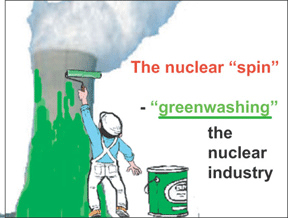 How nuclear plants are gaming climate-change How nuclear plants are gaming climate-change rules rules
In state after state, operators have figured out how turn green-power incentives into sweetheart deals. https://www.politico.com/agenda/story/2019/04/23/nuclear-energy-climate-change-000893, By TRAVIS KAVULLA 04/23/2019
Climate change is underway—and with the U.S. government mostly sitting on its hands when it comes to climate policy, states have been stepping into the breach. For more than a decade, state officials have been adopting procurement mandates to grow the share of electricity needs supplied by solar, wind and other renewable technologies. Today, such laws are in force in 29 states. As renewable technologies have grown in scale, cost has declined. Indeed, these laws have been so effective at reducing the cost of renewables that it is not readily apparent that such mandates are a necessary driver for decarbonization. A recent report by Energy Innovation, an independent research firm, suggests three-quarters of the U.S. coal fleet could be replaced today by renewables solely for economic reasons.
Yet these laws remain on the books, and recently some of the nation’s largest energy producers have started to turn them to their own benefit. For the past several years, I’ve been researching clean-energy regulations at the state level, and a troubling pattern has begun to emerge: In numerous states, companies with large investments in nuclear energy — including Exelon, First Energy, Dominion and PSEG — have lobbied states to reconfigure their clean-power incentives to subsidize existing nuclear plants, rather than the emergent technologies that the laws were intended for.
 The result is a contagion of subsidies to nuclear power plants that started in Democratic states like Illinois and New York in 2016, spread to Connecticut in 2017 and New Jersey in 2018. Bills to this effect are now being considered by Republican-led chambers in Ohio and Pennsylvania. If those measures pass, nuclear interests will have executed a clean sweep of the six northeastern states that have the largest quantities of nuclear generation.The state nuclear-handout schemes are all slightly different. But they all take advantage of green-sounding energy incentives, and they share a basic outline intended to avoid the appearance of being a naked subsidy. For example, Illinois’ program creates a commodity called a “zero emission credit,” or ZEC. A ZEC may only be created by a “zero emission facility” — which makes it sound like they are available to any form of zero-carbon energy. B ut the law defines “zero emission facility” as being a power plant “fueled by nuclear power.” The law then creates an artificial demand for ZECs, requiring utilities to buy a certain quantity. The law sets this number at a level tellingly similar to the total expected output of the state’s nuclear power fleet. All of this is topped off with a requirement that a government commission pass through the costs of these ZECs to customers through a mandatory rate they have no choice (other than cutting the cord entirely) but to pay.
In short, the law seems to be creating a program that promotes adoption of all kinds of clean energy, but in fact creates a direct subsidy for nuclear power plants and guarantees them customers for years to come. Instead of spurring competition between emissions-reducing power sources, it locks in one energy supplier for the foreseeable future.
These state policies starkly differ from other carbon-reduction policies, such as a carbon tax or a cap-and-trade program. Those policies have the advantage of aiming directly at their target: carbon emissions. While potentially costly, either would circulate revenue back to consumers or taxpayers, or use that revenue on government spending intended to amplify the program’s core purpose.
THAT’S NOT THE case here. The nuclear subsidy schemes are an elaborate greenwashing that neither returns money to the public nor further reduces carbon emissions.
And these are not cheap programs. Exelon booked $150 million in 2017 from the sale of ZECs produced by its six Illinois nuclear plants. New Jersey just last week gave final approval to a $300 million annual tranche of subsidies, over the objections of one utility regulator who called it a “disgrace.” Ohio’s has a similar tab, and would partially pay for it by repealing incentives for renewable technologies. Pennsylvania’s program, if enacted, would cost more than $500 million per year, all paid for by ratepayers. That is quadruple the cost of the state’s existing alternative-energy procurement mandate. In total, these state programs’ costs run into billions of dollars—in addition to what these nuclear generators are already being paid from the sale of their energy on the open market.
Supporters say directing subsidies to existing nuclear power plants is necessary to prevent their closure and a loss of jobs. They also say that supporting nuclear power would help ensure that emissions do not spike if nuclear units are replaced by abundant and cheap natural gas.
 But the contention that nuclear facilities might close without subsidies is dubious. Indeed, the argument is contradicted by the most recent available market data. It is true that wholesale power prices have fallen 40 percent over roughly a decade in North America’s largest electricity market, known as PJM, from Illinois to Maryland. But Joe Bowring, PJM’s independent market monitor, the official appointed to conduct analysis independent of any financial participant, forecaststhat for the 18 nuclear plants in the PJM market, only three are projected to be unprofitable between 2019 and 2021. The at-risk plants are older, smaller, single-unit facilities, like Pennsylvania’s Three Mile Island. But the contention that nuclear facilities might close without subsidies is dubious. Indeed, the argument is contradicted by the most recent available market data. It is true that wholesale power prices have fallen 40 percent over roughly a decade in North America’s largest electricity market, known as PJM, from Illinois to Maryland. But Joe Bowring, PJM’s independent market monitor, the official appointed to conduct analysis independent of any financial participant, forecaststhat for the 18 nuclear plants in the PJM market, only three are projected to be unprofitable between 2019 and 2021. The at-risk plants are older, smaller, single-unit facilities, like Pennsylvania’s Three Mile Island.
It’s also important to keep sight of the big picture: Lower energy prices are a good thing for consumers, both private citizens and businesses. Lower prices are only a crisis for energy suppliers who can’t compete.
In my conversations with state officials, some have struggled to understand how this has emerged as a political issue if the nuclear fleet is not, in fact, facing an existential crisis. This is naïve. Executives at corporations that own nuclear power plants, watching as neighboring states hand out subsidies, have a fiduciary duty to their shareholders to try to get it for themselves—whether or not their plants are already turning a profit. Debra Raggio, senior vice president for regulatory affairs for Talen Energy, admitted as much when she testified before a Pennsylvania legislative committee at an April 8 hearing, saying that if the state’s legislation featured a needs test to determine whether nuclear plants actually needed a subsidy to remain open, her company would oppose the bill. Bowring projects that the company’s only Pennsylvania nuclear plant, located along the Susquehanna River, will be profitable in each of the coming three years. In Ohio and Pennsylvania, the whole drama is unfolding on terms dictated by the nuclear plant owners, with utility corporations making threats to shut down certain facilities to force sweeping legislative action without the time for meaningful scrutiny.
BY PROPPING UP older technologies, these state bailouts actually risk doing harm to innovative technologies looking to break into the market. Pennsylvania provides a useful example. In 2004, the state Legislature set aside a relatively modest amount of consumer demand to be served by renewable and other technologies in its Alternative Energy Portfolio Standard. That program constitutes 18 percent of consumer demand. Under the current proposal, a whopping 50 percent would be carved out for existing nuclear plants. In other words, 68 percent of customer demand would be met by power plants preordained by government officials for that purpose. That leaves energy producers who don’t benefit from subsidies left to fight for the scraps. One cannot encourage innovation when the innovators have only one-third of the market share to compete for.
Sadly, these handouts are unraveling a successful state policy that has benefited customers and reduced carbon emissions in the process. Pennsylvania and the other nuclear battleground states adopted policies two decades ago to replace government planning and monopolies with competition between generators. The results have been significant. Customers in these so-called restructured states have seen their electricity costs drop an average of 8 percent between 2008 and 2016, according to a 2017 study by Phil O’Connor, the late chairman of the Illinois Commerce Commission. Customers in states where legislatures, government commissions, and monopolies together select the “right” resource mix have seen prices rise 15 percent. Meanwhile, these competitive markets ensured that when the Marcellus natural gas shale supply boomed, that uneconomic coal plants did not hang around. Carbon emissions from the U.S. power sector have declined 3,855 million metric tons between 2005 and 2017, according to the Energy Information Administration. The majority of those savings, 2,360 million metric tons, come from natural gas’ replacement of coal, and not zero-emission facilities. It’s deeply ironic that these competitive markets might become a victim of their own successes.
The necessity of acting on climate change is palpable in our politics today. But the answer is a genuine competition between low-emission producers through a market for carbon, not handouts to the nuclear industry. The legislation proposed in the Pennsylvania House of Representatives plays footsie with this issue, suggesting that if a price of $15 per ton of carbon emissions were enacted, the nuclear handout would sunset. This is silly. After all, if you’ve got your subsidy, are you going to be willing to support a law that sets a more level playing field between clean-energy technologies—or where you might lose out to efficient gas generators? It would be next to impossible to obtain a comprehensive carbon policy if technology-specific handouts such as these continue to become law, because the political support that might have existed for a carbon policy would have been sapped.
Whatever your view of nuclear energy, it should compete fairly against other electricity sources. In the run-up to this year’s legislative session in Harrisburg, Exelon tripled its lobbying expenditures in Pennsylvania, to $1.7 million, which is a lot of money in state politics. But the company stands to obtain a large portion of the annual $500 million dole of the Pennsylvania nuclear program. That’s a good return on investment—and easier to earn than having to compete for it.
Travis Kavulla is director of energy and environment policy at the R Street Institute.
|
|
April 25, 2019
Posted by Christina Macpherson |
climate change, politics, secrets,lies and civil liberties |
Leave a comment
Journalist Glenn Greenwald defends Assange: The Hill, Julia Manchester 24 Apr 19, ‘Things that journalists do every single day’ Journalist Glenn Greenwald on Monday defended WikiLeaks founder Julian Assange after he was charged by the Justice Department earlier this month for allegedly conspiring to hack a government computer in connection with the organization’s release of sensitive government files in 2010.
“So much of what’s in the indictment, encouraging a source to get more documents, helping a source cover her tracks in order not to be detected, are things that journalists do every single day,” Greenwald, co-founding editor at The Intercept, told hosts Krystal Ball and Buck Sexton in an appearance on Hill.TV.
“You can say journalists don’t typically help a source hack into a password in order to get you know, a better way of hiding her identity, but helping a source avoid detection is definitely something journalists are not just entitled to do, but obligated to do,” he continued. ……https://thehill.com/hilltv/rising/439992-greenwald-defends-assange-these-are-things-that-journalists-do-every-single-day
April 25, 2019
Posted by Christina Macpherson |
2 WORLD, civil liberties, media |
Leave a comment
U.S. appeals court denies Manning’s bail request, upholds contempt finding, Sarah N. Lynch, 24 Apr 19, WASHINGTON (Reuters) – Former U.S. Army intelligence analyst Chelsea Manning will remain in jail after a federal appeals court on Monday denied her request to be released on bail, and upheld a lower court’s decision to hold Manning in civil contempt for refusing to testify before a grand jury.
The ruling is a blow to Manning, who has been detained since March after she declined to answer questions in connection with the government’s long-running investigation into Wikileaks and its founder Julian Assange.
In a comment released by a spokesman, Manning said that while disappointing, the appeals court ruling will still allow her to “raise issues as the government continues to abuse the grand jury process.”
“I don’t have anything to contribute to this, or any other grand jury,” Manning added.
Assange was arrested on April 11 at Ecuador’s Embassy in London, after U.S. prosecutors in the Eastern District of Virginia unsealed a criminal case against him alleging he conspired with Manning to commit computer intrusion.
The Justice Department said Assange was arrested under an extradition treaty between the United States and Britain.
……Manning has tried to fight the grand jury subpoena in the Assange case, citing her First, Fourth and Sixth Amendment rights under the Constitution.
Manning’s lawyer, Moira Meltzer-Cohen, suggested prosecutors were abusing “grand jury power,” and that “the likely purpose of her subpoena is to help the prosecutor preview and undermine her potential testimony as a defense witness for a pending trial.”
Her lawyers have also argued that the courtroom was improperly sealed during substantial portions of the hearing.https://www.reuters.com/article/us-usa-manning/us-appeals-court-denies-mannings-bail-request-upholds-contempt-finding-idUSKCN1RY14O
April 25, 2019
Posted by Christina Macpherson |
civil liberties, Legal, USA |
Leave a comment

 The chain of custody has already been broken. Assange’s lawyers will not be present at the illegal seizure of his property, which has been “requested by the authorities of the United States of America”.




 nuclear-news