Nuclear weapon material worth $72mn seized in a car in Turkeyhttps://www.rt.com/news/463556-turkey-radioactive-material-bust/: 7 Jul, 2019 Turkish police have taken five people into custody over the smuggling of a highly-radioactive substance used to build nuclear weapons and power nuclear reactors. The 18.1-gram haul was found in a car.
Police discovered a vial of the material after they pulled over a car in the northwestern Bolu province. The substance, believed to be californium, was found stashed under the gear stick wrapped in a bag. Officers had to cut the upholstery to get to the parcel, which is estimated to be worth US$72 million.
Five suspects were detained in the raid, and the mixture was taken to the Turkish Atomic Energy Agency (TAEK) for a detailed analysis.
Californium is named after the place where it was synthesized back in 1950 – a laboratory at the University of California. Apart from being used to manufacture nukes and nuclear-powered reactors, the element also has a range of rather innocuous civilian applications. It can be used as part of metal detectors and is used in cancer treatment as well as oil, silver, and gold mining operations. Still, the substance is highly dangerous and its production, distribution, and transportation is restricted. Currently, only the US and Russia synthesize the isotope.
It is not the first time Turkish police have reported a major bust involving californium.
In a scare in March of last year, police in Ankara said they had seized a whopping 1.4kg of the same substance in a car following a tip-off. It turned out to be false alarm, as the haul was later found to have no trace of nuclear or radioactive material, and was, in fact, organic matter.
Josh Goad, Cincinnati Enquirer July 3, 2019If you’re an Ohioan with a TV or radio, you’ve probably heard about a nuclear power bailout bill that lawmakers are considering in Columbus. But what you can’t find out is exactly how much money is being spent on those ads – or who originally gave the money for them.
House Bill 6 seeks to tax Ohioans 80 cents a month through their utility bill to bailout First Energy Solutions’ nuclear power plants in Northern Ohio. Critics say the bill, which also will boost costs for commercial and industrial customers, will discourage the use of renewable energy for businesses across the state. Proponents say the bill will help Ohio stay energy independent and keep badly needed jobs in the communities around the plants.
The bill, which has the backing of powerful House Speaker Larry Householder, triggered up to $8.3 million in ads and other campaign spending, published estimates show. For comparison, a record $45 million was spent in the 2018 Ohio gubernatorial race.
Yet an Enquirer analysis of ad purchases for and against House Bill 6 and reported to the Federal Communications Commission shows just $2.7 million in sales. The Cincinnati market, the state’s third largest, was the leader in ads on the bailout bill.
Why the gap between the $2.7 million hard figure and the $8.3 million estimate? Some broadcasters, including Cincinnati’s WCPO-TV, are choosing not to post billings for the ads – and under FCC rules, they don’t have to do so.
The big money behind the bill hasn’t been reserved for ads this year. Groups allied with Householder put $800,000 into ads for Ohio’s 2018 campaigns, boosting candidates who put Householder into the speaker’s seat. A couple of the winning candidates also are key sponsors of House Bill 6.
But donors behind the campaign money, and for many of the ads you’ve seen about the bill, can’t be pinpointed.
The money backing the bill primarily started with a 501(c)(4) or “dark money” organization called Generation Now that doesn’t have to list donors. Generation Now then gave to a political action committee, which must disclose donors. So while it’s clear which candidates got the “dark money” boosting the nuke plant bailout went, it’s uncertain who originally contributed it or the money that bought airtime.
Who runs Generation Now and is on its board isn’t clear. But the Columbus address of a longtime Householder adviser, Jeff Longstreth, is listed as the principal office in documents filed to the Ohio Secretary of State. So far, the 501(c)(4) hasn’t filed paperwork with the IRS – a step that such nonprofits seeking to stay in existence take. Paperwork that’s normally filed with broadcasters, listing the board members of groups airing political ads also is missing.
How much is being spent?
Generation Now has spent over $1.9 million on ads supporting House Bill 6, documents filed with the FCC show. This is out of around $2.7 million reported being spent on ads across Ohio on the proposal.
First Energy, which owns the plants being bailed out, backs the Ohio Clean Energy Jobs Alliance. The alliance has spent around $275,000 on ads in support of the bill and has stuck to Facebook for distribution.
The opposition to House Bill 6 has put $400,000 into its ads. The total from Ohio Consumers Power Alliance, American Energy Action and Ohioans Against Nuke Bailout compares to the roughly $1.3 million Generation Now has spent in Cincinnati alone.
Why isn’t all the spending being reported?
The FCC requires stations to make ad spending records available for the public record, but only if the ads are focused on a specific candidate or a national issue. State and local issues are not on the short list of requirements.
Some stations choose to file everything for the sake of transparency. Others don’t.
FCC public inspection files show 41 stations in markets across Ohio – Cincinnati, Dayton, Columbus, Cleveland-Akron, Toledo, Zanesville and Wheeling-Steubenville – were contacted by Generation Now or other interested parties because they are required to file such contracts by FCC rules.
But 13 stations, including every commercial TV broadcaster in Dayton, did not report how much Generation Now and other organizations spent on ads.
Where did the money come from?
‘Dark money’ is inherently difficult to track. While we don’t know the source, the money can be followed when it changes hands.
Other than the money Generation Now spent in 2019 on ads, the nonprofit also donated over $1 million to the Growth & Opportunity PAC in 2018. The political action committee is based in Lexington, Kentucky, but operates throughout the Midwest.
According to documents filed with the FEC, the PAC only raised around $1.1 million in 2018. Almost all of that money would go on to pay for ads for Ohio Republican candidates during the midterm elections. Though Generation Now did not directly pay for those ads, it did provide the majority of funds necessary through three sizable donations to the PAC.
When the donations were made last year, Generation Now and the PAC had something in common: A treasurer from Dinsmore Agent Co, a subsidiary of Cincinnati-based law firm Dinsmore and Shohl.
Eric Lycan, the treasurer and former lawyer at Dinsmore’s Lexington office, would have overseen the donation. He still serves as the treasurer for both the organization and the PAC, and several documents filed to the FEC include his Dinsmore email address.
The only Ohio-based organization that is easily traceable is Ohio Citizen Action, founded in Cleveland in 1976. Through its education fund, Ohio Citizen Action created the Ohio Consumers Power Alliance, who has paid for $8,000 in anti-House Bill 6 ads.
As nonprofits, Ohio Citizens Action and its education fund report their annual revenues to the IRS but not their donors. The last available filing for the education fund was for 2017, which was posted in January 2019.
Where did the ‘dark money’ go?
Reps. Jamie Callender, R-Concord, and Shane Wilkin, R-Hillsboro, both primary sponsors of House Bill 6, directly benefited from the ads purchased by the Growth & Opportunity PAC.
Of the 22 Republican candidates that received either mail or radio ads, 19 would go on to win a seat in the House. Callender received more in ad spending than any other winning candidate, with $93,000 spent on seven different ad buys.
Householder also had nearly $50,000 worth of ads paid for by the PAC during his election to his Southeast Ohio seat. Another $25,000 was donated directly to Householder by FirstEnergy’s PAC.
Karen Kasler, of public radio’s Statehouse News Bureau, asked Householder earlier this year if House Bill 6 was a priority to him because of his connections to Eric Lycan and the Growth & Opportunity PAC.
“It’s a priority bill for me because I’ve always cared about the energy in the state of Ohio,” said Householder. “I’ll tell you who’s paying for these ads: it’s working men and women from Ohio, who want to save their jobs and it’s Ohio corporations, headquartered in Ohio, that want to stay here. That’s who’s paying for it.”
Why is ‘dark money’ hard to track?
It can be as simple as Generation Now, and other dark money groups, not filing the appropriate paperwork to the IRS. If a tax-exempt organization doesn’t file for three consecutive years, it loses its status. Since Generation Now was incorporated in January 2017, the three-year deadline is approaching.
Though Householder says that hardworking men and women donated money to the organization, Generation Now doesn’t have a donation portal on its website.
While reaching out to Generation Now for comment, Curt Steiner, CEO of Columbus-based Steiner Public Relations, answered instead. He said that he represents Generation Now and that he couldn’t speak on why there is no donation portal.
Why have the ads run recently?
Many of the ads about House Bill 6 played on Ohio’s airwaves talked about getting the bill passed before the end of June.
Some of the ads feature an ominous voice talking about what Ohio’s future might look like under the bill, others showcase somebody who talks about their life and what FirstEnergy has done for them.
So why the deadline for passage? FirstEnergy Solutions needed to know whether to place an order for $52 million worth of fuel for one of its nuclear power plants. It takes months for such an order to be filled.
Action on FirstEnergy Solutions restructuring plan, filed through the Bankruptcy Court for the Northern District of Ohio, has been posted four times, moves that a FirstEnergy spokeswoman described as “not unusual.”
Senate President Larry Obhof, R-Medina, told Statehouse reporters on Saturday he isn’t worried about the delayed fuel purchase.
“I’ve had a number of conversations with (FirstEnergy) going back several months about what the timeline was and there’s always been a little bit of flexibility,” Obhof said.
Meanwhile, House Bill 6 is still awaiting a vote in the Ohio Senate.
The incident took place on Monday, according to the Defense Ministry, but was not officially disclosed until late on Tuesday. Nearly two days on, there was still no word on whether the submarine was nuclear-powered.
Some Russian media accused officials of starving the public of details and drew parallels with the dearth of official information during the meltdown of a Soviet nuclear reactor in Chernobyl in 1986.
The type of vessel was not specified by the ministry and there were few details of the circumstances beyond the fact that it had been in Russian territorial waters and the fire had been extinguished.
“Absolutely nothing is known at the moment — who, what… I don’t understand one thing: why did a day go by and only then did they make the statement about the deceased?” said Yevgeny Buntman, an anchor for the Ekho Moskvy radio station. “Why don’t we know their names? Is this normal?”
The Bell, a news site often critical of the government, wrote: “Nearly a day without information about the accident in a nuclear facility and the need to look out for Norwegian statements about the level of radiation should have given a shudder to those who remember the Chernobyl nuclear power station.”
Secret sub Norway’s authorities said on Tuesday they had not detected any abnormal radiation.
Asked on Wednesday if the vessel had a nuclear reactor on board, Kremlin spokesman Dmitry Peskov referred the question to the Defense Ministry.
He told reporters in a conference call that details of the submarine were classified, but that information had been provided in good time. Several hours before the official statement, blogger Yevgeny Karpov reported a fire on a vessel belonging to the Northern Fleet, but he then took down the report at the fleet’s request, he told the Meduza news site.
The fire is one of the deadliest submarine accidents since August 2000, when the nuclear-powered Kursk sank to the floor of Barents Sea, killing all 118 men aboard.
Authorities then, and in particular President Vladimir Putin, who was at the beginning of now almost two decades as president or prime minister, came under fire for their slow response and shortcomings in the rescue operation.
THREE CONVICTED IN DIMONA NUCLEAR RESEARCH AGENCY FRAUD, Besides the three individual defendants, the case also led to charges against two entities used by the defendants. Jerusalem Post, BY YONAH JEREMY BOB JULY 4, 2019
The Beersheba District Court has convicted three persons engaged by Israel’s nuclear research agency in Dimona of an NIS 3.2 million fraud scheme, including also money-laundering and breach of trust.
Announced for the first time by the court spokesperson’s office on Wednesday, the convictions and jail sentences of the three were actually handed down in April and earlier, but were under gag order due to the implications for national security.
Unlike a normal case probed by police, the investigation was led by a special division in the Defense Ministry which eventually worked with a special team in the state prosecution – again all due to the extreme sensitivity of all issues related to Dimona.
Israel has never confirmed that it has nuclear weapons, but according to foreign sources, the Dimona reactor has been used to produce between 80-200 nuclear weapons which Israel can deploy by land, sea and air.
The central defendant, an external consultant in 2002 who eventually became a senior manager within the Negev Nuclear Research Center in 2011, was sentenced to 30 months in prison and fined NIS 100,000. Another defendant was sentenced to 18 months in prison and fined NIS 75,000. A third defendant had cut a plea deal with the state at an earlier date. Due to the cooperative plea deal, the third defendant received only six months of community service and a NIS 50,000 fine.
Unlike a normal case probed by police, the investigation was led by a special division in the Defense Ministry which eventually worked with a special team in the state prosecution – again all due to the extreme sensitivity of all issues related to Dimona.
Besides the three individual defendants, the case also led to charges against two entities used by the defendants.
Combined, the court fined those companies or seized assets worth NIS 450,000.
A statement by the Justice Ministry said that some of the defendants had appealed the decision to the Supreme Court. …….
Secrets of Chernobyl spill out more than three decades after the nuclear disaster, By SERGEI L. LOIKOsergei.l.loiko@gmail.com, JUN 30, 2019| CHERNOBYL, UKRAINE[good photographs on original]
Seated in a jeep and clutching a screeching Geiger counter, Lt. Col. Viktor Chershnev led a convoy of 30 military trucks through the center of sleeping Kiev.
The measuring device was sounding off loudly on that night 33 years ago, not because of the convoy’s cargo — 30 antiaircraft missiles, three of them tipped with nuclear warheads — but because of where and when the post-midnight parade had kicked off: at the Chernobyl air defense missile base just three days after the explosion of a reactor at the adjacent Chernobyl nuclear power plant that had sent enough radioactivity spewing into the air that it at one point had the potential of poisoning much of Eastern Europe.
Chershnev knew that the missiles, the trucks and his crew were badly contaminated and that they should not have been ordered to drive through a city of more than 2 million people. But there was no bypass road at the time — and orders were orders. What Chershnev didn’t know in the early hours of the morning of April 30, 1986, was that a radioactive cloud had already caught up with them and blanketed the city on the eve of its annual May Day festivities.
The reaction to HBO’s recent “Chernobyl” miniseries has been almost as far-reaching as the initial tragedy and has spurred a daily line of buses packed with foreign tourists at the gate of the Chernobyl Exclusion Zone, which extends for 20 miles around the plant. But Chernobyl still boasts secrets more than three decades later, including the story of Chershnev and his charges — a saga of dysfunction and disregard for human life that lays bare conditions in the waning years of the Soviet Union.
When the red alert sounded, Chershnev, then the deputy commander and chief engineer of the Kiev Air Defense Brigade, was responsible for the readiness of weaponry and equipment at the Chernobyl antiaircraft battalion’s base in a massive in-ground bunker with 10-inch-thick, rusty metal doors.
These days, the site also features a 10-yard-long missile launcher’s towing trolley, half-buried in silver moss, the former walls of a second smaller bunker surrounded by dense pines and a vast carcass of barracks with missing floorboards, dilapidated walls and a mural of a Soviet soldier cheerfully calling upon comrades to defend the motherland.
Seventy officers and men — ill-informed, unprotected and exposed to deadly radiation — were housed at the site along with the missiles back in 1986, under orders to arduously protect and save the weapons and structures rather than themselves.
The site included the nuclear plant and the Chernobyl over-the-horizon early warning radar station, a 500-meter-long, 150-meter tall installation designed to detect strategic missiles launched from the United States. The now-rusty structure still towers over the area and is a major tourist attraction, a frightening monument to the Cold War that even the complex‘s normally fearless marauders have not attempted to cut into pieces to sell as scrap metal outside the zone, a routine business in these parts.
In the aftermath of the 1986 explosion — as the government evacuated more than 50,000 residents from the town of Pripyat, including the families of nuclear plant workers, plus more than 75,000 residents of nearby villages — the men of the Chernobyl air defense unit stayed put until they received fresh orders.
“Three days after the explosion, on April 29, I arrived at the base with 30 heavy trucks and we loaded on them 30 missiles from the storage hangars,” recalls Chershnev, who headed the evacuation effort. “Twenty-seven of them were conventional, but the other three were tactical rockets with nuclear warheads. We were to take them to a facility outside Boryspil, near Kiev.
“After that, we were ordered to go back and salvage the remaining equipment that could be dismantled.”
The men traveled — without protective gear — for 14 hours at speeds lower than 20 mph as radiation from the explosion leaked into the air.
Chershnev admits he knew the dangers but says he was a career officer and could not disobey orders………….
When Chershnev got back from that trip, he repeated the ritual of burning his uniform.
“No one in the world knows that we existed and what we went through,” he said. “And all for nothing. All so stupid and futile. We didn’t save anyone. We didn’t clean up anything.
“All those I personally know and have kept track of all these years are either badly sick like myself or dead by now. My driver who accompanied me on all the convoys was discharged and died at 28. My fellow deputy brigade commander, … who was also dealing with contaminated equipment, died [in 1995] of cancer. Warrant Officer Petro Pozyura went blind. And so on and so forth. I have a heart ailment and every year spend a couple of weeks in hospital.”
The cardiologist who has been treating Chershnev for the last few years once asked him to retrieve his Chernobyl-era medical records from the military. But Chershnev was told that the records no longer exist.
“Here I am on a pension with a monthly Chernobyl health compensation of about $11 a month,” he concluded bitterly. “It is not even enough to buy a bottle of decent vodka, let alone medicines.”
The official death toll related to the explosion is listed as 39, but out of the officially registered 3.2 million people who were exposed to radiation in Ukraine alone, 1.3 million have died in the last 33 years, said Vladimir Kobchik, a former Chernobyl cleanup worker who is now a leader of a group that aims to protect the rights of fellow survivors.
“For the last four years, the government of Ukraine has been allocating $70 million annually for the needs of the affected. That is $37 per person per year! Not a penny more! How many of those remaining 1.9 million people affected by Chernobyl are sick [and] we can’t even tell? The doctors will never tell you you are sick or dying because of radiation.”……… https://www.latimes.com/world/la-fg-ukraine-chernobyl-secrets-20190630-story.html
It started in the 1940s, near A-bomb development sites. More recently, something has been stalking nuclear carrier strike groups. ADAM JANOS 23 June 19, Why are so many UFOs being reported near nuclear facilities—and why isn’t there more urgency on the part of the government to assess their potential national-security threat?
Those are questions being asked by a team of high-ranking former U.S. defense and intelligence officials, aerospace-industry veterans, academics and others associated with To the Stars Academy of Arts & Science. The team has been investigating a wide range of these sightings—and advocating more serious government attention.
Their investigations are the subject of HISTORY’s limited series “Unidentified.”
Throughout history, unexplained aerial phenomena (UAPs) have shocked, frightened and fascinated sky watchers. And in the last century, more than a few have been reported in military contexts. In late World War II, U.S. airmen called them “foo fighters”: strange orange flying lights by the French-German border. During the Korean War, some soldiers claimed a blue-green light emitting “pulsing rays” made their whole battalion sick with what, to some, resembled radiation poisoning.
Less known: In the last 75 years, high-ranking U.S. military and intelligence personnel have also reported UAPs near sites associated with nuclear power, weaponry and technology—from the early atomic-bomb development and test sites to active nuclear naval fleets.
“All of the nuclear facilities—Los Alamos, Livermore, Sandia, Savannah River—all had dramatic incidents where these unknown craft appeared over the facilities and nobody knew where they were from or what they were doing there,” says investigative journalist George Knapp, who has studied the UAP-nuclear connection for more than 30 years. Knapp has gathered documentation by filing Freedom of Information Act requests to the departments of defense and energy.
“There seems to be a lot of correlation there,” says Lue Elizondo, who from 2007 to 2012 served as director of a covert team of UAP researchers operating inside the Department of Defense. The program, called the Advanced Aerospace Threat Identification Program (AATIP), received $22 million of the Pentagon’s $600 billion budget in 2012, The New York Times reported. Elizondo now helps lead To the Stars’ investigations.
The UFO-nuclear connection began at the dawn of the atomic age.
Nuclear-adjacent sightings go back decades, says Robert Hastings, a UFO researcher and author of the book UFOs and Nukes: Extraordinary Encounters at Nuclear Weapons Sites. Hastings says he’s interviewed more than 160 veterans who have witnessed strange things in the skies around nuclear sites.
“You have objects being tracked on radar performing at speeds that no object on earth can perform,” Hastings says. “You have eyewitness [military] personnel. You have jet pilots.” Witnesses to these incidents are often highly trained personnel with top security clearances. In recent years, their reports are being corroborated by sophisticated technology.
In late 1948, “green fireballs” were reported in the skies near atomic laboratories in Los Alamos and Sandia, New Mexico, where the atomic bomb was first developed and tested. A declassified FBI document from 1950 mentions “flying saucers” measuring almost 50 feet in diameter near the Los Alamos labs. And Knapp has interviewed more than a dozen workers from the Nevada desert atomic test site, where scores of A-bombs were detonated in the post-WWII years. He says they told him UFO activity was so commonplace there, employees were assigned to monitor the activity.
In the 1960s and ’70s, repeated UFO sightings emerged at Malmstrom Air Force Base in Montana, a storage site for nuclear-tipped intercontinental ballistic missiles (ICBMs). At one such alleged sighting in 1967, former Air Force Capt. Robert Salas says several of those missiles became inoperative at the same time base security reported seeing a glowing red object, about 30 feet in diameter, hovering over the facility. Salas, who commanded ICBMs as a launch officer and later worked in the aerospace industry and at the Federal Aviation Administration, told CNN the “missiles began going into what’s called a ‘no-go condition,’ or unlaunchable.”
Observers can only speculate about the origin of these unexplained phenomena. But the repeated proximity to sensitive defense sites connected to our nation’s most powerful weapons has raised the question of whether they might originate from adversaries—known or unknown.
In late December 1980, air-traffic controllers encountered something alarming near Royal Air Force Bentwaters in England. Used by the U.S. Air Force as a European foothold during the Cold War, Bentwaters housed a secret stash of nuclear weapons in 25 fortified underground bunkers.
“We looked up on the radar scope and saw something…not like anything I’d seen before,” Ivan Barker, a U.S. Air Force air-traffic controller working that night, told HISTORY.com.
Barker, a master sergeant who was second in charge at the facility, says he was an 18-year veteran at that point and knew “about every aircraft in the U.S., NATO and the Soviet bloc.” This object, he says, shocked him and his two colleagues that night with its remarkable speed and maneuverability. On radar, it covered 120 miles in a matter of seconds, he said: “It had to be moving Mach 5, 6, 7 or 8—faster than anything other than possibly a missile.”
As he looked up from the radar to view it directly, the craft moved into close range, slowed and then stopped over the base’s water tower: “Like a helicopter hovering, except with a helicopter you get movement up and down. This was stationary. It was between about 1,500 and 2,000 feet high. The thing was…at least a city block…in diameter.”
Barker says it was shaped like a giant basketball, with portholes around the center, from which lights were emanating outward. “I was shocked… There was nothing aerodynamic about it. Basketballs don’t fly.”
Newspaper headlines reporting on the Rendlesham forest UFO report in Suffolk, England.
It stopped over the water tower for only a few seconds, he said, before reversing course and speeding back the way it came in: “It was like—swish!—it’s gone.”
Barker didn’t report the sighting to his superiors. “You don’t understand what the Air Force did to people who reported UFOs,” he says.
Barker’s story dovetails with that of Col. Charles Halt, Bentwaters’ deputy commander at the time. Halt led a patrol that night to investigate strange colorful lights seen descending into nearby Rendlesham Forest. Halt described to Elizondo what he saw from inside the forest: a red light moving horizontally though the trees, “obviously under some kind of intelligent control.” A laser-like beam, he said, “landed 10-15 feet away from us. I was literally in shock.”
Then the beam’s source quickly left, flying north toward the base, says Halt, who audiotaped the incident at the time. “We could hear chatter on the radios that the beams went down into the weapons storage area.”
Later, his commander played the audio for a general, who dismissed the need for further investigation. They were loath to get involved, says Halt.
Navy sightings in the Atlantic and the Pacific
In recent years, sightings of unidentified aerial phenomena have emerged from America’s nuclear navy.
F-18 fighter pilots from the nuclear-powered USS Theodore Roosevelt carrier strike group saw UAPs almost daily for several months between the summer of 2014 and the spring of 2015 while executing training maneuvers along the Eastern seaboard between Virginia and Florida, witnesses told Elizondo.
“Wherever we were, they were there,” says Ryan Graves, an active-duty F-18 fighter pilot from the USS Roosevelt, who holds a degree in aerospace engineering.
The objects appeared in three shapes, Graves says—some were discs, others looked like a cube inside a sphere, while smaller round objects flew together in formation. All lacked visible engines or exhaust systems. Some tilted, mid-flight, like spinning tops, as seen on an infrared video released by the U.S. Department of Defense in 2017. Graves and another F-18 pilot, Danny Accoin, confirm that video, along with one other released by the government, had been shot by their fellow Roosevelt pilots while in the air.
One UAP, Grave says, almost caused a terrifying collision by zipping dangerously between two planes. An aviation flight-safety report was filed, he says, but never investigated.
Graves says the unidentified objects reappeared once the Roosevelt had deployed to its mission in the Persian Gulf.
“It’s hard to find a prosaic explanation for a carrier battle group being shadowed by unidentified aircraft all the way across the Atlantic, to an area of operations overseas in the Middle East,” says Chris Mellon, former U.S. Deputy Assistant Secretary of Defense for Intelligence during the Clinton and George W. Bush administrations, who now serves as an integral part of the To The Stars team. “It makes an extremely compelling case for the existence of technologies we didn’t think were possible.”
Leon Golub, a senior astrophysicist at the Harvard-Smithsonian Center for Astrophysics, told The New York Times there may indeed be several “low-probability” prosaic explanations for the Roosevelt sightings. They include “bugs in the [radar’s] code for the imaging and display systems, atmospheric effects and reflections [and] neurological overload from multiple inputs during high-speed flight.”
Still, the Roosevelt reports echo those made by Navy pilots undergoing training exercises on the other side of the country. In November 2004 pilots and radar operators from the USS Nimitz carrier fleet saw a 40-foot long tic-tac shaped object flying just above the ocean while flying 100 miles off the coast of California near San Diego. When F-18 fighter jets were scrambled to approach the object, it accelerated, easily outrunning the supersonic Navy craft.
Increasing attention to the topic
Whereas earlier reports were career-killers for military personnel, there is an increasing openness in the Pentagon and on Capitol Hill to taking these sightings seriously as potential threats. In April 2019, the U.S. Navy announced that it was updating its guidelines for how pilots and personnel should report unexplained aerial phenomena—making it easier for military members to report sightings to superiors without facing professional stigma and backlash. And Congress, beginning with former Senate majority leader Harry Reid, has taken more interest in being briefed.
George Knapp says that’s more activity than he has seen in three decades. He, and many others, think it’s overdue.
“At the facilities where we were first designing and building nuclear weapons…at the places where we were processing the fuel…at the facilities where we were testing the weapons…at the bases where we deployed those weapons, on the ships…the nuclear submarines… All those places, all the people working there have seen these things,” Knapp says.
“Are they all crazy?” he continued. “Because if they are, they shouldn’t have their hands on nuclear weapons.”
Inside the Russian Woodpecker, the top secret military facility in the shadow of Chernobyl, We all know about the Chernobyl nuclear disaster but few have heard of the nearby secret military facility whose purpose is shrouded in mystery. News.com.au, Benedict Brook@BenedictBrook 23 June 19
“…….in the highest echelons of the Soviet military, Chernobyl had long been known for something else: an ominous top secret Cold War facility buried deep in the forest just a few kilometres from the notorious power plant.
To the USSR military it was known as the Duga array. To those who discovered its existence in the West it was dubbed the “Russian Woodpecker.” A cheery name that belied the fear and mystery that surrounded the facility.
When Chernobyl blew, it wasn’t just the city of Pripyat which disappeared off the map; so did the enormous military installation. It became bathed in radioactive dust and was left to rust in the exclusion zone, where it remains to this day.
Not that Duga was on any maps. It was marked, instead, as a children’s camp. But there were no kids here. Secret it may have been but come anywhere near it and it was hard to miss.
Built in 1976, from afar it looks like a giant wall towering over the forest. But get closer and it’s far more porous — a massive metal lattice work that stands some 50 stories tall and stretches for 500 meters long.
Despite its size, few outside of Chernobyl knew of its existence. Few of the West knew of it either — but then they began to hear it.
From the mid 1970s onwards a strange rapidly repeating interference began to be noticed on some radio frequencies. The incessant tapping was reminiscent of a woodpecker. Now and then, the signal would stray off little used frequencies and interrupt radio stations around the world.
THE RUSSIAN WOODPECKER’S ROLE
Ham radio enthusiasts, as well military experts, deduced the signal was coming from somewhere north of Kiev, now in Ukraine but at the time part of Moscow ruled USSR. The Duga array had successfully given away its own secret location.
Luke Johnson, who took a tour of the Duga for Atlas Obscura magazine, said it wasn’t just the west that was picking up the eerie signal from Chernobyl.
“Higher-end Soviet television sets were sold with a special ‘woodpecker jamming’ device built in. More alarmingly, the mysterious signal began to interfere with emergency frequencies for aircraft,” he wrote.
But what exactly was the purpose of the Russian Woodpecker? Speculation in the West was rife with some theories that it could control the weather or even that the huge structure transmitted some kind of mind control power.
At the time the US and USSR were at the height of the Cold War with thousands of nuclear tipped missiles ready to be launched at a moment’s notice.
The Duga’s main role was as a huge radar receiver, part of a network of facilities designed to detect the launch of missiles headed towards the USSR.
…….. THREE MINUTE WARNING
While most visitors to Chernobyl make a beeline for the power station and abandoned town of Pripyat, the Duga array remains off the beaten track.
“During the Cold War, even approaching this spot would have had dire consequences, but today there is just one guard, near a dilapidated guard house with wood smoke rising from the chimney,” writes Mr Johnson.
…… Masses of discarded computer terminals, that once would have provided the USSR with the three minute warning, now lie broken and battered in the snow.
“While the nuclear reactor remains a nexus of international concern, the Russian Woodpecker stands largely forgotten,” said Mr Nazarayan.
….. The distinctive tapping sound was last heard sometime around 1989. And with that, the Russian Woodpecker fell silent.
Nuclear waste, rising seas and Trump: Marshall Islands struggles to stay above water, Yahoo News, Marshall Islands President Heine speaks with Reuters in Geneva By Tom Miles, 21 June 19, GENEVA (Reuters) – The Marshall Islands is literally struggling to stay above water but its President Hilda Heine told Reuters she had saved her breath rather than try to persuade U.S. President Donald Trump to hear its climate change message.
Heine met Trump at the White House last month, along with the presidents of Palau and the Federated States of Micronesia, both of which are also under threat from rising sea levels.
But they did not talk about climate change.
“We made a conscious decision to discuss those things that we think we could accomplish, rather than spend time talking about something that we know is not going to happen,” she said.
“We know that we’re not going to be able to change his mind in 30 minutes about climate change.”
The Marshall Islands, comprising 31 tropical atolls between Australia and Hawaii, risks being underwater in 10-20 years.
“If that’s not scary enough, I don’t know what is. For us, it’s of course an existential issue,” said Heine, who was in Geneva to open a diplomatic mission, address the International Labour Organization and press her country’s case for a seat on the U.N. Human Rights Council.
The scene of massive U.S. nuclear tests in the 1950s, it is also at risk of disaster from radioactive debris the U.S. military left behind.
Her government has put a line item in its budget to cope with environmental costs, with about 5% of spending set aside to fund sea walls to save at least its two most populated areas.
On climate change, Heine said she had a simple message for the world: “Get real. Climate change is here. It’s not anything to just talk about and think, that is going to happen. It’s happening.”
The official statement from the White House meeting cited “the region’s most pressing issues, including responding to natural disasters”, but not climate change or rising sea levels.
The main topic was renewal of U.S. financial grants and the rollover of a Cold War-era defence and security agreement.
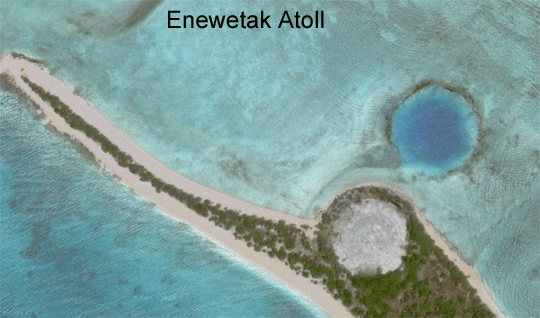
The Marshall Islands was occupied by Allied forces in 1944 and placed under U.S. administration in 1947. Between 1946 and 1958, the United States detonated 23 atomic and hydrogen bombs on Bikini and Enewetak atolls, debris from which was left buried under a shallow concrete dome on Enewetak.
“We’re told it’s seeping into the lagoon,” Heine said, adding that the government wanted help to assess the damage and impact on marine life and potential costs of making it safe.
Asked if it was potentially a nuclear disaster on top of a climate emergency, she said: “It could be.”
NUCLEAR JUSTICE
The Marshall Islands gained independence in 1986 and later tried in vain to sue nuclear powers in a David-and-Goliath case at the International Court of Justice.
It now has a “nuclear justice strategy” to cope with displacement and higher cancer rates, but cannot back a treaty banning nuclear weapons because of one provision that would force it to take care of its own clean-up, Heine said.
BY CRISTINA MAZAON 6/19/19 Terrorist groups are making a concerted effort to access nuclear and biological weapons technology to carry out attacks, officials in Russia warned on Wednesday.
Russian officials, for example, claimed that terrorist groups are targeting Russian military facilities in Syria in an effort to steal advanced weapons technology.
“A number of tendencies in the tactics of international terrorist organizations’ steps deserve special attention and analysis,” Yuri Kokov, Russia’s Deputy Security Council Secretary, said during an international security forum held in the Russian city of Ufa.
“First of all, this concerns the continued attempts to get access to data about the manufacturing of nuclear, chemical and biological weapons, their increased attention to issues related to the use of pathogenic biological agents and toxic chemicals for terrorist purposes,” Kokov continued, without providing details of specific incidents.
Kokov said that terrorist groups are using a variety of methods, including underwater attacks carried out by trained swimmers and the use of minors. The comments focused entirely on the tactics of terrorist groups and not on the activities of state-backed actors.
The Ufameeting, which will run until June 20, will be attended by at least one member of the U.S. National Security Council, Russian officials have claimed.
“The Americans have been skipping our forum in the recent years. But this year we hope to see them at a meeting in Ufa. At least, they have confirmed the visit by one of the U.S. Security Council’s directors,” Russian Security Council Deputy Secretary Alexander Venediktov told reporters on Sunday before the event began.
The White House has not confirmed whether the report is accurate or who, if anyone, will be attending the Ufa forum from the U.S. National Security Council.
At least one Iranian official, Admiral Ali Shamkhani, secretary of Iran’s Supreme National Security Council, will attend the event, raising questions about whether U.S. and Iranian officials could potentially meet at a moment when tensions are rising between the two countries.
Korea’s nuclear reactor technologies allegedly leaked to UAE, US By Shin Ji-hye, Jun 18, 2019 – The South Korean government is reportedly looking into allegations of leaks of key nuclear reactor technologies to other countries. According to multiple local news reports Tuesday, the Nuclear Safety and Security Commission and the National Intelligence Service are verifying the authenticity of a tipoff delivered to the NSSC through a nuclear safety ombudsman system.
Based on the tipoff, one retiree from state-run nuclear operator Korea Hydro & Nuclear Power has allegedly leaked “critical” nuclear reactor technologies to the US and the United Arab Emirates. The retiree had reportedly moved to the UAE’s Nawah Energy Company in 2015.
He is alleged to have provided blueprints, production technologies and detailed documents of an APR-1400, an advanced pressurized water nuclear reactor designed by the Korea Electric Power Corp., according to the reports. ….http://www.koreaherald.com/view.php?ud=20190618000628
Nuclear Regulatory Commission (NRC) Attacks Gundersen – Again! Plus SSFL/Woolsey Fire Update – NH #417
Nuclear Regulatory Commission (NRC) staff and management don’t like whistleblowers, and somebody who probably ranks as their least favorite one is this week’s Nuclear Hotseat guest.Arnie Gundersen is a former nuclear industry executive and nuclear engineer with more than 44 years of nuclear industry experience. He became a whistleblower in 1990. Gundersen has written dozens of expert reports for non-government organizations and the state of Vermont. His curriculum vitae shows Gundersen is a licensed Critical Facility Reactor Operator from 1971-1972. He is Chief Engineer at Fairewinds Energy Education.In this extended interview with Nuclear Hotseat Producer/Host Libbe HaLevy, Gundersen goes into his history as a nuclear industry insider, the consequences of his bringing safety considerations to the attention of his boss, and the personal and professional “fallout” that resulted from his standing up for the truth. Included is Arnie’s update on what can be shared thus far about the Woolsey Fire at the Santa Susana Field Lab and the challenges faced in trying to learn more from ash and soil samples.
The Joint Chiefs of Staff briefly published and then removed from public access a new edition of their official doctrine on the use of nuclear weapons. But a public copy was preserved. See Joint Publication 3-72, Nuclear Operations, June 11, 2019.
The document presents an unclassified, mostly familiar overview of nuclear strategy, force structure, planning, targeting, command and control, and operations.
“Using nuclear weapons could create conditions for decisive results and the restoration of strategic stability,” according to one Strangelovian passage in the publication. “Specifically, the use of a nuclear weapon will fundamentally change the scope of a battle and create conditions that affect how commanders will prevail in conflict.”
The document might have gone unremarked, but after publishing it last week the Joint Chiefs deleted it from their public website. A notice there states that it (JP 3-72) is now only “available through JEL+” (the Joint Electronic Library), which is a restricted access site. A local copy remains publicly available on the FAS website.
The miniseries follows the power plant workers, first responders, Soviet Union officials, scientists, soldiers and the locals of Pripyat, Ukraine (formerly the Soviet Union) in the wake of the Chernobyl nuclear reactor exploding.
As with most historical dramas, the show has been critiqued for taking liberties with the truth in service of the story. And these departures are somewhat ironic for a show whose tagline is “the cost of lies”.
But the function of historical dramas isn’t pinpoint accuracy: the best ones work as allegories.
And as an allegory for our times, Chernobyl could not be more fitting.
Moscow has a long history of ‘fake news’
The lies start early on. While most of the town sleeps through the nuclear explosion, in the control room of the power plant, denial is in full swing.
The assistant chief engineer, Anatoly Dyatlov (Paul Ritter), tells his men to pump water to the core, insistent the problem can be fixed.
An engineer tells Dyatlov: “there is no core”.
Dyatlov insists the core is intact. From the earliest moments, the truth is in flux.
The radiation leak has already begun to kill these workers; we’re in the company of the living dead.
But despite the horror of watching these men slowly die, as if a needle is untethering the fabric of their DNA, it’s the words of a Soviet Union official (Donald Sumpter) that shock the most.
“When the people ask questions that are not in their own best interests,” he tells his men, “they should simply be told to keep their minds on their labour and leave matters of the state to the state.”
The next step is to seal the city and cut the phone lines to prevent the spread of misinformation.
The speech is met with applause.
Over the course of the series it becomes clear the Chernobyl disaster was caused by the cost-cutting measures of the Soviet Union, but the state was structured perfectly to work their way out of the problem and contain the truth.
Miners and soldiers are conscripted to clean-up the mess, despite the risk to their health. Scientists are told to do their job and not ask any questions.
All the while, Soviet officials work to compartmentalise the tragedy to hide the horrors of a nuclear meltdown.
For scientists Valery Legasov (Jared Harris) and Ulana Khomyuk (Emily Watson) to understand what caused the meltdown they must be critical of the Soviet Union.
The most intense moments are the conversations where characters weigh up the risk of telling the truth.
The war on the truth continues
Decades later, Moscow continues to tightly control the flow of information both at home and abroad — its “troll farms” set up to spread misinformation and propaganda are just the latest iterations.
But Australia is not immune to attempts by government to conceal and manipulate the truth.
Chernobyl focuses on what happens when government policy is put before human lives.
The scientists investigating Chernobyl repeatedly attempted to sound the alarm, warning Soviet Union officials that the problem was bigger than one reactor as poison spread across Eastern Europe (one study predicts by 2065 the disaster could cause 16,000 cases of thyroid cancer and 25,000 cases of other cancers).
Today, scientists are trying to warn us of an existential threat to our health and safety: climate change. Once again, government drags its feet.
If we take anything from Chernobyl, it should be this: put science before politics.
In 2019, we may have grasped the extreme dangers of radiation, but the war on the truth is ongoing — it’s eternal.
As we face another environmental catastrophe, the question will be: what is the cost of lies?
Born Violent: The Origins of Nuclear Power, Asian Journal of Peacebuildling, 2019, Robert (Bo) Jacob
Please excuse the “t”s and “f”s which have somehow turned into squares–my copying problems.
(Copious references are provided on the original) “…his article traces the origins o nuclear power technology as it was speciically developed to produce nuclear weapons or use against a civilian population in war……
It will trace numerous radiological disasters during the production history o the Hanord reactor fleet and at other military plutonium production reactor sites during the early Cold War.It will describe the later emergence o the nuclear power production industry which used nuclear reactors to also produce energy or civilian use and the history o partial and ull nuclearuel meltdowns that accompanied that industry……..
Hanford during the Cold War…..During the Cold War, the United States produced over 60,000 nuclear weapons, most o them with the plutonium produced at Hanord. This includes both ission weapons like the one used in the nuclear attack on Nagasaki, and also in thermonuclear weapons. While nuclear weapons were not used in wararea ater 1945, over 2,000 weapons have been detonated in nuclear tests, roughly hal o those (1,054) by the United States. The United States tested 928 nuclear weapons at the Nevada est Site, and another 67 at the Pacific Proving Grounds in the Marshall Islands. wo hundred and sixteen o those tests were in the atmosphere, which distributed vast quantities o radioactive allout in heavy quantities close to the test sites, and also globally when the atmospheric clouds reached the upper atmosphere.
A 2015 article in The Lancet describes how “risk modelling studies o exposure to ionising radiation rom the Nevada est Site in the United States suggest that an extra 49,000 (95 percent CI 11 300–212 000)cases o thyroid cancer would be expected to occur among U.S. residents alive at the time o the testing—an excess o about 12 percent over the 400,000 cases othyroid cancer expected to develop in the absence o allout” (Simon and Bouville 2015, 407-408).
The Marshall Islands had ar ewer tests than the Nevada test site, however the United States tested its thermonuclear weapons exclusively at the Pacific Proving Ground which resulted in massive amounts o radioactive allout aecting the local population and also entering into the Paciic Ocean rom which the radionuclides could disperse throughout the Pacific Rim.
One test, the Bravo test o 1954, which was the largest weapon ever tested by the United States, created a vast and lethal allout cloud that enguled numerous Marshallese atolls. he entire population o Rongelap Atoll suered rom radiation sickness after the Bravo test. The Japanese tuna fishing boat the DaigoFukuryu Maru , among many others, was also exposed to the allout cloud. When it came to port in Yaizu, Japan two weeks after the test, its crew was hospitalized or radiation sickness. One crew member, radioman Aikichi Kuboyama, died ocomplications rom his exposure six months later,even though he was physically located about 100km rom the actual detonation point. All of these illnesses and deaths can be traced back to the nuclear reactors at Hanford.
During its years o production, Hanord was the site o numerous substantial radiological releases that endangered the local population as well as those downwind. …….. Large releases o radiation into the nearby ecosystem would be routine during the operation o the Hanord reactors and especially the plutonium extraction procedures. hese activities would leave a disastrous legacy once the plants were closed……
Historical Disasters at Plutonium Production Sites
Hanord did not suffer a major uel meltdown or catastrophic fire. However, all other nuclear weapon states have also operated multiple plutonium production reactors and the first two large-scale nuclear disasters occurred in such reactor complexes, happening within two weeks o each other.
On September 29, 1957, writes Kate Brown, as a soccer game was beingplayed in a stadium in Ozersk, in the Chelyabinsk Oblast near the Ural Mountainsin Central Russia, where the Mayak Production Association was located, a loudexplosion was heard nearby.Te source o the blast was an underground storage tank holding highly radioactivewaste that overheated and blew, belching up a 160-ton cement cap buried twenty-oureet below the ground and tossing it seventy-five eet in the air. Te blast smashedwindows in the nearby barracks and tore the metal gates off the perimeter ence.
The explosion and subsequent radiological disaster, known as the KyshtymDisaster, occurred just eight years and one month after the detonation o the firstnSoviet nuclear weapon made with plutonium produced at Mayak, the plutonium production that was the target o surveillance motivating the Green Run at Hanord.
he radioactive cloud rom the explosion, “settled over an area o 20,000square kilometers, home to 270,000 people” (Rabl 2012). Te Soviet authorities were slow to react to the crisis. “A week after the explosion,” writes Brown, who did extensive fieldwork in the region as well as at Hanord, “radiologists ollowed the cloud to the downwind villages, where they ound people living normally,children playing bareoot. hey measured the ground, arm tools, animals and people. he levels o radioactivity were astonishingly high” (Brown 2013, 239-240). he contaminated area would eventually be known as the East Urals Radioactive race (Ichikawa 2015).
Eleven days later a fire ignited in one o the reactors at the Windscale Works, the plutonium production site o the United Kingdom located in Cumbria in Northwest England. he ire burned inside o the reactor or three days and released massive amounts o radiation blanketing surrounding communities and downwind areas. “While the authorities denied large releases o radioactivity at the time, this was not a correct portrayal o the situation…On 12 October, authorities stopped the distribution o milk originating rom seventeen areaarms. However, just three days later, milk rom a ar wider area (200 square miles compared to the previous 80) was restricted” (Makhijani et al. 1995, 418). Falloutrom the accident was detected in Ireland, and the confiscated milk was dumped into the Irish Sea (Bertell 1985)
The Establishment of Commercial Nuclear Power……. Many o these plants would experience occasional leaks or releases oradiation into their local ecosystems. Several would have catastrophic nuclear accidents. In addition to the accidents at plutonium production reactors citedabove, partial core meltdowns would occur at Santa Susana in Simi Valley,Caliornia (1957), Fermi-1 in Detroit, Michigan (1966), the Lucens reactor inVaud, Switzerland (1969), Leningrad-1 in Leningrad, USSR (1975), and hreeMile Island-2 in Harrisburg, Pennsylvania (1979). A ull, catastrophic nuclearmeltdown occurred at Chernobyl-4 (1986) and three ull meltdowns occurred at Fukushima 1-2-3 in 2011.
In addition to these dire nuclear accidents, the spent uel rom normal operations at nuclear power plants pose a vexing problem or tens o thousands o generations. hese spent uel rods will need to be eectively contained or millennia as they will remain highly dangerous or over 10,000 years, and seriously dangerous or over 100,000 years. Almost all o this spent uel, millions o tons, sit in temporary or intermediate storage on the grounds o the reactors where the uel was burned. Finland will be the very irst nation to attempt to permanently store the spent uel rom its very limited nuclear power program in deep geological storage at the Onkalo site on the Baltic Sea, beginning in the2020s. All o the spent nuclear uel rom the long history o operation at Hanord still sits in temporary storage, some o it or over seventy years now (Deense Nuclear Facilities Saety Board 1997).
he challenges o containing this highly toxic waste or millennia and insuring that the sites are not damaged by geologicalorces or breached by uture human societies is speculative at best. The ongoing capacity o nuclear power to damage the health o human beings and other creatures or millennia, through the risks posed by this waste, means that we can never adequately grasp the ull violence that will result rom its production (Jacobs2018). o date, over seventy years after the successul operation o CP-1, not one spent uel rod has been placed in “permanent” storage anywhere on the planet………
Beyond the visible, nuclear waste may kill and harm for tens of thousands of years to come. Hundreds of thousands of tons of spent nuclear fuel rods will remain deadly for over 100,000 years and must be successfully contained for that entire period of time to protect the health of thousands of generations of humans and other creatures yet unborn. Nuclear power will remain violent long past the generation of any electricity that will benefit any being. The legacy waste of operating nuclear power plants—for weapons or for electricity—will remain dangerous for longer than human civilization has so far existed.
Abe pushing idea that Fukushima nuclear disaster is ‘under control’, http://www.asahi.com/ajw/articles/AJ201906110001.htmlTHE ASAHI SHIMBUN, 10 June 19 Without special protection against radiation, Prime Minister Shinzo Abe stood on elevated ground about 100 meters from the three melted-down reactors at the Fukushima No. 1 nuclear power plant.
“I was finally able to see the view just wearing a normal suit without having to wear protective clothing and a mask (for radiation),” he said on April 14 after hearing explanations from Tokyo Electric Power Co. officials. “The decommissioning work has been making progress in earnest.”
An act of bravado, perhaps. But it was more likely one of the ways Abe and his government want to show that the Fukushima disaster is, as he famously said, “under control.”
Progress has been made, albeit slowly, for the monumental task of decommissioning TEPCO’s crippled nuclear plant.
But radiation levels in certain areas of the plant are still lethal with extended exposure. The problem of storing water contaminated in the reactors continues.
And only recently was TEPCO able to make contact with melted nuclear fuel in the reactors through a robot. The means to extract the fuel has yet to be decided.
However, the government keeps touting progress in the reconstruction effort, using evacuee statistics, which critics say are misleading, to underscore its message.
Abe’s previous visit to the nuclear plant was in September 2013.
“When I conducted an inspection five years ago, I was completely covered in protective gear,” he said at a meeting with decommissioning workers in April. “This time I was able to inspect wearing a normal suit.”
Officials in Abe’s circle acknowledged that they wanted to “appeal the progress of reconstruction” by letting the media cover the prime minister’s “unprotected” visit to the site.
His visit in a business suit was possible largely because the ground was covered in mortar and other materials that prevent the spread of radioactive substances, not because decommissioning work has lowered radiation levels as a whole.
The radiation level at the elevated inspection ground still exceeds 100 microsieverts per hour, making it dangerous for people who remain there for extended periods.
Abe’s inspection ended in six minutes.
The prime minister raised eyebrows, particularly in Fukushima Prefecture, in 2013 when he gave a speech to promote Tokyo’s bid to host the 2020 Summer Olympics.
Concerning the Fukushima nuclear plant, he told International Olympic Committee members, “Let me assure you, the situation is under control.”
An hour before he inspected the plant in April, Abe attended the opening ceremony of the new government building of Okuma, one of the two towns that host the nuclear plant.
The ceremony followed the lifting of an evacuation order for part of the town on April 10.
“We were able to take a step forward in reconstruction,” Abe said.
The central government uses the number of evacuees to show the degree of progress in reconstruction work.
In April 2018, Abe said in the Diet that the lifting of evacuation orders has reduced the number of evacuees to one-third of the peak.
According to the Reconstruction Agency, the number of people who evacuated in and outside of Fukushima Prefecture, including those who were under no orders to leave, peaked at about 160,000. But the initial evacuation orders for 11 municipalities in Fukushima Prefecture have been gradually lifted, and the agency now puts the total number at about 40,000.
About 71,000 people were officially registered as residents of areas that were ordered to evacuate. Now, only about 11,000 people live in those zones.
This means that about 60,000 people have not returned to the homes where they were living before the nuclear accident unfolded in March 2011.
The gap of 20,000 can be attributed to how the agency classifies or declassifies evacuees.
NOT COUNTED AS EVACUEES
The Reconstruction Agency sent a notice in August 2014 to all prefectures that have counted the number of evacuees.
It defined “evacuees” as people who moved to different places because of the nuclear disaster and have the “will” to return to their original homes.
The notice also said that if it is difficult to perceive their “will,” they can be regarded as people who have ended their evacuation if they bought new homes or made arrangements for new accommodations.
Based on the notice, people in Fukushima Prefecture who have bought new homes during their evacuation or settled down in public restoration housing or disaster public housing are regarded as living “stable” lives and are not counted as evacuees.
“It is not a problem because we continue supporting them even if they are removed from the evacuee statistics,” a prefectural government official said.
An official of the Reconstruction Agency said, “The judgment is made by each prefecture, so we are not in a position to say much.”
However, the prefecture has not confirmed all evacuees’ will to return to their homes. In addition, those who are removed from the list of evacuees are not informed of their new status.
Many people bought homes in new locations during their prolonged evacuations although they still hope to return to their hometowns in the disaster area.
Yumiko Yamazaki, 52, has a house in Okuma in a “difficult-to-return” zone.
But because she moved to public restoration housing outside of the town, she is not considered an evacuee by the agency and the prefecture.
“I had to leave my town although I didn’t want to,” Yamazaki said. “It is so obvious that the government wants to make the surface appearance look good by reducing the number of evacuees.”
“I can’t allow them to try to pretend the evacuation never happened,” Yamazaki said.
Critics say the central government’s emphasis of positive aspects and the downplaying of inconvenient truths in the evacuee statistics have much in common with its response to the suspected nepotism scandals involving school operator Moritomo Gakuen and the Kake Educational Institution.






 nuclear-news