By Oscar Grenfell, 19 October 2019 Over the past week, several prominent public figures, including federal members of parliament, have called on the Australian government to fulfil its obligations to defend WikiLeaks’ publisher Julian Assange, including by taking steps to prevent his extradition from Britain to the US.
The statements come in the lead-up to British extradition hearings in February, that will decide whether Assange is dispatched to the US. He faces a maximum sentence of 175 years in an American prison for exposing US war crimes and diplomatic intrigues.
There are concerns within the Australian political and media establishment that the refusal of successive governments to defend Assange, an Australian citizen and journalist, has generated widespread anger and opposition. The fear in ruling circles is that if Assange is extradited, or if his parlous health continues to deteriorate, the latent support for him will coalesce into a political movement against the entire official set-up.
In a statement to the House of Representatives on Wednesday, independent MP Andrew Wilkie declared that Assange is “an Australian citizen and must be treated like any other Australian. He was not in the US when he provided evidence of US war crimes in Iraq. He can’t possibly have broken their laws.”
Wilkie said that if Assange is extradited to the US, he “faces serious human rights violations including exposure to torture and a dodgy trial. And this has serious implications for freedom of speech and freedom of the press here in Australia, because if we allow a foreign country to charge an Australian citizen for revealing war crimes, then no Australian journalist or publisher can ever be confident that the same thing won’t happen to them.”
He concluded by stating: “Put simply, he must be allowed to return to Australia.”
Wilkie, a former intelligence agent who resigned to speak out against “weapons of mass destruction” lies used to justify the illegal 2003 invasion of Iraq, has previously condemned the assault on democratic rights. In 2010 and 2011, he made statements and spoke at public events in defence of Assange. Alongside the Greens and a host of civil liberties organisations, however, Wilkie has largely remained silent about the WikiLeaks founder’s plight for a number of years and has boycotted all actions taken in his defence.
Wilkie said that if Assange is extradited to the US, he “faces serious human rights violations including exposure to torture and a dodgy trial. And this has serious implications for freedom of speech and freedom of the press here in Australia, because if we allow a foreign country to charge an Australian citizen for revealing war crimes, then no Australian journalist or publisher can ever be confident that the same thing won’t happen to them.”
He concluded by stating: “Put simply, he must be allowed to return to Australia.”
Wilkie, a former intelligence agent who resigned to speak out against “weapons of mass destruction” lies used to justify the illegal 2003 invasion of Iraq, has previously condemned the assault on democratic rights. In 2010 and 2011, he made statements and spoke at public events in defence of Assange. Alongside the Greens and a host of civil liberties organisations, however, Wilkie has largely remained silent about the WikiLeaks founder’s plight for a number of years and has boycotted all actions taken in his defence.
Joyce, a populist who has sought to build a base of support in rural areas, was well aware of the sentiments in favour of Hicks among workers in regional centres and country towns. He played a role in the sordid agreement brokered by Howard, which saw Hicks returned to Australia in 2007. Hicks was forced to serve out a bogus prison sentence in Australia and was banned for a year from speaking to the media.
In comments to the media on Monday, former Labor foreign minister Bob Carr hinted at the concerns animating the comments in defence of Assange by such figures from within the political establishment.
Carr told the Sydney Morning Herald that ordinary people would be “deeply uneasy” about the prospect of an Australian citizen being handed over to the “living hell of a lifetime sentence in an American penitentiary.” He criticised current Foreign Minister Marise Payne over her claim that she made “friendly” representations on behalf of Assange to US Secretary of State Mike Pompeo. Pompeo has denounced Assange as a “demon” who is not entitled to any democratic rights and labelled WikiLeaks as a “non-state hostile intelligence service.”
Carr stated: “I think the issue will gather pace, and in the ultimate trial there will be a high level of Australian public concern, among conservative voters as much as any others.”
In his strongest comments in defence of Assange yet, Carr declared: “We have an absolute right to know about American war crimes in a conflict that the Australian government of the day strongly supported. We wouldn’t know about them except for Assange.”
Carr is no political innocent. During his decades in the Labor Party, he functioned as a secret informant for the US embassy, beginning in the 1970s. He was a leading minister in the Gillard Labor government which refused to defend the WikiLeaks founder and instead pledged to assist the US campaign against him.
That Carr has spoken out now is a measure of the fears within the ruling elite that the defence of Assange will animate millions of workers, students and young people in the coming period.
In keeping with the central role of Labor in the US-led pursuit of Assange, no prominent current figure in the party has joined the calls for him to be defended. When the WikiLeaks’ founder was illegally expelled from the Ecuadorian embassy and arrested by the British police in April, Labor MP Tanya Plibersek shared a Tweet denouncing his supporters as “cultists.”
Julian Hill, a little-known federal backbencher representing a working-class electorate in outer Melbourne, is the only Labor MP to have spoken out. He told the Guardian on Thursday that Assange is “an Australian and, at the very least, we must be vigorously consistent in opposing extradition to countries where he might face the death penalty.”
Prime Minister Scott Morrison responded this week by blandly declaring that Assange must “face the music” in the US. Senior government ministers have previously maligned Assange, repeating the lies concocted by the US intelligence agencies to discredit him.
Liberal Senator James Paterson attempted to provide a more sophisticated argument for the government’s refusal to defend Assange, telling the Sydney Morning Herald last week that both Britain and the US were “rule-of-law countries.”
Paterson piously stated: “This is not the case in many other countries in the world. Sadly, we know there are Australian citizens detained right now in China and Iran who are not facing free and fair legal systems … and the Australian government does have a greater obligation to assist those citizens.”
The suggestion that the Australian government has a responsibility to defend its citizens in some jurisdictions, but not in others, is a legal fiction that has no basis in Australian or international legislation.
Paterson’s statements, moreover, fly in the face of repeated warnings by United Nations officials and human rights organisations that Assange’s legal and democratic rights have been trampled upon by the British and US authorities.
Paterson’s comments point to the real reason why successive Australian governments, Labor and Liberal-National alike, have joined the US-led vendetta against Assange. Their participation in the attacks against him has gone hand in hand with unconditional backing for the US alliance and support for Washington’s military build-up in the Asia-Pacific region, in preparation for war against China.
The record demonstrates that no faith can be placed in any section of the political or media establishment to defend Assange or any democratic rights. All the official parties and institutions in Australia are implicated in the persecution of the WikiLeaks founder. They will take action only to the extent that they fear the political consequences if they do not.
Workers, students and young people must be mobilised as part of an international movement demanding the immediate freedom of Assange and all class war prisoners. This is the only way that an Australian government will be forced to uphold its responsibility to prevent Assange’s extradition to the US and allow him to unconditionally return to Australia.
Dick Smith lobbied US to drop Julian Assange extradition request, The Age, By Rob Harris, October 14, 2019 Entrepreneur Dick Smith personally lobbied the United States ambassador for Washington to drop its extradition request for Julian Assange for the sake of “good relations” with Australia.Mr Smith, who made his name and fortune with his chain of electronics stores, made his views clear in a letter to Arthur B Culvahouse Jnr earlier this year, warning the US’s relationship with Australia would be “damaged” should Mr Assange be extradited from Britain.
The campaign for the Morrison government to intervene gathered momentum on Monday after former deputy prime minister Barnaby Joyce lent his support to the WikiLeaks founder’s cause.
Independent MP Andrew Wilkie also revealed that a multi-party parliamentary group to “agitate” for Mr Assange to be brought home to Australia would be launched in the coming weeks and would include some members of the Coalition government.
In April, Mr Smith voiced concerns to Washington’s man in Canberra that Mr Assange could be charged under an “outrageous” US claim to “universal jurisdiction over every person on earth”.
“Australians, like Americans, may have mixed opinions on Julian Assange, however, I believe the tide will turn if it appears an Aussie is being made a scapegoat for a security failure of the US intelligence services,” Mr Smith wrote in the letter seen by The Age and The Sydney Morning Herald.
“I can assure you that many Australians will not readily accept that Mr Assange is being held responsible for such a serious security failure, as embarrassing as it may be.”
He said it was “imperative to maintain the good relations” between Australia and the US, but Washington would “jeopardise” the relationship by asking its courts to “criminalise journalistic endeavours”.
“I believe this will damage the reputation of the United States as an upholder of freedom of speech and a defender of human rights, and result in untold damage to the good relations between Australia and the American people.”
Treasurer Josh Frydenberg said the government would not intervene in attempts by the US to have the 48-year-old Australian stand trial, where he faces a sentence of 175 years if found guilty of computer fraud and obtaining and disclosing national defence information…….
Barnaby Joyce joins calls to stop extradition of Assange to US, The Age, By Rob Harris, October 13, 2019 Former deputy prime minister Barnaby Joyce has joined calls for the Morrison government to try to halt Julian Assange’s potential extradition from Britain to the United States on espionage charges, as the WikiLeaks founder’s supporters intensify their campaign to bring him to Australia.
Mr Joyce joined former foreign minister Bob Carr in voicing concerns over US attempts to have the 48-year-old Australian stand trial in America, where he faces a sentence of 175 years if found guilty of computer fraud and obtaining and disclosing national defence information.
Also seeking to increase pressure on the federal government is actress Pamela Anderson, who is demanding to meet Prime Minister Scott Morrison to request he intervene in the case. She plans to visit Australia next month.
Assange’s supporters say they are increasingly concerned about his health and his ability to receive a fair trial in the US………
Mr Carr has challenged Foreign Minister Marise Payne to make “firm and friendly” representation to US Secretary of State Mike Pompeo, believing Australians would be “deeply uneasy” at a fellow citizen being handed over to the “living hell of a lifetime sentence in an American penitentiary”.
Mr Joyce, who in 2007 was the first Coalition MP to call for the then Howard government to act over the detention of Australian David Hicks in Guantanamo Bay, said his position was principled and he gave “no opinion of Mr Assange whatsoever”.
“If someone was in another country at a time an alleged event occurred then the sovereignty of the land they were in has primacy over the accusation of another nation,” Mr Joyce said.
“It would be totally unreasonable, for instance, if China was to say the actions of an Australian citizen whilst in Australia made them liable to extradition to China to answer their charges of their laws in China. Many in Hong Kong have the same view.”
Assange is serving a 50-week sentence in Belmarsh Prison in south-east London for bail violations after spending seven years inside the Ecuadorian embassy in London in a bid to avoid extradition to Sweden to answer allegations of rape and molestation in 2012.
In June, the then British home secretary, Sajid Javid, signed an extradition request after the US Justice Department filed an additional 18 Espionage Act charges over Assange’s role in obtaining and publishing 400,000 classified US military documents on the war in Iraq in 2010.
Mr Carr, the former NSW premier who served as foreign minister in the Gillard government, said he understood many people would have reservations about the “modus operandi” of Assange and his alleged contact with Russia.
“On the other hand, we have an absolute right to know about American war crimes in a conflict that the Australian government of the day strongly supported – we wouldn’t know about them except for Assange,” he said.
Mr Carr said the Morrison government should make strong representations to the US on behalf of an Australian citizen who “is in trouble because he delivered on our right to know”.
“I think the issue will gather pace and in the ultimate trial there’ll be a high level of Australian public concern, among conservative voters as much as any others.”……..
Mr Carr said the Morrison government should make strong representations to the US on behalf of an Australian citizen who “is in trouble because he delivered on our right to know”.
Gifts and donations link official in Kepco scandal to second nuclear plant and ex-trade minister Hiroshige Seko, Japan Times, 10 Oct 19, KYODO, JIJI OSAKA – A former senior Kansai Electric Power Co. official said Thursday he received gift coupons in the 1990s from a former deputy mayor of a town hosting one of the company’s nuclear power plants, though he was in charge of a plant outside the town.Eiji Moriyama, the late deputy mayor of Takahama in Fukui Prefecture, later hinted that a particular firm undertake regular inspection work at the utility’s Oi plant in the same prefecture, the former official said.
The latest revelation suggests Moriyama was trying to involve himself in the operations of a nuclear plant in addition to the one at Takahama. Kepco has already admitted that 20 of its executives and officials received a total of ¥318.45 million worth of gifts from Moriyama…….
Kepco Chairman Makoto Yagi and four other executives stepped down Wednesday amid growing criticism over the shady ties between the nuclear industry and local government officials.
Also on Wednesday, former trade minister Hiroshige Seko’s office said his fund management body had received political donations from a company head linked to Moriyama.
Seko’s political fund management body received ¥6 million from the head of Yanagida Sangyo, a maintenance service company based in Takasago, Hyogo Prefecture, according to the office. Moriyama served as an adviser to Yanagida Sangyo.
The body accepted ¥1.5 million, the maximum amount for a personal donation, every year between 2012 and 2015 from the company head, the office said.
Seko’s office said that the donations from the company head were handled appropriately as the money was reported in his political funding reports.
Seko now serves as secretary-general for the ruling Liberal Democratic Party in the House of Councilors.
Google has made “substantial” contributions to some of the most notorious climate deniers in Washington despite its insistence that it supports political action on the climate crisis.
Among hundreds of groups the company has listed on its website as beneficiaries of its political giving are more than a dozen organisations that have campaigned against climate legislation, questioned the need for action, or actively sought to roll back Obama-era environmental protections.
The list includes the Competitive Enterprise Institute (CEI), a conservative policy group that was instrumental in convincing the Trump administration to abandon the Paris agreement and has criticised the White House for not dismantling more environmental rules.
Google said it was disappointed by the US decision to abandon the global climate deal, but has continued to support CEI.
Google is also listed as a sponsor for an upcoming annual meeting of the State Policy Network (SPN), an umbrella organisation that supports conservative groups including the Heartland Institute, a radical anti-science group that has chided the teenage activist Greta Thunberg for “climate delusion hysterics”.
SPN members recently created a “climate pledge” website that falsely states “our natural environment is getting better” and “there is no climate crisis”.Google has defended its contributions, saying that its “collaboration” with organisations such as CEI “does not mean we endorse the organisations’ entire agenda”
It donates to such groups, people close to the company say, to try to influence conservative lawmakers, and – most importantly – to help finance the deregulatory agenda the groups espouse.A spokesperson for Google said it sponsored organisations from across the political spectrum that advocate for “strong technology policies”.“We’re hardly alone among companies that contribute to organisations while strongly disagreeing with them on climate policy,” the spokesperson said.
Amazon has, like Google, also sponsored a CEI gala, according to a programme for the event reported in the New York Times.CEI has opposed regulation of the internet and enforcement of antitrust rules, and has defended Google against some Republicans’ claims that the search engine has an anti-conservative bias.
But environmental activists and other critics say that, for a company that purports to support global action on climate change, such tradeoffs are not acceptable.“You don’t get a pass on it. It ought to be disqualifying to support what is primarily a phoney climate denying front group. It ought to be unacceptable given how wicked they have been,” said Sheldon Whitehouse, a Democratic senator from Rhode Island who is one of the most vocal proponents of climate action in Congress.“What all of corporate America should be doing is saying if you are a trade organisation or lobby group and you are interfering on climate, we are out. Period,” he added.On its website, Google says it is committed to ensuring its political engagement is “open, transparent and clear to our users, shareholders, and the public”.
Bill McKibben, a prominent environmentalist who has been on the frontline of the climate crisis for decades, said Google and other companies were engaged in a “functional greenwashing” given the contradiction in their public pronouncements and private donations. He said Google and other technology companies had also not used their own lobbyists to advocate for change on climate.
“Sometimes I’ll talk to companies and they will be going on and on about their renewable server farm or natural gas delivery, and I say thank you, but what we really need is for your lobbying shop in Washington to put serious muscle behind it. And they never do,” McKibben said. “They want some tax break or some regulations switch and they never devote the slightest muscle behind the most important issue of our time or any time.”A spokesperson for Google said: “We’ve been extremely clear that Google’s sponsorship doesn’t mean that we endorse that organisation’s entire agenda – we may disagree strongly on some issues.“Our position on climate change is similarly clear. Since 2007, we have operated as a carbon neutral company and for the second year in a row, we reached 100% renewable energy for our global operations.”The company said it called for “strong action” at the climate conference in Paris in 2015 and helped to sponsor the Global Climate Action summit in San Francisco last year.But that position is at odds with the support it gives to CEI.The group’s director of energy and environment policy, Myron Ebell, helped found the Cooler Heads Coalition 20 years ago, a group of libertarian and rightwing organisations that have sowed the seeds of climate denial with funding from the fossil fuel industry.
When Donald Trump was elected to the White House in 2016, Ebell joined the transition team and advised the new president on environmental issues, successfully lobbying Trump to adhere to a campaign promise and abandon the Paris agreement.
Kert Davies, the founder of the Climate Investigations Center, a research group that examines corporate campaigning, said Ebell had led the anti-climate-action crusade for decades.
“They’re extremists,” he said, referring to the Cooler Heads Coalition. “They are never finished,” he said. “Myron has taken a lot of credit for Trump’s actions and is quite proud of his access.”
Recently, however, Ebell – who declined a request for an interview – has criticised the White House for not rolling back environmental protections aggressively enough, even though the Trump administration has gutted every major environmental act established under Obama.
His wishlist now includes reversing a 2009 finding by the Environmental Protection Agency that CO2 and other greenhouse gases endanger the health and welfare of Americans.
CEI said it “respects the privacy of its donors” and declined to answer questions about Google. A CEI spokesperson told the Guardian: “On energy policy, CEI advances the humanitarian view that abundant and affordable energy makes people safer and economies more resilient. Making energy accessible, especially for the most vulnerable, is a core value.”
One source who is familiar with Google’s decision-making defended the company’s funding of CEI.
“When it comes to regulation of technology, Google has to find friends wherever they can and I think it is wise that the company does not apply litmus tests to who they support,” the source said.
Hidden gold, ‘murky’ payoffs threaten Japan nuclear revival, Straits Times, TOKYO (BLOOMBERG) 9 Oct 19, – A payoff scandal has struck Japan’s nuclear world, threatening to delay the restart of idled reactors in what’s becoming the industry’s biggest crisis since the Fukushima meltdown of 2011.The issue, which emerged at the end of last month, centres around how an influential municipal official in a town that hosts a nuclear plant spent years doling out large gifts to executives of its operator, one of the country’s biggest power producers.
It’s an example of how big business and small towns work together, sometimes at the expense of corporate governance.
The payments to senior management at Kansai Electric Power Co included hundreds of millions of yen, US currency, vouchers for tailored suits and even gold coins hidden in a box of candy.
To make matters worse, the official in question was close to – and received money from – a company that won construction work from the utility.
The news is a blow to an already deeply unpopular industry as it seeks to resume operations at plants that were shuttered after Fukushima. It’s likely to have an impact beyond Kansai Electric, with the government’s top spokesman, who called the payoffs “murky,” vowing to investigate whether there are similar cases at other companies.
It’s also a headache for Prime Minister Shinzo Abe, who has set his stall as a proponent of nuclear power, a cheaper source of energy than imported fuels such as oil, coal and natural gas. And questions in Parliament about the scandal may delay Mr Abe’s efforts to pass a US trade deal and proceed towards changing the country’s pacifist Constitution.
…….The scandal is the latest exposure of governance issues at Japanese companies, which include the arrest last year of Nissan Motor Co’s chairman for concealing more than US$140 million (S$193 million) in compensation and Kobe Steel’s indictment in 2018 for falsifying quality data.
Kansai Electric chairman Makoto Yagi and president Shigeki Iwane bowed in apology at a three-hour public briefing last week as they detailed how they and 18 other executives received almost 320 million yen (S$4.12 million) in cash and presents from 2006 to 2018 from Mr Eiji Moriyama, the former deputy mayor of Takahama town, where a nuclear power plant is located. Mr Moriyama died at the age of 90 in March……..
The immediate risk for Kansai Electric is that the issue may delay the restart of three of its reactors, including two in the town in question, Takahama. Every month a reactor stays offline saddles the utility with extra fuel costs of 3.6 billion yen ……….
Kansai Electric’s investigation will leave no stone unturned to determine the cause and events surrounding the payments, the company said in an e-mailed response. The utility will also make efforts to ensure that this type of incident doesn’t happen again, it said.
In a sense, the goings-on at Kansai Electric suggest things haven’t changed in the nuclear industry. They mirror what independent investigators said in a 2012 report led to the scale of the Fukushima meltdown: collusion between government officials and a power company.
Abe seeks to pass U.S. trade pact, work to revise constitution
Opposition want to use Kansai Electric scandal to derail plans
Questions in parliament about a nuclear payoff scandal threaten to delay Japanese Prime Minister Shinzo Abe’s bid to pass a U.S. trade pact and make progress toward changing the country’s pacifist constitution.
Opposition lawmakers have pledged to hammer Abe’s ruling Liberal Democratic Party as the new session opened Friday over revelations that executives at Kansai Electric Power Co. took millions of dollars in payments, including gold coins hidden in a box of sweets, from a former local official in a town that hosts a major nuclear plant. Minority parties want to summon the executives for questioning in parliament….. (subscribers only)https://www.bloomberg.com/news/articles/2019-10-04/nuclear-scandal-hangs-over-japan-s-abe-as-parliament-opens
Kansai Electric officials took $3 million in cash and gifts
Payments came from deputy mayor of town hosting nuclear plant
Top Japanese utility executives who admitted to taking illicit payments related to their nuclear business sought to deflect blame onto a deceased local official and vowed to stay in their roles, potentially deepening the nation’s latest corporate governance scandal.
Kansai Electric Power Co.’s Chairman Makoto Yagi and President Shigeki Iwane spent more than three hours Wednesday detailing in a public briefing how they and 18 other executives received nearly 320 million yen ($3 million) in cash and gifts, including suits and gold, from a former deputy mayor in the western town Takahama, which hosts the company’s biggest nuclear plant. They didn’t return the payments because the official, who died in March at the age of 90, wielded influence and intimidated employees, they said.
The Kansai Electric payments are the latest-high profile exposure of corporate malfeasance in Japan, which include the arrest last year of Nissan Motor Co.’s chairman for concealing more than $140 million in compensation and Kobe Steel Ltd.’s indictment in 2018 for falsifying quality data. It also follows the acquittal last month of executives charged with negligence related to the Fukushima meltdown, which has loomed in the background of the nation’s worst nuclear scandal since the 2011 disaster…….
Nuclear Nerve
That the drama is playing out in the nuclear power industry touches a raw nerve in Japan, where the technology has been shunned since the trauma of Fukushima. Public opinion has consistently been opposed to restarting the nation’s reactor fleet, once the biggest source of atomic power in Asia, as trust in the both the industry and regulators hasn’t recovered………
Gold, Suits, Cash
The company also revealed new details Wednesday of the gifts and cash Moriyama gave to executives from 2006 to 2018. Satoshi Suzuki, director of the utility’s nuclear power division, received the most at 123.7 million yen, which included 500 grams of gold and 14 suits, as well as $35,000 in U.S. currency.
Who’s behind the Chinese conspiracy ads against Ohio’s nuclear referendum? Ohio law lets political action groups keep funders secret during drive to let voters get a say on nuclear subsidies. Energy News Network, Kathiann M. Kowalski -23 Sept 19 The video ad starts like a horror film trailer.
“They” are “coming for our energy jobs. The Chinese government is quietly invading our American electric grid.”
Troops march in Tiananmen Square and Chinese President Xi Jinping appears as the announcer’s deep voice speaks.
“Don’t sign the petition allowing China to control Ohio’s power.”
The ads have circulated in recent weeks along with a massive print and mail campaign, all attempting to undercut a potential referendum on FirstEnergy power plant subsidies.
The ads imply that signing the petition would give voters’ personal information to the Chinese government — a conspiracy theory that has beensubstantiallydebunked.
Yet questions remain about where the money is coming from to fund both the petition drive for a public vote on FirstEnergy’s subsidies and the inflammatory campaign against it by a group called Ohioans for Energy Security.
“The group operates largely in the shadows in terms of their funding,” Dave Anderson, policy and communications manager for the Energy and Policy Institute, said of Ohioans for Energy Security.
Here’s what’s known so far — and what’s not known.
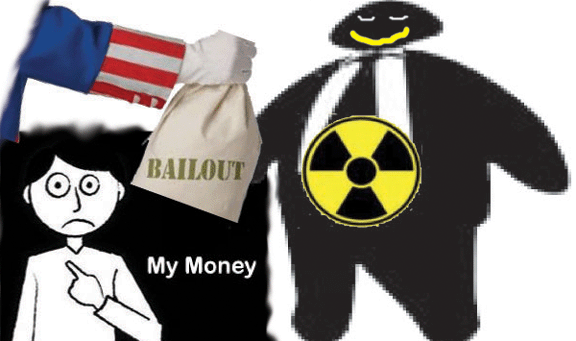
Ohioans for Energy Security is aggressively campaigning against a petition effort to put the state’s nuclear bailout law to a public vote.
The ads aim to prevent a referendum on a new law, House Bill 6, which will add charges to electric customers’ bills to subsidize nuclear and coal plants while gutting the state’s clean energy standards.
Ohio lawmakers passed the law in July, and a group called Ohioans Against Corporate Bailouts began working on a referendum initiative soon after. Ohioans’ right to seek a referendum on legislation is guaranteed by Article II of the state’s Constitution.
On Aug. 30, the group got a go-ahead from the Ohio secretary of state to start collecting signatures for the referendum petition. Supporters need to collect approximately 266,000 signatures to get the issue on the ballot next year.
Even before that approval came, Ohioans for Energy Security began its aggressive ads aiming to keep voters from getting a say on the bill’s coal and nuclear bailouts.
And less than a week later, FirstEnergy’s bankrupt generation subsidiary, FirstEnergy Solutions, filed a lawsuit asking the Ohio Supreme Court to stop the referendum petition effort. FirstEnergy Solutions stands to lose roughly $900 million in subsidies for its nuclear plants if voters eventually reject HB 6.
Ohio campaign finance laws let Ohioans for Energy Security keep its funding sources secret during the petition drive.
It’s not clear who’s behind Ohioans for Energy Security, and the group isn’t required to disclose the funders for any of its anti-referendum ads during the petition drive. The group has filed incorporation papers with the Ohio Secretary of State, which serve to limit its legal liability under state law.
Those papers, filed on July 30, show attorney Donald Brey as the sole “authorized representative.” Patrick Pickett signed on behalf of statutory agent IW Agent, LLC. Pickett and Brey are both partners at the Isaac Wiles law firm in Columbus, which shares its business address with IW Agent.
The group’s lawyers won’t answer questions about its funding.
Brey, Pickett and their partner Mark Weaver did not answer the Energy News Network’s questions about who pays for the firm’s services for Ohioans for Energy Security. The lawyers likewise declined to identify the officers, directors and shareholders of the corporation.
The firm’s lawyers “cannot ethically discuss information within the attorney-client privilege,” Weaver replied via email……..
Public records reveal associations between the anti-referendum group’s spokesperson and another group with connections to FirstEnergy Solutions.
Public relations for Ohioans for Energy Security are being handled by Carlo LoParo at LoParo Public Relations in Columbus. LoParo did not respond to questions from Energy News Network about the identity of the funders for Ohioans for Energy Security and his client contacts for that organization.
LoParo has also acted as spokesperson for the Ohio Clean Energy Jobs Alliance. The group’s website describes it as a “coalition of Ohio community leaders and organizations committed to preserving the jobs, economic benefits, carbon-free energy and electricity grid reliability” of nuclear energy. The group ran ads in favor of the nuclear and coal subsidy bill, House Bill 6, when it was pending in the legislature.
“Powered by FirstEnergy Solutions,” says a note at the bottom of the alliance’s home page, though it does not provide details about what that means.
LoParo has told the Energy and Policy Institute that the Dewey Square Group lobbying firm had acted “on behalf of FES [FirstEnergy Solutions] and the Ohio Clean Energy Jobs Alliance to advocate for keeping the state’s nuclear plants open.” And bankruptcy casefilings show charges by consultants for FirstEnergy Solutions supporting the launch of the alliance and coordinating with it………
FirstEnergy Solutions won’t say if it’s funding Ohioans for Energy Security………
Ohioans for Energy Security used one of the same contractors that Generation Now used for its ads pushing for passage of the nuclear subsidy bill………
Generation Now is also reported to have made substantial “dark money” contributions to elect Ohio Speaker of the House Larry Householder and others sympathetic to nuclear subsidies. At least one donor to that group is the International Union of Operating Engineers, Local 18, based in Cleveland. Some of the union’s members likely work at FirstEnergy Solutions plants.
It’s unclear who else is funding Generation Now The union’s $295,000 in 2019 spending for the group is less than a sixth of the more than $1.9 million the group reportedly spent on ads supporting HB 6. The group is not required to disclose its funders.
The group has been paying people to hover near folks seeking to collect signatures for the referendum petition. Those “field staffers” are sometimes referred to as “blockers,” because their presence can discourage voters from listening to those who seek to explain a referendum.
Referendum supporters’ funding is also a secret, but may be revealed later…….
Unfortunately the Fissionline journal has ceased its publishing and has deleted its content. I have saved some important journals and have added links below to the 3 surviving files left in my possession for you to download for free (as evidence of a well funded nuclear cover up).
Within that vast repository of knowledge was information about the British Nuclear Test Veterans campaign for justice because of the health effects on the veterans and their children by the nuclear weapons testing carried out by the UK Government. As well as fighting for justice for these victims, Fissionline also challenged the Ministry of Defense (MoD) and UK nuclear industry for their complicity in covering up the health effects from nuclear reactor disasters such as Fukushima, Chernobyl and Semipalantisk (Soviet Kazakhstan) etc.
Specific to Fukushima Fissionline covered the the most egregious case of the BBC and their Science Media Centre colleagues (Now called Sense About Science after a rebrand because of Journalists, Nuclear Health Physicists, bloggers and others who pushed back against the “charity”/Corporate Lobbyists version of “The right science”) supporting bad science advise and pro military and industry bias.
Fissionline gave Prof. Geraldine (Gerry) Thomas an interview where she made many of her spurious health and safety claims on public broadcasting platforms around the world whilst promoting nuclear energy. This made her one of the prime lobbyists for the nuclear energy and nuclear weapons industries, in fact she was surprisingly appointed as Officer of the Order of the British Empire (OBE) in the 2019 Birthday Honours for services to science and public health.[9].
Many nuclear professionals etc, reacted against her incorrect and dangerous advice to the families of Fukushima and the wider world, in a series of official complaints and the BBC had to retract its Fukushima video series (3 videos) of her in Japan discussing Fukushima contamination in set of surreal nuclear marketing propaganda pieces (The BBC did this quietly without even informing the complainants), only one of these videos now exists and is a debunk of one of the videos Goddards Journal on You Tube and I recommend you read the comments on YouTube under the video for a detailed breakdown of the types of reaction from both anti nuclear and pro nuclear experts and activists that all agree she was dreadfully wrong in her calculations and so called expert advice.
In an astounding interview with Dr Keith Baverstock (who worked in the World Health Organisation as a radiological health expert) on Fissionline, we saw that he debunked her claims in a blow by blow during his interview. There were two specific articles in Fissionline issues 44 and 45 (you can download the issues for a limited time on the links) that were evidence to this interaction between the UK MOD “Expert” and ex-WHO expert and his testimony also supported the Complainants to the BBC videos.
The way in which the nuclear and military industries (supported by the various departments secretly working behind the auspices of the UK Home Office) have managed the devastating impact to the nuclear industry from the Fukushima Daichi nuclear disaster in 2011 which has been been impressive in its scope and its costs! At the forefront of this is Prof Geraldine Thomas OBE for the UK and people like Michael Shellenberger for the USA nuclear and military complex.
At the same time as Prof Thomas OBE was receiving her Honours from the Queen of England was she thinking about the fate of her opponent (Prof Chris Busby) at the court case for the British Nuclear Veterans (whose children and grandchildren for another 20 generations would be effected) where she used the same and similar arguments, to argue for the Mod against the victims of the UK`s nuclear testing. These same arguments she used to win the case were challenged by Prof Keith Baverstock in a concise and precise way.
Chris Busby had his house raided in a ridiculous over the top display of the operations of Project Servitor (Home Office Stasi like program) being used to embarrass and frighten Prof Busby with his neighbors and friends as well as the wider public.
He returned home that night to find officers had searched his home laboratory and sealed off his home in Bridge Street.
“They destroyed my experiment. It was most irritating,” he said.
Dr Busby said he felt he was being targeted because of his criticism of the government’s current assessment of radiation risks.
Even though huge funding from the UK Home Office and nuclear industry and massive man power costs by the security and police services etc have failed to save the nuclear industry because of costs, lack of transparency, connection to nuclear weapons, depleted uranium weapons etc, not compatible with climate change energy policies nor compatible with future renewable energy transmission infrastructure. Also, multiple nuclear disasters and costs over runs in building nuclear reactors and dealing with nuclear cleanup and nuclear waste disposal etc.
The only winners are the MoD in saving the cost of having to fully compensate their nuclear victims and TEPCO the Japanese energy company responsible for the Fukushima Nuclear disaster not having to fully compensate the victims of the nuclear meltdown.
In fact TEPCOs CEOs were recently found not guilty (in a surprise decision given the evidence) for their part in the bad governance of their company before , during and after the nuclear disaster. Of course, Prof Thomas OBE got an OBE for helping the UK Mod as well as helping TEPCO and the Japanese Government to reassure everyone (the courts and the media) that everything in Fukushima is just wonderful and dandy. Maybe even the UK Government supported Japans anti disaster marketing #TOKYO2020 Olympics bid? It certainly was a WIn WIn situation in that respect!
Of course many would say that any industry or government would not be able to pull off such a coup right in front of our faces? Its a conspiracy theory and fake news but as we see in the field of climate science, good science can be corrupted by bad science if you have enough money and power and control the narrative. Some excellent evidence for this also exists because of brave whistleblowers, publishers and activists and can be found here
Through Cablegate, @WikiLeaks exposed how the Copenhagen climate talks didn't fail to reach consensus; they were sabotaged by polluters who didn't want to pay and those who will lose profit in a low carbon economy. https://t.co/3qUG3tF5uo#Strike4Climate#climatestrike
Feel free to download the 2 evidential articles that were removed from the internet as proof of the power of PR marketing and ownership of perception while it is available.
“If you tell a lie big enough and keep repeating it, people will eventually come to believe it. The lie can be maintained only for such time as the State can shield the people from the political, economic and/or military consequences of the lie. It thus becomes vitally important for the State to use all of its powers to repress dissent, for the truth is the mortal enemy of the lie, and thus by extension, the truth is the greatest enemy of the State.”
COLUMBUS — Holes in Ohio’s campaign finance law allow corporations to secretly fund campaigns battling over Ohio’s new nuclear bailout, which undermines direct democracy and intimidates voters, government watchdog groups said on Thursday.
They called on lawmakers to update the state’s campaign finance law to prevent such groups from hiding behind nebulous nonprofit and limited liability corporations to shield the identities of the deep pockets behind them.
“It’s fear-mongering,” said Jen Miller, director of the League of Women Voters of Ohio. “It’s this idea that somehow China wants our information. … They probably wouldn’t make those kinds of statements if they would be held accountable by their shareholders or by the public if we knew who they were.”
The U.S. Supreme Court held in its 2010 Citizens United decision that corporations may exercise political speech through money and blocked states from limiting that speech. But the court left the door open for government to require public disclosure of those putting up the cash.Ohio talked about doing that but never followed through.
Most of the criticism on Thursday focused on Ohioans for Energy Security, the group trying to thwart efforts by petitioners to put House Bill 6 on the November, 2020, election ballot in hopes voters will reject it.
As tracked by Columbus-based Medium Buying, the group has purchased nearly $3.4 million in TV, cable, and radio airtime through Friday as it seeks to convince would-be petition signers that the Chinese are behind the repeal effort. Through these ads and direct mail, they’ve also said signing the petitions would amount to turning over personal information to the Chinese government.
But both sides of the energy law fight have created limited liability corporations to fund their operations. Both have promised to follow Ohio law as it is, but that means they could still use their corporate entities to shield the names of their individual, business, or union backers and the amounts they ponied up.
“We’re asking for a light to be shown on all the money,” said Catherine Turcer, executive director of Common Cause Ohio. “… We’re really interested in understanding the political landscape and to be able to follow the money no matter who spends it.”
House Bill 6 is set to go into effect Oct. 21. It would surcharge consumers on their electricity bills to create a $170 million-a-year fund through 2026. Of that, $150 million would go to support FirstEnergy Solutions’ Davis-Besse nuclear plant near Oak Harbor and Perry plant east of Cleveland.
The remaining $20 million would go to six utility-scale solar fields that already have received siting approval, most of them in southern Ohio.
The law also separately would impose statewide surcharges through 2030 to support two 1950s-era coal-fired power plants owned by a multiutility corporation. Those plants are in southern Ohio and southeast Indiana.
There is no official campaign yet. Ohioans Against Corporate Bailouts, the entity hoping to ask voters to repeal House Bill 6, has until Oct. 21 to file at least 265,774 valid signatures of registered voters to put the law on hold at least through the 2020 vote.
That group will have to file its first report 30 days after the filing of signatures detailing its petition circulation activities, but it remains to be seen how specific that filing will be in terms of individual names and amounts.
Nothing would prevent either side from voluntarily disclosing their donors.
“We will exercise our First Amendment rights as any citizen is allowed to do,” said Carlo LoParo, spokesman for Ohioans for Energy Security. “When the law requires us to disclose, we will disclose, just like the other side.
“… They’re not letting you know that it’s a handful of natural gas companies … ” he said. “When the law requires them to disclose, they will disclose. When the law requires us to disclose, we will certainly disclose.”
The group maintains that a bank tied to the government of China is financially backing natural gas operations in Ohio and, therefore, the petition effort.
On the other side, the conjecture has been that FirstEnergy Solutions or its investors is behind the campaign.
“We are left assuming the worst about FirstEnergy Solutions, but we don’t actually know,” Ms. Turcer said. “It could be FirstEnergy Solutions. We should not be in a time period where we receive something in the mail about elections and we don’t actually understand what it’s about.”
Ignoring the advice of her own expert panel, Trudeau’s environment minister Catherine McKenna has exempted more projects and further gutted Canada’s environmental assessment regime.
The Trudeau government’s controversial Impact Assessment Act (Bill C-69) and its key regulation (the Physical Activities Regulations, better known as the “project list”) came into force on August 28 — slipped through during the summer season.
In 2012 the Harper government slashed the number of projects requiring environmental assessment, arguing that only the biggest projects have an impact on the environment.
Under the Impact Assessment Act, many nuclear projects can now proceed unimpeded by impact review requirements to assess effects on the environment, health, social or economic conditions; effects of malfunctions or accidents; or impacts on the rights of Indigenous peoples.
The Harper government’s 2012 project list did require assessment of new uranium mines or mills. The new list requires assessment only if a uranium mine or mill has a capacity over 2,500 tonnes per day.
The 2012 list required assessment of new nuclear reactors. The new list allows reactors generating up to 200 million watts of heat to be built anywhere without assessment.
Furthermore, the new list allows nuclear waste storage facilities to be built on the sites of any of these so-called “small modular reactors” without assessment.
This paves the way for a Canadian landscape dotted with mass-produced nuclear reactors — the vision of a “roadmap” released by Natural Resources Minister Amarjeet Sohi in November 2018.
Canada’s nuclear industry giants — Cameco and SNC-Lavalin — were deeply involved in these developments. The nuclear industry has long been the darling of the federal government.
Cameco operates the world’s largest uranium mine in northern Saskatchewan, the world’s largest commercial uranium refinery in Blind River, Ontario, and the Port Hope, Ontario uranium conversion facility. But it has been losing global market share to facilities in Kazakhstan.
Competition is fierce. Uranium markets dried up after the Fukushima disaster. Rapid growth of renewables has virtually halted reactor construction.
Under a secret 10-year, multi-billion-dollar contract put in place during the fall 2015 election period, the Harper government gave SNC-Lavalin, in alliance with two U.S. companies, ownership of “Canadian Nuclear Laboratories” (then a subsidiary of the Crown corporation, Atomic Energy of Canada Limited).
The contract allows the alliance to carry out commercial activities — including small nuclear reactor development — at the federal government’s heavily subsidized research facility in Chalk River, Ontario.
According to the federal lobbyist registry, Neil Bruce, former president of SNC-Lavalin, met with Michael Binder, former president of the Canadian Nuclear Safety Commission (CNSC), to discuss “environment, climate, energy, infrastructure” on July 12, 2018.
The following week, on July 19, Tim Gitzel, president and CEO of Cameco, met with Christine Loth-Brown, a vice-president in the Canadian Environmental Assessment Agency (CEAA), and with Jason Cameron, a CNSC vice-president. On July 26, Gitzel again met with these same two people, plus another CEAA vice-president. For that meeting he was accompanied by Pierre Gratton, president of the Canadian Mining Association.
On November 11, 2018, Gratton met with the following people, at the same time: Rumina Velshi, president, CNSC; Ron Hallman, president, CEAA; Christyne Tremblay, deputy minister, Natural Resources Canada; and Stephen Lucas, deputy minister, Environment and Climate Change Canada.
Canada’s senior bureaucrats gutted environmental assessment after this series of meetings.
The SNC-Lavalin affair has ripped the veil off the domination of Canada by a corporate oligarchy. Government departments, regulatory bodies such as the CNSC and CEAA (now the “Impact Assessment Agency”), and elected officials behave like corporate lapdogs.
The Conservatives handed the federal government’s nuclear research facilities over to SNC-Lavalin and its partners, along with a juicy multi-year, multi-billion-dollar contract. The Liberals pulled out all the stops so SNC-Lavalin could continue to hold federal contracts, despite fraud and corruption charges.
Natural Resources Minister Amarjeet Sohi released a road map promoting new nuclear reactors.
Environment Minister Catherine McKenna exempted these reactors and their wastes from impact assessment.
The 2015 Liberal election promise to restore public trust in environmental assessment has been broken.
Ole Hendrickson is a retired forest ecologist and a founding member of the Ottawa River Institute, a non-profit charitable organization based in the Ottawa Valley.
“The ashes of half a dozen unidentified laborers ended up at a Buddhist temple in a town just north of the crippled Fukushima nuclear plant. Some of the dead men had no papers; others left no emergency contacts. Their names could not be confirmed and no family members had been tracked down to claim their remains. They were simply labeled “decontamination troops”
Fukushima’s Radioactive Water Crisis, https://www.counterpunch.org/2019/09/16/fukushimas-radioactive-water-crisis/ byROBERT HUNZIKERSEPTEMBER 16, 2019Tokyo Electric Power’s Fukushima Daiichi Nuclear Power Station, which experienced three massive meltdowns in 2011, is running out of room to store radioactive water. No surprise! But now, what to do about phosphorescent water?
Addressing the issue, Japan’s environmental minister Yoshiaki Harada held a news conference (September 2019). Unfortunately, he proffered the following advice: “The only option will be to drain it into the sea and dilute it.” (Source: Justin McCurry in Tokyo, Fukushima: Japan Will Have to Dump Radioactive Water Into Pacific, Minister Says, The Guardian, Sept. 10, 2019)
“The only option”… Really?
Over the past 8 years, Tokyo Electric Power (TEPCO) has scrambled like a Mad Hatter to construct emergency storage tanks (1,000) to contain upwards of one million tonnes of contaminated radioactive water, you know, the kind of stuff that, over time, destroys human cells, alters DNA, causes cancer, or produces something like the horrific disfigured creature in John Carpenter’s The Thing! That’s the upshot of a triple nuclear meltdown that necessitates constant flow of water to prevent further melting of reactor cores that have been decimated and transfigured into corium or melted blobs. It’s the closest to a full-blown “china syndrome” in all of human history. Whew! Although, the truth is it’ll be a dicey situation for decades to come.
Ever since March 11, 2011, TEPCO has scrambled to build storage tanks to prevent massive amounts of radioactive water from pouring into the ocean (still, some lesser amounts pour into the ocean every day by day). Now the government is floating a trial balloon in public that, once the tanks are full, it’ll be okay to dump the radioactive water into the ocean. Their logic is bizarre, meaning, on the one hand, the meltdown happens, and they build storage tanks to contain the radioactive water, but on the other hand, once the storage tanks run out of space, it’s okay to dump radioactive water into the ocean. Seriously?
Meantime, the Fukushima meltdown brings the world community face to face with TEPCO and the government of Japan in an unprecedented grand experiment that, so far, has failed miserably. Of course, dumping radiation into the Pacific is like dumping radiation into everybody’s back yard. But, for starters, isn’t that a non-starter?
Along the way, deceit breeds duplicity, as the aforementioned Guardian article says the Japanese government claims only one (1) death has been associated with the Fukushima meltdown but keep that number in mind. Reliable sources in Japan claim otherwise, as explained in previous articles on the subject, for example, “Fukushima Darkness, Part Two” d/d November 24, 2017, and as highlighted further on in this article.
When it comes to nuclear accidents, cover-ups reign supreme; you can count on it.
As such, it is believed the Japanese government is lying and should be held accountable for hoodwinking the world about the ravages of Fukushima, especially with the Olympics scheduled for next year.
For example, the following explains how death by radiation is shamefully hidden from the public via newspeak: Fukushima Daiichi Nuclear Power Station worker deaths “that expire at home” are not officially counted. Accordingly, how many workers on a deathbed with radiation sickness leave home to go to work (where deaths are counted) just before they die? Oh, please!
Meanwhile, the last thing the world community needs in the face of an uncontrollable nuclear meltdown, like Fukushima, is deceptiveness and irresponsibility by the host government. Too much is at stake for that kind of childish nonsense. And just to think, the 2020 Olympics are scheduled with events held in Fukushima. Scandalously, the International Olympic Committee (IOC) is A-Okay with that.
In contrast, a Greenpeace International March 8th 2019 article entitled: Japanese Government Misleading UN on Impact of Fukushima Fallout on Children, Decontamination Workers: “The Japanese government is deliberately misleading United Nations human rights bodies and experts over the ongoing nuclear crisis in areas of Fukushima… In areas where some of these decontamination workers are operating, the radiation levels would be considered an emergency if they were inside a nuclear facility.” Enough said!
“In its reporting to the United Nations, the Japanese government deliberately misrepresents the scale, complexity, and radiation risks in areas of Fukushima, the working practice and conditions for workers, and its disregard for children’s health and wellbeing. This reality should shame the government to radically change its failing policies,” said Kazue Suzuki, Energy Campaigner of Greenpeace Japan.
As such, either Greenpeace or the IOC is “dead wrong” about the conditions at Fukushima. Take your pick.
After all, the trend of misrepresentation of nuclear accidents has been established for decades. Not only Fukushima, Chernobyl (1986) is a nuclear disaster zone where the “official death count from radiation exposure” has been considerably discounted by various governmental agencies and NGOs. For inexplicable reasons (actually explicable but a long story), nuclear accidents are given Get Out Jail Free cards by the world’s press and associated governmental orgs and NGOs.
Yet, over time, the truth comes out, and when it does it’s dreadfully atrocious: A BBC special report, The True Toll of the Chernobyl Disaster d/d July 26, 2019 says: “The official, internationally recognized death toll, just 31 people died as an immediate result of Chernobyl while the UN estimates that only 50 deaths can be directly attributed to the disaster.”
That’s the official tally. Ugh! It’s so far off the mark that, if it were a baseball pitch, it’d be in the dirt, and a prime example of the public not getting the truth about the ravages of nuclear power accidents.
Of course, it is important to take note of how “wordsmiths” describe the death numbers, i.e., “died as an immediate result of Chernobyl” can only include someone standing at the site when it happened, leaving out all cases of radiation exposure that kills and cripples over subsequent days, months, and years. Or, in the case of the UN statement, “only 50 deaths can be directly attributed.” Only those standing there when it happened… ahem!
According to the BBC article, the Russian Academy of Sciences said as many as 112,000-125,000 died by 2005. That’s 2,500xs more deaths than the official reports, which also never increase in number over time as radiation takes its merry ole time blasting, destroying, and/or altering human cell structure. Ukrainian authorities claim death rates of Chernobyl cleanup workers rose from 3.5 to 17.5 deaths per 1,000 between 1988 and 2012 on a database of 651,453 cleanup workers, which equates to 11,392 deaths. Additionally, Belarus had 99,693 cleanup workers, equating to 1,732 deaths. Not only that, disability among workers shows that approximately 5% are still healthy in 2012 (only 5%, meaning 95% unhealthy) with commonality of cardiovascular and circulatory diseases and nervous system problems.
By 2008 in Belarus alone 40,049 liquidators or cleanup workers of Chernobyl were registered with cancer.
Viktor Sushko, deputy director general of the National Research Centre for Radiation Medicine (NRCRM) based in Kiev, Ukraine, describes the Chernobyl disaster as: “The largest anthropogenic disaster in the history of humankind,” Ibid.
Thus begging the most obvious of questions re Fukushima victims in the years ahead; how many cases of cancer, and how many will die? Unfortunately, radioactive isotopes don’t stop once they’re activated in a nuclear meltdown. They’re pernicious over time destroying and/or grotesquely altering human cell structure. For proof, visit second-generation Chernobyl children locked up in orphanages in Belarus.
“As of January 2018, 1.8 million people in Ukraine, including 377,589 children, carried status of victims of the disaster, according to Sushko and his colleagues. Not only that, there has been a rapid increase in the number of people with disabilities, rising from 40,106 in 1995 to 107,115 in 2018,” Ibid.
According to a USA Today article – Chernobyl’s Legacy: Kids With Bodies Ravaged by Disaster, April 17, 2016: “There are 2,397,863 people registered with Ukraine’s health ministry to receive ongoing Chernobyl-related health care. Of these, 453,391 are children — none born at the time of the accident. Their parents were children in 1986. These children have a range of illnesses: respiratory, digestive, musculoskeletal, eye diseases, blood diseases, cancer, congenital malformations, genetic abnormalities, trauma.” Many of the children are hidden away deep in the forested countryside in orphanages in Belarus.
Back to Fukushima, there are numerous instances of governmental meddling to hide the truth, starting with passage of the 2013 government secrecy act, The State Secrecy Law, aka: Act on the Protection of Specially Designated Secrets (SDS), Act No. 108, which says that civil servants or others who “leak secrets” will face up to 10 years in prison, and those who “instigate leaks,” especially journalists, will be subject to a prison term of up to 5 years. Subsequently, Japan fell below Serbia and Botswana in the Reporters Without Borders 2014 World Press Freedom Index.
Horrifically, at the end of the day, when nuclear goes bad, it takes everyone along on a daunting trip for years and years and more years, outliving life spans but continuing generation after generation, like the 453,391 Chernobyl-radiated-influence children born after the nuclear blowout in 1986. Chernobyl altered their genes before they were born…. Imagine that!
Cliodhna Russell visited children’s orphanages in Belarus in 2014: “Children rocking back and forth for hours on end, hitting their heads against walls, grinding their teeth, scraping their faces and putting their hands down their throats.” (Source: How My Trip to a Children’s Mental Asylum in Belarus Made Me Proud to be Irish, the journal.ie, March 18, 2014.)
Postscript: “It’s a real shame that the authorities hide the truth from the whole world, from the UN. We need to admit that actually many people are dying. We are not allowed to say that, but TEPCO employees also are dying. But they keep mum about it,” Katsutaka Idogawa, former mayor of Futaba (Fukushima Prefecture) Fukushima Disaster: Tokyo Hides Truth as Children Die, Become Ill from Radiation – Ex-Mayor, RT News, April 21, 2014)
Post-Postscript: “The ashes of half a dozen unidentified laborers ended up at a Buddhist temple in a town just north of the crippled Fukushima nuclear plant. Some of the dead men had no papers; others left no emergency contacts. Their names could not be confirmed and no family members had been tracked down to claim their remains. They were simply labeled “decontamination troops” — unknown soldiers in Japan’s massive cleanup campaign to make Fukushima livable again five years after radiation poisoned the fertile countryside,” (Source: Mari Yamaguchi, Fukushima ‘Decontamination Troops’ Often Exploited, Shunned, AP & ABC News, Minamisona, Japan, March 10, 2016)
Unbeknownst to most Canadians, the Darlington nuclear power plant 70 kilometres east of Toronto has been playing a not-so-small role in the U.S. race to weaponize space
The 50th anniversary of the Apollo 11 mission added momentum to the new push to go farther into outer space than humans have ever gone before.
Ontario’s nuclear industry could receive both a reflected glow from the extraterrestrial travel hype and a new revenue stream. It could also potentially increase international nuclear-weapons proliferation.
Unbeknownst to most Canadians, the Darlington nuclear power plant 70 kilometres east of Toronto has already been playing a not-so-small role in the space race.
The plant has been producing radioactive plutonium-238 as fuel for spacecraft in NASA’s mushrooming space pipeline since 2017.
That’s when Ontario Power Generation (OPG) announced excitedly that it would start making plutonium-238 for space exploration. The plant produces about 10 kilograms of plutonium-238 a year.
“We are proud to have Ontario play a part, however small, in this most noble of human endeavours,” OPG’s then-president and CEO Jeff Lyash said in a news release.
Canadian Nuclear Laboratories (CNL), which runs the Chalk River facility near Ottawa, another participant in the initiative, posted a “Success Stories” article on its website seven days later. It cautioned that “this opportunity is still subject to regulatory and licensing processes.” But it quotes a CNL official as saying “staff should take a lot of pride in the fact that we are key partners.”
CNL has continued communicating with other project stakeholders. But when NOW contacted CNL for a comment it responded on September 5 that it is no longer involved in the project. OPG has removed the news release from its website and did not respond to NOW’s request for information. Turns out a company called Technical Solutions Management (TSM) is steering the initiative now.
TSM is owned by former nuclear-industry executives Billy Shipp, Pierre Tremblay and Paul Spekkens. CEO Shipp told NOW in an August 29 phone interview that NASA has yet to give its formal thumbs-up.
“For us to get out ahead of our client [NASA], in terms of anticipated need [for plutonium-238], or making statements of their need, is not that professional on our part. So we really have been very low-key on this,” Shipp says when reached for an interview aboard a boat off Vancouver Island.
But he noted that U.S. President Donald Trump’s establishment of a Space Command makes the project more likely to proceed.
Plutonium-238 has long been used to fuel flight, via conversion into electricity of the intense heat the atom pumps out. The U.S. powered military satellites with it in the 1960s. NASA also harnessed it most recently to propel Curiosity Rover to Mars in 2011.
The steps involved for the manufacture of made-in-Canada plutonium-238 to supplement the U.S.’s production involves first synthesizing neptunium-237, plutonium-238’s precursor at the Pacific Northwest National Laboratory in Richland, Washington.
From there, the material is transported to Chalk River where it is put into bundles before it’s sent to Darlington and inserted into CANDU reactors. There, the neptunium-237 catches stray neutrons, transforming it into plutonium-238. The bundles are shipped back to Chalk River where the plutonium-238 is separated from by-products and packaged into pellets. The pellets are transported to Idaho National Lab where they are readied as ‘nuclear batteries’ for spacecraft engines. The current price of plutonium-238 isn’t public, but back in 2003 one kilogram was worth about $8 million U.S.
Gordon Edwards, co-founder and president of the Canadian Coalition for Nuclear Responsibility, says the form of radioactivity emitted by plutonium (namely, alpha particles) is highly toxic when inhaled but often isn’t picked up by radiation detectors.
For example, in November 2009, hundreds of workers at OPG’s Bruce nuclear plant breathed in plutonium dust (a by-product of nuclear-energy production) but the plutonium remained undetected for weeks. Many of the workers had not been given respirators. It was the largest preventable exposure of workers to internal radioactive contamination in the history of the civilian nuclear industry.
Even worse, says Edwards, is the fact the process used to create plutonium-238 can also be used to transform depleted uranium into plutonium-239, the key explosive in nuclear bombs.
“I grant that TSM’s plutonium-238 program does not fundamentally enhance this danger, but it does provide an opportunity to tell the public and politicians that if you can produce one kind of plutonium for the space program you can just as easily produce another kind of plutonium for a nuclear-weapons program, using essentially the same CANDU technology,” Edwards tells NOW.
However, no one inside the space or nuclear industries appears be seriously addressing these well-known problems. And there is plenty of money potentially available for a new plutonium-238 venture. NASA projects its research and development budget – including developing power and propulsion systems – will be $1.5 billion next year, rising to $3.4 billion by 2024.
TSM’s other co-owners, Tremblay and Spekkens, are well-placed to move such a project forward. Tremblay was OPG’s chief nuclear operating officer and president of OPG’s subsidiary Canadian Nuclear Partners. He became AECOM Canada Nuclear Operations’ president and CEO in August 2018. The American multinational is playing key roles in the multi-billion-dollar Darlington refurbishment. Tremblay started consulting for AECOM in June 2016; an industry article about this said the firm “has recruited key expertise that will undoubtedly position the company to play a key part in the massive nuclear power projects anticipated for Ontario over the next decade.”
Spekkens retired in 2016 as OPG’s vice president of science and technology and as chair of the CANDU Owners Group, a Toronto-based private organization that promotes CANDU use around the world. He then became a consultant and director of nuclear technology at Kinectrics.
He opined on the nuclear industry’s future at a June 2017 conference. In the abstract of his lecture, Spekkens says “this future will, of course, depend heavily on technology. But also (and perhaps equally) important will be non-technical considerations such as public acceptance, a pipeline full of qualified future employees, public policy in several levels of government, and of course, finances.”
[in 1992] Baverstock and his colleagues published a letter on their findings in the scientific journal Nature, in which they concluded, “the consequences to the human thyroid, especially in fetuses and young children, of the carcinogenic effects of radioactive fallout is much greater than previously thought.”
Now, after more than 30 years, U.N.-sponsored researchers have backed away from the 1992 UNSCEAR study by concluding that “studies of clean-up workers/liquidators suggest dose-related increases of thyroid cancer and hematological malignancies in adults,” as well as “increases in cardiovascular and cerebrovascular disease. If confirmed, these would have significant public health and radiation protection implications.”
The United States’ involvement with the Chernobyl aftermath was shaped largely, and shamefully, by the desire to avoid potential legal liabilities associated with the 166 U.S. open-air nuclear weapons tests in Nevada and the Marshall Islands. At the time of the Chernobyl accident, compensation radiation claims for injuries and deaths from bomb testing were looked upon by the nuclear weapons program as a dagger aimed at the heart of U.S. national security.
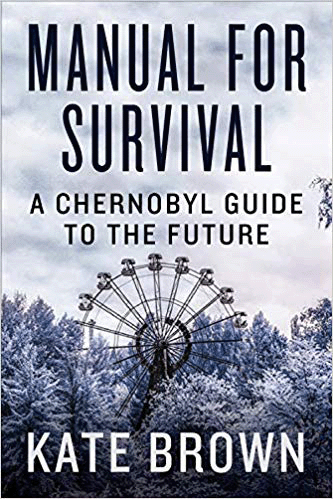
Much has been written about the strengths and flaws of Chernobyl—the HBO miniseries nominated for 19 Emmys that chronicles the catastrophe at the eponymous Russian nuclear power plant in 1986. In the mind of this reviewer, it’s a riveting if sobering television gem, and highly recommended. And to this newly enlivened debate over nuclear power we can now add Kate Brown’s book, Manual for Survival: A Chernobyl Guide to the Future, a tour de force about the radiological aftermath of the Chernobyl disaster. A science historian at the Massachusetts Institute of Technology, Brown peels away the layers of long-held mythologies—that in the end, the accident only killed 54 people, and that “radiation phobia” among the people who sustained heavy radioactive fallout was a bigger problem than any of the other health outcomes.
Brown, who is conversant in Russian, devoted years to extensive archival research (much of which was scattered and hidden from official attempts at confiscation). She conducted interviews with villagers, military officials, factory workers, medical doctors, Soviet nuclear experts, emergency responders, KGB operatives (who assumed control over much of the data from the accident), and international nuclear safety and radiation health experts. The result is a rich and deeply disturbing picture of the environmental perils of extensive and lasting nuclear contamination.
She digs prodigiously, much to the disfavor of defenders of nuclear power, into the widespread practice of secrecy and deception regarding the radiological harm from elevated, long-term, chronic exposures. Continue reading →














 nuclear-news
