Rotten Apple: Dozens of Former Israeli Spies Hired by Silicon Valley Giant

July 18th, 2025, Alan Macleod
Apple has made headlines in recent weeks for touting its commitment to privacy and human rights, rolling out tools to limit surveillance and spyware. But behind the corporate messaging lies a much darker reality.
The company has quietly brought in dozens of veterans from Unit 8200, Israel’s shadowy military intelligence unit known for blackmail, mass surveillance, and targeted killings.
Many of these hires took place as Israel escalated its war on Gaza, and as CEO Tim Cook publicly expressed support for Israel while disciplining employees for pro-Palestinian expressions. Apple’s deepening ties to Israel’s most controversial intelligence raise uncomfortable questions, not only about the company’s political loyalties, but also about how it handles vast troves of personal user data.
A MintPress News investigation has identified dozens of Unit 8200 operatives now working at Apple. The company’s hiring spree coincides with growing scrutiny of its ties to the Israeli government, including its policy of matching employee donations to groups such as Friends of the IDF and the Jewish National Fund, both of which play a role in the displacement of the Palestinian people. The intense pro-Israel bias at the corporation has led many former and current employees to speak out.
This investigation is part of a series examining the close collaboration between Unit 8200 and Western tech and media companies. Previous investigations examined the links between Unit 8200 and social media giants like TikTok, Facebook and Google, and how former Unit 8200 spies are now responsible for writing much of America’s news about Israel/Palestine, holding top jobs at outlets like CNN and Axios.
A Few (Dozen) Bad Apples
Israel’s international reputation has taken a severe hit amid multiple spying scandals and ongoing attacks against its neighbors. During this same period, Apple has ramped up its recruitment of former Israeli intelligence personnel.
The Silicon Valley giant has hired dozens of former agents from the controversial Israeli intelligence outfit, Unit 8200, raising questions about the corporation’s political direction.
Nir Shkedi is among the most prominent examples. From 2008 to 2015, he served as a commander and Chief of Learning at Unit 8200, leading a team of approximately 120 operatives who developed new artificial intelligence tools to perform rapid data analysis.
Unit 8200 is at the forefront of this technology, and is known to have used AI to auto-generate kill lists of tens of thousands of Gazans, including children. These tools helped the Israeli Defense Forces (IDF) bypass what it called human targeting, “bottlenecks,” and strike huge numbers of Palestinians.
Shkedi has been a physical design engineer at Apple’s Bay Area campus since 2022.
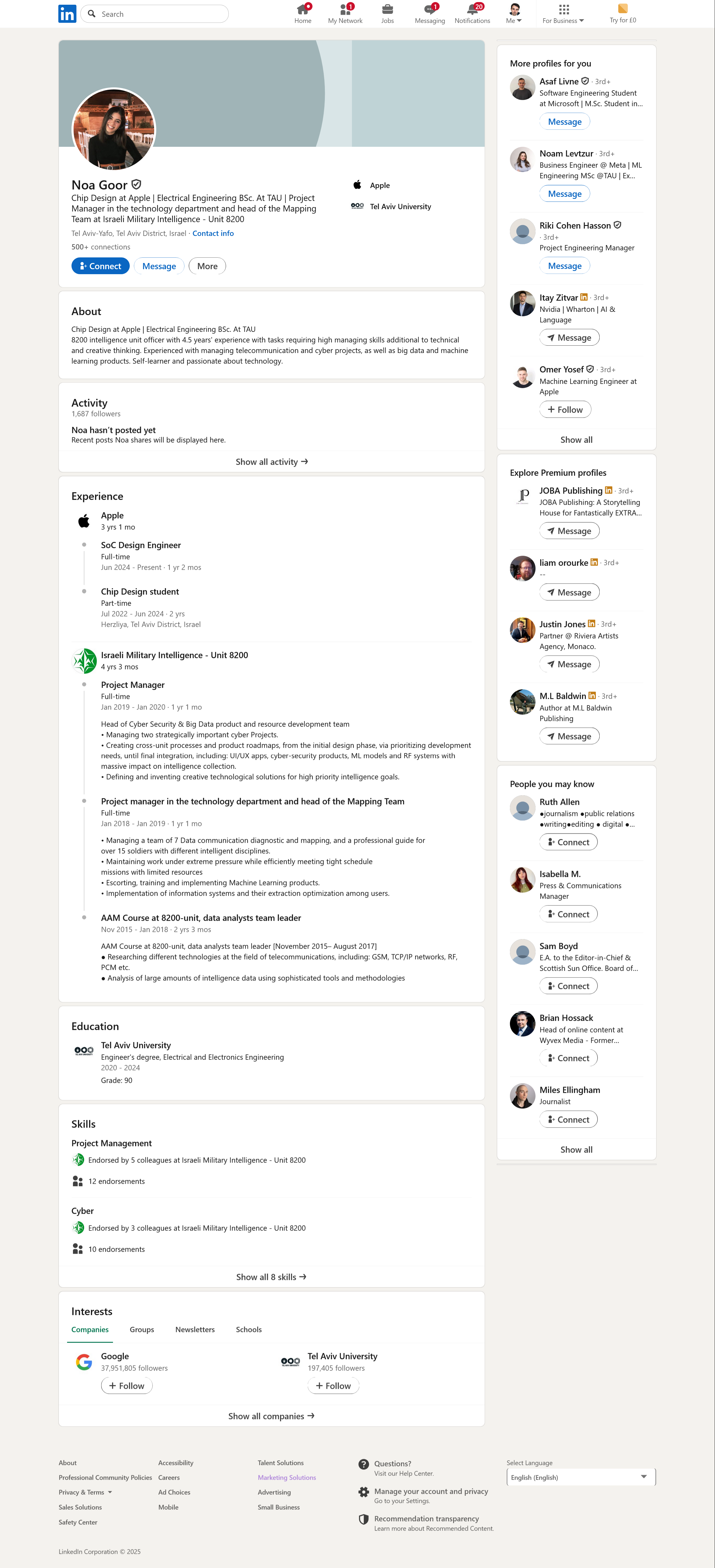
Noa Goor is another senior Unit 8200 figure turned Apple employee. From 2015 to 2020, Goor rose to become a project manager and head of cybersecurity and big data development team at Unit 8200, where she, in her own words, “invent[ed] creative technological solutions for high priority intelligence goals” and “manag[ed] two strategically important cyber projects” for the IDF.
One of the most important cyber projects Unit 8200 has launched in recent times is the September pager attack on Lebanon, an act that injured thousands of civilians and was widely condemned as an act of international terrorism, including by former CIA Director Leon Panetta. While Goor was not personally involved in that operation, Unit 8200 has spearheaded similarly nefarious actions for decades.
In 2022, Goor was hired by Apple as a system-on-chip design engineer.
Eli Yazovitsky, meanwhile, was directly recruited from Unit 8200. In 2015, he left a high-powered nine-year career as a manager in the military unit to join Apple, where he rose to become an engineering manager. He has since moved on to tech giant Qualcomm.
Unit 8200 is Israel’s most elite—and most controversial—military intelligence unit. It serves as the backbone of both Israel’s burgeoning tech sector and its repressive surveillance apparatus. The unit has developed cutting-edge technology like facial recognition and voice-to-text software to surveil, repress, and target Palestinians.
The vast amounts of data gathered on the Palestinian population, including their medical history, sex lives, and search histories, have been used for coercion and extortion. If a certain individual needed to travel across checkpoints for crucial medical treatment, permission could be suspended until they complied. Information about extramarital affairs or sexual orientation, especially homosexuality, is exploited as blackmail material. One former Unit 8200 agent recalled that he was instructed during his training to memorize different Arabic words for “gay” so that he could listen out for them in intercepted conversations.
Internationally, Unit 8200 may be best known for its “former” agents who created the notorious Pegasus software, used by repressive governments around the world to spy on tens of thousands of prominent figures, including royals, heads of state, activists, and journalists.
Among them was Washington Post columnist Jamal Khashoggi, who was assassinated by Saudi operatives in Türkiye in 2018.
While military service is mandatory for Jewish Israelis, few end up in Unit 8200 by accident. Described as “Israel’s Harvard,” parents spend fortunes on STEM-based extracurricular lessons for their children in the hopes that they will be selected to join the IDF’s most elite and selective unit. Those chosen are rewarded with lucrative careers in the tech industry upon completion of their service.
Given Unit 8200’s documented history of violence, espionage, and surveillance, both domestically and internationally, it is worth asking whether tech giants should be hiring its alumni in such large numbers.
Shkedi, Goor, and Yazovitsky are the most high-profile examples, but they are from alone. A closer look reveals that dozens of other Unit 8200 veterans have also secured key roles at Apple.
Engineering and Hardware Design:
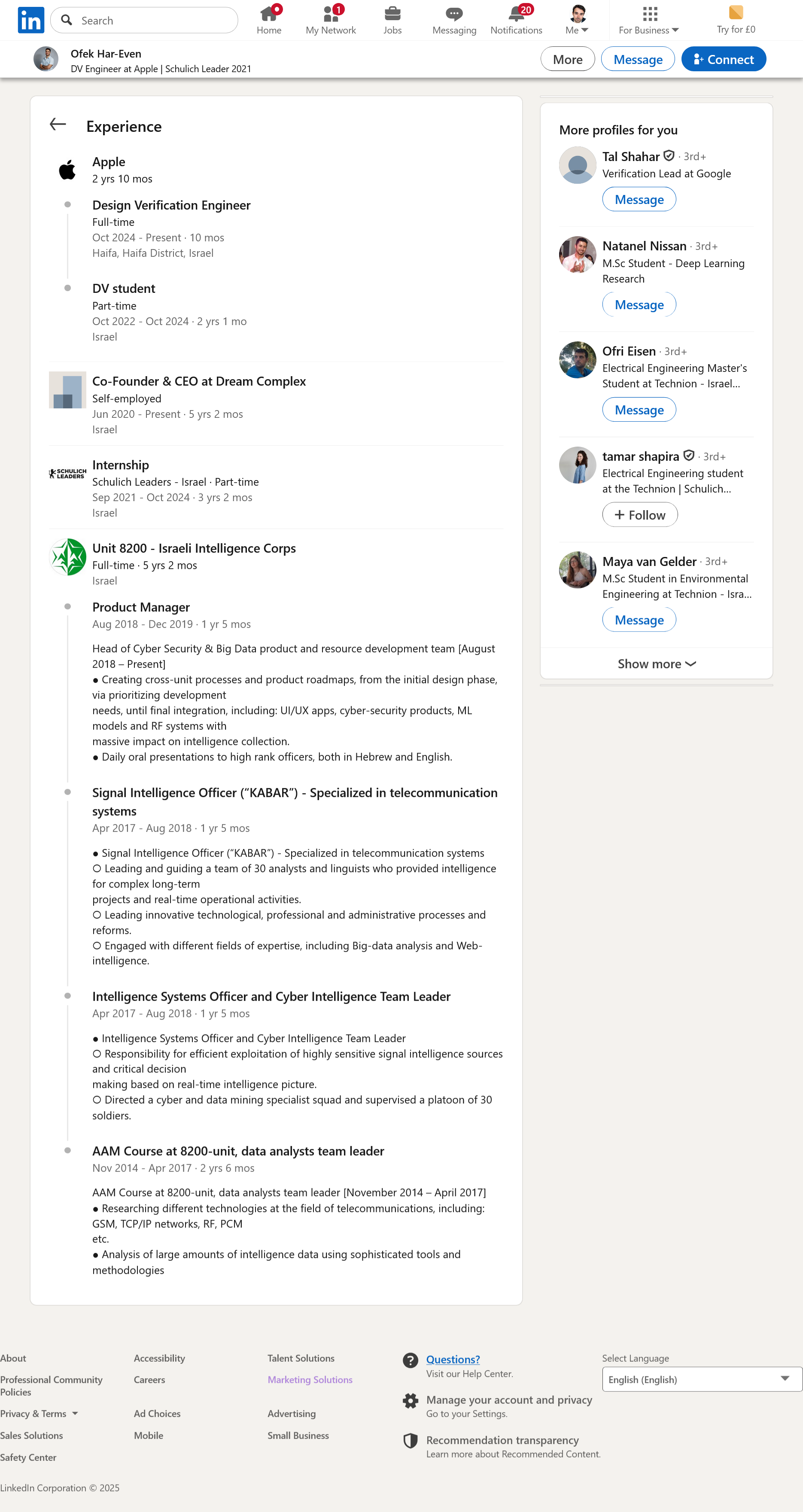
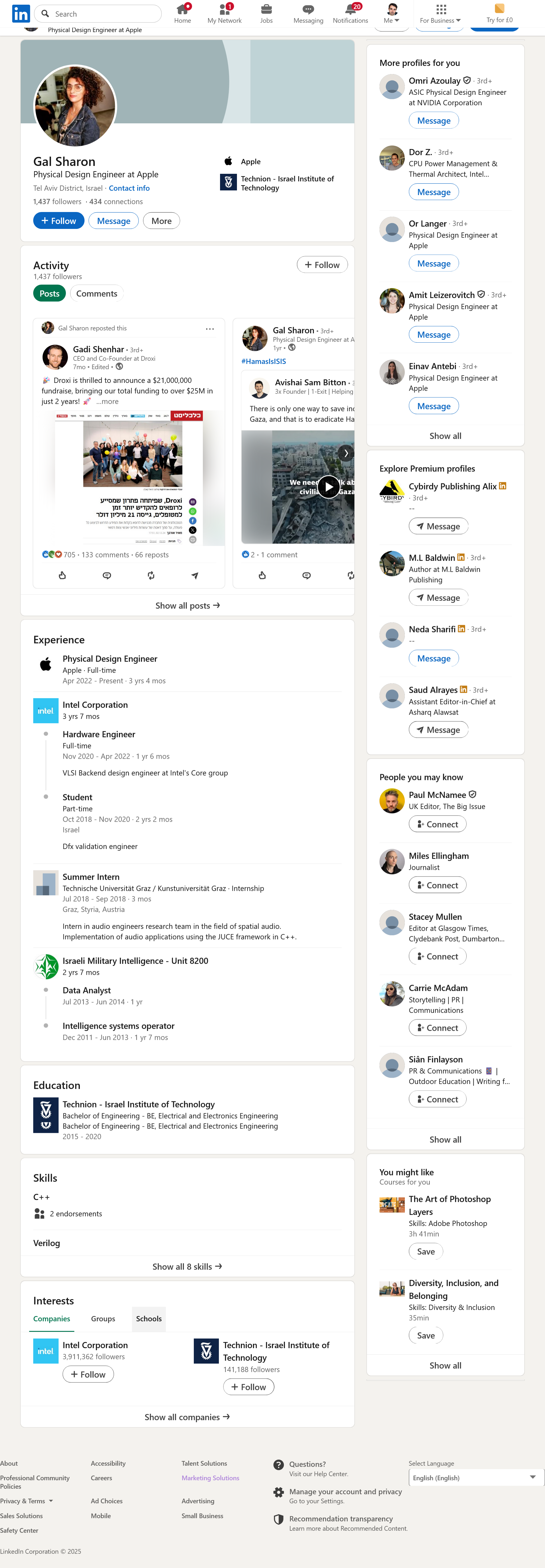
Natanel Nissan, formerly head of data analysis at Unit 8200, joined Apple’s Tel Aviv office in 2022. Ofek Har-Even, a longtime officer and manager in the unit, has been a design verification engineer at Apple since 2022. Gal Sharon, a former intelligence systems operator and data analyst, has also worked as a physical design engineer since that same year.
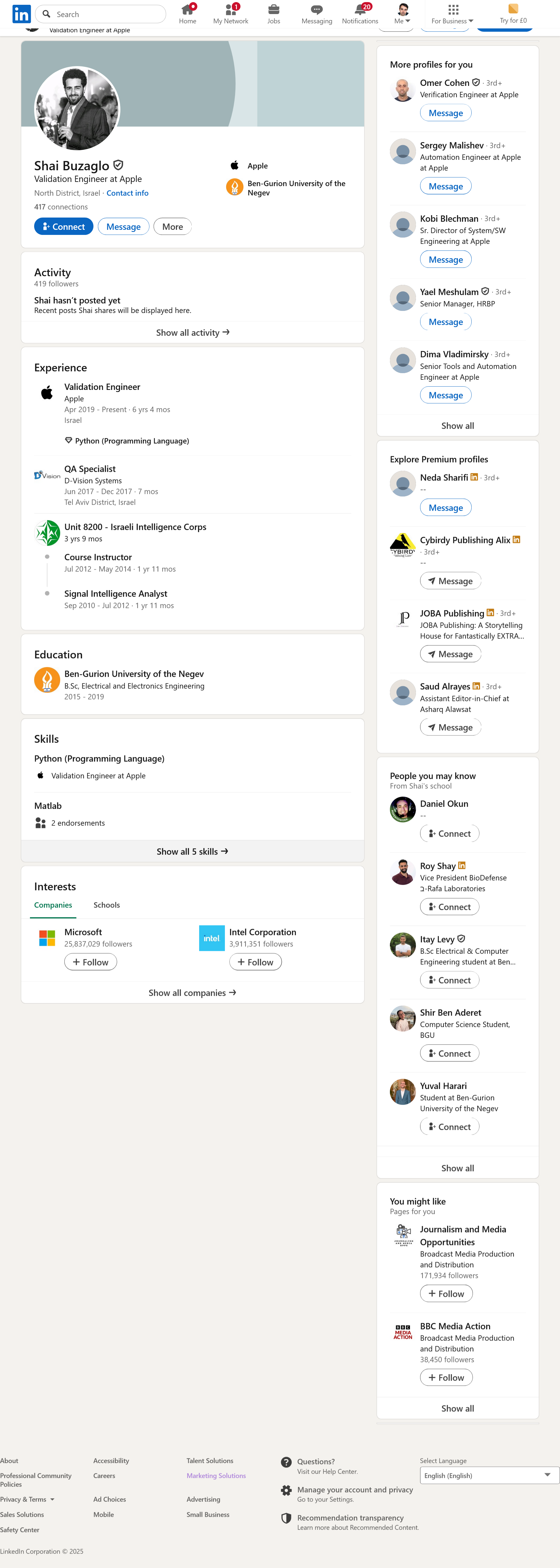
Mayan Hochler and Shai Buzgalo, both former Unit 8200 analysts and instructors, hold roles in physical design and validation engineering, respectively.
Software and Cybersecurity:
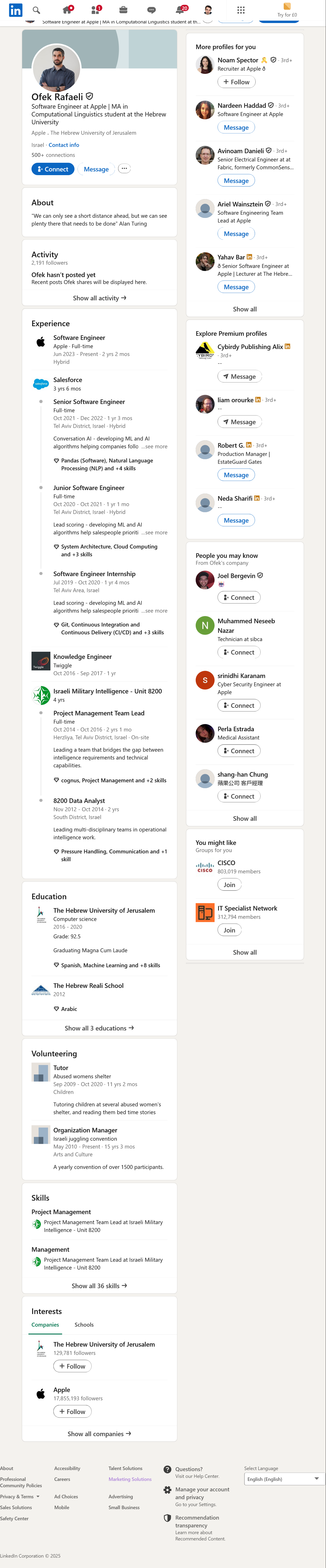
Ofer Tlusty, who served nearly six years in Unit 8200 as a security and intelligence analyst, has worked as a software engineer at Apple since 2021. Ofek Rafaeli, who served between 2012 and 2016 and rose to project manager during Israel’s 2016 assault on Gaza, became a software engineer at Apple in 2023.
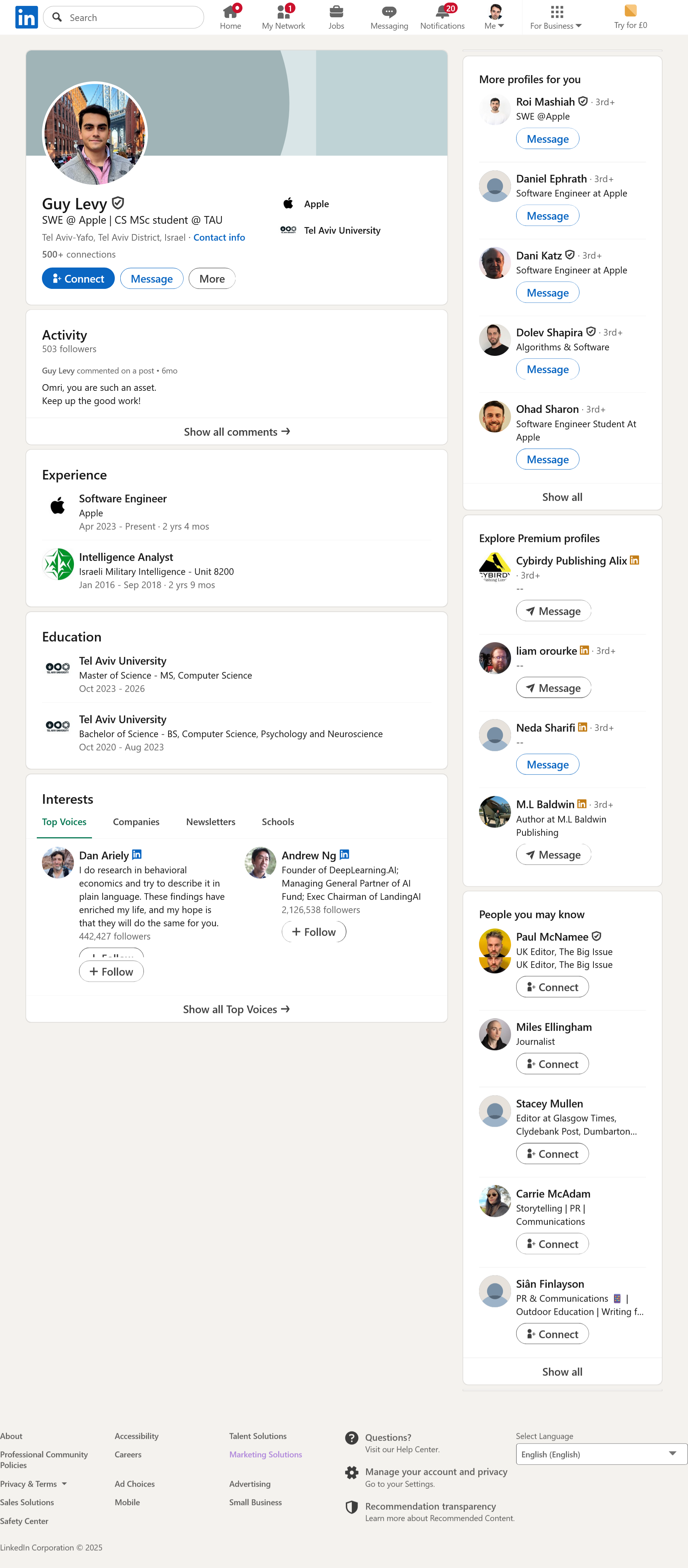
Guy Levy, a former intelligence analyst, now also works as a software engineer.
AI, Machine Learning, and Validation:
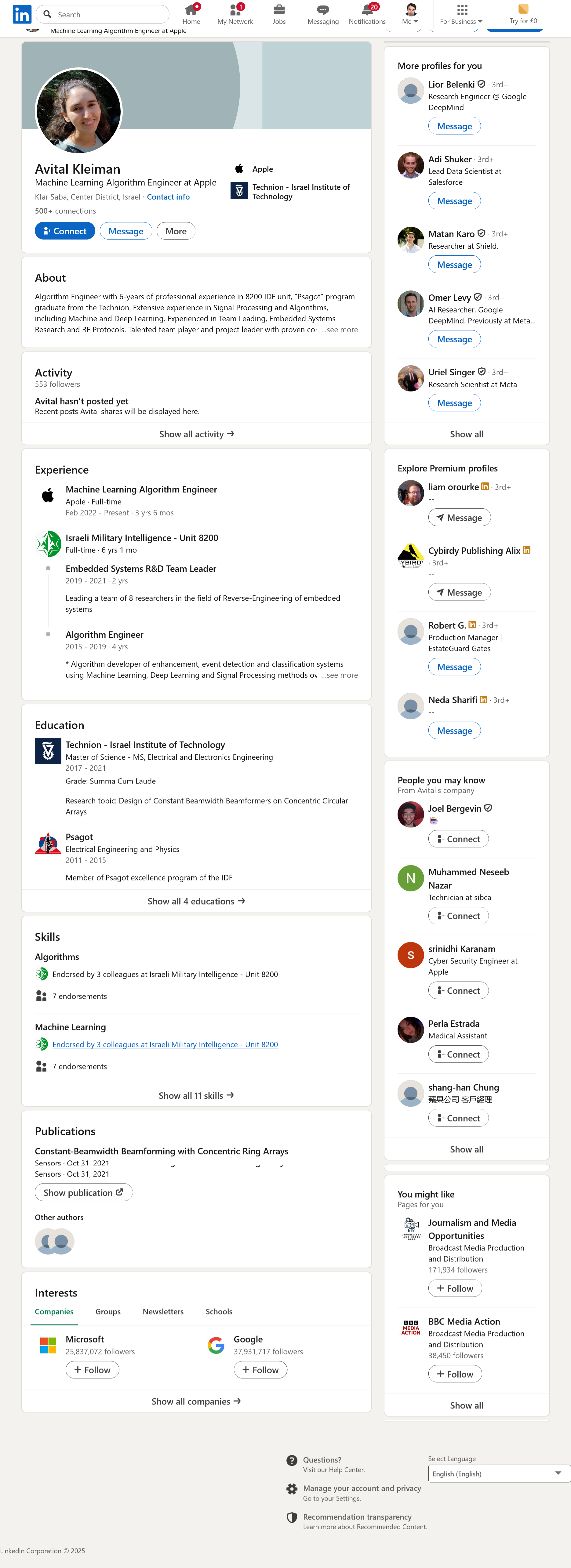
Avital Kleiman, a six-year veteran of Unit 8200, is now a machine learning algorithm engineer at Apple. Niv Lev Ari, currently a validation engineer, notes in his LinkedIn profile that he received a letter of commendation from Unit 8200 commander Aviv Kochavi for his work in the unit.
Other Technical Roles:
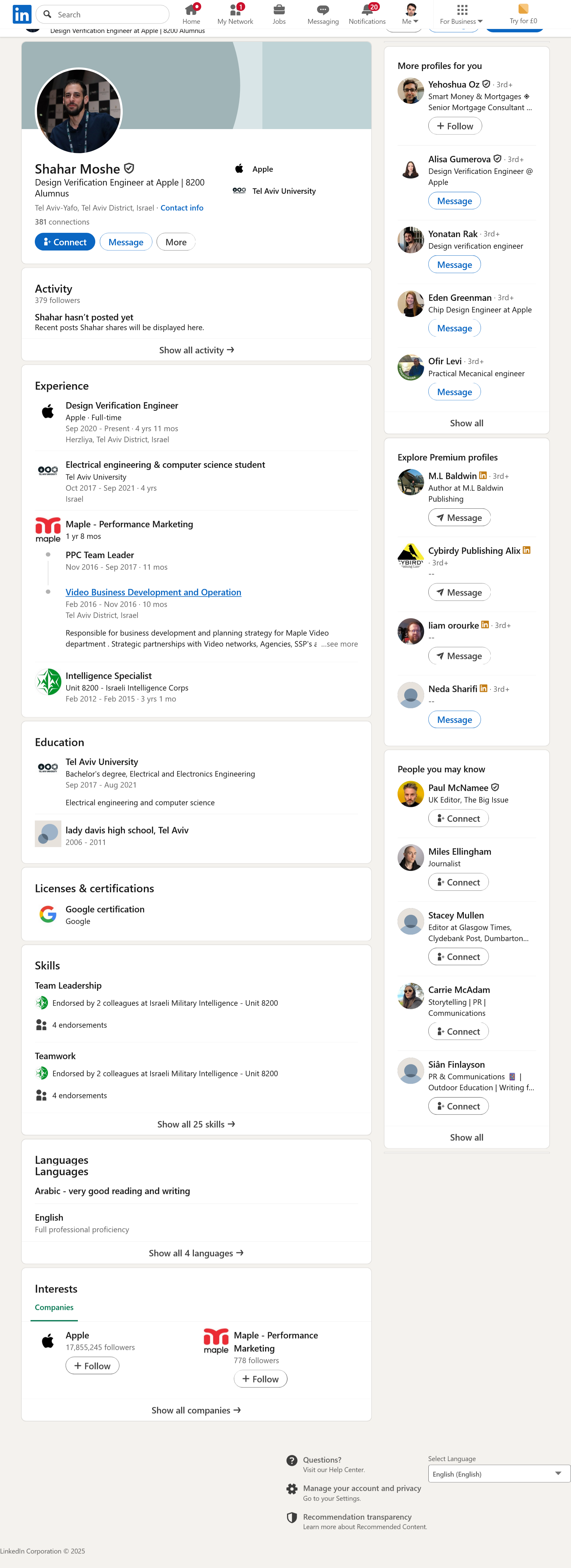
Shahar Moshe, who worked as an intelligence specialist at Unit 8200 from 2012 to 2015, is now a design verification engineer. Gil Avniel, who spent over five years in the unit, currently serves as a network engineer.
An Apple Rots From the Core
The growing number of former Israeli intelligence operatives working at Apple does not seem to concern the company’s senior management. CEO Tim Cook is known to hold strongly pro-Israel views and has spearheaded the Silicon Valley giant’s collaboration with the Israeli state.
Apple has acquired several Israeli tech firms and now operates three centers in the country, employing around 2,000 people. In 2014, Cook invited Israeli Prime Minister Benjamin Netanyahu to the company headquarters in Cupertino, CA, where, in front of the cameras, the two openly embraced. The following year, Cook accepted an invitation from President Reuven Rivlin to visit Israel. “It is a great privilege to host you and your team here,” Rivlin said, “Even for me, as one who prefers to write with a pen and paper, it is clear what a great miracle you have created when I look at my staff, and my grandchildren.”
Effusive praise for the Apple CEO has also come in the form of honors from pro-Israel organizations. In 2018, the Anti-Defamation League presented Cook with its inaugural Courage Against Hate Award at its Never Is Now Summit on anti-Semitism and Hate, where the organization described him as a “visionary leader in the business community.”
In the wake of the October 7, 2023, attacks, Cook sent out a company-wide email expressing his solidarity with Israel. “Like so many of you, I am devastated by the horrific attacks in Israel and the tragic reports coming out of the region,” he wrote, My heart goes out to the victims, those who have lost loved ones, and all of the innocent people who are suffering as a result of this violence.”
Yet, according to Apples4Ceasefire—a group of former and current employees opposing Israeli actions in Gaza—he has yet to say anything publicly about the mass devastation caused by the Israeli response to October 7.
Indeed, the Silicon Valley corporation has a policy of matching employee donations to groups such as Friends of the IDF, which raises money to buy equipment for IDF soldiers, and the Jewish National Fund, an organization that participates in the theft and destruction of Palestinian land.
Under Cook’s leadership, Apple employees have been disciplined or even fired for wearing pins, bracelets, or keffiyehs in support of the Palestinian people. Nevertheless, groups such as Apples4Ceasefire continue to speak out about what they describe as Apple’s complicity in genocide.
The Unit 8200 Tech Takeover
To be fair, Apple is far from the only tech or media company to hire large numbers of former Unit 8200 operatives. A 2022 MintPress exposé revealed hundreds of Israeli intelligence veterans working at Google, Facebook, Microsoft, and Amazon.
Perhaps the most notable of these is Emi Palmor, a former Israeli justice ministry official who sits on Facebook’s 21-person Oversight Board. Described by Mark Zuckerberg as his platform’s “supreme court,” the board ultimately decides what content is allowed or removed from the world’s largest social network. Facebook has worked closely with the Israeli government to censor or deplatform Palestinian content and accounts.
Even TikTok, often seen as a more open platform, has been hiring former Israeli spies to help manage its operations, according to a November investigation by MintPress. Reut Medalion, for example, served as a Unit 8200 intelligence commander and led its cybersecurity operations team.
In December 2023, during the peak of Israel’s attack on Gaza, Medalion moved to New York City to accept a job as global incident manager for TikTok’s trust and safety division. Considering the events going on in the world at the time, it’s worth asking what sorts of “global incidents” she was brought in to manage.
After MintPress exposed Medalion’s past to a worldwide audience, she deleted her entire digital footprint from the internet.
Former Israeli intelligence operatives have also found their way into American newsrooms, shaping coverage of the Middle East. A recent MintPress investigation uncovered a network of former Unit 8200 operatives working in some of the most influential newsrooms in the United States.
Among them is Axios correspondent Barak Ravid, whose Middle Eastern coverage won him the prestigious White House Press Correspondents’ Award. Until at least 2023, Ravid was a member of Unit 8200. CNN has also hired at least two former agents to produce their news coverage, one of whom, Tal Heinrich, now serves as the official spokesperson for Prime Minister Netanyahu.
Given this pattern, Silicon Valley’s partiality towards Israel should not come as no surprise. From tech giants like Google and Amazon to social media powerhouses like TikTok and Facebook, the field is filled with former Israeli spies. Apple is no exception, having hired dozens, if not more, Unit 8200 operatives to run its platforms and shape the company.
This investigation does not claim that the Israeli state is deliberately infiltrating Silicon Valley. However, what it does unquestionably suggest is that the outlook and general biases of these entities are strongly pro-Israel. What does it say about Silicon Valley’s culture that individuals with well-documented ties to a controversial foreign spy agency are considered ideal hires?
It is unthinkable that former intelligence agents of Hezbollah, Iran’s Ministry of Intelligence, or Russia’s FSB or GRU would be hired en masse, and trusted with our most sensitive data. Yet, when it comes to Israel (or U.S. surveillance agencies), the answer is different. Many of these employees are not even “former” agents, and are directly recruited from Unit 8200 while still in active service, despite Israeli law explicitly prohibiting the group’s members from identifying themselves or divulging their alliances.
Thus, in this light, it appears that those like Apples4Ceasefire struggling to end the company’s double standards are fighting an uphill battle.
Local website reveals city’s secret nuclear weapons programme

by Paul Linford , 18 Jul 2025, https://www.holdthefrontpage.co.uk/2025/news/local-website-reveals-citys-secret-nuclear-weapons-programme/
A city news website has revealed a university’s role in a programme to develop a new nuclear warhead.
The Sheffield Tribune, part of Mill Media, found evidence of a secure cell established at the Advanced Manufacturing Research Centre – part of the University of Sheffield.
The unit was set up by the Atomic Weapons Establishment (AWE) – an MoD body responsible for developing nuclear weapons — with the purpose of helping develop a new warhead for the UK’s nuclear arsenal, known as Astraea.
Data journalist Daniel Timms pieced together the story from documents already in the public domain, including a set of minutes from a meeting of parish councillors in Berkshire.
Danie spent four months working on the story and has written a first-person piece about how he uncovered the scoop.
Local website reveals city’s secret nuclear weapons programme
by Paul Linford Published 18 Jul 2025

A city news website has revealed a university’s role in a programme to develop a new nuclear warhead.
The Sheffield Tribune, part of Mill Media, found evidence of a secure cell established at the Advanced Manufacturing Research Centre – part of the University of Sheffield.
The unit was set up by the Atomic Weapons Establishment (AWE) – an MoD body responsible for developing nuclear weapons — with the purpose of helping develop a new warhead for the UK’s nuclear arsenal, known as Astraea.
Data journalist Daniel Timms pieced together the story from documents already in the public domain, including a set of minutes from a meeting of parish councillors in Berkshire.
Daniel, pictured, spent four months working on the story and has written a first-person piece about how he uncovered the scoop.
The key breakthrough came when he read a set of minutes from a meeting of Berkshire parish councillors around the AWE’s Aldermaston HQ in November 2023 which was addressed by an AWE director, Andrew McNaughton.
Wrote Daniel: “Unsurprisingly, AWE publishes very little. But they do have occasional meetings with local parish councillors around their Berkshire site. And in the published minutes, I finally find what I’d been searching for.
“It was the 108th meeting of the committee, in November 2023. Andrew McNaughton, the executive director for infrastructure on the fissile programme, explained that AWE had not had to design new warheads for decades, and taking this on will require new buildings and facilities.
“But in the meantime, they were doing some work elsewhere. And this was where the key admission was made.
“‘We already have a secure cell in Sheffield (part of Sheffield University) where we have some of the equipment we have been using… where we are going to be trialling the processes and training some of our employees,” McNaughton said.”
The Tribune gave both the Ministry of Defence and the university the opportunity to dispute its reporting, but they did not.
Added Daniel: “I’ve been working on this story for four months. I have no previous experience with the defence sector, and I assumed it would be an interesting diversion that would ultimately lead nowhere.
“Instead, largely by relying on freely available documents, I’ve been able to reveal where a significant aspect of the UK’s nuclear weapons programme is taking place — in a building with apparently minimal security just outside Sheffield.
“It’s possible that others with more of a headstart — and with less benign motives — have been able to do the same. But, given the lack of pushback (we haven’t been asked not to publish) perhaps the parties involved aren’t too concerned.”
A spokesperson for the university told The Tribune: “Our work at the AMRC involves developing and testing new technologies and processes for manufacturing companies and does not involve production of components for deployment.
Local website reveals city’s secret nuclear weapons programme
by Paul Linford Published 18 Jul 2025
A city news website has revealed a university’s role in a programme to develop a new nuclear warhead.
The Sheffield Tribune, part of Mill Media, found evidence of a secure cell established at the Advanced Manufacturing Research Centre – part of the University of Sheffield.
The unit was set up by the Atomic Weapons Establishment (AWE) – an MoD body responsible for developing nuclear weapons — with the purpose of helping develop a new warhead for the UK’s nuclear arsenal, known as Astraea.
Data journalist Daniel Timms pieced together the story from documents already in the public domain, including a set of minutes from a meeting of parish councillors in Berkshire.
Daniel, pictured, spent four months working on the story and has written a first-person piece about how he uncovered the scoop.
The key breakthrough came when he read a set of minutes from a meeting of Berkshire parish councillors around the AWE’s Aldermaston HQ in November 2023 which was addressed by an AWE director, Andrew McNaughton.
Wrote Daniel: “Unsurprisingly, AWE publishes very little. But they do have occasional meetings with local parish councillors around their Berkshire site. And in the published minutes, I finally find what I’d been searching for.
“It was the 108th meeting of the committee, in November 2023. Andrew McNaughton, the executive director for infrastructure on the fissile programme, explained that AWE had not had to design new warheads for decades, and taking this on will require new buildings and facilities.
“But in the meantime, they were doing some work elsewhere. And this was where the key admission was made.
“‘We already have a secure cell in Sheffield (part of Sheffield University) where we have some of the equipment we have been using… where we are going to be trialling the processes and training some of our employees,” McNaughton said.”
The Tribune gave both the Ministry of Defence and the university the opportunity to dispute its reporting, but they did not.
Added Daniel: “I’ve been working on this story for four months. I have no previous experience with the defence sector, and I assumed it would be an interesting diversion that would ultimately lead nowhere.
“Instead, largely by relying on freely available documents, I’ve been able to reveal where a significant aspect of the UK’s nuclear weapons programme is taking place — in a building with apparently minimal security just outside Sheffield.
“It’s possible that others with more of a headstart — and with less benign motives — have been able to do the same. But, given the lack of pushback (we haven’t been asked not to publish) perhaps the parties involved aren’t too concerned.”
A spokesperson for the university told The Tribune: “Our work at the AMRC involves developing and testing new technologies and processes for manufacturing companies and does not involve production of components for deployment.
“Our collaboration with partners in the defence sector helps them to overcome sustainability and productivity challenges, and support UK security and sovereign capabilities.”
Joshi Hermann, proprietor of Mill Media commented: “This is a fantastic story from Daniel Timms, revealing the existence of a secret nuclear weapons programme in Sheffield.
“If he can work this out from sources and the minutes of a parish council meeting in Berkshire, then the Russians/Chinese can too.”
Francesca Albanese: “A revolutionary shift is underway”
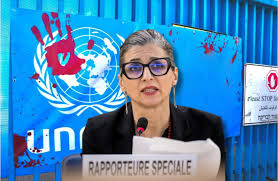
Remarks of Francesca Albanese, the UN Special Rapporteur on the situation of human rights in the Palestinian territory occupied since 1967, at the Hague Group Emergency Conference of States in Bogotá, Colombia.
By Francesca Albanese / Progressive International, https://progressive.international/wire/2025-07-16-francesca-albanese-a-revolutionary-shift-is-underway/en
Excellencies, Friends,
I express my appreciation to the government of Colombia and South Africa for convening this group, and to all members of the Hague Group, its founding members for their principled stance, and the others who are joining. May you keep groing and so the strength and effectiveness of your concrete actions.
Thank you also to the Secretariat for its tireless work, and last but not least, the Palestinian experts—individuals and organisations who travelled to Bogota from occupied Palestine, historical Palestine/Israel and other places of the diaspora/exile, to accompany this process, after providing HG with outstanding, evidence-based briefings.
And of course all of you who are here today,
It is important to be here today, in a moment that may prove historical indeed. There is hope that these two days will move all present to work together to take concrete measures to end the genocide in Gaza and, hopefully, end the erasure of the
Palestinian for what remains of Palestine—because this is the testing ground for a system where freedom, rights, and justice are made real for all. This hope, that people like me hold tight, is a discipline. A discipline we all should have.
The occupied Palestinian territory today is a hellscape. In Gaza, Israel has dismantled even the last UN function—humanitarian aid—in order to deliberately starve, displace time and again, or kill a population they have marked for elimination. In the West Bank, including East Jerusalem, ethnic cleansing advances through unlawful siege, mass displacement, extrajudicial killings, arbitrary detention, widespread torture. Across all areas under Israeli rule, Palestinians live under the terror of annihilation, broadcast in real time to a watching world. The very few Israeli people who stand against genocide, occupation, and apartheid—while the majority openly cheers and calls for more—remind us that Israeli liberation, too, is inseparable from Palestinian freedom. .
The atrocities of the past 21 months are not a sudden aberration; they are the culmination of decades of policies to displace and replace the Palestinian people.
Against this backdrop, it is inconceivable that political forums, from Brussels to NY, are still debating recognition of the State of Palestine—not because it’s unimportant, but because for 35 years states have stalled, refused recognition, pretending to “invest in the PA” while abandoning the Palestinian people to Israel’s relentless, rapacious territorial ambitions and unspeakable crimes. Meanwhile political discourse has reduced Palestine to a humanitarian crisis to manage in perpetuity rather than a political issue demanding principled and firm resolution: end permanent occupation, apartheid and today genocide. And it is not the law that has failed or faltered—it is political will that has abdicated.
But today, we are also witnessing a rupture. Palestine’s immense suffering has cracked open the possibility of transformation. Even if this is not fully reflected into political agendas (yet), a revolutionary shift is underway—one that, if sustained, will be remembered as a moment when history changed course.
And this is why I came to this meeting with a sense of being at a historical turning point —discursively and politically.
First, the narrative is shifting: away from Israel’s endlessly invoked “right to self-defence” and toward the long-denied Palestinian right to self-determination—systematically invisibilised, suppressed and delegitimised for decades. The weaponisation of antisemitism applied to Palestinian words, and narratives, and the dehumanising use of the terrorism framework for Palestinian action (from armed resistance to the work of NGOs pursuing justice in international arena), has led to a global political paralysis that has been intentional. It must be redressed. The time is now.
Second, and consequentially, we are seeing the rise of a new multilateralism: principled, courageous, increasingly led by the Global Majority it pains me that I have yet to see this include European countries. As a European, I fear what the region and its institutions have come to symbolize to many: a sodality of states preaching international law yet guided more by colonial mindset than principle, acting as vassals to the US empire, even as it drags us from war to war, misery to misery and when it comes to Palestine: from silence to complicity.
But the presence of European countries at this meeting shows that a different path is possible. To them I say: the Hague Group has the potential to signal not just a coalition, but a new moral center in world politics. Please, stand with them.
Millions are watching—hoping—for leadership that can birth a new global order rooted in justice, humanity, and collective liberation. This is not just about Palestine. This is about all of us.
Principled states must rise to this moment. It does not need to have a political allegiance, color, political party flags or ideologies: it needs to be upheld by basic human values. Those which Israel has been mercilessly crushing for 21 months now.
Meanwhile I applaud the calling of this emergency conference in Bogota to address the unrelenting devastation in Gaza. So it is on this, that focus must be directed. The measures adopted in January by the Hague Group were symbolically powerful. It was the signal of the discursive and political shift needed. But they are the absolute bear minimum. I implore you to expand your commitment. And to turn that commitment into concrete actions, legislatively, judicially in each of your jurisdictions. And to consider first and foremost, what must we do to stop the genocidal onslaught. For Palestinians, especially those in Gaza, this question is existential. But it really is applicable to the humanity of all of us.
In this context my responsibility here is to recommend to you, uncompromisingly and dispassionately, the cure for the root cause. We are long past dealing with symptoms, the comfort zone of too many these days. And my words will show that what the Hague Group has committed to do and is considering expanding upon, is a small commitment towards what’s just and due based on your obligations under international law.
Obligations, not sympathy, not charity.
Each state immediately review and suspend all ties with Israel. Their military, strategic, political, diplomatic, economic, relations – both imports and exports – and to make sure that their private sector, insurers, banks, pension funds, universities and other goods, and services providers in the supply chains do the same. Treating the occupation as business as usual translates into supporting or providing aid or assistance to the unlawful presence of Israel in the OPT. These ties must be terminated as a matter of urgency. I will have the opportunity to elaborate on the technicalities and implications in our further sessions but lets be clear, I mean cutting ties with Israel as a whole. Cutting ties only with the “components” of it in the oPt is not an option.
This is in line with the duty on all states stemming from the July 2024 Advisory Opinion which confirmed the illegality of Israel’s prolonged occupation, which it declared tantamount to racial segregation and apartheid . The General Assembly adopted that opinion. These findings are more than sufficient for action. Further, it is the state of Israel who is accused of war crimes, crimes against humanity and genocide, so it is the state that must be responsible for its wrongdoings.
As I argue in my last report to the HRC, the Israeli economy is structured to sustain the occupation, and has now turned genocidal. It is impossible to disentangle Israel’s state policies and economy from its longstanding policies and economy of occupation. It has been inseparable for decades. The longer states and others stay engaged, the more this illegality at its heart is legitimised. This is the complicity. Now that economy has turned genocidal. There is no good Israel, bad Israel.
I ask you to consider this moment as if we were sitting here in the 1990s, discussing the case of apartheid South Africa. Would you have proposed selective sanctions on SA for its conduct in individual Bantustans? Or would you have recognised the state’s criminal system as a whole? And here, what Israel is doing is worse. This comparison— is a legal and factual assessment supported by international legal proceedings many in this room are part of.
This is what concrete measures mean. Negotiating with Israel on how to manage what remains of Gaza and West Bank, in Brussels or elsewhere, is an utter dishonor to international law.
And to the Palestinians and those from all corners of the world standing by them, often at great cost and sacrifice, I say whatever happens, Palestine will have written this tumultuous chapter—not as a footnote in the chronicles of would-be conquerors, but as the newest verse in a centuries-long saga of peoples who have risen against injustice, colonialism, and today more than ever neoliberal tyranny.
Australia obstructed probe into deadly ‘Rainbow Warrior’ bombing
David Robie, July 10, 2025 , https://johnmenadue.com/post/2025/07/australia-obstructed-probe-into-deadly-rainbow-warrior-bombing/
France’s ‘Operation Satanique’ bombing of the Greenpeace ship Rainbow Warrior, 40 years ago this month, was state-sponsored terrorism – and Australia had a part in helping French secret agents to escape.
A DECLASSIFIED AUSTRALIA SPECIAL REPORT
The French Government terror bombing of Greenpeace ship, Rainbow Warrior, 40 years ago in Auckland harbour backfired on the French disastrously. It added to mounting Pacific and global pressure to force France 11 years later to abandon nuclear testing on its Pacific island colonies.
Australia’s obstruction of the New Zealand police investigation of the French secret agents who conducted the terror bombing still rankles, 40 years on.
David Robie, the only journalist on board the ship in the weeks leading up to the bombing, looks back on the event and on the legacy of this sordid act of state terrorism in a New Zealand port.
Was dubbed “Blunderwatergate”. This was an apt epithet for the Jacques Tati-like farce marking the bombing of the Rainbow Warrior by French secret agents on 10 July 1985.
And the bungled attempts to cover up the murky trail leading back to the highest levels of government, the military and intelligence in Paris.
It was tragic too. The killing of Greenpeace’s photojournalist Portuguese-born Fernando Pereira that night at Auckland’s Marsden Wharf was a shock to the crew – and to me as a journalist who had been on board documenting the ship’s voyage for 10 weeks.
But we had no illusions about French involvement. The Greenpeace ship had just arrived in Auckland and was preparing for a protest voyage to Moruroa Atoll, in the French Pacific territory of Tahiti, to highlight the French nuclear testing.
A combination of a swift investigation by New Zealand police, and curious bystanders, led to the arrest and charging with murder of two French secret agents from France’s secret service, the Directorate-General for External Security (DGSE). The arrested agents had been posing as Swiss honeymooners in the days that followed the bombing.
A lack of co-operation and actual obstruction by Australian authorities stymied an attempt to arrest four more French DGSE agents who had fled to Australian territory of Norfolk Island.
French terror in Opération Satanique
In a sense it was lucky that the death toll on board the Rainbow Warrior that night wasn’t a lot higher. Fernando had gone below deck after the first blast looking for a missing crew member and to rescue his camera gear.
In their appropriately titled “Opération Satanique”, the French spies used a deadly double detonation to bomb the ship twice, precisely seven minutes apart. This technique has similarities to the now-familiar “double tap” bombing that often results in first responders and rescuers being targeted, and has been described as a war crime as it violates the Geneva Convention by targeting civilians and the wounded.
Fernando died when the second bomb exploded, rapidly flooding the ship further and crippling the propellor shaft just behind his cabin – and next to my own.
Ten other crew members on board scrambled off, some thrown into the water. More people could have died, as several had been asleep after the lively 29th birthday party for campaign co-ordinator Steve Sawyer earlier in the evening.
Some were still chatting in the mess when the first French Naval limpet mine went off, blasting a massive hole the size of a garage door in the hull at the engine room, at 10 minutes to midnight.
There had been no warning from the French to the crew or others on board in this worst case of state terrorism ever to happen in New Zealand. And no warning of the second blast to come.
The final voyage
The man killed in the blast, Fernando Pereira, aged 36 and the father of two young children, was on the Rainbow Warrior’s Pacific voyage almost by chance.
At the beginning of the voyage, co-ordinator Steve Sawyer had been seeking a wirephoto machine for transmitting photographs to the world of the campaign voyage to the Marshall Islands.
He phoned Fiona Davies, then heading the Greenpeace photo office in Paris. But he wanted the machine and a photographer separately.
“No, no – I’ll get you a wire machine,” replied Davies. “But you’ll have to take my photographer with it.”
So Fernando Pereira joined the Rainbow Warrior in Hawai’i and he covered the voyage to Rongelap Atoll in the Marshall Islands The islanders there wanted help to leave their contaminated ancestral home, and in May 1985, Greenpeace’s ship, the Rainbow Warrior, set out to help them.
They suffered serious health problems because of radioactive fallout that had dusted their island home from at least five “dirty” US nuclear bomb tests in the 1950s. Marshall Islands, 3500kms north-east of Australia, had been occupied by US forces since WW2, and in 1979 voted to exercise sovereignty in a Compact in Free Association with the United States.
The 15-megaton “Bravo” test on 1 March 1954, a thousand times more powerful than the US atomic bomb that devastated Hiroshima, was the most lethal to the islanders. Hundreds of people were living on the downwind atolls of Rongelap, Rongerik and Utirik, barely 150km to the east. They are left with a deadly legacy of thyroid tumours, cancers, still births, and a host of other illnesses.
Neglected by both the US and Marshall Islands authorities, and despite losing their homes and much cultural heritage, the islanders urged the Greenpeace flagship to evacuate them to Mejatto on Kwajalein Atoll, 120km away.
It took four return voyages for the Rainbow Warrior to move about 320 Rongelapese with their dismantled homes and belongings — some hundreds of tonnes — to their new atoll.
Their future and their health remain uncertain four decades after Greenpeace helped them. But the media spotlight on the humanitarian voyage helped pressure the US to partially make amends.
The US did provide US$150 million as part of the agreement for the Compact of Free Association, to establish a Nuclear Claims Tribunal to deal with health claims over the testing. Established in 1988, the Tribunal ran out of funds in 2011 and ceased to function.
It also provided US$45 million to the Rongelap people to “clean up” the atoll – but so far just one of 60 islands has been cleaned up. The islanders are debating a return to their homeland of Rongelap, but many are not convinced that their atoll is safe yet.
Australian involvement in Opération Satanique
One aspect of the police investigation that rankled with New Zealanders was the lack of co-operation verging on obstruction by Australian authorities. This was the pursuit of the DGSE agents posing as the crew of the yacht Ouvéa that had been chartered in New Caledonia and was suspected of smuggling the explosives into New Zealand.
On 15 July, five days after the deadly bombing, a team of eight New Zealand detectives — including two French speakers — and a forensic scientist on the hunt for the fleeing French agents, were flown in a New Zealand Air Force plane to Australia’s Norfolk Island.
They interviewed the three crew on board (they missed the leader Dr Xavier Maniguet, who had earlier managed to fly to Sydney) – DGSE agents Chief Petty Officer Roland Verge, 32; Petty Officer Gerald Andries, 32; and Petty Officer Jean-Michael Barcelo, 33. They all claimed to be “tourists”.
The next day the detectives searched the Ouvéa, took scrapings from the yacht’s bilges to check for explosives, and seized documents. They also found a map of Auckland with a near-harbour Ponsonby address of a Greenpeace member handwritten on it – later shown to be a map sent by the French spy Christine Cabon, who had infiltrated Greenpeace, to the DGSE. She later fled to Israel, but managed to elude a New Zealand detective who tracked her down.
The 11-metre yacht the Ouvéa had been secretly chartered by the “covert action” arm of the DGSE French spy agency, to carry the two limpet bombs, the diving gear, a zodiac dingy, and radios and other gear to Auckland harbour.
The information collected after analysis produced enough evidence to charge the three agents with murder on the same basis as the two DGSE agents already arrested, but the New Zealand police needed time for the analytics, and even the passport checks took five days.
However, the Australian police and immigration officials on Norfolk Island, without doubt operating under instructions from Canberra (where the Bob Hawke Labor Government was in power), would not allow extra time for holding the suspects.
They gave New Zealand police just one day — an impossible deadline of 2pm on 16 July — and after that the yacht crew and their boat were free to depart, unimpeded by Australian authorities.
By the time the New Zealand police had obtained arrest warrants for the arrest of the Ouvéa crew on 26 July on charges of arson and murder, they and their boat had already sailed away from Australian territory.
Australian assistance to the French may have been more than mere obstruction.
A former head of DGSE in his memoir admitted to many covert sabotage and espionage operations against Greenpeace. He described how its “traditional allies” had ”on several occasions” been informed of plans for covert operations and had either lent a hand or “turned a blind eye on such-and-such a day”.
Whether Australia’s intelligence agencies also directly assisted the French with intelligence, surveillance, or preparations for carrying out the bombing, or in the escape of their agents, is unclear.
Tahitian sources said the DGSE agents, after being released by Australian authorities from Norfolk Island, had rendezvoused with the French Navy’s nuclear-powered attack submarine Rubis which was used for Special Forces deployment and surveillance, and had been conveniently deployed to the Coral Sea area.
The Ouvéa yacht was then scuttled. An empty life raft was detected in the area shortly after by a New Zealand Air Force P-3 Orion surveillance plane dispatched to hunt for the yacht and for the French submarine known to be in the area. The DGSE agents were landed ashore from the submarine at the French Pacific territory of Tahiti.
Four other French agents remained undetected in New Zealand. One of the agents nonchalantly flew out unimpeded through Sydney, while the others laid low under cover for two weeks before quietly slipping out of the country.
French state violence against Greenpeace
So why was the Rainbow Warrior bombed? Many in the French military were blinded by an intense paranoia over Greenpeace and other activists working to highlight nuclear testing in the South Pacific and in supporting independence struggles in their Pacific colonies.
The French secret service, the DGSE, was given a free hand by Defence Minister Charles Hernu to “neutralise” the environmental organisation.
The French prime minister at the time, Laurent Fabius, claimed in a TVNZ interview in 2005 that he had been “betrayed” by his defence minister. Hernu died in 1990 – still popular in France over the bombing.
The sabotage attack on the Rainbow Warrior certainly wasn’t out of character with many other brutal actions taken by French authorities against Greenpeace vessels protesting against nuclear testing in the Pacific.
In 1973, for example, French commandos boarded the Greenpeace yacht Vega off Moruroa Atoll and savagely beat two of the crew, including one of the founders of Greenpeace, David McTaggart, who almost lost an eye.
McTaggart filed a civil action against the French Navy, accusing it of piracy. The Paris court found the Navy guilty of having deliberately rammed the Vega.
In 1995, Greenpeace led another flotilla to Moruroa. Ten years after the lethal bombing in Auckland, French commandos boarded the Rainbow Warrior II, smashed equipment, fired tear gas at crew on the ship’s bridge, arrested Greenpeace activists, and seized the ship.
France only returned the vessel to Greenpeace several months later.
And I also had my personal run-ins with French authorities as a journalist covering environmental and independence issues in the 1980s.
In January 1987, a year after the first edition of my book, Eyes of Fire: The Last Voyage of the Rainbow Warrior, was published, I was arrested at gunpoint by French troops in the French Pacific territory of New Caledonia /Kanaky, near the New Caledonian village of Canala.
The arrest followed a week of being tailed by secret agents in the capital, Nouméa. When I was handed over by the military to local gendarmes for interrogation, accusations of my being a “spy” and questions over my book on the _Rainbow Warrior_bombing were made in the same breath.
After about four hours of questioning by the gendarmes, I was released.
Greenpeace, after being awarded $8 million in compensation — but no apology — from France by the International Arbitration Tribunal, finally towed the Rainbow Warrior to Matauri Bay and scuttled her off Motutapere, in the Cavalli Islands in northern New Zealand on 12 December 1987, to create a living reef.
Her namesake, the Rainbow Warrior II, formerly the Grampian Fame, was launched in Hamburg exactly four years after the bombing, to continue the environmental advocacy work
Cutting a deal
The diplomatic pressure from France heaped upon New Zealand to release the DGSE agents was huge. A deal was finally agreed but it sparked almost as much anger in New Zealand as the bombing itself, when France threatened to block trade access to New Zealand’s European markets.
The compensation deal for New Zealand, mediated in 1986 by then UN secretary-general Javier Perez de Cuellar, awarded the government $13 million. The money was used to fund anti-nuclear projects and the Pacific Development and Conservation Trust.
The compensation agreement and an apology by France was in exchange for the deportation of the two jailed DGSE secret agents, Alain Mafart and Dominique Prieur (“the honeymooners”), after they had served less than a year of their 10-year sentences for manslaughter and wilful damage of the bombed ship.
They were transferred to Hao Atoll in French Polynesia to serve three years in exile at a “Club Med”-style nuclear and military base.
But the bombing scandal didn’t end there. The same day as the “burial at sea” of the Rainbow Warrior in 1987, the French government told New Zealand that Mafart had a “serious stomach complaint”.
French authorities repatriated him to France – in defiance of the terms of the UN agreement and protests from David Lange’s Labour Government.
It was later claimed by a Tahitian newspaper, Les Nouvelles, that Mafart was being smuggled out of Tahiti on a false passport hours before New Zealand was even told of his “illness”.
The other French agent, Prieur, was also repatriated to France in May 1988 because she was pregnant. France ignored protests by the New Zealand Government, and the secret agent pair were honoured, decorated and promoted in their homeland.
A supreme irony is that such an act of terrorism should be publicly rewarded, given the past two decades efforts against terrorism in the so-called “war on terror”.
Satanique mea culpa
In May 2005, the French agents’ lawyer, Gerard Currie, tried to block footage of their 1985 guilty pleas in the New Zealand High Court — shown on closed circuit to journalists, including myself, at the time but not seen publicly — from being broadcast in TVNZ’s Sunday program.
Losing the High Court ruling, the DGSE ‘s lawyer appealed against the footage being broadcast. But the two former agents had lost any spurious claim to privacy over the act of terrorism by publishing their own memoirs – Agent Secrete (Prieur, 1995) and Carnets Secrets (Mafart, 1999).
More than three decades after the bombing, in September 2015, the French secret agent who planted the French Naval limpet mines on the hull of the Rainbow Warrior, “outed” himself and apologised to Greenpeace, the Pereira family, and the people of New Zealand, describing the operation as a “big, big failure”.
Retired colonel Jean-Luc Kister (alias Alain Tonel), revealed in simultaneous interviews with TVNZ’s Sunday program reporter John Hudson and French investigative journalist Edwy Plenel, publisher of _Mediapart_, his role in the sabotage.
Colonel Kister revealed that an early French proposal to merely damage the ship’s engine in Auckland Harbour was rejected.
“There was a willingness at a high level to say: ‘This has to end once and for all. We need to take radical measures’.
“We were told we had to sink it,” Kister said in the interview.
“I have the blood of an innocent man on my conscience, and that weighs on me. We are not cold-blooded killers. My conscience led me to apologise and explain myself.”
The legacy of nuclear resistance
Bengt Danielsson, a Swedish anthropologist, and his French wife, Marie-Thérèse, were an inspiration to the nuclear-free and independent Pacific movement, especially in the Cook Islands, New Zealand and Tahiti.
Along with Elaine Shaw of Greenpeace Aotearoa, they played a vital role in raising public awareness of the plight of Tahitians harmed by the years of French atmospheric nuclear tests.
While the Danielssons published several scientific studies and popular books on the islands, including _Moruroa, Mon Amour_ and Poisoned Reign, they constantly campaigned to expose French nuclear colonialism.
They were honoured for their commitment and achievements with Bengt being awarded the Right Livelihood Award, an alternative Nobel Peace Prize-style international recognition, “exposing the tragic results of and advocating an end to French nuclear colonialism”.
However, Bengt Danielsson’s health deteriorated after this honour and he died in July 1997, barely a year after French nuclear testing in the Gambier Islands ended for good. Marie-Thérèse died six years later in 2003.
France agreed to sign the Comprehensive Test Ban Treaty after a swansong package of eight planned nuclear tests to provide data for simulation computer software.
However, such was the strength of international hostility and protests and riots in Pape’ete that Paris ended the nuclear program after just six tests. France officially ratified the CTBT on 10 September 1996.
Elaine Shaw worked for Greenpeace Aotearoa for 16 years and developed it with a core group into the small but lively movement it had become by the time of the bombing.
But she was not comfortable with the changes and rapid growth of the organisation after the bombing. She worked tirelessly for the people of Rongelap as well as “French” Polynesia, the victims of nuclear testing until she died of cancer in 1990.
“I sensed that her interest stemmed from her concern for the people rather than any political ideology,” said Tahitian activist Tea Hirshon. “She went to many islands and saw for herself what people in the Pacific wanted.”
Still other Greenpeace stalwarts have died since the Rainbow Warrior bombing, including Warrior of the Rainbow author and journalist Robert Hunter (2005), founding president of Greenpeace; and David McTaggart (2004), for many years the inspirational chairman of Greenpeace International.
Kawhia-based Owen Wilkes, who had joined a Vega voyage to the Cook Islands in mid-1986, and Fijian nuclear-free and independent Pacific campaigner Amelia Rokotuivuna, both also died in 2005.
The campaign co-ordinator of the fatal voyage, Steve Sawyer, died of pneumonia caused by lung cancer in 2019. One of the crew members on the Rongelap mission, the Rainbow Warrior’s chief engineer Davey Edward, also died of cancer in 2021.
The best possible memorial for Elaine Shaw, Amelia Rokotuivuna, Owen Wilkes, the Danielssons and other Pacific campaigners came in 2004 when Tahitians elected Oscar Temaru as their territorial President.
He had established the first nuclear-free municipality in the Pacific Islands when he was mayor of the Pape’ete suburb of Faa’a.
Since the Temaru coalition came to power, demands increased for a full commission of inquiry to investigate new evidence of radiation exposure from the atmospheric tests in the Gambiers in French Polynesia from 1966-1974.
Altogether France carried out 193 nuclear tests in the South Pacific, 46 of them dumping more than nine megatons of explosive energy into the atmosphere – 42 over Moruroa, and four over Fangataufa atolls.
It was recently revealed that the French Atomic Energy Commission has spent at least €90,000 in a vain campaign to undermine the research by an investigative journalism unit called Disclose and revealed in the book _Toxique,_ published in 2021 and an associated website “The Moruroa Files“.
The investigators trawled some 2000 pages of declassified documents and carried out scores of interviews, concluding that French authorities consistently underestimated the scale of the impact on the environment, geology and the health of the islanders of the French nuclear testing in Polynesia.
The CEA produced its own booklet, “Nuclear tests in French Polynesia: why, how and with what consequences”, printed 5000 copies, and distributed these around Pacific countries.
However, the pressure on France to atone for its actions will continue.
From death springs life
The sordid Rainbow Warrior affair was a diplomatic debacle for the French, and it has taken years for Paris to recover some mana — spiritual power and authority — in the South Pacific region.
Greenpeace and the general environmental movement have grown dramatically and matured over the past four decades. Greenpeace is currently operating Rainbow Warrior III as its campaign flagship.
Campaigns have broadened from the dangers of nuclear power, into issues such as the climate crisis, driftnet fisheries, genetic engineering, glacier retreat, the illegal rainforest timber trade, and now the growing threat of deep sea mining industry.
The original Rainbow Warrior’s last voyage and the death of Fernando Pereira were not in vain. The struggle lives on.
Republished from Declassified Australia , 1 July 2025
Sellafield nuclear power plant safety fears as ‘potentially deadly nitrogen gas leaks’
One incident involved an ‘elevated level’ of nitrogen gas,
which can cause asphyxiation, at the plant’s Magnox facility. The incident
was played down, the source claimed.
Safety at the UK’s biggest nuclear
site is under threat due to a culture of secrecy and ‘cover ups’, a whistle
blower told the Mirror. The source described a potentially deadly incident
in which nitrogen gas, which can cause asphyxiation, leaked at the
Sellafield Magnox storage facility. The incident was covered up, the source
claimed, adding that staff are afraid to raise safety issues because they
fear they will be “targeted”.
The leak was at the Magnox Swarf Storage
Silo – the most hazardous building within Sellafield in Cumbria – where
waste products from used nuclear fuel rods are stored. The source said the
leak in May 2023 was raised as an incident report and “was of a level
that needed to be escalated”. But it was not escalated, according to the
whistleblower, who added that “no lessons were learned”. They said:
“There is no confidence or trust in the senior management now. We are
dealing with nuclear waste and people are afraid to speak up.
The problem is that people are being victimised if they report safety issues. “Or
they are escalated to managers who then try to cover them up or sweep them
under the carpet. And that is a really dangerous culture in a place like
Sellafield.”
Mirror 5th July 2025,
https://www.mirror.co.uk/news/uk-news/sellafield-nuclear-power-plant-safety-35504096
U.S. sanctions U.N. expert critical of Israel’s war in Gaza
Francesca Albanese has called for an arms embargo on Israel and accused the U.S. ally of waging a “genocidal campaign” in Gaza.
The United States said on Wednesday it was imposing sanctions on Francesca Albanese, the United Nations’ special rapporteur on human rights in the occupied Palestinian territories, who has been very critical of U.S. ally Israel’s war in Gaza.
“Today I am imposing sanctions on UN Human Rights Council Special Rapporteur Francesca Albanese for her illegitimate and shameful efforts to prompt (International Criminal Court) action against U.S. and Israeli officials, companies, and executives,” Secretary of State Marco Rubio said in a statement.
In a post on X late on Wednesday, Albanese wrote that she stood “firmly and convincingly on the side of justice, as I have always done,” without directly mentioning the U.S. sanctions. In a text message to Al Jazeera, she was quoted as dismissing the U.S. move as “mafia style intimidation techniques.”
Albanese, an Italian lawyer and academic, has called on states at the U.N. Human Rights Council to impose an arms embargo and cut off trade and financial ties with Israel while accusing the U.S. ally of waging a “genocidal campaign” in Gaza.
Israel has faced accusations of genocide at the International Court of Justice and of war crimes at the ICC over its devastating military assault on Gaza. Israel denies the accusations and says its campaign amounts to self-defense after a deadly October 2023 Hamas attack.
In a report published earlier this month, Albanese accused over 60 companies, including major arms manufacturers and technology firms, of involvement in supporting Israeli settlements and military actions in Gaza. The report called on companies to cease dealings with Israel and for legal accountability for executives implicated in alleged violations of international law.
Albanese is one of dozens of independent human rights experts mandated by the United Nations to report on specific themes and crises. The views expressed by special rapporteurs do not reflect those of the global body as a whole.
Rights experts slammed the U.S. sanctions against Albanese. Dylan Williams, vice president for government affairs at the Center for International Policy think tank, labeled them as “rogue state behavior” while Amnesty International said special rapporteurs must be supported and not sanctioned.
“Governments around the world and all actors who believe in the rule-based order and international law must do everything in their power to mitigate and block the effect of the sanctions against Francesca Albanese and more generally to protect the work and independence of Special Rapporteurs,” Amnesty International’s Secretary General Agnes Callamard, a former UN special rapporteur, said.
Since returning to office in January, President Donald Trump has stopped U.S. engagement with the U.N. Human Rights Council, extended a halt to funding for the Palestinian relief agency UNRWA and ordered a review of the U.N. cultural agency UNESCO.
He has also announced U.S. plans to quit the Paris climate deal and the World Health Organization.
His administration imposed sanctions on four judges at the ICC in June in retaliation over the war tribunal’s issuance of an arrest warrant for Israeli Prime Minister Benjamin Netanyahu and a past decision to open a case into alleged war crimes by U.S. troops in Afghanistan.
Palantir’s Shadow War On Iran
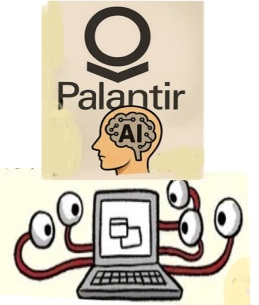
July 2, 2025, Kit Klarenberg, https://www.kitklarenberg.com/p/palantirs-shadow-war-on-iran
As the dust settles on the “12 Day War”, it is ever-clearer that the conflict was a crushing defeat for Israel and the US. In retrospect, the Zionist entity’s sole success was a wave of assassinations in the conflict’s first hours. A fawning June 19th Financial Times report hinted cutting-edge technology drawing together diverse data and intelligence sources was responsible. This raises the obvious question of whether Tel Aviv was assisted in its murderous spree by notorious private spying giant Palantir.
An avowedly pro-Israel tech giant founded by Donald Trump confidante and ardent Zionist Peter Thiel, which reportedly provides artificial intelligence tech supporting Tel Aviv’s genocide in Gaza, Palantir’s tendrils extend typically unseen into almost every conceivable sphere of public and private life across the West. Moreover, the firm – launched with seed funding from CIA venture capital wing In-Q-Tel – has long-played a pivotal but barely acknowledged role in the International Atomic Energy Agency’s monitoring of Tehran’s nuclear research.
The interpretation Palantir was one way or another involved in Israel’s illegal “preemptive” war of aggression against Tehran is amply reinforced by the release of sensitive Israeli documents by Iran’s intelligence ministry. These files indicate the IAEA previously provided Israeli intelligence with the names of several Iranian nuclear scientists, who were subsequently assassinated. Additionally, current Association chief Rafael Grossi enjoys a close, long-running, clandestine relationship with Israeli officials. Subsequent disclosures could expose the IAEA’s dark alliance with Palantir.
‘Fishing Expedition’
In July 2015, the Obama administration inked the Joint Comprehensive Plan of Action with Tehran. Under its auspices, in return for sanctions relief, the IAEA was granted unimpeded access to Iran’s nuclear facilities, to ensure the Islamic Republic was not developing nuclear weapons. Vast amounts of information on and within the sites, including surveillance camera photos, measurement data, and documents were collected along the way. The Association consistently found Iran was stringently adhering to the JCPOA’s terms.
Following Trump’s first inauguration however, the JCPOA began to come apart at the seams. In October 2017, he refused to certify Iran’s compliance with its obligations on bogus grounds, and began threatening to tear up the agreement outright and reimpose sanctions. The next March, then-IAEA director general Yukiya Amano sounded alarm over this prospect, claiming the JCPOA had produced “the world’s most robust [nuclear] verification regime” in Iran, and its cessation would represent a “great loss”. He went on to boast of how Association inspectors:
“Now spend 3,000 calendar days per year on the ground in Iran. We have installed some 2,000 tamper-proof seals on nuclear material and equipment. We have carried out more than 60 complementary accesses [unannounced inspections] and visited more than 190 buildings…We collect and analyse hundreds of thousands of images captured daily by our sophisticated surveillance cameras…about half of the total number of such images that we collect throughout the world. We collect over one million pieces of open source information each month.”
Amano added IAEA activities in Tehran were “supported by state-of-the-art technology, including data collecting and processing systems.” Unmentioned was that these innovative resources were provided by Palantir. The company’s central role in scrutinizing Iran’s nuclear compliance and intimate handshake with the IAEA was revealed two months later by Bloomberg, mere days before the Trump administration shredded the Agreement and launched a “maximum pressure” campaign against Tehran. Former US energy secretary Ernest Moniz effusively praised Palantir’s contribution:
“We have a completely unique and unparalleled intrusive verification regime that was not there before the agreement.”
A tool dubbed Mosaic served as “the analytical core” and “platform of choice” for the IAEA’s verification mission in Iran. The software helped the Association “plan and justify unscheduled probes”, collating and processing data from around 400 million “digital objects” globally, “including social media feeds and satellite photographs.” Mosaic was also charged with examining en-masse documents not only collected by the IAEA, but tens of thousands of sensitive files stolen by Mossad from Tehran.
Bloomberg quoted Ali Vaez, International Crisis Group’s Iran Project director, as expressing concern about Mosaic analysing “dirty” data obtained by Mossad, “which prides itself on deception.” After all, “even a small amount of false information could trigger a flurry of unnecessary snap inspections and derail an agreement that took years to reach.” The broader the terms of Palantir’s work with the IAEA, the more the mission “appears as a fishing expedition,” Vaez fretted, suggesting Iran could become less willing “to open its doors to inspectors.”
Vaez’s comments were eerily prophetic. Recent disclosures of intensive collusion between the IAEA and Zionist entity authorities, and the resultant prospect Association inspections assisted Israeli and US attacks on Tehran, prompted Iranian lawmakers to unanimously pass legislation indefinitely suspending cooperation with the Association on June 25th. It is unlikely IAEA inspectors will ever be permitted to tread on the Islamic Republic’s territory again. But Bloomberg highlighted a number of other anxieties that have only gained in gravity in light of recent events.
‘False Assumption’
For one, the outlet recorded how Palantir’s IAEA role granted the company “access to information that governments don’t,” while questioning whether “an international agency known for its independence” could truly remain neutral and objective given “Thiel’s close personal ties to Trump.” Furthermore, Bloomberg noted the Association’s Palantir-provided “enhanced investigative abilities” had “raised concern that the IAEA may overstep the boundary between nuclear monitoring and intelligence-gathering,” transforming its inspectors into unwitting “potential cyber sleuths.”
Such fears were only exacerbated by Mosaic being based upon Palantir’s highly controversial “predictive-policing software”. For the IAEA, this capability turned “databases of classified information into maps” helping “inspectors visualize ties between the people, places and material involved in nuclear activities” in Tehran. The risk of innocent Iranian civilians being made targets for surveillance, harassment, or even assassination created by erroneous data being fed into and/or pumped out by Mosaic is gargantuan.
Bloomberg quoted a representative of a British company “that advises governments on verification issues” as saying “predictive-analysis” systems were extremely vulnerable to such corruption, “either by accident or design.” He noted, “you will generate a false return if you add a false assumption into the system…[and] end up convincing yourself that shadows are real.” Of course, a dangerous “false assumption” lay at the very core of the IAEA’s inspection mission in Iran – namely, that Tehran was developing nukes in the first place.
The Islamic Republic has for decades consistently denied any suggestion it harbours ambitions to possess nuclear weapons. Her denials were corroborated by a November 2007 US National Intelligence Estimate expressing “high confidence that in fall 2003, Tehran halted” any and all research into nuclear weapons. This assessment remained unchanged for several years, and was reportedly shared by Mossad. As Bloomberg recorded, come May 2018 the IAEA had “certified Iran’s work 10 times.”
In March 2025, Director of National Intelligence Tulsi Gabbard testified to Congress that Iran had not restarted the nuclear weapons program it halted in 2003. On June 17th, with the 12 Day War well-underway, IAEA chief Grossi declared “we did not have any proof of a systematic effort” by Tehran “to move into a nuclear weapon.” Yet, Israel justified its attacks based on an intelligence dossier that concluded the Islamic Republic had in fact reached the “point of no return” in acquiring nukes.
That dodgy dossier depended in no small part on the findings of a May IAEA report. The document provided no new information – its dubious charges related “to activities dating back decades” at three sites where purportedly, until the early 2000s, “undeclared nuclear material” was handled. If this report was analysed by Palantir’s “predictive-analysis” systems, it is all but inevitable false results and connections would’ve been created, in turn influencing the Zionist entity’s targets and strategy.
One of the “predictive policing” tools innovated by Palantir guiding Mosaic’s operations is Gotham, which is used by an uncertain number of Western law enforcement agencies. Leaked documents on the resource show it collects an extraordinary volume of data on entire populations – whether they are law-abiding, suspected of having committed a crime, or simply connected to individuals accused of wrongdoing. This includes sex, race, names, contact details, addresses, prior warrants, mugshots, surveillance photos, personal relationships, past and current employers, and identifying features such as tattoos.
In October 2024, a major Norwegian asset manager divested from Palantir due to the company offering “AI-based predictive policing systems”, aiding the Zionist entity’s mass surveillance of Palestinians in Gaza and the West Bank. These systems are designed “to identify individuals who are likely to launch ‘lone wolf terrorist’ attacks, facilitating their arrests preemptively before the strikes that it is projected they would carry out.” Their deployment results in countless Palestinians languishing in Israeli dungeons without charge or trial.
If Mosaic informed the Zionist entity’s strategy during the 12 Day War, that may account for why individuals with no connection whatsoever to Iran’s civilian nuclear program were directly targeted for assassination. This includes Majid Tajan Jari, a prominent professor in the field of AI locally, slain in an Israeli strike on a residential building in Tehran on June 16th. Yet, reliance on faulty or false information collated by Mosaic would simultaneously explain the conflict ending in embarrassing defeat for Israel, and victory for Tehran.
Spying on Iran: How MI6 infiltrated the IAEA
The Iranian government has alleged that the IAEA supplied the identities of its top nuclear scientists to Israeli intelligence, enabling their assassinations, and provided critical intelligence to the US and Israel on the nuclear facilities they bombed during their military assault this June.
Leaked confidential files indicate the International Atomic Energy Agency was infiltrated by a veteran British spy who has claimed credit for sanctions on Iran.
The Grayzone, Jul 02, 2025, By Kit Klarenberg, https://thegrayzone.substack.com/p/spying-on-iran-how-mi6-infiltrated?utm_source=post-email-title&publication_id=474765&post_id=167288793&utm_campaign=email-post-title&isFreemail=true&r=n09ij&triedRedirect=true&utm_medium=email
A notorious British MI6 agent infiltrated the International Atomic Energy Agency (IAEA) on London’s behalf, according to leaked documents reviewed by The Grayzone. The agent, Nicholas Langman, is a veteran intelligence operative who claims credit for helping engineer the West’s economic war on Iran.
Langman’s identity first surfaced in journalistic accounts of his role in deflecting accusations that British intelligence played a role in the death of Princess Diana. He was later accused by Greek authorities of overseeing the abduction and torture of Pakistani migrants in Athens.
In both cases, UK authorities issued censorship orders forbidding the press from publishing his name. But Greek media, which was under no such obligation, confirmed that Langman was one of the MI6 assets withdrawn from Britain’s embassy in Athens.
The Grayzone discovered the résumé of the journeyman British operative in a trove of leaked papers detailing the activities of Torchlight, a prolific British intelligence cutout. The bio of the longtime MI6 officer reveals he “led large, inter-agency teams to identify and defeat the spread of nuclear, chemical and biological weapons technology, including by innovative technical means and sanctions.”
In particular, the MI6 agent says he provided “support for the [IAEA] and Organization for the Prohibition of Chemical Weapons [OPCW] and through high level international partnerships.”
Langman’s CV credits him with playing a major role in organizing the sanctions regime on Iran by “[building] highly effective and mutually supportive relations across government and with senior US, European, Middle and Far Eastern colleagues for strategy” between 2010 and 2012. He boasts in his bio that this achievement “enabled [the] major diplomatic success of [the] Iranian nuclear and sanctions agreement.”
The influence Langman claimed to have exerted on the IAEA adds weight to Iranian allegations that the international nuclear regulation body colluded with the West and Israel to undermine its sovereignty. The Iranian government has alleged that the IAEA supplied the identities of its top nuclear scientists to Israeli intelligence, enabling their assassinations, and provided critical intelligence to the US and Israel on the nuclear facilities they bombed during their military assault this June.
This June 12, under the direction of its Secretary General Rafael Grossi, the IAEA issued a clearly politicized report recycling questionable past allegations to accuse Iran of violating the Non-Proliferation Treaty. Three days later, Israel attacked the country, assassinating nine nuclear scientists as well as numerous top military officials and hundreds of civilians.
Iranian former Vice President for Strategic Affairs Javad Zarif has since called for the IAEA’s Grossi to be sacked, accusing him of having “abetted the slaughter of innocents in the country.” This June 28, the Iranian government broke ties with the IAEA, refusing to allow its inspectors into the country.
While Iranian officials may have had no idea about the involvement of a shadowy figure like Langman in IAEA business, it would likely come as little surprise to Tehran that the supposedly multilateral agency had been compromised by a Western intelligence agency.
Langman’s name placed under official UK censorship order
In 2016, Langman was named a Companion of the Order of St Michael and St George, the same title bestowed on fictional British spy James Bond. By that point, the supposed secret agent held the dubious distinction of being publicly ‘burned’ as an MI6 operative on two separate occasions.
First, in 2001, journalist Stephen Dorril revealed that Langman had arrived in Paris weeks prior to Princess Diana’s fatal car crash in the city on August 31 1997, and was subsequently charged with conducting “information operations” to deflect widespread public speculation British intelligence was responsible for her death.
Then, in 2005, he was formally accused by Greek authorities of complicity in the abduction and torture of 28 Pakistanis in Athens. The Pakistanis, all migrant workers, were suspected of having had contact with individuals accused of perpetrating the 7/7 bombings in London, July 2005.
Brutally beaten and threatened with guns in their mouths, the victims “were convinced their interrogators were British.” When Greek media named Langman as the MI6 operative who oversaw the migrants’ torture, British news outlets universally complied with a government D-notice – an official censorship order – and kept his identity under wraps when reporting on the scandal.
London vehemently denied any British involvement in torturing the migrants, with then-Foreign Secretary Jack Straw dismissing the charge as “utter nonsense.” In January 2006 though, London admitted MI6 officers were indeed present during the Pakistanis’ torture, although officials insisted the operatives played no active part in their arrests, questioning or abuse.
Following his withdrawal from Athens, Langman returned to London to head the UK Foreign Office’s Iran Department, a shift which highlights his importance to MI6 and suggests the British government had no qualms about his allegedly brutal evidence gathering methods.
Britain’s Foreign Office collaborates closely with MI6, whose agents use it as cover just as the CIA does with State Department diplomatic postings.
MI6’s man on Iran takes credit for “maximum pressure” strategy
While leading the Foreign Office’s Iran Department from 2006 – 2008, Langman oversaw a team seeking to “develop understanding” of the Iranian government’s “nuclear program.”
It’s unclear exactly what that “understanding” entailed. But the document makes clear that Langman then “generated confidence” in that assessment among “European, US and Middle Eastern agencies” in order to “delay programme [sic] and pressurise Iran to negotiate.” The reference to “Middle Eastern agencies” strongly implied MI6 cooperation with Israel’s Mossad intelligence services.
In April 2006, Tehran announced it had successfully enriched uranium for the first time, although officials denied any intention to do so for military purposes. This development may have triggered Langman’s intervention.
The Islamic Republic has rejected any suggestion it harbors ambitions to possess nuclear weapons. Its denials were corroborated by a November 2007 US National Intelligence Estimate expressing “high confidence that in fall 2003, Tehran halted” any and all research into nuclear weapons. This assessment remained unchanged for several years, and was reportedly shared by the Mossad, despite Benjamin Netanyhau’s constant declarations that Iran was on the brink of developing a nuclear weapon.
Langman’s IAEA support work overlaps with Iran sanctions blitz
International governmental attitudes towards Iran changed abruptly between 2010 and ‘12. During this period, Western states and intergovernmental institutions initiated an array of harshly punitive measures against the country, while Israel ramped up its deadly covert operations against Iran’s nuclear scientists.
This period precisely overlapped with Langman’s tenure at the Counter-Proliferation Centre of the UK Foreign Office. His bio implies he used this position to influence the IAEA and other UN-affiliated organizations to foment a campaign of global hostility towards Iran.
In June 2010, the UN Security Council adopted Resolution 1929, which froze the Iranian Revolutionary Guard Corps’ assets, and banned overseas financial institutions from opening offices in Tehran. A month later, the Obama administration adopted the Comprehensive Iran Sanctions, Accountability, and Divestment Act. This set off a global chain of copycat sanctions by Washington’s vassals, who often imposed even more stringent measures than those levied by the UN and US.
In March 2012, the EU voted unanimously to cut Iranian banks out of the SWIFT international banking network. That October, the bloc imposed the harshest sanctions to date, restricting trade, financial services, energy and technology, along with bans on the provision of insurance to Iranian companies by European firms.
BBC reporting on the sanctions acknowledged European officials merely suspected Tehran of seeking to develop nuclear weapons, but lacked concrete proof. And behind the scenes, the MI6 operative Langman was claiming credit for helping legitimize the allegations against Iran.
Following the Western-led campaign isolation of Iran from 2010 – 2012, over its purported nuclear weapon program, the Obama administration negotiated a July 2015 agreement known as the Joint Comprehensive Plan of Action (JCPOA). Under the JCPOA’s terms, the Islamic Republic agreed to limit its nuclear research activities in return for sanctions relief. In the years that followed, the IAEA was granted virtually unlimited access to Tehran’s nuclear complexes, ostensibly to ensure the facilities were not used to develop nuclear weapons.
Along the way, IAEA inspectors collected vast amounts of information on the sites, including surveillance camera photos, measurement data, and documents. The Iranian government has since accused the Agency of furnishing the top secret profiles of its nuclear scientists to Israel. These include the godfather of Iran’s nuclear program, Mohsen Fakrizadeh, who was first publicly named in a menacing 2019 powerpoint presentation by Israeli Prime Minister Benjamin Netanyahu. The following year, the Mossad assassinated Fakrizadeh in broad daylight with a remote-controlled machine gun.
Internal IAEA documents leaked this June indicated that IAEA Secretary General Rafael Grossi has enjoyed a much closer relationship with Israeli officials than was previously known, and suggested he leveraged his cozy ties with Tel Aviv to secure his current position.
During a June 24 interview with Fox News’ war-crazed anchor Martha MacCallum, Grossi did not deny making the inflammatory claim that “900 pounds of potentially enriched uranium was taken to an ancient site near Isfahan.” Instead the IAEA director asserted, “We do not have any information on the whereabouts of this material.”
Well before Grossi rose to the top of the IAEA with Western and Israeli backing, the agency appears to have been penetrated by a British intelligence agent who took responsibility in his bio for engineering the West’s economic attack on Iran.
The IAEA has not responded to an email from The Grayzone seeking clarification on its relationship with Langman and the MI6.
How Iran could build a bomb in secret – despite Trump’s $30bn offer

Iran enters ‘era of nuclear ambiguity’ with its capabilities ‘hidden and unverifiable’
Radina Gigova, 27 June 25, https://inews.co.uk/news/world/how-iran-build-bomb-secret-despite-trumps-30bn-offer-3775501
Despite US strikes on Iranian nuclear sites, the Trump administration is reportedly prepared to offer Tehran financial incentives to strike a deal over its nuclear programme.
Sources familiar with current plans told CNN that Washington could offer investment in a civilian energy worth up to $30bn (£21.9bn) if the regime is willing to abandon uranium enrichment and adopt transparency measures, as well as sanctions relief.
But Iran has signaled that it intends to rebuild the programme after acknowledging heavy damage by US strikes, and it could do so in secret after passing a law to suspend co-operation with the International Atomic Energy Agency (IAEA), which would block inspections on its nuclear sites and pave the way to withdrawal from the Nuclear Non-Proliferation Treaty.
How far Iran has progressed towards nuclear weapons, and what steps it could take next, could now be hidden from view, experts say.
“The truth is, no one really knows – and that’s exactly the problem,” said Sina Toossi, an Iran specialist and senior fellow at the Centre for International Policy, a Washington DC think-tank.
“Iran is entering an era of nuclear ambiguity, where its capabilities are deliberately hidden and unverifiable,” he said.
The ambiguity has been heightened after President Donald Trump said he would consider bombing Iran again.
Trump said he had spared Khamanei’s life during the original raids. US officials told the Reuters news agency on June 15 that Trump had vetoed an Israeli plan to kill the supreme leader.
“His Country was decimated, his three evil Nuclear Sites were OBLITERATED, and I knew EXACTLY where he was sheltered, and would not let Israel, or the U.S. Armed Forces, by far the Greatest and Most Powerful in the World, terminate his life,” Trump said in a social media post.
“I SAVED HIM FROM A VERY UGLY AND IGNOMINIOUS DEATH,” he said.
Iran’s decision to suspend IAEA co-operation just two days after a ceasefire “marks a turning point in the decades-long nuclear dispute”, and is “a strategic setback for both the United States and Israel”, Toossi added.
Iran retains nuclear capabilities
Donald Trump claimed last Saturday that US “bunker-buster” bombs had thoroughly destroyed Iran’s nuclear enrichment facilities, including sites at Natanz and Fordo – the latter located deep underground – and a storage site in Isfahan.
“The strikes were a spectacular military success,” the US President declared, adding that Iran’s core enrichment infrastructure had been “completely and totally obliterated”.
Iranian officials, for their part, continue to deny any intention of developing a nuclear bomb.
But experts caution that Iran retains the potential to weaponise.
“Yes, Iran retains the technical capability and infrastructure to eventually build a nuclear bomb behind the scenes, despite the recent Israeli and US strikes,” said Dr Andreas Krieg, senior lecturer at the School of Security Studies at King’s College London, Royal College of Defence Studies and fellow at the Institute of Middle Eastern Studies.
The strikes caused substantial damage to critical nuclear facilities, including the enrichment and conversion sites at Natanz, Fordo, and Esfahan, according to US officials. However, intelligence reports and satellite imagery indicate that Iran likely relocated a large portion of its enriched uranium stockpile – and possibly even advanced centrifuges – to secret locations ahead of the attacks.
“This preserved the most critical elements of its breakout capability. Moreover, Iran’s knowledge base – its cadre of nuclear scientists and engineers – is intact. Human capital, unlike physical infrastructure, is difficult to eliminate and can reconstitute programmes even after significant setbacks,” said Dr Krieg.
Krieg noted that the IAEA has acknowledged that although inspections at declared sites have been hindered, there is only limited visibility into any potential undisclosed or secret facilities.
“This opens the possibility of a clandestine parallel programme – especially given that Iran has previously experimented with such pathways during the AMAD programme in the early 2000s,” he said, referring to an alleged secret Iranian nuclear weapons development project believed to have been active at the start of the century.
“Therefore, while recent military operations may have delayed Iran’s ability to assemble a bomb, they have not eliminated the potential,” he said.
“If Iran were to exit the Nuclear Non-Proliferation Treaty or reduce co-operation with the IAEA, concerns about a hidden weapons programme would intensify. In the absence of a durable diplomatic solution, Iran’s latent capability remains a central strategic risk in the region.”
Dr Pavel Podvig, a senior researcher and nuclear specialist at the UN Institute for Disarmament Research, said the US and Israel could struggle to keep track of a hidden programme.
“It would be very difficult without IAEA access,” he said. “Look at North Korea – and North Korea wasn’t really making a special effort to hide facilities underground.”
A clandestine “breakout” would prioritise storage of any remaining highly enriched uranium, he added, which could potentially be further enriched to weapons-grade at an unknown facility.
Basis of a deal may already exist
Krieg believes “it is imperative that the Trump administration, through mediators like Qatar, is transforming this current momentum of the ceasefire into a sustainable and mutually acceptable nuclear deal, including enrichment constraints and effective oversight mechanisms”.
Uranium is the central element in question, and according to the UN’s nuclear watchdog, no other country has as much enriched uranium at this level as Iran does without also engaging in a nuclear weapons programme.
John Erath, senior policy director at the Centre for Arms Control and Non-Proliferation, agrees that Iran may have the capability to build a nuclear weapon and that negotiating a new agreement, similar to the Joint Comprehensive Plan of Action (JCPOA) nuclear deal reached in 2015 and abandoned by Trump in 2018 – could be the basis of a new deal.
“We have an example of an arrangement that provided confidence that closed off the path to nuclear weapons for Iran,” he said, referring to the JCPOA, “and so, if I were negotiating a new arrangement, I would use that as a starting point but I would have something that would not have an expiration date.”
“If you want to demonstrate that you do not have nuclear weapons, be completely transparent, be completely open, and they were not that,” Erath claimed, referring to the Iranian government. “They were doing things that they wanted to keep hidden, that they wanted to keep in secret, that were only things that you could do if you were considering a nuclear weapons programme.”
Iranian officials have indicated reluctance to re-enter talks after the US and Israeli attacks, citing a lack of trust, although Tehran’s ambassador to the UN left the door open to a regional nuclear consortium involving Gulf states – a previous proposal floated by the US.
The 12-day war has “certainly put the possibility of further negotiations under serious threat”, Erath said. “[But that’s] what happened, and we have to live with the consequences.”
Why Limit Iranian Enrichment Peacefully When You Can Bomb Them Instead?
A deal was limiting Iran’s enrichment of uranium until Donald Trump pulled the U.S. out of it. Instead the Dealmaker bombed Iran, threatening to set the region on fire, writes Joe Lauria. With a ceasefire what does he do now?
By Joe Lauria, Consortium News. June 24, 2025, https://consortiumnews.com/2025/06/24/why-limit-iranian-enrichment-peacefully-when-you-can-bomb-them-instead/
In the last great achievement of international diplomacy, the United States and its allies Britain, France and Germany, concluded a deal in 2015 with Russia, China and Iran — something that today would be unthinkable — to limit Iran’s nuclear enrichment to purely civilian uses at 3.67 percent.
Negotiations on the deal began in November 2013, just three months before the U.S.-backed unconstitutional change of government in Kiev that started the long slide in U.S.-Russian relations. That did not prevent the nuclear deal from being concluded in July 2015 and endorsed by the Security Council in October of that year.
Seven years later, Washington and its European allies began fighting a hot war against Moscow through its proxy Ukraine. Relations with China have also sharply deteriorated. The idea of such cooperation on Iran now is unthinkable.
But in 2013 such wise diplomacy was still possible and the result was a peaceful resolution of the Iranian enrichment issue.
Iran agreed to stringent monitoring by the International Atomic Energy Agency and in exchange, the United States, Europe and the United Nations lifted economic sanctions against Tehran.
The IAEA certified that the deal was working. Iran was sticking to 3.67 percent enrichment. Diplomacy worked. Iran’s nuclear program was in check.
But the Israelis had opposed it all along because Israel’s aim has long been to overthrow the government in Iran in Israel’s quest for regional dominance.
Netanyahu could not stop Barack Obama from working with the Chinese and the Russians to conclude the deal that solved the nuclear issue and left the Iranian government in a more secure position.
Then Donald Trump became president. He did what Netanyahu wanted. He pulled the U.S. out of the deal, saying it was a lousy agreement and he could do better. But there was no new deal. Iran continued to cooperate with the existing agreement for a year before increasing enrichment, eventually to 60 percent for leverage in the negotiation. (90 percent is needed for a bomb, but U.S. intelligence and the IAEA said in recents months that Iran is not pursuing a bomb).
Obama’s vice president, Joe Biden, did nothing to return the U.S. to the deal to save it when he got into the White House, dishonoring probably Obama’s greatest achievement.
Trump 2.0’s idea of a better deal to limit Tehran’s enrichment was to demand zero percent after Iran agreed to return to 3.67 percent. Trump would look like a fool if he accepted 3.67 percent, as that would mean agreeing to the very deal that was working well before he tore it up.
So it was bombs away instead.
Clearing Smoke Reveals Trump’s Lies
More than 24 hours after the smoke cleared above Fordow, Natanz and Isfahan nuclear facilities Trump’s lies during his address Saturday night came clearly into view.
The strikes were not “a spectacular military success.” Iran’s “key nuclear enrichment facilities” were not “completely and totally obliterated.” There is no evidence that a single centrifuge was damaged and Iran’s 60 percent enriched fuel had already been removed and is in a location unknown to Israel, the U.S. and the IAEA.
Trump called Iran the “bully of the Middle East” when any neutral person knows that bully is Israel backed by the U.S., the bully of the world.
In just the past few months, with U.S. backing, Israel has invaded Lebanon and Syria, launched an unprovoked attack on Iran and is committing genocide in Gaza. The last time Iran invaded anyone was Iraq in 1982 but only after Iraq had invaded it first in 1980.
Israel gets away with this by portraying itself as the perpetual victim of an imminent new Holocaust 80 years after the fact and thus needs to invade and bomb its neighbors in “self defense” to pre-empt this from happening.
Regional hostility toward Israel does not stem from a reaction to its decades of aggression against Palestinians and its neighbors but purely from anti-semitic hatred. These countries must constantly be attacked to wipe out this hatred, not to reconstitute an ancient Hebrew empire from (beyond) the River to the Sea.
One power that empire never conquered was Persia
With their overlapping empires — Israel’s regional and the U.S.’s global — Iran, the land of Darius and Cyrus, is the prime target. The U.S. has sought to control it since at least its 1953 coup restored the shah to power for its oil and because of its Cold War rivalry with Russia.
Trump mimicked Israel, calling Iran “the world’s number one state sponsor of terror,” when an objective analysis would correctly award that title to the Gulf Sunni monarchies, principally Saudi Arabia, all allied with the United States.
They have sponsored al-Qaeda and ISIS and all their offshoots and rebrandings, while Iran has mostly supported militia resisting occupations in Lebanon, Iraq, Syria and Gaza.
Though formed in 1982 in response to Israel’s invasion and occupation of Lebanon, Hezbollah was only designated a terrorist organization by the European Union in 2013, for instance. Though founded in 1987, the EU did not view Hamas as a terrorist group until 2001.
Then Trump said of Iran:
“They have been killing our people, blowing off their arms, blowing off their legs with roadside bombs. That was their specialty. We lost over 1,000 people, and hundreds of thousands throughout the Middle East and around the world have died as a direct result of their hate.”
This is a bizarre statement that can only be related to attacks by militia against U.S. occupation forces in Iraq after the U.S. 2003 invasion. But only some of these groups were Iranian-backed and they killed not a thousand, but 169 U.S. soldiers, whom Trump referred to as “our people,” as if they were tourists and not an occupying army.
Trump’s thousand U.S. victims appears to come from propaganda put out by the Jerusalem Center for Public Affairs, which calls itself “a leading independent research institute, serving as Israel’s global embassy for national security and applied diplomacy.”
It combats what it calls “apartheid antisemitism.” It falsely called the 2015 nuclear agreement that Trump withdrew from “a deal that would allow Iran to become a nuclear-armed state.” In 2015, Haaretz named Sheldon Adelson, Trump’s principal donor, “one of the main financers of JCFA in recent years.”
Israel had to cut short its ambitions to conquer Iran (at least overtly) and agree to a ceasefire because it was running out of interceptor missiles; it’s economy, already weakened by Gaza, was threatened at $200 million a day; and it sustained far more damage than it will admit.
Now that there is a ceasefire, Trump is back to square one. The New York Times reported:
“Rafael Mariano Grossi, the director of the U.N.’s nuclear watchdog, welcomed news of a cease-fire. In a social-media post, he said he has invited Iran’s foreign minister Abbas Araghchi to meet to discuss a diplomatic solution on Iran’s nuclear program.”
That solution would be a return to 3.67 percent enrichment and Iran giving up its 60 percent stockpile, in other words, returning exactly to the deal Trump tore up to plunge the region into extreme danger with his bombing stunt.
Where will he turn now?
Joe Lauria is editor-in-chief of Consortium News and a former U.N. correspondent for The Wall Street Journal, Boston Globe, and other newspapers, including The Montreal Gazette, the London Daily Mail and The Star of Johannesburg. He was an investigative reporter for the Sunday Times of London, a financial reporter for Bloomberg News and began his professional work as a 19-year old stringer for The New York Times. He is the author of two books, A Political Odyssey, with Sen. Mike Gravel, foreword by Daniel Ellsberg; and How I Lost By Hillary Clinton, foreword by Julian Assange.
Trump rejects leaked intelligence that says strikes did not destroy Iran nuclear programme.
Donald Trump insists nuclear sites in Iran were
“completely destroyed” by US military strikes, despite an intelligence
report casting doubt on their success The leaked damage assessment from the
Pentagon’s Defense Intelligence Agency estimates the attack only set Iran’s
nuclear programme back “a few months”
BBC 25th June 2025,
https://www.bbc.co.uk/news/live/c20xel1e97gt
How the US and Israel Used Rafael Grossi to Hijack the IAEA and Start a War on Iran
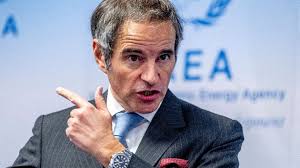
Rafael Grossi, director General of the International Atomic Energy Agency (IAEA), allowed the IAEA to be used by the United States and Israel—an undeclared nuclear weapons state in long-term violation of IAEA rules—to manufacture a pretext for war on Iran, despite his agency’s own conclusion that Iran had no nuclear weapons program.
Israel began working on a nuclear weapon in the 1950s, with substantial help from Western countries, including France, Britain and Argentina, and made its first weapons in 1966 or 1967. By 2015, when Iran signed the JCPOA nuclear agreement, former Secretary of State Colin Powell wrote in a leaked email that a nuclear weapon would be useless to Iran because “Israel has 200, all targeted on Tehran.”
The agency’s chief has not only continued its subservience to U.S. and Western interests, but also its practice of turning a blind eye to Israel’s nuclear weapons.
Medea BenjaminNicolas J.S. Davies, Jun 23, 2025, https://www.commondreams.org/opinion/how-the-us-and-israel-used-rafael-grossi-to-hijack-the-iaea-and-start-a-war-on-iran
Rafael Grossi, director General of the International Atomic Energy Agency (IAEA), allowed the IAEA to be used by the United States and Israel—an undeclared nuclear weapons state in long-term violation of IAEA rules—to manufacture a pretext for war on Iran, despite his agency’s own conclusion that Iran had no nuclear weapons program.
On June 12th, based on a damning report by Grossi, a slim majority of the IAEA Board of Governors voted to find Iran in non-compliance with its obligations as an IAEA member. Of the 35 countries represented on the Board, only 19 voted for the resolution, while 3 voted against it, 11 abstained and 2 did not vote.
Rafael Grossi, director General of the International Atomic Energy Agency (IAEA), allowed the IAEA to be used by the United States and Israel—an undeclared nuclear weapons state in long-term violation of IAEA rules—to manufacture a pretext for war on Iran, despite his agency’s own conclusion that Iran had no nuclear weapons program.
On June 12th, based on a damning report by Grossi, a slim majority of the IAEA Board of Governors voted to find Iran in non-compliance with its obligations as an IAEA member. Of the 35 countries represented on the Board, only 19 voted for the resolution, while 3 voted against it, 11 abstained and 2 did not vote.
Without you, Common Dreams simply wouldn’t exist.
In a moment that demands fearless reporting, Common Dreams needs your support to keep our independent journalism alive.
about:blank
The United States contacted eight board member governments on June 10th to persuade them to either vote for the resolution or not to vote. Israeli officials said they saw the U.S. arm-twisting for the IAEA resolution as a significant signal of U.S. support for Israel’s war plans, revealing how much Israel valued the IAEA resolution as diplomatic cover for the war.
The IAEA board meeting was timed for the final day of President Trump’s 60-day ultimatum to Iran to negotiate a new nuclear agreement. Even as the IAEA board voted, Israel was loading weapons, fuel and drop-tanks on its warplanes for the long flight to Iran and briefing its aircrews on their targets. The first Israeli air strikes hit Iran at 3 a.m. that night.
On June 20th, Iran filed a formal complaint against Director General Grossi with the UN Secretary General and the UN Security Council for undermining his agency’s impartiality, both by his failure to mention the illegality of Israel’s threats and uses of force against Iran in his public statements and by his singular focus on Iran’s alleged violations.
The source of the IAEA investigation that led to this resolution was a 2018 Israeli intelligence report that its agents had identified three previously undisclosed sites in Iran where Iran had conducted uranium enrichment prior to 2003. In 2019, Grossi opened an investigation, and the IAEA eventually gained access to the sites and detected traces of enriched uranium..
Despite the fateful consequences of his actions, Grossi has never explained publicly how the IAEA can be sure that Israel’s Mossad intelligence agency or its Iranian collaborators, such as the Mojahedin-e-Khalq (or MEK), did not put the enriched uranium in those sites themselves, as Iranian officials have suggested.
While the IAEA resolution that triggered this war dealt only with Iran’s enrichment activities prior to 2003, U.S. and Israeli politicians quickly pivoted to unsubstantiated claims that Iran was on the verge of making a nuclear weapon. U.S. intelligence agencies had previously reported that such a complex process would take up to three years, even before Israel and the United States began bombing and degrading Iran’s existing civilian nuclear facilities.
The IAEA’s previous investigations into unreported nuclear activities in Iran were officially completed in December 2015, when IAEA Director General Yukiya Amano published its “Final Assessment on Past and Present Outstanding Issues regarding Iran’s Nuclear Program.”
The IAEA assessed that, while some of Iran’s past activities might have been relevant to nuclear weapons, they “did not advance beyond feasibility and scientific studies, and the acquisition of certain relevant technical competences and capabilities.” The IAEA “found no credible indications of the diversion of nuclear material in connection with the possible military dimensions to Iran’s nuclear program.”
When Yukiya Amano died before the end of his term in 2019, Argentinian diplomat Rafael Grossi was appointed IAEA Director General. Grossi had served as Deputy Director General under Amano and, before that, as Chief of Staff under Director General Mohamed ElBaradei.
The Israelis have a long record of fabricating false evidence about Iran’s nuclear activities, like the notorious “laptop documents” given to the CIA by the MEK in 2004 and believed to have been created by the Mossad. Douglas Frantz, who wrote a report on Iran’s nuclear program for the Senate Foreign Relations Committee in 2009, revealed that the Mossad created a special unit in 2003 to provide secret briefings on Iran’s nuclear program, using “documents from inside Iran and elsewhere.”
And yet Grossi collaborated with Israel to pursue its latest allegations. After several years of meetings in Israel and negotiations and inspections in Iran, he wrote his report to the IAEA Board of Governors and scheduled a board meeting to coincide with the planned start date for Israel’s war.
Israel made its final war preparations in full view of the satellites and intelligence agencies of the western countries that drafted and voted for the resolution. It is no wonder that 13 countries abstained or did not vote, but it is tragic that more neutral countries could not find the wisdom and courage to vote against this insidious resolution.
The official purpose of the International Atomic Energy Agency, or IAEA, is “to promote the safe, secure and peaceful use of nuclear technologies.” Since 1965, all of its 180 member countries have been subject to IAEA safeguards to ensure that their nuclear programs are “not used in such a way as to further any military purpose.”
The IAEA’s work is obviously compromised in dealing with countries that already have nuclear weapons. North Korea withdrew from the IAEA in 1994, and from all safeguards in 2009. The United States, Russia, the United Kingdom, France and China have IAEA safeguard agreements that are based only on “voluntary offers” for “selected” non-military sites. India has a 2009 safeguard agreement that requires it to keep its military and civilian nuclear programs separate, and Pakistan has 10 separate safeguard agreements, but only for civilian nuclear projects, the latest being from 2017 to cover two Chinese-built power stations.
Israel, however, has only a limited 1975 safeguards agreement for a 1955 civilian nuclear cooperation agreement with the United States. An addendum in 1977 extended the IAEA safeguards agreement indefinitely, even though the cooperation agreement with the U.S. that it covered expired four days later. So, by a parody of compliance that the United States and the IAEA have played along with for half a century, Israel has escaped the scrutiny of IAEA safeguards just as effectively as North Korea.
Israel began working on a nuclear weapon in the 1950s, with substantial help from Western countries, including France, Britain and Argentina, and made its first weapons in 1966 or 1967. By 2015, when Iran signed the JCPOA nuclear agreement, former Secretary of State Colin Powell wrote in a leaked email that a nuclear weapon would be useless to Iran because “Israel has 200, all targeted on Tehran.” Powell quoted former Iranian President Mahmoud Ahmadinejad asking, “What would we do with a nuclear weapon? Polish it?”
In 2003, while Powell tried but failed to make a case for war on Iraq to the UN Security Council, President Bush smeared Iran, Iraq and North Korea as an “axis of evil,” based on their alleged pursuit of “weapons of mass destruction.” The Egyptian IAEA Director, Mohamed ElBaradei, repeatedly assured the Security Council that the IAEA could find no evidence that Iraq was developing a nuclear weapon.
When the CIA produced a document that showed Iraq importing yellowcake uranium from Niger, just as Israel had secretly imported it from Argentina in the 1960s, the IAEA only took a few hours to recognize the document as a forgery, which ElBaradei immediately reported to the Security Council.
Rafael Grossi, director General of the International Atomic Energy Agency (IAEA), allowed the IAEA to be used by the United States and Israel—an undeclared nuclear weapons state in long-term violation of IAEA rules—to manufacture a pretext for war on Iran, despite his agency’s own conclusion that Iran had no nuclear weapons program.
On June 12th, based on a damning report by Grossi, a slim majority of the IAEA Board of Governors voted to find Iran in non-compliance with its obligations as an IAEA member. Of the 35 countries represented on the Board, only 19 voted for the resolution, while 3 voted against it, 11 abstained and 2 did not vote.
Without you, Common Dreams simply wouldn’t exist.
In a moment that demands fearless reporting, Common Dreams needs your support to keep our independent journalism alive.
about:blank
The United States contacted eight board member governments on June 10th to persuade them to either vote for the resolution or not to vote. Israeli officials said they saw the U.S. arm-twisting for the IAEA resolution as a significant signal of U.S. support for Israel’s war plans, revealing how much Israel valued the IAEA resolution as diplomatic cover for the war.
The IAEA board meeting was timed for the final day of President Trump’s 60-day ultimatum to Iran to negotiate a new nuclear agreement. Even as the IAEA board voted, Israel was loading weapons, fuel and drop-tanks on its warplanes for the long flight to Iran and briefing its aircrews on their targets. The first Israeli air strikes hit Iran at 3 a.m. that night.
On June 20th, Iran filed a formal complaint against Director General Grossi with the UN Secretary General and the UN Security Council for undermining his agency’s impartiality, both by his failure to mention the illegality of Israel’s threats and uses of force against Iran in his public statements and by his singular focus on Iran’s alleged violations.
The source of the IAEA investigation that led to this resolution was a 2018 Israeli intelligence report that its agents had identified three previously undisclosed sites in Iran where Iran had conducted uranium enrichment prior to 2003. In 2019, Grossi opened an investigation, and the IAEA eventually gained access to the sites and detected traces of enriched uranium.
Despite the fateful consequences of his actions, Grossi has never explained publicly how the IAEA can be sure that Israel’s Mossad intelligence agency or its Iranian collaborators, such as the Mojahedin-e-Khalq (or MEK), did not put the enriched uranium in those sites themselves, as Iranian officials have suggested.
While the IAEA resolution that triggered this war dealt only with Iran’s enrichment activities prior to 2003, U.S. and Israeli politicians quickly pivoted to unsubstantiated claims that Iran was on the verge of making a nuclear weapon. U.S. intelligence agencies had previously reported that such a complex process would take up to three years, even before Israel and the United States began bombing and degrading Iran’s existing civilian nuclear facilities.
The IAEA’s previous investigations into unreported nuclear activities in Iran were officially completed in December 2015, when IAEA Director General Yukiya Amano published its “Final Assessment on Past and Present Outstanding Issues regarding Iran’s Nuclear Program.”
The IAEA assessed that, while some of Iran’s past activities might have been relevant to nuclear weapons, they “did not advance beyond feasibility and scientific studies, and the acquisition of certain relevant technical competences and capabilities.” The IAEA “found no credible indications of the diversion of nuclear material in connection with the possible military dimensions to Iran’s nuclear program.”
When Yukiya Amano died before the end of his term in 2019, Argentinian diplomat Rafael Grossi was appointed IAEA Director General. Grossi had served as Deputy Director General under Amano and, before that, as Chief of Staff under Director General Mohamed ElBaradei.
The Israelis have a long record of fabricating false evidence about Iran’s nuclear activities, like the notorious “laptop documents” given to the CIA by the MEK in 2004 and believed to have been created by the Mossad. Douglas Frantz, who wrote a report on Iran’s nuclear program for the Senate Foreign Relations Committee in 2009, revealed that the Mossad created a special unit in 2003 to provide secret briefings on Iran’s nuclear program, using “documents from inside Iran and elsewhere.”
And yet Grossi collaborated with Israel to pursue its latest allegations. After several years of meetings in Israel and negotiations and inspections in Iran, he wrote his report to the IAEA Board of Governors and scheduled a board meeting to coincide with the planned start date for Israel’s war.
Israel made its final war preparations in full view of the satellites and intelligence agencies of the western countries that drafted and voted for the resolution. It is no wonder that 13 countries abstained or did not vote, but it is tragic that more neutral countries could not find the wisdom and courage to vote against this insidious resolution.
The official purpose of the International Atomic Energy Agency, or IAEA, is “to promote the safe, secure and peaceful use of nuclear technologies.” Since 1965, all of its 180 member countries have been subject to IAEA safeguards to ensure that their nuclear programs are “not used in such a way as to further any military purpose.”
The IAEA’s work is obviously compromised in dealing with countries that already have nuclear weapons. North Korea withdrew from the IAEA in 1994, and from all safeguards in 2009. The United States, Russia, the United Kingdom, France and China have IAEA safeguard agreements that are based only on “voluntary offers” for “selected” non-military sites. India has a 2009 safeguard agreement that requires it to keep its military and civilian nuclear programs separate, and Pakistan has 10 separate safeguard agreements, but only for civilian nuclear projects, the latest being from 2017 to cover two Chinese-built power stations.
Israel, however, has only a limited 1975 safeguards agreement for a 1955 civilian nuclear cooperation agreement with the United States. An addendum in 1977 extended the IAEA safeguards agreement indefinitely, even though the cooperation agreement with the U.S. that it covered expired four days later. So, by a parody of compliance that the United States and the IAEA have played along with for half a century, Israel has escaped the scrutiny of IAEA safeguards just as effectively as North Korea.
Israel began working on a nuclear weapon in the 1950s, with substantial help from Western countries, including France, Britain and Argentina, and made its first weapons in 1966 or 1967. By 2015, when Iran signed the JCPOA nuclear agreement, former Secretary of State Colin Powell wrote in a leaked email that a nuclear weapon would be useless to Iran because “Israel has 200, all targeted on Tehran.” Powell quoted former Iranian President Mahmoud Ahmadinejad asking, “What would we do with a nuclear weapon? Polish it?”
In 2003, while Powell tried but failed to make a case for war on Iraq to the UN Security Council, President Bush smeared Iran, Iraq and North Korea as an “axis of evil,” based on their alleged pursuit of “weapons of mass destruction.” The Egyptian IAEA Director, Mohamed ElBaradei, repeatedly assured the Security Council that the IAEA could find no evidence that Iraq was developing a nuclear weapon.
When the CIA produced a document that showed Iraq importing yellowcake uranium from Niger, just as Israel had secretly imported it from Argentina in the 1960s, the IAEA only took a few hours to recognize the document as a forgery, which ElBaradei immediately reported to the Security Council.
Bush kept repeating the lie about yellowcake from Niger, and other flagrant lies about Iraq, and the United States invaded and destroyed Iraq based on his lies, a war crime of historic proportions. Most of the world knew that ElBaradei and the IAEA were right all along, and, in 2005, they were awarded the Nobel Peace Prize, for exposing Bush’s lies, speaking truth to power and strengthening nuclear non-proliferation.
In 2007, a U.S. National Intelligence Estimate (NIE) by all 16 U.S. intelligence agencies agreed with the IAEA’s finding that Iran, like Iraq, had no nuclear weapons program. As Bush wrote in his memoirs, “…after the NIE, how could I possibly explain using the military to destroy the nuclear facilities of a country the intelligence community said had no active nuclear weapons program?” Even Bush couldn’t believe he would get away with recycling the same lies to destroy Iran as well as Iraq, and Trump is playing with fire by doing so now.
ElBaradei wrote in his own memoir, The Age of Deception: Nuclear Diplomacy in Treacherous Times, that if Iran did do some preliminary research on nuclear weapons, it probably began during the Iran-Iraq War in the 1980s, after the US and its allies helped Iraq to manufacture chemical weapons that killed up to 100,000 Iranians.
The neocons who dominate U.S. post-Cold War foreign policy viewed the Nobel Prize winner ElBaradei as an obstacle to their regime change ambitions around the world, and conducted a covert campaign to find a more compliant new IAEA Director General when his term expired in 2009.
After Japanese diplomat Yukiya Amano was appointed as the new Director General, U.S. diplomatic cables published by Wikileaks revealed details of his extensive vetting by U.S. diplomats, who reported back to Washington that Amano “was solidly in the U.S. court on every key strategic decision, from high-level personnel appointments to the handling of Iran’s alleged nuclear weapons program.”
After becoming IAEA Director General in 2019, Rafael Grossi not only continued the IAEA’s subservience to U.S. and Western interests and its practice of turning a blind eye to Israel’s nuclear weapons, but also ensured that the IAEA played a critical role in Israel’s march to war on Iran.
Even as he publicly acknowledged that Iran had no nuclear weapons program and that diplomacy was the only way to resolve the West’s concerns about Iran, Grossi helped Israel to set the stage for war by reopening the IAEA’s investigation into Iran’s past activities. Then, on the very day that Israeli warplanes were being loaded with weapons to bomb Iran, he made sure that the IAEA Board of Governors passed a resolution to give Israel and the U.S. the pretext for war that they wanted.
In his last year as IAEA Director, Mohamed ElBaradei faced a similar dilemma to the one that Grossi has faced since 2019. In 2008, U.S. and Israeli intelligence agencies gave the IAEA copies of documents that appeared to show Iran conducting four distinct types of nuclear weapons research.
Whereas, in 2003, Bush’s yellowcake document from Niger was clearly a forgery, the IAEA could not establish whether the Israeli documents were authentic or not. So ElBaradei refused to act on them or to make them public, despite considerable political pressure, because, as he wrote in The Age of Deception, he knew the U.S. and Israel “wanted to create the impression that Iran presented an imminent threat, perhaps preparing the grounds for the use of force.” ElBaradei retired in 2009, and those allegations were among the “outstanding issues” that he left to be resolved by Yukiya Amano in 2015.
If Rafael Grossi had exercised the same caution, impartiality and wisdom as Mohamed ElBaradei did in 2009, it is very possible that the United States and Israel would not be at war with Iran today.
Mohamed ElBaradei wrote in a tweet on June 17th 2025, “To rely on force and not negotiations is a sure way to destroy the NPT and the nuclear non-proliferation regime (imperfect as it is), and sends a clear message to many countries “that their ‘ultimate security’ is to develop nuclear weapons!!!”
Despite Grossi’s role in U.S.-Israeli war plans as IAEA Director General, or maybe because of it, he has been touted as a Western-backed candidate to succeed Antonio Guterres as UN Secretary General in 2026. That would be a disaster for the world. Fortunately, there are many more qualified candidates to lead the world out of the crisis that Rafael Grossi has helped the U.S. and Israel to plunge it into.
Rafael Grossi should resign as IAEA Director before he further undermines nuclear non-proliferation and drags the world any closer to nuclear war. And he should also withdraw his name from consideration as a candidate for UN Secretary General.
Holtec: Criminality, Corruption, Incompetence, and Inexperience.

Below, brief introduction to the 2-page explanation at https://beyondnuclear.org/wp-content/uploads/2024/03/2-29-24-Holtec-two-pager.pdf
On June 16, an environmental coalition, including Beyond Nuclear, submitted an intervention petition against Holtec’s BAND-AID fixes on Michigan’s Palisades atomic reactor’s severe steam generator tube degradation, a pathway to catastrophic core meltdown. The generators have needed to be replaced for two decades, but Holtec’s two-year neglect of basic safety maintenance — a rookie error, by a company that has never operated a reactor — has made it dangerously worse. On June 18, the U.S. Supreme Court ruled against our side, regarding highly radioactive waste dumps in Texas (ISP’s) and New Mexico (Holtec’s). But now, we can pursue our Holtec dump appeal in the D.C. Circuit. TX and NM state laws also stand in the way of the dumps.
After Iraq There’s No Excuse For Buying The War Lies About Iran
Caitlin Johnstone, Jun 17, 2025, https://www.caitlinjohnst.one/p/after-iraq-theres-no-excuse-for-buying?utm_source=post-email-title&publication_id=82124&post_id=166146740&utm_campaign=email-post-title&isFreemail=true&r=1ise1&triedRedirect=true&utm_medium=email
There is absolutely no excuse for buying into the war propaganda about Iran after what we all saw with Iraq.
“OMG nuclear weapons!” Shut up, idiot. If you’re a grown adult with internet access still swallowing this load of bull spunk in the year 2025 you’re either stupid or evil.
President Donald Trump is now saying he has no intention of seeking or facilitating a ceasefire with Iran, telling reporters that he’s after a “complete give-up” from Iran instead.
“I’m not too much in a mood to negotiate,” Trump said.
Asked by the press if he’s worried about US troops being targeted by Iran in the coming days, the president said “We’ll come down so hard if they do anything to our people. We’ll come down so hard. The gloves are off. I think they know not to touch our troops.”
This is a stupid, crazy lie. Iran has explicitly said it will strike US bases in the region if the US attacks Iranian territory. If you punch someone, you expect to be punched back.
If Trump orders US forces to bomb Iran, it will be because he wants to start a war and knowingly chose to do so.
One of the dumbest narratives we’re currently being fed about Iran is the claim that Israel is precision-striking high-level targets in Iran while Iran is just bombing civilians all over the place in Israel.
A casual glance at the death tolls shows this is clearly false. As of this writing the current official death count sits at 24 Israelis killed by Iran and 224 Iranians killed by Israel — most of whom are reportedly civilians. On Friday they bombed a residential building and killed 60 people, including 20 kids.
Israeli Defense Minister Israel Katz thumped his chest on Twitter about an IDF strike on an Iranian television station on Monday, saying “The Iranian regime’s propaganda and incitement broadcasting authority was attacked by the IDF after a widespread evacuation of residents in the area.”
I wonder how the western press who are currently deceiving the public to promote Israel’s information interests feel about this new rule that it’s okay to bomb media outlets if someone decides they’re propaganda?
People shouldn’t be so hard on Trump about all this. You’d probably start a war with Iran too if someone was threatening to leak your child molestation video.
The war on Iran isn’t really about nuclear weapons — if it was they would’ve kept the nuclear deal in place, which was working as intended. The Gaza holocaust isn’t really about Hamas or hostages — if it was they would’ve just targeted Hamas or negotiated a hostage deal.
It’s all lies. The war on Iran is about regional hegemony and the genocide in Gaza is about Israel’s longstanding desire to remove all Palestinians from a Palestinian territory. It’s not about self-defense, it’s about land and power, and it always has been.
This is one of the reasons antiwar people have been focusing so hard on Gaza, by the way. It wasn’t just because it’s a horrific genocide happening right in front of us, it was because it always risked blowing up into a regional war involving Israel’s western allies. We’ve been watching it expand into the West Bank, Lebanon, Yemen, Syria, and into Iran for a bit last year, and now it’s blown up into all-out war between Israel and Iran with the US poised to join in.
For 20 months I’ve been getting people asking me why I’ve been so laser-focused on Gaza while paying less attention to this or that conflict or foreign policy issue. This is why. It’s a waking nightmare in and of itself, but it’s also always been a powderkeg that could explode into something much, much worse.
We Are, Of Course, Being Lied To About Iran
The western political/media class have been dutifully promoting this line and uncritically parroting Israel’s claim that its unprovoked attack on Iran was “preemptive”, but there is absolutely no evidence that any of this is true.
Caitlin Johnstone, Jun 15, 2025, https://www.caitlinjohnst.one/p/we-are-of-course-being-lied-to-about?utm_source=post-email-title&publication_id=82124&post_id=165951075&utm_campaign=email-post-title&isFreemail=true&r=1ise1&triedRedirect=true&utm_medium=email
Iran and Israel are at war, with the US already intimately involved and likely to become more so. Which of course means we’ll be spending the foreseeable future getting bashed in the face with lies from the most powerful people in the world.
The most immediately obvious of these is the Netanyahu-promoted narrative that Israel initiated this conflict because Iran was on the brink of developing a nuclear weapon. With absolutely no self-consciousness or sense of irony, the Israeli prime minister followed the attacks with a statement accusing Iran of “genocidal rhetoric” which it has backed up “with a program to develop nuclear weapons.” Israel, as we all know, has an unacknowledged nuclear arsenal, and its leaders are presently committing genocide in Gaza while spouting genocidal rhetoric.
“And if not stopped, Iran could produce a nuclear weapon in a very short time,” Netanyahu claimed. “It could be a year. It could be within a few months — less than a year. This is a clear and present danger to Israel’s very survival.”
The western political/media class have been dutifully promoting this line and uncritically parroting Israel’s claim that its unprovoked attack on Iran was “preemptive”, but there is absolutely no evidence that any of this is true.
Benjamin Netanyahu has spent literally decades falsely claiming that Iran was a year or two away from developing a nuke, only to have the calendar prove him wrong with the passage of time over and over again.
US intelligence chief Tulsi Gabbard testified just weeks ago that “The IC [Intelligence Community] continues to assess that Iran is not building a nuclear weapon and Supreme Leader Khamenei has not authorized the nuclear weapons program he suspended in 2003.”
As journalist Séamus Malekafzali recently noted on Twitter, one of the strongest arguments that Iran had not reversed its decision to refrain from obtaining nuclear weapons is that Iranian nuclear scientists have been publicly expressing frustration about the fact that their government won’t allow them to construct a nuke. They want to do it, but Tehran won’t let them.
US Secretary of Defense Pete Hegseth helped pave the way for Netanyahu’s claims this past Wednesday when he told the Senate that “there have been plenty of indications” Iran has been “moving their way toward something that would look a lot like a nuclear weapon.”
This claim by Hegseth was swiftly scooped up and promoted by warmongers like Tom Cotton who said that Hegseth had “confirmed that Iran’s terrorist regime is actively working towards a nuclear weapon.”
Cotton’s claim was then picked up by war pundit Mark Levin, who has been personally lobbying Trump to green light an attack on Iran, sarcastically quipping on Twitter, “So, SecDef Hegseth must by lying, too. Everyone’s lying except the isolationists, Koch-heads, Islamists, Chatsworth Qatarlson and their media propagandists.”
But let’s back up and look at what Hegseth actually said. He did not say “Iran is building a nuclear weapon.” He said “there have been plenty of indications” Iran has been “moving their way toward something that would look a lot like a nuclear weapon.”
If the US had intelligence that Iran was building a nuke, Hegseth would have just said so. But instead he performed this freakish verbal gymnastics stunt muttering about indications of something that might kinda sorta look like a nuclear weapon, which his fellow Iran hawks then falsely took and ran with as a positive assertion that Iran was building a nuke.
There are other lies being circulated to help market this war as well. As Moon of Alabama notes, the Washington Post’s odious war propagandist David Ignatius is pushing the narrative that Iran has been cultivating a relationship with de-facto al-Qaeda leader Saif al-Adel. The lie that Saddam Hussein was in league with al-Qaeda was used two decades ago to sell the invasion of Iraq.
At the same time, Trumpian pundits are currently circulating the narrative that the United States is full of Iranian “sleeper cells” who could activate at any moment and begin attacking Americans. The most egregious of these is Laura Loomer’s repeated claims that there are “millions” of such cells awaiting Iran’s orders to strike — possibly the single most bat shit insane claim I have ever seen anyone with any major platform make, since it would mean a very sizable percentage of the US population is actually a secret Iranian proxy army.
The fountain of lies is just getting started. There will be more. Believe nothing unless it is substantiated by mountains of evidence. These freaks have been caught lying to sell wars to the public far too many times for any of their claims to be taken on faith.
1 This Month

31st January – Challenging the War Machine – a DECLASSIFIED UK SUMMIT


Website of the Week
Now until to February 10, 2026 Radioactive waste storage in France: the debate is finally open! How to participate?
-
Archives
- January 2026 (227)
- December 2025 (358)
- November 2025 (359)
- October 2025 (377)
- September 2025 (258)
- August 2025 (319)
- July 2025 (230)
- June 2025 (348)
- May 2025 (261)
- April 2025 (305)
- March 2025 (319)
- February 2025 (234)
-
Categories
- 1
- 1 NUCLEAR ISSUES
- business and costs
- climate change
- culture and arts
- ENERGY
- environment
- health
- history
- indigenous issues
- Legal
- marketing of nuclear
- media
- opposition to nuclear
- PERSONAL STORIES
- politics
- politics international
- Religion and ethics
- safety
- secrets,lies and civil liberties
- spinbuster
- technology
- Uranium
- wastes
- weapons and war
- Women
- 2 WORLD
- ACTION
- AFRICA
- Atrocities
- AUSTRALIA
- Christina's notes
- Christina's themes
- culture and arts
- Events
- Fuk 2022
- Fuk 2023
- Fukushima 2017
- Fukushima 2018
- fukushima 2019
- Fukushima 2020
- Fukushima 2021
- general
- global warming
- Humour (God we need it)
- Nuclear
- RARE EARTHS
- Reference
- resources – print
- Resources -audiovicual
- Weekly Newsletter
- World
- World Nuclear
- YouTube
-
RSS
Entries RSS
Comments RSS
 nuclear-news