Cyberattack on nuclear unit in Brazil
Brazil’s Eletrobras says nuclear unit hit with cyberattack ,https://finance.yahoo.com/news/brazils-eletrobras-says-nuclear-unit-113223064., PAULO, Feb 4 (Reuters) – A nuclear power subsidiary of Brazil’s Eletrobras suffered a cyberattack but no operations were impacted, the state-controlled power holding company said in a filing late on Wednesday.
The network that was attacked by ransomware is not related to the operational systems of nuclear energy plants Angra 1 and Angra 2, said Centrais Eletricas Brasileiras, as Eletrobras is formally known.
Subsidiary Eletronuclear has suspended use of some of its administrative software to protect its data, the company said in the filing.
It said the incident is under investigation by government entities responsible for nuclear power security. (Reporting by Tatiana Bautzer; editing by Jason Neely)
Rapacious nuclear company Holtec: its dodgy record on safety, finance and lack of transparency

-” ………………There really is no fixed date on a repository,” said Rod McCullum of the Nuclear Energy Institute, an industry trade group. In the absence of a permanent storage place, the conversation has turned to interim storage sites that could save companies money until a final destination is established.Enter Holtec. The company was formed in the 1980s to design spent-fuel storage technology for nuclear plants. By the early 2000s, Holtec had secured contracts to provide specialized dry storage casks for a never-built interim facility on the Skull Valley Goshute reservation in Utah and the Tennessee Valley Authority’s Sequoyah Nuclear and Browns Ferry Nuclear plants. By 2018, Holtec operated branches in seven countries, including Ukraine and Spain.
In 2019, Holtec began acquiring decommissioned nuclear power plants. (Such plants can bring large profits, including whatever decommissioning funds are left over after they’ve been cleaned up.) Holtec purchased New Jersey’s Oyster Creek Generating Station; Massachusetts’ Pilgrim Nuclear Power Station; New York’s Indian Point Energy Center; and Michigan’s Palisades Nuclear Generating Station, as well as spent fuel from the former Big Rock Point Nuclear Power Plant.
But the company’s record was not without concern. Holtec has received an estimated nine violation notices since 2001 for failing to follow NRC quality assurance procedures, including rules meant to ensure that the company’s storage casks — the kind it would be using in New Mexico — consistently met safety standards.
The most recent violation occurred in 2018 when Holtec modified its casks without notifying the NRC, as mandated. The change was only discovered when workers preparing to load a cask at San Onofre Generating Station in California noticed a four-inch pin, meant to hold the fuel basket, loose at the bottom of the cask — an obvious manufacturing flaw. When asked for comment on the incidents, a Holtec spokesman told Searchlight that the company is an industry leader in quality assurance.
Holtec has run into other problems as well. An investigation conducted in 2010 by the Tennessee Valley Authority into suspected overbilling revealed that the company had bribed a TVA employee in order to secure a contract. In 2007, the employee pleaded guilty to concealing more than $54,000 received from Holtec. In the wake of the investigation, the TVA ordered the company to pay a $2 million fine, open its operations to outside monitors and face a largely symbolic 60-day ban from doing federal business — the first debarment in TVA history.
In 2014, Holtec failed to mention that debarment on tax credit application forms. The misrepresentation initially went unnoticed, allowing the company to receive $260 million in tax credits from the New Jersey Economic Development Authority (NJEDA), a story first reported by ProPublica and WNYC.
In 2019, the NJEDA announced it would investigate Holtec’s use of tax credits, prompting the company to sue the agency for withholding money. (The NJEDA declined to answer questions about the investigation’s status, saying it did not comment on matters related to pending litigation.)
Holtec’s use of offshore banking has also come under scrutiny. According to leaked records called the Paradise Papers, Holtec has operated at least one shell corporation in Bermuda between 2005 and 2007. The records, which were obtained by the German daily newspaper Süddeutsche Zeitung and shared with the International Consortium of Investigative Journalists, listed Krishna P. Singh II as an officer: He is the son of Holtec CEO Krishna P. Singh. Several of the CEO’s other family members were also listed as officers, as was Niraj Chaudhary, director of the executive committee for Holtec Asia. An additional offshore company in Bermuda that operated during the same time period, Southampton Technologies Ltd., included nearly identical officers and was listed at the same address.
Holtec did not respond to questions from Searchlight about why the accounts were used and whether the company still keeps bank accounts in tax havens. The leaked records don’t reveal this information, either. But tax havens like Bermuda can allow companies to avoid paying taxes.
“There’s nothing inherently nefarious about [the accounts],” said Jack Blum, a national authority on international tax evasion and money laundering whose anti-corruption work contributed to the establishment of the U.S. Foreign Corrupt Practices Act. However, Blum told Searchlight, Holtec “is a closely held company that has a history of being controlled by its founders, and wherever it goes, it wants to keep its finances as secret as it can and its taxes as low as it can.”
In general, Blum said: “Companies that are dealing in nuclear materials are in a world where there’s very little transparency.”
Holtec did not respond to questions from Searchlight about why the accounts were used and whether the company still keeps bank accounts in tax havens. ……. https://searchlightnm.org/new-mexicos-nuclear-rush/
French parliamentarians nominate Julian Assange for Nobel Peace Prize
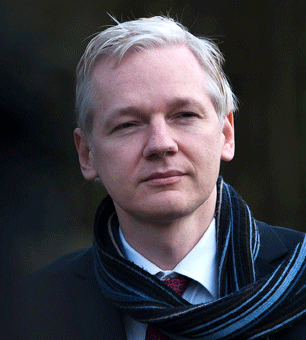 A Nobel Peace Prize for Julian Assange! https://melenchon.fr/2021/01/28/un-prix-nobel-de-la-paix-pour-julien-assange/ Thursday 28 January 2021, I decided to nominate journalist Julian Assange for the Nobel Peace Prize, as I have the power to do as a parliamentarian. Julian Assange is a hero of freedom. The WikiLeaks initiative has raised awareness of war crimes and serious human rights abuses. It is right that the peoples of the world express their gratitude to him.
- Several other rebellious parliamentarians will share this process with me. I thus continue my fight for Assange’s freedom. After going to see him in London in 2012, after having held a videoconference meeting with him in 2013, I asked for political asylum in France in 2019 then 2020. At the time, the Minister of Justice Dupont- Moretti made the same request. Julian Assange served France, including revealing the spying on three Presidents by the United States.
- I call on all French parliamentarians to in turn commit to having the Nobel Peace Prize awarded to Julian Assange.
South Korea considered setting up a nuclear power station with North Korea
South Korea says North Korea nuclear plant documents were ‘just an idea’ SEOUL (Reuters) By Hyonhee Shin 29 Jan 21, – South Korea’s energy ministry said on Sunday that documents about a potential plan to build a nuclear power plant in North Korea were meant to suggest an “idea” but this has never been pursued as an official project.
On Thursday, South Korean broadcaster SBS unveiled a prosecution indictment listing more than a dozen documents from the energy ministry that suggested a previously unknown project to set up a nuclear plant in North Korea.
This raised questions over whether South Korea’s President Moon Jae-in had sought any nuclear energy programme for North Korea as part of his drive to restart inter-Korean economic cooperation.
Many of the files were dated to May 2018, a month after Moon held his first summit with North Korean leader Kim Jong Un.
Shin Hee-dong, spokesman of South Korea’s energy ministry, said the files were “internal documents” that were discussed only among ministry officials after the summit, as an idea to consider in the future when the two Koreas can potentially reopen economic exchanges. ……
The documents were among some 530 that the ministry had deleted to conceal that it had distorted feasibility studies to shut down a reactor in South Korea. Prosecutors last month indicted three officials on charges of violating the Criminal Act by damaging public records.
Some of the files were reportedly titled “A plan to build a nuclear plant in North Korea” and “Tasks for phased cooperation to establish electricity infrastructure in North Korea.”
Reporting by Hyonhee Shin; Editing by Frances Kerry https://www.reuters.com/article/us-southkorea-politics-northkorea/south-korea-says-north-korea-nuclear-plant-documents-were-just-an-idea-idUSKBN2A00CG?il=0
Biden’s USA headed for confrontation with Russia? The troubling appointment of Victoria Nuland
Nuland’s actions helped produce the regime change in Ukraine which led to U.S. arms sales, U.S. sanctions on Russia, even the first Trump impeachment over the matter of anti-tank missile delivery. The coup damaged U.S.-Russian relations
Basic Notes on Victoria (“Fuck the EU!”) Nuland, more https://www.counterpunch.org/2021/01/25/basic-notes-on-victoria-fuck-the-eu-nuland/ BY GARY LEUPP, 25 Jan 21
On January 5 Joe Biden quietly announced the nomination of Victoria (“Fuck the EU!”) Nuland as Deputy Secretary of State for Political Affairs. This announcement may signal the inception of the confrontation with Russia placed on hold during the Trump presidency.
For four years the Democrats have pilloried Trump for “coddling” Putin, although in fact Trump has heaped sanctions on Russia bringing relations to their lowest point since the early Cold War. Now they want some more serious anti-Russian measures. They want their president, Commander-in-Chief of the Exceptional Nation and Leader of the Free World against its adversaries, return us to Clinton-Obama normalcy. That means “getting tougher” with Russia. But what does tougher mean?
Nuland is eminently qualified for the task of making things much worse, even provoking war with the other superpower that while lacking foreign bases, and spending a fraction of what NATO spends on military defense, has over 6000 nuclear weapons. (Remember? The U.S. developed and used nuclear weapons in 1945, the only country to ever do so. The Soviets followed by developing their own bomb in 1949, in self-defense. That’s when Truman established NATO as an anti-Soviet, anti-communist military alliance.)
Moscow feels a mounting resentment over the expansion of a hostile military alliance, formed during the Cold War under conditions no longer pertinent, to surround it. Is this hard to fathom? How would Congress view a gradual expansion of a Russian-led military alliance committed to spending 2% of its members’ GDPs on military spending to embrace Mexico, Cuba, Nicaragua, Venezuela, Panama and maybe Canada next year?
Nuland is a career official, serving under multiple administrations, representing bipartisan imperialism. She was deputy director for “affairs in the former Soviet republics” in the Bill Clinton administration. Her task was to exploit the pain and suffering caused by the implosion of the Soviet Union to assert greater U.S. hegemony over Eurasia, using the traditional mix of covert operations, National Endowment for Democracy meddling, “color revolutions,” aid promises, etc.
During this period Clinton reneged on the U.S. promise to Moscow in 1989 that NATO would not advance “one inch” east after the Soviets accepted German reunification. Instead he drew Poland, Hungary and Czechoslovakia, long members of the dissolved Warsaw Pact, into the anti-Russian military alliance in 1999. It was an extraordinary repudiation of the Bush-Gorbachev agreement, an egregious provocation of a now-friendly country (then headed by the buffoonish Boris Yeltsin), unremarked on by the U.S. press at the time as anything controversial. Since then the expansion of NATO has been treated as no more remarkable than the expansion of UNESCO. Thank Nuland in part for making you think relentless NATO growth is normal, and that it makes sense for North Macedonia and Montenegro to have joined most recently (during the Trump term).
Thank Nuland too, in part, for the “color revolutions” in Serbia (2000), Georgia (2003), Ukraine (2004) and Kyrgyzstan (2005). The (fake) concept of the popular uprising against (Russian-backed) tyranny, backed by an altruistic America that stands for Freedom and Democracy—that’s Nuland’s baby. She surely has plans for Belarus. And she must be deeply alarmed that the State Department did not try to interfere in the last flare-up of violence in Nagarno-Karabakh leaving Russian diplomacy to resolve the situation. (Just because Russia itself extends into the Caucasus and borders Georgia and Azerbaijan doesn’t mean that it should “interfere” in countries that ought by rights to be ruled by the U.S.A.—due to Exceptionalism and all.)
The extremely reactionary chauvinistic Nuland was deputy foreign advisor to Dick Cheney during the Bush-Cheney administration (2003-2005) and then U.S. ambassador to NATO (2005-2008). Under Obama she was Under Secretary of State for Europe and Eurasia, handpicked by Hillary Clinton. She is married to noted neocon warmonger-scholar Robert Kagan. Both were deeply complicit in spreading the Big Lies leading to the Iraq War in 2003. Nuland supported Hillary Clinton’s terroristic regime change efforts in Libya and Syria. But her main mission in life is to expand NATO. Joe Biden shares her passion for this project.
Nuland is perhaps best known for her pithy ejaculation: “Fuck the EU!” in a telephone call with the U.S. ambassador to Ukraine in 2014.
In that year, while Nuland built support for the coup in Kiev (Feb. 18 to 21), she boasted openly that the U.S. had invested $5 billion in supporting “the Ukrainian people’s European aspirations.” (This referred to the support of some Ukrainians for the violent overthrow of the democratically elected president, Viktor Yanukovych, on the basis of his alleged pro-Russian policies and his opposition to European Union affiliation under the conditions the EU was then offering.) To state the matter honestly: the U.S. spent $5 billion to install a government in Kiev that would request NATO membership (ostensibly to protect it from always-aggressive, always expanding Russia) and bind it forever to the U.S. military-industrial complex and “Free World.”
Since NATO membership since the end of the Cold War has invariably been followed by EU membership, it was easy for Nuland to pose as the champion of Ukraine’s EU membership versus the evil Russians (supposedly) opposing that membership. Yanukovych himself had negotiated seriously with the EU but rejected a plan for association due to its austerity provisions. Meanwhile Moscow offered an attractive aid package. This in the world of U.S. propaganda was a choice between Europe and Russia, with Yanukovych siding with America’s adversary.
The Maidan coup occurred just a month after Nuland was recorded discussing the upcoming event with U.S. ambassador to Ukraine, Geoffrey Pyatt. Nuland, who had joined Sen. John McCain and other U.S. politicians in offering cookies to the Maidan protestors, discussed with Pyatt who should serve as prime minister after the coup. Pyatt noted that the EU favored Vitali Klitschko, the ex-boxer.
“Fuck the EU!” replied Nuland, who wanted banker and NATO supporter Arseniy Yatsenyuk to lead the new government. She soon got her way.
Nuland worked with Oleh Tyahnybok, head of the neo-Nazi Svoboda Party (and one of the three leaders Nuland ordered Pyatt to keep in touch with) and the Right Sector militia. Both glorify Stephan Bandera, the Ukrainian fascist leader who aided the Nazis in rounding up Ukrainian Jews during the war. Tyahnybok publicly inveighs against the “Moscow-Jewish mafia ruling Ukraine.”
When Congressman Dana Rohrbacher Nuland in a hearing was asked soon after the coup whether there had been any neo-fascists on the Maidan she refused to answer the question, stating there were “mothers, grandmothers, and veterans…all colors of Ukraine, including ugly colors” on the Maidan. In other words, a diverse anti-Russian crowd. (Notice how she ignored the existence of the 30% of Ukrainians who are ethnic Russians and were a support base for the president targeted for toppling. Just the sort of sensitivity to ethnicity you’d expect from a top U.S. State Department official who’d been comfortable with the slaughter of Iraqis.) Continue reading
Bradwell: UK’s ill-conceived nuclear project, with cronyism and vested interests, will damage environment.
 Bradwell B Action Network 24th Jan 2021, Appeal to Prime Minster, Foreign and Energy Ministers, selected MP’s and Essex County Councillors to Reconsider Chinese State Plans for Essex Nuclear Power Plant by local community. Bradwell B Action Network (BAN), a front-line grass roots campaign organisation, sent a strong message to the Prime Minster and other representatives including the government energy and
foreign ministers and their opposites, pointing out a broad range of concerns and urging them to take immediate action to halt CGN’s plans for the Bradwell B nuclear plant.
State owned CGN are planning to build and operate. The site, at Bradwell on Sea, Essex is also within 30km range of large urban populations to the North, West and South. Despite UK security services raising concerns over the plans, consecutive Conservative governments have chosen to ignore the threats and allow CGN to pursue this ill-conceived project.
Nuclear waste: corruption in a small Australian town


Kimba’s Maree Barford new nuclear community liaison officer, Eyre Peninsula Tribune, Kathrine Catanzariti. AUGUST 24 2017
A Kimba local has been given the job of liaising between the community and government on all things nuclear.
National Radioactive Waste Management Facility Taskforce general manager Bruce McCleary announced on Thursday Maree Barford had been employed as community liaison officer – the first job created as a result of the community consulation on a potential National Radioactive Waste Management Facility at Kimba.
The announcement was made at the opening of a new project office in Kimba.
Mrs Barford moved to Kimba in December 2014 with her husband Shaun after they bought the lease for the Kimba Gateway Hotel.
Her role will be to liaise between the community and the government.
“I’ll be engaging with the community and then letting the government know what is happening in the community and their views,” Mrs Barford said.
She will start her role on Monday, working full-time from the project office.
“I think I can be the voice for the community, being the link between the town and the government.” ……
Barford would provide a permanent, local presence to help keep the community informed and involved in all activities, alongside the project team and other experts who would continue to visit Kimba……..
America’s Committee to Defend Australian citizen Julian Assange
|
A project of the Courage Foundation, the Assange Defense Committee is a national coalition fighting to free WikiLeaks founder Julian Assange. Comprising human rights defenders, press freedom advocates, civil liberties lawyers, and supporters across the United States, the Committee organizes public rallies, provides essential resources, and raises awareness about the unprecedented prosecution against Julian Assange and the threat it poses to the freedom of the press around the world. In supporting journalists’ right to publish, the Assange Defense Committee is upholding the public’s right to know what its government is doing in its name. Co-chairsThe Committee calls for Julian Assange’s immediate release, charges to be dropped, safe passage to the secure location of his choosing, and compensation for the psychological torture and arbitrary detention he has endured. Noam Chomsky Alice Walker Daniel Ellsberg Advisory BoardLeading journalists, lawyers, whistleblowers, and human rights defenders advising the Assange Defense Committee. See our supporters page for high-profile individuals and organizations who are standing up for Assange’s right to publish and your right to know………https://assangedefense.org/about/?fbclid=IwAR06__azOpLuMwwwNxlVcH2I3u7ZThlGnLHiVkhGmuX_HO-d4EDCo0N_fb0 |
|

Australia’s environmental scientists intimidated, silenced by threats of job loss
 Australia’s environmental scientists intimidated, silenced by threats of job loss, Michael West Media, by Elizabeth Minter | Jan 17, 2021 The silencing of environmental scientists, as revealed in a study late last year, profoundly damages our democracy, wastes taxpayers’ money, takes a huge personal toll, allows fake news to proliferate and short-changes the public. Elizabeth Minter reports.
“I declared the (action) unsafe. I was overruled and … was told to be silent or never have a job again.”
“We are often forbidden (from) talking about the true impacts of, say, a threatening process […] especially if the government is doing little to mitigate the threat.”
“I was directly intimidated by phone and Twitter by (a senior public servant).”
“… governments allow (industry) to treat data collected as commercial in confidence. This means experts most able to comment on the details of big mining and construction projects are hopelessly conflicted and legally gagged from discussing these projects in public.”
“(Government) staff are rewarded or penalized on the basis of complying with opinions of senior staff regardless of evidence.”
“I proposed an article in The Conversation about the impacts of mining […] The uni I worked at didn’t like the idea as they received funding from (the mining company).”
All in a day’s work
All these comments, straight from the mouths of some of Australia’s most esteemed scientists, highlight the threats faced by ecologists, conservation scientists, conservation policy makers and environmental consultants, whether they are working in government, industry or universities.
The scientists were responding to an online survey as part of a study conducted by academics Don Driscoll, Georgia Garrard, Alexander Kusmanoff, Stephen Dovers, Martine Maron, Noel Preece, Robert Pressey and Euan Ritchie. In an ironic twist, one of the research team’s initial members declined to contribute to the project for fear of losing funding and therefore their job.
As the study’s authors note, scientists self-censor information for fear of damaging their careers, losing funding or being misrepresented in the media. In others, senior managers or ministers’ officers prevented researchers from speaking truthfully on scientific matters.
This means important scientific information about environmental threats often does not reach the public or decision-makers, including government ministers. This information blackout, termed “science suppression”, can hide environmentally damaging practices and policies from public scrutiny.
Survey methodology……….
Ministers not receiving full information
Some 75% of the scientists surveyed reported having refrained from contributing to public discussion when given the opportunity – most commonly in traditional or social media. A small number self-censored conference presentations (9%) and peer-reviewed papers (7%).
For scientists working in government, the main reasons they didn’t comment was because of attitudes of senior management (82%), workplace policy (72%), a minister’s office (63%) and middle management (62%).
Fear of what would happen to their career prospects (49%) and concern about media misrepresentation (49%) also discouraged those working in government from speaking publicly.
Almost 60% of scientists working in government and 36% of scientists in industry reported that internal communications were modified…………
Critical conservation issues suppressed
The most common issue on which information was suppressed was threatened species. About half of industry and government scientists, and 28% of academics, said their commentary was constrained.
Scientists working in government also reported not being able to comment on logging and climate change…………..
The system is broken
Of those scientists who had spoken publicly about their research, 42% had been harassed or criticised for doing so. Of those, 83% believed the harassers were motivated by political or economic interests…….
Change is needed
As witnessed by the past four years of Donald Trump’s presidency, it has never been more important to ensure that the public are exposed to facts and information from trusted sources…….
The study was published late last year in Conservation Letters, a journal of the Society for Conversation Biology. https://www.michaelwest.com.au/australias-environmental-scientists-intimidated-silenced-by-threats-of-job-loss/
Profound questions raised by the employment tribunal case; bullying at Sellafield nuclear site?
 Byline Times 15th Jan 2021, An employment tribunal case that has been running for more than two yearshas started to raise profound questions over management at Europe’s
largest nuclear reprocessing plant, the ability of the employment tribunal
system to defend the rights of whistleblowers, ethical conduct by major law firms, and a conflict of interest at the Equality and Human Rights Commission.
The case of McDermott versus Sellafield, the Nuclear
Decommissioning Authority and former Sellafield HR director Heather Roberts
has been brought under the Public Interest Disclosure Act 1998 – also
known as the Whistleblowers’ Act. Alison McDermott, an HR professional
and diversity specialist, claims that the sudden termination of her
freelance contract in October 2018 by Sellafield was linked to her
protected disclosures containing evidence of systemic bullying, and racist
and sexist incidents at the Sellafield site in Cumbria.
”Small Modular Reactors”’- governments are being sucked in by the ”billionaires’ nuclear club”

SNC-Lavalin Scandal-ridden SNC-Lavalin is playing a major role in the push for SMRs.
Terrestrial Energy….. Terrestrial Energy’s advisory board includes Dr. Ernest Moniz, the former US Secretary of the Dept. of Energy (2013-2017) who provided more than $12 billion in loan guarantees to the nuclear industry. Moniz has been a key advisor to the Biden-Harris transition team, which has come out in favour of SMRs.
The “billionaires’ nuclear club” …“As long as Bill Gates is wasting his own money or that of other billionaires, it is not so much of an issue. The problem is that he is lobbying hard for government investment.”
Going after the public purse
Bill Gates was apparently very busy during the 2015 Paris climate talks. He also went on stage during the talks to announce a collaboration among 24 countries and the EU on something called Mission Innovation – an attempt to “accelerate global clean energy innovation” and “increase government support” for the technologies.
Gates’ PR tactic is effective: provide a bit of capital to create an SMR “bandwagon,” with governments fearing their economies would be left behind unless they massively fund such innovations.
governments “are being suckers. Because if Wall Street and the banks will not finance this, why should it be the role of the government to engage in venture capitalism of this kind?”
It will take a Herculean effort from the public to defeat this NICE Future, but along with the Assembly of First Nations, three political parties – the NDP, the Bloc Quebecois, and the Green Party – have now come out against SMRs.
|
Mini-Nukes, Big Bucks: The Interests Behind the SMR Push https://watershedsentinel.ca/articles/mini-nukes-big-bucks-the-money-behind-small-modular-reactors/
It’s remarkable that only five years ago, the National Energy Board predicted: “No new nuclear units are anticipated to be built in any province” by 2040.So what happened? The answer involves looking at some of the key influencers at work behind the scenes, lobbying for government funding for SMRs. |

An act of love — Beyond Nuclear International

Courts threaten freedom of Russian nature protector
An act of love — Beyond Nuclear International
Lyubov Kudryashova loves nature. Now she may be jailed for defending it
By Jack Cohen-Joppa
In Russian, her name means love. And it’s true. Lyubov Kudryashova loves the broad valley of Russia’s Tobol River, where it meanders out of Kazakhstan into the Kurgan Oblast. Her grandfather is buried there, she was born there, and she’s raised three sons there. As far as she knows, her ancestors have always lived there.
There, below the southern Urals, frigid continental winters give way to spring floods that inundate a landscape of oxbow lakes, wetlands, forests and fields. The waters sustain a large aquifer that Russia recognizes as a strategic reserve of fresh water.
“We, native people of the land, are against a barbaric attitude towards nature,” she says. “But our voices are too low.”
Which is why the passion of this campaigning environmentalist and entrepreneur has been met with fabricated charges of encouraging terrorism via the internet. She’s now on trial in a military court in Yekaterinburg, six hours away from her small town.
But Lyubov Kudryashova will not be spurned. “My ecological activity is going to continue. Well, I guess till the day the unjust court could takes away my freedom.”
In 2017, the government awarded an operating license for borehole leeching of uranium to Dalur, a uranium mining subsidiary of the Russian state nuclear agency Rosatom. The license to tap the Dobrovolnoye deposit around the village of Zverinogolovskoye condemned the very farmland Kudryashova’s father managed when she would accompany him as a child.
Dalur has two other leaky in-situ uranium projects in the Kurgan.
Many Tobol Valley residents feared environmental disaster when they learned that hundreds of exploratory wells would be drilled through the aquifer into the mineral deposit lying beneath it, without any public environmental review. Borehole leeching would eventually involve drilling thousands of wells and the injection of a million tons of sulfuric acid over 20-30 years, then withdrawing the dissolved minerals and chemically extracting the uranium.
Several times, activists tried to start a referendum and demand an independent environmental review, but met only refusals from the local officials.
Last fall, environmentalists surveyed some of Dalur’s other boreholes in Kurgan and documented much higher radiation levels than permitted. Despite the concerns, construction began on an in-situ leaching pilot plant and the huge clay-lined “mud pits” needed to receive the massive volume of toxic, acidified sludge produced in the process.
Beginning in 2017, Kudryashova was involved in the legal case against the Russian Federation over its refusal to conduct an environmental impact assessment before awarding the license to develop the mine.
That year, she also co-founded the Public Monitoring Fund for the Environmental Condition and the Population Welfare with the regional branch of the Communist Party of the Russian Federation. One month later, a judge of the Kurgan Regional Court issued an order giving the Russian Federal Security Service (FSB) authority to wiretap her telephone.
The Fund publishes information on the environmental impact of Dalur’s mining activity. Kudryashova writes, “Shortly after the completion of the case in the Supreme Court of the Russian Federation and the registration of the environmental fund, a hidden judgment of another court was rendered that allowed the FSB to begin wiretapping my phone and, I believe, begin to look for fictitious crimes in order to stop my work.
“I guess money is more important than the radioactive contamination of land,” she observed.
So it was that on January 29, 2019, armed men led by an FSB captain broke into her family’s home and spent the day searching it. That summer the FSB got a local court to involuntarily commit Kudryashova to the Kurgan District Psychiatric Hospital for most of the month of July. She was kept from speaking with family or others outside without permission of the agency.
Then in March 2020, the FSB charged Kudryashova with 12 counts of “public justification of terrorism using the Internet” based on a specious forensic analysis of posts on the social network VKontakte, which, according to Kudryashova, never belonged to her page. The actual source of those posts remains unknown because the protocol and the DVD-R capturing those posts show evidence of fabrication and forgery. And at the most recent session of her trial in late December, a CD-R the defense had presented to the court for evidence was found to have been erased by an FSB operative.
Prosecutors say she advocated for violent overthrow of the constitutional order by re-posting memes with such seditious phrases as, “The fate of Russia is determined by each of us, what you personally or I do, then Russia will. A correct position can only be revolutionary” and “If the nation is convinced that the ruling power in the state is directed not at the development of its cultural, economic and other needs, but, on the contrary, at trampling them, then it is not only the right, but also the duty of the nation to overthrow that power and establish one corresponding to the national interests of the people.”
Kudryashova writes, “Nonviolent ecological activism, in the understanding of the rulers of my country, is a crime. That’s why prisons are full of people who wanted to protect nature, but those who harmed it are free… Ecological crimes against present and future generations are not subject to the judgement of a military court.
“I’m 55 years old and my life is not as important as the preservation of nature. My duty and responsibility are to make a small contribution in a great cause — to stop violence against nature and people. The price of atomic energy is the life of future generations.”
Her trial is in the Central District Military Court of Yekaterinburg, where the next hearing is scheduled for 28-29 January, 2021. Agora International Human Rights Group and the Memorial civil rights society in Russia have provided an attorney and other support for Kudryashova.
Letters in support of Lyubov Kudryashova and seeking dismissal of the charges against her should be addressed to the chair of the court collegium examining the case, Judge Sergei Gladkih, st. Bazhova 85, Yekaterinburg, Russia 62005, or by email to opo.covs.svd@sudrf.ru. Refer to Case №: 2-42/2020, Lyubov Kudryashova.
Jack Cohen-Joppa is the co-editor of The Nuclear Resister, the co-founder of the eponymous organization and co-winner with Felice Cohen-Joppa of the 2020 Nuclear Free Future Award in the category of Education.
Judge’s refusal to extradite Julian Assange is still part of cowardly process to deny freedom of information
The personal conveniently distracts from the political in the Assange story, https://www.theage.com.au/national/the-personal-conveniently-distracts-from-the-political-in-the-assange-story-20210107-p56siu.html
Elizabeth Farrelly Judge Vanessa Baraitser’s refusal to extradite Julian Assange for “mental health” reasons may look humanitarian but is in fact a deft political move. In reducing what should be an argument of law and principle to a test of personality, Baraitser managed at a blow to impugn Assange’s stability, repudiate any suggestion of innocence and open the door for America to prove the comforts of its solitary confinement and thereby win his extradition.
It’s a story of many twists and turns but underlying it throughout is a profound and widespread moral cowardice.
Baraitser’s 132-page ruling found that although the UK-US Extradition Treaty of 2003 specifically prohibits extradition for “political offence”, this provision never became law in the UK and therefore has no effect. In essence, the treaty is worthless.
The court also supported all 18 of the espionage charges against Assange, arguing that WikiLeaks’ hacking and publication “would amount to” offences in English law. Baraitser identified eight charges under the UK Official Secrets Act that would be, she said, equivalent.
Interestingly, this “would have” construction does not apply to the treaty question. Had Assange engaged in the same conduct in America, targeting British government information, he could not have been extradited because America’s “monist” system regards any treaty as law once signed. So it’s ironic that undermining this particular protection is a key US argument.
Anyone who saw the 2019 docudrama Official Secrets, chronicling the leakage by GCHQ analyst-turned-whistleblower Katharine Gun of information on US-UK dirty dealing in drumming up UN support for the Iraq war, will understand just how murky and terrifying such prosecutions can become.
This fear, and the persistent cowardice of yielding to it, is the theme of Assange’s story. I’ve written about Assange several times. I visited him in Ecuador’s embassy. Yet each time, I’ve found myself reluctant.
Seven years ago, when I met him, Assange was ebullient and hopeful, even funny. Now, as Baraitser says, he is “a depressed and sometimes despairing man who is genuinely fearful about his future”. Assange, she said, was at “high risk of serious depression leading to suicide if he were to be extradited and placed in solitary confinement for a long period”.
Baraitser noted the “bleak” conditions of Assange’s likely US confinement would include “severely restrictive detention conditions designed to remove physical contact and reduce social interaction and contact with the outside world to a bare minimum”, with family limited to one supervised 15-minute phone call a month. Detailing Assange’s mental state, she opined that his risk of suicide, in such conditions, was “very high”. This is the loophole she offers the appellant US prosecutor.
Those fears – his of 175 years in solitary (honestly, who wouldn’t top themselves?) and hers of his suicide – underpin her judgment. But there are other, more insidious fears at play here.
Such fears, I see now, feed my reluctance to revisit the Assange story: fear, in particular, of confronting the terrifying truth about our imperial system. Regardless of Assange’s innocence or guilt, the simple facts of what our controlling powers can do to you if you step out of line are terrifying.
But this small, individual fear also operates, very effectively, at nation level.
From the start, the case against Assange has contrived to turn issues of principle into questions of personality. The initial Swedish rape charges, since dropped for lack of evidence as the witness’s recollections after so long were clouded, were extremely personal, spinning off the cancellation of his credit cards upon his arrival in Stockholm, forcing him to accept hospitality; the seductions, the sex – which everyone agrees was consensual – his failure to wear a condom although asked and reluctance to take an STD test. Then the left turned against him because of the Clinton leaks – which one suspects would have been fine, had they been directed at the other side – and perceptions about Assange’s ego. He was vain, it was said, and narcissistic. As if that itself were a crime, reason enough to let him rot in solitary.
The personal and emotive nature of all this – the Swedish prosecutor’s refusal to interview him in London, Britain’s willingness to imprison him for a year on bail charges, America’s determination to prosecute him for exposing their war crimes (in the Iraq War Logs of October 2010 and the film Collateral Murder showing air crew shooting unarmed civilians from a helicopter) and the description of WikiLeaks by US Secretary of State Mike Pompeo as “a hostile non-state intelligence service” – all suggest a bigger picture, and smaller values, than mere truth or justice.
It’s often said that Assange endangered the lives of US informers but, as Baraitser notes, no causality has been shown. Even the Senate Committee on Armed Service said, “the review to date has not revealed any sensitive sources and methods compromised by disclosure”. It is said that Assange, by dumping hacked emails from Hillary Clinton’s campaign, gave us Trump. But if she was engaged in skulduggery as alleged, wasn’t it better for the world to make its own judgment?
When you look coldly at the facts it’s hard not to suspect that Sweden was coerced into the original charges and that Britain and Ecuador have been similarly pressured. Certainly Australia’s persistent refusal to intervene for Assange, an Australian citizen who has broken no Australian law, suggests a similar abject timidity in the face of US might.
That’s the fear that guys like Assange and Edward Snowden make us confront. And it’s why they deserve, at the very least, a fair and open trial.
Government control over nuclear and radiation information; firing of sociologist Christine Fassert

 Le Monde 6th Jan 2021, Nuclear researchers worried after Fukushima specialist fired. The Institute for Radiation Protection and Nuclear Safety (IRSN) firmly denies having fired sociologist Christine Fassert because of the results of her work.
Is the independence of nuclear social science research weakened? After the dismissal of Christine Fassert by the Institute for Radiation Protection and Nuclear Safety (IRSN), a dozen French and foreign researchers are worried about a “resumption of control” over the production of nuclear knowledge, in a column in the World published Wednesday January 6.
Australia’s Prime Minister Scott Morrison could stop the persecution of Australian citizen Julian Assange
|
Rex Patrick, Independent senator, January 5, 2021 A British judge has rejected the US Justice Department’s effort to have Wikileaks publisher Julian Assange extradited to the United States to face espionage charges for obtaining and publishing secret documents that revealed war crimes. The decision of Judge Vanessa Baraitser to deny the extradition request has given Assange an important legal victory in his efforts to avoid extradition for actions many would regard as inherent to media freedom – the right of journalists to obtain and publish information and to protect confidential sources. However, in her ruling Judge Baraitser dismissed the arguments of Assange’s lawyers in relation to these matters, saying she was satisfied that the American authorities made their extradition request in good faith, that the case was not politically driven, and that Assange was not merely acting as a journalist. |
|

1 This Month

of the week – Shut Down Drone Warfare!


Tell the Ukrainian Government to Drop Prosecution of Peace Activist Yurii Sheliazhenko

Petition to revoke the licensing of the Near Surface Nuclear Disposal Facility (NSDF) at Chalk River. https://www.ourcommons.ca/petitions/en/Petition/Details?Petition=e-7247
To see nuclear-related stories in greater depth and intensity – go to https://nuclearinformation.wordpress.com
-
Archives
- April 2026 (68)
- March 2026 (251)
- February 2026 (268)
- January 2026 (308)
- December 2025 (358)
- November 2025 (359)
- October 2025 (376)
- September 2025 (257)
- August 2025 (319)
- July 2025 (230)
- June 2025 (348)
- May 2025 (261)
-
Categories
- 1
- 1 NUCLEAR ISSUES
- business and costs
- climate change
- culture and arts
- ENERGY
- environment
- health
- history
- indigenous issues
- Legal
- marketing of nuclear
- media
- opposition to nuclear
- PERSONAL STORIES
- politics
- politics international
- Religion and ethics
- safety
- secrets,lies and civil liberties
- spinbuster
- technology
- Uranium
- wastes
- weapons and war
- Women
- 2 WORLD
- ACTION
- AFRICA
- Atrocities
- AUSTRALIA
- Christina's notes
- Christina's themes
- culture and arts
- Events
- Fuk 2022
- Fuk 2023
- Fukushima 2017
- Fukushima 2018
- fukushima 2019
- Fukushima 2020
- Fukushima 2021
- general
- global warming
- Humour (God we need it)
- Nuclear
- RARE EARTHS
- Reference
- resources – print
- Resources -audiovicual
- Weekly Newsletter
- World
- World Nuclear
- YouTube
-
RSS
Entries RSS
Comments RSS
 nuclear-news